
Quick Answer Box
- A lawsuit attorney is a licensed civil litigator who represents plaintiffs or defendants through the full procedural lifecycle of a legal claim, from pre-suit demand through trial or settlement.
- Anyone who has suffered a compensable injury, financial harm, or rights violation may qualify to retain a plaintiff-side lawsuit attorney, subject to applicable statutes of limitations.
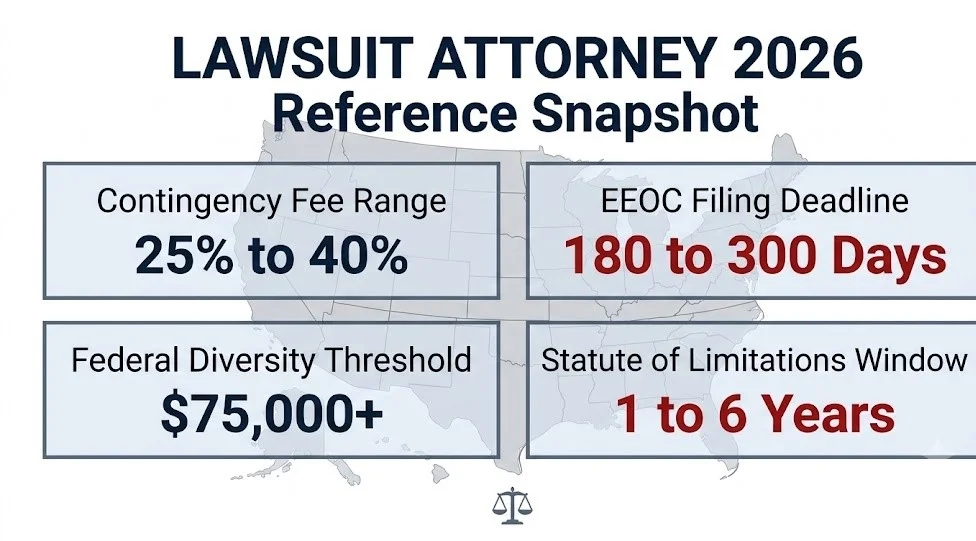
- Attorney costs vary by case type: most personal injury and mass tort attorneys work on contingency fees ranging from 25% to 40% of the recovery, with no upfront payment required.
Case Snapshot
| Detail | Info |
|---|---|
| Practice Area | Civil litigation (plaintiff and defense side) |
| Governing Rules | Federal Rules of Civil Procedure; ABA Model Rules of Professional Conduct |
| Fee Framework | Contingency (25% to 40%), hourly, or flat fee depending on case type |
| Key Federal Statute | 28 U.S.C. Sections 1331 and 1332 (jurisdiction); FRCP Rule 23 (class actions) |
| Class Action Threshold | $5 million aggregate under CAFA (Class Action Fairness Act) for federal court |
| Statute of Limitations | 1 to 6 years depending on case type and state |
| Consultation | Most plaintiff-side lawsuit attorneys offer free initial case evaluations |
Introduction
Choosing the right lawsuit attorney is not a matter of finding the nearest office with good reviews. It is a strategic legal decision that affects the outcome, timeline, and financial result of your case.
The civil litigation system in the United States processed more than 17 million civil cases in state courts in a recent reporting year, and federal district courts handled over 350,000 new civil filings annually. The type of attorney who handles each case varies significantly by subject matter, jurisdiction, and the damages structure involved.
Understanding which attorney category applies to your situation, how they are compensated, and what the process looks like from filing through resolution is the essential starting point. Most people who need a lawsuit attorney do not realize how different the options are.
This guide covers every dimension of that decision for 2026.
What Does a Lawsuit Attorney Do?
A lawsuit attorney manages every stage of civil litigation on behalf of a client, from the pre-suit investigation through final resolution by settlement, judgment, or appeal.
The role begins before a complaint is ever filed. A plaintiff-side lawsuit attorney investigates the facts, evaluates the legal theory, calculates potential damages, and sends a demand letter to the opposing party. That letter often triggers settlement negotiations before litigation formally begins.
If the case proceeds to court, the attorney handles all pleadings, motions, and discovery. Discovery alone, which includes depositions, document requests, and interrogatories, can span months or years in complex cases.
Attorneys handling these claims point to the pre-suit investigation phase as the period where case strength is established or undermined, noting that factual weaknesses identified early can be addressed before they become dispositive at summary judgment.
Core Functions of a Lawsuit Attorney:
- Pre-suit investigation and legal theory evaluation
- Demand letter drafting and pre-litigation negotiation
- Complaint drafting and court filing
- Discovery management (depositions, document production)
- Motion practice (motions to dismiss, summary judgment)
- Trial preparation and courtroom representation
- Settlement negotiation and resolution
- Post-judgment enforcement or appeal
Types of Lawsuit Attorneys: Which One Handles Your Case?
The phrase “lawsuit attorney” covers a wide range of licensed civil litigators, each with distinct subject matter expertise and procedural experience.
Selecting the wrong attorney type is one of the most common and costly mistakes a prospective plaintiff can make. A general practice attorney may lack the specific knowledge of federal MDL procedures that a mass tort case demands. A consumer protection specialist handles statutory claims under entirely different legal frameworks than a personal injury attorney.
The attorney type that matches your situation is determined primarily by what caused your harm and what legal theory supports your claim.
Attorneys handling these claims point to the importance of attorney specialization matching, noting that courts in complex litigation evaluate the competency of counsel as part of their oversight of settlements and class certifications.
| Attorney Type | Case Category | Typical Court | Fee Model |
|---|---|---|---|
| Personal injury | Accidents, negligence | State court | Contingency 33% to 40% |
| Mass tort / MDL | Defective products, drugs | Federal MDL court | Contingency 25% to 35% |
| Class action | Consumer fraud, securities | Federal district court | Court-approved fee |
| Medical malpractice | Healthcare provider negligence | State court | Contingency 33% to 40% |
| Employment | Discrimination, wage theft | State and federal | Contingency or hourly |
| Consumer protection | Deceptive practices, FDCPA | State and federal | Statutory fee-shifting |
Personal Injury Lawsuit Attorney: Scope and Standards
A personal injury lawsuit attorney represents individuals who suffered physical, psychological, or financial harm due to another party’s negligence or intentional conduct.
Personal injury is the largest category of civil litigation in the United States. Cases include motor vehicle accidents, slip-and-fall incidents, premises liability, product liability for consumer goods, and wrongful death claims. Each involves a negligence standard requiring proof of duty, breach, causation, and damages.
Most personal injury cases are filed in state court under state tort law. Federal court jurisdiction attaches when diversity of citizenship exists under 28 U.S.C. Section 1332, meaning the parties are from different states and the amount in controversy exceeds $75,000.
Attorneys handling these claims point to the causation element as the most contested in personal injury litigation, noting that defendants routinely challenge the medical link between the incident and the claimed injury using independent medical examiners.
Personal Injury Damages Framework:
- Compensatory damages: medical expenses, lost wages, future earning capacity
- Non-economic damages: pain and suffering, emotional distress, loss of consortium
- Punitive damages: available in cases of gross negligence or willful misconduct
- Wrongful death damages: funeral costs, survivor loss of support, grief
Litigation Watch: Personal injury, class action, and mass tort attorneys operate under different procedural rules, fee structures, and court systems, making attorney type selection the most consequential early decision a prospective plaintiff faces.
Class Action Lawsuit Attorney: Federal Rules and Certification
A class action lawsuit attorney represents a group of plaintiffs with substantially similar claims against the same defendant, consolidating individual cases into a single proceeding.
Class actions in federal court are governed by Federal Rule of Civil Procedure 23. Before any case proceeds as a class action, the court must certify the class, which requires meeting four requirements: numerosity (enough class members), commonality (shared legal questions), typicality (the named plaintiff’s claims are typical), and adequacy (the named plaintiff and counsel can adequately represent the class).
The Class Action Fairness Act of 2005 (CAFA) expanded federal jurisdiction over class actions where aggregate claims exceed $5 million and minimal diversity exists. This shifted many large consumer class actions from state to federal court.
Attorneys handling these claims point to the class certification stage as the critical inflection point in any class action, noting that defendants typically fight certification aggressively because a certified class creates immediate and substantial settlement pressure.
FRCP Rule 23 Certification Requirements:
- Numerosity: class is too numerous for individual joinder (generally 40 or more members)
- Commonality: common questions of law or fact
- Typicality: named plaintiff’s claim is typical of the class
- Adequacy: named plaintiff and counsel will adequately represent the class
Mass Tort Attorney: MDL Proceedings and How They Work
A mass tort attorney represents individual plaintiffs in large-scale litigation involving defective products, dangerous drugs, or industrial exposure, where thousands of cases share common facts.
Mass tort cases differ from class actions in a critical respect. Each plaintiff in a mass tort retains individual damages based on their specific injury, rather than sharing in a class-wide recovery. The cases are not merged into one action. They are coordinated for pretrial proceedings before a single federal judge through the multidistrict litigation (MDL) system under 28 U.S.C. Section 1407.
The Judicial Panel on Multidistrict Litigation (JPML) transfers related cases to a single district court for consolidated discovery and pretrial motions. As of 2026, active MDL dockets include pharmaceutical, medical device, and chemical exposure cases involving tens of thousands of plaintiffs.
Attorneys handling these claims point to the MDL bellwether trial process as the mechanism that sets settlement values for the broader inventory of cases, noting that a strong bellwether verdict substantially increases average per-plaintiff recovery.
Mass Tort vs. Class Action: Key Differences
| Feature | Mass Tort | Class Action |
|---|---|---|
| Individual damages | Yes, per plaintiff | No, shared class recovery |
| Court structure | MDL coordination | Single certified class |
| Settlement | Individual or global | Class-wide with court approval |
| Governing rule | 28 U.S.C. 1407 | FRCP Rule 23 |
| Attorney fee | Contingency per plaintiff | Court-approved percentage |
Medical Malpractice Lawsuit Attorney: Specialized Standards
A medical malpractice lawsuit attorney handles claims arising from healthcare provider negligence that deviates from the accepted standard of medical care and causes patient harm.
Medical malpractice is among the most technically demanding categories of civil litigation. Cases require an expert witness who can testify that the defendant healthcare provider deviated from the standard of care that a reasonably competent provider would have applied under the same circumstances. Without that expert, most states will dismiss the case at the pleading or early motion stage.
Many states impose specific procedural requirements on medical malpractice cases before a complaint can be filed. These requirements include certificate of merit provisions, pre-suit notice periods, and expert affidavit requirements. Failure to comply can bar an otherwise valid claim.
Attorneys handling these claims point to the expert selection as the single most important factor in medical malpractice litigation, noting that the quality and credibility of the plaintiff’s medical expert frequently determines whether the defendant offers a meaningful settlement.
State-Specific Medical Malpractice Requirements (Selected States):
| State | Pre-Suit Notice Required | Expert Certificate Required | Damages Cap |
|---|---|---|---|
| Florida | Yes (90 days) | Yes | $500,000 (non-economic) |
| Texas | Yes (60 days) | Yes | $250,000 per defendant |
| California | No formal pre-suit | Yes (MICRA applies) | $350,000 (non-economic, as of 2023 cap increase) |
| New York | No pre-suit notice | Yes | No cap |
| Illinois | No pre-suit notice | Yes | No cap (prior cap struck down) |
Litigation Watch: Medical malpractice, employment, and consumer protection lawsuit attorneys operate under state-specific procedural requirements that can extinguish valid claims if missed, making early attorney consultation a time-sensitive priority.
Employment Lawsuit Attorney: Federal and State Claims
An employment lawsuit attorney represents employees in claims arising from workplace discrimination, harassment, wrongful termination, wage theft, and retaliation.
Federal employment claims arise under Title VII of the Civil Rights Act, the Age Discrimination in Employment Act (ADEA), the Americans with Disabilities Act (ADA), and the Fair Labor Standards Act (FLSA). State employment claims arise under parallel state statutes, which often provide broader protections or longer filing periods.
A critical procedural requirement governs most federal employment claims. Before filing a discrimination lawsuit in federal court, a plaintiff must file a charge of discrimination with the Equal Employment Opportunity Commission (EEOC) and receive a right-to-sue letter. The EEOC filing deadline is 180 days from the discriminatory act in most states, or 300 days in states with their own anti-discrimination agencies.
Attorneys handling these claims point to the EEOC exhaustion requirement as a procedural trap that bars many otherwise meritorious claims, noting that employees who delay seeking legal counsel risk missing the EEOC filing window entirely.
Employment Claim Checklist:
- Title VII (discrimination): EEOC charge required, 180 to 300 day deadline
- ADEA (age discrimination): EEOC charge required, same deadlines
- FLSA (wage/overtime): 2-year statute of limitations (3 years for willful violations)
- ADA (disability): EEOC charge required, same deadlines
- State claims: vary by state, often 1 to 3 years from the adverse action
Consumer Protection Lawsuit Attorney: Statutory Claims and Fee-Shifting
A consumer protection lawsuit attorney handles claims arising from deceptive trade practices, false advertising, debt collection violations, and unfair business conduct under state and federal consumer protection statutes.
Federal consumer protection claims arise under statutes including the Fair Debt Collection Practices Act (FDCPA), the Truth in Lending Act (TILA), the Consumer Financial Protection Act, and others administered by the Federal Trade Commission. State-level consumer protection statutes vary significantly in their scope and remedies.
One feature that distinguishes consumer protection litigation from other lawsuit categories is fee-shifting. Many federal and state consumer protection statutes require the defendant to pay the plaintiff’s attorney’s fees if the plaintiff prevails. This structure makes consumer protection cases financially viable for attorneys even when individual monetary damages are modest.
Attorneys handling these claims point to the fee-shifting mechanism as the primary reason consumer protection litigation can proceed on behalf of individual plaintiffs with relatively small dollar claims, noting that statutory damages and fee awards can substantially exceed actual harm.
Key Federal Consumer Protection Statutes:
| Statute | Claim Type | Statutory Damages | Fee-Shifting |
|---|---|---|---|
| FDCPA | Debt collection abuse | Up to $1,000 per action | Yes |
| TILA | Lending disclosure violations | Up to $4,000 per action | Yes |
| TCPA | Unwanted robocalls/texts | $500 to $1,500 per call | No |
| FCRA | Credit reporting errors | $100 to $1,000 per violation | Yes |
How Much Does a Lawsuit Attorney Cost?
Lawsuit attorney costs depend on the case type, the fee arrangement, and whether the case resolves before trial.
Three primary fee models govern civil litigation. Contingency fees are the most common for plaintiff-side personal injury, mass tort, and class action cases. Hourly billing applies in many commercial disputes, employment defense matters, and cases where damages are uncertain. Flat fees are used for discrete legal tasks such as demand letters or contract review.
Contingency fees mean the attorney receives a percentage of the recovery only if the client wins. No recovery means no attorney fee. The percentage varies by case type and stage of resolution.
Attorneys handling these claims point to the cost structure as one of the most important factors in case viability, noting that high litigation costs relative to expected recovery can make an otherwise meritorious case economically unworkable on contingency.
Contingency Fee Ranges by Case Type (2026):
| Case Type | Pre-Suit Settlement | Post-Filing Settlement | Trial or Appeal |
|---|---|---|---|
| Personal injury | 25% to 33% | 33% to 40% | 40% to 45% |
| Mass tort / MDL | 25% to 33% | 33% to 40% | 40% |
| Medical malpractice | 33% | 33% to 40% | 40% |
| Employment (contingency) | 33% | 33% to 40% | 40% |
| Class action | Court-approved (typically 20% to 33% of common fund) |
Litigation Watch: Contingency fee arrangements shift the financial risk of litigation from the client to the attorney, but cost deductions for litigation expenses such as expert fees and filing costs are separate from the percentage and can significantly reduce net recovery.
Contingency Fee Attorney Explained: What ABA Model Rule 1.5 Requires
A contingency fee attorney is paid a predetermined percentage of the client’s recovery rather than an hourly rate, with no fee owed if the case does not result in a recovery.
ABA Model Rule of Professional Conduct 1.5 governs attorney fee agreements in all U.S. jurisdictions that have adopted the Model Rules, which includes the vast majority of states. The rule requires that contingency fee agreements be in writing, signed by the client, and specify the percentage to be charged. The agreement must also state whether litigation expenses are deducted before or after the fee percentage is calculated, which has a significant impact on the client’s net recovery.
The distinction between gross and net recovery calculations matters substantially. If the attorney takes their percentage from the gross recovery before expenses are deducted, the client pays more than if expenses are deducted first.
Attorneys handling these claims point to the expense deduction order as one of the most consequential terms in a contingency fee agreement, one that many clients overlook when signing.
Contingency Fee Calculation Example:
| Scenario | Recovery | Fee % | Expenses | Client Net |
|---|---|---|---|---|
| Fee on gross (before expenses) | $100,000 | 33% | $10,000 | $57,000 |
| Fee on net (after expenses) | $100,000 | 33% | $10,000 | $60,300 |
When to Hire a Lawsuit Attorney: Timing and Trigger Points
The right time to hire a lawsuit attorney is earlier than most people expect. Waiting too long is the single most common procedural mistake that eliminates viable claims.
Several specific trigger points signal that attorney consultation is warranted. A formal legal notice or demand letter from another party, a denial of a significant insurance claim, an adverse employment action, a serious physical injury caused by another’s negligence, or receipt of a class action notice all represent situations where prompt attorney consultation is the appropriate response.
Beyond the strategic benefit of early involvement, timing matters because of statutes of limitations. Once a limitations period expires, even a strong factual case is legally barred from court regardless of its merits.
Attorneys handling these claims point to the statute of limitations as an absolute deadline, noting that no equitable argument or compelling set of facts will revive a time-barred claim in most civil courts absent very narrow tolling exceptions.
When Attorney Consultation Is Warranted Immediately:
- Serious physical injury caused by another party’s conduct
- Receipt of a lawsuit complaint naming you as a defendant
- Termination that appears connected to protected activity
- Denial of a significant insurance claim without adequate explanation
- Discovery of a defective product that caused injury
- Any situation involving potential class membership in a pending action
Statute of Limitations by Lawsuit Type: 2026 Reference
The statute of limitations is the legally prescribed time period within which a plaintiff must file a lawsuit or forfeit the right to do so permanently.
Limitations periods vary by claim type and state. Federal claims have their own limitations periods established by statute. State claims are governed by state law, and the same type of injury can have different filing deadlines depending on where the plaintiff resides and where the harm occurred.
Certain circumstances toll, or pause, the limitations period. Discovery tolling applies when the plaintiff could not reasonably have known about the injury. Minor tolling applies when the plaintiff is a child at the time of the injury. Fraudulent concealment tolling applies when the defendant actively hid the basis for the claim.
Attorneys handling these claims point to the discovery rule as the most frequently misunderstood tolling doctrine, noting that courts apply it narrowly and that a plaintiff’s subjective unawareness alone is insufficient without objective evidence of why the harm was not reasonably discoverable.
Statute of Limitations by Case Type (Key Jurisdictions):
| Case Type | Federal | California | New York | Texas | Florida |
|---|---|---|---|---|---|
| Personal injury | N/A (state law) | 2 years | 3 years | 2 years | 2 years |
| Medical malpractice | N/A | 3 years / 1 year from discovery | 2.5 years | 2 years | 2 years |
| Product liability | N/A | 2 years | 3 years | 2 years | 2 years |
| Employment (Title VII) | 180 to 300 days (EEOC) | 1 year (DFEH) | 3 years | 180 days (TWC) | 365 days (FCHR) |
| Consumer protection (FDCPA) | 1 year | 1 year | 1 year | 1 year | 1 year |
| Fraud | Varies | 3 years | 6 years | 4 years | 4 years |
How to Find a Lawsuit Attorney: Evaluation Criteria
Finding a lawsuit attorney requires more than a directory search. The evaluation process should be systematic and focused on practice-area match, track record, and fee structure transparency.
The most reliable sources for identifying qualified lawsuit attorneys are state bar association referral services, the American Association for Justice (AAJ) membership directory for plaintiff attorneys, and court dockets that identify which law firms have handled similar cases in your jurisdiction. PACER, the federal court’s public records system, allows anyone to search attorney appearances in federal civil cases by name or firm.
Once a candidate attorney is identified, the consultation serves two functions. It gives the attorney the information needed to evaluate the case. It gives the client the information needed to evaluate the attorney.
Attorneys handling these claims point to the consultation as the appropriate moment to ask directly about the attorney’s track record in cases similar to yours, the expected timeline, the realistic range of outcomes, and the complete fee agreement including cost deduction structure.
Attorney Evaluation Checklist:
- State bar membership in good standing (verify through state bar website)
- Specific experience in your case type (not just general litigation)
- Prior cases in the relevant court (federal or state)
- Fee agreement provided in writing before engagement
- Clear explanation of cost deduction structure and expense management
- Realistic assessment of case strengths and weaknesses provided upfront
Litigation Watch: A lawsuit attorney’s subject matter specialization, court experience, and fee agreement transparency are the three most important evaluation criteria, and none of them appear in directory star ratings.
Federal Versus State Court Lawsuit Attorney: Jurisdiction Matters
Whether your lawsuit belongs in federal or state court is a threshold legal question that determines which attorney’s court experience is most relevant.
Federal courts have limited jurisdiction. They hear cases arising under federal law (federal question jurisdiction under 28 U.S.C. Section 1331) and cases between citizens of different states where the amount in controversy exceeds $75,000 (diversity jurisdiction under 28 U.S.C. Section 1332). Class actions meeting CAFA’s $5 million aggregate threshold also move to federal court.
State courts are courts of general jurisdiction. They hear the vast majority of civil cases in the United States, including personal injury, medical malpractice, contract disputes, and state employment claims. State court procedures differ from federal procedures in discovery rules, motion practice, and trial management.
Attorneys handling these claims note that some cases can be filed in either court, and the strategic choice of forum affects discovery timelines, jury composition, and the applicable evidentiary rules, making jurisdictional strategy a meaningful early decision.
| Feature | Federal Court | State Court |
|---|---|---|
| Jurisdiction basis | Federal law or diversity ($75,000+) | General jurisdiction |
| Procedural rules | FRCP | State civil procedure rules |
| Discovery | Broader federal discovery standards | Varies by state |
| Typical timeline | Longer (18 to 36+ months to trial) | Varies widely by state |
| MDL eligibility | Yes | No |
| Class action threshold | $5 million (CAFA) | Varies by state |
Lawsuit Attorney Consultation: What to Expect
A lawsuit attorney consultation is a structured legal evaluation, not a sales meeting. Understanding what it covers helps prospective clients prepare effectively.
Most plaintiff-side lawsuit attorneys offer free initial consultations for personal injury, mass tort, employment, and consumer protection cases. The consultation typically lasts 30 to 60 minutes. The attorney will ask about the facts of the incident or harm, the timeline, available documentation, and any communications with the opposing party or their insurer.
The attorney will then provide a preliminary assessment of the legal theory, the strength of the evidence, the potential damages range, and whether the case warrants representation. A good attorney will give a candid assessment, including the challenges, not just the upside.
Attorneys handling these claims point to the quality of the attorney’s candor during the consultation as one of the clearest indicators of their professional approach, noting that attorneys who only discuss favorable outcomes without acknowledging case weaknesses are not providing the full picture.
What to Bring to a Lawsuit Attorney Consultation:
- Written timeline of events leading to the harm
- All relevant documents (contracts, medical records, correspondence)
- Photographs or other evidence of injury or damage
- Insurance communications or denial letters
- Names and contact information of potential witnesses
- Any prior legal correspondence received from the opposing party
How Long Does a Lawsuit Take With an Attorney?
The duration of a lawsuit with attorney representation ranges from a few months for straightforward negotiated settlements to several years for complex federal litigation.
Pre-suit settlement, reached through demand letter and negotiation before a complaint is filed, can resolve a case in 30 to 180 days depending on the opposing party’s responsiveness and the clarity of liability. Once a lawsuit is filed, federal civil cases average 24 to 36 months from filing to trial under typical docket conditions, though MDL proceedings can extend significantly longer.
State court timelines vary by jurisdiction. Some state courts with active docket management resolve civil cases within 12 to 18 months of filing. High-volume jurisdictions in California, New York, and Illinois may run longer.
Attorneys handling these claims point to the discovery phase as the primary timeline driver in complex litigation, noting that extensive document production, multiple depositions, and expert report preparation typically account for the majority of pre-trial time.
Lawsuit Timeline by Resolution Stage:
| Stage | Estimated Duration |
|---|---|
| Pre-suit demand and negotiation | 30 to 180 days |
| Complaint filing to responsive pleading | 21 to 60 days |
| Discovery phase | 6 to 18 months |
| Summary judgment briefing and ruling | 3 to 6 months post-discovery |
| Trial (if case proceeds) | 1 to 4 weeks (varies by complexity) |
| Post-trial motions and appeal | 6 to 24 months additional |
Lawsuit Attorney by State 2026: Jurisdiction-Specific Considerations
The state where a lawsuit is filed significantly affects which attorney is best suited to handle the case, what procedural rules apply, and how long the case is likely to take.
Each state has its own civil procedure rules, evidence standards, damages caps, and court management practices. An attorney licensed in California but not New York cannot represent a client in a New York state court proceeding without seeking pro hac vice admission. Federal court admission is separate from state bar admission, and not all litigation attorneys practice in both forums.
For cases with a strong state-court dimension, such as personal injury, medical malpractice, and most employment claims, the attorney’s state bar admission and familiarity with the local rules of the relevant court are non-negotiable qualifications.
Attorneys handling these claims point to local court knowledge as an underappreciated factor in case outcomes, noting that familiarity with a particular judge’s preferences in discovery disputes and motion practice can affect the tactical decisions that determine case trajectory.
State-Specific Lawsuit Attorney Considerations (2026):
| State | Notable Feature | Key Consideration |
|---|---|---|
| California | Broad consumer protection statutes (CCPA, UCL) | MICRA cap on malpractice non-economic damages |
| Texas | Loser-pays provisions in some cases | Medical malpractice expert certificate required |
| New York | No damages cap for most tort claims | Long discovery periods in complex cases |
| Florida | Modified comparative fault (51% bar rule) | Recent tort reform changes in 2023 |
| Illinois | No damages cap (prior cap overturned) | Cook County docket can be extensive |
Frequently Asked Questions
What is a lawsuit attorney?
A lawsuit attorney is a licensed civil litigator who represents clients in legal disputes that proceed through the court system.
They manage every stage of the case, from pre-suit investigation and demand through discovery, motion practice, trial, and settlement.
Different lawsuit attorney types specialize in personal injury, mass tort, class action, employment, medical malpractice, or consumer protection claims.
How much does a lawsuit attorney cost?
Most plaintiff-side lawsuit attorneys charge a contingency fee ranging from 25% to 40% of the recovery, with no upfront payment required.
If the case does not result in a recovery, no attorney fee is owed under a true contingency arrangement.
The fee agreement must be in writing under ABA Model Rule 1.5, and it should specify whether litigation costs are deducted before or after the percentage is calculated.
When should I hire a lawsuit attorney?
You should consult a lawsuit attorney as soon as you become aware of a potential legal claim, particularly one involving physical injury, financial loss, or an adverse employment action.
Statutes of limitations create hard deadlines that permanently bar claims once they expire.
Early consultation preserves all available legal options and allows the attorney to gather evidence before it deteriorates or becomes unavailable.
What is the difference between a mass tort attorney and a class action attorney?
A mass tort attorney represents individual plaintiffs who each retain their own damages claim within a coordinated federal MDL proceeding.
A class action attorney represents a certified class of plaintiffs who share in a collective recovery approved by the court.
In a mass tort, each plaintiff’s recovery is determined individually; in a class action, the recovery is distributed across the class based on a court-approved allocation plan.
How do I find a qualified lawsuit attorney for my case?
Search state bar referral services, the American Association for Justice directory for plaintiff attorneys, and PACER for attorneys who have handled similar cases in federal court.
Verify the attorney’s state bar status, confirm their specific experience in your case type, and review the written fee agreement before signing anything.
The initial consultation, which most plaintiff attorneys provide at no charge, is the appropriate venue for assessing case strength and attorney fit simultaneously.
How long does it take to resolve a lawsuit with an attorney?
Pre-suit settlement can resolve a case in 30 to 180 days if liability is clear and the opposing party negotiates in good faith.
Federal civil cases that proceed through full litigation average 24 to 36 months from filing to trial.
MDL proceedings and class actions often run longer, with some large mass tort dockets spanning five or more years from initial filing to final resolution.
Closing
The decision to retain a lawsuit attorney is both time-sensitive and consequential. Statutes of limitations are absolute. The attorney type you select shapes your procedural options, your damages exposure, and the forum where your case will be decided.
If your situation involves physical injury, financial harm, employment retaliation, or a defective product, the appropriate next step is a consultation with an attorney who specifically handles that case category in your jurisdiction. Most plaintiff-side lawsuit attorneys offer that evaluation at no cost and with no obligation to proceed.
