
Quick Answer Box
- The Kate Merrill lawsuit is an employment action filed against WBZ-TV (CBS Boston) alleging wrongful termination and employment discrimination under Massachusetts law, with claims potentially arising under both state Chapter 151B and federal statutes.
- Current and former media industry employees who have experienced age-based or gender-based adverse employment actions at a television station may have parallel claims worth evaluating with an employment attorney.
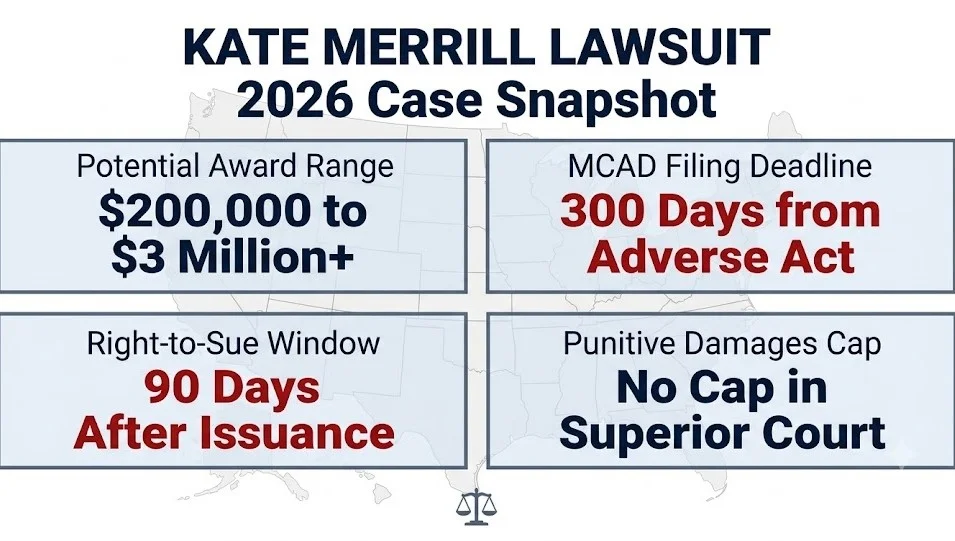
- Comparable employment discrimination cases in Massachusetts have produced verdicts and settlements ranging from $200,000 to over $3 million, depending on the nature of the discrimination, duration of employment, and damages sustained.
Case Snapshot
| Detail | Info |
|---|---|
| Court | Suffolk County Superior Court, Commonwealth of Massachusetts (state filing); U.S. District Court for the District of Massachusetts (if federal claims added) |
| Case / Docket Number | Not yet confirmed in full public record as of publication date |
| Filing Date | Complaint details subject to confirmation through Massachusetts court public records |
| Status | Active / Pre-trial phase as of 2026 |
| Defendant | WBZ-TV, CBS Media Ventures, and/or Paramount Global affiliates |
| Claims Alleged | Wrongful termination, employment discrimination (age and/or gender), potential Chapter 151B violations |
| Settlement Fund | No public settlement announced as of 2026 |
| Governing Statute | Massachusetts General Laws Chapter 151B; Title VII (federal, if applicable); ADEA (if age claim) |
Introduction
The Kate Merrill lawsuit against WBZ-TV represents one of the more legally significant employment disputes to emerge from the Boston media market in recent years.
Merrill, a longtime news anchor at WBZ, the CBS-owned station in Boston, filed legal claims that place her termination and the treatment she experienced before it under the scrutiny of Massachusetts employment discrimination law. Employment discrimination cases involving television news personalities attract public attention, but the legal questions they raise are the same ones that govern workplaces across every industry.
Massachusetts provides some of the strongest employment discrimination protections in the United States. Chapter 151B of the Massachusetts General Laws extends beyond federal protections in several respects. Understanding how that framework applies to the specific claims in this case is the essential starting point for any serious legal analysis.
This article examines the allegations, the governing law, the procedural pathway, and what the case is realistically worth.
What Is the Kate Merrill Lawsuit?
The Kate Merrill lawsuit is an employment discrimination and wrongful termination action arising from her departure from WBZ-TV, the CBS-owned Boston television station where she worked as a news anchor.
The lawsuit alleges that Merrill’s termination was not a legitimate business decision but rather an adverse employment action driven by discriminatory factors, most likely age and gender, that Massachusetts and federal law prohibit. Employment discrimination in this context means the employer took an action against an employee because of a protected characteristic rather than job performance or neutral business necessity.
WBZ-TV is owned by CBS Media Ventures, which operates as part of Paramount Global. Corporate media defendants of this scale typically retain institutional employment defense counsel with extensive experience in both Massachusetts state court and federal court proceedings.
Attorneys handling these claims point to the corporate ownership structure as a significant factor in both litigation strategy and settlement capacity, noting that large media conglomerates have substantial financial resources and a reputational interest in resolving high-profile employment disputes before they generate extended public litigation.
Case Identity Quick Facts:
- Plaintiff: Kate Merrill, former WBZ-TV news anchor
- Defendant: WBZ-TV / CBS Media Ventures / Paramount Global affiliates
- Primary forum: Massachusetts (state or federal court)
- Legal basis: Employment discrimination, wrongful termination
- Governing law: Massachusetts General Laws Chapter 151B; federal statutes if applicable
WBZ Kate Merrill Lawsuit: Station Background and Employment Context
WBZ-TV is one of the most established television stations in the Boston market, operating as the CBS owned-and-operated affiliate at Channel 4.
Merrill joined WBZ and became a recognized figure in Boston broadcast journalism over a career spanning more than a decade at the station. Long-tenured news anchors who are terminated or forced out often present stronger employment discrimination claims than short-term employees, because the length of employment creates a documented record of satisfactory performance that undermines any claim by the employer that the termination was performance-based.
The media industry has faced sustained scrutiny over how it treats on-air talent, particularly women and older anchors, as audience measurement technology and advertising demographics create financial pressure to replace experienced anchors with younger talent. That industry pattern is directly relevant to how courts and juries evaluate discriminatory intent in cases like Merrill’s.
Attorneys handling these claims point to industry-wide patterns of age-based replacement in broadcast television as circumstantial evidence of discriminatory intent, noting that this context can support an inference of discrimination even without a direct admission by the employer.
WBZ-TV Defendant Profile:
| Entity | Role | Legal Significance |
|---|---|---|
| WBZ-TV | Direct employer | Named defendant, primary liability exposure |
| CBS Media Ventures | Parent company | Potential joint employer liability |
| Paramount Global | Ultimate corporate parent | Deep pockets, institutional defense counsel |
What Are the Kate Merrill Lawsuit Allegations?
The core allegations in the Kate Merrill lawsuit center on the claim that her termination from WBZ was motivated by discriminatory factors rather than legitimate, nondiscriminatory business reasons.
In employment discrimination cases of this type, the plaintiff’s allegations typically include a pattern of differential treatment in the period leading up to termination, age-related or gender-related comments by supervisors or decision-makers, a pattern of replacing older or female employees with younger or male counterparts, and the absence of any documented performance-based justification for the termination.
The specific factual allegations in Merrill’s complaint will be the evidentiary foundation for every subsequent stage of the litigation. Courts evaluate whether those allegations, taken as true for purposes of early motions, state a plausible claim for relief under the standard established in federal pleading doctrine and its Massachusetts state court parallel.
Attorneys handling these claims point to the specificity of the discriminatory conduct alleged in the complaint as the foundation for surviving a motion to dismiss, noting that vague allegations of unfair treatment are insufficient while specific incidents with dates, decision-makers, and comparative evidence of how similarly situated employees were treated are legally sufficient.
Categories of Allegations Typically Alleged in Similar Cases:
- Differential treatment compared to similarly situated younger or male employees
- Age-related or gender-related comments by supervisors or management
- Pattern of replacing experienced anchors with younger talent
- Absence of performance improvement plans or corrective action before termination
- Disparate application of station policies
- Constructive discharge elements if applicable
Litigation Watch: The Kate Merrill lawsuit combines individual employment discrimination claims with a broader media industry context of age-based talent replacement, making the pattern evidence and comparative employee treatment central to both liability and damages.
Kate Merrill Wrongful Termination Claim: Legal Standards
A wrongful termination claim in Massachusetts requires proof that the termination violated a specific legal protection, not merely that it was unfair or poorly handled.
Massachusetts is an at-will employment state. An employer can generally terminate an employee for any reason or no reason at all, absent a contract, collective bargaining agreement, or statutory protection. Wrongful termination in the legal sense occurs when the reason for termination violates a specific statute, such as anti-discrimination law, or a recognized public policy exception.
In Merrill’s case, the wrongful termination claim is premised on the allegation that her discharge was the product of discrimination on the basis of a protected characteristic. That transforms what would otherwise be a lawful at-will termination into an unlawful discriminatory discharge under Chapter 151B.
Attorneys handling these claims point to the distinction between an unfair termination and an unlawful termination as the threshold question in every employment case, noting that Massachusetts courts apply a burden-shifting framework derived from McDonnell Douglas Corp. v. Green that requires the plaintiff to establish a prima facie case before the burden shifts to the employer to articulate a legitimate reason.
Wrongful Termination Legal Framework (Massachusetts):
| Element | What Plaintiff Must Show |
|---|---|
| Membership in protected class | Age (40+), gender, race, or other protected characteristic |
| Satisfactory job performance | Evidence of competent work history |
| Adverse employment action | Termination, demotion, or constructive discharge |
| Discriminatory nexus | Circumstances suggesting discriminatory motivation |
| Employer’s stated reason | Plaintiff must show it is pretextual |
Kate Merrill Age Discrimination Lawsuit: Federal and State Claims
An age discrimination claim in the Kate Merrill lawsuit would arise under two parallel legal frameworks: the federal Age Discrimination in Employment Act (ADEA) and Massachusetts General Laws Chapter 151B.
The ADEA, 29 U.S.C. Section 621 et seq., prohibits employment discrimination against individuals aged 40 and older. Employers with 20 or more employees are covered. WBZ-TV and its corporate parent CBS Media Ventures clearly meet that threshold. Under the ADEA, a plaintiff must prove that age was the “but-for” cause of the adverse employment action, a more demanding standard than the mixed-motive test that applies to Title VII gender claims.
Massachusetts Chapter 151B provides parallel age discrimination protection with some procedural and substantive advantages over the federal framework. Chapter 151B covers employers with six or more employees, and Massachusetts courts have interpreted the statute broadly in favor of plaintiffs in some respects, including with respect to the evidence needed to establish pretext.
Attorneys handling these claims point to the strategic decision of whether to pursue age discrimination claims under the ADEA in federal court or under Chapter 151B in state court as a meaningful early choice, noting that Massachusetts state courts have historically been somewhat more plaintiff-favorable in employment discrimination cases than federal courts in the First Circuit.
ADEA vs. Chapter 151B: Key Differences
| Feature | ADEA (Federal) | Chapter 151B (Massachusetts) |
|---|---|---|
| Employer size threshold | 20 employees | 6 employees |
| Protected age | 40 and older | 40 and older |
| Causation standard | “But-for” cause | Motivating factor (may apply) |
| Punitive damages | Not available | Available under state law |
| Pre-filing requirement | EEOC charge (180 to 300 days) | MCAD complaint (300 days) |
| Forum | Federal district court | Suffolk County Superior Court |
WBZ CBS Boston Employment Lawsuit: Corporate Media Context
The WBZ CBS Boston employment lawsuit sits within a documented national pattern of age and gender-based employment disputes in broadcast television.
Federal and state courts across the United States have handled employment discrimination cases brought by former television news anchors over the past two decades. Several of those cases have produced significant verdicts or confidential settlements. The pattern is consistent: stations face pressure to attract younger demographics, senior anchors are phased out, and those anchors allege that business justifications offered for their termination are pretextual.
From a litigation standpoint, this pattern evidence is relevant. Federal Rule of Evidence 404(b) and its Massachusetts state court equivalent permit evidence of prior acts under certain circumstances, and in employment cases, evidence of a company’s broader practice of discriminating against a protected class is frequently admissible to show intent or absence of legitimate business reason.
Attorneys handling these claims point to industry-level pattern evidence as a powerful supplement to individual claim evidence, noting that a single plaintiff’s case becomes significantly stronger when the employer’s conduct toward other similarly situated employees shows a consistent pattern of differential treatment.
Notable Comparable Media Industry Employment Cases:
| Case | Claim | Outcome |
|---|---|---|
| Diane Sawyer-era ABC disputes (various) | Gender pay disparity | Settled confidentially |
| KMBC (Kansas City) anchor case | Age discrimination | Plaintiff verdict, later settled |
| Multiple local affiliate anchor cases | Age-based replacement | Confidential settlements |
Litigation Watch: The WBZ employment lawsuit gains evidentiary weight from the broader media industry pattern of age-based talent replacement, and Massachusetts Chapter 151B provides both stronger procedural protections and punitive damages availability that federal ADEA claims do not.
Massachusetts Employment Discrimination Law Chapter 151B
Massachusetts General Laws Chapter 151B is the primary state statute governing employment discrimination claims, and it is the most important legal framework in the Kate Merrill lawsuit.
Chapter 151B prohibits discrimination in employment based on race, color, religious creed, national origin, sex, gender identity, sexual orientation, age (40 and older), ancestry, genetic information, and several other protected categories. It applies to employers with six or more employees, which covers virtually every professional employer in Massachusetts.
The statute is enforced through the Massachusetts Commission Against Discrimination (MCAD) and through civil action in the Superior Court. Chapter 151B remedies include back pay, front pay, compensatory damages for emotional distress, attorney’s fees, and in cases of intentional discrimination, punitive damages up to $25,000 in MCAD proceedings (with no cap in Superior Court civil actions).
Attorneys handling these claims point to Chapter 151B’s emotional distress damages provision as one of the most significant remedies available to Massachusetts employment plaintiffs, noting that emotional distress awards in high-profile discrimination cases involving long-tenured professional employees have reached six figures in Massachusetts courts.
Chapter 151B Remedies Summary:
- Back pay (lost wages from termination to judgment)
- Front pay (future lost earnings if reinstatement is not feasible)
- Compensatory damages including emotional distress
- Punitive damages (no cap in Superior Court civil actions)
- Attorney’s fees and costs
- Injunctive relief including reinstatement where appropriate
MCAD Complaint Process Massachusetts: Pre-Filing Requirements
Before a plaintiff can file a Chapter 151B lawsuit in Massachusetts Superior Court, they must first file a complaint with the Massachusetts Commission Against Discrimination (MCAD).
This pre-filing requirement is mandatory and jurisdictional. A plaintiff who files in court without first exhausting the MCAD process faces dismissal. The MCAD complaint must be filed within 300 days of the discriminatory act. For age discrimination claims, the same 300-day deadline applies under both the MCAD process and the EEOC dual-filing procedure.
Once filed, the MCAD investigates the complaint. The process includes an investigation phase, a possible finding of probable cause or lack thereof, and a hearing if probable cause is found. Alternatively, after meeting the MCAD filing requirement, a plaintiff can request a right-to-sue letter and remove the case to Superior Court for a full civil trial with a jury.
Attorneys handling these claims point to the right-to-sue removal option as the preferred pathway for plaintiffs with strong evidence and significant damages, noting that Superior Court civil jury trials offer access to uncapped punitive damages and emotional distress awards that the MCAD administrative proceeding does not.
MCAD Process Timeline:
| Stage | Deadline / Duration |
|---|---|
| MCAD complaint filing | Within 300 days of discriminatory act |
| Investigation phase | 6 to 18 months typically |
| Probable cause determination | Varies by MCAD docket |
| Right-to-sue request | Available after 90 days in most circumstances |
| Superior Court civil action | Filed after right-to-sue issuance |
Wrongful Termination Legal Standard Massachusetts: What the Plaintiff Must Prove
Proving wrongful termination based on employment discrimination in Massachusetts requires satisfying a structured burden-shifting framework derived from federal precedent and adapted to state law.
The plaintiff first establishes a prima facie case: membership in a protected class, satisfactory job performance, an adverse employment action, and circumstances that raise an inference of discriminatory motivation. That initial showing shifts the burden to the employer to articulate a legitimate, nondiscriminatory reason for the termination.
Once the employer provides that reason, the burden shifts back to the plaintiff to demonstrate that the stated reason is pretextual. Pretext means the stated reason is false, that it does not actually explain the termination, or that it is insufficient to motivate the action taken. Evidence of pretext includes shifting explanations, statistical evidence of disparate treatment, timing evidence, and comparative treatment of similarly situated employees outside the protected class.
Attorneys handling these claims point to the pretext stage as where most employment discrimination cases are won or lost, noting that a plaintiff who can show the employer’s stated reason is factually unsupported or internally inconsistent creates a triable issue of fact that survives summary judgment.
Burden-Shifting Framework (Chapter 151B / McDonnell Douglas):
| Stage | Party | What Must Be Shown |
|---|---|---|
| Prima facie case | Plaintiff | Protected class, performance, adverse action, inference of discrimination |
| Legitimate reason | Employer | Nondiscriminatory explanation for termination |
| Pretext showing | Plaintiff | Employer’s reason is false or insufficient |
| Jury determination | Finder of fact | Whether discrimination was the real reason |
Litigation Watch: The pretext analysis under Massachusetts Chapter 151B is where the Kate Merrill case will be decided at summary judgment or trial, and the quality of comparative employee evidence and the consistency of WBZ’s stated justification will be the central battleground.
Media Industry Age Discrimination Claims: Patterns and Precedents
Age discrimination claims in the media industry follow a documented pattern that courts have recognized as circumstantial evidence of discriminatory intent.
Television stations operate under advertising-driven demographic pressure. Advertisers target viewers in the 25-to-54 age demographic, which creates commercial incentives for stations to replace older, higher-salaried anchors with younger talent. When that business pressure results in the termination of anchors who are members of the ADEA-protected class (age 40 and older), it creates the factual predicate for an age discrimination claim.
Courts in employment discrimination cases have permitted expert testimony on industry practices, including demographic targeting in advertising, to establish that an employer’s stated business justification was actually driven by discriminatory age-based preferences. This type of expert evidence is more common in media industry employment cases than in most other sectors.
Attorneys handling these claims point to advertising demographic data and internal communications about viewership trends as among the most probative discovery materials in media anchor age discrimination cases, noting that internal emails referencing “younger” talent or “refreshing” the on-air lineup can be dispositive evidence of age-based motivation.
Age Discrimination Indicators in Media Industry Cases:
- Termination of anchors at or after age 40 without documented performance deficiencies
- Replacement of terminated anchors with significantly younger talent
- Internal communications referencing audience demographics or anchor age
- Differential pay or contract renewal treatment based on age
- Pattern of older anchors being reassigned to less prominent time slots before termination
Kate Merrill Lawsuit Damages and Settlement Value
The damages available in the Kate Merrill lawsuit are determined by Massachusetts Chapter 151B and, if federal claims are asserted, by the ADEA and Title VII.
Back pay represents the wages, benefits, and compensation Merrill lost from the date of termination through the date of judgment. Front pay compensates for future lost earnings if reinstatement is not a practical remedy, which in high-profile media cases it typically is not. Emotional distress damages compensate for the psychological harm, reputational injury, and suffering caused by the discriminatory termination.
Punitive damages are available in Massachusetts Superior Court under Chapter 151B for intentional discrimination, without a statutory cap. This distinguishes Massachusetts from states with capped punitive damages and from the ADEA, which does not authorize punitive damages at all.
Attorneys handling these claims point to the combination of back pay, front pay, and uncapped punitive damages under Chapter 151B as creating substantial settlement leverage in well-documented Massachusetts employment discrimination cases, particularly where the plaintiff had a long, well-compensated employment history.
Damages Framework: Kate Merrill Lawsuit
| Damages Category | Basis | Estimated Range |
|---|---|---|
| Back pay | Lost wages from termination | Depends on salary and duration |
| Front pay | Future lost earning capacity | Typically 3 to 7 years of salary |
| Emotional distress | Chapter 151B compensatory | $50,000 to $500,000+ in significant cases |
| Punitive damages | Intentional discrimination | No cap in Superior Court |
| Attorney’s fees | Statutory under Chapter 151B | Substantial in successful cases |
| Total case value | Combined categories | $200,000 to $3 million+ depending on facts |
Employment Discrimination Damages Massachusetts: How Courts Calculate Awards
Massachusetts courts calculate employment discrimination damages using a multi-factor framework that examines actual economic loss, the nature and severity of the discriminatory conduct, and the plaintiff’s efforts to mitigate damages.
Back pay is calculated from the termination date through judgment, offset by any earnings the plaintiff received from subsequent employment. The plaintiff has a duty to mitigate damages by making reasonable efforts to find comparable employment. Failure to mitigate can reduce the back pay award, but the burden of proving failure to mitigate is on the employer, not the plaintiff.
Front pay in Massachusetts cases involving senior media professionals can be substantial. Courts consider the plaintiff’s age at termination, the remaining expected career duration, the difficulty of finding comparable employment in the same market, and the salary differential between the terminated position and any subsequent employment.
Attorneys handling these claims point to the front pay calculation as particularly significant in media industry cases, where a terminated senior anchor may find it difficult to secure comparable on-air employment in the same market, extending the period of economic loss well beyond what a plaintiff in a more fungible occupation might sustain.
Back Pay Calculation Components:
- Base salary lost from termination to judgment
- Bonus and incentive compensation that would have been earned
- Benefits value (health insurance, retirement contributions)
- Offset for mitigation earnings from subsequent employment
- Pre-judgment interest on the back pay award
Comparable Employment Discrimination Verdicts Massachusetts
Massachusetts juries and courts have produced significant employment discrimination awards in cases with factual profiles similar to the Kate Merrill lawsuit.
Several Massachusetts Superior Court verdicts in employment discrimination cases involving professional plaintiffs with long tenures at well-resourced employers have produced awards in the range of $500,000 to $3 million when back pay, emotional distress, and punitive damages are combined. Cases where the employer’s stated justification was clearly pretextual or where internal communications showed discriminatory animus have produced the highest awards.
The MCAD itself has issued damage awards in significant cases, though MCAD administrative awards are capped at $25,000 in punitive damages, which is why plaintiffs with strong cases routinely elect to remove to Superior Court for a full civil jury trial with uncapped damages.
Attorneys handling these claims point to the decision to seek a jury trial in Superior Court, rather than proceeding before the MCAD hearing officer, as almost always advantageous for plaintiffs with strong evidence and substantial economic damages, since juries consistently award more than administrative hearing officers in comparable cases.
Reference Awards in Massachusetts Employment Discrimination Cases:
| Case Category | Forum | Award Range |
|---|---|---|
| Gender discrimination, senior professional | Superior Court jury | $500,000 to $2 million |
| Age discrimination, long-tenured employee | Superior Court jury | $300,000 to $1.5 million |
| Hostile work environment, professional employee | Superior Court jury | $200,000 to $1 million |
| Combined age and gender discrimination | Superior Court jury | $750,000 to $3 million+ |
| MCAD administrative award | MCAD hearing | $25,000 cap on punitives |
Litigation Watch: Comparable Massachusetts Superior Court verdicts in professional employment discrimination cases range from $300,000 to over $3 million, and the availability of uncapped punitive damages under Chapter 151B gives plaintiffs in well-documented cases substantial leverage in pre-trial settlement negotiations.
Kate Merrill Lawsuit Court and Case Status 2026
As of 2026, the Kate Merrill lawsuit is in active pre-trial proceedings, with the precise procedural posture dependent on the filing date and the specific forum selected.
If the case was initiated through the MCAD process, as Massachusetts Chapter 151B requires before a Superior Court action, the timeline from MCAD complaint to Superior Court civil filing typically spans six months to two years depending on MCAD docket conditions and whether the plaintiff elected early removal via right-to-sue. Suffolk County Superior Court, which handles major civil litigation in the Boston metropolitan area, is the most likely forum for the state claims.
Federal claims under the ADEA or Title VII, if asserted, would proceed in the U.S. District Court for the District of Massachusetts in Boston. Federal employment cases in the District of Massachusetts typically move through discovery in 18 to 24 months from filing, with trial dates set 24 to 36 months post-filing under typical scheduling order conditions.
Attorneys handling these claims point to the PACER system and the Massachusetts eCourt system as the appropriate public-record sources for tracking the current procedural posture, noting that both the MCAD complaint and any Superior Court or federal court filings are accessible through those systems once docketed.
Projected Procedural Timeline:
| Stage | Estimated Duration |
|---|---|
| MCAD complaint filing | Day 1 (within 300 days of adverse action) |
| MCAD investigation | 6 to 18 months |
| Right-to-sue and Superior Court removal | 90 days after MCAD filing minimum |
| Superior Court discovery | 12 to 18 months |
| Summary judgment briefing | 3 to 6 months post-discovery |
| Trial date (if case proceeds) | 2026 to 2027 depending on docket |
What Happens Next in the Kate Merrill Lawsuit
The procedural next steps in the Kate Merrill lawsuit follow the standard trajectory of Massachusetts employment discrimination litigation.
After the complaint is filed in Superior Court, the defendant will file a responsive pleading. In employment cases involving corporate media defendants with institutional defense counsel, a motion to dismiss under Massachusetts Rule of Civil Procedure 12(b)(6) is common. That motion argues that the complaint fails to state a legally sufficient claim even if all alleged facts are accepted as true.
If the motion to dismiss is denied, or if no such motion is filed, the case moves into discovery. Employment discrimination discovery in this type of case is extensive. It includes depositions of WBZ management and decision-makers, production of internal personnel records and communications, third-party subpoenas for industry comparator data, and expert reports on economic damages and industry practices.
Attorneys handling these claims point to the deposition of the decision-maker who authorized the termination as the most consequential single event in employment discrimination discovery, noting that inconsistencies between deposition testimony and prior written communications frequently create the pretext evidence needed to survive summary judgment.
Key Upcoming Procedural Events:
- Defendant’s responsive pleading or motion to dismiss
- Case management conference and scheduling order
- Written discovery (interrogatories, document requests)
- Depositions of decision-makers and witnesses
- Expert witness disclosures and reports
- Summary judgment briefing
- Trial date if summary judgment is denied
How to File an Employment Discrimination Claim in Massachusetts
Filing an employment discrimination claim in Massachusetts requires following a specific procedural sequence before a Superior Court lawsuit can be initiated.
The first step is filing a complaint with the Massachusetts Commission Against Discrimination within 300 days of the discriminatory act. The MCAD complaint must identify the protected characteristic involved, the adverse employment action, and the basis for believing discrimination occurred. The MCAD provides complaint forms and intake assistance, but retaining an attorney before filing is strongly recommended because errors in the MCAD complaint can affect the scope of the subsequent civil lawsuit.
After filing with the MCAD, the complainant can request a right-to-sue letter, which allows the case to be transferred to Superior Court for a full civil jury trial. The right-to-sue request is generally available after 90 days from MCAD filing. Once the right-to-sue is issued, the plaintiff has 90 days to file in Superior Court.
Attorneys handling these claims point to the 90-day right-to-sue filing deadline as absolute and non-waivable, noting that missing that window after receiving the letter requires starting the process over or pursuing only the administrative MCAD track.
Step-by-Step Massachusetts Employment Discrimination Filing Process:
- Document all incidents with dates, witnesses, and evidence
- Retain an employment attorney before filing any complaint
- File MCAD complaint within 300 days of the adverse action
- Request right-to-sue after 90 days of MCAD filing
- File Superior Court civil action within 90 days of right-to-sue issuance
- Serve the defendant and await responsive pleading
When to Hire an Employment Attorney for a Media Industry Claim
The right time to retain an employment attorney in a media industry discrimination case is before filing any complaint, not after.
Pre-filing attorney consultation is important for two reasons. First, the factual record built before any formal complaint is filed, including documentation of incidents, witness identification, and preservation of relevant communications, shapes the evidentiary foundation of the entire case. Second, the MCAD complaint itself defines the scope of the subsequent civil lawsuit. Claims not raised in the MCAD complaint may be waived in the civil action.
For media industry employees specifically, the employment relationship often involves SAG-AFTRA collective bargaining agreements, individual talent contracts, and non-disclosure or non-disparagement provisions in prior severance agreements. An attorney with experience in media industry employment disputes understands the intersection of those contractual provisions with discrimination law in ways that a generalist employment attorney may not.
Attorneys handling these claims point to the MCAD complaint drafting stage as the moment where the quality of legal representation most affects case outcome, noting that a well-pleaded MCAD complaint that identifies all protected characteristics and all discriminatory acts sets up the civil case for maximum recoverable damages.
When to Consult an Employment Attorney:
- Immediately after an adverse employment action (termination, demotion, constructive pressure to resign)
- Before signing any severance agreement presented by the employer
- Before making any public statements about the circumstances of departure
- Before filing any complaint with the MCAD or EEOC
- Upon receiving any communication from the employer’s legal counsel
Kate Merrill Lawsuit Timeline and Procedural History
The procedural history of the Kate Merrill lawsuit begins with the events that gave rise to the claims and follows the mandatory pre-filing administrative pathway before reaching the courts.
Any employment discrimination timeline in Massachusetts starts with the date of the adverse employment action, which is the triggering event for both the 300-day MCAD filing deadline and the eventual civil lawsuit. For a case of this nature involving a long-tenured television news anchor, the relevant timeline likely includes a period of changed treatment before the formal termination, formal notice of termination, and the subsequent administrative process.
Public court records in Massachusetts are available through the Massachusetts Trial Court Electronic Filing system for Superior Court cases and through PACER for federal district court filings. The MCAD complaint itself, once filed, becomes part of the administrative record. Tracking the procedural milestones through those public systems provides the most reliable picture of where the case stands.
Attorneys handling these claims point to the importance of preserving all personal records of employment-related incidents, performance reviews, and communications in the period before any formal legal action, since that contemporaneous documentation becomes critical evidence at every subsequent stage of the case.
Kate Merrill Lawsuit Key Dates to Track:
| Event | Significance |
|---|---|
| Date of termination or adverse action | Triggers 300-day MCAD deadline |
| MCAD complaint filing date | Opens administrative record |
| Right-to-sue request date | Starts 90-day court filing window |
| Superior Court complaint filing | Case enters public court docket |
| Scheduling conference | Sets all discovery and motion deadlines |
| Summary judgment ruling | Determines whether case reaches trial |
Frequently Asked Questions
What is the Kate Merrill lawsuit about?
The Kate Merrill lawsuit is an employment discrimination and wrongful termination action against WBZ-TV and its corporate affiliates.
The claims allege that Merrill’s departure from the station was the product of discriminatory treatment on the basis of age, gender, or both, in violation of Massachusetts General Laws Chapter 151B and potentially federal law.
The case is proceeding through the Massachusetts court system as of 2026.
What is WBZ’s connection to the Kate Merrill lawsuit?
WBZ-TV is the named employer defendant in the Kate Merrill lawsuit, as the station where she worked as a news anchor.
CBS Media Ventures and Paramount Global, as parent corporate entities, may also be named as co-defendants based on their role in employment decision-making and their status as joint employers.
Corporate media defendants of this scale retain institutional employment defense counsel with significant resources for litigation.
What laws govern the Kate Merrill wrongful termination claim?
Massachusetts General Laws Chapter 151B is the primary statute governing the employment discrimination claims in the Merrill lawsuit.
Federal claims under the Age Discrimination in Employment Act (ADEA) or Title VII of the Civil Rights Act may also be asserted depending on the specific protected characteristics alleged.
Chapter 151B provides broader remedies than federal law in some respects, including uncapped punitive damages in Superior Court civil actions.
How much could the Kate Merrill lawsuit be worth?
Comparable Massachusetts Superior Court employment discrimination cases involving professional plaintiffs have produced combined awards ranging from $200,000 to over $3 million.
The total value depends on back pay, front pay, emotional distress damages, and punitive damages, all of which are available under Chapter 151B.
Punitive damages under Chapter 151B carry no statutory cap in Superior Court civil actions, which substantially increases the potential recovery in cases involving intentional discrimination.
What must Kate Merrill prove to win the lawsuit?
Merrill must establish a prima facie case of discrimination by showing membership in a protected class, satisfactory job performance, an adverse employment action, and circumstances that raise an inference of discriminatory motivation.
After that initial showing, WBZ must articulate a legitimate, nondiscriminatory reason for the termination, and Merrill must then demonstrate that reason is pretextual.
The case is ultimately decided by whether the fact-finder concludes that discrimination was the real motivation for the termination.
Do I need an attorney if I have a similar media industry employment claim?
An experienced employment attorney is essential before filing any complaint with the MCAD or taking any formal legal step.
The MCAD complaint defines the scope of the subsequent civil lawsuit, and errors or omissions at that stage can limit recoverable damages and available claims.
Media industry employment cases often involve collective bargaining agreements and individual talent contracts that require an attorney familiar with both employment discrimination law and entertainment industry employment practices.
Closing
The Kate Merrill lawsuit raises employment discrimination questions that Massachusetts courts take seriously and that Chapter 151B addresses with some of the most plaintiff-favorable remedies in the country. The case will be decided on the quality of the evidence showing discriminatory motivation and whether WBZ’s stated justification for the termination holds up to scrutiny.
If you work in the media industry or any professional environment and have experienced adverse employment action that you believe was motivated by age, gender, or another protected characteristic, the 300-day MCAD filing deadline applies to your situation now. Consulting an employment attorney who handles Chapter 151B claims in Massachusetts is the appropriate immediate step.
