
Quick Answer
- The Baymark Partners lawsuit is a federal RICO and fraud case filed by D&T Partners LLC over an acquisition that allegedly stripped a company’s assets through a shell entity and a fraudulent bankruptcy.
- No consumer class exists. Anyone with a potential claim would need to be a creditor, investor, or seller who dealt directly with Baymark in a similar transaction.
- There is no settlement fund. The core RICO claims were dismissed and the Fifth Circuit affirmed that dismissal in 2024.
| Detail | Info |
|---|---|
| Court | U.S. District Court, Northern District of Texas, Dallas Division |
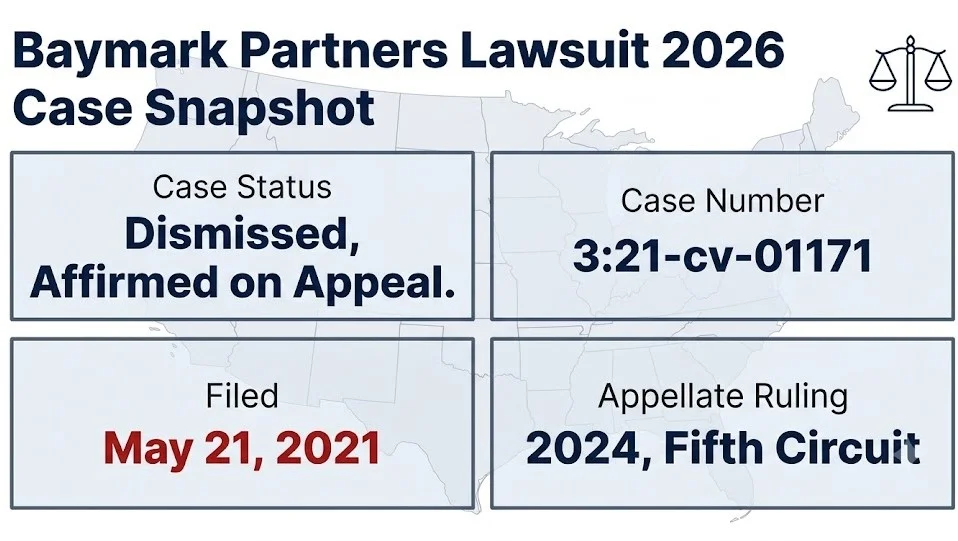
| Case Number | 3:21-cv-01171 |
| Judge | Jane J. Boyle |
| Filing Date | May 21, 2021 |
| Status | Dismissed at the district court; dismissal affirmed by the Fifth Circuit in 2024 |
| Settlement Fund | None. The case ended in dismissal, not a monetary settlement |
The Baymark Partners lawsuit centers on a Dallas private equity firm accused of stripping a company’s assets through a web of shell entities.
That case, D&T Partners LLC v. Baymark Partners LP, has already run its course through the federal court system. A Fifth Circuit panel affirmed dismissal of the central racketeering claims in 2024.
Court records show the dispute began with a $3.2 million secured note and ended with an appellate ruling on what counts as a RICO pattern. Few searches on this topic reach that level of detail.
This briefing lays out the actual docket, the allegations that survived and those that did not, and what the outcome means for anyone considering legal action against a private equity buyer.
What Is the Baymark Partners Lawsuit
The Baymark Partners lawsuit is a federal racketeering and fraud case tied to a soured private equity acquisition, not a consumer product case.
D&T Partners LLC, successor to ACET Venture Partners LLC, filed suit against Baymark Partners LP and related entities in May 2021. The complaint alleged a coordinated scheme to seize a company’s assets and avoid a debt.
At the center of the dispute sat ACET Global LLC, an online retail business. D&T Partners held a secured $3.2 million promissory note against ACET Global, backed by a security interest in its assets.
Quick facts:
- Plaintiffs: D&T Partners LLC and ACET Global LLC
- Core allegation: asset stripping through shell entities and a fraudulent bankruptcy filing
- Underlying debt: a $3.2 million secured note
Attorney Insight: Attorneys who litigate private equity disputes note that RICO gets pleaded often in acquisition fraud cases, but it rarely survives a motion to dismiss.
This was never framed, in the actual filings, as a mass consumer matter. It was a creditor dispute dressed in federal racketeering language.
Who Are the Parties in the Baymark Partners Lawsuit
The named parties span both corporate entities and individual executives connected to Baymark’s private equity operations.
Plaintiffs were D&T Partners LLC and ACET Global LLC. Defendants included Baymark Partners LP, Baymark Partners Management LLC, Baymark ACET Holdco LLC, and Baymark ACET Direct Invest LLC.
Individual defendants named in the complaint included David Hook, Tony Ludlow, Matthew Denegre, William Szeto, Marc Cole, and Steven Bellah. Court filings describe Hook and Ludlow as Baymark’s owners.
| Role | Party |
|---|---|
| Plaintiff | D&T Partners LLC (successor to ACET Venture Partners LLC) |
| Plaintiff | ACET Global LLC |
| Primary Defendant | Baymark Partners LP and affiliated Baymark entities |
| Named Individuals | David Hook, Tony Ludlow, Matthew Denegre, William Szeto, Marc Cole, Steven Bellah |
| Other Named Parties | Super G Capital LLC, SG Credit Partners Inc, Windspeed Trading LLC |
Attorney Insight: Litigators tracking this case point out that naming individual executives, not just the fund entities, is a common tactic when plaintiffs suspect the corporate structure was built to shield people from liability.
Windspeed Trading LLC matters here. Plaintiffs alleged it was the entity that secretly received ACET Global’s stripped assets.
Baymark Partners Lawsuit Court and Case Number
The case was filed in the U.S. District Court for the Northern District of Texas, Dallas Division, under case number 3:21-cv-01171.
Judge Jane J. Boyle presided over the district court proceedings. The complaint itself ran to 146 pages and asserted federal RICO claims alongside a set of Texas state law claims.
According to court records, the original complaint was filed May 21, 2021. Defendants included the corporate Baymark entities plus more than a dozen individually named executives and affiliated companies.
Case identifiers:
- Court: N.D. Texas, Dallas Division
- Docket number: 3:21-cv-01171
- Presiding judge: Jane J. Boyle
- Filed: May 21, 2021
Attorney Insight: Attorneys who monitor this docket say the Dallas Division was a natural venue, since Baymark Partners operates out of Dallas and several transactions at issue closed there.
Litigation Watch: The Baymark Partners lawsuit is a single, already-resolved federal case built around a $3.2 million secured note, not an ongoing mass claim with named plaintiffs still being added.
Baymark Partners Lawsuit Timeline
The Baymark Partners lawsuit moved from filing to a final appellate ruling over roughly three years.
The complaint was filed May 21, 2021. Plaintiffs later sought a default judgment against Baymark Partners LP after it allegedly failed to respond.
On June 1, 2022, Judge Boyle denied that default judgment. The court found that Baymark Partners LP’s certificate of partnership had been canceled back in 2012, meaning the entity no longer legally existed to be sued.
| Date | Event |
|---|---|
| May 21, 2021 | Original complaint filed in N.D. Texas |
| June 1, 2022 | Default judgment against Baymark Partners LP denied; claims against that entity dismissed |
| October 2022 | RICO claims dismissed with prejudice; state law claims dismissed for lack of jurisdiction |
| 2024 | Fifth Circuit affirms the district court’s dismissal |
Attorney Insight: Attorneys handling similar creditor disputes say the canceled-partnership finding is a reminder to check an entity’s actual legal status before filing, not just its name on a contract.
By October 2022, the case had lost its federal anchor once the RICO claims were dismissed with prejudice.
RICO Allegations Against Baymark Partners Explained
RICO allegations against Baymark Partners claimed the firm ran a coordinated scheme to defraud creditors through mail fraud, wire fraud, and bankruptcy fraud.
The Racketeer Influenced and Corrupt Organizations Act lets private plaintiffs sue over a pattern of racketeering activity. If proven, it allows triple damages under 18 U.S.C. § 1964(c).
Plaintiffs argued Baymark’s control over ACET Global, exercised through shell entities described in testimony as “just pieces of paper,” amounted to an ongoing criminal enterprise rather than a single bad deal.
Alleged predicate acts included:
- Mail and wire fraud tied to misrepresentations made to creditors
- Bankruptcy fraud connected to ACET Global’s filing
- Obstruction related to hiding asset transfers
Attorney Insight: Attorneys who work RICO cases in the private equity space describe this framing as common but fragile, since courts demand proof of an open-ended pattern, not one contained transaction.
That fragility is exactly what unraveled the claim on review.
Fraud and Fraudulent Transfer Claims Against Baymark Partners
Beyond RICO, the complaint alleged fraud, fraudulent transfer, and breach of fiduciary duty under Texas law.
Plaintiffs claimed Baymark executives made false statements and backdated documents to mislead creditors. They also alleged assets were shifted to Windspeed Trading LLC under the Texas Uniform Fraudulent Transfer Act, specifically to dodge D&T’s claim.
A breach of fiduciary duty claim argued that Baymark-affiliated executives owed duties to ACET Global’s stakeholders but instead acted to enrich themselves and related entities.
State law claims alleged:
- Common law fraud and misrepresentation
- Fraudulent transfer under Texas law
- Breach of fiduciary duty
- Civil conspiracy
Attorney Insight: Business fraud attorneys note that state law fraud claims often survive even when a federal RICO theory fails, provided the court retains jurisdiction to hear them.
Here, that did not happen. Once the RICO claim fell, the state claims fell with it for lack of jurisdiction.
Why the RICO Claims Were Dismissed
The RICO claims were dismissed because the alleged scheme targeted a limited number of victims through a finite, single-purpose plan, not an open-ended criminal enterprise.
In October 2022, the district court dismissed the RICO counts with prejudice. It found D&T Partners could not plead a legally sufficient pattern of racketeering activity.
RICO requires more than one bad act. Courts look for continuity, meaning the scheme either continued over time or posed an ongoing threat of repetition.
Why the pattern requirement failed here:
- The scheme had one target, ACET Global
- The objective was singular: acquiring and stripping one company
- The alleged conduct did not threaten to repeat indefinitely
Attorney Insight: Litigators tracking private equity fraud cases say this is the most common reason RICO theories fail against a single acquisition, even when the underlying fraud allegations sound serious.
The court’s reasoning did not clear Baymark of wrongdoing. It simply held that what was alleged did not fit RICO’s specific legal test.
Baymark Partners Lawsuit Fifth Circuit Appeal
D&T Partners appealed the dismissal to the U.S. Court of Appeals for the Fifth Circuit, and the panel affirmed the district court in 2024.
The Fifth Circuit reviewed the dismissal de novo, meaning it examined the legal question fresh rather than deferring to the lower court. It accepted the complaint’s factual allegations as true for purposes of that review.
Even accepting those facts, the panel held the alleged conduct did not amount to a RICO “pattern.” The court noted the victims were limited in number and the scheme’s scope was finite.
| Appeal Detail | Info |
|---|---|
| Appellate Court | U.S. Court of Appeals for the Fifth Circuit |
| Case Style | D&T Partners, L.L.C. v. Baymark Partners Mgmt., L.L.C. |
| Outcome | Dismissal affirmed |
| Decision Year | 2024 |
Attorney Insight: Appellate attorneys point to this ruling as a useful citation for defense counsel facing RICO claims tied to single-target acquisition disputes.
Litigation Watch: Both the RICO dismissal and the Fifth Circuit’s 2024 affirmance rested on the same legal problem, a scheme too narrow in scope to qualify as racketeering, not a factual finding that no fraud occurred.
Is There a Baymark Partners Lawsuit Settlement
There is no confirmed Baymark Partners lawsuit settlement, because the case ended in dismissal rather than a negotiated resolution.
Public court records show the RICO claims were dismissed with prejudice in October 2022. The Fifth Circuit affirmed that outcome in 2024, closing the federal case without a settlement fund or damages award.
What this means practically:
- No settlement fund exists to claim against
- No class or group payout has been established
- Individual plaintiffs would need a separate, viable claim to pursue damages
Attorney Insight: Attorneys caution readers against sites suggesting a payout is pending in this specific docket, since the public record shows the opposite outcome.
Some online content describes settlement talks or new plaintiffs joining in 2026. None of that is verifiable against the federal docket for this case as of this writing.
Who Qualifies to Bring a Claim Against Baymark Partners
Qualifying to bring a claim tied to Baymark Partners means having a direct, provable business relationship where fraud, fiduciary breach, or fraudulent transfer allegedly caused financial harm.
This is not a consumer case. It is not a class action. There is no intake process for the general public to join an existing claim number.
People who might have standing generally fall into a narrow group: sellers who transacted directly with a Baymark entity, secured creditors owed money by a Baymark-controlled company, or minority investors in a Baymark-acquired business.
Who this generally does not include:
- Customers of businesses Baymark has invested in
- Employees with standard workplace disputes
- People with no direct contractual or creditor relationship to a Baymark deal
Attorney Insight: Business litigation attorneys stress that these claims live or die on the paper trail, promissory notes, security agreements, and board resolutions, not general complaints about how a deal turned out.
Anyone in the first group should have an attorney review deal documents before assuming a claim exists.
Baymark Partners vs BayMark Health Services
Baymark Partners LP and BayMark Health Services are two completely separate companies that happen to share a nearly identical name.
Baymark Partners LP is the Dallas-based private equity firm named as a defendant in the D&T Partners lawsuit. It focuses on acquiring smaller companies across a range of industries.
BayMark Health Services, based in Lewisville, Texas, is the largest addiction treatment provider in North America. It has been backed by Webster Equity Partners since 2015, a completely different ownership group with no connection to the Baymark Partners litigation.
| Company | Business | Ownership | Connection to This Lawsuit |
|---|---|---|---|
| Baymark Partners LP | Private equity, lower middle market acquisitions | Founded by David Hook and Tony Ludlow | Named defendant |
| BayMark Health Services | Addiction treatment, medication-assisted treatment | Backed by Webster Equity Partners | None |
Attorney Insight: Attorneys reviewing this confusion note that mixing up two unrelated companies in a legal search can waste real time for someone trying to identify the correct party or attorney.
Several lower quality pages online blend facts about both companies together. That mixup is worth flagging before assuming anything about addiction treatment regulation applies to this case.
Other Lawsuits Linked to Baymark Partners
D&T Partners’ complaint referenced other litigation involving Baymark to argue a broader pattern of conduct existed.
The most notable is Greb v. Singleton, No. 3:18-CV-01439, decided in the Northern District of Texas in September 2019. That case involved a separate foreclosure dispute where a borrower eventually sold an interest to Baymark.
D&T’s lawyers called that case “strikingly similar,” pointing to a creditor arrangement where Baymark ultimately profited from a resale. The Fifth Circuit still found this insufficient to establish a RICO pattern tied to the ACET Global scheme.
Key point: Referencing a separate case helps illustrate business practices, but it does not automatically extend liability from one dispute to another.
Attorney Insight: Litigators note that courts routinely reject this kind of pattern argument unless the separate cases share the same scheme, the same victims, or clear coordination.
No other confirmed, currently active federal lawsuit against Baymark Partners has surfaced in public court records as of this writing.
What This Case Means for Business Owners Selling to Private Equity
This case is a caution for business owners who sell to a private equity firm and expect management continuity or clean post-closing conduct.
D&T Partners alleged that promises about keeping existing management in place were broken shortly after the sale closed. Whether or not that rises to fraud in every deal, it highlights a real risk in acquisition structuring.
Sellers should treat management continuity clauses, earnout terms, and security interests as enforceable contract provisions, not informal handshake commitments.
Protective steps sellers can take before closing:
- Get management continuity promises written into the purchase agreement, not left as verbal assurances
- Confirm the buyer’s actual legal entity status and history of prior disputes
- Retain independent counsel to review post-closing control provisions
Attorney Insight: Transactional attorneys who represent sellers say the biggest gap they see is relying on a buyer’s reputation instead of the contract’s actual enforcement mechanisms.
Litigation Watch: The practical lesson from this case has less to do with RICO law and more to do with contract drafting before a deal ever closes.
State by State: Where These Fraud Claims Get Filed
Private equity fraud and fiduciary duty claims like these are generally filed in the state or federal court tied to where the target company operated or where the buyer is based.
Texas courts, particularly the Northern District of Texas, see a concentration of these disputes because many private equity buyers, including Baymark, are based there. Delaware also sees a heavy volume, since many acquisition entities are formed as Delaware LLCs.
| State | Why Claims Land There |
|---|---|
| Texas | Buyer or target company headquarters, as in this case |
| Delaware | Corporate formation state for many acquisition vehicles |
| California | High concentration of lower middle market acquisitions |
| New York | Financing and lender-side disputes |
Attorney Insight: Attorneys who litigate across state lines note that venue often comes down to where the security agreement or purchase contract specifies disputes must be resolved.
Anyone reviewing a similar deal should check the governing law and venue clause in their own contract before assuming any particular state’s court would apply.
What Type of Lawyer Handles a Case Like This
A case built on RICO, fraud, and fraudulent transfer allegations against a private equity firm calls for a business litigation attorney with fraud and creditor rights experience, not a personal injury or mass tort lawyer.
Relevant experience includes commercial fraud litigation, secured creditor disputes, fraudulent transfer law, and, where applicable, federal RICO claims.
Look for an attorney who has handled:
- Breach of fiduciary duty claims against corporate insiders
- Fraudulent transfer actions under state law
- Federal RICO litigation, including motion practice at the pleading stage
- Post-acquisition disputes between buyers and sellers
Attorney Insight: Attorneys in this practice area emphasize that early document preservation, contracts, emails, and financial records, often determines whether a claim survives a motion to dismiss.
A general consumer attorney is not the right fit here. This is business-to-business litigation with a distinct set of legal standards.
Current Status of the Baymark Partners Litigation in 2026
As of 2026, the well-documented federal case against Baymark Partners, D&T Partners LLC v. Baymark Partners LP, is closed.
Court records show the case was terminated at the district court level in October 2022 and the Fifth Circuit affirmed that outcome in 2024. No settlement fund, class certification, or active federal trial date exists in this docket.
Some online sources claim new plaintiffs and settlement talks are unfolding in 2026. That claim is not corroborated by the public federal docket for this specific case as of this writing.
Confirmed 2026 status:
- Original federal case: closed, dismissal affirmed
- Settlement fund: none confirmed
- New consolidated litigation: not verified in court records
Attorney Insight: Attorneys tracking this case recommend treating any claim of an active 2026 settlement process with skepticism until it is confirmed against an actual docket number.
Litigation Watch: The single most important 2026 fact is that the flagship federal case is closed, which should reset expectations for anyone hoping a payout is coming from this specific lawsuit.
What Happens Next
What happens next depends on whether any new, separate claim gets filed against Baymark by a different party.
The original D&T Partners case has run its full course through dismissal and appeal. Any future action would need to be its own independent lawsuit with its own facts and its own docket number.
Anyone who believes they have a similar claim should consult an attorney promptly, since fraud and fiduciary duty claims carry state-specific statutes of limitations.
Frequently Asked Questions
Is the Baymark Partners lawsuit still active in 2026?
No, the primary federal case, D&T Partners LLC v. Baymark Partners LP, is closed. The RICO claims were dismissed in 2022 and the Fifth Circuit affirmed that dismissal in 2024.
What company is actually being sued in the Baymark Partners case?
The named defendant is Baymark Partners LP, a Dallas-based private equity firm, along with related Baymark entities and individual executives. This is separate from BayMark Health Services, an addiction treatment company with different ownership.
Did anyone win the Baymark Partners lawsuit?
The plaintiffs did not win on their central RICO claims. Courts dismissed those claims, finding the alleged scheme did not meet RICO’s legal pattern requirement.
Is Baymark Partners connected to BayMark Health Services?
No, these are two unrelated companies with similar names. Baymark Partners LP is a private equity firm named in this lawsuit, while BayMark Health Services is a separately owned addiction treatment provider.
Can a business owner sue a private equity firm for fraud after a deal fails?
Yes, if there is evidence of fraud, fraudulent transfer, or breach of fiduciary duty tied to the transaction. Success depends heavily on documented facts like contracts, notes, and communications, as shown in this case’s outcome.
What court handled the Baymark Partners RICO case?
The U.S. District Court for the Northern District of Texas, Dallas Division, handled the case under case number 3:21-cv-01171. The dismissal was later reviewed and affirmed by the U.S. Court of Appeals for the Fifth Circuit.
Closing
The Baymark Partners lawsuit is a closed federal RICO and fraud case, not a live mass claim with a pending payout.
Anyone who believes they have a similar business dispute with Baymark, or any private equity buyer, should have a business litigation attorney review the actual contracts and transfer records before filing anything.
Court records, not general blog claims, should guide that decision.
META BLOCK Meta Title: Baymark Partners Lawsuit 2026: Full Court Record and Status Meta Title Chars: 59/59 Meta Desc: The Baymark Partners lawsuit involves RICO fraud claims, a Fifth Circuit appeal, and no settlement fund. See the full 2026 case status and court record. Meta Desc Chars: 153/159 Focus Keywords: baymark partners lawsuit, D&T Partners v Baymark Partners, baymark partners RICO lawsuit, baymark partners lawsuit settlement, baymark partners fifth circuit appeal Slug: /baymark-partners-lawsuit/
