
Quick Answer Box
- Most lawsuit settlements are taxable, except for damages tied to a documented physical injury or physical sickness.
- Qualification depends on the type of damage claimed, not the type of lawsuit filed.
- Tax exposure ranges from $0 on a pure physical injury award to full ordinary income tax on punitive damages, lost wages, and most emotional distress claims.
Tax Treatment Snapshot
This article addresses general federal tax law, not a single court case. There is no docket number or settlement fund to report because the underlying authority is the U.S. Tax Code itself.
| Detail | Info |
|---|---|
| Governing Statute | IRC Section 104(a)(2), IRC Section 61 |
| Controlling IRS Guidance | IRS Publication 4345, Lawsuits, Awards, and Settlements Audit Techniques Guide |
| Key Legislative Change | 1996 amendment requiring “physical” injury or sickness for exclusion |
| Reporting Forms | Form 1099-MISC, Form 1099-NEC, Form W-2, Schedule 1 |
| Status | Standing federal tax law, applies to settlements received in tax year 2026 |
Lawsuit settlements are not automatically tax-free, and the IRS treats most of them as ordinary income. That single fact catches more people off guard than any other part of the litigation process.
Roughly a third of personal injury settlements include components that are fully taxable, even when the core injury claim is not. The line between taxable and tax-free is not the lawsuit category. It is the specific type of damage being compensated.
Congress drew that line sharply in 1996, when it added the word “physical” to the federal tax code. Before that change, emotional distress settlements could be excluded from income with no injury requirement at all.
This guide walks through every major damage category, the IRS forms involved, and where settlement language can legally affect your tax bill.
Are Lawsuit Settlements Taxable
Lawsuit settlements are taxable unless the payment compensates for a physical injury or physical sickness. The default rule under IRC Section 61 treats all income as taxable from whatever source it comes from, including legal settlements.
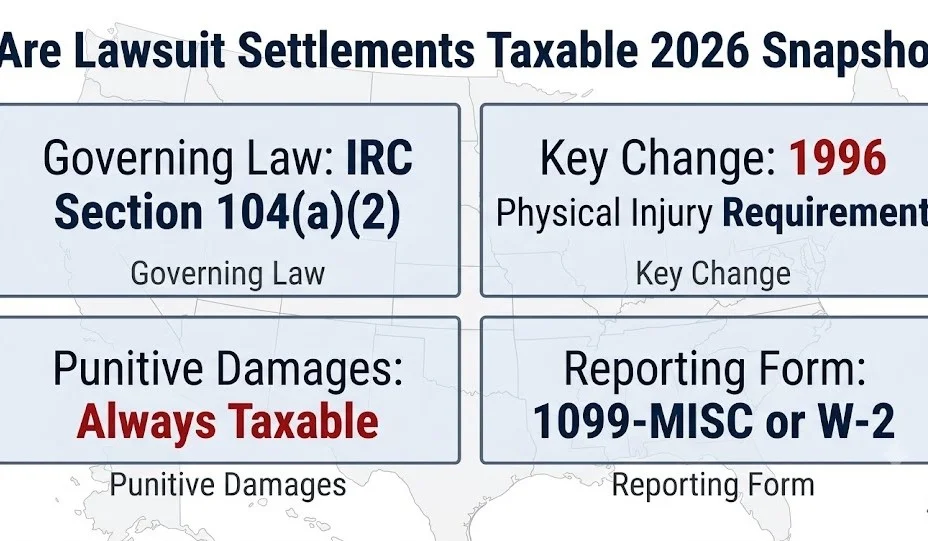
The exception lives in IRC Section 104(a)(2). It excludes damages received “on account of personal physical injuries or physical sickness” from gross income.
Everything outside that narrow exception, lost wages, emotional distress without physical injury, punitive damages, interest, and most employment claims, gets taxed as ordinary income.
Quick Facts:
- Default IRS position: settlements are income.
- Only exception: physical injury or physical sickness damages.
- Burden of proof sits with the taxpayer, not the IRS.
Attorney Insight: Attorneys handling settlement negotiations point to the damage description in the complaint as the first place the IRS looks when a return gets flagged.
Is a Lawsuit Settlement Taxable
A lawsuit settlement is taxable based on what the payment is for, not what the lawsuit was originally filed as. A breach of contract case and a slip-and-fall case can both end in identical dollar amounts with very different tax outcomes.
The IRS looks past the case caption. It examines the settlement agreement language and the underlying claims for each dollar paid.
That means a single settlement check can have both taxable and non-taxable pieces inside it.
| Settlement Element | Generally Taxable |
|---|---|
| Physical injury damages | No |
| Medical expenses tied to physical injury | No |
| Emotional distress from physical injury | No |
| Lost wages (non-injury claim) | Yes |
| Punitive damages | Yes |
| Interest on judgment | Yes |
Attorney Insight: Attorneys drafting settlement language say a vague release clause is one of the most common reasons clients face an unexpected 1099 the following January.
Lawsuit Settlement Taxable By Damage Type
Lawsuit settlement taxability changes depending on the specific damage category named in the agreement. Each category has its own tax rule, and a single case can include several categories at once.
A workplace injury settlement, for example, may pay out physical injury damages, lost wages, and punitive damages in the same check.
Only the physical injury portion typically escapes taxation. The rest gets reported as income.
Common damage categories and their default tax status:
- Physical injury or sickness: non-taxable.
- Medical expenses for physical injury: non-taxable, unless previously deducted.
- Emotional distress unconnected to physical injury: taxable.
- Lost wages or back pay: taxable as wages.
- Punitive damages: always taxable.
- Property damage up to basis: generally non-taxable.
Attorney Insight: Attorneys structuring multi-claim settlements often push for an itemized allocation schedule precisely because the IRS will not do that itemization for the taxpayer.
Is Personal Injury Settlement Taxable
A personal injury settlement is generally not taxable when it compensates for observable bodily harm. Compensatory damages for a broken bone, a surgical injury, or a documented physical illness fall under the IRC Section 104(a)(2) exclusion.
The exclusion covers more than the injury itself. Medical expenses, pain and suffering tied to the injury, and lost wages caused directly by the physical injury are typically excluded too.
There is one catch on medical expenses. If you already deducted those costs on a prior tax return, the reimbursed amount becomes taxable in the year of settlement.
Litigation Watch: Settlement taxability turns on the damage category named in the agreement, not the type of lawsuit filed, and physical injury remains the narrowest reliable path to a tax-free recovery.
Is Emotional Distress Settlement Taxable
An emotional distress settlement is taxable unless the distress stems directly from a physical injury. This is one of the most misunderstood rules in settlement taxation.
Before 1996, emotional distress damages could be excluded from income on their own. Congress closed that door by requiring the distress to be physical-injury-based.
A defamation case causing severe anxiety, for example, produces a fully taxable settlement. A car accident causing anxiety after a broken leg may still qualify for exclusion, because the distress traces back to physical harm.
| Emotional Distress Source | Tax Status |
|---|---|
| Caused by physical injury | Non-taxable |
| Standalone, no physical injury | Taxable |
| Physical symptoms of distress (insomnia, headaches) | Taxable |
Attorney Insight: Attorneys preparing emotional distress claims note that physical symptoms caused by stress, rather than an actual injury, almost never qualify for the exclusion under current IRS guidance.
Are Punitive Damages Taxable
Punitive damages are always taxable, regardless of the underlying claim. This rule applies even in cases where every other dollar of the settlement is tax-free.
IRC Section 104(c) makes a narrow exception only for certain wrongful death cases under specific state statutes. Outside that narrow carveout, punitive damages get reported as “Other Income” on Schedule 1, line 8z of Form 1040.
The reasoning is straightforward. Punitive damages punish the defendant’s conduct rather than compensate the plaintiff for a loss, so the IRS treats them as a financial windfall.
Bold callout: Punitive damages are taxed as ordinary income even when paid inside a physical injury settlement.
Attorney Insight: Attorneys negotiating high-value verdicts often try to separate punitive and compensatory damages clearly in the judgment, since blended awards create reporting disputes later.
Is Lost Wages Settlement Taxable
A lost wages settlement is taxable as ordinary wage income in most circumstances. Back pay, front pay, and severance paid through a settlement get treated the same as a regular paycheck for tax purposes.
The exception is narrow. If the lost wages stem directly from a physical injury claim, they may fall under the Section 104 exclusion along with the rest of the injury damages.
Outside that scenario, expect full employment tax treatment.
Quick Facts:
- Lost wages from physical injury claims: often non-taxable.
- Lost wages from employment, discrimination, or contract claims: taxable wages.
- Subject to Social Security and Medicare withholding when paid as wages.
Attorney Insight: Attorneys handling wage-related settlements flag that employers sometimes withhold payroll taxes directly from a settlement check, which can change the net amount a client actually receives.
Is Employment Settlement Taxable
An employment settlement is taxable as ordinary income when it resolves claims like discrimination, harassment, or wrongful termination without an underlying physical injury. This includes back pay, front pay, and most severance components.
According to IRS guidance in Publication 4345, the portion of an employment settlement tied to lost wages is subject to employment tax, including Social Security and Medicare.
Severance payments resolving employment disputes are treated the same way, even when labeled separately from “wages” in the settlement agreement.
| Employment Claim Type | Tax Treatment |
|---|---|
| Discrimination without physical injury | Taxable |
| Wrongful termination | Taxable |
| Unpaid overtime or wage violations | Taxable |
| Harassment causing physical injury | May qualify for exclusion |
Litigation Watch: Employment settlements rarely qualify for the physical injury exclusion, which makes wage and severance components fully taxable in nearly every case.
Are Attorney Fees Taxable In A Settlement
Attorney fees are often taxable to the plaintiff even though the money never reaches the plaintiff’s bank account. This rule surprises more people than any other part of settlement taxation.
In non-physical-injury cases, like employment or defamation claims, the full settlement amount, including the portion paid directly to the lawyer, generally counts as the plaintiff’s gross income.
Following the Tax Cuts and Jobs Act of 2017, many plaintiffs can no longer deduct those legal fees as a miscellaneous itemized deduction. That can create a situation where a plaintiff owes tax on money they never personally kept.
Bold callout: A $100,000 employment settlement with $35,000 in attorney fees can still require tax on the full $100,000.
Attorney Insight: Attorneys structuring fee arrangements in non-injury cases say this fee taxation issue is one of the most common reasons clients are blindsided at filing time.
How Is A Lawsuit Settlement Reported On Taxes
A lawsuit settlement is reported on taxes based on the 1099 or W-2 form issued by the paying party. Taxable settlement income that is not wages generally appears on Form 1099-MISC, while wage-related components appear on Form W-2.
Plaintiffs report most taxable settlement income on Schedule 1 of Form 1040, then carry the total to the main return.
Non-taxable physical injury settlements typically generate no 1099 at all, but the absence of a form does not eliminate the underlying record-keeping responsibility.
Reporting checklist:
- Confirm which forms the defendant or insurer issued.
- Match each form to the corresponding damage category in the settlement agreement.
- Report wage components separately from non-wage taxable income.
- Keep the signed settlement agreement as supporting documentation.
Attorney Insight: Attorneys reviewing settlement paperwork recommend requesting a written damage allocation before signing, since that document becomes the primary defense in an audit.
1099 For Lawsuit Settlement
A 1099 for a lawsuit settlement is typically issued as Form 1099-MISC for taxable damages or Form 1099-NEC when the payment resembles independent contractor compensation. Defendants and insurance companies must issue these forms once a taxable payment crosses the IRS reporting threshold.
Settlements that qualify entirely for the physical injury exclusion often generate no 1099 whatsoever, since the income is not considered taxable in the first place.
Receiving no 1099 does not guarantee tax-free treatment. The taxpayer still carries the burden of proving the exclusion applies if the IRS asks.
| Form Type | Common Use |
|---|---|
| Form 1099-MISC | General taxable settlement payments |
| Form 1099-NEC | Payments resembling contractor income |
| Form W-2 | Wage-based settlement components |
| No 1099 issued | Settlement fully excluded under Section 104 |
Attorney Insight: Attorneys advising clients on 1099 mismatches say discrepancies between the form received and the actual settlement allocation are a frequent audit trigger.
Is Settlement Interest Taxable
Settlement interest is always taxable as interest income, regardless of how the underlying damages are treated. This applies to both pre-judgment and post-judgment interest.
Even when the core settlement qualifies for the physical injury exclusion, any interest layered on top of that award remains fully taxable.
Interest income gets reported separately on Form 1040, line 2b, distinct from the rest of the settlement.
Quick Facts:
- Pre-judgment interest: taxable.
- Post-judgment interest: taxable.
- Applies even to otherwise tax-free physical injury awards.
Attorney Insight: Attorneys negotiating delayed settlements note that prolonged litigation can quietly increase a client’s tax bill through accumulated interest, separate from the principal award.
Is Class Action Settlement Taxable
A class action settlement is taxable using the same damage-based rules that apply to individual lawsuits. Each class member’s tax treatment depends on what the payout compensates for, not the fact that it came from a class action.
Consumer protection class actions often pay out small per-claimant amounts, sometimes under common 1099 reporting thresholds, which can mean no form is issued even though the income may still be reportable.
Physical injury or product liability class actions can qualify for exclusion the same way an individual injury settlement would, provided the payout is tied to documented physical harm.
Litigation Watch: Reporting forms and per-claimant dollar amounts vary by case, but the underlying tax test for class action payouts mirrors individual settlement law exactly.
Is Structured Settlement Taxable
A structured settlement carries the same tax treatment as a lump sum, based on the original damage category. Spreading a physical injury settlement into periodic annuity payments does not make it taxable, and spreading a taxable settlement into installments does not make it tax-free.
Structured settlements are commonly used in large physical injury cases specifically because the periodic payments, and any growth inside a qualified settlement structure, remain excluded under Section 104.
For taxable settlements, each periodic payment generally remains taxable in the year received, just like wage income paid over time.
Quick Facts:
- Tax-free settlements stay tax-free when structured into payments.
- Taxable settlements stay taxable when structured into payments.
- Growth on a qualified physical injury structure is typically excluded as well.
Attorney Insight: Attorneys recommending structured settlements in injury cases point to the tax-free growth feature as a primary reason clients choose annuity payments over a lump sum.
State Tax On Lawsuit Settlement
State tax treatment of a lawsuit settlement generally follows the federal exclusion, but exact conformity varies by state. Most states with an income tax mirror the federal Section 104 framework for physical injury exclusions.
A handful of states apply their own modifications to gross income calculations, which can create a gap between what is excluded federally and what gets excluded at the state level.
Residents of states with no state income tax, including Texas and Florida, avoid this layer of analysis entirely.
| State Tax Situation | Practical Impact |
|---|---|
| State follows federal Section 104 | Same exclusion applies at state level |
| State has independent modifications | Possible mismatch with federal treatment |
| No state income tax | State-level question does not apply |
Attorney Insight: Attorneys working multi-state cases say state-level treatment is often overlooked until a client files their state return and finds an unexpected discrepancy.
How To Reduce Taxes On A Settlement
A settlement’s tax burden can sometimes be reduced through how the agreement allocates damages between taxable and non-taxable categories. The IRS generally honors a written allocation if it reflects the genuine intent of both parties and the underlying facts support it.
Clear, specific language describing physical injury, medical expenses, and emotional distress tied to that injury gives the strongest support for exclusion.
Vague catch-all language that lumps every damage type together gives the IRS more room to recharacterize the payment as fully taxable.
Strategies attorneys commonly pursue:
- Itemized allocation across damage categories in the agreement.
- Structured settlement payments for qualifying physical injury claims.
- Separating punitive damages clearly from compensatory damages.
- Timing settlement receipt across tax years where legally appropriate.
Attorney Insight: Attorneys drafting settlement language say the allocation clause is the single highest-leverage paragraph in the entire agreement for tax purposes.
Settlement Agreement Tax Allocation Language
Settlement agreement tax allocation language is the specific wording that assigns dollar amounts to particular damage categories. This language carries significant weight with the IRS, even though it is not automatically binding.
The IRS examines whether the allocation reflects economic reality or simply minimizes taxes without factual support.
A settlement that pays for a documented physical injury but uses vague boilerplate language can lose exclusion benefits the parties intended to preserve.
What strong allocation language typically includes:
- A specific description of the physical injury or sickness.
- A breakdown between compensatory and punitive components.
- Clear treatment of any interest included in the payment.
- Separate identification of attorney fees where relevant.
Litigation Watch: Allocation language only works when it matches the actual facts of the case, since the IRS is not required to accept labels that lack economic substance.
When To Talk To A Tax Attorney About A Settlement
A tax attorney becomes worth consulting once a settlement involves mixed damage types, a six-figure or larger payout, or any ambiguity in the agreement language. Complex allocations carry real audit risk if handled incorrectly.
Cases involving punitive damages, employment claims, or class action payouts in particular benefit from a professional review before the agreement is finalized, not after.
A tax attorney working alongside the litigation attorney can review draft settlement language and flag allocation problems while there is still room to negotiate changes.
Signs it’s time to consult a tax attorney:
- The settlement mixes multiple damage categories.
- Punitive damages are part of the payout.
- The total exceeds $100,000.
- The agreement language is vague about damage types.
Attorney Insight: Attorneys who routinely handle high-value settlements recommend a tax review before signing, not after the check has already cleared.
Frequently Asked Questions
Do I have to pay taxes on a lawsuit settlement?
Yes, in most cases, unless the settlement compensates for a physical injury or physical sickness.
The specific damage category, not the lawsuit type, determines whether tax applies.
Is a personal injury settlement considered taxable income?
No, a personal injury settlement is generally not taxable when it compensates for observable bodily harm.
Related medical expenses and emotional distress tied to that injury typically share the same tax-free treatment.
Are attorney fees from a settlement tax deductible?
In most non-physical-injury cases, attorney fees are no longer deductible after the 2017 tax law changes.
This can mean paying tax on the full settlement amount, even the portion paid directly to the lawyer.
Will I get a 1099 for my lawsuit settlement?
You will likely receive a 1099 if any part of your settlement is taxable.
Fully tax-free physical injury settlements often generate no 1099 at all.
Are punitive damages always taxed?
Yes, punitive damages are taxed as ordinary income in nearly every case.
This applies even when the rest of the settlement qualifies for the physical injury exclusion.
Can a settlement agreement be written to reduce my taxes?
Yes, clear damage allocation language can support a stronger tax position.
The IRS still requires that allocation to reflect the actual facts of the case, not just convenient labels.
Closing
Settlement taxability comes down to one question: what was the money actually for. Physical injury claims remain the clearest path to a tax-free recovery, while almost everything else gets taxed as ordinary income.
Anyone facing a mixed settlement, a large payout, or vague agreement language should involve a tax attorney before signing, not after the check arrives.
