
Quick Answer Box
- What this case is: A federal civil lawsuit filed by actress Blake Lively against director Justin Baldoni and Wayfarer Studios in the U.S. District Court for the Southern District of New York, alleging sexual harassment, retaliation, and a coordinated PR smear campaign; Baldoni has filed a $400 million countersuit alleging defamation and civil extortion
- Who is involved: Blake Lively as plaintiff; Justin Baldoni, Wayfarer Studios, PR operatives Melissa Nathan and Jed Wallace of Street Relations, and associated parties as defendants; Ryan Reynolds is named in Baldoni’s countersuit as a contributor to the alleged defamation campaign
- What it’s worth: Lively’s complaint seeks unspecified compensatory and punitive damages; Baldoni’s countersuit demands $400 million in damages for reputational and economic harm
Case Snapshot
| Detail | Info |
|---|---|
| Court | U.S. District Court, Southern District of New York (SDNY) |
| Case / Docket Number | 1:24-cv-10049 (Lively v. Baldoni et al.) |
| Filing Date | December 2024 (initial complaint) |
| Status | Active; discovery phase, 2026 |
| Presiding Judge | Judge Lewis Liman, SDNY |
| Baldoni Countersuit Filed | January 2025 |
| Baldoni Countersuit Amount | $400 million |
| Settlement Fund | None; no settlement reached as of 2026 |
Introduction
The Blake Lively lawsuit update heading into 2026 is not a celebrity scandal story. It is active federal civil litigation in one of the country’s most prominent trial courts, with competing claims that touch sexual harassment law, defamation doctrine, civil extortion, and the evidentiary use of private communications between PR operatives.
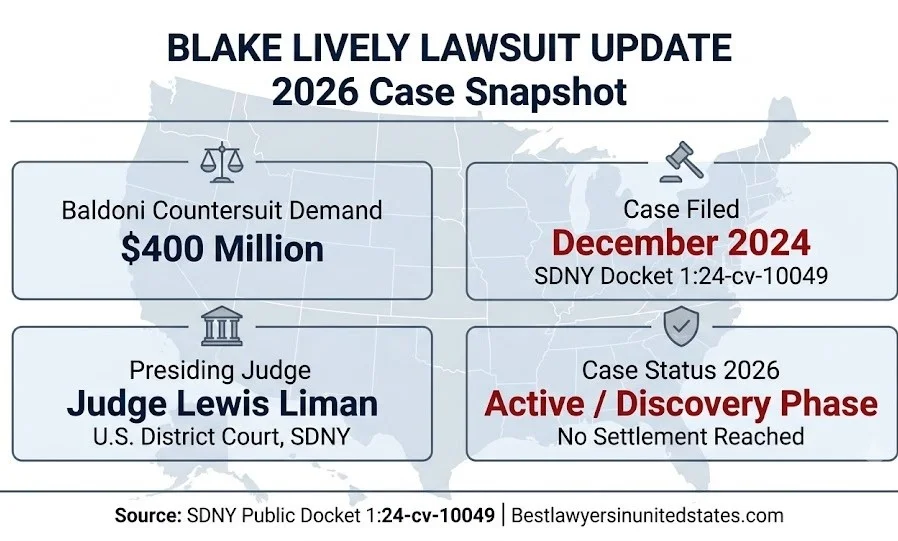
Filed in the Southern District of New York in December 2024, Lively’s complaint names Baldoni, Wayfarer Studios, and two crisis PR professionals as defendants. Baldoni’s $400 million countersuit, filed in January 2025, names Lively, her husband Ryan Reynolds, and their publicist.
The case is now in active discovery. Both sides are seeking documents, communications, and depositions.
What makes this litigation legally significant beyond its celebrity profile is the breadth of claims on both sides. The Lively complaint raises statutory employment harassment and retaliation claims alongside tort claims. The Baldoni countersuit raises defamation and civil extortion, which carry distinct legal standards and distinct evidentiary burdens.
Blake Lively Justin Baldoni Lawsuit News 2026
The central development in 2026 is the case’s entry into the discovery phase under Judge Lewis Liman’s supervision in the Southern District of New York.
Discovery in complex civil litigation of this type involves document production, interrogatories, and depositions. Both sides have subpoenaed communications records, including text messages, emails, and internal strategy documents from third-party PR firms.
Key 2026 developments:
- Judge Liman has managed pretrial scheduling through SDNY’s standard civil case management procedures
- Both parties have filed motions regarding the scope of discovery, including disputes over privilege claims on communications between attorneys and PR consultants
- Baldoni’s legal team, led by publicly named attorney Bryan Freedman, has pursued aggressive pretrial motion practice
- Lively’s counsel has opposed multiple motions seeking to narrow the scope of the claims
Attorney Insight: Attorneys handling high-profile harassment and defamation cases note that the discovery phase in cases like this often produces the most significant evidentiary developments, because internal communications that were never intended for public view become part of the court record.
2026 Status Summary:
| Case Element | Status in 2026 |
|---|---|
| Lively’s complaint | Active; no dismissal |
| Baldoni’s countersuit | Active; no dismissal |
| Discovery | Ongoing |
| Anti-SLAPP motion | Pending or ruled upon |
| Trial date | Not yet set as of early 2026 |
What Is the Blake Lively Lawsuit About
The Blake Lively lawsuit involves two sets of competing civil claims filed in federal court arising from the production and promotion of the 2024 film It Ends With Us.
Lively’s complaint alleges that Baldoni engaged in sexual harassment on set, retaliated against her after she raised concerns, and orchestrated a coordinated public relations campaign designed to damage her reputation. The complaint names Baldoni’s PR operatives directly as participants in the alleged smear operation.
Baldoni’s counterclaims allege that Lively, Reynolds, and their publicist fabricated a false narrative of harassment, fed it to major media outlets, and used it to destroy his career and Wayfarer Studios’ business relationships. Baldoni frames this as defamation, civil extortion, and tortious interference with business relations.
The core dispute, distilled:
| Side | Central Allegation | Primary Legal Theory |
|---|---|---|
| Lively | Baldoni harassed and then retaliated by smearing her | Sexual harassment, retaliation, IIED |
| Baldoni | Lively fabricated the harassment narrative to seize control | Defamation, civil extortion, tortious interference |
Attorney Insight: Attorneys handling cases with competing harassment and defamation claims note that the sequencing of events, specifically who made the first public allegation and through what channel, often becomes the decisive factual question at trial.
Litigation Watch: The Blake Lively lawsuit is active federal civil litigation in the SDNY with competing claims on both sides, a $400 million countersuit in play, and both parties in discovery as of 2026, making this one of the most consequential entertainment industry civil cases currently before a federal court.
Blake Lively Sexual Harassment and Retaliation Claims Explained
Lively’s sexual harassment claims arise primarily under California’s Fair Employment and Housing Act, commonly referred to as FEHA. The film was produced under California-connected agreements, and FEHA governs workplace harassment in the entertainment production context.
Under FEHA, sexual harassment is defined as unwanted sexual conduct that creates a hostile work environment or results in a tangible employment action. Lively’s complaint alleges that Baldoni’s conduct on set met this threshold on multiple occasions.
The retaliation claim is legally distinct. Retaliation under FEHA occurs when an employer takes adverse action against an employee for engaging in protected activity, such as reporting harassment. Lively alleges that the PR smear campaign constituted retaliatory conduct after she raised concerns about Baldoni’s behavior.
Elements Lively must prove for each claim:
| Claim | Required Elements |
|---|---|
| Sexual Harassment (FEHA) | Unwanted conduct; severity or pervasiveness; altered work conditions |
| Retaliation (FEHA) | Protected activity; adverse action; causal connection |
| Intentional Infliction of Emotional Distress | Extreme and outrageous conduct; severe emotional harm |
Bold callout: FEHA allows for both compensatory and punitive damages, and there is no statutory cap on punitive damages in harassment cases under California law.
Attorney Insight: Attorneys handling FEHA harassment claims note that the retaliation count is often strategically more durable than the underlying harassment count, because the retaliatory conduct is typically better documented through communications than the original harassment incidents.
Justin Baldoni Defamation and Civil Extortion Counterclaims
Baldoni’s $400 million countersuit rests on three primary legal theories: defamation, civil extortion under California law, and tortious interference with prospective business relations.
The defamation claims allege that Lively, Reynolds, and their publicist made false statements of fact to journalists and the public, knowing those statements were false or acting with reckless disregard for their truth. Baldoni’s complaint points to a December 2024 New York Times article as a vehicle through which the alleged defamatory statements were published.
The civil extortion theory is legally distinct and more aggressive. Under California Penal Code Section 519, civil extortion occurs when a party threatens to expose information, whether true or false, to extract a benefit. Baldoni alleges that Lively’s team threatened to go public with the harassment narrative unless Baldoni capitulated to her demands regarding creative control of the film.
Baldoni’s counterclaim structure:
- Defamation: False statements published to media; $400 million in claimed reputational and economic harm
- Civil Extortion: Alleged threats to publish damaging information as leverage
- Tortious Interference: Alleged intentional disruption of Wayfarer Studios’ business relationships with Sony and other partners
Attorney Insight: Attorneys handling defamation cases against public figures note that the actual malice standard from New York Times v. Sullivan applies when the plaintiff is a public figure, requiring Baldoni to prove Lively’s team knew the statements were false or acted with reckless disregard for their truth, a demanding evidentiary burden.
Blake Lively Lawsuit Court Filing SDNY Docket
The Blake Lively lawsuit is filed in the U.S. District Court for the Southern District of New York under docket number 1:24-cv-10049.
The SDNY is one of the busiest and most prominent federal trial courts in the country. Cases in this district routinely involve complex commercial, employment, and entertainment disputes. The court’s procedural rules require active case management, and Judge Liman has applied standard SDNY scheduling order requirements to this matter.
The docket is publicly accessible through PACER. Key filings include Lively’s initial complaint, Baldoni’s answer and counterclaims, discovery-related motions, and any orders issued by Judge Liman on disputed matters.
Key docket facts:
| Filing | Date |
|---|---|
| Lively’s initial complaint | December 2024 |
| Baldoni’s answer and counterclaims | January 2025 |
| Discovery scheduling order | Early 2025 |
| Anti-SLAPP motion (if applicable in SDNY) | Pending |
| Trial date | Not yet set |
Bold callout: The SDNY docket for this case is publicly accessible through PACER at no cost for the first ten pages of any document. The case number is 1:24-cv-10049.
Attorney Insight: Attorneys following high-profile civil litigation note that the SDNY’s active case management culture means Judge Liman will set firm discovery deadlines and is unlikely to permit the extended delay tactics that sometimes occur in less actively managed jurisdictions.
Litigation Watch: The Blake Lively lawsuit is docketed at 1:24-cv-10049 in the SDNY before Judge Lewis Liman, who is applying active case management procedures that are pushing both sides toward substantive discovery on an accelerated schedule.
Which Judge Is Presiding Over the Blake Lively Case
Judge Lewis Liman is the presiding federal district judge in this case. Judge Liman sits in the Southern District of New York and was appointed to the federal bench in 2018.
Judge Liman has experience with complex commercial and civil rights litigation. His procedural rulings in this case reflect SDNY’s standard approach to high-profile civil matters: tight scheduling orders, active management of discovery disputes, and a preference for resolving pretrial motions efficiently.
The judge’s rulings on discovery scope, privilege claims, and any anti-SLAPP motion will significantly shape how the trial record is built. His pretrial orders are part of the public docket.
Judge Liman’s profile relevant to this case:
| Detail | Information |
|---|---|
| Court | U.S. District Court, SDNY |
| Appointed | 2018 |
| Relevant experience | Complex civil, commercial, civil rights litigation |
| Case management style | Active; tight scheduling |
| Key pending rulings | Discovery scope; privilege disputes; anti-SLAPP if applicable |
Attorney Insight: Attorneys practicing in the SDNY note that Judge Liman’s courtroom places a premium on precise, well-documented legal arguments. Broad or speculative evidentiary claims tend not to survive his pretrial scrutiny.
Anti-SLAPP Motion in the Blake Lively Baldoni Lawsuit
A SLAPP suit, which stands for Strategic Lawsuit Against Public Participation, is a legal action filed to silence or punish someone for exercising their free speech rights. California’s anti-SLAPP statute, California Code of Civil Procedure Section 425.16, allows defendants to move to strike claims that arise from protected activity.
Baldoni’s legal team has raised anti-SLAPP arguments in connection with Lively’s claims that the PR campaign constituted tortious conduct. The theory is that communications to journalists and the public are protected speech activity, and claims arising from that activity should be stricken at the pleading stage.
The legal complication is that anti-SLAPP motions are a California procedural device. Their applicability in a federal court sitting in New York is a contested question. Federal courts in the Ninth Circuit regularly apply California’s anti-SLAPP statute. The Second Circuit, which covers the SDNY, has applied it inconsistently.
Anti-SLAPP procedural analysis:
| Question | Legal Issue |
|---|---|
| Does anti-SLAPP apply in SDNY? | Contested; Second Circuit has not uniformly resolved this |
| Which claims are targeted? | PR campaign conduct; media communications |
| Burden if motion is granted | Moving party gets attorney fees; claims stricken |
| Burden if motion is denied | Case proceeds; full discovery on PR-related claims |
Attorney Insight: Attorneys handling defamation and harassment cases in federal court note that the anti-SLAPP applicability question in Second Circuit federal courts is genuinely unsettled, and how Judge Liman rules on that threshold question will affect the entire shape of the case.
PR Firm Evidence in the Blake Lively Lawsuit
The evidentiary core of the Blake Lively lawsuit is a substantial record of private communications between Baldoni’s PR operatives and their clients. These communications were obtained by the New York Times and formed the basis of the December 2024 reporting that triggered the public dispute.
The communications allegedly show detailed strategy sessions in which Baldoni’s crisis PR team discussed how to damage Lively’s public image. Specific tactics allegedly discussed include planting negative stories, cultivating hostile commentary, and managing the narrative around her complaints about on-set conduct.
These communications are now potential trial exhibits. Their legal significance depends on whether they were prepared with attorney involvement, which could trigger attorney-client privilege or work product protection, or whether they are purely commercial communications between a client and a non-attorney vendor.
PR evidence legal framework:
| Evidence Type | Privilege Status | Evidentiary Use |
|---|---|---|
| PR firm strategy emails | Likely not privileged | Available as trial exhibits |
| PR firm communications with attorney | May be privileged | Subject to privilege challenge |
| Text messages between operatives | Generally not privileged | Available as trial exhibits |
| Internal memos from Wayfarer Studios | Depends on content | Subject to discovery review |
Attorney Insight: Attorneys handling cases where PR firm communications are at issue note that courts have generally declined to extend attorney-client privilege to PR consultants unless they were expressly retained to assist the attorney in providing legal advice, not simply managing public perception.
Litigation Watch: The private communications between Baldoni’s crisis PR operatives are central physical evidence in this lawsuit, and their likely admissibility as non-privileged business communications gives Lively’s legal team significant leverage in the document production phase of discovery.
Melissa Nathan and Street Relations Role in the Blake Lively Case
Melissa Nathan and Jed Wallace are the two crisis public relations professionals named in Lively’s complaint as active participants in the alleged smear campaign. Nathan is a prominent entertainment industry crisis PR specialist. Wallace is identified as the principal of Street Relations Inc.
Lively’s complaint alleges that Nathan and Wallace were retained by Baldoni and Wayfarer Studios specifically to manage the reputational fallout from Lively’s complaints about on-set conduct. The complaint further alleges that the operatives went beyond legitimate reputation management and engaged in conduct designed to harm Lively personally and professionally.
Nathan and Wallace are named as defendants, not merely witnesses. That distinction matters procedurally. As defendants, they are subject to the full scope of discovery, including deposition, document production, and potential liability.
Third-party defendant exposure:
| Defendant | Role Alleged | Legal Exposure |
|---|---|---|
| Melissa Nathan | Crisis PR principal | Tortious conduct; civil conspiracy |
| Jed Wallace / Street Relations | PR operative | Tortious conduct; civil conspiracy |
| Wayfarer Studios | Client of PR operatives | Respondeat superior; direct liability |
Bold callout: Naming PR operatives as defendants, rather than simply subpoenaing them as third-party witnesses, is a deliberate litigation strategy. It subjects them to full civil liability and creates pressure for cooperation or settlement.
Attorney Insight: Attorneys handling cases with third-party tortfeasor defendants note that naming PR operatives directly as defendants often produces more complete document production than third-party subpoenas, because defendants face sanctions for non-compliance while non-party witnesses have more room to resist.
Blake Lively Lawsuit Discovery and Deposition Timeline 2026
The discovery phase in the Lively-Baldoni litigation is the most active current phase of the case. Both parties are engaged in document production, and depositions of key witnesses are either scheduled or anticipated in 2026.
In SDNY civil cases under standard scheduling orders, fact discovery typically runs for six to twelve months from the initial scheduling conference. Given the complexity of this case, including multiple parties, third-party defendants, and disputed privilege claims, the discovery period is likely to extend through at least mid-2026.
Key deposition targets on Lively’s side likely include Baldoni, Wallace, Nathan, and current and former Wayfarer Studios executives. On Baldoni’s side, depositions of Lively, Reynolds, and their publicist are expected.
Anticipated discovery timeline:
| Phase | Estimated Period |
|---|---|
| Document production | Late 2025 through early 2026 |
| Third-party subpoenas | Ongoing in 2026 |
| Key depositions | Mid-2026 |
| Expert witness disclosures | Late 2026 |
| Pretrial motions (summary judgment) | Late 2026 or early 2027 |
| Trial (if not settled) | 2027 or later |
Attorney Insight: Attorneys following complex multi-party civil litigation note that deposition testimony from named PR operatives in this case could be more consequential than deposition testimony from the primary parties, because the operatives’ communications constitute direct evidence of the alleged scheme.
What Damages Blake Lively Is Seeking in the Lawsuit
Lively’s complaint seeks compensatory damages, punitive damages, and injunctive relief. The complaint does not specify a dollar amount, which is standard practice in harassment and retaliation complaints filed in federal court.
Compensatory damages in a FEHA harassment and retaliation case can include lost earnings, lost career opportunities, emotional distress damages, and reputational harm damages. In cases where the conduct is found to be malicious or oppressive, California law permits punitive damages without a statutory cap.
The reputational harm element of Lively’s damages claim is notable. She alleges that the PR campaign caused concrete professional harm, including damage to business relationships, brand partnerships, and future project opportunities. Quantifying that harm will require expert testimony on entertainment industry economics.
Categories of damages Lively has sought:
| Damage Category | Legal Basis | Notes |
|---|---|---|
| Compensatory (economic) | FEHA, tort law | Lost earnings, project losses |
| Compensatory (non-economic) | FEHA, IIED | Emotional distress |
| Punitive damages | California Civil Code | No statutory cap under FEHA |
| Injunctive relief | Equity | Cease and desist from future conduct |
Attorney Insight: Attorneys handling high-profile harassment cases note that the punitive damages exposure in a case with documented evidence of a coordinated retaliation campaign is substantial, because juries tend to respond strongly to evidence of premeditated reputational attacks.
Litigation Watch: Lively’s unspecified damages demand is structurally significant because punitive damages under FEHA have no statutory cap, meaning the actual damages exposure for Baldoni and Wayfarer Studios could far exceed the $400 million Baldoni claims in his countersuit.
Justin Baldoni $400 Million Countersuit Against Blake Lively
Baldoni filed his $400 million countersuit in January 2025, naming Blake Lively, Ryan Reynolds, and Lively’s publicist Leslie Sloane as counterclaim defendants.
The $400 million figure encompasses alleged reputational harm to Baldoni personally, economic harm to Wayfarer Studios, including the reported loss of distribution and development deals with Sony Pictures, and the business destruction of Street Relations Inc. as a company.
The countersuit’s central factual allegation is that Lively’s team orchestrated a media campaign through the New York Times and other outlets to preemptively control the narrative before Lively’s complaint was filed. Baldoni alleges this was not legitimate whistleblowing but a coordinated attack designed to destroy him before he could respond.
Baldoni’s $400 million breakdown (alleged):
| Category | Claimed Harm |
|---|---|
| Personal reputational harm (Baldoni) | Portion of $400 million total |
| Wayfarer Studios business losses | Sony deal collapse, production losses |
| Street Relations Inc. business harm | Client loss, reputational destruction |
| Ryan Reynolds’ alleged involvement | Named as contributor to defamation campaign |
Bold callout: The $400 million figure is Baldoni’s claimed damages demand. It is not a settlement amount, a judgment, or a verified economic calculation. It represents the ceiling of what Baldoni’s legal team has put before the court as a claim.
Attorney Insight: Attorneys handling defamation countersuits note that headline-grabbing damage figures in counterclaims serve a dual purpose: they frame the counterclaimant as a serious litigation adversary and create settlement pressure by raising the total financial exposure for both sides.
Blake Lively Lawsuit Settlement Chances 2026
Settlement in this case is possible but faces structural obstacles that make a near-term resolution less likely than in typical civil disputes.
Both parties have made strong public statements, through their filings and through the press, that frame the other as a bad actor. That public positioning creates reputational incentives to litigate rather than settle quietly. A confidential settlement would deny both sides the vindication they have publicly sought.
The PR evidence presents a specific obstacle to settlement. If Lively’s team has communications showing a deliberate smear operation, the evidentiary record is strong enough to motivate a trial. If Baldoni’s team believes the defamation case is solid, the $400 million demand gives him settlement leverage.
Factors affecting settlement probability:
| Factor | Effect on Settlement |
|---|---|
| Public positioning by both sides | Reduces settlement incentive |
| Strength of documentary evidence | Favors party with better communications record |
| $400 million countersuit | Creates bilateral settlement pressure |
| Reputation stakes for both parties | Motivates trial for vindication |
| SDNY trial calendar | Delays trial, increases settlement window |
| Insurance coverage (if any) | Could facilitate settlement discussion |
Attorney Insight: Attorneys handling defamation and harassment cases in federal court note that cases with strong documentary evidence on one side tend to settle once the opposing party has seen the document production, because the trial risk becomes quantifiable rather than theoretical.
What California FEHA Means for Blake Lively’s Claims
The California Fair Employment and Housing Act is the statutory framework for Lively’s harassment and retaliation claims. FEHA is one of the broadest state employment anti-discrimination and anti-harassment statutes in the country.
FEHA applies to workplaces with five or more employees. It prohibits sexual harassment, including conduct by supervisors and by individuals with authority over a worker’s professional opportunities. In the entertainment production context, a director’s authority over an actor’s on-set environment has been treated as sufficient to trigger FEHA’s protections.
FEHA also prohibits harassment by non-employees in certain circumstances, which extends the statute’s reach to the alleged conduct by third-party PR operatives if that conduct is shown to have been directed and ratified by the employer. This is the legal mechanism by which Nathan and Wallace’s alleged conduct becomes Baldoni’s legal responsibility.
FEHA’s key provisions relevant to this case:
| FEHA Provision | Application to Lively’s Claims |
|---|---|
| Sexual harassment prohibition | On-set conduct by Baldoni |
| Retaliation prohibition | PR campaign following her complaints |
| Employer liability for non-employee harassment | Nathan/Wallace conduct if ratified by Wayfarer |
| No cap on punitive damages | Full jury discretion on punitive award |
| Right to sue in court | Exercised after DFEH filing |
Attorney Insight: Attorneys handling FEHA cases in the entertainment industry note that the director-actor relationship is increasingly scrutinized under FEHA’s broad definition of a supervisory relationship, particularly where the director has practical control over how an actor appears on screen and in promotional materials.
Blake Lively Justin Baldoni Lawsuit Timeline of Events
The procedural history of this case moves quickly for complex federal civil litigation. The speed reflects the high-profile nature of the parties and the strength of pre-litigation preparation on both sides.
Comprehensive case timeline:
| Date | Event |
|---|---|
| 2024 (production) | It Ends With Us filmed; alleged harassment incidents occur on set |
| Summer 2024 | Film released; public friction between Lively and Baldoni emerges |
| December 2024 | New York Times publishes extensive report on alleged smear campaign |
| December 2024 | Lively files complaint in SDNY; docket number 1:24-cv-10049 |
| January 2025 | Baldoni files $400 million countersuit against Lively, Reynolds, Sloane |
| Early 2025 | Both sides file preliminary motions; discovery scheduling conference held |
| Mid-2025 | Document production begins; privilege disputes filed |
| Late 2025 | Anti-SLAPP motion briefing; third-party subpoenas issued |
| 2026 | Active discovery; depositions scheduled; pretrial motion practice |
| 2027 (estimated) | Trial, if not settled |
Attorney Insight: Attorneys following this case note that the speed of Baldoni’s countersuit filing, within weeks of Lively’s complaint, indicates his legal team had anticipated and prepared for the litigation in advance, which suggests a document preservation strategy was already in place.
Litigation Watch: The case timeline shows that both sides had litigation strategies prepared before the first complaint was filed, meaning the evidentiary record on both sides is likely more complete than in cases where litigation was unanticipated.
What Attorneys Say About the Blake Lively Baldoni Litigation
Attorneys who regularly handle entertainment industry harassment and defamation cases have identified several legally significant aspects of this litigation that go beyond its celebrity profile.
The first is the direct naming of PR operatives as defendants. This is unusual. Crisis communications professionals are typically subpoenaed as witnesses. Making them defendants exposes them to full civil liability and creates pressure for testimony that may not favor their former client.
The second is the bilateral nature of the claims. Both sides have filed substantive civil complaints with legally cognizable claims. This is not a case where one side filed suit and the other mounted a defense. Both sides are simultaneously plaintiffs and defendants, which complicates settlement math and expands the discovery record.
The third is the evidentiary centrality of private communications. When text messages and strategy documents are this central to the factual dispute, the trial presentation becomes largely documentary rather than testimonial.
Attorney community observations:
- Naming PR operatives as defendants is an aggressive and unusual litigation strategy
- The bilateral claim structure creates complex settlement dynamics
- Documentary evidence from PR communications may be the most consequential evidence at trial
- The anti-SLAPP question in the SDNY is an unresolved legal issue that could reshape the case
- Punitive damages exposure on Lively’s side is potentially significant
Attorney Insight: Attorneys handling entertainment industry litigation note that cases of this nature often settle after depositions of the named PR operatives, because that testimony tends to either confirm or refute the central factual allegations in a way that makes the trial outcome more predictable.
Blake Lively Lawsuit What Happens Next in 2026
The trajectory of the Blake Lively lawsuit through 2026 follows a predictable civil litigation arc, with several specific decision points that will shape the case’s outcome.
The most significant near-term event is the conclusion of fact discovery and the filing of summary judgment motions. If either party’s legal team can show that no genuine dispute of material fact exists on a given claim, they can seek dismissal of that claim before trial.
The second significant event is Judge Liman’s ruling on the anti-SLAPP question. A ruling that California’s anti-SLAPP statute does not apply in SDNY federal court would significantly narrow Baldoni’s ability to challenge Lively’s PR-related claims at the pleading stage.
Settlement remains possible at any point. Cases with this level of bilateral public exposure most commonly resolve after the deposition phase, when both sides have a complete picture of the evidentiary record.
What to watch in 2026:
- Judge Liman’s anti-SLAPP ruling
- Completion of fact discovery and deposition testimony
- Summary judgment motion practice
- Any settlement conference ordered by the court
- Potential interlocutory appeals on discovery rulings
- Trial date setting, if the case proceeds past summary judgment
Attorney Insight: Attorneys handling complex multi-party civil cases note that the period immediately following the close of fact discovery is statistically the most likely settlement window, because both sides have seen the full evidentiary record and can rationally assess trial risk for the first time.
Frequently Asked Questions
What is the current status of the Blake Lively lawsuit in 2026?
The case is in the active discovery phase in the U.S. District Court for the Southern District of New York, docket number 1:24-cv-10049, before Judge Lewis Liman.
Both parties are engaged in document production and preparing for depositions of key witnesses.
No settlement has been reached, and no trial date has been set as of early 2026.
How much is Justin Baldoni’s countersuit against Blake Lively worth?
Baldoni filed a $400 million countersuit against Lively, Ryan Reynolds, and publicist Leslie Sloane in January 2025.
The figure encompasses alleged personal reputational harm to Baldoni, business losses at Wayfarer Studios, and economic harm to Street Relations Inc.
The $400 million is a claimed damages demand, not a judgment or a verified economic calculation.
What are Blake Lively’s specific legal claims against Justin Baldoni?
Lively’s complaint alleges sexual harassment and retaliation under California’s Fair Employment and Housing Act, intentional infliction of emotional distress, and claims arising from the alleged coordinated PR smear campaign.
The complaint names Baldoni, Wayfarer Studios, Melissa Nathan, and Jed Wallace of Street Relations as defendants.
The retaliation claim centers on the allegation that the PR campaign was orchestrated in response to Lively raising concerns about on-set conduct.
What is the anti-SLAPP motion in this case and why does it matter?
An anti-SLAPP motion seeks to strike claims that arise from protected speech activity, such as communications to the press.
Baldoni’s legal team has raised anti-SLAPP arguments under California Code of Civil Procedure Section 425.16, arguing that the PR communications at issue are protected speech.
The legal question of whether California’s anti-SLAPP statute applies in a New York federal court is unsettled in the Second Circuit, and Judge Liman’s ruling on this point will significantly affect the scope of the case.
Is there a settlement in the Blake Lively and Justin Baldoni lawsuit?
No settlement has been reached in this case as of 2026.
Settlement is legally possible at any stage of the litigation, but both sides’ public positioning and the bilateral nature of the competing claims make near-term resolution less likely than in a standard civil dispute.
Cases of this type most commonly settle after fact discovery is complete and both sides have reviewed the full evidentiary record.
What type of attorney handles a case like the Blake Lively lawsuit?
This case involves a combination of employment harassment law, entertainment industry contract law, and civil defamation litigation, requiring attorneys with federal civil trial experience in multiple practice areas.
For individuals facing workplace harassment or retaliation in the entertainment industry, a California employment attorney with FEHA experience and federal court admission is the appropriate starting point.
For defamation or civil extortion claims, a civil litigation attorney with First Amendment and media law experience, admitted in the relevant federal district court, handles these matters.
Closing
The Blake Lively lawsuit is not a tabloid story that happens to involve lawyers. It is substantive federal civil litigation with competing statutory claims, a $400 million countersuit, named PR operatives as defendants, and a documentary evidence record that will likely determine the case’s outcome.
The most important development to watch in 2026 is the conclusion of discovery and Judge Liman’s anti-SLAPP ruling. Those two events will set the trial frame.
If you are an individual facing workplace harassment, retaliation, or a coordinated reputational attack in a professional context, the legal frameworks raised in this case are directly relevant to your situation. An attorney who handles employment harassment or civil defamation claims in federal court is the appropriate professional to consult.
