
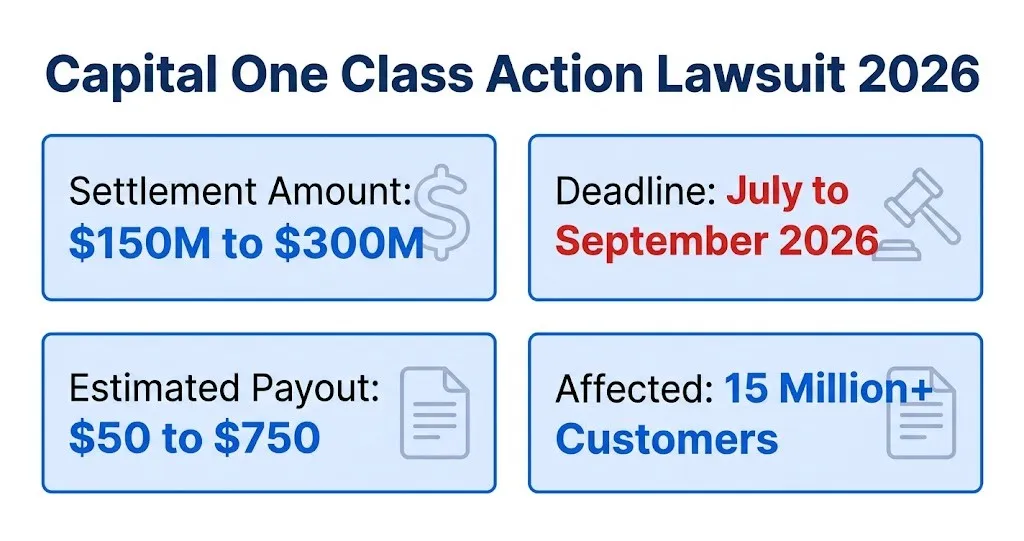
Capital One faces multiple active class action lawsuits in 2026, with settlements potentially reaching hundreds of millions of dollars for affected customers. If you held a Capital One savings account, 360 product, or credit card during specific timeframes, you may qualify for compensation.
These cases center on allegations that Capital One suppressed interest rates on savings accounts while advertising competitive APYs. The bank allegedly kept rates artificially low even as the Federal Reserve raised benchmark rates multiple times.
This guide breaks down every active lawsuit against Capital One. You will learn exactly who qualifies, estimated payout amounts, filing deadlines, and step-by-step claim instructions.
One key fact worth knowing: some Capital One 360 savings customers may have lost over $500 in interest payments they should have received. That money could come back to you.
Capital One Class Action Lawsuit
The Capital One class action lawsuit refers to consolidated legal actions alleging the bank engaged in deceptive practices regarding savings account interest rates and promotional offers. Multiple cases filed between 2023 and 2025 have been grouped together for efficiency.
The core allegation is straightforward. Capital One advertised high-yield savings rates to attract customers. Once customers deposited funds, the bank allegedly kept rates far below market standards while competitors offered significantly higher APYs.
| Case Detail | Information |
|---|---|
| Lead Case | In re Capital One Savings Account Litigation |
| Court | U.S. District Court, Eastern District of Virginia |
| Case Status | Active, class certification pending |
| Estimated Class Size | 15 million+ account holders |
| Primary Allegation | Interest rate suppression and deceptive advertising |
Plaintiffs claim Capital One violated state consumer protection laws across multiple jurisdictions. The lawsuit also alleges breach of the implied covenant of good faith and fair dealing.
Capital One has denied all allegations. The bank maintains its interest rate practices comply with all applicable laws and account agreements.
Court documents show discovery is ongoing. Both sides have exchanged millions of pages of internal communications and financial records.
Is There a Class Action Lawsuit Against Capital One
Yes, there are currently multiple class action lawsuits pending against Capital One in 2026. The cases target different products and alleged violations, but all share common themes of consumer harm.
The most significant active cases include:
- Savings Account Interest Rate Litigation: Alleges Capital One suppressed APY on savings accounts
- 360 Performance Savings Lawsuit: Targets the flagship 360 savings product specifically
- Offers Program Lawsuit: Claims Capital One failed to honor promotional bonus offers
- Credit Card Fee Litigation: Alleges improper fee assessments on credit card accounts
Each lawsuit has different eligibility criteria. You may qualify for more than one depending on your relationship with Capital One.
Class certification has been granted in some cases. Others remain in earlier stages of litigation.
If you received a notice in the mail about a Capital One lawsuit, you are likely a class member. Keep that notice. It contains your unique claim ID.
Capital One 360 Savings Class Action Lawsuit
The Capital One 360 savings class action lawsuit specifically targets the bank’s popular online savings account product. Plaintiffs allege Capital One advertised the 360 Performance Savings account as a high-yield option while paying rates below industry standards.
| 360 Lawsuit Details | Information |
|---|---|
| Product Affected | Capital One 360 Performance Savings |
| Time Period | January 2022 to December 2024 |
| Alleged Harm | Interest rate suppression during Fed rate hikes |
| Potential Damages | $150 million to $300 million |
| Current Status | Settlement negotiations in progress |
The Federal Reserve raised interest rates 11 times between March 2022 and July 2023. Plaintiffs claim Capital One failed to pass these rate increases on to 360 savings customers in a timely manner.
Internal bank emails obtained during discovery allegedly show executives discussing strategies to delay rate increases. These documents form the backbone of the plaintiffs’ case.
Capital One argues its 360 savings rates remained competitive. The bank points to terms and conditions that give it discretion over rate changes.
Settlement talks began in late 2025. Industry analysts expect a resolution by mid-2026.
Key Takeaway: The Capital One 360 savings lawsuit focuses on interest rate suppression between 2022 and 2024, with settlements potentially reaching $300 million for affected account holders.
Capital One Savings Account Lawsuit
The Capital One savings account lawsuit encompasses claims beyond just the 360 product line. This broader action includes traditional savings accounts, money market accounts, and CD products offered through Capital One Bank branches.
Plaintiffs allege a pattern of conduct across all savings products. The central claim: Capital One systematically paid below-market rates while using advertising that implied competitive yields.
Key allegations in the savings account lawsuit include:
- Advertising “high yield” without disclosing rate limitations
- Implementing rate changes slower than competitors
- Failing to notify customers of rate reductions
- Using tiered rate structures that penalized smaller balances
The lawsuit seeks damages for the difference between rates paid and rates that should have been paid based on market conditions.
Customers with balances over $10,000 may have larger claims. Interest lost compounds over time, meaning long-term account holders suffered greater harm.
Court filings indicate the class period runs from January 2020 through December 2024. Anyone who held an eligible account during this period may qualify.
Capital One Credit Card Class Action Lawsuit
The Capital One credit card class action lawsuit involves separate allegations from the savings account cases. This litigation focuses on fee practices, interest calculations, and promotional offer disputes.
| Credit Card Lawsuit Details | Information |
|---|---|
| Products Affected | Venture, Quicksilver, SavorOne, Platinum |
| Primary Allegations | Improper fee assessments, interest miscalculations |
| Class Period | 2021 to 2024 |
| Estimated Class Size | 8 million cardholders |
| Case Status | Discovery phase |
Plaintiffs allege Capital One charged fees that violated cardholder agreements. Specific claims include late fees assessed before grace periods expired and foreign transaction fees on domestic purchases processed through foreign banks.
The interest calculation claims center on how Capital One computed daily balances. Plaintiffs argue the bank used methods that maximized interest charges beyond what disclosures indicated.
Some cardholders allege Capital One failed to honor sign-up bonus offers. These customers claim they met spending requirements but never received promised rewards points or cash back.
Capital One has filed motions to dismiss several claims. The court has yet to rule on all pending motions.
Capital One Offers Program Lawsuit
The Capital One offers program lawsuit targets the bank’s promotional bonus system. Plaintiffs allege Capital One advertised generous sign-up bonuses but implemented hidden restrictions that disqualified many customers.
Common allegations in this lawsuit include:
- Bonus offers requiring spending levels different from advertised
- Arbitrary account closures before bonuses posted
- Retroactive disqualification for “gaming” without clear rules
- Failure to credit bonuses within stated timeframes
One lead plaintiff claims she completed a $3,000 spending requirement within 90 days. Capital One allegedly denied her $200 bonus, citing a “previous relationship” exclusion not prominently disclosed.
| Offers Program Details | Information |
|---|---|
| Affected Offers | Sign-up bonuses, referral bonuses, promotional APRs |
| Primary Defense | Terms and conditions compliance |
| Discovery Status | Document exchange complete |
| Settlement Likelihood | Moderate, negotiations possible in 2026 |
The lawsuit seeks refunds of denied bonuses plus statutory damages under state consumer protection laws. Some states allow treble damages for willful violations.
Capital One maintains its offers program operates transparently. The bank argues all restrictions appear in offer terms.
Key Takeaway: Multiple Capital One lawsuits target different products, from savings accounts to credit cards to promotional bonus offers, giving customers several potential paths to compensation.
Capital One FDIC Lawsuit Overcharge
The Capital One FDIC lawsuit overcharge case involves allegations that the bank improperly assessed fees related to deposit insurance. This technical but significant case could affect millions of account holders.
FDIC insurance protects deposits up to $250,000 per depositor per institution. Banks pay premiums for this coverage based on their deposit base. Plaintiffs allege Capital One passed these costs to customers in ways that violated regulations.
| FDIC Overcharge Details | Information |
|---|---|
| Allegation | Improper FDIC-related fee assessments |
| Regulatory Basis | FDIC rules prohibit direct premium pass-through |
| Potential Refunds | $50 to $200 per affected account |
| Class Period | 2019 to 2024 |
The lawsuit claims Capital One buried fee disclosures in lengthy account agreements. Customers allegedly had no way to identify FDIC-related charges on their statements.
Federal banking regulations generally prohibit banks from directly charging customers for FDIC premiums. The premiums come from bank profits, not customer fees.
This case remains in early stages. Courts must first determine if Capital One’s fee structures actually violated FDIC rules.
If plaintiffs prevail, refunds would flow to affected accounts automatically in most cases.
Capital One Lawsuit Eligibility Requirements
Capital One lawsuit eligibility requirements vary depending on which lawsuit applies to your situation. Generally, you must have held a qualifying account during the specified class period to participate.
Basic eligibility for savings account lawsuits requires:
- Held a Capital One savings account between 2020 and 2024
- Account was open for at least 30 days
- Maintained a balance of at least $100 at some point
- Did not previously opt out of class action participation
Credit card lawsuit eligibility typically requires:
- Held an eligible Capital One credit card during the class period
- Paid fees or interest alleged to be improper
- Did not receive prior compensation for the same issues
| Eligibility Factor | Savings Lawsuit | Credit Card Lawsuit | Offers Lawsuit |
|---|---|---|---|
| Minimum Balance | $100 | N/A | N/A |
| Account Duration | 30+ days | Any duration | Applied for offer |
| Class Period | 2020-2024 | 2021-2024 | 2020-2024 |
| Documentation | Account statements | Card statements | Offer confirmation |
Current customers and former customers both qualify. Closing your account does not disqualify you from receiving compensation for past harm.
You do not need a lawyer to participate. Class members receive compensation automatically once settlements receive final approval.
Capital One Settlement Payout Amount
Capital One settlement payout amounts will vary based on your account history and documented losses. Early estimates suggest individual payments ranging from $25 to $750 depending on the lawsuit and your specific circumstances.
| Payout Factors | Impact on Payment |
|---|---|
| Account Balance | Higher balances mean larger claims |
| Account Duration | Longer relationships increase payouts |
| Documentation | Statements proving losses boost amounts |
| Claim Timing | Early filers may receive more |
For the 360 savings lawsuit, analysts project average payouts between $75 and $300. Customers with balances exceeding $50,000 could receive substantially more.
The calculation typically works like this: the settlement fund divides among all claimants based on relative harm. Your share depends on how much interest you lost compared to other class members.
Providing documentation significantly increases payouts. Account statements showing your average balance during the class period help administrators calculate accurate compensation.
Some settlements use simplified payment tiers. For example:
- Balance under $1,000: Flat $50 payment
- Balance $1,000 to $10,000: $50 plus $5 per $1,000
- Balance over $10,000: $100 plus $3 per $1,000
Final payout structures depend on settlement negotiations. Numbers will be confirmed once courts approve final agreements.
Key Takeaway: Settlement payouts could range from $25 to $750 per claimant, with higher balances and solid documentation leading to larger payments.
Capital One Lawsuit Claim
Filing a Capital One lawsuit claim requires specific steps and documentation. The process is designed to be simple, but providing accurate information maximizes your payment.
Step-by-step claim filing process:
- Locate your claim notice (mailed to class members)
- Find your unique Claim ID on the notice
- Visit the official settlement website
- Enter your Claim ID and personal information
- Verify your account details match records
- Upload supporting documentation if available
- Submit and save your confirmation number
| Claim Information Needed | Where to Find It |
|---|---|
| Claim ID | Class notice mailing |
| Account Number | Old statements or tax forms |
| Average Balance | Account statements |
| Account Open Date | Welcome letter or statements |
| Account Close Date | Final statement |
If you never received a notice, you can still file. The settlement website allows searches by Social Security Number or account number to confirm eligibility.
Online claims are fastest. Paper claim forms are available for those who prefer mail. Both methods work equally well.
Keep copies of everything you submit. Save your confirmation email or printout as proof of filing.
Capital One Lawsuit Application
The Capital One lawsuit application process differs slightly from standard claims. An “application” typically refers to joining a lawsuit before settlement, while a “claim” comes after settlement approval.
To apply for inclusion in an ongoing lawsuit:
- Contact class counsel listed in court filings
- Provide proof of account ownership
- Describe your specific damages
- Confirm you have not opted out previously
| Application vs Claim | Application | Claim |
|---|---|---|
| Timing | During litigation | After settlement |
| Purpose | Join the class | Receive payment |
| Documentation | Recommended | Often required |
| Deadline | Usually flexible | Strict cutoff |
Most people do not need to apply separately. If you held a qualifying account, you are automatically included in the class unless you opted out.
Opting out means you cannot participate in the class settlement. However, opting out preserves your right to file an individual lawsuit.
Very few people benefit from opting out. Individual lawsuits are expensive and time-consuming. Class settlements provide guaranteed compensation with zero effort.
If you want to apply as a lead plaintiff or class representative, contact the law firms handling the case. Lead plaintiffs receive additional compensation but must participate actively in litigation.
Capital One Class Action Deadline 2026
Capital One class action deadline dates for 2026 vary by lawsuit. Missing deadlines means losing your right to compensation, so tracking these dates matters.
| Lawsuit | Expected Claim Deadline | Current Status |
|---|---|---|
| 360 Savings | July 2026 | Settlement pending |
| General Savings | September 2026 | Negotiations ongoing |
| Credit Card | TBD | Discovery phase |
| Offers Program | TBD | Pre-settlement |
| FDIC Overcharge | TBD | Early litigation |
The 360 savings lawsuit appears closest to resolution. If settlement receives preliminary approval by early 2026, claim deadlines would likely fall in summer 2026.
Courts typically allow 60 to 120 days for claim filing after preliminary approval. Final approval hearings follow, then payment distribution begins.
You will receive notice before any deadline. Notices go to your last known address and email on file with Capital One.
Update your address if you have moved. The settlement administrator uses Capital One’s records, which may be outdated.
Setting a calendar reminder for your specific deadline prevents missing it. Deadlines are strictly enforced with rare exceptions.
Key Takeaway: Most Capital One lawsuit claim deadlines fall in mid to late 2026, but specific dates depend on when settlements receive court approval, so watch your mail closely.
How to Get a Capital One Lawsuit Dismissed
How to get a Capital One lawsuit dismissed is a question that concerns both defendants and plaintiffs. Capital One has attempted various legal strategies to dismiss these cases, with mixed success.
Capital One’s primary dismissal arguments include:
- Arbitration clauses requiring individual dispute resolution
- Lack of standing (plaintiffs suffered no actual harm)
- Failure to state a claim under applicable law
- Preemption by federal banking regulations
| Dismissal Attempt | Court Ruling | Impact |
|---|---|---|
| Arbitration motion | Partially denied | Class proceeds for some claims |
| Standing challenge | Denied | Plaintiffs showed concrete harm |
| Failure to state claim | Partially granted | Some claims narrowed |
| Federal preemption | Pending | Could affect damages |
Courts have generally allowed the core claims to proceed. Judges found plaintiffs adequately alleged harm from interest rate suppression.
The arbitration argument proved partially successful. Some customer agreements contained arbitration clauses, while others did not. The class definition was adjusted accordingly.
If you signed an agreement with an arbitration clause, you may be excluded from the class. Check your account opening documents to confirm.
Capital One continues fighting the lawsuits. Settlement discussions happen simultaneously with litigation, which is standard practice.
CFPB Dismisses Lawsuit Against Capital One
The CFPB dismisses lawsuit against Capital One refers to a separate regulatory action, not the class action lawsuits. The Consumer Financial Protection Bureau had pursued enforcement against Capital One over savings account practices.
| CFPB Action Details | Information |
|---|---|
| Original Filing | 2024 |
| Allegations | Deceptive savings rate advertising |
| Outcome | Dismissed in early 2025 |
| Reason | Settlement of separate enforcement action |
| Impact on Class Actions | None, cases proceed independently |
The CFPB dismissal does not affect private class action lawsuits. These are separate legal proceedings with different standards and requirements.
Some viewed the CFPB dismissal as negative for plaintiffs. However, the dismissal resulted from Capital One agreeing to undisclosed regulatory remedies, not a finding of no wrongdoing.
Private class actions can succeed even when regulatory actions fail. The legal standards differ significantly. Class plaintiffs need only prove violations of state consumer laws, which have lower thresholds than federal regulatory statutes.
Capital One’s settlement with regulators may actually help plaintiffs. It suggests the bank acknowledged problems worth resolving quietly.
The class actions continue regardless of CFPB outcomes. Courts evaluate these cases independently based on evidence presented.
Capital One Bank Class Action Lawsuit
The Capital One bank class action lawsuit encompasses all pending litigation against Capital One Financial Corporation and its banking subsidiaries. This umbrella term covers multiple related cases.
Capital One operates through several entities:
- Capital One, National Association (primary banking charter)
- Capital One Bank (USA), N.A. (credit card operations)
- Capital One Financial Corporation (parent company)
| Entity | Primary Products | Lawsuits Affecting |
|---|---|---|
| Capital One, N.A. | Savings, checking, CDs | Savings rate litigation |
| Capital One Bank (USA) | Credit cards | Fee and interest litigation |
| Capital One Financial | All products | Corporate liability claims |
All entities face potential liability. Plaintiffs name multiple defendants to ensure comprehensive recovery.
The consolidated litigation approach helps efficiency. Rather than dozens of separate trials, courts handle related claims together.
Settlement negotiations involve all entities. Any resolution will require agreement from Capital One’s corporate structure and approval from banking regulators.
The bank has substantial resources to fight or settle. Capital One’s market capitalization exceeds $50 billion, making large settlements financially manageable.
Key Takeaway: Capital One faces lawsuits against multiple corporate entities, but consolidated proceedings and the bank’s financial strength suggest settlements are achievable by late 2026.
Capital One 360 Lawsuit
The Capital One 360 lawsuit specifically targets the bank’s direct banking division. Capital One 360 operates as the online-only arm of Capital One, offering savings, checking, and money market accounts without physical branches.
| 360 Product | Lawsuit Status | Key Allegations |
|---|---|---|
| 360 Performance Savings | Primary target | Rate suppression |
| 360 Checking | Secondary claims | Fee practices |
| 360 Money Market | Included | Below-market rates |
| 360 CDs | Limited claims | Early withdrawal penalties |
The 360 Performance Savings account is the lawsuit’s primary focus. This product attracted millions of customers with promises of high APY rates that allegedly never materialized.
At its peak, Capital One 360 held over $300 billion in deposits. Even small interest rate discrepancies across that base create massive potential damages.
Plaintiffs argue the 360 brand specifically marketed itself as a high-yield alternative to traditional banks. The gap between marketing and reality forms the core deception claim.
Capital One acquired ING Direct in 2012, rebranding it as Capital One 360. Some claims trace back to policies inherited from that acquisition.
The online-only model means detailed digital records exist. Every rate change, customer communication, and account statement is preserved electronically, helping both sides build their cases.
Discovery has produced millions of pages of internal documents. Settlement discussions accelerated after certain internal communications became part of the court record.
Frequently Asked Questions
How much money will I get from the Capital One class action lawsuit?
Most claimants can expect between $50 and $300 depending on their account balance and duration.
Customers with higher balances during the class period may receive $500 or more.
Payment amounts will be confirmed once settlements receive final court approval, likely by late 2026.
Who qualifies for the Capital One 360 savings account settlement?
Anyone who held a Capital One 360 savings account between January 2022 and December 2024 likely qualifies.
You must have maintained at least a minimal balance during that period.
Both current and former customers are eligible for compensation.
What is the deadline to file a Capital One lawsuit claim in 2026?
Most claim deadlines are expected to fall between July and September 2026.
Specific dates will be announced once settlements receive preliminary court approval.
You will receive a notice by mail with your exact deadline and claim instructions.
Can I still join the Capital One class action if I closed my account?
Yes, former customers qualify if their accounts were open during the class period.
Closing your account does not disqualify you from receiving settlement compensation.
You may need to provide old account statements to verify your eligibility and claim amount.
How long until Capital One settlement checks are mailed?
Settlement checks typically arrive 60 to 120 days after final court approval.
If settlements are approved in mid-2026, checks would likely mail by late 2026 or early 2027.
Electronic payments may be available for faster distribution to those who choose direct deposit.
Take Action on Your Capital One Claim
Capital One faces significant legal exposure across multiple class action lawsuits in 2026. If you held a savings account, 360 product, or credit card with Capital One during the relevant periods, you likely qualify for compensation.
Watch your mailbox for claim notices. These contain your unique ID and filing instructions.
Gather your account statements now. Documentation proving your balance history increases your payout.
Mark your calendar for summer 2026 deadlines. Missing these dates means forfeiting your share of settlements that could total hundreds of millions of dollars.
