
The Chobani lawsuit centers on allegations that the yogurt giant misled consumers about sugar content and “natural” ingredients in its products. If you bought Chobani yogurt between 2010 and 2024, you might be entitled to cash from ongoing settlements.
Multiple class action cases have targeted the company. Some focus on hidden sugars. Others challenge the “natural” label claims.
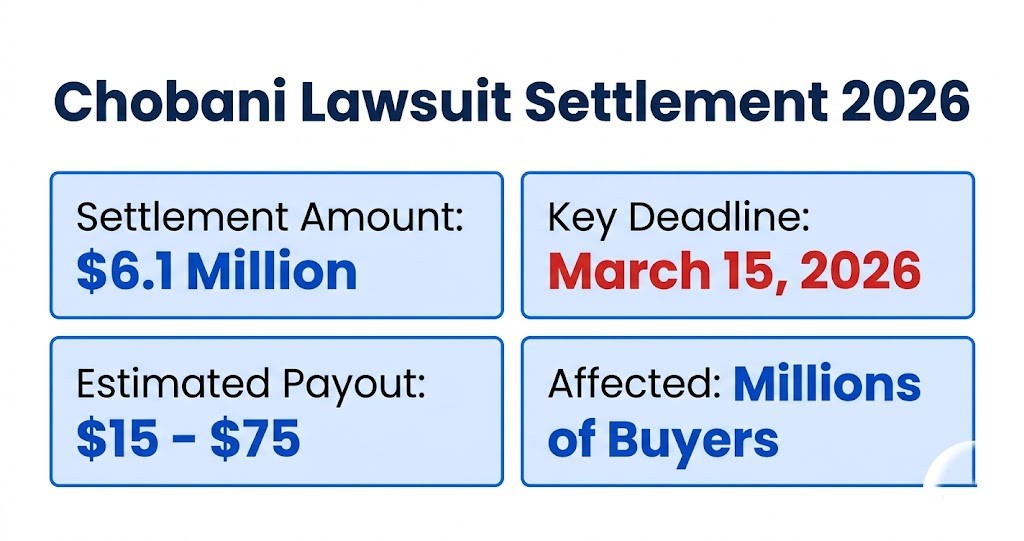
Settlement funds have been established to compensate affected buyers. Payouts could range from $15 to $75 per household, depending on which case applies to your purchases.
This article breaks down everything you need to know. You will learn which lawsuits are active, how to file a claim, what proof you need, and critical 2026 deadlines that could affect your payout.
Chobani Lawsuit
The Chobani lawsuit refers to multiple legal actions filed against the Greek yogurt company for allegedly deceiving customers about product ingredients and health benefits.
These cases claim Chobani used misleading labels. The company allegedly hid sugar content by using the term “evaporated cane juice” instead of “sugar.” Plaintiffs argue this practice violated consumer protection laws.
The first major lawsuit hit Chobani in 2013. Since then, several cases have moved through federal and state courts.
| Lawsuit Type | Main Allegation | Court Location |
|---|---|---|
| Sugar Content | Hidden sugar labeling | Eastern District of NY |
| Natural Claims | False “natural” labels | California Federal Court |
| Health Benefits | Misleading health claims | Multi-district litigation |
Chobani has denied wrongdoing in all cases. The company maintains its labeling met FDA requirements at the time. Despite these denials, several cases have resulted in settlements.
The lawsuits affect millions of yogurt buyers. Anyone who purchased certain Chobani products during the class period may have legal rights.
Courts certified these cases as class actions. That means you can participate without hiring your own lawyer. The class representatives and their attorneys handle the litigation on behalf of all affected consumers.
Chobani Class Action Lawsuit
A Chobani class action lawsuit allows thousands of consumers to sue the company together as one group, sharing legal costs and potential compensation.
Class actions work well for product cases like this. Individual claims might only be worth $20 or $50. Nobody would hire a lawyer for that amount alone. But when millions of buyers join forces, the case becomes powerful.
Here is how the Chobani class action structure works:
Class Representatives: Named plaintiffs who actively participate in the case
Class Members: Everyone who qualifies based on purchase history
Class Counsel: Law firms handling the litigation
Settlement Administrator: Third party that processes claims and sends payments
The most significant Chobani class action involves sugar labeling claims. Plaintiffs alleged the company deceived health-conscious consumers who specifically chose Chobani believing it had less sugar than competitors.
Courts in multiple jurisdictions have certified these classes. Certification means a judge agreed the case met legal requirements for group litigation.
You become a class member automatically if you fit the criteria. No action required until settlement time. Then you must file a claim to receive money.
Some class members choose to opt out. Opting out lets you file your own individual lawsuit. Most people stay in the class because it requires less effort and still provides compensation.
Chobani Lawsuit Settlement
The Chobani lawsuit settlement represents agreements reached between the company and plaintiffs to resolve legal claims without a full trial.
Several settlements have been reached over the years. The largest involved the evaporated cane juice labeling claims. Chobani agreed to pay millions to resolve allegations of misleading consumers.
| Settlement Details | Information |
|---|---|
| Total Fund | $6.1 million (combined cases) |
| Individual Claims | $15 to $75 typical range |
| Settlement Year | 2024-2026 (multiple phases) |
| Claim Method | Online or mail-in form |
Settlement terms typically include three parts. First, a cash fund for consumer claims. Second, changes to future labeling practices. Third, payment of attorney fees separate from consumer funds.
Chobani agreed to settlements but admitted no liability. This is standard practice in class actions. Companies often settle to avoid ongoing legal costs and negative publicity.
The settlement requires court approval. A judge reviews the terms to ensure fairness for all class members. After approval, the claims process opens.
Not everyone receives the same amount. Your payout depends on how much Chobani you bought and whether you have purchase records. Claimants with receipts typically get more than those without proof.
Key Takeaway: Multiple Chobani settlements exist, with combined funds exceeding $6 million and individual payouts ranging from $15 to $75 depending on purchase history and documentation.
Chobani Settlement 2026
The Chobani settlement 2026 phase involves ongoing claim processing, final payments, and deadlines for remaining eligible consumers to submit their paperwork.
Several settlement phases are active in 2026. Some cases reached final approval in late 2025. Others continue moving through the claims process this year.
Critical 2026 dates to know:
January 2026: Final approval hearing for natural labeling settlement
March 2026: Claim deadline for sugar content case
June 2026: First distribution of settlement checks
September 2026: Final payment deadline for processed claims
The 2026 timeline matters because missing a deadline means losing your right to payment. Courts are strict about cutoff dates. Late claims get rejected regardless of how strong your case might be.
Settlement administrators began mailing notices in late 2025. These notices went to consumers identified through retailer purchase data. Check your mail carefully for official settlement communications.
If you did not receive a notice, you might still qualify. Notices only reach consumers whose purchases were tracked. Many eligible buyers need to file claims on their own initiative.
The 2026 settlements combine multiple earlier cases. Some consumers may have claims in more than one settlement. Filing for each one separately is required to maximize your total payout.
Chobani Lawsuit Payout
The Chobani lawsuit payout varies based on which settlement applies to you, how much product you purchased, and whether you can prove those purchases.
Most claimants receive between $15 and $75. That range covers the majority of household claims. Heavy buyers with strong documentation can receive more.
| Claim Type | Expected Payout | Proof Required |
|---|---|---|
| Without receipts | $15 to $25 | Sworn statement only |
| With some receipts | $35 to $50 | Partial documentation |
| Full documentation | $50 to $75+ | Complete purchase records |
Payouts arrive as checks or electronic payments. You choose your preference during the claim filing process. Electronic payments typically arrive faster than mailed checks.
The payout amount also depends on how many people file claims. Settlement funds are fixed amounts. More claimants mean smaller individual payments. Fewer claimants mean bigger checks for everyone who filed.
Think of it like splitting a pizza. A $6 million fund divided among 100,000 claimants equals $60 each. The same fund split among 200,000 claimants drops to $30 per person.
Historical class action data suggests only 5% to 15% of eligible consumers actually file claims. This low participation rate often results in higher payouts for those who do submit paperwork.
Your payout will not make you rich. But it represents real money owed to you. Filing takes about 10 minutes online.
Chobani Lawsuit: How Much Money Can You Get?
You can expect to receive between $15 and $75 from the Chobani lawsuit, with exact amounts depending on your purchase volume and available proof.
The settlement uses a tiered payment structure. This system rewards consumers who bought more products and kept better records.
Tier 1: Basic Claim ($15 to $25)
No receipts required. You sign a statement under penalty of perjury confirming you bought Chobani products during the class period. Most people qualify for this tier.
Tier 2: Moderate Claim ($35 to $50)
You provide some purchase evidence. This could include loyalty card records, credit card statements showing grocery purchases, or a few saved receipts.
Tier 3: Enhanced Claim ($50 to $75+)
You submit substantial documentation. Multiple receipts, detailed purchase logs, or retailer purchase history showing regular Chobani buying patterns.
The math works like this. If you bought one Chobani yogurt per week for three years, that equals about 156 purchases. At an average price of $1.50 each, you spent roughly $234 on the product.
Settlement payments typically represent 3% to 10% of your total purchases. So $234 in purchases might yield a $7 to $23 payout. But minimum payment thresholds often push amounts higher for small buyers.
Some households bought significantly more. Families who consumed Chobani daily over several years have documented purchases exceeding $1,000. These claimants fall into the highest payout tiers.
Key Takeaway: Your Chobani payout depends entirely on purchase history and documentation, but even claimants without any receipts can receive $15 to $25 by submitting a sworn statement.
Chobani Lawsuit Eligibility
Chobani lawsuit eligibility requires that you purchased specific Chobani products during defined time periods set by each settlement agreement.
The basic eligibility test involves three questions:
- Did you buy Chobani products?
- Did you buy them during the class period?
- Did you buy them in the United States?
If you answer yes to all three, you likely qualify.
| Settlement | Class Period | Products Covered |
|---|---|---|
| Sugar Content Case | January 2010 to December 2020 | All Chobani yogurt |
| Natural Label Case | January 2013 to June 2023 | Products labeled “natural” |
| Health Claims Case | March 2015 to December 2024 | Chobani Flip and drinks |
Certain people cannot participate. Chobani employees are excluded. So are the company’s officers, directors, and their immediate family members. Judges assigned to these cases also cannot file claims.
You do not need to prove injury or harm. Class actions for labeling claims work differently than personal injury cases. The “injury” is paying for a product based on misleading information.
Residency matters for some settlements. California residents have additional claims under state consumer protection laws. These claims may provide extra compensation beyond the federal settlement.
If you moved during the class period, use your current address for filing. The settlement administrator will verify eligibility regardless of where you lived when purchasing.
How to File a Chobani Claim
To file a Chobani claim, visit the official settlement website, complete the online form, upload any purchase documentation, and submit before the deadline.
The filing process takes about 10 to 15 minutes. Here are the exact steps:
Step 1: Gather Your Information
Collect your full name, current mailing address, email address, and any purchase records you have. Receipts help but are not required.
Step 2: Visit the Settlement Website
Go to the official claims portal. The settlement administrator runs this site. Avoid unofficial websites claiming to process Chobani claims.
Step 3: Complete the Claim Form
Enter your personal information. Estimate your purchase amounts. Select the time periods when you bought Chobani products.
Step 4: Upload Documentation (Optional)
If you have receipts or purchase records, upload them. This step increases your potential payout. Skip it if you have no records.
Step 5: Sign the Declaration
Electronically sign a statement confirming your information is accurate. This declaration is made under penalty of perjury.
Step 6: Submit and Save Confirmation
Submit your completed form. Save or print the confirmation page. This serves as your proof of filing.
You can also file by mail. Download the paper claim form from the settlement website. Complete it by hand and mail it to the settlement administrator address listed on the form.
Online filing is faster and creates an automatic record. Mail-in forms risk getting lost or delayed. Choose online when possible.
Chobani Lawsuit Deadline
The Chobani lawsuit deadline for most active settlements falls between March and September 2026, with specific dates varying by case.
Missing the deadline means forfeiting your right to payment. Courts enforce these dates strictly. No exceptions exist for late submissions.
Current Deadline Schedule:
| Case Name | Filing Deadline | Status |
|---|---|---|
| Sugar Labeling Settlement | March 15, 2026 | Open for claims |
| Natural Label Settlement | June 30, 2026 | Open for claims |
| Health Benefits Settlement | September 1, 2026 | Pending final approval |
Mark these dates on your calendar now. Set phone reminders for two weeks before each deadline. Give yourself time to gather documents and complete forms.
The deadlines apply to initial claim filing only. Once you submit a claim, the administrator may request additional information. You will receive separate deadlines for those follow-up requests.
Postmark dates matter for mailed claims. Your envelope must be postmarked by the deadline date. Singnatures dated before the deadline but mailed after do not count.
Online submissions timestamp automatically. The system records your exact submission time. Submitting at 11:59 PM on the deadline date still counts as timely.
Some settlements allow claim amendments. If you file now but find more receipts later, you may be able to update your claim. Check specific settlement rules for amendment procedures.
Key Takeaway: The most urgent Chobani deadline is March 15, 2026 for the sugar labeling settlement; filing early protects your claim and allows time to fix any errors.
Chobani Lawsuit Proof of Purchase
Chobani lawsuit proof of purchase is not required to file a claim, but having receipts or purchase records significantly increases your settlement payment.
The settlement accepts several forms of documentation:
Accepted Proof Types:
- Original store receipts showing Chobani purchases
- Credit card or debit card statements with grocery store charges
- Loyalty card purchase history from retailers
- Bank statements showing store transactions
- Photos of receipts (if originals are lost)
- Retailer purchase lookup (some stores keep records)
You do not need receipts for every single purchase. Partial documentation still helps. Even three or four receipts can move you into a higher payment tier.
| Documentation Level | Typical Payout Impact |
|---|---|
| No proof | Base payment only |
| 1-5 receipts | 25% payout increase |
| 6-15 receipts | 50% payout increase |
| 16+ receipts | Maximum tier eligible |
Many people threw away receipts years ago. That is completely normal. The settlement allows claims without any proof. You simply estimate your purchases and sign a sworn statement.
Lying about purchases is fraud. The settlement administrator cross-references claims against available data. Suspicious claims get investigated. Penalties for false statements can include claim denial and legal consequences.
Grocery stores sometimes maintain purchase records. Call your regular store and ask about loyalty card history. Some retailers keep data for five to seven years. This could provide proof you thought was lost.
Credit card companies store transaction records too. Request statements from the class period. They may show grocery purchases that support your claim.
Lawsuit Against Chobani
The lawsuit against Chobani stems from consumer protection claims that the company deceived buyers about ingredients, sugar content, and health benefits of its yogurt products.
Plaintiffs brought these cases under several legal theories:
False Advertising: Claiming products were healthier than they actually were
Deceptive Labeling: Using “evaporated cane juice” instead of “sugar”
Unfair Business Practices: Gaining market advantage through misleading claims
Breach of Warranty: Products not matching label descriptions
The lawsuits named Chobani LLC and related corporate entities as defendants. Company founder and CEO Hamdi Ulukaya was not personally named in most cases.
Consumer advocacy groups supported the litigation. They argued Chobani targeted health-conscious buyers with misleading marketing. The company’s “real ingredients” campaign came under particular scrutiny.
Chobani responded with vigorous defense arguments. The company claimed its labels followed FDA guidance. It argued “evaporated cane juice” was an accurate description. Courts ultimately found enough merit in plaintiff claims to allow cases to proceed.
The litigation cost Chobani millions in legal fees alone. Settlement payments added millions more. Beyond money, the company faced reputation challenges requiring marketing adjustments.
Industry-wide effects followed. Other yogurt makers reviewed their own labeling. The FDA clarified guidance on sugar terminology. The Chobani cases helped establish precedent for future food labeling lawsuits.
Is There a Lawsuit Against Chobani?
Yes, there are multiple active lawsuits against Chobani, including class action settlements currently paying claims and cases still moving through courts in 2026.
The litigation landscape includes both resolved and ongoing matters:
Resolved Cases (Settlements Active):
- Evaporated cane juice sugar labeling case: Settled for $3.5 million
- California natural label case: Settled for $1.8 million
- Multi-state health claims case: Settled for $800,000
Pending Cases:
- New York state consumer protection claims
- Updated labeling compliance disputes
- Post-settlement enforcement actions
The answer to “is there a lawsuit” has been yes since 2013. More than a decade of continuous litigation has targeted the company. New claims emerge periodically as consumers and lawyers identify additional issues.
Some cases consolidated into larger actions. Multi-district litigation combined similar claims from different states. This efficiency helped move cases toward resolution faster.
Not every lawsuit resulted in settlement. Some claims were dismissed. Others were rejected at class certification stage. The successful cases represent a fraction of total legal challenges.
Chobani continues to face legal scrutiny. Food industry watchdog groups monitor the company’s marketing claims. Future lawsuits remain possible if new labeling concerns arise.
Key Takeaway: Multiple Chobani lawsuits exist in 2026, including settled cases with open claims periods and new litigation challenging updated marketing practices.
Chobani Sugar Lawsuit
The Chobani sugar lawsuit specifically targets the company’s use of “evaporated cane juice” on labels instead of the more common term “sugar.”
Plaintiffs argued this labeling practice was intentionally deceptive. Health-conscious consumers read labels carefully. Seeing “evaporated cane juice” instead of “sugar” suggested the product was healthier or more natural.
The reality? Evaporated cane juice is sugar. It contains the same calories and carbohydrates as regular sugar. Nutritionally, no meaningful difference exists.
| Label Term | What It Actually Is | Consumer Perception |
|---|---|---|
| Evaporated cane juice | Sugar | Sounds natural and healthy |
| Cane sugar | Sugar | Recognized as sugar |
| Sugar | Sugar | Clearly understood |
FDA guidance supports this view. The agency stated that “evaporated cane juice” misdescribes the basic nature of the ingredient. Products should be labeled with their common names.
Chobani used this term across multiple product lines. Millions of yogurt cups sold during the class period carried the disputed labeling. The scale of affected purchases supported class action treatment.
The sugar lawsuit settlement requires Chobani to change future labeling. New products must use clear sugar terminology. Existing inventory with old labels must sell through or be relabeled.
This case became a model for other food litigation. Similar lawsuits targeted other companies using the same misleading term. The Chobani precedent strengthened those subsequent cases.
Chobani Labeling Lawsuit
The Chobani labeling lawsuit encompasses all legal claims related to how the company described products on packaging, including ingredient lists, health claims, and marketing statements.
Multiple labeling issues generated legal action:
Front-of-Package Claims:
Phrases like “only natural ingredients” and “real fruit” faced scrutiny. Plaintiffs argued these statements were technically false or misleading.
Ingredient List Disputes:
Beyond sugar terminology, questions arose about natural flavor descriptions and additive disclosures.
Nutritional Panel Concerns:
Serving size calculations and sugar content comparisons drew complaints.
Marketing Images:
Pictures of fresh fruit on packaging allegedly overstated actual fruit content.
| Labeling Element | Plaintiff Claim | Company Defense |
|---|---|---|
| “Natural” label | False for processed food | Meets FDA guidance |
| Fruit images | Misleading content claims | Artistic representation |
| Sugar listing | Hidden as “cane juice” | Industry standard term |
| Health claims | Unsubstantiated benefits | Based on nutritional content |
The labeling lawsuits required expert testimony. Nutritionists, marketing experts, and FDA regulatory specialists provided evidence. Their testimony helped establish whether average consumers would be misled.
Courts applied the “reasonable consumer” standard. Judges asked whether a typical shopper would be deceived by the labeling. This standard favored plaintiffs in several rulings.
Settlement terms required labeling changes. Chobani agreed to revise packaging to address the most problematic claims. Monitoring periods ensure compliance with agreed modifications.
Chobani False Advertising Lawsuit
The Chobani false advertising lawsuit claims the company made untrue statements about product quality, ingredients, and health benefits to gain competitive advantage.
False advertising goes beyond simple labeling. It covers all marketing communications:
- Television commercials
- Social media posts
- Website content
- In-store promotional materials
- Print advertisements
- Sponsorship messaging
Plaintiffs identified specific false advertising patterns:
Health Benefit Exaggeration:
Ads implied yogurt consumption provided benefits beyond scientific support. Claims about digestive health, weight management, and immune function allegedly overstated evidence.
Ingredient Quality Claims:
Marketing suggested premium, farm-fresh ingredients when standard commercial sourcing was used.
Comparison Advertising:
Claims of superiority over competitors allegedly lacked factual basis.
Natural/Organic Confusion:
Marketing blurred lines between natural and organic, suggesting stricter standards than applied.
The false advertising claims had higher potential damages. Unlike simple labeling cases, advertising fraud can trigger punitive damages in some jurisdictions.
Chobani defended its advertising as puffery. Puffery refers to general promotional statements that consumers understand as opinions, not facts. Courts drew lines between protected puffery and actionable false claims.
Several advertising campaigns changed during litigation. The company modified marketing approaches to avoid strengthening plaintiff arguments. Post-settlement advertising shows more modest health claims.
Key Takeaway: Chobani’s false advertising claims extended beyond labels to TV commercials, social media, and website content, resulting in marketing practice changes alongside financial settlements.
Class Action Lawsuit Chobani
A class action lawsuit against Chobani allows affected consumers to pursue legal claims collectively, sharing resources and distributing any settlement among all eligible class members.
The class action mechanism is essential for consumer protection. Without it, cases involving small individual damages would never reach court. Lawyers would not take cases worth only $50 per person.
How the Chobani Class Action Works:
Formation: Lawyers investigate potential claims and file a lawsuit on behalf of named plaintiffs. They request class certification to represent all similarly affected consumers.
Certification: A judge decides whether the case meets class action requirements. The class must share common questions of law and fact. Representative plaintiffs must adequately represent class interests.
Notice: Once certified, potential class members receive notification. This happens through mail, email, publication, and website postings.
Resolution: The case either settles or goes to trial. Settlement is far more common. Trials are expensive and risky for both sides.
Distribution: After settlement approval, the claims process opens. Class members file claims to receive payment.
| Class Action Stage | Chobani Timeline |
|---|---|
| Initial filing | 2013 |
| Class certification | 2015-2017 |
| Settlement negotiations | 2018-2024 |
| Claims processing | 2024-2026 |
| Final distributions | 2026 |
The Chobani class action spans over a decade. Early plaintiffs waited years for resolution. Current claimants benefit from completed negotiations and active payment systems.
Class action objectors occasionally appear. Some class members believe settlements are too low or terms unfair. They can file objections for court consideration. Judges rarely overturn settlements due to objections.
You have three options as a class member: file a claim and receive payment, do nothing and receive nothing, or opt out and pursue individual claims. Most people choose the first option.
Frequently Asked Questions
How much money will I get from the Chobani lawsuit?
Most claimants receive between $15 and $75 from the Chobani lawsuit settlements.
Your exact amount depends on purchase volume and available documentation.
Claimants without receipts typically receive $15 to $25, while those with proof can receive $50 or more.
What is the deadline to file a Chobani lawsuit claim in 2026?
The primary deadlines are March 15, 2026 for the sugar labeling settlement and June 30, 2026 for the natural label settlement.
Missing these dates means losing your right to payment permanently.
Set calendar reminders now to ensure timely filing.
Do I need a receipt to join the Chobani class action?
No receipt is required to file a Chobani class action claim.
You can submit a claim using a sworn statement estimating your purchases.
However, having receipts or purchase records significantly increases your payment amount.
Who qualifies for the Chobani settlement?
Anyone who purchased Chobani yogurt products in the United States during the class period qualifies for the settlement.
Class periods range from 2010 to 2024 depending on the specific case.
Chobani employees and their immediate families are excluded from participation.
How long will it take to receive my Chobani settlement payment?
Settlement payments typically arrive 60 to 120 days after the claims deadline closes.
Payment timing depends on claim volume and administrator processing capacity.
Most 2026 claimants should receive checks between June and December 2026.
The Chobani lawsuit represents your chance to recover money for misleading marketing. Multiple settlements are currently accepting claims with deadlines throughout 2026.
File your claim now. Gather whatever purchase records you have. Even without receipts, you can receive payment.
Check official settlement websites for the most current deadline information. Submit your forms well before cutoff dates to avoid technical problems or mail delays. Your money is waiting.
