
The Google Android lawsuit in California has reshaped how Big Tech operates its app stores. If you own an Android phone, you might be owed money.
Google agreed to pay $700 million to settle claims it overcharged millions of Android users. A jury also found Google guilty of running an illegal monopoly through its Play Store. Both outcomes hit in recent years, and the fallout is still unfolding in 2026.
This guide breaks down every active case. You’ll learn who qualifies, how much you could receive, exact deadlines, and how to file a claim. We’re covering the antitrust ruling, the consumer settlement, the state AG lawsuit, and the privacy claims all in one place.
No other resource puts all of this together. Let’s get into it.
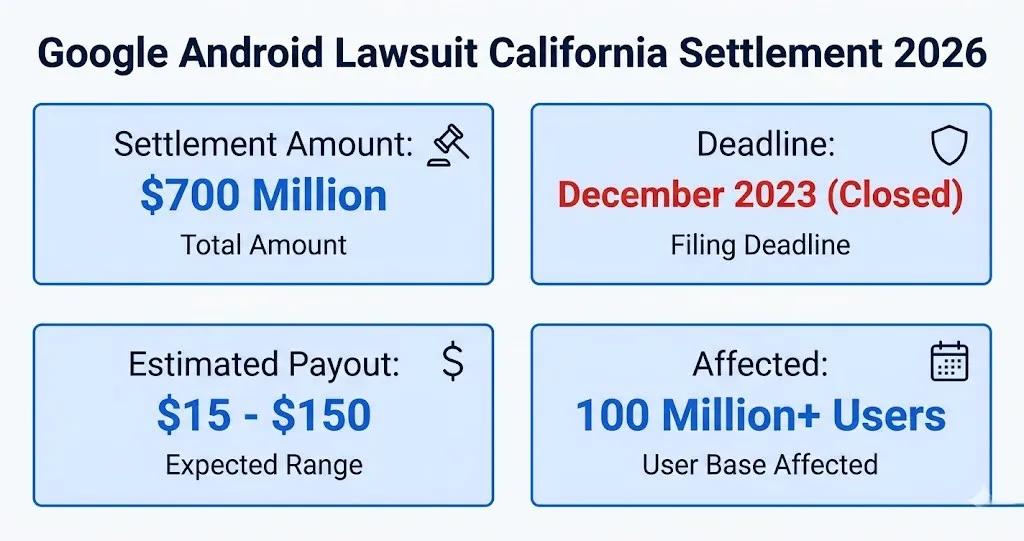
Google Android Lawsuit California
The Google Android lawsuit in California refers to multiple legal actions accusing Google of abusing its control over the Android operating system and Google Play Store. These cases include a consumer class action, an Epic Games antitrust trial, a California state attorney general lawsuit, and privacy-related claims.
The common thread across all cases is simple. Google allegedly used its dominance to force Android users and developers into its own payment system. That meant higher prices for apps and in-app purchases.
| Case Type | Lead Plaintiff / Party | Court | Status in 2026 |
|---|---|---|---|
| Consumer Class Action | Android users nationwide | N.D. California | Settlement of $700M approved |
| Epic Games Antitrust | Epic Games | N.D. California | Jury verdict against Google; remedies in effect |
| State AG Lawsuit | California AG Rob Bonta | San Francisco Superior Court | Active litigation |
| Privacy Claims | California consumers | Various CA courts | Ongoing |
California sits at the center of all of this. Google is headquartered in Mountain View. The federal court in the Northern District of California has handled the biggest cases. State courts in San Francisco have taken on the AG’s claims.
These aren’t small disputes. They challenge the foundation of how Android works as a business.
Google California Android Lawsuit 2026 Update
As of mid-2026, the Google California Android lawsuit landscape includes a finalized settlement, court-ordered Play Store changes, and ongoing state litigation. Things have moved fast since the Epic Games verdict.
The $700 million consumer settlement received final approval in late 2023. Payments began rolling out in 2024 and continued into 2025. By 2026, most eligible claimants who filed on time have received their checks.
On the antitrust side, Judge James Donato issued remedies after the Epic Games jury verdict. Those remedies took effect in late 2024 and require Google to allow third-party app stores and alternative billing on Android devices for a period of three years.
Google has appealed portions of the ruling. The appeal is pending before the Ninth Circuit Court of Appeals as of 2026. Google argues the remedies go too far and harm Android’s security model.
Meanwhile, California Attorney General Rob Bonta’s separate state lawsuit continues. That case seeks additional penalties and injunctive relief beyond what the federal cases achieved.
- Consumer settlement: payments largely distributed
- Epic Games remedies: in effect, under appeal
- State AG case: still in active litigation
- Privacy claims: moving through discovery
There is still time to act on some claims. New filings and related cases keep this story alive.
California Sues Google Over Android
California sued Google in 2021, alleging the company turned Android into a tool for extracting excessive fees from consumers and developers. Attorney General Rob Bonta filed the complaint in San Francisco Superior Court.
The state’s case focuses on Google’s 30 percent commission on app purchases and in-app transactions. California argues this fee is inflated because Google eliminated competition. Without real alternatives, developers had no choice but to pay.
The lawsuit claims Google used secretive deals with phone manufacturers like Samsung. These deals ensured the Google Play Store came pre-installed on virtually every Android phone sold. Competing app stores were effectively locked out.
California also alleged Google paid game developers directly to prevent them from launching their own competing app stores. One notable example involved Activision Blizzard, which Google reportedly paid to abandon plans for an independent store.
| Allegation | Detail |
|---|---|
| Excessive fees | 30% commission on app sales |
| OEM agreements | Deals requiring Play Store pre-installation |
| Developer payoffs | Payments to block competing stores |
| Consumer harm | Higher app prices passed to buyers |
This state case is separate from the federal lawsuits. Even with the $700 million federal settlement, California can pursue its own penalties. The state wants refunds, civil penalties, and permanent changes to Google’s business practices.
The case has survived multiple motions to dismiss. As of 2026, it remains in the discovery and pre-trial phase.
Key Takeaway: Multiple lawsuits in California target Google’s Android practices from different angles. The consumer settlement has paid out, the Epic Games remedies are in effect but under appeal, and the state AG’s case is still fighting for additional penalties.
Google Android Antitrust Lawsuit Explained
The Google Android antitrust lawsuit is built on claims that Google violated federal and state antitrust laws by monopolizing the Android app distribution market. The core allegation is that Google used its control over Android to crush competition in app stores and payment processing.
Antitrust law prohibits companies from maintaining monopoly power through anticompetitive means. The Sherman Act is the main federal statute at play. California’s Cartwright Act and Unfair Competition Law also apply in the state cases.
Here’s what prosecutors and plaintiffs argued Google did wrong:
- Tied Google Play Store to Android: Phone makers had to include it to get other Google apps
- Blocked sideloading: Made it scary and difficult to install apps outside the Play Store
- Revenue sharing deals: Paid carriers and OEMs to keep competing stores off devices
- Project Hug: Internal program to pay top developers to stay exclusive to Google Play
Google’s defense centered on competition with Apple’s App Store. Google argued that Android is more open than iOS, that users can sideload apps, and that its commission rates are competitive.
The jury in the Epic Games trial didn’t buy it. They found Google liable on all counts in December 2023. That verdict validated the antitrust theories that drive every related California case.
This ruling matters because it established legal precedent. Other courts hearing similar claims can point to this jury’s findings.
Google Play Store Monopoly Lawsuit
The Google Play Store monopoly lawsuit centers on the argument that Google controls over 90 percent of Android app distribution in the United States. That level of dominance, combined with anticompetitive behavior, meets the legal definition of an illegal monopoly.
Think of it like owning the only highway into a city and charging every delivery truck a toll. Competitors can’t build their own roads because the city’s rules prevent it. That’s essentially what Google did with the Play Store on Android devices.
Google’s Play Store dominance wasn’t accidental. Plaintiffs proved Google spent billions to maintain it.
| Strategy | Purpose | Cost to Google |
|---|---|---|
| Revenue sharing with OEMs | Keep Play Store as default | Billions annually |
| Project Hug payments | Prevent developers from leaving | Hundreds of millions |
| Anti-sideloading warnings | Scare users away from alternatives | Engineering resources |
| GMS licensing requirements | Bundle Play Store with popular apps | Contractual leverage |
The monopoly finding has real consequences. Courts can order structural changes to break up that control. Judge Donato’s remedies already require Google to allow third-party app stores on Android.
Google must let users download competing stores without frightening security warnings. It must also allow alternative billing systems inside apps for a three-year period.
These changes are already visible on newer Android devices. But Google’s appeal could modify or reverse them.
Epic Games Google Android Ruling
The Epic Games ruling against Google in December 2023 was the single biggest legal blow to Google’s Android business model. A jury in the Northern District of California found Google guilty of maintaining illegal monopolies in both Android app distribution and in-app billing.
Epic Games, the maker of Fortnite, sued Google after being kicked off the Play Store. Epic had tried to use its own payment system inside Fortnite to bypass Google’s 30 percent cut. Google removed the game. Epic responded with a lawsuit.
The trial lasted about a month. Internal Google documents played a starring role. Emails showed Google executives worried about losing developers and created programs like Project Hug to pay them to stay.
Key outcomes from the ruling:
- Google must allow third-party app stores on Android devices
- Google must permit alternative payment systems inside apps
- Google cannot pay developers to keep games exclusive to the Play Store
- Google cannot make deals that restrict phone makers from pre-installing competing stores
- Remedies last for three years, starting late 2024
This ruling was different from Epic’s case against Apple, which Epic largely lost. The difference came down to evidence. Google’s internal communications showed a clear, deliberate strategy to eliminate competition.
Google filed an appeal with the Ninth Circuit in early 2025. Oral arguments are expected in late 2026 or early 2027.
Until the appeal is decided, the remedies stay in place. Android users are already seeing more options.
Key Takeaway: The Epic Games verdict proved Google illegally monopolized the Android app market. Court-ordered remedies now force Google to open up Android to competing stores and payment systems, though Google’s appeal could change things.
Google Android Settlement 2026
The Google Android settlement in 2026 refers primarily to the $700 million consumer class action settlement approved in 2023. By 2026, most payments from this settlement have been distributed to eligible claimants.
This settlement resolved claims that Google overcharged Android users through inflated app and in-app purchase prices. The overcharges resulted from Google’s anticompetitive Play Store practices.
| Settlement Detail | Information |
|---|---|
| Total fund | $700 million |
| Cash portion for consumers | $630 million |
| Policy changes value | $70 million (estimated) |
| Number of eligible consumers | Approximately 100 million |
| Payment method | Direct deposit, PayPal, or check |
Google also agreed to make policy changes as part of the settlement. These included better disclosure of billing practices and easier ways for users to manage subscriptions.
There’s an important distinction here. The $700 million settlement resolved the consumer class action. It did not resolve the California AG’s case or the Epic Games remedies. Those are separate.
If you missed the original filing deadline, you likely cannot file a claim for this particular settlement. However, the California AG lawsuit could produce a separate settlement or judgment with its own payout structure.
Some related cases are still developing. New class actions targeting Google’s data collection practices on Android are active in California courts as of 2026. These could produce additional settlement funds.
Google Android Lawsuit Payout
The Google Android lawsuit payout from the $700 million settlement varied widely depending on each claimant’s purchase history. Most individual payments landed between $15 and $150.
People who spent more on apps and in-app purchases through the Google Play Store received larger payouts. The settlement administrator calculated each person’s share based on their total Play Store spending between August 2016 and September 2023.
Here’s a rough breakdown of what claimants reported receiving:
| Play Store Spending (2016-2023) | Estimated Payout |
|---|---|
| Under $50 | $5 to $15 |
| $50 to $200 | $15 to $40 |
| $200 to $500 | $40 to $80 |
| $500 to $1,000 | $80 to $120 |
| Over $1,000 | $120 to $150+ |
These aren’t exact figures. Actual payouts depended on the total number of valid claims filed. Fewer claims meant bigger individual checks.
The payout amounts disappointed some people. When you split $630 million among tens of millions of claimants, each person’s share shrinks. That’s the math of class action settlements.
But the money is only part of the story. The policy changes and the Epic Games remedies are worth far more to consumers long-term. Lower app prices from real competition could save Android users billions over time.
For those waiting on future payouts from the CA Attorney General case or new privacy lawsuits, amounts remain uncertain. Those cases haven’t reached the settlement stage yet.
Google Play Store Settlement Amount
The Google Play Store settlement amount totaled $700 million in the primary consumer class action. This was one of the largest antitrust settlements in U.S. tech history.
Of that $700 million, roughly $630 million went directly to consumer refunds. The remaining $70 million covered attorney fees, court costs, and the value of business practice changes Google agreed to implement.
To put this number in context:
- Apple’s App Store settlement (from a separate lawsuit) was only $100 million
- Facebook’s privacy settlement was $725 million
- Google’s location tracking settlement was $392 million
The Play Store settlement ranks among the top five tech consumer payouts ever.
- Total settlement fund: $700 million
- Consumer cash distribution: $630 million
- Attorney fees: approximately $70 million
- Claims period: August 2016 through September 2023
- Eligible purchases: apps and in-app purchases on Android
Google did not admit wrongdoing as part of this settlement. That’s standard in class action deals. The company maintained it did nothing wrong while agreeing to pay and make changes.
The settlement resolved claims from consumers in all 50 states, not just California. But the case was litigated in California federal court, and California consumers made up the largest share of claimants.
Key Takeaway: The $700 million settlement has mostly paid out, with individual checks ranging from about $5 to $150 depending on your Play Store spending history. Separate cases in California could produce additional payouts in the future.
How Much Will I Get From the Google Android Lawsuit
Most people who filed valid claims received between $15 and $150 from the Google Android consumer settlement. Your exact amount depended on how much you spent in the Google Play Store between 2016 and 2023.
If you haven’t received a payment yet and you did file a claim, contact the settlement administrator. Delays sometimes happen due to invalid mailing addresses or payment processing issues.
Here’s what determines your payout:
- Total Play Store spending during the eligible period
- Number of valid claims filed (more claims means smaller individual shares)
- Payment method you selected (direct deposit arrived faster than checks)
If you didn’t file a claim by the deadline, you won’t receive money from this settlement. The claims window closed in 2023.
However, you might still benefit from future cases. The California Attorney General lawsuit hasn’t settled yet. If it does, it could create a new claims process with a new deadline.
For developers, the calculation works differently. Developers who paid Google’s 30 percent commission on app sales may have separate claims. Several developer-focused class actions are active.
The honest truth about class action payouts is that they rarely make anyone rich. The real value comes from forcing corporate behavior changes. In this case, those changes mean more app store competition and potentially lower prices for years to come.
Who Qualifies for the Google Android Lawsuit
Anyone who purchased apps or made in-app purchases through the Google Play Store between August 16, 2016, and September 30, 2023 qualified for the $700 million consumer settlement. You did not need to live in California.
Qualification was straightforward. If you spent money in the Play Store during that period, you were automatically part of the class unless you opted out.
| Qualification Factor | Requirement |
|---|---|
| Purchase type | Apps or in-app purchases on Google Play |
| Time period | August 16, 2016 to September 30, 2023 |
| Location | Any U.S. state |
| Minimum spend | $1 or more |
| Proof needed | Google had records; no receipts required |
For the California AG lawsuit, qualification may be narrower. That case focuses specifically on harm to California residents. If a settlement comes from that case, only California consumers might qualify.
Free app downloads did not count. You needed to have actually spent money. Subscriptions purchased through the Play Store (like YouTube Premium or Spotify Premium) also counted if Google processed the payment.
People who already received a check from the $700 million settlement can still qualify for future settlements from different cases. Each lawsuit is independent. Receiving one payout doesn’t disqualify you from another.
Business accounts that purchased apps may have different eligibility rules. Check with the claims administrator for your specific situation.
Google Android Lawsuit Eligibility
Google Android lawsuit eligibility depends on which specific case you’re looking at. The consumer settlement cast the widest net, but other cases have different criteria.
Here’s a comparison across the active lawsuits:
| Case | Who Is Eligible | Key Criteria |
|---|---|---|
| Consumer class action ($700M) | All U.S. Android users who spent money on Play Store | Purchases between 2016 and 2023 |
| California AG lawsuit | California residents who used Android | Purchased apps or were overcharged |
| Privacy class actions | Android users in California | Had location or data collected without consent |
| Developer fee lawsuits | App developers who paid Google’s commission | Paid 15% or 30% commission to Google |
For the consumer settlement, eligibility was automatic. Google’s own transaction records identified class members. You didn’t need to prove anything. The company already had the data.
Privacy-related cases have stricter eligibility. You may need to show that Google collected your data without proper consent. This typically involves location tracking, search history, or app usage data gathered in ways that violated California privacy laws.
Developer eligibility is based on whether you published a paid app or received in-app payments through Google Play. Developers who used alternative billing (rare before the Epic ruling) may not qualify.
If you’re unsure about your eligibility for any active case, the settlement administrator websites maintain records. You can search by email address or Google account.
How to File a Google Android Lawsuit Claim
Filing a claim in the Google Android lawsuit required submitting a form through the official settlement website before the deadline. For the $700 million consumer settlement, that window has closed.
The process was simple when it was open:
- Visit the settlement administrator’s website
- Enter the email linked to your Google account
- Verify your identity
- Choose your payment method (direct deposit, PayPal, or check)
- Submit the form
No receipts were needed. Google provided purchase records directly to the settlement administrator. Your claim amount was calculated automatically.
For future cases that may still be open or upcoming, the filing process will likely follow a similar pattern. Class action claims are designed to be easy. The harder they are to file, the fewer people claim money, and courts don’t like that.
If you want to participate in the California AG lawsuit or privacy cases, you typically don’t need to do anything right now. Class action members are included automatically unless they opt out. When and if a settlement is reached, you’ll be notified by email or mail.
Keep your contact information current on your Google account. Settlement administrators use that information to reach you. An outdated email means missed notifications.
Key Takeaway: Eligibility for the main settlement was broad, covering any U.S. Android user who spent money on the Play Store from 2016 to 2023. The claims window for that case is closed, but new cases in California could open fresh opportunities to file.
Google Android Lawsuit Claim Form
The Google Android lawsuit claim form was a short online submission that took about five minutes to complete. It asked for basic information: your name, email address, Google account, and preferred payment method.
Here’s what the form required:
- Full legal name matching your Google account
- Email address associated with your Play Store purchases
- Mailing address for check delivery (if selected)
- Payment preference: direct deposit, PayPal, or physical check
- Verification: confirming you made eligible purchases
The form did not ask for credit card numbers. It did not ask for your Google password. Any website asking for that information is a scam.
| Form Element | What to Provide |
|---|---|
| Name | Legal name on your Google account |
| Gmail or email tied to Play Store | |
| Address | Current mailing address |
| Payment choice | Direct deposit, PayPal, or check |
| Documentation | None required; Google provided records |
For the $700 million settlement, claim forms are no longer accepted. The filing deadline passed.
If a new settlement arises from the California AG case or privacy lawsuits, expect a new claim form. These forms will be published on the official settlement website and announced through court-approved notices.
Watch for legitimate notifications. They’ll come from verified court administrators, not random emails. Scammers frequently impersonate settlement administrators after high-profile cases. Only use websites directly referenced in court documents.
Google Android Lawsuit Deadline
The deadline to file a claim in the $700 million Google Android consumer settlement was December 2023. That deadline has passed, and late claims are generally not accepted.
| Deadline Type | Date | Status |
|---|---|---|
| Claim filing deadline | December 2023 | Expired |
| Opt-out deadline | Late 2023 | Expired |
| Final approval hearing | Completed | Settlement finalized |
| Payment distribution | 2024 through 2025 | Mostly complete |
| California AG case deadline | TBD | Case still active |
| Privacy lawsuits deadline | TBD | Cases in early stages |
Missing a class action deadline is like showing up to the airport after your flight left. There’s usually no way to get on that plane.
However, there’s still hope. The California AG lawsuit hasn’t reached a settlement yet. If it does settle, there will be a brand-new deadline with a fresh claims period. That case is likely to produce a ruling or settlement in late 2026 or 2027.
Privacy-related class actions against Google in California are even earlier in the process. These cases are still in discovery. Any settlement or deadline is probably two to three years away.
If you missed the consumer settlement deadline, you should still stay informed. Sign up for case updates through legal news services. New cases and new deadlines appear regularly when a company faces this many lawsuits.
The best way to never miss a deadline again is to keep your Google account email active and check it regularly.
Google Android Privacy Lawsuit California
The Google Android privacy lawsuit in California targets how Google collects, stores, and uses personal data from Android devices. These cases are separate from the antitrust claims and focus specifically on privacy violations.
California’s Consumer Privacy Act (CCPA) and California Invasion of Privacy Act (CIPA) provide the legal foundation. Plaintiffs allege Google tracked location data, recorded search activity, and monitored app usage even when users turned tracking off.
Key allegations in the privacy cases:
- Google collected location data after users disabled location services
- Android phones transmitted data to Google servers every few minutes
- App activity tracking continued in “incognito” mode
- Personal data was used for targeted advertising without proper consent
Google settled a related location tracking lawsuit for $392 million in 2022 with 40 state attorneys general. But individual privacy class actions continue to move through California courts.
| Privacy Case | Allegation | Status in 2026 |
|---|---|---|
| Location tracking class action | Collected location data with settings turned off | Active; post-discovery |
| Incognito mode lawsuit | Tracked browsing in private mode | Settled for $5 billion; payments pending |
| Wiretapping claims | Intercepted communications via Android | Active in California courts |
The incognito mode settlement of $5 billion (approved in 2024) is noteworthy. That’s separate from the Android Play Store cases but affects Android users who used Chrome’s private browsing.
California’s strong privacy laws give residents extra protections. If you used an Android phone in California, you may be part of one or more of these class actions without even knowing it.
Key Takeaway: Privacy lawsuits against Google in California are active and separate from the antitrust cases. Location tracking and incognito mode claims have already produced billions in settlements, with more cases in the pipeline.
Google Play Store Developer Fees Lawsuit
The Google Play Store developer fees lawsuit targets the 15 to 30 percent commission Google charges app developers for sales processed through its billing system. Developers argue these fees are inflated by Google’s monopoly power.
Google charges 30 percent on most app and in-app purchases. It reduced the rate to 15 percent for the first $1 million in annual revenue starting in 2021. But developers say even 15 percent is too high when there’s no real alternative.
Before the Epic Games ruling, developers had virtually no choice. Publishing on the Play Store meant using Google’s billing. The 30 percent cut came off the top.
- Spotify publicly campaigned against Google’s fees
- Match Group (owner of Tinder) joined legal challenges
- Coalition for App Fairness organized developer opposition
- Small indie developers said the fees ate their entire profit margin
| Revenue Tier | Google’s Commission | Effective After Epic Ruling |
|---|---|---|
| First $1M annually | 15% | Developers can now use alternative billing |
| Above $1M annually | 30% | Alternative billing available; Google may charge reduced fee |
| Subscriptions | 15% (after first year) | Alternative billing available |
The developer lawsuits seek refunds of excessive fees paid over the years. These cases are still active in California courts as of 2026.
If the courts rule that 30 percent was unreasonably high, Google could owe developers billions in refunds. The argument is strong: Apple’s similar fee generated a lawsuit that settled for only $100 million, suggesting Google’s case could go higher given the monopoly finding.
For indie developers, this matters enormously. A 30 percent cut on a $5 app leaves just $3.50. If that fee drops to 10 or 15 percent through court action, it could be the difference between a viable business and a hobby project.
Android Class Action Lawsuit 2026 Status
The Android class action lawsuit status in 2026 shows a mix of completed settlements, active litigation, and new filings. Here’s a consolidated view of where everything stands.
| Case | Status | Next Major Event |
|---|---|---|
| $700M consumer settlement | Finalized; payments distributed | Claims closed |
| Epic Games v. Google | Remedies in effect; appeal pending | Ninth Circuit oral arguments (late 2026/early 2027) |
| California AG v. Google | Active litigation; pre-trial phase | Trial date expected in 2027 |
| Privacy class actions | Discovery phase | Settlement discussions possible in 2027 |
| Developer fee lawsuits | Active; class certification pending | Certification hearing in late 2026 |
| Incognito mode settlement ($5B) | Approved; payments ongoing | Distribution continues through 2026 |
The biggest event to watch in 2026 is the Ninth Circuit appeal of the Epic Games remedies. If the appeals court upholds Judge Donato’s order, the changes to Android’s app store model become harder for Google to reverse.
If the court overturns the remedies, Google could roll back third-party app store access and alternative billing. That would affect millions of users and developers.
New class actions continue to be filed. Several 2025 and 2026 complaints target Google’s collection of biometric data through Android, its use of AI training data from Android users, and alleged deceptive practices in the Play Store’s app rankings.
The volume of litigation shows no signs of slowing down. Google faces a constant stream of legal challenges tied to Android.
Stay updated on these cases. Settlement notifications go to the email on your Google account. Make sure yours is current.
Key Takeaway: As of 2026, the Android legal saga includes completed payouts, active appeals, ongoing state litigation, and new privacy and developer cases. The Ninth Circuit appeal of Epic Games remedies is the most important event on the horizon.
Frequently Asked Questions
How much money will I get from the Google Android lawsuit?
Most claimants from the $700 million settlement received between $15 and $150.
The exact amount depended on your total Google Play Store spending between 2016 and 2023.
Payments have largely been distributed as of 2026.
Who qualifies for the Google Android class action settlement?
Anyone in the United States who purchased apps or made in-app purchases through the Google Play Store between August 2016 and September 2023 qualified.
Free app downloads did not count.
The claims deadline for this settlement has passed.
What is the deadline to file a claim in the Google Android lawsuit?
The deadline for the $700 million consumer settlement was December 2023, and it has expired.
Future lawsuits, including the California AG case and privacy actions, will have their own separate deadlines.
Those deadlines haven’t been set yet because the cases are still in active litigation.
Is Google still fighting the Android antitrust ruling?
Yes, Google appealed the Epic Games verdict to the Ninth Circuit Court of Appeals in early 2025.
Oral arguments are expected in late 2026 or early 2027.
The court-ordered remedies remain in effect during the appeal.
How do I file a claim in the Google Play Store settlement?
The claims period for the main $700 million settlement is closed, and new claims are not being accepted.
If a new settlement arises from the California AG lawsuit or privacy cases, a new claims process will be announced.
Watch for official court notifications sent to the email address linked to your Google account.
This story isn’t over. Google still faces active lawsuits in California over Android’s antitrust issues, privacy practices, and developer fees. New settlement opportunities could emerge in 2027 and beyond.
If you missed the first round, keep your Google account email active. Check for official settlement notices. New deadlines will arrive when the next case settles.
The best time to pay attention was 2023. The second-best time is right now.
