
Multiple class action lawsuits are actively being litigated against Ford Motor Company, claiming that EcoBoost engines across several engine sizes are defective — causing coolant to leak into cylinders, leading to engine failures, fires, and costly repairs. Unlike some lawsuits covered by other sites, no cash settlement has been reached yet as of early 2026 — but the litigation is advancing, and you need to be protecting your rights right now.
Here’s what you need to know immediately: If your Ford or Lincoln vehicle with an EcoBoost engine suffered overheating, misfires, low coolant issues, or engine failure, you may be part of the class. No claims process is open yet, but the steps you take today will determine what you can recover if and when a settlement is reached. Target Class Action Lawsuit 2026
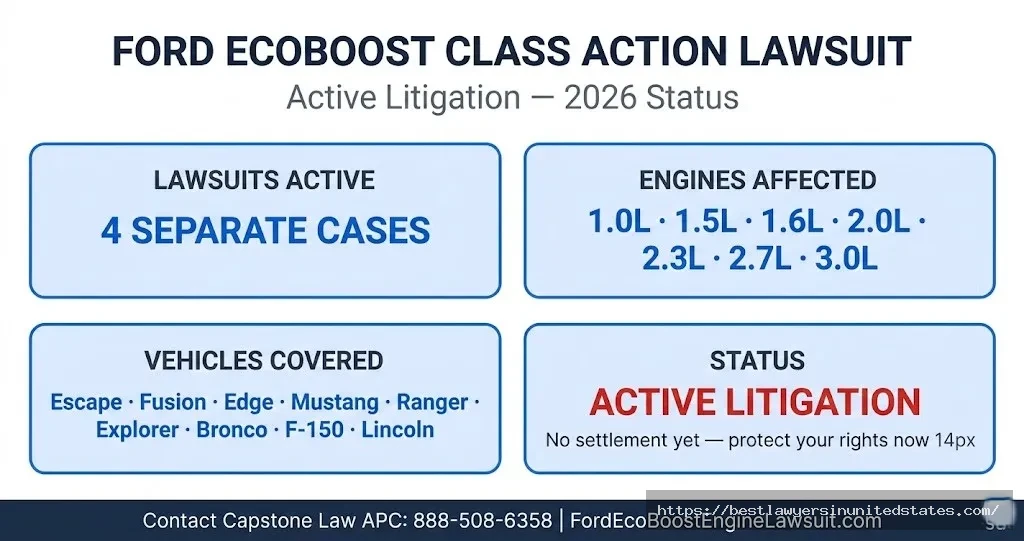
Quick Answer: The Ford EcoBoost class action lawsuits involve 1.5L, 1.6L, 2.0L, 2.3L, 2.7L, 3.0L, and 1.0L EcoBoost engines in vehicles ranging from 2013-2024 Ford Escapes, Fusions, Edges, Mustangs, Explorers, Rangers, Broncos, F-150s, and Lincoln models. No settlement amount has been finalized. The cases are in active litigation in federal court in California. Keep all your repair records and purchase documents now — you’ll need them.
What Is the Ford EcoBoost Class Action Lawsuit About?
Background of the Lawsuits
Ford has marketed its EcoBoost engines for over a decade as powerful, fuel-efficient powerplants. But a growing body of complaints — and now multiple consolidated federal lawsuits — tells a very different story. At the heart of every EcoBoost class action is the same basic claim: these engines have a design defect that allows coolant to leak into the engine’s cylinders.
When coolant gets where it doesn’t belong, the results can be severe. Owners have reported misfires, sudden overheating, oil contamination, and in some cases, complete engine destruction — all at unexpectedly low mileage. Some vehicles have even caught fire. And the lawsuits allege that Ford knew about these dangers years before owners ever complained.
Ford’s response, according to plaintiffs, has been a series of inadequate fixes — software recalibrations, low coolant warning sensors, and partial recalls that don’t fix the root problem. The lawsuits argue these are little more than “Band-Aid” remedies that delay real accountability while owners face repair bills that can reach $8,000–$11,000 or more.
There Are Multiple Active EcoBoost Lawsuits — Here’s How They Break Down
This is where most other websites get it wrong: there isn’t just one Ford EcoBoost lawsuit. There are several, each covering different engine sizes and vehicle models.
| Lawsuit | Case Number | Engine(s) Covered | Court | Status |
|---|---|---|---|---|
| Miller et al. v. Ford Motor Co. | 2:20-cv-01796-TLN-CKD | 1.5L, 1.6L, 2.0L EcoBoost | E.D. California | Active litigation |
| Nelson et al. v. Ford Motor Co. | 2:24-cv-02231-DAD-CKD | 2.3L EcoBoost | E.D. California | Active litigation |
| Barkus et al. v. Ford Motor Co. | Filed Jan. 2025 | 2.7L, 3.0L EcoBoost | Federal court | Active litigation |
| 1.0L EcoBoost lawsuit | Filed 2023, amended 2024 | 1.0L EcoBoost | Federal court | Active litigation |
Understanding which lawsuit applies to your vehicle is the first step in protecting your rights.
Timeline of Key Events
| Date | Event | Details |
|---|---|---|
| 2010 | First owner complaints | NHTSA begins receiving EcoBoost engine complaints |
| 2016 | Ford’s alleged internal knowledge | Internal communications reportedly show Ford knew of 1.0L defect |
| 2019–2020 | First class actions filed | Reed v. Ford, Lund v. Ford, Miller v. Ford filed separately |
| December 2020 | Consolidated complaint filed | Miller et al. v. Ford combined into 256-page complaint |
| 2020–2023 | Partial recalls issued | Ford issues at least 3 recalls, plaintiffs argue they don’t fix the root cause |
| June 2023 | 1.0L EcoBoost lawsuit filed | Lawsuit over oil pump defect in 1.0L three-cylinder engine |
| 2024 | Nelson lawsuit filed | New case expands coverage to 2.3L EcoBoost engines |
| September 2024 | 1.0L lawsuit amended | Expanded complaint alleges Ford knew since 2016 |
| January 2025 | 2.7L/3.0L lawsuit filed | Covers F-150s, Broncos with larger EcoBoost engines |
| June 2025 | Renewed media attention | Ford faces ongoing litigation across multiple EcoBoost suits |
| 2026 | Active litigation | No settlement reached; cases proceeding through discovery |
Who Filed the Lawsuits?
The original Miller case was consolidated from three separate lawsuits — Reed v. Ford, Patricia Lund v. Ford, and Miller v. Ford — bringing together 28 named plaintiffs. It’s being handled by a consortium of top consumer law firms including Capstone Law APC, Kershaw Talley Barlow PC, Lieff Cabraser Heimann & Bernstein LLP, Berger Montague PC, Newsom Law PLC, and Thrash Law Firm.
The Nelson case, covering 2.3L engines, is also being handled by Capstone Law APC. The 2.7L/3.0L case is being litigated by The Miller Law Firm, DiCello Levitt LLP, and Smith Krivoshey, PLLC.
What Are the Core Allegations?
Every EcoBoost lawsuit shares a common thread of allegations against Ford:
- Ford knew about the defect before selling these vehicles — internal documents allegedly confirm awareness of the cooling system problems years before public disclosure
- Ford failed to warn buyers about the coolant intrusion risk at the time of purchase or lease
- Ford issued inadequate recalls that addressed symptoms (like low coolant levels) rather than the structural design flaw causing them
- Ford’s “repairs” made things worse for some owners — applying software patches and warning sensors instead of replacing defective engine blocks
- Ford continued selling vehicles with the known defect, exposing more buyers to the same risks
- The defect creates a serious safety hazard — coolant in the cylinders can cause sudden engine failure or fire at highway speed
Which Vehicles Are Covered? Eligibility by Engine Size
Quick Answer: Your vehicle may be covered if it has a 1.5L, 1.6L, 2.0L, 2.3L, 2.7L, 3.0L, or 1.0L EcoBoost engine and you experienced engine problems. Different lawsuits cover different engines — check the table below carefully.
The 1.5L, 1.6L & 2.0L EcoBoost (Miller Lawsuit)
| Vehicle | Model Years | Engine | Notes |
|---|---|---|---|
| Ford Escape | 2013–2019 | 1.5L, 1.6L, 2.0L | Most common complaint vehicle |
| Ford Fusion | 2013–2019 | 1.5L, 1.6L, 2.0L | High volume of claims |
| Ford Edge | 2015–2018 | 2.0L | Covered in consolidated suit |
| Lincoln MKC | 2016–2019 | 2.0L | Lincoln brand covered |
| Lincoln MKZ | 2016–2019 | 2.0L | Lincoln brand covered |
The 2.3L EcoBoost (Nelson Lawsuit)
| Vehicle | Model Years | Engine | Notes |
|---|---|---|---|
| Ford Mustang | 2015–2024 | 2.3L | Popular sports car covered |
| Ford Ranger | 2019–2024 | 2.3L | Mid-size truck covered |
| Ford Explorer | 2016–2024 | 2.3L | Full-size SUV covered |
| Ford Bronco | 2021–2024 | 2.3L | Newer model included |
| Lincoln MKC | 2015–2020 | 2.3L | Lincoln version covered |
| Lincoln Corsair | 2020–2022 | 2.3L | Lincoln luxury SUV |
The 2.7L & 3.0L EcoBoost (Barkus Lawsuit, Filed Jan. 2025)
| Vehicle | Model Years | Engine | Notes |
|---|---|---|---|
| Ford F-150 | 2021+ | 2.7L | Best-selling truck affected |
| Ford Bronco | 2021+ | 2.7L | Off-road SUV affected |
| Additional models TBD | Various | 2.7L, 3.0L | Lawsuit expanding |
The 1.0L EcoBoost (Separate Lawsuit)
| Vehicle | Model Years | Engine | Notes |
|---|---|---|---|
| Ford EcoSport | 2018–2021 | 1.0L | Oil-drive belt tensioner defect |
| Ford Focus | 2016–2018 | 1.0L | Three-cylinder engine |
| Ford Fiesta | 2016–2017 | 1.0L | Smallest engine affected |
Who Does NOT Qualify (Right Now)?
There are limitations you should understand clearly:
- Vehicles outside the listed model years — even if they have EcoBoost engines, they may not be covered by current suits
- Owners who settled individual claims with Ford may have waived class action rights
- Commercial fleet purchasers may face additional eligibility hurdles
- Owners who have not experienced engine problems may have limited claims, though depreciation-based arguments are also being made
- Vehicles outside the specific engine displacements listed above
If you’re unsure, talk to an attorney before assuming you don’t qualify.
What Problems Signal a Defective EcoBoost Engine?
The lawsuits cover specific failure modes. If your vehicle showed any of these symptoms, you should be documenting everything:
| Symptom | What It Indicates | Action to Take |
|---|---|---|
| Frequent low coolant warnings | Coolant leaking internally | Document every warning; keep receipts |
| Engine misfires | Coolant entering cylinders | Get diagnostic codes printed and saved |
| Overheating | Loss of coolant causing heat buildup | Keep dealership service records |
| White smoke from exhaust | Coolant burning in cylinders | Photo/video evidence is valuable |
| Oil contamination / milky oil | Coolant mixing with engine oil | Keep oil change records showing contamination |
| Sudden engine failure | Catastrophic result of untreated leak | Preserve all repair invoices |
| Engine fire | Worst-case outcome | Report to NHTSA and photograph everything |
| High repair bills ($2,000–$11,000+) | Out-of-pocket costs for a known defect | These are potentially recoverable |
What Compensation Could You Get?
Since no settlement has been reached yet, exact payout amounts aren’t fixed. But based on what plaintiffs are seeking and how similar automotive class action settlements have played out, here’s a realistic picture. Cosmic Crisp Apple Lawsuit
What the Lawsuits Are Seeking
| Compensation Type | Description | Who Qualifies |
|---|---|---|
| Repair cost reimbursement | Full or partial repayment of engine repair bills | Anyone who paid out of pocket for covered repairs |
| Vehicle buyback / lemon law equivalent | Full refund of vehicle purchase price | Severe cases with multiple failed repairs |
| Diminished vehicle value | Compensation for loss in resale value | All class members |
| Rental car costs | Reimbursement while vehicle was in the shop | Those with documented rental expenses |
| Punitive damages | Additional penalty for Ford’s alleged concealment | Decided by court, not individual claims |
| Attorney fees | Paid by Ford, not class members | Standard in class actions |
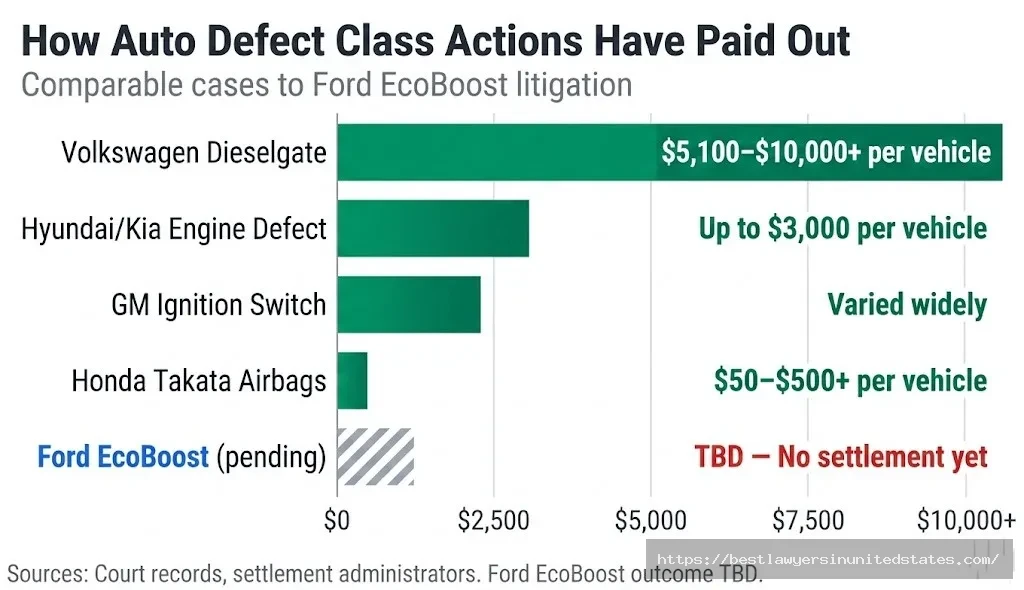
How Similar Auto Class Actions Have Paid Out
To give you a sense of what’s possible, here’s how comparable auto defect class actions settled:
| Case | Settlement Amount | Affected Vehicles | Individual Payout Range |
|---|---|---|---|
| Ford EcoBoost (current) | Pending | Potentially millions | TBD |
| Volkswagen Dieselgate | $14.7 billion | ~475,000 vehicles | $5,100–$10,000+ |
| GM Ignition Switch | $900 million | Millions | Varied widely |
| Honda Airbags (Takata) | $1.5 billion | Millions | $50–$500+ per vehicle |
| Hyundai/Kia Engine Defect | $760 million | 900,000 vehicles | Up to $3,000 |
The EcoBoost cases involve serious engine defects across a very large number of vehicles — which typically translates to meaningful individual settlements when resolved.
The Lemon Law Option (Potentially Worth More)
This is something most websites don’t tell you: if your vehicle qualifies under your state’s lemon law, an individual claim may pay far more than a class action settlement. Lemon law claims can result in a full vehicle buyback or replacement, plus attorney fees paid by Ford. The tradeoff is that opting out of the class action is typically required to pursue this path.
If you’ve had 3+ failed repair attempts for the same EcoBoost issue while under warranty, or your vehicle has been in the shop for 30+ cumulative days for this problem, speak with a lemon law attorney before making any decisions.
What You Should Do Right Now — Step by Step
Even though there’s no claim form open yet, what you do in 2026 matters enormously. Here’s your action plan.
Step 1: Identify Your Vehicle and Engine
Check your owner’s manual, door jamb sticker, or the National Highway Traffic Safety Administration (NHTSA) database at nhtsa.gov to confirm your exact engine size and model year. Make sure it falls within the ranges listed above.
Step 2: Gather and Organize All Documentation
This is the most critical step — do it now, before memories fade and papers get lost.
| Document | Why You Need It | Where to Get It |
|---|---|---|
| Vehicle purchase/lease agreement | Proves you owned the covered vehicle | Dealership, lender, DMV |
| Repair orders and invoices | Shows engine problems and costs | Dealership service department |
| Warranty claim records | Demonstrates Ford was on notice | Ford/dealer service history |
| NHTSA complaint confirmations | Evidence of reported defects | nhtsa.gov — file one if you haven’t |
| Out-of-pocket receipts | Supports reimbursement claim | Your own records |
| Photos/videos of symptoms | Visual evidence of defects | Your phone — take these now |
| Rental car receipts | Shows consequential damages | Rental company records |
| Written communications with Ford | Proves you sought resolution | Your email/mail records |
Step 3: File a Complaint with NHTSA
Go to nhtsa.gov and file a safety complaint if you haven’t already. This creates an official record, contributes to regulatory pressure on Ford, and establishes a timestamped account of your experience. It’s free and takes about 10 minutes.
Step 4: Contact the Law Firms Handling the Case
You can reach out directly to ask whether your vehicle is included and learn about your options:
- Capstone Law APC (Miller & Nelson cases): info@FordEcoboostLawsuit.com or info@FordEcoBoostEngineLawsuit.com | Phone: 888-508-6358
- Kershaw Talley Barlow (Miller case): (916) 345-2247 | ktblegal.com
- For attorney referrals: admin@bestlawyersinunitedstates.com
Step 5: Decide: Stay In or Opt Out?
Once the class gets certified and you receive a notice, you’ll have a choice:
- Stay in the class: Receive whatever the class settlement provides; give up the right to sue individually
- Opt out: Pursue your own claim (lemon law or individual lawsuit); potentially recover more, but you take on more risk and effort
Don’t make this decision without legal counsel, especially if you have high repair bills or a vehicle that’s been a persistent problem.
Step 6: Monitor for Class Certification and Settlement Notices
When the court certifies the class and a settlement is reached, a notice will be mailed to class members. Keep your address current with the court if you move. You can also monitor:
- FordEcoboostLawsuit.com
- FordEcoBoostEngineLawsuit.com
- ClassAction.org for updates
Step 7: File Your Claim When the Window Opens
Once a settlement is approved and a claim process opens, you’ll have a limited window to submit your claim. Missing this deadline means getting nothing. Set calendar reminders once you learn of a deadline.
Current Lawsuit Status — As of March 2026
Miller et al. v. Ford (1.5L, 1.6L, 2.0L) — Active Litigation
This is the most advanced of the EcoBoost cases. Filed originally in 2019–2020 and consolidated in December 2020, the Miller lawsuit has been working through the federal court system in the Eastern District of California for over five years. As of early 2026, the case is still in active litigation — no settlement has been announced. Class certification proceedings are ongoing, which is a key step that must happen before any settlement can be distributed.
Nelson et al. v. Ford (2.3L) — Early Stage
The Nelson case was filed in 2024 and expanded the covered vehicles to include popular models like the Mustang, Explorer, Ranger, and Bronco. It’s at an earlier stage than Miller, but both cases are pending before the same court, which could lead to coordination or consolidation.
Barkus et al. v. Ford (2.7L, 3.0L) — Newest Case
Filed in January 2025, this case covers the larger EcoBoost engines popular in F-150 trucks and Broncos. It’s the newest of the major EcoBoost lawsuits and is in early stages.
1.0L EcoBoost Lawsuit — Separate Track
The 1.0L case (covering EcoSport, Focus, and Fiesta) involves a different defect — a fracturing oil-drive belt tensioner arm rather than coolant intrusion. This case has a unique angle: internal Ford communications allegedly confirm the company knew about the defect since at least 2016.
What Happens Next?
The most important upcoming milestones to watch for:
- Class certification rulings — courts must formally certify the class before settlements can be distributed
- Discovery completion — attorneys are still gathering internal Ford documents
- Settlement negotiations — these typically happen after class certification; they can happen quickly once courts signal their direction
- Notice to class members — when a settlement is reached and preliminarily approved, mailed notices will go out
- Claim filing window — typically 60–120 days after notice goes out
The timeline for resolution is uncertain, but cases of this complexity often take 5–8 years from filing to final payment. With the Miller case filed in 2020, a resolution could be getting closer — but there are no guarantees.
Do You Need a Lawyer?
Quick Answer: You don’t need to hire a lawyer right now for most people. But you should absolutely consult one — for free — before making any decisions about opting out of the class action.
What You Can Do Yourself
Right now, the most important actions — gathering documents, filing an NHTSA complaint, and monitoring for case updates — you can handle on your own at no cost. Once a settlement is reached and a claim form opens, filing a basic claim is designed to be straightforward. Texas Roadhouse Lawsuit
When a Lawyer Matters Most
Consider getting legal help if:
- Your repair bills are high ($3,000 or more)
- Your vehicle has had multiple failed repairs for the same issue
- You’re wondering whether lemon law gives you a better path than the class action
- You receive a notice asking you to make an opt-out decision
- Your claim is denied or you receive pushback from Ford or a dealer
- You’ve already been offered a settlement by Ford directly — don’t accept without legal review
How to Get Free Help
The law firms handling these cases typically offer free consultations with no upfront cost — they only get paid if the case is successful. This is standard for class action work.
- Capstone Law APC: info@FordEcoboostLawsuit.com | 888-508-6358
- Kershaw Talley Barlow: (916) 345-2247
- General referrals: admin@bestlawyersinunitedstates.com
Frequently Asked Questions
What is the Ford EcoBoost class action lawsuit?
Quick Answer: It’s actually several lawsuits claiming Ford sold vehicles with EcoBoost engines containing a design defect that causes coolant to leak into the engine, leading to failure, fire risk, and expensive repairs — and that Ford knew about the problem but didn’t tell buyers.
The lawsuits argue that Ford’s “fixes” — warning sensors and software patches — addressed symptoms rather than the root cause, leaving owners with defective vehicles and growing repair bills.
Who is eligible to join the lawsuit?
Quick Answer: Generally, anyone who purchased or leased a covered Ford or Lincoln vehicle with a defective EcoBoost engine and experienced related problems may be included as a class member automatically.
You don’t “join” a class action — if the class is certified and your vehicle is covered, you’re typically included by default unless you opt out. The specific models and engine sizes are listed in the eligibility tables above. Contact the law firms if you’re unsure about your specific vehicle.
How much money could I get?
Quick Answer: No settlement amount exists yet, so no one can tell you a specific number. But compensation could include repair reimbursement, diminished value, rental costs, and other damages.
Individual payouts in auto defect class actions vary enormously — from under $100 to several thousand dollars — depending on the total settlement fund, how many claims are filed, and what tier your damages fall into. Owners with serious engine damage and documented repair costs typically receive more than those with minor issues.
Is there a deadline to file a claim?
Quick Answer: No claim deadline exists right now because no settlement has been reached. But acting now — documenting your records and filing an NHTSA complaint — protects your position.
Once a settlement is reached and the court sets a claim deadline, it will be firm. Missing it means receiving nothing. Sign up for updates at the case websites or with ClassAction.org to be notified when deadlines are announced.
How do I file a claim?
Quick Answer: No claim form exists yet. When one becomes available, it will be announced through official class notice, court filings, and the case websites.
When the time comes, you’ll likely be able to file online at a dedicated settlement website. You’ll need your vehicle information, purchase documentation, and records of the problems you experienced.
Do I need a lawyer to file a claim?
Quick Answer: No — class action claim forms are designed for individuals to complete without an attorney. But consult a lawyer before deciding whether to stay in the class or opt out.
What documents do I need to keep?
Quick Answer: Purchase/lease agreement, repair orders, warranty records, NHTSA complaint confirmation, out-of-pocket receipts, and any written communication with Ford or a dealer.
Don’t wait to organize these. The more documentation you have, the stronger your potential claim.
What if I don’t have my repair receipts anymore?
Quick Answer: Contact the dealership service department — they keep records. You can also request your vehicle’s repair history from Ford Customer Service.
Even if your personal copies are gone, dealerships and Ford maintain service records digitally in most cases. Call your dealership’s service department and ask for a printout of all service visits associated with your VIN.
When will I receive any payment?
Quick Answer: There’s no timeline yet. Settlement payments in complex class actions typically arrive 1–3 years after a settlement agreement is announced.
Here’s a realistic timeline once a settlement is announced: 2–4 months for preliminary court approval → class notice sent → 60–120 days for claims window → final court approval hearing → 3–6 months for payment processing. From announcement to check in hand can easily be 12–18 months.
How will I receive payment?
Quick Answer: Most auto class action settlements pay by mailed check or electronic payment. Some offer repair credits instead of cash for certain claim types.
The specific payment method will be outlined when a settlement is announced. Cash payments (check or electronic transfer) are typical for compensation-focused settlements.
Has the lawsuit been settled?
Quick Answer: No. As of March 2026, all major Ford EcoBoost class action lawsuits are in active litigation. No settlement has been reached or announced.
This is an important distinction from some other class actions that have finalized. The EcoBoost cases are still working through the courts.
Can I opt out of the class action?
Quick Answer: Yes — once the class is certified, you’ll have a window to opt out and pursue your own legal claim. You can’t opt out before class certification.
If you believe your individual damages are high enough to justify pursuing a separate lemon law or tort claim, opting out may make sense. This decision should be made with legal counsel.
What if I already sold or traded in my vehicle?
Quick Answer: You may still have a claim. Former owners who experienced EcoBoost problems during their ownership period are typically still eligible.
Keep your old purchase documents, any repair records from when you owned the vehicle, and any trade-in paperwork showing the vehicle’s value when you sold it.
What if I already paid for repairs out of pocket?
Quick Answer: That’s actually the basis for your claim. Documented out-of-pocket repair costs for EcoBoost defects are exactly what the lawsuits seek to recover.
Make sure you have copies of every repair invoice. If you paid at a non-Ford shop, those receipts count too as long as the repair relates to the defect described in the lawsuit.
Do I have to give up my right to sue Ford separately?
Quick Answer: If you stay in the class and accept the settlement, yes — you waive your right to bring an individual lawsuit over the same issues. This is why the opt-out decision matters.
For most people, the class settlement will be the most practical path. But for those with very high damages, opting out to pursue a stronger individual claim may be worth exploring.
What if I missed the deadline?
Quick Answer: Since no claim deadline exists yet, you haven’t missed anything. When a deadline is set, it will be strict — set up notifications now so you don’t miss it.
How do I report my EcoBoost problem to the government?
Quick Answer: File a complaint at nhtsa.gov. It’s free, takes about 10 minutes, and creates an official record that regulators and courts can see.
Go to nhtsa.gov/report-a-safety-problem, enter your VIN, and describe what happened. Each complaint contributes to the overall picture of the defect’s scope.
Could I pursue a lemon law claim instead?
Quick Answer: Possibly — and it could pay significantly more. If your vehicle had 3+ failed repair attempts for the same issue while under warranty, or spent 30+ days in the shop, consult a lemon law attorney before making any decisions about the class action.
Lemon law claims can result in a full vehicle buyback (the full amount you paid, including taxes and fees) plus legal fees paid by Ford. This is often far more valuable than a class action payment — but it requires opting out of the class, which has its own risks.
Will my settlement payment be taxed?
Quick Answer: It depends on what part of the payment compensates what. Reimbursement for property damage is generally not taxable; compensation for physical injury or emotional distress may have different treatment. Consult a tax professional when a settlement is reached.
Where can I find official information about the lawsuits?
Quick Answer: The most reliable sources are FordEcoboostLawsuit.com (Miller case), FordEcoBoostEngineLawsuit.com (Nelson case), and federal court records through PACER (pacer.gov).
You can also monitor ClassAction.org and CarComplaints.com for news and updates on both cases.
What if my engine caught fire or I was injured?
Quick Answer: This is a priority legal situation — contact an attorney immediately. You may have an individual personal injury or product liability claim that goes far beyond what a class settlement would provide.
Vehicle fires caused by the EcoBoost defect are alleged in the lawsuits. If you or a passenger experienced injury, or suffered property damage beyond the vehicle itself, your individual damages could far exceed anything available through a class settlement. Don’t rely on the class action alone.
The Bottom Line: Protect Yourself Now
The Ford EcoBoost class action lawsuits represent one of the more significant ongoing auto defect cases in the country, spanning multiple engine families, dozens of vehicle models, and potentially millions of affected owners. The litigation is active and advancing — but it hasn’t reached the payout stage yet.
What you do now matters. Get your documents organized. File an NHTSA complaint if you haven’t. Keep your address current so you receive any mailed class notices. And if your repair bills are substantial, talk to one of the law firms handling the case — consultations are free.
The owners who are best positioned to recover when these cases resolve are the ones who started paying attention early.
This article is for informational purposes only and does not constitute legal advice. The status of this litigation may change — consult an attorney for guidance specific to your situation. As of March 2026, no Ford EcoBoost class action settlement has been reached or approved.
