
The Cosmic Crisp apple lawsuit — actually a series of connected legal battles — centers on who has the right to grow and sell one of America’s most valuable new apple varieties. Washington State University (WSU) spent more than 20 years and tens of millions of dollars developing the Cosmic Crisp, and it has aggressively defended its intellectual property in federal courts. WSU won its first major case against a spinoff company and later filed a second patent infringement suit against an unlicensed nursery. There is no active consumer class action settlement with open claim deadlines as of early 2026 — but growers, nurseries, and agricultural businesses have real legal exposure, and consumers have valid questions about pesticide disclosures and labeling that could fuel future claims. Texas Roadhouse Lawsuit
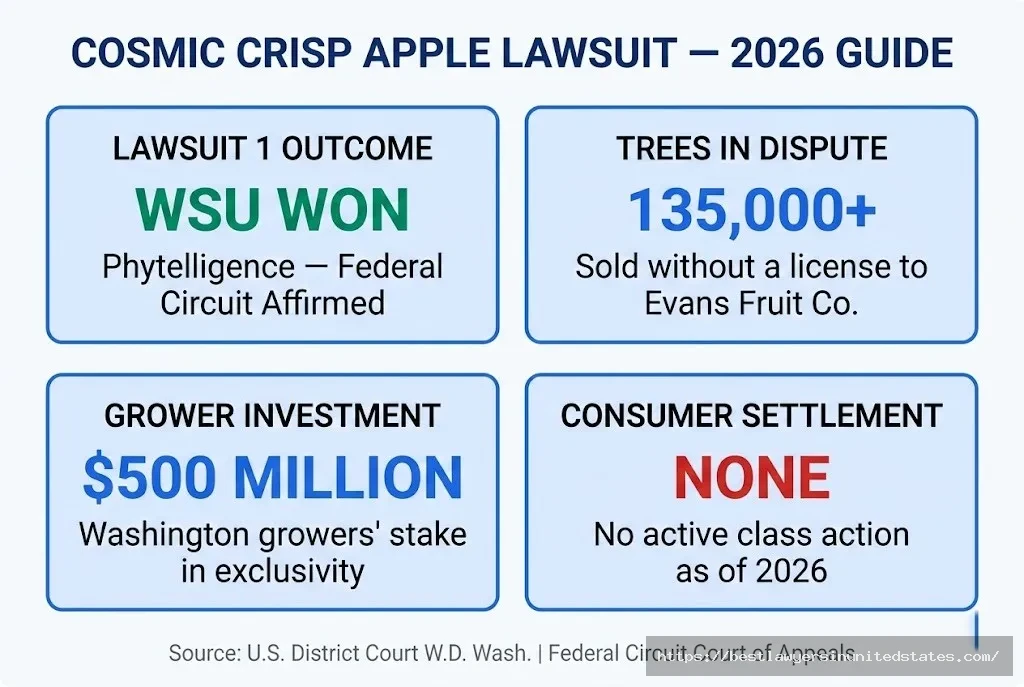
Quick Answer: The Cosmic Crisp apple lawsuits are intellectual property disputes in which Washington State University sued companies for propagating and selling its patented WA 38 apple trees without a license. WSU won its first case (Phytelligence, resolved ~2020–2021) and filed a second suit against Angel’s Grafting and Nursery in 2020. Consumers are not currently eligible to file claims in a class action settlement, but the legal history affects how the apple is grown, sold, and marketed — and consumer protection questions around pesticide labeling remain active in the food law space.
What Is the Cosmic Crisp Apple Lawsuit About?
Background: The Apple, the Patent, and the Business Model
The Cosmic Crisp — officially registered as plant variety WA 38 — didn’t happen by accident. WSU professor Bruce Barritt began crossing Honeycrisp and Enterprise apples in 1997, spending two full decades on research, testing, and commercialization before the first Cosmic Crisp appeared in grocery stores in December 2019. The university filed a plant patent in 2012, giving it legal control over who can propagate the tree.
To turn that patent into revenue, WSU partnered with Proprietary Variety Management (PVM), a Yakima, Washington-based organization that manages licenses for nurseries and growers. Washington apple growers — who collectively financed part of the apple’s development — were given at least 10 years of exclusive North American growing rights starting in 2019. That exclusivity window was worth a lot: growers had already invested an estimated half a billion dollars in planting Cosmic Crisp trees by the time the apple hit shelves. That high-stakes financial environment turned any unauthorized tree propagation into a serious legal threat.
The Core Legal Dispute
Two separate lawsuits have defined the Cosmic Crisp legal story:
- WSU vs. Phytelligence (2018–2021) — A dispute between WSU and a university spinoff over who could sell Cosmic Crisp trees.
- PVM/WSU vs. Angel’s Grafting and Nursery (2020–ongoing) — A patent infringement suit against a small nursery accused of propagating and selling tens of thousands of unlicensed WA 38 trees.
Both cases stem from the same core issue: WSU’s licensing agreement allows certain parties to grow WA 38 trees, but explicitly prohibits selling them to third parties without a separate commercial license. When those lines were crossed, WSU went to court.
Timeline of Key Legal Events
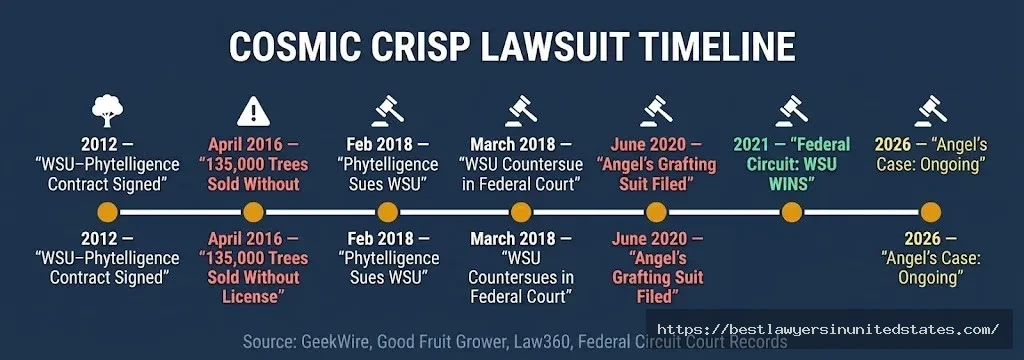
| Date | Event | Details |
|---|---|---|
| 1997–1998 | Research begins | WSU professor Bruce Barritt crosses Honeycrisp and Enterprise |
| 2012 | Plant patent filed | WA 38 patent granted; Phytelligence agreement signed |
| April 2016 | Alleged unauthorized sale | Phytelligence reportedly sold 135,000 trees to Evans Fruit Company |
| 2016–2020 | Angel’s Grafting activity | Nursery in Tieton, WA allegedly propagated unlicensed trees for multiple growers |
| January 2018 | WSU terminates Phytelligence agreement | Demands tree destruction, asserts breach of contract |
| February 26, 2018 | Phytelligence sues WSU | Filed in King County Superior Court, Seattle |
| March 8, 2018 | WSU countersues Phytelligence | Filed in U.S. District Court, Western District of Washington |
| December 2019 | Cosmic Crisp reaches retail | First consumer sale in history |
| 2020 (approx.) | WSU wins against Phytelligence | Federal court rules in WSU’s favor on contract and patent claims |
| 2021 | Federal Circuit affirms WSU win | Phytelligence appeals rejected; company later closes and declares bankruptcy |
| June 22, 2020 | Second lawsuit filed | PVM and WSU sue Angel’s Grafting and Nursery, U.S. District Court, Eastern Washington |
| 2021–present | Angel’s Grafting case proceeds | Status: litigation ongoing as of early 2026 |
Who Filed the Lawsuits?
Case 1 — Phytelligence: The legal battle was initiated by Phytelligence, which sued WSU first in February 2018, claiming WSU wrongly blocked them from commercializing Cosmic Crisp trees. WSU immediately countersued in federal court. Lead defendants in the WSU action included Phytelligence’s leadership; the law firms involved included WSU’s Office of the Attorney General (representing the university as a public institution). Phytelligence was founded in 2012 by individuals connected to WSU, including chief science officer and WSU professor Amit Dhingra.
Case 2 — Angel’s Grafting and Nursery: WSU and its licensing arm, Proprietary Variety Management, filed the complaint. The defendants are the owners of Angel’s Grafting and Nursery, located in Tieton, Washington. The suit was filed in the U.S. District Court for the Eastern District of Washington on June 22, 2020.
Key Allegations
In the Phytelligence Case, WSU alleged:
- Phytelligence sold approximately 135,000 Cosmic Crisp trees to Evans Fruit Company in April 2016 without the required commercial license
- The 2012 propagation agreement explicitly prohibited transferring or selling trees to third parties without a separate WSU contract
- Phytelligence breached its contract and infringed WSU’s plant patent
- WSU offered Phytelligence three pathways to obtain a commercial license; the company declined all three
Phytelligence alleged in its suit against WSU:
- WSU wrongfully blocked the company from commercializing trees it had a contractual right to sell
- The 2012 agreement granted Phytelligence the option to propagate WA 38 for commercial sale
- WSU’s actions caused substantial financial harm to the company
In the Angel’s Grafting Case, PVM/WSU alleged:
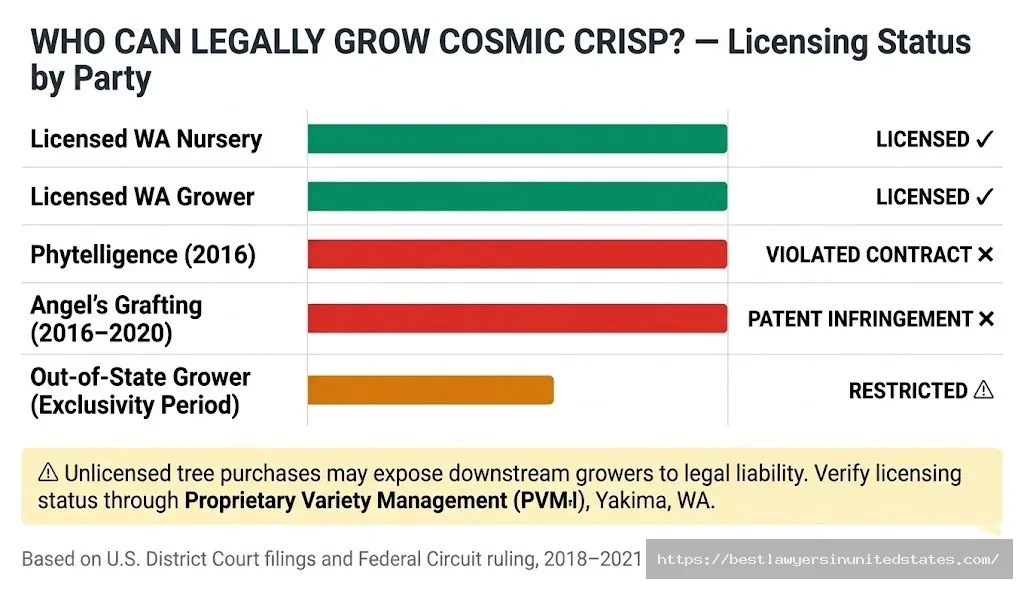
- Angel’s Grafting propagated tens of thousands of WA 38 trees between 2016 and 2020 without a license
- The nursery sold those trees to multiple growers, none of whom held valid licenses
- The owners knowingly violated the plant patent
- At least one affected grower destroyed his trees to avoid legal exposure
Phytelligence Case: Outcomes and What the Court Decided
WSU Wins — and the Federal Circuit Agrees
A federal judge in the Western District of Washington ruled in WSU’s favor, finding that the university had not violated the 2012 agreement when it terminated Phytelligence’s propagation rights and blocked unauthorized sales. The court agreed with WSU’s reading of the contract: growing trees was permitted; selling them was not.
Phytelligence appealed. The U.S. Court of Appeals for the Federal Circuit affirmed WSU’s win. The company could not overcome the plain language of its own contract. Following the loss, Phytelligence shut down operations and declared bankruptcy.
| Stage | Outcome |
|---|---|
| Trial Court (W.D. Wash.) | WSU wins on contract and patent claims |
| Federal Circuit Appeal | WSU win affirmed |
| Phytelligence fate | Company closed; declared bankruptcy |
| WA 38 exclusivity | Intact; WSU and PVM retain full control |
This outcome was significant not just for WSU, but for Washington’s 12,000+ apple growers who had collectively bet hundreds of millions on the Cosmic Crisp’s exclusive status. Byte Aligners Lawsuit
Angel’s Grafting and Nursery Case: What We Know
The Second Wave of Litigation
The 2020 suit against Angel’s Grafting and Nursery filled in a troubling gap: even after the Phytelligence dispute was resolved, unlicensed Cosmic Crisp trees had apparently continued circulating in the market. The complaint, filed June 22, 2020 in U.S. District Court of Eastern Washington, alleges that the Tieton, Washington nursery operated an unauthorized propagation operation for years.
The stakes were particularly high because of the 10-year North American exclusivity window. Every unlicensed tree planted by an unauthorized grower potentially diluted the return on investment for the thousands of Washington farmers who followed the rules, paid for licenses, and in some cases waited years to bring their orchards into production.
One grower reportedly pulled up and destroyed Cosmic Crisp trees after learning they came from an unlicensed source — a dramatic illustration of the real-world consequences of the legal situation.
| Allegation Detail | Information |
|---|---|
| Defendants | Owners of Angel’s Grafting and Nursery, Tieton, WA |
| Alleged activity period | 2016 to 2020 |
| Approximate trees involved | Tens of thousands |
| Number of unlicensed growers affected | Multiple (number not publicly specified) |
| Court | U.S. District Court, Eastern District of Washington |
| Filed | June 22, 2020 |
| Legal basis | Plant patent infringement |
| Current status | Litigation (status as of early 2026 not fully public) |
What Licensed Growers, Nurseries, and Agricultural Businesses Need to Know
The Licensing Framework — How It Actually Works
If you’re in the apple industry, the Cosmic Crisp licensing system works through PVM. Nurseries must obtain a license to propagate WA 38 trees. Growers must separately obtain a license to plant them. Retailers and marketers operate under trademark rules governing the “Cosmic Crisp” brand name.
| Party | What They Need | Who Grants It |
|---|---|---|
| Nursery | Propagation license | PVM / WSU |
| Grower | Planting license (10-yr exclusivity window for WA growers) | PVM |
| Out-of-state grower | Subject to exclusivity restrictions | PVM |
| International distributor | Separate marketing license | PVM / WSU |
| Retailer using “Cosmic Crisp” name | Trademark compliance | Trademark owner |
The Phytelligence case confirmed: ambiguous contract language does not override explicit restrictions on sales. If your agreement says you can grow but not sell, you cannot sell — even if you believe otherwise.
Consumer Side: Pesticide Concerns and Labeling Questions
A Different Legal Angle Some Attorneys Are Watching
Separate from the IP battles, some consumer protection attorneys and food safety advocates have raised questions about pesticide use and labeling on Cosmic Crisp apples. Apples are among the most pesticide-treated crops in American agriculture. The Cosmic Crisp’s long shelf life — reportedly up to a year in controlled storage — depends in part on post-harvest chemical treatments.
Claims in this space (not yet a certified class action as of early 2026) allege:
- Marketing emphasizing the apple’s “natural” freshness and long shelf life may not adequately disclose chemical treatments
- Pesticide residue levels, while within EPA limits, may not reflect what consumers expect when purchasing a premium-marketed apple
- Packaging does not clearly disclose all post-harvest chemical applications
Important note: As of early 2026, there is no certified class action, no settlement fund, and no claim filing deadline for consumers related to Cosmic Crisp apples. If this changes, it would likely be announced through official court documents, credible legal news outlets, or a settlement administrator website. Be skeptical of any website claiming you can file a claim right now for money from a Cosmic Crisp consumer settlement — no such settlement exists.
| Claim Type | Status (Early 2026) |
|---|---|
| WSU vs. Phytelligence (IP) | Resolved — WSU won |
| WSU/PVM vs. Angel’s Grafting (patent) | Litigation ongoing |
| Consumer class action (pesticides/labeling) | No certified class action; under watch |
| Consumer settlement with claim portal | Does NOT exist as of this writing |
How the Cosmic Crisp Lawsuits Compare to Similar Agricultural IP Cases
Seed and Plant Patent Disputes Are Common — and High-Stakes
The Cosmic Crisp cases fit into a broader pattern of universities and breeders using plant patents and licensing agreements to control high-value agricultural varieties. Similar disputes have arisen across the food industry.
| Case | Parties | Issue | Outcome |
|---|---|---|---|
| Cosmic Crisp (Phytelligence) | WSU vs. startup | Unauthorized tree sales | WSU won; Phytelligence bankrupt |
| Cosmic Crisp (Angel’s Grafting) | WSU/PVM vs. nursery | Unlicensed propagation | Ongoing |
| Monsanto vs. Bowman (2013) | Seed company vs. Indiana farmer | Unauthorized seed replanting | Monsanto won (U.S. Supreme Court) |
| SunWorld International vs. growers | Licensors vs. growers | Unauthorized propagation of table grapes | Settled |
| University of Minnesota Honeycrisp | UMN licensing disputes | Expired patents, royalty questions | Licensing restructured |
The consistent theme: when a university or breeder patents a crop variety, commercial rights belong to the patent holder — and courts have consistently backed that position.
What Makes the Cosmic Crisp Case Unique?
Three things set these lawsuits apart from typical agricultural IP disputes:
1. The Scale of Investment. Washington apple growers had planted an estimated 12 million trees and invested roughly $500 million before the first Cosmic Crisp reached a grocery shelf. That made every unauthorized tree a real economic threat to the entire industry ecosystem.
2. A University Suing Its Own Spinoff. The Phytelligence case was unusual because the defendant was a company founded by WSU faculty members and originally supported by the university. The dispute laid bare how quickly university-industry relationships can break down when commercialization rights are ambiguous.
3. National Media Attention on a New Apple Variety. The New York Times called the Cosmic Crisp “the most promising and important apple of the future.” When a product generates that level of hype, the legal battles around it get noticed well beyond agricultural trade publications.
Do You Need Legal Help? When to Contact an Attorney
If You’re a Grower, Nursery, or Agricultural Business
You should consult an agricultural IP attorney if:
- You purchased Cosmic Crisp trees and are unsure whether they came from a licensed source
- You were approached by someone offering to sell WA 38 trees outside the PVM licensing system
- You received a letter or legal notice from WSU or PVM
- You’re considering entering the apple-growing business and want to understand your rights and obligations
Being an unknowing downstream purchaser of unlicensed trees doesn’t necessarily protect you from legal exposure — the Angel’s Grafting case shows that growers who received unlicensed trees faced pressure to destroy their orchards. Camp Lejeune Lawsuit Lawyer
If You’re a Consumer
If you’re a regular shopper who has bought and eaten Cosmic Crisp apples, there’s no action for you to take right now. No consumer settlement exists. If a class action emerges in the future around pesticide labeling or false advertising, class members are typically notified directly by mail or through court-supervised notice programs.
If you have questions about food safety, pesticide exposure, or your consumer rights, resources like the Environmental Working Group (EWG), the FDA’s food safety portal, or a consumer protection attorney in your state can help.
Frequently Asked Questions
What is the Cosmic Crisp apple lawsuit?
It’s actually a series of lawsuits filed by Washington State University (WSU) to protect its patent on the WA 38 apple variety — sold as “Cosmic Crisp.” The main cases involve a university spinoff (Phytelligence) and a small nursery (Angel’s Grafting) accused of propagating and selling trees without a license.
Did WSU win the Cosmic Crisp lawsuit?
Yes — in the first case against Phytelligence. A federal district court ruled in WSU’s favor, the Federal Circuit Court of Appeals affirmed that ruling, and Phytelligence subsequently closed and declared bankruptcy. The second case against Angel’s Grafting and Nursery remains in litigation.
Is there a consumer class action settlement I can claim money from?
No. As of early 2026, there is no active consumer class action settlement related to Cosmic Crisp apples. Any website suggesting you can file a claim for compensation right now should be treated with skepticism. If a legitimate settlement is reached in the future, it will be announced through official court documents and a court-authorized settlement administrator.
What was Phytelligence accused of doing?
WSU alleged that Phytelligence — a Seattle-based company founded by WSU faculty — sold approximately 135,000 Cosmic Crisp trees to a commercial grower (Evans Fruit Company) in April 2016 without the commercial license required under its 2012 agreement with WSU. The contract allowed Phytelligence to grow trees, but not to sell them without a separate agreement.
What happened to Phytelligence?
After losing in federal court and having its appeal rejected by the Federal Circuit, Phytelligence shut down operations and declared bankruptcy. The company had raised more than $12 million and was once named to GeekWire’s list of Seattle’s most promising startups.
Who is Angel’s Grafting and Nursery?
A small nursery based in Tieton, Washington, accused in a 2020 federal lawsuit of propagating tens of thousands of WA 38 (Cosmic Crisp) apple trees without a license and selling them to growers between 2016 and 2020.
What is WA 38?
WA 38 is the official plant variety designation for the apple marketed as “Cosmic Crisp.” The name comes from Washington State University’s apple breeding program. The apple was developed by crossing Honeycrisp and Enterprise varieties starting in 1997–1998.
Why did WSU invest so heavily in developing the Cosmic Crisp?
Washington is responsible for roughly 70% of all apples grown in the United States. WSU’s apple breeding program is partly funded by Washington growers who wanted a premium variety to compete with apples like Honeycrisp. The Cosmic Crisp was designed to be crispier, longer-lasting, and more marketable — and the growers who funded its development were promised exclusive North American growing rights for at least 10 years.
What does the exclusivity period mean for growers?
Washington State growers had a 10-year exclusive window (starting 2019) to grow and sell Cosmic Crisp apples in North America. That means growers outside Washington — and outside the licensing system — could not legally sell apples under the Cosmic Crisp trademark during that period. Unauthorized trees threatened that entire competitive advantage.
Are there pesticide concerns with Cosmic Crisp apples?
Some consumer attorneys and food safety advocates have raised questions about pesticide residue levels and whether post-harvest chemical treatments are adequately disclosed to buyers of this premium-marketed product. These concerns reflect broader apple industry practices, not something specific to Cosmic Crisp alone. No lawsuit on this issue has been certified as a class action as of early 2026.
What if I bought Cosmic Crisp trees from an unlicensed source?
Contact an agricultural IP attorney immediately. The Angel’s Grafting lawsuit shows that downstream purchasers of unlicensed trees faced real legal pressure — including being asked to destroy their orchards. Not knowing the trees were unlicensed may affect your liability exposure, but it doesn’t necessarily eliminate it.
Where can I get a legitimate Cosmic Crisp growing license?
Contact Proprietary Variety Management (PVM) in Yakima, Washington. PVM is WSU’s authorized licensing partner for the Cosmic Crisp variety.
Does this lawsuit affect the price or availability of Cosmic Crisp apples in stores?
Generally, no. WSU and PVM consistently stated during litigation that the lawsuits were not intended to disrupt the market. The Cosmic Crisp launched on schedule in December 2019, and production has grown steadily since. From a consumer perspective, you can continue buying Cosmic Crisp apples normally.
Is “Cosmic Crisp” a trademark?
Yes. “Cosmic Crisp” is a registered trademark. Using that name to market unlicensed apples or trees constitutes trademark infringement in addition to any plant patent violations.
Could new consumer lawsuits emerge around Cosmic Crisp?
It’s possible. As the apple’s market share grows and food labeling litigation remains active across the agricultural sector, issues around pesticide disclosure, marketing claims, and supply chain transparency could produce future consumer claims. Monitoring food law publications and class action tracking sites is the best way to stay current.
How to Stay Informed About Future Cosmic Crisp Legal Developments
If you’re in the agriculture industry, a food industry professional, or a consumer who wants to track this issue, here’s how to monitor it:
- Court filings: Search PACER (Public Access to Court Electronic Records) at pacer.gov using case terms like “WA 38,” “Proprietary Variety Management,” or “Cosmic Crisp”
- Agricultural trade press: Good Fruit Grower (goodfruit.com) has covered these cases thoroughly
- Food law news: Food Safety News and Bloomberg Law track food and agricultural IP litigation
- WSU updates: Washington State University’s communications office occasionally issues statements on significant case developments
If a consumer class action is ever filed and certified, affected people will typically receive direct mail notice — you don’t need to monitor anything proactively to participate as a class member.
The Bigger Picture: What These Lawsuits Mean for Agriculture
The Cosmic Crisp lawsuits are a preview of where agricultural IP law is headed. As universities, private breeders, and agricultural technology companies develop proprietary crop varieties — whether apples, wheat, soybeans, or specialty produce — the licensing frameworks around those varieties become enormously valuable. And where there’s value, there’s litigation.
For growers and nurseries, the lesson from the Cosmic Crisp cases is clear: read licensing agreements carefully, verify the source of any propagating material, and get everything in writing. The Phytelligence case shows that even a well-funded startup with a university connection can find itself locked out of a market it thought it had rights to — and ultimately out of business entirely.
For consumers, the relevant questions are less about the lawsuits themselves and more about what they reveal: when a single company controls the intellectual property behind a food product, that control shapes who can grow it, where it’s sold, and how it’s marketed. Those are questions worth asking about any premium agricultural product — not just the Cosmic Crisp.
This article is for informational purposes only and does not constitute legal advice. If you have questions about your specific situation — whether as a grower, nursery operator, or consumer — consult a licensed attorney in your state. Information reflects publicly available court records and news reporting as of early 2026.
