
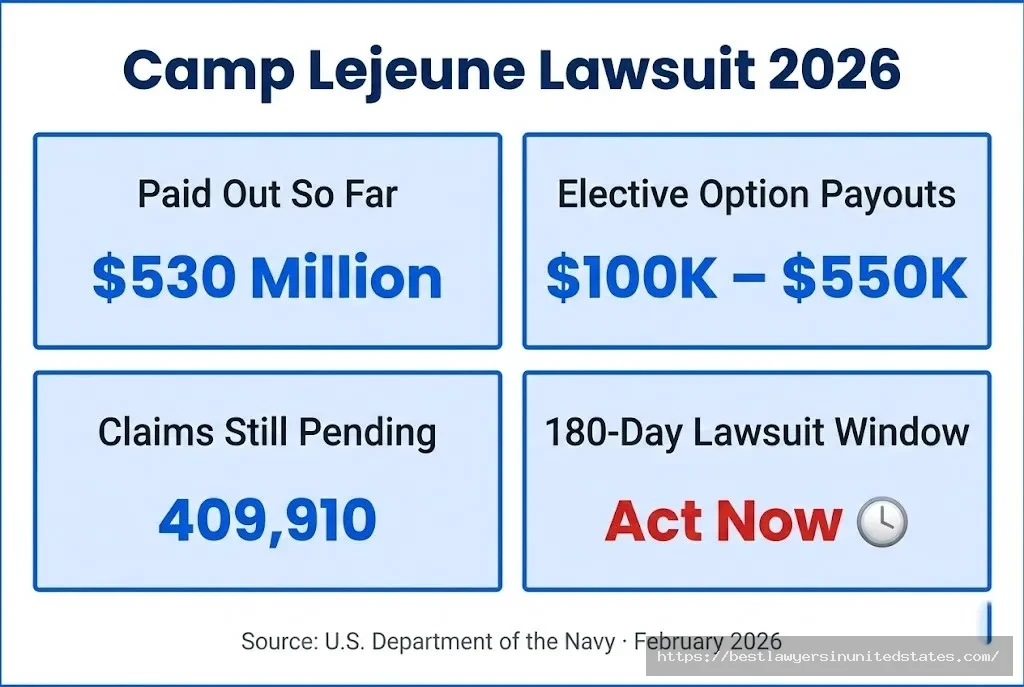
The Camp Lejeune lawsuit involves one of the largest toxic water contamination cases in U.S. history — over one million military personnel, families, and civilian workers were exposed to cancer-causing chemicals at the base between 1953 and 1987. The government has already paid $530 million through its fast-track Elective Option program, with payouts ranging from $100,000 to $550,000 per qualifying case. The administrative claims deadline passed on August 10, 2024 — but if your claim was denied or went unanswered for six months, you may still have a 180-day window to file a federal lawsuit. ogx lawsuit
Quick Answer: Camp Lejeune victims who lived or worked on base for 30+ days between August 1953 and December 1987 and developed a qualifying illness may be entitled to $100,000 to over $1 million in compensation. The original claim filing deadline was August 10, 2024, but options remain open in 2026 for many claimants. Hiring an experienced Camp Lejeune lawsuit lawyer is the most important step you can take right now.
This guide covers everything you need to know in 2026: who still qualifies, what compensation looks like, how the Elective Option works, and why having the right lawyer could be the difference between a lowball offer and the full value of your case. Costco Lawsuit 2026
What Is the Camp Lejeune Lawsuit About?
Background of the Contamination
For more than three decades, the drinking water at Marine Corps Base Camp Lejeune in Jacksonville, North Carolina was quietly poisoning the people who lived and worked there. Between August 1953 and December 1987, at least two water treatment facilities — Tarawa Terrace and Hadnot Point — were contaminated with industrial chemicals at levels far exceeding safe limits.
The primary contaminants included trichloroethylene (TCE), perchloroethylene (PCE), benzene, and vinyl chloride. These are known carcinogens. Marines, their spouses, their children, civilian employees, and even babies in the womb were drinking, bathing in, and cooking with water laced with these chemicals — often for years at a time. Estimates suggest over one million people were exposed during this period.
The government knew about the contamination as far back as the early 1980s but took years to act. Affected families spent decades unable to hold the government accountable due to sovereign immunity protections. That changed in 2022.
Timeline of Key Events
| Date | Event | Details |
|---|---|---|
| 1953 | Contamination begins | Toxic chemicals enter Camp Lejeune’s water supply |
| Early 1980s | Government discovers problem | Internal reports identify contaminated wells |
| 1985 | Contaminated wells shut down | Years after initial discovery |
| 1987 | Contamination period officially ends | December 31, 1987 |
| 2012 | Honoring America’s Veterans Act | First law authorizing VA benefits for Camp Lejeune victims |
| August 10, 2022 | Camp Lejeune Justice Act signed | Part of the Honoring Our PACT Act; 2-year claim window opens |
| September 2023 | Elective Option launched | DOJ and Navy announce fast-track settlement program |
| July 2023 | Lead counsel appointed | Weitz & Luxenberg’s Robin Greenwald named co-lead counsel |
| August 10, 2024 | Administrative claims deadline | Last day to file a claim with the Department of the Navy |
| January 2026 | 409,910 claims still pending | Over 3,700 federal lawsuits filed in Eastern District of NC |
| 2026 (expected) | First bellwether trials begin | Will set precedent for all remaining cases |
| 2026 (projected) | Settlement matrix development | Settlement Masters surveying 2,400 claimants |
Who Filed the Lawsuit?
This is not a traditional class action settlement. Instead, under the Camp Lejeune Justice Act (CLJA), individuals file their own claims against the U.S. federal government — specifically the Department of the Navy. Over 546,500 administrative claims were filed with the Navy before the August 2024 deadline. More than 3,700 of those have escalated into federal lawsuits filed in the U.S. District Court for the Eastern District of North Carolina.
Lead plaintiff counsel includes Weitz & Luxenberg, which was appointed by the court in July 2023 to help coordinate the massive litigation. The defendants are the United States government, represented by the Department of Justice.
What Are the Allegations?
The core allegation is that the U.S. government was negligent in allowing contaminated water to flow to residents for decades, and then slow to act once the problem was discovered.
Key claims include:
- Chemical negligence: TCE, PCE, benzene, and vinyl chloride contaminated water supplies at dangerous concentrations, in some cases 70 times above safe limits
- Failure to warn: The government knew about contamination as early as the early 1980s but failed to notify residents or shut down wells quickly
- Causal connection to cancer: Federal agencies have confirmed that contaminants at Camp Lejeune are directly linked to at least 15 serious illnesses
- Sovereign immunity abuse: For decades, the government used legal immunity to block victims from seeking justice, until Congress passed the CLJA in 2022
- Ongoing delays: Critics and attorneys allege the DOJ continues to use delay tactics — including unnecessary medical exams and motion practice — to minimize payouts
Who Qualifies for the Camp Lejeune Lawsuit?
Quick Answer: You may qualify if you lived, worked, or were stationed at Camp Lejeune for at least 30 days between August 1, 1953, and December 31, 1987, and developed a qualifying illness. People exposed in utero also qualify. You need proof of your presence at the base and medical records documenting your diagnosis.
Eligibility Requirements
| Requirement | Details | Documentation Needed |
|---|---|---|
| Time at Camp Lejeune | At least 30 days between Aug. 1, 1953 and Dec. 31, 1987 | DD-214, orders, housing records, pay stubs |
| Qualifying illness | Diagnosed with a covered condition (see list below) | Medical records, pathology reports |
| Diagnosis timing | Diagnosed 2–35 years after last exposure | Medical records with date of diagnosis |
| Diagnosis date | Must be prior to August 10, 2022 for Elective Option | Medical records |
| Relationship to victim | Claimant, family member, or estate of deceased victim | Birth certificate, marriage certificate, death certificate |
You don’t have to be a Marine to qualify. Veterans of all branches, military family members (including children and spouses), civilian employees, and contractors who worked on base are all covered. Babies who were exposed in utero — meaning their mothers were at Camp Lejeune while pregnant — also qualify under the law.
Qualifying Illnesses (Full List)
The Agency for Toxic Substances and Disease Registry (ATSDR) has identified specific conditions with a scientifically proven link to the contaminants found at Camp Lejeune. They are divided into two tiers based on the strength of the causal evidence.
| Illness Category | Condition | Tier |
|---|---|---|
| Cancer | Bladder cancer | Tier 1 |
| Cancer | Kidney cancer | Tier 1 |
| Cancer | Liver cancer | Tier 1 |
| Cancer | Non-Hodgkin’s lymphoma | Tier 1 |
| Cancer | Leukemia | Tier 1 |
| Cancer | Multiple myeloma | Tier 2 |
| Cancer | Breast cancer | Tier 2 |
| Cancer | Lung cancer | Tier 2 |
| Cancer | Esophageal cancer | Tier 2 |
| Neurological | Parkinson’s disease | Tier 2 |
| Blood | Aplastic anemia | Tier 2 |
| Blood | Myelodysplastic syndromes | Tier 2 |
| Kidney | End-stage renal disease | Tier 2 |
| Autoimmune | Scleroderma/systemic sclerosis | Tier 2 |
| Reproductive | Female infertility, miscarriage | Tier 2 |
| Other | Neurobehavioral effects, renal toxicity | Tier 2 |
Who Does NOT Qualify?
You are generally not eligible if:
- ❌ You were at Camp Lejeune after December 31, 1987
- ❌ You spent fewer than 30 days at the base during the covered period
- ❌ Your illness was first diagnosed before you were exposed, or more than 35 years after your last exposure
- ❌ Your condition is not on the qualifying illness list
- ❌ The administrative claim deadline passed and you either didn’t file a claim or your claim wasn’t denied or ignored for 6+ months
Required Documentation
| Document | Why It’s Needed | Where to Find It | Alternative |
|---|---|---|---|
| DD-214 / Discharge Papers | Proves military service and base assignment | National Archives (archives.gov) | Unit orders, pay records |
| Base Assignment Orders | Shows you were stationed at Camp Lejeune | Personnel records | Housing or base records |
| Housing Records | Proves you lived on base | Base records, personal files | Utility bills, school records |
| Medical Records | Confirms diagnosis and date | Doctor or hospital | VA medical records |
| VA Disability Award | Can substitute for some proof requirements | VA.gov | N/A |
| Death Certificate (if applicable) | For wrongful death claims | State vital records office | Long-form death certificate with cause |
How Much Money Can You Get?
Quick Answer: Through the government’s fast-track Elective Option, payouts range from $100,000 to $550,000 depending on your illness tier and length of exposure. For cases that go to litigation, estimates from legal experts range from $25,000 to over $1 million. The Congressional Budget Office projected the government will pay over $22 billion total across all claims.
The Elective Option Payout Grid
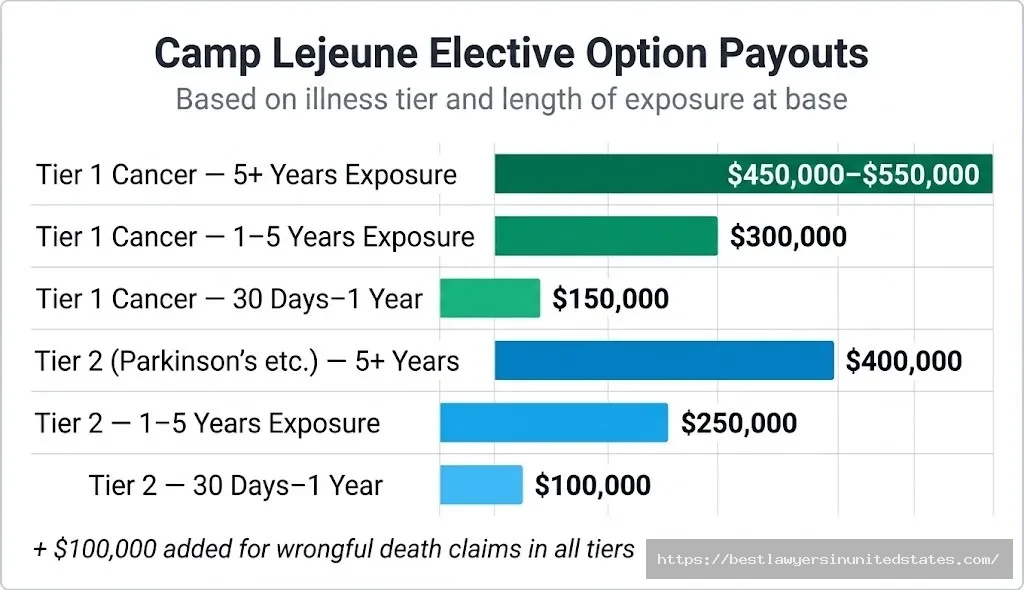
The Elective Option uses a 2-by-3 grid: two illness tiers (Tier 1 and Tier 2) crossed with three exposure durations. Additional compensation applies for wrongful death claims.
| Illness Tier | Exposure Duration | Estimated EO Payout | Add for Death |
|---|---|---|---|
| Tier 1 (bladder, kidney, liver, NHL, leukemia) | 30 days – 1 year | $150,000 | +$100,000 |
| Tier 1 | 1–5 years | $300,000 | +$100,000 |
| Tier 1 | More than 5 years | $450,000–$550,000 | +$100,000 |
| Tier 2 (Parkinson’s, multiple myeloma, others) | 30 days – 1 year | $100,000 | +$100,000 |
| Tier 2 | 1–5 years | $250,000 | +$100,000 |
| Tier 2 | More than 5 years | $400,000 | +$100,000 |
Important warning from legal experts: Many attorneys — including those who represent thousands of claimants — believe the Elective Option amounts are significantly lower than what these cases are worth at trial. For Parkinson’s disease alone, early estimates suggested trial verdicts could reach $1 million to $1.5 million per case. The government designed the EO to reduce its exposure, not to make victims whole.
Litigation Settlement Estimates
For claims that proceed through the courts rather than the Elective Option:
| Case Type | Estimated Settlement Range | Notes |
|---|---|---|
| Tier 1 illness (cancer) – minor exposure | $25,000–$200,000 | Limited documentation |
| Tier 1 illness (cancer) – significant exposure | $200,000–$600,000 | Strong evidence |
| Tier 1 illness (cancer) – long-term/severe | $600,000–$1 million+ | Documented, severe outcomes |
| Parkinson’s disease | $1 million–$1.5 million (estimated) | Based on pre-trial projections |
| Wrongful death (any tier) | Add $100,000–$500,000+ | Depends on circumstances |
Factors That Affect Your Payout
How much you ultimately receive depends on several key factors:
- Your diagnosis — Tier 1 illnesses receive higher amounts than Tier 2
- Length of exposure — More time at Camp Lejeune typically means more compensation
- Whether you accept the EO or litigate — Litigation may yield more, but takes longer
- Whether you (or your loved one) died from the illness — Wrongful death adds $100,000 minimum in the EO program
- Quality of your documentation — Better records = stronger case = higher offers
- Bellwether trial outcomes — The first trial verdicts in 2026 will set values for all remaining cases
Payment Timeline
| Stage | Timeframe | What Happens |
|---|---|---|
| Elective Option offer accepted | Within 60 days of acceptance | Government pays EO settlement |
| Administrative claim submitted | Ongoing | Navy reviews for EO eligibility |
| No response after 6 months | Triggers your right to sue | File federal lawsuit within 180 days |
| Federal lawsuit filed | Underway in 2026 | Discovery, motions, preparation |
| Bellwether trials | Expected 2026 | Sets precedent values |
| Global settlement framework | Projected 2026–2027 | Settlement matrix developed |
| Individual case resolution | After global framework | Varies by case |
Why You Need a Camp Lejeune Lawsuit Lawyer
This is not the kind of case you want to handle on your own. The Camp Lejeune litigation is one of the most complex mass torts ever pursued against the U.S. government. Here’s what’s at stake.
The Elective Option Is Designed to Save the Government Money
The DOJ and Department of the Navy created the Elective Option without input from victim attorneys. Legal experts who represent Camp Lejeune claimants are nearly unanimous: the EO amounts are significantly lower than what these cases would be worth at trial. Without a lawyer reviewing your offer, you might accept $150,000 when your case could be worth $800,000 or more in litigation.
An experienced Camp Lejeune lawyer will:
- Review your specific facts and medical records to assess your case’s true value
- Advise you whether to accept an EO offer or hold out for litigation
- File your federal lawsuit before the 180-day deadline expires if your claim was denied or ignored
- Navigate the complex Eastern District of North Carolina court system
- Monitor bellwether trial outcomes and advise you on timing
How Camp Lejeune Attorneys Get Paid
You don’t pay anything upfront. Camp Lejeune lawyers work on contingency, meaning they only get paid if you win. Attorney fees are capped by law:
- 20% of your settlement if your case resolves before a lawsuit is filed
- 25% of your settlement if your case resolves after a lawsuit is filed
This means hiring a lawyer costs you nothing out of pocket. It’s a no-risk decision.
When a Lawyer Is Especially Critical
Consider contacting an attorney immediately if:
- Your claim was denied by the Navy
- Your claim has been pending for 6+ months with no response (your 180-day window to sue may be ticking)
- You received an Elective Option offer and aren’t sure whether to accept it
- Your loved one died from a qualifying illness
- You’re unsure whether your condition qualifies
- Your records are incomplete or partially missing
Choosing the Right Camp Lejeune Lawyer
Not every personal injury attorney is equipped to handle this litigation. Look for these qualifications:
- Mass tort experience — Camp Lejeune is a mass tort, not a standard personal injury case
- Environmental/toxic tort background — Experience with chemical exposure cases is directly relevant
- Knowledge of the CLJA — Your lawyer should be deeply familiar with the Camp Lejeune Justice Act and the Eastern District of North Carolina court
- No upfront fees — All legitimate Camp Lejeune attorneys work on contingency
- No pressure tactics — A good lawyer explains your options honestly and lets you decide
For attorney referrals, contact: [email protected]
How to Protect Your Rights in 2026
⚠️ CRITICAL: If you filed an administrative claim before August 10, 2024, and have received no response for 6+ months — or were denied — you have only 180 days to file a federal lawsuit. This window is strict. Missing it could permanently bar you from recovery.

Step-by-Step: What to Do Right Now
Step 1: Confirm you filed before August 10, 2024 The administrative claims deadline has passed. If you never filed, your options are extremely limited. Consult an attorney immediately to assess any remaining pathways.
Step 2: Check your claim status Log into the Navy’s official portal at navy.mil/clja or contact the Navy claims office directly to find out if your claim has been evaluated.
Step 3: Calculate your 180-day deadline If your claim was denied, or if 6 months have passed since you filed with no response, start counting from that date. You have 180 days from that point to file a federal lawsuit. Do not wait.
Step 4: Contact a Camp Lejeune lawyer immediately Even if you’re unsure whether you have a case, a free consultation with a qualified attorney is the fastest way to find out. This costs you nothing. GBRS Group Lawsuit
Step 5: Gather your documents Start pulling together your evidence. Key documents include:
- Military orders or DD-214 showing assignment to Camp Lejeune
- Housing records, utility bills, school enrollment from the base
- All medical records related to your qualifying condition
- VA disability award letters (if applicable)
- Long-form death certificate (if filing on behalf of a deceased family member)
Step 6: Evaluate any Elective Option offer with your lawyer If you’ve received an EO offer, don’t accept or reject it without consulting your attorney. You have 60 days to respond to an EO offer. Your lawyer can tell you if it’s fair or if litigation would likely yield more.
Step 7: Monitor bellwether trial outcomes The first test trials expected in 2026 will set the value for remaining cases. Your attorney should be tracking these closely and advising you accordingly.
Current Status & 2026 Updates
Where Things Stand as of February 2026
The Camp Lejeune litigation is at a critical turning point. Here’s the current picture:
- 409,910 administrative claims remain pending with the Department of the Navy
- Over 3,700 federal lawsuits have been filed in the Eastern District of North Carolina
- $530 million has been paid out so far through the Elective Option program
- The first bellwether trials are expected to begin in 2026, after multiple delays throughout 2025
- Settlement Masters are actively surveying approximately 2,400 claimants to build a payment matrix — a draft framework could be submitted to the court in 2026
- Daubert motions (challenges to expert testimony) are pending before the court and must be resolved before trials begin
- December 2025 settlement discussions were described as “productive” by both sides
The DOJ’s Strategy
The government is not making this easy. Independent medical exams (IMEs) ordered by the DOJ have drawn criticism from plaintiff attorneys for invasive questioning, excessive testing, and attempts to downplay injuries. Throughout 2025, the government repeatedly requested trial extensions, which the court granted. Critics say delay is the DOJ’s primary strategy — many claimants are elderly or in poor health, and some have died waiting.
If a Camp Lejeune plaintiff passes away before their case is resolved, the estate can pursue a wrongful death claim — but the government’s delay tactics make this a painful reality for many families.
What to Expect in 2026
| Expected Date | Event |
|---|---|
| Early 2026 | Court rules on Daubert motions (expert testimony challenges) |
| 2026 (TBD) | First bellwether trials begin |
| 2026 (projected) | Draft settlement matrix submitted to court |
| 2026–2027 | Potential global settlement framework negotiations |
Camp Lejeune vs. Similar Mass Tort Lawsuits
| Lawsuit | Settlement Fund | Affected Parties | Payout Range | Status |
|---|---|---|---|---|
| Camp Lejeune Water Contamination | $22B+ projected | 1 million+ | $100K–$1M+ | Active litigation, 2026 |
| Flint, Michigan Water Crisis | $626 million | ~8,000 residents | $500–$150K | Settled 2021 |
| Roundup (Bayer/Monsanto) | $10.9 billion | ~100,000 plaintiffs | Varies widely | Ongoing settlements |
| 3M Earplug Veterans | $6.01 billion | 250,000+ veterans | $0–$300K+ | Settled 2023 |
| NEC Baby Formula | Ongoing | Premature infants | Varies | Active trials |
Camp Lejeune stands apart for its sheer scale and the fact that the defendant is the U.S. federal government. Unlike corporate defendants, the government has essentially unlimited resources to delay and fight claims — which is exactly why having the right legal representation matters so much.
Frequently Asked Questions
What is the Camp Lejeune lawsuit?
Quick Answer: It’s litigation under the Camp Lejeune Justice Act of 2022 that allows people who lived or worked at Camp Lejeune between 1953 and 1987 to sue the U.S. government for illnesses caused by contaminated drinking water.
The Camp Lejeune Justice Act was signed into law as part of the Honoring Our PACT Act on August 10, 2022. It gave victims a two-year window to file claims against the federal government — something that had previously been blocked by sovereign immunity. Over 546,500 people filed before the August 10, 2024 deadline.
Did the filing deadline already pass?
Quick Answer: Yes. The administrative claims deadline was August 10, 2024. However, if you filed before that date and your claim was denied or went unanswered for 6+ months, you still have 180 days from that point to file a federal lawsuit.
If you never filed a claim at all, your options are very limited. Contact an attorney immediately to see if any pathway remains open in your specific situation.
Who qualifies for the Camp Lejeune lawsuit?
Quick Answer: Anyone who lived, worked, or was stationed at Camp Lejeune for at least 30 cumulative days between August 1, 1953 and December 31, 1987, and who developed a qualifying illness, may qualify.
This includes veterans of all branches, military spouses and children, civilian employees, and people who were exposed in utero. The illness must be on the ATSDR’s list of qualifying conditions and must have been diagnosed between 2 and 35 years after your last exposure at the base.
How much money will I receive?
Quick Answer: Elective Option payouts range from $100,000 to $550,000. Litigation settlements could potentially be significantly higher — experts project $1 million or more for serious cases like Parkinson’s disease.
The amount depends on your specific diagnosis, how long you were at Camp Lejeune, your evidence quality, and whether you accept the Elective Option or pursue litigation. An attorney can give you a realistic estimate for your situation.
What is the Elective Option?
Quick Answer: It’s a fast-track settlement program the Department of Justice and Navy created to pay qualifying claimants quickly — typically within 60 days of acceptance — without going to trial.
The EO uses a tiered payout structure based on your illness (Tier 1 or Tier 2) and your length of exposure. While it offers speed and certainty, many attorneys believe the amounts are significantly below what cases would be worth at trial. You can reject an EO offer and proceed with litigation instead.
Should I accept an Elective Option offer?
Quick Answer: Don’t decide without talking to a lawyer first. Many experts say EO offers are lower than fair value for most cases.
This is one of the most important decisions you’ll make in your Camp Lejeune case. Accepting an EO offer permanently waives your right to sue for that specific claim. If you need money now and your health is declining, the EO may make sense. If you can afford to wait, litigation may yield substantially more — especially after bellwether trial verdicts establish higher precedent values in 2026.
Do I need a lawyer to file a Camp Lejeune claim?
Quick Answer: Technically no, but practically yes — especially to evaluate EO offers, file a federal lawsuit, and maximize your compensation.
The original administrative claims process was designed for individuals to file on their own. But once you’re in litigation or evaluating a settlement offer, legal expertise is critical. Attorneys work on contingency (20–25%), so there’s no upfront cost and no financial risk.
What documents do I need?
Quick Answer: Military records proving your time at Camp Lejeune (DD-214, orders, housing records) and medical records confirming your diagnosis.
If you have a VA disability rating for a qualifying condition, that can substitute for some proof requirements under the Elective Option. For wrongful death claims, you’ll also need a long-form death certificate listing the cause of death or a signed letter from the treating physician.
What if I don’t have all my records?
Quick Answer: Don’t assume you can’t file just because your records are incomplete. An attorney can help you find alternatives and gather evidence you might not know about.
Military records can be requested through the National Archives at archives.gov. The VA database may also contain relevant information. Base housing records, utility bills, school enrollment, and even photographs can help establish that you were at Camp Lejeune during the covered period.
My claim was denied. What can I do?
Quick Answer: You have 180 days from the date of denial to file a federal lawsuit in the Eastern District of North Carolina.
Contact a Camp Lejeune attorney immediately if your claim was denied. The 180-day window is firm, and once it passes, you lose your right to sue. An attorney can file your lawsuit quickly and begin building your case.
My claim has been pending for over 6 months with no response. Now what?
Quick Answer: Six months of silence from the Navy triggers your right to file a federal lawsuit — and your 180-day window has started counting.
This is one of the most time-sensitive situations in the Camp Lejeune litigation. If the Navy hasn’t responded to your claim in 6 months, the law treats this as a de facto denial. You have 180 days from that 6-month mark to file in federal court. Act now.
What if my loved one died from a Camp Lejeune illness?
Quick Answer: The estate or surviving family members can file a wrongful death claim. In the Elective Option, an additional $100,000 is added on top of the standard illness-based payout.
Wrongful death claims require additional documentation, including a long-form death certificate showing the illness caused or contributed to death, or a letter from the treating physician. Filing a wrongful death claim is more complex than a standard claim — an attorney is strongly advised.
Can I receive VA benefits AND a Camp Lejeune settlement?
Quick Answer: Yes. Camp Lejeune CLJA settlements and VA disability benefits are legally separate and you can receive both.
The VA’s disability compensation for Camp Lejeune conditions and a CLJA claim settlement are different programs. One does not automatically offset the other, though there may be some offsets in specific circumstances. Your attorney can advise you on how your specific VA benefits might interact with any settlement. Can You Be Notified of a Lawsuit by Phone?
What are bellwether trials and why do they matter?
Quick Answer: Bellwether trials are the first test cases to go to trial. Their verdicts establish baseline settlement values for all remaining Camp Lejeune cases.
When a jury (or judge, since these are bench trials) decides a bellwether case worth $800,000, that becomes a reference point for every similar case. This is why the first Camp Lejeune trials expected in 2026 are so critical — they’ll shape the value of hundreds of thousands of pending claims. Many attorneys are advising clients to wait for these verdicts before accepting EO offers.
Will Camp Lejeune settlements be taxed?
Quick Answer: In most cases, compensation for physical injuries and illness is not taxable under IRS rules. However, consult a tax professional for your specific situation.
Under Section 104 of the Internal Revenue Code, damages received for physical injuries or physical illness are generally excluded from gross income. Camp Lejeune settlements that compensate for illness, medical expenses, and related damages typically fall under this exclusion.
When will I receive my payment?
Quick Answer: Elective Option payments come within 60 days of acceptance. Litigation settlements could take 2–5+ years depending on how the bellwether trials and global settlement negotiations unfold.
If you’re in poor health or need funds urgently, the EO’s 60-day payment timeline may be the most important factor in your decision. If you’re able to wait and want to maximize your recovery, litigation — while slower — is likely to produce higher results, especially once 2026 bellwether verdicts are handed down.
How do I check my claim status?
Quick Answer: Visit the official Navy claims portal at navy.mil/clja or contact the Navy claims office directly.
You should also stay in regular contact with your attorney if you have one. Claim statuses can change, EO offers can arrive without advance notice, and your response deadlines may be stricter than you realize.
What if the global settlement falls apart?
Quick Answer: Individual cases would still proceed through litigation. The bellwether trials would continue to set values, and the court would work through the 3,700+ federal lawsuits one by one or in groups.
The Settlement Masters working on the payment matrix could be unsuccessful — the DOJ would have to agree to any framework, and there’s no guarantee that happens. Your attorney should be prepared to litigate your case aggressively regardless of how the global settlement negotiations go.
I was exposed in utero. Can I file a claim?
Quick Answer: Yes. People who were in their mother’s womb while their mother lived or worked at Camp Lejeune during the covered period are eligible to file claims.
The law specifically covers in utero exposure. Your mother must have been at Camp Lejeune for at least 30 days between August 1953 and December 1987 during her pregnancy. You’ll need records showing your mother’s presence at the base and your medical records documenting a qualifying condition.
I’m a civilian who worked at Camp Lejeune. Do I qualify?
Quick Answer: Yes. Civilian contractors, employees, and workers who were on base for 30+ days during the covered period are fully eligible.
The Camp Lejeune Justice Act covers everyone who lived or worked at the base — not just military members and their families. If you worked on base as a civilian for any company or government agency during the 1953–1987 period and developed a qualifying illness, your claim is just as valid.
Bottom Line: What Should You Do Right Now?
The Camp Lejeune litigation is entering its most consequential phase. First trials are expected in 2026. A settlement matrix is being built. And 409,910 claims are stuck in limbo with a government that’s shown every sign of wanting to delay.
If you filed a claim before August 10, 2024:
- Check your status at navy.mil/clja
- Calculate whether your 180-day window to file a federal lawsuit has started
- Talk to an experienced Camp Lejeune lawyer — today, not next week
- Don’t accept any Elective Option offer without legal review
If someone in your family died from a qualifying illness, a wrongful death claim may still be available through the estate.
The government has paid $530 million so far — but experts believe the full value of these cases is in the tens of billions. The difference between what you’re offered and what you deserve often comes down to one thing: having the right lawyer in your corner.
For a free consultation or attorney referral, contact: [email protected]
