
If someone just called you claiming you’re being sued, your heart is probably racing right now. Here’s what you need to know immediately: a phone call alone is not valid legal service in any U.S. state. It cannot start the clock on any legal deadline, it doesn’t obligate you to respond, and in the vast majority of cases, it’s either a scam or an informal heads-up that carries no legal weight whatsoever.
That said, you shouldn’t simply ignore the situation. Real lawsuits do occasionally follow informal phone contact, and there are specific steps you need to take to protect your rights. ogx lawsuit
Quick Answer: No, you cannot be legally notified of a lawsuit solely by phone in the United States. Valid service of process requires written documentation delivered through an approved method — such as personal delivery by a process server, certified mail, or in rare cases, court-authorized alternatives. A phone call, voicemail, or even a text message does not satisfy these legal requirements in any jurisdiction.
What Is “Service of Process” and Why Does It Matter?
Before anything else, you need to understand one concept: service of process. This is the formal, legally required procedure for notifying someone that a lawsuit has been filed against them.
Service of process isn’t a technicality — it’s a constitutional right. The Fifth and Fourteenth Amendments to the U.S. Constitution guarantee due process of law, which means every person has the right to be properly notified of legal action before a court can rule against them. A court cannot enter a valid judgment against you unless you were served correctly.
This matters enormously. If you were never properly served, any default judgment entered against you can potentially be challenged and vacated. Mirena IUD Lawsuit
The Core Legal Standard: What the Law Actually Requires
| Requirement | What It Means | Why It Matters |
|---|---|---|
| Written documentation | Physical or verified electronic documents | Provides a record that can’t be disputed |
| Proof of delivery | Signed affidavit from the process server | Gives courts verified evidence service occurred |
| Approved delivery method | Personal service, certified mail, or court-ordered alternative | Ensures actual notice reaches the defendant |
| Proper identification | Server must confirm recipient identity | Prevents wrongful service on the wrong person |
| Filed with the court | Return of service lodged with the clerk | Creates official record in the case file |
Under the Federal Rules of Civil Procedure (Rule 4), and mirrored in every state’s civil procedure rules, service of process must meet these specific standards. A phone call satisfies none of them.
Can You Be Notified of a Lawsuit by Phone? The Short Answer
No. Not in California. Not in Texas. Not in New York. Not in any U.S. state.
A phone call may serve as an informal alert regarding an impending lawsuit, but it does not substitute for formal service of process. The legal system demands written documents, adherence to proper procedures, and verifiable delivery methods.
Here’s why a phone call can never work as legal service:
| Problem with Phone Notification | Why It Disqualifies It as Legal Service |
|---|---|
| No verifiable proof of delivery | Courts require a sworn affidavit from the server — there’s no phone equivalent |
| No documentation to review | Defendants have a right to read the complaint and know the specific claims |
| Easily denied or disputed | A caller can’t verify who actually answered or understood |
| No official record | Legal proceedings require permanent, court-filed records |
| No physical summons | A summons must include the court’s seal, case number, and response deadline |
| Not an approved method | No state’s civil procedure rules list “phone call” as valid service |
Even if the caller claims to be a lawyer, a process server, a sheriff’s deputy, or a court employee, the call still carries no legal force as notification of a lawsuit.
How Are Lawsuits Actually Served? Valid Methods by State
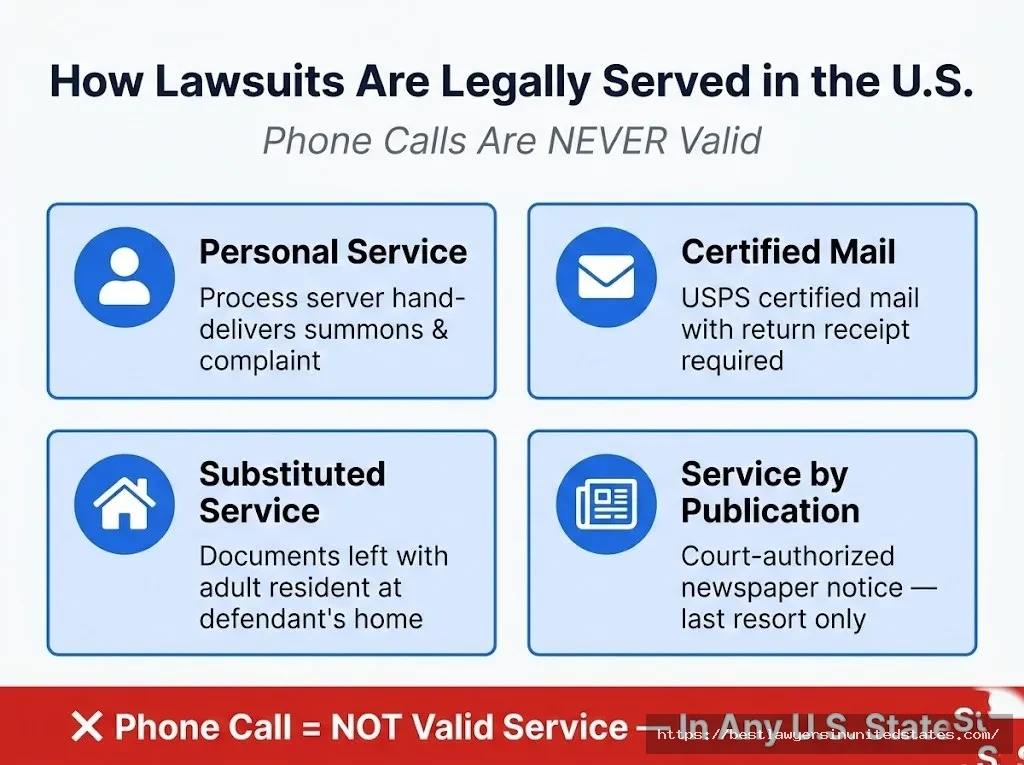
The law allows several legitimate ways to serve someone with a lawsuit. These vary slightly by state but follow a consistent framework.
Method 1: Personal Service (The Gold Standard)
Personal service is the most direct and formal method of delivering legal documents. A process server or other authorized individual hand-delivers the legal papers — typically a summons and complaint — to the person being sued. This ensures the defendant is directly informed of the lawsuit. The server usually provides a signed affidavit or return of service to confirm the documents were properly delivered.
If someone shows up at your door, home, or workplace and hands you an envelope of documents, that’s real service. You don’t have to “accept” them for it to be legally valid — if you’re positively identified and the papers are placed near you, it still counts.
Method 2: Certified Mail
Many states allow certified mail as a primary or backup service method. The plaintiff sends the summons and complaint via U.S. Postal Service certified mail with return receipt requested. Your signature on the return receipt serves as proof of delivery.
Important: In many states, regular first-class mail is also sent simultaneously, and if you sign the certified mail receipt, that constitutes valid service.
Method 3: Substituted Service
When an individual to be served is unavailable for personal service, many jurisdictions allow for substituted service. This allows the process server to leave service documents with another responsible individual — a person of suitable age and discretion — such as a cohabiting adult or a teenager.
Generally, the person receiving the documents must:
- Be at least 18 years old (varies by state)
- Reside at the defendant’s home, OR
- Be a manager or person in charge at the defendant’s workplace
Method 4: Service by Publication
This is the last resort. A person who can’t be found after reasonable efforts can be served by publication: the plaintiff takes out a newspaper ad, and after it runs for the required period, the defendant is deemed to have been served. Courts require proof of genuine attempts at personal service before allowing publication service.
Method 5: Court-Authorized Alternative Service
In rare circumstances, courts can authorize creative service methods when standard methods fail. There have even been courts authorizing service over Facebook, though this remains uncommon and requires court approval. These alternatives always require a judge’s specific permission.
Service Methods by State: A Quick Reference
| State | Personal Service | Certified Mail | Substituted Service | Publication |
|---|---|---|---|---|
| California | ✅ Primary method | ✅ After 3 failed attempts | ✅ Strict diligence required | ✅ Court-ordered |
| Texas | ✅ Primary method | ✅ Certified, return receipt | ✅ Yes, with conditions | ✅ Court-ordered |
| New York | ✅ Primary method | ✅ Deliver-and-mail method | ✅ With mailing backup | ✅ Court-ordered |
| Florida | ✅ Primary method | ✅ Allowed | ✅ Yes | ✅ Court-ordered |
| Illinois | ✅ Primary method | ✅ Allowed | ✅ Yes | ✅ Court-ordered |
| Washington | ✅ Primary method | ✅ Allowed | ✅ Yes | ✅ After due diligence |
| All other states | ✅ Allowed | ✅ Most states | ✅ With conditions | ✅ With court order |
Phone call: Not valid in any state.
What Happens at the Federal Level?
The Federal Rules of Civil Procedure allow you to follow the state laws where the defendant is located for service of process, unless another federal law prohibits it. Service may be completed by personally delivering the summons and complaint, leaving a copy at the individual’s dwelling with someone of suitable age and discretion who also resides there, or delivering a copy to an agent authorized by appointment or law to receive service of process.
In federal court, a defendant must be served within 90 days of the complaint being filed. If service doesn’t happen in that window, the court can dismiss the case — meaning delayed or improper service actually protects defendants more than it hurts them.
The proof of service — a sworn affidavit from the process server — must be filed with the court. No phone call creates this record.
Receiving a Phone Call About a Lawsuit: Is It a Scam?
Here’s the uncomfortable truth: most phone calls claiming you’re being sued are scams.
Civil complaint phone calls are often scam attempts — possibly debt collectors or impersonators — trying to extract your personal information.
The Numbers Are Alarming
FTC data shows a more than four-fold increase since 2020 in reports from older adults who lost $10,000 or more to scammers who impersonate trusted government agencies or businesses. Combined losses reported by older adults who lost more than $100,000 increased eight-fold, from $55 million in 2020 to $445 million in 2024. Trulicity Lawsuit 2026
Common Lawsuit Phone Scam Scripts
Scammers follow predictable patterns. Here’s what they say versus what’s actually true:
| What the Caller Says | The Reality |
|---|---|
| “You’ve been legally notified” | Phone calls are never valid legal notification |
| “A process server will come to your home or work unless you pay now” | Real process servers don’t call ahead to negotiate payment |
| “You owe [amount] on a debt from [company]” | Real debt collection has strict rules under the FDCPA |
| “Call this 888 number and give your case number” | Legitimate courts have publicly searchable case records |
| “Pay now and the lawsuit goes away” | Real settlements happen through attorneys, in writing |
| “You’ll be arrested if you don’t respond” | You can’t be arrested for civil debt in the U.S. |
| “This is your final notice” | Courts don’t issue final notices by phone |
Red Flags That Scream “Scam”
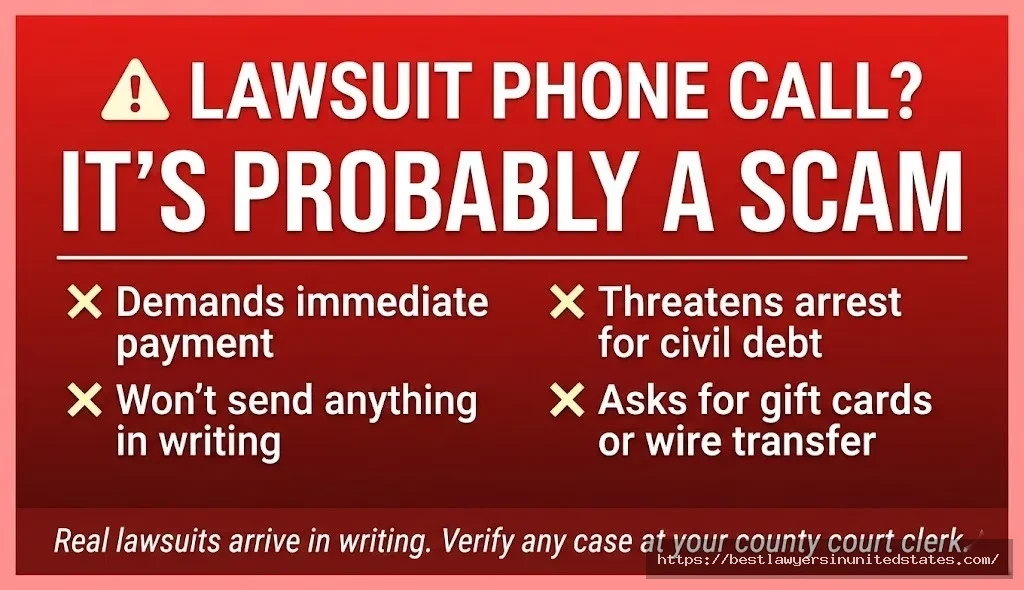
Watch for these warning signs when you receive a call claiming you’re being sued:
- The caller demands immediate payment over the phone
- They ask for gift cards, wire transfers, or cryptocurrency
- They refuse to give you their full name, bar number, or firm address
- They won’t send anything in writing
- They claim you’ll be arrested for not paying a civil debt
- Your caller ID shows a government agency name — caller ID can be faked, and it could be anyone calling from anywhere in the world
- They pressure you to decide on the spot
- They ask you to confirm your Social Security number, bank account details, or birthdate
- Searching the case number they provide turns up nothing in court records
What to Do If You Get a Call Saying You’re Being Sued
Don’t panic. Take these steps in order.
Your Step-by-Step Response Plan
Step 1: Stay calm and don’t confirm personal information
Don’t confirm your name, address, Social Security number, date of birth, or financial information. Scammers use partial information to add credibility to their pitch.
Step 2: Get their information — not yours
Ask for:
- The caller’s full name
- The law firm or company name
- Their phone number and address
- The case number
- The court where the case is filed
- The plaintiff’s name
Write everything down. Real attorneys and process servers will have no trouble providing all of this.
Step 3: Search public court records
Most courts have free online case search tools. You can check:
- Your state court’s official website
- PACER.gov for federal cases (federal court records)
- Your county court clerk’s website
If the case number they provided doesn’t appear in any court records, it’s a scam.
Step 4: Do not call back on the number they gave you
If you want to verify the caller, look up the law firm or court independently using Google or the official court website. Never dial back the number they provided — scammers use this to establish contact and continue the pressure campaign.
Step 5: Contact an attorney
If you’re concerned about a legitimate lawsuit, a free initial consultation with a local attorney can confirm whether you’ve actually been sued. Many attorneys offer 30-minute free consultations. You can also contact your state bar’s lawyer referral service.
Step 6: Report it if it’s a scam
Report the call to:
- The FTC at ReportFraud.ftc.gov
- Your state Attorney General
- The FCC at fcc.gov/consumers/guides/filing-informal-complaint
What to Do If You Later Receive Actual Legal Papers
| Situation | What to Do | Deadline |
|---|---|---|
| Process server hands you documents | Read them immediately — note the response deadline | Usually 20–30 days from service |
| Certified mail with court documents | Sign receipt, open immediately, note deadline | Usually 20–30 days from service |
| Documents left with someone at your home | Still counts as valid service — respond promptly | Usually 20–30 days from service |
| Can’t tell if papers are real | Call the court directly to verify the case number | Don’t wait — response deadlines are firm |
| Already past the deadline | Contact an attorney immediately about setting aside default | Act within days, not weeks |
Do You Have to Respond If You Were Only Notified by Phone?
No. You cannot be notified of a lawsuit through a telephone call or voicemail message. If you think you might have been sued, check with the court in the county where you live to see if any complaints have been filed with you as the defendant.
If a lawsuit was actually filed but you haven’t been properly served, you have no legal obligation to respond — yet. However, being proactive is always smarter than waiting. The plaintiff will eventually serve you correctly, and at that point a real response deadline kicks in.
A word of caution: Some defendants who learn about a lawsuit informally choose to engage with it proactively, which can sometimes complicate later arguments that service was improper. Talk to an attorney before making any decisions.
Your Rights When It Comes to Service of Process
You have significant legal protections here. Understanding them helps you push back if something goes wrong.
Due Process Rights Under the Constitution
The 14th Amendment guarantees that no state can deprive you of liberty or property without due process of law. Proper service of process is a constitutional requirement — not just a procedural nicety.
The Right to Challenge Improper Service
If you were not properly served, you can file a motion to dismiss for insufficient service of process. Courts take this seriously. Proper service of process initially establishes personal jurisdiction of the court over the person served. If the defendant ignores further proceedings, the court may find the defendant in default — but the defendant may contest any default in their home state.
Your Rights Under the FDCPA (Debt Cases)
If the phone call involves a debt collection lawsuit, the Fair Debt Collection Practices Act (FDCPA) gives you additional rights:
- Debt collectors cannot threaten arrest for civil debts
- They must verify the debt in writing if you request it
- They cannot call at unreasonable hours
- They cannot use abusive, deceptive, or unfair practices
- Violations can entitle you to statutory damages of up to $1,000 per violation
Your Rights Table
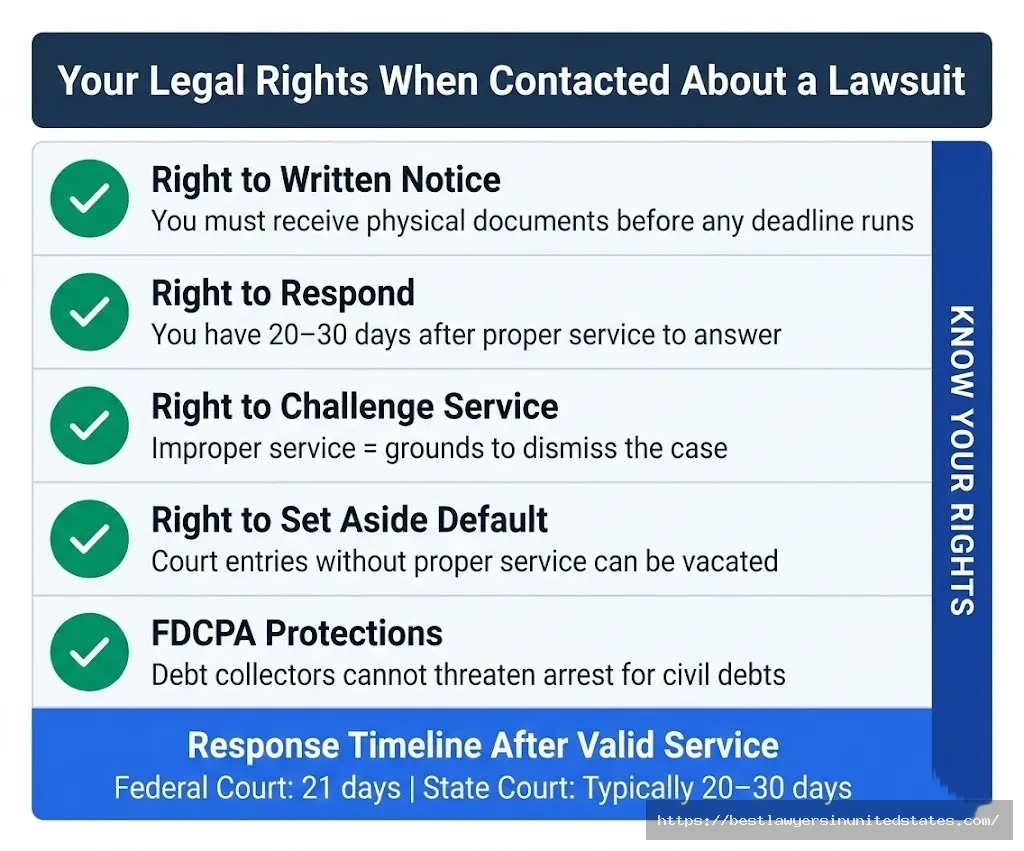
| Right | What It Means | How to Exercise It |
|---|---|---|
| Right to proper notice | You must receive written legal documents before deadlines run | Challenge improper service via motion to dismiss |
| Right to respond | You have a set period (usually 20–30 days) to answer the complaint | File a timely answer or hire an attorney |
| Right to challenge service | If service was improper, the case can be dismissed | File a Rule 12(b)(5) motion in federal court |
| Right to set aside default | If default was entered due to improper service | File a motion to vacate default judgment |
| FDCPA protections | Against abusive debt collection tactics | Report to CFPB or sue the collector |
Legitimate Scenarios Where Phone Contact Is Used
Not every call about a lawsuit is a scam or entirely meaningless. There are legitimate situations where phone contact plays a role in the legal process.
Pre-Lawsuit Negotiation: Attorneys sometimes call defendants before filing to attempt settlement. This is real and happens all the time, but the call still carries no legal obligation until formal service follows.
Informal Notice from a Known Party: If someone you know (a business partner, former spouse, contractor) tells you they’ve filed or are about to file a lawsuit, that’s an honest heads-up — not formal service. Use it to get an attorney involved early.
Process Server Scheduling: Some process servers call ahead to ask when you’ll be home. This is a courtesy call only. If a process server says “I’m going to serve you Tuesday at 3pm,” that’s a heads-up — the actual service happens when they hand you the papers.
Attorney Follow-Up: After proper service, your opponent’s attorney may call to discuss timelines, settlement, or scheduling. This is normal litigation conduct. The service already happened in writing.
Electronic Service: The Future of Legal Notification
Courts are increasingly allowing electronic service in some limited circumstances. Here’s what’s currently permitted and what isn’t.
| Electronic Method | Status | Requirements |
|---|---|---|
| Email service | Allowed in some jurisdictions | Usually requires prior consent or court order |
| Text message service | Extremely rare | Only with specific court authorization |
| Social media service | Has been court-authorized | Requires showing traditional methods have failed |
| Fax service | Allowed in some jurisdictions | Must use confirmed delivery methods |
| Phone call | Not valid anywhere | No U.S. jurisdiction accepts this |
| Secure electronic portal | Growing acceptance | Requires authentication and proof of receipt |
Digital delivery of legal documents refers to the use of secure electronic channels such as email, dedicated secure web portals, and cryptographically-anchored systems to effect compliant service. In many jurisdictions, courts now permit parties to consent to electronic delivery in lieu of traditional personal service or mail, provided that the method ensures authentication of the recipient and reliable proof of transmission.
Even with growing acceptance of electronic methods, standard phone calls remain universally excluded because they provide no verifiable documentation.
How to Verify If You’ve Actually Been Sued
Worried there might be a real lawsuit out there with your name on it? Here’s how to check.
Option 1: Search State Court Records Online Every state has an online case search tool. Go to your state’s official court website and search by your name. This is free in most states.
Option 2: Search Federal Court Records via PACER PACER.gov is the federal court’s electronic records system. You can register for free and search for federal cases.
Option 3: Call Your County Court Clerk Find the number for your county court clerk on your county government’s official website. They can search by name for free and tell you if any cases have been filed against you.
Option 4: Check for Certified Mail A real lawsuit will typically follow the same route: personal service attempt, then certified mail. Watch your mailbox, especially if someone called about a lawsuit recently.
Option 5: Consult an Attorney If you have any real doubt, a 30-minute consultation with a local civil litigation attorney is worth every dollar. Many attorneys offer free initial consultations. Average Settlement for Retaliation Lawsuit
Frequently Asked Questions
Can a process server legally notify you of a lawsuit by phone?
No. A process server’s job is to physically deliver documents — not make phone calls. A process server who only calls you has not served you. They must actually hand you the papers (or leave them through an approved substitute method) and file a sworn affidavit with the court proving they did so.
What if I received a voicemail saying I’ve been “officially notified”?
You cannot be notified of a lawsuit through a telephone call or voicemail message. The phrase “you have been officially notified” spoken in a voicemail is legally meaningless. It’s a classic scam script designed to create urgency and fear.
Can I be sued without ever knowing about it?
Technically, yes — a lawsuit can be filed without your immediate knowledge. But before the court can do anything that affects you, you must be properly served. If you’ve never been served, any default judgment is potentially voidable.
What happens if I ignore a real lawsuit?
If you’ve been properly served and ignore it, the plaintiff can ask the court for a default judgment — meaning you automatically lose. That judgment can be used to garnish wages, freeze bank accounts, or place liens on property. Never ignore properly served legal papers.
How long do I have to respond after being properly served?
In most civil cases: 20–30 days after service. In federal court: 21 days under the Federal Rules. These deadlines are strict. Missing them can result in default judgment.
Can a lawyer calling me about a lawsuit be legal service?
Phone calls from lawyers are typically used to warn or discuss a potential lawsuit, but they do not count as official legal notification. The attorney must formally serve you through approved methods.
What if I was served by someone I didn’t know at my door?
That may be real service. If someone handed you an envelope with legal documents and asked for your name, you were likely served by a professional process server. Read the documents immediately and note any response deadlines.
Can a court issue a judgment against me if I was only called?
Not legitimately. Before any judgment can be entered, the court requires proof of valid service filed with the clerk. A phone call creates no such proof. If a judgment was entered without proper service, you have grounds to challenge it.
What if the person calling knows my personal information?
Scammers routinely obtain partial personal information from data breaches, public records, and purchased data lists. Them knowing your name, last four digits of your SSN, or your address does not mean the call is legitimate. Caller ID can be faked — it could be anyone calling from anywhere in the world.
Can I be served by email?
In limited circumstances and only with court authorization or prior consent from the party to be served. It’s not the default, and you’d typically know about any agreement to accept electronic service.
What should I say if someone calls claiming to be a process server?
Ask for their name, company name, and the court case number. Tell them you’d like the documents delivered in person or by certified mail. Do not confirm your address, SSN, or financial information. Then verify the case number independently through official court records.
Is it illegal to threaten someone with a lawsuit over the phone?
Threatening a lawsuit to coerce payment can violate the FDCPA if it’s done by a debt collector without actually intending to file. It can also violate state consumer protection laws. Report abusive calls to your state Attorney General and the FTC at ReportFraud.ftc.gov.
Do I owe anything to someone who only called me about a lawsuit?
You owe nothing based solely on a phone call. You have no legal obligation to call back, pay money, or provide information based on a verbal claim that you’re being sued.
Can I record the call if someone claims to be serving me with a lawsuit?
Recording laws vary by state. In “one-party consent” states, you can record a call you’re a party to. In “two-party consent” states (like California and Florida), you need the caller’s consent. Check your state’s laws before recording.
What is “sewer service” and could it affect me?
“Sewer service” is the unsavory practice where a process server deliberately fails to serve a lawsuit while submitting a fraudulent affidavit of service to the court claiming service was made. If you discover a judgment was entered against you and you were never actually served, you may have been a victim of sewer service — which is fraud. Contact an attorney immediately.
Where do I report a lawsuit phone scam?
Report to:
- FTC: ReportFraud.ftc.gov
- FCC: fcc.gov/consumers/guides/filing-informal-complaint
- Your state Attorney General’s office
- CFPB: consumerfinance.gov/complaint (if it involves debt collection)
Summary: What You Need to Remember
If you take nothing else away from this guide, remember these five points:
1. A phone call is never valid service of process. No state, no court, no jurisdiction in the U.S. accepts a phone call as legal notification of a lawsuit.
2. Most “lawsuit” calls are scams. The FTC has documented billions in losses from impersonation and fake legal threat scams. Don’t pay a cent or give personal information to anyone who calls claiming you’re being sued.
3. Verify before you react. Search official court records before assuming any call is real. Most will turn up nothing.
4. Real service comes in writing. When you’re actually served with a lawsuit, you’ll receive physical documents — typically a summons and complaint — delivered in person or by certified mail.
5. Response deadlines are real once you’re properly served. If you do receive actual legal documents, the 20–30 day response window is firm. Get an attorney involved immediately.
