
Quick Answer Box
- The hair relaxer lawsuit is a federal mass tort alleging chemical hair straighteners caused uterine, ovarian, or endometrial cancer and fibroids.
- You may qualify if you used chemical hair relaxers regularly and were later diagnosed with one of these conditions.
- No settlement has been reached yet, with individual case values projected between $75,000 and $1.75 million depending on diagnosis severity.
Case Snapshot
| Detail | Info |
|---|---|
| Court | U.S. District Court for the Northern District of Illinois |
| Case / MDL Number | MDL No. 3060, In Re: Hair Relaxer Marketing, Sales Practices, and Products Liability Litigation |
| Filing Date | MDL centralized February 2023 |
| Status | Active. In discovery and bellwether trial preparation. No settlement reached |
| Settlement Fund | None yet. No global or individual settlement has been finalized as of mid-2026 |
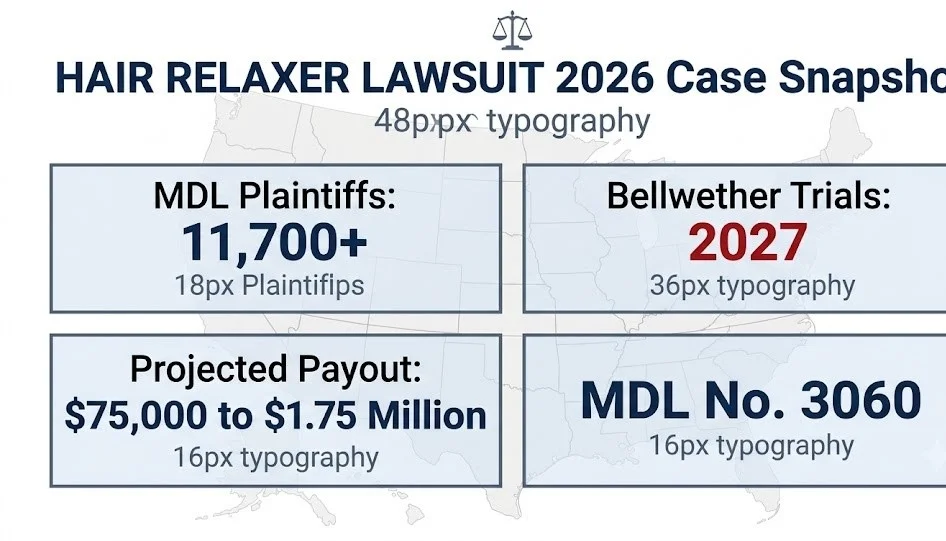
The hair relaxer lawsuit has grown into one of the largest active mass torts in the country, now exceeding 11,700 plaintiffs. Most are women diagnosed with uterine or ovarian cancer after years of chemical relaxer use.
This is not a class action in the traditional sense. It is a multidistrict litigation, meaning each case is evaluated individually rather than paid from one shared fund.
Bellwether trials, the test cases that shape settlement negotiations, are not expected until 2027. That timeline surprises many people who assumed a resolution was closer.
Here is where the litigation actually stands, broken down by injury type, court track, and what a real claim requires in 2026.
What Is the Hair Relaxer Lawsuit About
The hair relaxer lawsuit alleges that chemical hair straightening products contain ingredients linked to hormone-disrupting effects and reproductive cancers. Plaintiffs claim manufacturers knew about these risks and failed to warn consumers.
The litigation centers on a 2022 National Institutes of Health study linking frequent chemical relaxer use to a significantly higher risk of uterine cancer. That study triggered a wave of lawsuits that consolidated into a single federal MDL the following year.
Quick facts:
- MDL formed: February 2023
- Presiding judge: Hon. Mary M. Rowland
- Court: U.S. District Court, Northern District of Illinois
- Current plaintiff count: over 11,700 as of mid-2026
Attorney Insight: Attorneys handling these claims point to the 2022 NIH study as the scientific foundation the entire litigation was built on, since it gave plaintiffs a peer-reviewed basis for causation.
Hair Relaxer Cancer Lawsuit
A hair relaxer cancer lawsuit specifically alleges that chemical relaxer exposure caused a reproductive cancer diagnosis. This is the largest category of claims within the broader MDL.
Most plaintiffs report using relaxers for a decade or longer, often starting in childhood or adolescence. Many describe regular salon or at-home application over fifteen to twenty years before diagnosis.
| Cancer Type | Role in Litigation |
|---|---|
| Uterine cancer | Primary injury alleged in most MDL claims |
| Ovarian cancer | Significant secondary injury category |
| Endometrial cancer | Frequently alleged alongside uterine cancer claims |
Litigation Watch: The strength of these cases rests heavily on long-term, frequent product use, not occasional or short-term exposure.
Attorney Insight: Attorneys evaluating new cases say duration and frequency of use are the first things they verify, since the underlying science ties risk to cumulative exposure over years.
Hair Relaxer Uterine Cancer Lawsuit
A hair relaxer uterine cancer lawsuit is the most common individual claim type within the MDL. Uterine cancer is the condition most directly tied to the 2022 NIH research that launched this litigation.
According to court filings, plaintiffs allege that endocrine-disrupting chemicals in relaxers, including phthalates and formaldehyde-releasing agents, contributed to abnormal cell growth in the uterus over years of repeated exposure.
Quick facts:
- Primary chemicals named: phthalates, formaldehyde-releasing agents
- Mechanism alleged: endocrine disruption affecting hormone-sensitive tissue
- Typical claimant profile: long-term user, diagnosis in mid-life
Attorney Insight: Attorneys building these cases say medical records showing diagnosis timing relative to product use history are the single most important document in a uterine cancer claim.
Hair Relaxer Hysterectomy Lawsuit
A hair relaxer hysterectomy lawsuit involves a plaintiff who underwent a hysterectomy as treatment for a relaxer-linked condition. This includes cases involving cancer, severe fibroids, or other conditions requiring surgical removal of the uterus.
Hysterectomy claims often carry higher settlement value projections than non-surgical cases. Permanent loss of reproductive capacity, particularly for younger plaintiffs, factors heavily into damages calculations.
Factors that increase claim value in hysterectomy cases:
- Plaintiff’s age at time of surgery
- Whether reproductive capacity was lost permanently
- Severity of the underlying condition requiring surgery
- Documented impact on quality of life and future fertility plans
Attorney Insight: Attorneys handling hysterectomy claims note that younger plaintiffs facing permanent infertility often see significantly higher case valuations than older plaintiffs with the same diagnosis.
Hair Relaxer Lawsuit Fibroids
A hair relaxer fibroids lawsuit alleges that chemical relaxer exposure caused or worsened uterine fibroids, noncancerous growths that can require surgical treatment. Fibroid claims are generally valued lower than cancer claims within the MDL.
Severe fibroid cases, particularly those requiring hysterectomy or significant surgical intervention, can still represent substantial claims. Mild fibroid diagnoses without major treatment typically fall toward the lower end of the compensation range.
| Severity Level | Typical Treatment | Relative Claim Value |
|---|---|---|
| Mild fibroids | Monitoring, minimal treatment | Lower tier |
| Moderate fibroids | Medication, minor procedures | Mid tier |
| Severe fibroids | Surgery, possible hysterectomy | Higher tier |
Attorney Insight: Attorneys note that fibroid claims requiring surgical intervention are evaluated much closer to cancer cases than mild, monitored cases.
Chemical Hair Relaxer Lawsuit
A chemical hair relaxer lawsuit refers to the entire category of litigation against manufacturers of lye and no-lye relaxer products. This includes both major national brands and smaller specialty product lines.
According to court filings, no-lye relaxers like certain Vitale, Optimum, and ORS Olive Oil products are named alongside more widely recognized brands. Plaintiffs allege these formulations carried similar undisclosed risks regardless of lye content.
Quick facts:
- Product types named: lye and no-lye chemical relaxers
- Common ingredients at issue: phthalates, parabens, formaldehyde-releasing preservatives
- Use pattern alleged: regular, long-term application, often starting young
Attorney Insight: Attorneys reviewing product use histories say no-lye formulations marketed as gentler have not been treated differently from traditional lye relaxers in terms of alleged health risk.
Lawsuit Against Hair Relaxer Brands
Lawsuits in the MDL target multiple manufacturers, with L’Oreal USA Inc. named as the most prominent defendant. Revlon, currently in bankruptcy proceedings, remains a defendant with available insurance coverage for these claims.
A June 2026 court order temporarily paused evidence sharing for several smaller defendants, including Wella, John Paul Mitchell Systems, Bronner Bros., Dudley Beauty Corp., Murray’s Worldwide, and Advanced Beauty. That pause is set to lift no earlier than July 23, 2026.
| Defendant | Status |
|---|---|
| L’Oreal USA Inc | Primary named defendant, active in MDL |
| Revlon | In bankruptcy, retains insurance coverage for claims |
| Namaste Laboratories | Faced and lost a motion to dismiss in New York state court |
| Wella, JPMS, Bronner Bros, Dudley Beauty, Murray’s, Advanced Beauty | Temporary evidence-sharing pause through at least July 2026 |
Litigation Watch: The defendant list spans both household-name brands and smaller manufacturers, meaning brand recognition alone does not determine case strength.
Attorney Insight: Attorneys tracking the defense side say Revlon’s bankruptcy status complicates timing but does not eliminate available compensation, since insurance coverage remains in place.
Olive Oil Hair Relaxer Lawsuit
An olive oil hair relaxer lawsuit refers specifically to claims involving ORS Olive Oil branded relaxer products. These products are named directly in plaintiff fact sheets filed within the MDL.
According to court records, one plaintiff added to the litigation in late 2025 reported using ORS Olive Oil Built-In-Protection relaxer, among other no-lye products, from 1973 to 2019 before an endometrial cancer diagnosis.
- Product line at issue: ORS Olive Oil Built-In-Protection
- Reported use span in cited case: 1973 to 2019
- Diagnosis: endometrial cancer
Attorney Insight: Attorneys say “olive oil” or “natural” branding on relaxer products has not insulated manufacturers from claims, since the underlying chemical formulation is what matters legally.
Class Action Lawsuit Hair Relaxer
The hair relaxer litigation is technically not a class action, despite frequent marketing use of that term. It is structured as a multidistrict litigation, where individual cases are consolidated for pretrial purposes only.
This distinction affects payouts directly. In a true class action, all members typically share a common settlement formula. In an MDL, each plaintiff’s case is valued separately based on their specific injury and product use history.
Key structural differences:
- MDL: individual case evaluation, separate settlement values
- Class action: shared settlement pool, more uniform payouts
- A new medical monitoring class action, filed March 2026, does exist separately for people not yet diagnosed with cancer
Attorney Insight: Attorneys caution that firms advertising this as a “class action lawsuit” are using simplified marketing language, not an accurate legal description of how compensation will actually be distributed.
Who Qualifies for the Hair Relaxer Lawsuit
Qualification generally requires regular chemical hair relaxer use and a confirmed diagnosis of a covered reproductive condition. Documentation of both use and diagnosis timing is essential.
Most successful claims involve at least several years of regular use, often beginning well before diagnosis. The litigation does not currently cover users without a qualifying diagnosis.
Likely to qualify:
- Diagnosed with uterine, ovarian, or endometrial cancer after regular relaxer use
- Diagnosed with severe uterine fibroids requiring treatment
- Used chemical relaxers regularly for multiple years before diagnosis
Likely excluded:
- No documented qualifying diagnosis
- Diagnosis predates relaxer use rather than following it
- Cases with significant complicating medical factors that bellwether selection criteria specifically exclude
Attorney Insight: Attorneys reviewing intake calls say complete medical records, including pathology reports and treatment history, often determine whether a claim is viable before it ever reaches filing.
Hair Relaxer Lawsuit Payout Amounts
Payout amounts have not been finalized, since no settlement or bellwether verdict has occurred as of mid-2026. Projected ranges vary by diagnosis severity and remain estimates rather than confirmed figures.
Industry estimates generally place uterine and ovarian cancer claims higher than fibroid or endometriosis claims. These figures are projections based on comparable mass tort litigation, not confirmed settlement data.
| Condition | Projected Range |
|---|---|
| Uterine or ovarian cancer | $300,000 to $1,750,000 (projected) |
| Endometrial cancer | $300,000 to $1,500,000 (projected) |
| Severe fibroids or endometriosis | $75,000 to $500,000 (projected) |
Litigation Watch: Every figure currently circulating is a projection based on comparable litigation, not a confirmed settlement number, since no global resolution exists yet.
Attorney Insight: Attorneys caution clients against treating early projected ranges as guaranteed outcomes, since bellwether trial results will be what actually sets realistic settlement benchmarks.
When Will the Hair Relaxer Lawsuit Be Settled
There is no confirmed settlement date, and bellwether trials are not expected until 2027. A global settlement, if one occurs, would likely follow those trial results rather than precede them.
Judge Rowland personally selected 10 representative bellwether cases in April 2026, excluding cases with complicating medical factors. This selection process is designed to produce a clean test of the core causation question.
Realistic timeline expectations:
- 2026: continued discovery, expert disclosures, Daubert hearings
- 2027: bellwether trials expected to begin
- Following bellwether results: settlement negotiations likely intensify
- Settlement checks, if a deal is reached: likely not before 2027 or later, given claims administration timelines
Attorney Insight: Attorneys following the MDL say a master settlement, if reached, would still require a claims resolution process to vet medical documentation before any checks go out, adding additional time beyond an announced settlement.
Hair Relaxer Lawsuit Statute of Limitations
The statute of limitations for hair relaxer claims varies by state and generally runs from the date of diagnosis, not the date of product use. Some states apply a discovery rule that delays the clock until the connection between use and injury was reasonably knowable.
Filing deadlines typically range from one to several years depending on the state where the claim is filed. Missing the applicable deadline can permanently bar a claim regardless of its underlying strength.
| Consideration | Typical Standard |
|---|---|
| Clock start | Generally from diagnosis date, not product use date |
| Typical range | 1 to several years, varies significantly by state |
| Discovery rule | May apply if causation link was not reasonably known earlier |
| Georgia statute of repose | State Supreme Court issued a plaintiff-favorable ruling in 2026 |
Attorney Insight: Attorneys stress that state-specific deadlines vary enough that a claim viable in one state could be time-barred in another, making early consultation essential.
How to File a Hair Relaxer Lawsuit
Filing starts with confirming diagnosis and exposure history, then submitting a claim through the federal MDL or an applicable state court. Most plaintiffs use a streamlined short-form complaint process within the MDL.
The court allows new plaintiffs to join by checking off the specific products used and injuries suffered, rather than drafting a full individual complaint. A plaintiff fact sheet detailing medical and product use history is also required.
Filing steps:
- Confirm a qualifying diagnosis through medical records
- Document product use history, including brands and duration
- Consult a mass tort attorney handling hair relaxer claims
- Complete a short-form complaint to join the federal MDL, or file in an applicable state court
- Submit a plaintiff fact sheet with detailed medical and product use information
Attorney Insight: Attorneys note that incomplete plaintiff fact sheets are a common reason cases face dismissal motions, making thorough documentation critical at filing.
Hair Relaxer Lawsuit Marketing and Attorney Advertising
Attorney advertising around this litigation has been unusually aggressive, with firms running national campaigns to recruit plaintiffs. This surge reflects the scale of the case, now exceeding 11,700 plaintiffs, but it also means not every firm advertising has deep experience in this specific MDL.
Some firms market the litigation as a “class action” despite its actual MDL structure, which can create confusion about how compensation will ultimately be distributed. Reading past the advertising to verify a firm’s actual involvement in the MDL leadership or steering committee matters more than slogan-driven marketing.
What advertising claims to verify before signing with a firm:
- Whether the firm has filed cases directly in MDL No. 3060
- Whether they accurately describe the case as a mass tort, not a class action
- Whether projected settlement figures are labeled as estimates, not guarantees
Attorney Insight: Attorneys with direct MDL experience caution that heavy advertising volume does not necessarily correlate with how a specific case will be litigated or valued.
Hair Relaxer Lawsuit Lawyers
Hair relaxer lawsuit lawyers typically work on contingency, with several firms holding formal leadership roles within the MDL’s Plaintiffs’ Steering Committee. Motley Rice attorney Fidelma Fitzpatrick serves as co-lead counsel, with attorney Tope Leyimu on the Steering Committee.
Choosing an attorney with direct MDL filing experience, rather than one simply running referral advertising, can affect how efficiently a case moves through the litigation. Firms with leadership roles often have the clearest visibility into settlement timing and strategy.
What to ask a prospective attorney:
- Do they file cases directly in MDL No. 3060, or refer cases to other firms
- Do they hold any leadership or steering committee role in the litigation
- What is their fee structure and case cost policy
- How do they handle documentation requirements like the plaintiff fact sheet
Attorney Insight: Attorneys experienced in this MDL note that firms serving in formal leadership roles typically have the most direct insight into how bellwether outcomes might shape broader settlement strategy.
Frequently Asked Questions
Who qualifies for the hair relaxer lawsuit?
Women diagnosed with uterine, ovarian, or endometrial cancer after regular chemical relaxer use generally qualify.
Severe fibroid diagnoses requiring treatment may also qualify.
Documentation of both diagnosis and long-term product use history is required to support a claim.
When will the hair relaxer lawsuit be settled?
No settlement date has been set, and bellwether trials are not expected until 2027.
A global settlement, if one occurs, would likely follow those trial results.
Even after a settlement announcement, claims processing could delay actual payouts further.
How much is a hair relaxer lawsuit payout?
No confirmed payout amounts exist yet, since no settlement has been reached.
Projected ranges suggest $300,000 to $1.75 million for cancer diagnoses and $75,000 to $500,000 for fibroid cases.
These figures remain estimates based on comparable litigation, not guaranteed outcomes.
What is the statute of limitations for a hair relaxer lawsuit?
Deadlines vary by state and generally run from the date of diagnosis, not product use.
Some states apply a discovery rule that can extend the filing window.
Consulting an attorney promptly is important since deadlines differ significantly across jurisdictions.
Is the hair relaxer lawsuit a class action?
No, it is a multidistrict litigation, not a traditional class action.
Each plaintiff’s case is evaluated individually based on their specific injury and product use.
A separate medical monitoring class action exists for people not yet diagnosed with cancer.
Should I be cautious about hair relaxer lawsuit advertising?
Yes, advertising volume does not always reflect a firm’s actual experience with this specific MDL.
Verify whether a firm files cases directly or simply refers them to other attorneys.
Confirm any settlement figures they cite are described as projections, not guarantees.
The Bottom Line for 2026
The hair relaxer lawsuit remains an active, growing mass tort with no settlement yet reached and bellwether trials still a year or more away. Anyone diagnosed with a qualifying condition after long-term chemical relaxer use should confirm their documentation now.
Speaking with a mass tort attorney with direct MDL experience, not just heavy advertising presence, is the most useful next step. State filing deadlines continue running regardless of where the federal litigation stands.
