
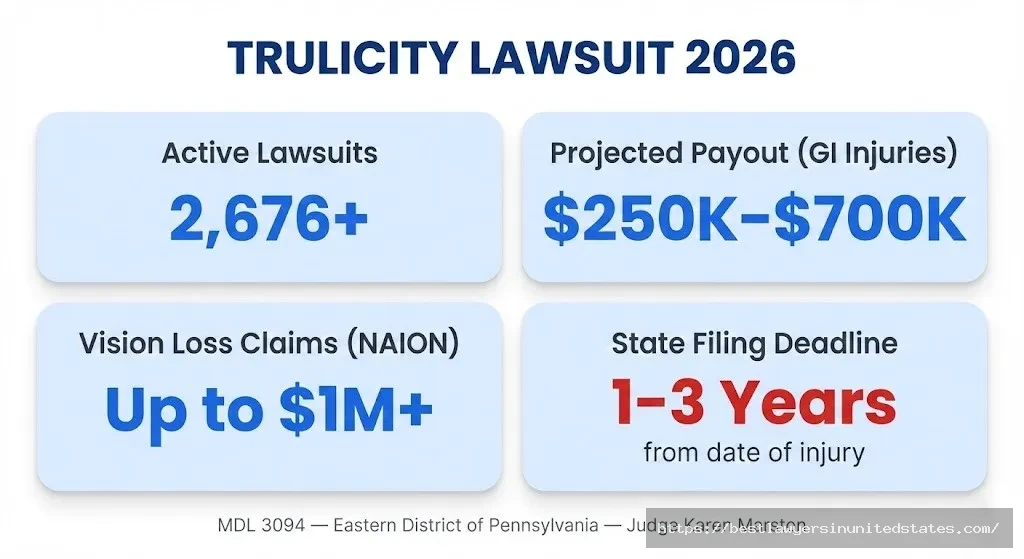
The Trulicity lawsuit involves thousands of people who say the popular diabetes drug gave them stomach paralysis, intestinal blockages, vision loss, and other life-altering conditions — and that maker Eli Lilly never warned them it could happen. As of February 2026, more than 2,676 individual lawsuits have been filed and consolidated into federal multidistrict litigation (MDL 3094) in Pennsylvania, with thousands more expected. There is no class action claims portal or a single filing deadline — instead, each person files their own individual lawsuit with the help of an attorney. State-specific statutes of limitations, typically 1 to 3 years from the date of injury or diagnosis, mean that waiting could cost you your right to sue. ogx lawsuit
Quick Answer: The Trulicity lawsuit is a growing mass tort action against Eli Lilly & Company, the maker of the diabetes drug Trulicity (dulaglutide). Plaintiffs allege the drug causes severe gastrointestinal injuries including gastroparesis (stomach paralysis), bowel obstruction, and vision loss — and that Eli Lilly failed to warn them. No global settlement has been reached yet. Projected individual payouts range from $250,000 to over $1 million depending on injury severity. You must act before your state’s statute of limitations runs out — contact an attorney as soon as possible for a free case review.
Trulicity Lawsuit Overview
| Detail | Information |
|---|---|
| Drug Name | Trulicity (generic: dulaglutide) |
| Manufacturer | Eli Lilly and Company |
| FDA Approval | September 2014 |
| Drug Class | GLP-1 Receptor Agonist |
| MDL Case Number | MDL 3094 |
| MDL Court | U.S. District Court, Eastern District of Pennsylvania |
| Presiding Judge | Hon. Karen Spencer Marston |
| Active Cases (Feb 2026) | 2,676+ and growing |
| Lawsuit Type | Mass Tort / Multidistrict Litigation (NOT a class action) |
| Current Phase | Discovery / Expert Hearings |
| Settlement Status | No global settlement reached yet |
| Projected Payouts | $250,000–$1,000,000+ (individual cases) |
| Statute of Limitations | 1–3 years (varies by state) |
What Is the Trulicity Lawsuit About?
Background of the Lawsuit
Trulicity is a once-weekly injectable prescription drug made by Eli Lilly & Company. The FDA approved it in September 2014 to help adults and children (as young as 10) manage type 2 diabetes. Millions of Americans have been prescribed Trulicity, making it one of the most widely used drugs in its class.
Trulicity works by mimicking the GLP-1 hormone, which tells the pancreas to release insulin and slows down how fast your stomach empties food. That slowing effect is key to how it manages blood sugar — but it’s also at the center of the legal claims. Many patients say the drug slowed their stomachs so severely and permanently that they developed a condition called gastroparesis, or stomach paralysis.
Lawsuits claim that Trulicity and similar GLP-1 receptor agonists caused severe side effects like gastroparesis (stomach paralysis), with patients alleging that manufacturers failed to adequately warn about the risks. In plain terms: people say Eli Lilly knew the drug could paralyze their stomachs, destroy their quality of life, or even blind them — and never told them. Average Settlement for Retaliation Lawsuit
Timeline of Key Events
| Date | Event | Details |
|---|---|---|
| September 2014 | FDA approves Trulicity | Approved for type 2 diabetes management in adults |
| 2020 | Expanded FDA approval | Also approved to reduce cardiovascular risk in T2D adults |
| 2021–2022 | First patient injuries reported | Patients report severe gastroparesis, hospitalizations, and bowel obstructions |
| 2023 | Similar GLP-1 lawsuits filed | Ozempic and Mounjaro face related lawsuits over gastroparesis |
| February 2024 | MDL 3094 created | JPML consolidates GLP-1 lawsuits into Eastern District of Pennsylvania |
| April 2024 | First Trulicity MDL cases filed | Iowa woman’s gastroparesis case among the first centralized |
| May 2024 | Judge Pratter dies unexpectedly | Potential delays as new judge is assigned |
| June 2024 | Judge Karen Marston appointed | Takes over MDL 3094 presiding duties |
| June 2024 | Science Day held | Both sides present scientific evidence on GLP-1 side effects |
| August 2024 | Common benefit fund established | Court sets cost-sharing protocols for plaintiffs |
| November 2024 | Expert report deadlines set | Plaintiff reports due Nov. 18; defense reports due Dec. 23 |
| December 2024 | DVT claims dropped from MDL | Deep vein thrombosis removed as qualifying injury for MDL 3094 |
| January 2025 | Cases reach 1,331 | MDL grows by 200+ cases in a single month |
| May 2025 | Daubert hearing scheduled | Court to decide admissibility of expert causation testimony |
| August 2025 | Cases surpass 2,676 | 486 new plaintiffs join in a single two-month window |
| December 2025 | NAION MDL created | Eye/vision loss claims get separate MDL (MDL 3163) in Philadelphia |
| January 2026 | MDL 3163 process begins | Judge Marston also oversees new eye-injury MDL |
| Late 2026 (projected) | Bellwether trials expected | Test cases to set compensation benchmarks |
| 2027+ (projected) | Global settlement possible | Mass resolution expected after bellwether trial outcomes |
Who Filed the Lawsuit?
These are not class action lawsuits — every plaintiff files their own individual case. The cases have been centralized for pretrial coordination under MDL 3094. Motley Rice is among the law firms that argued for the creation of the GLP-1 RA multidistrict litigation, which originated in February 2024. The case was initially assigned to U.S. District Judge Gene E.K. Pratter. However, Pratter unexpectedly died in May. In June, U.S. District Judge Karen Marston was named Pratter’s replacement.
The defendants are Eli Lilly and Company (maker of Trulicity and Mounjaro) and Novo Nordisk (maker of Ozempic, Wegovy, and Rybelsus). The plaintiffs are individual patients — everyday people who took Trulicity and ended up hospitalized, unable to eat, or facing permanent health damage.
What Are the Allegations?
The lawsuits center on a failure-to-warn theory. Plaintiffs don’t just argue that Trulicity hurt them — they argue Eli Lilly knew the risks and hid them. Key allegations include:
- Failure to warn patients and doctors about the risk of gastroparesis, ileus, and bowel obstruction
- No warning about NAION (a type of eye stroke that can cause sudden, permanent vision loss) prior to 2023 updates
- No ileus warning before 2023, despite internal knowledge of cases
- Deceptive marketing by promoting Trulicity for off-label uses (like weight loss) while downplaying dangers
- False safety representations suggesting the drug was safer than the evidence showed
- Failure to update labels quickly enough as adverse event reports piled up with the FDA
Who Qualifies for a Trulicity Lawsuit?
Quick Answer: You may qualify if you took Trulicity as prescribed and later developed a serious condition like gastroparesis, intestinal blockage, bowel obstruction, vision loss (NAION), or pancreatitis. You’ll need medical records proving both your Trulicity use and your diagnosis. The clock on your state’s statute of limitations may already be running — act quickly.
Eligibility Requirements
| Requirement | Details | Documentation Needed |
|---|---|---|
| Proof of Trulicity use | You were prescribed and took Trulicity | Prescription records, pharmacy records, medical charts |
| Qualifying injury | Diagnosed with a serious condition linked to the drug | Medical records, diagnostic test results |
| Causal link | Injury developed during or after Trulicity use | Doctor notes, timeline of symptoms relative to drug use |
| Damages | You suffered financial, physical, or emotional harm | Hospital bills, pay stubs, doctor statements |
| Statute of limitations | Your state’s filing window has not expired | Determined by date of injury or diagnosis (1–3 years by state) |
Most attorneys recommend you have been on Trulicity for at least several months (many suggest 12+ months) and that your injury was medically confirmed through diagnostic testing — not just self-reported symptoms.
Qualifying Injuries
The injuries at the heart of these lawsuits are severe. Mild nausea or temporary stomach upset does not qualify — the litigation focuses on serious, documented medical events.
| Injury Type | Description | How It’s Diagnosed |
|---|---|---|
| Gastroparesis | Stomach paralysis — food stops moving through the digestive system | Gastric emptying study, upper GI endoscopy |
| Ileus | Intestinal blockage without a physical obstruction | CT scan, X-ray, blood tests |
| Small bowel obstruction | Physical blockage of the small intestine (can be life-threatening) | CT imaging, surgical notes |
| NAION | Non-arteritic anterior ischemic optic neuropathy — eye stroke causing vision loss | Ophthalmology exam, imaging |
| Pancreatitis | Severe inflammation of the pancreas | Blood lipase/amylase levels, CT imaging |
| Gallbladder disease | Gallstones or cholecystitis requiring surgery | Ultrasound, surgical records |
Proof of diagnosis of a severe side effect including prolonged vomiting, gastroparesis (stomach paralysis), ileus (intestinal obstruction or blockage), blindness and/or vision problems, bile duct cancer, Lou Gehrig’s Disease (ALS), gallbladder cancer, or sinus cancer are among the conditions attorneys are reviewing.
Who Does NOT Qualify?
Not everyone who took Trulicity and felt sick has a viable claim. The lawsuits focus specifically on serious, documented injuries — not standard side effects that were listed on the label.
- ❌ You only experienced mild, temporary nausea, diarrhea, or stomach discomfort that resolved on its own
- ❌ You cannot provide any medical documentation linking your condition to Trulicity
- ❌ Your gastrointestinal condition has a clear alternative cause unrelated to the drug (such as prior surgery, alcohol use, or a pre-existing condition)
- ❌ Your state’s statute of limitations has expired and you have no valid legal grounds for an extension
- ❌ You took Trulicity for only a very short period of time with no serious adverse outcome
How to Prove Your Claim
Eli Lilly has enormous legal resources. The strength of your case depends on the strength of your evidence. Courts require objective medical proof — not just your word.
| Document Type | Why It’s Needed | Where to Find It | If You Don’t Have It |
|---|---|---|---|
| Prescription records | Proves you were prescribed Trulicity | Your prescribing doctor’s office | Pharmacy records may substitute |
| Pharmacy dispensing records | Proves you filled and received the drug | Your pharmacy chain or mail-order pharmacy | Request directly from the pharmacy |
| Medical records with diagnosis | Proves your qualifying injury | Hospital, ER records, specialist notes | Request from each provider |
| Diagnostic test results | Objectively confirms the injury | Lab results, imaging (CT, MRI, gastric emptying studies) | May need new testing |
| Hospitalization records | Shows severity of injury | Hospital billing and discharge summaries | Request from the hospital’s records department |
| Doctor’s notes on adverse reactions | Shows your provider documented side effects | Your chart notes from follow-up appointments | Ask your doctor to document retroactively |
| Financial loss documentation | Supports damages claims | Pay stubs, bills, insurance statements | Bank records, tax returns |
How Much Money Can You Get from a Trulicity Lawsuit?
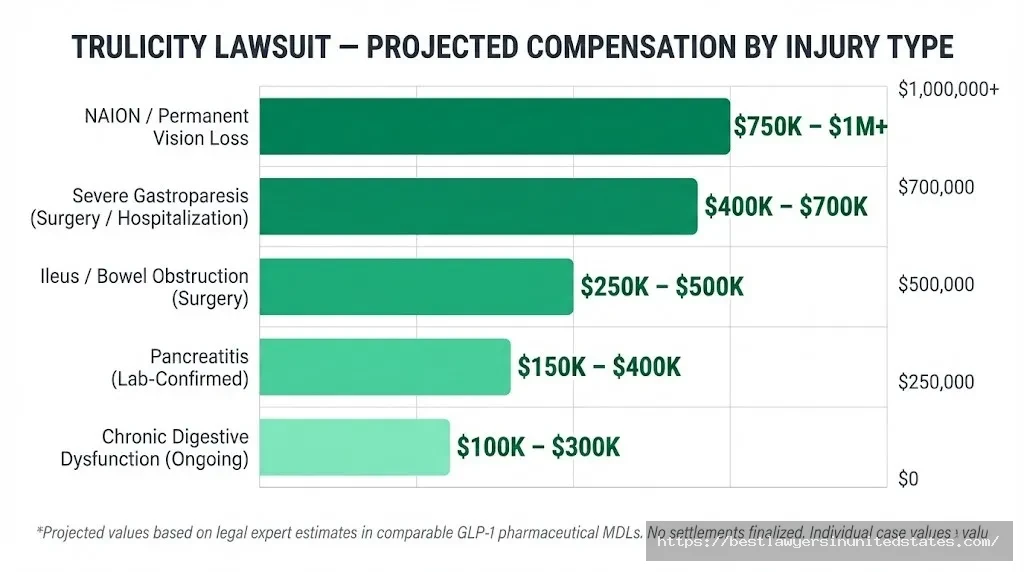
Quick Answer: No global settlement has been reached yet, so there are no guaranteed payout amounts. However, legal experts project individual case values ranging from $250,000 to over $1 million based on injury severity, hospitalization, and long-term impact. Cases involving permanent vision loss could exceed $1 million. These are individual lawsuits — what you receive depends entirely on your specific situation.
Why There Are No Fixed Amounts Yet
This is different from a typical class action where everyone gets the same payout from a settlement fund. In MDL mass torts, each person has their own case and their own potential settlement. There are no standardized settlement amounts yet as these cases are still in the early stages of litigation. The first bellwether (test) trials, expected in late 2026 or 2027, will set the benchmarks that both sides use to negotiate individual case values. Dude Wipes Lawsuit
Projected Compensation Ranges by Injury Type
| Injury Category | Projected Value Range | Key Qualifying Factors | Notes |
|---|---|---|---|
| Severe gastroparesis (hospitalization, ongoing) | $400,000–$700,000 | Hospitalization, confirmed diagnosis, ongoing treatment | Based on legal expert projections from similar GLP-1 cases |
| Gastroparesis with gallbladder surgery | $400,000–$700,000+ | Cholecystectomy, prolonged care | Surgical documentation strengthens case |
| NAION / Permanent vision loss | $750,000–$1,000,000+ | Ophthalmologist diagnosis, permanence of loss | Most severe injury type; high settlement projections |
| Ileus / Bowel obstruction with surgery | $250,000–$500,000 | Surgical intervention, CT imaging confirmed | Stronger with ICU admission or repeat hospitalizations |
| Pancreatitis | $150,000–$400,000 | Lab-confirmed, hospitalization required | Severity and duration affect value |
| Ongoing chronic digestive dysfunction | $100,000–$300,000 | Long-term inability to eat normally, nutritional deficiency | Quality of life documentation critical |
Settlement estimates for severe gastroparesis claims range from $250,000 to $700,000, while vision loss claims (NAION) could command even higher values, potentially exceeding $1 million due to the severity and permanence of the injury.
What Factors Affect Your Payout?
How much you could receive depends on the specifics of your case. Attorneys evaluate several factors:
- Severity of your injury — A person who needed emergency surgery gets a higher case value than someone who was briefly hospitalized
- How long you were on Trulicity — Longer use strengthens the causal link argument
- Whether you were hospitalized or had surgery — ICU admissions, gallbladder removal, and bowel surgeries all increase case value
- Permanence of the damage — Irreversible vision loss or chronic gastroparesis carries more weight than temporary conditions
- Lost wages and earning capacity — Time off work, career changes, and inability to work long-term are compensable
- Pain and suffering — Documented accounts of how the condition affects daily life
- Quality of documented evidence — Cases built on solid medical records are worth far more than those without strong documentation
Types of Damages You Can Seek
Trulicity plaintiffs can pursue compensation across multiple categories:
- Medical expenses: ER visits, hospitalizations, surgeries, procedures, follow-up care, ongoing treatment, medications
- Lost wages: Time missed from work during illness and recovery
- Loss of earning capacity: If the injury affected your ability to work long-term
- Pain and suffering: Physical pain from symptoms and treatments
- Emotional distress: Anxiety, depression, and psychological impact of chronic illness
- Loss of enjoyment of life: Inability to engage in activities you previously could
How to File a Trulicity Lawsuit — Step by Step
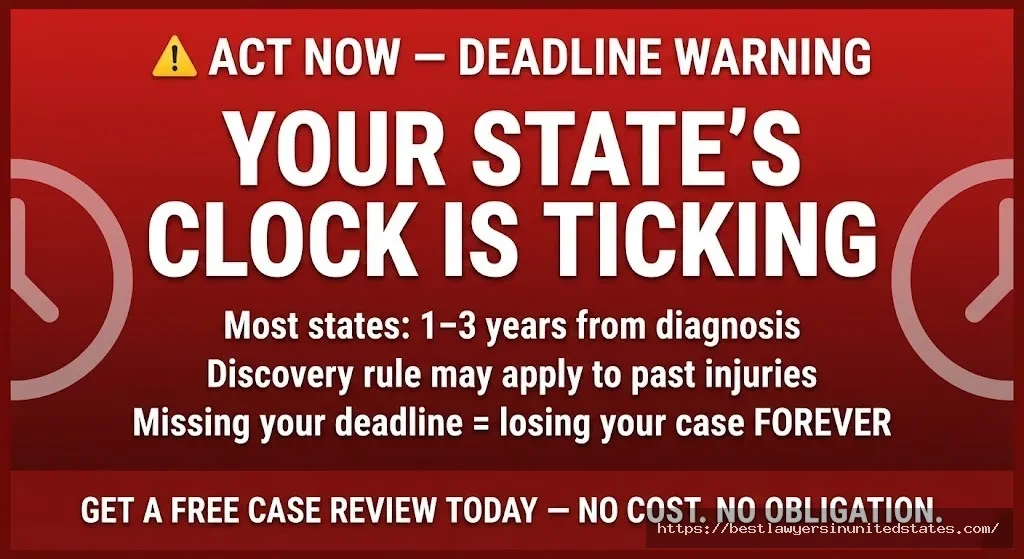
⚠️ CRITICAL: This is NOT a class action with a single claims portal. You must work with an attorney to file your individual lawsuit. Statute of limitations deadlines vary by state — most are 1 to 3 years from the date of your injury or diagnosis. Do not wait.
Complete Filing Process
Step 1: Get Medical Attention and Documentation
If you haven’t already, see a specialist — a gastroenterologist for stomach-related injuries, or an ophthalmologist for vision problems. Getting a formal diagnosis is essential. Courts require objective medical evidence, not just symptoms. Ask your doctor to document the connection between your Trulicity use and your diagnosis in your medical records.
Step 2: Contact an Attorney for a Free Case Review
Every major firm handling these cases offers a free consultation with no obligation. You don’t pay anything unless they win. During the consultation, the attorney will review your prescription history, your diagnosis, your documentation, and your state’s filing deadlines. This is the most important step — an attorney can tell you quickly whether you have a viable claim.
Key attorneys and firms handling Trulicity cases:
- Motley Rice LLC — Among the original firms that argued for MDL creation
- Morgan & Morgan — The largest personal injury firm in the U.S., actively accepting cases
- Johnson//Becker, PLLC — Accepting cases nationwide
- Schmidt Firm, PLLC — Handling Trulicity injury cases in all 50 states
- King Law — Providing free consultations for Trulicity side effects
Step 3: Gather Your Evidence
Your attorney will guide you through this, but start pulling together:
- All prescription and pharmacy records for Trulicity
- Medical records and diagnostic test results (gastric emptying studies, CT scans, lab work)
- Hospital records, ER discharge summaries, surgical notes
- Billing records showing medical expenses
- Documentation of time missed from work
Step 4: Attorney Files Your Lawsuit
Your attorney files an individual complaint that gets transferred to MDL 3094 in the Eastern District of Pennsylvania (or MDL 3163 if your claim involves vision loss). They handle all paperwork, deadlines, and court requirements. You don’t appear in court unless your case is selected as a bellwether trial.
Step 5: Discovery Phase
Both sides exchange information. Your attorney submits a plaintiff fact sheet with details about your Trulicity use and injuries. Eli Lilly’s attorneys may review your medical history. This phase is largely handled by your legal team.
Step 6: Expert Testimony and Hearings
Courts are currently working through Daubert hearings to decide what expert testimony on causation will be allowed at trial. This stage determines whether plaintiffs’ medical experts can testify about the link between Trulicity and your injury type.
Step 7: Bellwether Trials (Expected Late 2026 – 2027)
A small number of representative cases will go to trial first. The verdicts from these cases establish real-world compensation benchmarks and typically trigger mass settlement negotiations.
Step 8: Settlement or Trial
Most MDL cases settle before going to individual trial. Once bellwether trials provide a baseline, your attorney negotiates your specific settlement with Eli Lilly. If a fair deal can’t be reached, your case can proceed to trial.
Critical Deadlines Table
| Deadline Type | Timeframe | What It Means |
|---|---|---|
| State statute of limitations | 1–3 years from injury/diagnosis (varies by state) | Hard deadline to file — missing it bars your claim forever |
| State discovery rule | Varies | In some states, the clock starts when you discovered the injury, not when it happened |
| Attorney consultation | As soon as possible | Earlier consultation = more time to build a strong case |
| Expert disclosure deadlines (MDL) | Managed by attorneys | Handled by your legal team inside the MDL |
| Bellwether trial dates | Projected late 2026–2027 | Test cases that will shape global settlement values |
Common Mistakes to Avoid
People hurt themselves legally without realizing it. Avoid these errors:
- Waiting too long — Statutes of limitations are not flexible. Miss the deadline and you lose your right to sue, no matter how serious your injury.
- Assuming you don’t qualify — Many people with valid claims don’t realize it. A free attorney consultation takes 15 minutes and could change your financial future.
- Skipping diagnostic testing — Lawsuits live or die on objective evidence. If you haven’t had a gastric emptying study, a CT scan, or an ophthalmology exam, get one.
- Not connecting symptoms to Trulicity in your medical records — Ask your doctor to document the timeline in writing.
- Talking to Eli Lilly or their representatives without a lawyer — Don’t sign anything or make statements about your health without legal counsel.
- Thinking it’s a class action — This is an individual lawsuit. You are not automatically enrolled just because you took the drug. You must affirmatively file.
Lawsuit Status and Latest 2026 Updates
Current Status (February 2026)
The Trulicity lawsuit is one of the fastest-growing mass torts in the country. From August to September of 2025, 486 new plaintiffs joined the group lawsuit against GLP-1 drug manufacturers, bringing the total to 2,676. People who have joined this federal group litigation are seeking compensation for the injuries they suffered.
The litigation is currently in the advanced discovery phase. Both sides have exchanged expert reports, and the court is working through a critical Daubert hearing process — this is the stage where Judge Marston decides which expert testimony on causation (the link between Trulicity and injuries) will be allowed at trial. The outcome of these hearings significantly affects how many claims move forward and at what value.
Bellwether trials — which are test cases used to gauge how juries respond to the evidence — likely won’t begin until late 2026 or into 2027. These test cases will be the turning point for the entire litigation.
The Eye Injury MDL (MDL 3163)
In addition to the GI injury litigation, a separate group of cases has been consolidated around NAION — an eye stroke linked to GLP-1 drugs. These Trulicity eye claims have now been consolidated into an MDL in the Philadelphia federal court. MDL No. 3163 is active and affected patients can sue Trulicity’s maker, Eli Lilly, by transferring or filing a new action in IN RE: Glucagon-like Peptide-1 Receptor Agonists (GLP-1 RAs) Non-Arteritic Anterior Ischemic Optic Neuropathy Products Liability Litigation.
As of February 2026, at least 37 eye-related lawsuits are already consolidated in MDL 3163, and the judge is setting the initial case management schedule and appointing attorney leadership. AngelLift: The Full Story — Shark Tank History, Founder Dispute, and Where the Company Stands Today
Recent Developments
- February 2026: MDL 3163 officially underway for Trulicity NAION/vision loss claims; Judge Marston overseeing both GI and eye MDLs
- December 2025: JPML creates separate MDL for eye injury claims; 37+ cases already consolidated
- August–September 2025: 486 new plaintiffs join GLP-1 MDL 3094 in a single two-month window
- August 2025: JAMA study confirms association between GLP-1 drugs and increased NAION risk — of 159,000 patients studied, GLP-1 users showed elevated rates of the eye condition
- May 2025: Rule 702 (Daubert) hearing scheduled to determine admissibility of plaintiff expert testimony on causation — a pivotal moment for the entire MDL
- January 2025: Cases in MDL 3094 surpass 1,331; attorneys estimate 10,000+ eventual filings
What Happens Next
- Mid-2026: Bellwether case selection; court designates representative cases for early trial
- Late 2026 – Early 2027: First bellwether trials begin; jury verdicts set real-world compensation benchmarks
- 2027: Global settlement negotiations expected to accelerate; mass resolution possible but not guaranteed
- 2028+: Individual case resolutions for plaintiffs not covered by any global settlement
Trulicity Lawsuit vs. Similar GLP-1 Drug Cases
How These Cases Compare
The Trulicity lawsuit is part of a wave of GLP-1 drug litigation that is reshaping pharmaceutical law in the United States. Understanding how it compares to related cases helps set expectations.
| Lawsuit | Drug Involved | Manufacturer | Cases (est.) | Qualifying Injuries | Projected Payouts | Status |
|---|---|---|---|---|---|---|
| Trulicity MDL 3094 | Trulicity (dulaglutide) | Eli Lilly | 2,676+ | Gastroparesis, ileus, bowel obstruction | $250K–$700K+ | Active discovery |
| Ozempic/Wegovy MDL 3094 | Semaglutide | Novo Nordisk | 2,190+ | Gastroparesis, ileus, NAION | $250K–$700K+ | Active discovery |
| Mounjaro/Zepbound | Tirzepatide | Eli Lilly | Part of MDL 3094 | Gastroparesis, ileus | TBD | Active |
| NAION MDL 3163 | Multiple GLP-1s | Multiple | 37+ (growing) | NAION / vision loss | $750K–$1M+ | Just formed |
| Byetta/Victoza (prior) | Exenatide/Liraglutide | Various | Thousands | Pancreatitis, thyroid tumors | Settled in some cases | Partially resolved |
What Makes Trulicity Cases Unique
Trulicity has some specific characteristics that distinguish it from other GLP-1 lawsuits:
- Longer market history: Trulicity has been on the market since 2014, giving it a longer track record of adverse event reporting than newer drugs like Mounjaro.
- Pediatric prescribing: Trulicity is approved for patients as young as 10, adding a potential category of pediatric injury claims.
- Price negotiation involvement: CMS is actively negotiating Trulicity’s Medicare price in 2026, suggesting it’s deeply embedded in the healthcare system — which underscores the scale of potential harm.
- Dual MDL exposure: Eli Lilly faces claims in both MDL 3094 (GI injuries) and MDL 3163 (vision loss), creating compounded legal pressure.
- Warning label timing: Internal documents reportedly show that Eli Lilly had mounting evidence of serious GI risks years before warning labels were updated in 2023.
Do You Need a Lawyer to File?
Quick Answer: Yes — unlike a class action, you cannot file this type of lawsuit without a lawyer. These are individual mass tort cases requiring legal representation. The good news: virtually every firm handling these cases works on contingency, meaning you pay nothing upfront and nothing unless you win or settle.
Why You Need an Attorney
This is not a simple claims form you fill out online. Filing a Trulicity lawsuit requires:
- Drafting and filing a legal complaint that meets federal court requirements
- Complying with MDL case management orders (plaintiff fact sheets, discovery protocols)
- Working with medical experts who can testify on your behalf
- Negotiating with one of the world’s largest pharmaceutical companies and their legal team
Trying to do this alone is not realistic. Fortunately, the contingency fee model means your attorney’s interests are aligned with yours — they only get paid if you do.
The Cost to You Is Zero Upfront
Every major firm handling Trulicity cases works on a contingency fee basis. It does not cost anything to hire a lawyer if you are eligible for a Trulicity lawsuit. We take all cases on a contingency basis which means we do not get paid unless we win or settle your case.
Attorneys typically take 33–40% of any settlement or verdict as their fee, with case expenses also deducted. This means if you recover nothing, you owe nothing.
When to Get Legal Help
If you took Trulicity and experienced any of the qualifying injuries listed above — even if you’re not sure you “have a case” — talk to an attorney. The free consultation is genuinely free and no-obligation. Attorneys can tell you quickly whether your situation is worth pursuing. The only downside of calling is learning you don’t qualify. The downside of not calling could be losing a $250,000+ claim to a statute of limitations deadline.
Frequently Asked Questions
What is the Trulicity lawsuit about?
Quick Answer: People who took Trulicity and developed serious health conditions are suing Eli Lilly for failing to warn them about the risks.
The lawsuits allege that Eli Lilly knew Trulicity could cause stomach paralysis, intestinal blockages, vision loss, and other severe conditions — and either failed to warn patients and doctors, or waited too long to update the drug’s warning label. These are individual lawsuits consolidated for efficiency into federal MDL litigation in Pennsylvania.
Is the Trulicity lawsuit a class action?
Quick Answer: No — it is mass tort litigation, which means each person has their own individual lawsuit and potential individual compensation.
This is not a Trulicity class action lawsuit, rather they are mass torts meaning they are your own individual case but because they are so many, they are sent to one court for coordinated discovery and pretrial proceedings. Your payout won’t be split equally with thousands of others. Your case value is based entirely on your specific injuries and circumstances.
Who qualifies for a Trulicity lawsuit?
Quick Answer: You may qualify if you took Trulicity as prescribed and were later diagnosed with a serious condition like gastroparesis, ileus, bowel obstruction, NAION, or pancreatitis.
Most attorneys also want to see that you were on the drug for a meaningful period, that your injury is medically documented, and that your state’s statute of limitations has not expired. The only way to know for sure is to speak with an attorney in a free case review.
How much money can I get?
Quick Answer: No settlements have been finalized yet. Legal experts project individual case values of $250,000–$700,000 for serious gastroparesis and $750,000–$1 million+ for vision loss cases.
These are projections based on similar pharmaceutical MDLs and early case valuations — not guarantees. Your specific case value depends on your injury severity, medical documentation, hospitalization history, lost wages, and other factors.
When is the deadline to file?
Quick Answer: There is no single deadline. Your state’s statute of limitations — typically 1 to 3 years from your diagnosis or the date you discovered your injury — controls when you must file.
Missing this deadline permanently bars your lawsuit. Some states apply a “discovery rule” that starts the clock when you realized (or reasonably should have realized) that Trulicity caused your injury. Do not assume you have more time than you think — speak with an attorney now.
Do I need a lawyer?
Quick Answer: Yes. This is not a class action with a simple online claims form. You need an attorney to file an individual lawsuit. The good news is that every major firm handles these on contingency — no payment unless you win.
What documents do I need?
Quick Answer: Prescription records showing you took Trulicity, medical records confirming your diagnosis, and documentation of your financial losses (medical bills, lost wages).
Specifically helpful: gastric emptying study results (for gastroparesis claims), CT scan or imaging reports (for bowel obstruction), ophthalmology records (for NAION claims), surgical notes if you had any procedures, and ER discharge summaries.
What if I don’t have my medical records?
Quick Answer: You can request them — every patient has a right to their own records.
Under HIPAA, you can request records from any provider who treated you. Attorneys’ offices handle this routinely and can help you obtain the records you need. The process takes weeks, not months. Start immediately.
Can I still file if I stopped taking Trulicity?
Quick Answer: Yes. The key is the injury, not whether you’re still taking the drug.
Yes, you can still file a lawsuit if you stopped taking the drug. The important thing is the injury or side effect caused by Trulicity. As long as your injury is documented and your statute of limitations hasn’t run, you have standing to sue.
When will I receive payment?
Quick Answer: There is no payment timeline yet. The litigation is in discovery. Settlements for individual cases are not expected to begin until after bellwether trials in late 2026 or 2027 at the earliest.
This is a realistic expectation: pharmaceutical mass torts take time. The Vioxx litigation, a comparable pharmaceutical MDL, took several years from filing to global settlement. Planning for a 3–5 year timeline from the filing of your case to resolution is reasonable, though individual cases may resolve sooner.
What if my injury happened years ago?
Quick Answer: You may still qualify if your state’s statute of limitations hasn’t expired — but check now.
Many states apply a “discovery rule” that starts the clock when you discovered (or should have discovered) that Trulicity caused your injury. If you were recently diagnosed and are connecting it to past Trulicity use, your window may still be open. Consult an attorney today — waiting even one more month could be the difference.
Will filing a lawsuit affect my healthcare or Trulicity prescription?
Quick Answer: No. Filing a lawsuit does not affect your medical care in any way.
Your doctor’s treatment decisions are independent of any legal action you take. If you still need medication for your diabetes, discuss alternatives with your physician — don’t make changes based on the lawsuit.
What is NAION, and how does Trulicity cause it?
Quick Answer: NAION is non-arteritic anterior ischemic optic neuropathy — an eye stroke that cuts off blood flow to the optic nerve, causing sudden, often permanent vision loss in one eye.
Some studies have shown that the active ingredient in Trulicity, dulaglutide, may lead to an increased risk of NAION, a type of vision loss in one eye. A 2025 JAMA study found that among 159,000+ GLP-1 users, significantly more developed NAION than non-users. Patients who lost vision while taking Trulicity are now filing lawsuits in the new MDL 3163.
What is gastroparesis and how does Trulicity cause it?
Quick Answer: Gastroparesis is stomach paralysis — your stomach stops moving food into the small intestine. Trulicity’s mechanism (slowing gastric emptying) is believed to trigger permanent nerve and muscle damage in some patients.
Gastroparesis is also known as stomach paralysis. This can cause chronic nausea and vomiting, which can lead to malnutrition and dehydration. In severe cases, patients cannot eat normally, lose dramatic amounts of weight, require feeding tubes, and are hospitalized repeatedly. This is the most common injury type in the Trulicity litigation.
Can I file even if I used Trulicity for weight loss, not diabetes?
Quick Answer: Possibly — speak with an attorney. Off-label use claims are more complex but may still be valid.
Some attorneys note that off-label weight loss use may slightly complicate a claim, but the core theory — that Eli Lilly failed to warn about serious side effects — still applies regardless of why you were prescribed the drug. An attorney can assess your specific situation.
What happens if I do nothing?
Quick Answer: Your statute of limitations will eventually expire, and you will permanently lose the right to sue, regardless of how serious your injury is.
There is no benefit to waiting. Free consultations don’t cost you anything, and attorneys don’t take a fee unless they win. The only person who loses if you wait is you.
How do I get started?
Quick Answer: Call a law firm that handles Trulicity cases for a free, no-obligation case review.
You’ll need to describe what drug you took, when, your diagnosis, and how it has affected your life. From there, an attorney determines eligibility and handles everything else. Most major firms accept calls 24/7 for injury case evaluations. There is no pressure and no upfront cost.
