
Workplace retaliation is the #1 complaint filed with the Equal Employment Opportunity Commission (EEOC) every single year — and for good reason. When you speak up about discrimination, harassment, or illegal conduct at work, your employer is legally prohibited from punishing you for it. If they do it anyway, you have the right to fight back and get compensated.
So what’s the average settlement for a retaliation lawsuit? Most retaliation cases settle between $20,000 and $150,000, with mid-to-severe cases reaching $250,000 or more. High-stakes cases — particularly those involving wrongful termination, whistleblowing, or clear malicious intent — can result in verdicts or settlements exceeding $500,000. ogx lawsuit
The exact amount depends on the strength of your evidence, how much income you lost, and how badly the retaliation damaged your career and wellbeing. Dude Wipes Lawsuit
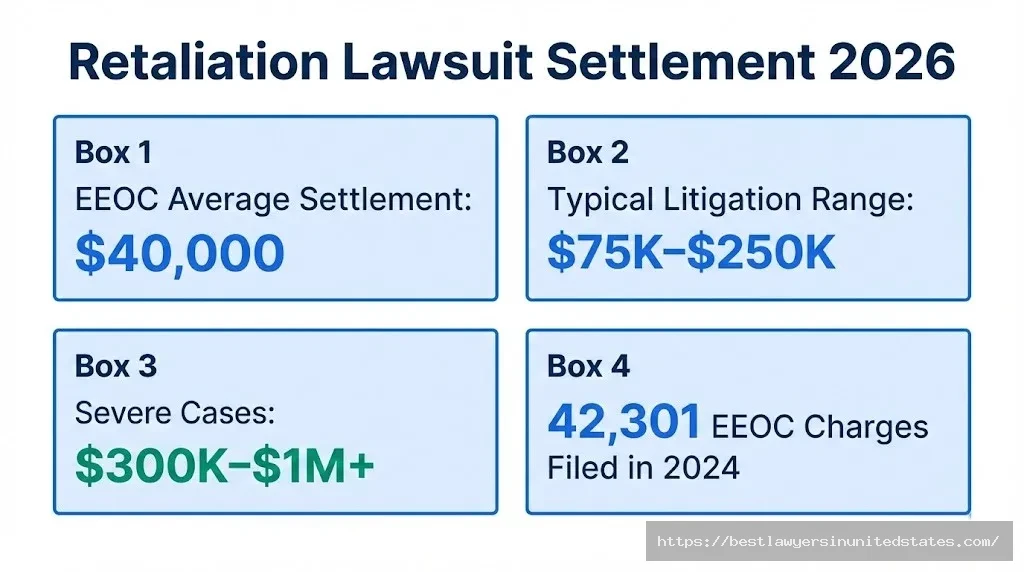
Quick Answer: Retaliation lawsuit settlements typically range from $20,000 to $150,000 for most workers. EEOC-mediated cases average around $40,000. Cases that go to litigation — especially those involving termination, long-term harm, or strong documentation — regularly settle in the $75,000–$300,000 range, with some reaching seven figures. Your specific settlement depends on your losses, your evidence, your state’s laws, and whether you have legal representation.
What Is a Retaliation Lawsuit?
What Counts as Workplace Retaliation
Retaliation happens when your employer punishes you for doing something the law protects. That protected activity can include reporting discrimination or harassment, filing an EEOC charge, refusing to participate in illegal practices, requesting reasonable accommodation, taking FMLA leave, filing a workers’ compensation claim, or blowing the whistle on financial fraud or safety violations.
The punishment — called an “adverse action” — doesn’t have to be a firing. Courts have recognized demotions, pay cuts, shift changes, exclusion from meetings, sudden negative performance reviews, and even a hostile change in supervisor attitude as qualifying retaliation. If you can connect the adverse action to your protected activity, you likely have a claim.
More than 42,000 retaliation charges were filed with the EEOC in fiscal year 2024 alone, making it the most common employment complaint for the third year running. The EEOC secured nearly $700 million for all discrimination victims in FY 2024 — the highest recovery in the agency’s recent history.
Retaliation Overview at a Glance
| Factor | Details |
|---|---|
| Most Common Claim Type | Retaliation (EEOC #1 charge, FY 2024) |
| EEOC Charges Filed (FY 2024) | 42,301 retaliation charges |
| Average EEOC Settlement | ~$40,000 |
| Typical Litigation Settlement | $75,000–$250,000 |
| Severe Case Range | $250,000–$1 million+ |
| % of Cases That Settle Before Trial | 90%+ |
| EEOC Success Rate in Litigation (FY 2024) | 97% |
| Governing Federal Laws | Title VII, ADA, ADEA, FMLA, OSHA |
What Laws Protect You
Several federal laws prohibit retaliation, and many states layer on additional protections on top of them. The key federal statutes include:
- Title VII of the Civil Rights Act (1964) — protects against retaliation for reporting sex, race, religion, color, or national origin discrimination
- Americans with Disabilities Act (ADA) — protects employees who request accommodation or report disability discrimination
- Age Discrimination in Employment Act (ADEA) — protects workers 40+ from retaliation for age-discrimination complaints
- Family and Medical Leave Act (FMLA) — prohibits retaliation for taking protected medical leave
- Occupational Safety and Health Act (OSHA) — protects workers who report safety violations
- False Claims Act / Dodd-Frank Act — protects whistleblowers who report financial fraud or securities violations
States like California, New York, and New Jersey have even broader protections under their own employment statutes, which is why settlements in those states tend to run higher.
Common Retaliatory Actions
Not every act of retaliation is obvious. Employers sometimes try to make things miserable enough that you quit — a legal concept called “constructive discharge.” Here are the most frequently alleged retaliatory behaviors:
- ❌ Termination or forced resignation
- ❌ Demotion or reduction in job responsibilities
- ❌ Pay cuts or withheld bonuses
- ❌ Negative performance reviews that weren’t an issue before
- ❌ Schedule changes designed to inconvenience you
- ❌ Exclusion from meetings, projects, or advancement opportunities
- ❌ Increased surveillance or micromanagement
- ❌ Transfer to a less desirable role or location
- ❌ Harassment or a sudden hostile work environment
Average Settlement Amounts by Case Type
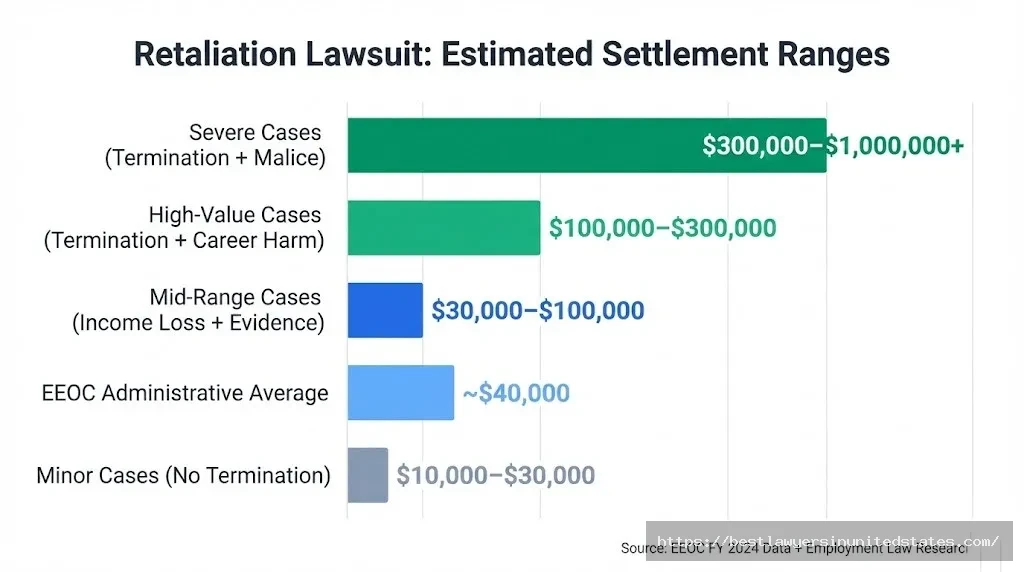
Quick Answer: The “average” settlement depends heavily on the type of retaliation and how it affected you. EEOC-mediated claims average ~$40,000. Cases that go to court — especially termination cases — regularly settle for $100,000 or more. Whistleblower cases are typically the highest-value, often $100,000–$500,000+.
Settlement Ranges by Retaliation Type
| Type of Retaliation | Typical Settlement Range | Key Factors |
|---|---|---|
| EEOC-Mediated Claims (All Types) | $10,000–$100,000 | Evidence strength, employer size |
| Wrongful Termination Retaliation | $50,000–$150,000 | Lost wages, career damage |
| Whistleblower Retaliation | $100,000–$500,000+ | Severity, public policy implications |
| Harassment Complaint Retaliation | $40,000–$120,000 | Ongoing harm, documentation |
| Workers’ Comp Retaliation | $30,000–$80,000 | Medical records, timeline |
| FMLA Retaliation | $25,000–$100,000 | Duration of harm, back pay |
| Demotion / Pay Cut Only | $15,000–$60,000 | Wage difference, evidence |
| Severe Cases (Termination + Pattern + Malice) | $300,000–$1 million+ | Punitive damages, bad faith |
Settlement Tiers Explained
Most retaliation cases fall into one of four tiers:
Tier 1 — Minor Cases ($10,000–$30,000): Mild retaliation with limited financial harm. Think a single write-up, a lateral transfer, or one denied promotion. Cases here often lack strong documentation or the adverse effect was temporary. Many of these resolve during EEOC mediation.
Tier 2 — Mid-Range Cases ($30,000–$100,000): Cases with clear evidence, some income loss, and emotional distress. A demotion with a pay cut, multiple incidents of retaliation, or a termination with moderate career impact falls here. Most people in this range have some documentation and file a lawsuit.
Tier 3 — High-Value Cases ($100,000–$300,000): Cases involving termination, significant wage loss, career blacklisting, or documented emotional harm. Strong paper trails, attorney representation, and an employer that acted with obvious bad faith push cases into this range.
Tier 4 — Exceptional Cases ($300,000–$1 million+): These involve egregious employer conduct, whistleblowing on fraud, long-term career destruction, or punitive damages awarded by a jury. One publicized example: Jackson National Life Insurance paid $20.5 million to resolve a retaliation case — though such outcomes are rare.
How Much Does the EEOC Average Mean for You?
The frequently cited “$40,000 average” for EEOC retaliation settlements can be misleading. That figure primarily reflects cases that resolve during the EEOC administrative process — before a lawsuit is ever filed. Think of it as an early-stage settlement number where both sides want to avoid the time and expense of litigation.
Once a case moves into active litigation, the stakes — and the settlements — go up considerably. California employment attorneys report that cases hitting the courtroom regularly settle between $75,000 and $250,000. Cases with strong facts and punitive damage exposure can reach well beyond that. AngelLift: The Full Story — Shark Tank History, Founder Dispute, and Where the Company Stands Today
What Determines Your Settlement Amount
The 8 Biggest Factors That Affect Retaliation Settlements
Your case is unique. No formula spits out a number. But these eight factors have the biggest real-world impact on what you can expect:
1. Strength of Your Evidence
This is the single biggest driver of settlement value. If you have emails, texts, HR complaint records, performance reviews that suddenly turned negative after your complaint, or witness statements — your case value goes up substantially. Without documentation, even a legitimate claim becomes much harder to settle favorably.
2. How Much Income You Lost
Back pay — the wages you would have earned if you hadn’t been retaliated against — forms the mathematical backbone of most retaliation settlements. If you were terminated and it took you 12 months to find comparable work, that’s 12 months of back pay on the table. Add bonuses, benefits, and retirement contributions you missed, and the number grows fast.
3. Front Pay (Future Lost Earnings)
If retaliation ended your career trajectory or you’ve been effectively blacklisted in your industry, courts can award front pay to compensate for future earnings you’ll never see. This is especially significant for high earners and long-tenured employees who face a difficult road back to their prior compensation level.
4. Emotional Distress Damages
Retaliation doesn’t just hurt your wallet. It causes anxiety, depression, sleep disorders, and lasting psychological harm. Courts and juries take emotional distress seriously, especially when you can document it with therapy records, medical notes, or testimony about how your life changed. California in particular tends to award significant emotional distress damages.
5. The Employer’s Size and Financial Resources
A Fortune 500 company has more money, more reputation to protect, and a stronger incentive to settle quietly. They’re also more likely to offer higher settlements early to avoid bad press. Smaller businesses may be unable to pay much even if they wanted to, which creates a real ceiling on recovery regardless of how good your case is.
6. Whether Punitive Damages Apply
When an employer acted with malice or reckless indifference to your rights, courts can award punitive damages on top of your actual losses. Under Title VII, punitive damages are capped based on employer size — ranging from $50,000 for employers with 15–100 employees up to $300,000 for those with more than 500 employees. Under the ADEA, willful violations can result in “liquidated damages” that double your back pay award.
7. Your Jurisdiction and State Laws
Where you live matters enormously. California’s FEHA and Labor Code §1102.5 are among the strongest retaliation protection laws in the country, with no cap on emotional distress or punitive damages. New York, New Jersey, and Illinois also offer stronger protections than the federal baseline. If you’re in a state with minimal employment law protections beyond federal statutes, your ceiling may be lower.
8. Whether You Have an Attorney
Workers with experienced employment attorneys consistently recover more than those who represent themselves. An attorney knows how to value a case, build a paper trail, counter low-ball offers, and credibly threaten trial — which is what ultimately gets employers to pay a fair number. Many employment attorneys take retaliation cases on contingency (usually 30–40% of the recovery), so you pay nothing unless you win.
What Types of Damages You Can Recover
Quick Answer: A successful retaliation claim can include back pay, front pay, emotional distress damages, attorney’s fees, and potentially punitive damages. Non-economic damages like reinstatement or neutral references can also be part of a settlement.
Breakdown of Available Damages
| Damage Type | What It Covers | Notes |
|---|---|---|
| Back Pay | Lost wages and benefits from retaliation to resolution | Must actively look for new work (mitigation) |
| Front Pay | Projected future lost earnings | Applies when reinstatement isn’t practical |
| Emotional Distress | Psychological harm, anxiety, depression | Requires documentation; uncapped in many states |
| Punitive Damages | Punishment for egregious employer conduct | Capped under Title VII; doubled under ADEA for willful violations |
| Attorney’s Fees | Cost of your legal representation | Often paid by employer if you win |
| Benefits Restoration | Health insurance, retirement, PTO | Often part of settlement terms |
| Reinstatement | Return to your job | Rare; usually replaced by front pay |
| Non-Monetary Relief | Policy changes, training, neutral reference | Common in settlements; adds value |
One important rule: you have a legal duty to mitigate your damages. This means actively looking for comparable work after a termination. Courts expect you to make a good-faith effort to find new employment, and they’ll reduce your back pay award if you don’t. Keep a detailed log of every job application, interview, and rejection.
How the Retaliation Claims Process Works

Step 1: Document Everything — Right Now
Before you take any official step, document everything you can. Save every email, text, performance review, HR complaint, and voicemail. Write down dates, times, witnesses, and what was said. If you’re still employed, note any changes in how you’re treated after filing a complaint. This contemporaneous record becomes the backbone of your claim.
Step 2: File an EEOC Charge (Federal Claims)
For claims under federal law (Title VII, ADA, ADEA, FMLA), you must file a charge with the EEOC before you can sue. This deadline is critically important. You generally have 180 days from the retaliatory act to file — or 300 days if your state has its own anti-discrimination agency (most states do). Missing this deadline can kill your claim entirely.
After you file, the EEOC notifies your employer and begins an investigation. This process typically takes 6–12 months. The agency may attempt mediation, which is where many cases settle (the ~$40,000 average comes from here).
Step 3: Receive Your Notice of Right to Sue
If the EEOC can’t resolve the case, they issue a “Notice of Right to Sue,” which gives you 90 days to file a lawsuit in federal court. You can also request this notice before the EEOC finishes its investigation if you want to move faster.
Step 4: File a Lawsuit
Once you file suit, the discovery process begins — and this is where settlements often jump. Employers who might have ignored your EEOC charge suddenly take things seriously when their executives face depositions and their internal communications become evidence. More than 90% of retaliation cases settle before trial, often during or after discovery.
Step 5: Settlement Negotiations
Your attorney will exchange settlement demands and offers with the employer (or their insurer and legal team). Mediation with a neutral third party is common and often effective. A strong documented case + credible threat of trial = maximum settlement leverage.
Critical Deadlines You Cannot Miss
| Deadline | Federal Rule | What Happens If You Miss It |
|---|---|---|
| EEOC Charge Filing | 180 days (or 300 days with state agency) | You lose your right to sue under federal law |
| EEOC Right to Sue Request | Any time after 180 days | You can request early if needed |
| Lawsuit After Right to Sue Notice | 90 days from receipt | Claim is time-barred |
| State Law Claims | Varies (often 1–3 years) | Varies by state |
| Document Preservation | Immediately upon retaliation | Lost evidence = weaker case |
How to Strengthen Your Retaliation Claim
Build the Strongest Possible Paper Trail
The difference between a $30,000 settlement and a $150,000 settlement is often documentation. Here’s what to gather and keep:
| Document Type | Why It Matters | Where to Find It |
|---|---|---|
| Your original complaint/report | Establishes the protected activity | HR records, EEOC filing, email sent |
| Timing evidence | Shows retaliation came after your complaint | Email dates, performance review dates |
| Pre-complaint performance records | Shows you were in good standing before | Prior reviews, commendations |
| Post-complaint adverse actions | Documents what changed | Demotion letters, termination notice, schedule changes |
| Witness statements | Corroborates your account | Colleagues who saw or heard events |
| Medical/therapy records | Supports emotional distress damages | Doctor/therapist notes post-retaliation |
| Job search records | Shows mitigation efforts | Applications, rejections, interview notes |
Don’t Make These Mistakes
Retaliation claims can be weakened — sometimes fatally — by mistakes employees make early on. The most common ones:
Waiting too long to file. The EEOC clock starts ticking the moment the retaliation happens. Many workers wait months before consulting an attorney, only to find they’re close to — or past — the deadline.
Failing to mitigate damages. Courts expect you to look for a new job after termination. If you sit home for a year without applying anywhere, the employer’s attorney will argue your lost wages should be reduced accordingly.
Signing a settlement without attorney review. Employers sometimes offer quick settlements shortly after the retaliatory act, before you’ve had time to assess the full value of your claim. A settlement you sign too early may release claims worth far more than what you accepted.
Discussing the case on social media. Anything you post can be used against you. Keep your case private.
Destroying or deleting evidence. Even accidentally deleting communications can look bad. Preserve everything.
Retaliation Settlement Comparison: How Does Your Case Stack Up?
Notable Real-World Retaliation Cases
| Case / Context | Settlement Amount | Type |
|---|---|---|
| Jackson National Life Insurance | $20.5 million | Retaliation + discrimination |
| Ivy League Institution (antisemitism/retaliation) | $21 million | EEOC settlement, 2025 |
| National service provider (sexual harassment + retaliation) | $400,000 | EEOC, 2025 |
| EEOC v. Cardinal Health (racial harassment + retaliation) | $1.45 million | Federal litigation |
| National restaurant franchise (harassment + retaliation) | $400,000 | EEOC |
| Average EEOC administrative settlement | ~$40,000 | All retaliation types |
| Typical mid-level litigation settlement | $75,000–$250,000 | State/federal court |
How Retaliation Compares to Other Employment Claims
| Claim Type | Typical Settlement Range | Commonality |
|---|---|---|
| Retaliation | $20,000–$250,000+ | #1 EEOC charge category |
| Sexual Harassment | $30,000–$300,000+ | Often combined with retaliation |
| Race Discrimination | $20,000–$200,000+ | #2 EEOC charge category |
| Wrongful Termination | $5,000–$100,000 | Wide range; fact-dependent |
| Disability Discrimination | $25,000–$200,000+ | ADA protections |
| FMLA Violations | $20,000–$100,000 | Back pay focused |
Do You Need a Lawyer for a Retaliation Lawsuit?
Quick Answer: You’re not required to have a lawyer. But workers with experienced employment attorneys consistently recover more — sometimes significantly more — than those who represent themselves. Most employment attorneys handle these cases on contingency, so you pay nothing unless you win.
When You Can Handle It Yourself
If your case involves a fairly clear-cut EEOC charge, your primary goal is administrative resolution, and the damages are relatively modest, it’s possible to navigate the process without a lawyer. The EEOC website has detailed guidance, and many workers successfully represent themselves during the EEOC mediation phase. EcoShield Lawsuit 2026
When You Absolutely Need an Attorney
You should strongly consider hiring an employment attorney if:
- You were terminated and face significant lost wages
- You want to file a lawsuit rather than just an EEOC charge
- Your employer has already hired legal counsel
- You’re dealing with complex state law claims in addition to federal ones
- Your claim involves potential punitive damages
- You’re unsure whether you’ve met all the filing deadlines
- You’ve been offered a settlement and aren’t sure if it’s fair
Attorney Fees Explained
Most employment attorneys handle retaliation cases on a contingency fee basis, typically 30–40% of the final recovery. This means zero out-of-pocket cost to you — you pay only if you win. In addition, federal law allows courts to award attorney’s fees separately to winning plaintiffs, which can increase total employer liability and is often used as a negotiating tool.
Frequently Asked Questions
What is the average settlement for a retaliation lawsuit?
Quick Answer: The average EEOC-mediated retaliation settlement is around $40,000. Cases that go to litigation typically settle between $75,000 and $250,000. Severe cases can reach $500,000 or more.
The “$40,000 average” reflects early-stage EEOC settlements — before a lawsuit is filed. Once attorneys get involved and discovery begins, the numbers rise considerably. Your settlement depends on your evidence, how much you lost financially, and how severely the retaliation affected your life.
Who qualifies to file a retaliation lawsuit?
Quick Answer: Anyone who faced adverse employment action after engaging in a legally protected activity — like reporting discrimination, filing a complaint, or requesting leave — may have a claim.
You need to show three things: (1) you engaged in a protected activity, (2) your employer took an adverse action against you, and (3) there’s a causal connection between the two. Timing is often the key — retaliation that happens shortly after you complain is much easier to prove.
What documentation do I need to file a retaliation claim?
Quick Answer: The strongest claims have emails, HR complaint records, performance reviews showing a change after your complaint, witness names, and medical records documenting emotional distress.
If you don’t have receipts or formal records, that doesn’t automatically end your claim. Witnesses, timeline notes, and inconsistencies in the employer’s stated reasoning can all be powerful evidence too.
How long does a retaliation lawsuit take?
Quick Answer: The EEOC process alone typically takes 6–12 months. If you file a lawsuit afterward, expect 1–3 additional years before resolution, though many cases settle well before trial.
Cases with strong documentation tend to move faster because there’s less room for the employer to dispute the facts. Cases that require extensive discovery or face procedural battles can drag out much longer.
What is the deadline to file a retaliation claim?
Quick Answer: For federal claims, you generally have 180 days from the retaliatory act to file with the EEOC, or 300 days if your state has its own civil rights agency.
State law deadlines vary. Some states give you as little as one year; others give up to three. Once the EEOC issues your Right to Sue notice, you have exactly 90 days to file a lawsuit. These deadlines are hard — missing them almost always ends your claim.
Do I have to pay taxes on my retaliation settlement?
Quick Answer: It depends on what the money is for. Back pay is taxable. Emotional distress damages are generally taxable. Physical injury compensation may not be. Punitive damages are always taxable.
Because the tax treatment of settlements is complex and depends on how the settlement agreement is structured, it’s worth consulting a tax professional alongside your employment attorney when you’re close to settling.
Can I get my job back as part of a settlement?
Quick Answer: Technically yes — reinstatement is a legal remedy. In practice, most employees opt for front pay instead, since returning to a workplace where you were retaliated against is rarely desirable or practical.
Courts and settlement agreements often replace reinstatement with front pay — a cash payment representing the earnings you would have made if you’d been allowed to continue working. This is usually the better outcome.
What if I already signed a separation agreement?
Quick Answer: If your separation agreement included a general release of claims, you may have waived your right to sue. But there are exceptions — especially if the release was signed under duress, wasn’t knowing or voluntary, or didn’t comply with statutory requirements (like those under the ADEA).
Don’t assume a signed release ends your options. An employment attorney can review the agreement and assess whether any claims survived.
What if I can’t prove why I was fired?
Quick Answer: You don’t need a confession. Courts look at circumstantial evidence — especially timing, inconsistent employer explanations, and a sudden change in treatment after a protected activity.
Employers rarely say “we fired you because you reported us.” But if your performance reviews were stellar, nothing changed at work, and you were let go two weeks after filing an HR complaint — a jury can connect those dots.
What is the difference between a retaliation lawsuit and a discrimination lawsuit?
Quick Answer: Discrimination means you were treated unfairly because of a protected characteristic (race, sex, age, etc.). Retaliation means you were punished for reporting discrimination or exercising another legal right. Many cases involve both.
Retaliation claims can actually be stronger in some ways because you don’t need to prove discriminatory intent — you just need to show a causal connection between your protected activity and the adverse action. That’s why retaliation is the EEOC’s most common charge type.
Can I file a retaliation claim if I still work at the company?
Quick Answer: Yes. You don’t need to be fired to have a retaliation claim. Demotions, pay cuts, bad performance reviews, schedule changes, or a hostile environment following a complaint can all qualify.
In fact, some employees find it strategically better to file a claim while still employed, since it creates a formal record and may stop ongoing retaliation. Just document everything carefully.
How much will I actually take home after attorney fees?
Quick Answer: If your attorney works on a 33% contingency and you settle for $150,000, you’d receive approximately $100,500 before taxes. Some settlements also include attorney’s fees paid separately by the employer.
The math matters. Talk to your attorney upfront about their fee structure and how taxes will affect your net recovery. Some attorneys negotiate to have the employer pay attorney’s fees separately, which can increase your net take-home.
What happens if the EEOC doesn’t find in my favor?
Quick Answer: A “no cause” finding from the EEOC doesn’t end your case. You can still request a Right to Sue notice and file a lawsuit independently.
The EEOC investigates tens of thousands of charges each year with limited resources. A no-cause finding means investigators didn’t find enough to pursue the case themselves — not that your underlying claim is worthless. Many successful retaliation lawsuits were filed after EEOC no-cause findings.
Should I accept the first settlement offer?
Quick Answer: Usually no. First offers are almost always low. Employers start conservative to test whether you know the value of your claim.
This is where having an attorney pays off. An experienced employment lawyer knows what similar cases have settled for in your jurisdiction, how to build a counter-offer, and when a number is genuinely fair versus when to push harder.
What’s the statute of limitations for a retaliation lawsuit in California?
Quick Answer: For state-law claims under FEHA, you generally have three years from the retaliatory act to file a complaint with the California Civil Rights Department (formerly DFEH). Federal EEOC deadlines (300 days) also apply to federal claims.
California has some of the strongest employee protections in the country. If you’re in California, your settlement ceiling is generally higher than the national average because of uncapped emotional distress damages and the availability of punitive damages under state law.
What if my employer claims they fired me for performance reasons?
Quick Answer: That’s the most common defense. Your job is to show that the stated reason is a pretext — that performance wasn’t really the issue, and the real reason was your protected activity.
Evidence of pretext includes: performance reviews that were positive before your complaint and suddenly turned negative after; inconsistent explanations from your employer; similarly situated employees who weren’t fired despite similar performance issues; and the suspicious timing of the adverse action. These are the details that make or break retaliation claims.
What to Do Right Now If You’ve Been Retaliated Against
The steps you take in the days and weeks after retaliation begins will define how your case plays out. Here’s your immediate action plan:
1. Save all evidence before you lose access to it. If you’re still employed, forward key emails to a personal account (check your company policy first) or screenshot them. HR complaint submissions, performance reviews, communications showing a change in treatment — get them while you still can.
2. Write a detailed timeline. Sit down today and write out every significant event — dates, witnesses, what was said. Memory fades. A contemporaneous timeline is one of the most valuable documents you can have.
3. Don’t sign anything yet. If your employer hands you a separation agreement, a non-disparagement agreement, or any other document, don’t sign it on the spot. Take time to have an attorney review it.
4. Consult an employment attorney. Many offer free initial consultations. Even if you’re not sure whether you have a case, getting a professional assessment costs you nothing and could be worth thousands.
5. File your EEOC charge in time. Don’t let the clock run out. You can file online at eeoc.gov or at your nearest EEOC office. The 180-day (or 300-day) deadline waits for no one.
This article is for informational purposes only and does not constitute legal advice. Retaliation claims are highly fact-specific. If you believe you’ve experienced workplace retaliation, consult a licensed employment attorney in your jurisdiction as soon as possible to protect your rights and deadlines.
