
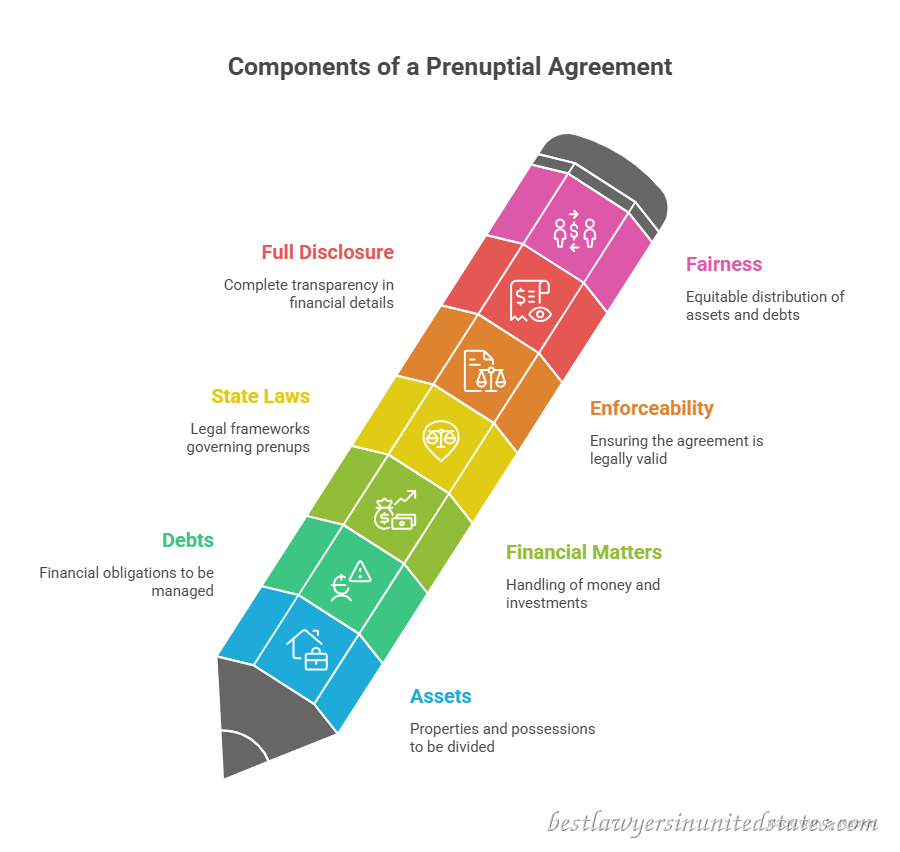
A prenuptial agreement (prenup) is a legally binding contract entered into before marriage that outlines how assets, debts, and financial matters will be handled in the event of divorce, separation, or death.
Governed by state-specific laws like Florida’s Uniform Premarital Agreement Act or California’s community property rules, prenups provide certainty and protection.
Unlike generic forms or AI-generated templates, a well-drafted prenup by an experienced lawyer ensures enforceability, full disclosure, and fairness—avoiding common pitfalls that render agreements invalid.

What Is a Prenuptial Agreement?
Prenups define marital vs. separate property, alimony terms, debt responsibilities, and inheritance rights. They cannot dictate child custody, support, or non-financial matters like household chores, as these violate public policy in most states.
Postnuptial agreements offer similar protections after marriage, ideal for evolving financial situations—such as career changes or unexpected inheritances.
Why Do You Need a Prenuptial Agreement?
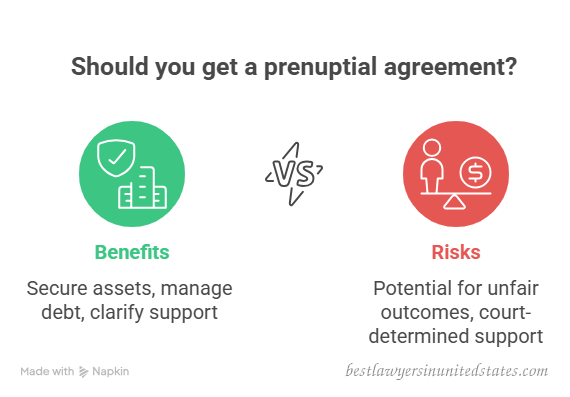
Without a prenup, state laws default to equitable distribution (e.g., New York) or community property (e.g., Texas), potentially leading to unfair outcomes. In 2025, with divorce rates at 43% for first marriages, prenups are more essential than ever for financial security. Key reasons include:
- Asset Protection: Shield premarital wealth, real estate, stocks, retirement accounts, businesses, or emerging assets like cryptocurrency and digital portfolios.
- Debt Management: Clarify responsibility for student loans, credit card debt, or future liabilities—critical as dual-income households rise.
- Spousal Support Clarity: Set alimony limits or waivers, preventing court-determined amounts that could lead to financial hardship.
- Inheritance Safeguards: Ensure assets pass to children from prior relationships, bypassing spousal claims.
- Business and Career Security: Protect professional degrees, anticipated income growth, or company interests. Prenups are vital for high-net-worth individuals, those with prior marriages, significant wealth disparities, or family inheritances—but they’re increasingly common for everyday couples seeking transparency. Surveys show 42% of U.S. adults support prenups, with interest growing rapidly.
A prenup makes sense if you:
- Own a business or professional practice
- Expect an inheritance or already hold family wealth
- Have children from a prior relationship
- Carry significantly different assets or debt (e.g., student loans)
- Want a clear, low-conflict plan if life changes
2025 Trends in Prenuptial Agreements
Prenups are surging in popularity, with 47% of millennials and 41% of Gen Z couples signing them—more than double older generations. Women are leading the charge, initiating agreements to protect careers and assets in an era of later marriages and financial independence. No longer just for the ultra-wealthy (median net worth of signers: $78,000), they’re becoming standard for all income levels, especially in states like Florida where adoption is rising.
Modern prenups address digital assets, AI tools for drafting (though professionals are recommended), and collaborative planning to align on long-term goals. Experts view them as smart financial planning rather than distrust, fostering transparency and reducing conflicts.
Who Should Consider a Prenuptial Agreement?
Anyone entering marriage with:
- Substantial assets or debts (e.g., student loans averaging $37,000 per borrower).
- Business ownership or entrepreneurial ventures.
- Children from previous relationships—vital as 60% of second marriages end in divorce.
- Anticipated inheritances or gifts.
- Professional qualifications (e.g., medical or law degrees) that could appreciate in value. Even if you’re not wealthy, a prenup fosters honest discussions and reduces future conflicts. In 2025, 15% of couples overall sign them, but 40% of those aged 18-34 do—reflecting a shift toward proactive planning.
Why Hire a Prenuptial Agreement Lawyer?
DIY prenups or online templates often fail in court due to lack of customization, incomplete disclosure, or coercion claims—potentially costing thousands in disputes. A specialized lawyer ensures:
- Legal Compliance: Adherence to state requirements, like Pennsylvania’s full financial disclosure or Florida’s voluntary signing rules.
- Fair Negotiation: Independent representation for each partner to avoid invalidation.
- Enforceability: Drafting that withstands scrutiny—our attorneys boast 95%+ uphold rates in disputes.
- Personalization: Tailoring to your situation, including complex elements like international assets, cryptocurrency, or NFTs. Hiring separate lawyers is crucial; shared counsel risks conflicts of interest. Expect costs from $1,500-$7,500 (flat fees common), with 80% of our listed attorneys offering free initial consultations.
What to Look for in a Prenuptial Agreement Attorney
- Experience and Specialization: Focus on family law with 10+ years in prenups/postnups.
- State Knowledge: Expertise in your jurisdiction’s laws (e.g., no-fault divorce impacts in Illinois).
- Client Reviews and Success Metrics: High ratings, testimonials, and case histories showing multimillion-dollar asset protections.
- Communication Style: Clear explanations, empathy, and mediation skills for amicable negotiations.
- Fee Transparency: Upfront quotes, no hidden costs—compare via our directory.
- Modern Expertise: Proficiency in 2025 trends like digital asset protection or international marriages.
The Prenuptial Agreement Drafting Process

Start 3-6 months before your wedding to allow time for negotiations without pressure. Steps include:
- Initial Consultation: Discuss goals, assets, and concerns with your lawyer.
- Full Disclosure: Exchange financial statements (income, debts, properties) for transparency—mandatory for validity.
- Negotiation: Collaborate with your partner’s attorney to agree on terms, now often viewed as a joint financial exercise.
- Drafting and Review: Create a clear, concise document; revise as needed.
- Signing: Execute voluntarily, often with notarization or witnesses per state law. Our attorneys guide you through, ensuring no unconscionable terms that could invalidate the agreement.
Invalid Prenuptial Agreement Provisions
Courts may void prenups if:
- Signed under duress or fraud.
- Lacking full asset disclosure.
- Unfairly one-sided (unconscionable).
- Including illegal clauses (e.g., waiving child support, dictating personal behaviors). State variations apply—e.g., California scrutinizes spousal support waivers if they cause hardship.
What Happens If You Sign a Prenup and Get Divorced?
A valid prenup streamlines divorce:
- Spousal Support: Follows agreed terms, though judges may override if it leads to public assistance (e.g., Florida).
- Premarital Assets: Remain separate, but commingling (e.g., joint use) could reclassify them.
- Marital Assets: Divided per the agreement, overriding state defaults—essential as 85% of married couples haven’t used prenups yet.
- Gifts/Inheritances: Protected if specified; otherwise, potentially divisible. Postnups can amend terms mid-marriage. If challenged, courts assess voluntariness and fairness—our lawyers prepare ironclad defenses.
Browse Top Prenuptial Agreement Lawyers by State
Our peer-reviewed directory features thousands of attorneys across the U.S. Filter by city, fees, or specialties for personalized matches. Use our interactive map to visualize options near you, from urban hubs to rural areas.
- Alabama • Alaska • Arizona • Arkansas • California • Colorado • Connecticut • Delaware
- Florida • Georgia • Hawaii • Idaho • Illinois • Indiana • Iowa • Kansas
- Kentucky • Louisiana • Maine • Maryland • Massachusetts • Michigan • Minnesota • Mississippi
- Missouri • Montana • Nebraska • Nevada • New Hampshire • New Jersey • New Mexico • New York
- North Carolina • North Dakota • Ohio • Oklahoma • Oregon • Pennsylvania • Rhode Island • South Carolina
- South Dakota • Tennessee • Texas • Utah • Vermont • Virginia • Washington • West Virginia
- Wisconsin • Wyoming
Featured Prenuptial Agreement Attorneys
- Dr. Sophia Reyes, JD (Chicago, IL): 25+ years, 99% enforceability rate, specializes in high-asset prenups with flat fees from $2,000. Expert in digital assets and international marriages.
- Alexander Kim, Esq. (Dallas, TX): Master of community property laws, bilingual (English/Korean), 150+ prenups drafted annually—including crypto and NFT protections.
- Rachel Patel, Esq. (Boston, MA): Focus on tech entrepreneurs, mediation-certified, free virtual consultations for modern couples.
- Maria Gonzalez, Esq. (Miami, FL): Bilingual (English/Spanish), specializes in same-sex and cross-border prenups, flat fees from $1,800.
- David Lerner, Esq. (Seattle, WA): Collaborative law expert, 98% client satisfaction, handles complex inheritance cases. Compare up to 5 profiles side-by-side with our tool.
How Our Directory Helps You Find the Best Prenuptial Agreement Lawyer
- Advanced Search: Keyword, location, or practice filters for instant results—now with trend-based suggestions like “crypto-savvy lawyers.”
- In-Depth Profiles: Bios, success stories, peer endorsements, and 1-minute video intros for a personal touch.
- Secure Contact: Message or call directly via encrypted channels; track responses in your free account.
Expert Resources and Tools
- Prenup Checklist: Downloadable PDF covering disclosures, clauses, and state-specific requirements.
- State-by-State Guide: Compare laws (e.g., NY equitable vs. CA community) with expandable tabs for quick access.
- Interactive Quiz: “Do You Need a Prenup?” – Answer 5 questions on assets and goals for tailored advice and attorney matches.
- Cost Calculator Tool: Estimate fees based on complexity, location, and 2025 averages ($1,500-$7,500).
- Video Guide: “Prenups 101” – A 2-minute explainer on benefits and pitfalls.
Prenup vs. Postnup — What’s the Difference?
| Feature | Prenup (Before Marriage) | Postnup (After Marriage) |
|---|---|---|
| Timing | Signed before the wedding | Signed after the wedding |
| Leverage | Clear expectations up front | Useful if circumstances change |
| Court scrutiny | High | High (sometimes higher) |
| Best for | Planning ahead | Adjusting to new realities |
Frequently Asked Questions About Prenuptial Agreements
Are prenups only for the wealthy?
No—they benefit anyone seeking financial clarity, with median signers at $78,000 net worth.
Can a prenup be changed?
Yes, via amendments or postnups with mutual consent.
How long does it take?
1-3 months for drafting; start early to avoid coercion claims.
What if my partner refuses?
Discuss openly; a lawyer can mediate—transparency strengthens relationships.
Do both parties need lawyers?
Absolutely—for validity and fairness.
How are prenups enforced?
Courts uphold if voluntary, disclosed, and fair—our attorneys ensure 95%+ compliance.
Can prenups cover international assets?
Yes, with specialized expertise in cross-border law.
Are AI templates reliable?
They can start discussions but often lack enforceability—consult a lawyer.
Client Testimonials and Success Stories
- Mark T., San Francisco, CA: “Protected my startup and crypto seamlessly—highly recommend!”
- Elena S., Atlanta, GA: “Fair, fast, and affordable. The directory made it easy for our dual-income setup.”
- David L., Denver, CO: “Expert guidance on inheritance—peace of mind achieved in our second marriage.”
- Sophia M., Miami, FL: “As a woman entrepreneur, this prenup empowered me—trends show more like me are doing it.”
- Ryan K., New York, NY: “Handled my digital assets perfectly; avoided common pitfalls.”
- Aisha R., Los Angeles, CA: “Bilingual support and virtual consults made it stress-free.”
- Liam P., Phoenix, AZ: “Saved thousands with a flat-fee prenup—clear and enforceable.”
Recent Case Studies
- 2025 California Case: Upheld a $10M prenup protecting a tech founder’s equity, drafted by our listed attorney.
- Florida High-Net-Worth Prenup: Secured $5M in assets and crypto for a couple, avoiding commingling disputes.
- New York Second Marriage: Ensured inheritance for children from prior relationships, completed in 6 weeks.
Ready to Secure Your Future? Contact a Prenuptial Agreement Lawyer Today
Browse our directory, compare top attorneys, and schedule a free consultation. No obligations—just expert support for your most important decisions. Protect what matters most—start now!
