
If you’ve been living with your partner in Indiana for several years, you might be wondering: “Are we considered married under common law?” Perhaps you’ve heard that living together for seven years automatically makes you married, or you’re concerned about your legal rights if your relationship ends.
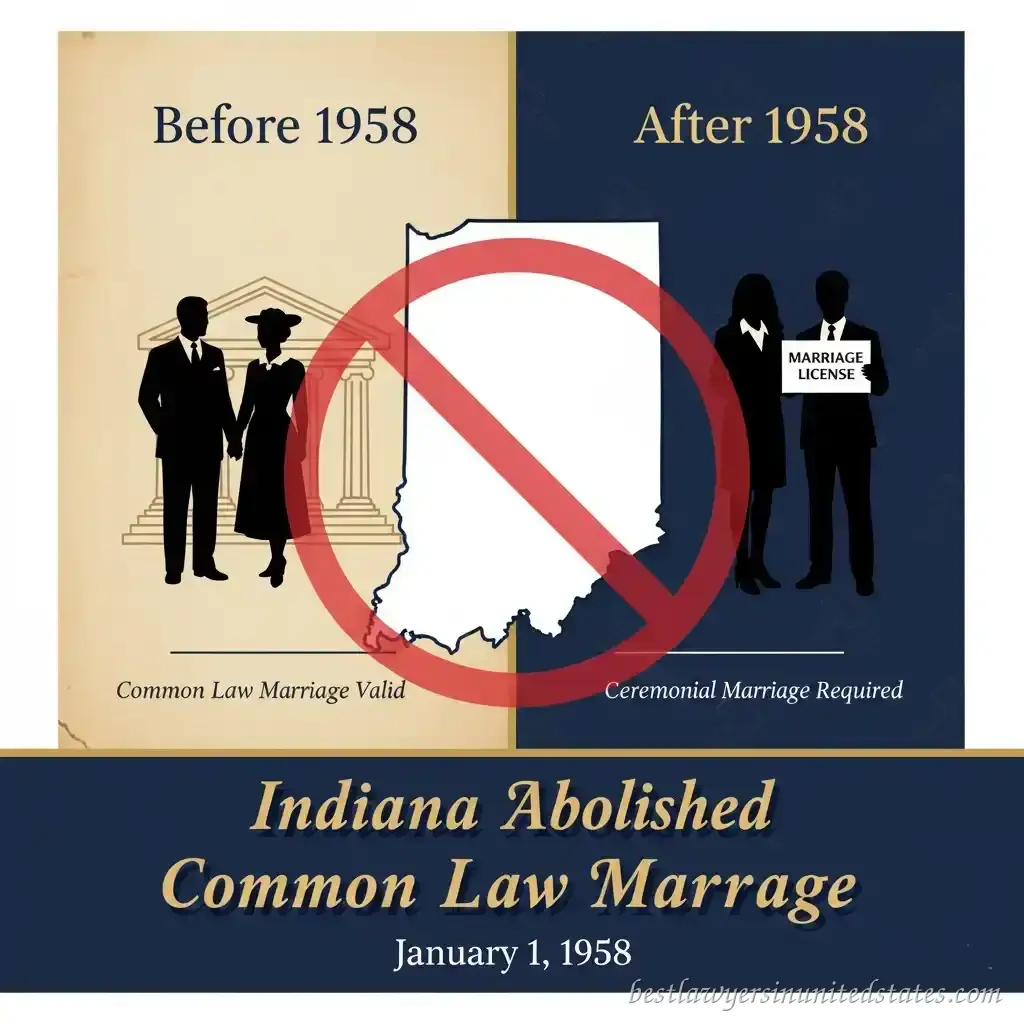
Here’s the straightforward answer: Indiana does not recognize common law marriage. The state abolished this practice on January 1, 1958. No matter how long you live together, share finances, or present yourselves as a married couple, you will not acquire the legal status of marriage in Indiana without obtaining a marriage license and having a formal ceremony.
However, this doesn’t mean unmarried couples have no legal options or protections. In this comprehensive guide, we’ll explore everything you need to know about common law marriage in Indiana, including your rights as a cohabiting couple, how to protect yourself legally, and what happens if you established a common law marriage in another state.
Does Indiana Have Common Law Marriage?
The Clear Answer: No (Since 1958)
Indiana is not a common law marriage state. According to the Indiana Code, the state eliminated the legal recognition of common law marriages formed within its borders effective January 1, 1958. This decision was made by the Indiana General Assembly to establish clear standards for what constitutes a valid marriage.
This means:
- Living together for any length of time does not create a marriage
- Introducing your partner as your “husband” or “wife” doesn’t legally marry you
- Sharing a last name, bank accounts, or property doesn’t change your marital status
- Filing taxes together (if you could) doesn’t establish a marriage
- Having children together doesn’t make you legally married
What Is Common Law Marriage?
Common law marriage is a legal doctrine recognized in some states where couples can be considered legally married without obtaining a marriage license or having a formal ceremony. Traditionally, common law marriage required:
- Intent to marry – Both partners agree to be married
- Holding out as married – The couple presents themselves publicly as spouses
- Cohabitation – Living together as a married couple
- Capacity to marry – Both parties are legally able to marry (age, not already married, etc.)
While this doctrine has historical roots in English common law, most states—including Indiana—have abolished it in favor of formal marriage requirements.
Debunking Common Myths About Common Law Marriage
Myth #1: Living Together for 7 Years Makes You Married
FALSE. There is no “7 years myth” or “10-year marriage law” that automatically grants you married status in Indiana. You could live with your partner for 20 years, and you would still be legally considered unmarried unless you obtained a marriage license and had a legal ceremony.
This misconception likely stems from old legal doctrines or confusion with other states’ laws, but it has no basis in Indiana law.
Myth #2: Common Law Marriage Exists in Indiana for Federal Benefits
FALSE. While the federal government may recognize valid common law marriages from states where they were legally formed, this doesn’t create a common law marriage in Indiana. If you’re living in Indiana and have never established a common law marriage in a state that allows it, you cannot claim federal spousal benefits based on your relationship.
Myth #3: Having a “Common Law Spouse” Gives You Legal Rights
PARTIALLY FALSE. The term “common law spouse Indiana” is a misnomer because Indiana doesn’t recognize this status. However, unmarried couples do have some legal options to protect themselves through contracts and estate planning (discussed below).
States That Still Recognize Common Law Marriage in 2025
While Indiana doesn’t allow common law marriage, several states still do. As of 2025, the following states recognize common law marriages formed within their borders:
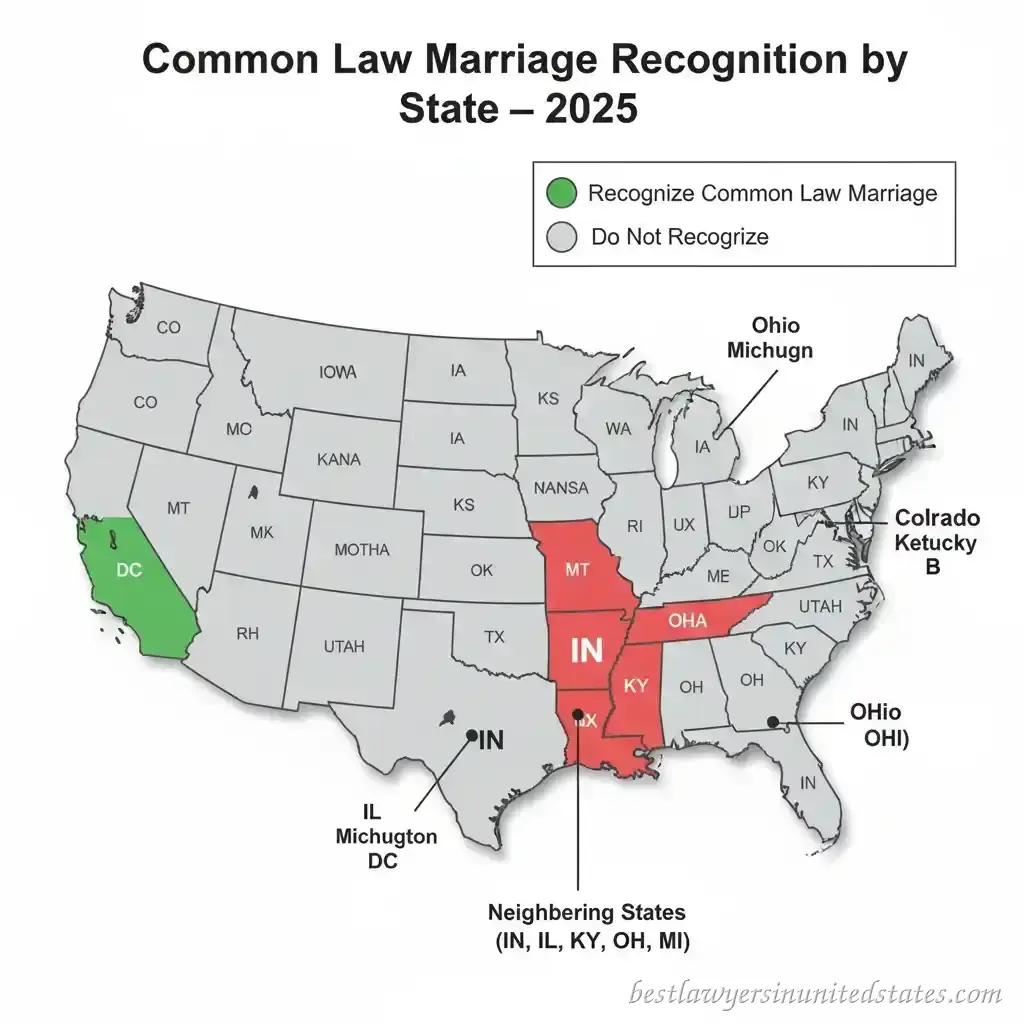
States Currently Recognizing Common Law Marriage:
- Colorado
- Iowa
- Kansas
- Montana
- New Hampshire (for inheritance purposes only)
- Oklahoma (if formed before November 1, 2019)
- Rhode Island
- South Carolina
- Texas
- Utah
- District of Columbia
Important for Indiana Residents: If you lived in one of these states and established a valid common law marriage there, Indiana courts will recognize your marriage.
Neighboring States Comparison
| State | Common Law Marriage Allowed? | Notes |
|---|---|---|
| Indiana | No (abolished 1958) | Must obtain marriage license |
| Illinois | No (abolished 1905) | Very strict formal marriage requirements |
| Kentucky | No (abolished 1852) | One of the earliest states to abolish |
| Ohio | No (abolished 1991) | Recognizes valid out-of-state common law marriages |
| Michigan | No (abolished 1957) | Similar timeline to Indiana |
| Iowa | Yes | Still recognizes common law marriage |
| Kansas | Yes | Must meet specific requirements |
I Have a Common Law Marriage from Another State: Will Indiana Recognize It?
This is one of the most important questions for couples who have relocated to Indiana. The answer is: Yes, Indiana will recognize a valid common law marriage that was legally established in another state.
The Full Faith and Credit Clause
Under the U.S. Constitution’s Full Faith and Credit Clause, states must generally recognize legal marriages performed or established in other states. This principle extends to common law marriages. If you validly established a common law marriage in Kansas, for example, and then moved to Indiana, the Indiana Family Law courts will treat you as legally married.
How Indiana Courts Evaluate Out-of-State Common Law Marriages
When determining whether to recognize an out-of-state common law marriage, Indiana Supreme Court precedent requires courts to examine:
- Was the marriage valid where it was formed? Courts look at whether you met all requirements of the state where you lived.
- Did you actually reside in that state? You can’t just visit a common law marriage state briefly to establish a marriage.
- Can you provide evidence of the marriage? Documentation is crucial.
- Was there intent and cohabitation? Courts examine whether you genuinely lived as a married couple.
Documentation You’ll Need to Prove Your Common Law Marriage
If you need to prove your out-of-state common law marriage to Indiana authorities or courts, gather these types of evidence:
Primary Documents:
- Joint tax returns filed as married
- Joint mortgage or lease agreements listing both parties
- Insurance policies naming each other as spouses
- Joint bank account statements
- Birth certificates of children listing both parties as parents
- Affidavits from witnesses who knew you as a married couple
Supporting Documents:
- Social media posts or announcements referring to each other as spouses
- Wedding rings or other symbols of marriage
- Shared last name (if applicable)
- Records showing you introduced yourselves as married
- Correspondence addressing you as “Mr. and Mrs.”
Legal Tip: If you have a common law marriage from another state, consider formalizing it with a marriage license in Indiana for clarity, especially for estate planning, healthcare decisions, and avoiding future disputes.
Real-World Scenario: The Kansas-to-Indiana Move
Example: Sarah and Michael lived together in Kansas from 2015 to 2023. They filed joint tax returns, owned a home together, wore wedding rings, and introduced themselves as husband and wife. They established a valid common law marriage under Kansas law. In 2024, they moved to Indianapolis for work.
Result: Indiana courts would recognize their marriage as valid. They could file taxes as married, Sarah could receive spousal benefits through Michael’s employer, and they would have inheritance rights if one partner died. However, they would need documentation to prove their Kansas common law marriage.
Federal Rights and Common Law Marriage: What Changed in 2024-2025
Federal Recognition of Common Law Marriage
The federal government recognizes valid common law marriages for purposes of federal benefits and programs. This is especially important for:
Social Security Benefits:
- Survivor benefits for widows/widowers
- Spousal retirement benefits
- Disability benefits for spouses
Veteran Benefits:
- VA survivor benefits
- Dependency and Indemnity Compensation (DIC)
- Healthcare coverage
Tax Filing Status:
- Married filing jointly
- Head of household considerations
- Estate tax exemptions
Recent Policy Updates (2024-2025)
As of 2025, there have been no major federal legislative changes specifically targeting common law marriage recognition. However, several developments affect couples:
- Social Security Administration Clarifications: The SSA has updated its guidance on proving common law marriages for survivor benefits, requiring more substantial documentation from claimants.
- Tax Implications: The IRS continues to recognize common law marriages valid under state law, allowing couples to file jointly and claim various tax filing status benefits.
- Federal Employee Benefits: The Office of Personnel Management (OPM) recognizes valid common law marriages for federal employee health insurance and retirement benefits.
What “Common Law Marriage Indiana Trump” Really Means
Many people search for “common law marriage indiana trump,” likely seeking information about recent policy changes. Here’s what you should know:
- There have been no federal executive actions eliminating or restricting common law marriage recognition
- Federal agencies continue to recognize valid state common law marriages
- Marriage equality protections remain in effect under federal law
- No changes to how Indiana treats common law marriage have occurred
If you’re concerned about federal recognition of your relationship status, consult with a family law attorney who can review your specific situation.
Cohabitation Laws in Indiana: Your Rights as an Unmarried Couple
While Indiana doesn’t offer the legal recognition of common law marriage, the state does have laws and legal principles that affect unmarried couples living together.
What Does Indiana Law Say About Cohabitation?
Cohabitation itself is legal in Indiana. Unmarried couples can:
- Live together without legal consequences
- Own property jointly
- Have children together
- Share financial accounts
- Make healthcare decisions (with proper documentation)
However, cohabiting couples do not automatically receive the same rights as married couples, including:
- No automatic inheritance rights
- No presumption of joint ownership of property
- No entitlement to spousal benefits
- No alimony or support payments if the relationship ends
- No automatic healthcare decision-making authority
Unmarried Couple Rights Under Indiana Law
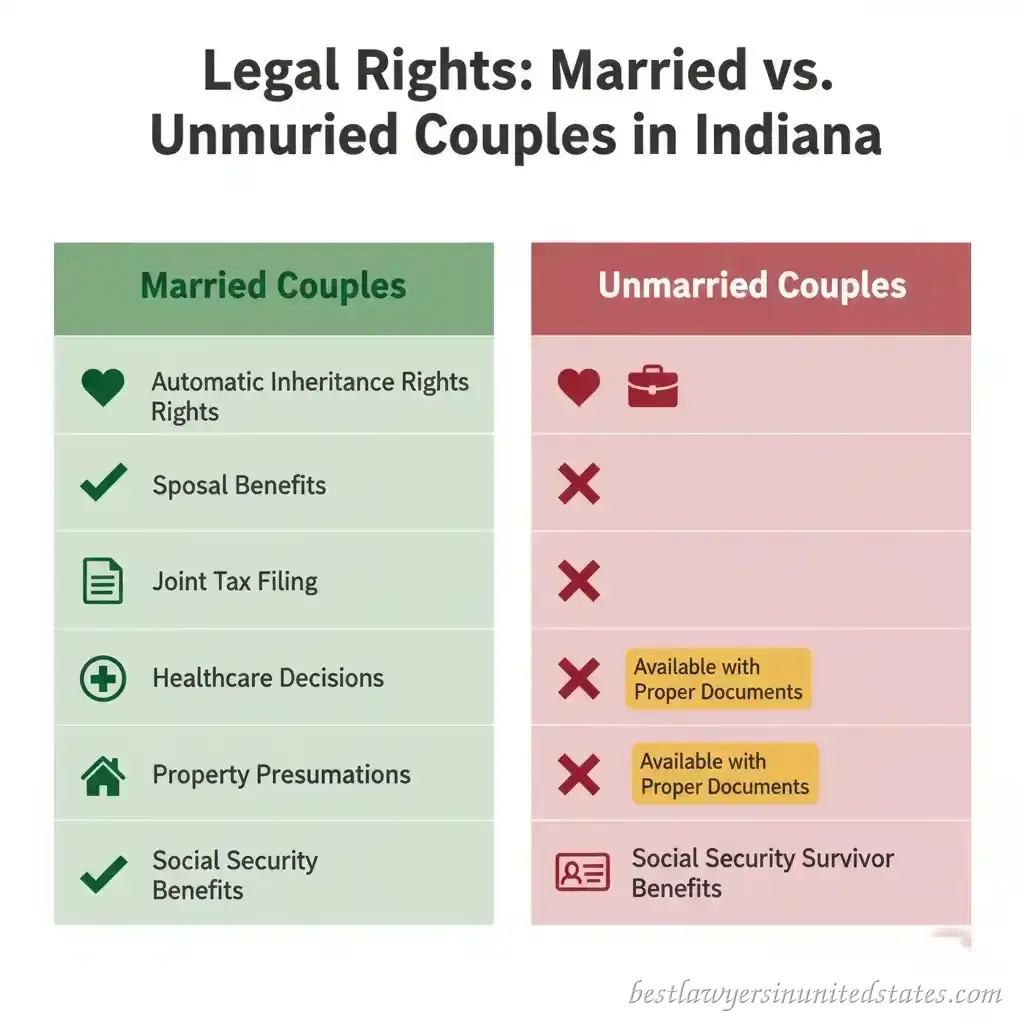
Indiana law doesn’t specifically address “unmarried couple rights” as a category, but couples can establish legal protections through:
- Contracts: Cohabitation agreements or other express contracts
- Property Law: Joint ownership structures for real estate and assets
- Estate Planning: Wills, trusts, and beneficiary designations
- Healthcare Directives: Power of attorney and medical directives
Legal Protections for Cohabiting Couples in Indiana

Creating a Cohabitation Agreement
A cohabitation agreement (also called a cohabitation contract) is a legally binding document that outlines how unmarried partners will handle finances, property, and responsibilities. This is the single most important protection for unmarried couples in Indiana.
What a Cohabitation Agreement Should Include:
Financial Provisions:
- How expenses will be shared (rent, utilities, groceries)
- Who owns what property (separate vs. shared)
- Bank account arrangements
- Debt liability and responsibility
- How shared assets will be divided if you separate
Property Rights:
- Real estate ownership structure
- How property purchased during the relationship is treated
- What happens to jointly purchased items if you break up
- Commingled assets and how to track contributions
Support and Care:
- Whether any support will be paid if the relationship ends
- Pet ownership and care responsibilities
- Care arrangements if one partner becomes disabled
Estate Planning Integration:
- Beneficiary designations
- Inheritance rights provisions
- How the agreement interacts with wills and trusts
Legal Requirements: For a cohabitation agreement to be enforceable in Indiana:
- Both parties must enter voluntarily
- There must be consideration (something of value exchanged)
- Terms cannot be unconscionable or illegal
- Both parties should have independent legal counsel review it
- It should be in writing and signed by both parties
Estate Planning Tools for Unmarried Couples
Since Indiana doesn’t provide automatic inheritance rights for unmarried partners, estate planning is critical.
Essential Documents:
1. Last Will and Testament Without a will and testament, Indiana’s intestacy laws will distribute your property to blood relatives—not your partner. Your will should:
- Name your partner as a beneficiary
- Specify what assets they receive
- Name them as executor if desired
- Address any jointly owned property
2. Durable Power of Attorney This document allows your partner to make financial decisions if you become incapacitated. Without it, courts may appoint a family member instead.
3. Healthcare Power of Attorney This authorizes your partner to make medical decisions on your behalf. Hospitals may otherwise defer to blood relatives.
4. Living Will/Advance Directive A living will specifies your end-of-life care preferences. Include your partner in these decisions by naming them as your healthcare representative.
5. Trust Documents Creating a trust can help:
- Avoid probate for your partner
- Provide privacy for your estate plan
- Protect assets from creditors
- Ensure your partner is cared for financially
6. Beneficiary Designation Forms Update all beneficiary designation forms for:
- Life insurance policies
- Retirement accounts (401k, IRA)
- Bank accounts (payable on death)
- Investment accounts (transfer on death)
Critical Note: Retirement accounts like 401(k)s have special rules. If you’re married, your spouse has automatic rights to your retirement assets. If you’re unmarried, you must explicitly name your partner as beneficiary.
Joint Ownership Structures
How you hold title to property matters significantly for unmarried couples in Indiana.
Real Estate Ownership Options:
| Ownership Type | Rights | What Happens at Death | Best For |
|---|---|---|---|
| Joint Tenancy with Right of Survivorship | Both own equally; both must agree to sell | Property automatically goes to surviving owner | Committed couples wanting automatic transfer |
| Tenants in Common | Each owns specified percentage; can sell share independently | Each person’s share goes to their estate/heirs | Couples wanting individual control; unequal contributions |
| Sole Ownership | One person owns entirely | Property goes to owner’s estate | When one partner purchases before relationship |
Recommendation: For most unmarried couples purchasing real estate together, joint tenancy with right of survivorship provides the closest approximation to marital property rights. However, consult with a real estate attorney to determine the best structure for your situation.
Financial Planning Guide for Unmarried Couples in Indiana
Tax Considerations: Married vs. Unmarried
One significant difference between married and unmarried couples is tax filing status. Unmarried couples cannot file jointly, which affects:
Tax Differences:
Married Filing Jointly Benefits:
- Higher standard deduction
- More favorable tax brackets
- Better capital gains treatment
- Estate tax unlimited marital deduction
- Spousal IRA contributions
Unmarried Filing Single:
- Must file as single or head of household (if qualified)
- Lower standard deduction per person
- May pay more in taxes overall on combined income
- Each person pays their own taxes on their income
- No automatic estate tax exemptions for transfers to partner
Head of Household Status: One partner may qualify to file as head of household if they:
- Pay more than half the household costs
- Have a qualifying dependent (usually a child)
- Live with that dependent for more than half the year
Property Purchase Strategies
When unmarried couples buy property together in Indiana, proper planning is essential.
Key Considerations:
1. Document Financial Contributions Keep detailed records of:
- Down payment source and amount from each partner
- Who pays mortgage, taxes, and insurance
- Who funds improvements and repairs
- Any agreements about ownership percentages
2. Create a Property Agreement Beyond the deed of conveyance, create a written agreement addressing:
- Ownership percentages (especially if contributions are unequal)
- How mortgage payments will be split
- Who can claim mortgage interest and property tax deductions
- What happens if one person wants to sell
- Buyout procedures if you separate
3. Consider Debt Liability If you’re on the mortgage together, both of you are legally responsible for the debt liability, regardless of who makes payments. If one person stops paying, the other must cover it or risk foreclosure.
4. Title Insurance and Ownership Ensure your title and ownership structure are properly documented. Ambiguities can lead to expensive litigation.
Insurance Considerations
Unmarried couples face unique insurance challenges:
Health Insurance:
- You cannot add an unmarried partner to employer health insurance as a dependent (unless your employer offers domestic partner benefits)
- Each person needs their own coverage through an employer, marketplace, or individual policy
- You cannot make healthcare decisions for your partner without proper legal documents
Life Insurance:
- You can name your partner as beneficiary on any life insurance policy
- Consider purchasing policies to protect your partner financially
- Ensure beneficiary designation forms are current
Auto and Homeowners Insurance:
- Most companies allow unmarried couples to be on the same policy
- This can provide cost savings
- Ensure both partners are listed as drivers or residents
Disability Insurance:
- Unlike married spouses, your partner may not have automatic rights to care for you or access your benefits
- Coordinate with power of attorney documents
What Happens When Unmarried Couples Separate in Indiana
Property Division After Cohabitation
When unmarried couples break up in Indiana, there’s no automatic property division process like divorce. Instead, property distribution follows general contract and property law principles.
How Courts Handle Unmarried Couple Breakups:
1. Property Ownership Generally, property belongs to whoever has legal title:
- Separate property purchased by one person remains theirs
- Joint ownership requires agreement or court intervention to divide
- Jointly purchased items are divided based on ownership interest
2. Express Contracts If you have a cohabitation agreement or other written contract, courts will generally enforce it. This is why having agreements in writing is so important.
3. Implied Contracts In some cases, Indiana courts may recognize implied contracts based on the couple’s conduct and agreements, even if not written down.
4. Quantum Meruit Under the quantum meruit doctrine (Latin for “as much as he deserved”), one partner may recover the fair value of services or contributions if:
- They provided valuable services or contributions
- They expected compensation
- The other partner benefited
- It would be unjust not to compensate them
5. Unjust Enrichment If one partner unfairly benefited from the other’s contributions, courts may order compensation under the unjust enrichment doctrine, even without a contract.
6. Constructive Trust Courts may impose a constructive trust on property if one partner:
- Was promised an ownership interest
- Made substantial contributions based on that promise
- Would suffer injustice if the promise isn’t kept
Support Payments and Palimony
Unlike divorce, there is no automatic right to alimony or support payments when unmarried couples separate in Indiana. However:
Palimony in Indiana: “Palimony” (support payments to an unmarried former partner) is not automatically available but may be awarded if:
- There was an express or implied contract for support
- One partner relied on promises to their detriment
- Courts find it equitable under the circumstances
Important: Palimony claims are difficult to prove in Indiana and require substantial evidence. Courts are generally reluctant to impose ongoing support obligations on unmarried partners without clear contractual agreements.
Child Custody and Support for Unmarried Parents
Parental rights in Indiana are the same whether parents are married or not, but there are important procedural differences.
Key Points:
1. Paternity Establishment For unmarried parents, paternity establishment is crucial:
- Both parents can sign a voluntary paternity affidavit at birth
- Either parent can petition the court for paternity determination
- Genetic testing may be ordered
- Until paternity is established, the father has no legal rights or obligations
2. Child Custody
- Both parents have equal rights to seek child custody once paternity is established
- Indiana courts decide based on the child’s best interests
- Physical and legal custody may be shared or awarded to one parent
- Visitation rights are determined by the court
3. Child Support
- Child support obligations are the same for married and unmarried parents
- Indiana uses income-based guidelines to calculate support
- Support can be enforced through court orders and wage garnishment
- Both parents have financial responsibility for their children
4. Parenting Time
- Unmarried fathers must establish paternity to get guaranteed parenting time
- Courts favor meaningful relationships with both parents when appropriate
- Parenting plans specify when each parent has the child
Common Legal Mistakes Unmarried Couples Make
1. Assuming Time Together Creates Rights Many couples believe living together for years gives them legal protections. Without proper documentation, this is false.
2. Failing to Create a Cohabitation Agreement This is the single biggest mistake. A cohabitation agreement prevents costly disputes later.
3. Not Updating Estate Planning Documents Your partner won’t automatically inherit anything. Without a will, your assets go to blood relatives.
4. Improper Property Title How property is titled matters enormously. Many couples don’t consider ownership structures carefully enough.
5. Ignoring Healthcare Directives Without proper documents, your partner may not be able to make healthcare decisions for you in emergencies.
6. Commingling Assets Without Documentation Mixing finances without clear records of who contributed what leads to disputes. Keep detailed records of all commingled assets.
7. Not Establishing Paternity Unmarried fathers who don’t establish paternity have no legal relationship with their children.
8. Believing in the “7-Year Rule” There is no automatic marriage after living together for any period.
Action Checklist: Protecting Yourself as an Unmarried Couple in Indiana
If you’re living with your partner in Indiana, take these essential steps to protect your legal and financial interests:

Immediate Actions (Do These Now):
- ☐ Draft and sign a comprehensive cohabitation agreement
- ☐ Create or update your last will and testament
- ☐ Execute healthcare power of attorney and living will documents
- ☐ Sign durable power of attorney for financial matters
- ☐ Update all beneficiary designations (life insurance, retirement accounts, bank accounts)
- ☐ If you have children, ensure paternity is legally established
- ☐ Document all financial contributions to jointly purchased property
Within the Next 3 Months:
- ☐ Review property ownership structures and titles
- ☐ Create or update estate planning documents (trusts if appropriate)
- ☐ Review insurance coverage and add partner where possible
- ☐ Organize financial records and keep them updated
- ☐ Consult with a family law attorney about your specific situation
- ☐ If you have an out-of-state common law marriage, gather documentation
Ongoing Maintenance:
- ☐ Review and update legal documents every 2-3 years or after major life changes
- ☐ Keep detailed financial records
- ☐ Communicate openly about financial and legal matters
- ☐ Consider formalizing your relationship with a marriage license if desired
When to Consult a Family Law Attorney
While this guide provides comprehensive information, certain situations require professional legal counsel:
Seek Legal Advice If:
- You’re separating and have significant shared assets or property division disputes
- You need to prove an out-of-state common law marriage
- You’re facing child custody or child support issues
- You want to draft a cohabitation agreement or update estate planning
- Your partner has died and you’re facing inheritance rights challenges
- You’re purchasing real estate together and need guidance on ownership structures
- You believe you’re entitled to compensation for contributions to your partner’s property
- You need help with paternity establishment
- You’re dealing with complex financial situations involving commingled assets
An experienced attorney can:
- Draft enforceable legal documents
- Represent you in court if disputes arise
- Provide guidance tailored to your specific circumstances
- Help you understand your rights and obligations under Indiana law
- Ensure your estate plan protects your partner
The Indiana State Bar Association maintains a lawyer referral service that can connect you with qualified family law attorneys in your area.
Conclusion: Taking Control of Your Legal Future
Common law marriage in Indiana is not an option—the state abolished this doctrine in 1958, and no amount of time living together will create a legal marriage. However, this doesn’t leave unmarried couples without protections or options.
Key Takeaways:
- Indiana does not recognize common law marriage formed within the state after January 1, 1958
- Out-of-state common law marriages that were validly formed will be recognized by Indiana courts
- Cohabitation is legal, but doesn’t automatically grant you spousal rights
- Proactive legal planning is essential: cohabitation agreements, estate planning documents, and proper property structures protect your interests
- Financial planning differs significantly for unmarried couples, especially regarding taxes, property ownership, and benefits
- Federal benefits are available if you have a valid common law marriage from another state
- Children’s rights are protected regardless of parents’ marital status, but paternity must be established
The most important step you can take is to create clear legal documentation of your intentions and agreements. A cohabitation agreement, comprehensive estate plan, and properly structured property ownership can provide most of the protections that marriage offers—but they require deliberate action.
Don’t leave your legal and financial future to chance. If you’re living with a partner in Indiana, take control by implementing the protections discussed in this guide.
Ready to Protect Your Rights?
If you’re navigating cohabitation laws in Indiana, facing questions about your legal rights as an unmarried couple, or need help establishing legal protections for your relationship, don’t go it alone. The legal landscape for unmarried couples is complex, and mistakes can be costly.
Contact an experienced family law attorney today for a confidential consultation. A qualified attorney can help you:
- Draft a comprehensive cohabitation agreement tailored to your needs
- Create estate planning documents that protect your partner
- Understand your rights and obligations under Indiana law
- Navigate property disputes or separation issues
- Establish paternity and parenting plans
- Prove an out-of-state common law marriage
Your relationship deserves legal protection. Take the first step today to secure your future and protect what matters most.
