
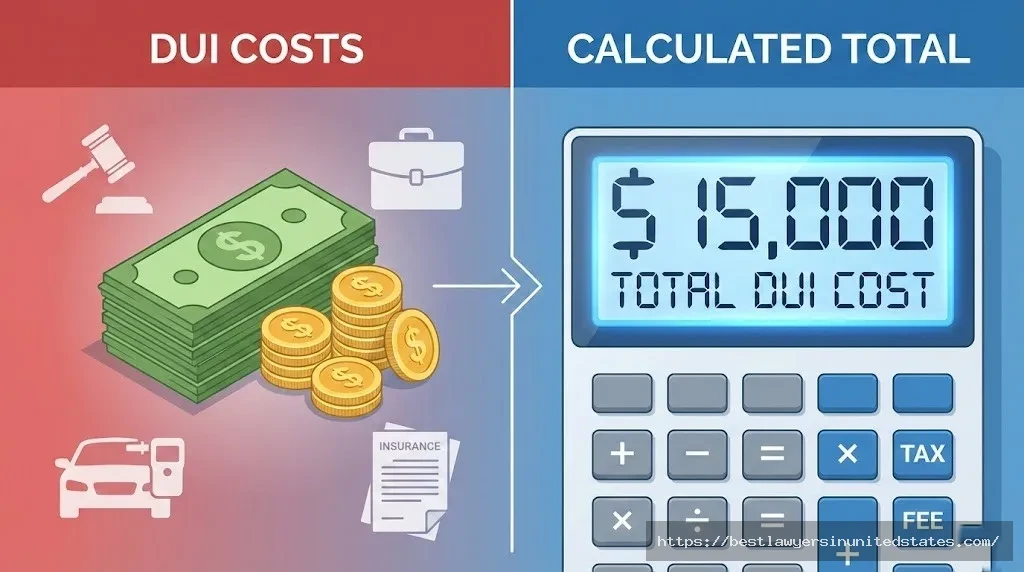
Calculate the complete cost of a DUI with our free 2026 calculator. Enter your state, offense number, and circumstances to get accurate estimates. Most first-time DUI convictions cost $10,000-$25,000 when you include all expenses. Second offenses often exceed $30,000.
DUI Cost Calculator
Estimate total DUI expenses by state and offense
Detailed Cost Breakdown
Payment Timeline
Bail bond, towing fees, car impound, attorney retainer
Initial court fines, DMV fees, DUI school enrollment, ignition interlock installation
Monthly probation fees, ignition interlock fees, DUI school payments, attorney balance
Insurance premium increases, license reinstatement, SR-22 filing fees
- Lost wages from missed work (court dates, jail time, DUI school) – $2,000-$10,000
- Job loss or difficulty finding employment – Varies
- Professional license suspension (doctors, lawyers, nurses, pilots) – Career ending
- Rideshare and transportation costs during suspension – $1,500-$5,000
- Travel restrictions and visa denials – Varies
- Security clearance loss – Career impact
- Child custody implications – Legal costs
- Rental car restrictions – Varies
- Personal relationships and mental health costs – Priceless
Our calculator breaks down every expense category you’ll face after a DUI arrest. Results show immediate costs, long-term expenses, payment timelines, and total financial impact over 10 years. Make informed decisions about your defense strategy with accurate cost projections.
What the Calculator Includes:
- Court fines and fees specific to your state
- Attorney costs by case complexity
- License reinstatement and suspension costs
- Ignition interlock device expenses
- DUI school and treatment program fees
- SR-22 insurance filing costs
- Insurance premium increases (3-5 years)
- Lost wages from court appearances and jail time
- Long-term career and professional impacts
Critical Reality: The sticker shock is real. A first DUI in California costs $15,000-$20,000 on average. In Florida, expect $12,000-$18,000. These numbers include everything from the moment you’re arrested through three years of insurance increases. Second offenses double or triple these amounts. Third offenses can exceed $50,000 and include felony charges.
Understanding the True Cost of a DUI
A DUI triggers a cascade of expenses that continue for years. Some costs hit immediately when you’re arrested. Others accumulate slowly as insurance rates climb and employment opportunities shrink. Understanding every expense helps you prepare financially and make smart decisions about your defense.
Why DUI Costs Are So Expensive
Lawmakers designed DUI penalties to accomplish three goals: punishment, deterrence, and rehabilitation. The expensive consequences aim to discourage drunk driving and fund victim support programs.
Courts impose heavy fines that fund law enforcement and court operations. States require expensive education and treatment programs. Insurance companies view DUI as proof of risky behavior and raise rates dramatically. Employers see DUI convictions as liability risks and may terminate employment.
The high costs also reflect the devastating harm drunk driving causes. Every year, approximately 13,000 people die in alcohol-impaired crashes. Hundreds of thousands suffer injuries. Society demands substantial penalties for behavior that kills and injures innocent people.
Your actual costs depend on multiple factors that affect every expense category. State laws create dramatic variations. California DUI costs differ significantly from Wyoming costs. Your specific circumstances matter enormously too.
Direct Costs vs Indirect Costs
Direct costs are obvious expenses with clear price tags. You receive bills or invoices for these costs. Examples include court fines, attorney fees, bail bonds, towing fees, DUI school tuition, and license reinstatement fees. These costs are unavoidable if convicted.
Direct costs are significant but represent less than half your total DUI expenses. They range from $5,000 to $15,000 for first offenses depending on your state and circumstances.
Indirect costs are less obvious but often larger than direct costs. Insurance rate increases represent the single biggest expense for most people. Your premiums can double or triple for three to five years. Lost wages from court appearances, jail time, and license suspension add thousands more.
Career impacts create the most devastating indirect costs. Professional license holders may lose their careers. Commercial drivers lose their CDL and their jobs. Security clearance holders may lose clearances and employment. These career impacts can cost hundreds of thousands over a lifetime.
Some people face relationship consequences including divorce proceedings and related expenses triggered by DUI arrests. The financial and emotional strain of DUI often damages marriages beyond repair.
Short-Term vs Long-Term Financial Impact
Short-term costs hit within the first year after arrest. These include bail bonds, towing and impound fees, attorney retainers, court fines, license reinstatement fees, and initial DUI class costs. Most people pay these expenses within 6-12 months of arrest.
The immediate financial shock strains most budgets. Coming up with $5,000-$10,000 in a few months requires loans, credit cards, or help from family. Many defendants struggle to afford quality legal representation while managing other immediate expenses.
Long-term costs accumulate over 3-10 years after conviction. Insurance companies raise your rates for at least three years, typically five years. This creates $3,000-$15,000 in additional premiums depending on your prior insurance costs and state requirements.
Employment consequences may last your entire career. A DUI on your record affects job applications for years. Some professional licenses carry permanent marks. Security clearances may never be reinstated. The income loss from reduced career opportunities compounds annually.
The total 10-year cost of a first DUI often exceeds $40,000. Second offenses commonly surpass $60,000. Third offenses can cost over $100,000 when you include felony defense costs, longer jail time, and permanent license revocation in some states.
Complete DUI Cost Breakdown by Category
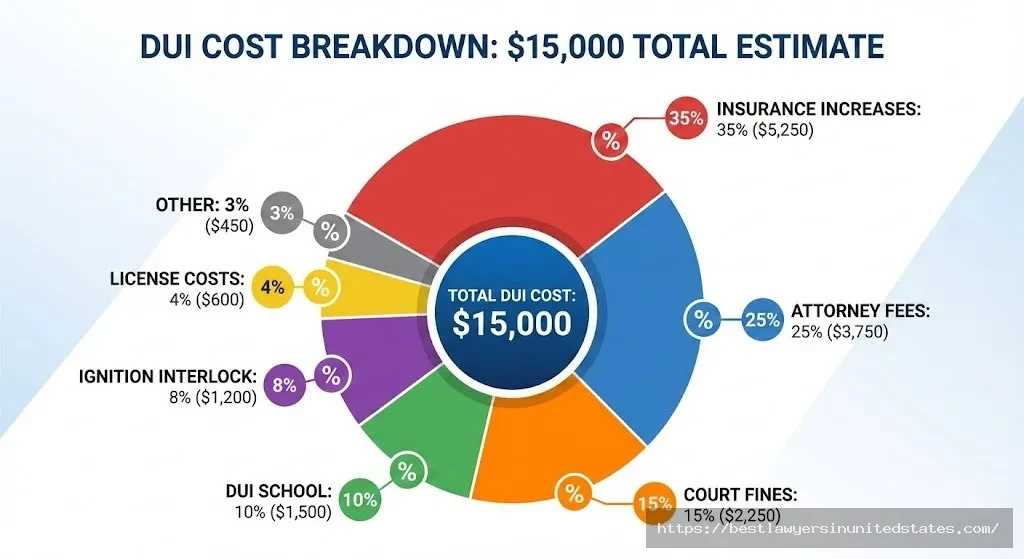
Understanding every expense category helps you budget and avoid surprises. This comprehensive breakdown covers every cost you’ll encounter from arrest through the end of insurance increases.
Immediate Costs at Arrest
Your financial obligations begin the moment police arrest you for DUI. These immediate costs hit before you even see a courtroom.
Bail Bond Costs
Bail amounts for DUI arrests typically range from $500 to $10,000 depending on your state, prior record, and whether anyone was injured. First-time offenders with no accidents usually face $500-$2,500 bail.
If you use a bail bondsman, you pay 10% of the bail amount as a non-refundable fee. A $2,500 bail costs $250 through a bondsman. This $250 is lost forever even if charges are dropped. You can post the full bail amount yourself and get it back after your case resolves, but most people don’t have thousands in cash available immediately.
Aggravating factors increase bail substantially. High BAC levels measured by breathalyzer or blood test push bail higher. DUI with accident or injury can mean $5,000-$10,000 bail or higher. Refusing chemical tests may increase bail too.
Some jurisdictions offer cite-and-release for first-time DUI with no aggravating factors. You’re released from the scene without posting bail but must appear for arraignment. This saves bail costs but isn’t available everywhere or for all offenders.
Typical Bail Costs:
- First offense, no accident: $500-$2,500 bail ($50-$250 bondsman fee)
- First offense, accident: $2,500-$5,000 bail ($250-$500 bondsman fee)
- Second offense: $2,500-$5,000 bail ($250-$500 bondsman fee)
- DUI with injury: $5,000-$25,000 bail ($500-$2,500 bondsman fee)
Towing and Impound Fees
Police tow your vehicle immediately after DUI arrest in most jurisdictions. Your car sits in an impound lot accumulating daily storage fees until you retrieve it or until it’s released after your case concludes.
Towing costs range from $100-$300 depending on your location and how far your vehicle travels. Urban areas charge more than rural areas. Long distances from arrest scene to impound lot increase fees.
Daily impound storage fees run $20-$75 per day. These fees accumulate every day your car sits in the lot. If you’re released the next day and immediately retrieve your vehicle, you might pay only $20-$75 in storage. If you spend several days in jail or can’t afford immediate retrieval, storage fees can reach $500-$1,000 or more.
Some states require an administrative impound period of 30 days for DUI arrests. California impounds vehicles for 30 days on second and subsequent offenses. At $50 per day, that’s $1,500 in mandatory storage fees before you can retrieve your car.
Vehicle release requires proof of ownership, valid registration, insurance, and payment of all fees. If your license is immediately suspended, you may need someone else to retrieve your vehicle. Some impound lots charge additional release or processing fees of $50-$150.
Typical Towing and Impound Costs:
- Towing: $100-$300
- Storage (1-3 days): $60-$225
- Storage (30-day impound): $600-$2,250
- Release fees: $50-$150
- Total immediate towing/impound: $210-$2,900
Administrative Fees at Jail
Many jails charge booking and processing fees when you’re arrested. These fees cover the cost of fingerprinting, photographing, and processing your arrest paperwork.
Booking fees typically range from $50-$200. Some jurisdictions charge additional fees for medical screening ($25-$50) or housing charges if you spend the night in jail ($50-$150 per night).
These fees are usually included in your final court costs or collected separately by the county jail. Some jurisdictions bill you weeks or months later. Others require payment before release.
Typical Jail Processing Fees:
- Booking fee: $50-$200
- Medical screening: $25-$50
- Housing (per night): $50-$150
- Total processing fees: $75-$400
Court Costs and Fines
Court-imposed costs represent the most visible DUI expenses. These mandatory payments go directly to the court system and state programs.
Base Fines by State
Every state imposes minimum and maximum fines for DUI convictions. These base fines vary dramatically by state and offense number. Judges have discretion within these ranges based on your specific circumstances.
First Offense Base Fines by State (Examples):
- California: $390-$1,000 base fine
- Florida: $500-$1,000 base fine
- Texas: $0-$2,000 base fine
- New York: $500-$1,000 base fine
- Illinois: $500-$2,500 base fine
- Arizona: $250-$2,500 base fine
These base fines are just the starting point. Additional penalty assessments often double or triple the base amount.
Penalty Assessments and Surcharges
Most states add multiple penalty assessments to the base fine. These assessments fund specific programs like victim compensation, court construction, emergency services, and law enforcement training.
California’s penalty assessments are notoriously complex. A $390 base fine balloons to approximately $1,800-$2,000 after all assessments. The state adds a state penalty assessment (100% of base fine), county penalty assessment (varies by county), court security fee, criminal conviction assessment, DNA identification fund fee, and several others.
Other states have simpler structures but still add substantial surcharges. Florida adds court costs, crime prevention fees, and various surcharges that can add $500-$1,000 to base fines.
Typical Total Court Fines (Base + Assessments):
- First offense: $1,500-$3,000
- Second offense: $2,500-$5,000
- Third offense: $3,500-$7,500+
Additional Court Costs
Beyond fines and assessments, courts charge various processing and administrative fees. These costs cover the expense of processing your case through the court system.
Common court costs include filing fees ($50-$200), conviction assessment fees ($100-$300), public defender fees if you used a court-appointed attorney ($500-$1,500), and probation supervision fees if you’re placed on probation ($40-$100 per month).
If your case goes to trial, you may owe jury fees and transcript costs. These can add hundreds or thousands more depending on trial length.
Typical Additional Court Costs:
- Filing and processing fees: $100-$400
- Conviction assessment: $100-$300
- Public defender reimbursement: $500-$1,500
- Probation fees (12 months): $480-$1,200
- Total additional costs: $1,180-$3,400
License Reinstatement Costs
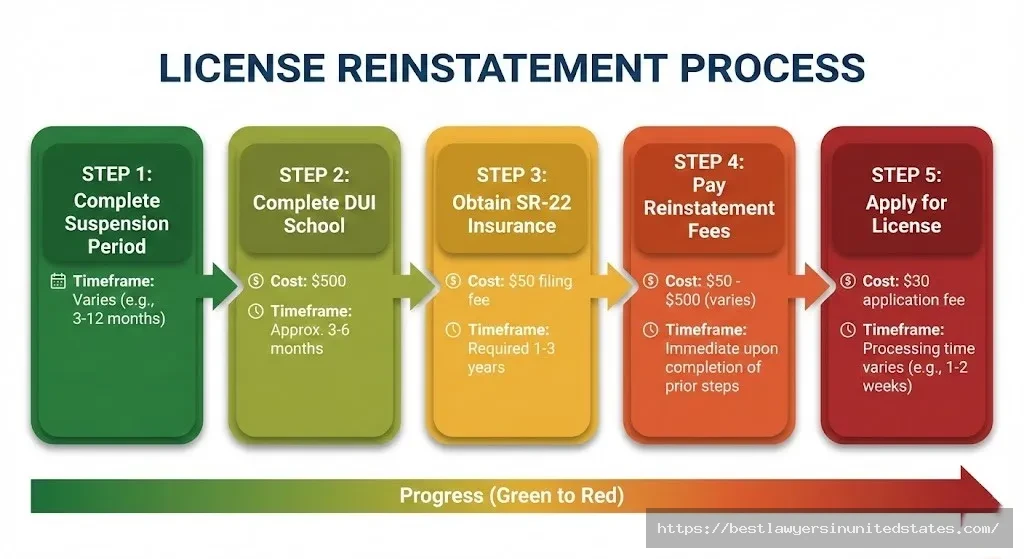
Your driver’s license faces immediate suspension or revocation after DUI arrest in most states. Getting your license back costs money and requires jumping through multiple hoops.
Administrative License Suspension
Most states impose immediate administrative license suspension when you’re arrested for DUI. This suspension is separate from criminal court proceedings and happens automatically if you fail or refuse chemical testing.
Administrative suspensions last 30-90 days for first offenses in most states. Second offenses bring 90-180 day suspensions. Third offenses may mean 6-12 months or permanent revocation.
You can request an administrative hearing to challenge the suspension. These hearings must be requested within 10-30 days of arrest depending on your state. Attorney fees for administrative hearings run $500-$2,000. Hearing success rates are low but may preserve your driving privileges temporarily.
Reinstatement Fees
When your suspension period ends, you must pay reinstatement fees to get your license back. These fees vary significantly by state.
State Reinstatement Fees (Examples):
- California: $125
- Florida: $75-$150
- Texas: $125
- New York: $50-$100
- Illinois: $500
- Arizona: $10 (processing fee)
Some states require additional fees for reissuing your actual physical license ($20-$30). You’ll also need to show proof of SR-22 insurance before reinstatement.
Restricted License Fees
Many states allow restricted or hardship licenses during suspension. These licenses permit driving to work, school, medical appointments, and DUI treatment programs only.
Restricted license applications cost $50-$100 in most states. Some states require ignition interlock devices for any driving during suspension, adding those costs.
Not all states offer restricted licenses. Some require serving your full suspension with no driving whatsoever.
Total License-Related Costs:
- Administrative hearing (optional): $500-$2,000
- Reinstatement fees: $50-$500
- License reissue: $20-$30
- Restricted license: $50-$100
- Total: $120-$2,630
DUI School and Treatment Programs
Courts mandate alcohol education and treatment programs for all DUI convictions. These programs aim to prevent future drunk driving through education and rehabilitation.
First Offender DUI Programs
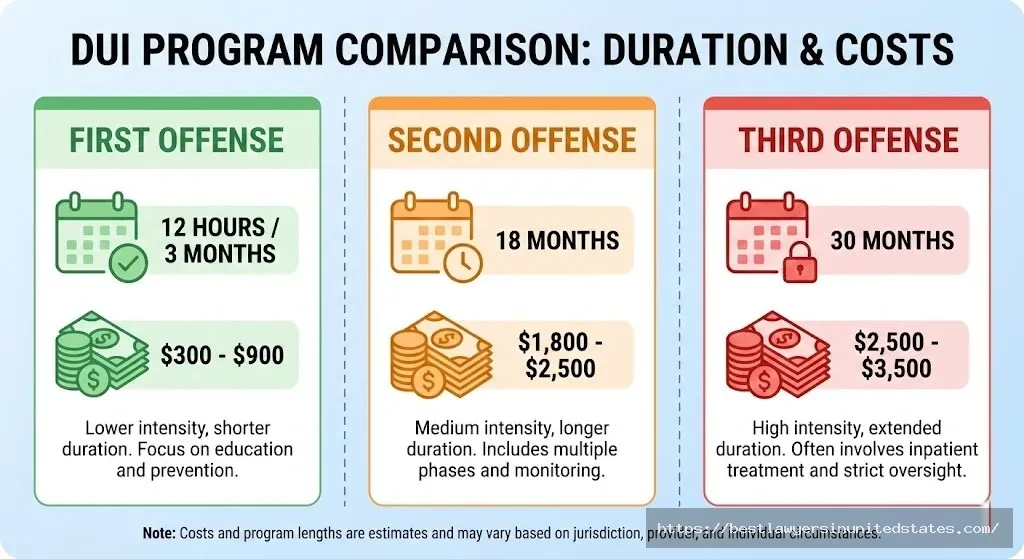
First-time offenders typically attend 12-hour to 16-hour DUI education programs. California requires a 3-month program (12 hours of classes plus individual sessions). Other states require similar lengths.
Program costs range from $300-$800 depending on your state and program length. Some states charge per class hour ($25-$50 per hour). Others charge flat program fees.
Classes meet weekly or biweekly. You must complete all sessions and pay all fees or face probation violations. Programs include education about alcohol effects, DUI laws, and victim impact panels where DUI crash victims share their stories.
First Offender Program Costs:
- 12-16 hour programs: $300-$800
- Class materials and fees: $50-$100
- Total first offender program: $350-$900
Multiple Offender Programs
Second and subsequent DUI convictions require longer and more expensive programs. California’s second offender program lasts 18 months and costs $1,800-$2,500. Third offenders attend 30-month programs costing $2,500-$3,500.
These extended programs include individual counseling, group therapy, and more intensive education. They meet more frequently and require regular attendance for the entire program duration.
Missing classes or failing to pay program fees violates probation and can result in jail time. Courts take program completion seriously as a condition of probation.
Multiple Offender Program Costs:
- 18-month program (second offense): $1,800-$2,500
- 30-month program (third offense): $2,500-$3,500
Alcohol Treatment and Counseling
High BAC arrests (typically 0.15% or higher) often require additional alcohol assessment and treatment beyond standard DUI programs. Courts may order outpatient treatment, intensive outpatient programs, or even residential treatment depending on assessment results.
Alcohol assessments cost $100-$300. Outpatient counseling runs $50-$150 per session with 10-20 sessions commonly required ($500-$3,000). Intensive outpatient programs cost $2,000-$5,000. Residential treatment programs can exceed $10,000-$30,000 for 30-90 day programs.
Insurance may cover some treatment costs if you have substance abuse coverage. Many people don’t have this coverage or face high deductibles. Treatment costs can become the single largest DUI expense for people requiring intensive programs.
Treatment Costs Beyond Standard Programs:
- Alcohol assessment: $100-$300
- Outpatient counseling (10-20 sessions): $500-$3,000
- Intensive outpatient: $2,000-$5,000
- Residential treatment (30 days): $10,000-$30,000### Ignition Interlock Device Costs
Many states require ignition interlock devices for DUI convictions. These devices prevent your car from starting if you have any alcohol in your system. You must blow into the device before starting the car and periodically while driving.
Installation and Monthly Fees
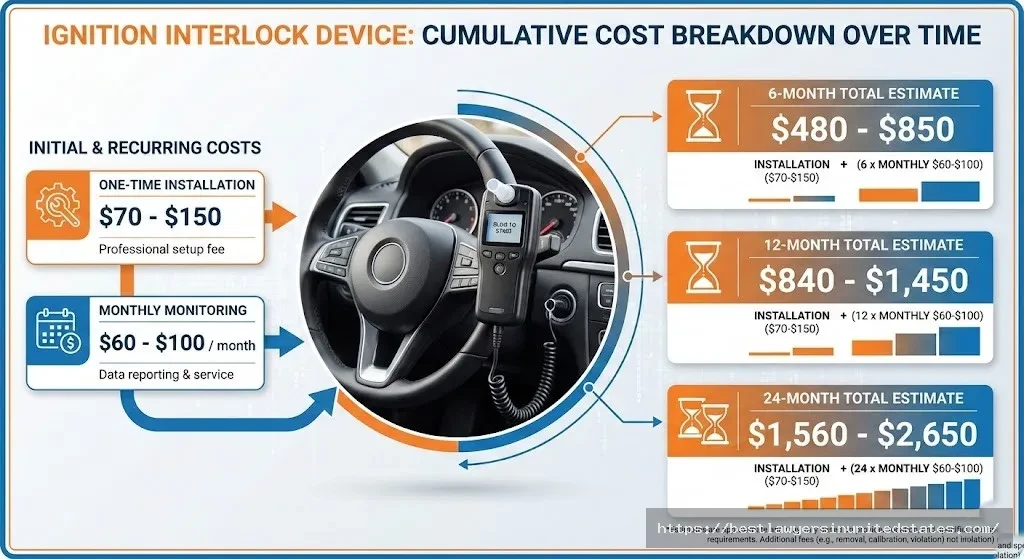
Ignition interlock installation costs $70-$150. State-certified installers perform the work. You cannot install the device yourself or use uncertified installers.
Monthly monitoring and calibration fees run $60-$100 per month. Devices require calibration every 30-60 days. These fees cover the calibration appointments, data downloads, and reporting to the court or DMV.
The required installation period varies by state and offense number. First offenders may need 6 months to 1 year. Second offenders often face 1-2 years. Third offenders may have permanent requirements.
Typical Ignition Interlock Costs:
- Installation: $70-$150
- Monthly fees (6 months): $360-$600
- Monthly fees (12 months): $720-$1,200
- Monthly fees (24 months): $1,440-$2,400
- Removal fee: $50-$100
- Total (6 months): $480-$850
- Total (12 months): $840-$1,450
- Total (24 months): $1,560-$2,650
Device Violations and Additional Costs
Failed breath tests trigger violations. If you attempt to start your car with alcohol in your system, the device records this violation. Multiple violations can extend your required installation period or result in new criminal charges.
Tampering with the device, missing calibration appointments, or trying to have someone else blow into the device all constitute serious violations. These can lead to probation violations, extended interlock requirements, and additional fines.
Some devices include cameras that photograph you while providing breath samples. This prevents someone else from blowing for you. Camera-equipped devices cost $10-$20 more per month.
Insurance Rate Increases
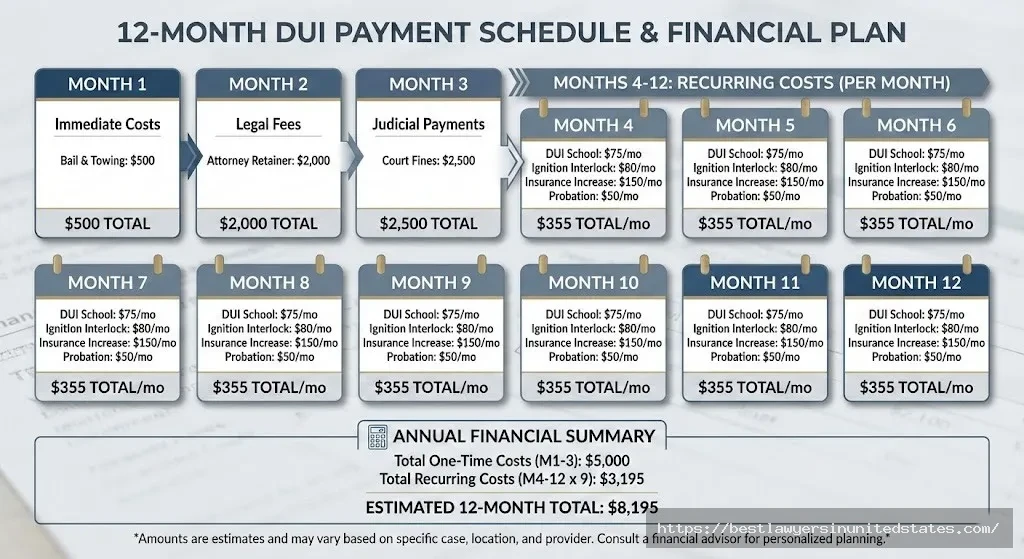
Insurance premium increases represent the single largest long-term cost of DUI for most people. These increases last 3-5 years and can add $10,000-$20,000 or more to your total DUI cost.
How Much Insurance Rates Increase After DUI
Insurance companies view DUI convictions as proof of high-risk behavior. Actuarial data shows DUI drivers are much more likely to file claims. Companies respond by dramatically raising premiums or dropping coverage entirely.
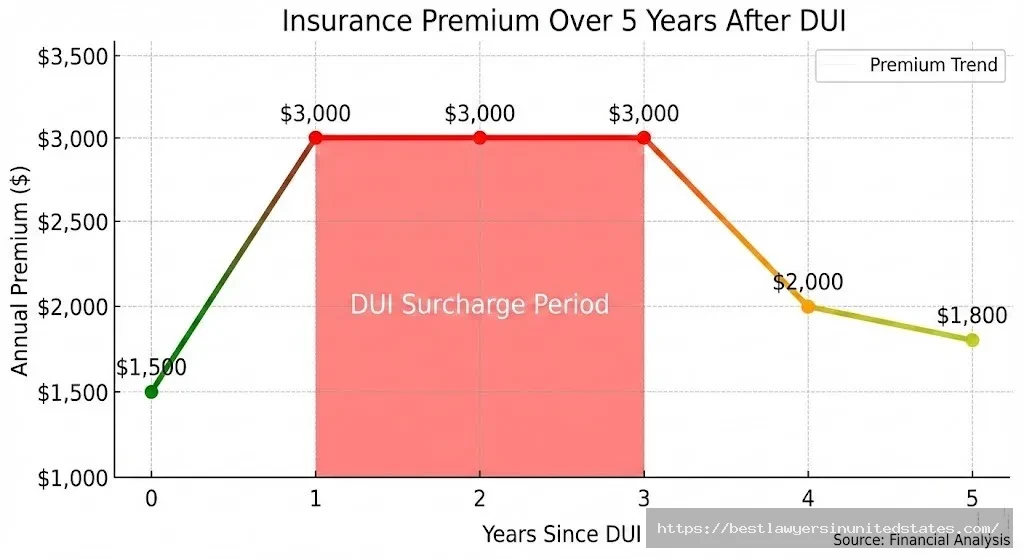
Average insurance rate increases after DUI range from 50% to 200% depending on your insurance company, state, driving history, and type of coverage. A driver paying $1,500 per year might see rates jump to $2,250-$4,500 per year after DUI.
Young drivers face even steeper increases. A 25-year-old paying $2,000 per year might see rates jump to $4,000-$6,000 per year. The combination of youth and DUI makes you extremely expensive to insure.
Some insurance companies drop DUI drivers entirely rather than raise rates. You’ll need to find new coverage with a high-risk insurance company. These companies charge premium prices because they specialize in high-risk drivers.
Example Insurance Increase Calculations:
Example 1: Middle-aged driver, clean record
- Pre-DUI premium: $1,200/year
- Post-DUI premium: $2,400/year (100% increase)
- Additional cost over 3 years: $3,600
- Additional cost over 5 years: $6,000
Example 2: Young driver, one previous ticket
- Pre-DUI premium: $2,500/year
- Post-DUI premium: $5,000/year (100% increase)
- Additional cost over 3 years: $7,500
- Additional cost over 5 years: $12,500
Example 3: Commercial vehicle owner
- Pre-DUI premium: $3,000/year
- Post-DUI premium: $7,500/year (150% increase)
- Additional cost over 3 years: $13,500
- Additional cost over 5 years: $22,500
How Long DUI Affects Insurance Rates
Most insurance companies surcharge DUI drivers for 3-5 years depending on state law and company policy. California typically sees 3-4 year surcharges. Other states may extend to 5 years.
The DUI remains on your driving record longer than the surcharge period. Most states keep DUI on your record for 7-10 years. However, insurance surcharges typically end after 3-5 years even though the conviction remains visible.
After the surcharge period ends, your rates return to normal levels assuming no additional violations. However, you’ve lost any good driver discounts you previously enjoyed. Rebuilding those discounts takes additional years of clean driving.
SR-22 Insurance Requirement
Most states require SR-22 or FR-44 certificates after DUI conviction. These are not insurance policies but proof that you carry the state-required minimum liability coverage. Your insurance company files the SR-22 with your state DMV.
Insurance companies charge $15-$50 filing fees for SR-22 certificates. Some charge annual renewal fees of $15-$25. The real cost isn’t the filing fee but the higher premiums that come with SR-22 requirement.
SR-22 requirements typically last 3 years from your conviction date or license reinstatement date depending on your state. You must maintain continuous coverage with SR-22 filing for the entire period. If your insurance lapses even for one day, your insurer notifies the DMV and your license is immediately suspended.
Finding insurance companies willing to file SR-22 can be challenging. Many major insurers refuse. You’ll likely need to use specialized high-risk insurers who charge much higher premiums.
SR-22 Related Costs:
- SR-22 filing fee: $15-$50
- Annual renewal fees (2-3 years): $30-$75
- Higher premiums due to SR-22 status: Included in rate increases above
- Total SR-22 fees: $45-$125 (not including higher premiums)
Attorney Costs and Legal Fees
Hiring an attorney is optional but highly recommended for DUI charges. Attorneys significantly improve your chances of reduced charges, dismissed cases, or minimized penalties. However, quality legal representation costs thousands of dollars.
Average DUI Attorney Fees by State
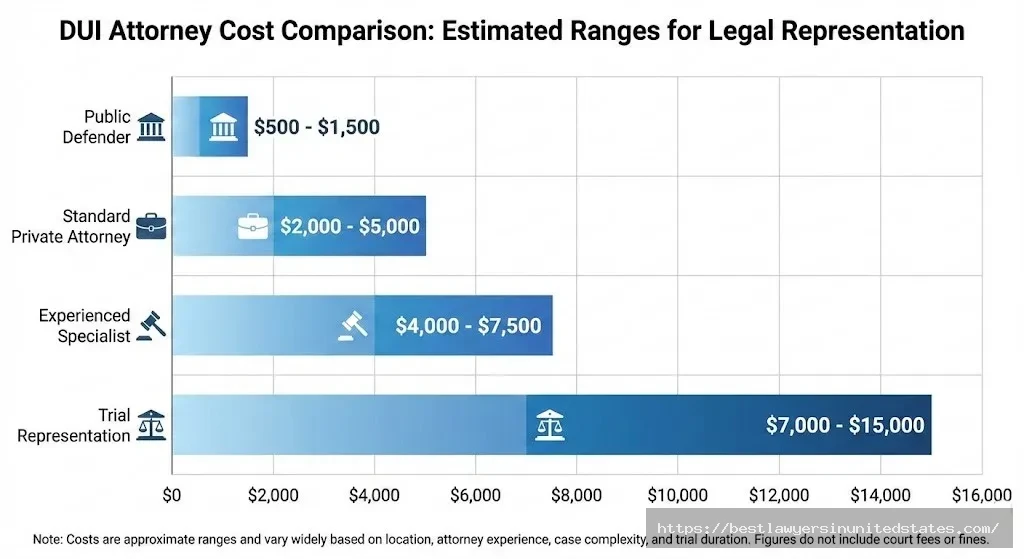
DUI attorney fees vary dramatically based on your location, case complexity, and attorney experience. Simple first-offense cases in rural areas might cost $1,500-$3,000. Complex cases in major cities can cost $5,000-$15,000 or more.
Average Attorney Fees by State (First Offense, No Trial):
- California: $2,500-$5,000
- Florida: $2,000-$4,000
- Texas: $2,000-$4,500
- New York: $3,000-$6,000
- Illinois: $2,500-$5,000
- Arizona: $2,000-$4,000
- Nevada (Las Vegas): $2,500-$5,000
- Colorado: $2,000-$4,000
- Georgia: $2,000-$4,000
- Pennsylvania: $2,500-$5,000
These fees typically cover initial consultation, arraignment, DMV hearing representation, pretrial negotiations, and plea agreement representation. Most attorneys charge flat fees for standard first-offense DUI cases.
Factors That Increase Attorney Costs
Several factors push attorney fees higher than standard ranges:
Trial Cases: If your case goes to jury trial, expect to pay significantly more. Trial fees often add $3,000-$10,000 to standard fees. Trials require extensive preparation, expert witnesses, and multiple days in court. Total fees for trial cases commonly reach $7,000-$15,000.
Aggravating Circumstances: High BAC (0.15%+), accidents with injuries, child passengers, or refused chemical tests make cases more complex. Attorneys charge 25-50% more for aggravated cases. A case that would cost $3,000 might cost $4,000-$4,500 with aggravating factors.
Multiple Offenses: Second and third DUI charges require more work and carry higher stakes. Second offense fees typically run 50% higher than first offense fees. Third offense cases often cost double first offense fees due to felony implications.
Expert Witnesses: Challenging breathalyzer or blood test results requires expert witnesses. Toxicologists charge $2,000-$5,000 for testimony. Accident reconstruction experts cost $3,000-$8,000. These expert fees come on top of attorney fees.
Appeals: If you’re convicted and appeal, appellate attorney fees run $5,000-$15,000 depending on the complexity. Appeals are expensive and have low success rates but may be necessary in some cases.
Flat Fee vs Hourly Billing
Most DUI attorneys offer flat fee arrangements for standard cases. Flat fees provide cost certainty. You know exactly what you’ll pay regardless of how many hours the attorney works.
Typical flat fees range from $2,000-$5,000 for first-offense DUI cases without trials. This covers all standard pretrial work, negotiations, and plea agreements. If your case goes to trial, the attorney charges an additional trial fee.
Some attorneys bill hourly instead. Hourly rates for DUI attorneys range from $200-$500 per hour depending on experience and location. Hourly billing can be cheaper if your case resolves quickly but much more expensive if it drags on or goes to trial.
Hourly billing creates uncertainty. You might think you’re hiring an attorney for $3,000 but end up with a $10,000 bill if your case is complex. Most people prefer flat fees for budgeting purposes.
Public Defender Costs
If you can’t afford a private attorney, you may qualify for a court-appointed public defender. Public defenders are free only if you’re truly indigent. Most states require financial disclosure and may later bill you for costs if you can afford to pay.
Public defender reimbursement fees range from $500-$1,500 depending on your state and the complexity of your case. Courts may add these fees to your final costs or pursue collection after your case concludes.
Public defenders handle heavy caseloads. They’re often skilled attorneys but have limited time for each case. Private attorneys generally spend more time on your case and may achieve better results through more thorough investigation and negotiation.
What Attorney Fees Include and Exclude
Standard flat fee DUI defense typically includes:
- Initial consultation and case review
- Arraignment appearance
- DMV administrative hearing representation
- Police report and evidence review
- Negotiations with prosecutors
- Pretrial court appearances
- Plea agreement representation
Standard fees typically exclude:
- Jury trial representation (additional $3,000-$10,000)
- Expert witness fees ($2,000-$8,000 per expert)
- Appeals ($5,000-$15,000)
- Civil lawsuits if accident victims sue you
- Divorce attorney costs if DUI damages your marriage
Always clarify what’s included before hiring an attorney. Get the fee agreement in writing. Understand what triggers additional charges.
Lost Wages and Employment Costs
DUI arrests cause immediate and long-term employment impacts. Lost wages from jail time, court appearances, and license suspension add thousands to your total costs. Career consequences can cost tens or hundreds of thousands over time.
Immediate Lost Wages
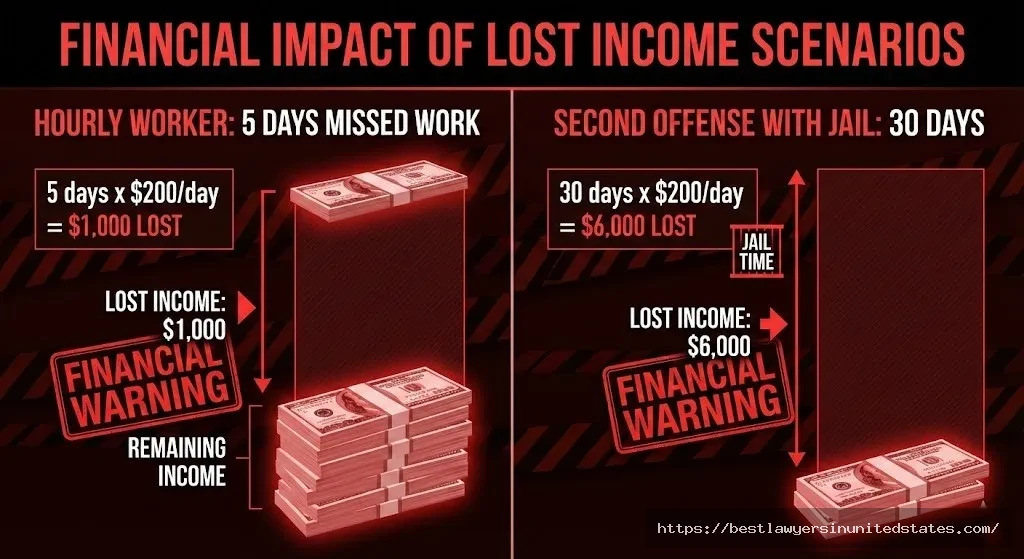
The average DUI defendant misses 2-5 days of work immediately after arrest. You lose at least one day for arrest and jail release. Court appearances require additional days off. DMV hearings take half days.
If you’re paid hourly, lost wages hit immediately. Someone earning $25 per hour loses $200 for each 8-hour workday. Missing 3 days costs $600. Salaried employees may not lose pay directly but use vacation or sick time they’d prefer to save.
Jail sentences increase lost wages substantially. First offense typically means no jail beyond initial booking, but some states impose mandatory minimum jail time. Second and third offenses often include 10-30 days or more in jail. At $200 per day, 30 days in jail means $6,000 in lost wages.
License suspension creates ongoing lost wages if you can’t get to work. People without public transit options or who live far from work may be unable to work during suspension. Several months without income can cost $10,000-$30,000 depending on your salary.
Typical Lost Wage Calculations:
Example 1: Hourly worker, first offense, no jail
- Initial arrest and booking: 1 day ($200)
- Court appearances (arraignment, pretrial, sentencing): 3 days ($600)
- DMV hearing: 0.5 days ($100)
- Total lost wages: $900
Example 2: Salaried professional, second offense, 30 days jail
- Arrest and initial proceedings: $600
- Jail time: 30 days ($6,000 if unpaid leave)
- Total lost wages: $6,600
Example 3: License suspension, cannot work
- 90-day suspension, no alternative transport
- Lost income: $12,000-$20,000
Long-Term Career Impact
DUI convictions appear on background checks. Many employers conduct criminal background checks on job applicants and current employees. A DUI conviction creates employment barriers that last years.

Professional license holders face license discipline or revocation. Doctors, nurses, lawyers, teachers, real estate agents, and others with professional licenses must report DUI convictions to licensing boards. Consequences range from probation to permanent license loss.
Medical professionals may face license suspension, required monitoring, and practice restrictions. This can cost tens of thousands in lost income during suspension plus monitoring costs of $5,000-$10,000 per year.
Commercial driver’s license (CDL) holders lose their CDL after DUI conviction. Federal law prohibits CDL holders from driving commercial vehicles for one year after first DUI, permanent revocation after second DUI. Truck drivers, bus drivers, and delivery drivers lose their careers. The lifetime income loss can exceed $500,000.
Security clearance holders often lose clearances after DUI. Government contractors, military personnel, and others requiring clearances may lose their jobs. Clearance reinstatement is difficult or impossible depending on circumstances.
Pilots face FAA license action after DUI. Consequences include temporary suspension or permanent revocation depending on circumstances. Commercial pilots may lose careers worth millions over a lifetime.
Job Termination Risk
Many employers terminate employees after DUI conviction. Termination is particularly common if:
- Your job involves driving (delivery, sales, transportation)
- You hold professional licenses
- Your employer has strict conduct policies
- You work with children or vulnerable populations
- You’re in law enforcement, government, or education
Even if not terminated, you may be passed over for promotions. Some employers limit advancement opportunities for employees with criminal records. The lost income from stunted career growth compounds over decades.
Estimated Career Impact Costs:
- Professional license monitoring (5 years): $25,000-$50,000
- Lost income from license suspension (6-12 months): $30,000-$80,000
- CDL loss (lifetime lost income): $500,000-$1,000,000
- Security clearance loss (varies greatly): $50,000-$300,000
- General career advancement impacts: Impossible to quantify precisely
State-by-State DUI Cost Comparison
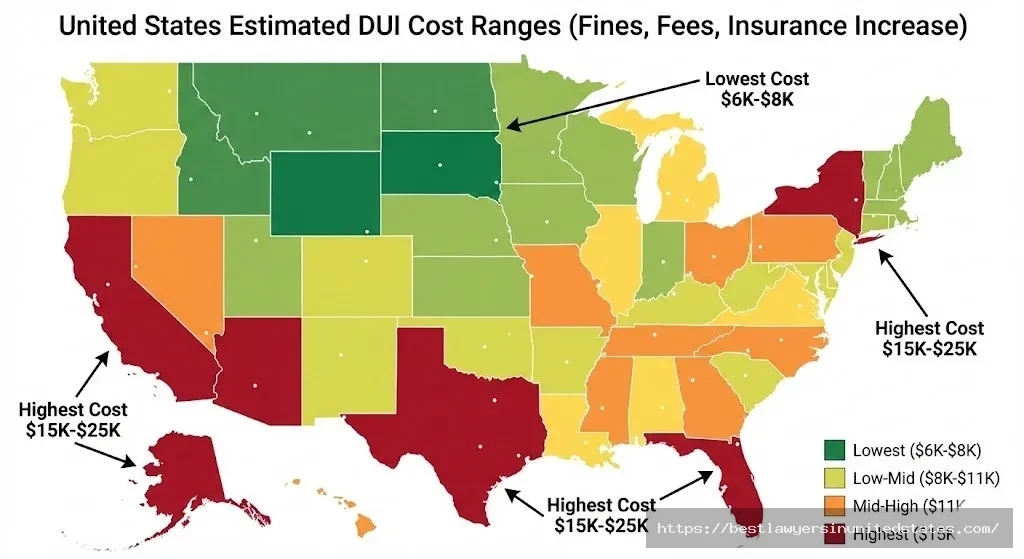
DUI costs vary dramatically by state. Understanding your state’s specific costs helps you budget accurately. This comprehensive table shows estimated first-offense DUI costs for all 50 states.
Complete 50-State Cost Breakdown
| State | Court Fines | Attorney Fees | DUI School | License Fees | Ignition Interlock | Insurance Increase (3yr) | Total Estimate |
|---|---|---|---|---|---|---|---|
| Alabama | $600-$2,100 | $2,000-$4,000 | $300-$500 | $100-$200 | $750-$1,200 | $3,000-$6,000 | $6,750-$14,000 |
| Alaska | $1,500-$3,000 | $2,500-$5,000 | $400-$800 | $200-$300 | $900-$1,500 | $4,000-$8,000 | $9,500-$18,600 |
| Arizona | $1,250-$2,500 | $2,000-$4,000 | $500-$800 | $10-$100 | $840-$1,450 | $3,500-$7,000 | $8,100-$15,850 |
| Arkansas | $150-$1,000 | $2,000-$4,000 | $350-$600 | $100-$150 | $750-$1,200 | $3,000-$6,000 | $6,350-$12,950 |
| California | $1,800-$2,600 | $2,500-$5,000 | $500-$900 | $125-$200 | $840-$1,450 | $4,500-$9,000 | $10,265-$19,150 |
| Colorado | $600-$1,500 | $2,000-$4,000 | $450-$700 | $95-$125 | $840-$1,450 | $3,500-$7,000 | $7,485-$14,775 |
| Connecticut | $500-$1,000 | $3,000-$6,000 | $400-$600 | $175-$225 | $900-$1,500 | $4,000-$8,000 | $8,975-$17,325 |
| Delaware | $500-$1,500 | $2,500-$5,000 | $250-$500 | $200-$300 | $840-$1,450 | $3,500-$7,000 | $7,790-$15,750 |
| Florida | $500-$1,000 | $2,000-$4,000 | $250-$500 | $75-$150 | $840-$1,450 | $3,500-$7,000 | $7,165-$14,100 |
| Georgia | $300-$1,000 | $2,000-$4,000 | $350-$600 | $200-$250 | $840-$1,450 | $3,500-$7,000 | $7,190-$14,300 |
| Hawaii | $150-$1,000 | $2,500-$5,000 | $150-$300 | $75-$150 | $900-$1,500 | $4,500-$9,000 | $8,275-$16,950 |
| Idaho | $1,000-$2,000 | $2,000-$4,000 | $250-$400 | $285-$335 | $840-$1,450 | $3,000-$6,000 | $7,375-$14,185 |
| Illinois | $500-$2,500 | $2,500-$5,000 | $400-$700 | $500-$600 | $1,080-$1,800 | $3,500-$7,000 | $8,480-$17,600 |
| Indiana | $500-$5,000 | $2,000-$4,500 | $275-$500 | $150-$250 | $900-$1,500 | $3,000-$6,000 | $6,825-$17,750 |
| Iowa | $625-$1,250 | $2,000-$4,000 | $100-$300 | $200-$300 | $900-$1,500 | $3,500-$7,000 | $7,325-$14,350 |
| Kansas | $500-$1,000 | $2,000-$4,000 | $250-$500 | $75-$100 | $900-$1,500 | $3,000-$6,000 | $6,725-$13,100 |
| Kentucky | $200-$500 | $2,000-$4,500 | $300-$500 | $100-$150 | $840-$1,450 | $3,000-$6,000 | $6,440-$13,100 |
| Louisiana | $300-$1,000 | $2,000-$4,000 | $300-$600 | $100-$200 | $840-$1,450 | $3,500-$7,000 | $7,040-$14,250 |
| Maine | $500-$2,000 | $2,500-$5,000 | $250-$400 | $50-$100 | $900-$1,500 | $3,500-$7,000 | $7,700-$16,000 |
| Maryland | $1,000-$2,000 | $2,500-$5,000 | $250-$500 | $150-$200 | $900-$1,500 | $4,000-$8,000 | $8,800-$17,200 |
| Massachusetts | $500-$5,000 | $3,000-$7,000 | $400-$600 | $500-$700 | $1,080-$1,800 | $4,500-$9,000 | $9,980-$24,100 |
| Michigan | $100-$500 | $2,000-$5,000 | $275-$500 | $125-$225 | $900-$1,500 | $3,500-$7,000 | $6,900-$14,725 |
| Minnesota | $1,000-$3,000 | $2,500-$5,000 | $200-$400 | $680-$730 | $900-$1,500 | $3,500-$7,000 | $8,780-$17,630 |
| Mississippi | $250-$1,000 | $1,800-$3,500 | $250-$450 | $100-$150 | $840-$1,450 | $3,000-$6,000 | $6,240-$12,550 |
| Missouri | $500-$1,000 | $2,000-$4,000 | $250-$500 | $45-$75 | $900-$1,500 | $3,000-$6,000 | $6,695-$13,075 |
| Montana | $600-$1,200 | $2,000-$4,500 | $225-$400 | $200-$300 | $900-$1,500 | $3,500-$7,000 | $7,425-$14,900 |
| Nebraska | $400-$1,000 | $2,000-$4,000 | $300-$500 | $125-$175 | $900-$1,500 | $3,000-$6,000 | $6,725-$13,175 |
| Nevada | $400-$1,000 | $2,500-$5,000 | $150-$300 | $140-$175 | $840-$1,450 | $4,000-$8,000 | $8,030-$15,925 |
| New Hampshire | $500-$1,200 | $2,500-$5,000 | $350-$600 | $100-$150 | $900-$1,500 | $3,500-$7,000 | $7,850-$15,450 |
| New Jersey | $250-$500 | $3,000-$7,000 | $200-$400 | $100-$200 | $1,080-$1,800 | $4,500-$9,000 | $9,130-$18,900 |
| New Mexico | $500-$1,000 | $2,000-$4,000 | $300-$500 | $100-$200 | $840-$1,450 | $3,500-$7,000 | $7,240-$14,150 |
| New York | $500-$1,000 | $3,000-$6,000 | $225-$400 | $50-$100 | $900-$1,500 | $4,500-$9,000 | $9,175-$18,000 |
| North Carolina | $100-$4,000 | $2,000-$5,000 | $100-$300 | $130-$165 | $900-$1,500 | $3,500-$7,000 | $6,730-$17,965 |
| North Dakota | $500-$1,500 | $2,000-$4,000 | $525-$850 | $50-$100 | $900-$1,500 | $3,000-$6,000 | $6,975-$13,950 |
| Ohio | $375-$1,075 | $2,500-$5,000 | $200-$400 | $475-$550 | $900-$1,500 | $3,500-$7,000 | $7,950-$15,525 |
| Oklahoma | $500-$1,000 | $2,000-$4,000 | $375-$600 | $50-$100 | $840-$1,450 | $3,000-$6,000 | $6,765-$13,150 |
| Oregon | $1,000-$6,250 | $2,000-$4,500 | $130-$600 | $75-$175 | $900-$1,500 | $3,500-$7,000 | $7,605-$20,025 |
| Pennsylvania | $300-$5,000 | $2,500-$5,000 | $300-$600 | $500-$700 | $1,080-$1,800 | $4,000-$8,000 | $8,680-$21,100 |
| Rhode Island | $100-$500 | $2,500-$5,000 | $260-$500 | $86-$136 | $900-$1,500 | $4,000-$8,000 | $7,846-$15,636 |
| South Carolina | $400-$1,000 | $2,000-$4,000 | $350-$550 | $100-$200 | $840-$1,450 | $3,000-$6,000 | $6,690-$13,200 |
| South Dakota | $500-$2,000 | $2,000-$4,000 | $200-$400 | $50-$100 | $840-$1,450 | $3,000-$6,000 | $6,590-$13,950 |
| Tennessee | $350-$1,500 | $2,000-$4,500 | $350-$600 | $65-$115 | $840-$1,450 | $3,500-$7,000 | $7,105-$15,165 |
| Texas | $0-$2,000 | $2,000-$4,500 | $90-$300 | $125-$200 | $840-$1,450 | $3,500-$7,000 | $6,555-$15,450 |
| Utah | $700-$1,920 | $2,000-$4,000 | $450-$800 | $65-$115 | $900-$1,500 | $3,500-$7,000 | $7,615-$15,335 |
| Vermont | $0-$750 | $2,500-$5,000 | $500-$800 | $98-$148 | $900-$1,500 | $3,500-$7,000 | $7,498-$15,198 |
| Virginia | $250-$2,500 | $2,500-$5,000 | $300-$600 | $220-$270 | $900-$1,500 | $4,000-$8,000 | $8,170-$17,870 |
| Washington | $865-$5,000 | $2,500-$5,000 | $200-$500 | $150-$200 | $900-$1,500 | $3,500-$7,000 | $8,115-$19,200 |
| West Virginia | $100-$500 | $2,000-$4,000 | $225-$400 | $15-$65 | $840-$1,450 | $3,000-$6,000 | $6,180-$12,415 |
| Wisconsin | $150-$300 | $2,000-$5,000 | $365-$435 | $200-$300 | $900-$1,500 | $3,500-$7,000 | $7,115-$14,535 |
| Wyoming | $200-$750 | $2,000-$4,000 | $200-$400 | $50-$100 | $840-$1,450 | $3,000-$6,000 | $6,290-$12,700 |
Table Notes:
- These are first-offense DUI estimates only
- Costs assume no accident, injury, or other aggravating factors
- Attorney fees are for standard case, not trial
- Insurance increases assume average driver, 3-year surcharge period
- Actual costs vary by specific circumstances
- Second and third offenses cost 2-3x these amounts
Highest and Lowest Cost States
Most Expensive States (First Offense):
- Massachusetts: $9,980-$24,100
- Pennsylvania: $8,680-$21,100
- Oregon: $7,605-$20,025
- California: $10,265-$19,150
- New Jersey: $9,130-$18,900
Least Expensive States (First Offense):
- Mississippi: $6,240-$12,550
- Wyoming: $6,290-$12,700
- Kentucky: $6,440-$13,100
- South Dakota: $6,590-$13,950
- Alabama: $6,750-$14,000
The cost difference between most and least expensive states can exceed $10,000-$15,000. State of arrest significantly impacts your total DUI expenses.## First vs Second vs Third DUI Offense Costs
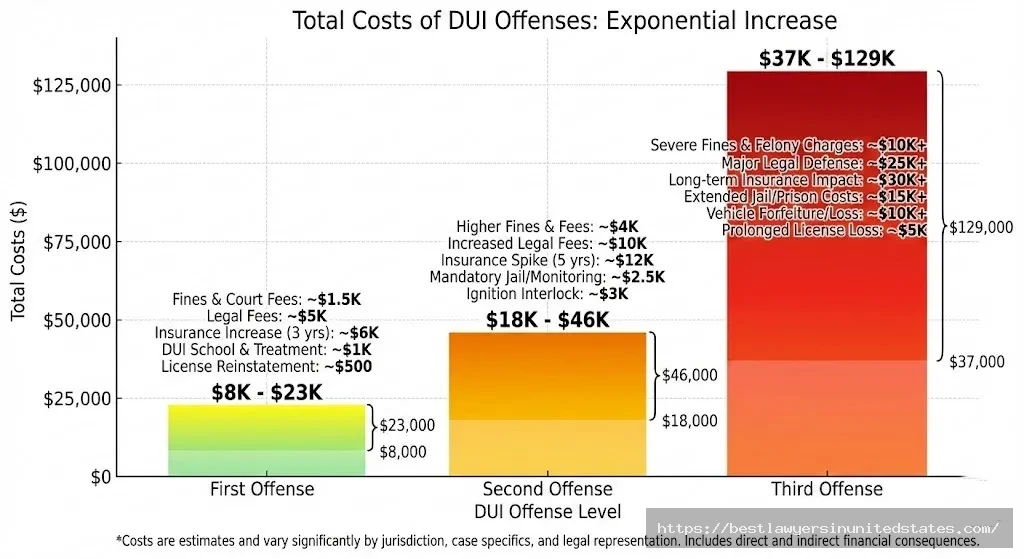
Repeat DUI offenses carry dramatically higher costs. Each subsequent conviction multiplies expenses across every category. Understanding the escalating costs emphasizes the importance of avoiding repeat offenses.
First Offense DUI Costs
First-time DUI offenses represent the baseline. Courts often show some leniency for first offenders with no aggravating circumstances. Many first offenders receive probation rather than jail time.
Typical First Offense Costs:
- Court fines and fees: $1,500-$3,000
- Attorney fees: $2,000-$5,000
- DUI school (3-6 months): $300-$900
- License reinstatement: $50-$500
- Ignition interlock (6-12 months): $840-$1,450
- Insurance increases (3 years): $3,000-$9,000
- Lost wages: $500-$2,000
- Bail and towing: $300-$800
- Total: $8,490-$22,650
Most first offenders avoid jail beyond initial booking. Probation lasts 1-3 years. License suspension ranges from 30-180 days with restricted license options in many states.
The key to minimizing first offense costs is hiring a competent attorney who can negotiate favorable terms. Many first offenders successfully complete diversion programs that result in dismissed charges or reduced penalties.
Second Offense DUI Costs
Second DUI convictions within 5-10 years (lookback period varies by state) trigger much harsher penalties. Courts view second offenses as proof you didn’t learn from your first conviction.
Typical Second Offense Costs:
- Court fines and fees: $2,500-$5,000
- Attorney fees: $3,000-$7,500
- DUI school (18 months): $1,800-$2,500
- License reinstatement: $50-$600
- Ignition interlock (12-24 months): $840-$2,650
- Insurance increases (3-5 years): $6,000-$15,000
- Lost wages (includes jail time): $2,000-$10,000
- Vehicle impound (30 days): $1,500-$2,250
- Bail bonds: $300-$600
- Total: $18,290-$46,100
Second offenses typically include mandatory jail time of 10-90 days depending on your state. Many states allow work release or electronic monitoring instead of continuous jail, but you’ll still lose income.
License suspensions extend to 1-2 years minimum. Some states offer restricted licenses, others don’t. Vehicle impound is common. Many states impound your vehicle for 30 days.
Second offenses close off many cost-reduction opportunities. Diversion programs typically aren’t available. Plea bargains are harder to negotiate. The prosecutor knows this is your second chance and you blew it.
Third Offense DUI Costs
Third DUI convictions become felonies in most states. Felony DUIs carry much more serious consequences including prison time, permanent license revocation, and lifelong criminal records.
Typical Third Offense Costs:
- Court fines and fees: $3,500-$10,000
- Attorney fees: $5,000-$15,000
- DUI school (30 months): $2,500-$3,500
- License reinstatement: $100-$1,000 (if allowed)
- Ignition interlock (24-60 months): $1,560-$6,600
- Insurance increases (5+ years): $12,000-$25,000
- Lost wages (includes prison time): $10,000-$50,000
- Vehicle impound and possible forfeiture: $2,000-$15,000
- Bail bonds: $500-$2,500
- Total: $37,160-$128,600
Third offenses often mean prison sentences of 1-5 years depending on your state. California imposes 120 days to 1 year. Some states go much higher. Prison time destroys employment and careers.
Many states permanently revoke licenses after third DUI. Others allow reinstatement after long periods (5-10 years) with ignition interlock requirements. Some third-time offenders never legally drive again.
Vehicle forfeiture is possible after third offense in some states. Your car may be seized and sold at auction as part of your punishment. This adds thousands more in costs.
Cost Comparison Summary Table
| Category | First Offense | Second Offense | Third Offense |
|---|---|---|---|
| Court Fines | $1,500-$3,000 | $2,500-$5,000 | $3,500-$10,000 |
| Attorney Fees | $2,000-$5,000 | $3,000-$7,500 | $5,000-$15,000 |
| DUI School | $300-$900 | $1,800-$2,500 | $2,500-$3,500 |
| License Costs | $50-$500 | $50-$600 | $100-$1,000 |
| Ignition Interlock | $840-$1,450 | $840-$2,650 | $1,560-$6,600 |
| Insurance (Total) | $3,000-$9,000 | $6,000-$15,000 | $12,000-$25,000 |
| Lost Wages | $500-$2,000 | $2,000-$10,000 | $10,000-$50,000 |
| Other Costs | $300-$800 | $2,100-$3,450 | $2,500-$17,500 |
| TOTAL | $8,490-$22,650 | $18,290-$46,100 | $37,160-$128,600 |
Each subsequent offense roughly doubles total costs. Third offenses cost 4-6 times more than first offenses when you include lost wages from prison time and potential vehicle forfeiture.
Hidden Costs People Don’t Expect
DUI creates expenses most people never anticipate. These hidden costs often exceed the obvious fines and fees. Understanding them prevents financial surprises.
Civil Lawsuits from Accident Victims
If your DUI involved an accident with injuries or property damage, expect civil lawsuits. Accident victims sue for medical expenses, lost wages, pain and suffering, and property damage.
Your insurance covers damages up to your policy limits. If damages exceed your limits, victims can sue you personally for the excess. A serious injury accident can result in judgments of $500,000 to several million dollars.
Even if insurance covers everything, you face higher premiums and possible policy cancellation. Your insurance rates will be astronomical for years after a claim.
Defense against civil lawsuits costs additional attorney fees of $5,000-$25,000 depending on case complexity. Some cases settle quickly. Others drag through litigation for years.
Professional License Consequences
Professional license holders must report DUI convictions to licensing boards. Boards impose discipline ranging from probation to permanent revocation.
Attorneys face bar discipline that can include suspension. Teachers may lose teaching credentials. Nurses and doctors face medical board action. Real estate agents, insurance agents, and financial advisors all face license discipline.
License discipline proceedings require specialized attorneys who charge $3,000-$10,000. Monitoring and compliance costs during probation run $5,000-$10,000 annually for several years.
Lost income during license suspension can exceed $50,000-$100,000 for high-earning professionals. Some professionals never fully recover their careers.
Child Custody and Family Law Consequences
DUI convictions affect child custody proceedings. Family courts consider DUI evidence of poor judgment and potential danger to children. Custody arrangements may be modified to restrict your parenting time.
Supervised visitation requirements add costs of $20-$50 per hour for professional supervision. This can cost $1,000-$2,000 per month if you have regular visitation.
DUI can trigger or accelerate divorce proceedings with substantial costs. The stress and financial burden of DUI frequently damages marriages beyond repair.
Security Clearance Loss
Government contractors, military personnel, and others requiring security clearances face clearance revocation after DUI. Clearance loss means immediate job loss in most cases.
Security clearance reinstatement is extremely difficult. Many people never regain clearances after DUI. The lifetime income loss from clearance jobs can exceed $500,000-$1,000,000.
Immigration Consequences
Non-citizens face potential deportation after DUI convictions. While a single DUI rarely triggers deportation, it creates serious immigration problems. Multiple DUIs or DUI with aggravating factors can result in removal proceedings.
Immigration attorneys specializing in criminal defense charge $5,000-$15,000 to defend against deportation. Even successful defense damages your immigration status and makes citizenship applications much harder.
Student Financial Aid Loss
College students convicted of DUI may lose federal financial aid eligibility. While DUI alone doesn’t trigger automatic loss, drug-related DUI or multiple convictions can affect aid.
Students also face university disciplinary proceedings separate from criminal court. University sanctions can include suspension or expulsion, forcing you to leave school and potentially lose scholarships.
Rental and Housing Applications
DUI convictions appear on background checks landlords conduct. Many landlords reject applicants with recent DUI convictions, viewing them as irresponsible or potential liability risks.
You may be forced to accept less desirable housing at higher rents. Some apartment complexes categorically refuse applicants with any criminal convictions.
Travel Restrictions
Canada denies entry to anyone with DUI convictions, viewing DUI as serious criminality. You cannot enter Canada for work or vacation for at least 5 years after your conviction. Some people are permanently inadmissible.
Obtaining special permission to enter Canada requires applications costing $200-$1,000 plus potential attorney fees. Many business travelers and vacation plans get ruined by Canada’s strict policy.
Other countries also restrict entry for DUI convictions. You may face problems traveling to Mexico, European countries, and Asian nations depending on their specific laws.
How to Reduce DUI Costs
While DUI is expensive, strategies exist to minimize total costs. Taking smart steps early in your case can save thousands of dollars.
Hire an Experienced DUI Attorney Immediately
The single best cost-reduction strategy is hiring a skilled DUI defense attorney before your arraignment. Good attorneys can:
- Get charges reduced or dismissed
- Negotiate lower fines and fees
- Avoid or minimize jail time
- Preserve your license
- Reduce probation terms
- Prevent insurance increases through charge reduction
A $4,000 attorney investment that gets your charge reduced to reckless driving saves $10,000+ in insurance costs alone. The attorney pays for themselves multiple times over.
Don’t use attorneys who advertise impossibly low fees. You get what you pay for. Experienced DUI specialists charge more but deliver better results.
Request a DMV Hearing Within the Deadline
Most states give you only 10 days to request an administrative license suspension hearing. Missing this deadline means automatic suspension with no opportunity to challenge it.
DMV hearings have low success rates but sometimes preserve your license. Even if you lose, the hearing generates valuable evidence your attorney can use in criminal court.
Many DUI attorneys include DMV hearing representation in their flat fees. Make sure your attorney requests the hearing immediately.
Complete DUI School Early and Enthusiastically
Judges favor defendants who start DUI school before sentencing. Voluntary enrollment shows remorse and willingness to change. Judges often impose lighter sentences when you’ve already started rehabilitation.
Completing classes early may shorten your probation or reduce other penalties. The $500-$900 program cost might save you months of probation supervision fees.
Negotiate Payment Plans for Fines and Fees
Courts understand DUI defendants struggle to pay large fines immediately. Most courts offer payment plans spreading costs over 12-36 months.
Payment plan fees are minimal, usually $25-$50 setup fees. The alternative is defaulting on fines, which triggers arrest warrants and additional penalties. Always arrange payment plans rather than ignoring court debts.
Shop Insurance Companies After DUI
Insurance rates vary dramatically between companies for DUI drivers. Some companies specialize in high-risk drivers and offer better rates than your current insurer.
Get quotes from at least 5-10 insurance companies. Focus on companies known for insuring DUI drivers. Rate differences can exceed $1,000 per year.
Don’t cancel your current insurance until you have new coverage in place. Any lapse in coverage suspends your license immediately due to SR-22 requirements.
Consider Diversion Programs if Eligible
First-time offenders in some states can enter diversion programs that result in dismissed charges. Diversion typically requires completing classes, community service, and probation.
Diversion is more expensive than simple probation but avoids a conviction on your record. The long-term savings from no insurance increases and no employment problems far exceed the higher short-term costs.
Request Work Release or Electronic Monitoring
If facing jail time, request work release or electronic monitoring instead of continuous incarceration. Work release lets you maintain employment and income while serving your sentence.
Electronic monitoring (house arrest with ankle monitor) costs $10-$15 per day but lets you work full-time. This beats losing $200+ per day in wages from jail.
Apply for Restricted or Hardship Licenses
Restricted licenses let you drive to work, school, medical appointments, and treatment programs during suspension. This preserves your income and employment.
Restricted license applications cost $50-$100 but save thousands in lost wages. Most states offer restricted licenses if you meet eligibility requirements.
Avoid License Suspensions Through Compliance
License suspensions get extended if you drive on suspended license, fail to maintain insurance, miss court dates, or violate probation. Every violation adds months to your suspension and additional fines.
Strictly comply with all requirements. Set reminders for every deadline. Missing one insurance payment can trigger 6-month suspension extensions.
Payment Plans and Financial Options
The large expenses from DUI strain most budgets. Understanding your payment options helps you manage costs without destroying your finances.
Court-Ordered Payment Plans
Courts allow payment plans for fines, fees, and restitution. Plans typically spread payments over 12-36 months with small monthly payments. A $3,000 fine might break down to $100-$150 per month.
Request payment plans at sentencing or shortly after. Courts prefer structured plans to defaulted debts. Most judges approve reasonable payment requests.
Payment plan setup fees usually run $25-$50. Some courts charge small monthly service fees of $5-$10. These fees are much cheaper than the consequences of unpaid fines.
Missing payments triggers bench warrants for your arrest. Set up automatic payments if possible to avoid missed payments.
Attorney Payment Plans and Financing
Many DUI attorneys offer payment plans letting you pay legal fees over time. Common arrangements include:
- Down payment of $500-$1,500 with balance over 3-6 months
- Credit card payments (with credit card fees added)
- Third-party legal financing through companies like Uplift or LawCharge
Attorney payment plans let you hire quality representation even without cash upfront. However, the attorney may limit services if you fall behind on payments.
Some attorneys charge interest or fees on payment plans. Clarify all costs before signing retainer agreements.
Credit Cards and Personal Loans
Many DUI defendants use credit cards for immediate expenses. While expensive due to interest rates, credit cards provide instant funds for bail, towing, and attorney retainers.
Personal loans from banks or credit unions offer lower interest rates than credit cards. However, loan approval takes time and requires good credit.
Credit card debt from DUI can take years to repay. Try to secure lower-interest options when possible.
Help from Family and Friends
Many people borrow from family members to cover DUI costs. Family loans often come with better terms than commercial loans or no interest at all.
If borrowing from family, put agreements in writing. Clear documentation prevents misunderstandings and relationship damage.
Avoiding Predatory Lenders
Desperate financial situations make you vulnerable to predatory lending. Avoid:
- Payday loans with 300%+ interest rates
- Title loans that risk losing your car
- Advance fee scams promising DUI charge dismissal
- Bail bond services charging excessive fees
Never pay attorneys who guarantee case dismissal or promise results before reviewing your case. These promises indicate scams.
Frequently Asked Questions About DUI Costs
How much does a DUI cost in total?
Total DUI costs range from $8,000-$25,000 for first offenses depending on your state and circumstances. This includes court fines, attorney fees, DUI school, license costs, ignition interlock devices, and insurance increases over three years. Second offenses typically cost $18,000-$50,000. Third offenses can exceed $50,000-$150,000.
The largest single expense is usually insurance rate increases over 3-5 years. Lost wages from license suspension and career impacts add significantly to total costs for many people.
What is the most expensive part of a DUI?
Insurance premium increases represent the largest single expense for most DUI defendants. Your rates can double or triple for 3-5 years, adding $3,000-$25,000 to total costs depending on your prior premiums and state requirements.
Attorney fees are the second largest expense, typically $2,000-$7,500 for standard cases. However, good attorneys save much more than they cost through better case outcomes.
Lost income from career impacts, license suspension, and jail time can exceed all other costs combined for some people, particularly professionals, CDL holders, and security clearance holders.
How much does a DUI lawyer cost?
DUI attorney fees typically range from $2,000-$5,000 for first-offense cases without trials. More complex cases with aggravating factors cost $3,000-$7,500. Cases going to trial often cost $7,000-$15,000 total including trial fees.
Rates vary by state and attorney experience. Major urban areas charge more than rural areas. High-profile attorneys with excellent track records charge premium rates but may deliver superior results.
Most DUI attorneys offer flat fee arrangements for standard cases. This provides cost certainty compared to hourly billing which can spiral out of control.
Can I get a payment plan for DUI costs?
Yes, courts typically allow payment plans for fines and fees spreading payments over 12-36 months. Most judges approve reasonable payment plans at sentencing.
Many DUI attorneys also offer payment plans for legal fees. Common arrangements include down payments of $500-$1,500 with monthly payments over 3-6 months.
DUI schools, ignition interlock companies, and treatment programs usually accept monthly payments rather than requiring full payment upfront.
How long do DUI costs last?
Direct costs like fines, attorney fees, and DUI school are one-time expenses paid within 1-2 years of arrest. However, indirect costs continue much longer.
Insurance increases last 3-5 years from your conviction date, adding thousands annually. Ignition interlock requirements can last 6 months to 5 years or more depending on your state and offense number.
Career and professional license impacts may last a lifetime. Some professionals never fully recover their earning potential after DUI convictions.
How much does insurance go up after DUI?
Insurance rates typically increase 50-200% after DUI depending on your insurance company, state, and driving history. Someone paying $1,500 annually might see rates jump to $2,250-$4,500 annually.
Young drivers face even steeper increases due to the combination of youth and DUI. Rates for under-25 drivers can triple or quadruple.
These increases last 3-5 years in most states. You’ll pay elevated premiums for at least three years from your conviction date.
Is a DUI attorney worth the cost?
Yes, hiring an experienced DUI attorney almost always provides value far exceeding the cost. Good attorneys can:
- Get charges reduced to lesser offenses like reckless driving
- Negotiate reduced fines and shorter suspensions
- Avoid or minimize jail time
- Challenge evidence and get cases dismissed
- Save thousands in insurance costs through charge reduction
A $4,000 attorney who gets your DUI reduced to reckless driving saves $10,000+ in insurance increases alone. The attorney more than pays for themselves through better outcomes.
Public defenders are free but handle heavy caseloads and have limited time for each case. Private attorneys generally achieve better results through more thorough investigation and negotiation.
Can I reduce DUI costs?
Several strategies can reduce total DUI costs:
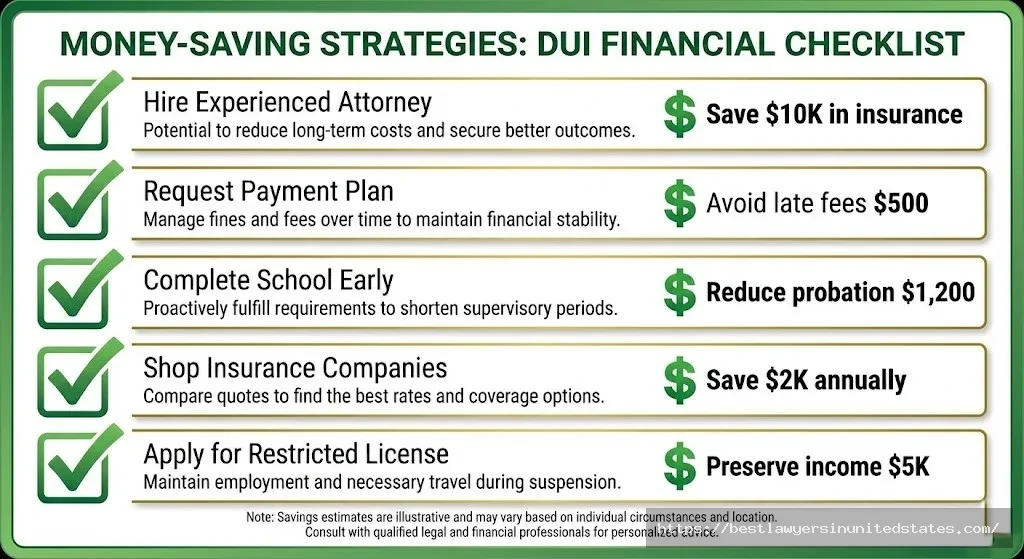
- Hire an experienced attorney to negotiate better outcomes
- Request payment plans for fines and fees
- Complete DUI school early to show judges your commitment
- Shop multiple insurance companies for best rates
- Request work release or electronic monitoring instead of jail
- Apply for restricted licenses to preserve income during suspension
- Enroll in diversion programs if eligible
- Strictly comply with all requirements to avoid additional penalties
The most effective cost reduction comes from hiring a skilled attorney who can get your charges reduced or dismissed entirely.
What are hidden DUI costs people forget?
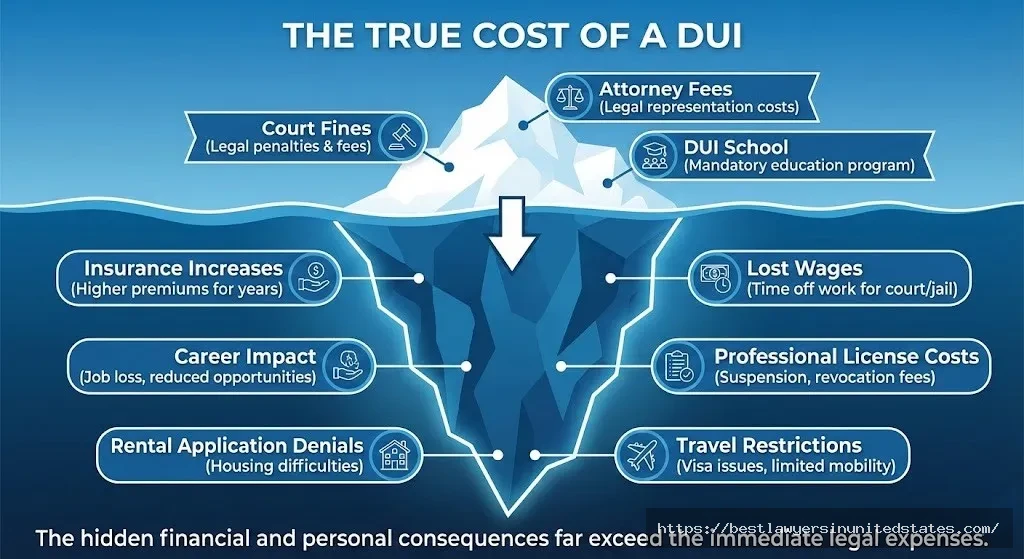
Common hidden costs include:
- Civil lawsuits if accidents caused injuries or property damage
- Professional license discipline and related attorney fees
- Child custody attorney fees if DUI affects custody
- Security clearance loss and lifetime income reduction
- Immigration attorney fees for non-citizens facing deportation
- Rental application rejections forcing higher housing costs
- Lost wages from court appearances beyond initial arrest
- Increased rates for other insurance policies (homeowners, life)
- Travel restrictions (Canada denies entry for DUI)
These hidden costs often exceed obvious expenses like fines and attorney fees.
How much does a second DUI cost?
Second DUI offenses typically cost $18,000-$50,000 depending on your state. This includes:
- Higher court fines: $2,500-$5,000
- Higher attorney fees: $3,000-$7,500
- Longer DUI program (18 months): $1,800-$2,500
- Longer ignition interlock (12-24 months): $840-$2,650
- Higher insurance increases: $6,000-$15,000
- Lost wages from jail time: $2,000-$10,000
- Vehicle impound costs (30 days): $1,500-$2,250
Second offenses typically include mandatory jail time of 10-90 days. Many states impound your vehicle for 30 days. License suspensions extend to 1-2 years minimum.
Get Legal Help for Your DUI Case
The costs and consequences of DUI convictions are substantial. Protecting your rights and your financial future requires experienced legal representation. Don’t face DUI charges alone.
Why You Need an Attorney
DUI law is complex and constantly evolving. Prosecutors have extensive experience and resources. You need an attorney who knows:
- How to challenge breathalyzer and blood test results
- When police violations require evidence suppression
- Which negotiations can reduce or dismiss charges
- How to minimize license suspension periods
- What treatment programs best serve your situation
- How to preserve your employment and professional licenses
Attorneys who practice DUI defense exclusively understand the nuances that public defenders and general practice attorneys miss. Specialized knowledge makes the difference between conviction and case dismissal.
What to Look for in a DUI Attorney
Choose attorneys with:
- Exclusive or primary focus on DUI defense
- Multiple years of DUI experience in your jurisdiction
- Knowledge of your specific court and judges
- Strong relationships with prosecutors
- Track record of successful case outcomes
- Transparent flat fee pricing
- Positive client reviews and testimonials
Avoid attorneys who:
- Handle DUI as a small part of diverse practice
- Promise specific results before reviewing your case
- Charge unusually low fees ($500-$1,000)
- Push you to plead guilty immediately
- Don’t explain strategies and options clearly
Contact Us for Attorney Referrals
We connect DUI defendants with experienced defense attorneys in your area. Our network includes highly-rated attorneys with proven track records.
Email: [email protected]
Get connected with an attorney who can:
- Provide a free case evaluation
- Explain your options and likely outcomes
- Offer fair flat-fee pricing
- Start defending your rights immediately
Don’t wait to seek legal help. Evidence disappears, witnesses forget details, and deadlines expire. Contact us today to protect your future.
Additional Resources
Learn more about related legal topics:
- Understanding Your BAC and Legal Limits
- State-Specific DUI Laws and Penalties
- Divorce Costs if DUI Damages Your Marriage
- Finding the Right Attorney for Your Case
Take Action to Protect Your Future
DUI costs extend far beyond fines and fees. The financial impact can last a decade or more. The career and personal consequences may last a lifetime.
Use our calculator to understand your potential costs. Make informed decisions about your defense strategy. Hire experienced legal representation to minimize the damage.
Your choices today determine your financial future. Don’t let DUI destroy everything you’ve worked to build. Take action now to protect yourself.
Remember: The numbers in this article represent averages and estimates. Your actual costs depend on your specific circumstances, state, and case outcome. Consult with an attorney in your jurisdiction for personalized advice.