
Calculate your blood alcohol content instantly with our free 2026 BAC calculator. Enter your weight, gender, drinks consumed, and time drinking to estimate your current BAC level and find out if you’re safe to drive.
BAC Calculator
Estimate your Blood Alcohol Content
• Commercial Driver (CDL): 0.04% BAC
• Drivers Under 21: 0.00-0.02% BAC (Zero Tolerance)
• Enhanced Penalties: 0.15% BAC or higher in most states
Our calculator uses the scientifically-proven Widmark formula to provide personalized BAC estimates. Results show your estimated blood alcohol percentage, time until you reach 0.00%, and whether you’re over your state’s legal limit. This tool helps you make informed decisions about driving safety.

Quick Benefits:
- Get instant BAC estimates based on your specific details
- See exactly when you’ll be sober enough to drive
- Compare your result to legal limits in all 50 states
- Access the calculator from any device, anytime
- Understand how different factors affect your blood alcohol level
Important Safety Disclaimer: This calculator provides estimates only. Your actual BAC may vary based on individual factors like metabolism, food intake, and health conditions. Never rely solely on a calculator to decide if you’re safe to drive. If you’ve been drinking, use a rideshare service, call a taxi, arrange for a designated driver, or use public transportation. The only safe BAC for driving is 0.00%.
Understanding Blood Alcohol Content (BAC)
Blood alcohol content represents the concentration of alcohol in your bloodstream. When you drink alcoholic beverages, your body absorbs ethanol through the stomach and small intestine. This alcohol then enters your blood and travels throughout your body, affecting your brain, organs, and physical abilities.
What BAC Percentage Actually Means
BAC is expressed as a percentage that shows grams of alcohol per 100 milliliters of blood. A BAC of 0.08% means you have 80 milligrams of alcohol per 100 milliliters of blood. This measurement helps law enforcement and medical professionals determine intoxication levels and impairment.
The percentage might seem small, but even 0.02% affects your abilities. Your brain is extremely sensitive to alcohol. Small amounts impact judgment, coordination, and reaction time. Understanding these percentages helps you recognize when you’re impaired.
How Medical Professionals Measure BAC
Four main methods exist for measuring blood alcohol content. Blood tests provide the most accurate results because they directly measure alcohol in your bloodstream. Hospitals and law enforcement use blood tests when precision matters most.
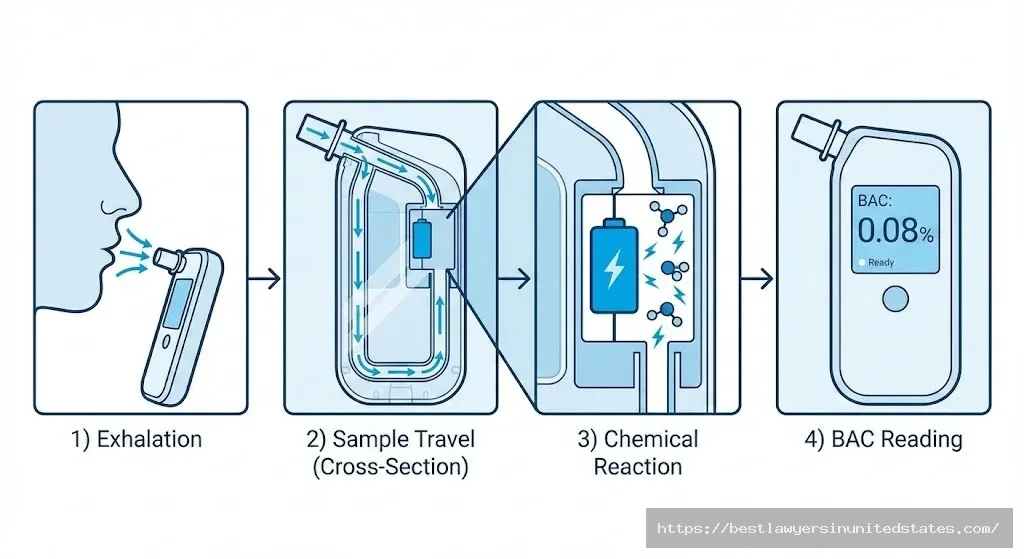
Breath tests are the most common method for roadside DUI stops. These devices measure alcohol in your breath and convert it to an estimated blood alcohol level. The conversion uses a ratio of 2100:1, meaning 2100 parts of breath alcohol equals one part blood alcohol.
Urine tests can detect alcohol but are less accurate for current BAC. They show alcohol consumed hours earlier. Saliva tests are newer technology. They’re becoming more popular because they’re less invasive than blood tests.
Each testing method has strengths and limitations. Blood tests are most accurate but require medical professionals. Breath tests are convenient but can be affected by mouth alcohol from recent drinks, mouthwash, or medical conditions like acid reflux.
The Science Behind the Widmark Formula
Swedish scientist Erik Widmark developed the BAC calculation formula in 1932. His formula remains the gold standard for estimating blood alcohol content. The Widmark formula accounts for the key variables that determine how much alcohol reaches your bloodstream.
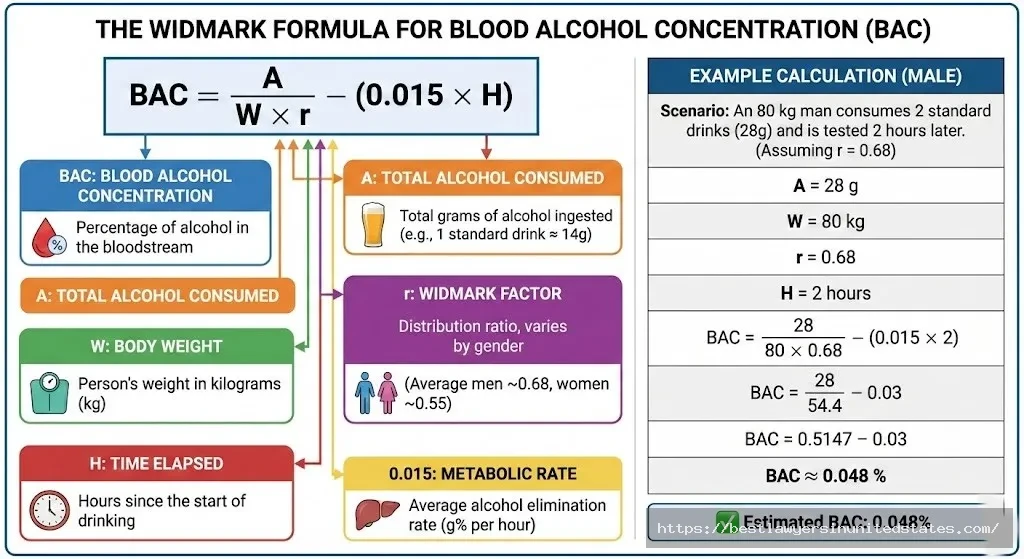
The formula looks like this:
BAC = (Alcohol consumed in grams / (Body weight in grams × r)) × 100 – (0.015 × Hours since first drink)
The variable “r” represents the alcohol distribution ratio. This number differs between men and women because of body composition differences. Men typically have an r value of 0.68 because their bodies contain about 68% water. Women have an r value of 0.55 because they have about 52-55% water in their bodies.
Why does water content matter? Alcohol dissolves in water, not fat. People with more body water dilute alcohol more effectively. Women naturally have higher body fat percentages than men, meaning less water to dilute alcohol.
The 0.015 represents the average elimination rate. Most people metabolize approximately 0.015% BAC per hour. This rate stays relatively constant regardless of how much you drink. Your liver can only process alcohol at this fixed speed.
Real Example Calculation
Let’s calculate BAC for a 180-pound man who drinks 4 beers over 2 hours.
First, convert body weight to grams: 180 pounds × 453.592 = 81,646 grams
Next, calculate pure alcohol consumed. Each standard beer contains 14 grams of pure alcohol: 4 beers × 14 grams = 56 grams of alcohol
Apply the Widmark formula: (56 / (81,646 × 0.68)) × 100 = 0.101%
Subtract alcohol eliminated over time: 0.101 – (0.015 × 2 hours) = 0.071%
Final estimated BAC: 0.071%
This man is still under the 0.08% legal limit, but he’s definitely impaired. His reaction time is slower, and his judgment is affected. He should not drive.
Historical Development of BAC Testing
The first breath-test device appeared in 1931, but it wasn’t practical for widespread use. Robert Borkenstein invented the modern breathalyzer in 1954. His device revolutionized DUI enforcement by providing roadside testing that didn’t require blood draws.
Throughout the 1960s and 1970s, states set legal limits at 0.15% BAC. This threshold was extremely high. A person at 0.15% is visibly drunk and severely impaired. Public outcry about drunk driving deaths led to change.
Mothers Against Drunk Driving (MADD) formed in 1980 after Candy Lightner’s daughter was killed by a drunk driver. MADD’s advocacy pushed states to lower legal limits. By the mid-1980s, most states adopted 0.10% limits.
The federal government stepped in during 2000. Congress passed legislation requiring all states to adopt 0.08% limits or lose federal highway funding. By 2004, every state complied. This change saved thousands of lives annually.
Recent years have seen calls for even stricter limits. The National Transportation Safety Board recommended 0.05% in 2013. Utah became the first state to adopt 0.05% in 2018. Other states are considering similar changes.
Why BAC Matters for Your Safety
Understanding your BAC helps you make critical safety decisions. Alcohol impairs your abilities long before you feel drunk. Many people at 0.05% or 0.06% think they’re fine to drive. The data shows they’re wrong.
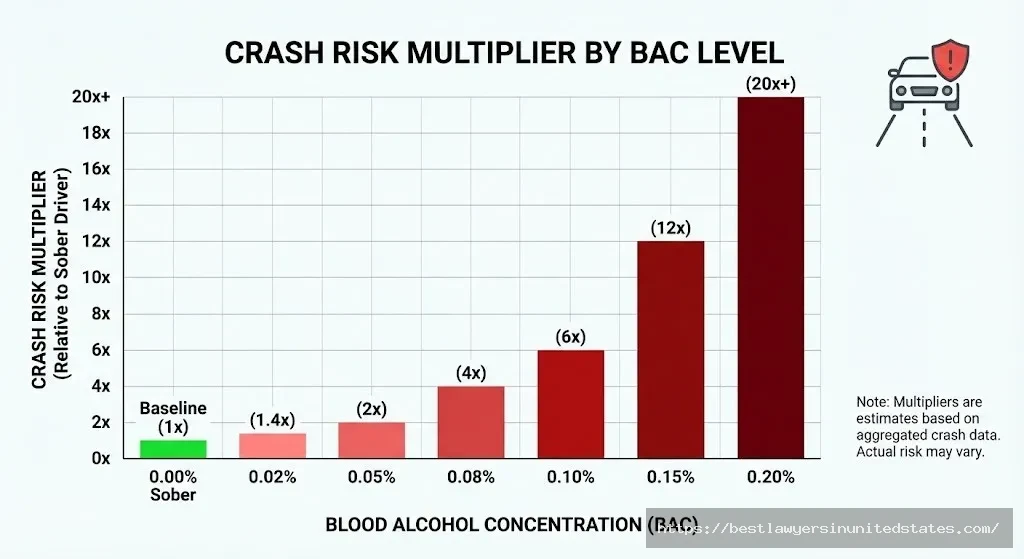
Research proves that impairment begins at 0.02%. Your ability to track moving objects declines. Your judgment about your own abilities becomes unreliable. You become more willing to take risks. These changes happen before you notice any effects.
At 0.08%, your crash risk is 2-4 times higher than when sober. At 0.10%, it’s 6-8 times higher. At 0.15%, you’re 12-15 times more likely to crash. These aren’t just statistics. They represent real crashes, injuries, and deaths.
BAC also matters for medical reasons. High BAC levels can cause alcohol poisoning. This condition kills people every year, often college students during binge drinking events. Knowing BAC warning signs can save lives.
Employers increasingly test for alcohol, especially in safety-sensitive industries. Commercial drivers must stay below 0.04%. Pilots face even stricter rules. Understanding BAC helps you comply with workplace policies.
How Our Calculator Provides Accurate Estimates
Our BAC calculator uses the validated Widmark formula with enhanced accuracy features. We account for all major variables: body weight, biological sex, number of drinks, alcohol content, and time elapsed since drinking began.
The calculator applies gender-specific distribution ratios. We use 0.68 for men and 0.55 for women. This distinction matters because it can mean the difference between legal and illegal BAC levels for the same number of drinks.
We calculate elimination continuously based on the standard 0.015% per hour rate. The calculator shows your current estimated BAC and projects when you’ll reach 0.00%. This helps you plan safe transportation or know when you can legally drive.
Our tool provides conservative estimates. When calculations fall between values, we round up slightly. This safety margin helps ensure you don’t underestimate your impairment. Remember that individual variation means your actual BAC could be 0.02% higher or lower than calculated.
The calculator cannot account for every variable. Your metabolism, medications, food intake, and health conditions all affect actual BAC. Use the calculator as a general guide, not a definitive measure. When in doubt, don’t drive.
Factors Affecting Your BAC
Your blood alcohol content depends on multiple factors beyond just how many drinks you consume. Understanding these variables helps you estimate your BAC more accurately and make safer decisions about drinking and driving.
Body Weight: The Dilution Factor
Body weight directly affects how alcohol distributes through your system. Alcohol dissolves in body water, not fat tissue. Heavier people generally have more total body water, which dilutes alcohol more effectively than in lighter individuals.

A 100-pound person drinking two beers will reach a much higher BAC than a 200-pound person drinking the same amount. The lighter person has less body water to dilute the alcohol. This creates higher concentration in the bloodstream.
The relationship between weight and BAC is roughly linear. If you double your body weight while drinking the same amount, your BAC will be approximately half. A 120-pound woman might reach 0.08% from three drinks, while a 240-pound man might need six drinks to reach the same level.
Athletes and muscular individuals may have advantages. Muscle tissue contains more water than fat tissue. Two people weighing 180 pounds can have different BAC levels from the same drinks if one is muscular and the other has higher body fat.
Very lightweight individuals face higher risks. Someone weighing 100-120 pounds can reach dangerous BAC levels quickly. Just 2-3 drinks in an hour might push them over 0.08%. These individuals need to be especially careful about alcohol consumption and driving under the influence.
Heavyweight individuals shouldn’t assume they’re immune to impairment. While their BAC may be lower for the same number of drinks, they can still be impaired. A 250-pound person at 0.05% is still experiencing reduced judgment and slower reactions.
Biological Sex and Gender Differences
Women typically reach higher BAC levels than men after consuming the same amount of alcohol, even when body weight is identical. This difference stems from biological factors related to body composition and metabolism.

Women’s bodies contain 52-55% water on average, compared to 68% for men. This means women have less fluid to dilute alcohol. The result is higher alcohol concentration in the bloodstream from the same quantity of drinks.
Body fat percentage plays a crucial role. Women naturally have higher body fat percentages than men, typically 25-31% compared to 18-24% for men. Since alcohol doesn’t dissolve in fat tissue, it concentrates in the smaller water volume.
Enzyme activity differs between sexes. The stomach produces alcohol dehydrogenase (ADH), an enzyme that breaks down alcohol before it reaches the bloodstream. Women produce 30-40% less stomach ADH than men. This means more alcohol enters women’s bloodstreams unmetabolized.
First-pass metabolism occurs in the stomach lining. Men’s stomachs break down more alcohol before absorption. Women absorb more alcohol directly into their blood. This contributes to faster intoxication from the same number of drinks.
Hormonal factors add complexity. During different phases of the menstrual cycle, women’s bodies may process alcohol differently. The premenstrual week often leads to higher BAC levels and slower metabolism. Oral contraceptives can affect alcohol metabolism too.
Pregnancy requires absolute zero alcohol consumption. No safe BAC level exists for pregnant women. Any alcohol consumption during pregnancy risks fetal alcohol spectrum disorders. If you’re pregnant, avoid alcohol completely.
A 160-pound woman drinking three beers in two hours might reach 0.095% BAC. A 160-pound man drinking the same amount might reach only 0.075%. That 0.02% difference can mean the difference between a legal drive home and a DUI arrest and related costs.
Number and Type of Alcoholic Drinks
Standard drink definitions help you track alcohol consumption accurately. One standard drink contains 14 grams (0.6 ounces) of pure alcohol. This amount appears in different volumes depending on the beverage type.
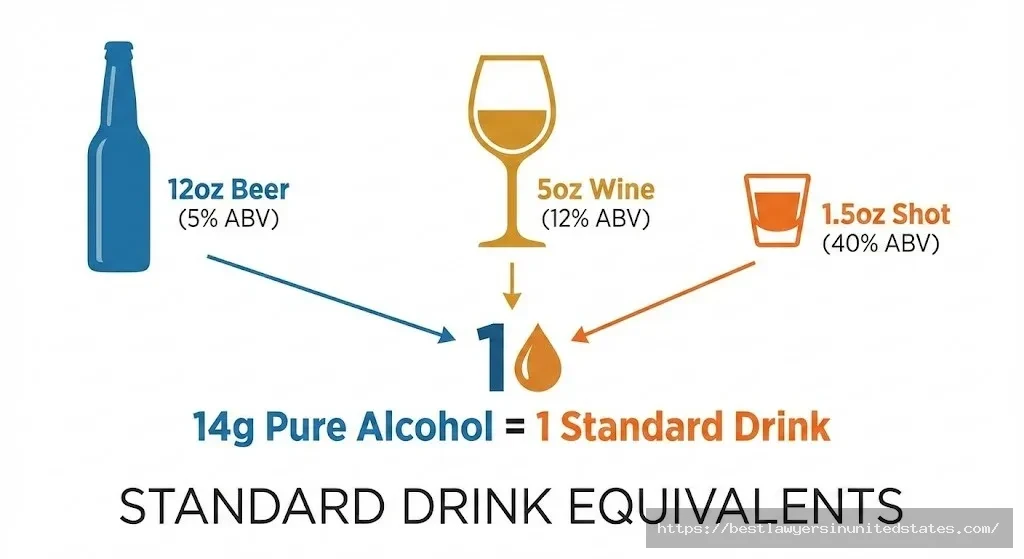
A 12-ounce regular beer at 5% alcohol by volume (ABV) equals one standard drink. So does a 5-ounce glass of 12% wine. A 1.5-ounce shot of 40% (80-proof) liquor also counts as one standard drink. These equivalents help you compare different beverages.
Craft beers complicate the picture. Many IPAs and specialty beers contain 7-9% ABV or higher. A 12-ounce IPA at 7% ABV contains 1.4 standard drinks. Drinking three craft beers might equal 4-5 standard drinks, not three.
Wine pours vary significantly. Restaurants often pour 6-8 ounces instead of the standard 5 ounces. An 8-ounce pour of 14% wine contains 1.9 standard drinks. Two large wine glasses could put you at four standard drinks.
Mixed drinks present the biggest challenge. You rarely know exactly how much alcohol a bartender pours. A “strong” mixed drink might contain 2-3 standard drinks worth of alcohol. Home pours tend to be even more generous than bar pours.
Hard seltzers and flavored malt beverages vary widely. Some contain 4-5% alcohol like regular beer. Others reach 8-12% alcohol. Always check the label for ABV and calculate accordingly.
Shots of different liquors contain different amounts of alcohol. A 1.5-ounce shot of 80-proof vodka (40% ABV) equals one standard drink. A shot of 100-proof whiskey (50% ABV) contains 1.25 standard drinks.
Keeping accurate count matters enormously. If you think you’ve had three drinks but actually consumed five standard drinks worth of alcohol, your BAC estimate will be dangerously wrong. You might think you’re at 0.06% when you’re actually at 0.10%.
Time Period and Drinking Rate
Your body eliminates alcohol at a constant rate of approximately 0.015% BAC per hour. This rate doesn’t change whether you drink slowly or rapidly. However, your drinking speed dramatically affects how high your BAC climbs.
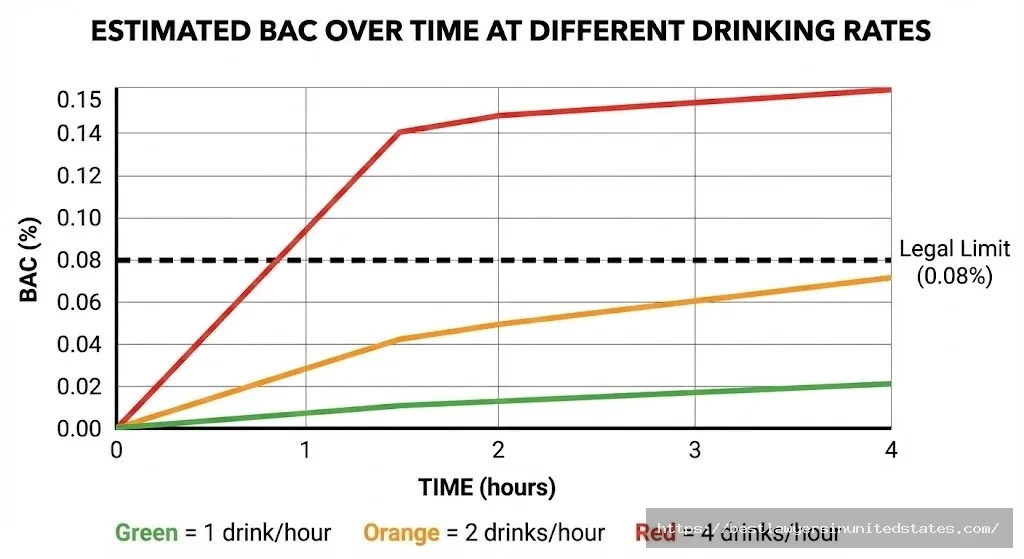
Drinking one beer per hour allows your body to metabolize alcohol as you drink. Your BAC might never exceed 0.02-0.03%. You’ll feel minimal effects. This pace is sometimes called “keeping up with your metabolism.”
Drinking two beers per hour exceeds your elimination rate. Your BAC will climb steadily. After four hours at this pace, you could reach 0.10% or higher. This moderate drinking pace is common at social events but can quickly lead to impairment.
Binge drinking involves consuming four or more drinks (for women) or five or more drinks (for men) within two hours. This rapid consumption overwhelms your body’s ability to process alcohol. BAC can spike to dangerous levels quickly.
Absorption takes time. Alcohol doesn’t appear in your bloodstream instantly. Peak BAC typically occurs 30-90 minutes after your last drink. You might feel fine immediately after drinking, then become much more impaired 30 minutes later.
The phenomenon of “delayed impairment” catches many people off guard. Someone who drinks three shots quickly might feel okay 15 minutes later. Then 45 minutes later, when the alcohol fully absorbs, they’re severely impaired. This delay causes people to make poor decisions about driving.
Taking breaks between drinks helps. If you wait 60-90 minutes between drinks, your body processes the previous drink before you add more alcohol. Your peak BAC stays much lower than drinking the same number of drinks rapidly.
Morning-after considerations matter too. If you drink heavily until 2 AM and wake at 7 AM, you’ve only had five hours for elimination. At 0.015% per hour, you’ve eliminated just 0.075% BAC. If you reached 0.20%, you’re still at 0.125% when you wake up, far above the legal limit.
Food in Your Stomach
Eating before or while drinking significantly affects your BAC. Food doesn’t prevent intoxication, but it slows alcohol absorption and reduces peak BAC by 20-50%.
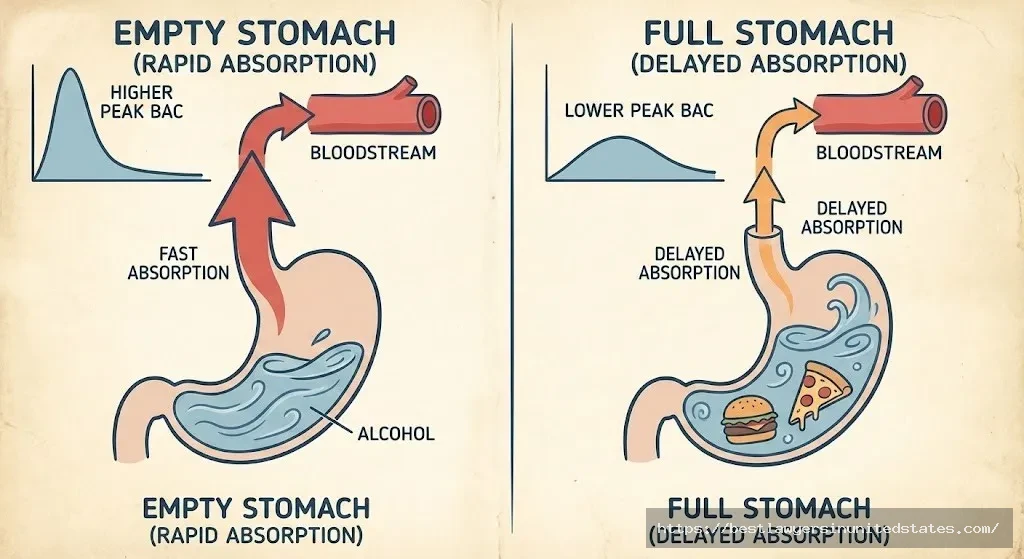
Food works by slowing gastric emptying. Your stomach holds food and alcohol longer before releasing them into the small intestine. Since 80% of alcohol absorption happens in the small intestine, this delay matters enormously.
The pyloric valve controls movement from stomach to intestine. Food causes this valve to close partially. Alcohol stays in your stomach longer, where only 20% of absorption occurs. This extended stomach time allows some alcohol to be metabolized before entering your bloodstream.
Food type makes a difference. High-fat foods provide the most benefit. Pizza, burgers, cheese, and fried foods slow stomach emptying substantially. They can delay peak BAC by 60-120 minutes and reduce the peak by 30-50%.
Protein-rich foods offer moderate effects. Meat, eggs, fish, and nuts slow absorption but less than fatty foods. They delay peak BAC by 30-60 minutes and reduce peaks by 20-30%.
Carbohydrates help least. Bread, pasta, rice, and similar foods provide minimal stomach-emptying delay. Peak BAC delays of just 15-30 minutes are typical. The reduction in peak BAC is only 10-20%.
Timing proves crucial. Food consumed before drinking provides maximum benefit. Your stomach already contains material to slow absorption. Food eaten while drinking still helps significantly. Food consumed after drinking provides minimal benefit because most alcohol has already been absorbed.
An empty stomach leads to rapid intoxication. Alcohol rushes into your small intestine and absorbs quickly. Peak BAC arrives faster and higher. This situation is especially dangerous because impairment hits suddenly.
Real-world example: Four drinks on an empty stomach might produce a peak BAC of 0.12% at 45 minutes. The same four drinks after a large meal might peak at 0.08% at 90 minutes. That meal could mean the difference between legal and illegal BAC.
Never rely on food to “sober you up.” Food only slows absorption of alcohol you haven’t yet absorbed. It doesn’t speed elimination. Once alcohol is in your blood, only time reduces BAC.
Medications and Health Conditions
Hundreds of medications interact with alcohol. Some combinations are merely uncomfortable. Others are dangerous or potentially fatal. Understanding these interactions protects your health and affects your BAC.
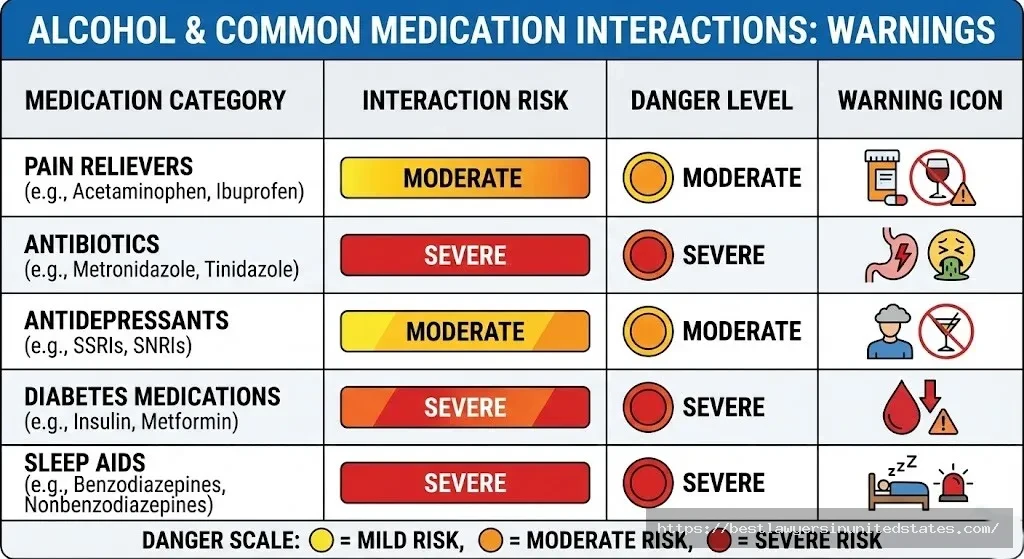
Antibiotics create various problems. Metronidazole (Flagyl) combined with alcohol causes severe reactions including nausea, vomiting, headaches, and rapid heartbeat. Cephalosporins can produce similar disulfiram-like reactions. Many doctors recommend avoiding alcohol entirely while taking antibiotics.
Antidepressants interact dangerously with alcohol. SSRIs (like Prozac, Zoloft, Lexapro) combined with drinking enhance sedation and impairment. You’ll feel more drunk than your BAC suggests. MAOIs can cause dangerous blood pressure spikes when mixed with alcohol, especially red wine.
Diabetes medications pose serious risks. Insulin combined with alcohol can cause severe hypoglycemia (low blood sugar). Metformin increases lactic acidosis risk. Sulfonylureas also increase dangerous low blood sugar episodes. Diabetics who drink must monitor blood sugar carefully.
Pain medications multiply dangers. Acetaminophen (Tylenol) combined with regular drinking causes liver damage. Even moderate alcohol consumption while taking acetaminophen regularly can lead to liver failure. NSAIDs like ibuprofen and aspirin increase stomach bleeding and ulcer risks when mixed with alcohol.
Opioid pain medications (Vicodin, OxyContin, Percocet) create extreme danger when combined with alcohol. Both substances depress respiration. Together, they can cause breathing to stop completely, leading to overdose death. Never mix opioids and alcohol.
Antihistamines, particularly sedating types like Benadryl, cause extreme drowsiness when combined with alcohol. This combination severely impairs driving ability beyond what BAC alone suggests. You might be legal by BAC but unable to drive safely.
Sleeping medications (Ambien, Lunesta) are extremely dangerous with alcohol. Both depress the central nervous system. The combination can cause memory blackouts, dangerous behaviors, and respiratory depression.
Health conditions affect alcohol metabolism too. Liver disease reduces your ability to process alcohol. People with cirrhosis or hepatitis reach higher BAC levels from fewer drinks and stay intoxicated longer.
Gastric bypass surgery dramatically changes alcohol processing. People who’ve had this surgery absorb alcohol 50-100% faster than before. They reach higher peak BAC levels and become intoxicated from fewer drinks. This effect is permanent.
Gastroesophageal reflux disease (GERD) can cause breathalyzer false positives. Acid reflux brings alcohol vapor from your stomach back into your mouth and throat. This “mouth alcohol” makes breathalyzers read artificially high.
Age-Related Metabolism Differences
Age significantly affects how your body processes alcohol. These changes occur gradually but become pronounced in older adults.
Young adults (21-25) typically have peak enzyme production. Alcohol dehydrogenase levels are highest during this period. Metabolism runs at maximum efficiency. However, younger drinkers often have less tolerance and experience with alcohol, leading to risky behaviors.
Middle-aged adults (26-55) maintain relatively stable metabolism. The Widmark formula works most accurately for this age group. Individual variation exists, but averages hold true. Many people in this range have developed some tolerance through years of occasional drinking.
Older adults (55+) experience declining liver function. Enzyme production decreases by 30-40% compared to young adults. This means higher BAC levels from the same number of drinks. Alcohol stays in the system longer because elimination slows.
Seniors also take more medications on average. These medications interact with alcohol more frequently. The combination of slower metabolism and medication interactions creates higher impairment risk.
Older adults have decreased body water percentage. As people age, body water content drops. Less water means less dilution of alcohol. A 70-year-old has significantly less body water than they had at age 30, even at the same body weight.
The brain becomes more sensitive to alcohol with age. Older adults experience greater cognitive impairment at the same BAC as younger people. Balance and coordination decline faster too, increasing fall and injury risks.
Drivers under 21 face zero tolerance laws in all states. Legal limits range from 0.00% to 0.02% depending on the state. These strict limits exist because underage drinking is illegal and because younger brains are still developing.
Individual Metabolism Rate and Genetic Factors
Genetics create significant variation in how people process alcohol. Some individuals metabolize alcohol 20% faster or slower than average due to genetic differences.
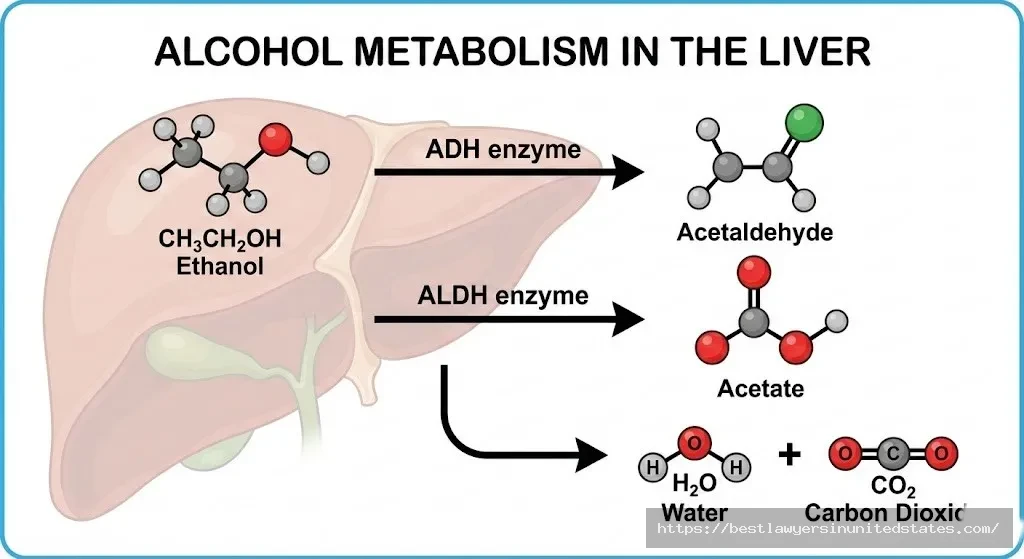
Alcohol dehydrogenase (ADH) enzyme variants affect metabolism speed. Different populations have different ADH gene variants. Some variants process alcohol faster, others slower. These differences are inherited and can’t be changed.
Aldehyde dehydrogenase (ALDH) variants cause dramatic effects. The ALDH2 deficiency, common in people of East Asian descent, causes “Asian flush.” Affected individuals experience facial flushing, nausea, rapid heartbeat, and headaches from small amounts of alcohol.
People with ALDH2 deficiency still absorb alcohol normally. Their BAC rises like anyone else’s. However, toxic acetaldehyde accumulates because they can’t break it down efficiently. This causes the unpleasant symptoms and significantly increases cancer risks from drinking.
Chronic drinkers develop enhanced first-pass metabolism. Regular drinking causes the stomach lining to produce more ADH enzyme. This means regular drinkers may absorb slightly less alcohol per drink than occasional drinkers. However, this doesn’t mean lower BAC overall if they’re drinking more.
Tolerance is not the same as lower BAC. Someone who drinks regularly may not feel drunk at 0.10% BAC because their brain has adapted. Their actual BAC is still 0.10%. They’re still legally intoxicated and still impaired for driving, even if they don’t feel it.
Athletes often have advantages in alcohol metabolism. Higher muscle mass means more body water for dilution. Regular exercise may enhance liver function slightly. Better overall health supports more efficient metabolism. However, these benefits are modest.
Sedentary individuals with higher body fat percentages may reach higher BAC from the same drinks. Fat doesn’t contain water to dilute alcohol. Two people of identical weight can have different BAC if one is athletic and the other is not.
Nothing speeds up alcohol elimination significantly. Coffee doesn’t sober you up. Cold showers don’t accelerate metabolism. Exercise doesn’t burn off alcohol faster. Your liver processes alcohol at its genetically-determined rate, period. Time is the only cure for intoxication.
Additional Environmental and Situational Factors
Carbonated alcoholic beverages absorb faster than non-carbonated drinks. Champagne, beer, and mixed drinks with soda create higher peak BAC than wine or straight liquor. Carbonation speeds gastric emptying, rushing alcohol into the small intestine where absorption happens fastest.
The carbonation effect can increase peak BAC by 10-15%. Someone drinking vodka-sodas might reach 0.10% while someone drinking the same amount of vodka neat reaches only 0.088%.
Altitude affects alcohol’s effects, though not BAC itself. At higher elevations, lower oxygen levels amplify alcohol’s impact on your brain. You won’t have higher BAC, but you’ll feel more impaired. This phenomenon catches mountain visitors off guard.
Dehydration concentrates alcohol in your blood. When you’re dehydrated, you have less body water. The same amount of alcohol dissolves in less fluid, creating higher concentration. Hot weather, exercise, and illness can cause dehydration that raises BAC.
Staying well-hydrated before drinking provides modest protection. Your body water volume is maximized, providing more dilution capacity. However, drinking water while drinking alcohol doesn’t reduce BAC. The alcohol is already in your system.
Beverage temperature has minimal effects. Warm alcohol absorbs slightly faster than cold alcohol. The difference is small enough that it rarely matters practically. Whether your beer is ice-cold or room temperature won’t significantly change your BAC.
Stress and fatigue amplify perceived impairment. Your actual BAC stays the same, but you feel more drunk when tired or stressed. These mental states don’t change blood alcohol levels but do affect your ability to handle impairment.
Legal BAC Limits: State-by-State Standards
Every state enforces blood alcohol content limits for drivers. Understanding these limits helps you know when you’re breaking the law and facing serious consequences including divorce-related financial impacts from DUI arrests.
The 0.08% National Standard
All 50 states plus the District of Columbia enforce a 0.08% BAC limit for drivers 21 and older. This uniform standard came from federal pressure, not state choice.
In 2000, Congress passed legislation requiring states to adopt 0.08% limits or lose federal highway funding. States that refused would forfeit millions of dollars annually. The financial pressure proved irresistible.
By 2004, every state had complied. The last holdouts were Delaware, Minnesota, and South Carolina. They changed their laws just before the funding deadline.
The 0.08% limit is called a “per se” law. This means BAC at or above 0.08% automatically proves intoxication. Police don’t need to prove actual impairment. The chemical test result alone supports a DUI conviction.
Officers can still arrest you under 0.08% if they observe impairment. Erratic driving, failed field sobriety tests, slurred speech, or other signs of intoxication support arrest even at 0.05% or 0.06%. The 0.08% limit is not a “safe zone.”
Studies show impairment begins at 0.02%. Your ability to track moving objects, divide attention, and make good decisions all decline at very low BAC levels. The legal limit represents an impairment level society has decided to criminalize, not a safety threshold.
Commercial Driver’s License (CDL) Limits
Professional drivers face stricter standards. Federal law sets a 0.04% BAC limit for anyone operating a commercial vehicle. This limit is exactly half the standard limit.
The 0.04% threshold applies while operating any vehicle requiring a CDL. This includes trucks, buses, hazmat vehicles, and vehicles designed to transport 16 or more passengers. The stricter limit reflects higher safety standards for professional drivers.
Getting caught at 0.04% or above means immediate consequences. The driver faces a minimum 24-hour out-of-service order. They cannot drive commercially for at least one day. Violating this order brings additional criminal charges.
First offense penalties for CDL holders are severe. A one-year CDL disqualification is standard. If transporting hazardous materials, the disqualification extends to three years. This effectively ends many drivers’ careers.
CDL holders also face their state’s standard DUI laws in their personal vehicles. If a truck driver gets a DUI while driving their car on a weekend, they lose their CDL. Even off-duty violations trigger CDL suspension.
The stricter limit recognizes public safety concerns. Commercial vehicles are larger and harder to control. Buses carry passengers. Trucks haul dangerous cargo. Society demands higher standards from professional drivers.
Zero Tolerance for Drivers Under 21
Every state enforces zero tolerance laws for underage drivers. Legal limits range from 0.00% to 0.02% BAC depending on the state. These limits exist because drinking under 21 is illegal everywhere in the United States.
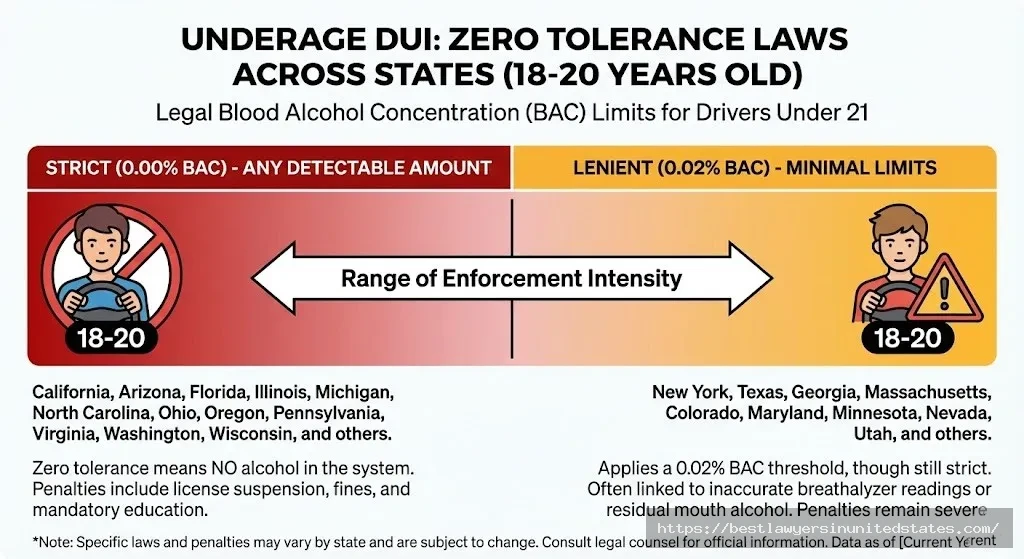
Most states set the limit at 0.01% or 0.02%. This allows for trace amounts from mouthwash, cough syrup, or other non-beverage sources. These tiny amounts don’t indicate drinking but might appear on sensitive tests.
Some states enforce absolute 0.00% limits. Any detectable alcohol results in violation. This strict interpretation leaves no margin for error. A teen who uses alcohol-based mouthwash could theoretically test positive.
Zero tolerance violations bring swift administrative penalties. License suspension typically ranges from 30 to 180 days for first offense. Many states impose this suspension before any court hearing under administrative per se laws.
Criminal charges often follow too. Underage DUI is a separate crime from adult DUI in most states. Penalties may include fines, community service, alcohol education classes, and probation.
Parents face notification in most states. Law enforcement must inform parents or guardians when a minor is arrested for underage DUI. This notification happens regardless of the minor’s age, even for 18-20 year olds.
The zero tolerance approach reflects public health priorities. Teen brains are still developing. Alcohol causes more damage to developing brains than adult brains. Zero tolerance aims to prevent underage drinking entirely.
Federal law requires these limits. The National Minimum Drinking Age Act of 1984 forced states to adopt 21 as the legal drinking age. States that refused lost federal highway funding. Zero tolerance laws followed as enforcement mechanisms.
Enhanced Penalty Thresholds
Many states impose harsher penalties for high BAC levels. These “aggravated DUI” or “extreme DUI” laws kick in at specific thresholds, typically 0.15% or 0.20%.
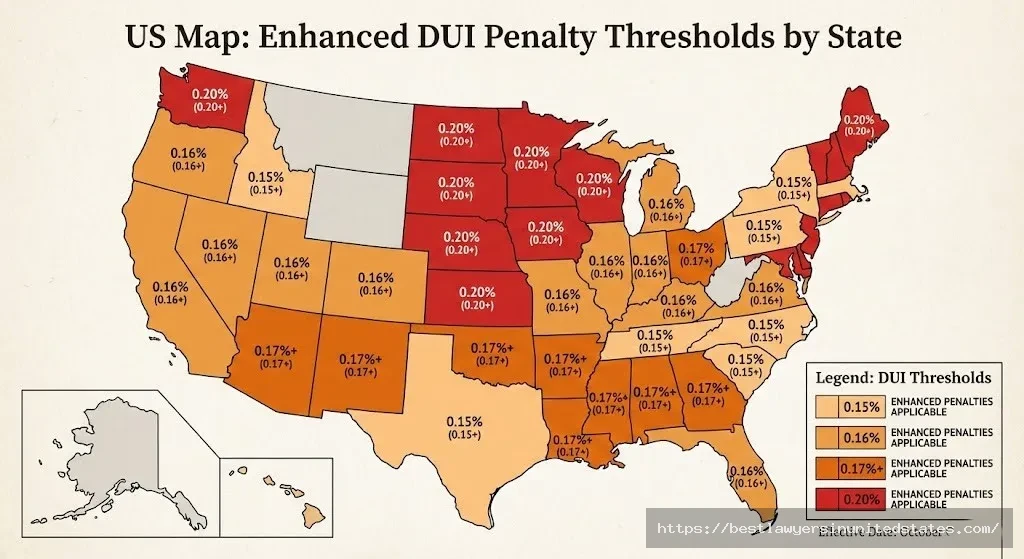
Arizona pioneered tiered DUI penalties. Standard DUI applies at 0.08-0.149%. Extreme DUI starts at 0.15%. Super extreme DUI begins at 0.20%. Each tier brings mandatory minimum jail time that increases with the tier.
First-time extreme DUI in Arizona requires 30 days in jail. Super extreme DUI mandates 45 days. These sentences cannot be suspended or reduced. Judges have no discretion to impose lesser penalties.
Other states adopted similar approaches. Colorado designates drivers at 0.15% or higher as “persistent drunk drivers.” Pennsylvania has “high rate” DUI at 0.10-0.159% and “highest rate” at 0.16%+. Each level increases mandatory penalties.
Enhanced penalties typically include longer license suspensions, higher fines, mandatory ignition interlock devices, and extended alcohol treatment programs. Some states require felony charges for second or third offenses at high BAC.
The 0.15% threshold is significant. At this BAC, you’re nearly twice the legal limit. Your impairment is obvious and severe. Crash risk is 12-15 times higher than sober driving. States view this level as especially dangerous.
High BAC often indicates alcohol abuse problems. Someone reaching 0.15% or 0.20% likely drinks regularly and heavily. Courts view these drivers as needing treatment, not just punishment. Mandatory alcohol evaluation and treatment become part of sentencing.
Some states use 0.20% as a super-enhancement threshold. This BAC level indicates extreme intoxication. People at 0.20% often can barely stand. They’re at serious risk for alcohol poisoning. Driving at this level shows extreme recklessness.### Complete 50-State BAC Legal Limits
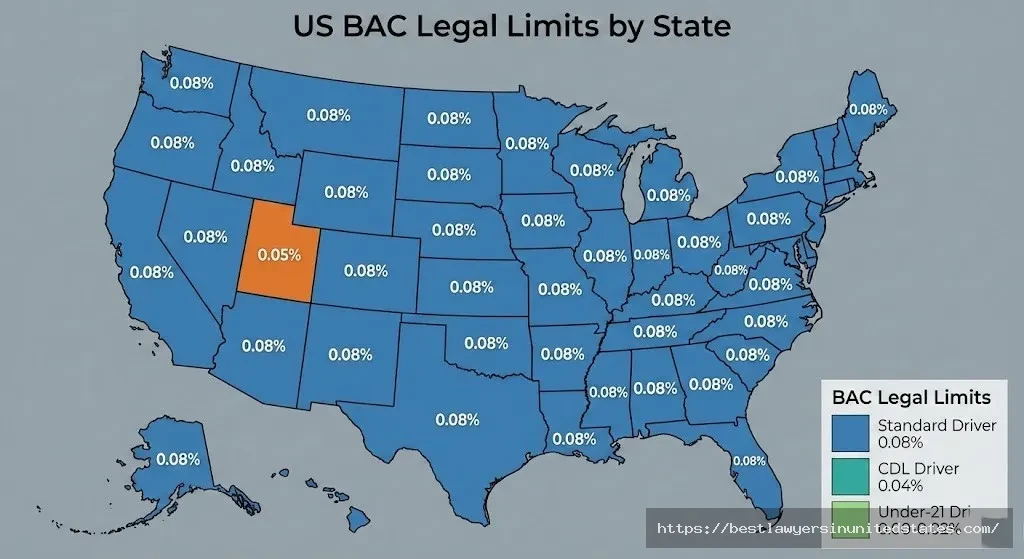
Understanding legal limits in your state helps you avoid DUI charges. This comprehensive table shows standard limits, CDL limits, underage limits, and enhanced penalty thresholds for all 50 states.
| State | Standard Limit | CDL Limit | Under-21 Limit | Enhanced Penalty | Special Notes |
|---|---|---|---|---|---|
| Alabama | 0.08% | 0.04% | 0.02% | 0.15%+ | Administrative license suspension |
| Alaska | 0.08% | 0.04% | 0.00% | 0.15%+ | Mandatory ignition interlock |
| Arizona | 0.08% | 0.04% | 0.00% | 0.15% extreme, 0.20% super | Strict tiered penalties |
| Arkansas | 0.08% | 0.04% | 0.02% | 0.15%+ | Per se law applies |
| California | 0.08% | 0.04% | 0.01% | 0.15%+ | Administrative per se law |
| Colorado | 0.08% | 0.04% | 0.02% | 0.15%+ | DWAI at 0.05-0.079% |
| Connecticut | 0.08% | 0.04% | 0.02% | 0.16%+ | Enhanced penalties apply |
| Delaware | 0.08% | 0.04% | 0.02% | 0.15%+ | Administrative suspension |
| Florida | 0.08% | 0.04% | 0.02% | 0.15%+ | Enhanced for high BAC |
| Georgia | 0.08% | 0.04% | 0.02% | 0.15%+ | Per se DUI law |
| Hawaii | 0.08% | 0.04% | 0.02% | 0.15%+ | Administrative revocation |
| Idaho | 0.08% | 0.04% | 0.02% | 0.20%+ | Excessive DUI penalties |
| Illinois | 0.08% | 0.04% | 0.00% | 0.16%+ | Aggravated DUI statute |
| Indiana | 0.08% | 0.04% | 0.02% | 0.15%+ | Enhanced BAC penalties |
| Iowa | 0.08% | 0.04% | 0.02% | 0.15%+ | OWI (Operating While Intoxicated) |
| Kansas | 0.08% | 0.04% | 0.02% | 0.15%+ | DUI statute applies |
| Kentucky | 0.08% | 0.04% | 0.02% | 0.15%+ | Aggravating circumstances |
| Louisiana | 0.08% | 0.04% | 0.02% | 0.15%+ | DWI laws enforced |
| Maine | 0.08% | 0.04% | 0.00% | 0.15%+ | OUI (Operating Under Influence) |
| Maryland | 0.08% | 0.04% | 0.02% | 0.15%+ | DUI and DWI distinctions |
| Massachusetts | 0.08% | 0.04% | 0.02% | 0.15%+ | OUI statute |
| Michigan | 0.08% | 0.04% | 0.02% | 0.17%+ | OWI and “super drunk” law |
| Minnesota | 0.08% | 0.04% | 0.00% | 0.16%+ | DWI aggravated at 0.16% |
| Mississippi | 0.08% | 0.04% | 0.02% | 0.15%+ | DUI penalties |
| Missouri | 0.08% | 0.04% | 0.02% | 0.15%+ | DWI statute |
| Montana | 0.08% | 0.04% | 0.02% | 0.16%+ | Aggravated DUI |
| Nebraska | 0.08% | 0.04% | 0.02% | 0.15%+ | DUI statute |
| Nevada | 0.08% | 0.04% | 0.02% | 0.18%+ | DUI laws strictly enforced |
| New Hampshire | 0.08% | 0.04% | 0.02% | 0.16%+ | Aggravated DWI |
| New Jersey | 0.08% | 0.04% | 0.01% | 0.10%+ | Lower enhancement threshold |
| New Mexico | 0.08% | 0.04% | 0.02% | 0.16%+ | Aggravated DWI |
| New York | 0.08% | 0.04% | 0.02% | 0.18%+ | Aggravated DWI statute |
| North Carolina | 0.08% | 0.04% | 0.00% | 0.15%+ | DWI laws |
| North Dakota | 0.08% | 0.04% | 0.02% | 0.16%+ | Enhanced penalties |
| Ohio | 0.08% | 0.04% | 0.02% | 0.17%+ | OVI (Operating Vehicle Impaired) |
| Oklahoma | 0.08% | 0.04% | 0.00% | 0.15%+ | DUI statute |
| Oregon | 0.08% | 0.04% | 0.00% | 0.15%+ | DUII (Driving Under Influence) |
| Pennsylvania | 0.08% | 0.04% | 0.02% | 0.10% high, 0.16% highest | Three-tier system |
| Rhode Island | 0.08% | 0.04% | 0.02% | 0.15%+ | DUI laws |
| South Carolina | 0.08% | 0.04% | 0.02% | 0.16%+ | DUAC (Unlawful Alcohol Content) |
| South Dakota | 0.08% | 0.04% | 0.02% | 0.17%+ | DUI statute |
| Tennessee | 0.08% | 0.04% | 0.02% | 0.20%+ | DUI laws |
| Texas | 0.08% | 0.04% | 0.00% | 0.15%+ | DWI statute |
| Utah | 0.05% | 0.04% | 0.00% | 0.16%+ | Strictest standard limit nationally |
| Vermont | 0.08% | 0.04% | 0.02% | 0.16%+ | DUI statute |
| Virginia | 0.08% | 0.04% | 0.02% | 0.15%+ | DUI and DWI charges |
| Washington | 0.08% | 0.04% | 0.02% | 0.15%+ | DUI laws |
| West Virginia | 0.08% | 0.04% | 0.02% | 0.15%+ | DUI statute |
| Wisconsin | 0.08% | 0.04% | 0.00% | 0.17%+ | OWI laws |
| Wyoming | 0.08% | 0.04% | 0.02% | 0.15%+ | DUI statute |
Utah’s Groundbreaking 0.05% Limit
Utah made history in 2018 by becoming the first state to lower its standard BAC limit to 0.05%. The law took effect December 30, 2018, despite significant opposition from the hospitality industry.
The lower limit means Utah drivers face DUI charges at BAC levels legal in other states. A 180-pound man might reach 0.05% after just 2-3 drinks. A 130-pound woman could hit 0.05% after 1-2 drinks.
Supporters argue the change saves lives. Research from other countries with 0.05% limits shows reduced drunk driving deaths. The National Transportation Safety Board has recommended 0.05% nationally since 2013.
Critics worried about economic impacts. Restaurant and bar owners feared customers would stop drinking entirely. Tourism industry representatives predicted visitors would avoid Utah.
Early data shows mixed results. Drunk driving arrests decreased in the first year. Fatal crashes involving alcohol also declined. However, it’s unclear whether these changes resulted from the law or other factors.
Other states are watching Utah’s experiment. If proven successful, more states may follow. The National Academies of Sciences, Engineering, and Medicine recommended 0.05% in a 2018 report.
Colorado’s DWAI: Driving While Ability Impaired
Colorado uniquely prosecutes impaired driving at 0.05% BAC through its DWAI statute. This charge is separate from and less severe than DUI but still criminal.
DWAI (Driving While Ability Impaired) applies when BAC is 0.05-0.079%. This range is legal in most states but prosecutable in Colorado. The charge recognizes that impairment begins well below 0.08%.
DWAI penalties are less severe than DUI but still serious. First offense brings up to 180 days in jail, fines up to $500, 8 points on your license, and up to 48 hours community service. These consequences still hurt.
The DWAI option gives prosecutors flexibility. When evidence supports impairment but BAC is under 0.08%, DWAI charges can proceed. This prevents impaired drivers from escaping consequences on technicalities.
Some defense attorneys view DWAI as a plea bargaining tool. Prosecutors may offer DWAI in exchange for guilty pleas in borderline DUI cases. Defendants accept the lesser charge to avoid DUI’s harsher penalties.
Per Se Laws Explained
Per se DUI laws revolutionized drunk driving enforcement. Before these laws, prosecutors had to prove both that a driver’s BAC exceeded the limit and that the driver was actually impaired.
Under per se laws, BAC at or above the legal limit automatically establishes DUI. The chemical test result alone proves the case. Prosecutors don’t need to show erratic driving, failed field tests, or other impairment signs.
Every state now has per se laws at 0.08% for standard drivers. These laws make conviction much easier. Defense attorneys must challenge the test’s accuracy rather than argue about impairment.
However, impairment-based DUI charges still exist alongside per se laws. If a driver shows obvious impairment but refuses testing or tests under 0.08%, prosecutors can pursue traditional impairment-based DUI.
This dual approach catches more impaired drivers. Someone at 0.06% BAC who’s swerving badly and fails field sobriety tests can still face DUI charges. The prosecutor must prove impairment through officer testimony and evidence, not just test results.
Administrative per se laws are related but different. These laws allow license suspension based solely on BAC test results, before any criminal trial. The administrative suspension happens quickly, often within days of arrest.
How BAC Affects Your Body and Mind
Blood alcohol content produces predictable effects at specific levels. Understanding what each BAC range does to your body helps you recognize dangerous impairment and make safer choices.
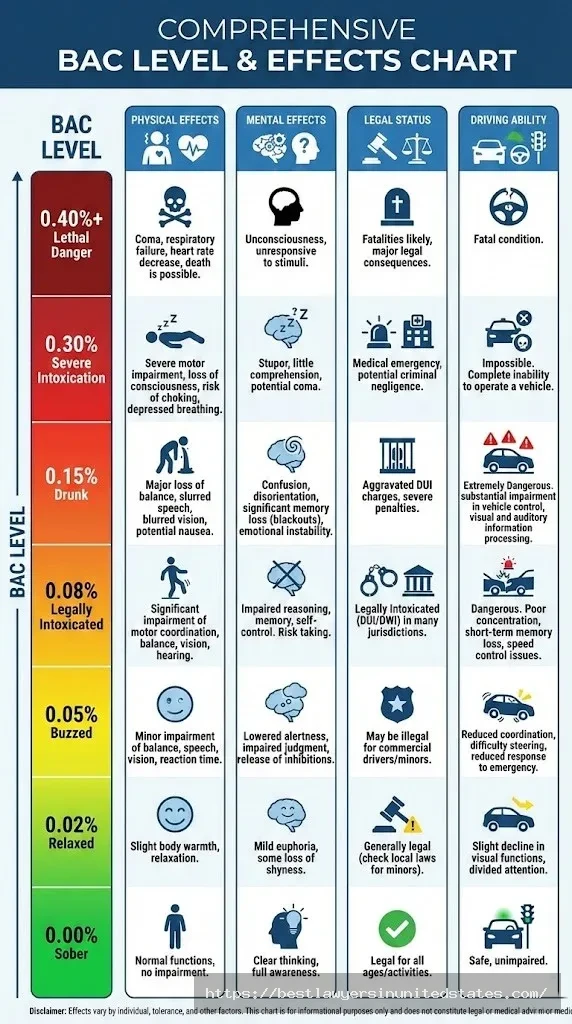
0.00% – 0.02%: Minimal to No Detectable Effects
At 0.00%, you’re completely sober. Your body contains no alcohol. All systems function normally. This is the only truly safe BAC for driving.
Between 0.01% and 0.02%, most people experience no noticeable effects. You might feel completely normal. Standard coordination and reaction time remain intact. Mental clarity persists.
However, sensitive research equipment can detect subtle changes even at 0.02%. Your brain’s ability to divide attention between multiple tasks decreases slightly. The effect is too small for you to notice but measurable in laboratory settings.
Most people reach 0.01-0.02% from less than one standard drink consumed in the last hour. A 180-pound man drinking half a beer might reach 0.01%. A 130-pound woman drinking a third of a glass of wine might hit 0.02%.
Legally, this range is safe for drivers 21 and older in all states except those with zero tolerance laws. You won’t face DUI charges at these levels unless you’re under 21.
Some people claim they “feel a buzz” at these low levels. This is usually psychological expectation rather than actual alcohol effects. The placebo effect is powerful with alcohol consumption.
Commercial pilots face stricter limits. Federal Aviation Administration rules prohibit flying within 8 hours of drinking or with any detectable BAC. The “8 hours bottle to throttle” rule exists because even 0.01% could impair the split-second decisions required in aviation.
0.02% – 0.05%: Mild Impairment Begins
This range marks the beginning of measurable impairment. Research proves that abilities decline starting at 0.02%, well before you feel drunk.
Physical effects at this level include slight body warmth and mild relaxation. Your muscles relax slightly. You might feel a gentle pleasant sensation. Coordination remains mostly intact, though laboratory tests show tiny decreases.
Mental changes appear more significantly. Your inhibitions lower slightly. You become more willing to take minor risks. Judgment about your own abilities becomes less accurate. You’re more talkative and socially confident.
Your ability to track moving objects declines measurably. If you’re driving, you’re slightly slower to notice pedestrians, other cars, or obstacles entering your field of vision. The difference seems small but matters in emergencies.
Concentration and attention span decrease. Multitasking becomes harder. You might miss details you’d normally catch. Divided attention tasks like driving while talking become more challenging.
Emotionally, you feel relaxed and more confident. Social anxiety decreases. You’re more willing to approach people and start conversations. This is why alcohol is called “social lubricant.”
For driving, you’re entering dangerous territory even though it’s legal in most states. Your reaction time slows by 10-15%. Your ability to respond to sudden changes decreases. Crash risk doubles compared to sober driving.
A 180-pound man reaches this range after 1-2 drinks in an hour. A 130-pound woman might get here from just one drink. The effects are subtle enough that you might not realize you’re impaired.
0.05% – 0.08%: Moderate Impairment, Approaching Legal Limit
This critical range sits just below the legal limit but involves significant impairment. Many people at 0.06% or 0.07% think they’re fine to drive. They’re wrong.
Physical effects become obvious. You feel warm and flushed. Coordination declines noticeably. Balance becomes slightly unstable. Reaction time slows by 20-30%. Small muscle control deteriorates, making tasks like texting or manipulating keys harder.
Mental impairment is substantial. Judgment about your own abilities is seriously compromised. You think you’re functioning better than you actually are. This false confidence is extremely dangerous.
Reasoning ability decreases. You make poorer decisions. Risk assessment becomes unreliable. Memory formation is impaired, possibly leading to “brownouts” where you later can’t remember events clearly.
Alertness and information processing slow down. You’re slower to understand complex situations. Reading and comprehending information takes longer. Following conversations requires more effort.
Emotionally, you feel euphoric and very confident. This false sense of competence is a hallmark of this BAC range. You’re actually quite impaired but feel more capable than when sober.
Driving ability is seriously compromised. Your ability to track moving objects is significantly reduced. Steering becomes less precise. Response to emergency situations slows dangerously. You’re 2-4 times more likely to crash than when sober.
In Utah, you’re already over the legal limit at 0.05%. In Colorado, you can be charged with DWAI at 0.05%. In all other states, you’re technically legal but extremely dangerous on the road.
People often make the fatal mistake of thinking “I’m under 0.08%, so I’m okay.” This thinking kills. Impairment is real and dangerous well before the legal limit.
A 180-pound man might reach this range after 2-3 drinks in 1-2 hours. A 130-pound woman could get here from 1-2 drinks in the same period. Individual variation means these are estimates only.
0.08% – 0.15%: Legally Intoxicated, Significant Impairment
At 0.08%, you’re legally drunk in all 50 states. This BAC level involves obvious impairment that seriously compromises your ability to function safely.
Physical effects are unmistakable. Speech begins slurring. Coordination is clearly impaired. Balance problems are obvious. Walking in a straight line becomes difficult. Reaction time is 35-50% slower than sober.
Vision problems emerge. You may see double or experience blurred vision. Peripheral vision shrinks. Your eyes have trouble focusing. Night vision deteriorates significantly.
Mental function is severely compromised. Judgment is seriously impaired. You make poor decisions and don’t recognize they’re poor. Reasoning ability drops substantially. Short-term memory is unreliable.
Concentration becomes nearly impossible. Following complex instructions is very difficult. You struggle to pay attention to multiple things simultaneously. Information processing slows to a crawl.
Self-control diminishes dramatically. You’re more likely to say or do things you’d never consider when sober. Emotional regulation fails. You might become loud, aggressive, sad, or overly affectionate without appropriate triggers.
Emotionally, you experience significant mood swings. You might shift from happy to angry to sad rapidly. Exaggerated emotions are common. Some people become aggressive or hostile. Others become weepy or overly sentimental.
Driving is extremely dangerous and illegal. You cannot safely operate a vehicle. Speed control is impaired. Braking response time is severely delayed. Lane tracking becomes erratic. Your crash risk is 5-10 times higher than sober driving.
If police stop you, arrest is nearly certain if you take a breath test. Your BAC alone proves DUI under per se laws. You’ll face criminal charges, license suspension, fines, possible jail time, and dramatically increased insurance rates.
At 0.10%, impairment is even more obvious. Slurred speech is pronounced. Stumbling when walking is common. Reaction time is halved. Mental confusion is apparent to observers.
At 0.15%, you’re approaching the enhanced penalty threshold in most states. You’re visibly drunk to anyone watching. Coordination is severely impaired. Judgment is almost completely unreliable.
A 180-pound man typically reaches 0.08% after 4-5 drinks in 2-3 hours. A 130-pound woman might get there from 3 drinks in 1-2 hours. These are rough estimates subject to all the individual variations discussed earlier.
0.15% – 0.20%: Severe Intoxication, High Risk
This range represents severe intoxication. You’re nearly twice the legal limit. Physical and mental impairment is extreme. Medical risks increase substantially.
Physical effects are severe and obvious. Walking without stumbling is very difficult or impossible. You need to hold onto walls or furniture to move. Gross motor skills are profoundly impaired. Fine motor control is essentially gone.
Vomiting becomes likely, especially in the upper part of this range. Your body recognizes dangerous alcohol levels and tries to expel it. Vomiting brings its own risks, especially if you’re lying down or unconscious.
Vision is severely impaired. Double vision is common. Blurry vision makes reading impossible. Your ability to judge distances fails completely. In dim lighting, you can barely see at all.
Mental function deteriorates severely. Severe confusion is typical. You may not recognize where you are or understand your situation. Decision-making ability is essentially absent. You can’t assess dangers or make safe choices.
Memory formation fails in this range. Blackouts become likely. You may be conscious and moving around but forming no lasting memories. The next day, hours of your life are simply gone from your memory.
Speech is very slurred and often incomprehensible. Forming complete sentences is difficult. You might speak nonsense or confuse words. Communication becomes nearly impossible.
Emotionally, you’re unstable and unpredictable. Severe mood swings are common. You might become aggressive without provocation. Crying, laughing, or anger can appear suddenly for no apparent reason. Emotional control is completely lost.
Driving is impossible and would likely result in serious or fatal crashes. You couldn’t safely operate a vehicle even if you tried. If you somehow got behind the wheel, you’d be a lethal threat to yourself and everyone nearby.
Legal consequences are severe. Most states impose enhanced penalties starting at 0.15%. You face aggravated or extreme DUI charges. Mandatory jail time applies in many states. License revocation lasts a year or more. Heavy fines of several thousand dollars are standard.
Medical risks increase substantially. Alcohol poisoning becomes a real possibility if you continue drinking. Vomiting while unconscious could cause you to choke. Injury from falls is highly likely because you can’t maintain balance.
Your body’s protective reflexes are compromised. You might not wake up if you vomit while sleeping. You won’t feel pain from injuries as readily, so you might hurt yourself without realizing it.
A 180-pound man might reach this range after 7-9 drinks in 2-3 hours. A 130-pound woman could get here from 5-6 drinks in 2 hours. At this point, you should stop drinking immediately and seek help.
0.20% – 0.30%: Extreme Intoxication, Medical Emergency
BAC levels in this range constitute a medical emergency. The risk of death from alcohol poisoning becomes significant. Immediate medical attention may be necessary.
Physical function is critically impaired. You cannot stand without help. Complete loss of motor control means you’re likely lying on the floor or slumped in a chair. Moving independently is impossible.
Vomiting is frequent and forceful. The aspiration risk is extreme. If you vomit while lying on your back, you could choke and die. This is how many alcohol poisoning deaths occur.
Incontinence is common. Bladder and bowel control fail. You may urinate or defecate without awareness or control. Your body’s basic functions are shutting down.
Consciousness is severely impaired or lost. You may be in a stupor, conscious but unable to respond meaningfully. You might be completely unconscious. Trying to wake you is difficult or impossible.
Mental function has essentially stopped. If conscious at all, you’re severely confused and disoriented. You don’t know where you are or what’s happening. You cannot communicate coherently. Memory formation has completely ceased.
Breathing becomes slow and irregular. Respiratory depression is the primary cause of alcohol poisoning deaths. Your brain stem, which controls automatic breathing, is being suppressed by alcohol.
Heart rate slows dangerously. Blood pressure drops. Body temperature falls, creating hypothermia risk. Your skin may appear pale or bluish. These are signs of circulatory system failure.
This is a life-threatening emergency. If someone reaches this BAC level, call 911 immediately. Do not wait to see if they improve. Do not try to make them vomit. Do not leave them alone.
While waiting for emergency services, position the person on their side in the recovery position. This prevents choking if they vomit. Monitor their breathing continuously. Stay with them until help arrives.
Legal consequences are severe if you survive and were driving. You face super extreme DUI charges in states that have such laws. Felony charges are possible. Years of license loss are certain. Jail time of months or years is likely.
Medical treatment involves IV fluids, monitoring, possible ventilator support, and observation until BAC falls to safe levels. Hospital stays of 12-24 hours are typical.
A person might reach this range after consuming 15 or more drinks rapidly. This is binge drinking at its most dangerous. Drinking games, hazing rituals, and “drinking challenges” often result in these deadly BAC levels.
0.30% – 0.40%: Life-Threatening Alcohol Poisoning
This BAC range is immediately life-threatening. Most people at these levels are unconscious and face imminent risk of death without medical intervention.
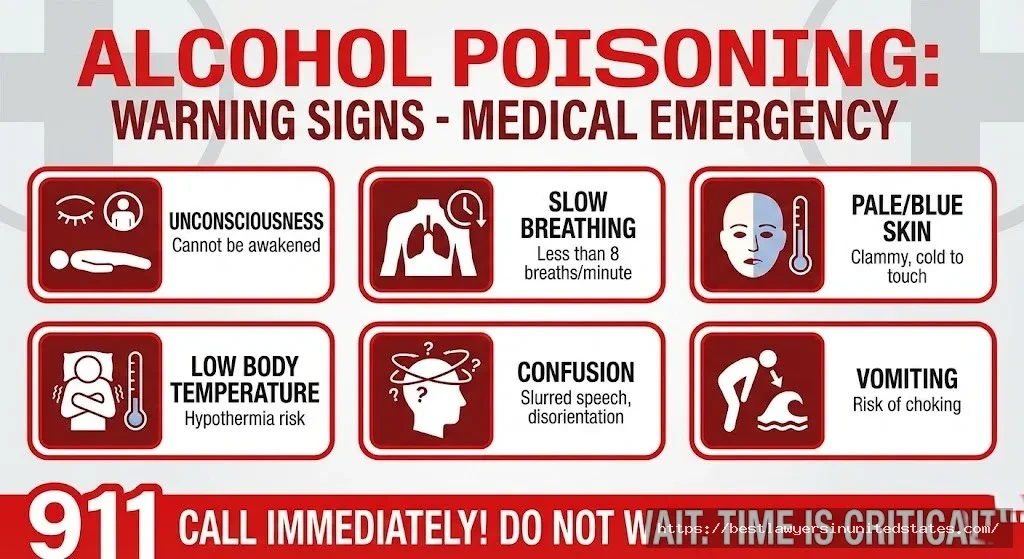
You are almost certainly unconscious or in a coma. If any consciousness remains, it’s minimal and unresponsive. You cannot be awakened by normal means. Painful stimuli might not even get a response.
Breathing is dangerously slow and shallow. Respiratory arrest (breathing stops completely) is imminent. Without medical intervention, brain damage from oxygen deprivation will occur within minutes.
Heart function is critically impaired. Cardiac arrest becomes likely. Your heart may beat irregularly or too slowly to sustain life. Blood pressure is dangerously low.
Body temperature has dropped significantly. Severe hypothermia is present even in normal room temperature. Your body has lost the ability to regulate its temperature.
All protective reflexes are gone. You won’t cough if choking. You won’t respond to pain. The gag reflex that normally prevents choking on vomit has failed.
Skin appears pale, bluish, or clammy. This indicates poor circulation and inadequate oxygen in the blood. Seizures may occur. These can cause additional injury and complicate medical treatment.
This is a critical medical emergency requiring immediate advanced life support. Call 911 now. Every minute matters. Don’t wait to see if the person improves. They won’t improve on their own at this BAC level.
Emergency treatment includes possible intubation and mechanical ventilation, IV fluids and medications, continuous monitoring of vital signs, treatment for hypothermia, and possibly dialysis to remove alcohol from the blood faster.
Hospital stays of several days are typical. Intensive care unit admission is likely. Medical costs can exceed tens of thousands of dollars even with insurance.
Brain damage from oxygen deprivation is possible even if the person survives. Permanent neurological problems can result from alcohol poisoning at this level.
Very few people reach this BAC level and survive without immediate medical care. Those who do survive often have consumed alcohol so rapidly that they passed out before drinking even more.
0.40% and Above: Usually Fatal
BAC levels of 0.40% or higher are typically fatal. Death usually results from complete respiratory failure. The brain stem stops sending signals to breathe. Without mechanical ventilation, death follows within minutes.
Cardiac arrest is another common cause of death. The heart stops beating or beats so irregularly that it can’t pump blood effectively. Organs begin failing from lack of oxygen.
Complete coma is certain at this level. No consciousness exists. The person is completely unresponsive to all stimuli. They appear dead even though the heart may still be beating.
Some people have survived these extreme BAC levels, but they’re rare exceptions. Medical literature documents a few cases of survival at truly extraordinary levels.
The highest recorded BAC with survival was 1.480% in Poland in 2004. The patient was a man found unconscious in a ditch. He received immediate aggressive medical treatment and survived with no permanent damage.
Another case from Bulgaria in 2005 involved a patient with 1.374% BAC who also survived. In Oregon in 2007, a woman survived a 0.914% BAC reading.
These extreme survivors likely have developed extraordinary tolerance through years of heavy chronic drinking. Their bodies adapted to process alcohol more efficiently. This doesn’t make high BAC safe. It just means they didn’t die when most people would have.
For typical drinkers without this extreme tolerance, 0.40-0.45% is the lethal range. Death occurs in most cases without immediate intensive medical intervention.
If someone reaches this BAC level and survives, they face likely permanent health consequences. Brain damage, liver damage, kidney damage, and neurological problems are common. Quality of life often never returns to pre-incident levels.
Prevention is the only answer. No one should ever drink enough to approach these BAC levels. If you or someone you know regularly drinks to very high BAC levels, professional help is needed immediately. This pattern indicates severe alcohol use disorder requiring treatment.
State-Specific DUI Information and Resources
Each state enforces DUI laws differently. Penalties, procedures, and legal requirements vary significantly. Understanding your state’s specific rules helps you navigate the legal system if arrested.
Regional Variations in DUI Enforcement
Western states tend to have stricter DUI enforcement and penalties. Utah’s 0.05% limit leads the nation. Arizona’s tiered extreme DUI system imposes harsh mandatory minimums. California’s administrative per se system suspends licenses quickly.
Southern states show wide variation. Some have relatively lenient first-offense penalties. Others impose harsh consequences from the first violation. Florida and Texas both prosecute DUIs aggressively with substantial penalties.
Midwestern states generally follow middle-ground approaches. Wisconsin treats first-offense DUI as a civil violation rather than a crime, unlike all other states. This unusual approach has drawn criticism from safety advocates.
Northeastern states often impose serious penalties. New York, Massachusetts, and Connecticut all have aggressive DUI enforcement. License suspensions tend to be longer in this region.
Links to State-Specific DUI Resources
If you’re facing DUI charges or need state-specific information, consult attorneys experienced in your state’s laws. Legal representation can significantly affect case outcomes and long-term consequences.
Understanding the potential financial impact of a DUI conviction helps you prepare. Beyond fines and attorney fees, you may face increased insurance costs and other divorce-related expenses if your marriage suffers strain from the arrest.
Each state maintains different requirements for license reinstatement after DUI. Some require completion of alcohol education programs. Others mandate ignition interlock device installation. Many states require both.
Court processes vary by jurisdiction. Municipal courts handle DUIs in some areas. District courts manage them in others. Understanding which court system applies in your location helps you prepare for proceedings.
Time to Sobriety: When Will You Reach 0.00%?
The most common question people ask is “when can I drive?” The answer depends entirely on your current BAC and your body’s elimination rate.
The 0.015% Per Hour Rule
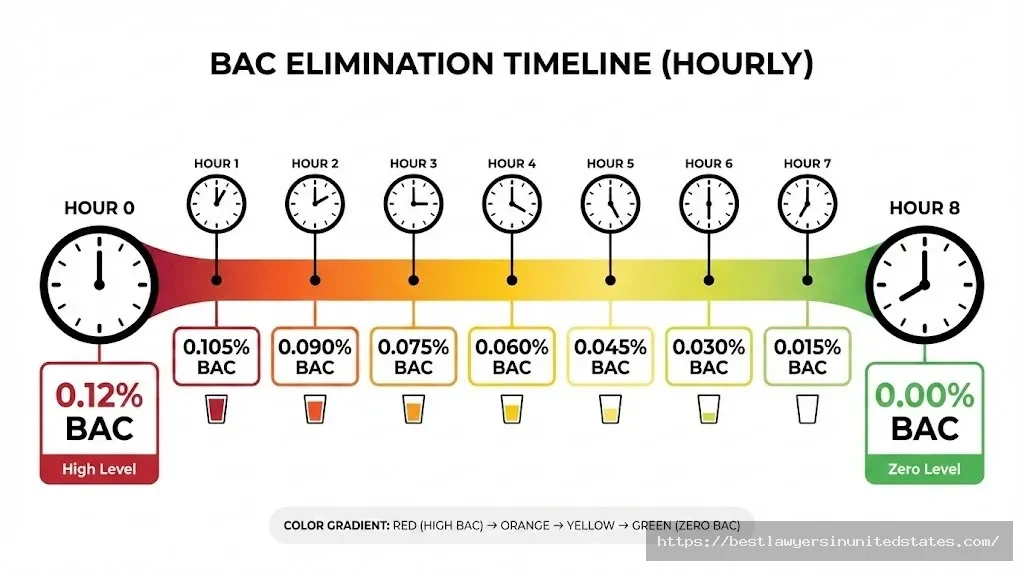
Your liver metabolizes alcohol at approximately 0.015% BAC per hour. This rate is relatively constant for most people regardless of how much they’ve drunk.
If your BAC is 0.08%, it takes roughly 5.3 hours to reach 0.00%. Calculate this by dividing your BAC by 0.015. For example: 0.08 ÷ 0.015 = 5.33 hours.
At 0.10% BAC, you need about 6.7 hours to fully sober up. At 0.15%, it takes 10 hours. These calculations assume you stop drinking immediately and don’t consume any more alcohol.
The elimination rate doesn’t speed up. You can’t make your liver work faster through any method. Coffee doesn’t help. Cold showers don’t help. Exercise doesn’t accelerate alcohol elimination. Time is the only cure.
Morning-After Driving Risks
Many people get DUIs the morning after heavy drinking. They assume they slept off the alcohol. The math proves otherwise.
Imagine drinking heavily until 2 AM and reaching 0.20% BAC. If you wake up at 7 AM, you’ve had five hours for elimination. At 0.015% per hour, you’ve eliminated 0.075% BAC. You’re still at 0.145% when you wake up, nearly twice the legal limit.
If you wake at 9 AM after seven hours, you’ve eliminated 0.105%. You’re still at 0.095%, well over the legal limit. You won’t reach legal levels until around noon, ten hours after you stopped drinking.
People make this mistake constantly. They feel fine in the morning because they slept. Their BAC is still dangerously high. They drive to work and get arrested for DUI during morning rush hour.
Factors That Don’t Speed Elimination
Despite popular myths, nothing speeds up alcohol elimination significantly. Your elimination rate is fixed by your liver’s processing capacity.
Coffee makes you more alert but doesn’t reduce BAC. You become a wide-awake drunk person instead of a sleepy drunk person. Your impairment remains the same.
Cold showers wake you up but don’t eliminate alcohol. The shock of cold water increases alertness temporarily. Your BAC stays exactly the same.
Exercise doesn’t burn off alcohol. You might sweat out tiny amounts through perspiration, but this represents less than 5% of total elimination. The liver does 95% of the work.
Drinking water helps prevent hangover symptoms but doesn’t reduce BAC. Staying hydrated is smart for your health but won’t make you sober faster.
Eating food after drinking provides no benefit. Food only helps if eaten before or during drinking, when it can slow absorption. Once alcohol is in your blood, food does nothing.
Vomiting removes unabsorbed alcohol from your stomach but not alcohol already in your bloodstream. If you’ve been drinking for an hour or more, most alcohol has already been absorbed. Vomiting won’t significantly reduce your BAC.
Time to Zero BAC Calculator
You can calculate time to 0.00% BAC using this simple formula:
Hours to 0.00% = Current BAC ÷ 0.015
Examples:
- Current BAC 0.06%: 0.06 ÷ 0.015 = 4 hours
- Current BAC 0.10%: 0.10 ÷ 0.015 = 6.7 hours
- Current BAC 0.15%: 0.15 ÷ 0.015 = 10 hours
- Current BAC 0.20%: 0.20 ÷ 0.015 = 13.3 hours
Add these hours to the time you stopped drinking to find when you’ll be at 0.00%. If you stopped drinking at 11 PM and your BAC was 0.12%, add 8 hours. You’ll be at 0.00% at 7 AM.
Remember that individual variation exists. Your actual elimination rate might be 0.012% to 0.018% per hour. Use 0.015% as a conservative average. When in doubt, wait longer.## Frequently Asked Questions About BAC and DUI
How accurate are BAC calculators?
BAC calculators provide estimates with accuracy ranges of plus or minus 0.02%. This means if a calculator shows 0.08%, your actual BAC could be anywhere from 0.06% to 0.10%.
Individual variation causes this uncertainty. Your metabolism, food intake, medications, and health conditions all affect actual BAC. The calculator uses average values that may not match your personal situation.
Professional breathalyzers used by police are more accurate when properly calibrated. They typically have accuracy within 0.01%. Blood tests are most accurate with precision to 0.005%.
Never rely solely on a calculator to decide if you can drive. Use calculators as general guides only. When in doubt, don’t drive. The consequences of misjudging your BAC are too severe.
Can drinking water lower my BAC?
No, drinking water does not lower your BAC. Alcohol is already in your bloodstream. Water dilutes alcohol in your stomach, but it cannot dilute alcohol that’s already been absorbed into your blood.
Water does help prevent dehydration and may reduce hangover severity. Staying hydrated is always smart when drinking alcohol. However, this health benefit doesn’t translate to lower BAC.
The myth that water reduces BAC probably comes from confusion about how BAC works. Some people think adding water to their body dilutes the alcohol. This isn’t how biochemistry works. The alcohol-to-blood ratio stays the same.
Only time eliminates alcohol from your bloodstream. Your liver metabolizes alcohol at a fixed rate. Drinking water doesn’t make your liver work faster.
How many drinks does it take to reach 0.08%?
The number of drinks needed to reach 0.08% BAC varies significantly by body weight, sex, and time period. There’s no universal answer that applies to everyone.
For a 180-pound man drinking over 2 hours, typically 4 standard drinks reach 0.08%. For a 130-pound woman in the same timeframe, 2-3 drinks might reach 0.08%.
Heavier individuals need more drinks to reach 0.08%. A 220-pound man might need 5-6 drinks over 2 hours. Lighter individuals need fewer drinks. A 110-pound woman might reach 0.08% from just 2 drinks.
Drinking speed matters enormously. Four drinks in one hour produces much higher BAC than four drinks over four hours. The faster you drink, the higher your peak BAC.
These are rough estimates only. Individual variation means your actual results may differ. Use our calculator with your specific details for personalized estimates.
What is the 20-minute rule for alcohol?
The 20-minute rule refers to waiting 20 minutes after your last drink before taking a breathalyzer test. This wait prevents “mouth alcohol” from causing falsely high readings.
When you’ve just finished drinking, alcohol vapor remains in your mouth and throat. Breathalyzers measure breath alcohol, which should reflect deep lung air. Mouth alcohol contaminates the sample and causes artificially elevated readings.
After 20 minutes, mouth alcohol dissipates. The breathalyzer then measures actual blood alcohol levels rather than residual mouth alcohol. This produces more accurate results.
Police typically wait 15-20 minutes after stopping you before administering a breathalyzer. This observation period serves multiple purposes. It ensures mouth alcohol doesn’t affect readings. It allows time for you to display impairment signs. It prevents you from consuming more alcohol or hiding evidence.
Using mouthwash, breath spray, or cough drops before a test can cause mouth alcohol problems. These products often contain alcohol. Police training teaches officers to watch for these contamination sources.
How long will 2 beers show up on a breathalyzer?
Two standard beers typically remain detectable on a breathalyzer for 2-4 hours depending on your body weight, sex, and metabolism.
For a 180-pound man, two beers produce approximately 0.04% BAC. At the standard elimination rate of 0.015% per hour, it takes about 2.7 hours to reach 0.00%.
For a 130-pound woman, two beers might produce 0.06% BAC. Elimination takes about 4 hours to reach 0.00%.
These estimates assume standard 12-ounce beers at 5% ABV consumed within an hour or so. Craft beers with higher alcohol content take longer to eliminate. Drinking over an extended period might mean the beers never produce detectable BAC if you’re drinking slowly enough.
Breathalyzers can detect alcohol down to 0.00%, though readings below 0.01% are often considered negligible for testing purposes.
Can you pass a breathalyzer after 12 hours?
Whether you can pass a breathalyzer after 12 hours depends on your BAC when you stopped drinking.
If you stopped drinking at 0.08% BAC, you’d be at 0.00% after about 5.3 hours. After 12 hours, you’d definitely pass.
If you stopped drinking at 0.20% BAC after heavy drinking, you’d eliminate about 0.18% in 12 hours (12 × 0.015 = 0.18). You’d still be at 0.02% BAC, which is detectable but under legal limits for adults over 21.
If you stopped drinking at 0.30% BAC (extremely intoxicated), you’d eliminate 0.18% in 12 hours. You’d still be at 0.12% BAC, well over the legal limit.
The key is knowing your approximate BAC when you stopped drinking. If you drank heavily, 12 hours may not be enough. If you drank moderately, 12 hours is usually sufficient.
Does coffee help you sober up?
No, coffee does not reduce your BAC or help you sober up. This is one of the most persistent alcohol myths.
Coffee contains caffeine, a stimulant. Caffeine increases alertness and reduces drowsiness. This might make you feel more awake. However, your BAC remains exactly the same.
Drinking coffee after alcohol creates a “wide-awake drunk” state. You feel more alert but your judgment, coordination, and reaction time are still impaired. This false sense of capability is actually more dangerous than recognizing you’re drunk.
Studies show that people who drink caffeine after alcohol often take more risks. They feel capable when they’re not. They’re more likely to attempt driving when impaired.
Only time eliminates alcohol from your system. Your liver processes alcohol at a fixed rate that caffeine cannot change. The “coffee sobers you up” myth has probably contributed to countless DUIs and crashes.
What is the fastest way to lower BAC?
Time is the only way to lower BAC. No method significantly speeds up alcohol elimination from your bloodstream.
Your liver metabolizes alcohol at approximately 0.015% BAC per hour. This rate is determined by enzyme availability and liver capacity. You cannot make it work faster through any natural means.
Things that do not speed elimination:
- Coffee or caffeine
- Cold showers
- Exercise or physical activity
- Drinking water
- Eating food
- Vomiting
- Sweating
The only exception is medical intervention for severe alcohol poisoning. Hospitals can use dialysis to remove alcohol from blood faster in life-threatening cases. This is rarely done and only for medical emergencies.
For normal situations, accept that you need to wait. If you’re at 0.12% BAC, you need 8 hours to reach 0.00%. No shortcuts exist.
Can you speed up alcohol metabolism?
No proven method exists for significantly speeding up alcohol metabolism in the short term.
Your metabolism rate is determined by genetics, liver size and health, and enzyme production. These factors don’t change quickly.
Some long-term factors may slightly enhance metabolism:
- Regular exercise may improve overall liver function marginally
- Good nutrition supports liver health
- Maintaining healthy body weight helps overall metabolism
However, these effects are small and develop over months or years. They won’t help you sober up faster after drinking tonight.
Chronic heavy drinkers develop slightly faster metabolism through enzyme induction. Their livers produce more alcohol-processing enzymes. This adaptation takes weeks or months of regular heavy drinking. It’s not a healthy change and comes with severe health consequences.
The bottom line: accept your body’s natural elimination rate. Plan accordingly by not drinking if you need to drive, work, or function normally within the next several hours.
What BAC is considered drunk?
Legally, 0.08% BAC defines drunk driving in all states except Utah (0.05%). However, impairment begins much lower.
Research shows measurable impairment starting at 0.02% BAC. Your abilities decline before you feel drunk. Most people don’t feel intoxicated until 0.05-0.06%.
The feeling of drunkenness is subjective. Someone who rarely drinks might feel drunk at 0.04%. A chronic heavy drinker might not feel drunk until 0.12% or higher due to tolerance.
Medical definitions of intoxication typically use 0.08% as the threshold. This represents clear, significant impairment in most people.
“Blackout drunk” usually occurs at 0.15% or higher. This is when memory formation stops, though you may still be conscious and moving.
“Severely intoxicated” describes BAC of 0.20% or higher. At these levels, you need assistance to function and face alcohol poisoning risk.
How accurate are blood alcohol tests?
Blood alcohol tests are the most accurate method for measuring BAC. They directly measure alcohol in blood samples rather than estimating from breath or urine.
Properly conducted blood tests have accuracy within 0.005% BAC. This precision makes them the legal gold standard. Courts consider blood test results highly reliable evidence.
However, blood tests can still have errors. Improper sample collection, contamination, improper storage, lab mistakes, and fermentation in stored samples can all affect results.
Defense attorneys challenge blood tests by questioning:
- Whether proper collection procedures were followed
- Chain of custody documentation
- Lab certification and quality control
- Timing of the blood draw relative to driving
Breathalyzers are less accurate but more convenient. When properly maintained and calibrated, they’re accurate within 0.01%. However, many factors can affect breathalyzer accuracy.
Urine tests are least accurate for current BAC. They show average BAC over time rather than BAC at a specific moment. Courts view them as less reliable than blood or breath tests.
Can mouthwash cause a positive breathalyzer?
Yes, mouthwash can cause falsely elevated breathalyzer readings. Many mouthwashes contain alcohol concentrations of 15-27%. This is higher than most wines.
When you use mouthwash, alcohol vapor remains in your mouth and throat for 10-20 minutes. If tested immediately, the breathalyzer detects this mouth alcohol instead of deep lung air that reflects blood alcohol.
This can produce readings much higher than your actual BAC. Someone with 0.00% BAC might register 0.05% or higher immediately after using mouthwash.
Police training teaches officers to wait 15-20 minutes after stopping someone before administering breathalyzers. This waiting period allows mouth alcohol to dissipate. It prevents false positives from mouthwash, breath spray, or recently consumed drinks.
If you recently used mouthwash and get stopped, inform the officer. Request waiting 20 minutes before testing. Most officers will comply because they know mouth alcohol affects accuracy.
Some mouthwashes are alcohol-free. These don’t cause breathalyzer problems. Check labels if you’re concerned about alcohol content.
How long does alcohol stay in urine?
Alcohol remains detectable in urine longer than in blood or breath. Standard urine alcohol tests can detect drinking for 12-48 hours after consumption.
The detection window depends on how much you drank. Light drinking (1-2 drinks) might be undetectable after 12 hours. Moderate drinking (3-5 drinks) shows up for 24 hours. Heavy drinking (6+ drinks or binge drinking) remains detectable for 48 hours or longer.
Advanced urine tests called EtG (Ethyl Glucuronide) tests can detect alcohol for 3-5 days after drinking. EtG is an alcohol metabolite that stays in urine long after alcohol itself disappears.
Some employers and probation departments use EtG tests because of their extended detection window. These tests can detect any alcohol consumption within the past several days.
Urine tests don’t accurately show current impairment. Someone who drank yesterday and is completely sober today could still test positive. This makes urine tests unsuitable for DUI enforcement but useful for sobriety monitoring programs.
What removes alcohol from the body?
Your liver removes approximately 95% of consumed alcohol. It breaks down alcohol through a two-step enzyme process.
First, alcohol dehydrogenase (ADH) converts ethanol to acetaldehyde. This happens primarily in the liver but also slightly in the stomach.
Second, aldehyde dehydrogenase (ALDH) converts toxic acetaldehyde to harmless acetate. Acetate then breaks down into water and carbon dioxide, which your body eliminates easily.
This process occurs at a fixed rate of about one standard drink per hour for most people. Your liver can only work so fast regardless of how much alcohol you’ve consumed.
About 2-5% of alcohol exits through breath, urine, and sweat. These elimination routes are minor compared to liver metabolism. You can’t sweat out or pee out significant amounts of alcohol.
Nothing speeds up liver metabolism significantly. Your elimination rate is fixed by enzyme availability and liver capacity.
Prevention and Safety Planning
Making smart choices before drinking prevents DUI arrests and keeps you safe. These strategies help you enjoy alcohol responsibly without risking your freedom or life.
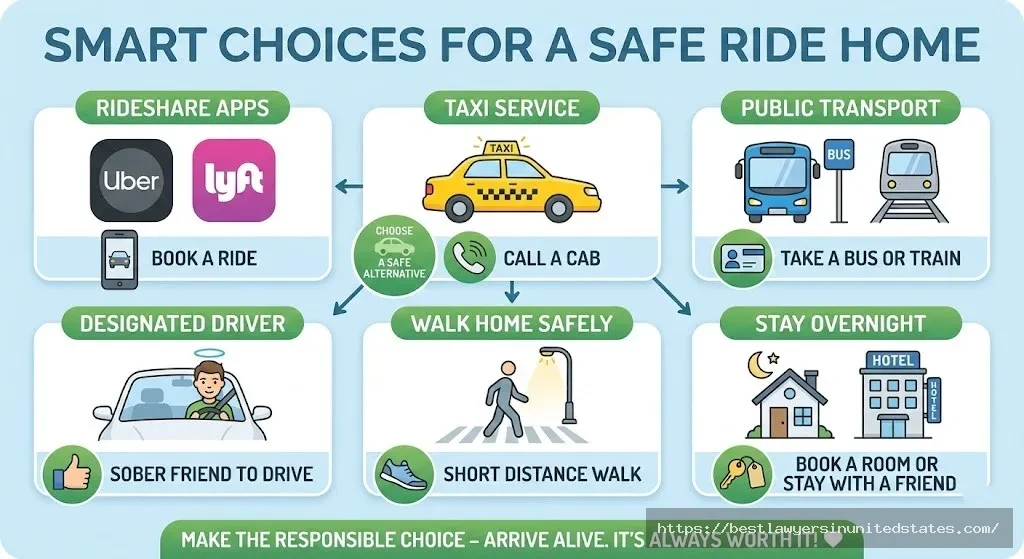
Before You Start Drinking
Plan your transportation before your first drink. Decide how you’ll get home safely while you’re still sober and thinking clearly. Options include designated drivers, rideshare services, taxis, public transportation, or staying where you are.
Arrange a designated driver from your group. This person commits to drinking nothing alcoholic all night. Rotate this responsibility among friends so everyone gets turns enjoying alcohol and driving safely.
Download rideshare apps before you go out. Set up your account and payment method when sober. Having Uber or Lyft ready on your phone makes calling a ride easy even when impaired.
Check public transportation schedules. Know when the last bus or train runs. Make sure you can get home using transit before service ends for the night.
Consider staying overnight. If drinking at a friend’s house, ask if you can sleep over. Hotels near entertainment districts offer another option if you’re out at bars or restaurants.
Tell someone your plans. Let a friend or family member know where you’ll be and when you expect to be home. This safety check ensures someone knows to look for you if problems occur.
Strategies to Moderate Your Drinking
Eat a substantial meal before drinking. Food slows alcohol absorption and reduces peak BAC significantly. Choose foods high in protein and fat for maximum effect.
Pace yourself by drinking slowly. Sip drinks instead of gulping. Put your drink down between sips. Make each drink last 45-60 minutes.
Alternate alcoholic drinks with water or other non-alcoholic beverages. This slows consumption, keeps you hydrated, and helps you drink less overall.
Set a drink limit before you start. Decide on a maximum number based on your weight and the time you’ll be drinking. Stick to your limit even if you feel fine.
Avoid drinking games, shots, and chugging contests. These activities cause rapid intoxication and dangerous BAC levels. The peer pressure isn’t worth the risk.
Know your limits from experience. If three drinks usually makes you feel drunk, stop at two. Leave a safety margin because different circumstances affect BAC.
What to Do If You’ve Had Too Much
Stop drinking immediately once you recognize you’re too impaired. No more drinks, period. Start drinking water instead.
Find a safe place to wait. Sit down somewhere comfortable. Stay with friends who can monitor you. Don’t isolate yourself when very drunk.
Eat food if possible. While it won’t reduce existing BAC, it might make you feel better and prevents drinking on an empty stomach if you continue.
Call for a safe ride. Use rideshare, taxi, or a sober friend. Never try to “tough it out” and drive. The risk isn’t worth it.
If you’re extremely intoxicated (difficulty standing, severe confusion, vomiting), seek medical help. Call 911 if necessary. Alcohol poisoning is life-threatening.
Never let friends drive drunk. Take their keys if necessary. Call them a ride even if they protest. Real friends keep friends safe.
Morning-After Considerations
Calculate your likely BAC before driving the next morning. If you drank heavily until 2 AM and wake at 7 AM, you might still be legally drunk.
Use our calculator to estimate morning BAC. Enter your drinking details and the time you stopped. Check whether you’re likely to be under 0.08% when you need to drive.
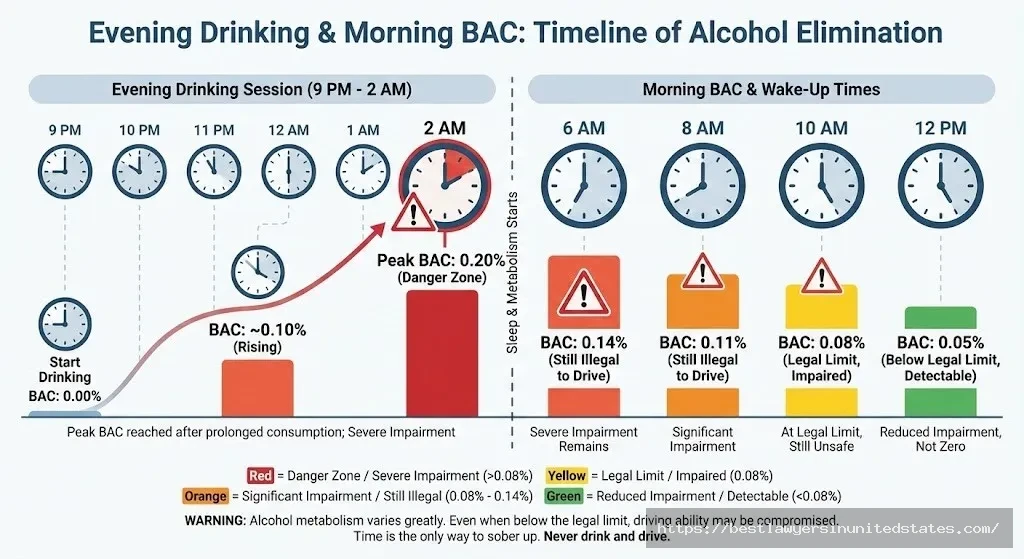
If in doubt, don’t drive. Call in sick to work if necessary. Your job isn’t worth a DUI arrest. Employers generally prefer a sick day to an employee in jail.
Eat breakfast and drink plenty of water. While this doesn’t reduce BAC, it helps you feel better and think more clearly.
Watch for hangover symptoms that affect driving even at 0.00% BAC. Fatigue, headache, and nausea can impair driving ability. If you feel terrible, you probably shouldn’t drive even if your BAC is legal.
Related Tools and Resources
Additional Calculators
Our DUI Cost Calculator helps you understand the full financial impact of a drunk driving arrest. Calculate potential expenses including fines, legal fees, insurance increases, and other costs. Understanding these financial consequences, including potential divorce expenses, motivates safer choices.
Government and Safety Resources
The National Highway Traffic Safety Administration (NHTSA) provides extensive drunk driving prevention information. Their website offers statistics, research, and educational materials about alcohol-impaired driving.
The Centers for Disease Control and Prevention (CDC) publishes research on alcohol’s health effects and impaired driving prevention strategies. Their fact sheets help you understand the risks.
Mothers Against Drunk Driving (MADD) offers victim support, prevention programs, and advocacy for stricter drunk driving laws. Their resources help affected families.
Legal Support
If you’re facing DUI charges, consult an experienced DUI defense attorney immediately. Legal representation can significantly impact your case outcome. Many DUI lawyers offer free consultations to discuss your situation.
State bar associations maintain lawyer referral services. These services connect you with licensed attorneys in your area who handle DUI cases.
Alcohol Support Services
If you struggle with alcohol use, help is available. The Substance Abuse and Mental Health Services Administration (SAMHSA) operates a 24/7 helpline at 1-800-662-4357. This free, confidential service provides treatment referrals and support.
Alcoholics Anonymous (AA) offers free support groups nationwide. Their 12-step program has helped millions achieve sobriety. Find meetings at aa.org.
SMART Recovery provides science-based mutual support groups as an alternative to 12-step programs. Their approach uses cognitive-behavioral techniques.
Take Control of Your Safety
Understanding blood alcohol content empowers you to make informed decisions about drinking and driving. Use our calculator before making choices that could change your life forever.
Remember that calculator results are estimates only. Your actual BAC may vary. When in doubt, always choose the safe option. No destination is worth risking your life, freedom, or someone else’s safety.
If you’ve been arrested for DUI or have questions about your legal rights, contact an experienced attorney immediately. Early legal advice can significantly impact your case outcome.
Contact Us
Have questions about BAC calculation or DUI laws? Need help finding legal representation in your state? Contact us at [email protected].
Our team connects you with experienced DUI defense attorneys who understand your state’s specific laws and procedures. Don’t face DUI charges alone. Get the legal help you need.
Free Resources Available
Access our complete library of legal guides and calculators:
- State-by-state DUI law guides
- Attorney fee calculators
- Legal process timelines
- Rights protection checklists
Visit our blog for articles on DUI defense, legal procedures, and your rights during traffic stops.
Make the Safe Choice Tonight
Planning to drink? Make arrangements for safe transportation now. Download a rideshare app. Identify a designated driver. Check public transit schedules. Your future self will thank you.
If you’re reading this after drinking, don’t drive. Call a ride service. Ask a friend. Walk if it’s safe and close. Sleep where you are. Any option is better than driving impaired.
The consequences of drunk driving extend far beyond legal penalties. DUI arrests strain relationships, jeopardize employment, and damage reputations. In worst cases, impaired driving kills innocent people and destroys families. The emotional burden of causing death or injury while drunk lasts forever.
Make the choice that keeps everyone safe. Use our calculator to understand your BAC. Know your limits. Plan ahead. Never drive impaired.
Your life, your freedom, and the lives of others depend on the choices you make tonight. Choose wisely.