
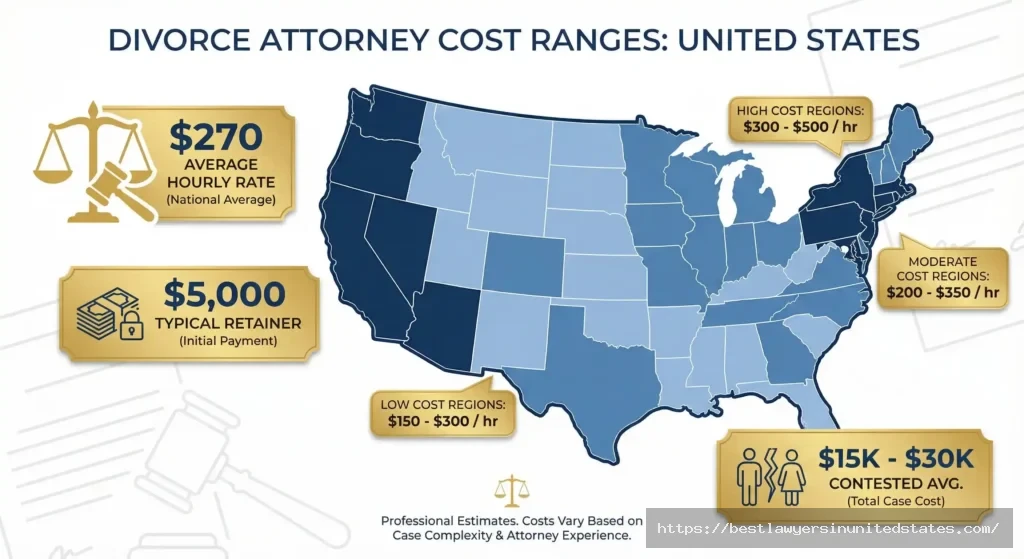
Quick Answer: Divorce attorney fees typically range from $150 to $500 per hour depending on your location and attorney experience. Average retainers run $2,500 to $10,000. Total costs for an uncontested divorce average $3,000-$7,000, while contested divorces cost $15,000-$30,000+. Court filing fees vary by state from $52 to $435.
How Much Do Divorce Attorneys Charge?
Divorce attorney fees vary significantly based on where you live, the complexity of your case, and your attorney’s experience level. Most family law attorneys bill by the hour, though flat-fee arrangements exist for simple cases.

National Divorce Attorney Fee Ranges:
| Fee Type | Cost Range | What It Covers |
|---|---|---|
| Hourly Rate | $150-$500/hour | Attorney time for calls, emails, court appearances, document preparation |
| Retainer Fee | $2,500-$10,000 | Upfront deposit that attorney bills against as work is performed |
| Consultation | $0-$400 | Initial meeting to discuss your case (many attorneys offer free consultations) |
| Flat Fee | $1,500-$5,000 | Complete uncontested divorce with no disputes over assets or custody |
Your actual costs depend on whether your divorce is contested, the value of marital assets, custody arrangements, and how cooperative both spouses are during negotiations.
Calculate Divorce Attorney Fee Now
Divorce Cost Calculator
Get an estimated cost for your divorce based on your specific situation
Your Estimated Divorce Cost
Cost Breakdown
📧 Get a Personalized Consultation
Have questions about your specific situation? Contact our legal experts for guidance tailored to your needs.
Contact Us via EmailWho Pays Attorney Fees in Divorce?
Understanding who covers legal costs is crucial when budgeting for divorce. The answer varies by state law and your specific financial situation.
General Rules on Fee Payment
Typically, each spouse pays their own attorney fees. However, courts in every state have the authority to order one spouse to pay some or all of the other spouse’s legal fees under certain circumstances.
When Courts Order Fee-Shifting
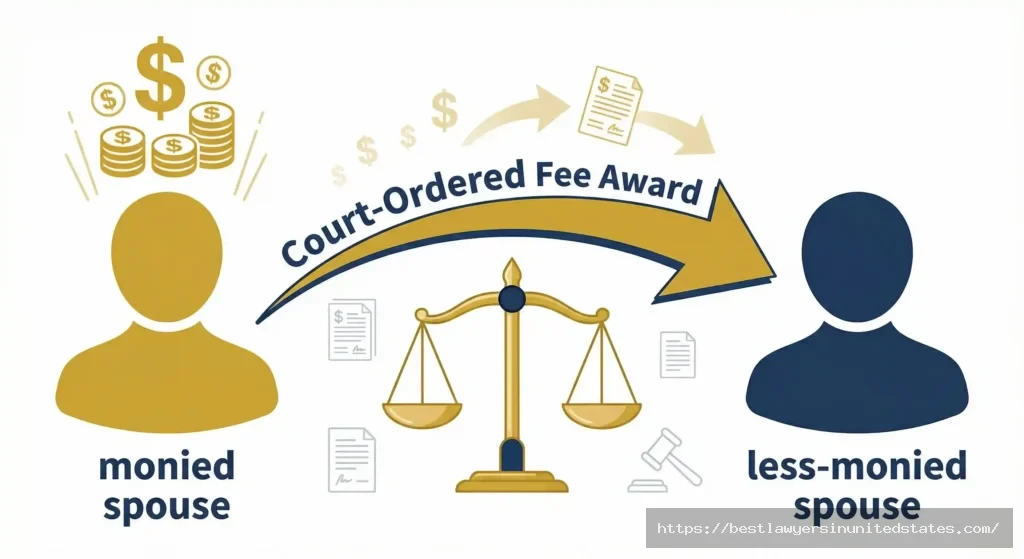
Courts may require the higher-earning spouse (called the “monied spouse”) to pay the other spouse’s attorney fees when:
- Income disparity exists – One spouse earns significantly more or controls the marital assets
- Financial hardship – The lower-earning spouse cannot afford representation
- Bad faith conduct – One spouse deliberately increases costs through unnecessary litigation
- Leveling the playing field – Ensuring both parties have adequate legal representation
Interim vs. Final Attorney Fee Awards
Pendente lite fees are temporary awards granted during the divorce process to help the less-monied spouse afford representation. Final fee awards come at the end of the case based on the overall conduct and financial circumstances.
How to Request Attorney Fee Awards
If you need your spouse to contribute to your legal costs:
- File a motion for attorney fees with the court
- Submit a detailed financial affidavit showing income, expenses, and assets
- Provide billing statements from your attorney
- Demonstrate the financial disparity between spouses
- Show why the fee award is necessary and fair
Are Divorce Attorney Fees Tax Deductible?
This is one of the most searched questions about divorce costs, and the answer has changed significantly in recent years.
Current 2025 Tax Rules
No, divorce attorney fees are generally NOT tax deductible for divorces finalized after December 31, 2017, due to the Tax Cuts and Jobs Act (TCJA).
What Changed?
Before 2018, taxpayers could deduct certain divorce-related legal fees as miscellaneous itemized deductions under IRC Section 212. The TCJA eliminated most personal miscellaneous itemized deductions through 2025.
Limited Exceptions
You may still deduct legal fees related to:
- Tax advice during divorce – If your attorney bills separately for tax planning or advice on tax consequences of property division
- Business-related matters – Legal fees for protecting business interests may be deductible as business expenses
- Alimony structuring (pre-2019 divorces only) – For divorces finalized before January 1, 2019, alimony remains deductible/taxable
What This Means for You
Since divorce legal fees are considered personal expenses, you cannot write them off on your federal taxes. Keep detailed records anyway, as state tax laws may differ, and the TCJA provisions sunset in 2025, potentially restoring some deductions.
Divorce Attorney Fees by State
Legal costs vary dramatically depending on where you file for divorce. Attorney rates, filing fees, and total costs reflect each state’s cost of living, legal complexity, and market competition.
High-Cost States (Attorney Rates $300-$500/hour)
California – $300-$500/hour average | Filing fee: $435 As a community property state with complex asset division laws, California attorneys command premium rates. Major metropolitan areas like Los Angeles, San Francisco, and San Diego see the highest costs.
New York – $300-$500/hour average | Filing fee: $335 New York’s Domestic Relations Law § 237 provides strong fee-shifting provisions, allowing lower-earning spouses to request the other party pay their legal fees.
Massachusetts – $300-$450/hour average | Filing fee: $200-$215 High cost of living in Boston and surrounding areas drives attorney rates up significantly.
New Jersey – $300-$450/hour average | Filing fee: $300 Complex equitable distribution laws and high living costs contribute to elevated legal fees.
Connecticut – $300-$450/hour average | Filing fee: $350 Another high-cost Northeastern state with sophisticated family law requirements.
Moderate-Cost States (Attorney Rates $200-$350/hour)
Texas – $250-$350/hour average | Filing fee: $300-$350 Despite being a community property state, Texas offers more moderate rates than coastal states, though major cities like Houston, Dallas, and Austin run higher.
Florida – $260-$350/hour average | Filing fee: $409 Florida Statutes § 61.16 governs attorney fee awards and provides mechanisms for the financially disadvantaged spouse to obtain legal representation.
Illinois – $250-$400/hour average | Filing fee: $289 750 ILCS 5/508 allows courts to order contribution toward attorney fees when one party lacks sufficient funds.
Pennsylvania – $250-$400/hour average | Filing fee: $300-$350 Moderate costs in most areas, with Philadelphia commanding higher rates.
Ohio – $200-$350/hour average | Filing fee: $175-$350 Filing fees vary significantly by county, from $175 in some rural counties to $350 in Cuyahoga County (Cleveland).
Georgia – $200-$350/hour average | Filing fee: $200-$400 County-by-county variation in both attorney rates and filing fees, with Atlanta commanding premium prices.
North Carolina – $200-$350/hour average | Filing fee: $75 Low filing fees but requires one-year separation before filing for absolute divorce.
Michigan – $250-$350/hour average | Filing fee: $175-$230 Moderate costs with regional variations between Detroit metro and rural areas.
Colorado – $250-$400/hour average | Filing fee: $230 Mountain state with growing metro areas sees increasing attorney costs.
Washington – $250-$400/hour average | Filing fee: $280-$314 Community property state with higher costs in Seattle-Tacoma metro area.
Arizona – $250-$350/hour average | Filing fee: $349 Community property state with moderate costs outside Phoenix/Scottsdale.
Maryland – $250-$400/hour average | Filing fee: $165 Complex family law statutes drive up attorney time and costs.
Virginia – $250-$400/hour average | Filing fee: $86-$110 Low filing fees but requires one-year separation in most cases.
Minnesota – $250-$350/hour average | Filing fee: $365 Higher filing fees but moderate attorney rates.
Oregon – $250-$400/hour average | Filing fee: $301 Portland metro area commands higher rates than rural regions.
Lower-Cost States (Attorney Rates $150-$300/hour)
Alabama – $200-$300/hour average | Filing fee: $250-$300 Equitable distribution state with moderate costs throughout.
Alaska – $250-$400/hour average | Filing fee: $250 Higher rates due to cost of living, but smaller legal market.
Arkansas – $150-$250/hour average | Filing fee: $165 Among the most affordable states for divorce legal services.
Delaware – $250-$350/hour average | Filing fee: $150 Small state with limited attorney pool, moderate costs.
Hawaii – $300-$500/hour average | Filing fee: $250 Highest cost of living drives up attorney fees despite smaller market.
Idaho – $200-$300/hour average | Filing fee: $154 Community property state with affordable legal services.
Indiana – $200-$300/hour average | Filing fee: $157 Consistently moderate costs across the state.
Iowa – $200-$300/hour average | Filing fee: $185 Affordable legal market with straightforward divorce laws.
Kansas – $200-$300/hour average | Filing fee: $183 Moderate costs throughout the state.
Kentucky – $200-$300/hour average | Filing fee: $148 Lower filing fees and affordable attorney rates.
Louisiana – $250-$350/hour average | Filing fee: $250-$450 Community property state with 365-day waiting period that can increase total costs.
Maine – $200-$350/hour average | Filing fee: $120 Lower costs in rural areas, moderate in Portland.
Mississippi – $150-$250/hour average | Filing fee: $52 Lowest filing fees in the nation and affordable attorney rates.
Missouri – $200-$300/hour average | Filing fee: $163 Moderate costs with St. Louis and Kansas City slightly higher.
Montana – $200-$300/hour average | Filing fee: $170 Rural state with limited attorney pool but affordable rates.
Nebraska – $200-$300/hour average | Filing fee: $158 Consistent moderate pricing across the state.
Nevada – $250-$400/hour average | Filing fee: $326 Community property state with just six-week residency requirement, Las Vegas commands higher rates.
New Hampshire – $250-$350/hour average | Filing fee: $250 Moderate costs for New England region.
New Mexico – $200-$300/hour average | Filing fee: $137 Community property state with affordable legal services.
North Dakota – $200-$300/hour average | Filing fee: $80 Low filing fees and affordable attorney rates.
Oklahoma – $150-$250/hour average | Filing fee: $183 Among the most affordable legal markets.
Rhode Island – $250-$400/hour average | Filing fee: $120-$160 Small state with moderate costs.
South Carolina – $200-$300/hour average | Filing fee: $150 Requires one-year separation for no-fault divorce, moderate costs.
South Dakota – $200-$300/hour average | Filing fee: $95 No residency requirement and low costs make it attractive for some filers.
Tennessee – $200-$350/hour average | Filing fee: $184-$400 Wide county-by-county variation in filing fees.
Utah – $200-$300/hour average | Filing fee: $310-$360 Higher filing fees but moderate attorney rates.
Vermont – $250-$350/hour average | Filing fee: $90-$295 Small population, moderate costs.
West Virginia – $200-$300/hour average | Filing fee: $135 Affordable legal services throughout the state.
Wisconsin – $250-$350/hour average | Filing fee: $184 Community property state with moderate costs.
Wyoming – $200-$300/hour average | Filing fee: $70 Lowest filing fees among Western states, affordable attorney rates.
Contested vs. Uncontested Divorce Costs
The single biggest factor determining your total legal costs is whether your divorce is contested or uncontested.
Uncontested Divorce Costs
An uncontested divorce occurs when both spouses agree on all major issues:
- Property division
- Debt allocation
- Child custody and visitation
- Child support
- Spousal support (alimony)
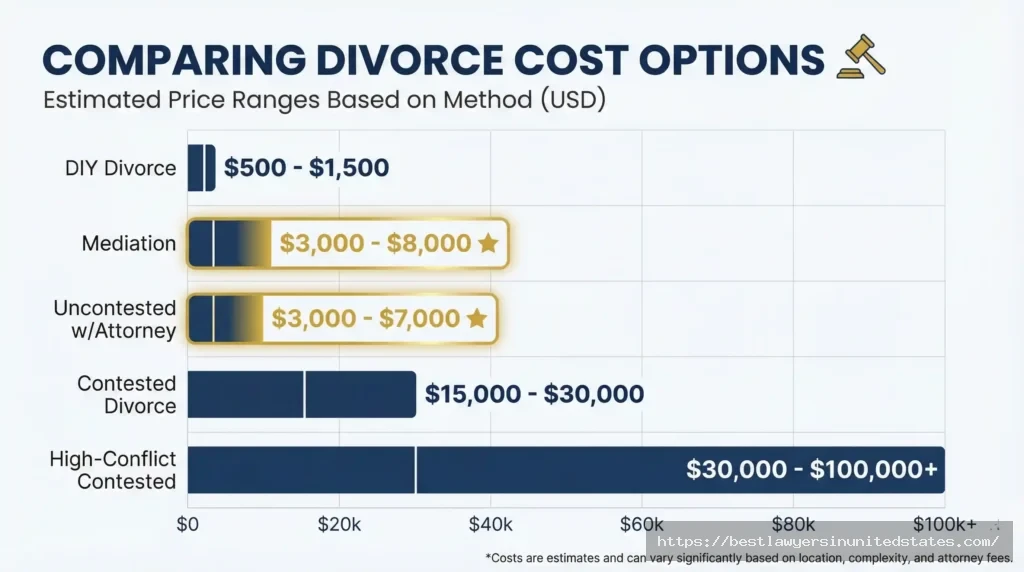
Typical costs: $3,000-$7,000 total including attorney fees and filing costs
Timeline: 2-6 months depending on state waiting periods
Attorney involvement: Minimal – mainly document preparation, filing, and court appearance
Some couples pursuing uncontested divorce use DIY methods or online services to reduce costs even further, though consulting with an attorney is still recommended.
Contested Divorce Costs
A contested divorce means spouses disagree on one or more major issues requiring court intervention.
Typical costs: $15,000-$30,000+ per spouse
Timeline: 12-24+ months
What drives up costs:
- Discovery process (interrogatories, depositions, subpoenas)
- Expert witnesses (business valuators, custody evaluators, real estate appraisers)
- Multiple court hearings and motions
- Trial preparation and trial days
- Post-judgment modifications
Alternative Options to Reduce Attorney Fees
If traditional attorney representation seems too expensive, several alternatives can reduce your overall divorce costs.
Divorce Mediation
Mediation involves a neutral third party helping you and your spouse reach agreements. Mediators typically charge $150-$400 per hour, split between both spouses.
Average total cost: $3,000-$8,000
Best for: Couples who communicate reasonably well and want to avoid court
Benefits:
- Significantly cheaper than litigation
- Faster resolution
- More control over outcomes
- Less adversarial process
- Private and confidential
Collaborative Divorce
Collaborative divorce involves each spouse hiring a specially trained collaborative attorney who commits to resolving issues outside court.
Average total cost: $10,000-$25,000 per spouse
Best for: High-asset couples or those with complex custody issues who want to avoid court
Benefits:
- Team approach with financial specialists and child specialists
- Creative solutions not available in court
- Preserves relationships better than litigation
Limited Scope Representation (Unbundled Services)
You hire an attorney for specific tasks only, handling other parts yourself. Examples:
- Document review only
- Consultation and advice
- Court appearance for specific hearings
- Negotiation assistance
Cost: Varies widely, typically $500-$3,000 depending on services
Best for: Financially savvy individuals comfortable handling some legal tasks
Legal Aid and Pro Bono Services
If you meet income requirements, you may qualify for free or reduced-cost legal assistance.
Eligibility: Typically 125-200% of federal poverty level
How to find services:
- State bar association referrals
- Legal aid societies
- Law school clinics
- Pro bono programs
What Factors Increase Divorce Attorney Fees?
Understanding what drives costs up helps you make strategic decisions throughout your divorce.
Child Custody Disputes
Custody battles significantly increase legal fees. When parents cannot agree, courts may order:
- Custody evaluations: $3,000-$10,000
- Guardian ad litem: $2,000-$10,000
- Parenting coordinator: $150-$400 per hour
Each expert adds substantial costs plus the attorney time needed to work with them.
High-Net-Worth Asset Division
Complex asset division requires additional expertise and time:
- Business valuations: $5,000-$30,000+
- Real estate appraisals: $300-$600 per property
- Forensic accounting: $5,000-$30,000+
- QDRO preparation (retirement account division): $500-$3,000 per plan
Going to Trial
Trial is the most expensive phase of divorce. Expect:
- Extensive preparation time (50-100+ attorney hours)
- Multiple days in court at full billing rates
- Exhibit preparation and expert witness fees
- Post-trial briefs and motions
A simple three-day trial can easily add $15,000-$30,000+ in attorney fees.
Geographic Location
Urban areas with higher costs of living see premium attorney rates:
- Major metros: $300-$500/hour
- Suburban areas: $250-$350/hour
- Rural areas: $150-$250/hour
Attorney Experience Level
More experienced attorneys typically charge more:
- Senior partners (20+ years): $400-$500+/hour
- Mid-level attorneys (10-20 years): $250-$400/hour
- Junior attorneys (0-10 years): $150-$250/hour
- Paralegals: $75-$150/hour
Spouse Cooperation Level
The more your spouse cooperates, the less your attorney needs to do. Uncooperative behavior that increases costs:
- Refusing discovery requests
- Missing court dates
- Hiding assets
- Filing frivolous motions
- Dragging out negotiations
Community Property vs. Equitable Distribution States
Your state’s property division method affects how complex your divorce becomes and potentially your attorney fees.
Community Property States (9 Total)
Assets acquired during marriage are split 50/50: Arizona, California, Idaho, Louisiana, Nevada, New Mexico, Texas, Washington, Wisconsin
How it affects costs: Generally simpler division means less attorney time arguing over who gets what. However, disputes still arise over what is community vs. separate property.
Using community assets: In community property states, you can typically use community funds to pay your divorce attorney since those funds belong equally to both spouses.
Equitable Distribution States (41 States)
Assets are divided “fairly” but not necessarily equally based on multiple factors like:
- Length of marriage
- Each spouse’s income and earning capacity
- Contributions to marital property
- Age and health of each spouse
- Tax consequences
How it affects costs: “Equitable” division requires more attorney time presenting evidence and arguments about what’s fair, potentially increasing legal fees.
How to Pay for Your Divorce Attorney
Understanding payment options helps you afford representation when you need it.
Retainer Agreements
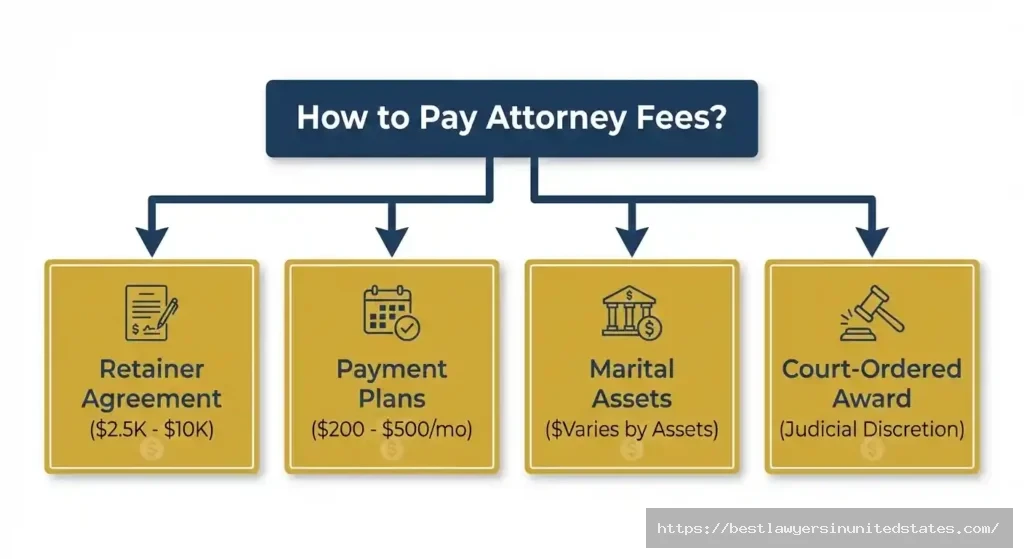
Most divorce attorneys require an upfront retainer deposit of $2,500-$10,000. You sign a retainer agreement explaining:
- The retainer amount
- Hourly billing rates
- What’s included and excluded
- How costs are deducted from the retainer
- What happens if retainer runs out
- Refund policy for unused portions
The attorney bills against this retainer as work is performed. When it’s depleted, you’ll need to “replenish” it.
Payment Plans
Many attorneys offer monthly payment plans, especially for uncontested divorces. Typical arrangements:
- Initial deposit: $500-$1,500
- Monthly payments: $200-$500 over 12-24 months
- Interest may or may not apply
Ask potential attorneys about payment plans during your initial consultation.
Using Marital Assets
In many cases, you can use marital funds to pay attorney fees, including:
- Joint bank accounts
- Home equity lines of credit
- Tax refunds
- Investment accounts
Community property states explicitly allow using community assets for divorce representation. Equitable distribution states generally permit it as a legitimate marital expense.
Court-Ordered Fee Awards
As discussed earlier, you can request the court order your spouse to pay some or all of your attorney fees if:
- Income disparity exists between spouses
- You lack access to marital funds
- Your spouse is being unreasonable or litigious
File a motion early in the process if you need financial assistance with legal fees.
Credit Cards and Loans
As a last resort, some people use:
- Credit cards (though high interest rates make this expensive long-term)
- Personal loans from banks or credit unions
- Loans from family members
- 401(k) loans (be aware of tax implications)
Fee Waivers for Low-Income Filers
If you cannot afford filing fees and court costs, every state offers a fee waiver process.
Income Requirements
Each state sets its own limits, typically around:
- 125-200% of federal poverty guidelines
- Receipt of public assistance (SNAP, TANF, SSI)
- Demonstrated financial hardship
What Gets Waived
Fee waivers typically cover:
- Court filing fees
- Service of process fees
- Motion filing fees
- Copy and certification fees
Note: Fee waivers do NOT cover attorney fees. You’ll still need to find affordable representation through legal aid, pro bono services, or limited scope representation.
How to Apply
- Obtain fee waiver forms from your county clerk or court website
- Complete detailed financial disclosure showing income, assets, expenses
- Attach proof of income or public assistance
- File with your divorce petition or separately
- Wait for court approval (may require brief hearing)
Helpful Resource
Visit your state court’s self-help center or family law facilitator office for assistance completing fee waiver applications.
Court Filing Fees by State
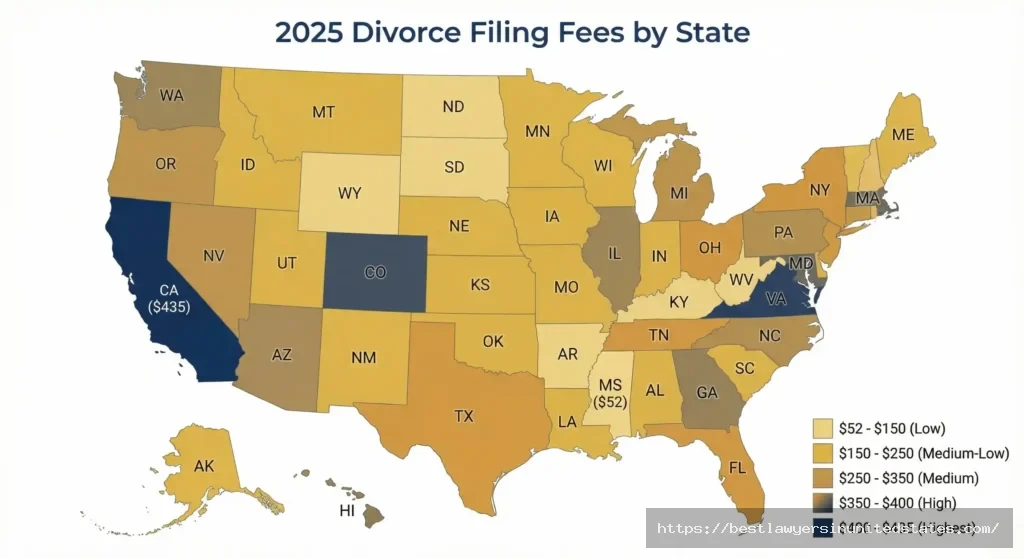
Filing fees represent your first mandatory cost when initiating divorce proceedings. Here’s what you’ll pay in each state:
| State | Filing Fee Range | Notes |
|---|---|---|
| Mississippi | $52 | Lowest in nation |
| Wyoming | $70 | Among lowest costs |
| North Carolina | $75 | Low filing, but 1-year separation required |
| North Dakota | $80 | Low cost state |
| Virginia | $86-$110 | Low filing fees, county variation |
| Vermont | $90-$295 | Wide county range |
| South Dakota | $95 | No residency requirement |
| Maine | $120 | Affordable Northeast option |
| Rhode Island | $120-$160 | Small state variation |
| West Virginia | $135 | Moderate costs |
| New Mexico | $137 | Community property state |
| Kentucky | $148 | Below-average costs |
| Delaware | $150 | Small state |
| South Carolina | $150 | 1-year separation required |
| Idaho | $154 | Community property, affordable |
| Indiana | $157 | Consistent moderate pricing |
| Nebraska | $158 | Moderate Midwest costs |
| Missouri | $163 | Affordable metro areas |
| Arkansas | $165 | Among lowest costs |
| Maryland | $165 | Low filing for high-cost state |
| Montana | $170 | Rural affordable |
| Ohio | $175-$350 | Significant county variation |
| Michigan | $175-$230 | County differences |
| Kansas | $183 | Moderate plains state |
| Oklahoma | $183 | Affordable legal market |
| Wisconsin | $184 | Community property, moderate |
| Tennessee | $184-$400 | Huge county differences |
| Iowa | $185 | Consistent pricing |
| Georgia | $200-$400 | Atlanta higher than rural |
| Massachusetts | $200-$215 | Low for high-cost state |
| Colorado | $230 | Growing metro costs |
| Alaska | $250 | High cost of living |
| Alabama | $250-$300 | County variation |
| Hawaii | $250 | Highest cost of living |
| New Hampshire | $250 | Moderate New England |
| Louisiana | $250-$450 | Wide range, 365-day wait |
| Illinois | $289 | Major metro state |
| New Jersey | $300 | High-cost Northeast |
| Texas | $300-$350 | Community property, county variation |
| Pennsylvania | $300-$350 | High-cost state |
| Oregon | $301 | Moderate West Coast |
| Utah | $310-$360 | Higher filing fees |
| Nevada | $326 | 6-week residency only |
| New York | $335 | Major metro state |
| Arizona | $349 | Community property |
| Connecticut | $350 | High Northeast costs |
| Minnesota | $365 | Higher filing fees |
| Florida | $409 | Among highest filing fees |
| California | $435 | Highest filing fee nationwide |
State-Specific Attorney Fee Laws
Each state has specific statutes governing when and how courts can order attorney fee awards. Understanding your state’s law helps you plan strategically.
States with Strong Fee-Shifting Provisions
New York – Domestic Relations Law § 237 Creates a rebuttable presumption that the monied spouse shall pay the less-monied spouse’s attorney fees to ensure adequate representation.
California – Family Code § 2030, § 2032 Courts must ensure both parties have access to legal representation, ordering the higher-earning spouse to contribute when financial disparity exists.
Illinois – 750 ILCS 5/508 Allows courts to order contribution toward attorney fees and costs after considering financial resources of both parties.
Florida – Florida Statutes § 61.16 Courts may order payment of attorney fees based on financial resources and need for representation.
Texas – Family Code § 6.502, § 106.002 Courts may order reasonable attorney fees based on financial resources, benefits to the estate, and whether party acted in good faith.
What This Means for You
If you’re the lower-earning spouse, these statutes provide legal mechanisms to request your spouse help pay your attorney fees. If you’re the higher-earning spouse, you may be required to contribute to your spouse’s legal costs even if you don’t want to.
Consult with a family law attorney in your state to understand how fee-shifting laws apply to your situation.
How to Reduce Your Divorce Attorney Fees
Strategic choices throughout your divorce can dramatically reduce total legal costs.
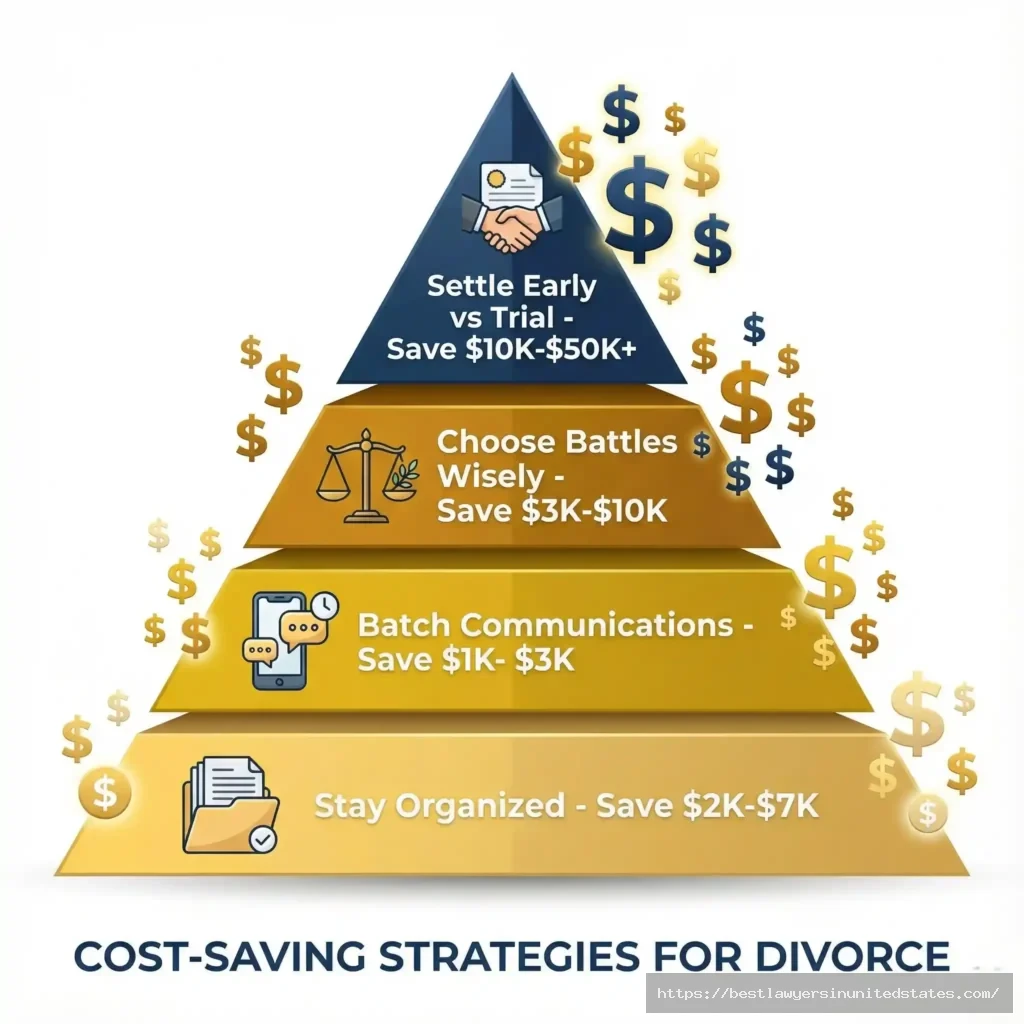
Be Organized and Prepared
The more organized you are, the less time your attorney spends tracking down information:
✓ Create organized files for all financial documents ✓ Compile complete asset and debt lists ✓ Track important dates and deadlines yourself ✓ Prepare written questions before calling your attorney ✓ Respond promptly to all attorney requests ✓ Keep communications concise and focused
Potential savings: 10-20 hours of billable time = $2,000-$7,000
Choose Your Battles Wisely
Not everything is worth fighting over. Ask yourself:
- What is this disagreement costing me in attorney fees?
- Is the item worth more than the legal fees to fight for it?
- Am I fighting on principle rather than practicality?
Example: Spending $5,000 in attorney fees fighting over a $2,000 piece of furniture makes no financial sense.
Communicate Efficiently
How you communicate with your attorney affects your bill:
Expensive: Calling your attorney every time you have a question Better: Batching questions in one call or email Best: Handling routine questions with paralegals (lower hourly rate)
Avoid using your attorney as an emotional support system. That’s what therapists, friends, and support groups are for.
Consider Settlement Early
The earlier you settle, the less you pay. Settlement at various stages:
- During negotiation (cheapest)
- At mediation (moderate cost)
- On courthouse steps before trial (expensive)
- During trial (most expensive)
Use Technology
Many attorneys offer client portals where you can:
- Access documents 24/7
- Track billing in real-time
- Send secure messages
- Approve documents electronically
This reduces time-consuming phone calls and paper document exchange.
Read Everything Carefully
Review all documents before your attorney reviews them. This reduces time your attorney spends explaining basic terms or catching your errors.
What Should You Ask During Initial Consultations?
Most divorce attorneys offer free or low-cost initial consultations. Come prepared with these essential questions:
About Fees
- What is your hourly rate?
- What is the retainer amount?
- How often will I receive billing statements?
- What tasks are delegated to paralegals (and at what rate)?
- Do you offer payment plans?
- What happens if my retainer runs out?
- Are there any additional costs I should expect?
About Your Case
- How long do divorces like mine typically take?
- What are the possible outcomes?
- What is your strategy for my case?
- Who will handle my case day-to-day?
- How often will we communicate?
- What are my chances of getting a fee award?
About the Attorney
- How many years have you practiced family law?
- What percentage of your practice is divorce cases?
- Have you handled cases similar to mine?
- What is your settlement vs. trial rate?
- Can you provide references?
Red Flags to Watch For
Avoid attorneys who:
- Guarantee specific outcomes (no one can guarantee results)
- Badmouth all other attorneys or judges
- Encourage unnecessary conflict
- Won’t explain fees clearly
- Seem disorganized or unprepared
- Don’t return phone calls promptly
Divorce Timeline and How It Affects Costs
How long your divorce takes directly impacts your attorney fees. More time = more billable hours.
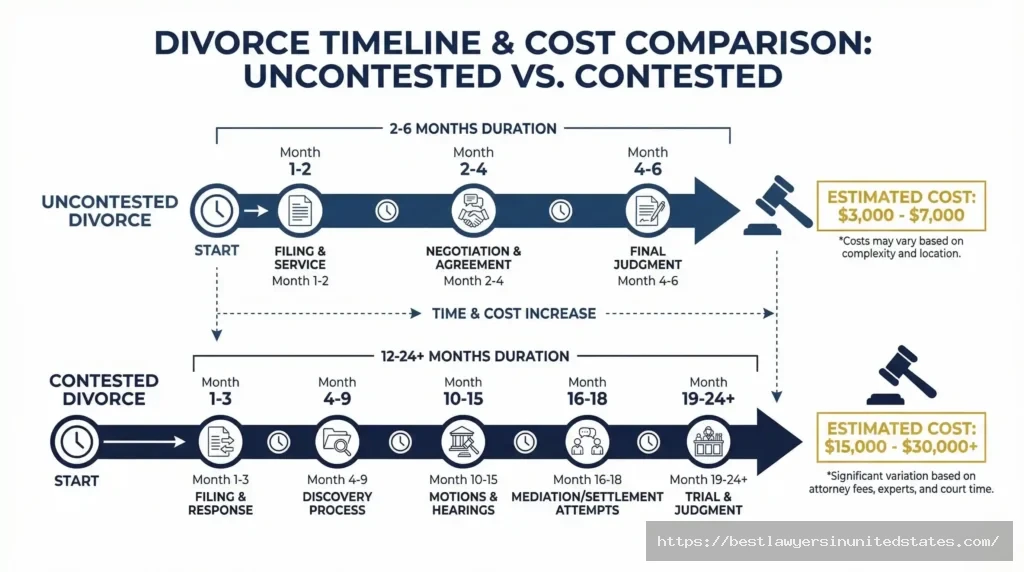
Uncontested Divorce Timeline
2-6 months total
- Week 1-2: File petition and serve spouse
- Week 3-6: Wait for response (varies by state)
- Week 7-12: Negotiate settlement agreement
- Month 4-6: Finalize paperwork and attend final hearing
Attorney time: 10-25 hours = $1,500-$7,500 in fees
Contested Divorce Timeline
12-24+ months
- Months 1-2: Filing, service, initial responses
- Months 3-6: Discovery (interrogatories, depositions, document production)
- Months 7-9: Motion hearings on temporary orders
- Months 10-15: Expert evaluations and reports
- Months 16-20: Settlement negotiations/mediation
- Months 21-24: Trial preparation and trial
Attorney time: 100-300+ hours = $15,000-$100,000+ in fees
State Waiting Periods
Some states impose mandatory waiting periods before divorces can be finalized:
Longest waiting periods:
- Louisiana: 365 days (living separate and apart)
- North Carolina: 365 days (separation required)
- South Carolina: 365 days (for no-fault divorce)
- Virginia: 365 days (with children) or 180 days (without children, with separation agreement)
Shortest/no waiting periods:
- Alaska: 30 days
- Idaho: 20 days
- Nevada: 42 days (but only 6-week residency requirement)
- South Dakota: No residency requirement, 60-day processing
Longer waiting periods mean you may accumulate more attorney fees over time, even in uncontested cases.
Frequently Asked Questions About Divorce Attorney Fees
How much does a divorce lawyer cost on average?
Divorce attorney fees average $270 per hour nationally but range from $150-$500 per hour depending on location and attorney experience. Most require retainers of $2,500-$10,000. Total costs for uncontested divorces average $3,000-$7,000, while contested divorces cost $15,000-$30,000+ per spouse.
Can I make my spouse pay my divorce attorney fees?
Yes, in many cases. Courts in every state can order the higher-earning spouse to pay some or all of the other spouse’s attorney fees when income disparity exists. You must file a motion requesting fees and provide financial documentation showing why you need the award. Success depends on your state’s specific laws and your financial circumstances.
Are divorce lawyer fees tax deductible?
No, divorce attorney fees are generally not tax deductible for divorces finalized after December 31, 2017, due to the Tax Cuts and Jobs Act. The only exception is legal fees specifically related to tax advice during divorce. Pre-2018, some divorce legal fees qualified as miscellaneous itemized deductions, but this is no longer allowed through 2025.
What if I can’t afford a divorce attorney?
Several options exist for those who cannot afford traditional representation. Apply for a court fee waiver if your income is below 125-200% of federal poverty guidelines. Contact your state’s legal aid society for free representation if you qualify. Many attorneys offer payment plans for $200-$500 monthly. Consider limited scope representation where you hire an attorney for specific tasks only. Divorce mediation costs significantly less than litigation. Some people pursue DIY divorce for simple uncontested cases, though legal consultation is still recommended.
What’s the difference between a retainer fee and hourly rate?
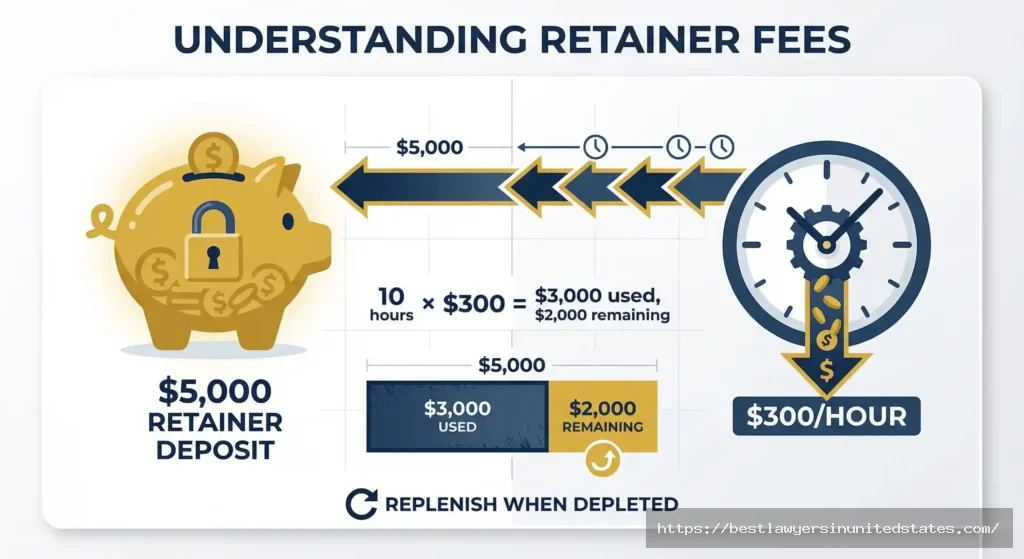
A retainer fee is an upfront deposit you pay to secure an attorney’s services, typically $2,500-$10,000. Your attorney bills their hourly rate against this retainer as work is performed. For example, if you pay a $5,000 retainer and your attorney’s hourly rate is $300, after 10 hours of work ($3,000), you’ll have $2,000 remaining in your retainer. When depleted, you’ll need to replenish it to continue representation.
How much is a retainer for a divorce lawyer?
Retainer fees typically range from $2,500 to $10,000 depending on your location, case complexity, and attorney experience. Simple uncontested divorces may require lower retainers of $1,500-$3,500. Complex contested divorces with custody disputes or high-value assets often require $7,500-$15,000 retainers. Urban attorneys in expensive markets charge higher retainers than rural practitioners.
Do divorce lawyers offer payment plans?
Yes, many divorce attorneys offer payment plans, especially for uncontested divorces. Typical arrangements include a smaller initial deposit ($500-$1,500) followed by monthly payments of $200-$500 over 12-24 months. Some attorneys charge interest on payment plans while others don’t. Always get payment plan terms in writing before signing a retainer agreement. Not all attorneys offer this option, so ask during your initial consultation.
How long does a divorce take?
Uncontested divorces typically take 2-6 months from filing to finalization. Contested divorces average 12-24+ months. Your state’s mandatory waiting period affects timeline—some states like Nevada allow divorce in 6 weeks while Louisiana, North Carolina, and South Carolina require one-year separations. Complex issues like child custody disputes, business valuations, or hidden assets extend the timeline significantly. The longer your divorce takes, the more attorney fees you’ll accumulate.
What is the cheapest way to get a divorce?
The cheapest divorce option is an uncontested DIY divorce where both spouses agree on everything and file paperwork themselves. This costs just the filing fee ($52-$435 depending on state) plus minor document preparation costs. Online divorce services charge $200-$500 to prepare paperwork for uncontested cases. Mediation costs $3,000-$8,000 total, split between spouses. Limited scope representation runs $500-$3,000 for specific services. Traditional uncontested divorce with full attorney representation costs $3,000-$7,000 per spouse.
Can I use a divorce cost calculator?
Yes, divorce cost calculators provide estimates based on your specific situation. Input factors like whether your divorce is contested, whether you have children, asset complexity, and your state to receive a customized cost range. While calculators can’t predict exact costs, they help you budget and understand which factors drive expenses up. Use calculator results as general guidance rather than guaranteed pricing.
What is a monied spouse in divorce?
A “monied spouse” is the higher-earning or wealthier spouse in a divorce who has greater access to financial resources and marital assets. Courts often order the monied spouse to pay some or all of the “less-monied spouse’s” attorney fees to level the playing field and ensure both parties have adequate legal representation. This concept appears in many state statutes governing attorney fee awards, particularly in California, New York, and Illinois.
What is fee-shifting in divorce?
Fee-shifting occurs when a court orders one spouse to pay the other spouse’s attorney fees. This typically happens when significant income disparity exists, one spouse lacks access to marital funds, or one spouse engages in bad faith conduct that unnecessarily increases litigation costs. Fee-shifting ensures both parties can afford adequate representation and prevents wealthier spouses from using superior financial resources as a weapon in divorce proceedings.
What are pendente lite attorney fees?
Pendente lite (Latin for “pending the litigation”) fees are temporary attorney fee awards granted during the divorce process before final judgment. These interim awards help the less-monied spouse afford representation throughout the case. Courts may order additional fee contributions as the case progresses. Final attorney fee awards come at the end of the case based on overall conduct, financial circumstances, and whether one party unnecessarily increased costs.
How do I know if my divorce attorney fees are reasonable?
Research average hourly rates in your area through state bar association surveys or initial consultations with multiple attorneys. Compare your attorney’s rates to others with similar experience levels. Review your billing statements carefully—legitimate charges include time spent on calls, emails, document review, research, court appearances, and case strategy. Question any vague entries like “miscellaneous” or “case review.” Excessive billing might include 15-minute phone calls billed as one hour, or routine administrative tasks billed at attorney rates instead of paralegal rates.
Can I negotiate divorce attorney fees?
Yes, many aspects of attorney fees are negotiable. You might negotiate the retainer amount, payment plan terms, or hourly rates for different types of work. Some attorneys offer reduced rates for uncontested divorces or flat fee arrangements. However, extremely experienced attorneys in high demand may not negotiate. Never choose an attorney based solely on the lowest price—expertise, communication style, and case strategy matter more than saving $50 per hour.
What is limited scope representation?
Limited scope representation (also called “unbundled legal services”) means hiring an attorney for specific tasks only while handling other parts yourself. Examples include hiring an attorney just to review your settlement agreement, appear at one court hearing, or provide consultation and advice while you file paperwork. This costs significantly less than full representation—typically $500-$3,000 total depending on services. It works best for legally savvy individuals comfortable handling some tasks independently.
Do I need a lawyer for an uncontested divorce?
While not legally required, consulting an attorney for even uncontested divorces is highly recommended. An attorney ensures your settlement agreement is legally valid, doesn’t inadvertently waive important rights, properly addresses tax implications, and includes all necessary provisions. Many people use limited scope representation for uncontested cases—paying an attorney to review documents and provide consultation without full representation. This costs $500-$2,000 and provides valuable legal protection.
What questions should I ask my divorce attorney about fees?
Ask these critical fee questions: What is your hourly rate and paralegal rate? What is the retainer amount and when must I replenish it? How often will I receive billing statements? What tasks can paralegals handle at lower rates? Do you offer payment plans? Are there additional costs beyond attorney fees (expert witnesses, court reporters, filing fees)? What is your billing increment (6 minutes, 15 minutes, or hourly)? How do you handle brief email or phone communications? Can I get fee estimates for different scenarios (settlement vs. trial)?
How can I reduce my divorce attorney fees?
Reduce attorney fees by staying organized with all financial documents readily available. Batch questions into single communications rather than multiple calls. Handle routine tasks yourself like gathering documents. Respond promptly to all attorney requests. Choose battles wisely—don’t fight over low-value items. Consider mediation or collaborative divorce instead of litigation. Settle early rather than going to trial. Work with paralegals for routine tasks when possible. Avoid using your attorney for emotional support—that’s what therapists and support groups provide.
Finding the Right Divorce Attorney
Selecting the right attorney significantly impacts both your costs and outcome. Don’t make this decision lightly.

Where to Find Divorce Attorneys
State Bar Association Referral Services Most state bars maintain referral programs that match you with licensed family law attorneys in your area. Initial consultations are often free or discounted.
Online Legal Directories Websites like Avvo, Martindale-Hubbell, and Super Lawyers provide attorney profiles, reviews, client ratings, and fee information.
Personal Referrals Ask friends, family members, or colleagues who’ve gone through divorce for attorney recommendations. Personal experiences provide valuable insights into communication style and effectiveness.
Legal Aid Societies If you qualify based on income, legal aid organizations provide free representation for divorces involving domestic violence, child custody, or other critical issues.
State/Local Bar Associations Many local bar associations host family law sections with member directories and specialist certifications.
Attorney Certifications and Credentials
Look for attorneys with specialized credentials:
Board Certification in Family Law Many states offer voluntary board certification in family law requiring extensive experience, continuing education, peer review, and examination passage. Board-certified specialists typically charge premium rates but bring deep expertise.
Collaborative Law Training Attorneys trained in collaborative divorce have specialized skills in cooperative negotiation and out-of-court resolution.
Mediation Training Some divorce attorneys are also trained mediators who can facilitate settlement discussions.
Trial Experience If your case may go to trial, prioritize attorneys with courtroom experience and strong litigation records.
Initial Consultation Checklist
Bring these items to your first meeting:
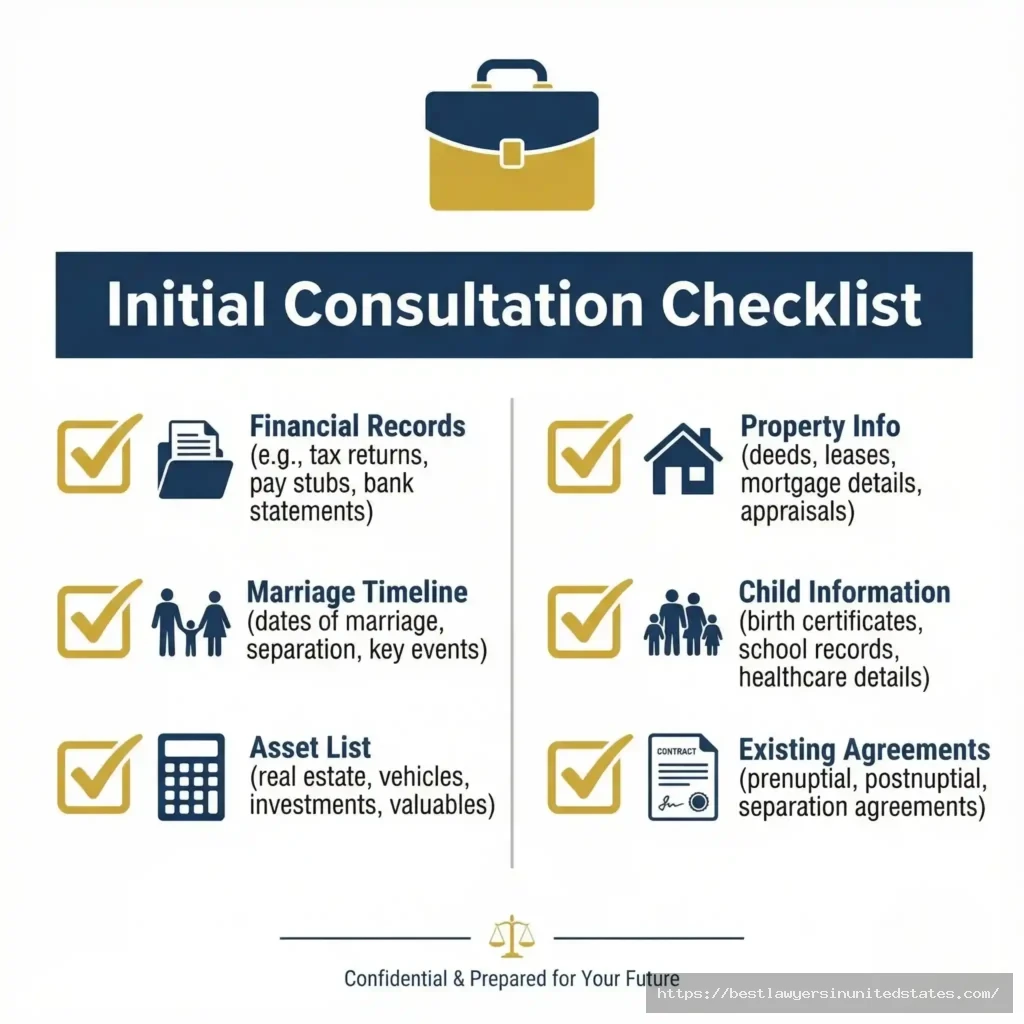
✓ Timeline of your marriage and separation ✓ List of all marital assets and values ✓ List of all marital debts ✓ Income information for both spouses ✓ Information about children (ages, special needs, custody preferences) ✓ Any existing agreements (prenuptial, postnuptial) ✓ Documentation of domestic violence or abuse (if applicable) ✓ Questions for the attorney ✓ Notepad for taking notes
Evaluating Attorneys
Compare multiple attorneys before deciding. Consider:
Communication Style Do they explain legal concepts clearly? Do they listen to your concerns? Do they return calls and emails promptly?
Strategy and Approach Are they aggressive litigators or settlement-focused? Does their approach match your goals?
Availability Will the attorney personally handle your case or delegate to associates? How accessible are they for questions?
Fee Structure Are fees clearly explained? Do they seem reasonable for your area? Are payment plans available?
Personality Fit Divorce is stressful and personal. You need an attorney you trust and feel comfortable working with over many months.
Experience with Cases Like Yours Have they handled divorces with similar issues (custody disputes, business valuation, high-conflict spouses, etc.)?
Special Considerations for Complex Divorces
Certain divorce situations require additional planning and potentially higher attorney fees.
Military Divorce
Military divorces involve unique issues:
- 10-year rule for military pension division
- Servicemembers Civil Relief Act (SCRA) protections
- Jurisdiction questions when spouses live in different states
- Tricare benefits continuation
- BAH and military allowances
- Deployment considerations
Additional costs: Expect 20-40% higher attorney fees due to specialized knowledge required.
High-Net-Worth Divorce
Divorces involving significant assets require:
- Multiple business valuations
- Complex property division strategies
- Tax planning and QDRO preparation
- Forensic accounting to find hidden assets
- International asset tracing
- Trust and estate considerations
Additional costs: Expert witness fees of $20,000-$100,000+ common, attorney fees often exceed $50,000-$150,000 per spouse.
Divorces Involving Domestic Violence
When domestic violence exists, additional protections and costs include:
- Emergency protective orders
- Supervised visitation arrangements
- Safety planning
- Relocation considerations
- Therapy and evaluation costs
Resources: Most states have domestic violence legal aid programs providing free representation to abuse victims regardless of income.
International Divorce
When spouses live in different countries or have assets abroad:
- Hague Convention considerations
- International service of process ($500-$2,000+)
- Foreign asset discovery
- Currency exchange implications
- Enforceability of judgments across borders
Additional costs: 50-100% higher attorney fees, often requiring attorneys licensed in multiple jurisdictions.
Post-Divorce Modification Costs
Your relationship with divorce attorneys may not end at final judgment. Future modifications may require legal assistance.
When Modifications Are Necessary
Common reasons for post-divorce modifications:
- Job loss or significant income changes
- Relocation requiring custody modifications
- Child’s changing needs (medical, educational, special needs)
- Remarriage affecting alimony
- Non-compliance with court orders
Modification Costs
Uncontested modifications: $1,500-$5,000 Both parties agree to changes; attorney drafts modified agreement and submits to court.
Contested modifications: $5,000-$20,000+ One party objects; requires motion practice, hearings, or trial to modify original orders.
Enforcement Costs
If your ex-spouse violates the divorce decree:
Contempt proceedings: $2,500-$10,000 Court action to enforce compliance with existing orders.
Wage garnishment setup: $500-$2,000 Establishing automatic deduction for child support or alimony.
Asset seizure/liens: $1,000-$5,000 Legal action to collect unpaid support through property liens or asset seizure.
State-by-State Attorney Fee Comparison Table
Quick reference for planning your divorce budget based on location:
| Cost Tier | States | Average Hourly Rate | Typical Total Cost (Uncontested) | Typical Total Cost (Contested) |
|---|---|---|---|---|
| Very High | CA, NY, NJ, MA, CT, HI | $300-$500/hour | $7,000-$12,000 | $25,000-$50,000+ |
| High | IL, PA, FL, TX, WA, MD, VA, CO, AZ | $250-$400/hour | $5,000-$9,000 | $18,000-$35,000 |
| Moderate | OH, GA, NC, MI, MN, OR, NV, WI | $200-$350/hour | $4,000-$7,000 | $15,000-$28,000 |
| Low | AL, AR, IN, IA, KS, KY, MS, MO, NE, OK, TN, WV | $150-$300/hour | $3,000-$6,000 | $12,000-$22,000 |
Note: These are averages. Urban areas within any state command higher rates than rural regions.
Red Flags: When to Fire Your Divorce Attorney
Sometimes changing attorneys becomes necessary despite the cost and disruption. Watch for these warning signs:

Ethical Violations
Fire your attorney immediately if they:
- Suggest hiding assets or lying to the court
- Make romantic or sexual advances
- Misappropriate client funds
- Fail to communicate material case developments
- Represent conflicting interests without disclosure
Report ethical violations to your state bar association.
Competence Issues
Consider changing attorneys if they:
- Miss court deadlines repeatedly
- Seem unfamiliar with family law basics
- Fail to return calls or emails for weeks
- Don’t prepare adequately for hearings
- Make repeated procedural errors
- Don’t know judges or local court rules
Communication Problems
While not necessarily grounds for immediate termination, poor communication may warrant change:
- Never available or responsive
- Speaks down to you or dismisses your concerns
- Bills excessive time for routine communications
- Delegates everything without your knowledge
- Doesn’t explain legal strategy or options
Billing Disputes
Red flags in billing practices:
- Vague or incomplete billing statements
- Charges for work not performed
- Excessive charges for administrative tasks
- Surprise bills for undisclosed costs
- Refuses to provide detailed billing
How to Change Attorneys
If you decide to change lawyers:
- Don’t fire your current attorney until you’ve hired a new one—gaps in representation can harm your case
- Notify your current attorney in writing of termination
- Request your complete file (you’re entitled to it)
- Settle any outstanding balance or work out payment arrangements
- File a substitution of attorney with the court
- Transfer knowledge seamlessly to your new attorney
Expect the new attorney to spend 5-15 hours reviewing your file, which you’ll pay for. Despite this cost, changing attorneys is sometimes necessary.
Final Thoughts: Making Smart Financial Decisions During Divorce
Divorce attorney fees represent a significant expense, but they’re an investment in protecting your financial future. Making smart decisions now can save you tens of thousands of dollars and years of future complications.
Budget Realistically
Use the information in this guide plus consultations with local attorneys to create a realistic divorce budget. Include:
- Attorney retainer and estimated total fees
- Filing and court costs
- Expert witness fees (if needed)
- Mediation or evaluation costs
- Temporary living expenses during divorce
- Moving costs
- Individual therapy or counseling
Build a 20-30% cushion for unexpected costs—divorces rarely go exactly as planned.
Prioritize What Matters
Focus your attorney’s time (and your money) on issues that truly matter:
High priority: Child custody arrangements, fair property division, adequate support payments, protecting retirement assets
Low priority: Specific household items, “winning” against your spouse, blame or fault issues in no-fault states
The emotional satisfaction of “beating” your spouse in court costs far more than any victory is worth.
Think Long-Term
Decisions you make now affect your financial future for decades. Spending more on quality legal advice today can prevent costly mistakes that impact you forever.
A poorly drafted settlement might save $2,000 in attorney fees now but cost you $50,000 in lost retirement benefits over your lifetime. A rushed custody agreement might require expensive modifications later.
Quality legal representation is expensive, but inadequate representation costs more.
Protect Your Credit and Finances
During divorce:
- Close joint credit cards and open individual accounts
- Monitor credit reports for unauthorized activity
- Document all marital assets and debts
- Keep detailed records of all divorce-related expenses
- Don’t hide assets (penalties are severe)
- Follow all temporary court orders regarding finances
Take Care of Your Mental Health
The stress of divorce combined with financial strain takes a toll. Invest in:
- Individual therapy or counseling
- Divorce support groups
- Financial planning assistance
- Healthy stress management activities
Your mental health affects your decision-making during divorce. Poor decisions made under extreme stress can be financially devastating.
Resources for Additional Help
National Organizations:
- American Bar Association Family Law Section: www.americanbar.org/family
- Legal Services Corporation: www.lsc.gov (find local legal aid)
- National Domestic Violence Hotline: 1-800-799-7233
Financial Resources:
- Certified Divorce Financial Analysts: Institute for Divorce Financial Analysts
- Financial Planning Association: www.plannersearch.org
State Resources:
- Your state bar association website
- State court self-help centers
- County law libraries (free legal research assistance)
Conclusion
Divorce attorney fees vary dramatically based on your location, case complexity, and choices throughout the process. While costs range from $3,000 for simple uncontested divorces to $50,000+ for complex contested cases, understanding what drives these costs empowers you to make informed decisions.
