
Filing for divorce without a lawyer—called a DIY or pro se divorce—can save you thousands of dollars if your situation qualifies. This comprehensive guide covers everything you need to know about DIY divorce across all 50 states, including exact costs, step-by-step filing instructions, and when you should reconsider going solo.
Quick Answer: A DIY divorce typically costs $200-$500 in most states, covering filing fees, service of process, and notary costs. You can file without a lawyer if both spouses agree on all terms, have no minor children (or a complete custody agreement), and minimal assets to divide.
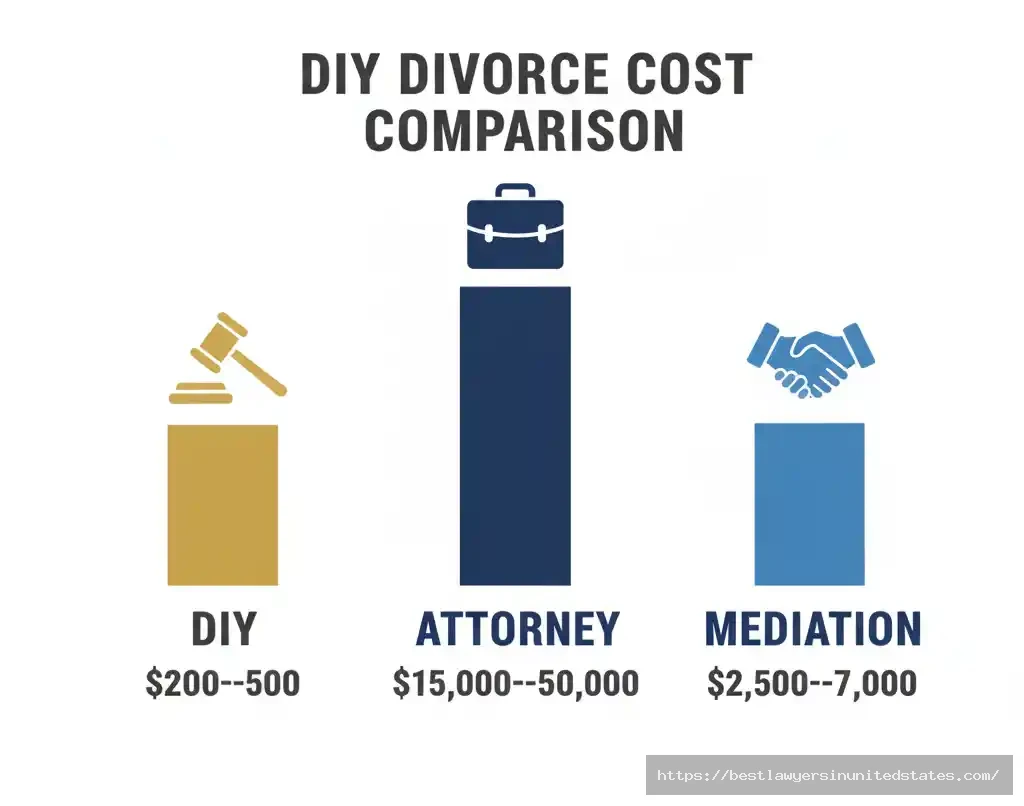
How Much Does a DIY Divorce Cost?
The cost of handling your own divorce varies significantly by state, but here’s what you can expect:
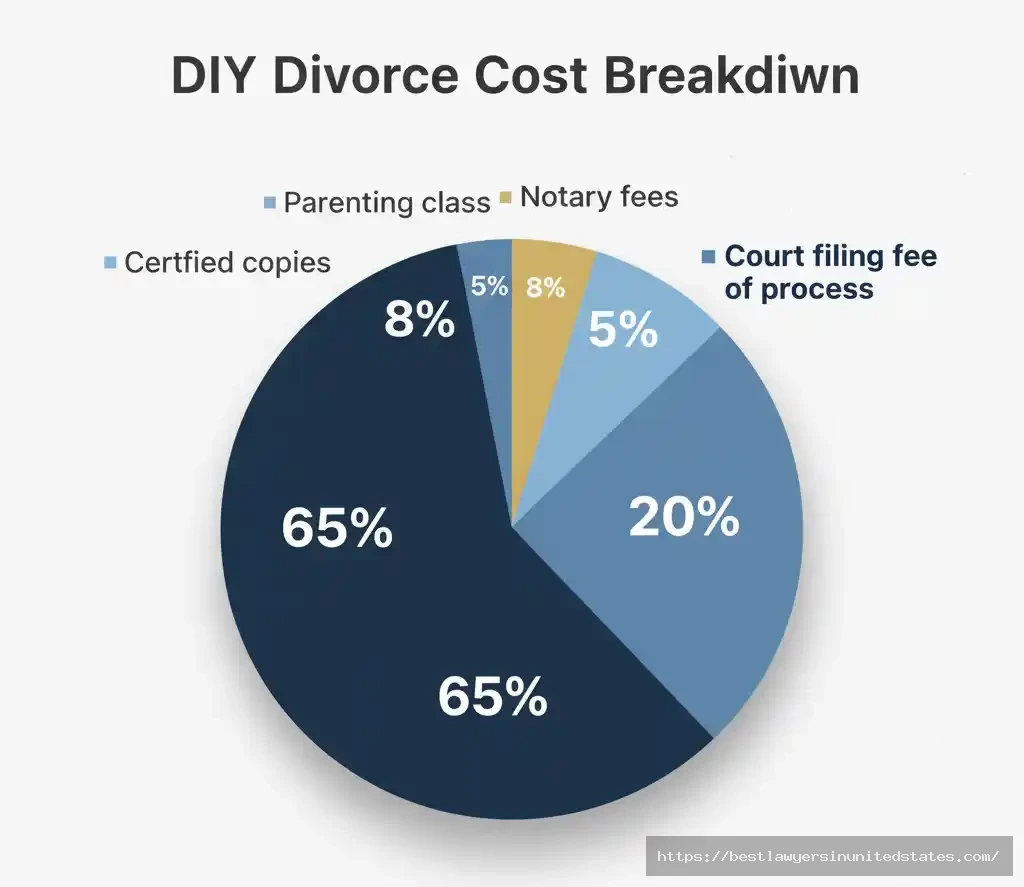
Average DIY Divorce Costs by Component:
| Cost Item | Price Range | Notes |
|---|---|---|
| Court filing fee | $150-$435 | Varies by state and county |
| Service of process | $40-$150 | Sheriff, certified mail, or process server |
| Notary fees | $10-$25 per signature | Multiple documents may need notarization |
| Certified copies of decree | $5-$25 each | Most people need 2-3 copies |
| Parenting class (if required) | $20-$75 | Only in states/counties that mandate it |
| Total DIY cost | $200-$500 | Assumes uncontested, simple divorce |
Compare this to traditional divorce costs:
- Uncontested divorce with attorney: $1,500-$5,000
- Contested divorce with attorney: $15,000-$50,000+
- Divorce mediation: $2,500-$7,000
Divorce Cost Calculator
Get an estimated cost for your divorce based on your specific situation
Your Estimated Divorce Cost
Cost Breakdown
📧 Get a Personalized Consultation
Have questions about your specific situation? Contact our legal experts for guidance tailored to your needs.
Contact Us via EmailAre DIY Divorces Legal in All States?
Yes. Every U.S. state allows you to represent yourself in divorce proceedings—this is called proceeding “pro se” (for yourself). The Sixth Amendment doesn’t apply to civil cases, but state constitutions universally protect the right to self-representation in family court.
However, legal doesn’t always mean advisable. Family courts expect pro se litigants to follow the same procedural rules as licensed attorneys, which trips up many DIY filers.
Can You File for Divorce Without a Lawyer?
Absolutely, but only if your situation meets these criteria:

✅ You CAN file DIY if:
- Both spouses agree to the divorce
- You agree on property division, debt allocation, and spousal support (if any)
- No minor children, OR you have a complete parenting plan both agree to
- Combined marital assets under $100,000
- No business ownership or complex retirement accounts
- Neither spouse is hiding assets
- No history of domestic violence
- Both parties can communicate civilly
❌ You should NOT file DIY if:
- Your spouse contests the divorce
- Significant assets (over $100,000) or complex property division
- Business ownership, stock options, or military pensions
- One spouse has been financially controlling
- Custody disagreements
- History of abuse or manipulation
- International custody concerns
- Prenuptial agreement disputes
For borderline cases, consider a limited-scope attorney consultation ($200-$500) to review your DIY paperwork before filing.
What Is a DIY Divorce vs. Simplified Dissolution?
DIY Divorce (Pro Se): You handle a standard divorce yourself, filing all the same forms an attorney would file. Available in all 50 states for any divorce type.
Simplified Dissolution: A streamlined divorce option available in 15 states (including Arizona, California, Florida) with strict eligibility requirements—typically no children, married less than 5 years, and minimal assets (often under $50,000).
Key Difference: Simplified dissolution uses fewer forms and faster timelines, but DIY divorce is more widely available since it doesn’t have asset caps.
States offering simplified dissolution: Alaska, Arizona, California, Colorado, Florida, Illinois, Indiana, Kentucky, Montana, Nevada, Oregon, Tennessee, Washington, Wisconsin
DIY Divorce Cost Breakdown by State
Filing fees vary dramatically by state and even by county. Here’s a snapshot of DIY divorce costs in high-volume search states:
| State | Filing Fee Range | Average Total DIY Cost | Fee Waiver Available? |
|---|---|---|---|
| California | $435-$450 | $550-$700 | Yes |
| Texas | $250-$350 | $350-$500 | Yes |
| Florida | $409 (standard) | $500-$650 | Yes |
| New York | $210-$335 | $350-$500 | Yes |
| Michigan | $175-$230 | $300-$450 | Yes |
| Pennsylvania | $300-$350 | $400-$550 | Yes |
| Illinois | $210-$388 | $350-$550 | Yes |
| Ohio | $175-$350 | $300-$500 | Yes |
| Georgia | $200-$400 | $350-$550 | Yes |
| North Carolina | $225 | $350-$475 | Yes |
For detailed state-specific costs, see:
- California divorce cost guide
- Texas divorce costs
- Florida divorce filing fees
- New York divorce expenses
- Michigan divorce costs
Pro Tip: Most states allow fee waivers if your household income falls below 125-150% of the federal poverty line. Ask the court clerk for Form IFP (In Forma Pauperis) or “Application to Waive Court Fees.”
How to File for DIY Divorce: 8-Step Process
Here’s the complete process for handling your own divorce, from initial paperwork to final decree:
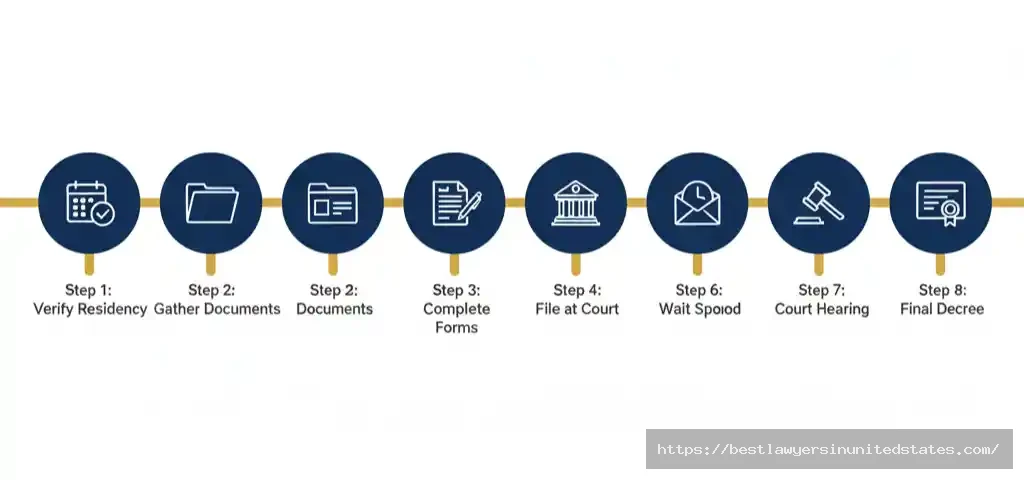
Step 1: Verify You Meet State Residency Requirements
Every state requires at least one spouse to have lived in the state for a minimum period before filing:
Residency Requirements by State:
- 6 months: California, Florida, Michigan, New York, Texas
- 3 months: Illinois, Pennsylvania
- 90 days: North Carolina
- 60 days: Georgia
- No requirement: Alaska, South Dakota, Washington
Most states also require filing in the county where you or your spouse currently lives.

Step 2: Gather Required Information and Documents
Before touching any forms, compile:
Personal Information:
- Full legal names (including maiden names)
- Social Security numbers
- Current addresses
- Marriage date and location
- Separation date (if applicable)
- Children’s names, birthdates, SSNs
Financial Documentation:
- Last 3 months of pay stubs (both spouses)
- Previous year’s tax returns
- Bank statements (all accounts)
- Credit card statements
- Mortgage documents and property deeds
- Car titles and loan statements
- Retirement account statements (401k, IRA, pension)
- Life insurance policies
- Business ownership documents (if applicable)
Step 3: Obtain State-Specific Divorce Forms
Most state courts provide free DIY divorce forms online. Search “[Your State] court divorce forms pro se” or visit:
Where to Find Forms:
- State supreme court website (judicial branch)
- County clerk of court website
- Court self-help centers (in-person assistance available)
Essential Forms You’ll Need:
- Petition for Dissolution of Marriage (or Complaint for Divorce)
- Summons
- Financial Affidavit (Income and Expense Declaration)
- Marital Settlement Agreement (if uncontested)
- Child Custody and Visitation Plan (if applicable)
- Child Support Worksheet (if applicable)
- Final Judgment of Dissolution
State-Specific Form Resources:
- California: FL-100 series forms
- Texas: Texas Law Help DIY Divorce Program
- Florida: Family Law Form 12.901 series
- New York: Uncontested Divorce Packet (UD-1 through UD-11)
Step 4: Complete Forms Accurately
This is where most DIY divorces fail. Courts can reject your petition for:
- Missing signatures
- Incorrect filing fees
- Incomplete financial disclosures
- Math errors in child support calculations
- Inconsistent information across forms
Form Completion Tips:
- Use black ink only (if filing paper forms)
- Type forms when possible for legibility
- Make photocopies before signing originals
- Double-check Social Security numbers
- Calculate child support using your state’s official calculator
- List ALL assets and debts, even if small
- Have forms notarized where required BEFORE filing
Common Errors to Avoid:
- Listing only separate property (must disclose marital AND separate property)
- Forgetting to divide retirement accounts (requires QDRO)
- Vague custody language (“reasonable visitation” is not specific enough)
- Not accounting for tax implications (who claims kids as dependents?)
Step 5: File Papers With the Court Clerk
Take your completed forms to the clerk of court in the county where you or your spouse lives.

What to Bring:
- Original documents (2-3 copies)
- Filing fee payment (cash, money order, or credit card—check local rules)
- Government-issued photo ID
- Self-addressed stamped envelope (for court to mail you documents)
Filing Process:
- Clerk reviews forms for completeness
- You pay filing fee (or submit fee waiver application)
- Clerk file-stamps your documents
- You receive a case number
- Court keeps originals; you keep file-stamped copies
Important: The clerk cannot give legal advice but can tell you if forms are missing or incorrectly filled out.
Step 6: Serve Divorce Papers on Your Spouse

After filing, you must legally notify your spouse by “serving” them with copies of your petition. You CANNOT serve the papers yourself—it must be done by:
Service Methods (Choose One):
- Sheriff’s Department: $40-$75
- Most official method
- Sheriff delivers papers and completes affidavit of service
- Private Process Server: $50-$150
- Faster than sheriff
- Professional process servers track down evasive spouses
- Certified Mail, Return Receipt: $10-$15
- Cheapest method
- Only works if spouse will sign for mail
- Not accepted in all states for divorce
- Personal Service (by friend/relative over 18): Free
- Allowed in some states
- Server must complete affidavit
- Cannot be you or anyone living with you
Your spouse typically has 20-30 days to respond after being served. If they don’t respond, you can request a default judgment.
Step 7: Wait Out the Mandatory Waiting Period
Most states impose a “cooling-off period” between filing and finalization:
State Waiting Periods:
- 6 months: California, Iowa
- 90 days: Michigan, North Carolina
- 60 days: Arizona, Florida, Texas, Washington
- 30 days: Georgia, Illinois, Ohio
- No waiting period: Nevada (with joint petition)
You cannot finalize your divorce before this period expires, even if both parties are ready.
Step 8: Attend the Final Hearing
If your divorce is uncontested, the final hearing is brief (10-20 minutes). Only one spouse needs to appear in some states if both signed the agreement.

What to Expect at Your Hearing:
Before the hearing:
- Arrive 15 minutes early
- Dress professionally (business casual minimum)
- Bring file-stamped copies of all documents
- Bring photo ID
- Silence your phone
During the hearing:
- Judge reviews your settlement agreement
- You’ll be sworn in
- Judge asks standard questions about residency, assets, children
- Judge confirms you understand the agreement
Sample Questions Judges Ask:
- “Have you been a resident of this state for at least [X] months?”
- “Is this marriage irretrievably broken with no hope of reconciliation?”
- “Did you fully disclose all assets and debts?”
- “Do you understand this agreement is binding?”
- “Is anyone forcing you to agree to these terms?”
After the hearing:
- Judge signs the final decree
- Decree is filed with the court (usually same day)
- You request certified copies ($5-$25 each)
- Your divorce is official once the decree is filed
Processing Time: Final decree typically arrives by mail 2-4 weeks after your hearing.
What If You Can’t Afford Court Filing Fees?
Every state offers fee waivers for low-income filers. Here’s how to qualify:
Typical Fee Waiver Eligibility:
- Income below 125-150% of federal poverty line
- Receiving public assistance (SNAP, TANF, SSI)
- Demonstrable financial hardship
How to Apply:
- Request “Application for Fee Waiver” or “In Forma Pauperis” form from court clerk
- Complete financial disclosure (income, expenses, assets)
- Provide proof: pay stubs, benefits letters, tax returns
- File with your divorce petition
- Judge reviews and grants/denies (usually within 3-5 days)
If approved, you pay $0 for filing, service, and certified copies. If denied, you must pay within 10-14 days or your case is dismissed.
State-Specific DIY Divorce Requirements (Top 10 States)
Each state has unique requirements. Here are details for the highest-search-volume states:
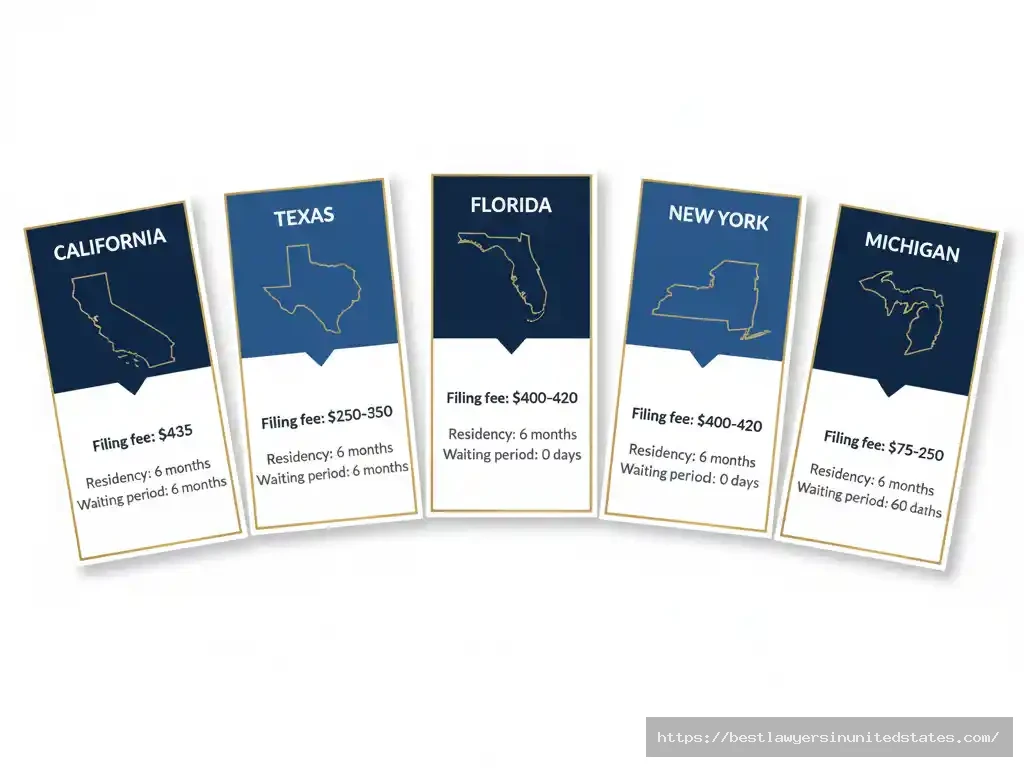
California DIY Divorce
Filing Fee: $435
Residency: 6 months in California, 3 months in county
Waiting Period: 6 months from service date
Forms: FL-100 series (Petition, Summons, Response, Settlement Agreement)
Simplified Option: Yes (under $49,000 assets, married under 5 years, no kids)
Special Notes: California is community property state—all marital assets split 50/50 unless agreed otherwise
Full California divorce cost breakdown
Texas DIY Divorce
Filing Fee: $250-$350 (by county)
Residency: 6 months in Texas, 90 days in county
Waiting Period: 60 days from filing date
Forms: Available through Texas Law Help or county district clerk
Simplified Option: No (but uncontested is straightforward)
Special Notes: Texas requires “Waiver of Service” if spouse agrees, or formal service by constable/process server
Complete Texas divorce filing guide
Florida DIY Divorce
Filing Fee: $409 standard
Residency: 6 months in Florida
Waiting Period: 20 days (if both parties agree)
Forms: Family Law Form 12.901 series
Simplified Option: Yes (Simplified Dissolution—no kids, no real property, no alimony)
Special Notes: Both parties must appear together at final hearing for simplified dissolution
Florida divorce costs by county
New York DIY Divorce
Filing Fee: $210 (upstate) to $335 (NYC)
Residency: Either you or spouse lived in NY for 1 year (or 2 years if married in NY)
Waiting Period: None (but processing takes 3-4 months minimum)
Forms: Uncontested Divorce Packet (UD-1 through UD-11)
Simplified Option: No
Special Notes: NY requires “sworn statement of removal of barriers to remarriage” in most cases
New York City divorce filing costs
Michigan DIY Divorce
Filing Fee: $175-$230 (by county)
Residency: 180 days in Michigan, 10 days in county
Waiting Period: 60 days (no kids) or 180 days (with kids)
Forms: Available at county clerk or Michigan Legal Help
Simplified Option: No
Special Notes: Friend of the Court involvement required if minor children (reviews custody and support)
Michigan divorce process and costs
Pennsylvania DIY Divorce
Filing Fee: $300-$350
Residency: 6 months in Pennsylvania
Waiting Period: 90 days for mutual consent divorce
Forms: Available through PA Courts website
Simplified Option: No, but “mutual consent” divorce is streamlined
Special Notes: Must complete “divorce education” class if minor children
Pennsylvania divorce filing fees
Illinois DIY Divorce
Filing Fee: $210-$388 (by county)
Residency: 90 days in Illinois
Waiting Period: None if both parties agree
Forms: Illinois Supreme Court website
Simplified Option: Joint Simplified Dissolution (married under 8 years, no kids, under $50K assets)
Special Notes: Both parties must attend parenting class if children under 18
Illinois divorce costs by county
Ohio DIY Divorce
Filing Fee: $175-$350 (by county)
Residency: 6 months in Ohio
Waiting Period: 30-90 days (by county)
Forms: Ohio Supreme Court Self-Help Center
Simplified Option: No
Special Notes: Dissolution (both parties file together) is faster than divorce (one files, one responds)
Georgia DIY Divorce
Filing Fee: $200-$400 (by county)
Residency: 6 months in Georgia
Waiting Period: 31 days minimum
Forms: Georgia Superior Court website
Simplified Option: No
Special Notes: Cannot file if wife is pregnant—must wait until after birth
Georgia divorce costs by county
North Carolina DIY Divorce
Filing Fee: $225
Residency: 6 months in North Carolina
Waiting Period: Must be separated for 1 year before filing
Forms: NC Judicial Branch website
Simplified Option: No
Special Notes: NC requires 1 year separation before divorce—longest waiting period in U.S.
North Carolina divorce requirements
10 Costly DIY Divorce Mistakes (and How to Avoid Them)
Even simple divorces can have expensive mistakes. Here are the most common errors and their solutions:

1. Forgetting to Divide Retirement Accounts
The Mistake: Your settlement says “each party keeps their own retirement accounts” without specifying that contributions during marriage are marital property.
The Cost: In a 15-year marriage with a $200,000 401(k), you could forfeit $50,000+ of marital value.
How to Avoid: Retirement accounts accrued during marriage are marital property in all states. You need a QDRO (Qualified Domestic Relations Order) to split them without tax penalties. Consult an attorney for QDRO preparation ($500-$1,500) even if doing DIY divorce.
2. Incomplete Financial Disclosure
The Mistake: Not listing small bank accounts, forgetting to disclose credit card debt, or omitting a storage unit with belongings.
The Cost: Judge can set aside the entire divorce and order you to start over. If spouse discovers hidden assets later, they can reopen the divorce for fraud.
How to Avoid: Disclose EVERYTHING—even if you think it’s insignificant. Get a free credit report to find all accounts in your name. If you intentionally hide assets, it’s perjury.
3. Vague Custody Language
The Mistake: Agreement says “Mom has primary custody” or “reasonable visitation” without specific schedules.
The Cost: Back to court within 6 months arguing about what “reasonable” means ($5,000+ in attorney fees).
How to Avoid: Specify exact schedules:
- “Father has children every other weekend from Friday 6pm to Sunday 6pm”
- “Mother has children Monday-Friday during school year”
- “Parents alternate holidays on even/odd years per attached schedule”
- Define how holidays, vacations, and schedule changes are handled
4. Filing in the Wrong County
The Mistake: Filing in the county where you got married instead of where you currently live.
The Cost: Dismissal of your case and loss of filing fee ($200-$400).
How to Avoid: File in the county where you OR your spouse currently resides. Most states require residence in that county for 10-90 days before filing.
5. Improper Service of Process
The Mistake: Handing papers to your spouse yourself, or having your teenage son serve them.
The Cost: Service is invalid—your case cannot proceed. Must re-serve properly (another $50-$150).
How to Avoid: Use sheriff, process server, or certified mail return receipt. You cannot serve papers yourself. Server must be over 18 and not a party to the case.
6. Not Addressing Tax Implications
The Mistake: No agreement on who claims children as dependents, or splitting a house without considering capital gains.
The Cost: IRS dispute when both parents claim kids, or $20,000 surprise tax bill.
How to Avoid:
- Specify which parent claims kids (often alternates by year)
- If selling house, understand capital gains exclusion ($250K single, $500K married)
- Alimony paid is no longer tax-deductible (as of 2019 divorces)
- Consult a CPA before finalizing agreement
7. Keeping Joint Accounts Open
The Mistake: Final decree says you’re divorced, but you still have joint credit cards and bank accounts.
The Cost: Ex-spouse runs up $15,000 on joint credit card—you’re legally liable for half.
How to Avoid:
- Close all joint credit cards before filing
- Open individual bank accounts
- Refinance house to remove ex from mortgage
- Update beneficiaries on life insurance, retirement accounts
- Remove ex as authorized user on all accounts
8. Rushing the Settlement Agreement
The Mistake: Signing agreement without understanding long-term implications because you just want it over.
The Cost: Giving up $50,000 in home equity because you didn’t know what it was worth.
How to Avoid:
- Get appraisals on house, cars, collectibles
- Review retirement account statements
- Calculate actual value of pensions (not just current balance)
- Sleep on the agreement for 48 hours before signing
- Consider a $500 attorney consultation to review
9. Ignoring Debts
The Mistake: Agreement doesn’t mention the $30,000 in credit card debt acquired during marriage.
The Cost: Creditors will pursue both of you regardless of divorce agreement. If ex doesn’t pay, your credit is ruined.
How to Avoid:
- List every debt in settlement agreement
- Assign responsibility for each debt
- Understand that creditors aren’t bound by divorce decree—they can still pursue either spouse
- Consider refinancing debts in one name only before divorce finalized
10. Missing Court Deadlines
The Mistake: Not filing response within 30 days, or missing your scheduled hearing date.
The Cost: Default judgment against you (you automatically lose), or case dismissal (start over and pay filing fee again).
How to Avoid:
- Write every deadline in multiple places (phone, calendar, sticky note)
- Set reminders 7 days AND 1 day before deadlines
- If you’ll miss a deadline, file a motion for extension
- Always appear at scheduled hearings—judges don’t reschedule easily
When DIY Divorce Is a Bad Idea
Even if you technically CAN file DIY, you shouldn’t if any of these apply:
High-Conflict Red Flags
- Spouse is vindictive or threatening
- History of domestic violence or abuse
- Spouse is hiding assets or income
- You fear retaliation for filing
- Spouse has already hired an attorney
- Spouse refuses to cooperate or communicate
Why it matters: These cases require protective orders, forensic accountants, and aggressive advocacy. You cannot adequately protect yourself pro se.
Alternative: Hire an attorney. Many offer payment plans or sliding scale fees.
Complex Financial Situations
- Combined assets over $500,000
- Business ownership by either spouse
- Stock options, deferred compensation, or unvested equity
- Multiple properties or rental income
- Inheritance or trust funds involved
- One spouse has significantly higher income ($150K+ difference)
- Professional licenses or practices (doctors, lawyers)
Why it matters: Asset valuation, tax implications, and equitable distribution require expertise. Mistakes cost tens of thousands.
Alternative: Hire an attorney experienced in high-asset divorce, or at minimum use divorce mediation with financial neutral.
Child Custody Disputes
- Parents disagree on custody arrangement
- One parent wants to relocate out of state
- Substance abuse or mental health concerns
- Child expresses preference for one parent
- Domestic violence involving children
- Special needs child requiring detailed care plan
Why it matters: Custody agreements affect your child for years. Poor language now = back to court repeatedly.
Alternative: Hire a family law attorney or use professional mediation. Child custody is the one area you cannot afford to get wrong.
Legal Complexities
- Military divorce (special rules apply)
- International custody issues
- Spouse in another country
- Prenuptial or postnuptial agreement in place
- Alimony dispute
- One spouse is incarcerated
Why it matters: These situations have unique legal rules that pro se litigants routinely mishandle.
Alternative: Limited-scope representation—attorney handles the complex parts, you handle routine filings. Costs $1,500-$3,000 vs. $15,000 for full representation.
DIY Divorce vs. Mediation vs. Attorney: Which Should You Choose?
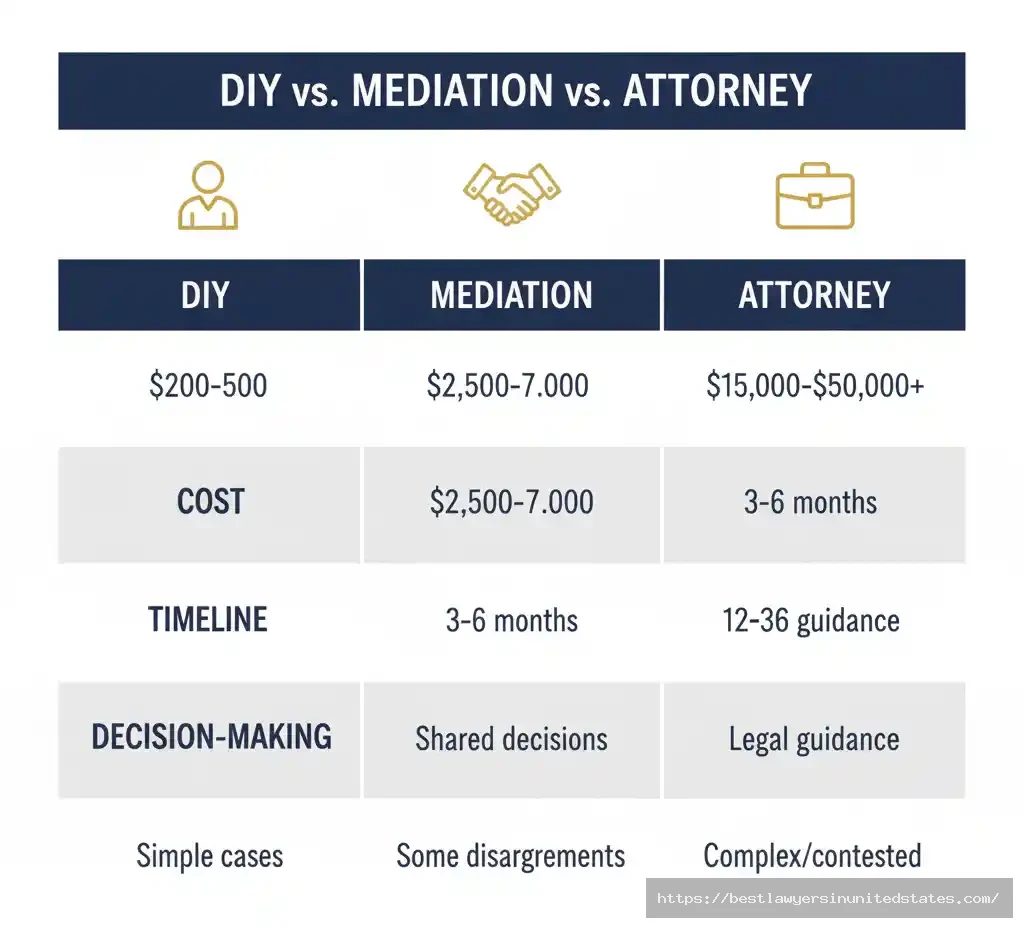
Still unsure which path is right? Here’s a detailed comparison:
| Factor | DIY Divorce | Mediation | Full Attorney Rep |
|---|---|---|---|
| Cost | $200-$500 | $2,500-$7,000 | $15,000-$50,000+ |
| Best for | Simple, amicable, no disagreements | Some disagreements on custody/assets | High-conflict, complex, contested |
| Timeline | 3-6 months | 3-6 months | 12-36 months |
| Your control | Complete | Shared (mediator facilitates) | Attorney advises, you decide |
| Court appearances | 1 (final hearing) | 1 (final hearing after agreement) | Multiple (hearings, motions, trial) |
| Emotional support | None | Moderate | High |
| Asset division complexity | Simple only | Moderate | Can handle anything |
| Risk of mistakes | High | Low | Very low |
| If spouse hires attorney | You’re at major disadvantage | Balanced (mediator is neutral) | Level playing field |
When to Choose DIY Divorce
✅ Both spouses fully agree on everything
✅ Combined assets under $100,000
✅ No children, or complete agreement on custody
✅ Communication is civil and productive
✅ You’re comfortable with legal paperwork
✅ Neither spouse earns substantially more
✅ No hidden assets or trust issues
When to Choose Mediation
✅ Minor disagreements on custody or assets
✅ Want to avoid court battle
✅ Need help calculating fair division
✅ One spouse less financially knowledgeable
✅ Want to keep legal costs under $10,000
✅ Children involved and want co-parenting plan
Learn more: How much does divorce mediation cost?
When to Hire an Attorney
✅ Spouse already has attorney
✅ High conflict or abuse
✅ Complex assets (business, stock options, multiple properties)
✅ Custody dispute
✅ Spouse hiding assets
✅ You feel overwhelmed or intimidated
✅ You want someone to fight for your interests
See: Cost of divorce lawyer (complete guide)
What Is a Silent Divorce?
A “silent divorce” isn’t a legal term—it refers to couples who emotionally separate but continue living together and stay legally married. They function as roommates rather than spouses.
Why people choose silent divorce:
- Can’t afford two households
- Staying together “for the kids”
- Religious objections to divorce
- Health insurance coverage
- Immigration status concerns
Legal problems with silent divorces:
- Assets acquired post-separation may still be marital property
- Inheritance rights remain (your “ex” inherits if you die)
- Tax filing complications
- Cannot remarry
- Unclear child custody if one parent moves out later
Better alternative: File for legal separation. You’re still married but have court orders on custody, support, and asset division. Can convert to divorce later.
Understanding the 10-10-10 Rule for Divorce
The “10-10-10 rule” applies to military divorces and determines if a former spouse can receive direct retirement payments:
The 10-10-10 Rule Requirements:
- Married for at least 10 years
- Service member performed at least 10 years of creditable military service
- At least 10 years of marriage overlapped with 10 years of service
What it means: If you meet 10-10-10, the Defense Finance and Accounting Service (DFAS) will pay your share of military retirement directly to you. If you don’t meet 10-10-10, you still get your share, but your ex must pay you directly (less reliable).
20/20/20 Rule: If married 20 years, member served 20 years, and 20 years overlap, former spouse retains military benefits (healthcare, commissary).
Military divorces are complex—consult a military divorce attorney even if filing DIY.
What Money Is Untouchable in Divorce?
Generally, these assets remain separate property and aren’t divided:
Separate Property (Not Divided):
- Assets owned before marriage
- Inheritance received by one spouse (even during marriage)
- Gifts given to one spouse specifically
- Personal injury settlements (for pain and suffering portion)
- Property designated as separate in a prenup
- Assets acquired after legal separation (in some states)
HOWEVER: Separate property can become marital property through:
- Commingling: Depositing inheritance in joint account
- Transmutation: Putting spouse’s name on deed to pre-marital house
- Appreciation: Separate property house increases $100K during marriage—that $100K may be marital
Community Property vs. Equitable Distribution:
- Community property states (9 states including CA, TX): Marital assets split 50/50
- Equitable distribution states (41 states): Marital assets split “fairly” (not always 50/50)
Protect separate property by:
- Keeping inheritance in separate account (don’t commingle)
- Not using marital funds for mortgage on pre-marital house
- Getting prenuptial or postnuptial agreement
- Keeping documentation proving source of funds
Common DIY Divorce Questions Answered
Can you get a divorce without a lawyer?
Yes, in all 50 states. Called “pro se” (representing yourself) or DIY divorce. You file the same forms an attorney would file but handle all paperwork yourself. Best for uncontested divorces with no children and minimal assets. Expect to pay $200-$500 in court fees.
What is the cheapest way to get divorced?
DIY divorce is cheapest at $200-$500 if both spouses agree on all terms. If you need help but want to save money:
- DIY with forms: $200-$500 (cheapest)
- Online divorce service: $300-$1,500 (they prepare forms)
- Mediation: $2,500-$7,000 (third party helps you agree)
- Unbundled legal services: $1,500-$3,000 (attorney handles specific parts)
- Full attorney representation: $15,000-$50,000+ (most expensive)
How long does a DIY divorce take?
3-6 months on average, depending on:
- State waiting period: 0-6 months from filing to finalization
- Court backlog: Varies by county (urban courts slower)
- Spouse cooperation: Uncontested faster than contested
- Paperwork accuracy: Errors require refiling (adds weeks)
Fastest states: Nevada (no waiting period with joint petition), Alaska (30 days)
Slowest states: California (6 months), Iowa (6 months)
Can you do a divorce without going to court?
Almost never. Even uncontested divorces typically require one final hearing where the judge reviews your agreement and issues the decree. However:
Exceptions:
- Some states allow waiver of hearing if both spouses file jointly
- During COVID, some courts allowed video hearings
- A few counties offer “default divorce” if respondent doesn’t appear
The final hearing is usually brief (10-20 minutes) and straightforward if your paperwork is in order.
What happens if my spouse won’t sign divorce papers?
You can still get divorced. Your options:
- Serve them properly: If they refuse to sign but were properly served, wait out the response period (usually 30 days). If they don’t file a response, request a default judgment.
- Default divorce: Court enters judgment in your favor because they didn’t respond. They forfeit their right to contest terms.
- Service by publication: If you can’t locate your spouse, you can publish notice in a newspaper for several weeks, then proceed with default.
You do NOT need your spouse’s permission or signature to get divorced—only to get an uncontested divorce.
Are free DIY divorce forms legitimate?
Yes, if obtained from official sources:
✅ Legitimate free forms:
- State court websites (judicial branch)
- County clerk of court websites
- State bar association sites
- Legal aid organizations
- Law school legal clinics
❌ Avoid:
- Random websites selling “free” forms (then charge for filing)
- Forms not specific to your state
- Generic templates from non-legal sites
Pro tip: Call your county clerk to verify which forms are required. Requirements change, and using outdated forms gets your petition rejected.
Can I divorce without splitting assets?
Yes, if both spouses agree in writing to waive property division. However:
Important caveats:
- Waiver must be voluntary and in writing (marital settlement agreement)
- Both parties should initial statement: “We have fully disclosed all assets and debts and voluntarily waive property division”
- Cannot waive child support (it’s the child’s right, not yours)
- Can waive spousal support (alimony) by agreement
Red flag: If one spouse is pressuring the other to waive rights, judge may reject the agreement. Courts protect against coercion.
When this makes sense:
- Very short marriage (under 1 year)
- Both parties kept finances completely separate
- No shared property was acquired during marriage
- Both have similar incomes and assets
What is an uncontested divorce program?
An “uncontested divorce program” typically refers to:
- Court self-help programs: Free assistance with DIY divorce paperwork (not legal advice)
- Online divorce services: Companies that prepare your forms for $300-$1,500
- Legal document preparers: Non-attorneys who fill out forms (regulated in some states)
These programs are designed for couples who agree on all terms but need help with paperwork. They’re cheaper than attorneys ($1,500-$5,000 saved) but offer no legal advice.
Learn more about costs: Uncontested divorce cost guide
Do I need a QDRO for retirement accounts?
Yes, if you’re dividing any retirement accounts (401k, 403b, pension, military retirement). A QDRO (Qualified Domestic Relations Order) is required to:
- Split accounts without tax penalties
- Ensure clean transfer of funds
- Protect both parties’ interests
DIY QDRO risks: This is one area where mistakes are expensive. Incorrect QDROs:
- Get rejected by plan administrator
- Trigger early withdrawal penalties (10% + income tax)
- Leave one spouse without their share
Cost of QDRO: $500-$1,500 if prepared by attorney or QDRO specialist. Worth the investment even in DIY divorce.
Exception: IRAs don’t require a QDRO—just a provision in the divorce decree specifying the transfer.
Can I change my name during divorce?
Yes, most states allow you to revert to your maiden name (or any previous legal name) as part of the divorce decree. You must:
- Request name change in your petition or settlement agreement
- Specify the exact name you’re reverting to
- Get it included in the final decree
After divorce: Take certified copy of decree to Social Security office, DMV, banks, etc. to update your name.
Note: You can only revert to a name you previously used legally—you cannot change to a completely new name through divorce (that requires separate name change petition).
Post-Divorce Action Checklist
Once your decree is final, you’re not done. Complete these tasks within 30-60 days:

Legal Updates:
- [ ] Get 3-5 certified copies of final decree
- [ ] Update your will and estate plan
- [ ] Change beneficiaries on life insurance
- [ ] Update beneficiaries on retirement accounts
- [ ] Remove ex-spouse as power of attorney
- [ ] Update healthcare proxy
Financial Tasks:
- [ ] Close joint bank accounts
- [ ] Remove ex as authorized user on credit cards
- [ ] Cancel joint credit cards
- [ ] Open accounts in your name only
- [ ] Update billing addresses on all accounts
- [ ] Establish your own credit (if you had joint credit only)
- [ ] Refinance house if you kept it (remove ex from mortgage)
Legal Documents:
- [ ] Change name with Social Security (if applicable)
- [ ] Get new driver’s license with updated name/address
- [ ] Update passport
- [ ] Update car title and registration
- [ ] Update property deed
Other Updates:
- [ ] Notify HR department at work (for benefits, tax withholding)
- [ ] Update tax withholding (change from married to single)
- [ ] Notify children’s schools of custody arrangement
- [ ] Update emergency contacts
- [ ] Update voter registration
If you have children:
- [ ] Set up child support payment method
- [ ] Create custody exchange schedule
- [ ] Update school records with both parents’ info
- [ ] Update medical/dental provider records
- [ ] Set up communication method for co-parenting
Resources for DIY Divorce Help
National Resources
Legal Aid: LegalServices.gov – Find free legal help by ZIP code
Self-Help Centers: Most county courthouses have self-help centers with staff who can:
- Review your forms for completeness (not give legal advice)
- Explain court procedures
- Provide form packets
- Help with fee waiver applications
Document Preparation Services: Non-attorneys who type forms for you ($300-$800). Regulated in California, Arizona, Nevada. Cannot give legal advice but cheaper than attorneys.
State Court Resources
Find your state’s court forms:
- Search: “[Your State] judiciary forms”
- Example: “California Courts Self-Help” or “Texas Law Help”
Most state supreme courts maintain divorce form libraries for pro se filers.
Online Divorce Services
These companies prepare your paperwork for $300-$1,500:
- Collect your information via questionnaire
- Prepare state-specific forms
- Provide filing instructions
- Some offer money-back guarantee if forms are rejected
Not a substitute for legal advice, but helpful if paperwork intimidates you.
Final Thoughts: Should You File DIY Divorce?
DIY divorce can save you thousands of dollars, but only if your situation is straightforward. Use this decision checklist:
✅ File DIY if ALL of these are true:
- You and spouse agree on everything
- Combined assets under $100,000
- No minor children, OR complete agreement on custody
- No business ownership
- No complex retirement accounts
- You can handle legal paperwork
- Your spouse won’t hire an attorney
❌ Hire help (mediation or attorney) if ANY of these apply:
- You and spouse disagree on custody or assets
- Combined assets over $100,000
- Business ownership
- Complex retirement or stock options
- History of abuse or controlling behavior
- Your spouse already hired an attorney
- You feel overwhelmed
⚠️ Consider hybrid approach:
- DIY with attorney consultation ($200-$500 to review your paperwork)
- Mediation to reach agreement, then DIY the paperwork
- Unbundled services (attorney handles complex parts like QDRO)
Remember: The cheapest option isn’t always the best option. A $500 DIY divorce that misses $50,000 in retirement assets isn’t really cheaper than a $3,000 mediated divorce.
When in doubt, invest in a consultation. Most family law attorneys offer 30-60 minute consultations for $200-$400. You’ll know within an hour whether DIY is appropriate for your situation.
Explore more divorce cost guides:
- How much does divorce cost? (comprehensive guide)
- Divorce cost calculator (estimate your costs)
- Contested divorce costs (when you disagree)
Good luck with your divorce process. Approach it thoughtfully, protect your interests, and don’t be afraid to ask for help when you need it.
