
Quick Answer: Divorce mediation typically costs between $3,000 and $8,000 total, with mediator hourly rates ranging from $100 to $400 per hour. Most couples need 4-10 sessions to reach a settlement. This is 60-80% cheaper than traditional litigation, which averages $15,000-$50,000.
Divorce mediation offers a path forward when you’re facing one of life’s most difficult transitions. The cost matters because you’re already dealing with emotional strain—the last thing you need is financial devastation on top of everything else.
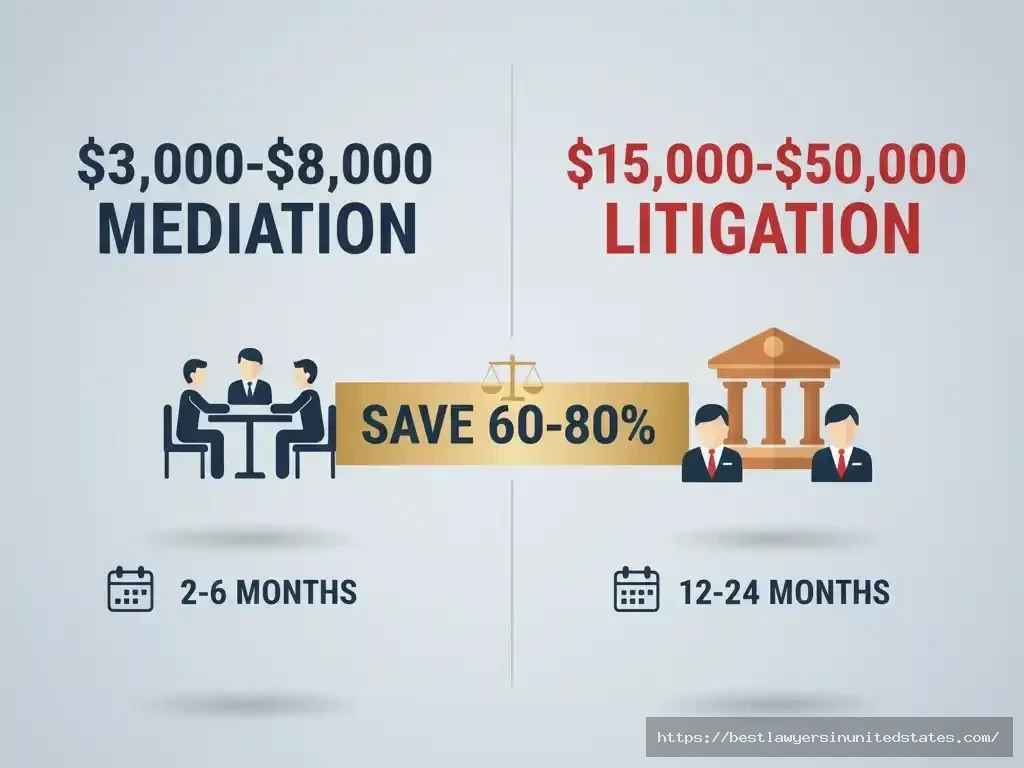
Here’s what drives the final price tag: your mediator’s experience, how complex your situation is, where you live, and whether you’re splitting one house or dividing a business empire. The good news? Even expensive mediation costs less than a moderate court battle.
Divorce Cost Calculator
Get an estimated cost for your divorce based on your specific situation
Your Estimated Divorce Cost
Cost Breakdown
📧 Get a Personalized Consultation
Have questions about your specific situation? Contact our legal experts for guidance tailored to your needs.
Contact Us via EmailUse our calculator to estimate your specific mediation costs based on your location, assets, and family situation.
How Much Does Divorce Mediation Actually Cost?
The National Average:
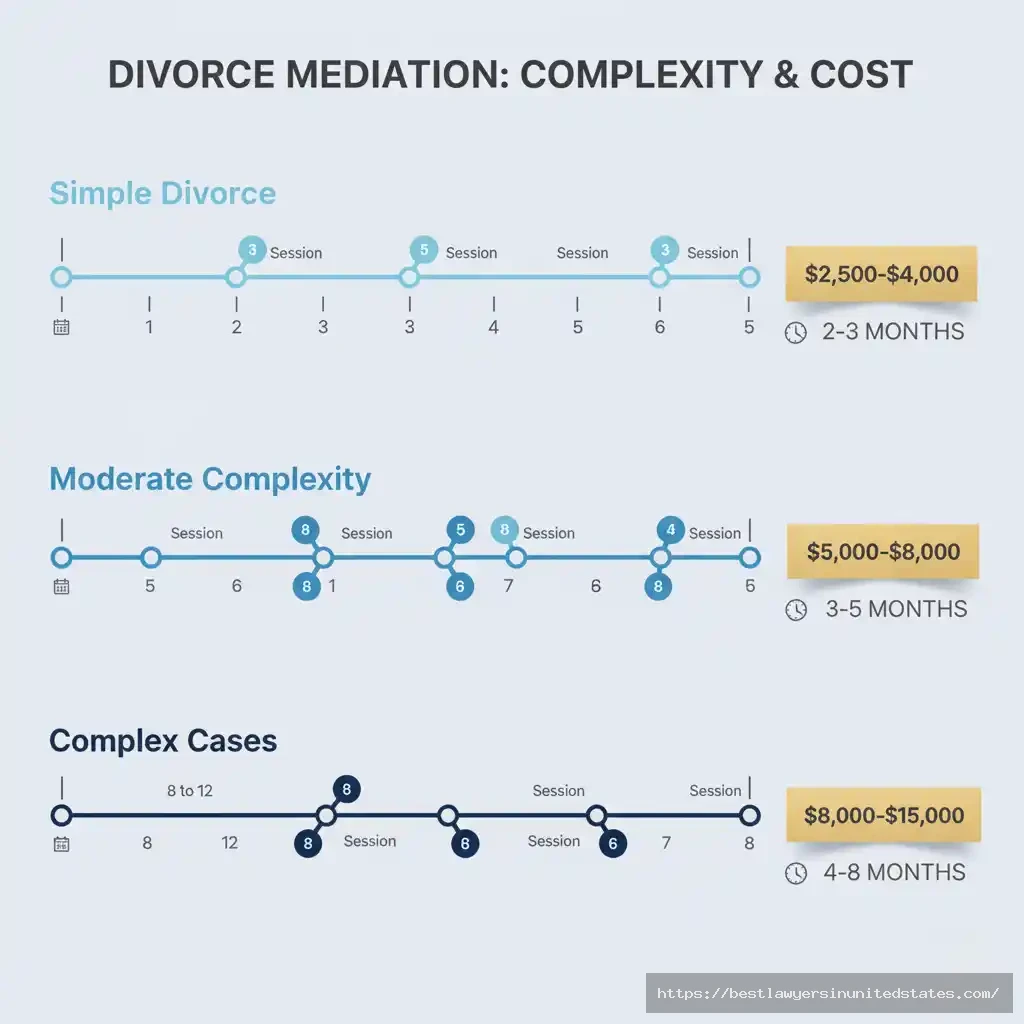
| Divorce Complexity | Total Mediation Cost | Number of Sessions | Timeline |
|---|---|---|---|
| Simple (No kids, minimal assets) | $2,500 – $4,000 | 3-5 sessions | 2-3 months |
| Moderate (Children, house, retirement) | $5,000 – $8,000 | 5-8 sessions | 3-5 months |
| Complex (Business, multiple properties) | $8,000 – $15,000 | 8-12 sessions | 4-8 months |
These figures include mediator fees, court filing costs, and basic document preparation. They don’t include review attorney fees, which most financial advisors recommend even in mediation.
Mediator Hourly Rates by Experience:
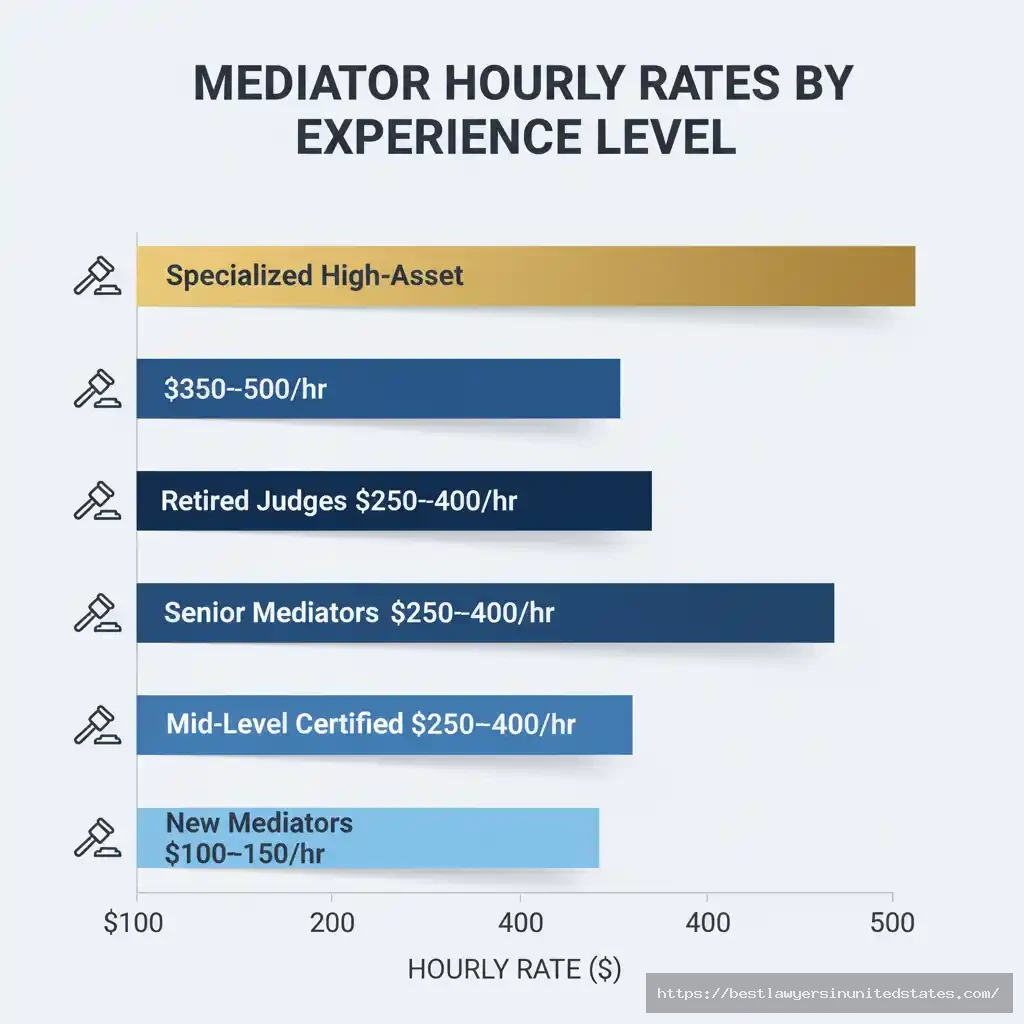
- New mediators: $100-$150/hour
- Mid-level certified mediators: $150-$250/hour
- Senior mediators and retired judges: $250-$400/hour
- Specialized business/high-asset mediators: $350-$500/hour
Most mediation sessions run 2-4 hours. Some mediators offer half-day (4-hour) or full-day (8-hour) flat rates ranging from $800 to $3,200.
What’s Included in Divorce Mediation Cost?
Let’s break down where your money actually goes. Understanding this helps you spot hidden fees and compare mediator quotes fairly.
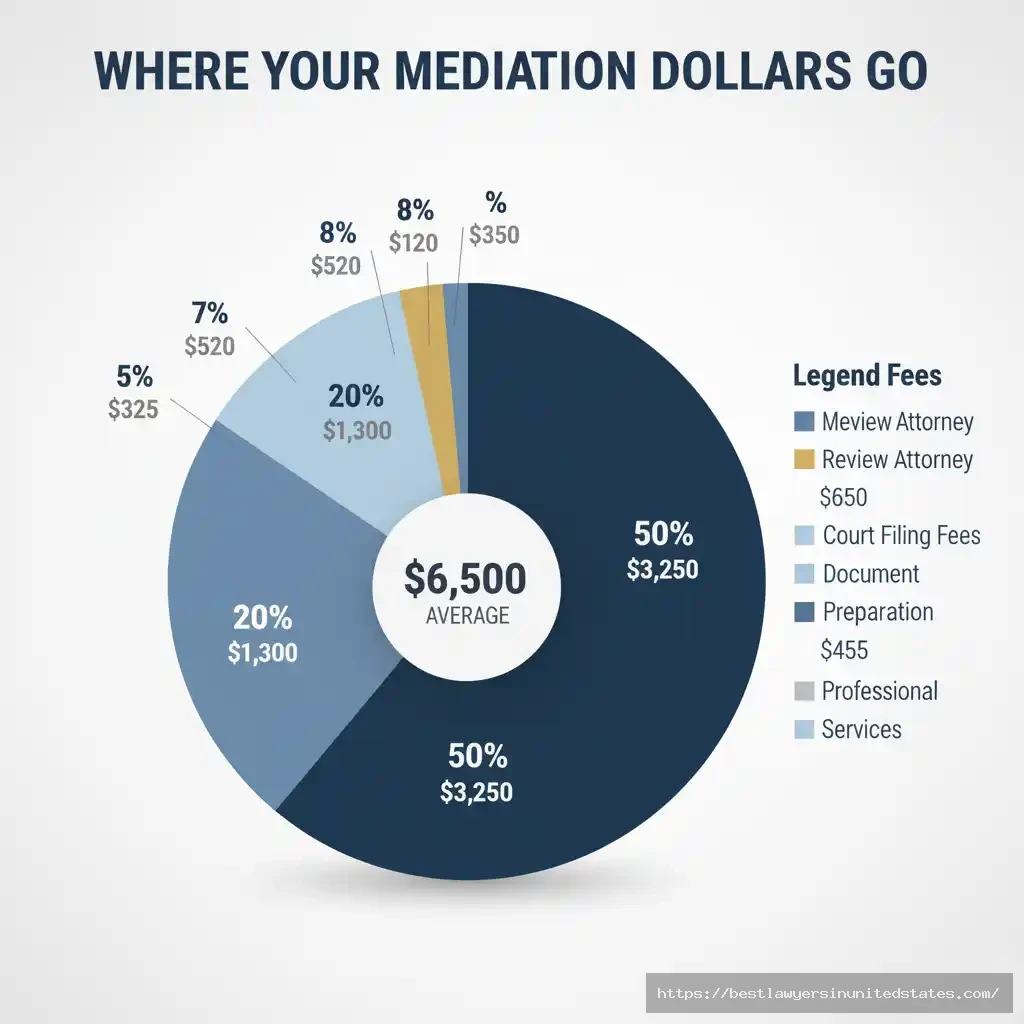
Mediator Session Fees
This is your biggest expense. You’re paying for the mediator’s time to facilitate discussions, draft settlement terms, and keep negotiations moving forward.
Most mediators charge by the hour, though some offer flat-fee packages. Hourly billing gives you flexibility if you settle quickly. Flat fees provide cost certainty but might not be refunded if you reach agreement early.
What’s typically included:
- Pre-mediation consultations and orientation
- All mediation sessions (in-person or virtual)
- Phone calls and email communication between sessions
- Draft settlement agreement preparation
- Follow-up sessions if issues arise
What costs extra:
- Copies of documents beyond a certain page count
- Notarization services
- Rush processing fees
- Evening or weekend session premiums (10-25% more)
Court Filing Fees
Even with mediation, you still file divorce paperwork with the court. Filing fees vary dramatically by state and county.
| State | Filing Fee Range | Notes |
|---|---|---|
| California | $435-$450 | Fee waivers available based on income |
| Texas | $250-$350 | Varies by county |
| Florida | $408-$409 | Additional service fees may apply |
| New York | $335-$350 | NYC courts charge higher fees |
| Pennsylvania | $300-$350 | Philadelphia charges more |
| Illinois | $334-$388 | Cook County on higher end |
Most states offer fee waiver programs for low-income filers. You’ll need to complete a financial affidavit proving hardship.
For detailed state-specific filing costs, see our complete divorce cost calculator.
Review Attorney Fees
Smart move: have your own attorney review the mediation agreement before signing. This typically costs $500-$1,500.
Why you need this: Mediators can’t give legal advice specific to your situation. A review attorney ensures you’re not agreeing to something that hurts you long-term, especially with retirement accounts, tax implications, or custody details.
Some mediators build review attorney time into their flat-fee packages. Ask upfront.
Additional Professional Costs
Depending on your situation, you might need:
Financial experts:
- Property appraisers: $300-$600 per property
- Business valuators: $2,500-$10,000 depending on complexity
- Financial planners for asset division strategy: $150-$300/hour
- Forensic accountants (if hiding assets suspected): $200-$500/hour
Child-related professionals:
- Parenting coordinators: $150-$300/hour
- Child psychologists (for custody evaluations): $1,500-$5,000
Document preparation:
- QDRO (retirement account division): $500-$2,500
- Deed transfers: $150-$400
- Title searches: $75-$200
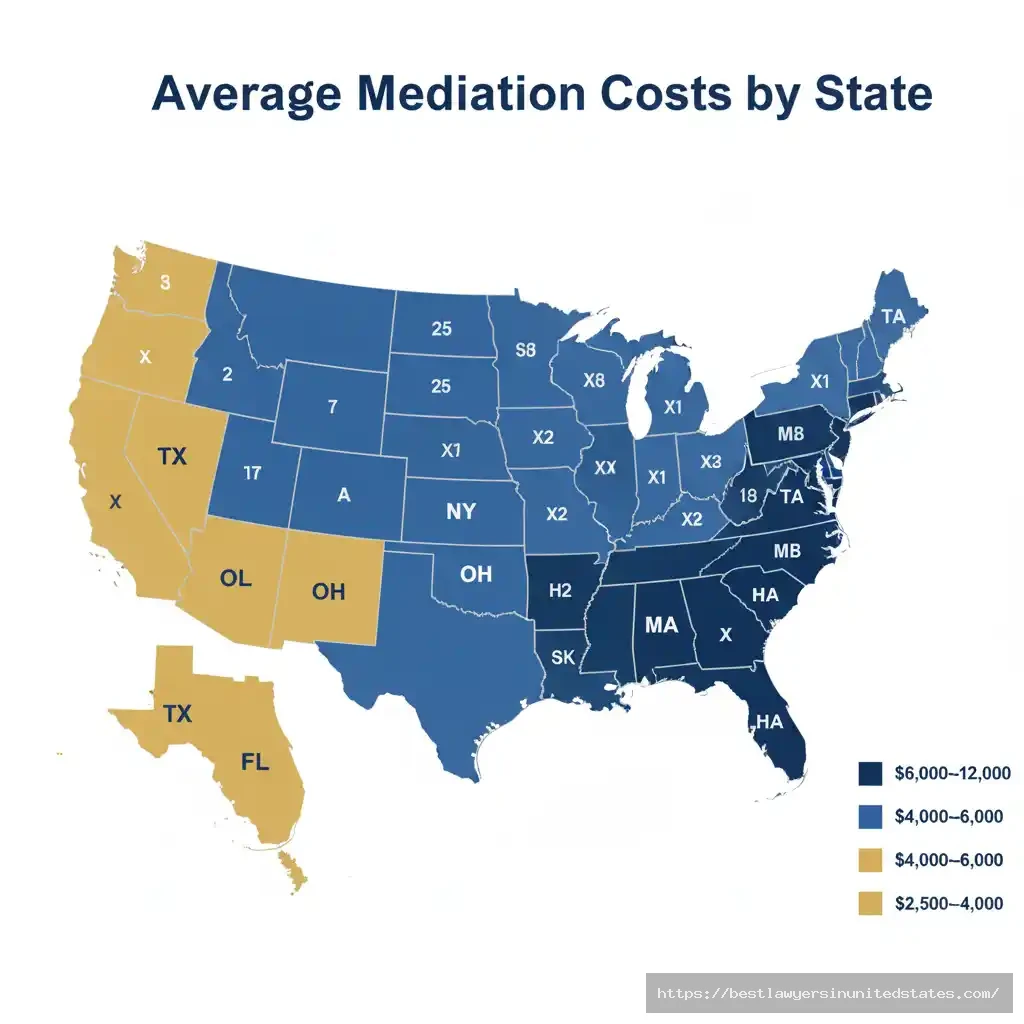
Divorce Mediation Cost by State
Geography matters more than you’d think. Urban areas command premium rates. States with mandatory mediation requirements sometimes offer free or sliding-scale court programs.
Highest-Cost States
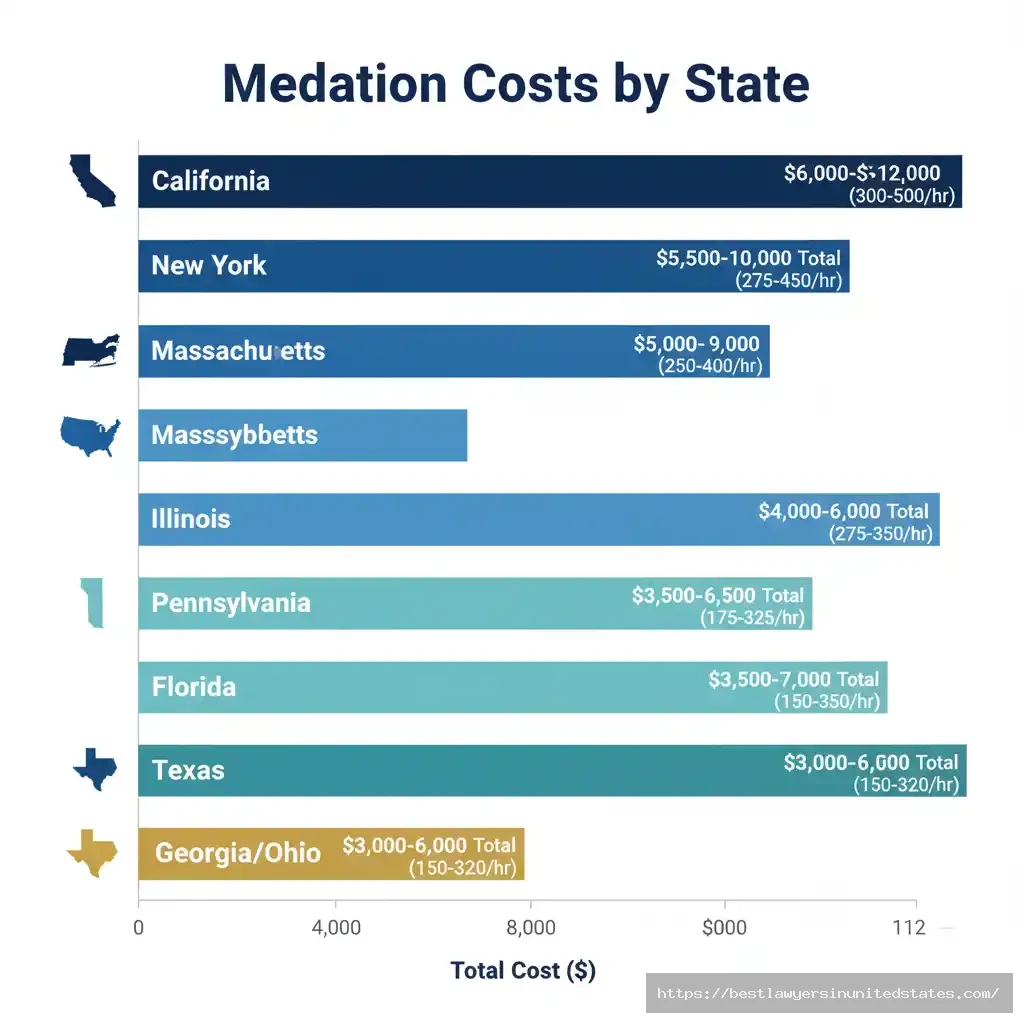
California: $250-$400/hour for mediators in Los Angeles, San Francisco, and San Diego. Total costs typically run $6,000-$12,000 for moderate complexity cases. The state’s community property laws and high cost of living drive these numbers.
Learn more about divorce costs in California.
New York: $200-$350/hour in NYC and surrounding areas. Manhattan mediators often charge $300-$400/hour. Expect $5,500-$10,000 total for cases with children and significant assets.
Check our New York divorce cost guide for county-specific details.
Massachusetts: $225-$350/hour typical range. Boston metro area runs higher. Total mediation costs average $5,000-$9,000.
Most Affordable States
Texas: Mediator rates run $150-$250/hour in most areas. Even Dallas and Houston stay below $300/hour. Total costs often land between $3,000-$6,000.
See Texas divorce costs broken down.
Florida: $175-$275/hour for experienced mediators. Court-connected programs offer free or low-cost mediation in many counties. Total costs typically $3,500-$7,000.
More details: Florida divorce cost analysis.
Georgia, Ohio, Michigan: These states generally see rates of $150-$250/hour with total costs of $3,000-$6,500.
Regional Comparison Table
| Region | Average Hourly Rate | Typical Total Cost | Sessions Needed |
|---|---|---|---|
| West Coast (CA, WA, OR) | $250-$350 | $6,000-$11,000 | 6-9 sessions |
| Northeast (NY, MA, PA) | $225-$325 | $5,500-$9,500 | 6-8 sessions |
| Southeast (FL, GA, NC) | $175-$275 | $4,000-$7,500 | 5-8 sessions |
| Midwest (IL, OH, MI) | $150-$250 | $3,500-$6,500 | 5-7 sessions |
| Southwest (TX, AZ) | $150-$275 | $3,500-$7,000 | 5-7 sessions |
Check these state guides for precise local costs:
What Factors Affect Your Divorce Mediation Cost?
Five main drivers determine whether you’ll spend $3,000 or $15,000. Understanding these helps you budget accurately and potentially reduce expenses.
Number of Mediation Sessions Required
Simple math: more sessions = higher costs. But what determines session count?
You’ll need fewer sessions if:
- Both parties come prepared with organized financial documents
- You’ve already agreed on major issues and just need help with details
- Neither party is emotionally volatile or seeking revenge
- Your assets are straightforward (one home, standard retirement accounts)
- No children involved, or you’ve already outlined a basic custody plan
Expect more sessions when:
- Complex business valuation or professional practice division needed
- One spouse suspects hidden assets
- High-conflict personalities require extensive negotiation
- Multiple properties or investment portfolios involved
- Disagreement about child custody schedules and decision-making
Most couples fall in the 5-8 session range. Budget for 6 sessions initially, then adjust if needed.
Complexity of Assets and Custody Issues
Asset complexity directly impacts mediation time and cost.
Simple asset division (fewer sessions):
- One marital home
- Basic checking/savings accounts
- Standard 401(k) or IRA accounts
- One or two vehicles
- Minimal personal property disputes
Complex asset division (more sessions):
- Business ownership or professional practice
- Multiple real estate properties
- Stock options, restricted stock units
- Inherited assets requiring tracing
- Substantial debt requiring strategic allocation
- Art, collectibles, or unique valuables
Child custody factors:
- Standard custody plans follow state guidelines: faster resolution
- Special needs children require detailed planning: more time
- Parents living far apart need complex schedules: additional sessions
- Disagreement about school choices or medical decisions: extended negotiation
Mediator Experience and Credentials
You’re not just paying for time—you’re paying for expertise. Here’s how credentials affect rates:
Basic mediators ($100-$175/hour):
- General mediation training
- Limited divorce-specific experience
- May still be building their practice
- Fine for very simple, amicable splits
Certified family mediators ($175-$275/hour):
- State certification in family mediation
- Extensive divorce mediation experience
- Understanding of family law and tax implications
- Can navigate moderate conflict effectively
Attorney-mediators and retired judges ($250-$400/hour):
- Dual role: legal knowledge plus mediation skills
- Can spot legal pitfalls most mediators miss
- Particularly valuable for complex estates or business interests
- Command respect from attorneys if they’re involved
Specialized mediators ($350-$500/hour):
- Focus on high-net-worth or business division cases
- Often have financial backgrounds (CPAs, CFPs)
- Can handle complex valuation issues in-house
Higher rates often mean faster resolution. An experienced mediator might accomplish in 4 sessions what takes a less skilled mediator 8 sessions to achieve.
Private vs. Court-Ordered Mediation
Court-connected programs offer significant savings but come with limitations.
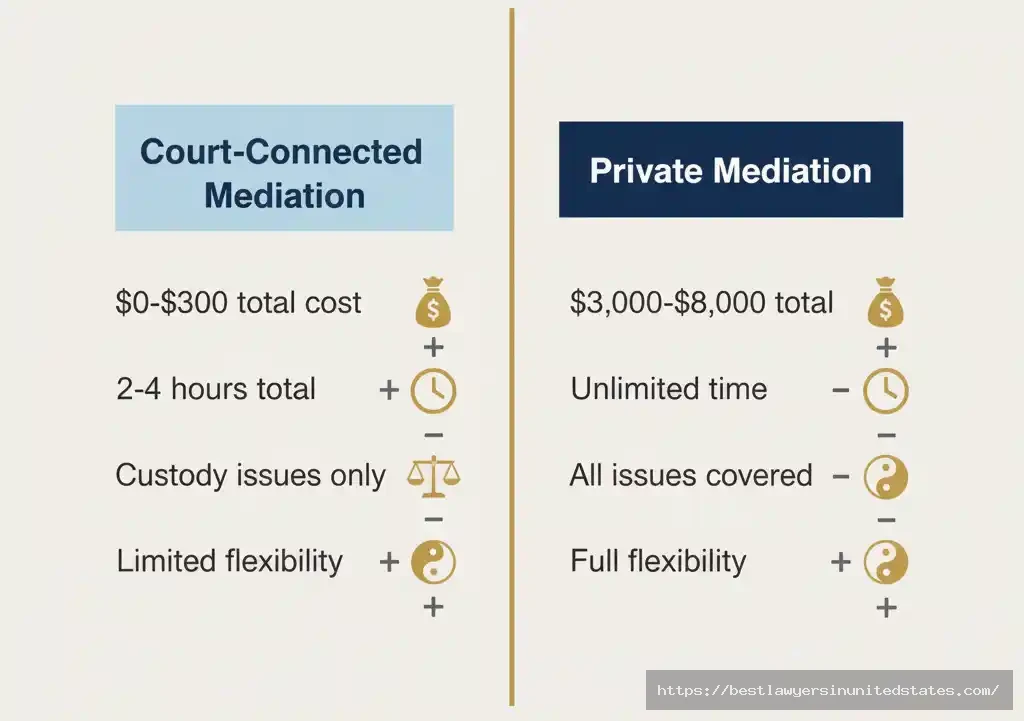
Court-Connected Mediation:
Many states provide free or sliding-scale mediation through family court programs. In Florida, for example, court-connected mediation runs $120-$240 total for income-qualifying couples.
Benefits:
- Dramatically lower cost (often $0-$300 total)
- Convenient court location
- Mediators familiar with local judges’ preferences
Drawbacks:
- Limited time (typically 2-4 hours total, not per session)
- Restricted to custody and parenting issues in many programs
- Can’t address complex financial matters
- Must resolve issues quickly or move to trial
Private Mediation:
You hire your own mediator and work at your own pace.
Benefits:
- Unlimited time to reach agreement
- Can address all issues (financial, custody, property)
- Choose a mediator with specific expertise
- Flexible scheduling
- More comfortable, private setting
Drawbacks:
- Significantly higher cost
- You’re responsible for finding a qualified mediator
- No time pressure to settle (can drag on if not managed)
Geographic Location: Urban vs. Rural
Cost of living directly correlates with mediator rates.
Urban rates: Metropolitan areas see 25-40% higher rates than rural areas in the same state. A mediator charging $300/hour in Manhattan might charge $175/hour if practicing in rural upstate New York.
Rural rates: Limited mediator availability sometimes creates supply issues. You might drive 60-90 minutes to find an experienced family mediator, adding travel time costs to your equation.
Suburban rates: Usually fall between urban and rural, often representing the best value—experienced mediators without premium urban overhead costs.
How Does Divorce Mediation Cost Compare to Litigation?
The financial difference between mediation and court is staggering. Let’s look at real numbers.
Average Litigation Costs: What You’re Avoiding
Traditional contested divorce costs in the United States:
Low-conflict litigation: $15,000-$25,000
- Minimal court appearances
- Some negotiation between attorneys
- Settlement reached before trial
Moderate-conflict litigation: $25,000-$50,000
- Multiple discovery requests
- Depositions
- Several court appearances
- Pre-trial settlement or short trial
High-conflict litigation: $50,000-$150,000+
- Extensive discovery and motions
- Expert witnesses
- Multi-day trial
- Custody evaluations and investigations
Average divorce lawyer costs range from $250-$550/hour depending on location and experience.
Why Mediation Saves 60-80% on Average
Mediation cuts costs in multiple ways:
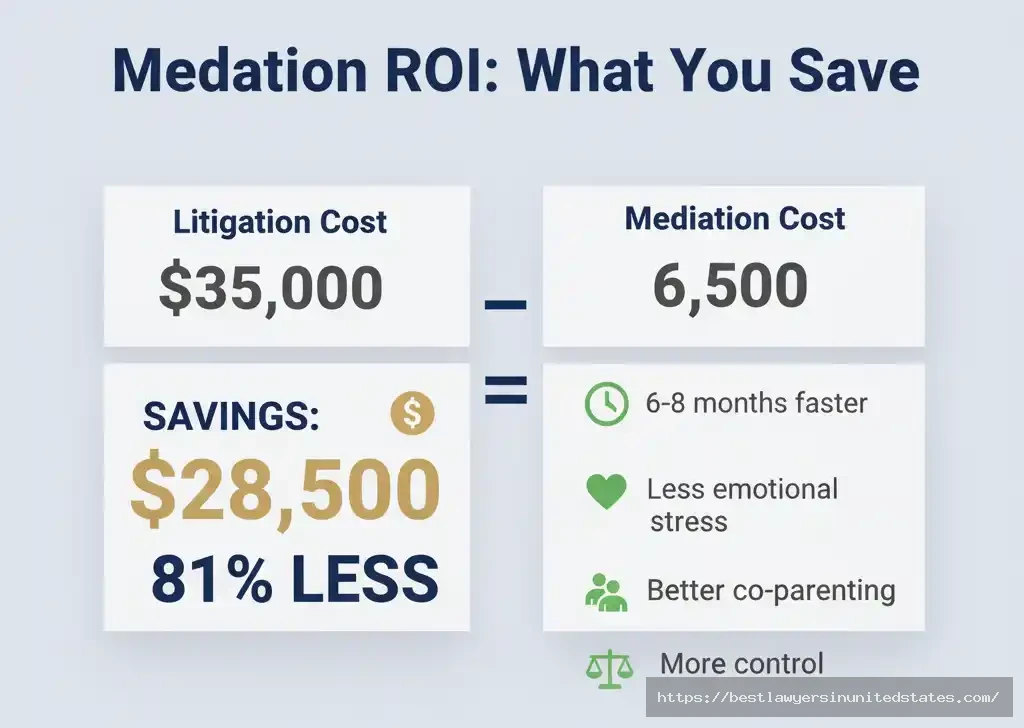
1. Single neutral instead of two adversarial attorneys
Litigation: Both spouses hire attorneys at $250-$500/hour. Every phone call, email, document review, and court appearance gets billed by both lawyers.
Mediation: One mediator at $150-$300/hour. Both parties split the cost.
2. Dramatically less time investment
Litigation: 12-24 months typical, often longer Mediation: 2-6 months typical
The timeline difference alone saves tens of thousands in attorney fees.
3. Minimal court involvement
Litigation requires:
- Multiple court appearances ($500-$2,000 in attorney time each)
- Trial preparation (50-100+ billable hours)
- Court reporter fees ($300-$600 per day)
- Exhibit preparation and filing fees
Mediation requires:
- One court filing
- No trial preparation
- No court appearances beyond final decree (if required)
4. Reduced emotional destruction
Less measurable but equally important: mediation preserves working relationships. This matters immensely when co-parenting. Future modification proceedings cost less when parents can communicate.
Cost Comparison Table
| Divorce Type | Typical Cost | Timeline | Court Appearances | Emotional Toll |
|---|---|---|---|---|
| Mediation | $3,000-$8,000 | 2-6 months | 0-1 | Low-Moderate |
| Uncontested (both attorneys) | $5,000-$15,000 | 6-10 months | 1-2 | Low-Moderate |
| Contested (moderate) | $25,000-$50,000 | 12-18 months | 4-8 | High |
| Trial (high-conflict) | $50,000-$150,000+ | 18-36 months | 8-15+ | Severe |
Compare with our guides on contested divorce costs vs. uncontested divorce costs.
Real Cost Examples: Three Case Studies
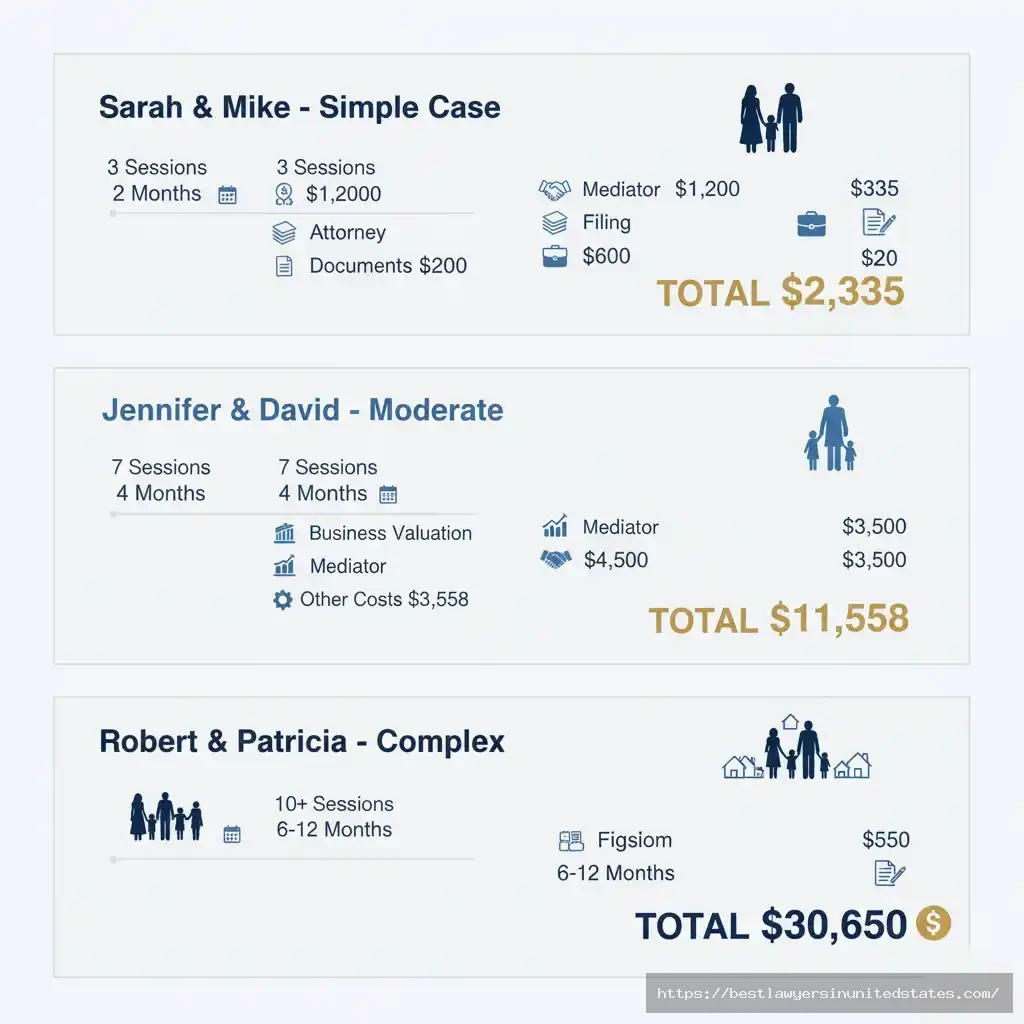
Case Study 1: Simple Mediation – Sarah and Mike
- Married 6 years, no children
- One jointly-owned home with $50K equity
- Standard retirement accounts totaling $75K
- Amicable split, both wanted quick resolution
Costs:
- Mediator fees: $1,200 (4 sessions × $300/hour)
- Court filing: $335
- Review attorney (one): $600
- Document preparation: $200
- Total: $2,335
Timeline: 8 weeks from first session to final decree
Case Study 2: Moderate Complexity – Jennifer and David
- Married 14 years, two children (ages 8 and 11)
- Home worth $450K with $180K equity
- Combined retirement accounts: $320K
- One spouse owned small business
- Disagreement on custody schedule
Costs:
- Mediator fees: $4,500 (7 sessions × $225/hour × 3 hours average)
- Business valuation: $3,500
- Court filing: $408
- Both spouses used review attorneys: $1,800 combined
- QDRO preparation: $750
- Parenting coordinator (2 sessions): $600
- Total: $11,558
Timeline: 4 months from initial consultation to signed agreement
This case would have cost $35,000-$55,000 in litigation based on comparable cases in their area.
Case Study 3: Complex High-Asset – Robert and Patricia
- Married 22 years, three children (one special needs)
- Multiple properties including vacation home
- Professional medical practice
- Investment portfolios exceeding $2M
- Disagreement about spousal support amount and duration
Costs:
- Senior mediator fees: $8,400 (12 sessions × $350/hour × 2 hours average)
- Medical practice valuation: $8,500
- Property appraisals (3 properties): $1,500
- Financial planner consultation: $2,100
- Court filing: $450
- Both spouses used attorneys for review and negotiation support: $6,000 combined
- QDRO preparation: $1,200
- Special needs trust documentation: $2,500
- Total: $30,650
Timeline: 7 months
Comparable litigation cases in their jurisdiction averaged $85,000-$120,000 and took 18-26 months.
Who Pays for Divorce Mediation?
Payment responsibility varies based on your situation and state law. Let’s clear up the confusion.
Standard 50/50 Split Arrangement
Most couples split mediation costs equally. This is standard practice because:
- Both parties benefit from the process
- Equal payment promotes balanced negotiation power
- Mediators maintain neutrality more easily
- Courts generally expect shared costs for voluntary mediation
How it works:
- Mediator bills after each session
- Each spouse pays half
- Or one spouse pays initially, reimbursement addressed in final settlement
Income-Based Fee Structures
When income disparity exists, adjusted payment arrangements make sense.
Court-ordered mediation often requires the higher-earning spouse to pay a larger percentage. Florida courts, for example, can order 60/40, 70/30, or even 100% payment by the higher earner.
Private mediation allows flexible arrangements:
- 70/30 split if one spouse earns significantly more
- Temporary payment by higher earner with equalization in final settlement
- Payment from marital funds if available
Document these arrangements clearly to avoid disputes later.
Court-Ordered Payment Arrangements
When courts mandate mediation, judges can order specific payment terms:
Factors courts consider:
- Income disparity between spouses
- Control of marital funds
- Bad faith by one party (refusing reasonable settlement)
- Financial misconduct (hiding assets, wasting marital funds)
Protection for lower-earning spouses:
If your spouse controls all finances and refuses to pay for mediation, document this. Courts can:
- Order immediate payment from marital accounts
- Require the controlling spouse to fund mediation entirely
- Award attorney fees for obstruction
Don’t let payment issues prevent you from pursuing mediation. Courts have mechanisms to ensure access.
Tax Implications of Mediation Costs
Tax treatment of divorce costs changed significantly in recent years.
The rule: Mediation costs for personal divorce matters are not tax-deductible for federal income tax purposes. This applies to:
- Mediator fees
- Attorney fees for divorce representation
- Document preparation costs
The exception: Costs specifically related to producing or collecting taxable income may be deductible. This includes:
- Fees for tax advice during settlement
- Costs to determine tax consequences of property division
- Attorney time spent on alimony or spousal support issues
Your tax professional needs to separate these costs with detailed billing statements. Most mediators can’t break this out meaningfully, so the deduction rarely applies.
Better strategy: Focus on tax-efficient settlement terms rather than deducting divorce costs. Your financial advisor and mediator should discuss:
- Tax-free property transfers under Section 1041
- Tax consequences of retirement account division
- Tax treatment of spousal support
- Capital gains implications of selling property
How Can You Afford Divorce Mediation?
Cost concerns shouldn’t prevent you from accessing mediation. Multiple options exist for financing your divorce.
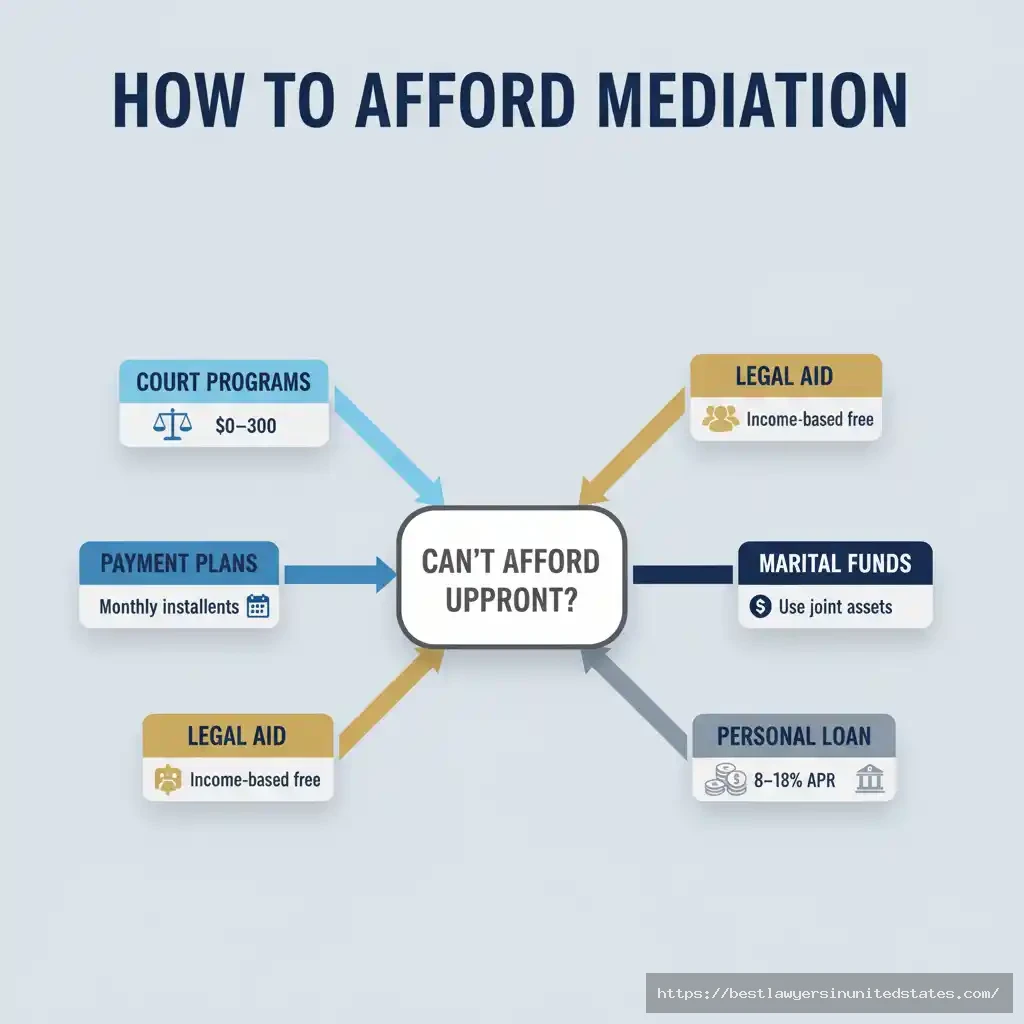
Payment Plans and Financing Options
Mediator payment plans:
Many mediators offer payment arrangements:
- Monthly installments over 3-6 months
- Deposit upfront, balance over time
- Per-session payment (pay as you go)
Ask before hiring. Some mediators require full payment within 30 days; others understand cashflow challenges and work with you.
Credit options:
Personal loans can fund mediation costs at rates typically lower than credit card debt:
- Personal loans: 8-18% APR for good credit
- Home equity lines: Often lowest rates but risk your home
- Credit cards: Last resort (18-29% APR typical)
Run the numbers. A $6,000 mediation on a 3-year personal loan at 12% costs about $200/month and $1,150 in interest. That’s often worth it to avoid $30,000 in litigation costs.
Family assistance:
Parents or other family members sometimes loan or gift divorce costs. Put loan terms in writing to avoid family disputes and tax complications.
Free and Low-Cost Mediation Programs by State
Court-connected programs provide access to mediation regardless of ability to pay.
How to access court programs:
- File your divorce petition (many courts waive filing fees for low-income petitioners)
- Request mediation through the court
- Complete financial affidavit showing income and assets
- Court assigns mediator at free or reduced rate
State program examples:
California: Many counties offer free mediation for custody and visitation issues. Financial matters typically cost $100-$300 on sliding scale.
Florida: Court-connected mediation programs charge $60-$240 based on household income. Some counties offer completely free services for domestic violence survivors.
Texas: Counties with over 1 million population must provide free or reduced-cost mediation. Harris County (Houston) offers 4 hours free mediation for eligible couples.
New York: Court-based programs in NYC and most counties provide free mediation for custody and parenting time. Financial mediation costs on sliding scale.
Check your county family court website for specific programs and eligibility requirements.
Legal Aid Eligibility Requirements
Legal aid organizations sometimes provide free mediation services or referrals to low-cost mediators.
General eligibility:
- Income at or below 125-200% of federal poverty level
- Limited assets (excluding home and vehicle)
- Legal issue within organization’s scope
Federal poverty guidelines (2025):
- Individual: $15,060 annual income
- Family of 2: $20,440
- Family of 3: $25,820
- Family of 4: $31,200
Legal aid typically helps at 125-150% of these amounts. A family of 4 earning $45,000 might qualify in many areas.
Where to find legal aid:
- Legal Services Corporation (LSC) locator: lsc.gov
- State bar association referral services
- Court self-help centers
- Domestic violence organizations (if applicable)
Using Marital Assets to Pay for Mediation
Marital funds can finance your divorce in most situations.
From joint accounts:
If you have access to joint checking or savings:
- Document withdrawals clearly (“mediation deposit”)
- Take only what’s needed for legitimate divorce costs
- Expect to account for these withdrawals in final settlement
Courts view reasonable divorce costs as necessary marital expenses.
From retirement accounts:
Some couples use 401(k) loans or IRA withdrawals:
- 401(k) loans: Borrow from your account, repay with interest to yourself
- IRA withdrawals: Can qualify for 10% penalty exception for divorce-related expenses in some cases
- Both options have tax consequences—consult a financial advisor first
From home equity:
If you own property with significant equity:
- Home equity line of credit (HELOC)
- Refinance with cash-out
- Sell the property and divide proceeds (includes divorce costs)
Warning: Don’t waste marital assets on unnecessary costs. Courts can sanction spouses who dissipate assets instead of negotiating reasonably. $8,000 in mediation costs is reasonable; $50,000 in vindictive litigation isn’t.
When Is Divorce Mediation Not Worth the Cost?
Mediation works beautifully for most couples. But certain situations require different approaches. Knowing when mediation won’t work saves you time and money.
Domestic Violence or Abuse Situations
Physical abuse: Never mediate if you fear physical harm from your spouse. The power imbalance makes fair negotiation impossible.
Signs mediation isn’t safe:
- History of physical violence or threats
- Protective orders in place
- Fear of being alone with your spouse
- Past violent reactions to disagreement
Emotional and financial abuse: Subtler but equally problematic. If your spouse:
- Controls all money and keeps you in the dark about finances
- Threatens economic ruin if you don’t comply
- Uses intimidation tactics consistently
- Has isolated you from family and friends
Mediation requires balanced power. Abuse creates inherent imbalance that mediators can’t fix.
What to do instead: Work with an attorney experienced in high-conflict divorce. Many offer payment plans. Domestic violence organizations provide free legal referrals.
Severe Power Imbalances
Beyond abuse, other power dynamics sabotage mediation:
Knowledge imbalance:
- One spouse managed all finances for years
- Complex business interests only one spouse understands
- Professional advantage (one spouse is an attorney or negotiation expert)
Financial disparity:
- One spouse economically dependent with no income
- Threat of being “cut off” financially
- Control of all marital assets and accounts
Personality factors:
- One spouse easily intimidated or manipulated
- Mental health issues affecting capacity to advocate
- Substance abuse affecting judgment
Good mediators recognize these issues. But they can’t create equal bargaining power where none exists. An attorney advocating specifically for you provides necessary protection.
Hidden Assets and Lack of Transparency
Mediation requires full financial disclosure. It fails when one spouse hides assets.
Red flags:
- Spouse refuses to provide requested financial documents
- “Lost” statements or incomplete information
- Business income that doesn’t match lifestyle
- Unexplained cash withdrawals or transfers
- New accounts opened shortly before separation
Why mediation fails here:
Mediators can’t subpoena records or conduct discovery. They rely on voluntary disclosure. If you suspect hidden assets, you need litigation tools:
- Formal discovery (interrogatories, document requests)
- Subpoenas to banks, employers, businesses
- Forensic accountants with investigation authority
- Court penalties for non-disclosure
Attempting mediation first wastes money when transparency issues exist. Address discovery through litigation, then potentially mediate once all assets are identified.
Complex Business Valuations
Business ownership complicates divorce significantly. While mediation can work, certain business situations require litigation:
When litigation makes more sense:
- Spouse claims business is worthless despite obvious value
- Disputes about valuation methodology
- Active business owner threatens to destroy business value out of spite
- Minority interest in family business with hostile majority owners
- Professional practice with complex goodwill issues
Business valuation disputes often exceed $50,000-$100,000 in value. The cost of litigation (even at $30,000-$50,000) becomes proportionate to what’s at stake.
When mediation can work:
- Both spouses agree on business valuation approach
- Independent valuator acceptable to both parties
- Business interest is minority stake with clear market value
- Both spouses want to preserve business value
Use a mediator with business valuation expertise. Attorney-mediators with corporate backgrounds handle these situations better than generalist mediators.
How Do You Choose a Divorce Mediator?
Picking the right mediator matters as much as choosing the right surgeon. You’re trusting this person with major life decisions. Here’s how to find someone qualified.
Essential Credentials to Look For
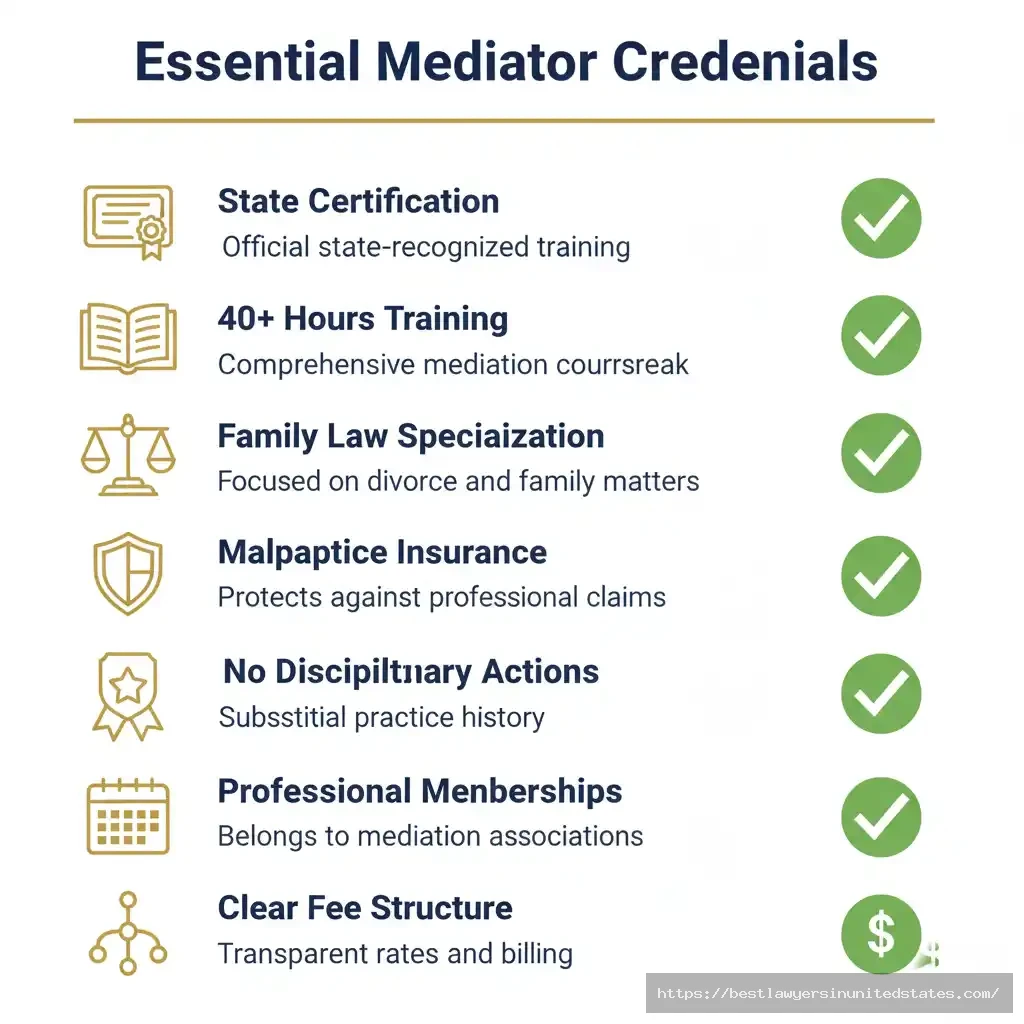
Minimum qualifications:
- State certification in family mediation (if your state requires it)
- 40+ hours mediation training
- Specific family/divorce mediation training
- Current malpractice insurance
- No disciplinary actions
Preferred qualifications:
- Attorney background in family law (understands legal implications)
- Financial expertise (CPA, CFP) for complex estates
- Advanced mediation certification (120-200 hours training)
- Member of professional mediation organizations
- 3+ years divorce mediation experience
Check credentials:
- State mediation association directories
- State bar association (if attorney-mediator)
- Court-approved mediator lists
- Professional organization membership verification
Don’t assume credentials. Ask directly and verify.
Questions to Ask About Fees and Services
Before hiring any mediator, get clear answers to:
About costs:
- What’s your hourly rate or flat fee?
- What exactly does that include?
- What costs extra?
- What’s your payment schedule?
- Do you offer payment plans?
- What’s your cancellation policy? (Charge for missed sessions?)
- How do you handle emails and phone calls between sessions?
- What’s the deposit required?
About process:
- How many sessions do couples with situations like ours typically need?
- What’s your success rate for reaching full settlement?
- Do you draft the settlement agreement or does our attorney?
- What happens if we can’t agree on certain issues?
- Will you file court paperwork or do we handle that?
- Do you offer virtual/video mediation?
- What’s your typical timeline from start to signed agreement?
About approach:
- What’s your mediation style? (Facilitative vs. evaluative?)
- Do you meet with us separately or always together?
- How do you handle power imbalances?
- What training do you have in domestic violence issues?
- Can we bring attorneys to sessions if we want?
Red Flags in Mediator Pricing
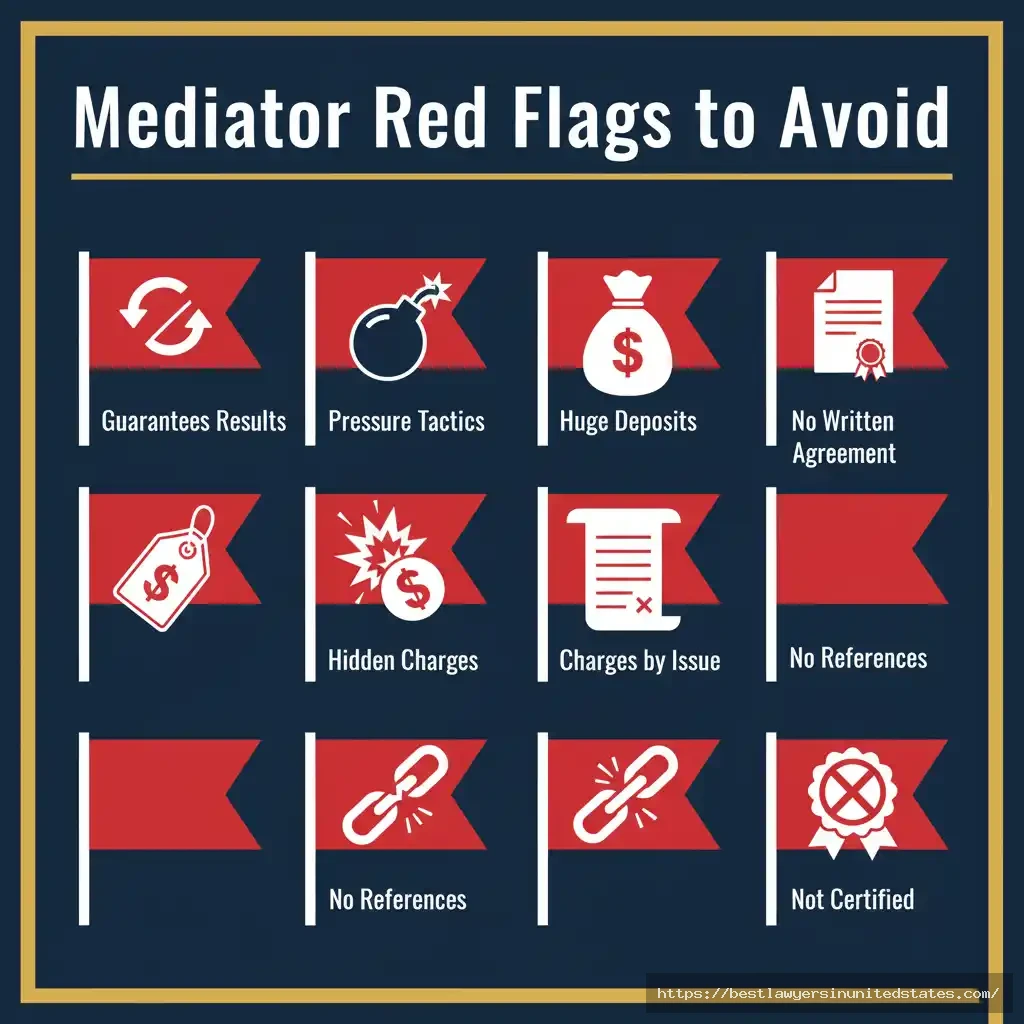
Run away from mediators who:
- Guarantee results – No ethical mediator promises specific outcomes
- Pressure quick decisions – “Sign today or lose this rate”
- Require huge upfront deposits – $5,000+ before starting is excessive
- Won’t provide written fee agreements – Everything should be in writing
- Add surprise charges – Nickel-and-diming for copies, phone calls, etc.
- Charge by the issue – Should be by time, not by number of topics
- Won’t give references – Established mediators have satisfied clients
Warning signs of low-quality mediators:
- Very new to practice (under 1 year experience)
- No specific divorce/family training
- Not certified in states requiring certification
- Unwilling to explain qualifications
- Work from home with no professional space (not always bad, but consider)
- No professional website or online presence
- Can’t explain their mediation approach
Free Consultation Best Practices
Most mediators offer 15-30 minute free consultations. Use this time strategically.
What to ask:
- Get fee clarity (see questions above)
- Explain your situation briefly
- Ask about their experience with similar cases
- Gauge whether you feel comfortable with their style
- Understand their process and timeline
What to observe:
- Do they listen well?
- Do they explain things clearly?
- Do they seem rushed or give you full attention?
- Do they pressure you to hire them immediately?
- Do they bad-mouth litigation or attorneys? (Red flag—good mediators recognize all options have merit)
After consultations:
Compare 2-3 mediators before deciding. The cheapest isn’t always best value. The most expensive isn’t always most skilled.
Consider:
- Relevant experience with cases like yours
- Communication style fit
- Credentials and training
- Availability and timeline
- Fee structure and total cost estimate
- Gut feeling about trustworthiness
Frequently Asked Questions About Divorce Mediation Costs
How much does divorce mediation typically cost?
Divorce mediation typically costs $3,000-$8,000 total for moderate complexity cases. Simple divorces with no children and minimal assets run $2,500-$4,000. Complex cases involving businesses or multiple properties cost $8,000-$15,000. Your final cost depends on the mediator’s hourly rate ($100-$400), number of sessions needed (4-10 typical), and any additional professional fees.
Is mediation cheaper than going to court for divorce?
Yes, significantly. Mediation costs 60-80% less than litigation. Traditional contested divorce averages $15,000-$50,000 or more, while mediation averages $3,000-$8,000. You avoid costs for adversarial attorneys, extensive discovery, court appearances, trial preparation, and expert witnesses. Most couples complete mediation in 2-6 months compared to 12-24+ months for litigation.
Who typically pays for divorce mediation?
Most couples split mediation costs 50/50, with each spouse paying half of the mediator fees and expenses. However, arrangements vary. Courts can order income-based splits (60/40, 70/30) when significant income disparity exists. Some couples agree the higher earner pays 100% initially, with adjustment in the final settlement. Many court-connected programs offer free or sliding-scale mediation based on household income.
What happens if I cannot afford mediation?
Several options exist: (1) Court-connected mediation programs offer free or sliding-scale services in most states, (2) Legal aid organizations provide free mediation for qualifying low-income individuals, (3) Many mediators offer payment plans spreading costs over several months, (4) You can use marital funds to pay for mediation costs, (5) Personal loans or family assistance can finance mediation. The savings compared to litigation (tens of thousands of dollars) often make financing worthwhile.
How much does a private mediator cost per hour?
Private mediator hourly rates range from $100-$500 depending on experience and location. New mediators charge $100-$150/hour. Mid-level certified mediators charge $150-$250/hour. Senior mediators and retired judges charge $250-$400/hour. Specialized mediators handling high-asset or business division cases charge $350-$500/hour. Urban areas command rates 25-40% higher than rural areas in the same state.
How many mediation sessions does a typical divorce require?
Most divorces require 5-8 mediation sessions to reach complete settlement. Simple divorces with no children need 3-5 sessions. Moderate complexity cases with children and significant assets need 5-8 sessions. Complex cases involving businesses or multiple properties need 8-12 sessions. Each session typically lasts 2-4 hours. Coming prepared with organized financial documents reduces the number of sessions needed.
Does divorce mediation cost include filing fees?
Usually not. Mediator fees typically cover only facilitation services and agreement preparation. Court filing fees ($250-$450 depending on state) are separate expenses. Additional costs not included in basic mediation fees: review attorney fees ($500-$1,500), property appraisals ($300-$600 each), business valuations ($2,500-$10,000), and QDRO preparation for retirement account division ($500-$2,500). Ask your mediator for a complete cost estimate including all anticipated expenses.
Is a lawyer needed during divorce mediation?
You don’t need attorneys present during mediation sessions, but you should have your own attorney review the mediation agreement before signing. Review attorneys typically charge $500-$1,500 for this service. They ensure you’re not agreeing to unfavorable terms and catch issues the mediator might miss. Mediators cannot provide legal advice specific to your situation. Some couples hire attorneys for limited scope representation, consulting between sessions while handling mediation themselves.
When is divorce mediation not recommended?
Mediation isn’t appropriate when: (1) Domestic violence or abuse creates unsafe power imbalance, (2) One spouse hides assets or refuses financial transparency, (3) Severe mental health issues or substance abuse impairs decision-making capacity, (4) One spouse completely refuses to negotiate or compromise, (5) Complex business valuations disputed with tens of thousands at stake, (6) One spouse intimidates or manipulates the other. These situations require litigation tools like discovery, subpoenas, and court orders.
Do both parties have to pay for mediation?
Not necessarily. While 50/50 splits are most common, courts can order different arrangements. If one spouse controls all marital funds or earns significantly more, judges can require they pay a larger percentage or all mediation costs. Court-connected mediation programs often charge on sliding scales based on each person’s income. Some couples agree one pays initially with reimbursement addressed in final settlement. Payment arrangements should be documented clearly upfront.
How much does court-ordered mediation cost?
Court-ordered mediation costs much less than private mediation. Court-connected programs typically charge $0-$300 total depending on your state and income. Florida programs charge $60-$240 based on household income. Some states provide completely free mediation for custody and parenting time issues. However, court mediation has limitations—usually 2-4 hours total time and restricted to certain issues. Private mediation offers unlimited time to address all divorce issues.
Can mediation costs be tax deductible?
Generally no. Personal divorce costs including mediation fees are not tax deductible on federal returns. The exception: fees specifically related to tax advice or producing taxable income may qualify. For example, costs to determine tax consequences of property division or structure alimony payments might be deductible if properly documented. Most mediation costs don’t meet this narrow exception. Focus instead on tax-efficient settlement terms rather than deducting the costs.
What’s included in a flat-fee divorce mediation package?
Flat-fee packages vary by mediator but typically include: (1) Initial consultation, (2) Specific number of mediation sessions (often 4-6 hours total), (3) All communication between sessions, (4) Draft mediation agreement preparation, (5) One revision to the agreement. What’s usually NOT included: additional sessions beyond the package, review attorney fees, court filing costs, professional valuations, QDRO preparation, evening/weekend session premiums. Clarify exactly what’s included before signing.
How much does divorce mediation cost in California?
California divorce mediation costs $6,000-$12,000 on average for moderate complexity cases. Mediator hourly rates run $250-$400 in Los Angeles, San Francisco, and San Diego. Simple divorces with no children cost $4,500-$7,000. Complex cases involving businesses or multiple properties cost $10,000-$20,000. Court filing fees add $435-$450. Many California counties offer free mediation for custody issues and sliding-scale programs for financial mediation based on income.
How much does divorce mediation cost in Texas?
Texas divorce mediation costs $3,000-$6,000 total for typical cases. Mediator hourly rates range $150-$250 even in major cities like Dallas, Houston, and Austin. Simple divorces cost $2,500-$4,000. Complex cases cost $6,000-$10,000. Court filing fees range $250-$350 by county. Counties with populations over 1 million must provide free or reduced-cost mediation. Harris County (Houston) offers 4 free mediation hours for eligible couples.
How much does divorce mediation cost in Florida?
Florida divorce mediation costs $3,500-$7,000 for most cases. Private mediator hourly rates run $175-$275 statewide. Court-connected mediation programs charge $60-$240 based on household income. Some counties offer free services for domestic violence survivors. Court filing fees are $408-$409 plus service fees. Simple divorces cost $3,000-$5,000 total. Complex cases with significant assets cost $7,000-$12,000. Florida courts frequently order mediation before trial.
How much does divorce mediation cost in New York?
New York divorce mediation costs $5,500-$10,000 for typical cases. Mediator hourly rates in NYC and surrounding areas run $200-$350, with Manhattan mediators charging $300-$400. Upstate and rural areas charge $150-$250/hour. Court filing fees are $335-$350. Court-based programs provide free mediation for custody issues and sliding-scale financial mediation. Simple cases cost $4,000-$6,000. Complex cases cost $10,000-$15,000 or more.
What’s the difference between mediator fees and total mediation costs?
Mediator fees cover only the mediator’s time and services—typically the largest expense but not the total cost. Total mediation costs include: mediator fees ($1,200-$8,000+), court filing fees ($250-$450), review attorney fees ($500-$1,500), document preparation, notary fees, and any professional services needed (appraisals, valuations, financial advisors). Always ask mediators for comprehensive cost estimates including all anticipated expenses, not just their hourly rate.
How can I reduce divorce mediation costs?
Reduce costs by: (1) Come prepared with organized financial documents reducing research time, (2) Agree on major issues before mediation starts, (3) Use court-connected programs if eligible, (4) Choose appropriate mediator experience level—don’t overpay for simple cases, (5) Limit between-session communication to necessary items, (6) Schedule longer sessions rather than more frequent short ones, (7) Consider virtual mediation reducing overhead costs, (8) Share one review attorney if comfortable, (9) Use templates for standard documents.
Is divorce mediation worth the cost?
Yes, for most couples. Mediation costs $3,000-$8,000 versus $15,000-$50,000+ for litigation—savings of $12,000-$42,000 or more. Beyond money, mediation offers: faster resolution (2-6 months vs. 12-24+ months), less emotional trauma, preserved co-parenting relationships, greater control over outcomes, and confidentiality. Success rates exceed 70-80% for couples who enter mediation in good faith. Even if mediation partially succeeds, you narrow issues requiring court intervention, still saving money.
Do mediators charge for phone calls and emails?
Policies vary by mediator. Some include reasonable communication in their hourly rate. Others bill separately for phone calls and email time, typically in 6 or 15-minute increments at their hourly rate. Flat-fee packages usually include communication between sessions. Clarify this policy upfront. Best practice: consolidate questions rather than frequent small inquiries. Save detailed discussions for scheduled sessions where you’re paying for time anyway.
Find Certified Divorce Mediators in Your State
Ready to start the mediation process? Use these resources to find qualified mediators in your area:
State-specific cost information and mediator directories:
- California Divorce Costs & Mediators
- Texas Divorce Costs & Mediation
- Florida Divorce Mediation Guide
- New York Divorce Costs
- Pennsylvania Divorce Expenses
- Illinois Divorce Mediation
- Ohio Divorce Costs
- Georgia Divorce Mediation
- North Carolina Divorce Costs
- Michigan Divorce Expenses
Compare all divorce costs:
Professional resources:
- State bar association mediator directories
- Academy of Professional Family Mediators (APFM)
- Association for Conflict Resolution (ACR)
- Court-approved mediator lists from your county family court
Your path forward starts with understanding costs and finding the right professional to guide you through this transition. Mediation offers hope for a less destructive, more affordable divorce process that preserves dignity and working relationships—especially crucial when children are involved.
