
Collaborative divorce typically costs between $5,000 and $30,000 per spouse, significantly less than traditional litigation which averages $15,000 to $77,000+. The final price depends on your location, asset complexity, and how well you and your spouse cooperate throughout the process.
Calculate Your Collaborative Divorce Cost
Divorce Cost Calculator
Get an estimated cost for your divorce based on your specific situation
Your Estimated Divorce Cost
Cost Breakdown
📧 Get a Personalized Consultation
Have questions about your specific situation? Contact our legal experts for guidance tailored to your needs.
Contact Us via EmailUnlike contested divorces that drag through court for months or years, collaborative divorce uses a team approach—each spouse has their own attorney, plus shared neutral professionals like financial specialists and divorce coaches—to reach agreements faster and more affordably.
How Much Does a Collaborative Divorce Cost?
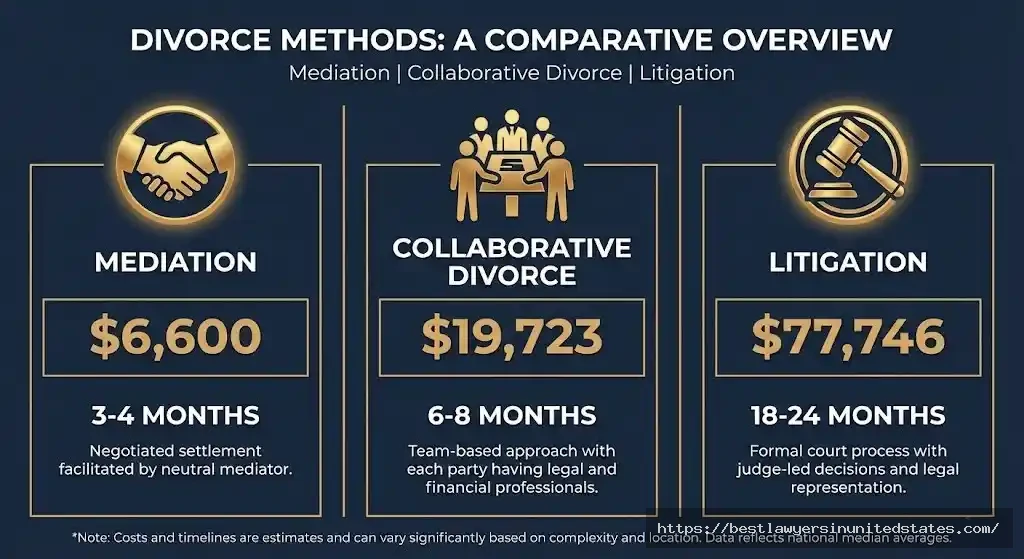
The average collaborative divorce costs $6,600 to $19,723 according to recent data from Boston Law Collaborative’s analysis of 199 cases. However, costs vary dramatically based on where you live and how complex your situation is.
National Cost Breakdown:
| Divorce Complexity | Collaborative Cost Range | Timeline |
|---|---|---|
| Simple (no kids, minimal assets) | $5,000 – $10,000 | 3-5 months |
| Moderate (children, house, retirement accounts) | $10,000 – $20,000 | 4-7 months |
| Complex (business ownership, multiple properties) | $20,000 – $35,000 | 6-10 months |
| High-net-worth (trusts, extensive assets) | $35,000 – $60,000+ | 8-12 months |
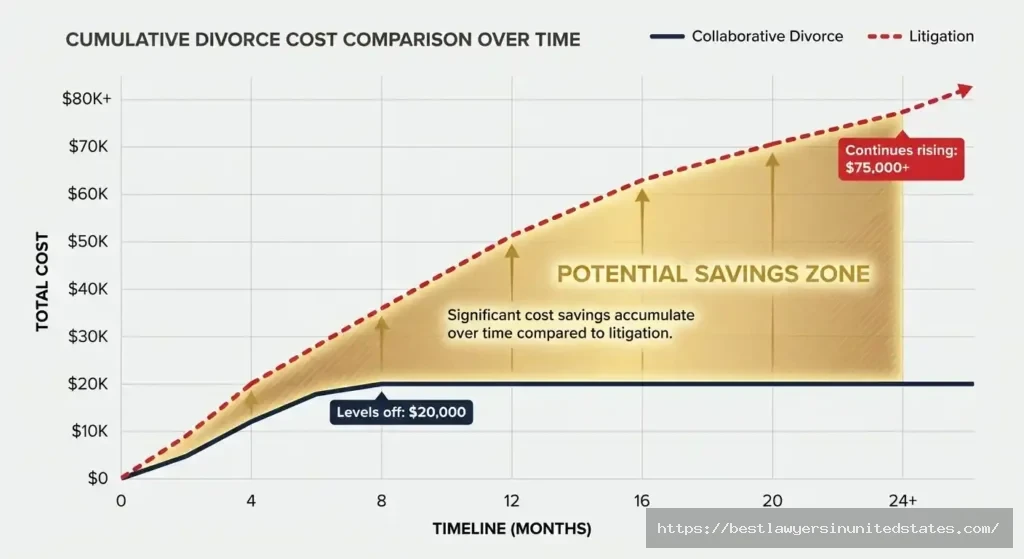
These figures represent costs per spouse, meaning the total family expenditure doubles. However, this is still substantially less than litigation where costs frequently exceed $50,000 per person.
What’s Included in Collaborative Divorce Costs?
Attorney Fees (Largest Expense)
Your collaborative attorney is your primary cost. Hourly rates typically range from $200 to $500 per hour depending on your location and the attorney’s experience.
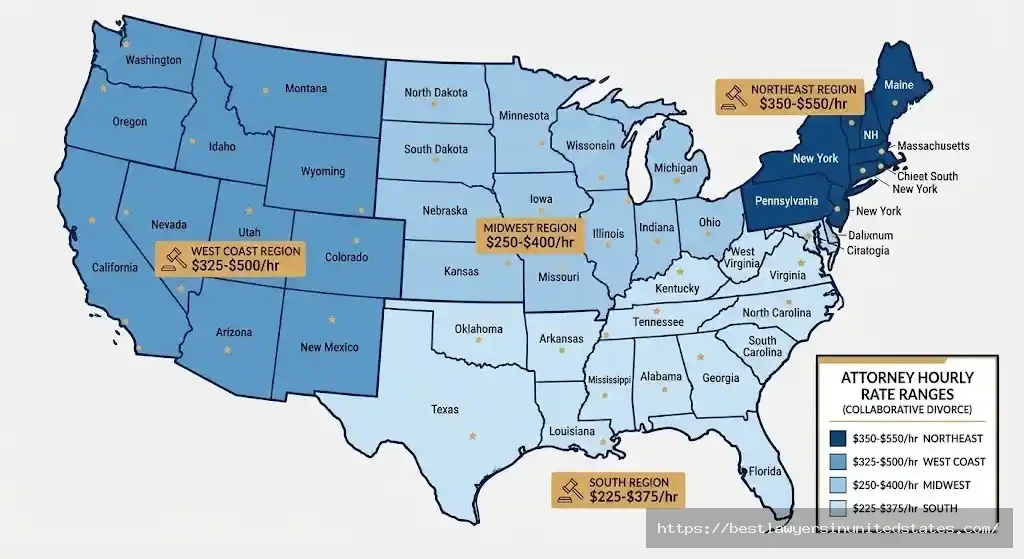
Regional Attorney Rate Ranges:
| Region | Average Hourly Rate | Initial Retainer |
|---|---|---|
| Major metros (NYC, LA, SF) | $400 – $550/hour | $7,500 – $15,000 |
| Mid-size cities (Dallas, Denver, Seattle) | $300 – $450/hour | $5,000 – $10,000 |
| Smaller cities and suburbs | $200 – $350/hour | $3,500 – $7,500 |
| Rural areas | $175 – $275/hour | $2,500 – $5,000 |
Most attorneys require an upfront retainer—typically enough to cover 10-20 hours of work. As they bill against this retainer, you’ll receive monthly statements and may need to replenish it if your case takes longer than expected.
Neutral Professional Fees

One major advantage of collaborative divorce is sharing the cost of neutral experts rather than hiring competing specialists:
Financial Neutral: $150-$400/hour
- Reviews assets, debts, tax implications
- Creates property division scenarios
- Prepares financial disclosures
- Typical total cost per couple: $2,000-$6,000
Mental Health Professional (Divorce Coach): $125-$300/hour
- Facilitates communication between spouses
- Manages emotional aspects of divorce
- Helps create parenting plans
- Typical total cost per couple: $1,500-$4,000
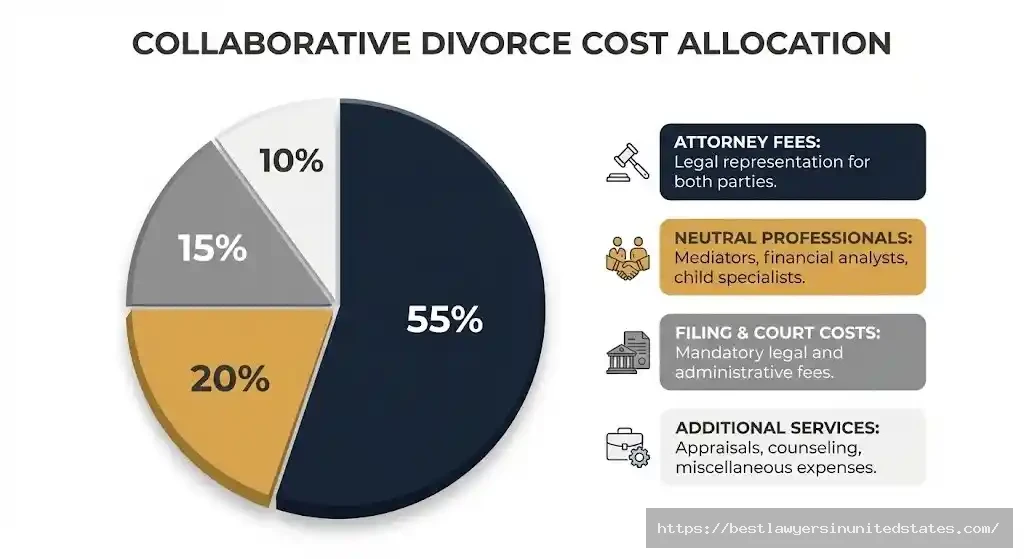
Child Specialist: $150-$350/hour
- Interviews children about their needs (age-appropriate)
- Provides input on custody arrangements
- Helps parents understand children’s perspective
- Typical total cost per couple: $2,000-$5,000
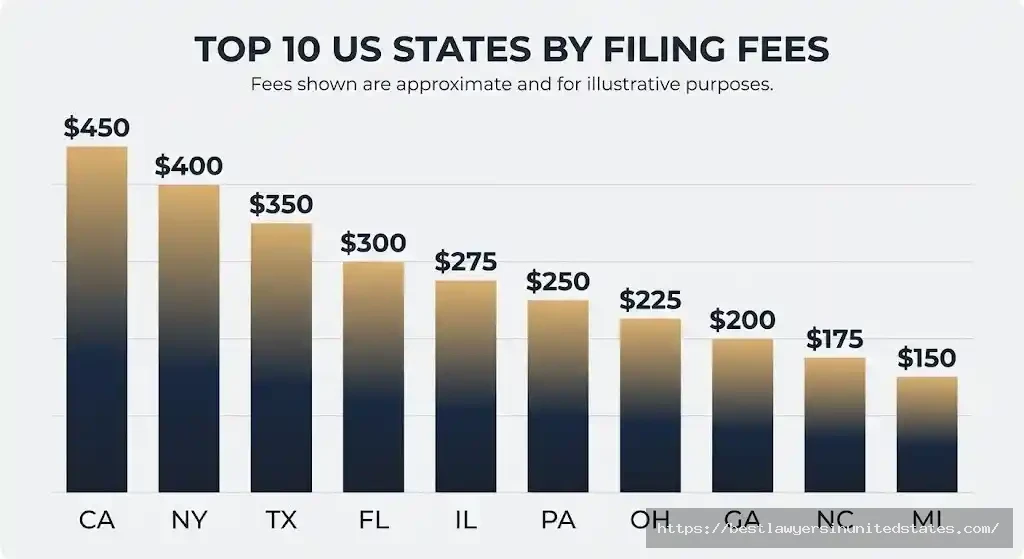
Court Filing Fees
These mandatory costs vary by county but are relatively minor compared to attorney fees:
State-by-State Filing Fees:
| State | Average Filing Fee | Fee Waiver Available? |
|---|---|---|
| California | $435 – $450 | Yes (income-based) |
| Texas | $300 – $350 | Yes (government benefits or legal aid) |
| Florida | $400 – $409 | Yes (financial hardship affidavit) |
| New York | $335 – $350 | Yes (poor person’s order) |
| Illinois | $337 – $388 | Yes (fee waiver petition) |
| Pennsylvania | $300 – $350 | Yes (in forma pauperis) |
Most states offer fee waivers if you can demonstrate financial hardship, receive government benefits, or qualify for legal aid services.
Additional Costs to Budget For
Document Preparation: $300-$800
- Participation Agreement drafting
- Settlement Agreement preparation
- Parenting Plan documentation
Notary and Filing Services: $50-$200
- Document notarization
- Court filing service fees
- Certified copies of final decree
Forensic Accounting (if needed): $3,000-$15,000
- Business valuation
- Hidden asset searches
- Complex asset tracing
Mandatory Parenting Classes: $40-$100 per person
- Required in most states when children are involved
- Usually 4-6 hour online or in-person course
Is Collaborative Divorce Cheaper Than Mediation or Litigation?
Yes, collaborative divorce typically costs less than litigation but more than simple mediation. Here’s how the three approaches compare:
| Divorce Method | Median Cost | Timeline | Attorney Required? |
|---|---|---|---|
| Mediation | $3,500 – $6,600 | 2-4 months | Optional (recommended) |
| Collaborative Divorce | $5,000 – $19,723 | 3-8 months | Yes (one per spouse) |
| Negotiated Settlement | $15,000 – $26,830 | 6-12 months | Yes (adversarial) |
| Full Litigation | $50,000 – $77,746+ | 12-36+ months | Yes (court representation) |
When Mediation Is Cheaper: If you and your spouse communicate well, have simple assets, and can reach agreements quickly, mediation with a single neutral mediator ($150-$300/hour) costs significantly less than collaborative divorce.
When Collaborative Divorce Saves Money: For moderate to complex cases where you need professional guidance but want to avoid court, collaborative divorce costs 30-70% less than traditional litigation while providing more expert support than basic mediation.
When Litigation Becomes Necessary: High-conflict situations, domestic violence, hidden assets, or complete inability to cooperate may require court intervention despite higher costs.
How Does Collaborative Divorce Cost Vary by State?
Your location dramatically impacts collaborative divorce costs due to differences in attorney rates, cost of living, and state-specific laws.
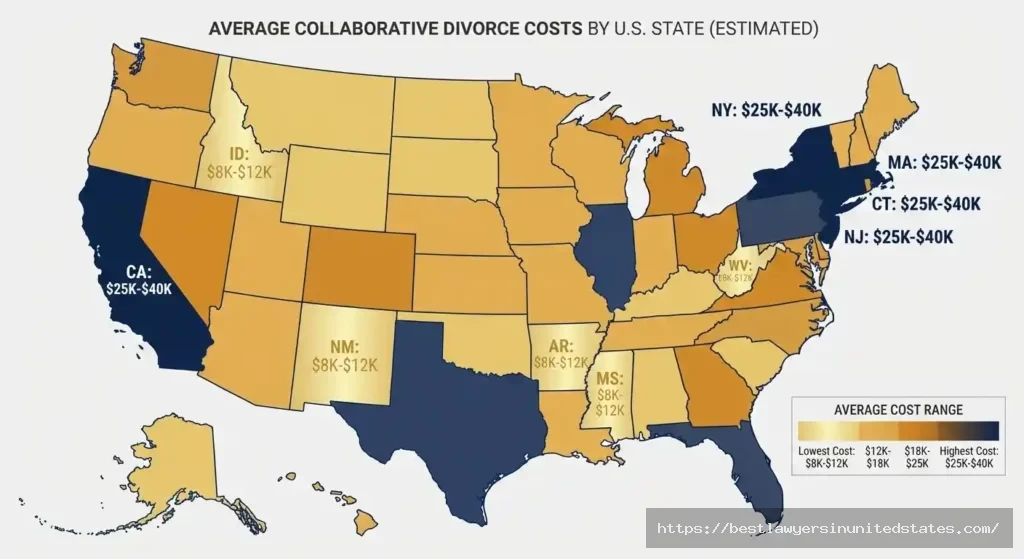
Texas Collaborative Divorce Cost
Average Total Cost: $10,000 – $25,000 per spouse
Texas follows community property laws, meaning marital assets split 50/50 unless agreed otherwise. Filing fees in major counties:
- Dallas County: $350
- Harris County (Houston): $300
- Travis County (Austin): $315
- Tarrant County (Fort Worth): $312
Attorney hourly rates: $250-$450 in major cities, $200-$325 in smaller towns.
Texas doesn’t require separation periods, and the Texas Family Code supports collaborative law through specific statutes, making it a favorable state for this process.
California Collaborative Divorce Cost
Average Total Cost: $15,000 – $35,000 per spouse
California’s high cost of living drives up professional fees. Filing fees range from $435-$450 depending on county. Attorney rates in major metros (Los Angeles, San Francisco, San Diego): $350-$550/hour.
As a community property state with complex division rules, California cases often require financial neutrals, increasing costs by $3,000-$7,000 per couple.
Florida Collaborative Divorce Cost
Average Total Cost: $12,000 – $28,000 per spouse
Florida has embraced collaborative divorce, with many family courts encouraging this approach. Filing fees: $400-$409. Attorney rates: $275-$475/hour in major cities.
Florida’s equitable distribution laws (not automatic 50/50 split) often require more negotiation, potentially extending the process and increasing costs.
New York Collaborative Divorce Cost
Average Total Cost: $18,000 – $40,000 per spouse
New York’s high attorney rates ($350-$600/hour in NYC) make collaborative divorce more expensive. However, this is still 40-60% less than full litigation in the state.
Filing fees: $335-$350. New York requires a 6-month separation period before finalizing, but collaborative work can begin immediately during separation.
Illinois Collaborative Divorce Cost
Average Total Cost: $13,000 – $30,000 per spouse
Illinois has strong collaborative law statutes. Chicago-area attorney rates: $300-$500/hour. Collar counties: $250-$400/hour. Downstate: $200-$325/hour.
Filing fees: $337-$388. Illinois requires parenting education classes ($40-$60 per person) when children are involved.
Hidden Costs Most People Don’t Expect
If the Collaborative Process Fails
The biggest hidden risk: if negotiations break down and you need to go to court, both collaborative attorneys must withdraw. You’ll need to hire new litigation attorneys and start over, essentially paying twice.
Cost of Process Failure:
- Lost investment in collaborative attorneys: $5,000-$15,000
- New litigation attorney retainer: $5,000-$15,000
- Extended timeline adds months of legal fees
- Potentially lost goodwill, making settlement harder
To minimize this risk, many collaborative teams conduct an initial assessment to determine if both spouses are genuinely committed before investing significant time and money.
Tax Preparation and Financial Planning
Dividing retirement accounts, real estate, and other assets creates tax implications requiring professional guidance:
CPA/Tax Professional Fees: $500-$2,500
- Tax impact analysis of proposed settlements
- QDRO (Qualified Domestic Relations Order) preparation for retirement accounts: $500-$1,500
- Tax return filing for year of divorce
Real Estate and Business Valuations
If you own property or businesses together:
Home Appraisal: $400-$600 Business Valuation: $3,000-$15,000+ Real Estate Holding Analysis: $1,000-$5,000
Temporary Living Expenses
If one spouse moves out during the process, you’re maintaining two households before the divorce finalizes. Budget for:
- Security deposits and moving costs: $2,000-$5,000
- Duplicate household items: $1,000-$3,000
- Increased utility and insurance costs
What Will YOUR Collaborative Divorce Cost? (4 Real Scenarios)
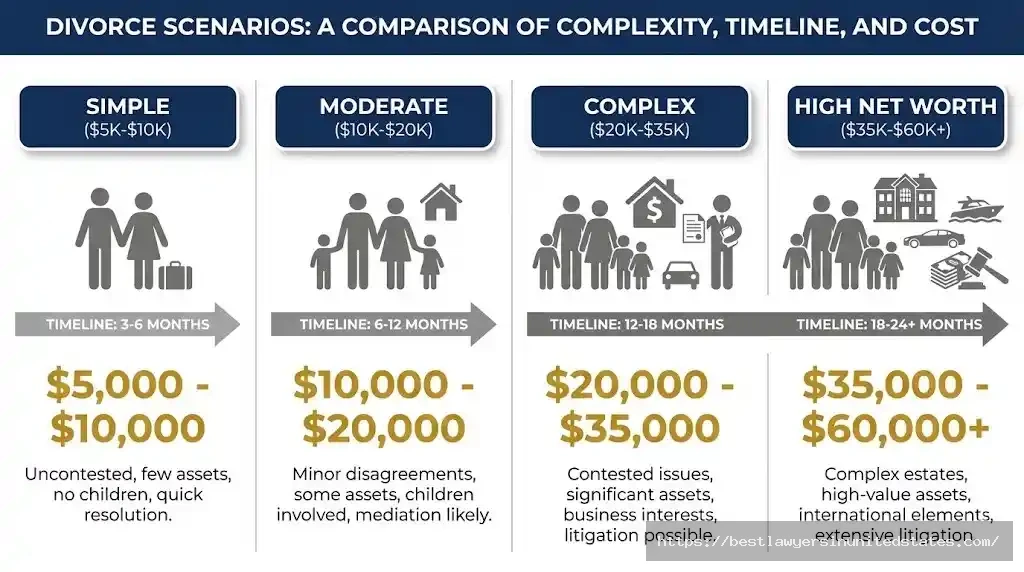
Scenario 1: Simple Divorce
Profile: Married 5 years, no children, apartment rental, two cars, minimal retirement savings
Estimated Costs:
- Attorney fees (each spouse): $3,500-$6,000
- Filing fees: $300-$450
- Document preparation: $300-$500
- Total per spouse: $4,100-$6,950
Timeline: 3-5 months
Both spouses work full-time, communicate reasonably well, and agree on asset division. Collaborative team includes only attorneys—no additional professionals needed.
Scenario 2: Moderate Complexity Divorce
Profile: Married 12 years, 2 children (ages 8 and 10), own home with mortgage, two cars, 401(k) accounts, modest savings
Estimated Costs:
- Attorney fees (each spouse): $7,500-$12,000
- Financial neutral: $2,500-$4,000 (split)
- Child specialist: $2,000-$3,500 (split)
- Mental health professional: $1,500-$2,500 (split)
- Filing fees: $300-$450
- Parenting class: $40-$100 (each)
- Home appraisal: $400-$600 (split)
- QDRO preparation: $500-$1,200 (split)
- Total per spouse: $11,290-$17,175
Timeline: 5-8 months
Primary disagreements center on custody schedule and house disposition. Child specialist helps create parenting plan. Financial neutral structures property division and support calculations.
Scenario 3: Complex Divorce
Profile: Married 18 years, 3 children, own home plus rental property, one spouse owns small business, significant retirement assets, inheritance questions
Estimated Costs:
- Attorney fees (each spouse): $15,000-$25,000
- Financial neutral: $4,000-$6,500 (split)
- Child specialist: $3,000-$4,500 (split)
- Mental health professional: $2,500-$4,000 (split)
- Business valuation: $5,000-$12,000 (split)
- Real estate appraisals (2 properties): $800-$1,200 (split)
- Forensic accounting: $3,000-$8,000 (split)
- Filing fees: $300-$450
- QDROs (multiple accounts): $1,500-$3,000 (split)
- Tax professional: $1,000-$2,500 (split)
- Total per spouse: $23,550-$38,825
Timeline: 8-12 months
Business valuation complexity and determining separate vs. marital property requires extensive financial analysis. Multiple children with different needs require detailed parenting plan.
Scenario 4: High-Net-Worth Divorce
Profile: Married 22 years, 2 adult children, multiple properties, investment portfolios, business interests, trusts, stock options, international assets
Estimated Costs:
- Attorney fees (each spouse): $30,000-$60,000+
- Financial neutral: $8,000-$15,000 (split)
- Multiple business valuations: $15,000-$40,000 (split)
- Forensic accounting: $10,000-$25,000 (split)
- Tax strategist: $3,000-$8,000 (split)
- Real estate appraisals: $2,000-$5,000 (split)
- Filing fees: $300-$450
- Total per spouse: $64,150-$131,725+
Timeline: 10-18 months
Extensive asset tracing, tax planning, and complex division scenarios require months of detailed financial work. Despite high costs, this is 30-50% less than litigation for similar cases.
10 Ways to Reduce Your Collaborative Divorce Costs
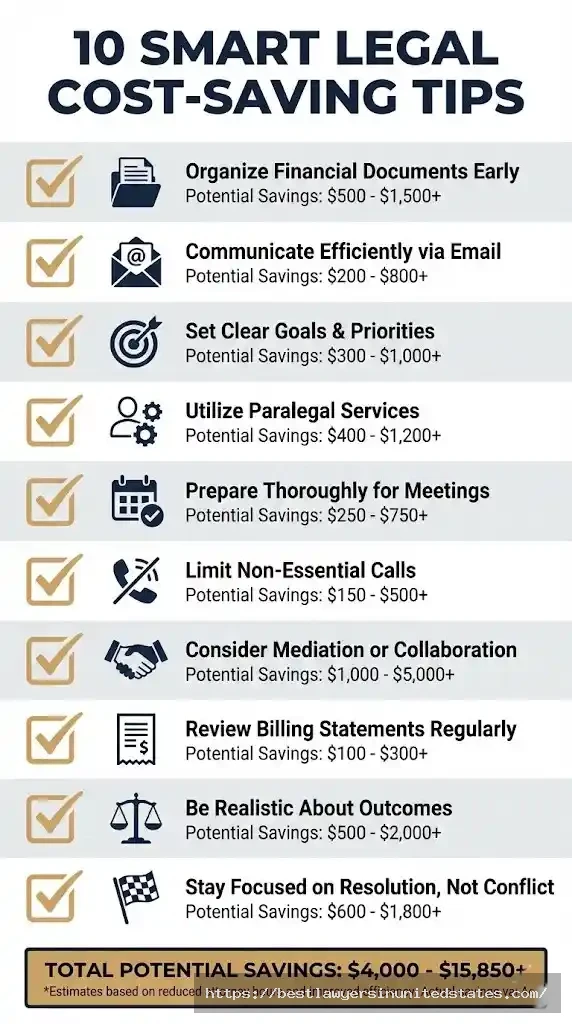
1. Come Prepared to Every Meeting
Attorney time is your biggest expense. Reduce billable hours by:
- Gathering financial documents before your first meeting
- Completing all requested forms promptly
- Reviewing materials before meetings so you don’t need explanations during expensive collaborative sessions
Potential Savings: $1,500-$3,000
2. Use Email Strategically
Don’t call your attorney for every question—many firms charge for phone calls in 15-minute increments. Instead, compile questions and send one organized email. Many attorneys don’t charge for brief email responses.
Potential Savings: $500-$1,200
3. Do Your Own Document Organization
Rather than paying your attorney $300/hour to organize bank statements and tax returns, do it yourself:
- Create clearly labeled digital folders
- Prepare spreadsheets listing assets and debts
- Compile three years of tax returns, pay stubs, and account statements
Potential Savings: $800-$2,000
4. Be Realistic About What You Need
Not every case requires every professional. If you don’t have children, you don’t need a child specialist. If finances are straightforward, you might not need a financial neutral.
Discuss with your attorney which professionals add genuine value versus those who might be optional.
Potential Savings: $2,000-$8,000
5. Negotiate Payment Plans
Many collaborative professionals offer:
- Extended payment terms (6-12 months)
- Reduced retainers with monthly payments
- Sliding scale fees based on income
- Bundled team rates
Don’t be afraid to ask—many attorneys prefer paid-over-time clients to no clients.
6. Use Your Employer’s EAP Benefits
Many employer assistance programs (EAPs) offer:
- 3-6 free sessions with divorce coaches or counselors
- Free or reduced-cost mediation services
- Financial planning consultations
- Legal consultation referrals
Potential Savings: $500-$1,500
7. Apply for Fee Waivers
If you qualify for government benefits or legal aid services, most states will waive:
- Court filing fees ($300-$450)
- Service of process fees ($40-$150)
- Document certification costs ($20-$50)
Potential Savings: $360-$650
8. Choose Zoom Over In-Person Meetings
Many collaborative teams now offer virtual sessions at reduced rates since there’s no office overhead, parking, or travel time billed to you.
Potential Savings: $1,000-$2,500
9. Make Decisions Between Meetings
Every disagreement that gets resolved during expensive collaborative sessions (with your attorney, your spouse, their attorney, and potentially neutral professionals all billing simultaneously) costs hundreds per hour.
Make as many joint decisions as possible outside these meetings through direct communication or email.
Potential Savings: $2,000-$5,000
10. Keep Emotions in Check
When discussions become emotionally charged, meetings run longer and require more professional time. Consider:
- Individual therapy outside the collaborative process
- Using the divorce coach between meetings
- Taking breaks during difficult conversations
One heated 4-hour session with professionals can cost $4,000-$8,000. Preventing one of these can justify the cost of several therapy sessions.
Potential Savings: $3,000-$10,000
When Collaborative Divorce Actually Costs MORE (Warning Signs)
Collaborative divorce isn’t always the most cost-effective option. Watch for these red flags that suggest you’re wasting money:
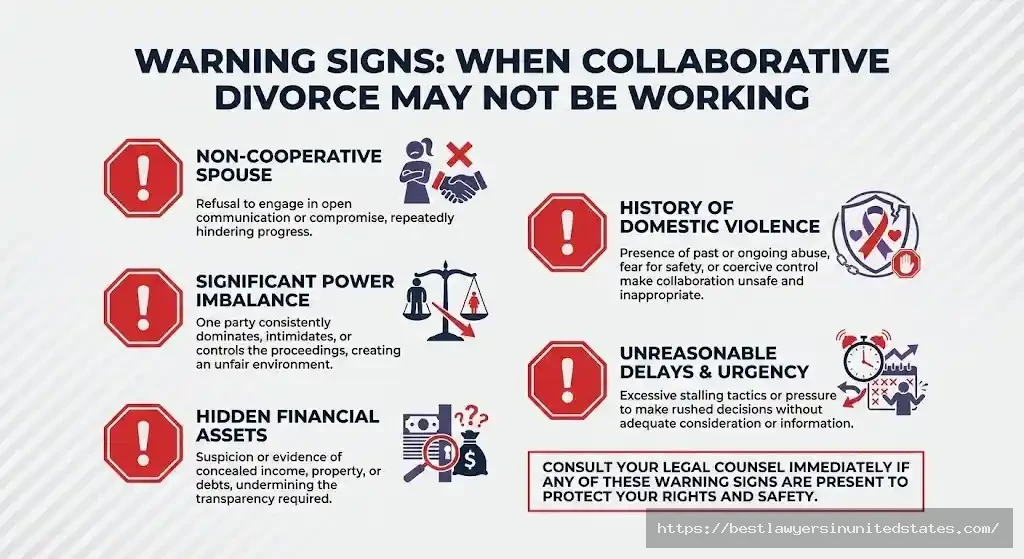
Your Spouse Isn’t Fully Committed
If your spouse:
- Misses meetings repeatedly
- Refuses to provide financial documentation
- Won’t sign the Participation Agreement
- Says they’ll “try collaboration but keep options open”
Reality Check: You’re spending money on a process that’s likely to fail. One spouse’s lack of commitment means you’ll eventually switch to litigation anyway, essentially paying twice.
There’s a Significant Power Imbalance
Collaborative divorce assumes both spouses can advocate for themselves in negotiation settings. If one spouse:
- Controls all financial information
- Has intimidated the other throughout the marriage
- Makes unilateral decisions the other fears challenging
Reality Check: The less powerful spouse may agree to unfavorable terms just to end the process, or the imbalance may require so much coaching and support that costs exceed litigation where a judge levels the playing field.
Hidden Assets Are Suspected
If you believe your spouse is hiding income, assets, or business valuations, collaborative divorce lacks the legal discovery tools (subpoenas, depositions, court orders) needed to uncover deception.
Reality Check: Paying $20,000 for collaborative divorce only to discover later that your spouse concealed $200,000 in assets means you’ll likely need to go back to court anyway.
Domestic Violence or Abuse History
Collaborative divorce requires face-to-face meetings and negotiations. If there’s been:
- Physical abuse
- Threatening behavior
- Stalking or controlling conduct
- Fear of retaliation
Reality Check: Your safety and ability to negotiate freely are more important than saving money. Traditional litigation provides protective orders, controlled communication through attorneys, and court security.
Time Sensitivity Issues
If you need immediate court orders for:
- Temporary support
- Protection from asset dissipation
- Emergency custody arrangements
Reality Check: Collaborative divorce moves too slowly for urgent situations. Litigation provides emergency hearings within days or weeks.
The True ROI of Collaborative Divorce: Beyond the Price Tag
While collaborative divorce costs more upfront than mediation, the investment often pays dividends that litigation can’t match.
Emotional Cost Savings
Traditional litigation amplifies conflict by design—each attorney advocates zealously, often villainizing the other spouse. This approach:
- Damages co-parenting relationships for years
- Creates lasting resentment that prevents future cooperation
- Requires therapy to process courtroom trauma: $3,000-$10,000+
- Increases stress-related health issues: impossible to quantify
Collaborative divorce’s cooperative approach:
- Preserves relationships that continue post-divorce
- Models healthy conflict resolution for children
- Reduces long-term mental health costs
Time-Value Money Analysis
Litigation Timeline: 18-36 months average Collaborative Timeline: 4-10 months average
The faster resolution means:
- Returning to full work productivity sooner
- Less time away from career advancement
- Reduced opportunity cost of prolonged uncertainty
- Faster access to your share of assets for reinvestment
If your earning capacity is $75,000/year and litigation distracts you enough to reduce productivity by 25% for an extra year versus collaborative divorce, that’s $18,750 in lost earning potential—more than many collaborative divorce total costs.
Preventing Future Legal Battles
Litigated divorces often result in one or both spouses feeling the outcome was “done to them” by a judge, leading to:
- Modification requests ($5,000-$15,000 each)
- Enforcement actions ($3,000-$10,000 each)
- Contempt proceedings ($2,000-$8,000 each)
Because collaborative agreements are created together rather than imposed, compliance rates are significantly higher, preventing these future legal costs.
Protecting Children from Court Trauma
Children called to testify, interviewed by Guardian ad litems, or subjected to custody evaluations experience documented psychological harm. Collaborative divorce:
- Uses child specialists who interview children sensitively
- Keeps children out of courtrooms
- Creates parenting plans based on children’s actual needs, not what sounds good to a judge
The long-term mental health benefit to children: priceless, but avoiding years of therapy has clear financial value.
What Happens If Collaborative Divorce Fails?
The Participation Agreement all parties sign includes a “disqualification provision”—if negotiations break down and someone files for litigation, both collaborative attorneys must withdraw.
Why This Rule Exists
The disqualification provision ensures attorneys can be completely transparent during negotiations without worrying that information shared in good faith becomes ammunition in court.
However, this creates financial risk if the process fails.
Your Options If Negotiations Stall
Option 1: Take a Break Sometimes emotions run too hot for productive discussion. You can pause the collaborative process for weeks or months while tempers cool, then reconvene.
Option 2: Add Professionals If you’re stuck on financial issues, bring in a financial neutral. If communication has broken down, engage a divorce coach. Often, the right professional can unstick negotiations.
Option 3: Limited Issue Mediation Try resolving the specific sticking point through traditional mediation while keeping the collaborative process open for other issues.
Option 4: Switch to Litigation If genuine cooperation is impossible, accept that collaborative divorce isn’t working and hire litigation attorneys. Your time wasn’t completely wasted—you’ve already gathered financial information and identified areas of agreement, which your new attorney can use.
Protecting Yourself From Process Failure
Get an honest assessment upfront: Experienced collaborative attorneys can usually identify within 1-2 meetings whether both spouses are genuinely committed.
Set clear timelines: Establish deadlines for document exchange and decision-making to prevent one spouse from dragging out the process.
Address bad faith immediately: If your spouse violates agreements or hides information, confront it right away rather than hoping it improves.
Know your walk-away point: Before investing $15,000, decide what behaviors or outcomes would signal collaborative divorce isn’t working.
Do I Need a Lawyer for Collaborative Divorce?
Yes—collaborative divorce, by definition, requires each spouse to have their own specially-trained collaborative attorney.
This differs from mediation, where you can work with a single neutral mediator without attorneys present (though bringing attorneys to mediation sessions is advisable).
What Collaborative Attorneys Do Differently
Collaborative attorneys receive specialized training in:
- Interest-based negotiation (focusing on underlying needs, not positions)
- Managing team dynamics with neutral professionals
- De-escalating conflict
- Creative problem-solving outside courtroom rules
Unlike litigation attorneys who must be ready to fight in court, collaborative attorneys commit to finding solutions through negotiation alone.
Can’t I Just Use a Regular Divorce Attorney?
Technically, any attorney can participate in collaborative divorce, but using an attorney without collaborative training is like using a surgeon for a routine checkup—the wrong skill set for the situation.
Regular divorce attorneys are trained to:
- Identify weaknesses in the opponent’s case
- Build evidence for trial
- Make adversarial arguments
- Prepare for courtroom testimony
Collaborative attorneys are trained to:
- Identify shared interests
- Build consensus
- Facilitate difficult conversations
- Create lasting agreements
How to Find a Qualified Collaborative Attorney
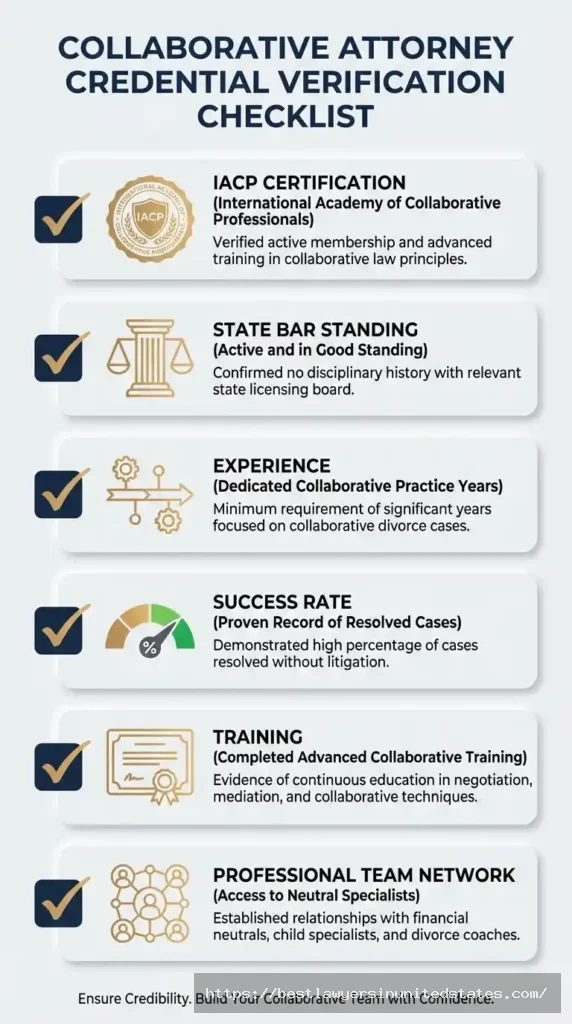
Check Professional Organizations:
- International Academy of Collaborative Professionals (IACP)
- State collaborative law organizations
- Local family law bar associations
Ask Qualifying Questions:
- How many collaborative cases have you handled?
- What percentage of your practice is collaborative vs. litigation?
- What’s your success rate keeping cases out of court?
- How do you handle situations where collaborative isn’t working?
Red Flags:
- Attorney mainly practices litigation but “does collaborative too”
- Can’t name the neutral professionals they typically work with
- Suggests collaborative as a negotiation tactic before litigation
- Hasn’t completed formal collaborative training
How Long Does a Collaborative Divorce Take?
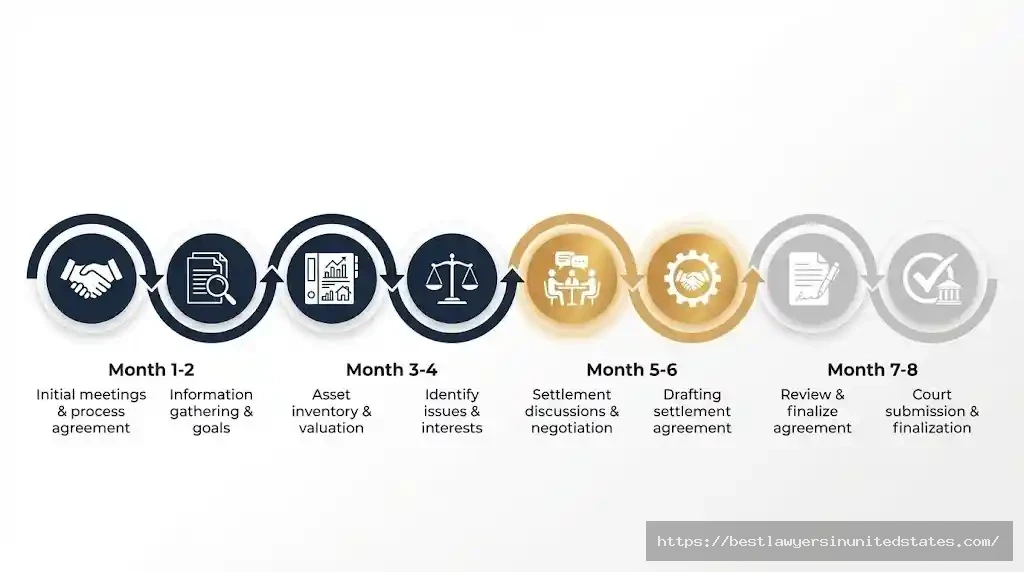
The typical collaborative divorce resolves in 4-8 months, significantly faster than litigated divorces that average 12-36 months.
Factors That Speed Up the Process
Strong Communication: Couples who can email or text about logistics between meetings progress faster than those who need attorneys to facilitate every exchange.
Complete Financial Disclosure: Gathering all financial documents upfront prevents delays waiting for information.
Clear Priorities: Knowing what matters most to each spouse helps focus negotiations on real issues rather than getting stuck on minor points.
Scheduled Regular Meetings: Setting standing appointments (e.g., every two weeks) maintains momentum rather than waiting weeks between sessions while everyone’s calendar aligns.
Decisive Neutral Professionals: Experienced financial and mental health professionals can often cut through disagreements quickly with objective analysis.
What Slows Down Collaborative Divorce
Complex Asset Valuation: Business appraisals, real estate evaluations, and retirement account analysis take weeks or months.
Emotional Processing Time: Major life changes require adjustment. Rushing agreements people aren’t emotionally ready for leads to regret and potential process failure.
Child Custody Disagreements: Creating parenting plans that genuinely serve children’s best interests requires careful thought and often multiple revisions.
Tax Strategy Development: Understanding tax implications of different settlement options needs time for CPAs to analyze scenarios.
Seasonal Delays: Summer vacations, holiday breaks, and end-of-year tax season create scheduling gaps.
Realistic Timeline Breakdown
Month 1-2: Initial meetings, Participation Agreement signing, financial document gathering
Month 3-4: Asset and debt inventory, initial settlement discussions, engaging neutral professionals if needed
Month 5-6: Working through specific issues (property division, support, custody), developing proposed settlement terms
Month 7-8: Finalizing Settlement Agreement, preparing final divorce paperwork, filing with court
Month 9+: Waiting for court processing and final decree (varies by jurisdiction)
Is Collaborative Divorce Worth the Cost?
For most couples with moderate to complex situations who can commit to cooperation, yes—collaborative divorce provides excellent value relative to litigation while offering more professional support than simple mediation.
Best Candidates for Collaborative Divorce:
- Moderate to high assets requiring professional financial guidance
- Children whose needs demand careful co-parenting planning
- Desire to preserve ongoing relationships (family businesses, close-knit extended family)
- Both spouses committed to fair resolution without court
- Situations where privacy matters (public figures, business owners)
When Other Options Make More Sense:
Choose mediation if: You have simple finances, no children, communicate well, and want the lowest cost option.
Choose litigation if: There’s domestic violence, suspected hidden assets, complete inability to cooperate, or need for emergency court orders.
Choose DIY divorce if: You’ve been married briefly, have no assets or debts, no children, and absolutely minimal income to work with.
The Bottom Line on Value
Collaborative divorce costs 30-70% less than litigation while providing more expert guidance than mediation. For couples in the middle—not simple enough for DIY, not hostile enough to require court—it offers the best balance of cost, support, and outcome quality.
The question isn’t whether collaborative divorce costs money, but whether that money buys you a better long-term outcome than cheaper or more expensive alternatives. For most couples, it does.
Frequently Asked Questions
How much does collaborative divorce cost in Texas?
Texas collaborative divorce typically costs $10,000-$25,000 per spouse, with filing fees of $300-$350 depending on county. Attorney rates range from $200-$450/hour. The process takes 4-8 months on average. Texas supports collaborative law through specific Family Code statutes, and many Texas courts encourage this approach to reduce litigation backlog.
Is collaborative divorce cheaper than going to court?
Yes, collaborative divorce costs significantly less than traditional litigation. The median collaborative divorce costs $5,000-$19,723 per spouse versus $50,000-$77,746 for full litigation. You save money by avoiding court hearing fees, depositions, expert witness costs, and the extended timeline of courtroom battles. However, collaborative divorce costs more than simple mediation ($3,500-$6,600 total).
What happens if collaborative divorce fails?
If collaborative divorce negotiations break down, both attorneys must withdraw under the Participation Agreement’s disqualification provision. You’ll need to hire new litigation attorneys and start the legal process over. This means you’ve lost the investment in your collaborative attorney (often $5,000-$15,000) and must pay a new retainer for litigation representation. To minimize this risk, most collaborative teams assess both spouses’ commitment level before investing significant time and money in the process.
Do both spouses split the cost of collaborative divorce?
Each spouse pays their own attorney separately, and you split the cost of shared neutral professionals (financial specialist, divorce coach, child specialist). If one spouse earns significantly more, the settlement may include provisions for the higher-earning spouse to contribute toward the other’s legal fees, but this is negotiated as part of the overall agreement rather than automatic.
Can I get a fee waiver for collaborative divorce?
Fee waivers typically only cover court filing fees ($300-$450), not attorney or professional fees. If you receive government benefits, qualify for legal aid, or can demonstrate financial hardship, most states will waive filing costs. However, collaborative attorneys and neutral professionals must be paid. Some offer sliding scale fees, payment plans, or reduced retainers for lower-income clients—ask during initial consultations.
How much does a financial neutral cost in collaborative divorce?
Financial neutrals charge $150-$400/hour depending on their credentials and location. Total cost typically ranges from $2,000-$6,000 per couple for moderate cases, split between spouses. Complex cases involving business valuations or extensive assets may cost $4,000-$15,000. Financial neutrals review all assets and debts, analyze tax implications, create property division scenarios, and prepare settlement proposals—often saving money by preventing mistakes that would require future legal action.
What’s the difference between collaborative divorce and mediation costs?
Mediation costs $3,500-$6,600 total for both spouses and uses one neutral mediator who facilitates negotiations but doesn’t represent either party. Collaborative divorce costs $10,000-$40,000+ total (for both spouses) and includes an attorney for each spouse plus shared neutral professionals. Mediation works best for simple cases with good communication. Collaborative divorce suits moderate to complex situations requiring more professional expertise and legal advocacy.
Does insurance cover any collaborative divorce costs?
Health insurance may cover mental health professional services if billed as individual therapy rather than divorce-specific coaching. Some employer EAP (Employee Assistance Programs) offer 3-6 free counseling sessions that can help with divorce stress. Legal insurance plans (if you have one) might cover initial consultations or provide discounted attorney rates, but most exclude divorce representation. Homeowner’s insurance rarely covers any divorce-related costs.
How long does collaborative divorce take compared to litigation?
Collaborative divorce typically resolves in 4-10 months versus 12-36+ months for litigation. The faster timeline saves money because you’re paying attorney and professional fees for less time. However, collaborative divorce shouldn’t be rushed—couples need adequate time to process emotions, analyze financial implications, and create sustainable agreements. The timeline depends on case complexity, how well spouses cooperate, and how quickly neutral professionals can complete valuations and analyses.
Can I switch from collaborative divorce to litigation without losing money?
When you switch to litigation, both collaborative attorneys must withdraw, so you lose your investment in their services (typically $5,000-$15,000 per spouse). However, the work isn’t completely wasted—you’ll have financial documentation, identified areas of agreement, and a better understanding of issues. Your new litigation attorney can use this information, potentially saving some time. The financial loss is real but not total. Consider whether completing collaborative divorce is possible before switching to avoid this sunk cost.
Ready to Start Your Collaborative Divorce?
Collaborative divorce offers a balanced approach for couples who want to avoid court battles without sacrificing professional guidance. While costs range from $5,000-$30,000+ per spouse depending on complexity and location, this investment typically saves 30-70% compared to litigation while preserving important relationships.
Next Steps:
- Assess your situation using the scenarios in this guide to estimate likely costs
- Research collaborative attorneys in your area through the International Academy of Collaborative Professionals (IACP)
- Schedule consultations with 2-3 collaborative attorneys to compare fees and approaches
- Discuss with your spouse whether you’re both willing to commit to the collaborative process
- Gather financial documents before your first meeting to maximize value from attorney time
For more guidance on divorce costs and options, explore our related resources:
- Divorce Cost Calculator – Estimate your total divorce expenses
- Divorce Mediation Cost – Compare mediation vs collaborative approaches
- Contested Divorce Cost – Understand litigation expenses
- Uncontested Divorce Cost – Explore the simplest divorce option
- How Much Does a Divorce Cost – Comprehensive divorce cost guide
- Cost of Divorce Lawyer: Complete Guide – Attorney fee breakdowns
State-Specific Cost Guides:
- Divorce Cost in Texas
- Divorce Cost in California
- Divorce Cost in Florida
- Divorce Cost in New York
- Divorce Cost in Illinois
- Divorce Cost in Pennsylvania
- Divorce Cost in Ohio
- Divorce Cost in Georgia
- Divorce Cost in North Carolina
- Divorce Cost in Michigan
Additional Resources:
- DIY Divorce State by State Guide – Self-filing options and costs
- Family Lawyer Cost Guide – Understanding attorney fees
- Military Divorce Lawyer – Special considerations for military families
- Prenuptial Agreement Lawyer – Protecting assets before marriage
The right divorce approach protects both your finances and your future. Collaborative divorce provides that balance for couples ready to work together toward a fair resolution.
