
Quick Answer: How Much Does It Cost to File for Divorce?
Divorce filing fees in the United States range from $50 to $450, depending on your state and county. Mississippi has the lowest filing fee at $50, while California has the highest statewide fee at $435. Most states charge between $150 and $350 to file a petition for dissolution of marriage.

When you’re facing divorce, understanding the court filing fees helps you plan financially for the process ahead. The filing fee is what you pay the clerk of court to officially start your divorce case, but it’s just one piece of your total divorce costs.
This guide breaks down exactly what you’ll pay in every state, which counties charge more, how to get fees waived if you’re struggling financially, and what other costs to expect beyond the initial filing fee.
Estimate Your Complete Divorce Cost
Divorce Cost Calculator
Get an estimated cost for your divorce based on your specific situation
Your Estimated Divorce Cost
Cost Breakdown
📧 Get a Personalized Consultation
Have questions about your specific situation? Contact our legal experts for guidance tailored to your needs.
Contact Us via EmailGet an instant estimate based on your location, divorce type, and whether you have children. Our calculator includes filing fees, service costs, and attorney fees if needed.

What Is a Divorce Filing Fee?
The divorce filing fee (also called a petition fee or court fee) is what you pay when you submit your petition for dissolution of marriage to the family court. This fee covers administrative costs like case processing, court staff time, and document filing in the court system.

When you file for divorce, you’re officially the petitioner (or plaintiff in some states). Your spouse becomes the respondent (or defendant). The petitioner pays the initial filing fee. The respondent typically pays a separate response fee or answer fee when they file their paperwork, which is usually $50 to $250 less than the initial filing fee.
In an uncontested divorce where both spouses agree on everything, you might file jointly and split costs. For a contested divorce where you disagree on property, custody, or other issues, each spouse files separately and pays their own fees.
How Much Does It Cost to File for Divorce by State?
Filing fees vary dramatically across the United States. Your state legislature and county commissioners court set these fees based on local court operational costs, case volume, and budget requirements.
Complete State-by-State Filing Fee Table
| State | Filing Fee Range | With Children | Response Fee | Fee Waiver Available |
|---|---|---|---|---|
| Alabama | $200-$350 | +$25 | $100-$200 | Yes |
| Alaska | $250 | Same | $200 | Yes (Form TF-920) |
| Arizona | $320-$380 | +$50 | $100-$150 | Yes |
| Arkansas | $100-$165 | +$15 | $60-$100 | Yes |
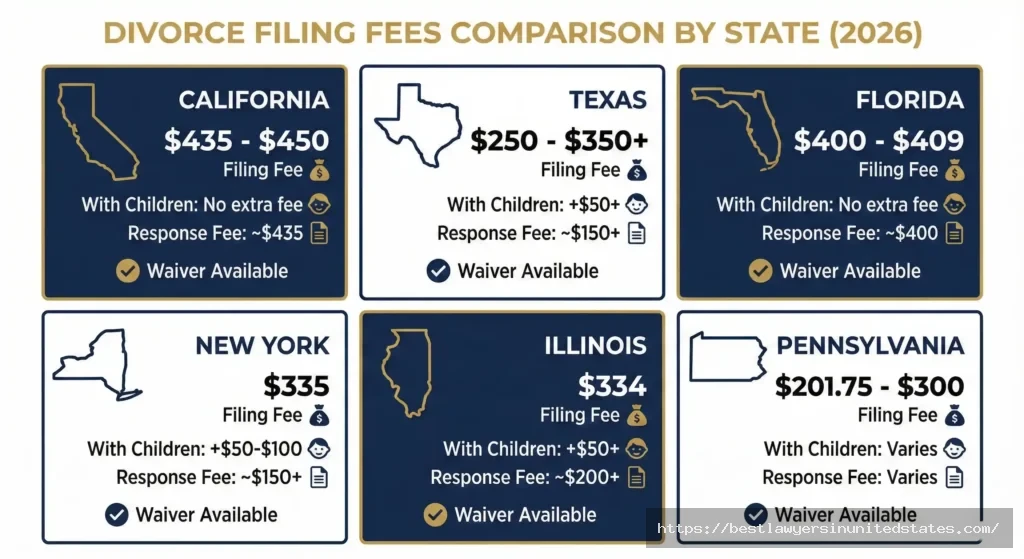
| California | $435-$450 | Same | $435-$450 | Yes (Form FW-001) |
| Colorado | $230-$350 | +$10 | $115-$200 | Yes |
| Connecticut | $350 | Same | $350 | Yes |
| Delaware | $165 | Same | $100 | Yes |
| Florida | $380-$430 | +$50 | $200-$250 | Yes |
| Georgia | $200-$400 | +$50 | $125-$250 | Yes |
| Hawaii | $250 | Same | $100 | Yes |
| Idaho | $154 | Same | $85 | Yes |
| Illinois | $289-$388 | +$50 | $150-$250 | Yes |
| Indiana | $157 | Same | $135 | Yes |
| Iowa | $185 | +$15 | $150 | Yes |
| Kansas | $195 | Same | $173 | Yes |
| Kentucky | $148 | Same | $100 | Yes |
| Louisiana | $150-$350 | +$25 | $100-$200 | Yes |
| Maine | $120 | Same | $100 | Yes |
| Maryland | $165-$195 | Same | $165 | Yes |
| Massachusetts | $215 | Same | $100 | Yes |
| Michigan | $175-$255 | +$80 | $100-$150 | Yes |
| Minnesota | $400+ | Same | $300+ | Yes |
| Mississippi | $50 | Same | $50 | Yes |
| Missouri | $100-$300 | +$50 | $100-$200 | Yes |
| Montana | $85-$170 | Same | $85 | Yes |
| Nebraska | $158 | Same | $158 | Yes |
| Nevada | $217-$299 | +$20 | $100-$150 | Yes |
| New Hampshire | $251 | Same | $251 | Yes |
| New Jersey | $300 | Same | $135 | Yes |
| New Mexico | $137 | Same | $100 | Yes |
| New York | $210-$335 | Same | $170-$250 | Yes |
| North Carolina | $225 | Same | $100 | Yes |
| North Dakota | $80 | Same | $80 | Yes |
| Ohio | $200-$350 | +$25 | $100-$200 | Yes |
| Oklahoma | $180-$280 | +$15 | $100-$200 | Yes |
| Oregon | $287 | Same | $273 | Yes |
| Pennsylvania | $300-$350 | +$50 | $200-$250 | Yes |
| Rhode Island | $160 | Same | $100 | Yes |
| South Carolina | $150 | Same | $100 | Yes |
| South Dakota | $95 | Same | $95 | Yes |
| Tennessee | $184-$400 | +$50 | $100-$250 | Yes |
| Texas | $250-$400 | +$30-$50 | $100-$200 | Yes (Form TB-002) |
| Utah | $333-$360 | Same | $100 | Yes |
| Vermont | $295 | Same | $295 | Yes |
| Virginia | $86-$100 | Same | $86-$100 | Yes |
| Washington | $280-$300 | Same | $200-$250 | Yes |
| West Virginia | $135 | Same | $100 | Yes |
| Wisconsin | $184 | Same | $150 | Yes |
| Wyoming | $70 | Same | $70 | Yes |
Which States Have the Highest Divorce Filing Fees in 2026?
If you’re filing in these states, budget carefully. The highest filing fees reflect urban court systems with heavy caseloads and higher operational costs.

California: $435-$450 (Highest in US)
California charges a base filing fee of $435 statewide. Some counties like Riverside and San Bernardino add local surcharges that push the total to $450. This fee is the same whether you have children or not. If your spouse files a response, they’ll also pay $435.
The high cost reflects California’s complex superior court system and the state’s approach to funding court operations through filing fees rather than taxes. For detailed California divorce costs beyond filing fees, see our California divorce cost guide.
Major California Counties:
- Los Angeles County: $435
- San Diego County: $435
- Orange County: $435
- Riverside County: $450 (includes surcharge)
- San Bernardino County: $450 (includes surcharge)
- Sacramento County: $435
Florida: $380-$430
Florida’s filing fees vary by county but typically range from $380 to $430. Most counties charge around $409 for the base filing fee. If you have minor children, expect to pay an additional $50 for a parenting education course that’s required by Florida family law.
The response fee in Florida is usually $200-$250, making it one of the more expensive states for both parties.
Check our Florida divorce cost breakdown for complete expense information.
Major Florida Counties:
- Miami-Dade County: $409
- Broward County: $409
- Palm Beach County: $409
- Hillsborough County (Tampa): $409
- Orange County (Orlando): $409
- Duval County (Jacksonville): $409
Minnesota: $400+
Minnesota charges over $400 to file for divorce, making it one of the most expensive states. The exact fee depends on your county, with some urban counties charging more than rural areas.
Hennepin County (Minneapolis): $400 Ramsey County (St. Paul): $400
Illinois: $289-$388
Illinois filing fees vary significantly by county. Cook County (Chicago) charges the highest at around $388, while rural counties may charge closer to $289. Cases with children cost an additional $50 in most counties.
See our Illinois divorce cost guide for county-specific information.
Major Illinois Counties:
- Cook County (Chicago): $388
- DuPage County: $337
- Lake County: $337
- Will County: $337
- Kane County: $337
Texas: $250-$400
Texas shows dramatic county-by-county variation. Rural counties might charge $250, while urban counties like Harris County (Houston) charge $350-$400. Texas also adds multiple surcharges to the base filing fee, so your actual cost includes fees for things like courthouse security, records preservation, and more.
For complete Texas filing information, visit our Texas divorce cost breakdown.
Major Texas Counties:
- Harris County (Houston): $350-$370
- Dallas County: $318
- Tarrant County (Fort Worth): $350-$370
- Bexar County (San Antonio): $318
- Travis County (Austin): $318
- Collin County: $318
Which States Have the Lowest Divorce Filing Fees?
These states make divorce more financially accessible with lower filing fees. If cost is a major concern and you have flexibility about where to file, these states offer significant savings.
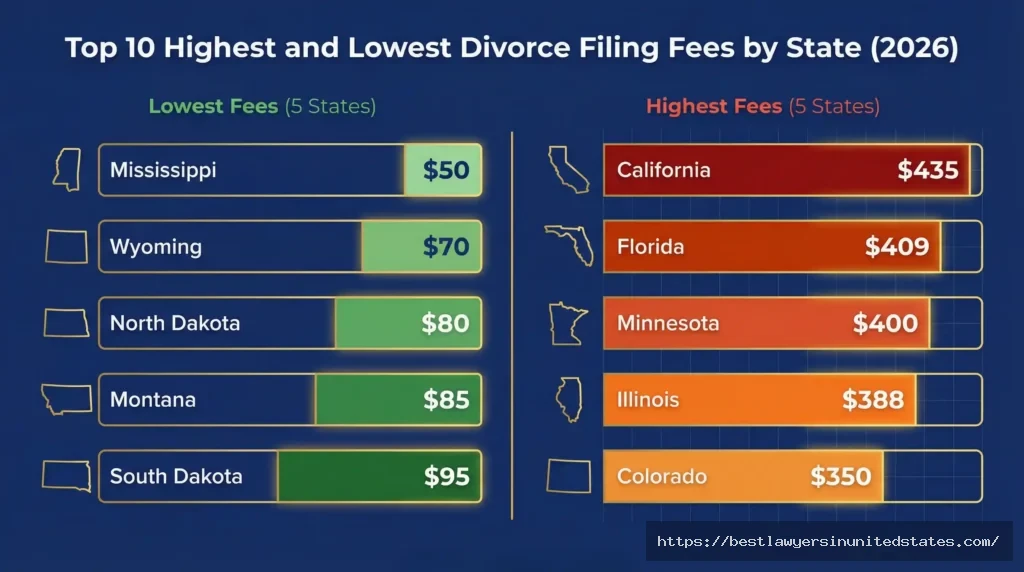
Mississippi: $50 (Lowest in US)
Mississippi has the lowest divorce filing fee in the nation at just $50. Both the petition and response cost $50, making it the most affordable state for divorce filing fees. This low cost makes the divorce process accessible even for residents with very limited financial resources.
Wyoming: $70
Wyoming charges only $70 to file for divorce, the second-lowest in the country. There are no additional fees for cases with children, and the response fee is also $70.
North Dakota: $80
North Dakota keeps divorce filing affordable at $80. The state uses a flat fee structure across all counties, so you’ll pay the same amount whether you’re in Fargo or a rural county.
Montana: $85-$170
Montana’s fees vary by county but start as low as $85 in some areas. Even the higher-end counties don’t exceed $170, making Montana one of the more affordable states overall.
South Dakota: $95
South Dakota charges $95 to file for divorce statewide. The straightforward fee structure makes it easy to budget for your filing costs.
Arkansas: $100-$165
Arkansas keeps fees reasonable, with most counties charging between $100 and $165. Cases with minor children add about $15 to cover additional court processing.
Why Do Divorce Filing Fees Vary So Much Between States?
Several factors explain why you might pay $50 in Mississippi but $435 in California:
Court Operational Costs: States with larger, more complex court systems have higher administrative expenses. California’s superior courts handle millions of cases annually and need extensive staff, technology, and facilities.
State Budget Priorities: Some states fund courts primarily through filing fees (user-pays model), while others use more tax revenue. States relying on filing fees naturally charge more.
Cost of Living: High-cost states like California, New York, and Massachusetts have higher court employee salaries, building costs, and operational expenses that get passed to filers through fees.
Case Complexity Requirements: States that require additional filings, hearings, or processing steps charge more. For example, states requiring parenting education classes or mediation build those costs into filing fees.
Population and Caseload: Urban counties with heavy court dockets often charge more to manage high case volumes. Rural counties with fewer cases can operate with lower fees.
Do Filing Fees Vary by County Within the Same State?
Yes, filing fees can vary significantly by county even within the same state. Your county board of commissioners or local court administration sets fees within state-mandated ranges.
Texas County Variations
Texas shows the widest variation:
- Rural counties: $250-$280
- Harris County (Houston): $350-$370
- Dallas County: $318
- Travis County (Austin): $318
Texas allows counties to add local surcharges for things like courthouse construction, technology upgrades, and records preservation, which explains the differences.
California County Additions
While California has a uniform $435 base fee, some counties add local surcharges:
- Most counties: $435
- Riverside County: $450
- San Bernardino County: $450
Florida County Consistency
Florida maintains more consistency, with most counties charging $409. However, additional fees for children or expedited processing can vary by county.
Georgia Wide Range
Georgia allows counties significant discretion, resulting in fees from $200 in rural counties to $400 in Fulton County (Atlanta).
Always verify your exact county’s fee with the local clerk of court before filing. County clerk websites usually list current fees, or you can call the clerk’s office directly.
What Does Your Divorce Filing Fee Actually Cover?
When you pay the filing fee to the district court or family court, here’s what it covers:
Case Initiation: Opening your case file in the court system and assigning a case number.
Document Processing: Court clerks review your petition for dissolution to ensure it meets legal requirements and formatting standards.
Electronic Filing System Access: Many courts now use e-filing systems, and your fee covers access to these digital platforms.
Court Administration: Salaries for court staff who manage your case, schedule hearings, and process documents.
Record Maintenance: Creating and maintaining your case file for the legally required retention period (usually 7-10 years).
Basic Court Services: Access to the courthouse, courtroom time for hearings, and judicial review of your case.
What the Filing Fee Doesn’t Cover:
- Service of process (typically $50-$150)
- Attorney fees (see our divorce attorney fees guide)
- Mediation costs
- Parenting classes ($50-$100)
- Document copies ($0.50-$1 per page)
- Expert witnesses or evaluations
- Court reporter fees for depositions
How Much Is the Response Fee vs. Filing Fee?
The response fee (also called answer fee) is what the respondent pays when they officially respond to the divorce petition. This fee is typically $50 to $250 less than the initial filing fee.
Response Fee by State
| State | Initial Filing Fee | Response Fee | Difference |
|---|---|---|---|
| California | $435 | $435 | $0 |
| Texas | $250-$400 | $100-$200 | $100-$200 |
| Florida | $409 | $200-$250 | $150-$200 |
| New York | $210-$335 | $170-$250 | $40-$85 |
| Illinois | $289-$388 | $150-$250 | $100-$150 |
| Georgia | $200-$400 | $125-$250 | $75-$150 |
| Pennsylvania | $300-$350 | $200-$250 | $50-$150 |
| Ohio | $200-$350 | $100-$200 | $100-$150 |
| Michigan | $175-$255 | $100-$150 | $75-$105 |
| North Carolina | $225 | $100 | $125 |
Why the difference? The petitioner’s filing fee covers more administrative work—opening the case, creating the file, assigning a judge. The respondent’s fee mainly covers processing their response and adding their documents to the existing file.
Avoid response fees entirely: File a joint petition with your spouse in states that allow it. You’ll split one filing fee instead of paying two separate fees.
Are Filing Fees Different for Contested vs. Uncontested Divorce?
No, the initial filing fee is the same whether your divorce is contested or uncontested. However, you’ll save money in an uncontested case by:
Avoiding Response Fees: If you file jointly or your spouse agrees not to file a formal response, you save $50-$250.
No Motion Fees: Contested divorces require multiple court motions (temporary orders, discovery disputes, custody modifications), each potentially costing $50-$100 in filing fees.
Fewer Hearings: Some courts charge hearing fees for contested matters. Uncontested cases often go straight to final hearing.
No Trial Costs: Contested cases that go to trial require court reporter fees ($300-$500), exhibit preparation, and potentially expert witness fees.
An uncontested divorce might cost $500-$3,000 total, while a contested divorce can easily reach $15,000-$30,000 when you include all fees and attorney costs.
How Can I Get My Divorce Filing Fee Waived?
Every state offers fee waivers for people who can’t afford to pay. The process requires proving financial hardship to the court.
Who Qualifies for a Fee Waiver?
You typically qualify if your household income is at or below 125-150% of the federal poverty guidelines. For 2026, that means:
Federal Poverty Guidelines (2026):
- Individual: $15,060 annual income → Qualify if earning less than $18,825-$22,590
- Family of 2: $20,440 → Qualify below $25,550-$30,660
- Family of 3: $25,820 → Qualify below $32,275-$38,730
- Family of 4: $31,200 → Qualify below $39,000-$46,800
You may also qualify if you receive:
- Supplemental Security Income (SSI)
- Food stamps (SNAP benefits)
- Medicaid or CHIP
- TANF (Temporary Assistance for Needy Families)
- General Assistance or General Relief
How to Apply for a Fee Waiver
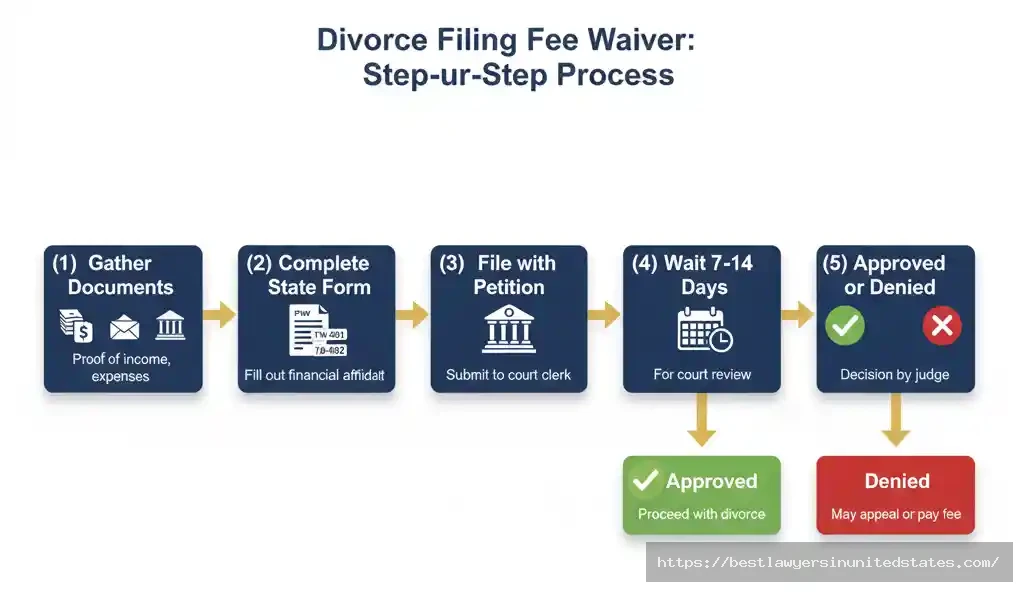
Step 1: Get the Right Form
Each state has specific fee waiver forms:
- California: Form FW-001 (Request to Waive Court Fees)
- Texas: Form TB-002 (Statement of Inability to Afford Payment)
- Florida: Application for Determination of Civil Indigent Status
- New York: Poor Person Application
- Illinois: Application for Waiver of Court Fees
- Pennsylvania: In Forma Pauperis Petition
Step 2: Gather Financial Documentation
You’ll need:
- Last 3 months of pay stubs
- Bank statements
- Government benefit letters (SSI, SNAP, etc.)
- Tax returns (most recent year)
- Proof of expenses (rent, utilities, medical bills)
Step 3: Complete the Form Accurately
List all income sources and monthly expenses. Be thorough and honest. Courts verify information and denying or lying on fee waiver applications can result in your case being dismissed.
Step 4: File with Your Divorce Petition
Submit the fee waiver application at the same time you file your petition for dissolution. Some courts let you file the waiver first and wait for approval before filing the divorce papers.
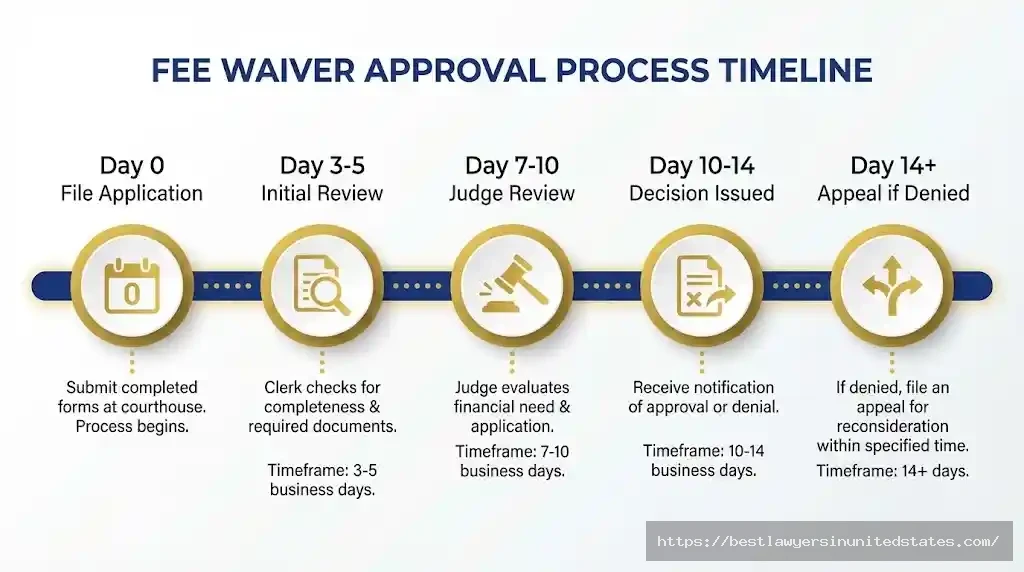
Step 5: Wait for a Decision
Most courts decide within 7-14 days. Some judges grant waivers immediately at filing. Others schedule a brief hearing to ask about your finances.
If Approved: You pay nothing and can proceed with your case.
If Denied: You can appeal the decision or request a payment plan (see below).
What If I Can’t Afford the Fee But Don’t Qualify for a Waiver?
If your income is slightly above the poverty guidelines but you still can’t afford $400+ upfront, ask about payment plans or fee deferrals.
Payment Plans
Many courts let you pay filing fees in installments:
Florida: Pay 25% upfront, then monthly payments with a $25 administrative fee California: Some counties offer 90-day payment plans Texas: Varies by county—some allow 60-90 day payment terms New York: Payment plans available through court clerk
Call your county clerk’s office and ask: “Do you offer payment plans for divorce filing fees?” Most clerks can set up an arrangement if you explain your situation.
Fee Deferral
Some states let you defer fees until your case ends. If you receive property or money in the settlement, the court takes the filing fee from your portion. If you don’t receive sufficient funds, the fee may be waived.
This works best in divorces with assets to divide. If there’s no property or money to split, courts usually prefer a fee waiver over deferral.
Who Pays the Filing Fee in a Divorce?
The petitioner (person filing) initially pays the filing fee. However, the financial responsibility can shift:
When You Might Get Reimbursed
Significant Income Disparity: If one spouse earns much more, courts often order the higher earner to pay the other’s fees and attorney costs. This is common in cases where one spouse was a stay-at-home parent or earned substantially less.
Attorney Fee Awards: Many states allow judges to order one spouse to pay the other’s reasonable attorney fees and court costs, including filing fees.
Settlement Agreements: You can negotiate who pays filing fees as part of your overall settlement. Some couples split all costs 50/50. Others agree the higher earner pays everything.
In California: Family courts routinely order fee reimbursement when there’s income disparity. If one spouse earns $150,000 and the other earns $30,000, expect the court to balance the financial burden.
In Texas: Courts can order one spouse to pay “suit money” covering the other spouse’s attorney fees and costs.
In New York: Monied spouse provisions require the higher earner to help fund the other spouse’s legal expenses in many cases.
Documenting Your Request
To request fee reimbursement, file an Income and Expense Declaration showing:
- Your monthly income
- Your spouse’s monthly income
- Monthly expenses
- Why you can’t afford the fees
The court reviews both spouses’ financial situations and decides what’s fair.
What Additional Costs Come with Divorce Beyond Filing Fees?
The filing fee is just the beginning. Here’s what else you’ll pay:
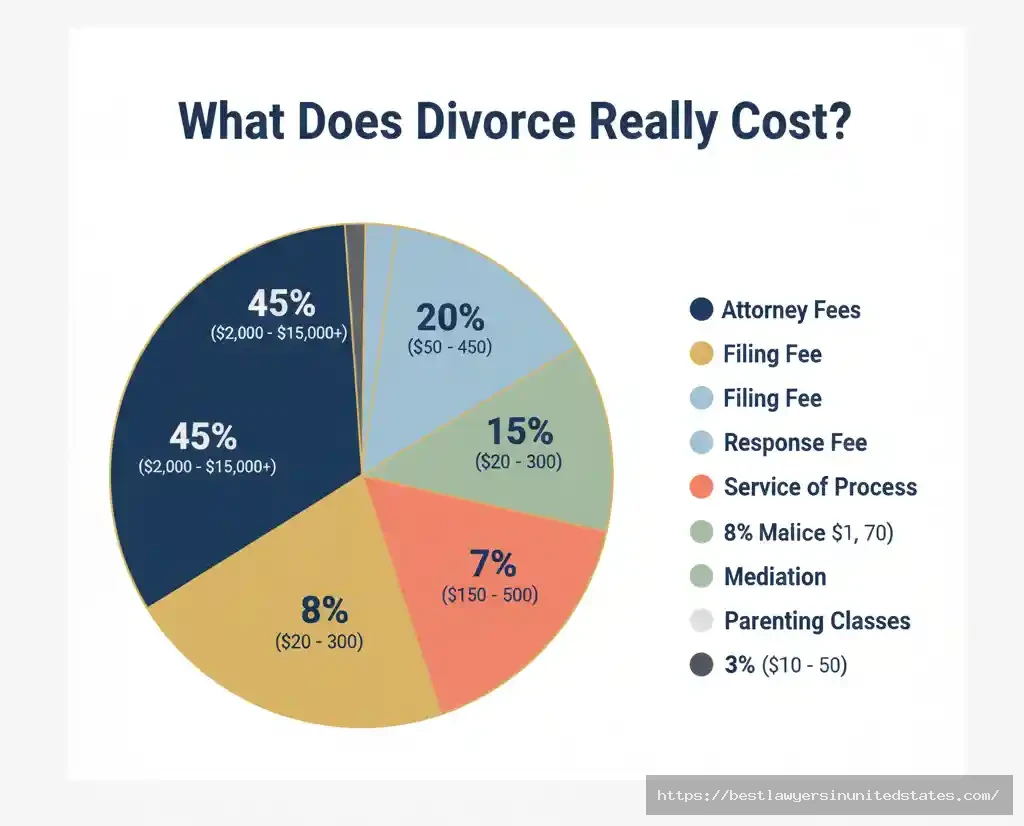
Service of Process: $50-$150
After you file your petition, you must formally “serve” your spouse with divorce papers. You can’t just hand them over yourself—you need:
- Sheriff service: $50-$75
- Private process server: $75-$150
- Certified mail with return receipt: $10-$15 (if spouse agrees to accept)
If your spouse agrees to accept service, have them sign an Acceptance of Service form and you’ll save $100+.
Response/Answer Fee: $50-$300
If your spouse files a formal response or answer, they’ll pay this fee to the court.
Parenting Education Classes: $50-$100
Many states require divorcing parents to complete a court-approved parenting class. Costs:
- Florida: $50-$75
- Texas: $60-$85
- California: $30-$75
- Georgia: $35-$50
Mediation: $100-$400 per hour
If you’re attempting divorce mediation to reach agreement, mediators charge hourly rates. Most cases need 2-8 hours of mediation. Some courts offer free or low-cost mediation through court-connected programs.
Document Copies: $0.50-$1 per page
Need copies of your divorce decree or other court documents? Courts charge per page for certified copies.
Attorney Fees: $3,000-$20,000+
If you hire a lawyer, expect costs from $3,000 for simple uncontested cases to $20,000+ for complex contested divorces. See our complete divorce lawyer costs guide for details.
Total Divorce Cost Ranges
Simple uncontested, no lawyer: $500-$1,500 Uncontested with lawyer: $2,000-$5,000
Contested divorce: $15,000-$30,000+
Use our divorce cost calculator to estimate your specific situation.
How Do I Pay the Divorce Filing Fee?
Courts accept multiple payment methods, but options vary by jurisdiction.
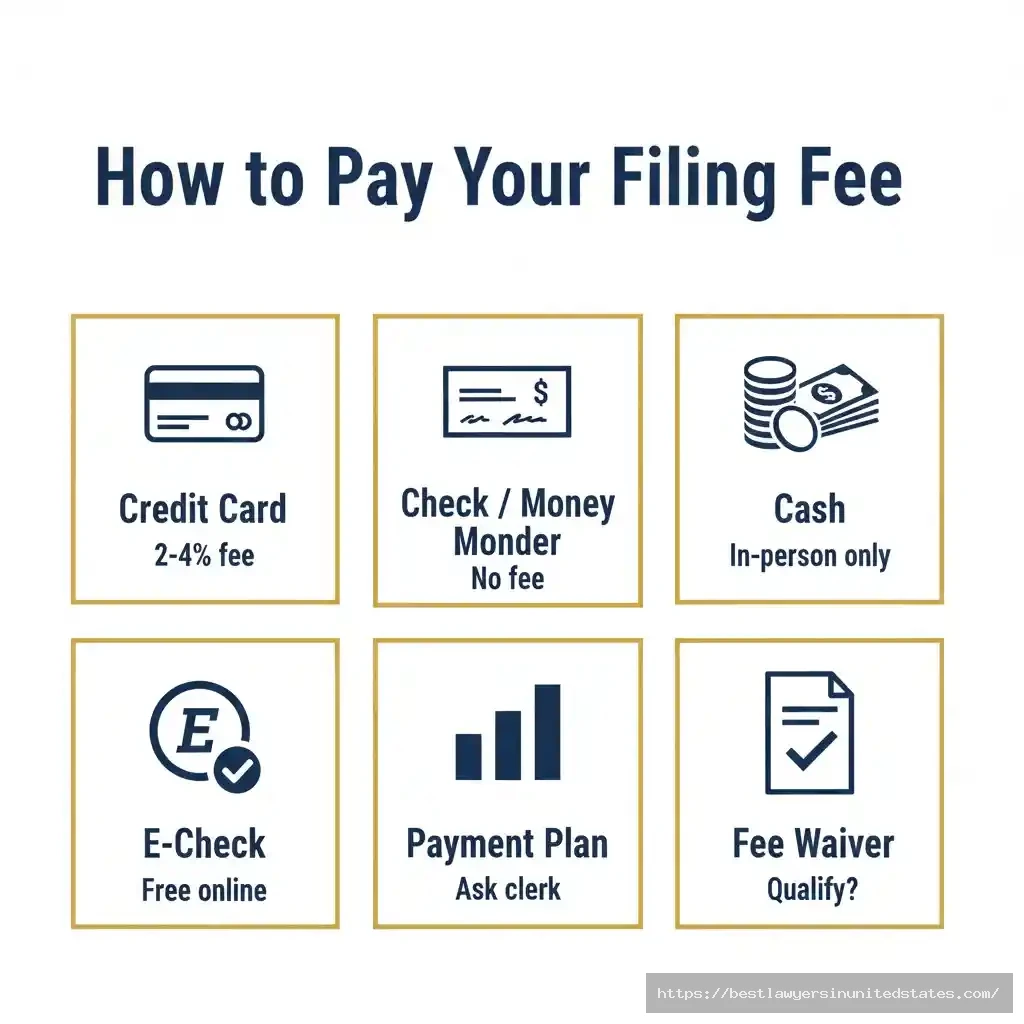
Accepted Payment Methods
In Person at Clerk’s Office:
- Cash
- Check or money order (made payable to “Clerk of Court” or your county clerk)
- Credit/debit cards (most courts)
- Cashier’s check
Online E-Filing:
- Credit/debit cards
- Electronic check/ACH transfer
- Some courts accept PayPal or other payment processors
By Mail:
- Check or money order only
- Include with your divorce petition
- Allow extra processing time
Credit Card Convenience Fees
Most courts charge a 2-4% convenience fee for credit/debit card payments. On a $400 filing fee, that’s an extra $8-$16. If you’re on a tight budget, paying by check or money order saves this fee.
Making the Check Out Correctly
When writing a check for filing fees:
- Payable to: “Clerk of Court – [Your County]” or “[County] District Clerk”
- Memo line: Your name and “Divorce Filing Fee”
- Amount: Exact fee amount—courts don’t make change
Call the clerk’s office if you’re unsure about the exact payee name. A check made out incorrectly will be rejected and delay your filing.
Does the Filing Fee Include Name Change After Divorce?
Yes, in most states you can request a name change as part of your divorce at no additional cost. You simply include the name you want to resume (typically your maiden name or a previous married name) in your petition for dissolution.
The court includes your name change in the final decree of divorce. Once the decree is signed, you can use it to update your:
- Social Security card
- Driver’s license
- Passport
- Bank accounts
- Credit cards
States That May Charge Extra
Louisiana: May charge $25-$50 additional for name change processing Some local jurisdictions: A few counties charge small administrative fees ($10-$25)
In most cases, though, the name change is included in your standard filing fee as long as you request it in the original petition. If you try to change your name after the divorce is finalized, you’ll need to file a separate name change petition with a new filing fee.
County-by-County Filing Fee Breakdown for Major States
For more detailed county information in high-population states:
California County Filing Fees
All California counties charge the base $435 filing fee, with these exceptions:
- Riverside County: $450
- San Bernardino County: $450
- Los Angeles County: $435
- San Diego County: $435
- Orange County: $435
- Santa Clara County: $435
- Alameda County: $435
- Sacramento County: $435
Texas County Filing Fees
Texas shows the widest variation:
Harris County (Houston): $350-$370 Dallas County: $318 Tarrant County (Fort Worth): $350-$370
Bexar County (San Antonio): $318 Travis County (Austin): $318 Collin County: $318 Denton County: $318 El Paso County: $300 Hidalgo County: $300 Fort Bend County: $350
Rural Texas counties: $250-$280
Florida County Filing Fees
Florida maintains consistency across most counties:
Miami-Dade, Broward, Palm Beach: $409 Hillsborough (Tampa): $409 Orange (Orlando): $409 Duval (Jacksonville): $409 Pinellas (Clearwater): $409 Polk (Lakeland): $409
Add $50 for cases with minor children for the required parenting course.
Illinois County Filing Fees
Cook County (Chicago): $388 DuPage County: $337 Lake County: $337 Will County: $337 Kane County: $337
Southern Illinois rural counties: $289-$320
New York County Filing Fees
New York County (Manhattan): $335 Kings County (Brooklyn): $335 Queens County: $335 Bronx County: $335 Richmond County (Staten Island): $335 Westchester County: $335 Erie County (Buffalo): $210 Monroe County (Rochester): $210
Upstate New York counties: $210-$250
How to Minimize Your Total Divorce Costs
The filing fee is mandatory, but you can reduce other divorce expenses significantly:
1. File a Joint Petition
If you and your spouse agree on all terms, file together as co-petitioners. You’ll pay one filing fee instead of two (petition + response). This alone saves $50-$300.
2. Waive Formal Service
If your spouse cooperates, have them sign an Acceptance of Service or Waiver of Service form. This saves $75-$150 on process server or sheriff costs.
3. Use Court Self-Help Services
Most family courts offer:
- Free legal advice clinics
- Document preparation assistance
- Self-help centers with staff who explain forms
- Online filing systems
These free resources help you complete paperwork correctly without hiring an attorney for simple cases.
4. Choose Uncontested Divorce
Resolve all issues before filing. An uncontested divorce costs $500-$3,000 total compared to $15,000-$30,000+ for contested divorces.
5. Try Mediation First
Collaborative divorce through mediation costs $2,000-$7,000—much less than litigation. Many courts offer free or sliding-scale mediation services.
6. DIY Document Preparation
For simple cases, use online divorce services or court forms to prepare documents yourself. This eliminates attorney fees for document preparation. See our DIY divorce state-by-state guide for options.
7. Take the Parenting Class Online
Online parenting education classes cost $25-$50 compared to $75-$100 for in-person classes.
8. Negotiate Fee Responsibility
In your settlement agreement, negotiate who pays what. If your spouse has more resources, ask them to cover filing fees and court costs.
Frequently Asked Questions About Divorce Filing Fees
How much is the divorce filing fee in California?
California charges $435 to file for divorce statewide. A few counties like Riverside and San Bernardino charge $450 due to local surcharges. Your spouse will also pay $435 if they file a response. This fee doesn’t change based on whether you have children.
How much does it cost to file for divorce in Texas?
Texas filing fees range from $250 to $400 depending on your county. Harris County (Houston) charges $350-$370, Dallas County charges $318, and rural counties may charge as little as $250. Texas adds multiple surcharges to the base filing fee, so always verify the total with your county clerk.
What is the filing fee for divorce in Florida?
Most Florida counties charge $409 to file for divorce. If you have minor children, add $50 for the required parenting education program. The response fee is typically $200-$250. Check with your specific county clerk as some counties charge slightly more or less.
How much is the divorce filing fee in New York?
New York filing fees range from $210 to $335 depending on location. New York City counties (Manhattan, Brooklyn, Queens, Bronx, Staten Island) charge $335. Upstate counties like Erie (Buffalo) and Monroe (Rochester) charge $210.
Which state has the cheapest divorce filing fee?
Mississippi has the lowest divorce filing fee at just $50. Wyoming ($70), North Dakota ($80), Montana ($85), and South Dakota ($95) also have very low fees compared to the national average.
Which state has the most expensive divorce filing fee?
California has the highest statewide fee at $435-$450. Minnesota ($400+), Florida ($409+), Illinois ($388 in Cook County), and Colorado ($350) also rank among the most expensive states for divorce filing fees.
Can I get my divorce filing fee waived if I’m unemployed?
Yes, unemployment qualifies you for a fee waiver in most states if your income falls below poverty guidelines. You’ll need to show proof of unemployment benefits or a recent termination letter, along with evidence that your current income (including unemployment compensation) is insufficient to pay the filing fee. File Form FW-001 in California, Form TB-002 in Texas, or your state’s equivalent fee waiver application.
Do both spouses have to pay filing fees?
The petitioner pays the initial filing fee ($50-$450 depending on state). The respondent pays a separate response fee ($50-$300) if they file an answer. In a joint petition where both spouses file together as co-petitioners, you typically pay one filing fee split between you. This saves money compared to filing separately.
Can I pay the divorce filing fee in installments?
Many courts offer payment plans for filing fees. Florida allows you to pay 25% upfront with monthly payments over 60-90 days plus a $25 administrative fee. California and Texas courts also offer installment plans in some counties. Call your county clerk’s office to ask about payment plan options.
How long does it take to get a fee waiver approved?
Most courts decide fee waiver applications within 7-14 business days. Some judges approve waivers immediately at the time of filing if your documentation clearly shows financial hardship. Others schedule a brief hearing within 2-3 weeks to review your finances. If denied, you can typically appeal within 10-30 days.
Does filing fee include serving divorce papers?
No, the filing fee covers only court processing of your petition. Service of process is a separate cost ranging from $50-$150. You must pay a sheriff ($50-$75) or private process server ($75-$150) to deliver papers to your spouse, or use certified mail ($10-$15) if your spouse agrees to accept service by mail.
What happens if I can’t afford to pay the filing fee?
Apply for a fee waiver (also called in forma pauperis petition) by filing a financial hardship affidavit with the court. If you receive SSI, SNAP, Medicaid, or other public benefits, or if your income is below 125-150% of federal poverty guidelines, courts typically waive all fees. If you don’t qualify for a full waiver, ask about payment plans or fee deferrals.
Are divorce filing fees tax deductible?
No, divorce filing fees are not tax deductible under current IRS rules. Before 2018, legal fees related to tax advice during divorce could be deducted, but the Tax Cuts and Jobs Act eliminated this deduction. Court filing fees, attorney fees, and other divorce costs are considered personal expenses, not business expenses, so they don’t qualify for tax deductions.
Can I use a credit card to pay the divorce filing fee?
Yes, most courts accept credit and debit cards for filing fees, both in person and through online e-filing systems. However, expect to pay a 2-4% convenience fee (about $8-$16 on a $400 filing fee). Paying by check or money order avoids this extra charge. Some courts also accept cash in person but not for online filings.
Do I need to pay the filing fee if I’m the respondent?
The respondent pays a response fee (also called answer fee) if they choose to file a formal response to the divorce petition. This fee is typically $50-$250 less than the initial filing fee. For example, in California the filing fee is $435 and the response fee is also $435, but in Texas the filing fee is $300-$400 while the response fee is only $100-$200. You can also apply for a fee waiver as a respondent.
Why are divorce filing fees so high in Los Angeles?
Los Angeles County charges California’s standard $435 filing fee, which reflects the state’s approach to funding court operations primarily through user fees rather than taxes. California courts handle over 1 million family law cases annually with high operational costs including court staff salaries, technology systems, building maintenance, and case management. The fee hasn’t increased since 2012, but it remains among the nation’s highest.
When do I pay the $400 divorce filing fee in Minnesota?
In Minnesota, you pay the filing fee at the time you submit your petition for dissolution to the court administrator’s office. The fee must be paid before the court will process your case. Minnesota charges over $400 depending on your county, making it one of the most expensive states. If you can’t afford the fee, file a fee waiver application (IFP petition) simultaneously with your divorce petition.
Does the divorce filing fee cover child custody filings?
Yes, your initial divorce filing fee covers all issues you raise in the petition, including child custody, parenting time, child support, spousal maintenance, and property division. You don’t pay separate fees for each issue. However, if you file post-divorce motions to modify custody or support, those typically require additional filing fees of $50-$150 per motion.
What’s the difference between filing fee and court costs?
The filing fee is specifically what you pay to file your petition for dissolution with the court. Court costs is a broader term that includes filing fees plus additional expenses like:
- Service of process fees
- Motion filing fees
- Hearing fees
- Document copy fees
- Court reporter fees
- Subpoena fees
When people ask about total court costs, they mean all court-related expenses, which can be $500-$1,500+ even in simple cases.
Can my spouse be ordered to pay my filing fee?
Yes, courts often order one spouse to reimburse the other’s court costs, including filing fees, when there’s a significant income disparity. If one spouse earns $150,000 and the other earns $25,000, judges routinely order the higher earner to pay the lower earner’s reasonable legal expenses. File an Income and Expense Declaration showing your financial situation and request fee reimbursement as part of your case.
How much does it cost to file for divorce in Georgia?
Georgia filing fees range from $200 to $400 depending on your county. Rural counties typically charge $200-$250, while Fulton County (Atlanta) charges around $400. Cases with minor children add approximately $50 to cover additional processing. The response fee is typically $125-$250. See our complete Georgia divorce cost guide for county-specific information.
What is the filing fee for divorce in Ohio?
Ohio divorce filing fees range from $200 to $350 depending on your county. Cuyahoga County (Cleveland) charges around $350, Franklin County (Columbus) charges $325, and rural counties charge $200-$250. Cases with children add about $25 for additional court processing. Response fees are typically $100-$200. For complete Ohio divorce costs, visit our Ohio divorce cost breakdown.
How much is the divorce filing fee in Illinois?
Illinois filing fees range from $289 to $388 depending on location. Cook County (Chicago) charges the highest at $388, while rural southern Illinois counties charge around $289. DuPage, Lake, Will, and Kane counties charge approximately $337. Cases with minor children add $50 in most counties. Check our Illinois divorce cost guide for detailed county information.
What is the filing fee for divorce in Pennsylvania?
Pennsylvania charges $300-$350 to file for divorce depending on your county. Philadelphia County charges around $350, while rural counties charge closer to $300. Cases with children typically add $50. The response fee ranges from $200-$250. For complete Pennsylvania divorce cost information, see our Pennsylvania divorce cost guide.
How much does divorce cost in Michigan?
Michigan filing fees range from $175 to $255 depending on your county. Wayne County (Detroit) charges around $255, while rural counties charge $175-$200. Cases with minor children add $80 in most counties, making Michigan one of the few states with a significant “children surcharge.” For total divorce costs beyond filing fees, visit our Michigan divorce cost breakdown.
What is the filing fee for divorce in North Carolina?
North Carolina charges a flat $225 statewide to file for divorce. The response fee is typically $100. North Carolina is one of the few states with relatively uniform fees across all 100 counties, making it easy to budget for filing costs. See our North Carolina divorce cost guide for complete information.
Hidden Fees You Need to Know About
Beyond the obvious filing fee, watch for these additional charges that catch many people by surprise:
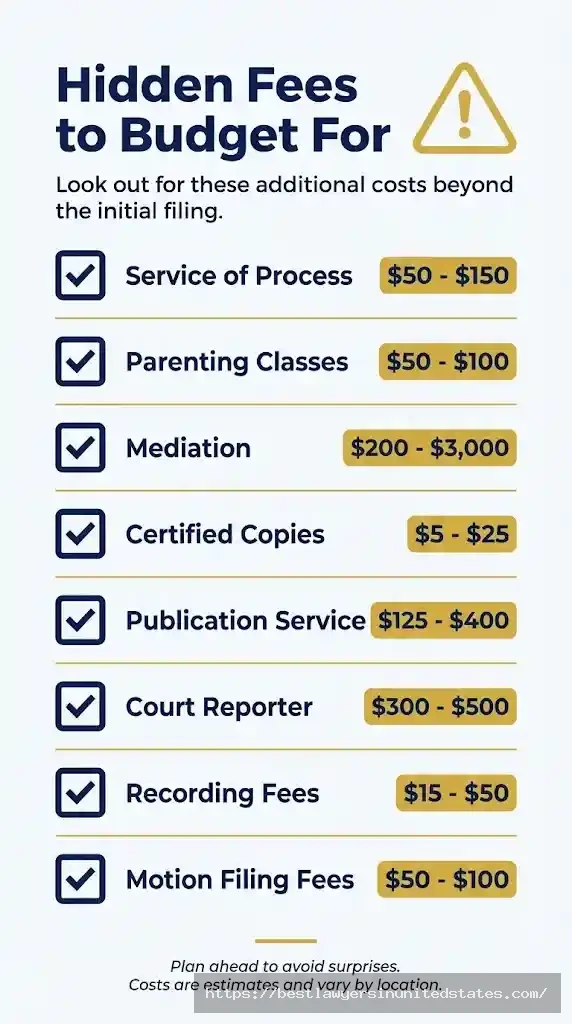
Parenting Education Class Fees
Required in these states: Arizona, Florida, Georgia, Idaho, Kansas, Kentucky, Minnesota, Missouri, Nevada, North Dakota, Oklahoma, Oregon, Tennessee, Texas, Utah, Washington
Cost: $30-$100
These mandatory classes teach co-parenting skills and must be completed before your divorce can be finalized. Some states offer free classes for low-income parents—ask your court.
Mediation Fees
If your court requires mediation before trial (common in custody disputes), expect:
- Court-connected mediation: Free to $100
- Private mediator: $100-$400 per hour for 2-8 hours
Total mediation costs: $200-$3,000 depending on complexity.
Case Management Fees
Some states add case management fees or surcharges:
- Texas: Multiple surcharges totaling $50-$100+
- California: $0 in most counties
- Florida: Included in base fee
Certified Copy Fees
You’ll need certified copies of your divorce decree for:
- Social Security name changes
- DMV updates
- Bank account changes
- Passport applications
Cost: $5-$25 per certified copy, or $0.50-$1 per page
Get 3-5 certified copies when your decree is issued to avoid returning to court later.
Service by Publication Fees
If you can’t locate your spouse and must serve by publication in a newspaper:
- Newspaper publication: $75-$300
- Court filing fee for publication motion: $50-$100
Total: $125-$400 for service by publication.
Recording Fees
If you need to record property settlement documents (quitclaim deeds, etc.):
- County recorder fees: $15-$50 per document
Sheriff’s Service Fees
If you use sheriff service instead of a private process server:
- Local service: $50-$75
- Out-of-county service: $75-$125
State-Specific Fee Waiver Information
Here’s exactly how to apply for a fee waiver in high-population states:

California Fee Waiver (Form FW-001)
Eligibility: Income below 125% of federal poverty level, or receiving SSI, SSP, SNAP, Medi-Cal, or IHSS
Forms needed:
- Form FW-001: Request to Waive Court Fees
- Form FW-002: Order on Court Fee Waiver (judge completes)
Processing time: 5-10 business days
What gets waived: Filing fees, service fees, court reporter fees, appeals
If denied: File Form FW-001-INFO within 10 days to appeal
Texas Fee Waiver (Form TB-002)
Eligibility: Income below 125% federal poverty level, or receiving means-tested government assistance
Forms needed:
- Form TB-002: Statement of Inability to Afford Payment of Court Costs
Processing time: 7-14 business days
What gets waived: Filing fees, service fees, jury fees
If denied: Request a hearing within 10 days
Florida Fee Waiver
Eligibility: Net income below 200% federal poverty level
Forms needed:
- Application for Determination of Civil Indigent Status
Processing time: 10-15 business days, or immediate at filing if documentation is complete
What gets waived: Filing fees, service fees, mediation fees
If denied: File motion for reconsideration within 10 days
New York Fee Waiver (Poor Person Application)
Eligibility: Income insufficient to pay fees without depriving yourself or dependents of necessities
Forms needed:
- Poor Person’s Application
- Affidavit of Income and Assets
Processing time: 7-10 business days
What gets waived: Filing fees, transcript fees, appeals
If denied: File written objection within 30 days
Illinois Fee Waiver
Eligibility: Income at or below 125% federal poverty level, or receiving public benefits
Forms needed:
- Application for Waiver of Court Fees
Processing time: 5-14 business days
What gets waived: All court fees including filing, service, and transcripts
If denied: Request a hearing within 21 days
Payment Methods Accepted by Courts
Different courts accept different payment methods. Here’s what to expect:
In-Person Payments at Clerk’s Office
Accepted:
- Cash (exact change recommended)
- Personal checks
- Cashier’s checks or money orders
- Credit/debit cards (Visa, Mastercard, Discover, sometimes Amex)
Not accepted:
- Third-party checks
- Foreign currency
- Cryptocurrency
Tip: Call ahead to confirm your county accepts your preferred payment method.
Online E-Filing Payments
Accepted:
- Credit/debit cards
- Electronic check/ACH transfer
- PayPal (in some jurisdictions)
Convenience fees: 2-4% for card payments, usually free for e-checks
Processing time: Immediate for cards, 2-5 days for e-checks
Mail-In Payments
Accepted:
- Personal checks
- Money orders
- Cashier’s checks
Not accepted:
- Cash (risk of loss or theft)
- Credit cards
Important: Include your name, case number (if you have one), and “Divorce Filing Fee” in the memo line. Allow 7-10 business days for processing.
How Filing Fees Fund Your Local Court System
Understanding where your money goes can make the fee less frustrating:
Court Clerk Salaries (35-40%): Staff who process paperwork, answer questions, maintain files, and manage the docket.
Judicial Salaries (25-30%): Judges, commissioners, and magistrates who hear cases and make decisions.
Building Operations (15-20%): Courthouse utilities, maintenance, security, and technology systems.
Case Management Systems (10-15%): E-filing platforms, electronic case files, public access portals, and digital record-keeping.
Legal Research Tools (5%): Access to legal databases that judges use to research case law.
Remaining (5%): Miscellaneous administrative costs, training, and overhead.
Your filing fee directly supports the infrastructure that processes your divorce case. Without these fees, courts would need significantly higher taxes to operate.
What Happens If You File Without Paying the Fee?
If you submit divorce papers without payment or an approved fee waiver, here’s what happens:
Immediate rejection: The clerk will refuse to accept your filing. Your case won’t receive a case number or be entered into the court system.
No filing date: Your filing date (important for jurisdiction and waiting periods) won’t start until you pay or get a waiver approved.
Delayed process: Your divorce will be delayed by days or weeks until you resolve the payment issue.
Exception: If you submit a fee waiver application with your petition, some courts will provisionally accept your filing while they review the waiver. If denied, you’ll have 10-30 days to pay before your case is dismissed.
Never advised: Some people try to file without payment hoping the court won’t notice. This never works and only delays your case. Either pay the fee, apply for a waiver, or arrange a payment plan before filing.
Final Tips for Managing Divorce Filing Fees
Verify current fees before filing: Filing fees change periodically. Call your county clerk or check their website within 1-2 weeks of filing to confirm the exact amount.
Get a receipt: Always get a stamped, filed copy of your petition and a payment receipt. This proves you filed and paid.
Budget for additional costs: The filing fee is just the start. Budget at least $500-$1,000 more for service, classes, copies, and other court costs.
Ask about fee waivers early: If you’re struggling financially, don’t wait until filing day to ask about waivers. Get the forms and gather documentation in advance.
Consider legal aid: If the fees seem overwhelming, contact your local legal aid office. They offer free legal help for low-income individuals and can assist with fee waiver applications.
Use the calculator: Get a personalized estimate using our divorce cost calculator before you file.
Conclusion: Plan Ahead for Divorce Filing Fees
Divorce filing fees range from $50 in Mississippi to $450 in California, with most states charging $150-$350. These fees cover basic court processing but represent just a fraction of total divorce costs.
If you can’t afford the filing fee, every state offers fee waivers for qualifying individuals. Apply using your state’s specific form and provide thorough financial documentation. Most people earning below 125-150% of poverty guidelines qualify.
Beyond filing fees, budget for service of process ($50-$150), response fees if your spouse files an answer ($50-$300), parenting classes if you have children ($50-$100), and potential attorney fees if your case is contested.
The key to managing costs is choosing an uncontested approach when possible, using court self-help resources, and negotiating who pays what as part of your overall settlement.
For state-specific guidance on total divorce costs, visit our comprehensive guides for California, Texas, Florida, New York, and all 50 states.
