
Quick Answer Box
- The H-1B lawsuit refers to three separate federal cases challenging Trump’s $100,000 H-1B visa fee, not one unified class action.
- There is no individual payout. Relief sought is declaratory and injunctive, meaning courts are deciding whether the fee itself can stand.
- One court has vacated the fee, one has upheld it, and a third is still pending, so the fee’s legal status depends on which case controls when your petition is filed.
Case Snapshot
| Detail | Info |
|---|---|
| Lead Court | U.S. District Court, District of Massachusetts |
| Case Number | 1:25-cv-13829, State of California v. Noem |
| Filing Date | December 12, 2025 |
| Status | Fee vacated June 8, 2026; government appeal pending, stay denied June 12, 2026 |
| Competing Case | Chamber of Commerce v. DHS (D.D.C.), fee upheld December 24, 2025, on appeal |
| Third Case | Global Nurse Force v. Trump (N.D. Cal.), filed October 3, 2025, still active |
| Monetary Relief | None. This is fee-vacatur litigation, not a damages case |
The H-1B lawsuit is not one case. It is three, running in three different federal courts, and as of this writing they do not agree with each other.
That split is the entire story right now. Employers filing new H-1B petitions are getting a different answer depending on which court’s ruling currently controls their circuit.
A federal judge in Boston vacated the $100,000 fee on June 8, 2026, calling it an unauthorized tax. A judge in Washington had already upheld the same fee months earlier.
This is not a defective product case with a fund waiting to be divided among claimants. It is a live legal fight over whether the executive branch can impose the fee at all.
What Is the H-1B Lawsuit About
The H-1B lawsuit is a set of federal court challenges to a presidential proclamation that added a $100,000 fee to new H-1B visa petitions.
President Trump signed the proclamation on September 19, 2025, effective 36 hours later. It applies to new H-1B petitions filed for consular processing on or after that date.
Plaintiffs argue the fee functions as a tax that only Congress can impose, not the executive branch acting alone. Defendants argue the president has broad authority to restrict entry of nonimmigrants.
Quick facts:
- Fee amount: $100,000 per qualifying petition
- Effective: September 21, 2025
- Legal theory: violation of the Administrative Procedure Act and separation of powers
Attorneys handling these claims point to the size of the fee itself as unusual, since it dwarfs the standard cost of an H-1B filing.
H-1B $100,000 Fee Lawsuit
The fee lawsuit is the correct legal name for what most people are searching for when they type “H-1B lawsuit.”
There are now three separate actions challenging the fee, filed in three different federal districts between October 2025 and December 2025. Each was filed by a different combination of plaintiffs.
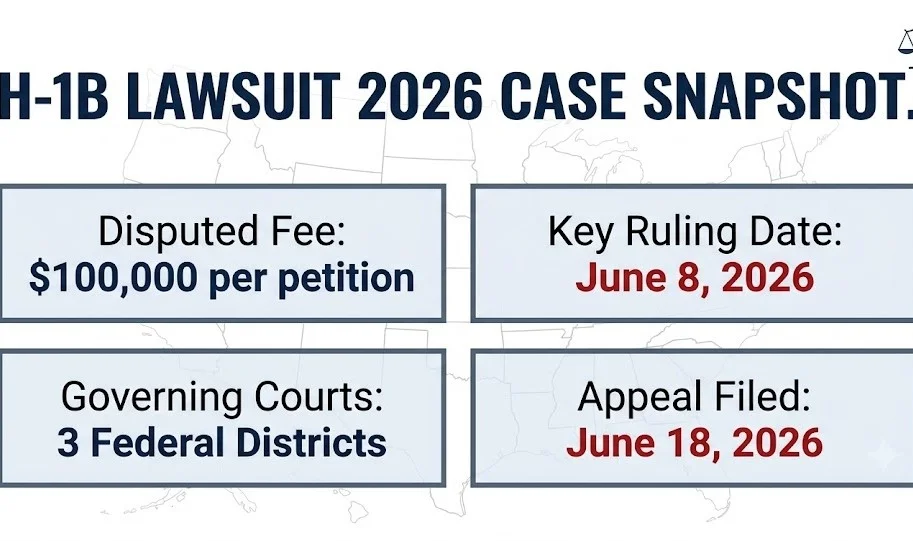
None of the three cases seeks money for individual visa holders. All three ask a court to strike down or block enforcement of the fee itself.
| Case | Filed | Court |
|---|---|---|
| Global Nurse Force v. Trump | October 3, 2025 | N.D. California |
| Chamber of Commerce v. DHS | Fall 2025 | D.D.C. |
| State of California v. Noem | December 12, 2025 | D. Massachusetts |
Attorneys handling these claims describe the fee as functioning like a tariff on labor, which is part of why the tax argument has gained traction in at least one court.
Who Filed the H-1B Lawsuit
Plaintiffs are not individual H-1B workers suing for damages. They are institutional plaintiffs suing over policy harm.
In Global Nurse Force v. Trump, plaintiffs include a nurse recruitment agency, labor unions including the United Auto Workers, university faculty associations, and religious organizations.
In State of California v. Noem, plaintiffs are twenty state attorneys general, led by California and Massachusetts, representing states that employ H-1B workers in public universities and hospitals.
Plaintiff states in the Massachusetts case:
- Arizona, California, Colorado, Connecticut, Delaware
- Hawaii, Illinois, Maryland, Massachusetts, Michigan
- Minnesota, Nevada, New Jersey, New York, North Carolina
- Oregon, Rhode Island, Vermont, Washington, Wisconsin
Attorneys handling these claims note that suing as institutions, rather than as individual visa holders, gives plaintiffs standing to argue broad economic harm rather than a personal injury.
Litigation Watch: Three separate plaintiff groups, none seeking individual payouts, are attacking the same $100,000 fee from three different federal courts at once.
H-1B Lawsuit Court List
Three federal district courts currently have jurisdiction over active H-1B fee litigation. That is unusual and it is why outcomes have diverged.
Courts currently involved:
- U.S. District Court for the Northern District of California (Global Nurse Force v. Trump)
- U.S. District Court for the District of Columbia (Chamber of Commerce v. DHS)
- U.S. District Court for the District of Massachusetts (State of California v. Noem)
Appeals from the D.C. case are before the D.C. Circuit. Appeals from the Massachusetts ruling are headed to the First Circuit.
Attorneys handling these claims expect the circuit courts, not the district courts, to be where this ultimately gets resolved.
State of California v. Noem
State of California v. Noem is the case that produced the most significant ruling to date against the fee.
According to court records, the case is docketed as 1:25-cv-13829 in the District of Massachusetts, filed December 12, 2025. Judge Leo Sorokin presides.
On June 8, 2026, Judge Sorokin granted the states’ motion for summary judgment and vacated the fee, finding it functioned as an unauthorized tax under the Administrative Procedure Act. The court declined to also issue a separate injunction, holding vacatur already provided full relief.
The government asked for a stay pending appeal. On June 12, 2026, the court denied that stay, so the vacatur has remained in effect while the appeal proceeds.
Attorneys handling these claims describe this ruling as the strongest to date against the fee, though it does not bind courts outside Massachusetts.
Chamber of Commerce v. DHS Ruling Explained
Chamber of Commerce v. DHS reached the opposite conclusion from the Massachusetts case.
Filed by the U.S. Chamber of Commerce and the Association of American Universities in the U.S. District Court for the District of Columbia, the case challenged the same fee on similar grounds.
On December 24, 2025, the D.C. district court upheld the fee, ruling it fell within the executive branch’s broad authority to restrict nonimmigrant entry. Plaintiffs appealed.
The D.C. Circuit fast-tracked the appeal given the upcoming annual H-1B registration period. Briefing closed by January 30, 2026, with oral argument expected in February 2026.
Attorneys handling these claims say this ruling is the reason the fee remained enforceable for months even after other courts began ruling against it.
Global Nurse Force v. Trump
Global Nurse Force v. Trump was the first case filed, and it remains active.
Filed October 3, 2025, in the Northern District of California, plaintiffs include a nurse recruitment agency, the United Auto Workers, university faculty groups, and religious organizations.
On February 26, 2026, the court heard oral argument on plaintiffs’ motion for emergency relief to block the fee, and on a motion to certify a nationwide class of employers harmed by it. The court rejected the government’s attempt to pause the case.
Quick facts:
- Filed: October 3, 2025
- Court: N.D. California
- Seeking: nationwide class certification of affected employers, not individual damages
Attorneys handling these claims note that class certification here would apply to employers as a group, not to individual H-1B workers seeking compensation.
Litigation Watch: All three courts have now weighed in, producing one ruling against the fee, one ruling for it, and one case still pending on emergency relief.
Is the H-1B Fee Still in Effect
Yes, in practice, despite the Massachusetts ruling against it.
The Massachusetts vacatur applies broadly, but the D.C. ruling upholding the fee remains in place, and the government filed a motion to stay the Massachusetts order pending appeal on June 18, 2026.
USCIS and the State Department have not withdrawn fee guidance as of this writing. Employers filing petitions for consular processing should expect the fee may still be collected until the First Circuit rules on the stay request.
| Scenario | Fee Status |
|---|---|
| Massachusetts ruling controls | Fee vacated, not collected |
| D.C. ruling controls | Fee upheld, still collected |
| Stay granted on appeal | Fee reinstated during appeal |
| Stay denied | Massachusetts vacatur continues to apply |
Attorneys handling these claims are telling employers to plan for the fee to remain a possibility until the First Circuit resolves the stay motion.
H-1B Lawsuit Appeal
The government is appealing the loss in Massachusetts, and Chamber of Commerce is appealing the loss in D.C. Both appeals are now live.
On June 18, 2026, the federal government filed its motion to stay Judge Sorokin’s order with the First Circuit Court of Appeals, seeking to keep the fee in effect during the appeal.
The D.C. Circuit appeal, brought by the Chamber of Commerce, was fast-tracked earlier in the year, with oral argument expected in February 2026.
Key appellate dates:
- January 9, 2026: appellant’s brief due in the D.C. Circuit case
- January 30, 2026: government’s response due
- June 18, 2026: government’s stay motion filed with the First Circuit
Attorneys handling these claims expect the First Circuit’s stay decision to be the next major turning point in this litigation.
H-1B Lawsuit Circuit Split
A circuit split is forming, and that increases the odds this eventually reaches the Supreme Court.
The First Circuit will review the Massachusetts vacatur. The D.C. Circuit will review the ruling upholding the fee. A third ruling, from the Northern District of California, could add a ninth Circuit appeal to the mix.
Why this matters:
- Conflicting circuit rulings on the same federal policy create nationwide uncertainty
- A circuit split is one of the strongest signals the Supreme Court will eventually take a case
- Until resolved, employers in different parts of the country may face different practical realities
Attorneys handling these claims say a circuit split of this kind rarely resolves quickly, often taking a year or more before the Supreme Court weighs in, if it does at all.
Litigation Watch: The fee’s legal status now depends on a developing circuit split, not a single final ruling, and employers should not assume the Massachusetts win ends the matter.
How the H-1B Lawsuit Affects Employers
Employers filing new H-1B petitions for consular processing are the parties most directly affected right now.
If the fee remains enforceable in your circuit, budgeting for $100,000 per qualifying petition is not optional. If the Massachusetts vacatur controls, the fee should not be collected, though guidance has been slow to catch up with the ruling.
Employers should:
- Track which circuit governs their petitions before filing
- Watch for updated USCIS or State Department guidance following each ruling
- Avoid assuming any single ruling nationwide has settled the issue
Attorneys handling these claims recommend employers document fees paid under protest, in case a later ruling makes those payments recoverable.
How the H-1B Lawsuit Affects H-1B Workers
Workers are affected indirectly, mostly through employer decisions rather than through any right to sue for money themselves.
None of the three lawsuits creates an individual claim for an H-1B worker to recover damages. The litigation is about whether the fee can be charged to employers at all.
Practical effects on workers:
- Employers may delay or decline new H-1B sponsorship while the fee’s status is unsettled
- Workers already inside the country on approved H-1B status are not directly subject to the fee
- New petitions for consular processing carry the most uncertainty
Attorneys handling these claims say most worker-side questions right now are really employer sponsorship questions in disguise.
State by State Impact of the H-1B Lawsuit
The twenty states behind State of California v. Noem are not evenly affected. States with large public university systems and hospital networks have the most exposure.
States party to the Massachusetts lawsuit include California, New York, Massachusetts, Illinois, and Washington, all of which rely heavily on H-1B hiring in higher education and healthcare.
States not party to that suit are still subject to whichever ruling controls their federal circuit, regardless of whether their attorney general joined the litigation.
| Region | Governing Case (as of filing) | Practical Fee Status |
|---|---|---|
| First Circuit states | Massachusetts vacatur | Contested, stay pending |
| D.C. Circuit | Chamber of Commerce ruling | Upheld, on appeal |
| Ninth Circuit | Global Nurse Force, pending | Unresolved |
| Other circuits | No controlling ruling yet | Uncertain |
Attorneys handling these claims say employers outside these circuits are effectively waiting for whichever appellate ruling comes first.
Litigation Watch: Geography now matters more than most employers realize, since the fee’s enforceability can differ by federal circuit until the split is resolved.
H-1B Lawsuit Timeline 2025 to 2026
Key dates in the H-1B fee litigation:
| Date | Event |
|---|---|
| September 19, 2025 | Proclamation signed imposing $100,000 fee |
| September 21, 2025 | Fee takes effect for new petitions |
| October 3, 2025 | Global Nurse Force v. Trump filed, N.D. California |
| December 12, 2025 | State of California v. Noem filed, D. Massachusetts |
| December 24, 2025 | D.C. court upholds fee in Chamber of Commerce case |
| January 9 to 30, 2026 | D.C. Circuit appeal briefing |
| February 26, 2026 | Oral argument on emergency relief, N.D. California case |
| June 8, 2026 | Massachusetts court vacates the fee |
| June 12, 2026 | Stay denied in Massachusetts case |
| June 18, 2026 | Government files stay motion with First Circuit |
What Happens Next in the H-1B Lawsuit
The next major event is the First Circuit’s decision on whether to stay the Massachusetts vacatur.
If the stay is granted, the fee is reinstated nationwide during the appeal. If denied, the vacatur likely continues to apply while the appeal proceeds on the merits.
Separately, the D.C. Circuit is expected to rule on the Chamber of Commerce appeal, and the Northern District of California case remains unresolved on class certification.
What to watch for:
- A First Circuit ruling on the stay motion
- A D.C. Circuit decision on the Chamber of Commerce appeal
- Any move toward the Supreme Court if the circuit split hardens
Attorneys handling these claims expect this to remain unsettled through at least the rest of 2026.
H-1B Immigration Lawyer
An immigration attorney becomes useful the moment a specific petition or hiring decision depends on which ruling currently applies.
This litigation is fast moving and jurisdiction dependent. General news coverage will not tell an individual employer whether a specific petition, filed on a specific date, in a specific circuit, is currently subject to the fee.
Situations where legal counsel matters most:
- An H-1B petition is ready to file and the fee’s status is unclear in your circuit
- An employer already paid the fee and wants to evaluate recovery options
- A university, hospital, or agency wants to understand exposure across multiple pending petitions
Attorneys handling these claims generally recommend a case specific review rather than relying on a single news update, given how quickly the rulings have shifted.
Frequently Asked Questions
What is the H-1B lawsuit actually about?
It is a challenge to a $100,000 fee added to new H-1B visa petitions by presidential proclamation in September 2025.
Three separate federal cases are testing whether that fee is legal under the Administrative Procedure Act.
Is the $100,000 H-1B fee still being charged?
It depends on which federal circuit governs the petition. A Massachusetts court vacated the fee in June 2026, while a D.C. court upheld it, and the government has asked the First Circuit to stay the Massachusetts ruling.
Can an H-1B worker sue for money over this fee?
No individual damages claim exists in any of the three current cases. Relief sought is declaratory and injunctive, aimed at blocking the fee for employers, not compensating individual workers.
Which court ruling controls right now?
No single ruling controls nationwide as of this writing. The Massachusetts vacatur, the D.C. ruling upholding the fee, and the pending California case are all still live.
What happens if the courts keep disagreeing?
A continuing circuit split raises the likelihood the Supreme Court eventually takes the issue. Until then, enforcement may vary depending on the circuit where a petition is filed.
When should an employer talk to an immigration lawyer about this?
As soon as a specific H-1B petition is ready to file in a circuit where the fee’s status is unsettled. A lawyer can assess which ruling currently applies and whether paying under protest makes sense.
The H-1B fee fight is not close to over. Three federal courts have now weighed in, and they disagree, which means the next ruling from the First Circuit or D.C. Circuit could change enforcement overnight.
Employers with pending or planned H-1B petitions should confirm which ruling currently governs their circuit before filing. Anyone facing a specific petition deadline or a fee already paid should talk to an immigration attorney who is tracking this litigation directly, not relying on a single headline.
