
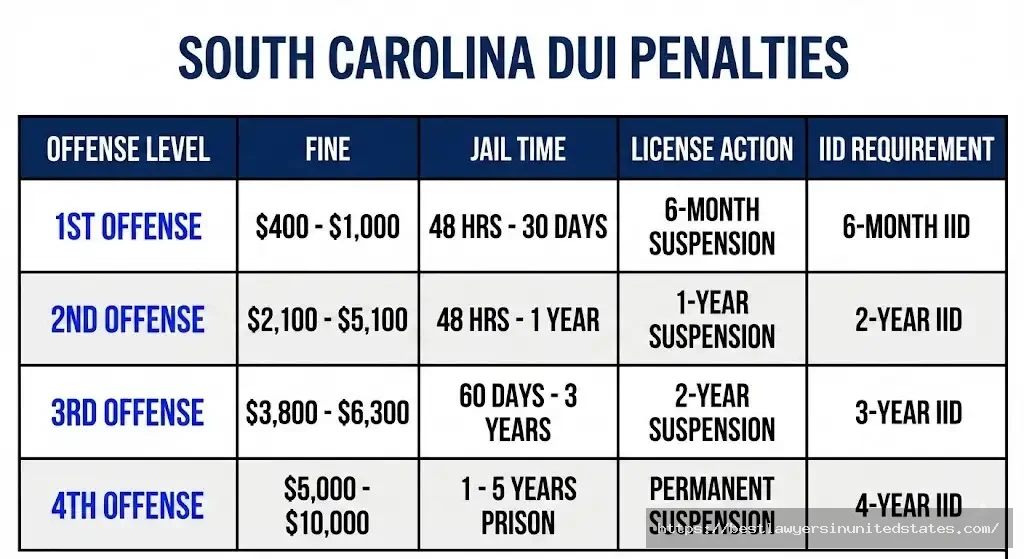
South Carolina enforces some of the nation’s strictest DUI laws, charging drivers with both DUI and DUAC simultaneously under South Carolina Code § 56-5-2930. First-time offenders face fines up to $1,000, jail time ranging from 48 hours to 90 days, and a mandatory ignition interlock device for six months.
South Carolina currently holds the highest DUI fatality rate in the United States, prompting ongoing legislative efforts to strengthen penalties through proposed Chandler’s Law reforms in 2025-2026. The state’s unique dual-charge system and “All Offender Law” require ignition interlock devices for every DUI conviction, including first offenses.
This guide covers South Carolina’s DUI penalties, BAC limits, arrest procedures, costs, and defense strategies based on current 2026 statutes.
What Qualifies as DUI in South Carolina?
South Carolina defines DUI as operating a vehicle while “under the influence of alcohol to the extent that the person’s faculties to drive are materially and appreciably impaired.” The state uses a dual-charge system unique among southeastern states.
The DUI and DUAC Dual-Charge System
South Carolina prosecutors simultaneously charge drivers with two separate offenses:
DUI (Driving Under the Influence): Requires proof of impairment through officer observations, field sobriety tests, or driving behavior.
DUAC (Driving with Unlawful Alcohol Concentration): Requires only proof that BAC measured 0.08% or higher.
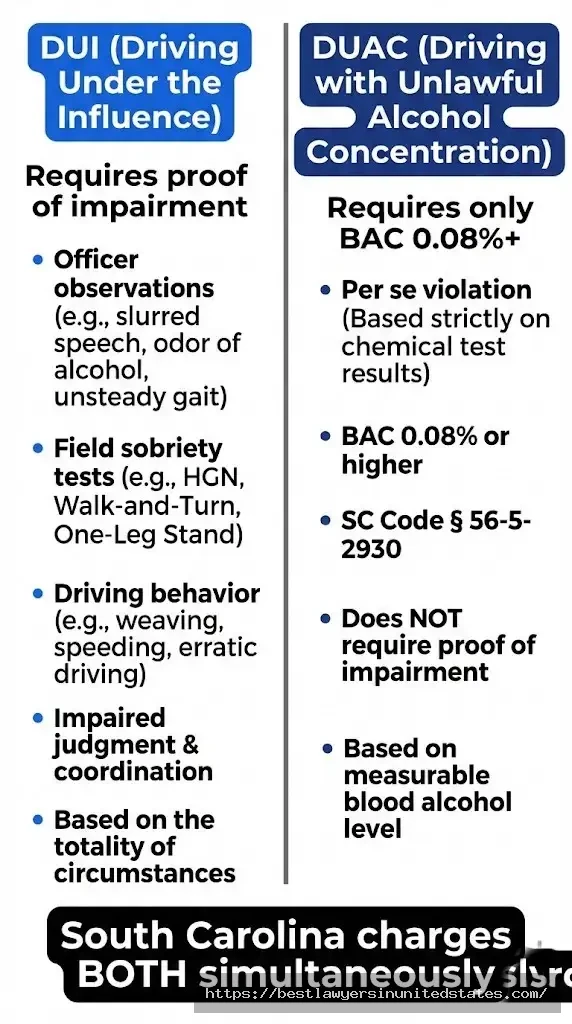
This dual-charge approach gives prosecutors two paths to conviction. Most defendants face both charges initially, though prosecutors often drop one as part of plea negotiations.
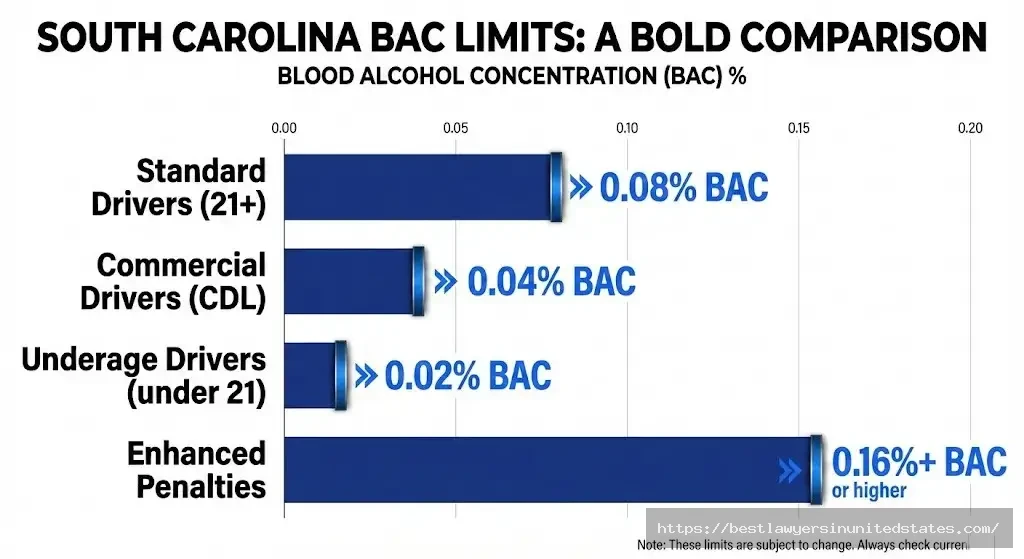
South Carolina BAC Limits by Driver Type
| Driver Type | Legal BAC Limit | Zero Tolerance |
|---|---|---|
| Standard drivers (21+) | 0.08% | No |
| Commercial drivers (CDL) | 0.04% | No |
| Underage drivers (under 21) | 0.02% | Yes |
| School bus drivers | 0.02% | Yes |
Critical point: BAC of 0.16% or higher triggers enhanced penalties, including mandatory 48-hour jail time for first offenses.
Not sure if you’re over South Carolina’s 0.08% legal limit? Use our BAC calculator to estimate your blood alcohol content based on drinks consumed, body weight, and time elapsed.
BAC Calculator
Estimate your Blood Alcohol Content
• Commercial Driver (CDL): 0.04% BAC
• Drivers Under 21: 0.00-0.02% BAC (Zero Tolerance)
• Enhanced Penalties: 0.15% BAC or higher in most states
South Carolina DUI Penalties by Offense Level
South Carolina structures DUI penalties based on offense number and BAC level. Sentences increase dramatically for repeat offenders and high BAC readings.
First Offense DUI Penalties
Standard BAC (0.08% to 0.15%):
| Penalty Type | Requirement |
|---|---|
| Fine | $400 minimum |
| Jail time | 48 hours to 30 days |
| License suspension | 6 months |
| ADSAP enrollment | Mandatory 20-hour program |
| Ignition interlock | 6 months minimum |
High BAC (0.16% or higher):
| Penalty Type | Requirement |
|---|---|
| Fine | $400 minimum |
| Jail time | 30 days to 90 days |
| License suspension | 6 months |
| ADSAP enrollment | Mandatory 20-hour program |
| Ignition interlock | 6 months minimum |
The 0.16% threshold makes South Carolina one of few states with enhanced first-offense penalties based solely on BAC level.
Second Offense DUI Penalties
Second DUI convictions within 10 years result in significantly harsher consequences:
| Penalty Type | Standard BAC | High BAC (0.16%+) |
|---|---|---|
| Fine | $2,100 to $5,100 | $3,500 to $6,500 |
| Jail time | 48 hours to 1 year | 90 days to 2 years |
| License suspension | 1 year | 2 years |
| ADSAP enrollment | Mandatory | Mandatory |
| Ignition interlock | 2 years | 3 years |
Key difference: South Carolina courts rarely allow suspended sentences for second offenses, meaning jail time is nearly guaranteed.
Third Offense DUI Penalties
Third DUI convictions within 10 years escalate to felony territory in South Carolina:
| Penalty Type | Requirement |
|---|---|
| Fine | $3,800 to $6,300 |
| Jail time | 60 days to 3 years |
| License suspension | 2 years minimum |
| Ignition interlock | 3 years after reinstatement |
| Vehicle forfeiture | Possible |
Third offenses require mandatory minimum 60-day jail sentences with no possibility of suspension. Courts may order permanent vehicle forfeiture for repeat offenders.
Fourth and Subsequent Offenses
Fourth DUI convictions carry the most severe penalties under South Carolina law:
- Fine: $5,000 to $10,000
- Prison time: 1 to 5 years (no parole eligibility)
- License suspension: Permanent (reinstatement possible after 3+ years)
- Ignition interlock: 4 years after any reinstatement
- Felony conviction: Permanent criminal record
Estimate your total DUI costs using our DUI cost calculator, which includes fines, legal fees, ignition interlock expenses, and insurance increases specific to South Carolina.
DUI Cost Calculator
Estimate total DUI expenses by state and offense
Detailed Cost Breakdown
Payment Timeline
Bail bond, towing fees, car impound, attorney retainer
Initial court fines, DMV fees, DUI school enrollment, ignition interlock installation
Monthly probation fees, ignition interlock fees, DUI school payments, attorney balance
Insurance premium increases, license reinstatement, SR-22 filing fees
- Lost wages from missed work (court dates, jail time, DUI school) – $2,000-$10,000
- Job loss or difficulty finding employment – Varies
- Professional license suspension (doctors, lawyers, nurses, pilots) – Career ending
- Rideshare and transportation costs during suspension – $1,500-$5,000
- Travel restrictions and visa denials – Varies
- Security clearance loss – Career impact
- Child custody implications – Legal costs
- Rental car restrictions – Varies
- Personal relationships and mental health costs – Priceless
Felony DUI Charges in South Carolina
South Carolina prosecutes certain DUI cases as felonies regardless of prior offense history.
DUI Resulting in Great Bodily Injury
Causing “great bodily injury” while driving under the influence constitutes felony DUI under SC Code § 56-5-2945:
- Prison sentence: 30 days to 15 years
- Fine: $5,100 to $10,100
- License suspension: 3 years minimum
- Ignition interlock: 3 years after reinstatement
“Great bodily injury” means injury creating substantial risk of death or causing serious permanent disfigurement.
Felony DUI Resulting in Death
DUI causing death carries the harshest penalties in South Carolina:
| Conviction Type | Prison Sentence | Fine |
|---|---|---|
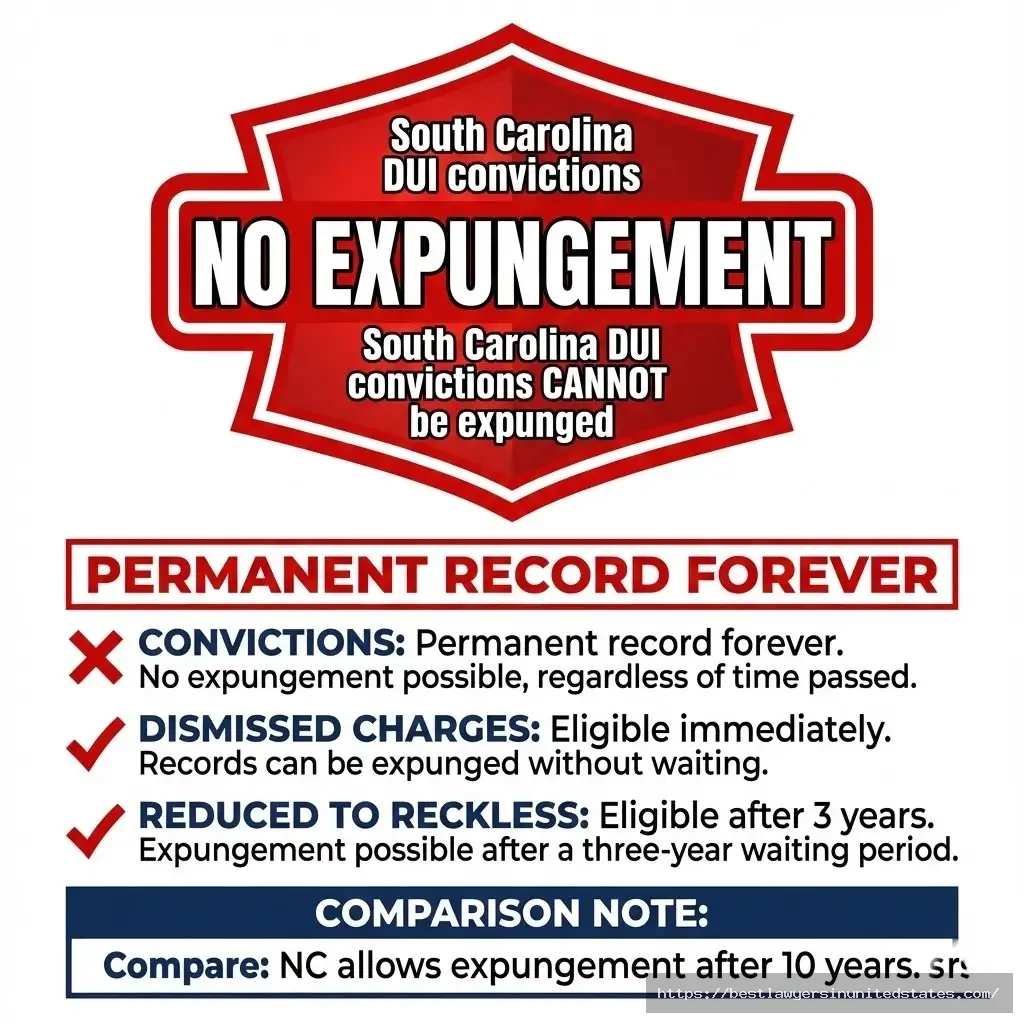
| DUI resulting in death | 1 to 25 years | Up to $25,100 |
| No parole eligibility | First 3 years minimum | Plus victim restitution |
Critical point: South Carolina treats DUI death cases separately from vehicular homicide, allowing prosecutors to pursue both charges simultaneously.
Chandler’s Law: 2025-2026 Legislative Push
South Carolina lawmakers proposed Chandler’s Law in 2025 to strengthen penalties for repeat DUI offenders. The legislation, named after fatal DUI victim Chandler Sease, would:
- Increase mandatory minimum sentences for third offenses
- Expand felony DUI to include second offense with injury
- Require longer ignition interlock periods
- Implement lifetime license revocation for fourth offenses
As of January 2026, the legislation remains under Senate committee review. South Carolina’s status as the nation’s leader in DUI fatalities has accelerated debate on these reforms.
Emma’s Law and the “All Offender” Ignition Interlock Requirement
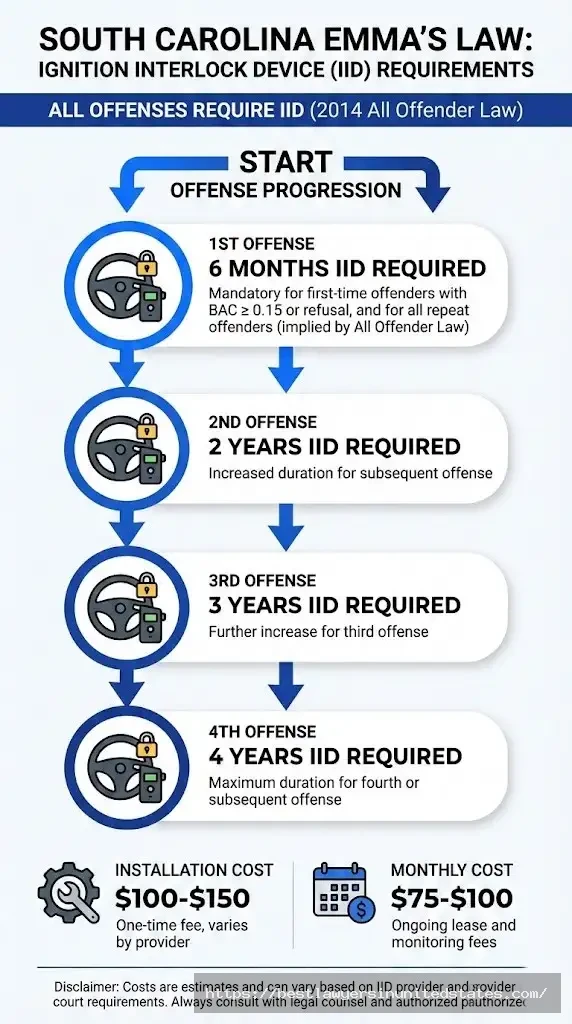
South Carolina’s 2014 Emma’s Law revolutionized DUI enforcement by mandating ignition interlock devices for all offenders.
What Emma’s Law Changed
Prior to 2014, only drivers with BAC of 0.15% or higher faced ignition interlock requirements. Emma’s Law eliminated this threshold, making South Carolina one of few states requiring IID for every DUI conviction.
Key provisions:
- All first-time offenders must install IID for 6 months minimum
- Second offenders: 2 years minimum
- Third offenders: 3 years minimum
- Fourth offenders: 4 years minimum
Ignition Interlock Device Requirements
IID devices connect to your vehicle’s ignition system and prevent starting if alcohol is detected on your breath.
| Cost Category | Amount |
|---|---|
| Installation fee | $100-$150 |
| Monthly monitoring | $75-$100 |
| Removal fee | $50-$75 |
| Calibration visits | $25-$50 (monthly) |
Total 6-month cost for first offense: $600-$900
Devices require monthly calibration at approved South Carolina service centers. Missing appointments or attempting to bypass the device results in immediate license suspension.
How Ignition Interlock Affects License Reinstatement
South Carolina offers two reinstatement options:
Option 1: Complete suspension period without driving
- Serve full suspension without IID
- Wait 6 months (first offense) to 2 years (second offense)
- Reinstate with IID requirement after suspension ends
Option 2: Install IID immediately for provisional license
- Install IID within 30 days of conviction
- Receive provisional license allowing work/school/medical driving
- Serve full IID requirement while maintaining driving privileges
Most drivers choose Option 2 to maintain employment and family obligations. Neighboring states like North Carolina and Georgia have similar programs but with different eligibility requirements.
South Carolina’s Implied Consent Law
Every South Carolina driver automatically consents to chemical testing when accepting their license under SC Code § 56-5-2950.
What Implied Consent Means
The law requires drivers arrested for DUI to submit to breath, blood, or urine testing when requested by law enforcement. Refusal triggers immediate consequences separate from any criminal charges.
Officers must read the implied consent warning before requesting a test. The warning explains:
- You must submit to chemical testing
- Refusal results in license suspension
- Test results can be used as evidence
- You have the right to additional independent testing
Consequences of Refusing Chemical Tests
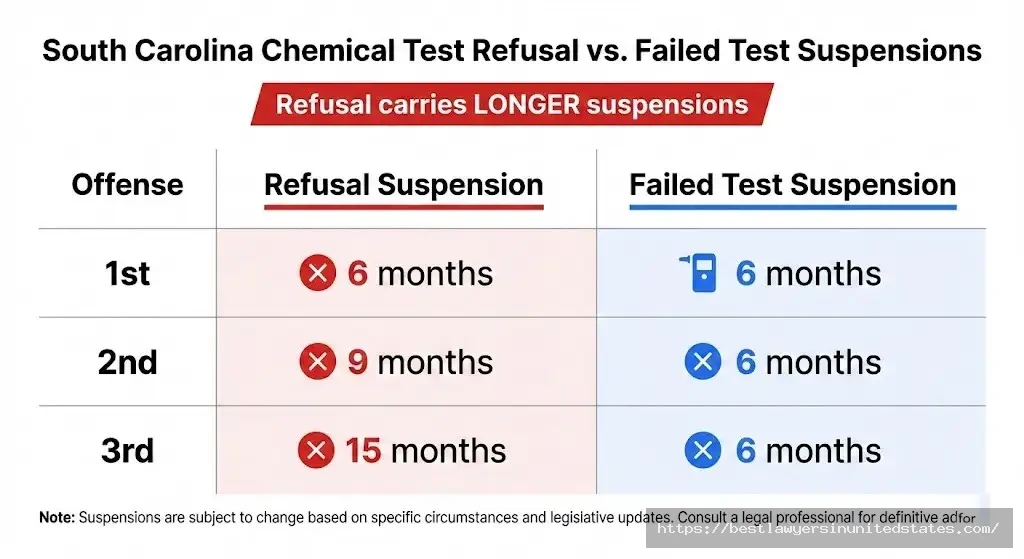
South Carolina imposes harsh penalties for test refusal:
| Offense | Refusal Suspension | Failed Test Suspension |
|---|---|---|
| First refusal | 6 months | 6 months |
| Second refusal | 9 months | 6 months |
| Third refusal | 15 months | 6 months |
Critical difference: Refusals carry the same or longer suspensions than failed tests, with no provisional license eligibility during the first 30 days.
Can Police Force You to Take a Test?
South Carolina law enforcement cannot physically force you to provide breath or blood samples without a warrant. However, officers increasingly obtain warrants for blood draws in cases involving:
- Serious injuries or fatalities
- Unconscious or uncooperative drivers
- Suspected drug impairment (requires blood test)
- Commercial vehicle operators
Exception: You may request additional independent testing at your own expense after completing the official test. Many defendants use private lab results to challenge state evidence.
Administrative License Suspension Timeline
Refusing or failing a chemical test triggers two separate suspension processes:
Administrative suspension (SC DMV):
- Begins 30 days after arrest
- Independent of criminal court proceedings
- Requires separate administrative hearing request
Criminal suspension (Court-ordered):
- Imposed only upon conviction
- Runs concurrently with administrative suspension
- Can extend total suspension period
You must request an administrative hearing within 30 days of arrest to challenge the suspension. Missing this deadline results in automatic suspension.
The DUI Arrest Process in South Carolina
Understanding the arrest timeline helps you protect your rights and prepare your defense.
Traffic Stop and Initial Contact
South Carolina law enforcement must have reasonable suspicion to stop your vehicle. Valid reasons include:
- Traffic violations (speeding, running red lights, improper lane changes)
- Equipment violations (broken taillight, expired registration)
- Erratic driving patterns
- DUI checkpoints (requires advance public notice)
Officers look for signs of impairment during initial contact:
- Odor of alcohol
- Slurred speech
- Bloodshot eyes
- Open containers in vehicle
Field Sobriety Tests
Officers typically request three standardized field sobriety tests approved by the National Highway Traffic Safety Administration:
Horizontal Gaze Nystagmus (HGN): Officer tracks your eye movements following a stimulus. Involuntary eye jerking indicates possible impairment.
Walk-and-Turn: You walk nine steps heel-to-toe along a straight line, turn, and return. Officers assess balance and ability to follow instructions.
One-Leg Stand: You stand on one foot for 30 seconds while counting aloud. Test measures balance and concentration.
Important: Field sobriety tests are voluntary in South Carolina. You may refuse without automatic penalties, though officers may arrest based on other observations.
Datamaster Breathalyzer Testing
South Carolina uses the Datamaster DMT breathalyzer device at police stations and jails. The device measures breath alcohol content using infrared spectroscopy.
Datamaster requirements under South Carolina law:
| Requirement | Details |
|---|---|
| Operator certification | Must hold valid SC certification |
| Observation period | 20 minutes minimum before testing |
| Calibration checks | Every 10 days or 150 tests |
| Duplicate samples | Two breath samples required |
| Results agreement | Samples must agree within 0.02% |
Common defense challenges:
- Improper calibration records
- Operator certification expired
- Inadequate observation period
- Mouth alcohol contamination
- Medical conditions affecting results
Blood and Urine Testing
Officers request blood tests when:
- Breath testing is unavailable
- Drug impairment is suspected
- Suspect is unconscious or injured
- Warrant obtained for refusal cases
South Carolina hospitals and medical facilities must release blood test results to law enforcement with proper authorization. Results typically take 2-6 weeks depending on crime lab backlog.
What Happens After Arrest
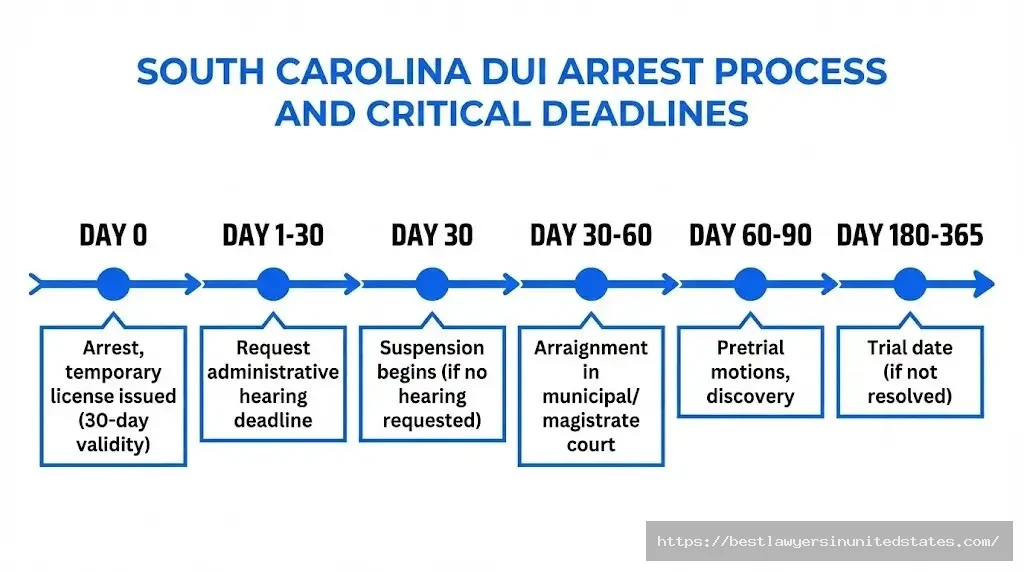
Immediate consequences:
- Booking at county detention center: Fingerprinting, photographing, and background check
- Bond hearing within 24 hours: Judge sets bail amount or releases on personal recognizance
- License confiscation: Officer issues temporary license valid 30 days
- Vehicle impoundment: If no sober driver available to retrieve vehicle
Critical deadlines:
- 30 days: Request administrative hearing to challenge license suspension
- 30 days: Temporary license expires (install IID for provisional license)
- 60-90 days: Arraignment in municipal or magistrate court
Contact a DUI attorney immediately after arrest. South Carolina’s complex dual-charge system and multiple suspension processes require experienced legal guidance.
DUI Checkpoints in South Carolina
South Carolina law enforcement agencies conduct sobriety checkpoints throughout the state, particularly during holidays and weekends.
Are DUI Checkpoints Legal in South Carolina?
Yes. The South Carolina Supreme Court upheld DUI checkpoint legality in State v. Clyburn (1986), following the U.S. Supreme Court decision in Michigan Department of State Police v. Sitz (1990).
Legal requirements for valid checkpoints:
- Advance public notice (newspaper, social media, or local news)
- Predetermined, neutral selection pattern (every vehicle, every third vehicle, etc.)
- Visible law enforcement presence with proper signage
- Minimal detention time for each vehicle
- Supervisory oversight by ranking officer
Your Rights at a Checkpoint
You must stop at properly established checkpoints. However, you retain certain constitutional protections:
What you must do:
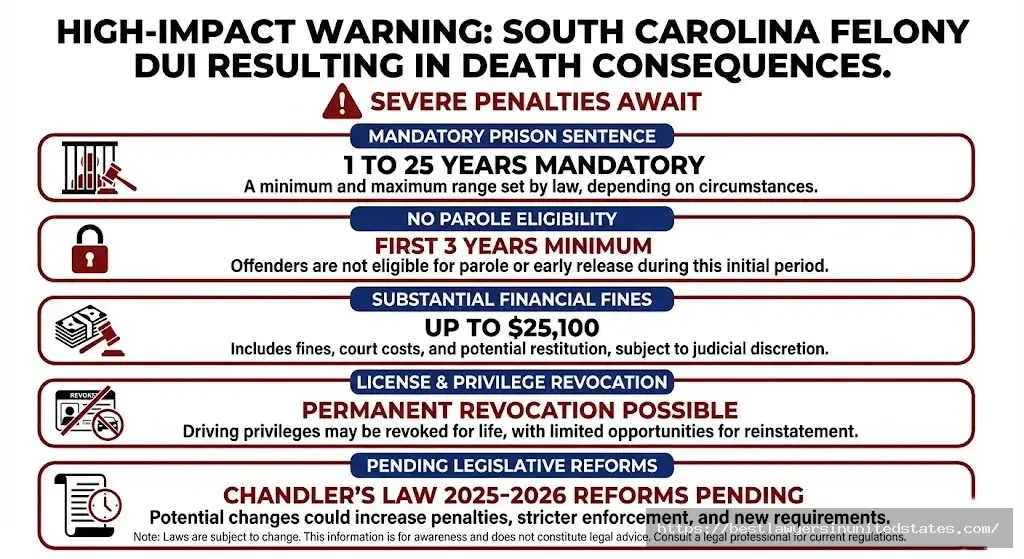
- ✓ Stop when directed
- ✓ Provide license, registration, and insurance
- ✓ Answer basic identification questions
What you can refuse:
- ✗ Field sobriety tests (voluntary)
- ✗ Vehicle searches without probable cause
- ✗ Extended questioning beyond identification
Can you turn around before a checkpoint?
Yes, if you can do so legally without violating traffic laws. Officers may not stop you solely for avoiding a checkpoint unless you commit a traffic violation during the turn.
Common South Carolina Checkpoint Locations
Law enforcement frequently establishes checkpoints on:
- I-26 between Charleston and Columbia
- I-85 near Greenville and Spartanburg
- Highway 378 in Lexington County
- Highway 17 along the coast
- College town areas during football season and spring break
South Carolina Highway Patrol publishes checkpoint locations on their website and social media accounts before major holidays.
The Real Cost of a South Carolina DUI
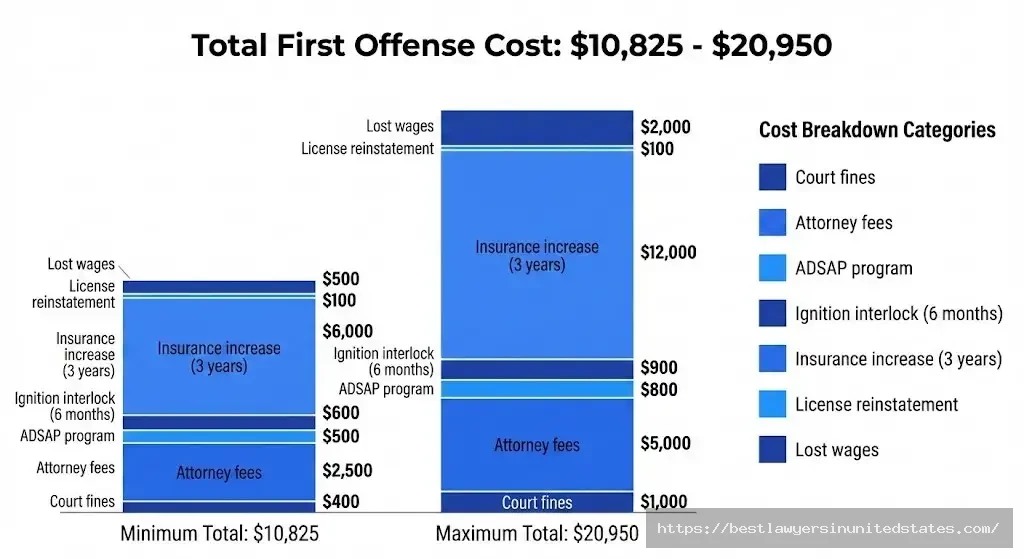
DUI convictions carry substantial financial consequences beyond court fines.
Complete First Offense Cost Breakdown
| Cost Category | Amount Range |
|---|---|
| Court fines | $400-$1,000 |
| Court costs and fees | $200-$300 |
| Attorney fees | $2,500-$5,000 |
| ADSAP program | $500-$800 |
| Ignition interlock (6 months) | $600-$900 |
| License reinstatement | $100 |
| SR-22 insurance filing | $25-$50/year |
| Insurance premium increase | $2,000-$4,000/year (3 years) |
| Lost wages (court dates, jail) | $500-$2,000 |
| Total first offense | $10,825-$20,950 |
Insurance impact: South Carolina insurers typically increase premiums 60-90% after DUI convictions. Expect higher rates for 3-5 years minimum.
Second Offense Costs
| Cost Category | Amount Range |
|---|---|
| Court fines | $2,100-$5,100 |
| Attorney fees | $3,500-$7,500 |
| ADSAP program | $800-$1,200 |
| Ignition interlock (2 years) | $2,400-$3,600 |
| License reinstatement | $100 |
| Insurance increase (3-5 years) | $3,000-$6,000/year |
| Lost wages (jail time, probation) | $5,000-$15,000 |
| Total second offense | $24,900-$53,500 |
Hidden Costs Often Overlooked
Employment consequences:
- Professional license suspensions (medical, legal, commercial driving)
- Background check failures for new jobs
- Security clearance revocations
- Lost wages during jail sentences
Personal costs:
- Alternative transportation (Uber, taxis, friends) during suspension
- Ignition interlock device embarrassment affecting personal relationships
- Rental car restrictions (most companies prohibit IID users)
- International travel restrictions for felony DUI convictions
Use our DUI cost calculator to estimate your total expenses based on offense number, BAC level, and county.
Long-Term Consequences of a South Carolina DUI
DUI convictions create lasting impacts beyond immediate penalties.
Criminal Record Duration
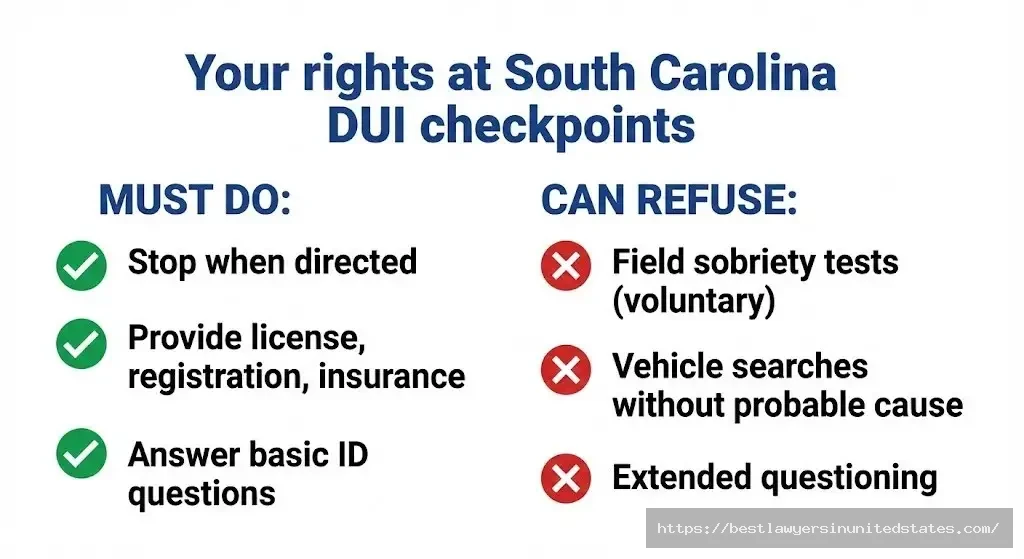
Critical point: South Carolina does NOT allow expungement of DUI convictions. A DUI remains on your criminal record permanently.
Only dismissed or reduced charges qualify for expungement after waiting periods:
| Case Outcome | Expungement Eligibility |
|---|---|
| DUI conviction | Never |
| Dismissed charges | Immediately |
| Reduced to reckless driving | After 3 years |
| Acquitted at trial | Immediately |
Compare this to neighboring North Carolina, which allows limited expungement for first offenses after 10 years.
Employment and Professional Licensing
South Carolina employers may consider DUI convictions in hiring decisions for positions involving:
- Commercial driving (CDL revoked for 1 year minimum)
- School employment (teachers, bus drivers, administrators)
- Healthcare positions (nurses, doctors, pharmacists)
- Legal professions (attorneys, paralegals)
- Financial services (banking, securities)
Professional licensing boards that sanction DUI convictions:
- South Carolina Board of Medical Examiners
- SC Bar Association
- SC Board of Nursing
- SC Real Estate Commission
- SC Department of Insurance (insurance agents)
Most boards require disclosure of DUI convictions and conduct disciplinary hearings. Sanctions range from formal reprimands to license revocation depending on offense severity.
Insurance and Financial Impact
South Carolina insurers file DUI convictions with the state, requiring SR-22 certificates proving financial responsibility.
SR-22 requirements:
- Minimum coverage: $25,000/$50,000/$25,000
- Duration: 3 years from conviction date
- Cost: $25-$50 annual filing fee
- Lapse consequences: License suspended immediately
Premium increases by insurance company:
Studies show South Carolina drivers pay 60-90% higher premiums after DUI convictions. Some insurers refuse coverage entirely, forcing drivers to high-risk pools.
Housing and Education Consequences
College admissions:
- Most universities require criminal history disclosure
- DUI convictions may affect admission decisions
- Financial aid eligibility reduced for drug-related DUIs
- Student athletes face NCAA sanctions
Housing applications:
- Landlords may deny rental applications
- Background checks reveal permanent conviction records
- Government housing programs restrict felony DUI offenders
Defense Strategies for South Carolina DUI Charges
Experienced attorneys challenge DUI charges using various legal strategies.
Challenging the Traffic Stop
Officers need reasonable suspicion to stop your vehicle. Defense attorneys examine:
Invalid stop reasons:
- Anonymous tips without corroboration
- Stops based solely on leaving bar parking lot
- Pretextual stops using minor equipment violations
- Checkpoint stops not meeting legal requirements
Successful challenges to the traffic stop result in suppression of all evidence gathered after the stop, typically leading to case dismissal.
Attacking Breathalyzer Accuracy
The Datamaster breathalyzer requires strict compliance with South Carolina regulations. Common defense challenges:
Calibration and maintenance issues:
- Missing or incomplete calibration logs
- Tests performed outside 10-day calibration window
- Improper simulator solution concentration
- Device malfunction history
Testing procedure violations:
- Inadequate 20-minute observation period
- Mouth alcohol contamination (recent drinking, dental work, GERD)
- Radio frequency interference near the device
- Medical conditions affecting results (diabetes, low-carb diets)
Operator certification problems:
- Expired certification at time of test
- Inadequate training documentation
- Failure to follow standardized procedures
Field Sobriety Test Challenges
NHTSA standardized field sobriety tests require specific administration procedures. Attorneys challenge based on:
Physical and environmental factors:
- Uneven or sloped testing surface
- Poor lighting or weather conditions
- Physical disabilities or injuries
- Age or weight affecting balance
- Improper footwear (high heels, work boots)
Officer administration errors:
- Incorrect instructions given
- Failure to demonstrate tests properly
- Inadequate explanation of procedures
- Distraction during test performance
Medical conditions affecting performance:
- Inner ear problems
- Knee or back injuries
- Neurological conditions
- Eye conditions affecting nystagmus test
Rising BAC Defense
Blood alcohol concentration continues rising for 30-90 minutes after drinking stops. The “rising BAC” defense argues your BAC exceeded legal limits only after you stopped driving.
Example scenario:
- You drink last beverage at 10:30 PM
- Police stop you at 10:45 PM
- Breathalyzer administered at 11:30 PM
- BAC measures 0.10%
Expert testimony may show your BAC was below 0.08% at the time of driving, with alcohol still absorbing during the arrest and testing period.
Necessity Defense
South Carolina recognizes necessity as a DUI defense in extremely limited circumstances:
Required elements:
- Immediate emergency requiring driving
- No reasonable legal alternative available
- Harm avoided outweighed harm caused by driving
- Defendant did not create the emergency situation
Examples where courts accepted necessity defense:
- Driving to hospital during medical emergency
- Fleeing immediate physical danger
- Preventing serious harm to others
Courts rarely accept necessity defenses, but experienced attorneys present them in appropriate cases.
Zero Tolerance Laws for Underage Drivers
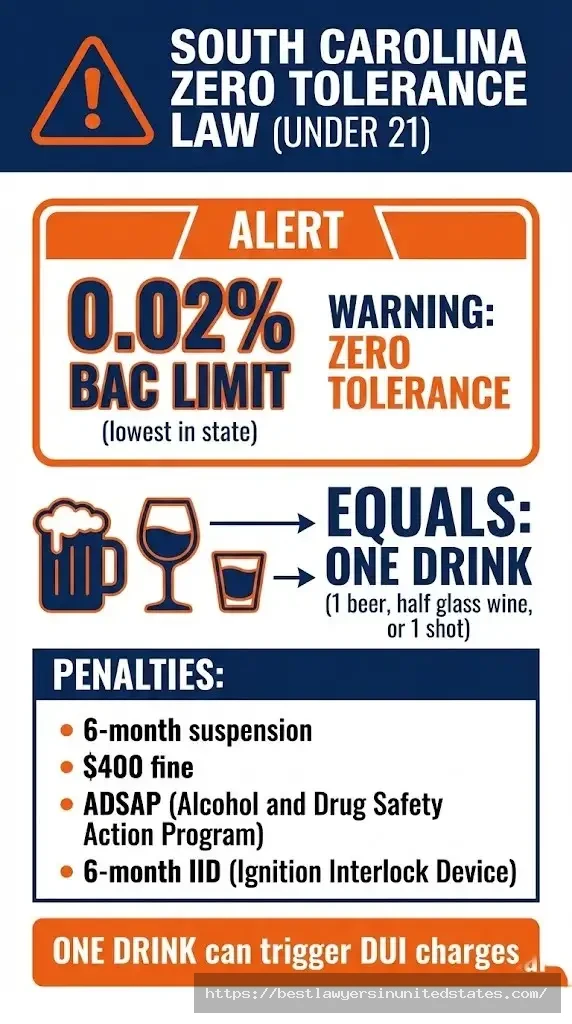
South Carolina enforces strict zero tolerance laws for drivers under 21.
Underage BAC Limits
Drivers under 21 face DUI charges with BAC of 0.02% or higher under SC Code § 56-5-2933. This represents the lowest threshold in South Carolina law.
0.02% BAC equals approximately:
- One 12-oz beer for a 120-pound person
- Half a glass of wine for a 140-pound person
- One shot of liquor for a 160-pound person
Many underage drivers register 0.02% BAC from:
- Mouthwash containing alcohol
- Medication with alcohol content
- Food prepared with wine or spirits
- Communion wine at religious services
Underage DUI Penalties
First offense for drivers under 21:
| Penalty Type | Requirement |
|---|---|
| License suspension | 6 months minimum |
| Fine | $400 or 15 days community service |
| ADSAP enrollment | Mandatory |
| Ignition interlock | 6 months after reinstatement |
Additional consequences for underage drivers:
- Loss of college scholarship eligibility
- NCAA athletic participation suspension
- Juvenile court jurisdiction (under 17)
- Parental notification required
- Possible school disciplinary action
Can Parents Be Held Liable?
South Carolina’s social host liability law holds adults criminally responsible for providing alcohol to minors. Parents face charges when:
- Knowingly allowing underage drinking in their home
- Providing alcohol to underage guests
- Failing to prevent underage drinking at parties
Criminal penalties:
- Misdemeanor charges
- Fines up to $200 per violation
- Up to 30 days jail time
Civil liability: Parents may face lawsuits for injuries or deaths caused by intoxicated minors who drank at their property.
Administrative vs. Criminal DUI Proceedings
South Carolina DUI arrests trigger two separate legal processes.
Administrative License Suspension (SC DMV)
The Department of Motor Vehicles handles administrative suspensions independently from criminal courts.
Suspension timeline:
| Action | Deadline/Date |
|---|---|
| Arrest date | Day 0 |
| Temporary license issued | Valid 30 days |
| Request hearing deadline | 30 days from arrest |
| Hearing scheduled | 30-60 days after request |
| Suspension begins | 30 days from arrest (if no hearing requested) |
Hearing request process:
- Complete Form DR-2615A
- Pay $200 filing fee
- Submit to SC DMV Office of Motor Vehicle Hearings
- Receive hearing notice (10-day advance notice)
Administrative hearings address only whether:
- Officer had reasonable grounds for arrest
- You were properly informed of implied consent
- You refused testing or tested above legal limits
The hearing officer cannot dismiss criminal charges or reduce penalties.
Criminal Court Proceedings
Criminal DUI cases proceed through South Carolina’s municipal, magistrate, or circuit courts depending on offense level.
Court jurisdiction:
| Offense Level | Court Type |
|---|---|
| First offense misdemeanor | Municipal or Magistrate Court |
| Second offense misdemeanor | Municipal or Magistrate Court |
| Third offense felony | Circuit Court |
| Felony DUI (injury/death) | Circuit Court |
Criminal case timeline:
Arraignment (30-60 days): Enter guilty or not guilty plea, bail hearing if not yet released
Pretrial motions (60-90 days): Defense files suppression motions, discovery requests
Plea negotiations (ongoing): Prosecutors offer reduced charges (DUAC to reckless driving)
Trial (6-12 months): Jury trial (felonies) or bench trial (misdemeanors)
Sentencing: Judge imposes penalties within statutory guidelines
Can I get a provisional license during suspension?
Yes, but only after installing an ignition interlock device. South Carolina offers two routes:
Route 1: Serve full suspension without driving
- Complete 6 months (first offense) to 2 years (second offense)
- Reinstated with IID requirement
- No driving privileges during suspension
Route 2: IID provisional license
- Install IID within 30 days of arrest
- Receive provisional license for work, school, medical appointments
- Must maintain IID throughout suspension period
- Full reinstatement after completion
Most drivers choose Route 2 to maintain employment. Similar programs exist in Georgia and Florida, though eligibility requirements vary.
Recent South Carolina DUI Law Changes (2025-2026)
South Carolina lawmakers continue revising DUI statutes in response to the state’s #1 ranking in DUI fatalities nationwide.
Chandler’s Law Legislative Push
Senator Shane Massey introduced Chandler’s Law (S.123) in January 2025 following the death of Chandler Sease, killed by a repeat DUI offender. Key provisions include:
Proposed changes:
- Third DUI offense increases from 60 days to 6 months mandatory minimum jail
- Second offense with injury escalates to felony charges
- Ignition interlock requirement extends from 2 years to 4 years for second offenses
- Fourth offense results in lifetime license revocation with no reinstatement option
- Enhanced monitoring of repeat offenders through electronic databases
Legislative status as of January 2026:
The bill passed the Senate Judiciary Committee 15-3 in March 2025. Full Senate vote expected in early 2026, with House consideration anticipated by summer.
South Carolina’s DUI Fatality Crisis
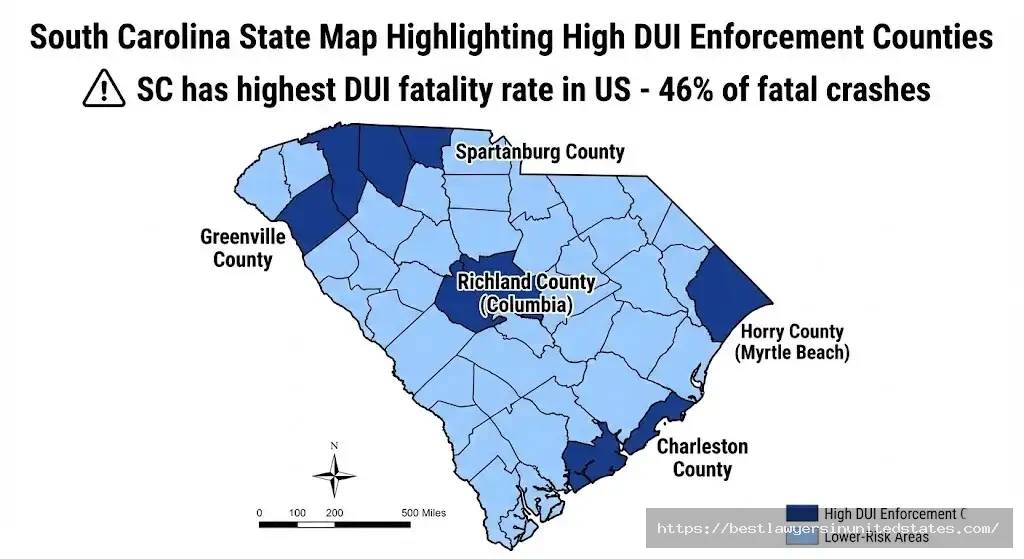
South Carolina recorded the nation’s highest rate of alcohol-impaired driving deaths in 2024 according to the National Highway Traffic Safety Administration.
Key statistics:
- 46% of fatal crashes involved alcohol (national average: 28%)
- 423 alcohol-related traffic deaths in 2024
- Highest per-capita DUI fatality rate for third consecutive year
State response initiatives:
- Increased DUI checkpoints during holidays and weekends
- Enhanced law enforcement training on drug recognition
- Public awareness campaigns targeting repeat offenders
- Legislative pressure for tougher penalties
New DUI Task Forces
South Carolina launched regional DUI task forces in Columbia, Charleston, and Greenville in 2025:
- Multi-agency coordination between city, county, and state police
- Saturation patrols targeting high-incident areas
- Grant funding for additional law enforcement overtime
- Enhanced prosecution resources for repeat offenders
Frequently Asked Questions About South Carolina DUI Laws
Can a DUI be expunged in South Carolina?
Quick Answer: No. South Carolina does not allow expungement of DUI convictions under any circumstances.
Only dismissed or reduced charges may be expunged. A DUI conviction remains on your criminal record permanently, regardless of how long ago it occurred.
How long does a DUI stay on your record in SC?
Quick Answer: Forever. South Carolina DUI convictions remain on your criminal record for life with no removal option.
The conviction also stays on your driving record permanently, affecting insurance rates and employment opportunities indefinitely.
Can I get a hardship license after a DUI in SC?
Quick Answer: South Carolina doesn’t offer traditional “hardship licenses,” but you can get a provisional license with an ignition interlock device.
Install an IID within 30 days of your arrest to receive provisional driving privileges for work, school, medical appointments, and ADSAP program attendance during your suspension period.
What is the legal alcohol limit in South Carolina?
Quick Answer: 0.08% BAC for drivers 21 and older, 0.04% for commercial drivers, and 0.02% for drivers under 21.
BAC of 0.16% or higher triggers enhanced penalties including longer jail sentences and extended ignition interlock requirements.
How likely is jail time for first DUI in SC?
Quick Answer: Nearly certain. South Carolina requires minimum 48 hours jail time for standard first offenses and 30-90 days for BAC of 0.16% or higher.
Some judges allow jail time to be served on weekends or through home detention, but South Carolina rarely suspends jail sentences entirely for first DUI convictions.
What is the zero tolerance law in South Carolina?
Quick Answer: Drivers under 21 face DUI charges with BAC of 0.02% or higher—one-fourth the standard limit for adults.
This extremely low threshold means a single drink or even alcohol-containing mouthwash can result in DUI charges for underage drivers.
How to beat a DUI in SC?
Quick Answer: Challenge the traffic stop legality, breathalyzer accuracy, field sobriety test administration, or rising BAC timing through experienced legal representation.
Common defenses include improper Datamaster calibration, inadequate observation periods, medical conditions affecting tests, and procedural violations during arrest.
What is DUAC vs. DUI?
Quick Answer: DUI requires proof of impaired driving ability, while DUAC requires only proof of 0.08% BAC or higher. South Carolina charges both simultaneously.
Prosecutors often drop one charge during plea negotiations, giving defendants leverage to reduce consequences or fight the remaining charge.
What is ADSAP?
Quick Answer: The Alcohol and Drug Safety Action Program is South Carolina’s mandatory education and treatment program for all DUI offenders, costing $500-$800.
First offenders complete 20 hours minimum. The program includes assessment, education classes, victim impact panels, and potential treatment referrals.
How much does a DUI cost in South Carolina?
Quick Answer: First offense total costs range from $10,825 to $20,950 including fines, attorney fees, ignition interlock, ADSAP, and insurance increases over 3-5 years.
Second offenses cost $24,900-$53,500. Use our DUI cost calculator for personalized estimates.
Is your license suspended immediately after a DUI in SC?
Quick Answer: No. You receive a temporary license valid for 30 days. Suspension begins 30 days after arrest unless you request an administrative hearing.
Requesting a hearing within 30 days postpones suspension until the hearing outcome, typically extending your driving privileges 2-3 months.
What is the most common plea for DUI?
Quick Answer: Pleading guilty to DUAC while prosecutors dismiss the DUI charge is the most common resolution in South Carolina.
This avoids trial costs while accepting similar penalties, though it still results in permanent criminal conviction with no expungement possibility.
Can I refuse a breathalyzer in South Carolina?
Quick Answer: Yes, but refusal results in 6-month license suspension for first offense, 9 months for second, and 15 months for third—often longer than if you fail the test.
Refusal also provides evidence of “consciousness of guilt” that prosecutors use against you at trial.
What happens if I get a DUI in SC but live in another state?
Quick Answer: South Carolina shares DUI convictions with your home state through the Driver License Compact, affecting your license and insurance there.
Your home state typically imposes its own penalties in addition to South Carolina’s penalties, potentially resulting in double suspension periods.
Does South Carolina have DUI diversion programs?
Quick Answer: No. South Carolina does not offer pretrial diversion or conditional discharge programs for DUI offenses.
You must proceed through criminal court or negotiate plea agreements. Completion of ADSAP does not result in charge dismissal like diversion programs in other states.
Conclusion: Protecting Your Rights After a South Carolina DUI Arrest
South Carolina’s dual-charge system, mandatory ignition interlock law, and no-expungement policy make DUI convictions particularly severe. First-time offenders face minimum $10,000 total costs, while repeat offenders risk felony convictions carrying years in prison.
The state’s status as the nation’s DUI fatality leader has intensified enforcement and prompted legislative efforts to strengthen penalties through Chandler’s Law reforms expected in 2026.
Critical actions after DUI arrest:
- Request administrative hearing within 30 days
- Install ignition interlock device for provisional license
- Document arrest circumstances immediately
- Consult experienced South Carolina DUI attorney
- Gather medical records affecting test results
Never attempt to navigate South Carolina’s complex DUI laws without legal representation. The permanent criminal record and financial consequences justify immediate attorney consultation.
Find a DUI Lawyer in South Carolina – Free Consultation
Email: admin@bestlawyersinunitedstates.com
