
Facing DUI charges in Rhode Island? You need to understand Rhode Island General Laws § 31-27-2, which sets penalties based on your BAC level. First-time offenders with BAC between .08-.10 face $100-$300 fines and up to 10 hours of community service, while BAC above .15 triggers jail time and mandatory ignition interlock devices.
Rhode Island uses a unique four-tier BAC penalty system that most states don’t have. The state also classifies “BAC Unknown” cases differently from standard breathalyzer refusals. Understanding these distinctions can save you thousands of dollars and protect your driving privileges.
This guide covers everything from arrest procedures to total costs, including Rhode Island’s 5-year lookback period for repeat offenses. You’ll learn about hardship licenses, expungement eligibility, and why Rhode Island’s Traffic Tribunal handles most DUI cases instead of District Court.
What is Considered DUI in Rhode Island?
Rhode Island law prohibits driving with a Blood Alcohol Content (BAC) of .08% or higher under § 31-27-2. Police can arrest you for DUI even if your BAC is below .08% if they observe impaired driving behavior.
Rhode Island Uses Both DUI and DWI Terms
Rhode Island statutes use “driving under the influence” (DUI) as the official term. However, law enforcement and courts also use “driving while intoxicated” (DWI) interchangeably. Both terms mean the same thing legally in Rhode Island.
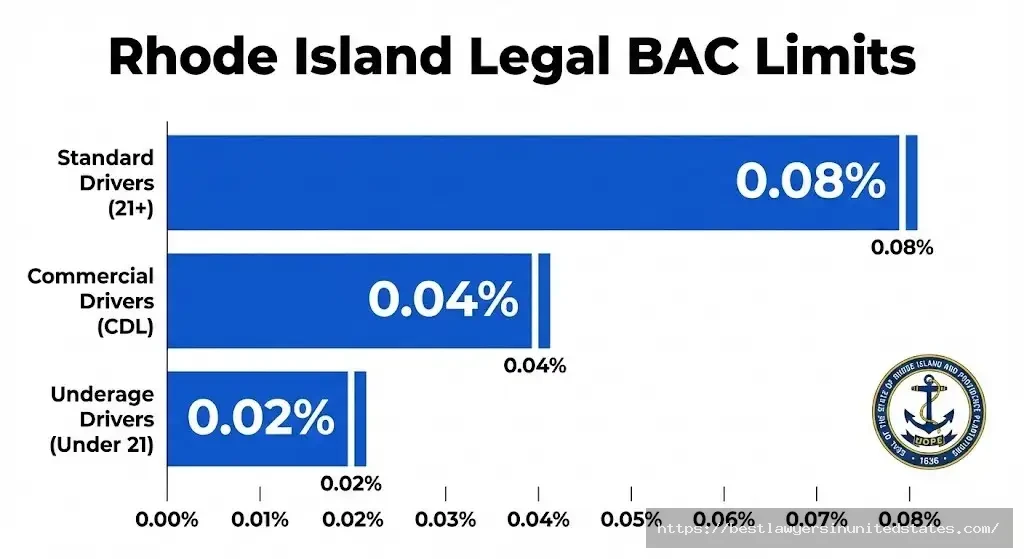
Different BAC Limits for Different Drivers
| Driver Type | Legal BAC Limit |
|---|---|
| Standard (21+) | 0.08% |
| Commercial drivers (CDL) | 0.04% |
| Under 21 | 0.02% |
Critical point: Commercial drivers lose their CDL for one year after a first DUI conviction, even if the offense occurred in their personal vehicle.
Drug DUI Laws in Rhode Island
Rhode Island § 31-27-2 also criminalizes driving under the influence of drugs, including:
- Illegal substances (marijuana, cocaine, heroin)
- Prescription medications (opioids, benzodiazepines)
- Over-the-counter drugs that impair driving
Police use Drug Recognition Experts (DREs) to evaluate suspected drug impairment. Blood tests detect specific drug levels, unlike alcohol’s standardized BAC measurement.
Rhode Island’s Unique Four-Tier BAC Penalty System
Rhode Island separates first-offense DUI penalties into four distinct categories based on your BAC level. Most states use only two tiers, making Rhode Island’s system more complex.
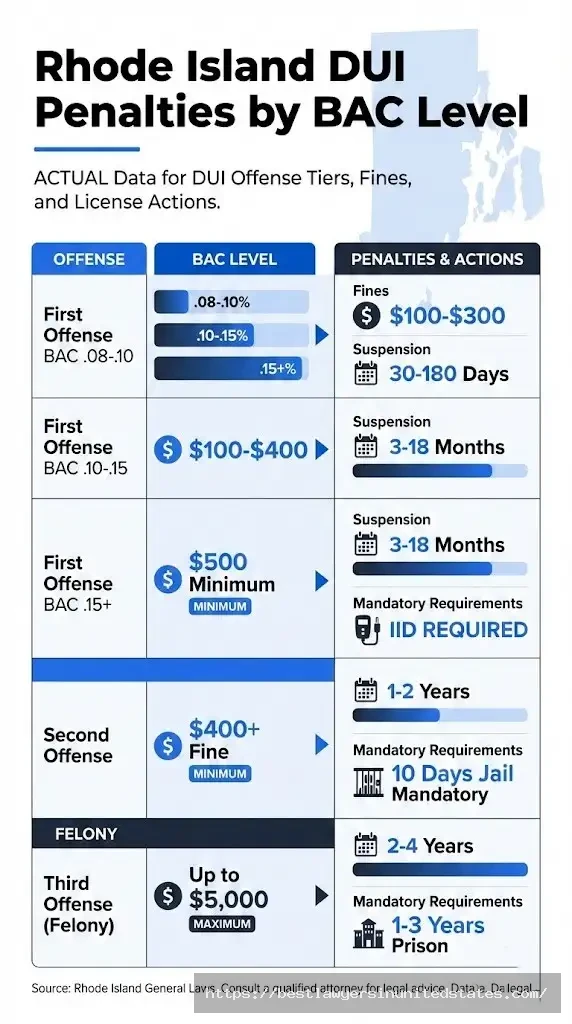
Understanding the Four BAC Tiers
Tier 1: BAC .08-.10
- Minimum penalties
- Often eligible for probation
Tier 2: BAC .10-.15
- Moderate penalties
- Possible jail time
Tier 3: BAC .15 and above
- Enhanced penalties
- Mandatory jail time or community service
- Required ignition interlock device
Tier 4: BAC Unknown
- Applies when you refuse testing or BAC cannot be determined
- Different from standard refusal penalties
- Separate administrative consequences
How BAC Unknown Differs from Refusal
Many drivers confuse “BAC Unknown” with chemical test refusal. Rhode Island treats these differently:
BAC Unknown applies when:
- Equipment malfunctions during testing
- Medical conditions prevent accurate testing
- Blood sample gets contaminated
- Officer fails to properly administer the test
Chemical test refusal applies when:
- You explicitly refuse breath, blood, or urine testing
- You fail to provide an adequate breath sample after multiple attempts
- You refuse to sign consent forms
The distinction matters because refusal triggers automatic license suspension under Rhode Island’s implied consent law, while BAC Unknown cases may offer more defense options.
First Offense DUI Penalties in Rhode Island
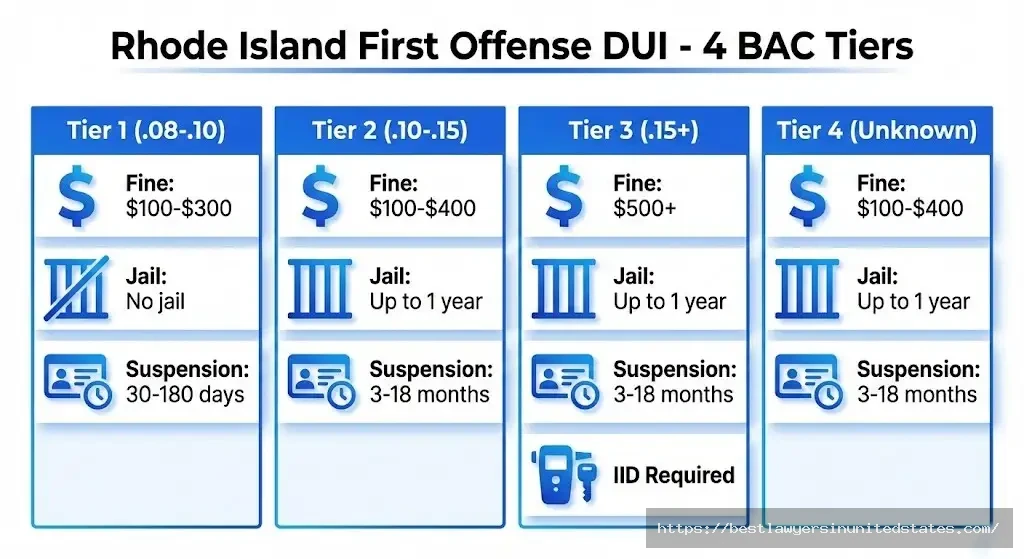
Rhode Island imposes different penalties for first-time DUI offenders based on BAC level. Check your potential penalties using our DUI cost calculator to estimate your total costs.
DUI Cost Calculator
Estimate total DUI expenses by state and offense
Detailed Cost Breakdown
Payment Timeline
Bail bond, towing fees, car impound, attorney retainer
Initial court fines, DMV fees, DUI school enrollment, ignition interlock installation
Monthly probation fees, ignition interlock fees, DUI school payments, attorney balance
Insurance premium increases, license reinstatement, SR-22 filing fees
- Lost wages from missed work (court dates, jail time, DUI school) – $2,000-$10,000
- Job loss or difficulty finding employment – Varies
- Professional license suspension (doctors, lawyers, nurses, pilots) – Career ending
- Rideshare and transportation costs during suspension – $1,500-$5,000
- Travel restrictions and visa denials – Varies
- Security clearance loss – Career impact
- Child custody implications – Legal costs
- Rental car restrictions – Varies
- Personal relationships and mental health costs – Priceless
BAC .08-.10 (First Tier)
| Penalty Type | Consequence |
|---|---|
| Fine | $100-$300 |
| Jail Time | None (suspended) |
| License Suspension | 30-180 days |
| Community Service | 10-60 hours |
| Alcohol/Drug Program | Mandatory attendance |
Quick takeaway: This tier offers the lightest penalties and often allows for probation instead of jail time.
BAC .10-.15 (Second Tier)
First offense with BAC between .10-.15 escalates penalties:
- Fine: $100-$400
- Jail time: Up to 1 year (usually suspended for community service)
- Community service: 20-60 hours
- License suspension: 3-18 months
- Highway Safety Assessment: Required attendance
Courts typically suspend jail sentences if you complete community service and alcohol education programs.
BAC .15 and Above (Third Tier – Enhanced Penalties)
Quick Answer: BAC .15+ triggers Rhode Island’s most severe first-offense penalties, including mandatory ignition interlock devices.
| Penalty Component | Requirement |
|---|---|
| Fine | $500 minimum |
| Jail Time | Up to 1 year |
| Community Service | Minimum 40 hours |
| License Suspension | 3-18 months |
| Ignition Interlock | Mandatory after suspension period |
| Highway Safety Assessment | Required |
Critical deadline: You must install an ignition interlock device before the Rhode Island DMV reinstates your license.
BAC Unknown Penalties
When BAC cannot be determined, Rhode Island treats the case similar to .10-.15 tier:
- Fines: $100-$400
- Potential jail time up to 1 year (usually suspended)
- License suspension: 3-18 months
- Mandatory Highway Safety Assessment
Defense opportunity: BAC Unknown cases often provide stronger grounds for challenging the prosecution’s evidence compared to cases with documented BAC levels.
Additional First Offense Consequences
Beyond court-imposed penalties, expect these costs:
- SR-22 insurance: Required high-risk auto insurance for 3 years
- License reinstatement fee: $51-$86 with Rhode Island DMV
- Victim impact panel: $50-75 attendance fee
- Alcohol/drug assessment: $150-300
First-time offenders who complete all requirements and maintain clean records may qualify for expungement after 5 years.
Second Offense DUI in Rhode Island (Within 5 Years)
Rhode Island uses a 5-year lookback period for repeat DUI offenses. Second convictions within 5 years carry mandatory minimum sentences that judges cannot reduce.
Second Offense Penalties
| Penalty Type | Minimum | Maximum |
|---|---|---|
| Fine | $400 | None specified |
| Jail Time | 10 days mandatory | 1 year |
| License Suspension | 1 year | 2 years |
| Community Service | 60 hours minimum | 100 hours |
| Ignition Interlock | 1-2 years | After reinstatement |
Critical point: The 10-day mandatory minimum jail sentence cannot be suspended, reduced, or substituted with community service for second offenses.
Why the 5-Year Lookback Period Matters
Rhode Island’s 5-year lookback is shorter than many states that use 7-10 year periods. This affects penalty classification:
Scenario 1: DUI in 2021, second DUI in 2025
- Falls within 5-year window
- Charged as second offense
- Mandatory 10 days jail
Scenario 2: DUI in 2020, second DUI in 2026
- Outside 5-year window
- Charged as first offense
- No mandatory jail time
Compare this to states like California, which uses a 10-year lookback period, making second offenses more likely.
Ignition Interlock Requirements
All second-time offenders must install ignition interlock devices after license reinstatement:
Installation requirements:
- Use Rhode Island-approved vendors only
- Install within 10 days of reinstatement notice
- Pay $100-150 installation fee
- Pay $75-100 monthly monitoring fee
- Maintain device for 1-2 years minimum
Approved Rhode Island vendors:
- LifeSafer Ignition Interlock (Providence)
- Smart Start Inc. (Warwick)
- Guardian Interlock Systems (Cranston)
Rhode Island Treatment Courts Option
Second-time offenders may qualify for Rhode Island’s DUI Court program:
- Intensive supervision instead of jail time
- Weekly court appearances
- Random alcohol/drug testing
- Mandatory treatment programs
- 12-18 month program duration
Eligibility: Non-violent offenders with substance abuse issues. Contact Rhode Island District Court in Providence at (401) 458-5400 for application details.
Third Offense DUI and Felony Charges
Rhode Island classifies third DUI offenses within 5 years as felonies. This classification brings lifetime consequences beyond jail time and fines.
Third Offense Penalties
| Penalty Type | Consequence |
|---|---|
| Classification | Felony |
| Fine | Up to $5,000 |
| Jail/Prison | 1-3 years mandatory |
| License Suspension | 2-4 years |
| Ignition Interlock | 2-4 years after reinstatement |
| Felony Record | Permanent (affects employment, housing, voting rights) |
Quick Answer: Third DUI convictions in Rhode Island result in mandatory prison time between 1-3 years, with no possibility of suspension or probation.
Long-Term Consequences of Felony DUI
Felony DUI convictions in Rhode Island create obstacles beyond the immediate penalties:
Employment impact:
- Professional licenses at risk (medical, legal, teaching, real estate)
- Background checks reveal felony record
- Federal employment prohibited
- Some employers have “no felony” policies
Other consequences:
- Loss of voting rights while incarcerated
- Firearm possession prohibited under federal law
- Immigration consequences for non-citizens (possible deportation)
- Student loan eligibility may be affected
License Revocation vs. Suspension
Third offenses trigger license revocation, not suspension:
Revocation means:
- Complete termination of driving privileges
- Must reapply for new license after revocation period
- Pass written and road tests again
- Pay all reinstatement fees ($86-$171)
- Provide proof of SR-22 insurance
Compare this to Massachusetts DUI laws, where third offenses also result in felony charges but with different revocation periods.
When You Can Drive Again
Minimum timeline for third offense:
- Serve 2-4 year revocation period
- Complete all court-ordered programs
- Pay all fines and fees
- Install ignition interlock device
- Obtain SR-22 insurance
- Pass DMV written and road tests
- Pay reinstatement fees
Total time before unrestricted driving: 4-8 years minimum from conviction date.
Rhode Island Implied Consent Law
Every driver who operates a vehicle in Rhode Island automatically consents to chemical testing under § 31-27-2.1. This “implied consent” activates the moment police arrest you for suspected DUI.
What Implied Consent Means
When you accept a Rhode Island driver’s license, you agree to:
- Submit to breath, blood, or urine tests when lawfully arrested
- Allow police to determine which test to administer
- Provide an adequate breath sample (multiple attempts may be required)
- Accept automatic suspension if you refuse testing
Critical point: Implied consent applies only after lawful arrest. Police cannot demand testing during a routine traffic stop without arrest.
The Implied Consent Warning
Rhode Island law requires officers to read you a specific warning before requesting a chemical test. The warning explains:
- Refusal triggers automatic license suspension
- Suspension periods for first and subsequent refusals
- Right to additional independent testing at your expense
- Refusal can be used as evidence against you in court
Officers must read this warning verbatim. Failure to provide the proper warning may invalidate the test results.
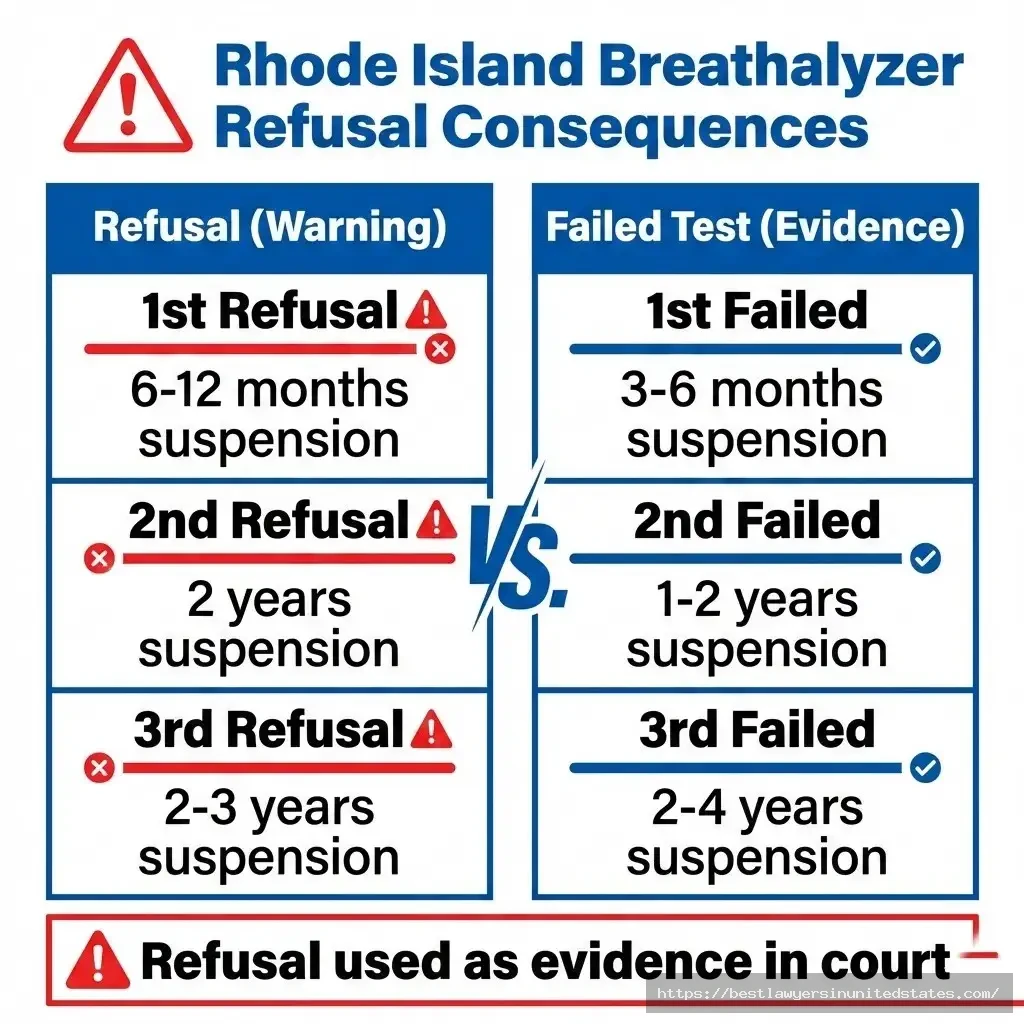
Refusal Penalties in Rhode Island
| Offense | Suspension Period | Compared to Failed Test |
|---|---|---|
| First refusal | 6-12 months | 3-6 months for failure |
| Second refusal (within 5 years) | 2 years | 1-2 years for failure |
| Third refusal (within 5 years) | 2-3 years | 2-4 years for failure |
Quick takeaway: Refusal carries harsher license suspension penalties than failing the test in Rhode Island.
Two Separate Suspension Processes
Refusing a chemical test triggers two independent suspensions:
Administrative suspension (Rhode Island DMV):
- Automatic upon refusal
- Separate from criminal case
- Begins 30 days after arrest
- Must request hearing within 6 days to contest
Criminal suspension (Rhode Island Traffic Tribunal/District Court):
- Imposed if convicted of DUI
- Runs separately from administrative suspension
- Can exceed administrative suspension period
Example: Refuse test + convicted of DUI = 12-month refusal suspension PLUS 3-18 month criminal suspension.
Can You Refuse Testing in Rhode Island?
You have the legal right to refuse chemical testing, but Rhode Island law imposes immediate consequences:
What happens when you refuse:
- Police document refusal in their report
- License suspended for 6-12 months (first offense)
- Refusal used as evidence of “consciousness of guilt” at trial
- Prosecutors argue you refused because you knew you were impaired
- Juries often view refusal negatively
Exception: Rhode Island allows you to request additional independent testing at your own expense after completing the official test. Your attorney can use independent lab results to challenge the state’s evidence.
Blood Test Warrants
Police cannot physically force you to provide breath or blood samples without a warrant. However, Rhode Island law enforcement increasingly obtains warrants for blood draws in cases involving:
- Serious accidents with injuries
- Suspected drug impairment (breath tests don’t detect drugs)
- Unconscious drivers
- Multiple prior DUI convictions
Timeline: Judges typically issue blood draw warrants within 1-2 hours of request. Once police obtain a warrant, refusal becomes irrelevant—medical personnel will draw blood regardless.
DUI Arrest Process in Rhode Island
Understanding the arrest procedure helps you protect your rights and build a stronger defense. Rhode Island law requires police to follow specific protocols during DUI arrests.
Traffic Stops and Probable Cause
Rhode Island State Police and local departments must have probable cause to initiate a DUI investigation. Common reasons include:
- Erratic driving (weaving, speeding, sudden stops)
- Traffic violations (running red lights, illegal turns)
- Equipment violations (broken taillight, expired registration)
- Anonymous tips (must be corroborated by officer observation)
Your rights during the stop:
- Remain silent (don’t admit to drinking)
- Politely decline to answer questions about alcohol consumption
- Ask “Am I free to leave?” to determine if you’re detained
Field Sobriety Tests in Rhode Island
Officers typically request three standardized field sobriety tests before arrest:
1. Horizontal Gaze Nystagmus (HGN)
- Officer watches your eyes track a pen or finger
- Looks for involuntary jerking movements
- Most reliable field test (when properly administered)
2. Walk-and-Turn Test
- Walk 9 steps heel-to-toe in a straight line
- Turn on one foot
- Return 9 steps
- Officer looks for 8 specific indicators of impairment
3. One-Leg Stand Test
- Stand on one foot for 30 seconds
- Count out loud
- Officer watches for swaying, hopping, or dropping foot
Can you refuse field sobriety tests? Yes. Rhode Island law does not require you to perform field sobriety tests. Refusal cannot trigger license suspension like chemical test refusal does.
Preliminary Breath Test (PBT) vs. Official Breathalyzer
Rhode Island uses two types of breath tests:
| Test Type | When Used | Legal Status | Refusal Consequence |
|---|---|---|---|
| Preliminary Breath Test (PBT) | Roadside, before arrest | Results not admissible in court | No suspension penalty |
| Official Breathalyzer | Station, after arrest | Results admissible in court | 6-12 month suspension |
Critical distinction: You can refuse the roadside PBT without triggering implied consent suspension. However, refusing the official breathalyzer after arrest activates the 6-12 month suspension.
At the Police Station
After arrest, police transport you to the station for official chemical testing:
Booking process:
- Fingerprinting and photographing
- Personal property inventory
- Official breathalyzer test or blood draw
- Implied consent warning read
- Opportunity to contact attorney
Timing: Rhode Island law requires police to administer the official breath test within 2-3 hours of arrest to ensure accuracy. If you’re wondering about your BAC level, use our BAC calculator to estimate based on drinks consumed and time elapsed.
BAC Calculator
Estimate your Blood Alcohol Content
• Commercial Driver (CDL): 0.04% BAC
• Drivers Under 21: 0.00-0.02% BAC (Zero Tolerance)
• Enhanced Penalties: 0.15% BAC or higher in most states
Bond and Release
Most first-time DUI defendants are released within 4-8 hours:
Release options:
- Personal recognizance (PR bond) – most common for first offense
- Surety bond – required for repeat offenders or high BAC
- Cash bond – used when flight risk exists
Conditions of release:
- Attend all court dates
- No new criminal violations
- No alcohol consumption (for some defendants)
- Surrender passport (rare, for flight risk cases)
Arraignment Timeline
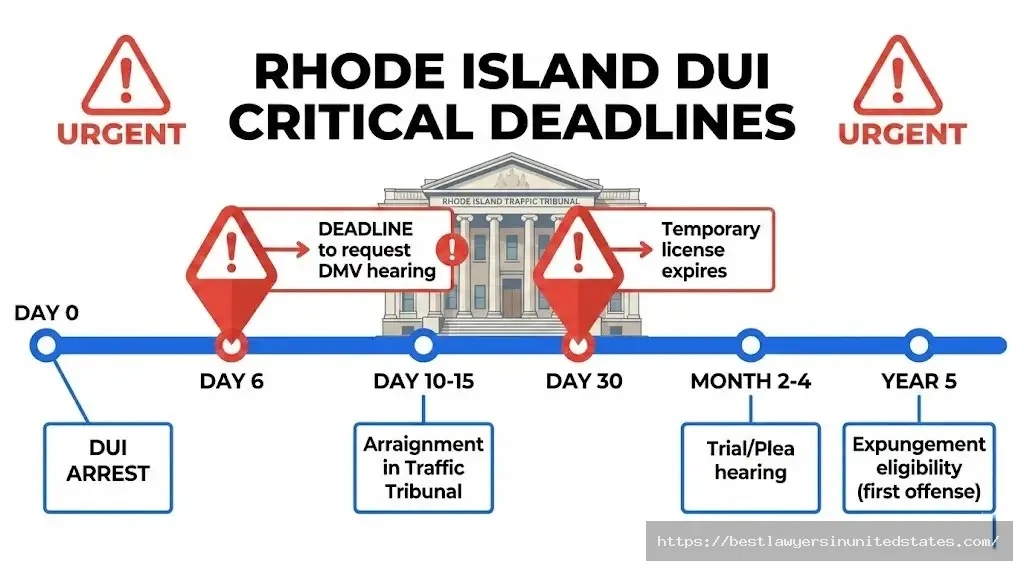
Rhode Island law requires arraignment within 10-15 days of arrest for DUI cases:
What happens at arraignment:
- Charges formally read
- Enter plea (guilty, not guilty, nolo contendere)
- Judge sets future court dates
- Discuss bond conditions
Critical deadline: The arraignment date appears on your bail paperwork. Missing arraignment results in a bench warrant for your arrest.
Rhode Island DMV Administrative Hearing Process
Rhode Island separates DUI proceedings into two tracks: criminal court and DMV administrative hearing. The administrative hearing determines whether you keep your license, independent of the criminal case outcome.
Requesting Your DMV Hearing
Critical deadline: You have 6 days from arrest to request an administrative hearing with the Rhode Island DMV.
How to request:
- Call Rhode Island DMV Administrative Adjudication Division: (401) 462-5755
- Submit written request to: RI DMV, 600 New London Avenue, Cranston, RI 02920
- Email: [email protected] (confirm receipt)
What happens if you miss the 6-day deadline:
- Your license suspends automatically 30 days after arrest
- No hearing opportunity
- No chance to challenge the suspension
Temporary License Period
Rhode Island issues a temporary license valid for 30 days after your arrest. This gives you time to request and attend your administrative hearing.
Important: You can drive legally during this 30-day period and any additional time before your hearing date. The suspension only begins if you lose the hearing or fail to request one.
What the DMV Hearing Decides
The administrative hearing determines only whether to suspend your license. The hearing officer reviews:
Four key questions:
- Did the officer have probable cause to stop you?
- Did the officer have probable cause to arrest you for DUI?
- Did you refuse the chemical test or have BAC .08% or higher?
- Did the officer properly advise you of implied consent consequences?
The hearing does NOT determine:
- Whether you’re guilty of criminal DUI
- What criminal penalties you’ll face
- Whether charges should be dismissed
Administrative Hearing vs. Criminal Court
| Aspect | Administrative Hearing | Criminal Court |
|---|---|---|
| Purpose | License suspension only | Criminal conviction and penalties |
| Standard of proof | Preponderance of evidence (51%) | Beyond reasonable doubt (99%) |
| Outcome | Keep or lose license | Guilty, not guilty, or dismissed |
| Judge | DMV hearing officer | Traffic Tribunal or District Court judge |
| Can outcomes differ? | YES – can lose license but win criminal case | YES – can keep license but get convicted |
Real scenario: Many defendants win their administrative hearing (keep their license) but later get convicted in criminal court. Others lose the administrative hearing but get their criminal charges dismissed.
Preparing for Your Administrative Hearing
What to bring:
- Arrest report and citation
- Temporary license
- Witness statements (if available)
- Medical records (if medical condition affected testing)
- Dashcam or body camera footage (if obtained through attorney)
Who can attend:
- You (defendant)
- Your attorney
- Police officer who arrested you
- Witnesses (if relevant to the four questions above)
Hearing location: Rhode Island DMV Administrative Adjudication 600 New London Avenue Cranston, RI 02920 Phone: (401) 462-5755
Possible Hearing Outcomes
If you win:
- License suspension lifted immediately
- Continue driving without restriction
- Still face criminal charges in Traffic Tribunal
If you lose:
- License suspended (period depends on offense number and whether you refused)
- May qualify for hardship license after suspension period
- Can appeal to District Court within 30 days
Settlement option: Some cases settle with reduced suspension periods in exchange for completing alcohol education programs early.
Appealing an Adverse Decision
Lost your administrative hearing? You have 30 days to appeal to Rhode Island District Court:
Appeal process:
- File notice of appeal with District Court
- Pay $80-120 court filing fee
- District Court reviews DMV hearing record
- Court can uphold, reverse, or modify suspension
Success rate: Appeals succeed in approximately 15-20% of cases, usually due to procedural errors by the hearing officer or arresting officer.
Rhode Island Traffic Tribunal vs. District Court
Rhode Island handles DUI cases in two different court systems depending on the offense severity. Understanding which court handles your case affects everything from procedures to potential outcomes.
When Cases Go to Traffic Tribunal
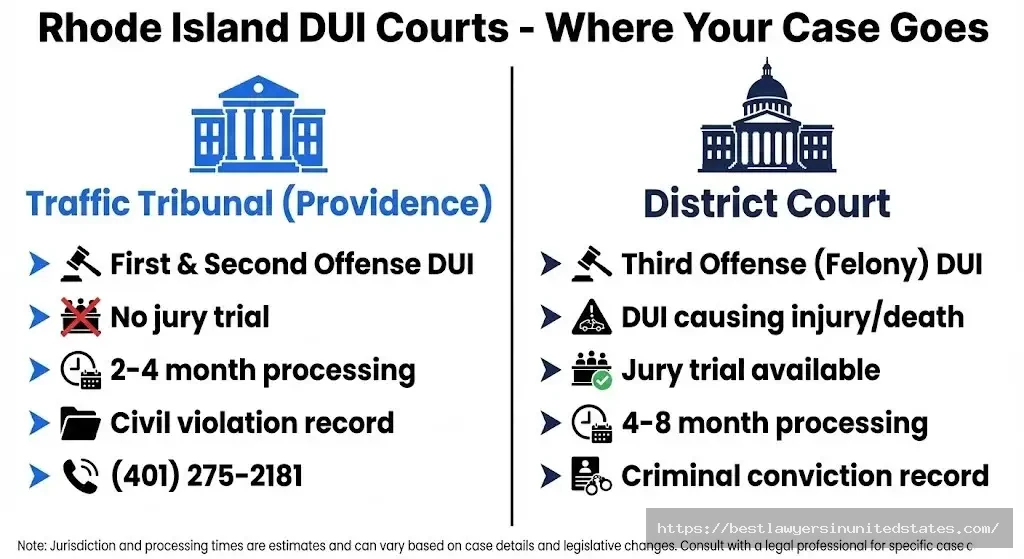
Rhode Island Traffic Tribunal handles most first and second-offense DUI cases:
Traffic Tribunal jurisdiction:
- First offense DUI (all BAC levels)
- Second offense DUI (within 5 years)
- Chemical test refusal violations
- License suspension hearings
- Some drug DUI cases (prosecutor’s discretion)
Traffic Tribunal location: Rhode Island Traffic Tribunal 345 Harris Avenue Providence, RI 02909 Phone: (401) 275-2181
Court sessions: Monday-Friday, 8:30 AM – 4:00 PM
When Cases Go to District Court
Rhode Island District Court handles more serious DUI offenses:
District Court jurisdiction:
- Third offense DUI (felony)
- DUI causing serious bodily injury
- DUI causing death
- DUI with minor passenger (under 13)
- Cases appealed from Traffic Tribunal
Multiple District Court locations in Rhode Island:
- Providence (Sixth Division): (401) 458-5400
- Warwick (Third Division): (401) 275-3500
- Newport (Second Division): (401) 841-8340
- Woonsocket (Seventh Division): (401) 765-1500
Key Procedural Differences
| Aspect | Traffic Tribunal | District Court |
|---|---|---|
| Right to jury trial | NO – magistrate decides | YES – can request jury |
| Appeal process | To District Court | To Superior Court |
| Sentencing authority | Limited penalties | Full sentencing range |
| Typical processing time | 2-4 months | 4-8 months |
| Record type | Civil violation record | Criminal conviction record |
Critical distinction: Traffic Tribunal DUI convictions appear as traffic violations, while District Court convictions create criminal felony records.
Traffic Tribunal Procedures
Typical Traffic Tribunal timeline:
Week 1-2: Arraignment
- Charges read
- Enter plea
- Request discovery (police reports, video footage)
Week 4-8: Pre-trial conference
- Meet with prosecutor
- Discuss plea agreements
- Review evidence
Week 12-16: Trial
- Present defense
- Cross-examine officer
- Magistrate issues decision
Alternative: Traffic Tribunal offers plea bargains in approximately 60-70% of first-offense cases, often reducing charges to reckless driving (§ 31-27-4) to avoid license suspension.
District Court Procedures
District Court follows formal criminal procedures:
Arraignment → Pretrial hearing → Motion hearings → Trial → Sentencing
Typical timeline: 6-12 months from arrest to final disposition
Your rights in District Court:
- Right to jury trial (12 jurors, unanimous verdict required)
- Right to discovery (all evidence against you)
- Right to compel witnesses
- Right to appeal to Superior Court
- Right to remain silent
Can You Transfer Between Courts?
Generally, no. Rhode Island statutes determine which court has jurisdiction based on:
- Number of prior offenses
- Severity of charges
- Whether injury/death occurred
Exception: If Traffic Tribunal magistrate finds violations beyond their sentencing authority, they can transfer to District Court for sentencing.
Hardship License in Rhode Island
Rhode Island offers hardship licenses (called “work permits” or “limited licenses”) to eligible DUI defendants. These restricted licenses allow driving for specific purposes during your suspension period.
Eligibility Requirements
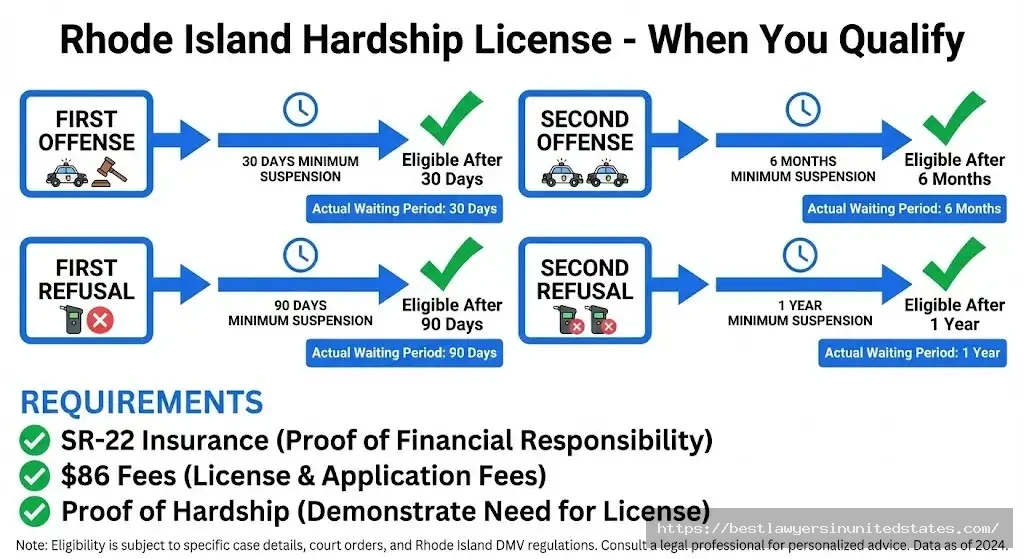
Quick Answer: You can apply for a Rhode Island hardship license after serving a minimum suspension period, typically 30 days for first offense.
Basic eligibility:
- Completed minimum mandatory suspension period
- No prior hardship license violations
- Demonstrate “hardship” (employment, medical, education)
- Maintain SR-22 insurance
- Pay all required fees
Excluded from hardship licenses:
- Third or subsequent DUI offenses
- DUI causing serious injury or death
- Suspended for chemical test refusal (some cases)
- Pending criminal charges in certain circumstances
Minimum Suspension Before Hardship License
| Offense | Minimum Suspension | When Eligible |
|---|---|---|
| First DUI | 30 days | After 30 days served |
| Second DUI | 6 months | After 6 months served |
| First refusal | 90 days | After 90 days served |
| Second refusal | 1 year | After 1 year served |
Example: First offense with .12 BAC = 30-day minimum suspension. You can apply for hardship license starting day 31.
What You Can Drive For (Permitted Uses)
Rhode Island hardship licenses restrict driving to specific purposes:
Approved hardship categories:
- ✅ Employment (commuting to/from work)
- ✅ Required medical appointments (yours or dependent family members)
- ✅ Education (college classes, vocational training)
- ✅ Court-ordered programs (DUI classes, community service)
- ✅ Essential household needs (child care, grocery shopping)
NOT approved:
- ❌ Social activities or entertainment
- ❌ Visiting friends or relatives
- ❌ Convenience (when public transit available)
- ❌ Recreational activities
Application Process Step-by-Step
Step 1: Gather required documentation
- Valid Rhode Island ID or expired license
- Proof of hardship (employer letter, medical records, school enrollment)
- SR-22 insurance certificate
- Completion certificate for alcohol/drug assessment
- Court disposition paperwork
Step 2: Complete application forms
- Form T1-1 (Application for Hardship License)
- Employer verification form
- Medical certification (if claiming medical hardship)
Step 3: Pay fees
- Application fee: $51
- License issuance fee: $35.50
- SR-22 filing fee (through insurance): $15-25
Step 4: Submit to Rhode Island DMV Rhode Island Division of Motor Vehicles 600 New London Avenue Cranston, RI 02920 Hardship License Unit: (401) 462-5824
Processing time: 10-15 business days
SR-22 Insurance Requirement
All hardship license applicants must obtain SR-22 insurance (high-risk insurance certificate):
How to get SR-22:
- Contact your current auto insurance company
- Request SR-22 filing
- Pay $15-25 filing fee
- Insurance company files electronically with Rhode Island DMV
- Expect 50-300% increase in premiums
SR-22 duration: Rhode Island requires SR-22 for 3 years from conviction date.
Major Rhode Island insurers offering SR-22:
- Progressive
- GEICO
- State Farm
- The General
- Bristol West
Hardship License Restrictions
Your Rhode Island hardship license will specify:
Time restrictions:
- Specific hours you can drive (example: 6 AM – 8 PM weekdays)
- Routes to approved destinations only
- No deviation from approved purposes
Vehicle restrictions:
- May require ignition interlock device
- Commercial vehicles prohibited (no CDL)
- Motorcycle endorsement suspended
Violation consequences:
- Immediate revocation of hardship license
- Extended suspension period (additional 6-12 months)
- Possible criminal charges for driving while suspended (§ 31-11-18)
Enforcement: Rhode Island State Police and local departments actively patrol for hardship license violations. Getting stopped outside permitted hours or locations triggers automatic revocation.
Alternative: Ignition Interlock Instead of Hardship License
Rhode Island offers an alternative to traditional hardship licenses for some offenders:
Ignition Interlock Restricted License:
- Available after completing minimum suspension
- Allows unrestricted driving with installed IID
- Must use IID-equipped vehicle for all driving
- Costs $100-150 installation + $75-100/month monitoring
Compare the two options:
| Feature | Hardship License | IID Restricted License |
|---|---|---|
| Where you can drive | Limited locations only | Anywhere |
| When you can drive | Specific hours | Anytime |
| Cost | Lower ($86 total) | Higher ($1,000-$1,500/year) |
| Convenience | Very restrictive | More freedom |
Best for: IID restricted license works better for defendants who can afford higher costs and need flexibility. Hardship license suits those on strict budgets with simple commutes.
Similar options exist in neighboring states like Connecticut and New Hampshire, though specific requirements vary.
Ignition Interlock Device Requirements in Rhode Island
Rhode Island requires ignition interlock devices (IIDs) for certain DUI convictions. These breathalyzer-connected devices prevent your vehicle from starting if they detect alcohol on your breath.
When IIDs Are Required
Mandatory IID installation:
- First offense with BAC .15% or higher
- All second offense DUI convictions
- All third and subsequent offenses
- Refusal cases (at judge’s discretion)
- Hardship license applicants (in some cases)
Optional/Discretionary:
- First offense with BAC .08-.149 (judge may require)
- Part of plea agreement to reduce other penalties
IID Installation Timeline
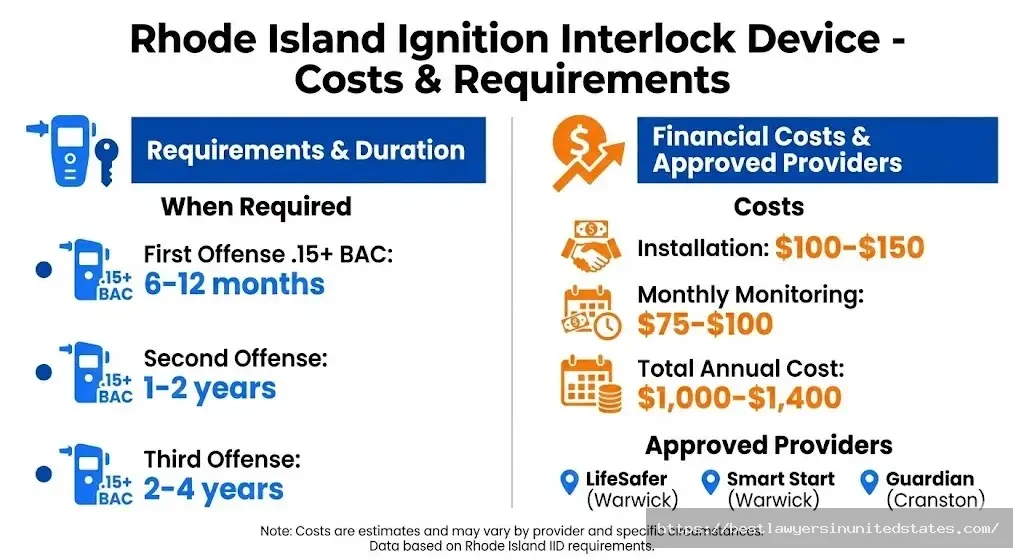
| Offense | When Required | Duration |
|---|---|---|
| 1st (.15+ BAC) | After license reinstatement | 6-12 months |
| 2nd offense | After license reinstatement | 1-2 years |
| 3rd offense | After license reinstatement | 2-4 years |
| Refusal cases | Varies by court order | 6 months-2 years |
Critical deadline: You must install the IID within 10 days of receiving your license reinstatement notice from Rhode Island DMV.
Rhode Island Approved IID Providers
Only state-certified vendors can install IIDs in Rhode Island:
LifeSafer Ignition Interlock 100 Jefferson Boulevard, Suite 103 Warwick, RI 02888 Phone: (800) 634-3077
Smart Start Inc. 1205 Jefferson Boulevard Warwick, RI 02886 Phone: (800) 880-3394
Guardian Interlock Systems 1000 Chapel View Boulevard Cranston, RI 02920 Phone: (866) 610-8970
Draeger Interlock Services multiple Rhode Island locations Phone: (800) 332-6858
IID Costs in Rhode Island
| Cost Type | Amount |
|---|---|
| Installation fee | $100-$150 |
| Monthly monitoring | $75-$100 |
| Calibration (every 30-60 days) | $0 (included in monitoring) |
| Removal fee | $50-$75 |
| Lockout reset (violations) | $50-$100 per incident |
Total annual cost: $1,000-$1,400 per year
Who pays: You pay all IID costs. Rhode Island offers no subsidies or assistance programs for IID expenses.
How IGDs Work
Starting your vehicle:
- Blow into device mouthpiece
- Device analyzes breath sample
- If BAC is 0.00%, vehicle starts
- If any alcohol detected, vehicle won’t start
While driving (rolling retests):
- Device randomly requests breath samples every 5-15 minutes
- You have 5-10 minutes to safely pull over and provide sample
- Failure to provide sample triggers alarm and logs violation
What triggers failures:
- Any detectable alcohol (even mouthwash, cough syrup)
- Insufficient breath sample
- Refusing to blow
- Someone else blowing into device
IID Violations and Consequences
Rhode Island IID providers report all violations to DMV monthly:
Common violations:
- Failed startup attempt (any alcohol detected)
- Missed rolling retest
- Tampering with device
- Skipping calibration appointment
- Someone else providing breath sample
Penalties for violations:
- Warning letter for first minor violation
- 30-90 day extension of IID requirement for repeated violations
- License re-suspension for serious violations (tampering)
- Criminal charges for circumventing IID (§ 31-27-2.8)
Violation threshold: Rhode Island typically allows 2-3 minor violations before imposing penalties. Major violations (tampering, circumvention) trigger immediate consequences.
IID Exemptions and Alternatives
Can’t afford IID? Rhode Island offers limited options:
Employer vehicle exemption: Some employers allow work vehicles without IID if:
- Your job requires driving
- Employer owns the vehicle
- You submit employer certification to DMV
- Vehicle is used for work only (no personal use)
Public transportation alternative: Some judges allow complete driving prohibition with public transit access instead of IID requirement. This works best in Providence and surrounding areas with RIPTA bus service.
No exemptions for:
- Financial hardship alone
- Medical conditions
- Living in rural areas without public transit
Installing and Maintaining Your IID
Installation appointment:
- Schedule within 10 days of DMV notice
- Bring vehicle registration and proof of ownership
- Installation takes 30-60 minutes
- Technician trains you on proper use
Monthly calibration:
- Required every 30-60 days
- Appointment takes 15-30 minutes
- Technician downloads violation data
- Reports sent to Rhode Island DMV automatically
Miss a calibration appointment? Device enters “lockout mode” after 5-7 days, preventing your vehicle from starting until you complete calibration.
Removal Requirements
You cannot remove your IID until you’ve completed the full required period with clean compliance:
Removal checklist:
- ✅ Completed full IID period (6 months to 4 years)
- ✅ No recent violations (typically 90-day clean period required)
- ✅ Paid all monitoring fees
- ✅ Obtained DMV removal authorization letter
- ✅ Scheduled removal appointment with provider
Important: Removing IID before receiving DMV authorization results in immediate license re-suspension and possible criminal charges.
Underage DUI Laws in Rhode Island (Under 21)
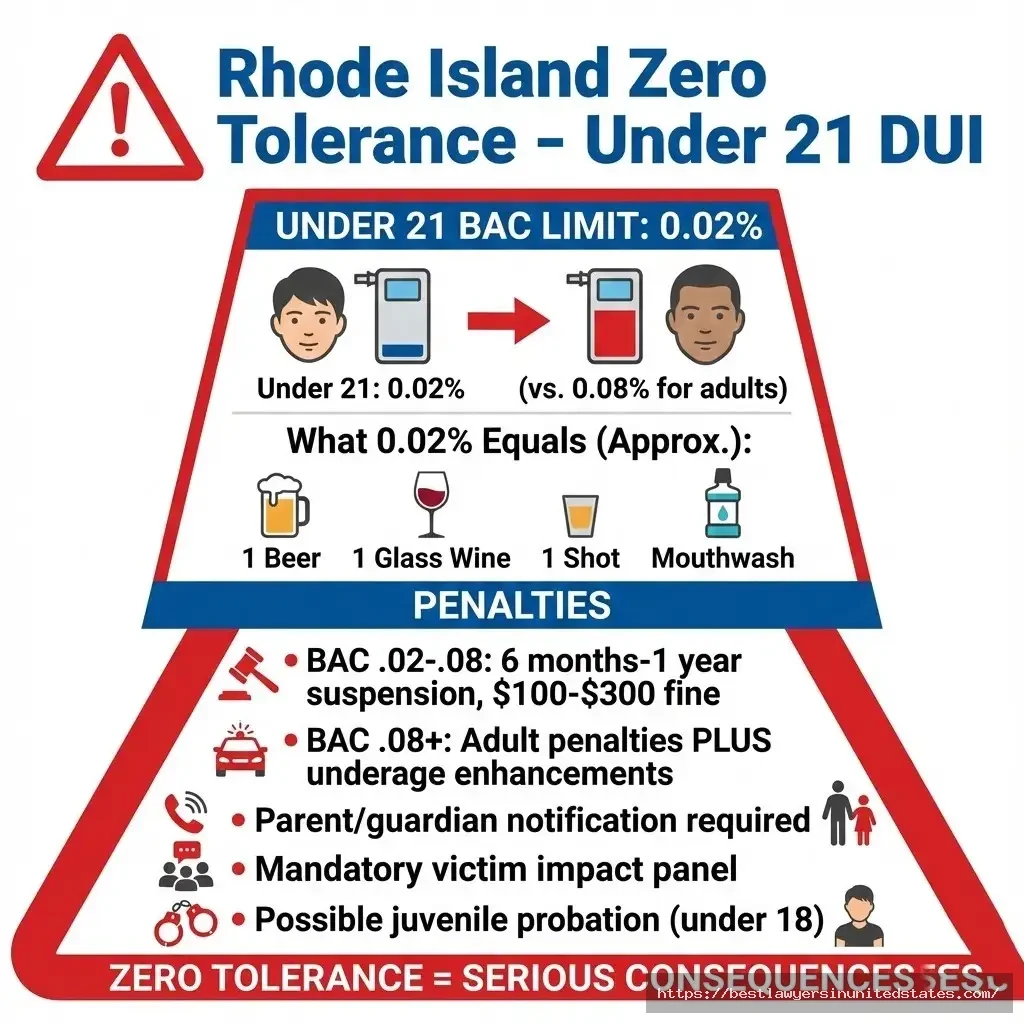
Rhode Island enforces a zero-tolerance policy for drivers under 21. The legal BAC limit drops from .08% to .02% for underage drivers under § 31-27-2.2.
.02 BAC Limit for Minors
Quick Answer: Rhode Island prohibits anyone under 21 from driving with BAC of .02% or higher—that’s about one drink for most people.
How .02 compares:
- Standard adult limit: .08%
- Commercial drivers: .04%
- Under 21: .02%
What produces .02 BAC:
- One 12 oz beer
- One 5 oz glass of wine
- One shot of liquor
- Certain medications containing alcohol
- Mouthwash used within 15 minutes of driving
Determine your BAC level after drinking using our BAC calculator designed for Rhode Island’s specific limits.
Underage DUI Penalties
Rhode Island imposes harsher penalties on drivers under 21 compared to adults with similar BAC levels:
| BAC Level | License Suspension | Additional Penalties |
|---|---|---|
| .02-.08 | 6 months-1 year | $100-$300 fine, community service |
| .08 or higher | 3-18 months | Adult penalties PLUS underage enhancements |
Enhanced penalties for underage offenders:
- Mandatory parent/guardian notification
- Required attendance at victim impact panel
- Juvenile probation (for drivers under 18)
- Possible vehicle impoundment
- Delayed license eligibility (drivers under 18)
Social Host Liability
Rhode Island § 3-8-6 holds adults criminally liable for providing alcohol to minors:
If you’re under 21 and caught driving after drinking at an adult’s property:
- You face DUI charges
- The adult who provided alcohol faces separate criminal charges
- Adult can be fined up to $1,000
- Adult may face 6 months jail time
This applies to:
- Parents who allow underage drinking parties
- Adults who purchase alcohol for minors
- Homeowners who permit underage drinking on their property
Underage DUI Process Differences
Drivers under 18 face juvenile court proceedings instead of Traffic Tribunal:
Rhode Island Family Court handles:
- All DUI cases for drivers under 18
- Sealed records (not public like adult convictions)
- Focus on rehabilitation vs. punishment
- Possible dismissal after completing diversion programs
Family Court location: Rhode Island Family Court 1 Dorrance Plaza Providence, RI 02903 Phone: (401) 458-3290
Drivers 18-20: Tried in Traffic Tribunal like adults but face enhanced penalties.
Long-Term Consequences for Underage DUI
College applications:
- Private universities often require disclosure
- Some schools deny admission for DUI convictions
- Athletic scholarships may be revoked
Job prospects:
- Background checks reveal conviction
- Employers in transportation, healthcare, education may reject applicants
- Military enlistment more difficult
Future license suspension:
- Any subsequent DUI (even years later) counts as second offense
- No “clean slate” at age 21
Underage DUI Defense Options
Common defenses for under-21 DUI:
- Mouth alcohol from recent use of mouthwash or breath spray
- Rising BAC (below .02 when driving, above .02 when tested)
- Improper stop (officer lacked reasonable suspicion)
- Faulty breathalyzer calibration
- Medical conditions affecting test results
Diversion programs: Rhode Island offers first-time underage offenders diversion programs that can result in charge dismissal:
Eligibility requirements:
- First offense only
- BAC under .10
- No accident or injuries
- Complete alcohol education program
- Perform community service
- Maintain clean record during probation
Successful completion: Charges dismissed, no conviction on record.
DUI Causing Injury or Death in Rhode Island
Rhode Island treats DUI cases involving injuries or fatalities as aggravated offenses with enhanced criminal penalties under § 31-27-2.3.
DUI with Serious Bodily Injury
Quick Answer: Causing serious bodily injury while driving drunk in Rhode Island results in felony charges with 1-10 years prison time, regardless of whether it’s your first offense.
“Serious bodily injury” definition:
- Permanent disfigurement
- Loss of bodily function
- Broken bones requiring surgery
- Brain injuries
- Internal organ damage
- Injuries requiring hospitalization
Penalties:
| Element | Consequence |
|---|---|
| Classification | Felony |
| Prison time | 1-10 years mandatory |
| Fine | Up to $10,000 |
| License revocation | 3-5 years |
| Restitution | Victim medical costs (can exceed $100,000) |
No probation option: Rhode Island law requires actual prison time for DUI causing serious injury—judges cannot suspend the sentence.
DUI Causing Death (Vehicular Homicide)
DUI resulting in death elevates charges to vehicular homicide under § 31-27-2.4:
Penalties:
- Classification: Felony
- Prison: 5-20 years mandatory
- Fine: Up to $25,000
- License revocation: Lifetime (eligibility for reinstatement after 10 years)
- Restitution: Funeral costs, loss of income to family
- Civil liability: Wrongful death lawsuits (damages often $500,000+)
Multiple deaths: Rhode Island can charge separate counts for each victim, with consecutive sentences totaling 20-40+ years.
Enhanced Investigation Process
DUI cases involving injury or death trigger intensive investigations:
What happens:
- Rhode Island State Police Collision Reconstruction Team responds
- Crime scene fully documented with photographs, measurements
- Black box data extracted from vehicles
- Witness statements collected
- Blood drawn (warrant obtained if you refuse)
- Toxicology testing for alcohol and drugs
Timeline: Investigation can take 6-12 months before charges are filed, compared to 1-2 weeks for standard DUI.
Civil Liability in Addition to Criminal Charges
Criminal conviction doesn’t end legal consequences. Victims or their families typically file civil lawsuits:
Civil lawsuit damages can include:
- Medical expenses (past and future)
- Lost wages and earning capacity
- Pain and suffering
- Emotional distress
- Wrongful death damages
- Punitive damages (to punish drunk driving)
Insurance coverage limits: Most Rhode Island auto policies cover $25,000-$100,000 per person. If damages exceed policy limits, your personal assets are vulnerable to seizure.
Example: $50,000 insurance policy + $300,000 verdict = You personally owe $250,000, which can lead to wage garnishment, property liens, and bankruptcy.
Plea Bargaining Restrictions
Rhode Island prosecutors rarely offer plea bargains in DUI injury/death cases:
Typical prosecution approach:
- No reduction to lesser charges
- Prison time non-negotiable
- Trial often required
- Victim impact statements heavily influence sentencing
Defense focus: Challenge evidence, BAC results, causation (proving DUI caused the injury), and medical expert testimony.
Drug DUI in Rhode Island
Rhode Island prohibits driving under the influence of any drug that impairs your ability to operate a vehicle safely under § 31-27-2. This includes illegal drugs, prescription medications, and over-the-counter substances.
What Counts as Drug DUI
Prohibited substances:
- Illegal drugs: Marijuana, cocaine, heroin, methamphetamine, LSD, ecstasy
- Prescription medications: Opioids (OxyContin, Vicodin), benzodiazepines (Xanax, Valium), sleeping pills (Ambien), stimulants (Adderall)
- Over-the-counter drugs: Strong cold medicines, allergy medications causing drowsiness
Critical point: Having a valid prescription does NOT protect you from DUI charges if the medication impairs your driving.
How Police Detect Drug Impairment
Unlike alcohol’s standardized .08% BAC limit, Rhode Island has no specific drug concentration limits. Police use different methods to establish impairment:
Detection methods:
1. Drug Recognition Expert (DRE) Evaluation Rhode Island State Police employ certified DREs who conduct 12-step evaluations:
- Eye examination (pupil size, tracking)
- Vital signs (blood pressure, pulse, temperature)
- Divided attention tests
- Muscle tone examination
- Injection site inspection
2. Blood Testing
- Police obtain warrant for blood draw
- Lab tests for marijuana (THC), opioids, cocaine, benzodiazepines
- Results take 4-8 weeks
- Presence of drug metabolites doesn’t prove impairment at time of driving
3. Observed Behavior
- Erratic driving
- Confusion or disorientation
- Slurred speech
- Coordination problems
- Admission to drug use
Marijuana DUI in Rhode Island
Rhode Island legalized recreational marijuana in 2022, but driving under marijuana’s influence remains illegal:
Legal marijuana possession + Impaired driving = DUI charges
Challenges with marijuana DUI:
- No consensus on impairment level
- THC stays in blood for days/weeks after use
- Blood test showing THC doesn’t prove impairment while driving
- Field sobriety tests less reliable for marijuana
Penalties: Same as alcohol DUI (fines, jail time, license suspension based on BAC tier equivalency).
Defense strategy: Challenge whether THC detected in blood caused actual impairment at the time you were driving versus residual amounts from prior use.
Prescription Drug DUI Defenses
Common defenses for prescription medication DUI:
1. Proper usage defense
- Took medication exactly as prescribed
- No warning label about driving impairment
- Doctor didn’t warn about driving risks
2. Tolerance defense
- Long-term prescription use built tolerance
- Medication doesn’t impair you at prescribed doses
- Medical expert testimony supports tolerance claim
3. Medical necessity
- Medication required for legitimate medical condition
- No reasonable alternative treatment
- Benefits outweigh risks
Important: These defenses don’t automatically win cases but provide negotiating leverage with prosecutors.
Drug DUI Penalties
Rhode Island imposes the same penalty structure as alcohol DUI:
| Offense | Fine | Jail | Suspension |
|---|---|---|---|
| First | $100-$500 | Up to 1 year | 30 days-18 months |
| Second | $400+ | 10 days-1 year | 1-2 years |
| Third | Up to $5,000 | 1-3 years | 2-4 years |
Enhanced penalty factors:
- Multiple drugs detected
- Combination of drugs and alcohol
- Commercial driver
- Underage driver
- Accident with injuries
Refusing Blood Tests for Drug DUI
Rhode Island’s implied consent law applies to blood tests for drug detection:
If you refuse blood test:
- 6-12 month license suspension (first refusal)
- Police obtain warrant and draw blood anyway
- Refusal used as evidence against you
Warrant timeline: Rhode Island judges typically issue blood draw warrants within 1-2 hours via phone or email.
Medical staff perform draw: Certified phlebotomists or nurses draw blood at hospitals or police stations, not police officers.
Total Cost of a DUI in Rhode Island
A DUI conviction in Rhode Island costs far more than court fines. Total expenses typically range from $5,000 to $15,000+ for first-time offenders when you include all hidden costs.
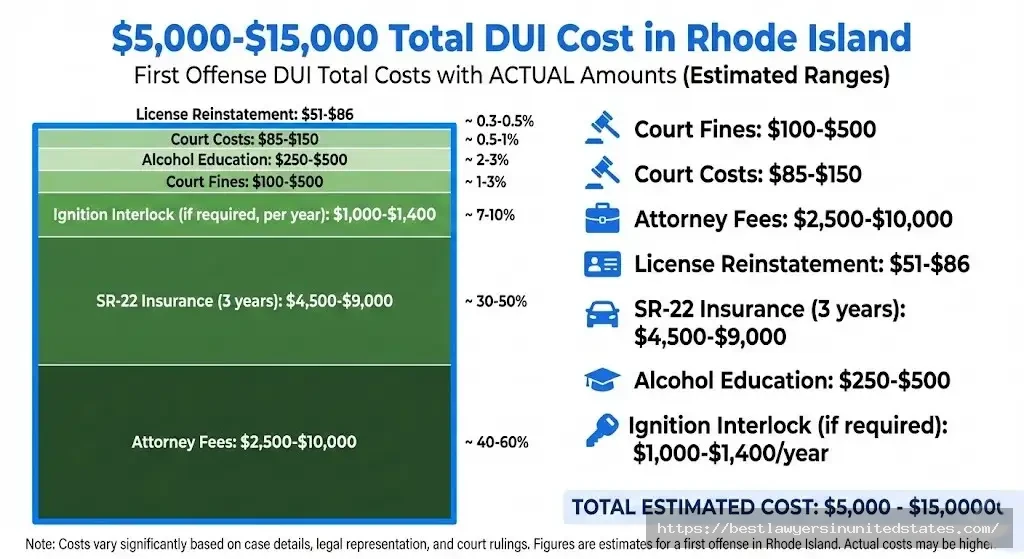
Use our DUI cost calculator to estimate your specific expenses based on your BAC level and circumstances.
Complete Cost Breakdown for First Offense
| Cost Category | Amount | Notes |
|---|---|---|
| Court fines | $100-$500 | Varies by BAC tier |
| Court costs | $85-$150 | Filing fees, administrative costs |
| Attorney fees | $2,500-$10,000 | Depends on case complexity |
| License reinstatement | $51-$86 | Rhode Island DMV fee |
| SR-22 insurance filing | $15-$25 | One-time fee through insurer |
| Insurance increase | $1,500-$3,000/year | 3-year requirement = $4,500-$9,000 total |
| Alcohol education program | $250-$500 | Highway Safety Assessment required |
| Victim impact panel | $50-$75 | One-time attendance fee |
| Ignition interlock | $0-$1,400/year | Required for .15+ BAC (installation + monitoring) |
| Towing/impound | $150-$400 | If vehicle towed after arrest |
| Bail bond | $0-$1,000 | 10% of bond amount if bail required |
| Lost wages | Varies | Court appearances, jail time, suspended license |
| TOTAL | $5,000-$15,000+ | First offense estimate |
Second Offense Costs
Second DUI convictions within 5 years increase expenses significantly:
Additional costs for second offense:
- Higher attorney fees: $5,000-$15,000 (more complex defense)
- Mandatory 10 days jail: Lost wages $1,000-$2,000
- Longer license suspension: Extended public transit/rideshare costs
- Longer ignition interlock: 1-2 years = $1,000-$2,800
- Higher insurance increases: 100-300% premium increase for 3 years
Second offense total: $10,000-$25,000+
Third Offense (Felony) Costs
Felony DUI convictions create lifetime financial consequences:
| Cost Type | Amount |
|---|---|
| Attorney fees | $10,000-$30,000+ |
| Court fines | Up to $5,000 |
| Prison costs | Lost income during 1-3 year sentence |
| License revocation | $500-$2,000 to reinstate + retest |
| Ignition interlock | $2,000-$5,600 (2-4 years) |
| Career impact | Lifetime reduced earning potential |
| Total | $20,000-$50,000+ |
Hidden Costs Most People Miss
Employment impact:
- Professional license suspension (doctors, nurses, lawyers, teachers)
- Security clearance loss
- Commercial driver’s license (CDL) loss = career change required
- Background checks prevent hiring for many positions
Personal costs:
- Divorce/relationship strain
- Child custody complications
- Housing applications denied (felony record)
- Student loan eligibility affected
- Travel restrictions (some countries deny entry with DUI)
Long-term insurance costs: Rhode Island requires SR-22 high-risk insurance for 3 years:
Average annual insurance increase:
- Before DUI: $1,200/year
- After DUI: $2,700-$4,200/year
- 3-year total increase: $4,500-$9,000
Compare this to neighboring states like Massachusetts where insurance increases often exceed Rhode Island’s rates.
Payment Plans and Financial Assistance
Court fines: Rhode Island courts offer payment plans for fines:
- Apply at sentencing hearing
- Monthly payments over 6-12 months
- Late payment fees apply
- Failure to pay can result in license re-suspension
Attorney fees: Most Rhode Island DUI lawyers offer:
- Free initial consultation
- Payment plans with down payment
- Credit card payments
- Some accept personal loans
No government assistance: Rhode Island provides no financial aid for DUI costs, including:
- No public defender for misdemeanor DUI (only felonies)
- No ignition interlock subsidies
- No insurance premium assistance
How to Minimize DUI Costs
Strategies to reduce expenses:
1. Hire an experienced attorney
- May get charges reduced to reckless driving
- Avoid conviction = no insurance increase
- Negotiate lower fines and reduced suspension
2. Complete programs early
- Early completion shows court commitment
- May reduce suspension period
- Demonstrates rehabilitation
3. Request hardship license
- Reduces rideshare/taxi costs
- Maintain employment = no lost wages
- $86 total cost vs. thousands in alternative transportation
4. Shop SR-22 insurance
- Compare quotes from multiple insurers
- Some specialize in high-risk drivers
- Rates vary significantly ($2,000-$4,500/year difference)
5. Avoid violations during probation
- Any additional violations extend costs
- Perfect record may allow early probation termination
How Long Does a DUI Stay on Your Record in Rhode Island?
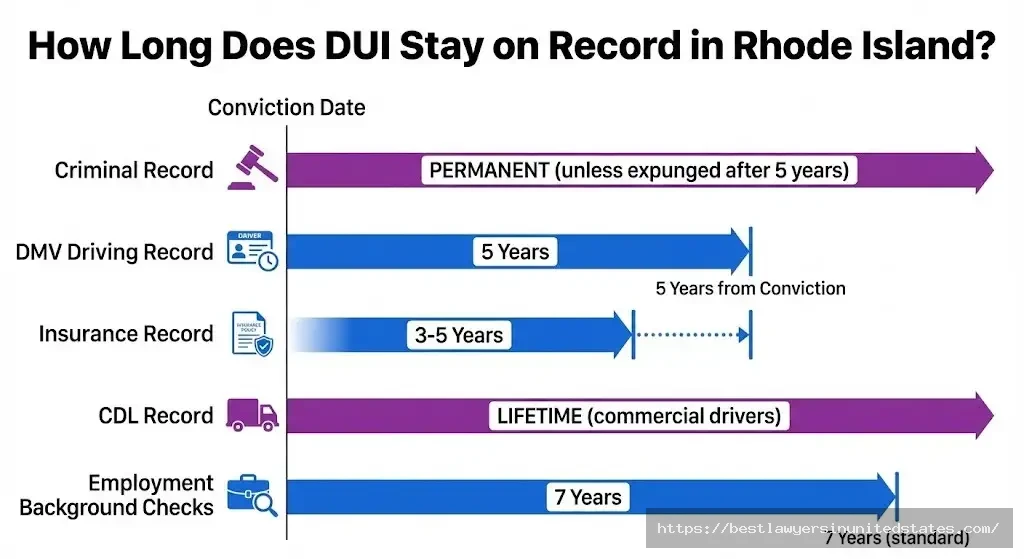
DUI convictions remain on different records for varying lengths of time in Rhode Island. Understanding these timelines helps you plan for employment, housing applications, and future legal matters.
Criminal Record Duration
Quick Answer: DUI convictions remain on your Rhode Island criminal record permanently unless you successfully petition for expungement.
What “permanent” means:
- Background checks show DUI conviction indefinitely
- Employers can see conviction years later
- Professional licensing boards have access
- Court records remain public
Exception: First-time offenders may qualify for expungement 5 years after completing all sentencing requirements (discussed in next section).
Driving Record Duration
Rhode Island DMV maintains DUI convictions on your driving record for different periods:
| Record Type | Duration |
|---|---|
| DMV driving record | 5 years from conviction date |
| Commercial driver (CDL) | Lifetime (never removed) |
| Out-of-state reporting | Permanent through interstate compact |
After 5 years: DUI no longer appears on standard Rhode Island driving record abstracts, but remains accessible to law enforcement and courts.
Commercial drivers: CDL holders never clear DUI from their record—one conviction permanently affects CDL eligibility.
Insurance Record Duration
Auto insurance companies maintain their own records separate from DMV:
Insurance company databases:
- Monitor driving record for 3-5 years
- Some companies check 7 years back
- DUI affects rates for 3-5 years typically
- Shopping for new insurer doesn’t erase DUI
When rates return to normal: Most Rhode Island drivers see insurance rates normalize 3-5 years after conviction, assuming no additional violations.
Comparison: States like California use 10-year DUI lookback periods, making Rhode Island’s 5-year period relatively short.
Background Check Implications
Employment background checks:
- Standard 7-year background checks show DUI
- Some industries check entire criminal history (transportation, healthcare, education, finance)
- Federal jobs check lifetime records
- Dismissed charges don’t appear, only convictions
Housing applications:
- Landlords typically check 3-7 years
- DUI alone rarely disqualifies applicants
- Multiple DUIs or recent convictions raise concerns
Professional licenses: Most Rhode Island professional licensing boards ask about criminal convictions:
- Medical licenses (physicians, nurses)
- Legal licenses (attorneys)
- Teaching licenses
- Real estate licenses
- Financial advisor licenses
Reporting requirement: You must typically report DUI convictions when applying or renewing professional licenses, even if expunged in some cases.
Interstate Reporting
Rhode Island participates in the Interstate Driver’s License Compact:
What this means:
- Rhode Island reports your DUI to your home state (if you have out-of-state license)
- Other states report DUI convictions to Rhode Island
- Moving to a new state doesn’t erase DUI from record
- Future DUI in another state counts as second offense if within 5 years
How Second Offenses Are Counted
Rhode Island uses a 5-year lookback period to determine if a DUI counts as a second offense:
Scenario 1: First DUI in 2021, second DUI in 2025
- Within 5-year window
- Charged as second offense
- Enhanced penalties apply
Scenario 2: First DUI in 2019, second DUI in 2025
- Outside 5-year window
- Charged as first offense
- Standard penalties apply
Important: The 5-year period runs from conviction date to new arrest date, not from arrest to arrest.
Record vs. Conviction vs. Arrest
Arrest record: Permanent
- Even if charges are dismissed
- Shows you were arrested for DUI
- Visible in law enforcement databases
Conviction record: Permanent unless expunged
- Only appears if you’re found guilty or plead guilty/nolo contendere
- Civil traffic convictions in Traffic Tribunal
- Criminal convictions in District Court
Dismissed cases: Don’t create conviction records
- Arrest record remains
- Should not affect most employment
- Can petition for arrest record sealing
DUI Expungement in Rhode Island
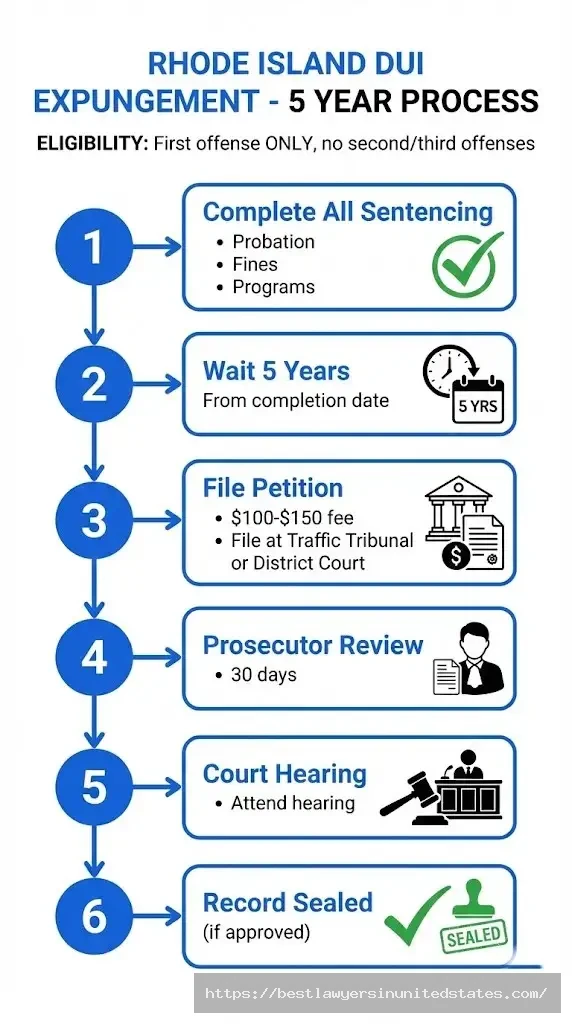
Rhode Island allows first-time DUI offenders to expunge their conviction under § 12-1.3-2, removing it from public criminal records. Expungement eligibility requires meeting strict criteria and completing a formal court process.
Eligibility Requirements
Quick Answer: You can expunge a first-offense DUI in Rhode Island 5 years after completing all sentencing requirements, including probation, fines, and programs.
Basic eligibility checklist:
- ✅ First DUI offense only (no prior or subsequent DUIs)
- ✅ Completed all court-ordered requirements
- ✅ Paid all fines, fees, and restitution
- ✅ Finished probation successfully
- ✅ 5 years passed since completion date
- ✅ No new criminal convictions during waiting period
Excluded from expungement:
- ❌ Second or subsequent DUI offenses
- ❌ DUI causing serious injury or death
- ❌ Commercial drivers seeking CDL expungement
- ❌ Convictions involving minor passengers
- ❌ Cases with pending charges
The 5-Year Waiting Period Explained
The clock starts ticking from your completion date, not conviction date:
Example timeline:
- January 2020: DUI conviction
- January 2020 – January 2021: Completed 1 year probation
- January 2021: All requirements finished (completion date)
- January 2026: Eligible for expungement (5 years after completion)
Common completion requirements:
- Jail time or community service finished
- All fines paid in full
- Alcohol education program completed
- License suspension served
- Ignition interlock period completed
- Probation successfully discharged
Expungement Process Step-by-Step
Step 1: Obtain court records
- Request certified copies of conviction from clerk
- Get proof of completion documents
- Collect certificates from completed programs
Step 2: File expungement petition
- File in the same court that convicted you (Traffic Tribunal or District Court)
- Complete “Petition for Expungement” form
- Pay $100-150 filing fee
- Submit supporting documents
Step 3: Notice to prosecution
- Court sends notice to Attorney General’s office
- Prosecutor has 30 days to object
- Most first-offense DUI expungements face no opposition
Step 4: Court hearing
- Judge reviews petition and objections (if any)
- You may need to appear (attorney recommended)
- Judge weighs factors: rehabilitation, time passed, public interest
Step 5: Court decision
- Granted: Records sealed from public access
- Denied: Can refile after addressing judge’s concerns
Processing time: 2-4 months from filing to final decision.
Where to File Your Petition
If convicted in Traffic Tribunal: Rhode Island Traffic Tribunal 345 Harris Avenue Providence, RI 02909 Clerk’s Office: (401) 275-2181
If convicted in District Court: File in the specific District Court division that handled your case:
- Providence (Sixth Division): (401) 458-5400
- Warwick (Third Division): (401) 275-3500
- Newport (Second Division): (401) 841-8340
What Expungement Actually Does
Records sealed from public access:
- General public cannot find conviction
- Most employers cannot see conviction in background checks
- Landlords cannot access sealed records
- Civil courts cannot reference conviction
Records still accessible to:
- Law enforcement (police, FBI)
- Courts for sentencing on future crimes
- Licensing boards (medical, legal, teaching)
- Immigration authorities
- Some federal agencies
Critical limitation: Expungement does NOT:
- Restore professional licenses automatically
- Remove from DMV driving record (separate process)
- Guarantee employment or housing approval
- Prevent immigration consequences for non-citizens
Benefits of Expungement
Employment opportunities:
- Can legally answer “no” to “Have you been convicted of a crime?” on most job applications
- Background checks won’t show conviction
- Avoid automatic disqualification from positions
Professional licensing:
- Removes barrier for many licensed professions
- May still need to report to licensing boards (verify with specific board)
Housing applications:
- Landlords cannot see conviction in background checks
- Qualify for housing with strict tenant screening
Personal peace of mind:
- Fresh start without public conviction record
- Reduced stigma
Cost of Expungement
| Cost Item | Amount |
|---|---|
| Court filing fee | $100-$150 |
| Certified court records | $25-$50 |
| Attorney fees (optional) | $500-$2,000 |
| Background check | $20-$50 |
| Total (DIY) | $145-$250 |
| Total (with lawyer) | $645-$2,250 |
DIY vs. Attorney:
- Simple first-offense cases: DIY usually successful
- Cases with complications (multiple charges, objections): Attorney recommended
- Attorney increases approval chances and speeds process
What If Your Petition Is Denied?
Common denial reasons and solutions:
Reason 1: Incomplete waiting period
- Solution: Wait until 5 full years from completion date, refile
Reason 2: Outstanding fines or fees
- Solution: Pay all amounts owed, provide receipts, refile
Reason 3: New criminal convictions during waiting period
- Solution: Wait additional 5 years from new conviction completion, refile
Reason 4: Serious public safety concerns
- Solution: Demonstrate rehabilitation, gather character references, hire attorney to argue mitigating factors
Appeals: Denied petitions can be appealed to Rhode Island Superior Court within 30 days.
Expungement vs. Sealing vs. Pardon
Expungement: Removes conviction from public record (what this section describes)
Sealing: Similar to expungement, Rhode Island uses terms interchangeably for DUI cases
Pardon: Forgiveness from Governor
- Doesn’t remove conviction
- Simply pardons the offense
- Very rare for DUI cases
- Apply through Rhode Island Parole Board
For DUI cases: Expungement provides better practical benefits than pardons.
Rhode Island Open Container Laws
Rhode Island prohibits open containers of alcohol in vehicles under § 31-22-21. Many people search “is there an open container law in Rhode Island”—the answer is yes, with specific rules and exceptions.
What Rhode Island’s Open Container Law Prohibits
Quick Answer: Rhode Island makes it illegal to possess an open container of alcohol in the passenger area of a vehicle, whether you’re driving or parked.
Prohibited locations:
- ❌ Driver’s seat area
- ❌ Front passenger seat
- ❌ Rear passenger seats
- ❌ Any area readily accessible to driver or passengers
Legal storage locations:
- ✅ Trunk (if separate from passenger compartment)
- ✅ Locked glove compartment
- ✅ Area behind last upright seat (SUVs, vans without trunk)
- ✅ Living quarters of motorhome/RV
What Counts as an “Open Container”
Rhode Island defines open container as any alcoholic beverage container with:
- Broken seal
- Some contents removed
- Open lid or cap
- Missing original seal
Examples that violate law:
- Beer can with tab pulled
- Wine bottle with cork removed
- Liquor bottle with cap off
- Solo cup containing alcohol
- Flask (even if capped, if accessible)
Legal containers:
- Unopened beer 6-pack in trunk
- Sealed wine bottle in locked glove box
- Closed liquor bottle in original packaging in trunk
Open Container Penalties
| Violation | Fine | Points | Additional |
|---|---|---|---|
| First offense | $85-$500 | 0 | No license suspension |
| Subsequent offense | $200-$1,000 | 0 | Possible court appearance |
Important distinction: Open container violations are civil offenses, not criminal charges. They don’t create criminal records but remain on traffic violation history.
Additional consequences:
- Increased auto insurance rates (minor impact)
- Evidence used in DUI investigations
- Probable cause for DUI arrest if driver shows impairment
Open Container vs. DUI
Having an open container doesn’t automatically mean DUI, but creates probable cause for investigation:
Scenario 1: Passenger has open beer, driver sober
- Open container violation: Yes
- DUI charge: No (unless driver impaired)
- Penalty: $85-$500 fine
Scenario 2: Driver has open container and shows impairment signs
- Open container violation: Yes
- DUI investigation: Yes (field sobriety tests, breathalyzer)
- Penalty: DUI penalties + open container fine
Scenario 3: Passenger drinking, empty containers in car, driver over .08 BAC
- Open container violation: Yes
- DUI charge: Yes
- Penalty: Full DUI penalties (open container becomes evidence of drinking in vehicle)
Exceptions to Rhode Island Open Container Law
Legal exceptions:
1. Hired vehicles
- Limousines with partition between driver and passengers
- Party buses with licensed operators
- Ride-share services where driver is paid (passengers can drink, driver cannot)
2. Living quarters of motorhomes
- RV residents can have open containers in living area
- Not in driver/passenger seats while vehicle operates
3. Boats and watercraft
- Rhode Island marine laws permit open containers on boats (different from vehicle law)
- Boat operators still face BUI (boating under influence) laws
How Police Enforce Open Container Laws
Common enforcement scenarios:
Traffic stops:
- Officer sees open container during traffic stop
- Officer smells alcohol odor
- Visible beer cans, wine bottles in passenger area
- Passenger drinking while vehicle in motion
Sobriety checkpoints:
- Rhode Island State Police conduct periodic checkpoints
- Check for DUI and open containers
- Locations published in advance (typically I-95, Route 1, Route 6)
Parking lots:
- Tailgating at sporting events (TF Green parking lots, Gillette Stadium)
- Beach parking areas in summer
- Concert venue parking lots
Defense strategy: Challenge whether container was truly “open” or whether it was in a legal storage location (trunk, locked glove box).
Open Containers and Passengers
Who gets cited?
- Generally the person possessing the open container
- In some cases, all passengers can be cited
- Driver always cited even if passenger holds container
Passenger responsibility:
- Passengers can be fined for possessing open containers
- Cannot legally hand open container to driver
- Should store alcohol in trunk before entering vehicle
Example: Four passengers in car, two have open beers. All four can receive open container citations ($85-$500 each), even though only two possessed containers.
Avoiding Open Container Violations
Best practices:
1. Before driving:
- Store all alcohol in trunk
- Ensure all bottles/cans are sealed
- Use locked compartments if no trunk available
2. After purchasing alcohol:
- Request store bag seal
- Keep receipt showing recent purchase
- Place in trunk immediately
3. Tailgating/events:
- Finish all drinks before entering vehicle
- Dispose of containers in trash
- Check entire vehicle for forgotten containers
4. Designated driver situations:
- DD should not have any containers in reach
- All alcohol stored in trunk
- Empty any open containers before driving
Finding a DUI Lawyer in Rhode Island
Hiring an experienced DUI attorney significantly improves your chances of reduced charges, lesser penalties, or case dismissal. Rhode Island DUI cases involve complex procedures across multiple courts and agencies.
When to Hire a DUI Attorney
Quick Answer: Contact a DUI lawyer immediately after arrest—within 24 hours if possible to preserve evidence and meet critical deadlines.
Critical early deadlines:
- 6 days: Request DMV administrative hearing
- 10-15 days: Arraignment date
- 30 days: Temporary license expires
Attorney helps with:
- Request DMV hearing before 6-day deadline
- Preserve evidence (police video, witness statements)
- Challenge traffic stop legality
- Negotiate with prosecutors for reduced charges
- Represent you at DMV hearing and court proceedings
What to Look for in Rhode Island DUI Lawyers
Experience factors:
- Years practicing DUI law in Rhode Island
- Familiarity with Rhode Island Traffic Tribunal procedures
- Relationships with local prosecutors
- Success rate with cases similar to yours
- NHTSA field sobriety test training
- Trial experience if case goes to hearing
Questions to ask during consultation:
- How many DUI cases have you handled in Rhode Island?
- What percentage of your practice is DUI defense?
- Have you handled cases in [your specific court/jurisdiction]?
- What’s your typical strategy for [your BAC level] cases?
- Do you have relationships with local prosecutors?
- Will you personally handle my case or pass to junior attorney?
Rhode Island DUI Attorney Costs
| Service Level | Typical Cost | What’s Included |
|---|---|---|
| Basic representation | $2,500-$5,000 | Arraignment, plea negotiation, court appearances |
| Standard defense | $5,000-$10,000 | Above + DMV hearing, trial preparation, investigation |
| Complex cases | $10,000-$15,000+ | Multiple charges, prior offenses, accident cases |
| Felony DUI | $15,000-$30,000+ | Serious injury/death, extensive investigation, trial |
Payment options:
- Flat fee (most common for standard DUI)
- Hourly rate ($200-$400/hour)
- Payment plans (most attorneys offer installments)
- Retainer + additional fees for trial
What’s typically NOT included:
- Court fines and fees
- Expert witness costs ($2,000-$5,000 if needed)
- Investigator fees
- Appeal costs
Free Consultation Options
Most Rhode Island DUI attorneys offer free initial consultations:
What free consultation includes:
- Case evaluation (15-30 minutes)
- Assessment of strengths/weaknesses
- Explanation of potential outcomes
- Fee discussion
- No obligation to hire
Come prepared with:
- Copy of citation/arrest paperwork
- Police report (if available)
- Temporary license
- List of questions
- Timeline of events written down
Public Defender Availability
Rhode Island public defenders handle only felony DUI cases (third offense or DUI causing injury/death):
Public defender eligibility:
- Must prove financial hardship
- Income below federal poverty guidelines
- No significant assets
- Application required at arraignment
Misdemeanor DUI: No public defender available—you must hire private attorney or represent yourself.
DIY vs. Hiring an Attorney
Self-representation risks:
- Unfamiliar with Traffic Tribunal procedures
- Miss technical defenses
- Prosecutors offer worse deals to self-represented defendants
- Higher conviction rates
- Harsher sentences
When DIY might work:
- First offense with low BAC (.08-.10)
- No accident or injuries
- Clear-cut case with no defense
- Willing to accept standard plea offer
- Cannot afford attorney
When attorney is essential:
- BAC over .15 (enhanced penalties)
- Second or subsequent offense
- Accident with injuries
- Commercial driver at risk of losing CDL
- Professional license at stake
- Possible defenses exist
Finding DUI Lawyers in Rhode Island
Rhode Island Bar Association Lawyer Referral Service: Phone: (401) 421-7758 Website: ribar.com
- Free referral to DUI attorneys
- Initial consultation often discounted
Online attorney directories:
- Avvo.com (ratings and reviews)
- Lawyers.com
- Martindale-Hubbell
- State Bar websites
Local recommendations:
- Ask friends/family who’ve hired DUI lawyers
- Read Google reviews for local attorneys
- Check Rhode Island Traffic Tribunal for active practitioners
Email for DUI lawyer referrals: [email protected]
Red Flags to Avoid
Warning signs of poor attorneys:
- ❌ Guarantee specific outcomes
- ❌ Request large upfront payments with no payment plan
- ❌ Never handled DUI cases in Rhode Island
- ❌ Poor communication (don’t return calls)
- ❌ Pressure to hire immediately without consultation
- ❌ No clear fee agreement in writing
Green flags for good attorneys:
- ✅ Upfront about realistic outcomes
- ✅ Written fee agreement
- ✅ Responsive to calls/emails
- ✅ Experienced in Rhode Island courts
- ✅ Willing to explain process clearly
- ✅ Professional office and staff
Rhode Island DUI Defense Strategies
Experienced Rhode Island DUI attorneys use various defense strategies depending on your case specifics. Understanding common defenses helps you evaluate your options and work effectively with your lawyer.
Challenging the Traffic Stop
Rhode Island law requires police to have reasonable suspicion to stop your vehicle. Without legal justification, all evidence from the stop gets suppressed.
Common invalid stop reasons:
- Random traffic enforcement without observed violation
- “Anonymous tip” without officer corroboration
- Racial profiling or pretextual stops
- Expired registration/inspection more than 1 year old
- Following too closely without clear observation
Valid stop reasons:
- Observed traffic violation (speeding, failure to signal, running red light)
- Equipment violation (broken taillight, headlight out)
- Erratic driving (weaving, sudden stops)
- Anonymous tip corroborated by officer observation
Defense strategy: Attorney obtains police dashcam video and challenges whether officer had legal basis for the stop. If stop was illegal, judge suppresses all evidence (breathalyzer results, field sobriety tests, observations).
Attacking Field Sobriety Test Results
Rhode Island police use standardized field sobriety tests, but many factors besides alcohol affect performance:
Horizontal Gaze Nystagmus (HGN) challenges:
- Officer lacks proper training/certification
- Medical conditions (inner ear problems, eye conditions)
- Neurological disorders
- Prescription medications
- Improper administration (wrong speed, angle, lighting)
Walk-and-Turn Test challenges:
- Uneven road surface
- Poor weather conditions (rain, ice, wind)
- Improper footwear (high heels, boots)
- Physical limitations (injuries, age, weight)
- Inadequate instructions from officer
- Poor lighting at night
One-Leg Stand Test challenges:
- Balance issues unrelated to alcohol
- Age over 65
- Weight over 250 pounds
- Previous leg/knee/ankle injuries
- Uneven surface
- Medical conditions affecting balance
Expert testimony: DUI attorneys often hire experts to testify that field sobriety tests are unreliable under the conditions of your stop.
Challenging Breathalyzer Results
Rhode Island breathalyzer results can be challenged on multiple grounds:
Machine calibration issues:
- Device not calibrated within required 31-day window
- Calibration logs show errors
- Device has history of malfunctions
- Missing calibration certificates
Operator error:
- Officer not properly certified to administer test
- Officer failed to observe you for required 20-minute period before testing
- Mouth alcohol from burping, vomiting, or recent drinking
- Test given too soon after arrest (BAC still rising)
Medical/biological defenses:
- Gastroesophageal reflux disease (GERD) causes falsely high readings
- Diabetes can produce acetone mistaken for alcohol
- Low-carb diets create ketones similar to alcohol
- Dentures or dental work trap alcohol
- Recent use of breath spray or mouthwash
Rising BAC defense:
- BAC below .08% while driving
- Continued absorption raises BAC by testing time
- Time gap between last drink and testing critical
- Expert testimony demonstrates rising BAC curve
Blood Test Challenges
Rhode Island blood tests face different challenges than breath tests:
Chain of custody issues:
- Blood sample not properly labeled
- Gaps in documentation showing who handled sample
- Improper storage temperature
- Contamination during storage or transport
Collection procedure violations:
- Non-certified person drew blood
- Improper cleaning of puncture site (alcohol swab can contaminate sample)
- Wrong preservatives used in vial
- Sample taken too long after arrest
Lab analysis problems:
- Lab not properly accredited
- Testing equipment not calibrated
- Lab technician not certified
- Irregular lab procedures
Independent testing: Rhode Island allows defendants to request independent blood analysis. Your attorney can send sample to private lab and challenge state’s results.
Reasonable Doubt Defense
Even without attacking specific evidence, attorneys create reasonable doubt:
Factors that create doubt:
- No observed erratic driving before stop
- You performed field sobriety tests well
- Polite cooperation with police
- Clear speech and coherent answers
- BAC barely over .08% (margin of error considerations)
- No accident or danger to public
- Officer testimony inconsistent with video evidence
Trial strategy: Attorney highlights all evidence suggesting sobriety, questions officer’s observations, emphasizes gaps in prosecution’s case.
Necessity Defense
Rhode Island recognizes “necessity” as a defense in rare circumstances:
Requirements:
- Immediate emergency existed
- Reasonable belief DUI driving was necessary
- No reasonable alternative
- Harm avoided greater than law violation
Example: Driving drunk to get someone experiencing medical emergency to hospital when:
- 911 not available or delayed
- No sober drivers available
- Injury/death imminent without immediate action
Limitation: Extremely difficult defense to win. Courts rarely accept necessity claims for DUI.
Medical Condition Defenses
Certain medical conditions mimic impairment or affect test results:
Conditions affecting field sobriety tests:
- Inner ear disorders
- Neurological conditions (multiple sclerosis, Parkinson’s)
- Vision problems
- Arthritis or joint problems
- Previous injuries
Conditions affecting breath tests:
- GERD or acid reflux
- Diabetes (ketoacidosis)
- Hypoglycemia
- Dental work or dentures
Defense approach: Medical expert testifies that condition, not alcohol, caused test failures or high BAC readings.
Frequently Asked Questions About Rhode Island DUI Laws
What is the legal BAC limit in Rhode Island?
Quick Answer: The legal Blood Alcohol Content limit in Rhode Island is .08% for drivers 21 and over, .04% for commercial drivers, and .02% for drivers under 21.
Rhode Island § 31-27-2 sets these limits. Police can arrest you for DUI even below .08% if they observe impaired driving behavior. Your BAC determines which penalty tier applies for sentencing.
How much does a first offense DUI cost in Rhode Island?
Quick Answer: A first offense DUI in Rhode Island typically costs $5,000-$15,000 total, including court fines ($100-$500), attorney fees ($2,500-$10,000), license reinstatement ($51-$86), insurance increases ($1,500-$3,000/year for 3 years), and alcohol education programs ($250-$500).
Higher BAC levels (.15+) increase costs due to mandatory ignition interlock devices ($1,000-$1,400/year). Second and third offenses cost significantly more due to longer jail time, extended license suspensions, and higher attorney fees.
Can I refuse a breathalyzer test in Rhode Island?
Quick Answer: You can legally refuse a breathalyzer test in Rhode Island, but refusal triggers automatic license suspension of 6-12 months for first refusal, which is harsher than the 3-6 month suspension for failing the test.
Rhode Island’s implied consent law (§ 31-27-2.1) means accepting your license means agreeing to chemical testing when lawfully arrested. Refusal also provides evidence prosecutors can use against you at trial, and juries typically view refusal negatively.
How long is my license suspended for a DUI in Rhode Island?
Quick Answer: Rhode Island license suspension periods vary by offense and BAC level: first offense with BAC .08-.10 = 30-180 days, BAC .10-.15 = 3-18 months, BAC .15+ = 3-18 months; second offense = 1-2 years; third offense = 2-4 years.
Chemical test refusal adds separate administrative suspension: 6-12 months for first refusal, 2 years for second refusal. You may qualify for hardship license after serving minimum suspension period (typically 30 days for first offense).
Do I need a lawyer for a first offense DUI in Rhode Island?
Quick Answer: While not legally required, hiring a DUI lawyer significantly improves outcomes for first-offense cases in Rhode Island. Attorneys typically reduce charges, lower penalties, or get cases dismissed in 40-60% of first-offense cases.
Lawyers help with critical 6-day DMV hearing deadline, negotiate with prosecutors for reduced charges (often to reckless driving), challenge evidence, and navigate Rhode Island Traffic Tribunal procedures. Attorney costs ($2,500-$10,000) often save more money through reduced penalties and avoided insurance increases.
Can I get a hardship license in Rhode Island?
Quick Answer: Yes, Rhode Island offers hardship licenses for work, medical appointments, education, and court-ordered programs after serving minimum suspension periods—typically 30 days for first offense, 6 months for second offense.
Apply through Rhode Island DMV with proof of hardship (employer letter), SR-22 insurance, and $86 in fees. Hardship licenses restrict driving to approved purposes only during specific hours. Violations result in immediate revocation and extended suspension.
How long does a DUI stay on my record in Rhode Island?
Quick Answer: DUI convictions stay on your Rhode Island criminal record permanently unless expunged, but only appear on DMV driving records for 5 years. Insurance companies typically consider DUI for 3-5 years when setting rates.
First-time offenders can petition for expungement 5 years after completing all sentencing requirements. Commercial drivers never clear DUI from their CDL record. Background checks show DUI convictions indefinitely unless successfully expunged.
What is “BAC Unknown” in Rhode Island DUI law?
Quick Answer: “BAC Unknown” is a unique Rhode Island classification when blood alcohol content cannot be determined due to equipment malfunction, medical conditions preventing testing, contaminated samples, or improper test administration—different from voluntary chemical test refusal.
BAC Unknown cases face penalties similar to .10-.15 BAC tier (fines $100-$400, jail up to 1 year, license suspension 3-18 months). This classification often provides stronger defense opportunities than cases with documented BAC levels.
Does Rhode Island have an open container law?
Quick Answer: Yes, Rhode Island prohibits open alcohol containers in the passenger area of vehicles under § 31-22-21. Violations result in $85-$500 fines for first offense.
Legal storage includes trunk, locked glove compartment, or area behind last seat in vehicles without trunks. Open containers create probable cause for DUI investigation if driver shows impairment. Exceptions exist for hired vehicles (limousines, party buses) and RV living quarters.
Can I expunge a DUI from my record in Rhode Island?
Quick Answer: Yes, first-offense DUI convictions in Rhode Island can be expunged 5 years after completing all sentencing requirements (probation, fines, programs). Second and subsequent DUI offenses cannot be expunged.
File expungement petition with the court that convicted you (Traffic Tribunal or District Court), pay $100-$150 filing fee, and attend hearing. Successful expungement seals records from public access but remains visible to law enforcement, courts, and some licensing boards.
Conclusion: Understanding Rhode Island DUI Laws
Rhode Island’s four-tier BAC penalty system creates unique challenges for DUI defendants. First-time offenders with BAC between .08-.10 face relatively lenient penalties ($100-$300 fines, no jail time), while BAC .15+ triggers enhanced penalties including mandatory ignition interlock devices and potential jail time.
The state’s 5-year lookback period for repeat offenses is shorter than many states, but second convictions still carry mandatory 10-day jail sentences. Third offenses become felonies with 1-3 years prison time and lifetime consequences affecting employment, professional licenses, and housing.
Critical deadlines require immediate action after arrest: you have only 6 days to request a DMV administrative hearing to challenge license suspension. The separate administrative and criminal court processes mean you can lose your license even if criminal charges get dismissed.
Rhode Island’s implied consent law makes chemical test refusal costly—first refusal triggers 6-12 month suspension compared to 3-6 months for failing the test. The state’s “BAC Unknown” classification and specific Traffic Tribunal procedures create defense opportunities that experienced DUI attorneys can exploit.
Total DUI costs typically range $5,000-$15,000 for first offense when including attorney fees, insurance increases, and program costs. However, hiring an attorney often reduces these costs through negotiated plea agreements and reduced penalties.
First-time offenders should explore hardship licenses after 30 days, consider ignition interlock restricted licenses for more driving freedom, and research expungement eligibility after 5 years. Understanding Rhode Island’s unique DUI laws and acting quickly protects your driving privileges and minimizes long-term consequences.
Get legal help today: Email: [email protected]
