
Facing a DUI charge in Pennsylvania? You’re looking at a three-tier penalty system based on your blood alcohol content (BAC), with fines ranging from $300 to $10,000, potential jail time, and license suspensions up to 18 months. Pennsylvania’s DUI law (75 Pa.C.S. § 3802) divides offenses into General Impairment, High BAC, and Highest BAC categories—each carrying escalating consequences.
This guide breaks down Pennsylvania’s DUI penalties, the ARD program that could save your record, and the two-hour rule that affects every case. You’ll learn exactly what happens after arrest, how much a DUI really costs, and when hiring an attorney becomes essential.
Understanding Pennsylvania’s Three-Tier DUI System
Pennsylvania uses a unique three-tier grading system under 75 Pa.C.S. § 3802 that separates DUI offenses by BAC level and substance type. Unlike neighboring states like New Jersey or Ohio, Pennsylvania increases penalties dramatically as your BAC rises.
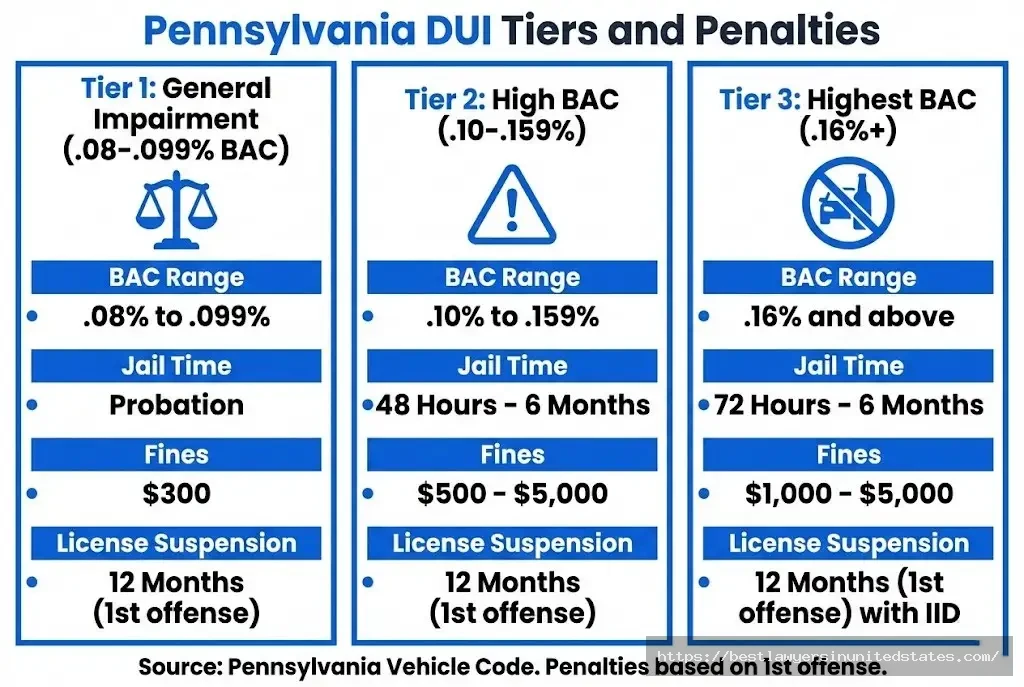
Tier 1: General Impairment
Tier 1 applies when you’re visibly impaired or have a BAC between .08% and .099%. Under 75 Pa.C.S. § 3802(a)(1) and (a)(2), first-time offenders often qualify for ARD and face no mandatory jail time. However, prosecutors can still prove impairment even without a specific BAC number through officer testimony about your driving behavior and field sobriety test performance.
Tier 2: High BAC
A BAC of .10% to .159% under 75 Pa.C.S. § 3802(b) pushes you into Tier 2. This tier also includes drivers under 21 with any detectable alcohol (.02% or higher) per § 3802(e), plus CDL holders at .04% or above and school bus drivers at .02% under § 3802(f). Penalties jump significantly—expect mandatory minimum jail time for second offenses.
Tier 3: Highest BAC
Tier 3 carries the harshest penalties. You’ll face these charges if your BAC hits .16% or higher (§ 3802(c)), if any controlled substance appears in your blood (§ 3802(d)), or if you refuse chemical testing. Refusing a breathalyzer automatically places you in Tier 3, regardless of your actual BAC.
Not sure where you stand? Use our BAC calculator to estimate your blood alcohol level based on drinks consumed, body weight, and time elapsed.
BAC Calculator
Estimate your Blood Alcohol Content
• Commercial Driver (CDL): 0.04% BAC
• Drivers Under 21: 0.00-0.02% BAC (Zero Tolerance)
• Enhanced Penalties: 0.15% BAC or higher in most states
Pennsylvania DUI Penalties Chart 2026
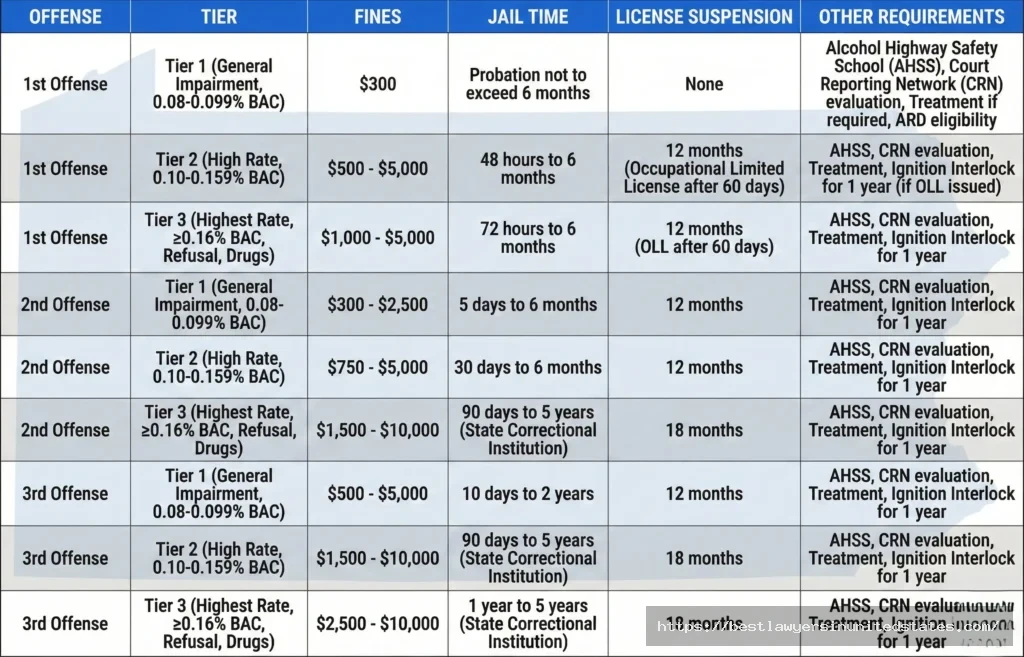
| Offense | Tier | Fines | Jail Time | License Suspension | Other Requirements |
|---|---|---|---|---|---|
| 1st Offense – Tier 1 | General Impairment | $300 | Probation | None (with ARD) | Alcohol Highway Safety School |
| 1st Offense – Tier 2 | High BAC | $500-$5,000 | 48 hours – 6 months | 12 months | Ignition interlock for restoration |
| 1st Offense – Tier 3 | Highest BAC | $1,000-$5,000 | 72 hours – 6 months | 12 months | Treatment, ignition interlock |
| 2nd Offense – Tier 1 | General Impairment | $300-$2,500 | 5 days – 6 months | 12 months | Treatment program |
| 2nd Offense – Tier 2 | High BAC | $750-$5,000 | 30 days – 6 months | 12 months | Ignition interlock 12 months |
| 2nd Offense – Tier 3 | Highest BAC | $1,500-$10,000 | 90 days – 5 years | 18 months | Ignition interlock 12 months |
| 3rd Offense – Tier 1 | General Impairment | $500-$5,000 | 10 days – 2 years | 18 months | Felony if certain conditions |
| 3rd Offense – Tier 2 | High BAC | $1,500-$10,000 | 90 days – 5 years | 18 months | Possible felony charge |
| 3rd Offense – Tier 3 | Highest BAC | $2,500-$10,000 | 1 year – 5 years | 18 months | Felony DUI charge |
Key deadline: You have 30 days to appeal your license suspension through PennDOT. Missing this window costs you your driving privileges immediately.
Will I Go to Jail for a First DUI in Pennsylvania?
Your jail time depends entirely on your BAC tier and whether you qualify for ARD.
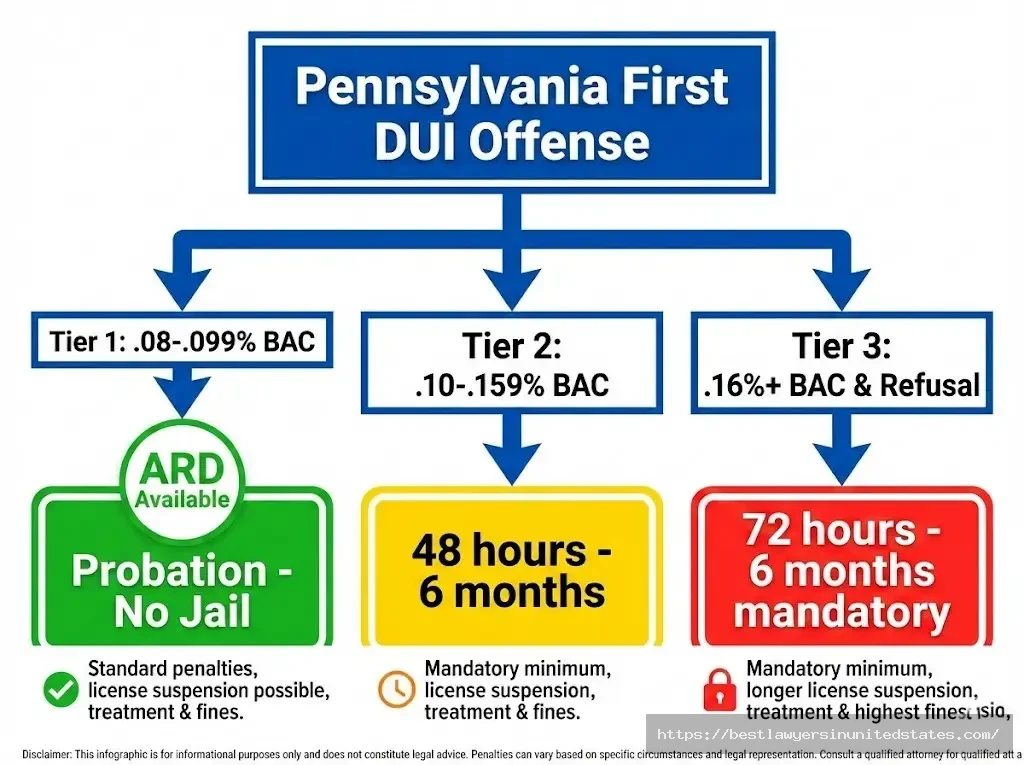
First Offense Tier 1 (General Impairment)
No mandatory jail time exists for Tier 1 first offenders. Most defendants receive probation instead. If accepted into ARD, you’ll complete community service and alcohol education classes while avoiding a criminal conviction entirely.
First Offense Tier 2 (High BAC)
Expect 48 hours to 6 months in jail for BAC between .10% and .159%. Judges can sentence you to house arrest or work release as alternatives to county jail. Your attorney can argue for the minimum 48-hour sentence if you have no prior record.
First Offense Tier 3 (Highest BAC or Refusal)
Mandatory minimum jail time starts at 72 hours for BAC of .16% or higher. Refusing the breathalyzer triggers the same 72-hour minimum. Maximum sentences reach 6 months for first-time Tier 3 offenses.
Jail alternative: Some Pennsylvania counties offer electronic home monitoring or weekend jail programs. Your attorney must request these options during sentencing negotiations.
The ARD Program: Pennsylvania’s Path to Expungement
Pennsylvania’s Accelerated Rehabilitative Disposition (ARD) program offers first-time DUI offenders a chance to avoid conviction. Successfully completing ARD lets you expunge the arrest from your record—a benefit unavailable in many neighboring states like Maryland or Delaware.
Who Qualifies for ARD?
You must meet these criteria:
- First DUI offense in Pennsylvania
- No prior ARD participation in past 10 years
- No injuries or property damage in the incident
- BAC under .16% (some counties accept higher BAC cases)
- District Attorney approval
County variation: Philadelphia, Montgomery, and Bucks County have different ARD acceptance standards. Philadelphia typically rejects cases with BAC over .20%, while some rural counties accept higher levels.
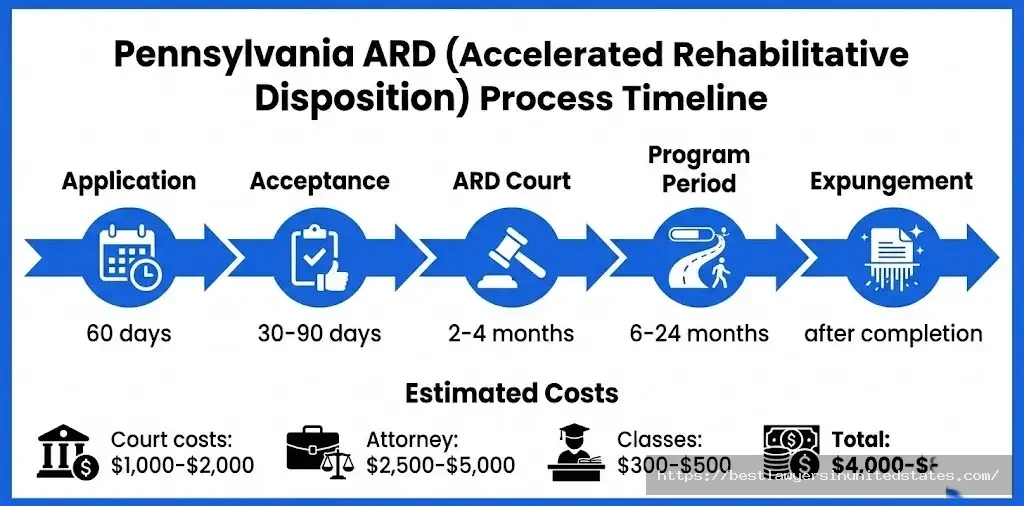
ARD Timeline and Process
| Step | Timeline | What Happens |
|---|---|---|
| Application | Within 60 days of arrest | Attorney submits ARD petition |
| Acceptance | 30-90 days | District Attorney approves/denies |
| ARD Court Date | 2-4 months | Judge formally accepts you into program |
| Program Length | 6-24 months | Complete all requirements |
| Completion | After program | Charges dismissed, eligible for expungement |
Critical deadline: You must request ARD before your preliminary hearing. Missing this window eliminates the option permanently.
ARD Costs and Requirements
ARD Program Expenses:
- Court costs: $1,000-$2,000
- Attorney fees: $2,500-$5,000
- CRN evaluation: $150-$300
- Drug/alcohol classes: $300-$500
- Victim impact panel: $50-$75
- Community service: 24-48 hours
- Monthly supervision: $50-$100
Total ARD cost: $4,000-$8,000 depending on county
You’ll need to:
- Complete alcohol highway safety school
- Pass CRN substance abuse evaluation
- Attend victim impact panel
- Perform community service hours
- Pay restitution (if applicable)
- Remain arrest-free during probation
License Suspension Under ARD
Your license suspension varies by tier:
- Tier 1 ARD: No suspension (if BAC under .10%)
- Tier 2 ARD: 30-day suspension
- Tier 3 ARD: 60-90 day suspension
After suspension, you’ll need ignition interlock for restoration in Tier 2 and 3 cases. Installation costs $100-$150, plus $75-$100 monthly monitoring fees.
Pennsylvania’s Implied Consent Law Explained
Driving in Pennsylvania means you automatically consent to chemical testing under 75 Pa.C.S. § 1547. Officers must read you the implied consent warning after arrest but before requesting a breath, blood, or urine test.
What Happens When You Refuse?
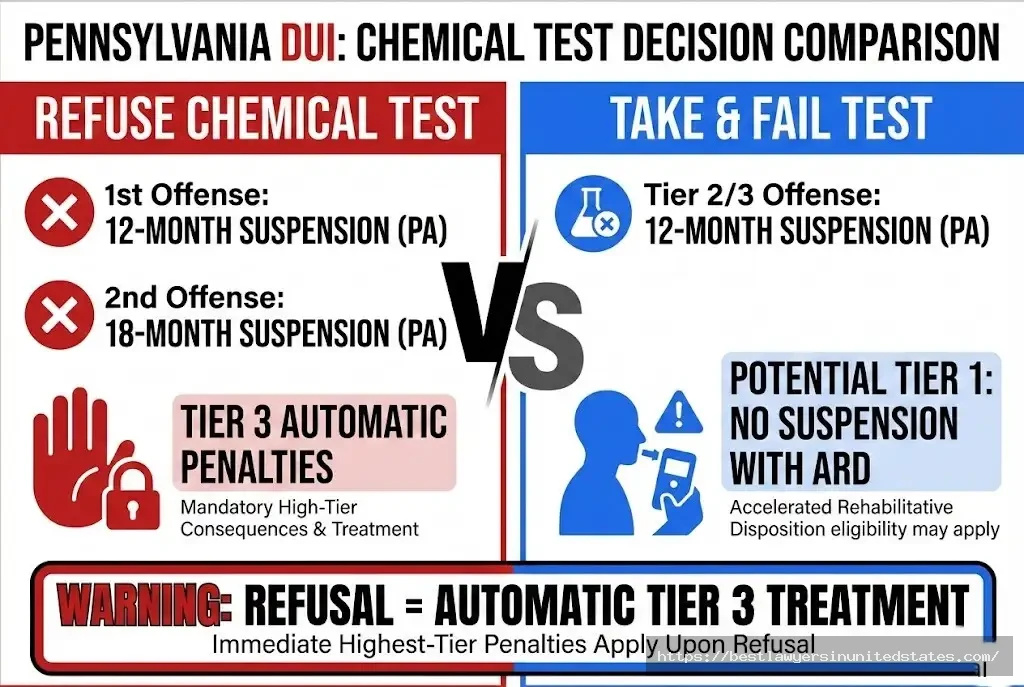
Refusal triggers automatic Tier 3 penalties even if you’re never convicted:
| Offense | Refusal Suspension | Test Failure Suspension |
|---|---|---|
| 1st refusal | 12 months | 12 months (Tier 2/3 only) |
| 2nd refusal | 18 months | 18 months |
| 3rd+ refusal | 18 months | 18 months |
Important distinction: Refusal places you in Tier 3 automatically. If you had actually blown under .10%, you would have faced Tier 1 or 2 penalties instead—a significantly better outcome.
Can Police Force You to Take a Test?
Officers cannot physically force you to blow into a breathalyzer without a warrant. However, Pennsylvania law allows warrants for blood draws in cases involving:
- Serious accidents with injuries
- Fatalities
- Minors in the vehicle
- Prior DUI convictions
Judges approve blood draw warrants within minutes via phone. If you refuse after a warrant, police will transport you to a hospital where medical staff will draw your blood. You’ll still face refusal penalties on top of DUI charges.
The Two-Hour Rule in Pennsylvania DUI Cases
Pennsylvania’s two-hour rule under 75 Pa.C.S. § 3802 requires testing within 2 hours of driving. Your BAC level from the test becomes legal evidence only if taken within this window.
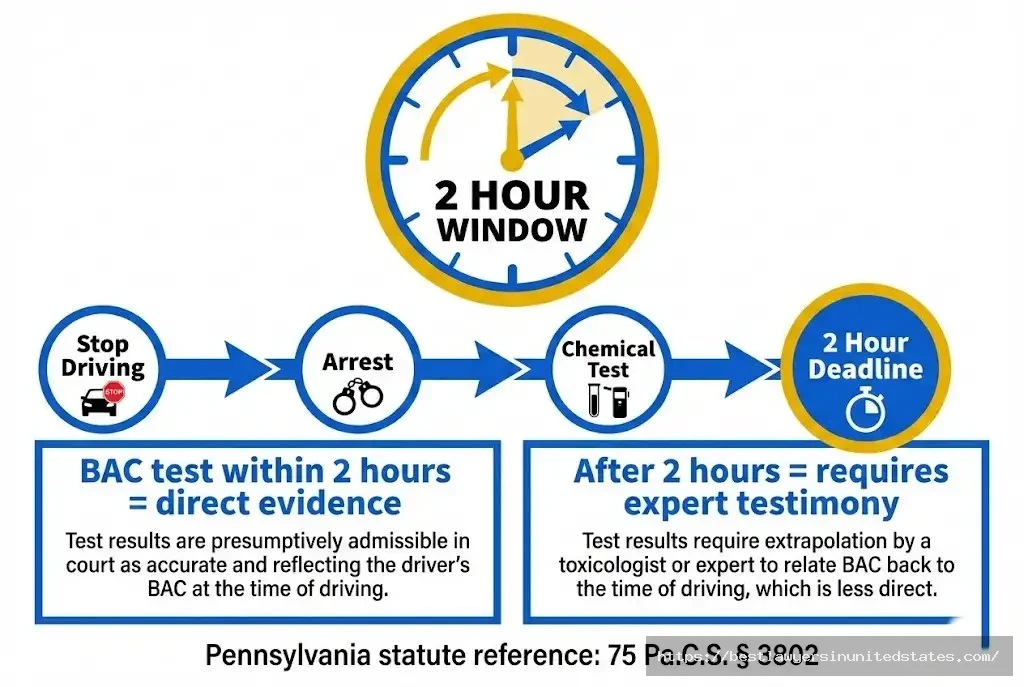
How prosecutors use it: If your BAC test occurs 90 minutes after you stopped driving, that result directly proves your BAC while driving. Tests taken after 2 hours require expert testimony to establish your BAC at the time of driving through retrograde extrapolation.
Defense opportunity: If police delayed your test beyond 2 hours without valid reason, your attorney can challenge BAC evidence admissibility. Common valid reasons include:
- Medical treatment for injuries
- Equipment malfunction at testing facility
- Officer needed warrant for blood draw
License Suspension and Restoration Process
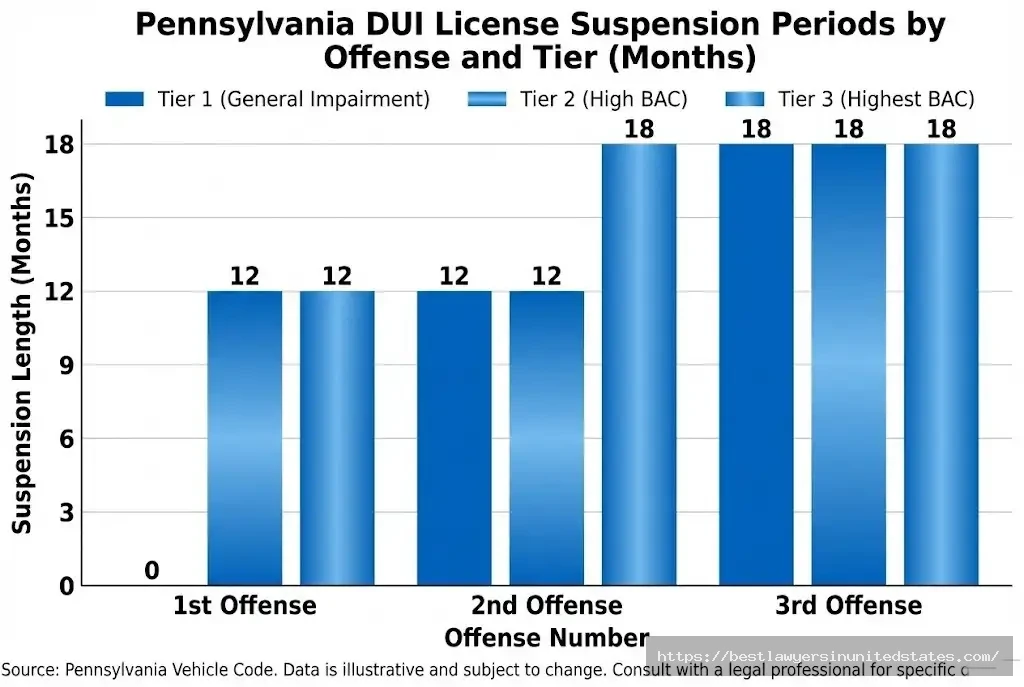
Pennsylvania imposes two separate license suspensions—administrative and criminal. You’ll serve whichever is longer, not both consecutively.
PennDOT Administrative Suspension
PennDOT suspends your license automatically after arrest:
| Tier | First Offense | Second Offense | Third Offense |
|---|---|---|---|
| Tier 1 | No suspension* | 12 months | 18 months |
| Tier 2 | 12 months | 12 months | 18 months |
| Tier 3 | 12 months | 18 months | 18 months |
*Tier 1 first offense receives no administrative suspension with ARD acceptance
Criminal Court Suspension
Judges impose additional suspensions upon conviction:
- Tier 1: 12 months (2nd offense), 18 months (3rd)
- Tier 2: 12-18 months depending on offense
- Tier 3: 12-18 months minimum
Five-Day Rule for License Appeals
You have 30 days to request an administrative hearing with PennDOT to challenge your suspension. However, the “five-day rule” gives you just 5 days to file certain time-sensitive appeals.
Critical deadline: Request your hearing in writing within 30 days or lose appeal rights permanently.
Getting an Occupational Limited License
Pennsylvania offers Occupational Limited Licenses (OLL) for work-related driving. You must:
- Complete required suspension period (varies by tier)
- Install ignition interlock device
- Maintain SR-22 insurance
- Pay $200 restoration fee
- Show employment verification
Ignition interlock period:
- First offense: 12 months minimum
- Second offense: 12 months minimum
- Third offense: 12 months minimum
Interlock installation costs $100-$150, plus $75-$100 monthly. Total one-year cost reaches $1,000-$1,350.
Special DUI Rules for CDL and Commercial Drivers
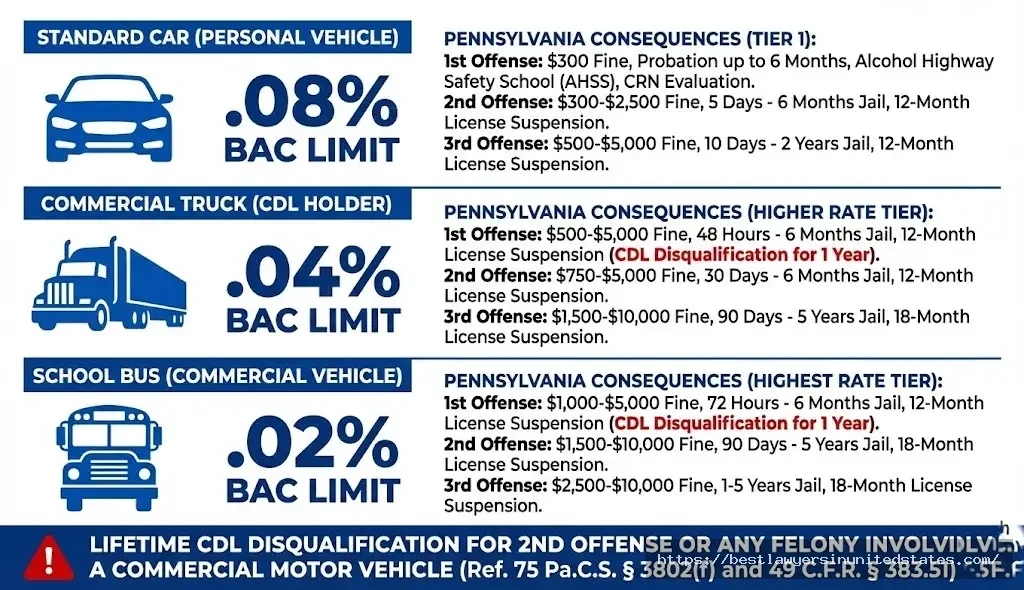
Commercial drivers face federal regulations on top of Pennsylvania state law under 75 Pa.C.S. § 3802(f).
Lower BAC Limits for CDL Holders
| License Type | BAC Limit |
|---|---|
| Standard driver (21+) | .08% |
| CDL holder (any vehicle) | .04% |
| School bus driver | .02% |
Career impact: A DUI conviction disqualifies CDL drivers from operating commercial vehicles for 1 year minimum. Second convictions mean lifetime disqualification from CDL driving.
Out-of-Service Orders
Pennsylvania immediately removes commercial drivers from the road:
- .04% BAC: Automatic out-of-service for 24 hours
- .08% BAC: Criminal charges plus CDL consequences
- Controlled substance: Immediate CDL disqualification
Even if you’re convicted only of a standard DUI while driving your personal vehicle, PennDOT still suspends your CDL. Many carriers terminate employment after any DUI arrest, regardless of conviction outcome.
Zero Tolerance: Pennsylvania DUI Laws for Minors
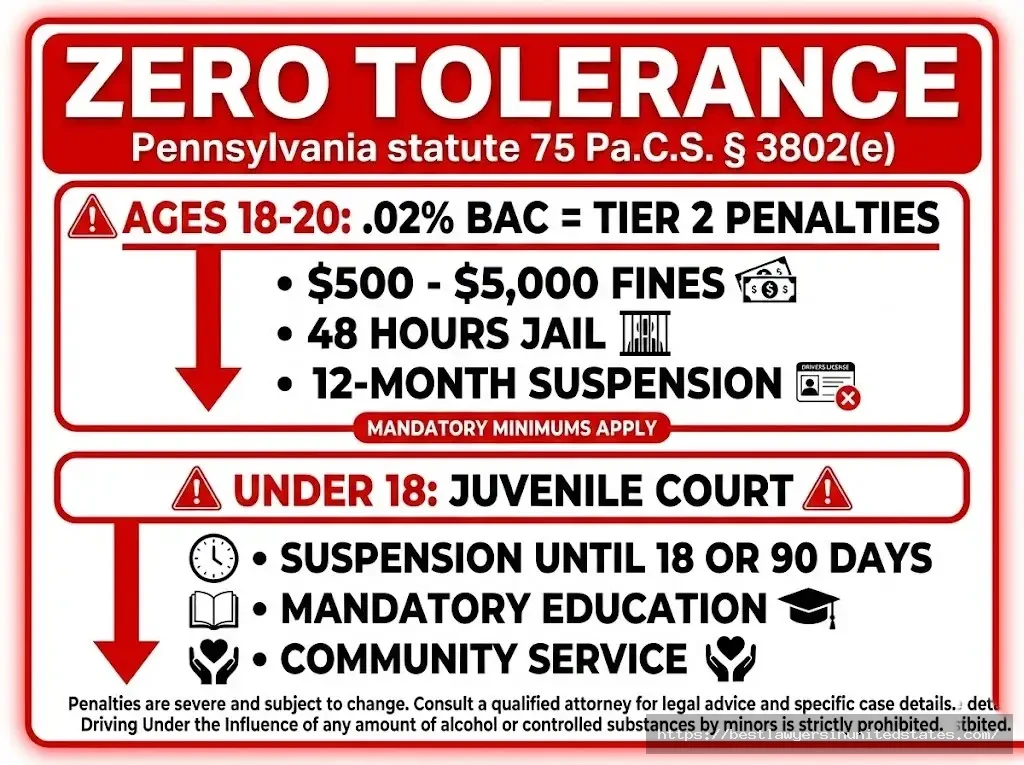
Pennsylvania enforces strict underage drinking and driving laws. Drivers under 21 face two separate charges.
Underage DUI (Ages 18-20)
Under 75 Pa.C.S. § 3802(e), drivers aged 18-20 with any BAC of .02% or higher face Tier 2 penalties:
- $500-$5,000 fine
- 48 hours to 6 months jail (first offense)
- 12-month license suspension
- Mandatory alcohol education
Key difference: One beer typically puts an 18-year-old over .02%. This is stricter than neighboring New York’s zero tolerance approach but less harsh than Ohio’s underage DUI penalties.
Minors Under 18
Drivers under 18 face juvenile court proceedings. Penalties include:
- License suspension until age 18 or 90 days minimum
- Mandatory alcohol education
- Community service
- Possible juvenile detention
- Parental notification
Pennsylvania also charges parents under social host liability if they provide alcohol to minors who then drive.
Medical Marijuana and Pennsylvania DUI Law
Pennsylvania legalized medical marijuana in 2016, but using it provides no DUI defense. Under 75 Pa.C.S. § 3802(d), any detectable amount of THC metabolites in your system constitutes Tier 3 DUI.
Active THC vs. Metabolites
Pennsylvania law makes no distinction between:
- Active THC (proves recent use and impairment)
- Inactive metabolites (remain in system for weeks after use)
Result: You can face Tier 3 DUI charges days or weeks after last marijuana use, even if you’re completely sober while driving. This differs from states like California that require proof of actual impairment.
Medical Marijuana Card Provides No Protection
Having a valid Pennsylvania medical marijuana card offers zero legal defense against DUI charges. Prosecutors need only prove:
- THC or metabolites present in blood
- You were operating a vehicle
Common scenario: Police arrest you for a traffic violation. You consent to blood testing. Lab finds THC metabolites from medical marijuana use 5 days earlier. You face Tier 3 DUI charges with $1,000-$5,000 fines and 72 hours to 6 months jail time.
The True Cost of a Pennsylvania DUI
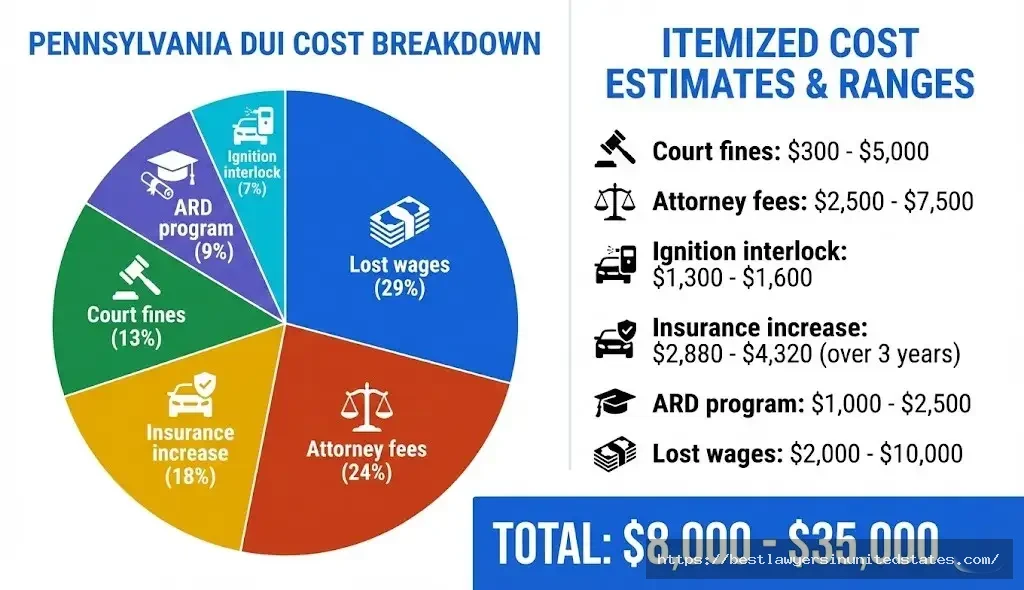
Pennsylvania DUI costs extend far beyond court fines. Here’s the complete financial breakdown.
Direct Legal Costs
| Expense Category | First Offense Cost | Second Offense Cost |
|---|---|---|
| Court fines | $300-$5,000 | $750-$10,000 |
| Court costs | $1,000-$2,000 | $1,500-$2,500 |
| Attorney fees | $2,500-$7,500 | $5,000-$15,000 |
| ARD program | $1,000-$2,500 | Not available |
| Bail bond | $500-$2,500 | $1,000-$5,000 |
License Restoration Costs
- PennDOT restoration fee: $200
- Ignition interlock installation: $100-$150
- Ignition interlock monthly: $75-$100 (12 months minimum)
- SR-22 insurance filing: $25-$50
- Total restoration: $1,300-$1,600
Insurance Rate Increases
Pennsylvania DUI convictions trigger SR-22 requirements for 3 years. Your insurance rates will increase by 80-120% on average:
Before DUI: $1,200/year average
After DUI: $2,160-$2,640/year
3-year increase: $2,880-$4,320
Indirect Costs
- Lost wages from jail/court: $2,000-$10,000
- Uber/taxi during suspension: $200-$500/month
- DUI education classes: $300-$500
- Victim impact panel: $50-$75
- CRN evaluation: $150-$300
- Employment consequences: Varies
Total First-Offense DUI Cost
Tier 1 (with ARD): $8,000-$15,000
Tier 2: $12,000-$25,000
Tier 3: $15,000-$35,000
Use our DUI cost calculator to estimate your specific situation based on tier, county, and employment status.
DUI Cost Calculator
Estimate total DUI expenses by state and offense
Detailed Cost Breakdown
Payment Timeline
Bail bond, towing fees, car impound, attorney retainer
Initial court fines, DMV fees, DUI school enrollment, ignition interlock installation
Monthly probation fees, ignition interlock fees, DUI school payments, attorney balance
Insurance premium increases, license reinstatement, SR-22 filing fees
- Lost wages from missed work (court dates, jail time, DUI school) – $2,000-$10,000
- Job loss or difficulty finding employment – Varies
- Professional license suspension (doctors, lawyers, nurses, pilots) – Career ending
- Rideshare and transportation costs during suspension – $1,500-$5,000
- Travel restrictions and visa denials – Varies
- Security clearance loss – Career impact
- Child custody implications – Legal costs
- Rental car restrictions – Varies
- Personal relationships and mental health costs – Priceless
Where Your Pennsylvania DUI Case Will Be Heard
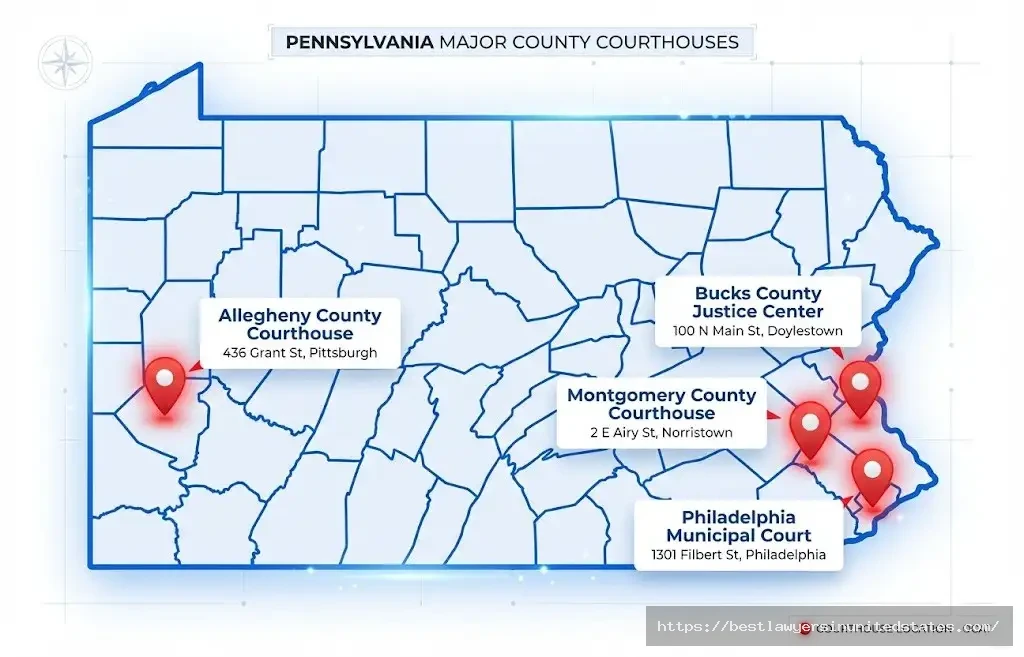
Pennsylvania processes DUI cases through county-specific courts. Here’s where you’ll appear in major Pennsylvania counties.
Philadelphia County Courts
Philadelphia Municipal Court
1301 Filbert Street, Philadelphia, PA 19107
Handles: First District Court and preliminary hearings
Philadelphia Court of Common Pleas
City Hall, Room 296, Philadelphia, PA 19107
Handles: DUI trials and ARD court
Philadelphia processes roughly 3,500 DUI cases annually. The city’s ARD program typically requires 12-month probation for acceptance.
Montgomery County Courts
Montgomery County Courthouse
2 East Airy Street, Norristown, PA 19404
Handles: District courts and Court of Common Pleas
Montgomery County accepts most first-time offenders into ARD, even with BAC levels up to .18%. The county offers Saturday ARD court dates for working defendants.
Bucks County Courts
Bucks County Justice Center
100 North Main Street, Doylestown, PA 18901
Handles: Preliminary hearings through sentencing
Bucks County maintains strict ARD standards. Cases involving property damage or BAC over .16% face frequent rejections from the program.
Allegheny County Courts
Allegheny County Courthouse
436 Grant Street, Pittsburgh, PA 15219
Handles: District courts and Common Pleas
Allegheny County processes the second-highest DUI volume in Pennsylvania after Philadelphia. The county typically requires 90-day license suspensions even for ARD participants.
Court appearance tip: Arrive 30 minutes early. Most Pennsylvania courthouses require security screening. Dress professionally and silence all electronic devices.
Pennsylvania DUI Defense Strategies
Attorneys challenge Pennsylvania DUI charges through several legal approaches.
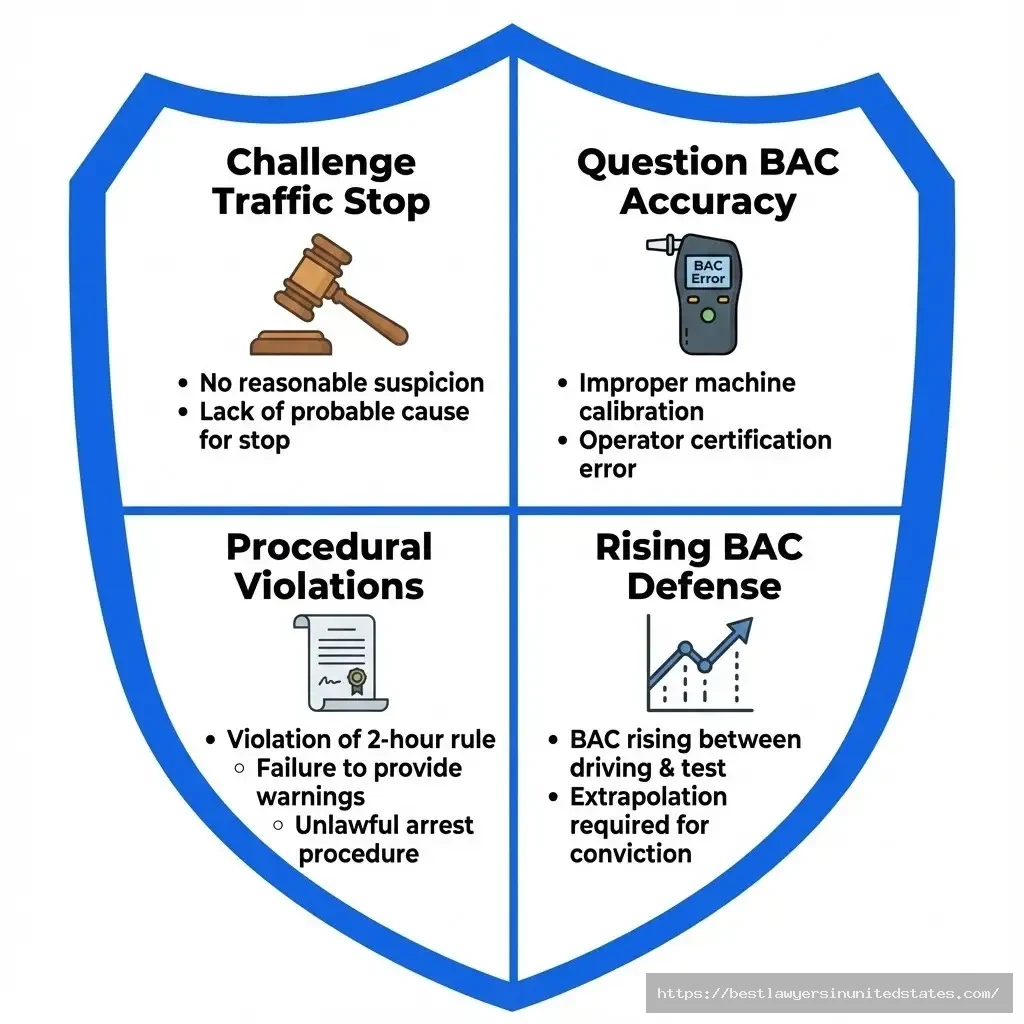
Challenging the Traffic Stop
Officers need reasonable suspicion to stop your vehicle. Common challenges include:
- No traffic violation occurred
- Anonymous tip without corroboration
- Improper checkpoint procedures
- Pretextual stop (stopping for minor violation to investigate DUI)
Successful challenge: Judge suppresses all evidence from the stop, including BAC test results. Prosecutors typically dismiss charges.
Questioning BAC Test Accuracy
Pennsylvania requires specific procedures for breath and blood testing. Defense attorneys examine:
Breathalyzer challenges:
- Calibration records missing or outdated
- Mouth alcohol contamination (GERD, dental work)
- Observation period violation (20 minutes required)
- Officer training certification expired
Blood test challenges:
- Chain of custody gaps
- Improper storage temperature
- Contaminated equipment
- Lab technician errors
Procedural Violations
Pennsylvania law mandates strict DUI arrest procedures:
- Miranda warnings before custodial questioning
- Implied consent warning before testing
- Two-hour rule compliance
- Proper warrant for blood draw
- Medical personnel qualifications for blood draw
Example: Officer reads implied consent warning after blood draw instead of before. Attorney files motion to suppress BAC results.
Rising BAC Defense
Alcohol takes 30-90 minutes to fully absorb into your bloodstream. Your BAC could be:
- Under .08% while driving
- Over .08% when tested 90 minutes later
Requirements for this defense:
- Expert witness testimony
- Timeline evidence (when you stopped drinking)
- Gap between driving and testing (longer gaps strengthen defense)
Pennsylvania’s Clean Slate Law and DUI Records
Pennsylvania’s Clean Slate Law (Act 56 of 2018) automatically seals certain criminal records after 10 years. However, DUI convictions face significant limitations.
What Qualifies for Automatic Expungement?
Eligible offenses:
- Summary offenses after 10 years
- Misdemeanors with fines under $2,500
- Charges resulting in not guilty verdict
- Withdrawn or dismissed charges
NOT eligible:
- DUI convictions (any tier)
- Felony DUI charges
- DUI with injuries or property damage
- Second or subsequent DUI offenses
ARD and Expungement
Successfully completing ARD makes you eligible for expungement. You must:
- Complete all ARD requirements
- Wait for program completion
- File expungement petition
- Pay $150-$200 filing fee
- Serve notice to District Attorney
Timeline: Most ARD expungements finalize within 6-9 months after program completion. Once granted, PennDOT removes the arrest from your record permanently.
Employment Background Checks
Pennsylvania DUI convictions appear on:
- Criminal background checks (indefinitely)
- Driving records (10 years minimum)
- Professional license applications
- Security clearance investigations
Critical for CDL drivers: DUI convictions remain on your record permanently for commercial driving purposes, even after expungement for other purposes.
Dram Shop and Social Host Liability in Pennsylvania
Pennsylvania holds establishments and individuals liable for serving alcohol to visibly intoxicated persons who then cause DUI accidents.
Dram Shop Law
Under 47 P.S. § 4-493(1), bars and restaurants face civil liability when:
- Serving visibly intoxicated patrons
- Who then cause DUI accidents
- Resulting in injuries or property damage
Real case example: Pennsylvania jury awarded $8.5 million against a Philadelphia bar that continued serving a patron with .24% BAC. The patron later crashed and paralyzed another driver.
Social Host Liability
Pennsylvania limits social host liability to serving minors. Homeowners face legal consequences when:
- Providing alcohol to persons under 21
- The minor drives while intoxicated
- Causes accident with injuries
Penalties for adults:
- First offense: $1,000 fine
- Second offense: $2,500 fine
- Criminal charges for serious injuries
Parent notification: Police notify parents when minors are arrested for DUI, regardless of where they obtained alcohol.
Pennsylvania’s New 2025 DUI Felony Law
Pennsylvania enacted stricter DUI legislation effective January 1, 2025. Third DUI offenses now qualify as third-degree felonies under specific conditions.
When Third DUI Becomes a Felony
Your third DUI becomes a felony if:
- Third offense within 10 years
- Prior offense involved injury or property damage
- BAC of .16% or higher on current charge
- Controlled substance DUI with prior convictions
Sentencing enhancement:
- Regular third offense: Misdemeanor (up to 5 years)
- Felony third offense: 3.5-7 years state prison
Fourth Offense and Beyond
All fourth and subsequent DUI offenses constitute felonies:
- $2,500-$10,000 fine minimum
- 1-5 years state prison
- 18-month license suspension
- Permanent ignition interlock requirement
Employment impact: Felony DUI convictions disqualify you from many professional licenses in Pennsylvania, including:
- Teaching certification
- Nursing licenses
- Security guard certification
- CDL privileges (permanent)
Pennsylvania joins neighboring New Jersey in treating repeat DUI as serious felony offenses.
Frequently Asked Questions About Pennsylvania DUI
How long does a DUI stay on your record in Pennsylvania?
Quick Answer: DUI convictions remain on your Pennsylvania criminal record indefinitely and your driving record for 10 years.
ARD completions can be expunged immediately after program completion. Regular DUI convictions stay permanently unless you successfully petition for a pardon through the Pennsylvania Board of Pardons.
Can you get ARD for a second DUI in PA?
Quick Answer: No. ARD is available only once in a lifetime for DUI offenses in Pennsylvania.
If you completed ARD 15 years ago for a different charge, some counties may grant a second ARD for DUI. However, most Pennsylvania counties strictly limit DUI defendants to one ARD opportunity ever.
What is the Cinderella Law in Pennsylvania?
Quick Answer: The “Cinderella Law” allows judges to set specific hours when underage drivers can operate vehicles, typically requiring them home by midnight.
This graduated license restriction applies to drivers under 18. Violating curfew hours can result in license suspension. Judges often impose stricter Cinderella restrictions as penalties for underage DUI or traffic violations.
How much does a DUI lawyer cost in Pennsylvania?
Quick Answer: Pennsylvania DUI attorneys charge $2,500-$7,500 for first-offense cases and $5,000-$15,000 for second or third offenses.
Costs vary by:
- County (Philadelphia charges more than rural counties)
- Case complexity (trials cost more than ARD cases)
- Attorney experience (specialists charge premium rates)
- Tier level (Tier 3 requires more work)
Most attorneys offer payment plans. Legal costs represent just 20-30% of your total DUI expenses.
Can you refuse a field sobriety test in Pennsylvania?
Quick Answer: Yes. Pennsylvania law does not require you to perform field sobriety tests, and refusal carries no penalty.
Unlike chemical test refusal, declining field sobriety tests creates no additional charges or license suspension. However, officers will likely arrest you anyway based on other evidence of impairment. Your refusal may also be mentioned in court.
Will a DUI affect your car insurance in Pennsylvania?
Quick Answer: Yes. Pennsylvania DUI convictions increase insurance rates by 80-120% for at least 3 years.
You’ll need SR-22 insurance certification for 3 years. Average increases:
- $1,200/year before DUI
- $2,160-$2,640/year after DUI
- Total 3-year cost: $2,880-$4,320 extra
Some insurers drop DUI drivers entirely. Shop multiple companies for best rates.
How accurate are breathalyzers in Pennsylvania?
Quick Answer: Pennsylvania-approved breathalyzers show ±.01% accuracy when properly maintained and calibrated.
State police maintain and calibrate devices monthly. However, errors occur through:
- Mouth alcohol from recent drinking
- GERD or acid reflux
- Dental work trapping alcohol
- Officer training issues
- Improper 20-minute observation period
Your attorney can request calibration records and challenge results.
Can you drive to work with a suspended license in PA?
Quick Answer: No. Pennsylvania does not allow driving with a suspended license, even for work, until you obtain an Occupational Limited License (OLL).
OLL requirements include:
- Completing mandatory suspension period
- Installing ignition interlock device
- Maintaining SR-22 insurance
- Paying $200 restoration fee
Driving on suspended license adds:
- $200 fine minimum
- Additional 6-month suspension
- Possible jail time for repeat violations
What happens if you get a DUI while on probation in PA?
Quick Answer: A new DUI while on probation triggers probation violation proceedings with possible jail time for the original offense plus new DUI charges.
Your probation officer will file a violation report. Judges can:
- Revoke probation
- Impose original suspended sentence
- Add probation time
- Order immediate incarceration
ARD impact: Getting arrested during ARD probation usually results in program removal and reinstatement of original DUI charges.
Does Pennsylvania participate in the Interstate Driver’s License Compact?
Quick Answer: Yes. Pennsylvania shares DUI conviction information with 44 other states through the Driver License Compact.
A Pennsylvania DUI affects your license in your home state. If you’re licensed in Ohio but arrested in Pennsylvania:
- Pennsylvania suspends your driving privileges in PA
- Ohio suspends your home license based on PA conviction
- You serve both state’s penalties
Pennsylvania DUI Resources
PennDOT Driver and Vehicle Services
Main Office:
PennDOT Bureau of Driver Licensing
1101 South Front Street, Harrisburg, PA 17104
Phone: 1-800-932-4600
Website: www.dmv.pa.gov
License Restoration:
Driver and Vehicle Services
1101 South Front Street, Harrisburg, PA 17104
Phone: 717-412-5300
County ARD Program Offices
Philadelphia ARD Program:
1301 Filbert Street, Philadelphia, PA 19107
Phone: 215-686-3608
Montgomery County ARD:
Adult Probation Department
Court House Annex, Norristown, PA 19404
Phone: 610-278-3318
Bucks County ARD:
Bucks County Courthouse
55 East Court Street, Doylestown, PA 18901
Phone: 215-348-6355
Ignition Interlock Providers
Pennsylvania approves these interlock device manufacturers:
- LifeSafer Ignition Interlock
- Smart Start Inc.
- Intoxalock
- Guardian Interlock Systems
Installation locations available in all Pennsylvania counties. Call providers for nearest location and scheduling.
DUI Education Programs
Alcohol Highway Safety School (required for ARD):
- Most counties: CRN (Clinical Research Network)
- Philadelphia: DCES (Driver Improvement Schools)
Contact your county ARD office for approved providers.
When to Hire a Pennsylvania DUI Attorney
Certain DUI cases require immediate legal representation.
Hire an Attorney If You Face:
Tier 2 or Tier 3 charges
Mandatory jail time and higher fines make attorney representation essential. Most defendants save more in reduced penalties than attorney fees cost.
Second or subsequent DUI
Enhanced penalties and felony potential require experienced defense counsel. ARD is unavailable, making trial defense critical.
Accident with injuries
Personal injury crashes add civil liability and potential felony charges. You need both criminal defense and civil protection.
CDL or professional license at risk
Career implications justify attorney costs. Specialized DUI attorneys understand license protection strategies.
BAC over .20%
Extremely high BAC cases face maximum penalties. Attorneys can negotiate reduced charges or challenge test accuracy.
What to Look for in a Pennsylvania DUI Attorney
Experience markers:
- 5+ years handling DUI cases specifically
- Regular appearances in your county court
- Knowledge of local prosecutors and judges
- Success rate with ARD applications
- Trial experience (not just plea bargains)
Red flags:
- Guarantees specific outcomes
- Requires full payment upfront
- Never tried cases in your county
- Practices mainly other law areas
- Poor online reviews from DUI clients
Average Pennsylvania DUI Attorney Fees by County
| County | First Offense | Second Offense | Trial |
|---|---|---|---|
| Philadelphia | $3,500-$7,500 | $7,500-$15,000 | $10,000-$25,000 |
| Montgomery | $3,000-$6,000 | $6,000-$12,000 | $8,000-$20,000 |
| Bucks | $2,500-$5,500 | $5,500-$11,000 | $7,500-$18,000 |
| Allegheny | $2,500-$6,000 | $6,000-$12,000 | $8,000-$20,000 |
| Rural counties | $2,000-$4,500 | $4,500-$9,000 | $6,000-$15,000 |
Most attorneys offer payment plans. Some accept credit cards or offer financing through legal funding companies.
Find experienced Pennsylvania DUI attorneys through:
Email: [email protected]
Taking Action After a Pennsylvania DUI Arrest
Pennsylvania DUI charges move quickly. Missing deadlines costs you legal defenses and driving privileges.
Immediate Steps (First 24 Hours)
- Request a copy of all citations and paperwork from the arresting officer
- Write down everything you remember about the stop, tests, and arrest
- Take photos of the arrest location if you can safely return
- Contact a DUI attorney for free consultation
- Don’t discuss your case with anyone except your lawyer
Critical Deadlines
| Deadline | Action Required | Consequence if Missed |
|---|---|---|
| 10 days | Request preliminary hearing | Waive right to challenge evidence |
| 30 days | Appeal license suspension | Automatic suspension begins |
| 60 days | Apply for ARD | May lose eligibility |
| Various | Attend all court dates | Bench warrant issued |
What NOT to Do
❌ Don’t discuss your case on social media
❌ Don’t drive with suspended license
❌ Don’t miss court dates or ARD appointments
❌ Don’t contact the arresting officer
❌ Don’t ignore PennDOT suspension notices
Compare Pennsylvania DUI penalties with other states:
Pennsylvania’s three-tier system and ARD program offer better outcomes than many states for first-time offenders. However, second and subsequent offenses carry severe penalties that rival the strictest DUI states in the nation. Acting quickly after arrest and securing experienced legal counsel provides your best chance at minimizing long-term consequences.
Estimate your total Pennsylvania DUI costs including fines, attorney fees, insurance increases, and license restoration using our DUI cost calculator.
