
Getting charged with an OUI (Operating Under the Influence) in Massachusetts carries serious consequences. You face fines up to $5,000, jail time up to 2.5 years, and license suspension for up to one year on a first offense. Massachusetts uses “OUI” instead of “DUI” as the official legal term under Massachusetts General Laws Chapter 90, Section 24.
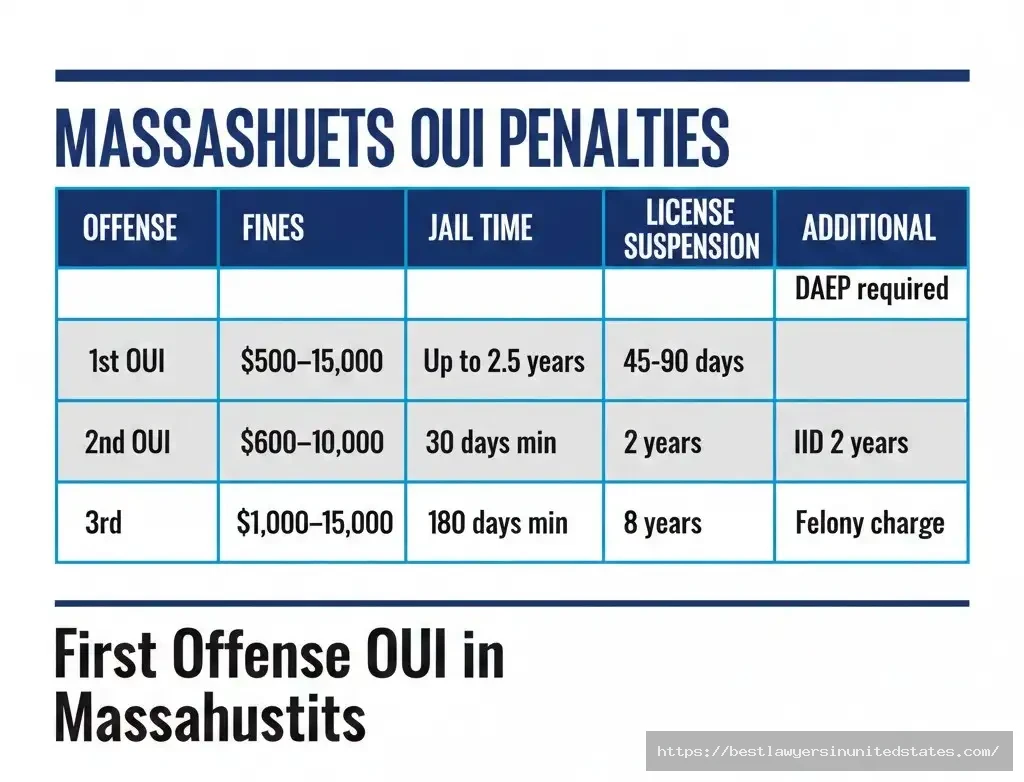
This guide explains Massachusetts OUI laws, penalties for each offense level, and your legal options. You’ll learn about BAC limits, breathalyzer refusal consequences, and the RMV suspension process.
Need to calculate potential costs? Check our DUI cost calculator for Massachusetts-specific estimates.
DUI Cost Calculator
Estimate total DUI expenses by state and offense
Detailed Cost Breakdown
Payment Timeline
Bail bond, towing fees, car impound, attorney retainer
Initial court fines, DMV fees, DUI school enrollment, ignition interlock installation
Monthly probation fees, ignition interlock fees, DUI school payments, attorney balance
Insurance premium increases, license reinstatement, SR-22 filing fees
- Lost wages from missed work (court dates, jail time, DUI school) – $2,000-$10,000
- Job loss or difficulty finding employment – Varies
- Professional license suspension (doctors, lawyers, nurses, pilots) – Career ending
- Rideshare and transportation costs during suspension – $1,500-$5,000
- Travel restrictions and visa denials – Varies
- Security clearance loss – Career impact
- Child custody implications – Legal costs
- Rental car restrictions – Varies
- Personal relationships and mental health costs – Priceless
What is an OUI in Massachusetts?
Massachusetts calls drunk driving “OUI” (Operating Under the Influence) instead of DUI or DWI. The terms mean the same thing legally. Maine and Rhode Island also use OUI terminology.
Legal Definition Under M.G.L. Chapter 90, Section 24
Massachusetts General Laws Chapter 90, Section 24 defines OUI as operating a motor vehicle while under the influence of intoxicating liquor or drugs. Prosecutors must prove three elements:
- You operated a motor vehicle
- On a public way or place where the public has right of access
- While under the influence of alcohol or drugs
Key point: “Operating” means more than just driving. You can get charged with OUI for sitting in a parked car with the keys in the ignition.
OUI vs DUI: What’s the Difference?
| Term | Used In | Legal Meaning |
|---|---|---|
| OUI | Massachusetts, Maine, Rhode Island | Operating Under the Influence |
| DUI | Most other states | Driving Under the Influence |
| DWI | Some states | Driving While Intoxicated |
All three terms describe the same crime. Massachusetts courts and police use OUI exclusively. If you see “DUI” in Massachusetts legal documents, it refers to OUI charges.
Massachusetts BAC Limits and Testing
Massachusetts sets different blood alcohol concentration limits based on driver type. Police use the Alcotest 9510 breathalyzer to measure BAC levels during traffic stops.
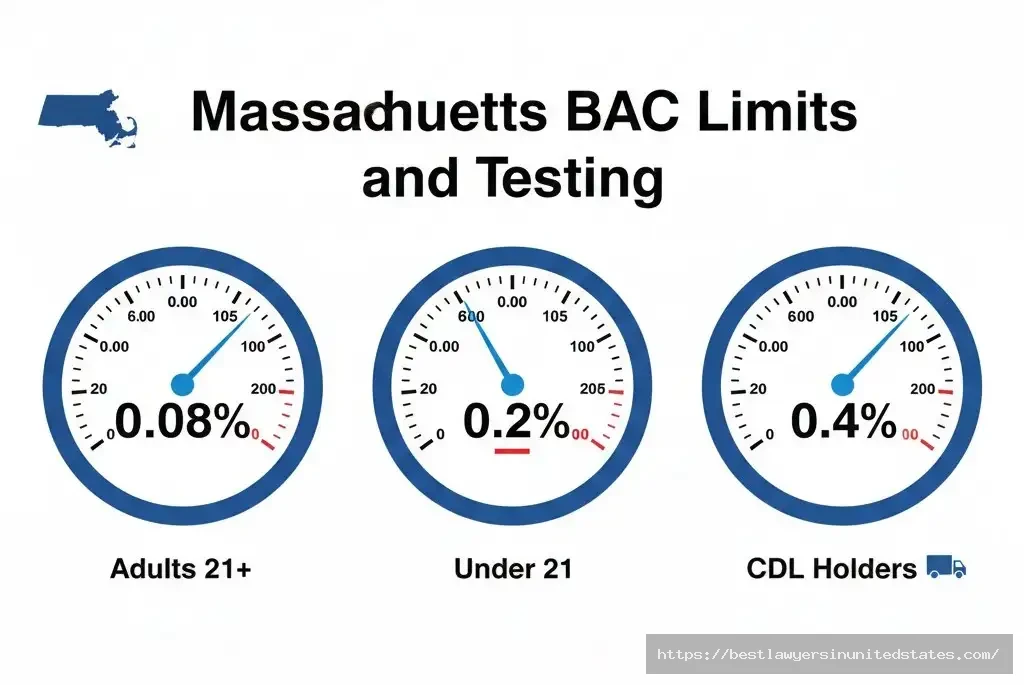
Standard BAC Limits by Driver Category
| Driver Type | Legal BAC Limit | Violation Type |
|---|---|---|
| Adults 21+ | 0.08% | Per se OUI |
| Under 21 | 0.02% | Zero tolerance violation |
| CDL holders | 0.04% | Commercial driver violation |
Wondering if you’re over the limit? Use our BAC calculator to estimate your blood alcohol level.
BAC Calculator
Estimate your Blood Alcohol Content
• Commercial Driver (CDL): 0.04% BAC
• Drivers Under 21: 0.00-0.02% BAC (Zero Tolerance)
• Enhanced Penalties: 0.15% BAC or higher in most states
How Massachusetts Measures BAC
Massachusetts State Police use Alcotest 9510 breathalyzer machines at police stations. These devices analyze your breath sample and calculate your BAC. The machines underwent legal challenges in recent years over calibration issues.
Two ways to prove OUI:
- Per se violation: BAC at or above 0.08% (automatic violation)
- Impairment: Observable signs of intoxication regardless of BAC
Police can arrest you for OUI even with a BAC below 0.08% if they observe impairment through field sobriety tests or driving behavior.
Zero Tolerance Law for Drivers Under 21
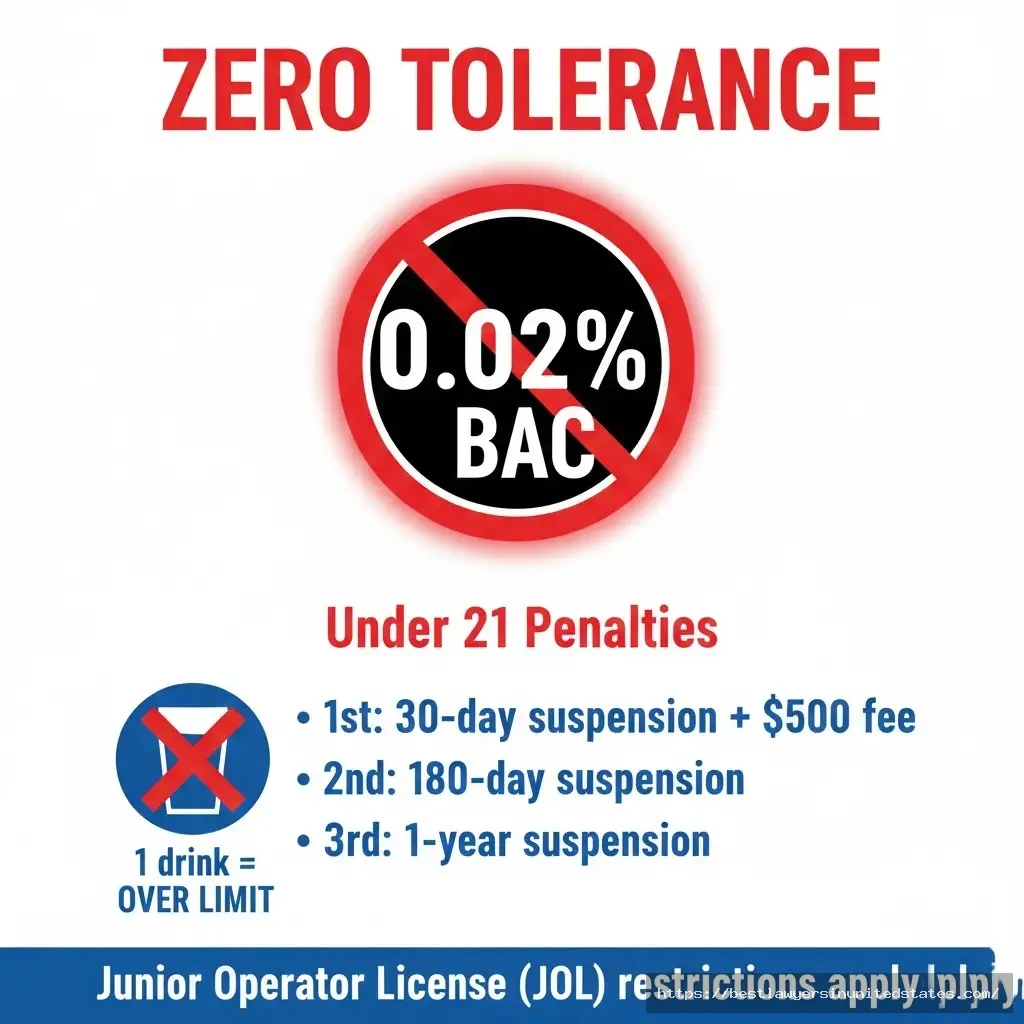
Massachusetts enforces strict rules for underage drivers. Anyone under 21 with a BAC of 0.02% or higher faces immediate license suspension. This equals roughly half a drink for most people.
Junior Operator License (JOL) holders face:
- Automatic 30-day license suspension (first offense)
- 180-day suspension (second offense)
- One-year suspension (third offense)
- Mandatory alcohol education program
Massachusetts Implied Consent Law
When you get a Massachusetts driver’s license, you automatically agree to chemical testing if police arrest you for OUI. This “implied consent” rule means refusal triggers automatic penalties.
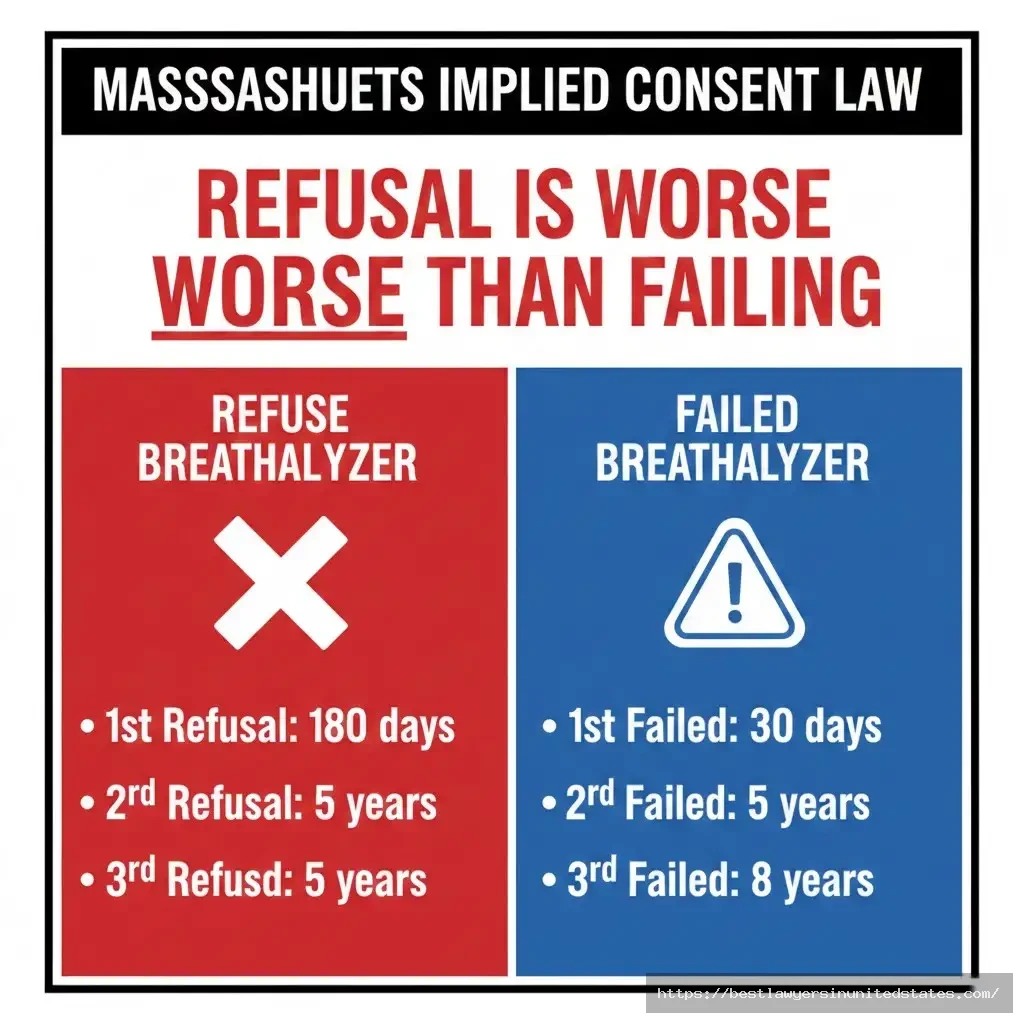
What Happens If You Refuse a Breathalyzer?
Quick Answer: Refusing a breathalyzer in Massachusetts results in automatic license suspension – 180 days for first refusal, longer for repeat refusals.
| Offense | Refusal Suspension | Failed Test Suspension |
|---|---|---|
| 1st refusal | 180 days | 30 days |
| 2nd refusal | 3 years | 2 years |
| 3rd refusal | 5 years | 8 years |
| 4th+ refusal | Lifetime | 10 years |
Can You Refuse Testing in Massachusetts?
You can legally refuse a breathalyzer, but consequences start immediately. The Massachusetts Registry of Motor Vehicles (RMV) suspends your license within 15 days of refusal. This suspension happens whether or not you’re convicted of OUI.
What refusal means for your case:
- Police document refusal in arrest report
- Prosecutors mention refusal at trial
- Judges may consider refusal during sentencing
- RMV suspension runs separately from court penalties
Police Rights During Testing
Officers must read you the implied consent warning before requesting a breath test. The warning explains refusal consequences. Police cannot physically force you to blow into a breathalyzer without a search warrant.
Exception: Officers increasingly obtain warrants for blood draws in cases involving:
- Serious accidents with injuries
- Suspected drugged driving
- Unconscious drivers
You can request independent testing at your own expense after completing the official test. Some defense attorneys use independent lab results to challenge prosecution evidence.
What Happens When You Get an OUI in Massachusetts
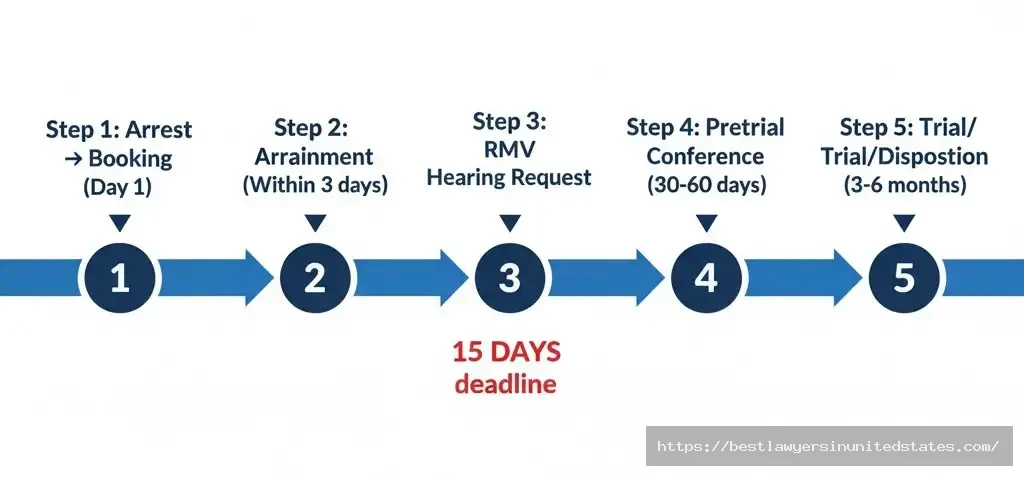
The OUI arrest process follows specific steps from initial stop through court proceedings. Understanding each stage helps you protect your rights.
Traffic Stop and Field Sobriety Tests
Police pull you over for traffic violations or erratic driving. Officers look for signs of intoxication like alcohol odor, slurred speech, or bloodshot eyes. They may ask you to perform field sobriety tests.
Common field sobriety tests in Massachusetts:
- Walk-and-turn test
- One-leg stand test
- Horizontal gaze nystagmus (eye movement test)
- Portable breathalyzer (preliminary screening)
Your rights: You can refuse field sobriety tests without automatic penalties. Unlike breathalyzer refusal at the station, roadside test refusal doesn’t trigger RMV suspension.
Arrest and Booking Process
Officers arrest you if they believe you’re operating under the influence. Police transport you to the station for booking. This includes:
- Fingerprinting and photographs
- Personal property inventory
- Official breathalyzer test (Alcotest 9510)
- License confiscation
- Release on bail or personal recognizance
Critical deadline: Police issue a temporary license valid for 30 days. You must request an RMV hearing within 15 days to contest the administrative suspension.
Arraignment and Court Process
Your arraignment happens within a few days of arrest at your local District Court. The judge reads charges, sets bail conditions, and schedules future court dates.
What to expect at arraignment:
- Formal reading of OUI charges
- Plea entry (guilty, not guilty, or nolo contendere)
- Bail/release conditions set
- Pretrial conference date scheduled
- License suspension begins if you refused breathalyzer
Where OUI Cases Are Heard in Massachusetts
Massachusetts handles OUI cases in District Courts across 14 counties. Your case goes to the court nearest your arrest location.
Major OUI courts by county:
- Boston Municipal Court (Suffolk County)
- Cambridge District Court (Middlesex County)
- Springfield District Court (Hampden County)
- Worcester District Court (Worcester County)
- Lowell District Court (Middlesex County)
- Brockton District Court (Plymouth County)
Each courthouse has specific hours and procedures for OUI hearings. Contact the court clerk for scheduling information.
First Offense OUI in Massachusetts
A first OUI in Massachusetts is a misdemeanor. Penalties range from fines and probation to possible jail time. Most first offenders avoid jail through alternative dispositions.
Criminal Penalties for First OUI
| Penalty Type | First Offense Range |
|---|---|
| Fines | $500 – $5,000 |
| Jail time | Up to 2.5 years (rarely imposed) |
| Probation | Up to 2 years |
| License suspension | 45-90 days (with alcohol program completion) |
Typical first offense outcome: Most first-time offenders receive:
- $500 minimum fine plus court costs ($250-$500)
- One year probation
- 45-day license suspension
- Mandatory alcohol education program
Driver Alcohol Education Program (DAEP)
The court orders all first offenders to complete a 16-hour Driver Alcohol Education Program. This program costs approximately $575 and runs over two weekends. You must complete DAEP to get your license reinstated.
DAEP requirements:
- Attend all eight 2-hour sessions
- Pass final assessment
- Pay full program fee
- No absences allowed (must restart if you miss sessions)
Alternative Disposition for First Offenders
Massachusetts courts offer an alternative disposition (also called “24D” disposition) for first OUI offenses. This option reduces license suspension time and keeps the conviction off your record temporarily.
24D disposition benefits:
- Reduced suspension (45-90 days vs. one year)
- Earlier license reinstatement with ignition interlock
- Possible expungement after probation completion
- No mandatory minimum jail time
Second Offense OUI in Massachusetts
A second OUI carries mandatory minimum penalties. Courts have less flexibility with sentencing. You face jail time, longer license suspension, and stricter program requirements.
Enhanced Penalties for Second OUI
| Penalty Type | Second Offense |
|---|---|
| Fines | $600 – $10,000 |
| Jail time | 30 days minimum (can be suspended with conditions) |
| Probation | Up to 2 years |
| License suspension | 2 years minimum |
| Ignition interlock | 2 years required |
Lookback period: Massachusetts counts prior OUIs within 10 years. An OUI from 11 years ago doesn’t count as a prior offense.
Cahill Disposition: Special Alternative for Second OUI
Massachusetts offers a unique alternative called the Cahill Disposition for some second OUI offenders. This treats your second offense like a first offense for sentencing purposes.
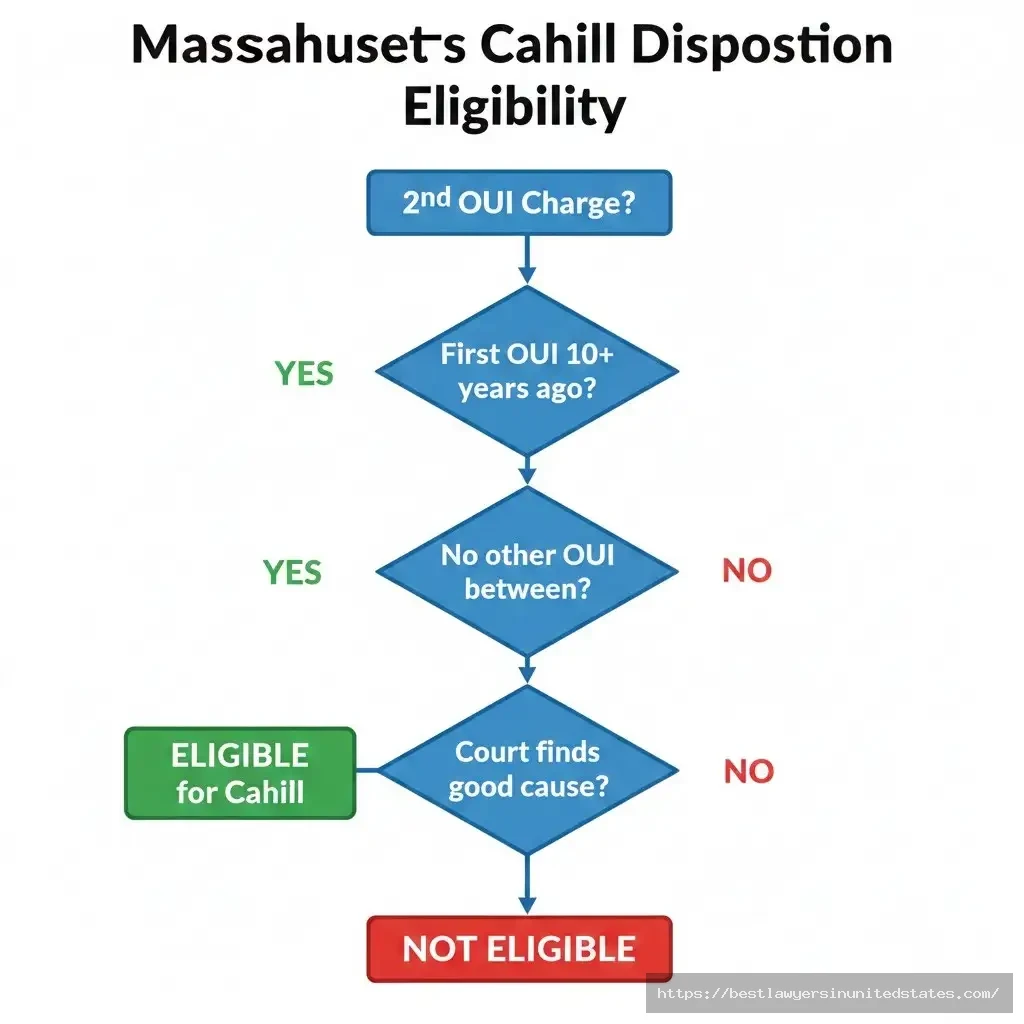
Cahill eligibility requirements:
- First OUI occurred more than 10 years ago
- No other OUI convictions in between
- Court finds “good cause” for alternative disposition
- Complete all required programs
Cahill benefits:
- Shorter license suspension (2 years vs. 2 years minimum)
- Possible reduction in jail time
- Less severe insurance consequences
- Better employment prospects
Your attorney must request Cahill disposition. Judges don’t automatically offer this option.
Inpatient Treatment Program
Second offenders must complete a 14-day residential treatment program or an equivalent outpatient program. This requirement applies even with Cahill disposition. Programs cost $3,000-$5,000 depending on facility.
Third Offense and Higher OUI in Massachusetts
A third OUI becomes a felony in Massachusetts with severe mandatory penalties. You face significant jail time, long-term license loss, and lifetime consequences.
Felony OUI Penalties
| Penalty Type | Third Offense | Fourth Offense | Fifth Offense |
|---|---|---|---|
| Fines | $1,000 – $15,000 | $1,500 – $25,000 | $2,000 – $50,000 |
| Jail time | 180 days minimum | 2 years minimum | 2.5 years minimum |
| Prison | Up to 5 years | Up to 5 years | Up to 5 years |
| License suspension | 8 years | 10 years | Lifetime |
No alternative dispositions: Courts cannot offer 24D or Cahill for third or subsequent offenses. You must serve mandatory minimum jail sentences.
Lifetime Lookback Period
Massachusetts uses a lifetime lookback for third and subsequent OUIs. Unlike the 10-year lookback for second offenses, any prior OUI conviction counts no matter how long ago it occurred.
Example: An OUI from 1995 counts toward your third offense in 2026.
License Reinstatement After Third OUI
Getting your license back after a third OUI requires:
- Complete full suspension period (8-10 years)
- Pass RMV hearing
- Complete all court-ordered programs
- Install ignition interlock device for 8 years
- Pay reinstatement fees ($1,200+)
- Obtain SR-22 high-risk insurance
Hardship licenses: You may apply for a hardship license after 5 years of the 8-year suspension. The RMV grants these rarely and only for essential needs like medical appointments or work.
Massachusetts RMV License Suspension Process
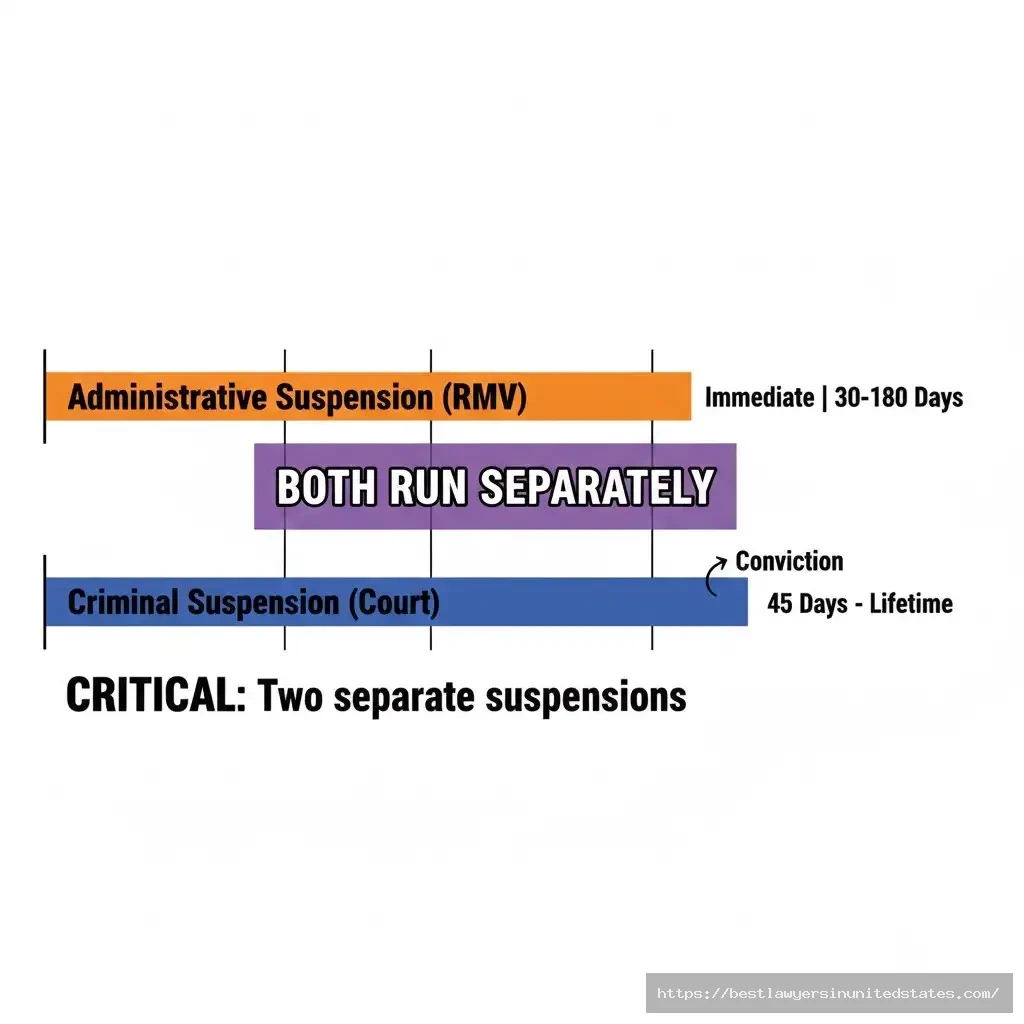
The Massachusetts Registry of Motor Vehicles handles all license suspensions. You face two separate suspension processes: administrative and criminal court.
Administrative vs. Criminal Suspension
Quick Answer: You face two suspensions – one automatic from the RMV for test refusal or failure, and one from criminal court if convicted.
| Suspension Type | Trigger | Duration | Can Be Appealed? |
|---|---|---|---|
| Administrative | Breathalyzer refusal or failure | 30-180 days | Yes, within 15 days |
| Criminal | OUI conviction | 45 days – lifetime | Through court appeal only |
These suspensions run separately. Even if you win your criminal case, the administrative suspension remains unless you successfully appealed it.
How to Request an RMV Hearing
You have 15 days from arrest to request an administrative hearing. Miss this deadline and your suspension becomes automatic.
Steps to request hearing:
- Visit mass.gov/rmv within 15 days
- Complete Request for Hearing form
- Pay $50 filing fee
- Receive temporary license valid until hearing date
- Attend scheduled hearing (usually 30-45 days after request)
Hearing topics you can challenge:
- Whether police had reasonable grounds for stop
- Whether officer properly administered breathalyzer test
- Whether you actually refused or failed the test
- Machine calibration and maintenance records
RMV Hearing Outcomes
The hearing officer decides whether to uphold or rescind your suspension. Most administrative suspensions get upheld unless you can prove procedural errors.
Possible outcomes:
- Suspension upheld: Full administrative suspension begins
- Suspension rescinded: You keep your license pending criminal case
- Partial relief: Reduced suspension period granted
License Reinstatement Requirements
Getting your license back after suspension requires multiple steps and fees. The process takes several weeks even after your suspension period ends.
Reinstatement checklist:
- Complete suspension period (all days must pass)
- Pay reinstatement fee ($500-$1,200 depending on offense)
- Complete all programs:
- DAEP (first offense)
- Residential treatment (second offense)
- Any court-ordered counseling
- Install ignition interlock (if required)
- Obtain SR-22 insurance (high-risk certificate)
- Pass RMV hearing (for multiple offenses)
- Pay any outstanding fines or fees
Visit your local RMV Service Center with proof of program completion and insurance. The RMV issues a new license once all requirements are met.
Major RMV locations:
- Boston RMV (Chinatown)
- Worcester RMV
- Springfield RMV
- Brockton RMV
- Lowell RMV
Processing takes 1-2 hours. Bring multiple forms of ID and all completion certificates.
Ignition Interlock Device Requirements in Massachusetts
Massachusetts requires ignition interlock devices for most OUI offenders under Melanie’s Law. This law took effect in 2005 and significantly expanded IID requirements.
When Is an Ignition Interlock Device Required?
| Offense Level | IID Required? | Duration |
|---|---|---|
| First OUI | Optional (for early reinstatement) | Remainder of suspension |
| Second OUI | Mandatory | 2 years |
| Third OUI | Mandatory | 8 years |
| Fourth+ OUI | Mandatory | 10 years |
| BAC 0.15%+ | May be required | Varies |
How ignition interlock works: The device connects to your car’s ignition system. You blow into it before starting the car. The engine won’t start if your BAC exceeds 0.02%.
Melanie’s Law and IID Mandates
Melanie’s Law made Massachusetts one of the strictest states for repeat OUI offenders. The law requires:
- Mandatory IID for all second and subsequent offenses
- Lifetime lookback for third offenses
- Enhanced penalties for child endangerment
- No exceptions for work or family vehicles
Named after: Melanie Powell, a 13-year-old killed by a repeat drunk driver in 2003.
Massachusetts Approved IID Providers
The RMV approves specific companies for ignition interlock installation. You must use an approved provider to meet legal requirements.
RMV-approved IID providers:
- LifeSafer Ignition Interlock
- Smart Start Inc.
- Monitech Ignition Interlock
- Guardian Interlock Systems
- Intoxalock
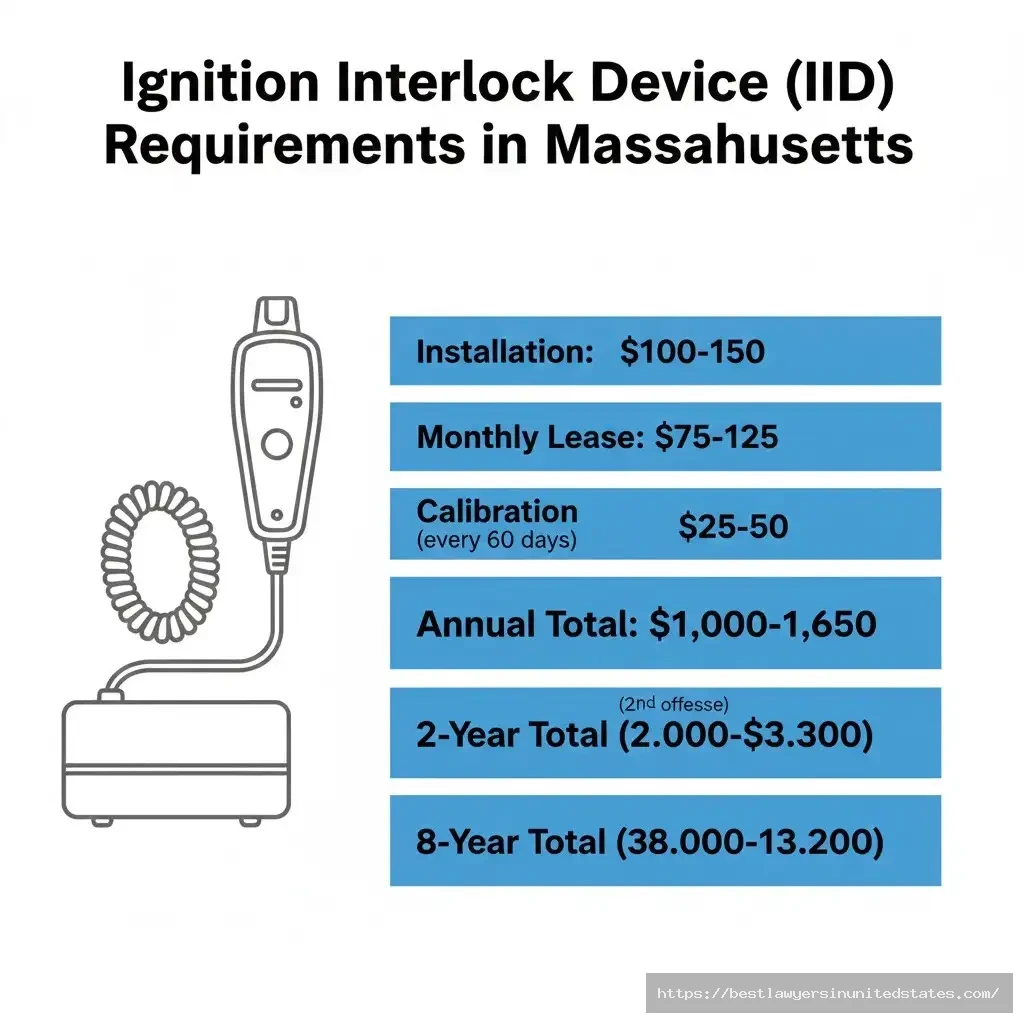
Installation and Monthly Costs
| Cost Type | Amount |
|---|---|
| Installation | $100-$150 |
| Monthly lease | $75-$125 |
| Calibration (every 60 days) | $25-$50 |
| Removal | $50-$100 |
| Annual total | $1,000-$1,650 |
Low-income drivers may qualify for reduced fees. Contact the provider for financial assistance applications.
How Long Must You Keep the Device?
Your IID requirement duration depends on offense level and suspension length. The clock starts when you install the device, not when your suspension begins.
Example timeline for second offense:
- Suspension: 2 years from conviction
- IID required: 2 years from installation
- Total time without normal license: 2+ years
You must maintain the IID in working order. Tampering with the device, having someone else blow into it, or failing random retests can extend your requirement period.
Aggravating Factors in Massachusetts OUI Cases
Certain circumstances increase OUI penalties beyond standard sentences. Courts take these aggravating factors seriously and impose enhanced punishment.
Child Endangerment (Under 14)
Operating under the influence with a child under 14 in the vehicle adds serious charges. Massachusetts treats this as child endangerment under M.G.L. Chapter 265, Section 13L.
Additional penalties for child endangerment:
- Mandatory 90-day jail sentence (minimum)
- Up to 2.5 years in jail
- Additional $1,000-$5,000 fine
- One-year license suspension on top of OUI suspension
- Department of Children and Families (DCF) investigation
These penalties apply regardless of whether it’s your first or subsequent OUI.
Serious Bodily Injury or Death
OUI causing serious bodily injury becomes a felony with enhanced penalties. OUI causing death may result in vehicular manslaughter charges.
Penalty ranges:
| Outcome | Charge | Maximum Penalty |
|---|---|---|
| Serious injury | OUI – Serious Bodily Injury | 10 years prison |
| Death | Motor Vehicle Homicide (OUI) | 15 years prison |
| Death (negligent) | Negligent Operation | 2.5 years jail |
Serious injury defined: Permanent disfigurement, loss of limb, loss of organ function, or substantial risk of death.
Extreme BAC Levels
While Massachusetts doesn’t have a separate “super drunk” law like some states, judges consider extremely high BAC levels during sentencing.
BAC levels affecting sentences:
- 0.08%-0.14%: Standard penalties
- 0.15%-0.19%: Likely enhanced probation terms
- 0.20%+: May face maximum jail time, even for first offense
A BAC of 0.20% or higher shows severe intoxication (twice the legal limit). Judges rarely grant alternative dispositions with extreme BAC levels.
Accident Involvement
OUI combined with property damage or accident involvement leads to additional charges. You may face:
- Leaving the scene of an accident (separate felony)
- Negligent operation of a motor vehicle
- Property damage restitution
- Civil liability lawsuits
Insurance companies treat accidents combined with OUI very seriously. Expect significant premium increases and possible policy cancellation.
OUI Laws for Underage Drivers in Massachusetts
Massachusetts enforces zero tolerance for drivers under 21. The penalties differ from adult OUI charges and include special restrictions.
Zero Tolerance Law (0.02% BAC)
Any driver under 21 with a BAC of 0.02% or higher violates Massachusetts zero tolerance law. This equals roughly one drink or less for most people.
Zero tolerance penalties:
| Offense | Suspension Length | Other Penalties |
|---|---|---|
| First | 30 days | Alcohol program, $500 reinstatement fee |
| Second | 180 days | Extended program, $500 fee |
| Third | One year | Court hearings, possible criminal charges |
These are separate from regular OUI charges. An underage driver can face both zero tolerance suspension AND criminal OUI charges simultaneously.
Junior Operator License (JOL) Implications
Drivers under 18 with a JOL face additional restrictions. Massachusetts law prohibits:
- Driving between 12:30 AM and 5:00 AM (Cinderella Law)
- Carrying passengers under 18 (except siblings)
- Cell phone use while driving (any age)
JOL violations combined with OUI:
- Immediate license suspension
- Extended JOL period (must restart)
- Parent/guardian notification required
- Mandatory court appearances
The Cinderella Law Explained
Massachusetts Cinderella Law restricts JOL holders from driving between 12:30 AM and 5:00 AM unless:
- Accompanied by parent/guardian
- Driving to/from work (with employer letter)
- Responding to medical emergency
Why it matters for OUI: Most underage OUI arrests happen during late-night hours. Violating Cinderella Law plus OUI means:
- Extended JOL period
- Delayed full license eligibility
- Additional fines and penalties
- Parent liability for damages
College Student Implications
An OUI conviction affects college students beyond legal penalties:
Academic consequences:
- Loss of financial aid (federal student loans)
- Scholarship suspension or cancellation
- Campus housing restrictions
- Study abroad program ineligibility
- Graduate school application problems
Professional consequences:
- Difficulty passing background checks
- Professional license denials (teaching, healthcare, law)
- Military enlistment disqualification
- Job offer rescission
Many colleges require students to report criminal charges. Some universities impose additional disciplinary actions beyond court penalties.
Long-Term Insurance Impact for Young Drivers
Young drivers already pay high insurance rates. An OUI conviction makes coverage even more expensive.
Typical insurance increases after OUI:
- First 3 years: 300%-400% increase
- Years 4-5: 150%-200% increase
- After 5 years: Returns to normal (if no other violations)
Example: If you paid $2,000/year before OUI, expect to pay $6,000-$8,000/year for three years after conviction. Total additional cost over five years: $20,000+.
Some insurance companies refuse coverage entirely for underage OUI convictions. You may need to obtain high-risk SR-22 insurance through specialized providers.
OUI Laws for Commercial Drivers in Massachusetts
Commercial driver’s license (CDL) holders face stricter standards and harsher penalties for OUI violations. One conviction can end your trucking career.
Federal vs. Massachusetts CDL Standards
The Federal Motor Carrier Safety Administration (FMCSA) sets minimum standards that Massachusetts must follow. State law often exceeds federal minimums.
Key differences:
| Standard | Federal Rule | Massachusetts Rule |
|---|---|---|
| BAC limit (commercial vehicle) | 0.04% | 0.04% |
| BAC limit (personal vehicle) | 0.08% | 0.08% (but CDL suspended at 0.04%) |
| First offense disqualification | 1 year | 1 year minimum |
| Second offense | Lifetime ban | Lifetime ban (possible relief after 10 years) |
0.04% BAC Limit for CDL Holders
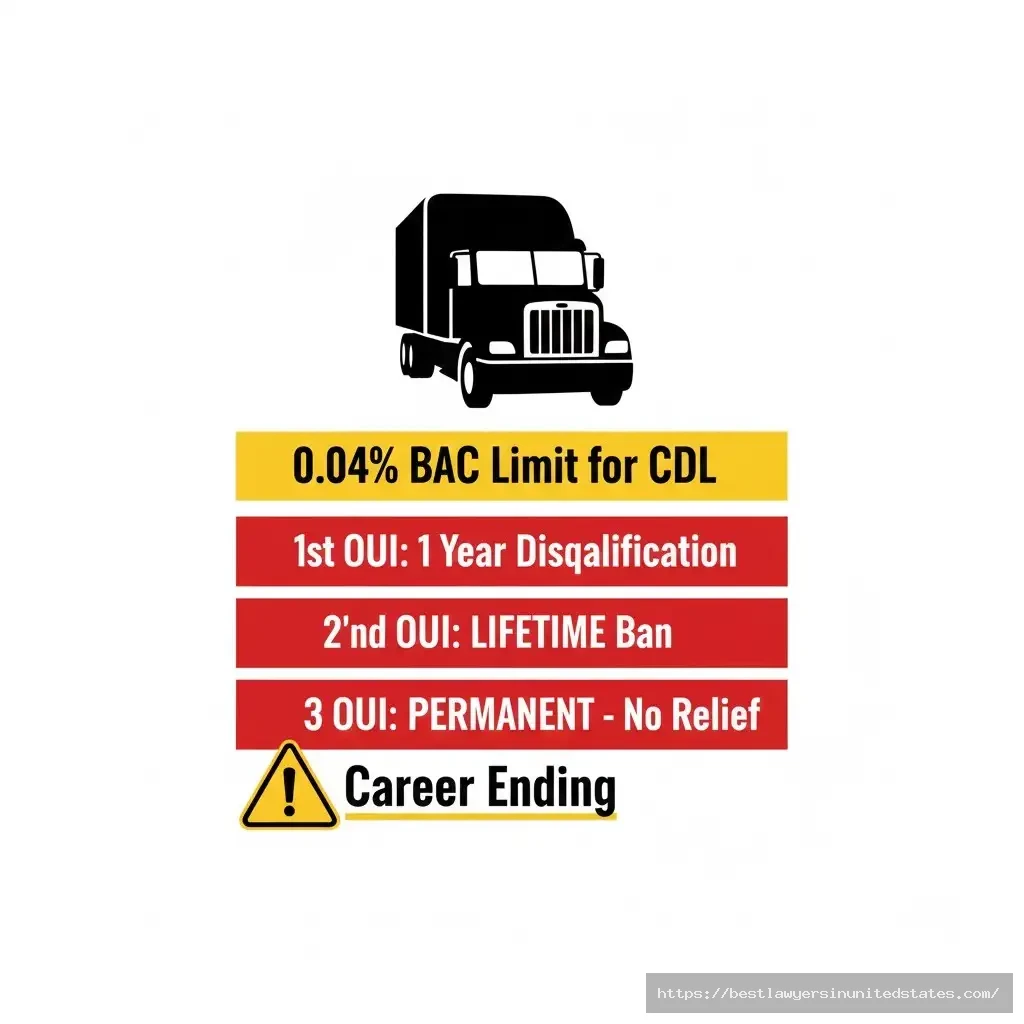
CDL holders face a 0.04% BAC limit while operating commercial vehicles. This is half the limit for regular drivers. Even in your personal vehicle, a 0.08% OUI conviction triggers CDL disqualification.
Critical point: You can lose your CDL for an OUI in your personal car off-duty. The conviction affects your commercial driving privileges regardless of what vehicle you drove.
Career-Ending Disqualification Periods
Massachusetts disqualifies CDL holders from operating commercial vehicles after any OUI conviction.
Disqualification periods:
| Offense | Disqualification | Can You Get License Back? |
|---|---|---|
| First OUI | 1 year | Yes, after full period |
| Second OUI | Lifetime | Possible after 10 years |
| Third OUI | Lifetime | No relief available |
| Hazmat first OUI | 3 years | Yes, after full period |
| Refusal | 1 year | Yes, after full period |
Employment impact: Most trucking companies won’t hire drivers with any OUI history. Your career effectively ends with the first conviction, even if you eventually get your CDL back.
Out-of-Service Orders
The RMV issues out-of-service orders immediately upon OUI arrest if you were driving a commercial vehicle. This prevents you from operating any commercial vehicle during your suspension period.
What out-of-service means:
- Cannot operate commercial vehicles
- Cannot receive pay for driving
- Employer must reassign you to non-driving duties
- Violation results in additional criminal charges
Violating an out-of-service order carries:
- $2,500-$5,000 fine
- 90-day additional disqualification
- Possible jail time
- Immediate employment termination
How to Beat an OUI Charge in Massachusetts
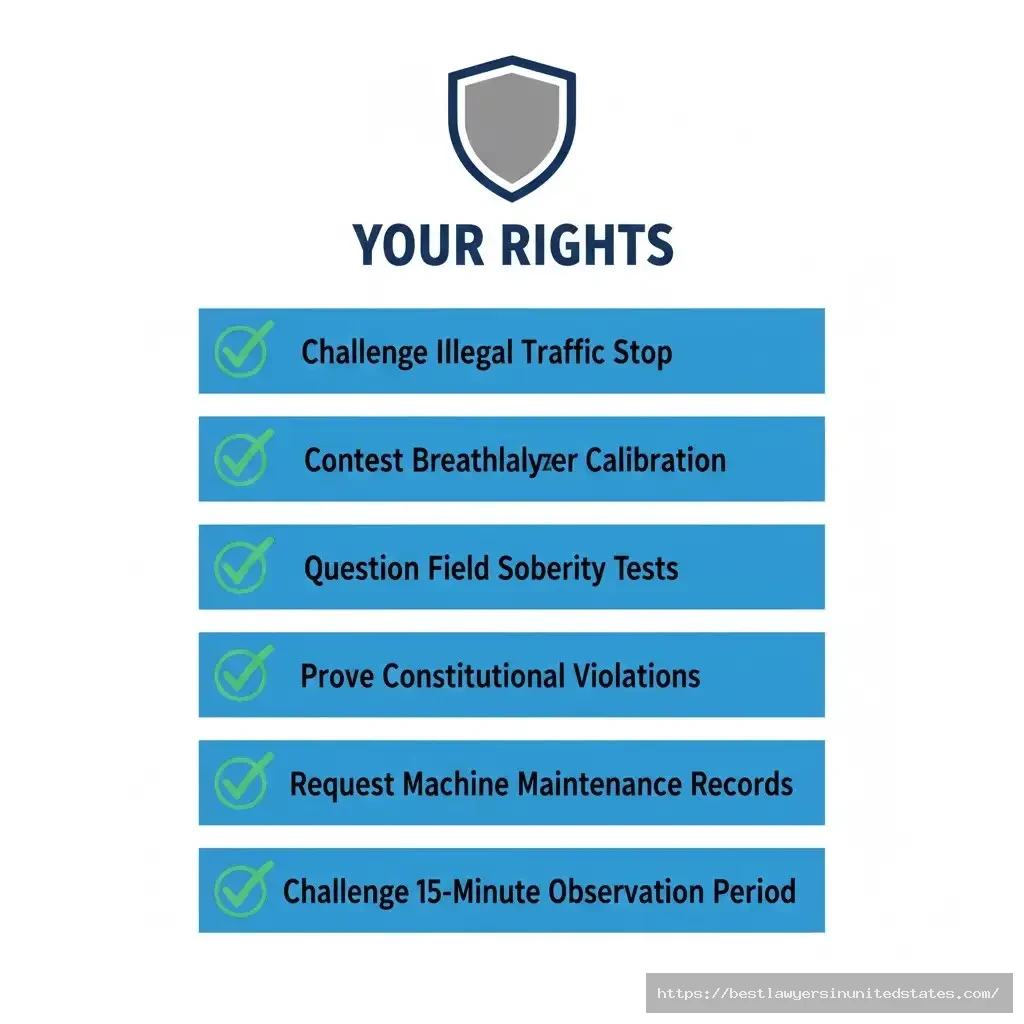
Defending an OUI charge requires understanding legal procedures and common prosecution weaknesses. Many defenses exist even if you failed a breathalyzer test.
Challenging Illegal Traffic Stops
Police must have reasonable suspicion to pull you over. They can’t stop you randomly without observing a traffic violation or suspicious driving behavior.
Common grounds to challenge stops:
- No traffic violation observed
- Anonymous tip without corroboration
- Pretextual stop (stopping for minor violation to investigate OUI)
- Sobriety checkpoint without proper notice
Example: If police stopped you only because you were driving late at night in a bar district, that’s not reasonable suspicion. Your attorney can file a motion to suppress all evidence from that stop.
Contesting Breathalyzer Accuracy
The Alcotest 9510 breathalyzer must be properly maintained and calibrated. Massachusetts courts require strict adherence to testing protocols.
Ways to challenge breathalyzer results:
- Machine not calibrated within required timeframe
- Officer not certified to operate device
- Improper observation period (must watch you for 15 minutes)
- Medical conditions affecting results (GERD, diabetes)
- Mouth alcohol from recent drinking or burping
Your attorney can subpoena machine maintenance records and certification documents. Many OUI cases get dismissed due to breathalyzer maintenance violations.
Field Sobriety Test Reliability Issues
Field sobriety tests have high error rates even with sober drivers. Many factors affect performance besides alcohol consumption.
Reasons people fail sober:
- Age over 50 (balance naturally decreases)
- Weight over 250 pounds
- Back, knee, or leg injuries
- Inner ear problems
- Anxiety or nervousness
- Poor roadside lighting
- Uneven pavement surface
- Restrictive clothing or shoes
Legal challenge: Police officers often don’t follow National Highway Traffic Safety Administration (NHTSA) standardized testing procedures. Even minor deviations can make test results unreliable.
Constitutional Rights Violations
Your constitutional rights protect you from illegal searches and self-incrimination. Common violations that can lead to case dismissal:
Fourth Amendment violations:
- Search without warrant or consent
- Extended detention without probable cause
- Forced blood draw without warrant
- Vehicle search beyond legal scope
Fifth Amendment violations:
- Continued questioning after requesting attorney
- Coerced statements
- Failure to read Miranda rights before interrogation
When to Hire an OUI Attorney
Quick Answer: Hire an attorney immediately after arrest, preferably before arraignment. Early legal help improves your chances of case dismissal or reduced charges.
What OUI attorneys do:
- Challenge illegal stops and searches
- Negotiate with prosecutors for reduced charges
- File motions to suppress evidence
- Arrange alternative dispositions
- Represent you at RMV hearings
- Negotiate Cahill disposition (second offense)
Average Massachusetts OUI attorney costs:
- First offense: $2,500-$5,000
- Second offense: $5,000-$10,000
- Third offense/felony: $10,000-$25,000
- Trial cases: $15,000-$50,000
Many attorneys offer payment plans. Public defenders are available if you can’t afford private counsel.
Find OUI lawyers in Massachusetts: Email [email protected] for free consultation referrals.
Massachusetts OUI Checkpoints and Your Rights
Massachusetts allows sobriety checkpoints under specific constitutional guidelines. Understanding your rights helps you navigate checkpoints legally.
Legality of Checkpoints in Massachusetts
The Massachusetts Supreme Judicial Court approved sobriety checkpoints in 1988. However, police must follow strict guidelines to make checkpoints constitutional.
Required checkpoint procedures:
- Advance public notice (media announcement)
- Neutral selection formula (every car, every third car, etc.)
- Clear signage warning of checkpoint ahead
- Supervisor oversight and written guidelines
- Brief, non-intrusive stops
- Safety measures (lighting, cones, warnings)
Checkpoints that violate these requirements are illegal. Any evidence from illegal checkpoints gets suppressed.
What to Expect at a Checkpoint
Police stop vehicles briefly to look for signs of intoxication. Most drivers pass through checkpoints in 30-60 seconds without incident.
Typical checkpoint procedure:
- Officer approaches and greets you
- Asks for license and registration
- Looks for alcohol odor, slurred speech, bloodshot eyes
- Asks if you’ve been drinking
- Either waves you through or directs you to secondary screening
Secondary screening: If police suspect intoxication, they direct you to a secondary area for field sobriety tests and further investigation.
Your Rights During a Checkpoint Stop
You maintain constitutional rights at sobriety checkpoints despite the stop’s mandatory nature.
What you must do:
- Stop when directed by police
- Provide license, registration, and insurance
- Truthfully identify yourself
What you can refuse:
- Answer questions about drinking (“Have you been drinking?”)
- Perform field sobriety tests
- Consent to vehicle searches
- Exit your vehicle (unless arrested)
Fifth Amendment right: You can politely decline to answer questions. Say “I prefer not to answer questions” or “I want to speak with my attorney.”
Can You Turn Around Before a Checkpoint?
You can legally turn away from a checkpoint if you do so safely and legally. However, police often position checkpoints to make avoidance difficult.
Legal turn-around: Make a legal U-turn or turn onto a side street before reaching the checkpoint.
Illegal avoidance: Making an illegal U-turn, dangerous maneuver, or traffic violation gives police reasonable suspicion to pull you over. The OUI investigation then proceeds normally.
Warning: Some checkpoints have spotters positioned before the checkpoint. They watch for drivers who attempt to avoid the stop, then radio ahead to patrol units who pull over suspicious vehicles.
Total Cost of an OUI in Massachusetts
An OUI conviction costs far more than just court fines. Total expenses over five years often exceed $15,000 for a first offense and $25,000+ for subsequent offenses.
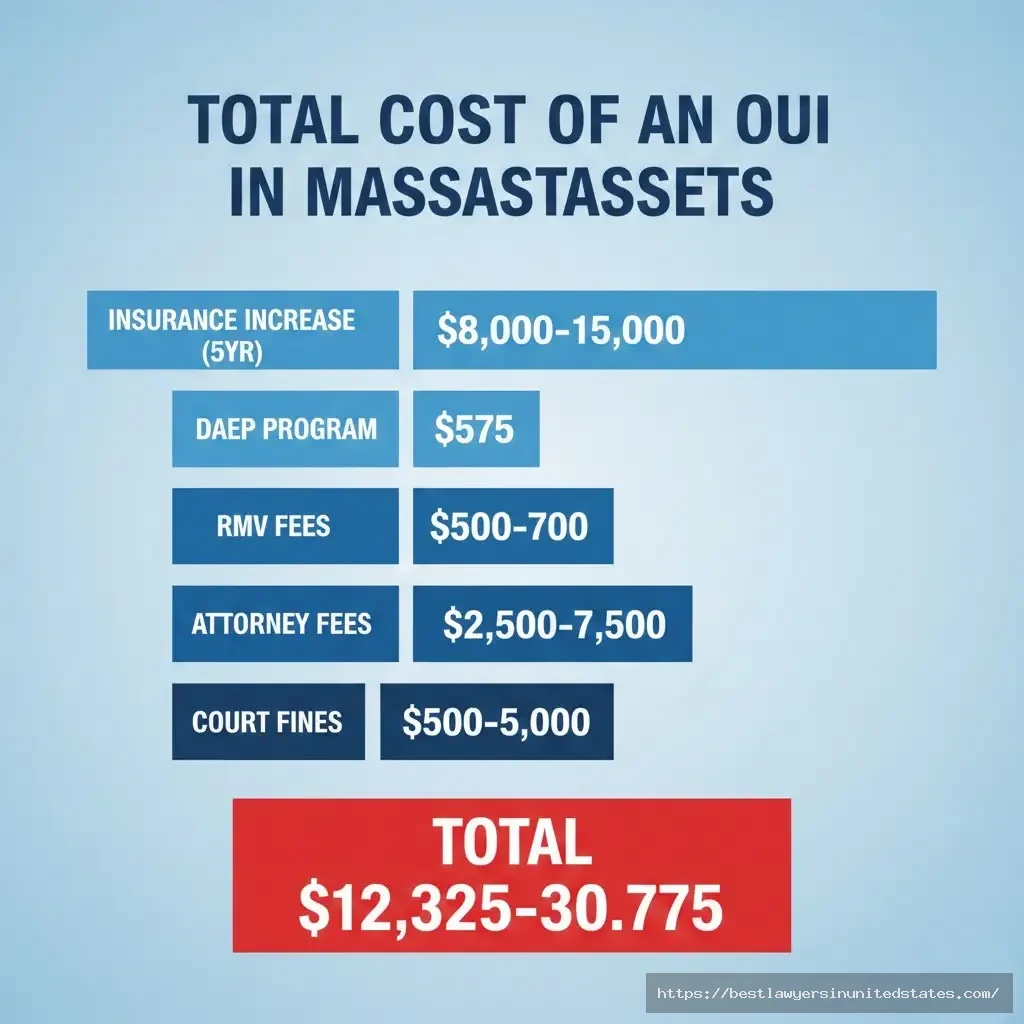
Itemized Cost Breakdown by Offense Level
| Cost Category | First Offense | Second Offense | Third Offense |
|---|---|---|---|
| Court fines | $500-$5,000 | $600-$10,000 | $1,000-$15,000 |
| Court costs | $250-$500 | $250-$500 | $500-$750 |
| Attorney fees | $2,500-$7,500 | $5,000-$15,000 | $10,000-$30,000 |
| RMV reinstatement | $500-$700 | $700-$1,200 | $1,200-$1,500 |
| DAEP/treatment | $575 | $3,000-$5,000 | $5,000-$8,000 |
| Ignition interlock | $0-$1,500 | $2,000-$3,300 | $8,000-$13,200 |
| SR-22 insurance | $0 | $500-$1,000 | $1,000-$2,000 |
| Insurance increase (5yr) | $8,000-$15,000 | $15,000-$25,000 | $20,000-$40,000 |
| Total estimated | $12,325-$30,775 | $27,050-$61,000 | $46,700-$111,450 |
Use our DUI cost calculator for personalized Massachusetts estimates based on your specific situation.
Hidden Costs Often Overlooked
Beyond direct legal expenses, OUI convictions trigger numerous indirect costs:
Employment costs:
- Lost wages during court appearances
- Job loss (especially for CDL holders)
- Background check failures for new jobs
- Professional license suspensions
Transportation costs:
- Uber/Lyft during suspension period
- Taxi fare to court and programs
- Public transportation passes
Personal costs:
- Bail money (if not released on personal recognizance)
- Towing and impound fees ($200-$400)
- Alternative transportation for family members
- Higher life insurance premiums
Massachusetts Insurance Rate Increases
Insurance companies view OUI as high-risk behavior. Your rates increase dramatically and remain elevated for years.
Typical premium increases:
| Years After OUI | Rate Increase | Example Annual Cost |
|---|---|---|
| Year 1-3 | 200%-300% | $6,000-$9,000 |
| Year 4-5 | 100%-150% | $4,000-$5,000 |
| Year 6+ | Returns to normal | $2,000-$3,000 |
Base assumption: $2,000/year before OUI. Some drivers with multiple violations face cancellation and must obtain high-risk insurance through the Massachusetts Assigned Risk Pool, costing even more.
Long-Term Financial Impact
The financial consequences extend well beyond five years:
10-year impact:
- Lifetime earnings reduction: $50,000-$150,000
- Career advancement delays or prevention
- Loan denials or higher interest rates
- Security clearance disqualification
- Professional reputation damage
Second and third offenses compound these costs. Many people file bankruptcy after multiple OUI convictions.
How Long Does an OUI Stay on Your Record?
OUI convictions remain on your record permanently in Massachusetts. However, different types of records affect you differently over time.
Criminal Record Implications
Massachusetts maintains permanent criminal records for all OUI convictions. There’s no automatic expungement after a certain period.
What stays on your record forever:
- Court conviction records
- Massachusetts Department of Criminal Justice Information (DCJIS) database
- FBI criminal history database
- CORI (Criminal Offender Record Information) reports
Who can see your criminal record:
- All employers conducting background checks
- Professional licensing boards
- Housing landlords
- Educational institutions
- Military recruiters
- Immigration officials
RMV Driving Record
The RMV maintains OUI records on your driving history indefinitely. These records never get removed.
RMV record includes:
- OUI conviction dates
- License suspension periods
- Reinstatement dates
- Ignition interlock requirements
- All administrative actions
Insurance companies access RMV records when setting rates. Your OUI remains visible to insurers permanently, though rate impacts decrease after five years.
Insurance Record (SDIP Points)
Massachusetts Safe Driver Insurance Plan (SDIP) assigns points for OUI convictions. These points directly affect insurance rates.
SDIP point values:
- OUI conviction: 5 points
- Points remain active: 6 years from conviction date
- Major impact years: Years 1-3
- Moderate impact: Years 4-6
- After 6 years: Points removed, rates normalize
Employment Background Checks
Most employers conduct criminal background checks. Massachusetts law limits how employers can use criminal records:
CORI reform protections:
- Employers can’t ask about arrests not leading to conviction
- First offense misdemeanors can be sealed after 3 years
- Employers must consider rehabilitation and time passed
- Jobs requiring driving still consider OUI heavily
However: These protections don’t apply to positions requiring clean driving records like commercial driving, delivery services, or company vehicle use.
Can You Seal or Expunge an OUI?
Massachusetts offers limited options for sealing OUI records. Expungement (complete erasure) is not available for OUI convictions.
Sealing eligibility:
- Wait 10 years from conviction or release from custody (whichever is later)
- No additional criminal convictions during waiting period
- File petition with court that convicted you
- Pay filing fees ($175-$200)
- Attend hearing where prosecutor may object
If granted: The conviction still exists but doesn’t appear on most background checks. Law enforcement and courts can still access sealed records.
What cannot be sealed:
- Second or subsequent OUI convictions
- OUI causing serious injury or death
- Convictions involving child endangerment
- Pending criminal charges
Out-of-State DUI Convictions and Massachusetts Drivers
Massachusetts participates in interstate agreements that share DUI conviction information. An out-of-state DUI affects your Massachusetts license.
Interstate Driver’s License Compact
The Driver’s License Compact (DLC) shares conviction information between 45 member states. Massachusetts receives notification when you’re convicted in another state.
How it works:
- You get convicted of DUI in another state
- That state reports conviction to Massachusetts
- RMV records conviction on your Massachusetts driving record
- Massachusetts may impose additional penalties
Non-member states: Georgia, Massachusetts, Michigan, Tennessee, and Wisconsin don’t fully participate. However, Massachusetts still learns about most out-of-state convictions through other data-sharing agreements.
How Out-of-State DUIs Affect Your MA License
Massachusetts treats out-of-state DUI convictions the same as Massachusetts OUI convictions for license suspension purposes.
RMV actions after out-of-state DUI:
- Immediate license suspension matching the out-of-state penalty
- Additional Massachusetts suspension period
- Requirement to complete Massachusetts alcohol programs
- Ignition interlock device requirement (second offense)
Example: If you’re convicted of DUI in Florida and receive a 6-month suspension there, Massachusetts adds its own suspension period. You could face 12+ months total without a valid license.
Massachusetts Lookback Periods for Out-of-State Offenses
Massachusetts counts out-of-state DUI convictions when determining whether you’re a repeat offender.
How lookback works:
- Prior 10 years: Out-of-state DUI counts as first prior offense
- Lifetime lookback: Third offense uses all prior convictions regardless of state or date
Example: A 2015 DUI in New York plus a 2026 OUI in Massachusetts = second offense penalties in Massachusetts.
What to Do If You Get a DUI Out of State
Immediate steps:
- Hire local attorney in state where arrested
- Notify Massachusetts RMV within 5 days
- Contact Massachusetts OUI attorney to protect home state license
- Don’t ignore out-of-state charges (arrest warrant may be issued)
- Attend all required hearings even if traveling is difficult
Critical point: You must resolve the out-of-state case. Massachusetts won’t reinstate your license until you’ve complied with all out-of-state requirements and penalties.
Frequently Asked Questions About Massachusetts OUI Laws
How long do you lose your license for a DUI in Massachusetts?
Quick Answer: First offense results in 45-90 days suspension with alcohol program completion, or one year without the program.
License suspension periods vary by offense level:
- First OUI: 45-90 days (with alternative disposition) or one year (standard)
- Second OUI: 2 years minimum
- Third OUI: 8 years
- Refusal: 180 days to lifetime depending on prior refusals
You may be eligible for hardship license earlier for work or education needs.
What is the penalty for first offense DUI in Massachusetts?
Quick Answer: First offense penalties include $500-$5,000 fine, up to 2.5 years jail time (rarely imposed), 45-90 day license suspension, and mandatory alcohol education program.
Most first offenders receive probation and avoid jail through the 24D alternative disposition. Total costs typically range from $5,000-$15,000 including all fees, programs, and attorney costs.
Is a DUI a felony in Massachusetts?
Quick Answer: A third or subsequent OUI is a felony in Massachusetts. First and second offenses are misdemeanors.
Felony OUI carries:
- 180 days minimum jail time (third offense)
- 2 years minimum (fourth offense)
- Up to 5 years in state prison
- $1,000-$15,000 fines
- 8-10 year license suspension
What happens if you refuse a breathalyzer in Massachusetts?
Quick Answer: Refusing a breathalyzer results in automatic 180-day license suspension for first refusal, plus the refusal can be used as evidence against you in court.
The suspension happens regardless of whether you’re eventually convicted of OUI. Second refusal brings a 3-year suspension. Third refusal brings a 5-year suspension.
Can you refuse a breathalyzer in Massachusetts?
Quick Answer: Yes, you can legally refuse a breathalyzer, but Massachusetts law imposes harsher license suspension penalties for refusal than for taking and failing the test.
Refusal doesn’t prevent OUI prosecution. Police can still arrest and charge you based on field sobriety tests, driving behavior, and physical observations of intoxication.
What is the blood alcohol limit in Massachusetts?
Quick Answer: The legal BAC limit is 0.08% for drivers 21 and over, 0.02% for drivers under 21, and 0.04% for commercial drivers.
You can be convicted of OUI even with a BAC below 0.08% if prosecutors prove you were impaired by alcohol or drugs. Calculate your BAC with our BAC calculator.
What is OUI vs DUI in Massachusetts?
Quick Answer: OUI (Operating Under the Influence) is Massachusetts’ official legal term for drunk driving. It means the same thing as DUI (Driving Under the Influence) used in other states.
Massachusetts, Maine, and Rhode Island use OUI terminology exclusively. All legal documents, court records, and police reports reference OUI, not DUI.
How much does a DUI lawyer cost in Massachusetts?
Quick Answer: Massachusetts OUI attorneys charge $2,500-$7,500 for first offenses, $5,000-$15,000 for second offenses, and $10,000-$30,000 for felony cases that go to trial.
Many attorneys offer free consultations and payment plans. Public defenders are available for those who can’t afford private counsel. Contact [email protected] for lawyer referrals.
Can you get a hardship license after a DUI in Massachusetts?
Quick Answer: Massachusetts doesn’t issue traditional hardship licenses for first offenses, but you can get early reinstatement with an ignition interlock device after completing your alcohol program.
For multiple offenses, you may petition for a hardship license after serving part of your suspension. The RMV grants these rarely and only for essential needs like medical appointments or work.
How long does an OUI stay on your record in Massachusetts?
Quick Answer: OUI convictions remain on your criminal and driving records permanently in Massachusetts. There’s no automatic expungement, though you may be able to seal your record after 10 years.
Insurance rate impacts decrease after 5-6 years. Employment background checks will show the conviction indefinitely unless sealed through court petition.
What is a Cahill Disposition in Massachusetts?
Quick Answer: A Cahill Disposition is a special alternative for second OUI offenders that treats the case like a first offense for sentencing purposes, resulting in reduced penalties.
You must meet specific eligibility requirements: first OUI occurred more than 10 years ago, no other OUI convictions between, and court finds “good cause.” Your attorney must request this option.
What is the Cinderella Law in Massachusetts?
Quick Answer: The Cinderella Law restricts Junior Operator License holders (under 18) from driving between 12:30 AM and 5:00 AM unless accompanied by a parent or driving to work.
Violating this law combined with OUI results in extended license suspension and delayed eligibility for a full license. Most underage OUI arrests occur during these restricted hours.
What happens to CDL holders with a DUI in Massachusetts?
Quick Answer: CDL holders face one-year commercial driving disqualification for first OUI and lifetime disqualification for second OUI, even if the offense occurred in a personal vehicle.
Most trucking companies won’t hire drivers with any OUI history. The conviction effectively ends your commercial driving career regardless of whether you eventually regain your CDL.
Do you go to jail for first OUI in Massachusetts?
Quick Answer: Most first-time OUI offenders avoid jail through alternative disposition (24D). The law allows up to 2.5 years jail time, but courts rarely impose incarceration for first offense.
You typically receive probation, fines, license suspension, and mandatory alcohol education instead. Jail becomes more likely with aggravating factors like accidents, high BAC (0.15%+), or child endangerment.
Can you beat an OUI charge in Massachusetts?
Quick Answer: Yes, OUI charges can be beaten through challenging illegal stops, contesting breathalyzer accuracy, demonstrating field sobriety test unreliability, or proving constitutional rights violations.
Success depends on case specifics. Many Massachusetts OUI cases get dismissed or reduced due to procedural errors, improper testing, or lack of probable cause. Hiring an experienced OUI attorney significantly improves your chances.
Find Massachusetts OUI Court Locations and Resources
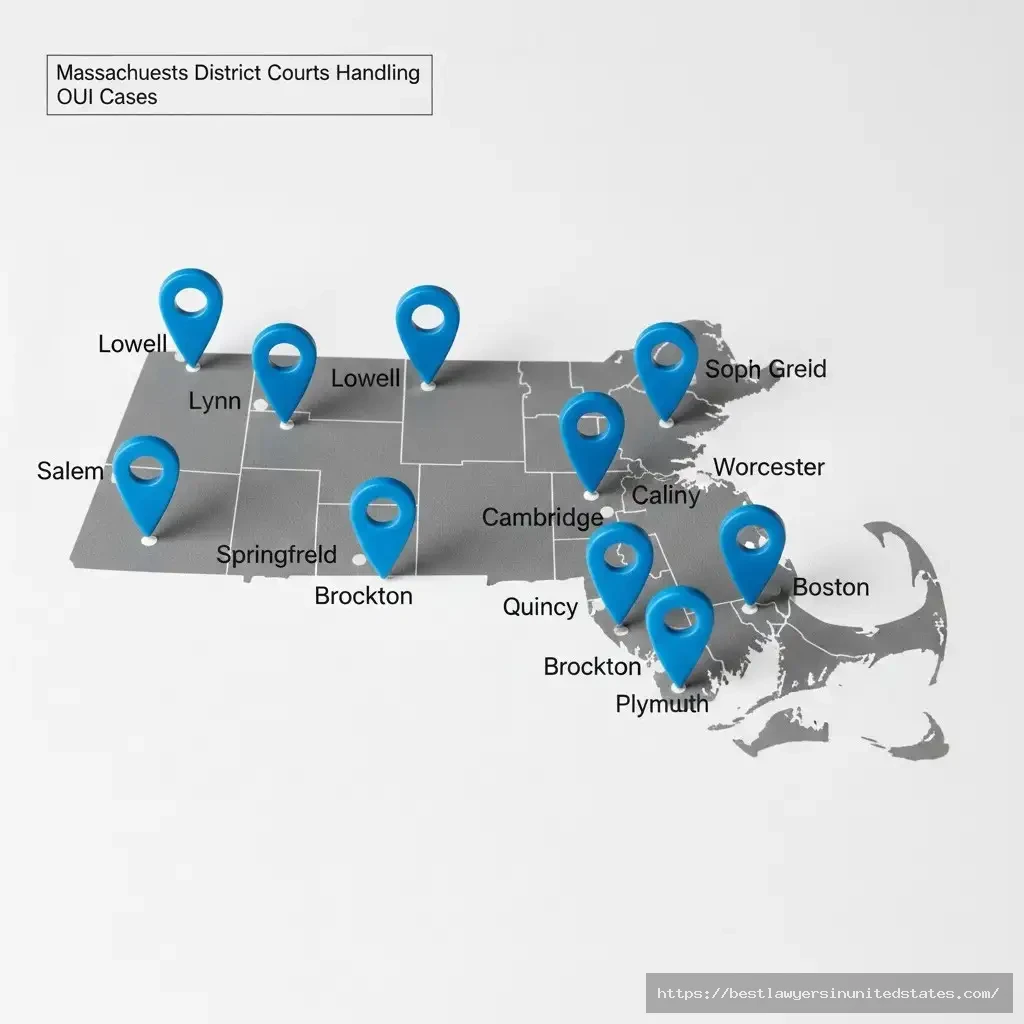
District Courts Handling OUI Cases
Massachusetts handles most OUI cases in District Courts across 14 counties. Your case goes to the court nearest your arrest location.
Major OUI courts by region:
Greater Boston:
- Boston Municipal Court – 24 New Chardon Street, Boston
- Cambridge District Court – 4040 Mystic Valley Parkway, Medford
- Quincy District Court – 1 Dennis F. Ryan Parkway, Quincy
- Dedham District Court – 631 High Street, Dedham
North Shore:
- Salem District Court – 56 Federal Street, Salem
- Lynn District Court – 580 Essex Street, Lynn
- Lowell District Court – 370 Jackson Street, Lowell
- Lawrence District Court – 2 Appleton Street, Lawrence
Central Massachusetts:
- Worcester District Court – 225 Main Street, Worcester
- Framingham District Court – 600 Concord Street, Framingham
- Marlborough District Court – 157 Main Street, Marlborough
Western Massachusetts:
- Springfield District Court – 50 State Street, Springfield
- Northampton District Court – 15 Gothic Street, Northampton
- Pittsfield District Court – 76 East Street, Pittsfield
South Shore/Cape Cod:
- Brockton District Court – 215 Main Street, Brockton
- Plymouth District Court – 52 Obery Street, Plymouth
- Barnstable District Court – 3195 Main Street, Barnstable
Massachusetts RMV Service Centers
Complete license reinstatement at RMV Service Centers after your suspension ends.
Major RMV locations:
- Boston (Chinatown) – 136 Blackstone Street
- Worcester – 166 High Street
- Springfield – 1350 Liberty Street
- Brockton – 40 Pearl Street
- Lowell – 155 Branch Street
- Fall River – 1 Maple Street
- New Bedford – 741 Belleville Avenue
Online services: Mass.gov/rmv handles hearing requests, license status checks, and form downloads. Some services available 24/7.
Driver Alcohol Education Program (DAEP) Providers
Complete your mandatory DAEP at approved locations across Massachusetts.
Program information:
- Duration: 16 hours (eight 2-hour sessions)
- Cost: Approximately $575
- Schedule: Two consecutive weekends or four weeknights
- No absences allowed
Contact the Massachusetts Department of Public Health for a complete provider list at mass.gov/dph.
Ignition Interlock Device Installation Centers
Install your required IID at RMV-approved provider locations.
Major IID providers in Massachusetts:
- LifeSafer – Multiple locations statewide
- Smart Start – Boston, Worcester, Springfield areas
- Monitech – Greater Boston area
- Guardian Interlock – Statewide service
- Intoxalock – Multiple Massachusetts locations
Schedule installation appointments 1-2 weeks before your eligibility date. Bring your RMV authorization letter and vehicle registration.
Legal Aid and Support Resources
Massachusetts Bar Association Lawyer Referral Service:
- Phone: (617) 742-0625
- Website: massbar.org
- Free 30-minute consultations
Committee for Public Counsel Services (CPCS):
- Public defender office for low-income defendants
- Phone: (617) 482-6212
- Apply through court clerk at arraignment
Need OUI attorney referrals? Email [email protected] for free consultation connections with experienced Massachusetts OUI lawyers.
Related state DUI resources:
- Compare penalties: Alabama DUI Laws | Connecticut DUI Laws | Louisiana DUI Laws
- Calculate costs: DUI Cost Calculator
- Check your BAC: BAC Calculator
