
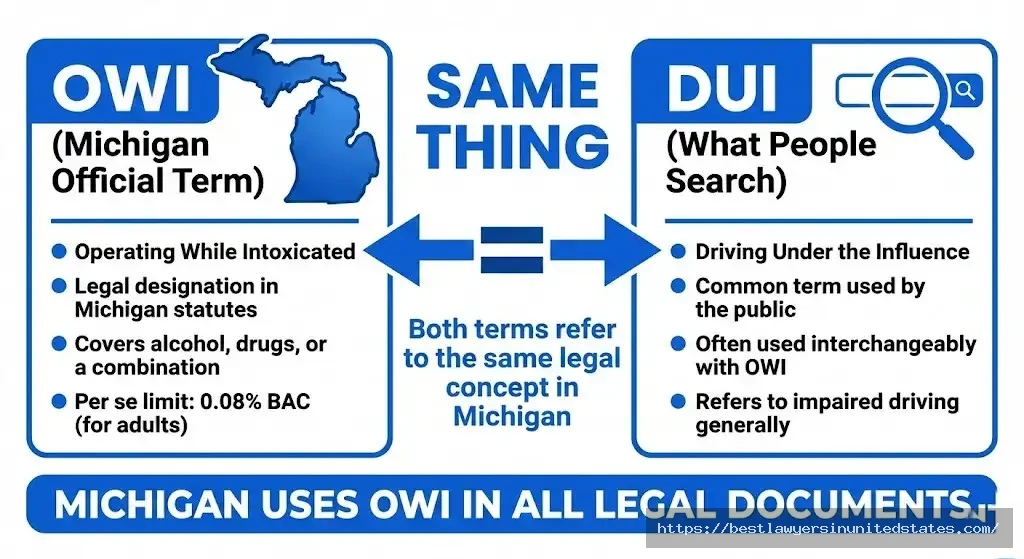
Michigan calls drunk driving “OWI” (Operating While Intoxicated), not DUI. First-time offenders face up to 93 days in jail, $100-$500 in fines, and 6-month license suspension. Michigan’s unique “Super Drunk” law adds harsher penalties for BAC of 0.17% or higher.
This guide explains Michigan’s OWI laws, penalties, costs, license restoration, and the Clean Slate expungement law.
Understanding Michigan OWI Laws
Michigan OWI vs DUI: What’s the Difference?
Quick Answer: Michigan uses “OWI” (Operating While Intoxicated) as the official legal term, not DUI. They mean the same thing.
Michigan Compiled Law (MCL) 257.625 defines the offense as OWI. People search “DUI” because most states use that term. Courts, police reports, and the Michigan Secretary of State all use “OWI” in official documents.
Michigan also uses OWVI (Operating While Visibly Impaired) for lesser impairment cases. OWVI carries lighter penalties than OWI.
Michigan BAC Limits by Driver Type
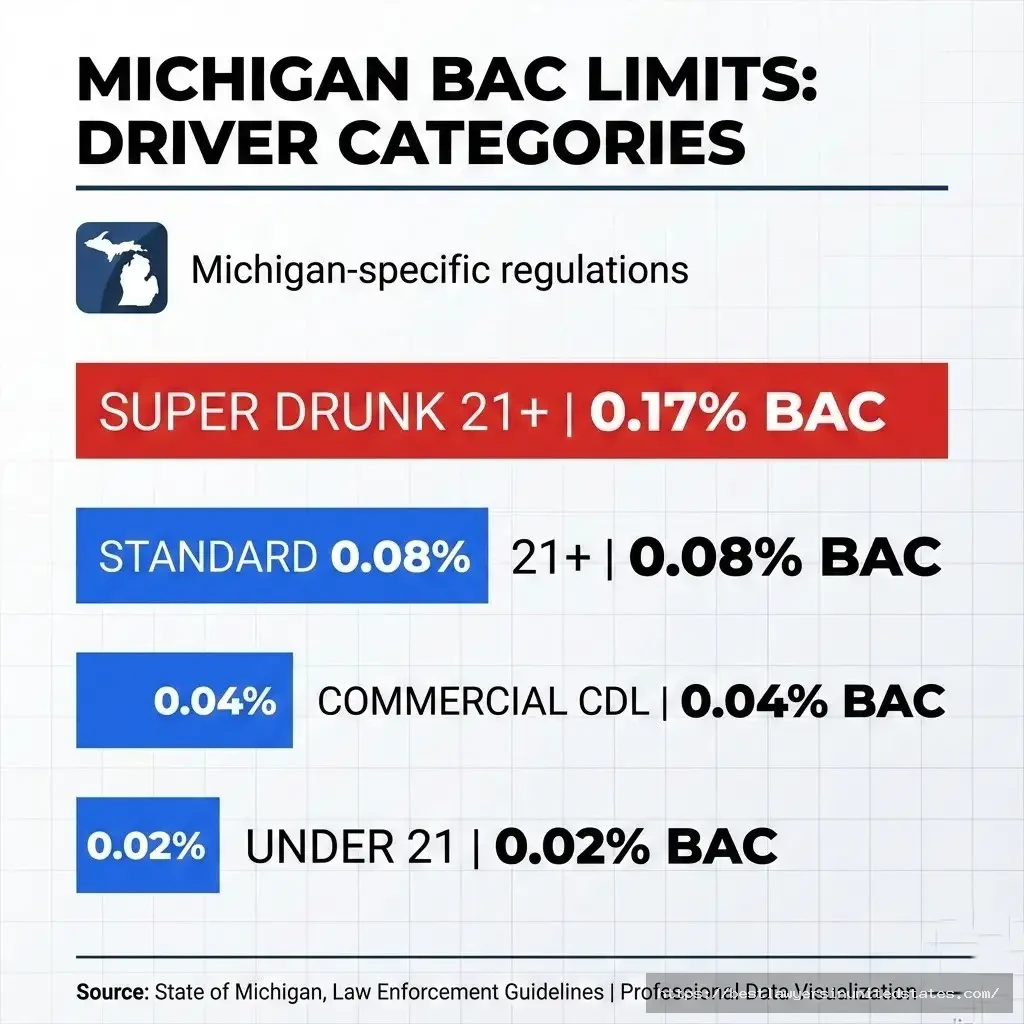
Different drivers face different legal limits in Michigan:
| Driver Type | BAC Limit | Violation |
|---|---|---|
| Standard (21+) | 0.08% | OWI |
| High BAC (21+) | 0.17% | Super Drunk OWI |
| Under 21 | 0.02% | Zero Tolerance |
| Commercial (CDL) | 0.04% | CDL OWI |
Important: You can face OWI charges below 0.08% if officers observe impaired driving.
What is Michigan’s “Super Drunk” Law?
Michigan’s Super Drunk law (MCL 257.625(1)(c)) targets drivers with BAC of 0.17% or higher.
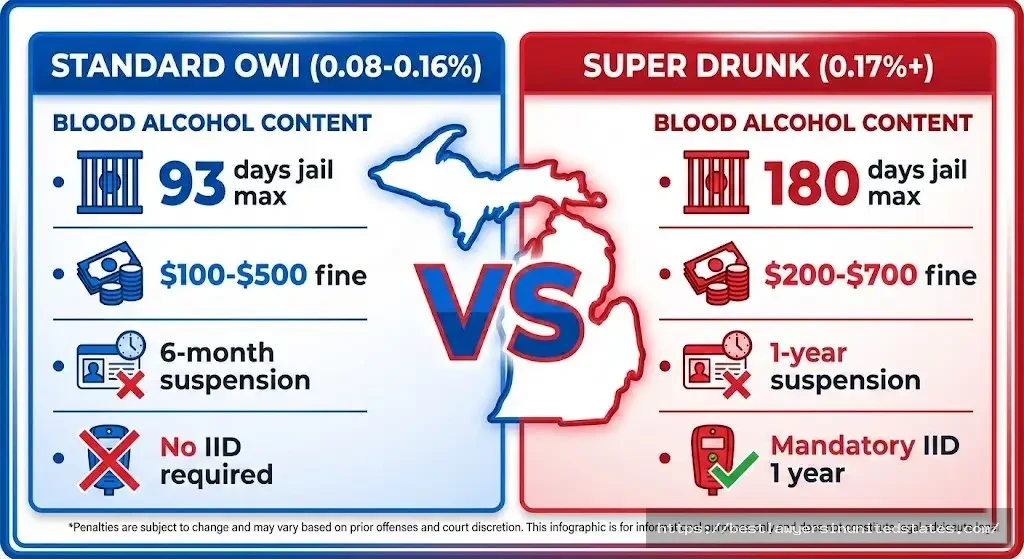
Super Drunk penalties include:
- Higher fines ($200-$700 vs. $100-$500)
- Longer jail time (up to 180 days vs. 93 days)
- Mandatory 1-year ignition interlock device
- 1-year license suspension (vs. 6 months for standard OWI)
- Higher driver responsibility fees
Example: A driver with 0.18% BAC faces Super Drunk charges. A driver with 0.10% BAC faces standard OWI charges.
Michigan Implied Consent Law
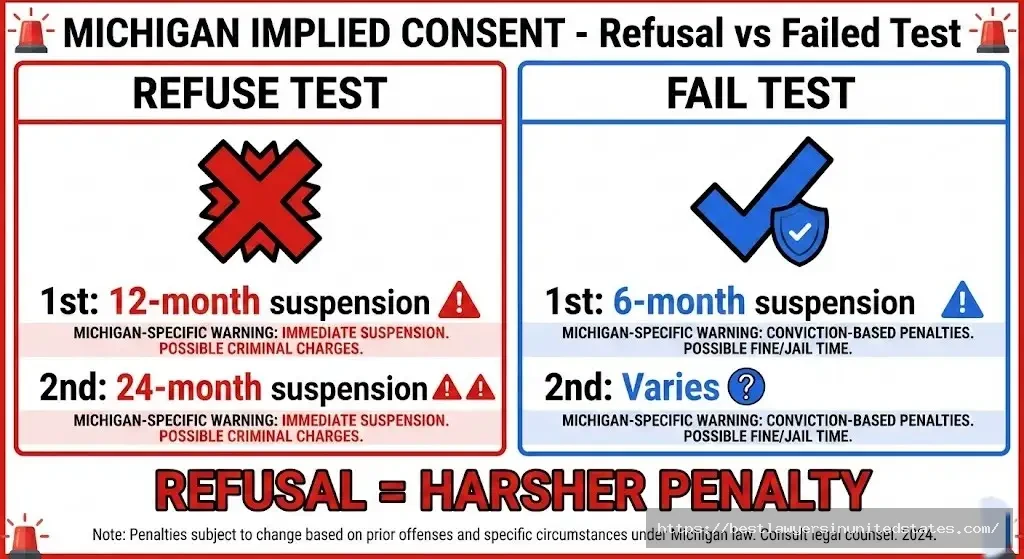
Every Michigan driver automatically agrees to chemical testing when they get a license. This “implied consent” under MCL 257.625c applies the moment an officer arrests you for suspected OWI.
What happens if you refuse testing:
| Offense | Refusal Penalty | Failed Test Penalty |
|---|---|---|
| 1st refusal | 12-month suspension | 6-month suspension |
| 2nd refusal | 24-month suspension | Varies by offense |
Officers must read you the implied consent warning before requesting breath, blood, or urine tests. The warning explains that refusing triggers automatic license suspension.
Critical point: The refusal suspension applies even if you’re never convicted of OWI. It runs separately from any criminal court penalties.
Check Your BAC Level
Not sure if you’re over Michigan’s legal limit? Our BAC calculator helps estimate your blood alcohol content based on drinks consumed, body weight, and time.
BAC Calculator
Estimate your Blood Alcohol Content
• Commercial Driver (CDL): 0.04% BAC
• Drivers Under 21: 0.00-0.02% BAC (Zero Tolerance)
• Enhanced Penalties: 0.15% BAC or higher in most states
Understanding your BAC helps you make safer decisions about driving.
Michigan OWI Penalties by Offense
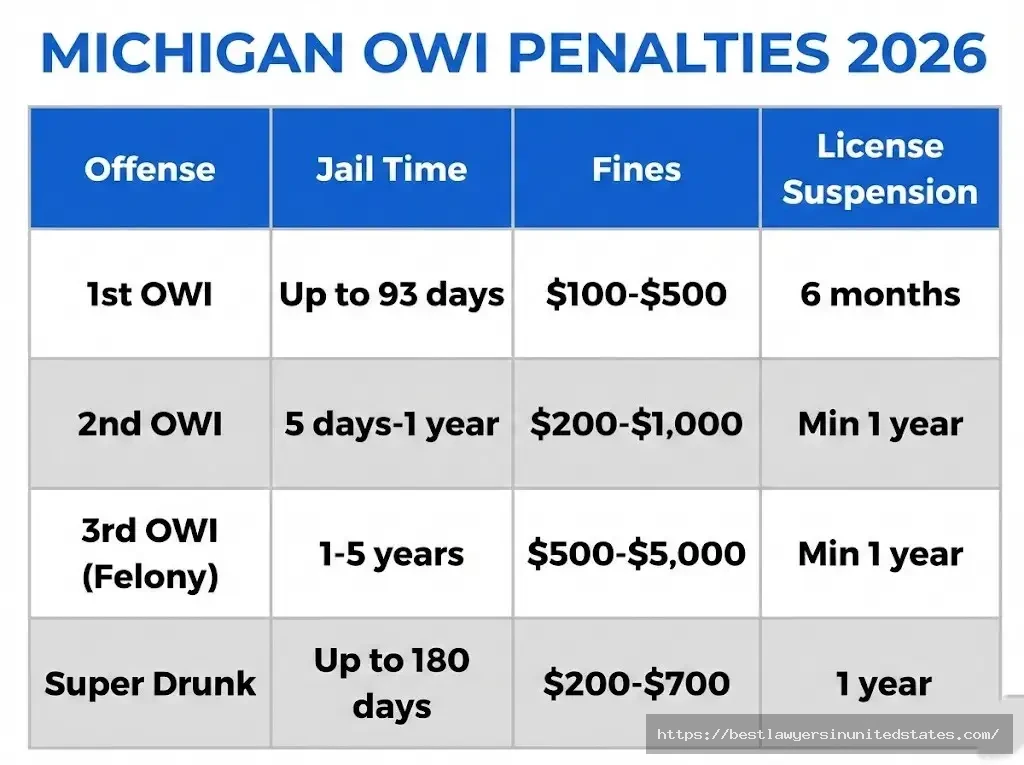
1st Offense OWI in Michigan
Quick Answer: First-time OWI offenders face up to 93 days in jail, $100-$500 in fines, 6-month license suspension, and 6 points on their driving record.
Complete 1st offense penalties:
| Penalty Type | Amount/Duration |
|---|---|
| Jail time | Up to 93 days |
| Fines | $100-$500 |
| License suspension | 6 months (30 days hard, then restricted) |
| Community service | Up to 360 hours |
| Points | 6 points |
| Probation | Up to 2 years |
Will you go to jail for a first OWI? Most first-time offenders avoid jail through probation, community service, and alcohol treatment programs. Judges consider your BAC level, driving record, and whether anyone was injured.
1st Offense OWVI (Impaired Driving)
OWVI is a lesser charge for visible impairment without reaching 0.08% BAC.
OWVI penalties:
- Up to 93 days in jail (rarely imposed)
- $100-$300 in fines
- 90-day restricted license
- 4 points on driving record
- Up to 360 hours community service
Key difference: OWVI allows restricted driving privileges immediately. OWI requires a 30-day hard suspension first.
Many OWI charges get reduced to OWVI through plea bargaining.
2nd Offense OWI (Within 7 Years)
Quick Answer: Second OWI carries mandatory 5 days to 1 year in jail, $200-$1,000 in fines, and minimum 1-year license revocation.
Complete 2nd offense penalties:
| Penalty Type | Amount/Duration |
|---|---|
| Jail time | 5 days to 1 year (mandatory minimum) |
| Fines | $200-$1,000 |
| License revocation | Minimum 1 year (5 days hard, then restricted) |
| Community service | 30-90 days |
| Vehicle immobilization | 90-180 days |
| Points | 6 points |
Is jail time mandatory? Yes. Michigan law requires at least 5 days in jail for a second OWI within 7 years. Some courts allow weekend jail or work release programs.
License revocation vs. suspension: Revocation means your license is canceled. You must reapply through a DLAD hearing after the minimum period.
3rd Offense OWI (Felony)
Quick Answer: Yes, a third OWI in Michigan is a felony. You face 1-5 years in prison, $500-$5,000 in fines, and minimum 1-year license revocation.
Complete 3rd offense penalties:
| Penalty Type | Amount/Duration |
|---|---|
| Prison time | 1-5 years (or probation with 30 days-1 year jail) |
| Fines | $500-$5,000 |
| License revocation | Minimum 1 year (after prison release) |
| Vehicle forfeiture | Possible vehicle seizure |
| Felony record | Permanent (unless expunged) |
Mandatory jail time for 3rd OWI: Courts can sentence probation instead of prison, but probation requires 30 days to 1 year in jail as a condition.
How to avoid jail time for 3rd OWI: Sobriety court programs offer treatment-based alternatives. Acceptance requires admitting guilt and completing intensive supervision.
Super Drunk (High BAC) Penalties
BAC of 0.17% or higher triggers enhanced first-offense penalties:
Super Drunk vs. Standard OWI:
| Penalty | Super Drunk (0.17%+) | Standard OWI (0.08-0.16%) |
|---|---|---|
| Jail time | Up to 180 days | Up to 93 days |
| Fines | $200-$700 | $100-$500 |
| License suspension | 1 year | 6 months |
| Ignition interlock | Mandatory 1 year | Not required (1st offense) |
| Points | 6 points | 6 points |
Critical point: Super Drunk requires ignition interlock even for first-time offenders. Standard OWI does not.
Aggravating Factors That Increase Penalties
Certain circumstances trigger enhanced penalties:
Child endangerment (child under 16 in vehicle):
- Additional 5 days to 1 year in jail
- Additional $200-$1,000 in fines
- Possible child protective services investigation
Causing injury or death:
- OWI causing serious injury: Up to 5 years prison
- OWI causing death: Up to 15 years prison
- Vehicle forfeiture possible
CDL holders:
- 1-year CDL disqualification (first offense)
- Lifetime CDL disqualification (second offense)
- Applies even if driving personal vehicle
Michigan License Suspension & Restoration
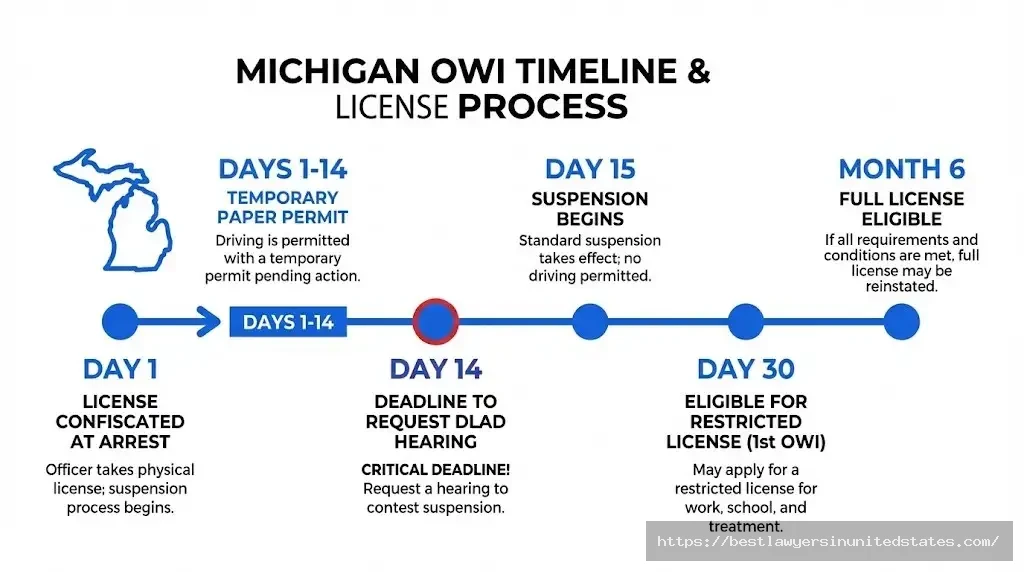
Do You Lose Your License Immediately After an OWI in Michigan?
Quick Answer: Yes, in most cases. Officers confiscate your license at arrest and issue a temporary paper permit valid for 14 days.
Two types of suspensions happen:
- Administrative suspension (Michigan Secretary of State) – Automatic for failed or refused tests
- Criminal suspension (Court-ordered) – Imposed if convicted
Both suspensions can run at the same time. You must satisfy both to restore full driving privileges.
Michigan Secretary of State (Not DMV)
Michigan doesn’t have a “DMV.” The Michigan Secretary of State (SOS) handles all driver licensing, including OWI suspensions.
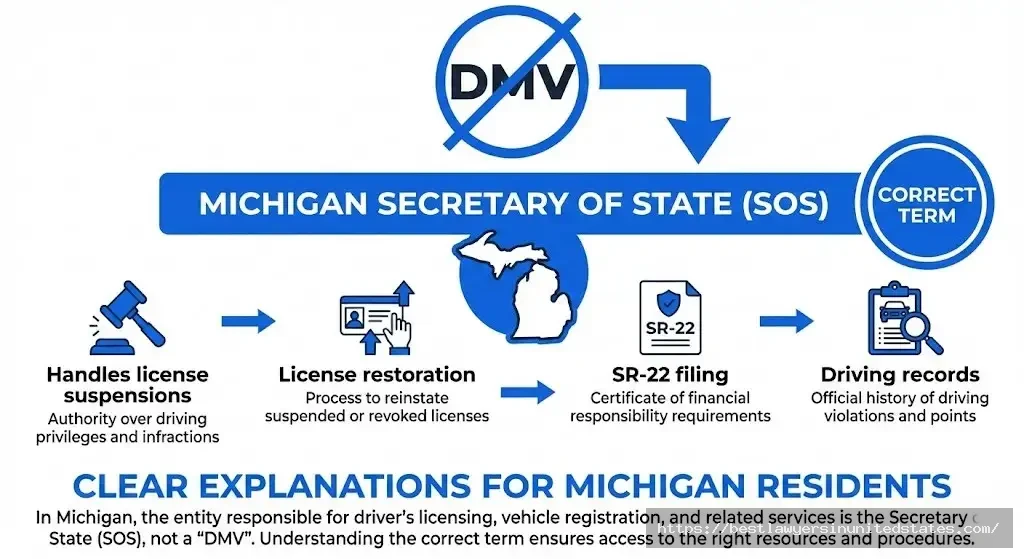
What the Secretary of State does:
- Issues administrative suspensions for failed/refused tests
- Processes license restoration applications
- Maintains driving records
- Approves ignition interlock providers
SOS offices in major Michigan cities:
- Detroit: 1401 E Warren Ave
- Grand Rapids: 3085 Breton Rd SE
- Lansing: 430 W Allegan St
- Ann Arbor: 2270 W Stadium Blvd
Contact SOS at (888) 767-6424 for license status.
License Suspension Periods by Offense
Suspension/revocation timelines:
| Offense | Administrative | Criminal | Total Period |
|---|---|---|---|
| 1st OWI | None (if you test) | 6 months* | 6 months |
| 1st Refusal | 12 months | 6 months (if convicted) | 12 months |
| 2nd OWI | Varies | Minimum 1 year revocation | Minimum 1 year |
| 3rd OWI | Varies | Minimum 1 year revocation | Minimum 5 years |
| Super Drunk | None (if you test) | 1 year* | 1 year |
*First 30 days = hard suspension (no driving). Remaining period = restricted license eligible.
DLAD Hearings (Driver License Appeal Division)
What is DLAD? The Driver License Appeal Division holds administrative hearings for license restoration after revocation.
When you need a DLAD hearing:
- After 2nd or 3rd OWI revocation
- To restore full driving privileges
- To challenge administrative suspension (within 14 days of arrest)
14-day deadline: You have 14 days from arrest to request an administrative hearing to challenge license suspension. Missing this deadline means automatic suspension.
DLAD hearing locations:
- Lansing (primary office)
- Grand Rapids
- Metro Detroit
Hearings require proof of sobriety, substance abuse evaluations, and testimony about lifestyle changes.
The 77-Day Rule Explained
What is the 77-day rule? After conviction, you have 77 days to file an appeal before your license suspension/revocation becomes final.
Why it matters:
- Filing an appeal within 77 days can delay license sanctions
- Your attorney can negotiate during this window
- Missing the deadline makes sanctions immediate and harder to modify
How to comply: Your attorney files a motion for reconsideration or appeal within 77 days of sentencing. This preserves your driving privileges while the appeal is pending.
This rule appears in Michigan Court Rules and applies to most criminal convictions, including OWI.
Getting a Restricted License in Michigan
Eligibility for restricted license:
- After 30-day hard suspension on 1st OWI
- After 45 days on 2nd OWI (with ignition interlock)
- Not available for refusal suspensions
- Not available during hard suspension period
Restricted license allows:
- Driving to/from work
- Driving during work hours (delivery drivers, sales)
- Medical appointments
- Alcohol treatment programs
- 12-step meetings (AA/NA)
- Court-ordered obligations
Application process:
- Wait out hard suspension period
- Complete substance abuse evaluation
- File application with Secretary of State
- Pay $125 reinstatement fee
- Install ignition interlock (if required)
Michigan Ignition Interlock Device (IID) Requirements
When IID is required:
- Mandatory for Super Drunk (0.17%+ BAC)
- Required for restricted license on 2nd offense
- Court may order for 1st offense at judge’s discretion
- Required for DLAD license restoration
How IID works: You blow into the device before starting your car. The engine won’t start if it detects alcohol above 0.025% BAC.
IID costs in Michigan:
| Expense | Amount |
|---|---|
| Installation | $75-$150 |
| Monthly lease | $60-$90 |
| Monthly monitoring | $30-$50 |
| Calibration visits | $20-$40 (every 60 days) |
| Removal fee | $50-$100 |
Total 1-year IID cost: $1,200-$2,000
Approved Michigan IID providers:
- Intoxalock
- LifeSafer
- Smart Start
- Guardian Interlock
Find providers at Michigan.gov/SOS.
SR-22 Insurance in Michigan
What is SR-22? An SR-22 is a certificate proving you carry minimum liability insurance. Michigan requires it after OWI convictions.
How long SR-22 is required:
- First OWI: 2 years from license restoration
- Second OWI: 2 years from restoration
- Third OWI: 3 years from restoration
SR-22 cost impact:
- Filing fee: $25-$50
- Insurance rate increase: 50-100% higher premiums
- Average annual increase: $1,000-$2,000
Your insurance company files SR-22 electronically with the Secretary of State. Letting coverage lapse triggers immediate license suspension.
Full License Restoration Process
Steps to restore full driving privileges:
- Complete suspension/revocation period – Serve minimum required time
- Pay all fines and fees – Court fines, reinstatement fees ($125), driver responsibility fees
- Complete substance abuse treatment – Court-ordered programs
- File restoration application – With Secretary of State
- Pass DLAD hearing (if revoked) – Prove sobriety and lifestyle changes
- Provide SR-22 proof – File with insurance company
- Pay reinstatement fee – $125 to Secretary of State
Fees to restore license:
- Reinstatement fee: $125
- DLAD hearing fee: $200 (if applicable)
- Substance abuse evaluation: $100-$300
- Attorney fees for DLAD hearing: $1,500-$3,000
The Legal Process in Michigan
What Happens When You Get an OWI in Michigan
Timeline from arrest to resolution:
Day 1 – Arrest:
- Officer observes erratic driving or checkpoint
- Field sobriety tests administered
- Preliminary breath test (PBT) on roadside
- Arrest if probable cause exists
- Transport to police station for official chemical test
Within 24 hours – Booking:
- Fingerprinting and photographing
- Official breathalyzer or blood test
- License confiscation
- Bond hearing (or release on personal recognizance)
Within 14 days – Arraignment:
- First court appearance
- Judge reads charges
- You enter plea (guilty, not guilty, no contest)
- Bond conditions set
- Attorney appointment (if needed)
30-60 days – Pre-Trial:
- Discovery (evidence exchange)
- Plea negotiations
- Motion hearings (suppress evidence, dismiss charges)
60-90 days – Trial or Plea:
- Plea agreement accepted, or
- Bench trial (judge decides), or
- Jury trial
After conviction – Sentencing:
- Judge imposes penalties
- Probation conditions explained
- 77-day appeal window begins
Michigan OWI Plea Bargains
Quick Answer: Many OWI charges get reduced to OWVI (Operating While Visibly Impaired) through plea bargaining. This reduces penalties and points.
OWI to OWVI reduction benefits:
| Factor | OWI | OWVI (Reduced) |
|---|---|---|
| Jail time | Up to 93 days | Up to 93 days (rarely imposed) |
| Fines | $100-$500 | $100-$300 |
| License suspension | 6 months | 90 days (restricted immediately) |
| Points | 6 points | 4 points |
| Stigma | More serious | Lesser offense |
When reduction is possible:
- First-time offender
- BAC close to 0.08% (not extremely high)
- No accident or injury
- Clean driving record
- Strong attorney negotiation
Pros of accepting OWVI plea:
- Avoid hard 30-day license suspension
- Fewer points on record
- Lower insurance impact
- Less severe criminal record
Cons of accepting OWVI plea:
- Still a criminal conviction
- Still counts as first offense (second OWI is still “second offense”)
- Still requires probation and fines
Prosecutors consider blood-test reliability, officer testimony strength, and court backlog when offering plea deals.
Can an OWI Be Dropped in Michigan?
Quick Answer: OWI charges can be dismissed if police violated your rights, evidence is unreliable, or procedural errors occurred. Success rates vary.
Common dismissal scenarios:
- Illegal traffic stop (no reasonable suspicion)
- Breathalyzer not properly calibrated
- Officer failed to observe 15-minute waiting period before breath test
- Blood sample chain-of-custody broken
- Miranda rights not read
- Field sobriety tests improperly administered
Defense success likelihood:
- Strong case (clear violations): 20-30% dismissal rate
- Moderate case (some issues): 5-10% dismissal rate
- Weak case (minor issues): 1-3% dismissal rate
Most cases resolve through plea bargaining rather than dismissal.
Common Legal Defenses in Michigan OWI Cases
Challenging the traffic stop:
- Officer lacked reasonable suspicion
- Checkpoint violated constitutional rules
- Anonymous tip without corroboration
Challenging BAC test results:
- Breathalyzer maintenance records missing
- Officer not certified to operate equipment
- Medical conditions (GERD, diabetes) affected results
- Mouth alcohol from recent drinking skewed test
- 15-minute observation period not followed
Challenging field sobriety tests:
- Officer not trained in standardized FST procedures
- Medical conditions prevented proper performance
- Uneven road surface or bad weather
- Improper instructions given
Rising BAC defense:
- You were below 0.08% while driving
- BAC rose to 0.08%+ during transport/testing
- Timing of last drink is critical
Successful defenses require expert witnesses, police dash-cam review, and detailed investigation.
Can You Refuse a Breathalyzer in Michigan?
Your rights at the scene:
Preliminary Breath Test (PBT) – Roadside test before arrest:
- You can refuse (civil infraction only)
- $200 fine for refusal
- 2 points on license
- Officer can still arrest based on other evidence
Official Chemical Test – At police station after arrest:
- You can refuse (triggers 1-year suspension)
- Refusal documented in police report
- Prosecutors use refusal as evidence of guilt
- Judge/jury may view refusal negatively
Critical difference: PBT refusal = minor penalty. Official test refusal = 12-month license suspension (separate from criminal case).
Exception: Officers can obtain a warrant for forced blood draw if:
- Serious injury accident occurred
- Death resulted
- Child was endangered
- You have prior refusal on record
Michigan Sobriety Court Programs
What are sobriety courts? Specialized court programs offering treatment instead of incarceration for repeat OWI offenders.
Eligibility requirements:
- Multiple OWI offenses (usually 2nd or 3rd)
- Diagnosed alcohol/substance dependence
- Willing to plead guilty
- Commit to 12-18 month program
Program requirements:
- Random drug/alcohol testing (3-5 times per week)
- Weekly court appearances
- Substance abuse treatment sessions
- 12-step meeting attendance (AA/NA)
- GPS monitoring or home visits
- Educational/employment requirements
Benefits of sobriety court:
- Reduced jail time or prison avoidance
- Intensive support and monitoring
- Treatment focus instead of punishment
- Possible expungement upon completion
Michigan counties with sobriety courts:
- Wayne County (Detroit)
- Oakland County
- Macomb County
- Kent County (Grand Rapids)
- Washtenaw County (Ann Arbor)
Contact your local district court to inquire about sobriety court availability.
Calculate Your Total OWI Costs in Michigan
Understanding the full financial impact helps you plan. Our cost calculator provides personalized estimates based on your offense level and circumstances.
DUI Cost Calculator
Estimate total DUI expenses by state and offense
Detailed Cost Breakdown
Payment Timeline
Bail bond, towing fees, car impound, attorney retainer
Initial court fines, DMV fees, DUI school enrollment, ignition interlock installation
Monthly probation fees, ignition interlock fees, DUI school payments, attorney balance
Insurance premium increases, license reinstatement, SR-22 filing fees
- Lost wages from missed work (court dates, jail time, DUI school) – $2,000-$10,000
- Job loss or difficulty finding employment – Varies
- Professional license suspension (doctors, lawyers, nurses, pilots) – Career ending
- Rideshare and transportation costs during suspension – $1,500-$5,000
- Travel restrictions and visa denials – Varies
- Security clearance loss – Career impact
- Child custody implications – Legal costs
- Rental car restrictions – Varies
- Personal relationships and mental health costs – Priceless
Costs & Financial Impact of Michigan OWI
Total Cost Breakdown: What a Michigan OWI Really Costs
Quick Answer: A first-time OWI in Michigan costs $4,500-$10,000 when you factor in fines, attorney fees, license reinstatement, insurance increases, and related expenses.
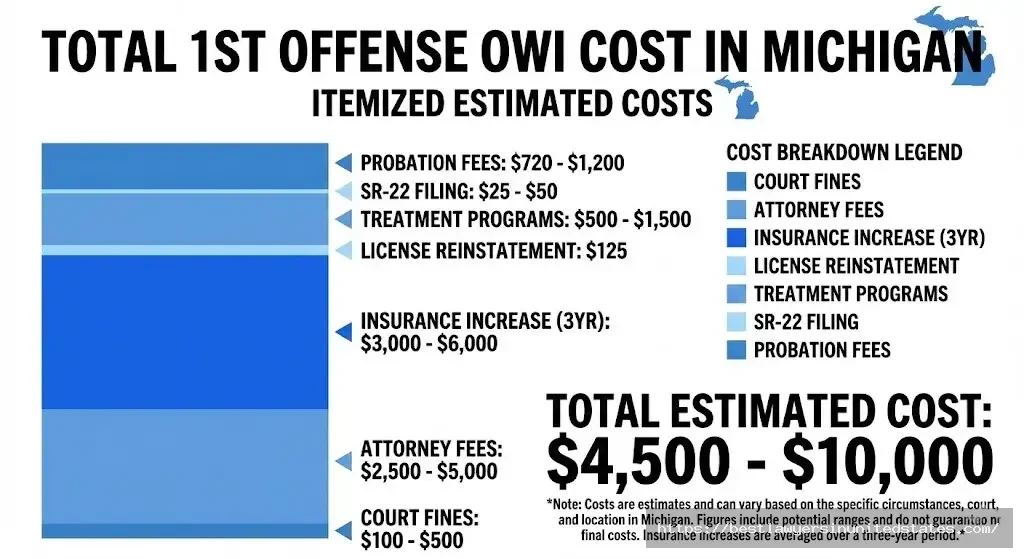
Complete 1st Offense Cost Breakdown:
| Cost Category | Amount |
|---|---|
| Court fines | $100-$500 |
| Court costs | $200-$500 |
| Attorney fees | $2,500-$5,000 |
| License reinstatement | $125 |
| SR-22 filing | $25-$50 |
| Insurance increase (3 years) | $3,000-$6,000 |
| Substance abuse evaluation | $100-$300 |
| Alcohol treatment program | $500-$1,500 |
| Probation supervision fees | $30-$50/month (24 months) |
| Community service alternative | $0 (time investment) |
| Ignition interlock (if Super Drunk) | $1,200-$2,000 |
| Total 1st Offense | $4,500-$10,000 |
2nd Offense Cost Breakdown:
| Cost Category | Amount |
|---|---|
| Court fines | $200-$1,000 |
| Court costs | $300-$600 |
| Attorney fees | $3,500-$7,500 |
| License reinstatement | $125 |
| DLAD hearing fee | $200 |
| SR-22 filing | $25-$50 |
| Insurance increase (3 years) | $4,000-$8,000 |
| Ignition interlock (mandatory) | $1,200-$2,000 |
| Substance abuse treatment | $1,000-$3,000 |
| Vehicle immobilization | $150-$300 |
| Probation fees | $30-$50/month |
| Total 2nd Offense | $10,000-$24,000 |
3rd Offense (Felony) Cost Breakdown:
| Cost Category | Amount |
|---|---|
| Court fines | $500-$5,000 |
| Court costs | $500-$1,000 |
| Attorney fees | $5,000-$15,000 |
| License reinstatement/restoration | $125-$500 |
| DLAD hearing + attorney | $2,000-$5,000 |
| SR-22 filing | $25-$50 |
| Insurance increase (5 years) | $10,000-$20,000 |
| Ignition interlock | $1,500-$3,000 |
| Substance abuse treatment | $2,000-$5,000 |
| Vehicle forfeiture | Varies (possible loss of car) |
| Lost wages (jail/prison) | $5,000-$50,000 |
| Total 3rd Offense | $25,000-$100,000+ |
How Long Does an OWI Affect Insurance in Michigan?
Quick Answer: OWI increases insurance rates for 3-5 years in Michigan. Expect 50-100% rate increases during SR-22 filing period.
Insurance impact timeline:
Years 1-2 (SR-22 required):
- Rate increase: 80-100%
- Average annual increase: $1,500-$2,500
- Cannot shop for better rates (most insurers deny coverage)
Years 3-5 (post-SR-22):
- Rate increase: 40-60%
- Average annual increase: $800-$1,500
- More insurers willing to quote
Years 6+:
- Rates return closer to normal
- OWI conviction may still appear in quotes
- Clean record reduces impact
Total 5-year insurance cost increase: $5,000-$10,000 for first offense.
Factors that increase rates more:
- High BAC (Super Drunk)
- Accident involvement
- Multiple offenses
- Young driver (under 25)
OWI Bail in Michigan
Typical bail amounts:
| Offense | Bail Range |
|---|---|
| 1st OWI | $100-$500 bond (or personal recognizance) |
| 2nd OWI | $500-$2,500 bond |
| 3rd OWI (felony) | $2,500-$10,000 bond |
| OWI causing injury | $5,000-$25,000 bond |
| OWI causing death | $25,000-$100,000+ bond |
Personal recognizance (PR bond): First-time offenders with no prior record often get released without posting money. You sign a promise to appear in court.
Factors affecting bail:
- Prior criminal record
- Flight risk assessment
- Community ties (job, family, residence)
- Severity of charges
- Court appearance history
Most OWI defendants post bail within 24 hours of arrest.
OWI Probation in Michigan
What Happens on OWI Probation in Michigan
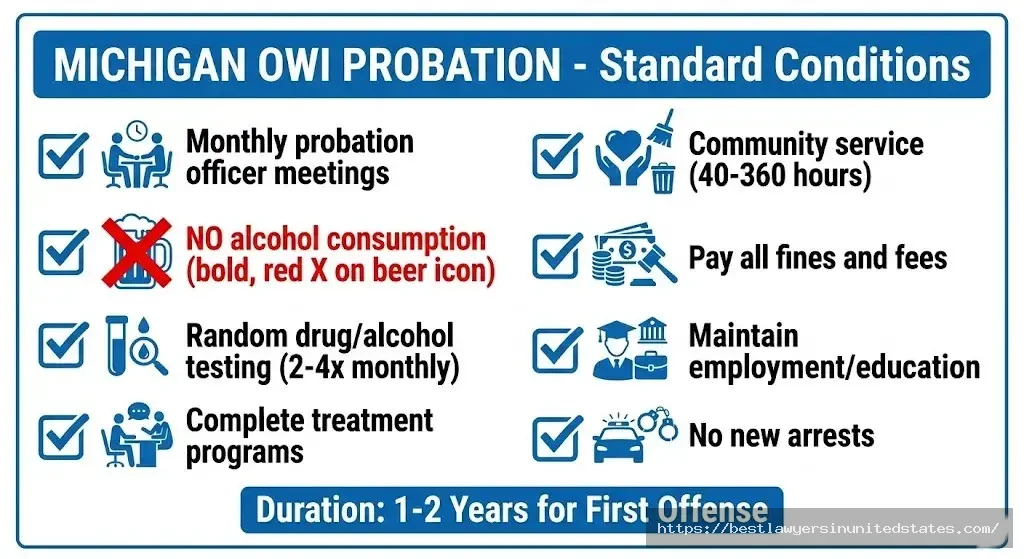
Quick Answer: OWI probation lasts 1-2 years and requires regular check-ins, alcohol abstinence, drug/alcohol testing, treatment completion, and community service.
Standard probation conditions:
Required for all probationers:
- Monthly meetings with probation officer
- No alcohol consumption
- Random drug/alcohol testing
- Complete court-ordered treatment programs
- Pay all fines and fees
- Maintain employment or education
- No new criminal charges
Common additional conditions:
- Community service (40-360 hours)
- Victim impact panel attendance
- 12-step meeting attendance (AA/NA)
- Essay or written assignments
- No contact with co-defendants
- Curfew restrictions
- GPS monitoring (repeat offenders)
Probation duration by offense:
- 1st OWI: 1-2 years
- 2nd OWI: 2 years
- 3rd OWI: 3-5 years (if probation granted instead of prison)
Monthly probation supervision fee: $30-$50
Drug & Alcohol Testing on OWI Probation
Testing frequency:
- First 6 months: 2-4 times per month (random)
- Months 6-12: 1-2 times per month
- After 12 months: Monthly or as needed
Types of tests used:
- Breathalyzer (immediate results)
- Urine analysis (detects alcohol and drugs)
- EtG/EtS testing (detects alcohol use 3-5 days prior)
- Hair follicle testing (90-day detection window)
- SCRAM ankle bracelet (continuous monitoring)
What tests detect:
- Alcohol (any amount)
- Marijuana
- Cocaine
- Opiates
- Methamphetamine
- Prescription drugs (without valid prescription)
Consequences of failed test:
- Warning (first minor violation)
- Increased testing frequency
- Additional treatment requirements
- Jail time (48 hours to 30 days)
- Probation violation hearing
- Revocation of probation (serve original jail sentence)
Can You Drink Alcohol While on OWI Probation in Michigan?
Direct answer: No. Michigan courts prohibit all alcohol consumption during OWI probation, regardless of the amount.
What the law says: Standard probation conditions under MCL 771.3 allow judges to “prohibit the probationer from using or possessing alcohol.” Nearly all OWI probation orders include this condition.
This means:
- Zero tolerance (no “just one beer”)
- No alcohol at weddings, parties, family gatherings
- No cooking wine or alcohol-based mouthwash
- EtG tests can detect even small amounts
Religious exceptions: Some judges allow communion wine or religious sacraments. Request written approval from the court before consuming.
Medical exceptions: Alcohol-based medications require doctor documentation and probation officer approval.
Probation Violations and Consequences
What counts as a violation:
- Failed drug/alcohol test
- Missed probation meeting
- New criminal charge or arrest
- Failure to complete treatment
- Unpaid fines or fees
- Leaving the state without permission
- Contact with prohibited persons
What happens after a violation:
- Probation officer report – Officer documents violation and files report with court
- Show cause hearing – Judge orders you to appear and explain
- Probation violation hearing – Prosecutor presents evidence of violation
- Judge’s decision:
- Warning and continue probation
- Extended probation term
- Additional conditions (more testing, treatment)
- Jail time (few days to full original sentence)
- Revoke probation and impose original jail sentence
Do you automatically go to jail for violating probation? No. Judges have discretion. First-time minor violations (missed meeting, late payment) usually result in warnings. Serious violations (new arrest, failed drug test) often result in jail time.
Critical point: You cannot be forced to serve more jail time than the original sentence allowed. For example, if your original OWI allowed “up to 93 days,” the judge cannot exceed 93 days even for probation violations.
Michigan OWI Expungement & Record
Michigan DUI Forgiveness: The Clean Slate Law
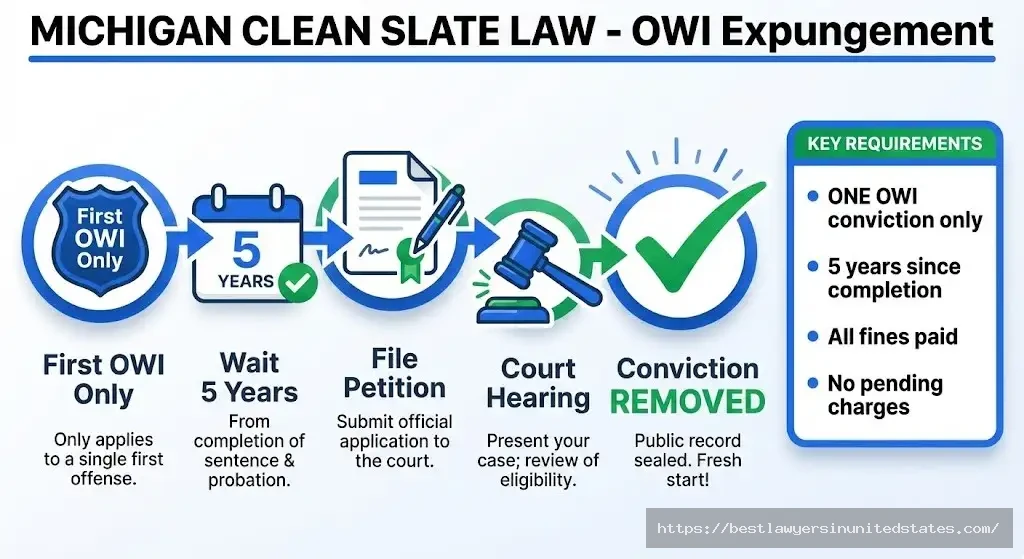
Quick Answer: Michigan’s Clean Slate law (effective April 2021) allows ONE-time expungement of a first OWI offense after 5 years. This removes the conviction from public criminal records.
What the Clean Slate law changed:
Before 2021: OWI convictions could never be expunged in Michigan.
After April 11, 2021: First-time OWI offenders can petition for expungement under MCL 780.621d.
Eligibility requirements:
| Requirement | Details |
|---|---|
| Only one OWI conviction | Cannot have multiple OWI/OWVI on record |
| 5-year waiting period | Must wait 5 years from completion of sentence (including probation) |
| No other felonies | Maximum 1 felony and 2 misdemeanors (or 3 misdemeanors total) |
| All penalties completed | Fines paid, probation finished, license restored |
| No pending charges | Cannot have open criminal cases |
What expungement does:
- Removes conviction from public criminal record
- Does not appear on most employment background checks
- Does not appear on housing applications
- Can legally answer “no” when asked about criminal convictions (with exceptions)
What expungement does NOT do:
- Does not remove from Secretary of State driving record
- Does not prevent use in future OWI cases (still counts as prior offense)
- Does not erase law enforcement records
- Does not remove professional licensing consequences
Application Process for OWI Expungement
Step-by-step expungement process:
- Wait 5 years – From date you completed all sentencing requirements (probation end date)
- Obtain conviction records – Request certified copies from court where convicted
- Obtain fingerprints – Schedule with local police department ($50-$75 fee)
- Complete application – Fill out expungement petition form
- File with court – Submit to the court that handled your original case ($50 filing fee)
- Serve prosecutor – Send copy to prosecuting attorney who handled your case
- Wait for hearing – Court schedules hearing 4-6 months out
- Attend hearing – Judge reviews your case and decides
- Order granted – If approved, court issues expungement order
Timeline: 6-12 months from filing to final approval.
Costs:
- Court filing fee: $50
- Fingerprinting: $50-$75
- Certified records: $25-$50
- Attorney fees (optional): $1,500-$3,000
Automatic expungement (future): Michigan is developing automatic expungement for eligible offenses. Check Michigan.gov/Expungement for updates.
How Long Does an OWI Stay on Your Record in Michigan?
Criminal record (lifetime unless expunged):
- OWI conviction stays on criminal record permanently
- Visible to law enforcement forever
- Counts as prior offense for future OWI charges
- Can only be removed through expungement after 5 years
Driving record (Secretary of State):
- OWI stays on driving record for 10 years
- Insurance companies see it for 10 years
- Points remain for 2 years
- Visible to employers doing MVR checks for 10 years
Background checks:
- Standard employment checks: 7 years (in practice, often permanent)
- Professional licensing boards: Permanent
- Government jobs: Permanent
- FBI background checks: Permanent
Important: Even after expungement from criminal records, OWI remains on Secretary of State driving records and can be used against you in future DUI cases.
How a Michigan OWI Affects Employment & Background Checks
What appears on background checks:
Standard employment background check (7 years):
- Criminal conviction shows unless expunged
- Shows as misdemeanor or felony
- May include charge details and sentence
Enhanced background check (FBI/government jobs):
- Shows conviction even if expunged
- Includes full arrest and conviction history
- Lifetime record visible
Motor vehicle record (MVR) check:
- Shows OWI for 10 years
- Points visible for 2 years
- License suspensions/revocations visible
Jobs affected by OWI conviction:
Cannot obtain/maintain:
- Commercial driver’s license (CDL) – Often permanent disqualification
- School bus driver
- Delivery driver for some companies
- Rideshare driver (Uber/Lyft) – 7-year ban
- Airline pilot or flight crew
- Some healthcare positions
- Childcare/daycare positions (in some cases)
- Law enforcement officer
- Attorney (requires disclosure to State Bar)
Requires disclosure:
- Nursing licenses (Michigan Board of Nursing)
- Teaching certificates (may face suspension)
- Real estate licenses
- Financial advisor licenses
- Professional licenses (architects, engineers, accountants)
Employer restrictions:
- Can ask about convictions (but not arrests without conviction)
- Cannot discriminate based on expunged convictions
- Can consider job-relatedness (driving jobs vs. desk jobs)
Your rights:
- After expungement, can answer “no” to conviction questions (with exceptions for law enforcement, judiciary positions)
- Employers cannot ask about expunged convictions
- Can petition professional boards for licensure despite conviction
Special Circumstances in Michigan
Can You Get an OWI on Private Property in Michigan?
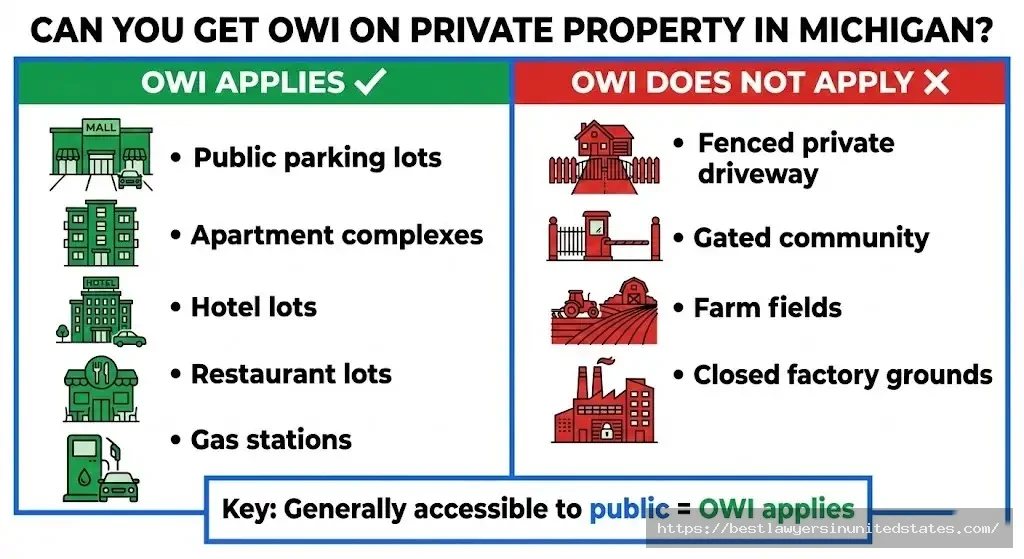
Quick Answer: Yes. Michigan OWI law applies on private property if the area is “generally accessible” to the public, including private parking lots, driveways open to visitors, and apartment complexes.
What the law says: MCL 257.625 prohibits operating a vehicle while intoxicated on a “highway or other place open to the general public or generally accessible to motor vehicles.”
Where OWI applies:
Public areas (definitely applies):
- All public roads and highways
- Public parking lots (Walmart, Target, shopping malls)
- Park roads and parking areas
- Rest areas along highways
Private property (usually applies):
- Apartment complex parking lots
- Hotel parking lots
- Restaurant parking lots
- Gas station lots
- Private roads accessible to public
Private property (usually does NOT apply):
- Fenced private driveway (not accessible to public)
- Gated community (unless roads are public)
- Farm fields
- Private ranch roads
- Closed factory grounds
Key question: Can the general public reasonably access the area?
Example cases:
- Sleeping in car in Meijer parking lot = OWI applies
- Driving drunk in apartment complex lot = OWI applies
- Driving drunk in own fenced driveway = OWI may not apply
- ATV on private farm = OWI likely does not apply
OWI Impact on Commercial Drivers (CDL) in Michigan
Quick Answer: CDL holders face a 1-year disqualification for first OWI and lifetime disqualification for second OWI, regardless of which vehicle they were driving.
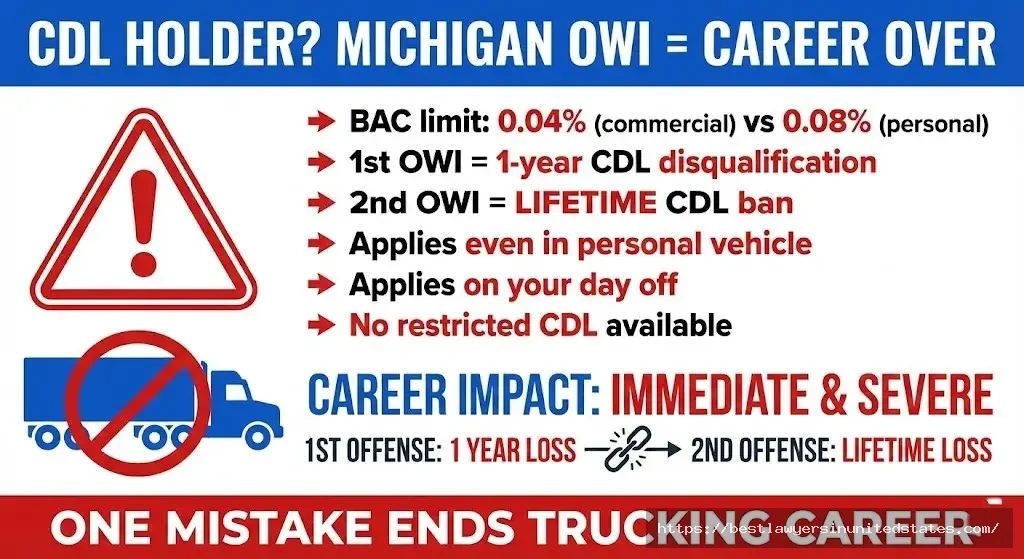
CDL-specific BAC limits:
| Situation | BAC Limit | Violation |
|---|---|---|
| Driving commercial vehicle | 0.04% | CDL OWI |
| Driving personal vehicle | 0.08% | Standard OWI |
Penalties for CDL holders:
First OWI (any vehicle):
- 1-year CDL disqualification (federal law)
- 3-year disqualification if carrying hazardous materials
- Standard OWI criminal penalties
- Must report to employer within 30 days
Second OWI (any vehicle):
- Lifetime CDL disqualification (federal law)
- Possible reinstatement after 10 years (not guaranteed)
- End of commercial driving career for most
Critical points:
- OWI in your personal car on your day off = CDL suspended
- Conviction in any state = CDL affected
- No “restricted” CDL available
- Cannot get CDL back during suspension period
Career impact:
- Immediate job loss for most truck drivers
- Cannot drive school bus, delivery trucks, semi-trucks
- Employer insurance may refuse coverage
- Few second chances in commercial driving industry
Boating While Intoxicated (BWI) in Michigan
Michigan’s OWI law applies to watercraft under MCL 324.80176.
BWI BAC limits (same as vehicles):
- 0.08% for standard operators
- 0.02% for under 21
- 0.17% for “Super Drunk” enhanced penalties
BWI penalties (first offense):
- Up to 93 days in jail
- $100-$500 fine
- Possible boat operation restriction
- Does NOT affect driver’s license
Unique aspects:
- BWI conviction does not suspend your driver’s license
- BWI can be charged for operating any watercraft (jet ski, boat, kayak with motor)
- Operating a boat while towing skiers/tubers = enhanced penalties if intoxicated
- Michigan State Police and DNR Conservation Officers enforce BWI
Critical point: BWI counts as a prior offense if you later get an OWI for a motor vehicle.
Zero Tolerance for Drivers Under 21
Michigan’s Zero Tolerance law (MCL 257.625(6)) prohibits any measurable alcohol for drivers under 21.
Under-21 BAC limits:
| BAC Level | Charge | Penalties |
|---|---|---|
| 0.02%-0.07% | Zero Tolerance violation | Up to $250 fine, 30-day license suspension, community service |
| 0.08%+ | OWI (adult charge) | Full OWI penalties |
First Zero Tolerance violation:
- Civil infraction (not criminal)
- $250 fine
- 30-day license suspension
- 4 points on driving record
- Community service possible
Second Zero Tolerance violation:
- Criminal misdemeanor
- Up to 93 days in jail
- $500 fine
- 90-day license suspension
- Substance abuse screening
Important: Drivers under 21 face OWI charges (not just Zero Tolerance) if BAC is 0.08% or higher.
Drugged Driving in Michigan
Michigan’s “any amount” law: Operating with any presence of Schedule 1 controlled substances in your body is illegal under MCL 257.625(8).
Schedule 1 substances include:
- Marijuana/THC (despite recreational legalization)
- Cocaine
- Heroin
- LSD
- Ecstasy/MDMA
- Methamphetamine
Critical point: You can be convicted of drugged driving OWI with THC in your system even if you’re not actually impaired and even though recreational marijuana is legal in Michigan.
Marijuana OWI complications:
- THC stays in system for weeks after use
- No “legal limit” like alcohol (any detectable amount = violation)
- Medical marijuana card does not protect you
- Recreational use is legal, but driving afterward is not
Prescription drug OWI:
- Legal prescription is a defense if taken as directed
- Must show valid prescription and doctor’s orders
- Impairment despite valid prescription can still result in OWI
Drugged driving penalties: Same as alcohol OWI (up to 93 days jail, $100-$500 fine, 6-month suspension).
Michigan-Specific Rules & Procedures
The 180-Day Rule in Michigan
What is the 180-day rule? Misdemeanor OWI charges must be filed within 180 days of the offense date under Michigan Court Rule 6.610.
Why it matters:
- Prosecutors face a 180-day statute of limitations for misdemeanor OWI
- If charges aren’t filed within 180 days, case can be dismissed
- Does not apply to felony OWI (longer statute of limitations)
When the clock starts: The date of the offense (arrest date).
Exceptions:
- Defendant fled the state
- Defendant cannot be located
- DNA/blood testing delays
This rule rarely benefits defendants because prosecutors typically file charges within 2-4 weeks of arrest.
Rule 21 in Michigan OWI Cases
What is Rule 21? Michigan Court Rule 6.610(C) requires the court to hold a preliminary examination within 21 days of arraignment for felony charges.
When Rule 21 applies:
- Third OWI (felony charge)
- OWI causing serious injury
- OWI causing death
What happens at preliminary examination:
- Prosecutor presents evidence to show probable cause
- Judge determines if case proceeds to circuit court
- Defendant can cross-examine witnesses
- Takes place in district court
Why it matters: The 21-day deadline ensures speedy processing of felony cases. Delays can result in dismissal, though courts often grant extensions.
For misdemeanor OWI (first and second offenses), Rule 21 does not apply.
Michigan OWI Checkpoint Laws
Are DUI checkpoints legal in Michigan? Yes. The Michigan Supreme Court upheld sobriety checkpoints in Sitz v. Department of State Police (1990).
Checkpoint requirements:
- Must be publicly announced in advance
- Must use neutral selection criteria (every car, every 3rd car)
- Cannot be random or discriminatory
- Must have supervisor on scene
- Must be clearly marked
Your rights at checkpoints:
- Must stop when directed
- Must provide license, registration, insurance
- Do not have to answer questions beyond identification
- Do not have to perform field sobriety tests
- Do not have to take roadside PBT (but civil infraction if you refuse)
Common checkpoint locations in Michigan:
- I-75, I-94, I-96 (major highways)
- Woodward Avenue (metro Detroit)
- US-131 (Grand Rapids area)
- Around college campuses (U-M, MSU, WMU)
- Holiday weekends (Memorial Day, July 4th, Labor Day, New Year’s)
Can you turn around before a checkpoint? Yes, if you do so legally (no illegal U-turn, no traffic violations). However, officers often watch for this behavior.
Frequently Asked Questions About Michigan OWI
Will I go to jail for my first OWI in Michigan?
Quick Answer: Most first-time OWI offenders avoid jail through probation, but jail time is possible (up to 93 days). Judges consider BAC level, driving record, and whether anyone was injured.
Factors that increase jail likelihood:
- Very high BAC (0.15%+)
- Accident with property damage or injury
- Child in vehicle
- Prior criminal record
- Refusal to cooperate with police
Factors that reduce jail likelihood:
- Low BAC (0.08-0.10%)
- Clean driving record
- No accident
- Cooperative with police
- Enroll in treatment voluntarily
Most judges impose probation, fines, community service, and alcohol treatment instead of jail for first-time offenders.
What is the most common penalty for first-time OWI in Michigan?
Quick Answer: Probation (1-2 years), fines ($100-$500), 6-month license suspension, community service (40-200 hours), and mandatory alcohol treatment.
Over 80% of first-time OWI cases result in:
- Probation instead of jail
- Reduced charge to OWVI (if possible)
- Alcohol treatment classes
- Restricted license after 30 days
How likely is jail time for first OWI in Michigan?
Quick Answer: About 10-20% of first-time OWI offenders serve some jail time in Michigan. Most serve only a few days, often on weekends.
Statistics show:
- 80-90% receive probation with no jail
- 10-20% serve 1-7 days in jail
- Less than 5% serve more than 30 days (usually high BAC or accidents)
Super Drunk charges (0.17%+ BAC) increase jail likelihood to 30-40%.
Can you beat your first OWI in Michigan?
Quick Answer: About 10-15% of OWI cases get dismissed or result in acquittal. Success depends on police errors, weak evidence, or constitutional violations.
Common successful defenses:
- Illegal traffic stop
- Faulty breathalyzer calibration
- Medical conditions affecting BAC
- Officer training issues
- Field sobriety test administration errors
Most cases (70-80%) resolve through plea bargaining (OWI reduced to OWVI).
What jobs can you not get with an OWI in Michigan?
Quick Answer: OWI convictions prevent employment as commercial drivers, school bus drivers, some healthcare workers, law enforcement, teachers (in some cases), and positions requiring professional licenses.
Restricted careers:
- CDL truck driver (1-year minimum ban, often permanent)
- Uber/Lyft driver (7-10 year ban)
- School bus driver
- Delivery driver for many companies
- Registered nurse (requires disclosure, possible license restriction)
- Teacher (requires disclosure to school district)
- Law enforcement officer
- Attorney (requires disclosure to State Bar)
- Airline pilot
Is an OWI life-changing in Michigan?
Quick Answer: An OWI can significantly impact your finances, career, and insurance rates, but most people recover within 3-5 years through license restoration, expungement, and rebuilding their record.
Long-term impacts:
- Financial cost: $5,000-$10,000 for first offense
- Insurance increases for 3-5 years
- Criminal record (until expunged after 5 years)
- Professional license complications
- Possible job loss (driving-related jobs)
Positive recovery steps:
- Complete probation successfully
- Maintain clean record for 5 years
- Petition for expungement
- Restore license through DLAD
- Rebuild insurance rates
How much does an OWI lawyer cost in Michigan?
Quick Answer: OWI attorneys in Michigan charge $2,500-$5,000 for first offense, $3,500-$7,500 for second offense, and $5,000-$15,000 for felony third offense.
Cost factors:
- Attorney experience and reputation
- Case complexity
- Trial vs. plea bargain
- County/jurisdiction
- Additional motion hearings
Payment options:
- Flat fee (most common)
- Hourly rate ($200-$400/hour)
- Payment plans available
- Public defender (if indigent)
Do you lose your license immediately after an OWI in Michigan?
Quick Answer: Yes. Officers confiscate your physical license and issue a temporary paper permit valid for 14 days while the Secretary of State processes the suspension.
Timeline:
- Day 1: License confiscated at arrest
- Days 1-14: Temporary paper permit allows driving
- Day 14: Request DLAD hearing to challenge suspension
- Day 15+: Suspension begins if no hearing requested
- Day 30 (first OWI): Eligible for restricted license
How long does an OWI affect insurance in Michigan?
Quick Answer: OWI increases insurance rates for 3-5 years. Expect 50-100% rate increases during the SR-22 requirement period (first 2 years).
What is the 77-day rule for OWI in Michigan?
Quick Answer: You have 77 days after sentencing to file an appeal before license sanctions become final and harder to modify.
Can I refuse a breathalyzer in Michigan?
Quick Answer: Yes, but refusal triggers automatic 12-month license suspension (separate from criminal case) and can be used as evidence of guilt.
What happens when you get an OWI in Michigan?
Quick Answer: You face arrest, license confiscation, bond hearing, arraignment, trial or plea bargain, sentencing, probation, license suspension, and potential jail time depending on offense level.
How long does an OWI stay on your record in Michigan?
Quick Answer: OWI stays on your criminal record permanently unless expunged after 5 years. It stays on your driving record for 10 years.
Can you expunge an OWI in Michigan?
Quick Answer: Yes. Michigan’s Clean Slate law (since April 2021) allows first-time OWI expungement after 5 years of completing all sentencing requirements.
Get Legal Help for Michigan OWI
Facing OWI charges in Michigan requires experienced legal representation. A qualified attorney can challenge evidence, negotiate plea bargains, and protect your rights.
Find a DUI Lawyer in Michigan
Need help with your OWI case? Contact experienced Michigan OWI defense attorneys for a free consultation.
Email: [email protected]
Related State DUI Laws:
- Indiana DUI Laws
- Illinois DUI Laws
- Ohio DUI Laws (coming soon)
