
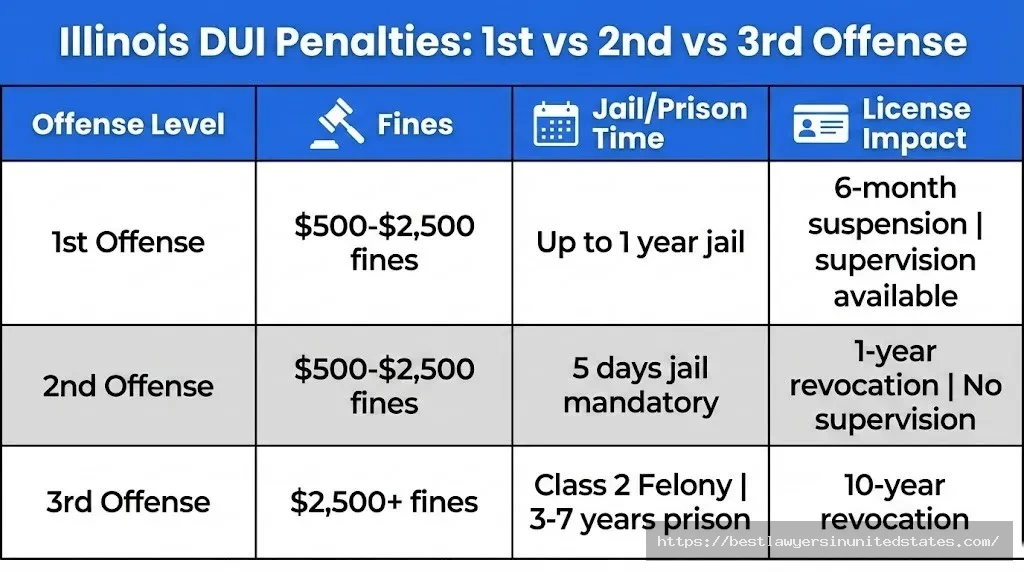
Quick Answer: Illinois DUI convictions are permanent and cannot be expunged. First offense costs $5,000-$15,000 with fines up to $2,500 and potential jail time up to one year. Third offenses become Class 2 felonies with mandatory prison sentences.
Getting pulled over for suspected DUI in Illinois starts two separate legal battles. The criminal court case determines your guilt and punishment. The Illinois Secretary of State automatically suspends your license on day 46 after arrest regardless of criminal court outcomes.

Court supervision exists only in Illinois for first-time DUI offenders. This unique option lets you avoid a permanent criminal conviction if you complete all requirements. Second and subsequent offenses don’t qualify for supervision.
Why Illinois DUI Laws Are Stricter Than Most States
Illinois uses lifetime lookback periods for DUI convictions. Your first DUI from 20 years ago still counts as a prior offense today. Many states reset after 10 years—Illinois never forgets.
Third DUI charges escalate to Class 2 felonies carrying 3-7 years prison time. Most states wait until the fourth offense for felony charges. Illinois prosecutors move faster and punish harder.
Refusing the breathalyzer doubles your license suspension. Failed test equals six months suspended. Refusal equals twelve months suspended. Most drivers don’t realize refusal carries worse penalties than failing.
2025 law changes affecting Illinois DUI cases:
- Restricted Driving Permits expanded to 12 hours daily for repeat offenders
- H.R.875 makes DUI deportable for green card holders and visa holders
- New BAIID requirements allow more driving privileges during suspension
Calculate your potential blood alcohol level with our BAC calculator before making decisions about driving.
BAC Calculator
Estimate your Blood Alcohol Content
• Commercial Driver (CDL): 0.04% BAC
• Drivers Under 21: 0.00-0.02% BAC (Zero Tolerance)
• Enhanced Penalties: 0.15% BAC or higher in most states
What You Need to Know About Illinois DUI Charges
Illinois statute 625 ILCS 5/11-501 defines seven different ways to violate DUI law. Prosecutors don’t need a 0.08% BAC reading to charge you in every scenario.
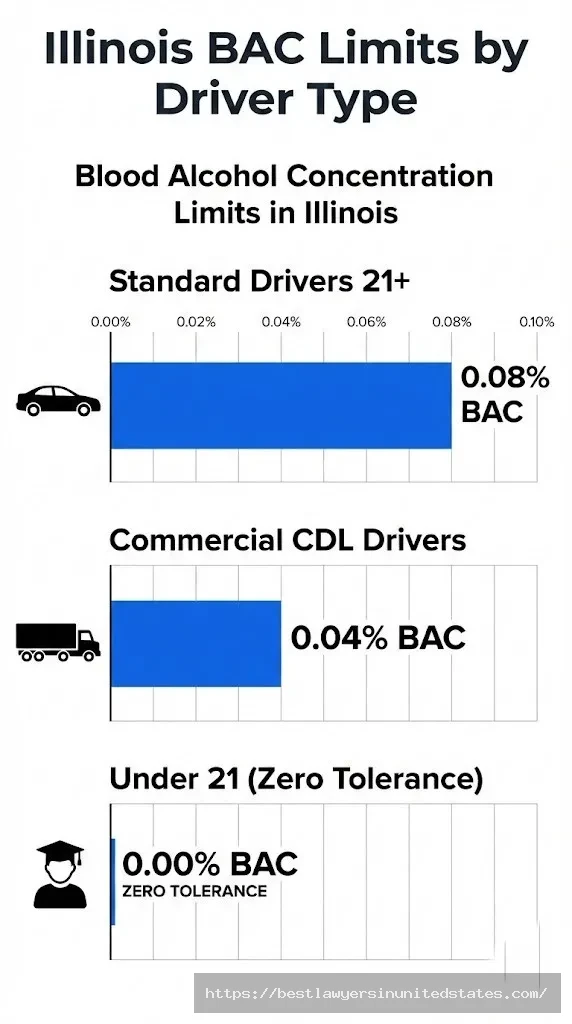
Illinois BAC limits by driver type:
- Standard drivers (21+): 0.08%
- Commercial CDL drivers: 0.04%
- Drivers under 21: 0.00% (zero tolerance)
Testing at 0.16% or higher triggers enhanced penalties at every offense level. First-time offenders with high BAC face mandatory 100 hours community service and $500 additional fines.
This guide covers penalties for first through third offenses, complete cost breakdowns, license suspension timelines, court supervision requirements, and defense strategies. You’ll learn about aggravated DUI charges, professional license consequences, and immigration impacts from recent 2025 federal law changes.
Understanding your rights and options now prevents costly mistakes later. Illinois DUI convictions stay on your record forever with zero expungement options.
Underage DUI in Illinois (Zero Tolerance)
Drivers under 21 face strict zero-tolerance policies in Illinois. Any detectable amount of alcohol in your system violates state law.
BAC Limits for Underage Drivers
| Driver Type | BAC Limit | Penalty |
|---|---|---|
| Under 21 | 0.00% | 3-month suspension (first) |
| Under 21 (second) | 0.00% | 6-month suspension |
| Under 21 at 0.08%+ | 0.08% | Full adult DUI charges |
Critical point: Even 0.01% BAC from mouthwash triggers charges.
What Happens After Underage DUI
Police commonly use Preliminary Breath Tests (PBT) on suspected underage drinkers. Any positive reading results in immediate arrest.
Administrative penalties hit fast:
- First violation: 3-month license suspension
- Second violation: 6-month suspension
- Third violation: 12-month suspension
These run separate from criminal charges. You face both simultaneously.
College and Career Impact
DUI convictions affect scholarship eligibility and college admissions. Many universities require disclosure of criminal convictions on applications.
Professional school programs in law, medicine, and teaching conduct background checks. An underage DUI can block admission to these programs.
CDL Holders & Commercial Drivers
Commercial drivers face stricter BAC limits and harsher consequences. Your CDL status doesn’t protect you—it makes penalties worse.
CDL-Specific Rules
| Situation | BAC Limit | Penalty |
|---|---|---|
| Operating CMV | 0.04% | 1-year CDL disqualification |
| Operating personal vehicle | 0.08% | Still affects CDL status |
| Second DUI (any vehicle) | Any | Lifetime CDL disqualification |
| Hazmat endorsement | 0.04% | Additional federal penalties |
No exceptions exist: First DUI equals one-year CDL loss minimum.
Career-Ending Consequences
Losing your CDL means losing your livelihood. Trucking companies, delivery services, and bus operations require valid CDLs. Most won’t hire drivers with DUI convictions even after reinstatement.
No hardship permits exist for CDL holders. You cannot drive commercially during suspension under any circumstances.
Out-of-state DUI convictions count against your Illinois CDL. The Interstate Driver License Compact shares conviction information across all states.
Reinstatement Challenges
Getting your CDL back after DUI requires completing all standard DUI requirements plus:
- Formal hearing with Illinois Secretary of State
- Proof of completed substance abuse treatment
- Employer letter verifying need for CDL
- Clean driving record during suspension
- All fees paid ($500+ reinstatement costs)
Second DUI triggers lifetime CDL disqualification. No appeals process reverses this penalty.
Cannabis (Marijuana) DUI in Illinois
Illinois legalized recreational cannabis in 2020. However, driving after using marijuana remains illegal and prosecutable.
THC Detection and Limits
Per se violation: 5 nanograms of THC in blood within 2 hours of driving creates automatic DUI charges.
| Substance | Detection Limit | Legal Status |
|---|---|---|
| THC (recreational) | 5 ng in blood | Illegal while driving |
| THC (medical card) | 10 ng in blood | Still illegal if impaired |
| Delta-9 THC | Any amount | Illegal (different from CBD) |
Medical marijuana cardholders receive slightly higher limits but no immunity from prosecution.
Detection Problems for Drivers
THC stays in your system much longer than alcohol. You can test positive days or weeks after using cannabis. However, prosecutors must prove you used within 2 hours of driving for the per se violation.
Blood tests measure active THC, not metabolites. This distinction matters because inactive metabolites remain in your body for weeks.
Defense Challenges
Proving THC impairment is harder than proving alcohol impairment. Unlike standardized breathalyzers for alcohol, THC testing requires blood draws and lab analysis.
Field sobriety tests work poorly for detecting marijuana impairment. Officers rely heavily on Drug Recognition Expert (DRE) evaluations and blood test results.
Use our BAC calculator to understand impairment levels, though it’s designed for alcohol rather than THC.
Prescription Drug DUI
Having a valid prescription provides no defense to DUI charges in Illinois. Prescribed medications can still impair your driving and result in convictions.
Commonly Implicated Medications
High-risk prescription drugs include:
- Ambien (zolpidem) – sleep medication
- Xanax (alprazolam) – anxiety medication
- Vicodin/Percocet – opioid pain medications
- Muscle relaxers (cyclobenzaprine, carisoprodol)
- Anti-seizure medications (some varieties)
- High-dose antihistamines
Warning labels matter significantly. Medications marked “do not operate machinery” or “may cause drowsiness” strengthen prosecution cases.
How Prosecutors Prove Impairment
Officers look for specific signs of drug impairment:
- Slurred speech
- Confusion or disorientation
- Slow response to questions
- Failed field sobriety tests
- Admission of medication use
Drug Recognition Experts conduct 12-step evaluations including:
- Eye examinations
- Vital sign checks
- Balance tests
- Muscle tone assessment
- Injection site searches
Blood tests confirm drug presence. Labs measure exact amounts in your system at the time of driving.
Your Doctor’s Orders Don’t Matter
Illinois law doesn’t recognize “following doctor’s orders” as a defense. Even if you took medication exactly as prescribed, you can still face DUI charges if it impaired your driving.
Mixing prescription drugs with alcohol increases your risk exponentially. Even small amounts of alcohol combined with medications can cause severe impairment.
DUI on Private Property
Illinois DUI laws apply everywhere within the state. Private property provides no safe harbor from prosecution.
Where DUI Laws Apply
You can be arrested for DUI in:
- Walmart parking lots
- Your own driveway
- Apartment complex parking areas
- Private roads and gated communities
- Gas station parking lots
- Church parking lots
- Anywhere “within this State” per 625 ILCS 5/11-501
The only requirement is being in “actual physical control” of a vehicle. You don’t need to be driving on public roads.
Actual Physical Control Explained
Illinois courts have convicted people who weren’t actively driving. Sitting in the driver’s seat with keys in the ignition counts as “actual physical control.”
Examples of actual physical control:
- Sleeping in a parked car with keys in ignition
- Sitting in driver’s seat with engine running (even if parked)
- Attempting to start the vehicle
- Having keys in lap while sitting in driver’s seat
Not actual physical control:
- Sleeping in back seat with keys in trunk
- Keys not accessible in the vehicle
- Clear evidence you weren’t about to drive
Private Property DUI Defense
Challenging private property DUI arrests is difficult but not impossible. Your attorney can argue lack of actual physical control or that you had no intent to drive.
Video evidence from security cameras can help prove you weren’t driving or attempting to drive. Witness testimony about your intentions matters too.
Out-of-State & Non-Resident DUIs
Illinois DUI convictions follow you home. Out-of-state residents face penalties in both Illinois and their home state.
Interstate Driver License Compact
Illinois participates in this information-sharing agreement. Your home state learns about Illinois DUI convictions and typically imposes additional penalties.
What gets reported:
- DUI arrests in Illinois
- Convictions (including court supervision in some states)
- License suspensions
- Traffic violations
Your home state treats Illinois DUI like a local conviction. Expect suspension or revocation in your home state too.
Handling Two-State Penalties
You must satisfy both Illinois requirements and your home state requirements. Ignoring either state creates additional legal problems.
Illinois requirements:
- Pay all Illinois fines and fees
- Complete Illinois DUI school
- Install BAIID if required
- Attend all Illinois court dates
Home state requirements:
- Additional fines or surcharges
- Home state DUI education programs
- License suspension/revocation
- SR-22 insurance
Out-of-State Prior DUIs
Illinois counts DUI convictions from any state as prior offenses. A DUI in California from 15 years ago still counts as a first offense, making your Illinois DUI a second offense.
The lifetime lookback period applies to all states. Illinois never forgets any DUI from anywhere at any time.
States with DUI reciprocity:
- All 50 states share conviction information
- Canadian DUI convictions count in Illinois
- Military DUI convictions count
Non-Resident Special Challenges
Non-residents can’t just leave Illinois and ignore the charges. Warrants follow you across state lines. License suspensions transfer to your home state.
You must return to Illinois for court dates unless your attorney can appear on your behalf. Missing court creates additional criminal charges.
Hiring a local Illinois DUI attorney becomes essential. They handle court appearances and negotiate with prosecutors while you’re out of state.
Illinois DUI Arrest Process: What Actually Happens
Understanding the arrest process helps you protect your rights. Each stage has specific procedures police must follow.
Traffic Stop & Investigation
Officers need reasonable suspicion to pull you over. Common reasons include:
- Weaving between lanes
- Speeding or driving too slowly
- Running red lights or stop signs
- Broken tail lights or equipment violations
- Anonymous tips (must be corroborated)
What officers look for:
- Odor of alcohol
- Slurred speech
- Bloodshot or watery eyes
- Open containers in vehicle
- Erratic behavior or confusion
Field Sobriety Tests
These tests are voluntary in Illinois. You can refuse without automatic penalties. However, officers note refusal in their reports.
Three standardized tests:
| Test | What It Measures | Pass/Fail Indicators |
|---|---|---|
| Horizontal Gaze Nystagmus | Eye tracking | Jerking or inability to follow |
| Walk-and-Turn | Balance and instruction following | Steps off line, wrong step count |
| One-Leg Stand | Balance | Hopping, swaying, putting foot down |
Weather, road surface, and medical conditions affect test results. Officers must account for these factors but often don’t.
Preliminary Breath Test (PBT)
Roadside breath tests are also voluntary. PBT results aren’t admissible in court but establish probable cause for arrest.
Refusing PBT carries no license suspension. However, officers almost always arrest you anyway based on other observations.
Probable Cause for Arrest
Officers need probable cause to arrest you for DUI. This means specific, articulable facts suggesting you’re impaired.
Sufficient probable cause includes:
- Failed field sobriety tests
- Admission of drinking
- Strong alcohol odor
- Dangerous driving behavior
- PBT results showing alcohol
Weak probable cause creates grounds to challenge the arrest later.
Booking & Chemical Testing
Arrest triggers the formal booking process and critical testing decisions.
What Happens at the Police Station
Standard booking procedures:
- Fingerprinting and photographing
- Property inventory
- Miranda rights (if questioning occurs)
- Implied consent warning
- Chemical test request
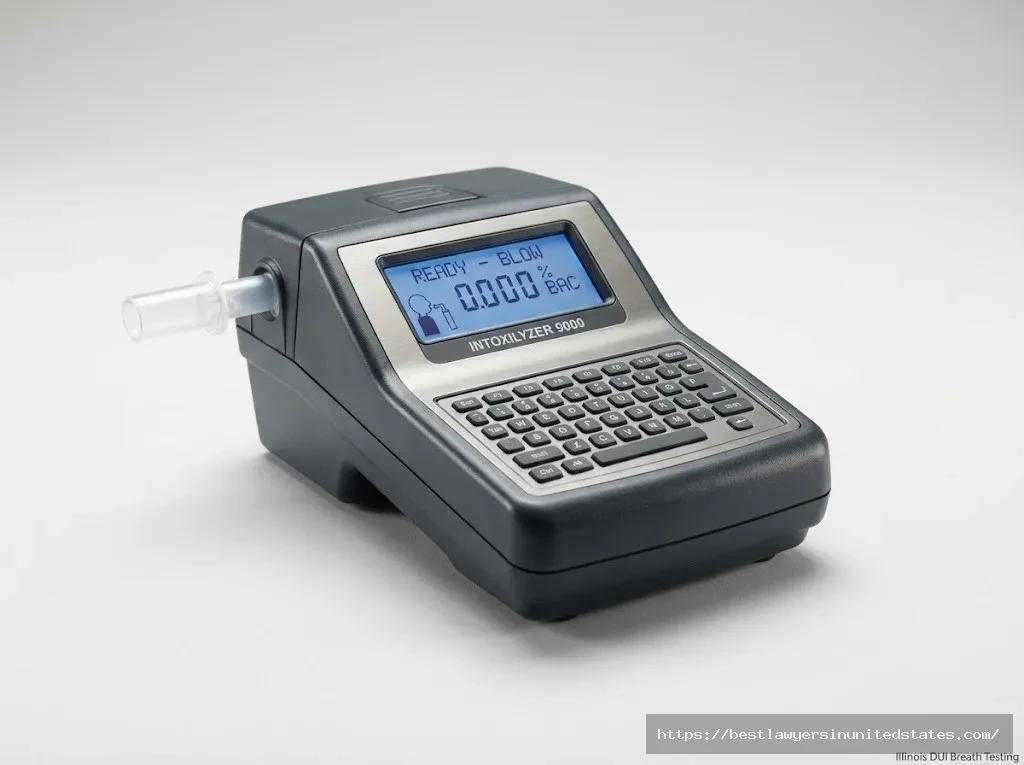
Officers must read the implied consent warning before requesting a chemical test. This warning explains suspension consequences for refusing.
Chemical Test Options
You must choose between three options:
| Test Type | Accuracy | Time to Results | Pros | Cons |
|---|---|---|---|---|
| Breath | ±0.01% | Immediate | Quick, non-invasive | Can be challenged |
| Blood | High | Days/weeks | Most accurate | Invasive, costly |
| Urine | Lower | Days | Detects drugs | Less accurate for alcohol |
Most people choose breath tests. Blood tests provide more accurate results but take longer to process.
Refusal Consequences vs. Testing
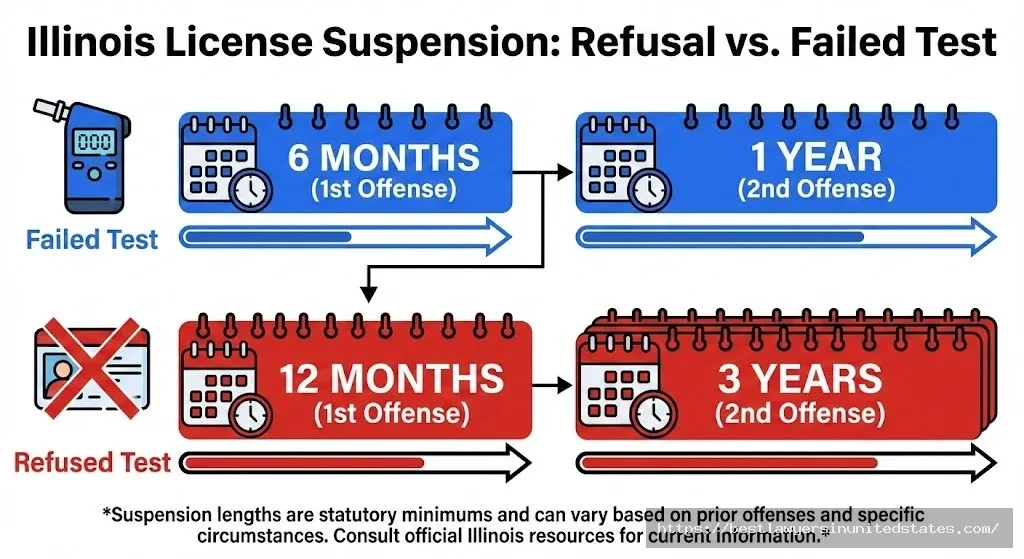
Quick comparison:
| Choice | First Offense Suspension | Second Offense Suspension | Court Impact |
|---|---|---|---|
| Take and fail test | 6 months | 1 year | BAC used as evidence |
| Refuse test | 12 months | 3 years | Refusal noted as evidence |
Refusing doubles your suspension length. Prosecutors and juries view refusal negatively.
Right to Additional Testing
Illinois law allows you to request independent testing at your expense after completing the official test. This right must be honored reasonably.
Some defendants use independent lab results to challenge state test accuracy. Private labs sometimes find different BAC levels or test administration errors.
Release Procedures
Most first-time DUI defendants get released on I-Bond (signature bond). You sign a promise to appear and leave without posting money.
Release conditions may include:
- No alcohol consumption
- No driving without valid license
- Appearing at all court dates
- Submitting to random testing
Violating release conditions results in arrest and bond revocation.
Statutory Summary Suspension
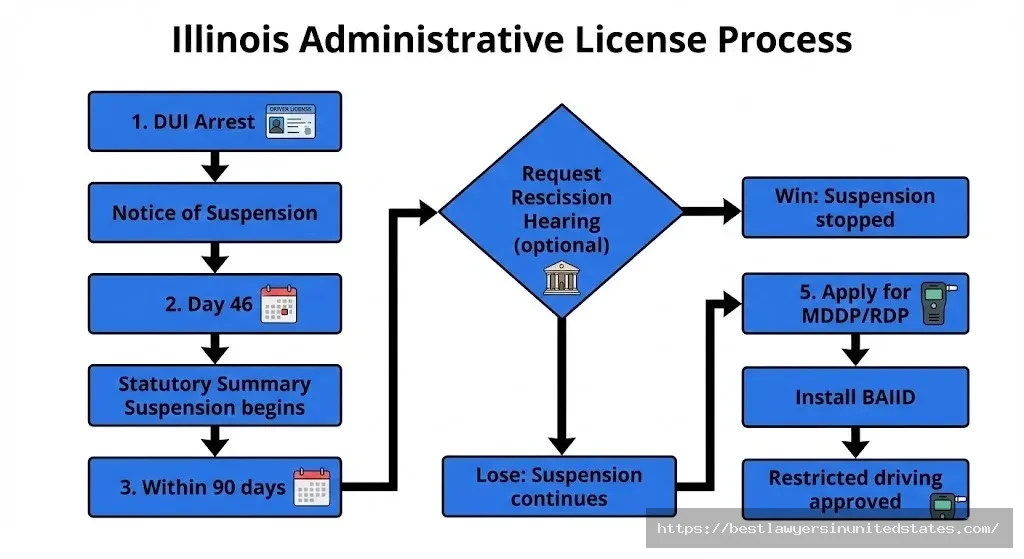
Illinois imposes automatic administrative license suspensions separate from criminal proceedings. This suspension begins whether or not you’re convicted.
How Summary Suspension Works
The suspension is “statutory” because it follows automatically from statute. Police serve you with a notice of suspension at arrest.
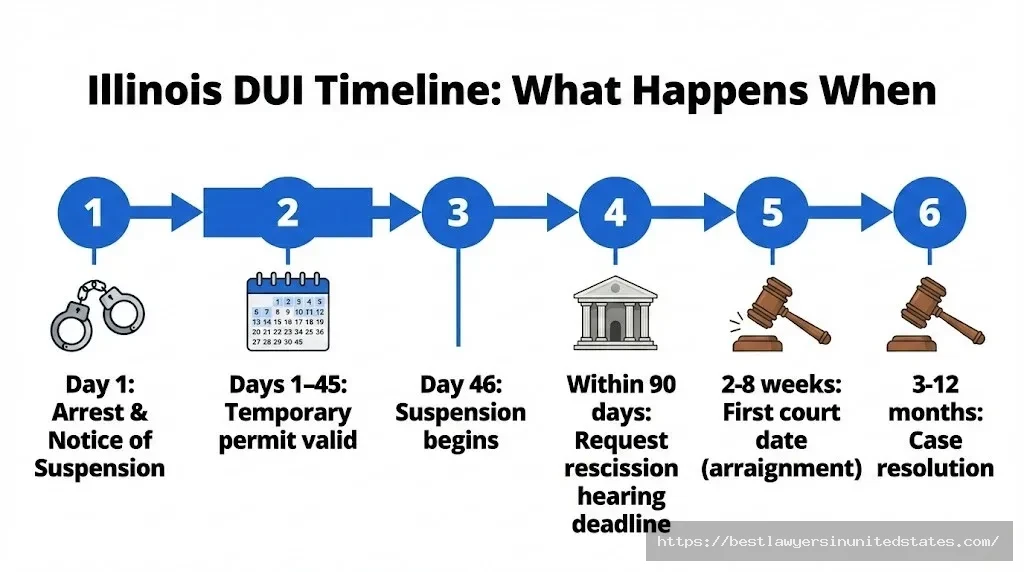
Timeline of events:
- Day 1: Arrest and notice of suspension
- Days 1-45: Temporary driving permit valid
- Day 46: Suspension begins automatically
- Within 90 days: Deadline to request rescission hearing
Your physical license gets confiscated. Police issue a temporary permit valid for 45 days.
Suspension Lengths by Offense
| Offense | Failed Test | Refused Test |
|---|---|---|
| First DUI | 6 months | 12 months |
| Second DUI | 1 year | 3 years |
| Third+ DUI | Varies | Varies |
| Under 21 (any alcohol) | 3 months | 6 months |
Critical point: These suspensions run even if you’re found not guilty of DUI in criminal court.
Rescission Hearing Option
You have 90 days from arrest to request a rescission hearing with the Illinois Secretary of State. This hearing challenges the administrative suspension only.
Grounds for rescission:
- Officer lacked reasonable suspicion for the stop
- No probable cause existed for arrest
- You weren’t driving or in actual physical control
- Police didn’t properly advise you of implied consent
- Testing equipment malfunctioned
- Test wasn’t administered properly
Winning rescission stops the administrative suspension immediately. Your license remains valid during the hearing process.
Two Separate Battles
The administrative suspension and criminal case proceed independently. Different rules and standards apply to each.
| Aspect | Administrative Case | Criminal Case |
|---|---|---|
| Burden of proof | Preponderance of evidence | Beyond reasonable doubt |
| Handled by | IL Secretary of State | Criminal court |
| Can result in | License suspension | Jail time, fines, conviction |
| Timeline | 30-90 days | 3-12 months |
You can lose the administrative case but win the criminal case, or vice versa.
Common DUI Defenses in Illinois
Multiple defense strategies exist depending on your case facts. Experienced DUI attorneys identify which defenses apply to your situation.
Challenging the Traffic Stop
Police need reasonable suspicion to pull you over. Without it, everything that follows gets suppressed.
Common invalid stop reasons:
- Anonymous tip without corroboration
- Hunch or “gut feeling”
- Racial profiling
- Following too closely to observe violation
- Stopping for lawful behavior
Dashcam footage often proves or disproves reasonable suspicion. Your attorney subpoenas this video evidence early.
Questioning BAC Testing Procedures
Breathalyzer results aren’t infallible. Multiple factors affect accuracy.
Challenge opportunities:
| Issue | How It Helps Defense |
|---|---|
| Calibration records | Show device wasn’t properly maintained |
| Observation period | Officer didn’t monitor you for 20 minutes pre-test |
| Mouth alcohol | Dental work, GERD, or recent alcohol in mouth |
| Rising BAC | You were below 0.08% while driving |
| Medical conditions | Diabetes, ketosis affecting readings |
Illinois law requires 20-minute observation periods before breath tests. Officers must ensure you don’t eat, drink, smoke, or vomit during this time.
Field Sobriety Test Issues
Standardized Field Sobriety Tests (SFSTs) must follow NHTSA guidelines exactly. Deviations from these standards make results unreliable.
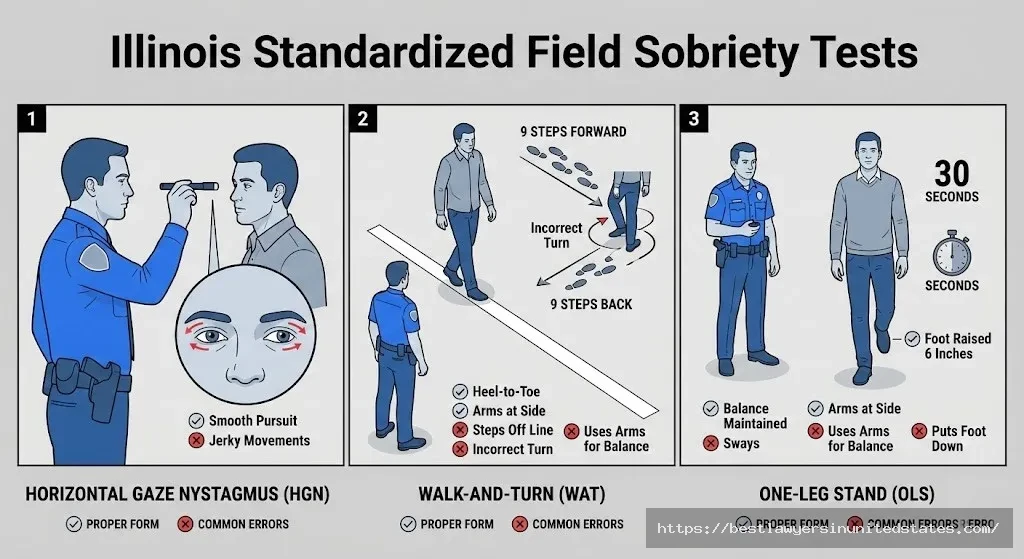
Common administration errors:
- Wrong instructions given
- Tests conducted on uneven surface
- Poor lighting conditions
- Officer didn’t demonstrate properly
- Weather factors not considered
Physical conditions prevent proper test performance:
- Inner ear problems
- Knee or hip injuries
- Back problems
- Age over 65
- Obesity
- Footwear issues
Challenging Probable Cause
Weak probable cause means illegal arrest. Everything following the illegal arrest gets suppressed.
Insufficient probable cause examples:
- Odor of alcohol alone
- Admission of “one drink” hours ago
- Red eyes from allergies or fatigue
- Nervousness (natural around police)
Video evidence from squad car cameras often contradicts officer testimony. Your attorney obtains all available video footage.
Cannabis & Prescription Drug Defenses
THC presence alone doesn’t prove impairment. Prosecutors must show you used cannabis within 2 hours of driving and were impaired.
Effective defenses include:
- No proof of recent use
- Medical marijuana exception (if under threshold)
- Lab testing errors
- No actual impairment evidence
Valid prescriptions don’t excuse impaired driving but create reasonable doubt about intent.
Should You Refuse the Breathalyzer?
Refusal carries significant consequences. Understanding the trade-offs helps you make informed decisions.
Pros of Refusing
No BAC evidence: Prosecutors lack hard numbers proving intoxication. They must rely on officer observations and field sobriety tests.
Some defense attorneys argue refusal cases are easier to defend. Without BAC evidence, prosecutors face higher burdens proving impairment.
Cons of Refusing
The cons typically outweigh the pros in Illinois:
Automatic 12-month suspension: Double the 6-month suspension for failing the test on first offense.
Used against you: Prosecutors tell juries you refused because you knew you were drunk. This “consciousness of guilt” argument is powerful.
Harder to get court supervision: Many judges deny supervision to defendants who refused testing.
Jury instruction: Illinois law allows special jury instructions about refusal, essentially telling jurors they can infer guilt from refusal.
When Refusal Might Make Sense
Very few scenarios justify refusal:
- BAC clearly far above 0.08% (maybe 0.15%+)
- Prior DUI where test would trigger enhanced penalties
- Commercial drivers facing automatic CDL loss
Even in these situations, refusal remains risky. Calculate your costs with our DUI cost calculator to see financial impacts of both choices.
DUI Cost Calculator
Estimate total DUI expenses by state and offense
Detailed Cost Breakdown
Payment Timeline
Bail bond, towing fees, car impound, attorney retainer
Initial court fines, DMV fees, DUI school enrollment, ignition interlock installation
Monthly probation fees, ignition interlock fees, DUI school payments, attorney balance
Insurance premium increases, license reinstatement, SR-22 filing fees
- Lost wages from missed work (court dates, jail time, DUI school) – $2,000-$10,000
- Job loss or difficulty finding employment – Varies
- Professional license suspension (doctors, lawyers, nurses, pilots) – Career ending
- Rideshare and transportation costs during suspension – $1,500-$5,000
- Travel restrictions and visa denials – Varies
- Security clearance loss – Career impact
- Child custody implications – Legal costs
- Rental car restrictions – Varies
- Personal relationships and mental health costs – Priceless
Forced Blood Draws
Police increasingly obtain warrants for blood draws in serious cases. They cannot physically force you to provide breath or urine without a warrant.
Blood draws require either consent or a warrant. Judges routinely issue warrants in cases involving:
- Serious accidents
- Injuries or fatalities
- Children in vehicle
- Multiple refusals by same defendant
Plea Bargains in Illinois DUI Cases
Illinois prosecutors rarely offer favorable DUI plea deals. The state’s tough stance on drunk driving limits negotiation opportunities.
Reckless Driving Reduction: Not Available
Many states allow DUI charges reduced to reckless driving. Illinois generally prohibits this practice.
Illinois policy: DUI stays DUI. Prosecutors cannot offer reckless driving pleas in most counties except in very weak cases where dismissal is likely anyway.
Compare this to states like Arizona or Colorado where reckless driving pleas occur more frequently.
Typical Plea Negotiations
Actual plea discussions focus on different issues:
First offense negotiations:
- Court supervision vs. conviction
- Minimum fines vs. maximum
- BAIID requirements
- Treatment program participation
Second offense negotiations:
- 5 days jail vs. 240 hours community service
- Treatment in lieu of additional jail
- Sentencing recommendations
- Concurrent vs. consecutive sentences (if other charges exist)
Third offense negotiations:
- Prison vs. probation
- Minimum vs. maximum sentence
- Treatment program credit toward sentence
- Ankle monitoring vs. incarceration
When to Fight vs. When to Plead
Fight the charges when:
- Weak probable cause for stop
- Failed breathalyzer calibration
- Video contradicts officer testimony
- No actual impairment evidence
- Rights violations occurred
Consider pleading when:
- BAC significantly over 0.08%
- Clear video evidence of impairment
- Accident involved
- Strong officer testimony
- Multiple witnesses
- You want to minimize uncertainty
Importance of Attorney Negotiation
Prosecutors negotiate differently with experienced DUI attorneys. Defense lawyers with good reputations and trial skills get better outcomes.
Your attorney’s relationship with local prosecutors and judges matters significantly in smaller counties. They know which arguments work with specific judges.
Calculate Your Total DUI Costs in Illinois
Understanding the full financial impact helps you prepare. DUI expenses extend far beyond court fines.
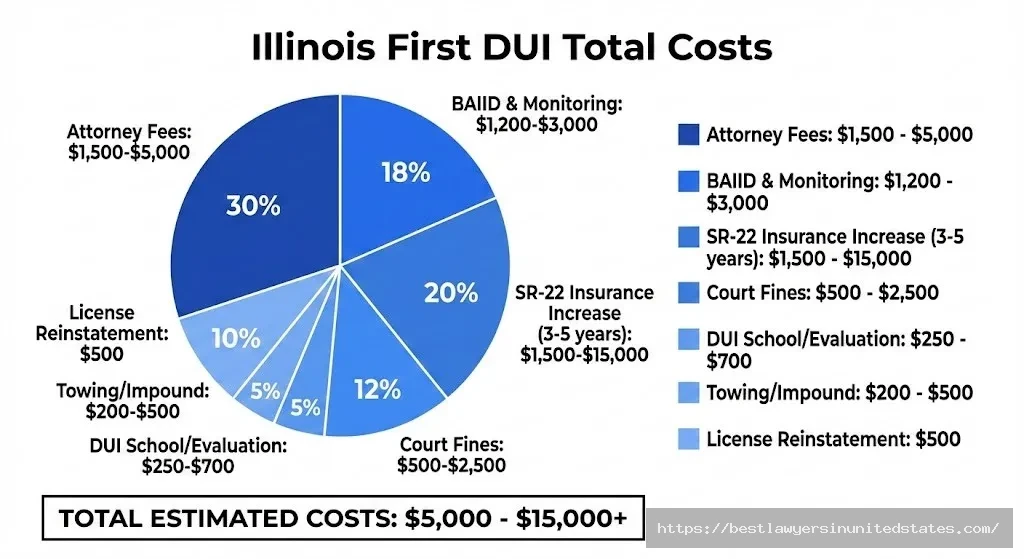
Use our DUI cost calculator for personalized estimates based on your situation.
DUI Cost Calculator
Estimate total DUI expenses by state and offense
Detailed Cost Breakdown
Payment Timeline
Bail bond, towing fees, car impound, attorney retainer
Initial court fines, DMV fees, DUI school enrollment, ignition interlock installation
Monthly probation fees, ignition interlock fees, DUI school payments, attorney balance
Insurance premium increases, license reinstatement, SR-22 filing fees
- Lost wages from missed work (court dates, jail time, DUI school) – $2,000-$10,000
- Job loss or difficulty finding employment – Varies
- Professional license suspension (doctors, lawyers, nurses, pilots) – Career ending
- Rideshare and transportation costs during suspension – $1,500-$5,000
- Travel restrictions and visa denials – Varies
- Security clearance loss – Career impact
- Child custody implications – Legal costs
- Rental car restrictions – Varies
- Personal relationships and mental health costs – Priceless
Complete First Offense Cost Breakdown
| Expense Category | Cost Range | Notes |
|---|---|---|
| Court fines | $500-$2,500 | Set by judge |
| Court costs | $200-$400 | Administrative fees |
| Attorney fees | $1,500-$5,000 | Simple case with supervision |
| DUI evaluation | $100-$200 | State-mandated |
| DUI education | $150-$500 | 10-20 hour programs |
| Victim impact panel | $50-$75 | One-time attendance |
| BAIID installation | $100-$150 | One-time |
| BAIID monthly rental | $70-$150 | 12+ months required |
| BAIID calibration | $50-$75 | Monthly appointments |
| License reinstatement | $500 | Secretary of State fee |
| SR-22 insurance filing | $25-$50 | Annual filing fee |
| Increased insurance premiums | $500-$3,000/year | For 3-5 years |
| Towing and impound | $200-$500 | Immediate cost |
| Lost wages | Varies | Court dates, jail time |
| TOTAL FIRST OFFENSE | $5,000-$15,000+ | Conservative estimate |
Second Offense Costs
Second offenses cost more due to mandatory minimums and longer suspensions:
Additional expenses:
- Higher attorney fees: $2,500-$7,500
- Longer BAIID requirement: 24-36 months
- Jail time lost wages: 5+ days minimum
- Higher insurance increases: 100-300%
- Longer reinstatement process: Formal hearing costs
Total second offense: $8,000-$25,000+
Third Offense (Felony) Costs
Felony DUI costs explode beyond direct expenses:
Direct costs:
- Attorney fees: $5,000-$15,000+
- Bond (if required): $1,000-$10,000
- Expert witnesses: $1,000-$5,000
- Investigation costs: $500-$2,000
Indirect costs:
- Job loss from prison sentence
- Years of lost income
- Unemployability in many fields
- Virtually uninsurable status
- Career destruction
Total third offense: $15,000-$50,000+ (plus incalculable life impact)
Hidden Costs Often Overlooked
These expenses surprise many defendants:
Professional consequences:
- Lost job requiring driving
- Inability to get certain professional licenses
- Career advancement blocked
- Business opportunities lost
Personal life impacts:
- Relationship strain or divorce
- Rental application denials (criminal record)
- Loan denials or higher interest rates
- College admission complications
- Security clearance denial
How Long Does a DUI Stay on Your Record in Illinois?
Quick Answer: Forever. Illinois DUI convictions are permanent and cannot be expunged or sealed.
Permanent Criminal Record
Illinois law prohibits expunging or sealing DUI convictions under any circumstances. No waiting period changes this rule.
Compare this to states like Connecticut where some expungement options exist after extended periods.
What stays permanent:
- DUI convictions
- Court supervision dispositions
- Arrest records
Even court supervision, despite not being a conviction, cannot be expunged. This surprises many first-time offenders who expected a clean slate eventually.
Background Check Impact
DUI convictions show up on criminal background checks forever. Employers, landlords, and licensing boards all see the conviction.
Court supervision is trickier:
- Not technically a conviction under Illinois law
- May or may not appear on commercial background checks
- Definitely appears on Illinois Secretary of State records
- Shows on FBI fingerprint checks
Driving Record vs. Criminal Record
These are separate records with different rules:
| Record Type | Content | Who Sees It | Duration |
|---|---|---|---|
| Criminal record | Arrests, convictions, dispositions | Employers, courts, licensing boards | Lifetime |
| Driving record | Traffic violations, suspensions, DUI | Insurance companies, DMV, employers | Lifetime |
| Secretary of State record | License status, DUI history | Anyone who looks you up | Lifetime |
All three records maintain DUI information permanently.
Impact on Future DUI Charges
Illinois uses a lifetime lookback period. Your first DUI at age 21 still counts as a prior offense if you get arrested again at age 65.
This differs from many states using 10-year lookback periods. In Illinois, prior DUIs never expire or fall off for charging purposes.
Background Check & Employment Impact
DUI convictions create lasting employment challenges. Understanding what employers see helps you prepare responses.
What Shows on Background Checks
Standard employment background checks reveal:
- DUI convictions (forever)
- Arrest records (even without conviction)
- Court supervision (sometimes)
- License suspensions
- Pending charges
The depth depends on the screening company and what the employer orders. Basic checks may miss older arrests while comprehensive checks find everything.
Jobs Difficult to Get with DUI
Virtually impossible:
- Commercial truck driving
- School bus driver
- Uber/Lyft/delivery driving
- Positions requiring company vehicle
- Jobs with DOT regulation
Very difficult:
- Police officers and law enforcement
- Childcare and education
- Healthcare (some positions)
- Jobs requiring security clearance
- Financial services (handling money)
- Government positions
Challenging but possible:
- Professional positions with driving
- Sales requiring travel
- Management roles
- Skilled trades
Professional License Consequences
State licensing boards take DUI convictions seriously.
Illinois professional licenses affected:
| License Type | Reporting Required | Typical Consequence |
|---|---|---|
| Nursing (IDFPR) | Yes, within 60 days | Probation, monitoring, possible suspension |
| Teaching (ISBE) | Yes | Review, possible certificate suspension |
| Law (ARDC) | Yes | Disciplinary proceedings |
| Medical | Yes | Board review, possible restrictions |
| Real estate | Yes | License review |
| CDL | Automatic | 1-year disqualification minimum |
Failure to report often causes worse consequences than the DUI itself.
Disclosure Requirements
Many job applications ask about criminal convictions. Lying creates bigger problems than disclosure.
Application questions vary:
- “Have you ever been convicted of a crime?”
- “Have you been convicted in the past 7 years?”
- “Have you been convicted of a felony?”
Court supervision technically isn’t a conviction. You can legally answer “no” to conviction questions if you only received supervision. However, some applications ask about arrests or “criminal dispositions.”
How to Address DUI with Employers
Best practices:
- Be honest if directly asked
- Focus on rehabilitation and lessons learned
- Highlight time passed since incident
- Emphasize clean record since DUI
- Provide context without making excuses
Many employers appreciate honesty over discovering the DUI through background checks.
Insurance Consequences
DUI convictions devastate your auto insurance situation for years. Prepare for massive premium increases and potential policy cancellation.
SR-22 Insurance Requirement
Illinois requires SR-22 certificates for 3-5 years after DUI. This isn’t a special insurance policy—it’s proof your insurer filed paperwork with the state.
SR-22 basics:
- Certificate proving you carry liability insurance
- Filed by your insurance company
- Must remain continuously valid for required period
- Lapses trigger license suspension
- Costs $25-$50 annual filing fee
Finding insurers willing to file SR-22 becomes your first challenge.
Premium Increases
Typical insurance rate increases after DUI:
| Insurance Category | Rate Increase | Duration |
|---|---|---|
| Standard drivers | 50-150% | 3-5 years |
| Good drivers (no prior incidents) | 80-150% | 3-5 years |
| Drivers with prior violations | 100-300% | 5+ years |
| Young drivers (under 25) | 150-300% | 5+ years |
A driver paying $1,200 annually might see rates jump to $2,400-$3,600 after DUI.
Policy Cancellation Risk
Many insurers drop DUI drivers at renewal. Standard carriers often refuse to renew policies after DUI convictions.
What happens after cancellation:
- You must find high-risk insurance
- Options become extremely limited
- Costs increase dramatically
- Coverage options narrow
High-Risk Insurance Pools
High-risk insurers specialize in DUI drivers. They charge significantly more than standard carriers.
High-risk insurance characteristics:
- Premiums 200-400% higher than standard rates
- Minimum coverage only (state requirements)
- Limited customer service
- Difficult claim processes
- Few discount opportunities
Duration of Increased Rates
Rate increases don’t disappear after SR-22 requirements end. Insurers typically surcharge DUI drivers for 5-7 years minimum.
Timeline:
- Years 1-3: Maximum surcharges (100-300% increases)
- Years 4-5: Moderate surcharges (50-100% increases)
- Years 6-7: Declining surcharges (25-50% increases)
- Year 8+: Rates return closer to normal
Some insurers maintain surcharges for 10 years.
Shopping for Better Rates
Not all insurers price DUI risk identically. Shopping multiple carriers finds the best available rates.
Tips for finding better insurance:
- Get quotes from 5-10 companies minimum
- Consider raising deductibles to lower premiums
- Ask about DUI-specific discount programs
- Inquire about defensive driving course discounts
- Bundle with home insurance where possible
- Consider usage-based insurance programs
Immigration Status Impact
Non-U.S. citizens face devastating immigration consequences from DUI convictions. The 2025 federal law changes make this worse.
H.R.875: Jeremy and Angel Act (2025)
This federal legislation passed the House in June 2025. It makes DUI a deportable offense for non-U.S. nationals.
Who it affects:
- Green card holders (lawful permanent residents)
- Work visa holders (H-1B, L-1, etc.)
- Student visa holders (F-1)
- Tourist visa holders
- Asylum seekers
- Undocumented immigrants
Consequences:
- Grounds for deportation/removal
- Inadmissibility for entering/re-entering U.S.
- Visa application denials
- Green card application denials
- Citizenship application denials
Immigration vs. Criminal Definitions
Immigration law uses different definitions than Illinois criminal law. Court supervision might not be a “conviction” under Illinois law but could still trigger immigration consequences.
| Illinois Law | Federal Immigration Law |
|---|---|
| Court supervision = not conviction | May still be conviction for immigration |
| Conviction requires guilty verdict | Broader definition includes admissions |
| Focus on punishment | Focus on conduct admitted |
Always consult an immigration attorney before pleading to ANY charge.
Deportation Risk Factors
Not every DUI leads to immediate deportation. ICE prioritizes certain cases:
Higher deportation risk:
- Second or third DUI
- DUI with accident causing injury
- DUI with child in vehicle
- High BAC (0.15%+)
- Undocumented status
- Prior immigration violations
Lower risk (but still possible):
- First DUI with court supervision
- Low BAC
- No aggravating factors
- Clean immigration history
- Long U.S. residence
Green Card Holders
Permanent residents once felt relatively safe from deportation for misdemeanors. H.R.875 changes this dramatically.
Green card consequences:
- Removal proceedings likely
- Re-entry difficulties after travel
- Citizenship application denial
- Adjustment of status denials
Time in the U.S. doesn’t provide protection. Even green card holders with decades of residence face deportation.
Visa Holders
Temporary visa holders face immediate problems:
Work visa issues:
- Visa renewal denials
- Entry denial after international travel
- Employer notification
- Job loss
Student visa problems:
- F-1 status termination
- School notification
- Inability to return after leaving U.S.
Critical Timeline for Non-Citizens
Immediate steps if arrested:
- Within 24 hours: Contact immigration attorney (before criminal attorney)
- Before arraignment: Understand immigration consequences of each plea option
- Before any plea: Have immigration attorney review and approve
- After conviction: Immediately consult about appeals or post-conviction relief
Never plead guilty or accept court supervision without immigration counsel. Criminal defense attorneys, even excellent ones, often misunderstand immigration consequences.
Professional License Consequences
Illinois professional licensing boards take DUI convictions seriously. Many professions require reporting convictions and face board disciplinary proceedings.
Nursing Licenses (IDFPR)
The Illinois Department of Financial and Professional Regulation oversees nursing licenses. Nurses must report DUI convictions within 60 days.
Typical consequences for nurses:
- Mandatory probation (2-5 years common)
- Random drug/alcohol testing
- Substance abuse treatment requirements
- Workplace monitoring
- License suspension (serious cases)
Second DUI convictions often result in longer suspensions or license revocation.
Teaching Certificates (ISBE)
Illinois State Board of Education reviews all teacher DUI convictions. Teachers must report arrests and convictions.
ISBE review process:
- Automatic investigation triggered
- Review of circumstances
- Consideration of time passed
- Assessment of rehabilitation
- Decision on certificate status
Possible outcomes:
- Warning or reprimand
- Probation with conditions
- Suspension (1-5 years)
- Revocation (permanent)
Elementary teachers and those working with young children face stricter scrutiny than high school teachers.
Law Licenses (ARDC)
The Attorney Registration and Disciplinary Commission handles lawyer discipline. Attorneys must report DUI arrests and convictions.
ARDC consequences vary:
- Informal admonition (minor cases)
- Censure (public reprimand)
- Suspension (6 months to 3 years typical)
- Disbarment (multiple DUIs or aggravated cases)
Lawyers face enhanced scrutiny because DUI involves dishonesty (potential false statements to police) and criminal conduct.
Medical Licenses
Illinois Department of Financial and Professional Regulation also oversees medical licenses. Doctors must report criminal convictions.
Medical board concerns:
- Substance abuse issues
- Judgment impairment
- Patient safety
- Professional fitness
Doctors often face monitoring programs, required treatment, and practice restrictions rather than immediate license suspension.
Real Estate Licenses
Real estate agents must maintain good character. IDFPR reviews DUI convictions for license holders.
Common consequences:
- Warning letter
- Probation
- Additional education requirements
- Suspension (rare for first DUI)
CDL Holders
Commercial Driver’s License holders face automatic disqualification. No board review or appeal process exists.
Automatic penalties:
- First DUI: 1-year CDL disqualification
- Second DUI: Lifetime CDL disqualification
- DUI with hazmat: Enhanced penalties
These penalties apply regardless of whether you were driving commercially at the time.
How DUI Cases Differ Across Illinois Counties
Illinois county prosecutors and judges handle DUI cases differently. Understanding local practices helps set realistic expectations.
Cook County (Chicago Area)
Cook County processes the highest volume of DUI cases in Illinois. Dedicated DUI court branches handle these cases exclusively.
Cook County characteristics:
- More plea bargain opportunities
- Court supervision readily available (first offense)
- Longer case timelines (3-12 months typical)
- Experienced DUI prosecutors
- Public defenders handle many cases
- Traffic courts in Skokie, Bridgeview, Rolling Meadows, Maywood
Chicago Police Department makes thousands of DUI arrests annually. Illinois State Police also patrol Cook County highways.
DuPage County
DuPage County takes a harder line on DUI than Cook County. Prosecutors offer fewer lenient deals.
DuPage characteristics:
- Stricter than Cook County
- Court supervision with more conditions
- Higher bail amounts
- Less flexibility on high BAC cases
- Faster case resolution (2-6 months)
- Main courthouse in Wheaton
DuPage County prosecutors rarely offer deals on second offenses. Expect mandatory minimum sentences.
Lake County
Lake County borders Wisconsin and sees significant DUI enforcement. County prosecutors take tough stances.
Lake County specifics:
- Very strict on repeat offenders
- Highway patrol focuses on Route 41, I-94
- Main courthouse in Waukegan
- Specialized DUI prosecutors
- Strong emphasis on victim impact
Lake County judges grant court supervision but often add BAIID requirements even for first offenses.
Kane County
Kane County covers western Chicago suburbs including Aurora, Elgin, and St. Charles. Moderate approach to DUI prosecution.
Kane County practices:
- Reasonable plea negotiations
- Court supervision for first offenders
- Strict on second offenses
- Multiple courthouse locations
- Suburban and rural areas both covered
Kane County State’s Attorney handles cases differently in Aurora (urban) versus rural western county.
Will County
Will County includes Joliet and rapidly growing southern suburbs. Growing population means increasing DUI arrests.
Will County approach:
- Moderately strict
- Court supervision available
- Growing caseload
- Mix of suburban and rural enforcement
- I-80 and I-55 corridors heavily patrolled
Downstate Illinois Counties
Rural and downstate counties vary dramatically. Some are very strict while others show more leniency.
Strictest downstate counties:
- Madison County (Alton, Edwardsville area)
- St. Clair County (Belleville, East St. Louis)
- Sangamon County (Springfield – state capital)
- McLean County (Bloomington-Normal)
More lenient downstate counties:
- Smaller rural counties
- Counties with part-time prosecutors
- Areas with fewer DUI arrests
Why County Matters
Local practices significantly affect outcomes. The same case might result in court supervision in Cook County but conviction in DuPage County.
Factors varying by county:
- Prosecutor policies
- Judge attitudes toward DUI
- Available alternative sentencing
- Bail amounts
- Discovery timelines
- Plea negotiation flexibility
Hiring an attorney practicing regularly in your county provides crucial advantages. Local relationships and knowledge of specific judges and prosecutors matter enormously.
What to Do If Arrested for DUI in Illinois
Taking proper steps immediately after arrest protects your rights and improves outcomes.
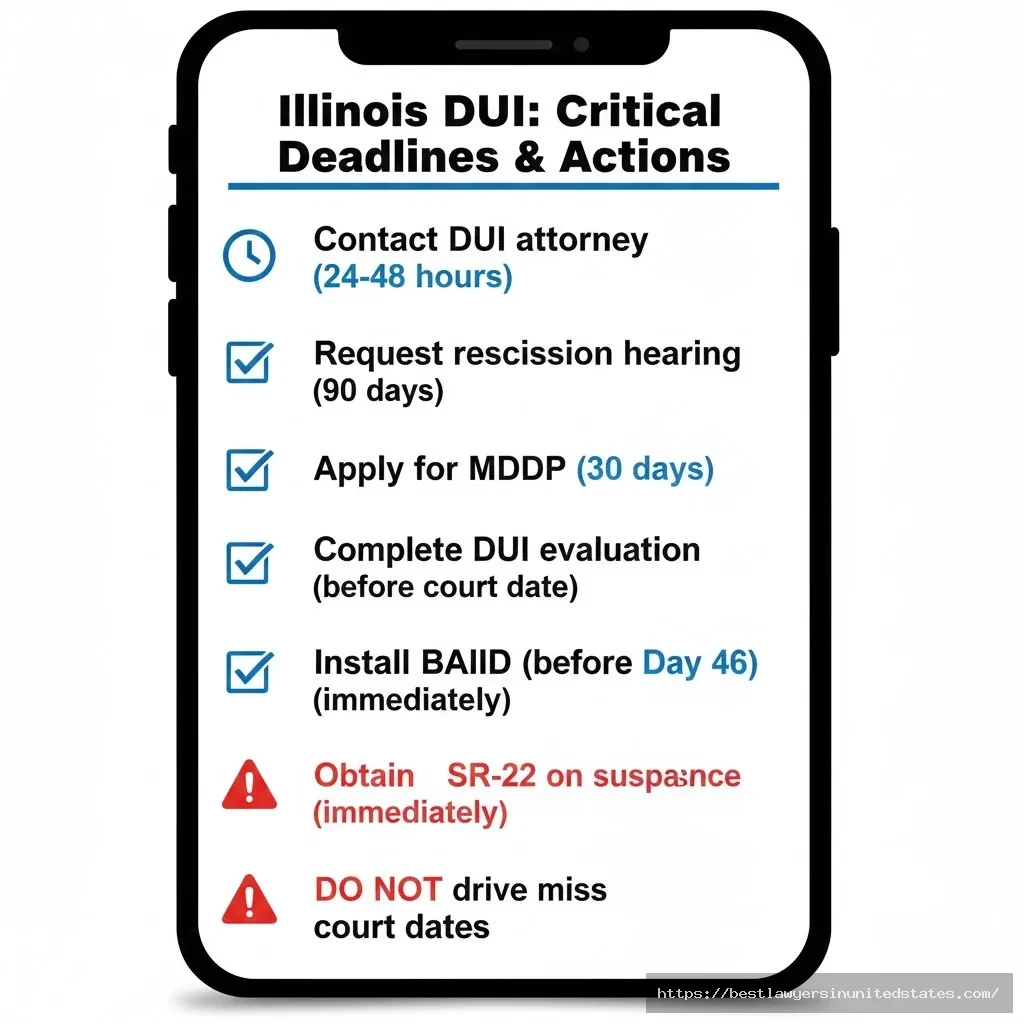
Immediate Steps (First 24-48 Hours)
Hour 1-6: You’re likely still in custody or just released.
- Do NOT post about arrest on social media
- Do NOT discuss case with anyone except attorney
- Do NOT answer police questions beyond identification
- Document everything you remember about the stop and arrest
Day 1: Contact attorney immediately.
- DUI specialists handle these cases best
- Free consultations are common
- Explain the situation honestly
- Follow attorney’s advice exactly
Days 2-45: Critical window before suspension begins.
- Gather evidence (receipts showing where you were, witness names)
- Take photos of arrest location if safe and legal
- Request copy of police report
- Begin researching DUI attorneys if you haven’t hired one
Requesting Rescission Hearing
You have 90 days to request this hearing. Don’t wait—request it immediately.
How to request:
- Download form from Illinois Secretary of State website
- Fill out completely and accurately
- File with appropriate Secretary of State office
- Pay required filing fee
- Keep copies of everything
Your attorney typically handles this filing. If you’re unrepresented, don’t skip this step.
Applying for MDDP/RDP
File for Monitoring Device Driving Permit within 30 days of arrest. This lets you keep driving during suspension.
MDDP requirements:
- $30 application fee
- Proof of SR-22 insurance
- BAIID installation in all vehicles you drive
- DUI evaluation (may be required first)
Processing takes 2-4 weeks. Apply early to avoid gaps in driving privileges.
Protecting Your Employment
If driving is essential for your job:
- Inform employer (if required by policy)
- Explore carpooling or public transportation
- Request temporary work-from-home
- Consider relocation closer to work
- Apply for MDDP immediately
CDL holders:
- Notify employer within 30 days
- Understand you cannot drive commercially during suspension
- Explore non-driving positions temporarily
- Consider career changes if second offense
What NOT to Do
Avoid these common mistakes:
- ❌ Posting about arrest on social media
- ❌ Discussing case with friends, family, coworkers
- ❌ Contacting the alleged victim (if accident involved)
- ❌ Driving on suspended license
- ❌ Missing court dates
- ❌ Ignoring attorney’s advice
- ❌ Lying to your attorney
- ❌ Hiring the cheapest lawyer
- ❌ Representing yourself
Choosing a DUI Attorney in Illinois
Hiring the right attorney makes the difference between conviction and court supervision, jail and probation, or winning and losing.
Why You Need a Specialist
DUI law is complex and constantly changing. General practice attorneys lack the specialized knowledge required.
DUI specialists know:
- Breathalyzer calibration requirements
- Field sobriety test administration standards
- Officer training requirements
- Chemical test chain of custody
- Administrative hearing procedures
- Local judge and prosecutor tendencies
Questions to Ask Potential Attorneys
Experience questions:
- How many DUI cases have you handled?
- What percentage of your practice is DUI?
- How many cases have you taken to trial?
- What’s your success rate?
- Have you handled cases in my county?
Specific case questions:
- Have you dealt with my judge before?
- Do you know the prosecutor assigned?
- What defenses apply to my case?
- What’s the likely outcome?
- What’s your strategy?
Practical questions:
- Will you handle my case personally?
- What’s your fee structure?
- What’s included in the fee?
- What additional costs should I expect?
- How do we communicate?
Red Flags to Avoid
Warning signs of problematic attorneys:
- Guarantees specific outcomes
- Promises to “get you off”
- Significantly cheaper than competitors
- No DUI specialization
- Poor communication
- Pressure to hire immediately
- No references available
Fee Structures
Typical Illinois DUI attorney fees:
| Service Level | Cost Range | What’s Included |
|---|---|---|
| Basic first offense | $1,500-$3,000 | Arraignment, plea negotiation, 1-2 court appearances |
| Complex first offense | $3,000-$5,000 | Above plus trial preparation, motions, expert consultation |
| Second offense | $2,500-$7,500 | Full representation through sentencing |
| Felony (third+) | $5,000-$15,000+ | Complete defense including trial |
Payment plans are common. Many attorneys accept credit cards or offer financing.
Local Experience Matters
Attorneys practicing regularly in your county know:
- Which judges grant court supervision readily
- Which prosecutors negotiate fairly
- Local courtroom procedures
- Administrative staff
- Best local expert witnesses
An attorney from your county offers significant advantages over one practicing primarily elsewhere.
Frequently Asked Questions: Illinois DUI Laws
Will I go to jail for my first DUI in Illinois?
Quick Answer: Most first-time offenders don’t see jail time. You’ll likely receive court supervision, probation, or conditional discharge instead.
Exceptions exist. You face jail time if your case involves accidents causing injuries, very high BAC (0.20%+), child passengers, or prior criminal history.
Cook County and collar counties handle first offenses differently. Cook County judges more readily grant court supervision without jail. DuPage and Lake Counties impose stricter conditions.
Alternative sentences like home monitoring, weekend reporting, and electronic monitoring help you avoid actual jail time while maintaining employment.
What is court supervision and how do I get it?
Quick Answer: Court supervision is Illinois’s unique second chance for first-time DUI offenders. It’s not a conviction and doesn’t create a criminal record.
To qualify you must:
- Have no prior DUI convictions
- Face no aggravating factors (accident, injury, child passenger)
- Complete DUI evaluation and recommended treatment
- Install BAIID if ordered
- Pay all fines and fees
- Avoid new criminal violations during supervision period
Court supervision typically lasts 12-24 months. Successfully completing it means no conviction appears on your record. However, court supervision itself cannot be expunged and remains permanently visible on Secretary of State records.
Violating supervision terms results in immediate conviction and full sentencing.
Can I refuse a breathalyzer in Illinois?
Quick Answer: Yes, you can refuse, but refusal triggers a 12-month license suspension compared to just 6 months for failing the test.
Refusal carries serious downsides:
- Longer automatic suspension
- Used as evidence of guilt at trial
- Harder to obtain court supervision
- Negative jury instructions allowed
Prosecutors argue refusal shows “consciousness of guilt”—you knew you were drunk and refused to prove it.
Very few situations justify refusal. Even defense attorneys disagree on whether refusal helps your case. The doubled suspension period usually outweighs any benefit from lack of BAC evidence.
How much does a DUI cost in Illinois?
Quick Answer: First offense costs $5,000-$15,000 total. Second offense runs $8,000-$25,000. Third offense (felony) exceeds $15,000-$50,000 plus potential job loss.
Use our DUI cost calculator for personalized estimates.
Major expense categories:
- Court fines: $500-$2,500
- Attorney fees: $1,500-$15,000+ (depending on offense)
- BAIID: $1,200-$3,000 annually
- SR-22 insurance increases: $1,500-$15,000 over 3-5 years
- Lost wages, towing, evaluations, classes: $1,000-$3,000
Hidden costs include job loss, career damage, and professional license consequences.
Does a DUI show up on background checks in Illinois?
Quick Answer: DUI convictions appear on criminal background checks permanently. Court supervision may or may not show depending on the screening company.
Convictions definitely appear on:
- FBI fingerprint checks
- State police criminal history checks
- Most commercial background screening
- Professional licensing board checks
Court supervision (not technically a conviction) shows on:
- Illinois Secretary of State records
- Some but not all commercial background checks
- Driving record checks
Employers, landlords, and licensing boards all conduct background checks that may reveal DUI history.
Can I get a DUI expunged in Illinois?
Quick Answer: No. Illinois law prohibits expunging or sealing DUI convictions under any circumstances. Your DUI remains on your record forever.
This includes:
- DUI convictions (permanent)
- Court supervision (permanent and unexpungeable)
- Arrest records (visible permanently)
No waiting period changes this rule. A DUI at age 21 remains visible at age 65 and beyond.
This differs from most other misdemeanors which can be expunged after completing sentences and waiting periods.
What happens at my first court date for DUI?
Quick Answer: Arraignment is your first court date. The judge reads charges, you enter a plea, and bond conditions are set. The entire proceeding takes 5-15 minutes.
What to expect:
- Arrive 30 minutes early
- Dress professionally
- Bring attorney if hired
- Judge reads charges against you
- You plead not guilty, guilty, or no contest (almost always not guilty at first appearance)
- Judge sets bond (usually I-bond for first offense)
- Next court date is scheduled
Bring your driver’s license, proof of insurance, and any paperwork from your arrest.
Your attorney can often appear without you at routine status hearings. You must appear personally at arraignment and any hearings where testimony occurs.
How do I get my license back after DUI in Illinois?
Quick Answer: First offense requires paying $500 reinstatement fee and showing proof of SR-22 insurance. Multiple offenses require formal hearings with the Secretary of State.
First offense reinstatement:
- Wait until suspension ends
- Complete DUI evaluation/treatment
- Obtain SR-22 insurance
- Pay $500 reinstatement fee
- Visit Secretary of State facility
Second/third offense reinstatement:
- Complete all court requirements
- Finish substance abuse treatment
- Gather character letters
- Prepare employment verification
- Request formal hearing
- Attend hearing and present evidence
- Receive decision (30-90 days)
Timeline varies but expect 30-90 days after eligibility for full reinstatement.
What makes a DUI “aggravated” in Illinois?
Quick Answer: Twelve specific factors trigger aggravated DUI charges. Third offense automatically qualifies. Other factors include accidents causing injury, child passengers, and driving on revoked license.
All 12 aggravating factors:
- Third or subsequent DUI
- School bus with passengers
- Great bodily harm/permanent disability
- Prior reckless homicide conviction
- School zone accident causing bodily harm
- Fatality (Class 2 felony, 3-14 years)
- Driving on DUI-related revoked/suspended license
- No valid driver’s license
- No liability insurance (knowingly)
- Bodily harm to child passenger under 16
- Second DUI while transporting child under 16
- For-hire vehicle (Uber/Lyft/taxi)
Aggravated DUI is a felony (Class 4, 2, or 1 depending on specifics). Prison time becomes likely or mandatory.
Can I drive for Uber/Lyft with a DUI in Illinois?
Quick Answer: Uber and Lyft prohibit drivers with DUI convictions within the past 7 years. Some exceptions exist but are rare.
Both companies conduct annual background checks. DUI convictions discovered at any point result in deactivation.
Rideshare DUI policies:
- 7-year lookback period (some variations by city)
- Both convictions and court supervision count
- Pending DUI charges cause immediate deactivation
- No appeals process
Food delivery services (DoorDash, Grubhub) have varying policies. Some allow DUI drivers after 3-5 years.
What’s the penalty for 3rd DUI in Illinois?
Quick Answer: Class 2 felony with 3-7 years prison. Probation is possible but rare. Minimum 10-year license revocation. Enhanced penalties apply with high BAC or child passengers.
Third DUI mandatory minimums:
- Base: 3-7 years prison (probation sometimes granted)
- High BAC (0.16%+): 90 days jail + $2,500 fine
- Child passenger: $25,000 fine + 25 days community service
Most defendants serve 18-36 months actual prison time with good conduct credits.
License revocation lasts minimum 10 years. Reinstatement requires formal hearing proving rehabilitation.
How does a DUI affect car insurance in Illinois?
Quick Answer: Expect 50-300% premium increases lasting 3-7 years. SR-22 filing is required for 3 years minimum. Some insurers drop DUI drivers entirely.
Insurance impact timeline:
- Years 1-3: Maximum surcharges (100-300%)
- Years 4-5: Moderate surcharges (50-100%)
- Years 6-7: Declining surcharges (25-50%)
- Year 8+: Rates approach normal
Driver paying $1,200 annually might see rates jump to $2,400-$4,800 after DUI.
High-risk insurance pools charge even more—often $3,000-$6,000 annually for minimum coverage.
Can I travel to Canada with an Illinois DUI?
Quick Answer: Canada considers DUI a serious criminal offense. Canadian border officials can deny entry to anyone with DUI convictions, even decades old.
Options for entering Canada with DUI:
- Deemed rehabilitation: Automatic after 10 years (single non-serious offense)
- Temporary resident permit: Allows entry for specific purposes
- Criminal rehabilitation: Permanent solution but expensive and time-consuming
Most DUI drivers get turned away at Canadian borders without advance preparation.
Apply for temporary resident permit ($200 CAD) or criminal rehabilitation ($1,000 CAD) before travel.
What is an MDDP vs. RDP in Illinois?
Quick Answer: Both allow restricted driving during suspension. MDDP (Monitoring Device Driving Permit) is for first offenders. RDP (Restricted Driving Permit) is for repeat offenders with expanded 2025 privileges.
| Feature | MDDP | RDP |
|---|---|---|
| Who qualifies | First offenders | Second/third offenders |
| Driving hours | Varies by need | 12 hours/day, 6 days/week |
| Mileage limits | Specific purposes | 200 miles/any lawful purpose |
| BAIID required | Yes | Yes |
| Application fee | $30 | $30 |
Both require BAIID installation in all vehicles you drive.
Do I need a lawyer for first DUI in Illinois?
Quick Answer: Yes. DUI convictions are permanent and cannot be expunged. An experienced attorney significantly improves your chances of court supervision instead of conviction.
What attorneys provide:
- Negotiate court supervision
- Challenge breathalyzer accuracy
- Question officer procedures
- Identify constitutional violations
- Handle rescission hearings
- Navigate administrative suspensions
Representing yourself risks conviction when supervision might have been possible. Attorney fees ($1,500-$5,000) are small compared to lifetime conviction consequences.
Even simple first-offense cases benefit from experienced counsel. Illinois prosecutors know when defendants lack representation and offer worse deals.
Conclusion
Illinois DUI laws impose some of the nation’s strictest penalties. Third offenses trigger felony charges where most states wait until the fourth. DUI convictions remain permanent with no expungement possible ever.
Court supervision represents your only chance to avoid a permanent criminal record. This option exists only for first-time offenders without aggravating factors. Second offenses face mandatory minimum jail time or community service with no supervision option.
The 2025 immigration law changes created new deportation risks for non-U.S. citizens. Even green card holders with decades of U.S. residence now face removal proceedings after DUI convictions.
If you’re facing DUI charges in Illinois, contact an experienced DUI attorney immediately. You have just 90 days to request a rescission hearing and 30 days to apply for restricted driving permits.
Take action now:
- Contact a DUI specialist attorney within 24-48 hours
- Request rescission hearing within 90 days
- Apply for MDDP/RDP within 30 days
- Complete DUI evaluation before first court date
- Document everything about your arrest
The decisions you make in the first few days after arrest significantly impact your case outcome.
Find DUI Lawyers in Illinois – Free Consultation
Email: [email protected]
Prevention remains the best strategy. Use rideshare services, designate a sober driver, or don’t drink before driving. The financial cost ($5,000-$50,000+), permanent criminal record, and potential jail time far exceed any inconvenience of finding alternative transportation.
Illinois takes drunk driving seriously. Take your DUI charge equally seriously by hiring experienced legal counsel and following their advice exactly.