
Arizona enforces some of the toughest DUI laws in America. A first offense can land you in jail for 10 days and cost over $10,000 when you add fines, legal fees, and insurance hikes. Your license gets suspended immediately after arrest. The state uses a tiered system where higher blood alcohol levels trigger harsher penalties.
You need to act fast after a DUI arrest. Arizona gives you only 15 days to request a Motor Vehicle Division hearing to fight your license suspension. Miss that deadline and you lose your driving privileges automatically.

This guide explains Arizona’s DUI laws, penalties for each offense level, and what happens from arrest through conviction. You’ll learn about BAC limits, the court process, and how to protect your rights.
What Are Arizona’s DUI Laws?
Arizona law prohibits driving or being in actual physical control of a vehicle while impaired by alcohol or drugs. Under A.R.S. § 28-1381, you can face DUI charges in two ways: having a BAC of 0.08% or higher, or being impaired to the slightest degree regardless of your BAC.
The “actual physical control” standard means you don’t have to be driving. Courts have convicted people found sleeping in parked cars with keys in their pocket. Arizona Department of Public Safety officers and local law enforcement use this broad definition to arrest impaired individuals even when the vehicle isn’t moving.
Arizona’s BAC Limits and Legal Thresholds
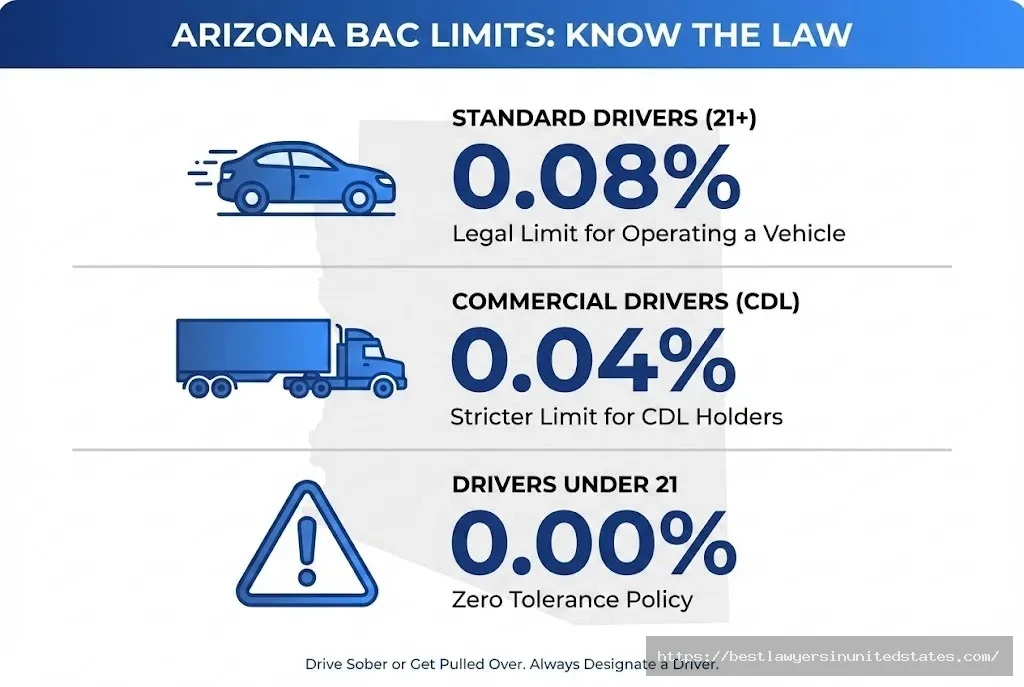
Different BAC limits apply based on your driver classification:
| Driver Type | Legal BAC Limit |
|---|---|
| Standard drivers (21+) | 0.08% |
| Commercial drivers (CDL) | 0.04% |
| Drivers under 21 | 0.00% (zero tolerance) |
| School bus drivers | 0.04% |
Arizona’s zero tolerance policy for underage drivers means any detectable alcohol results in criminal charges. The state uses breathalyzer devices called Intoxilyzers and blood tests to measure BAC levels.
Wondering where you stand? Use our BAC calculator to estimate your blood alcohol content based on drinks consumed, body weight, and time elapsed.
The Four Types of DUI in Arizona
Arizona categorizes DUI offenses into four levels based on BAC and circumstances:
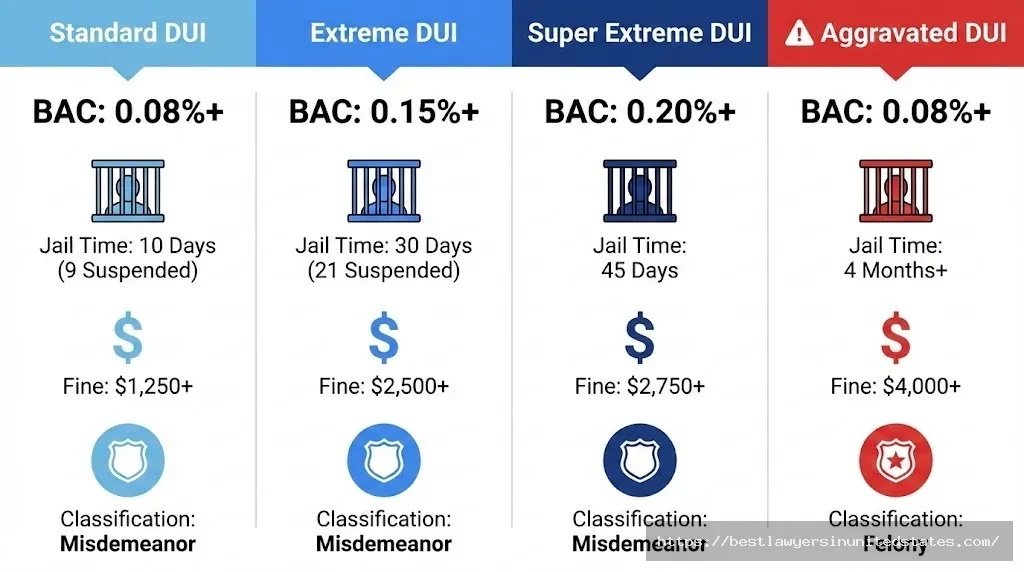
Standard DUI (A.R.S. § 28-1381): BAC between 0.08% and 0.149%. This is a Class 1 misdemeanor carrying mandatory jail time and fines.
Extreme DUI (A.R.S. § 28-1382): BAC between 0.15% and 0.199%. Penalties double compared to standard DUI. You face 30 days minimum jail time with only partial suspension available.
Super Extreme DUI (A.R.S. § 28-1382): BAC of 0.20% or higher. This triggers the harshest misdemeanor penalties with 45 days minimum jail time.
Aggravated DUI (A.R.S. § 28-1383): This felony charge applies when you drive on a suspended license, commit a third DUI within 84 months, drive wrong-way on a highway, or have a child under 15 in the vehicle. Prison time becomes mandatory.
Arizona DUI Penalties by Offense Level
Arizona mandates minimum sentences that judges cannot reduce below statutory limits. Courts can add penalties but never go below the floor set by law.
First Offense Standard DUI Penalties
Your first standard DUI conviction triggers these minimum penalties:
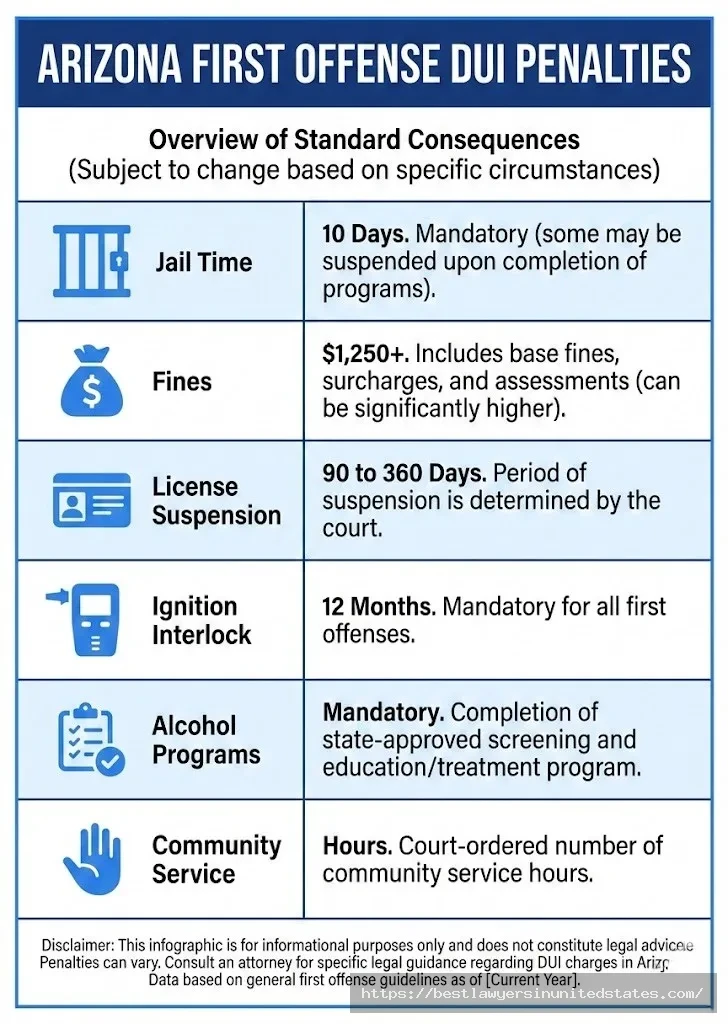
Jail Time: 10 consecutive days minimum. Judges can suspend 9 days if you complete alcohol screening. You must serve at least 24 consecutive hours.
Fines and Fees: Base fine of $1,250 plus surcharges totaling approximately $1,600. Additional court costs add $500-800.
License Suspension: 90 days minimum, up to 360 days maximum. The Motor Vehicle Division imposes this administratively separate from criminal court.
Ignition Interlock Device: Required for 12 months on any vehicle you operate. Installation costs $75-150, plus $60-125 monthly monitoring fees.
Alcohol Programs: Mandatory screening and counseling at your expense. Traffic Survival School costs $250-300 and requires 16 hours of attendance.
Community Service: Courts may order up to 100 hours.
Probation: Up to 5 years supervised probation with alcohol restrictions.
Calculate your total costs using our DUI cost calculator to see the full financial impact including insurance increases.
First Offense Extreme DUI Penalties
When your BAC tests between 0.15% and 0.199%, penalties increase substantially:
Jail Time: 30 consecutive days minimum. Judges can suspend 21 days if you install an ignition interlock device. You must serve at least 9 consecutive days.
Fines: $2,500 base fine plus surcharges totaling approximately $3,250.
License Suspension: 90 days minimum. You may qualify for a restricted license after 30 days with an ignition interlock device.
Ignition Interlock: 12 months required on all vehicles.
Additional Requirements: Same alcohol screening, counseling, and Traffic Survival School as standard DUI.
Some Phoenix Municipal Court and Scottsdale City Court judges require home detention with electronic monitoring for the suspended jail days.
First Offense Super Extreme DUI Penalties
A BAC of 0.20% or higher brings Arizona’s harshest misdemeanor DUI penalties:
Jail Time: 45 consecutive days minimum. Courts can suspend 31 days with ignition interlock installation. You serve at least 14 consecutive days with no early release.
Fines: $2,750 base fine plus surcharges approaching $3,500 total.
License Revocation: 12 months minimum. After 45 days, you may apply for a restricted license with ignition interlock.
Extended Interlock: 18 months of ignition interlock device use.
The Maricopa County Attorney’s Office rarely offers plea reductions for super extreme DUI cases. They prosecute these charges aggressively due to the high BAC readings.
Second Offense DUI Penalties (Within 84 Months)
Arizona counts any DUI conviction within 84 months (7 years) as a repeat offense with mandatory minimum sentences:
Standard Second DUI:
- Jail: 90 days minimum (60 days can be suspended)
- Fines: $3,000 plus surcharges
- License revocation: 12 months
- Ignition interlock: 12 months after reinstatement
- 30 hours community service mandatory
Extreme Second DUI:
- Jail: 120 days minimum (90 days can be suspended)
- Fines: $3,250 plus surcharges
- License revocation: 12 months
- Home detention often required for suspended time
Super Extreme Second DUI:
- Jail: 180 days minimum (150 days can be suspended)
- Fines: $3,750 plus surcharges
- License revocation: 12 months
- Ignition interlock: 24 months
Arizona Department of Public Safety maintains records of all DUI convictions statewide. Convictions in other states count toward your Arizona history under the Interstate Driver’s License Compact.
Aggravated DUI Penalties (Felony)
Aggravated DUI under A.R.S. § 28-1383 becomes a Class 4 or Class 6 felony depending on circumstances:
What Makes It Aggravated:
- Third DUI conviction within 84 months
- DUI while license is suspended, revoked, or cancelled
- DUI with a child under 15 in the vehicle
- DUI while required to have an ignition interlock device
- Wrong-way driving on a highway while impaired
Class 4 Felony Penalties (most cases):
- Prison: 4 months to 3.75 years
- Fines: Up to $150,000 plus surcharges
- License revocation: Minimum 3 years, often permanent
- Vehicle forfeiture possible
- Felony conviction on permanent record
Class 6 Felony (first aggravated DUI with no priors):
- Prison: Presumptive sentence of 1 year
- May qualify for probation instead of prison
- Still requires ignition interlock for life if license restored
Maricopa County Superior Court and Pima County Superior Court handle all felony DUI cases. These courts impose harsher sentences than municipal courts.
Check Your BAC Level
Not sure if you’re over the legal limit? Your BAC depends on several factors including drinks consumed, body weight, gender, and metabolism rate.
A 180-pound man typically reaches 0.08% BAC after 4 standard drinks in two hours. A 140-pound woman reaches the same level after 3 drinks. These are estimates only.
BAC Calculator
Estimate your Blood Alcohol Content
• Commercial Driver (CDL): 0.04% BAC
• Drivers Under 21: 0.00-0.02% BAC (Zero Tolerance)
• Enhanced Penalties: 0.15% BAC or higher in most states
Use our interactive BAC calculator to estimate your blood alcohol content. The tool shows how long until your BAC returns to zero.
Remember that Arizona law prohibits driving while impaired to the slightest degree, even below 0.08%. Officers can arrest you for DUI with any BAC if they observe impairment signs.
The DUI Arrest Process in Arizona
Understanding what happens after a DUI arrest helps you protect your rights and make informed decisions.
Traffic Stop and Initial Investigation
Arizona law enforcement must have reasonable suspicion to stop your vehicle. Common reasons include speeding, weaving between lanes, running a red light, or equipment violations like a broken taillight.
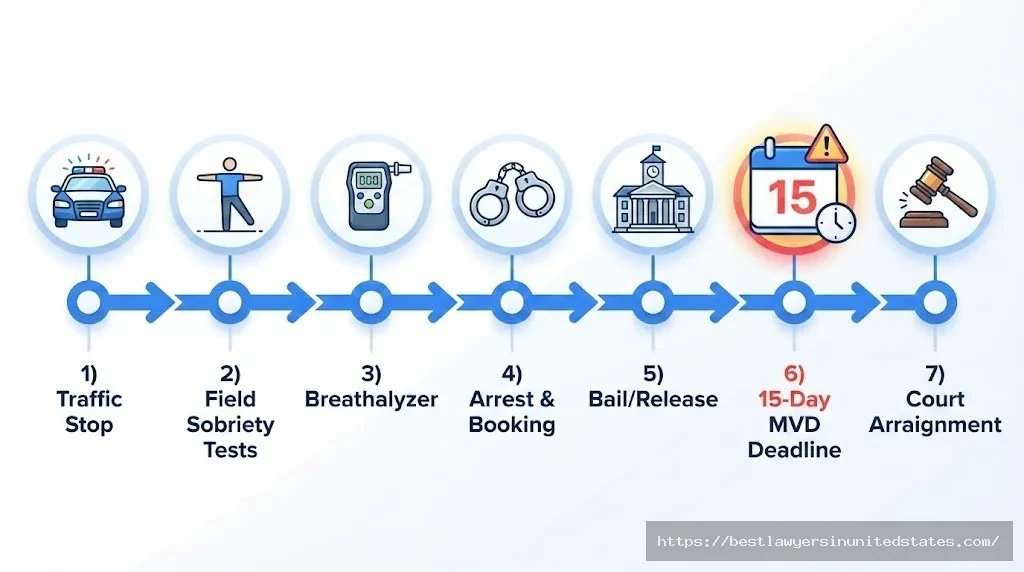
During the stop, officers look for impairment signs:
- Odor of alcohol
- Slurred speech
- Bloodshot or watery eyes
- Fumbling with license or registration
- Open containers in the vehicle
The officer will ask questions like “How much have you had to drink tonight?” You have the right to remain silent. Politely decline to answer potentially incriminating questions.
Field Sobriety Tests
Officers typically request three Standardized Field Sobriety Tests approved by the National Highway Traffic Safety Administration:
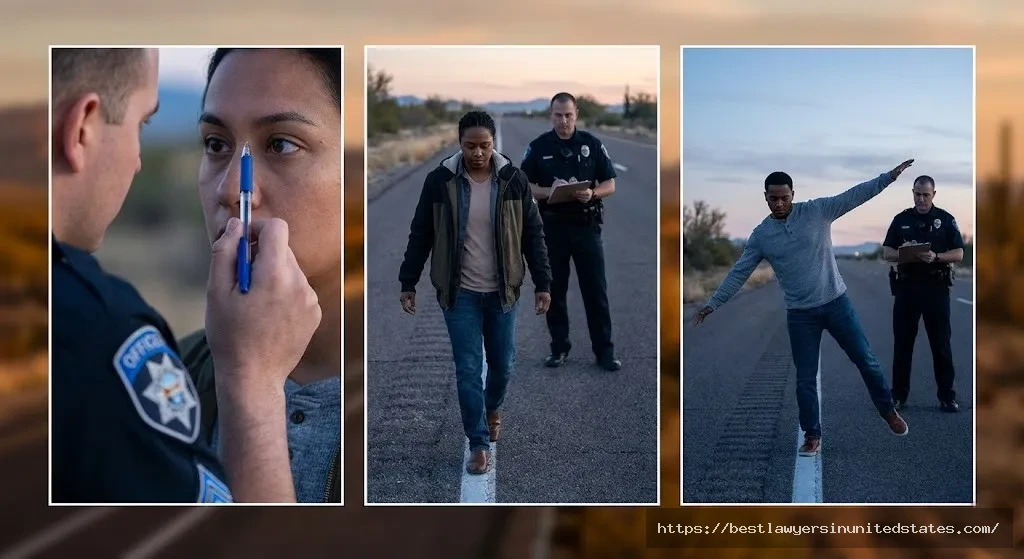
Horizontal Gaze Nystagmus (HGN): The officer moves a pen or flashlight and watches your eye movements. Involuntary jerking indicates possible impairment.
Walk-and-Turn Test: You walk nine steps heel-to-toe along a line, turn, and return. Officers look for balance issues, stepping off the line, or using arms for balance.
One-Leg Stand Test: You stand on one foot for 30 seconds. Swaying, hopping, or putting your foot down suggests impairment.
These tests are voluntary in Arizona. Refusing them creates less evidence against you but may increase officer suspicion. Officers usually arrest you anyway if they smell alcohol.
Breathalyzer and Chemical Testing
After field tests, officers request a preliminary breath test using a portable device. This roadside test is also voluntary.
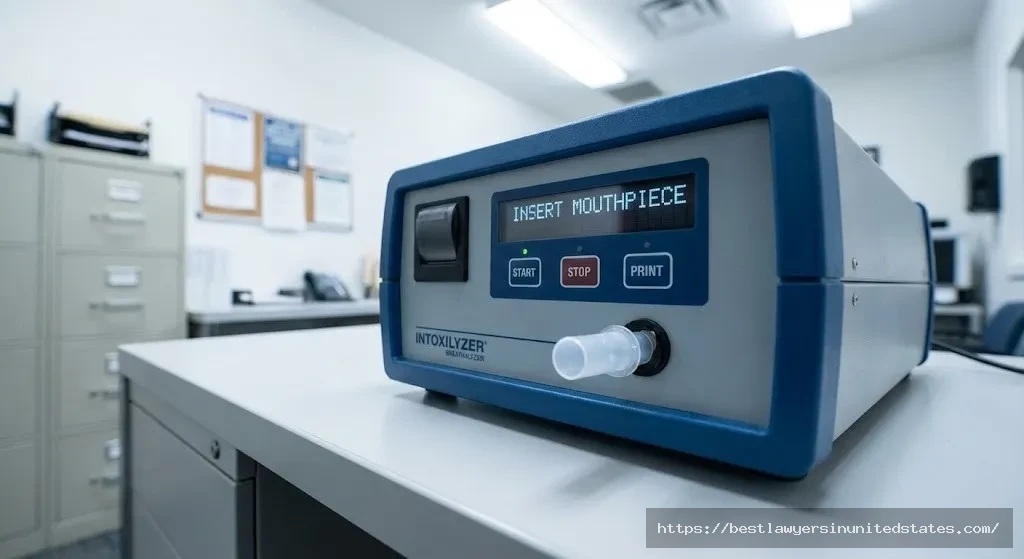
If arrested, you face chemical testing at the police station or hospital under Arizona’s implied consent law (A.R.S. § 28-1321). By holding an Arizona driver’s license, you’ve already consented to BAC testing when arrested for DUI.
Refusing Chemical Testing: Automatic 12-month license suspension regardless of conviction. The Motor Vehicle Division imposes this administratively. Prosecutors often mention your refusal at trial as consciousness of guilt.
Blood vs. Breath Tests: Officers may request blood tests for drug DUI cases or when breath testing equipment isn’t available. Blood tests are more accurate but involve potential chain-of-custody issues that defense attorneys can challenge.
Arrest and Booking
After testing, officers transport you to jail for booking. This process includes:
- Fingerprinting
- Photographing
- Property inventory
- Background check
- Miranda rights reading
Officers must read your Miranda rights before custodial interrogation. Anything you say can be used against you. Request an attorney and remain silent.
Bail varies by jurisdiction. Phoenix Municipal Court typically sets bail at $500-1,000 for first offense misdemeanor DUI. Scottsdale City Court and other jurisdictions may require higher amounts.
Administrative License Suspension
The Motor Vehicle Division acts separately from criminal court. An officer’s sworn statement that you failed or refused testing triggers automatic license suspension.
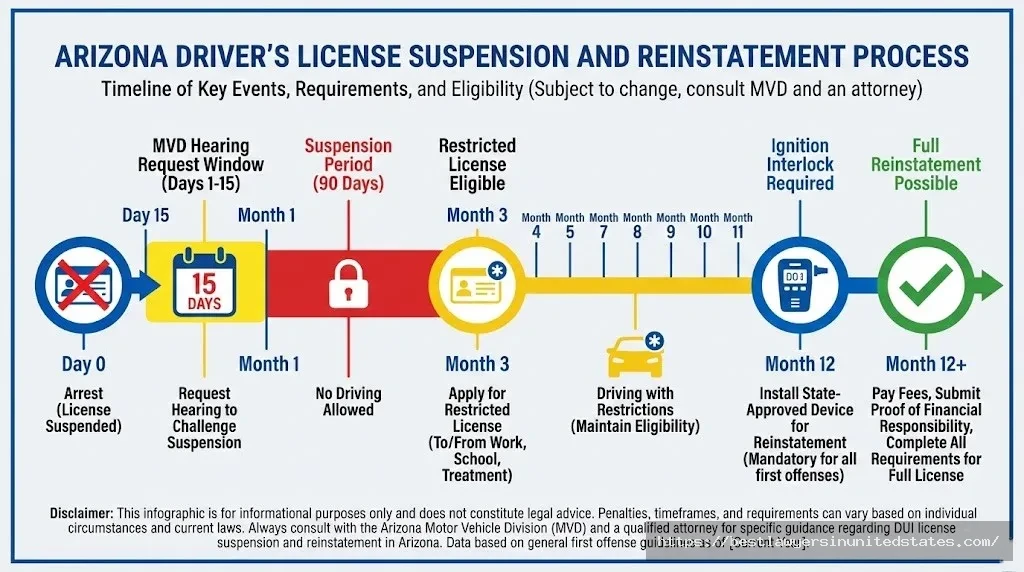
You receive a 15-day temporary license. Your actual license goes to the MVD. Within those 15 days, you must request an administrative hearing to challenge the suspension. Miss this deadline and your suspension becomes automatic.
The MVD hearing focuses only on whether officers had reasonable grounds for arrest and whether you failed or refused testing. It doesn’t determine guilt for criminal DUI charges.
You can apply for a restricted license allowing you to drive to work, school, and medical appointments if you install an ignition interlock device.
Calculate Your Total DUI Costs
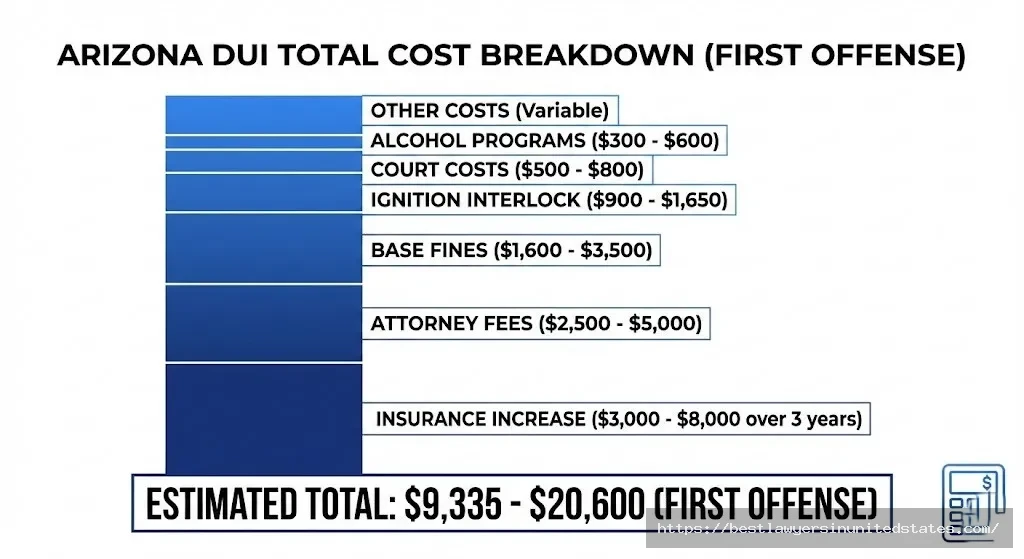
Arizona DUI penalties extend far beyond fines and jail time. The total financial impact can exceed $20,000 for a first offense when you include all costs.
DUI Cost Calculator
Estimate total DUI expenses by state and offense
Detailed Cost Breakdown
Payment Timeline
Bail bond, towing fees, car impound, attorney retainer
Initial court fines, DMV fees, DUI school enrollment, ignition interlock installation
Monthly probation fees, ignition interlock fees, DUI school payments, attorney balance
Insurance premium increases, license reinstatement, SR-22 filing fees
- Lost wages from missed work (court dates, jail time, DUI school) – $2,000-$10,000
- Job loss or difficulty finding employment – Varies
- Professional license suspension (doctors, lawyers, nurses, pilots) – Career ending
- Rideshare and transportation costs during suspension – $1,500-$5,000
- Travel restrictions and visa denials – Varies
- Security clearance loss – Career impact
- Child custody implications – Legal costs
- Rental car restrictions – Varies
- Personal relationships and mental health costs – Priceless
Use our DUI cost calculator to estimate your expenses based on offense level and circumstances.
Typical First Offense Costs:
| Expense Category | Cost Range |
|---|---|
| Base fines and surcharges | $1,600-3,500 |
| Court costs and fees | $500-800 |
| Attorney fees | $2,500-5,000 |
| Ignition interlock (12 months) | $900-1,650 |
| License reinstatement | $20-50 |
| Traffic Survival School | $250-300 |
| Alcohol screening/counseling | $300-600 |
| SR-22 insurance filing | $15-50 |
| Insurance premium increase (3 years) | $3,000-8,000 |
| Towing and impound | $200-500 |
| Bail bond (if used) | $50-150 |
| Total First Offense | $9,335-$20,600 |
These numbers don’t include lost wages from jail time or reduced earning potential from a criminal record. Commercial drivers with CDL licenses face career-ending consequences.
Arizona’s Zero-Tolerance Policy for Underage Drivers
Arizona enforces zero tolerance for drivers under 21. Any detectable alcohol in your system violates A.R.S. § 4-244(34), commonly called “Baby DUI.”
Baby DUI vs. Standard DUI
Baby DUI (under 0.08% BAC):
- Class 1 misdemeanor
- 2 years license suspension
- $500 fine plus surcharges
- Mandatory alcohol screening
- 24 hours community service
- Drug and alcohol counseling at your expense
Standard DUI (0.08% or higher BAC):
- Same penalties as adult DUI
- All minimum sentences apply
- No leniency for age
Police can charge you with both offenses simultaneously. Courts typically consolidate them but can impose separate penalties.
Impact on College and Scholarships
A DUI conviction creates lasting consequences for young adults:
College Admissions: Many colleges ask about criminal history on applications. A DUI conviction may require explanation or impact acceptance decisions.
Financial Aid: Federal student aid remains available, but some scholarships prohibit recipients with alcohol-related convictions.
Professional Programs: Medical schools, law schools, and nursing programs conduct thorough background checks. A DUI conviction may delay or prevent professional licensing.
Campus Housing: University housing offices may deny on-campus housing to students with alcohol-related convictions.
Arizona colleges including Arizona State University, University of Arizona, and Northern Arizona University maintain student conduct codes that may result in additional disciplinary action separate from criminal court.
Marijuana and Drug DUI Laws in Arizona
Arizona’s legalization of recreational marijuana in 2020 hasn’t changed DUI laws. You can still face criminal charges for driving while impaired by marijuana or any drug.
How Marijuana DUI Differs from Alcohol DUI
Arizona doesn’t have a per se limit for marijuana like the 0.08% BAC threshold for alcohol. Prosecutors must prove you were “impaired to the slightest degree” under A.R.S. § 28-1381(A)(1).
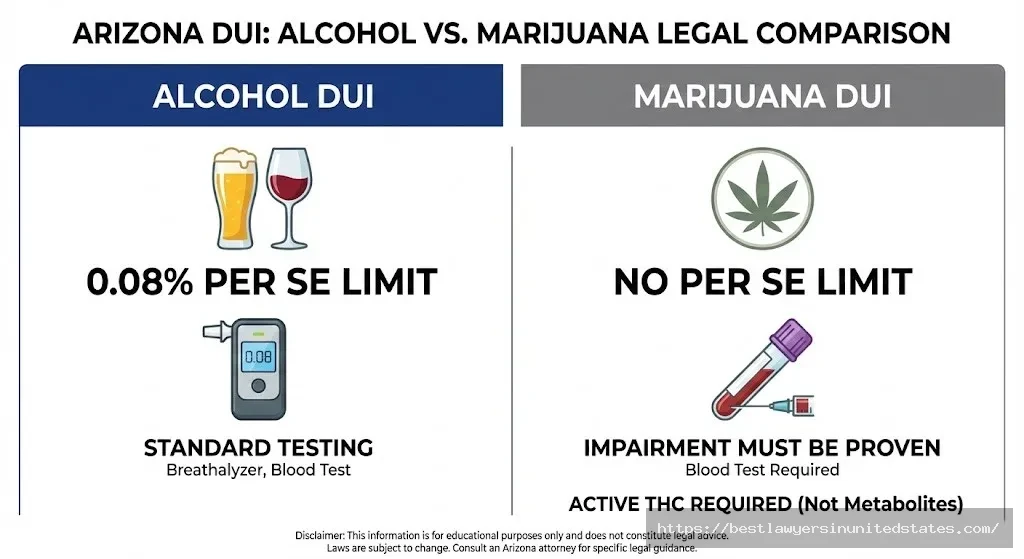
Active vs. Inactive THC Metabolites: Blood tests detect both active THC (which causes impairment) and inactive metabolites (which don’t). A 2016 Arizona Supreme Court ruling established that only active THC metabolite presence supports DUI charges.
This makes marijuana DUI cases harder for prosecutors. They need additional evidence beyond blood test results showing inactive metabolites.
Medical Marijuana Cardholders and DUI
Having an Arizona medical marijuana card provides no DUI defense. A.R.S. § 36-2802(A)(3) specifically states that medical marijuana law doesn’t permit driving while impaired.
The Arizona Department of Health Services issues medical marijuana cards but warns cardholders they face the same DUI penalties as anyone else.
Drug Recognition Expert (DRE) Evaluations
When officers suspect drug impairment but you pass breath testing, they may call a Drug Recognition Expert. These specially trained officers conduct a 12-step evaluation including:
- Preliminary examination and interview
- Eye examinations (pupil size, HGN, lack of convergence)
- Divided attention tests
- Vital signs check (pulse, blood pressure, temperature)
- Dark room examinations
- Muscle tone assessment
- Injection site inspection
- Suspect’s statements and admissions
DRE officers use their training to identify drug categories causing impairment. Arizona Department of Public Safety and Maricopa County Sheriff’s Office employ certified DRE officers who testify as experts in court.
Penalties for Drug DUI
Drug DUI carries identical penalties to alcohol DUI. First offense results in:
- 10 days jail minimum (24 hours mandatory)
- $1,250 fine plus surcharges
- 90-day license suspension
- Ignition interlock device (yes, even for drug DUI)
- Alcohol and drug screening
Courts impose ignition interlock devices even though they only detect alcohol. This requirement comes from statute language that doesn’t distinguish between alcohol and drug impairment.
Can You Get a DUI on a Bicycle or Scooter in Arizona?
Yes. Arizona’s DUI law applies to any vehicle, not just cars and trucks.
Bicycle DUI Laws
A.R.S. § 28-1381 defines DUI as operating “a vehicle” while impaired. Arizona law at A.R.S. § 28-101(70) defines vehicle broadly to include “a device in, on or by which a person or property is or may be transported or drawn on a public highway.”
Courts have upheld bicycle DUI convictions. You face the same penalties as a motor vehicle DUI:
- Jail time
- Fines
- License suspension (even though you weren’t driving a car)
- Mandatory alcohol programs
Phoenix Police and Tempe Police have arrested cyclists for DUI on Mill Avenue and near Arizona State University campus, particularly during bar closing hours.
Electric Scooter, Golf Cart, and ATV DUI
Arizona courts interpret “vehicle” broadly:
Electric Scooters: Lime and Bird scooters qualify as vehicles. Scottsdale Police and Phoenix Police regularly arrest impaired scooter riders.
Golf Carts: On-road golf cart use requires registration. Operating one while impaired results in DUI charges.
ATVs: Off-road vehicles used on highways trigger DUI laws. Operating an ATV on state trust land while impaired may violate separate statutes.
Motorized Wheelchairs: Courts haven’t ruled definitively, but the broad vehicle definition could apply.
Boating Under the Influence (BUI)
Arizona has separate BUI laws under A.R.S. § 5-395. Operating a boat on Arizona lakes including Lake Pleasant, Saguaro Lake, and Lake Havasu while impaired is illegal.
BUI shares the same 0.08% BAC limit as DUI. Penalties are similar but not identical:
- Class 1 misdemeanor
- Up to 6 months jail
- Up to $2,500 fine
- Boating safety course required
The Arizona Game and Fish Department enforces BUI laws. Lake Havasu City Police also patrol waterways during summer months when impaired boating peaks.
DUI Defenses: How to Fight Charges in Arizona
Arizona DUI cases can be challenged through multiple defense strategies. Success depends on case-specific facts and evidence quality.
Challenging the Legality of the Traffic Stop
The Fourth Amendment requires officers to have reasonable suspicion before stopping your vehicle. Without proper justification, any evidence collected gets suppressed.
Common Invalid Stop Reasons:
- Anonymous tip with no corroboration
- Pulling you over in a “high crime area” without traffic violation
- Following you after leaving a bar without observing driving problems
- Stopping you for equipment violations that don’t actually exist
Defense attorneys file motions to suppress evidence when officers lacked reasonable suspicion. If granted, prosecutors often dismiss the case because they can’t prove their case without the suppressed evidence.
Questioning BAC Test Accuracy
Breathalyzer and blood test results aren’t infallible. Multiple factors affect accuracy:
Breathalyzer Issues:
- Calibration errors (devices require monthly calibration)
- Mouth alcohol contamination (burping, dental work)
- Radio frequency interference
- Officer training deficiencies
- Failure to observe mandatory 15-minute waiting period
Blood Test Problems:
- Chain of custody breaks
- Improper storage temperatures
- Contamination during collection
- Lab technician errors
- Delayed testing (degradation over time)
Arizona requires officers to follow strict testing protocols. Defense attorneys obtain maintenance records for breath testing devices and challenge deviations from proper procedures.
Challenging “Actual Physical Control”
Arizona’s actual physical control doctrine allows DUI charges even when you’re not driving. Courts use multiple factors to determine control:
- Key location (ignition, pocket, floor)
- Engine status (running or off)
- Your location in the vehicle (driver’s seat or passenger seat)
- Whether the vehicle was operable
- Your intentions (sleeping it off vs. about to drive)
Sleeping in the back seat with keys in the trunk creates a stronger defense than sitting in the driver’s seat with keys in the ignition, even if the engine is off.
Officer Procedure Violations
DUI arrests require officers to follow specific procedures:
Miranda Violations: Officers must read rights before custodial interrogation. Statements obtained without proper Miranda warnings get suppressed.
15-Minute Observation Period: Before breath testing, officers must observe you for 15 minutes to ensure you don’t burp, vomit, or put anything in your mouth. Failure to properly observe creates grounds to challenge results.
Implied Consent Warnings: Officers must properly advise you of consequences for refusing testing. Defective warnings may prevent license suspension.
Medical Conditions That Mimic Intoxication
Certain medical conditions create impairment signs that officers mistake for alcohol intoxication:
Diabetes: Hypoglycemia causes confusion, slurred speech, and coordination problems. Diabetic ketoacidosis can create false positives on breath tests due to acetone production.
Neurological Disorders: Multiple sclerosis, cerebral palsy, and inner ear problems affect balance and coordination independent of alcohol.
Fatigue: Extreme tiredness creates similar symptoms to intoxication including slow reactions and poor coordination.
Speech Impediments: Natural speech patterns may sound slurred to officers unfamiliar with your normal speech.
Medical records and expert testimony can establish that observed symptoms resulted from medical conditions rather than impairment.
What to Do Immediately After a DUI Arrest in Arizona
Quick action after arrest protects your rights and improves case outcomes.
First 24 Hours: Critical Actions
Understand Your Release Conditions: Courts typically release first-time offenders on personal recognizance or low bail. Read your release paperwork carefully. It likely prohibits alcohol consumption and may restrict where you can go.
Retrieve Your Impounded Vehicle: Arizona law allows 72-hour holds for DUI arrests. Contact the impound lot immediately. Daily storage fees of $35-75 add up quickly. You’ll need someone else to drive the vehicle if your license is suspended.
Request MVD Hearing (15-Day Deadline): This is critical. Call the Motor Vehicle Division at (602) 255-0072 within 15 days to request an administrative hearing. Miss this deadline and your suspension becomes automatic with no hearing.
First Week: Building Your Defense
Hire a DUI Attorney: Interview multiple attorneys experienced with Arizona DUI law. Look for lawyers who regularly practice in the specific court handling your case. Phoenix Municipal Court differs from Maricopa County Superior Court in procedures and plea negotiation practices.
Gather Evidence: Write down everything you remember about the stop and arrest while details remain fresh. Collect:
- Receipts showing where you were and when
- Witness contact information
- Medication lists (prescribed or over-the-counter)
- Any medical conditions affecting balance, speech, or coordination
Document Everything: Start a file with copies of all court paperwork, police reports when available, and attorney communications.
Notify Your Insurance: Arizona requires SR-22 high-risk insurance after DUI. Contact your insurance company to discuss coverage changes.
First Month: Court Process Begins
Attend Arraignment: Your first court appearance happens 30-60 days after arrest. The judge reads charges and asks for your plea. Most defendants plead “not guilty” at arraignment to allow time for attorney negotiation.
Plea Options: You have several plea choices:
- Not guilty (proceed to trial)
- Guilty (accept prosecution’s terms)
- No contest (accept conviction without admitting guilt)
- Guilty to lesser charge (plea bargain)
Negotiate With Prosecutor: Experienced DUI attorneys negotiate with prosecutors to reduce charges or penalties. Factors affecting negotiations include:
- Your BAC level
- Prior criminal history
- Video evidence quality
- Testing procedure errors
- Officer testimony strength
Find DUI lawyers in Arizona for a free consultation about your case.
Long-Term Consequences: Life After DUI in Arizona
A DUI conviction creates consequences lasting years beyond your sentence completion.
How Long Does a DUI Stay on Your Record?
Criminal Record: DUI convictions remain on your Arizona criminal record permanently unless you obtain a set-aside. Background checks will show the conviction indefinitely.
MVD Driving Record: The Motor Vehicle Division maintains DUI convictions for 84 months (7 years) for purposes of determining repeat offender status. However, the conviction remains visible on your driving abstract much longer.
Employment Background Checks: Federal law generally limits background check reporting to 7 years for most jobs. This “Arizona 7-year rule” doesn’t apply to positions paying over $75,000 annually or jobs requiring professional licenses.
SR-22 Insurance Requirements
SR-22 isn’t insurance itself. It’s a certificate your insurance company files with the Motor Vehicle Division proving you carry minimum liability coverage.
Duration Requirements:
- First offense: 3 years
- Second offense: 3 years
- Aggravated DUI: 3 years minimum (may be longer)
Cost Impact: SR-22 designation increases premiums 150-300% on average. A driver paying $1,200 yearly may see rates jump to $3,000-4,800. Shopping multiple insurers helps, but all companies charge more for SR-22 drivers.
Maintaining Coverage: Any lapse in coverage restarts your 3-year SR-22 period. Your insurance company notifies MVD immediately if you cancel or fail to pay. MVD then suspends your license.
Ignition Interlock Device Requirements
Arizona requires ignition interlock installation on all vehicles you operate after a DUI conviction.
Installation Process: MVD-certified providers install the device in your vehicle. You blow into the device before starting the car. If it detects alcohol, the car won’t start.
Costs:
- Installation: $75-150
- Monthly monitoring: $60-125
- Removal: $50-100
- Calibration (every 30 days): Included in monthly fee
Violation Consequences: The device logs all attempts to start the vehicle. Failed tests or attempts to tamper with the device extend your ignition interlock requirement. Repeated violations can result in new criminal charges.
Duration by Offense:
- First offense standard DUI: 12 months
- First offense extreme DUI: 12 months
- Second offense: 12 months
- Aggravated DUI: Often lifetime requirement
Employment Impact and Background Checks
A DUI conviction affects employment in several ways:
Arizona Fair Chance Act: This law prohibits most employers from asking about criminal history on initial applications. However, they can conduct background checks after making a conditional job offer.
Jobs That Won’t Hire With DUI:
- Commercial driving positions (CDL required)
- School bus drivers
- Many healthcare positions
- Teaching positions (may require disclosure)
- Law enforcement
- Jobs requiring company vehicles
- Government positions requiring security clearances
Explaining to Employers: If asked about your conviction, be honest. Lying creates worse problems than the conviction itself. Brief explanations work best: “I made a mistake, completed all court requirements, and learned from the experience.”
Professional License Implications
Arizona professional licensing boards require conviction disclosure:
Nurses: Arizona State Board of Nursing requires reporting within 10 days of conviction. The board may impose discipline ranging from probation to license revocation.
Teachers: Arizona Department of Education conducts background checks. DUI convictions don’t automatically prevent teaching certification but trigger review.
Lawyers: State Bar of Arizona requires reporting. Multiple DUIs or aggravated DUI may result in suspension or disbarment.
Real Estate Agents: Arizona Department of Real Estate considers character and fitness. One DUI usually doesn’t prevent licensing, but multiple convictions create problems.
Each licensing board evaluates cases individually. Factors include offense severity, time elapsed, rehabilitation efforts, and whether you disclosed voluntarily.
DUI Expungement and Set Aside in Arizona
Arizona offers a process to clear your record after completing your sentence, though it differs from true expungement.
What is a Set Aside in Arizona?
Arizona uses “set aside” under A.R.S. § 13-907 instead of expungement. A set aside releases you from all penalties and civil disabilities resulting from conviction.
What Set Aside Does:
- Changes public records to show “set aside”
- Allows you to truthfully state you weren’t convicted (for most purposes)
- Restores gun rights
- Removes conviction as a sentencing factor for future cases
What Set Aside Doesn’t Do:
- Doesn’t erase the arrest record
- Doesn’t remove conviction from criminal databases
- Still shows on FBI background checks
- Still counts for professional licensing boards
Eligibility for DUI Set Aside
You can apply for set aside after completing all sentence terms:
Requirements:
- Jail time completed
- All fines and fees paid
- Probation successfully finished
- Ignition interlock period completed
- No pending charges
Waiting Periods:
- Misdemeanor DUI: Apply immediately after completing sentence
- Felony DUI: No statutory waiting period but judges often require 1-2 years
How to Apply for a Set Aside
Application Process:
- Obtain certified copy of judgment from court clerk
- Complete Application for Set Aside (form varies by court)
- File application with court that issued conviction
- Pay filing fee ($150-300 depending on court)
- Serve prosecutor with copy
- Attend hearing if court schedules one
- Wait for judge’s decision (30-90 days typical)
DIY vs. Attorney: Simple cases can be handled yourself. Hire an attorney for felonies or if you have multiple convictions. Attorney fees range $500-1,500.
Success Rate: Courts grant most set aside applications for DUI if you’ve completed all requirements and maintained a clean record since conviction.
What Crimes Cannot Be Set Aside in Arizona
A.R.S. § 13-907(E) prohibits set asides for:
- Sexual offenses requiring registration
- Crimes against minors under 15
- Violent crimes under A.R.S. § 13-901.03
DUI offenses CAN be set aside, including felony aggravated DUI. This makes set aside one of the most valuable post-conviction tools for DUI defendants.
Out-of-State Drivers: Arizona DUI Consequences in Your Home State
Getting a DUI in Arizona while holding an out-of-state license creates complications in both states.
Interstate Driver’s License Compact
Arizona participates in the Interstate Driver’s License Compact with 44 other states. Under this agreement, Arizona reports DUI convictions to your home state’s licensing authority.
How It Works:
- Arizona convicts you of DUI
- Arizona MVD reports conviction to your home state DMV
- Your home state applies penalties under their laws
- Your home state treats the Arizona conviction as if it occurred there
Non-Compact States: Georgia, Massachusetts, Michigan, Tennessee, and Wisconsin don’t participate. However, these states still learn about out-of-state convictions through other reporting systems.
Handling Arizona DUI From Another State
Can You Hire an Attorney to Appear for You?
Yes, for most court appearances. Arizona allows attorneys to appear without you present at:
- Arraignment (first appearance)
- Pre-trial conferences
- Some motion hearings
You must appear personally for:
- Trial
- Sentencing
- Any hearing where the judge specifically orders your appearance
Remote Court Appearances:
Some Arizona courts allow video appearances through CourtCall or Zoom, especially post-COVID. Phoenix Municipal Court and Scottsdale City Court have implemented remote appearance options. Check with your attorney about availability for your specific court.
License Suspension in Both States:
Arizona suspends your privilege to drive in Arizona. Your home state may impose additional suspension under their laws. You could face dual suspensions requiring separate reinstatement processes.
California drivers face particular problems. California treats Arizona DUI convictions the same as California DUIs, including similar suspension periods and insurance consequences.
Why is Arizona So Strict on DUI?
Arizona’s reputation for harsh DUI laws stems from decades of tough-on-crime legislative action.
Historical Context
Arizona’s DUI crackdown began in the 1990s following several high-profile fatal crashes involving repeat drunk drivers. The legislature responded with mandatory minimum sentences and enhanced penalties for extreme BAC levels.
Extreme DUI Creation (1998): Arizona became the first state to create separate enhanced DUI charges based on BAC levels. The legislature established 0.15% as the threshold for extreme DUI after research showed substantially higher crash risk at elevated BAC levels.
Super Extreme DUI (2007): After extreme DUI didn’t reduce high-BAC arrests sufficiently, lawmakers added super extreme DUI at 0.20% BAC with even harsher penalties.
Sheriff Joe Arpaio’s Influence
Maricopa County Sheriff Joe Arpaio’s DUI enforcement from 1993-2016 gained national attention. His “Tent City” jail housed DUI offenders in outdoor facilities with restricted amenities.
While controversial, Arpaio’s high-profile approach kept DUI enforcement in public consciousness. His sobriety checkpoints and saturation patrols led to thousands of arrests annually.
Comparison to Other States
Arizona’s DUI laws rank among the nation’s toughest:
| State | First DUI Jail Time | Mandatory Minimum? |
|---|---|---|
| Arizona | 10 days | Yes (1 day minimum) |
| California | Up to 6 months | No mandatory time |
| Texas | Up to 180 days | No mandatory time |
| Florida | Up to 6 months | No mandatory time |
| Nevada | 2 days to 6 months | Yes (2 days minimum) |
Only Alaska, Georgia, and a few other states match Arizona’s mandatory jail requirements for first offense.
Statistics: Arizona vs. National DUI Rates
According to National Highway Traffic Safety Administration data:
- Arizona DUI arrest rate: 267 per 100,000 population
- National average: 310 per 100,000 population
- Arizona alcohol-impaired fatality rate: 2.8 per 100,000 (below national average of 3.2)
Arizona’s strict laws may contribute to lower impaired driving fatality rates compared to national averages, though causation is difficult to prove definitively.
Do You Need a DUI Lawyer in Arizona?
The complexity of Arizona DUI law makes legal representation valuable in most cases.

When to Hire a DUI Attorney
First Offense Considerations:
You might handle a first offense yourself if:
- BAC was barely over 0.08%
- No accident or injuries occurred
- You can afford potential maximum penalties
- Video evidence clearly shows impairment
- You have no defenses to challenge
Hire an attorney if:
- Your BAC exceeded 0.15% (extreme DUI)
- You have prior convictions (even from years ago)
- Accident or property damage occurred
- You believe testing was flawed
- Your job requires a clean record
- You’re licensed professionally
- You hold a CDL
Second Offense or Higher: Always hire an attorney. Mandatory jail time increases substantially for repeat offenses. Experienced attorneys may negotiate reduced charges or alternative sentencing.
Aggravated DUI: Essential. Felony convictions create lifelong consequences. Prison time becomes mandatory. You need experienced counsel to navigate complex felony procedures.
What to Look for in an Arizona DUI Lawyer
Local Court Experience: Arizona has over 80 municipal courts plus superior courts in each county. Court procedures, judges, and prosecutors vary significantly. An attorney who regularly practices in your specific court understands local customs and relationships.
DUI Specialization: Criminal defense attorneys handle various cases. Look for lawyers who dedicate substantial practice to DUI defense. They know current case law, testing protocols, and effective negotiation strategies.
Track Record: Ask about dismissal rates and charge reductions. Experienced DUI attorneys can often get extreme DUI reduced to standard DUI or standard DUI reduced to reckless driving.
Trial Experience: Most cases resolve through plea agreements, but prosecutors negotiate more favorably when they know your attorney will go to trial if necessary.
How Much Does a DUI Lawyer Cost in Arizona?
Attorney fees vary based on offense severity and attorney experience:
Misdemeanor DUI (First Offense):
- Flat fees: $1,500-3,000 (experienced attorneys)
- Flat fees: $3,000-5,000 (high-demand attorneys)
- Hourly rates: $200-400/hour (less common for DUI)
Misdemeanor DUI (Second Offense):
- Flat fees: $2,500-4,500
Extreme or Super Extreme DUI:
- Flat fees: $3,500-6,000
Felony Aggravated DUI:
- Flat fees: $5,000-10,000 (can exceed $15,000 for complex cases)
- Additional costs for expert witnesses (toxicologists, accident reconstructionists)
Payment Plans: Many DUI attorneys offer payment plans. Some require partial payment upfront with monthly installments for the balance.
Compared to total DUI costs including fines, insurance increases, and lost income, attorney fees often provide significant value through reduced charges or penalties. For information on connecting with experienced Arizona DUI attorneys, contact [email protected].
Frequently Asked Questions About Arizona DUI Laws
Is jail time mandatory for first DUI in Arizona?
Yes. Arizona law requires 10 days jail time for first offense DUI. Judges can suspend 9 days if you complete alcohol screening, leaving 24 hours mandatory. Extreme DUI requires 30 days with only 21 days suspendable. Super extreme DUI mandates 45 days with 31 days suspendable.
Can a DUI be dismissed in Arizona?
Yes, but dismissals are uncommon. Prosecutors dismiss cases when evidence has fatal flaws like illegal traffic stops, improperly administered tests, or broken chains of custody for blood samples. Hiring an experienced attorney increases dismissal chances by identifying prosecutorial weaknesses.
How much does a first DUI cost in Arizona?
Total costs range from $9,000 to $20,000 including fines ($1,250-3,500), court costs, attorney fees ($1,500-5,000), ignition interlock ($900-1,650 yearly), alcohol programs ($300-600), and insurance increases ($3,000-8,000 over three years). Use our DUI cost calculator for personalized estimates.
Do you lose your license immediately after DUI?
Yes. Officers take your license at arrest and give you a 15-day temporary license. Your regular license goes to the Motor Vehicle Division. You must request an administrative hearing within 15 days to challenge suspension. Without a hearing request, suspension becomes automatic.
Can you refuse a breathalyzer in Arizona?
You can refuse, but consequences are severe. Arizona’s implied consent law means your license gets suspended for 12 months automatically when you refuse chemical testing. Prosecutors also mention refusal at trial as evidence of guilt. Refusing doesn’t prevent prosecution and often makes your case harder to defend.
How many drinks is 0.08 BAC?
It varies by weight and gender. A 180-pound man typically reaches 0.08% after 4 standard drinks in two hours. A 140-pound woman reaches 0.08% after 3 drinks in the same period. Metabolism, food consumption, and drink strength affect results. Our BAC calculator provides personalized estimates.
What is the 7-year rule in Arizona?
The 7-year rule refers to background check reporting limits under federal law. Most employers can only report criminal convictions from the past 7 years. Exceptions apply for jobs paying over $75,000 annually or requiring professional licenses. Arizona’s Motor Vehicle Division considers DUI convictions for 84 months (7 years) when determining repeat offender status.
Can you get a DUI expunged in Arizona?
Arizona doesn’t offer true expungement. Instead, the state uses “set aside” under A.R.S. § 13-907. After completing all sentence terms, you can apply to have your conviction set aside. This releases you from penalties and allows you to say you weren’t convicted for most purposes, though the arrest record remains visible on background checks.
What makes a DUI a felony in Arizona?
DUI becomes aggravated felony under A.R.S. § 28-1383 when you: commit a third DUI within 84 months, drive with a suspended license, drive with a child under 15 in the vehicle, drive the wrong way on a highway while impaired, or violate ignition interlock requirements. Aggravated DUI is a Class 4 or Class 6 felony carrying prison time.
How long does a DUI stay on your record in Arizona?
DUI convictions remain on your criminal record permanently unless you obtain a set aside. The Motor Vehicle Division maintains DUI for 84 months for repeat offender determination but keeps the conviction visible on driving records much longer. Employment background checks typically show convictions for 7 years under federal reporting limits, with exceptions for high-paying or licensed positions.
Additional DUI Resources in Arizona
Arizona Department of Transportation (ADOT): Official state transportation agency overseeing traffic safety programs. Visit azdot.gov for DUI statistics and prevention information.
Motor Vehicle Division (MVD): Handles license suspensions and reinstatements. Contact at (602) 255-0072 or visit servicearizona.com. MVD offices in Phoenix, Tucson, Mesa, Chandler, and other cities process reinstatements and restricted license applications.
Arizona Department of Public Safety (DPS): State law enforcement agency that patrols highways and enforces DUI laws statewide. Reports drunk driving incidents to (602) 223-2000.
Traffic Survival School Providers: State-certified programs include:
- Arizona Driving School
- 911 Driving School
- Desert Defensive Driving
- Phoenix Driving School
Ignition Interlock Device Providers: MVD-certified companies:
- Smart Start
- LifeSafer
- Intoxalock
- Guardian Interlock
MADD Arizona: Mothers Against Drunk Driving operates victim support programs and advocates for DUI prevention. Visit madd.org for resources.
Arizona Coalition for DUI Prevention: Statewide organization working to reduce impaired driving through education and policy advocacy.
For similar DUI law information in neighboring states, see Alaska DUI laws and Alabama DUI laws.
Arizona’s DUI laws rank among America’s strictest. Mandatory jail time applies even for first offenses, and enhanced penalties for higher BAC levels make Arizona unique. The financial impact exceeds $10,000 on average when you include fines, legal fees, and insurance increases.
If you face DUI charges, act immediately. You have only 15 days to request a Motor Vehicle Division hearing to fight license suspension. Contact an experienced DUI attorney who practices in your specific court. Early intervention creates the best chance for reduced charges or favorable outcomes.
Remember that Arizona offers no leniency for ignorance of these laws. The penalties described here represent minimum sentences that judges cannot reduce below statutory limits. Your best defense is prevention, but when charged, informed action and quality legal representation protect your rights and future.
Arizona DUI Case Timeline: What to Expect
Understanding the timeline helps you prepare for each stage of the DUI process. Arizona courts move faster than many states, particularly for misdemeanor cases.
Day 1: Arrest and Booking
Officers transport you to jail immediately after arrest. Booking takes 2-6 hours depending on facility capacity. Phoenix Police Department processes arrests at multiple facilities including the downtown Fourth Avenue Jail.
You receive a 15-day temporary driving permit. The actual license goes to the Motor Vehicle Division. Officers provide a citation with your court date, typically 30-60 days from arrest.
Days 1-15: Critical MVD Hearing Window
Contact the Motor Vehicle Division within 15 days to request an administrative hearing. Call (602) 255-0072 or submit the request online through servicearizona.com.
The MVD schedules hearings 30-90 days out. These hearings are separate from criminal court and focus only on whether officers had grounds for arrest and whether you failed or refused testing.
Winning the MVD hearing prevents automatic license suspension. However, conviction in criminal court still triggers suspension regardless of MVD hearing outcomes.
Days 30-60: Arraignment
Your first court appearance happens at the municipal or justice court listed on your citation. Maricopa County cases are heard at:
- Phoenix Municipal Court (620 W. Jackson St.)
- Scottsdale City Court (3700 N. 75th St.)
- Tempe Municipal Court (140 E. 5th St.)
- Mesa Municipal Court (130 N. Robson)
- Chandler Municipal Court (200 E. Chicago St.)
The judge reads charges and asks for your plea. Most defendants enter “not guilty” to allow attorney negotiation time. Pleading guilty at arraignment means accepting maximum penalties with no negotiation opportunity.
Days 60-120: Pre-Trial Period
Your attorney meets with prosecutors to discuss the case. Prosecutors review:
- Police reports and video evidence
- Breath or blood test results
- Your criminal history
- Any procedural errors or weak evidence
Strong cases with high BAC and clear video rarely get reduced. Borderline cases with BAC near 0.08% or questionable stops create negotiation opportunities.
Your attorney may file motions to suppress evidence or dismiss charges. Common motions challenge:
- Traffic stop legality
- Field sobriety test administration
- Breath test calibration and maintenance
- Blood test chain of custody
- Miranda rights compliance
Courts schedule motion hearings 30-60 days after filing. Successful motions often lead to dismissals or charge reductions.
Days 120-180: Resolution
Most DUI cases resolve through plea agreements rather than trial. Typical resolutions include:
Standard DUI with Strong Evidence: Prosecutors rarely reduce charges. Defendants plead guilty to standard DUI in exchange for prosecutors recommending minimum mandatory sentences.
Borderline BAC Cases (0.08-0.10%): Prosecutors may reduce to reckless driving if evidence has weaknesses. Reckless driving carries no mandatory jail time and doesn’t count as a prior DUI for future offenses.
Extreme DUI: May reduce to standard DUI if breath test results are questionable or procedural errors occurred.
Cases Going to Trial: If you reject plea offers, trial occurs 4-6 months after arraignment. Arizona guarantees speedy trial within 6 months for defendants not released on bail.
Post-Conviction Requirements
After sentencing, you begin serving penalties:
Immediate Actions:
- Pay all fines within 30 days (or arrange payment plan)
- Schedule ignition interlock installation within 30 days
- Complete alcohol screening within 30 days
- Begin jail time or work release program
Ongoing Requirements (12 months typical):
- Monthly ignition interlock calibration
- Complete alcohol counseling sessions
- Attend Traffic Survival School (16 hours over 2 days)
- Complete community service hours if ordered
- Report to probation officer monthly
- Submit to random alcohol testing
- Maintain SR-22 insurance continuously
Missing any requirement violates probation and may result in additional jail time or extended penalties.
DUI Checkpoints and Saturation Patrols in Arizona
Arizona law enforcement conducts regular DUI enforcement operations, particularly during holiday periods and summer months.
DUI Checkpoint Locations
The Arizona Governor’s Office of Highway Safety funds DUI checkpoints statewide. Common locations include:
Phoenix Metro Area:
- Mill Avenue in Tempe (especially weekends near ASU)
- Scottsdale Road between Old Town and North Scottsdale
- Grand Avenue (US 60) near downtown Phoenix
- Camelback Road between 7th Street and 7th Avenue
- Central Avenue south of downtown
Tucson Area:
- Broadway Boulevard near University of Arizona
- Speedway Boulevard east of downtown
- Congress Street in downtown Tucson
Northern Arizona:
- Historic Route 66 in Flagstaff
- State Route 89A through Sedona
- Lake Havasu Boulevard near London Bridge
Phoenix Police Department, Tempe Police, and Scottsdale Police announce checkpoints in advance as required by law. Watch local news or check police department social media for announcements.
Avoiding vs. Evading Checkpoints
You can legally avoid checkpoints by turning before reaching them. However, officers often position observers who stop vehicles making suspicious turns immediately before checkpoints.
Legal Turns: Using a normal turn signal and completing the turn properly before reaching the checkpoint is legal.
Illegal Evasion: Making unsafe turns, U-turns where prohibited, or turning into private property to avoid checkpoints gives officers probable cause to stop you.
Officers watch for avoidance attempts. They stop vehicles even without checkpoint contact if they observe traffic violations during avoidance maneuvers.
Saturation Patrols
Arizona DPS and local agencies conduct saturation patrols where multiple officers patrol high-DUI areas simultaneously. These operations don’t require advance notice unlike checkpoints.
High-Patrol Areas:
- Entertainment districts (Mill Avenue, Old Town Scottsdale, 7th Avenue corridor)
- Areas near sports venues (Chase Field, State Farm Stadium)
- Casino areas (Talking Stick Resort, Casino Arizona)
- Areas with high previous DUI arrest rates
Saturation patrols result in more arrests than checkpoints because officers can follow vehicles and observe actual driving behavior rather than randomly checking cars at checkpoints.
Commercial Driver’s License (CDL) and DUI
CDL holders face career-ending consequences from DUI convictions. Federal Motor Carrier Safety Regulations impose stricter standards than regular Arizona DUI law.
CDL BAC Limits
Commercial drivers face a 0.04% BAC limit when operating commercial vehicles – half the standard 0.08% limit. This applies whether you’re driving a semi-truck, bus, delivery vehicle, or any vehicle requiring a CDL.
Off-Duty Violations: Getting a DUI in your personal vehicle still affects your CDL. Arizona suspends your CDL for one year even if the DUI occurred in your personal car on your day off.
CDL DUI Penalties
First Offense (Commercial Vehicle):
- One year CDL disqualification
- Three years if transporting hazardous materials
- Standard criminal penalties apply (jail, fines)
- Loss of employment likely
First Offense (Personal Vehicle):
- One year CDL disqualification
- Criminal penalties under standard DUI law
- Employer notification required
Second Offense:
- Lifetime CDL disqualification
- May apply for reinstatement after 10 years
- Employers rarely hire drivers with multiple DUIs
Employer Notification Requirements
Federal regulations require CDL holders to notify employers within 30 days of any DUI conviction, even in personal vehicles. Failure to notify creates grounds for termination and additional penalties.
Arizona employers with CDL drivers must conduct annual Motor Vehicle Record checks. Your DUI conviction appears immediately, making concealment impossible.
Career Impact
The trucking industry maintains strict standards. Most major carriers won’t hire drivers with:
- Any DUI within 5 years
- Multiple DUIs ever
- DUI involving accident or injury
Some smaller carriers or local delivery companies hire drivers with single DUI convictions after 3-5 years. However, insurance costs make these placements rare and usually involve significant pay reductions.
Alternative Careers: Many CDL holders transition to:
- Warehouse management
- Logistics coordination
- Heavy equipment operation (non-road equipment)
- Freight brokerage
These positions don’t require active CDL licenses but use industry experience.
DUI and Immigration Consequences
Non-citizens face immigration consequences from DUI convictions beyond criminal penalties. Understanding these impacts is crucial for green card holders, visa holders, and undocumented individuals.
Deportability and Inadmissibility
A single DUI conviction typically doesn’t trigger deportation by itself. However, DUI convictions can affect immigration status in several ways:
Moral Turpitude Considerations: Standard DUI generally isn’t considered a crime involving moral turpitude (CIMT). However, aggravated DUI involving injury or extreme recklessness may qualify as CIMT.
Multiple Convictions: Two or more DUI convictions can establish a pattern of criminal behavior affecting discretionary immigration benefits.
Aggravating Factors: DUI with injury, DUI with a minor in the vehicle, or hit-and-run DUI create serious immigration consequences and potential deportation grounds.
Green Card Renewal
Lawful permanent residents must disclose criminal convictions when renewing green cards. USCIS reviews the circumstances:
Single Standard DUI: Usually doesn’t prevent renewal but requires explanation and documentation showing completion of all requirements.
Multiple DUIs: May result in denial or additional scrutiny. USCIS considers pattern of alcohol abuse a negative discretionary factor.
Aggravated DUI (Felony): Creates significant problems. Felony convictions trigger additional review and potential removal proceedings.
Naturalization Impact
Applying for U.S. citizenship requires demonstrating good moral character for the statutory period (typically 5 years, or 3 years for spouses of U.S. citizens).
DUI During Statutory Period: A DUI conviction during the good moral character period typically results in naturalization denial. USCIS generally won’t approve citizenship applications with DUI convictions less than 3-5 years old.
Multiple DUIs: Shows pattern of behavior inconsistent with good moral character. Even older convictions can prevent naturalization approval.
Strategy: Many immigration attorneys advise waiting 5 years after completing DUI sentence before filing naturalization applications.
Visa Holders and Travel
F-1 students, H-1B workers, and other visa holders face unique challenges:
Visa Renewals: DUI convictions must be disclosed on visa renewal applications. Consular officers have discretion to deny renewals based on criminal history.
International Travel: Leaving and re-entering the U.S. after a DUI conviction requires disclosure to Customs and Border Protection. Officers may deny entry based on the conviction, particularly for multiple DUIs or aggravated circumstances.
Visa Status Violations: If DUI results in jail time preventing you from attending school or work, you may violate visa status conditions. This can trigger deportation proceedings.
Undocumented Individuals
Undocumented individuals arrested for DUI face the highest immigration risks:
ICE Notification: Some Arizona law enforcement agencies notify Immigration and Customs Enforcement of arrests. Phoenix Police and Tucson Police have policies limiting ICE cooperation, but many smaller jurisdictions don’t.
Detention Risk: ICE may place immigration holds on undocumented individuals in jail. After completing criminal proceedings, individuals get transferred to ICE custody rather than released.
Deportation Proceedings: DUI conviction provides grounds for deportation proceedings against undocumented individuals. However, single misdemeanor DUI usually receives low priority unless combined with other factors.
Consult Immigration Attorney: Anyone with non-citizen status facing DUI charges should consult both criminal defense and immigration attorneys. Criminal plea agreements can have unintended immigration consequences that experienced immigration attorneys can help avoid.
Insurance Consequences of Arizona DUI
DUI convictions trigger massive insurance rate increases lasting years. Understanding these costs helps you plan financially.
Rate Increases by Carrier
Arizona insurance companies treat DUI as a major violation resulting in substantial premium hikes:
| Insurance Company | Average Rate Increase |
|---|---|
| State Farm | 185% |
| GEICO | 210% |
| Progressive | 195% |
| Allstate | 225% |
| Farmers | 200% |
| USAA | 150% (members only) |
| National Average | 198% |
A driver paying $1,200 annually pre-DUI will pay $2,400-3,900 post-DUI depending on carrier.
SR-22 Filing Requirements
Arizona requires SR-22 certificates proving you maintain minimum liability coverage:
Minimum Coverage Requirements:
- $25,000 bodily injury per person
- $50,000 bodily injury per accident
- $15,000 property damage per accident
Most carriers charge $15-50 to file SR-22 paperwork. The real cost comes from dramatically higher premiums due to high-risk driver classification.
Finding Affordable Post-DUI Insurance
Shop Multiple Carriers: Rate increases vary significantly between companies. Some insurers specialize in high-risk drivers and offer more competitive rates.
High-Risk Carriers: Consider:
- The General
- Direct Auto
- Bristol West
- Dairyland
- National General
These companies specialize in DUI insurance and sometimes offer better rates than traditional carriers for high-risk drivers.
Maintain Continuous Coverage: Any coverage lapse restarts your SR-22 period and triggers license suspension. Set up automatic payments to prevent lapses.
Good Driver Discounts Return Eventually: After 3-5 years of clean driving post-DUI, rates gradually decrease. Full standard rates return after 5-7 years depending on carrier.
Non-Owner SR-22 Policies
If you don’t own a vehicle but need SR-22 to reinstate your license, non-owner policies provide required coverage at lower costs than standard policies.
Cost: $300-800 yearly depending on your record.
Coverage: Provides liability coverage when you drive borrowed or rental vehicles. Doesn’t cover vehicles you own or regularly use.
Purpose: Maintains SR-22 filing compliance while keeping costs manageable if you’re not actively driving.
Refusing Blood Tests: What Really Happens
Arizona’s implied consent law creates serious consequences for test refusal, but some defendants still refuse. Understanding the full implications helps you make informed decisions.
Implied Consent Law Mechanics
A.R.S. § 28-1321 establishes that by driving on Arizona roads, you’ve already consented to BAC testing when arrested for DUI. Officers must read a specific admonition explaining consequences before you can legally refuse.
Required Warnings:
- Test refusal results in 12-month license suspension
- Refusal can be used against you in court
- You have no right to consult attorney before deciding
If officers fail to provide proper warnings, the MVD may not impose administrative suspension. However, this doesn’t prevent criminal prosecution.
License Consequences of Refusal
Immediate Suspension: Your driving privilege ends immediately when you refuse. Officers take your license and issue a 15-day temporary permit.
12-Month Administrative Suspension: The MVD suspends your license for 12 months regardless of criminal case outcome. This runs consecutive to any criminal suspension, not concurrent.
No Restricted License: Unlike standard DUI suspensions, you cannot get a restricted license during refusal suspensions. You face a complete 12-month ban from driving.
Criminal Case Impact
Prosecutors and judges view refusal negatively:
Consciousness of Guilt: Prosecutors argue refusal shows you knew you were too intoxicated. They present refusal as evidence of guilt during trial.
Harsher Plea Offers: Prosecutors offer less favorable plea agreements to defendants who refused testing. They view refusal as non-cooperation requiring firmer stance.
Jury Perception: If you proceed to trial, jurors often interpret refusal unfavorably despite judge’s instructions not to draw negative inferences.
When Refusal Makes Sense
Despite consequences, refusal sometimes represents the least-bad option:
Very High BAC Suspected: If you consumed large quantities of alcohol and believe your BAC significantly exceeds 0.20%, refusal prevents super extreme DUI charges. You’ll face standard DUI charges instead.
Previous DUI Convictions: A second DUI with high BAC creates extremely harsh penalties. Refusal may result in better plea offer for standard DUI than accepting extreme DUI charges.
Professional Licenses: Some professionals (pilots, doctors, lawyers) face license suspension from employer/licensing boards. Standard DUI may be survivable while extreme DUI ends careers.
Calculation: Compare 12-month license loss from refusal against potentially harsher criminal penalties. Consult an attorney immediately if possible before deciding.
Forced Blood Draws
Arizona law allows officers to obtain blood samples without consent in limited circumstances:
Warrant-Based: Officers can obtain search warrants for blood draws. This typically occurs when you refuse and they believe evidence will be lost. Many Arizona jurisdictions have “blood warrant” judges available 24/7 by phone.
Unconscious Suspects: If you’re unconscious from accident or intoxication, officers can authorize blood draws without consent under exigent circumstances.
Resistance: Physically resisting forced blood draw creates additional criminal charges including aggravated assault. Never physically resist officers executing warrants.
