
Arkansas treats driving while intoxicated (DWI) as a serious criminal offense. A first offense DWI in Arkansas carries up to one year in jail and fines up to $1,000. Your driver’s license gets suspended immediately upon arrest under the state’s administrative license suspension law.
Arkansas uses the term DWI (Driving While Intoxicated) instead of DUI in most cases. Both refer to operating a vehicle while impaired by alcohol or drugs. The legal blood alcohol content limit is 0.08% for drivers over 21, 0.04% for commercial drivers, and 0.02% for anyone under 21.
What Is the Difference Between DUI and DWI in Arkansas?
Arkansas law makes a distinction between DUI and DWI based on the driver’s age and BAC level.
DWI (Driving While Intoxicated) applies to drivers of any age who are intoxicated or have a BAC of 0.08% or higher. This is the more serious charge under Arkansas Code § 5-65-103.
DUI (Driving Under the Influence) specifically applies to drivers under age 21 with a BAC between 0.02% and 0.08%. Arkansas treats this as a zero-tolerance violation for underage drivers under § 5-65-303.
The penalties for DWI are harsher than DUI. A DWI conviction appears on your criminal record permanently unless expunged. A DUI for minors may qualify for record sealing under certain conditions.
Check Your BAC Level
Not sure if you’re over the legal limit? Understanding your blood alcohol content helps you make informed decisions about driving. Different factors affect how alcohol impacts your body, including weight, gender, and how much you’ve consumed.
BAC Calculator
Estimate your Blood Alcohol Content
• Commercial Driver (CDL): 0.04% BAC
• Drivers Under 21: 0.00-0.02% BAC (Zero Tolerance)
• Enhanced Penalties: 0.15% BAC or higher in most states
Use our BAC calculator to estimate your blood alcohol content based on drinks consumed, body weight, and time elapsed.
Arkansas DWI Penalties by Offense
Arkansas increases penalties with each DWI conviction. The state looks back at your entire lifetime record – there’s no lookback period that wipes prior offenses.
First Offense DWI Penalties
A first DWI in Arkansas is a Class A misdemeanor. The Pulaski County Circuit Court and other Arkansas circuit courts handle these cases.
Criminal Penalties:
- Jail: 24 hours to 1 year
- Fines: $150 to $1,000
- Community service: 10 to 30 days
- DUI education program: Required
- Substance abuse assessment: Required
License Penalties:
- Administrative suspension: 120 days (refusal) or 30 days (test failure)
- Criminal suspension: 6 months
- Ignition interlock device: Required for restricted license
- No hardship license for first 30 days
First-time offenders may qualify for probation instead of jail time. Arkansas courts often allow community service in place of jail for first offenses without aggravating factors.
Second Offense DWI Penalties
A second DWI remains a Class A misdemeanor but carries mandatory minimum penalties.
Criminal Penalties:
- Jail: 7 days to 1 year (mandatory minimum 7 days)
- Fines: $400 to $3,000
- Community service: 30 to 90 days
- SATOP program: Required
License Penalties:
- Administrative suspension: 2 years
- Criminal suspension: 24 months
- Ignition interlock device: Required for 2 years after reinstatement
- SR-22 insurance: Required
You cannot get probation for the mandatory 7-day jail sentence. The Arkansas Department of Finance and Administration will flag your driving record permanently.
Third Offense DWI Penalties
A third DWI is a Class D felony in Arkansas. This means a permanent felony conviction on your record.
Criminal Penalties:
- Prison: 90 days to 6 years (mandatory minimum 90 days)
- Fines: $900 to $5,000
- Community service: 60 to 180 days
- Felony probation: Possible after minimum served
License Penalties:
- Administrative suspension: 30 months
- Criminal suspension: 30 months
- Ignition interlock device: 30 months minimum
- Habitual offender status: Likely
The Arkansas Department of Corrections may handle sentencing for third offenses. You face prison time, not county jail. Your voting rights are suspended during incarceration and parole.
Fourth and Subsequent DWI Offenses
A fourth DWI or higher is a Class D felony with enhanced penalties.
Criminal Penalties:
- Prison: 1 to 6 years (mandatory minimum 1 year)
- Fines: $900 to $5,000
- No early release programs available
- Permanent felony record
License Penalties:
- License revocation: 4 years minimum
- Ignition interlock: Lifetime requirement
- May never regain full driving privileges
Arkansas law allows life imprisonment for sixth or subsequent DWI convictions. The state prosecutor can charge habitual offender enhancements that increase sentences significantly.
DWI Penalties Comparison Table
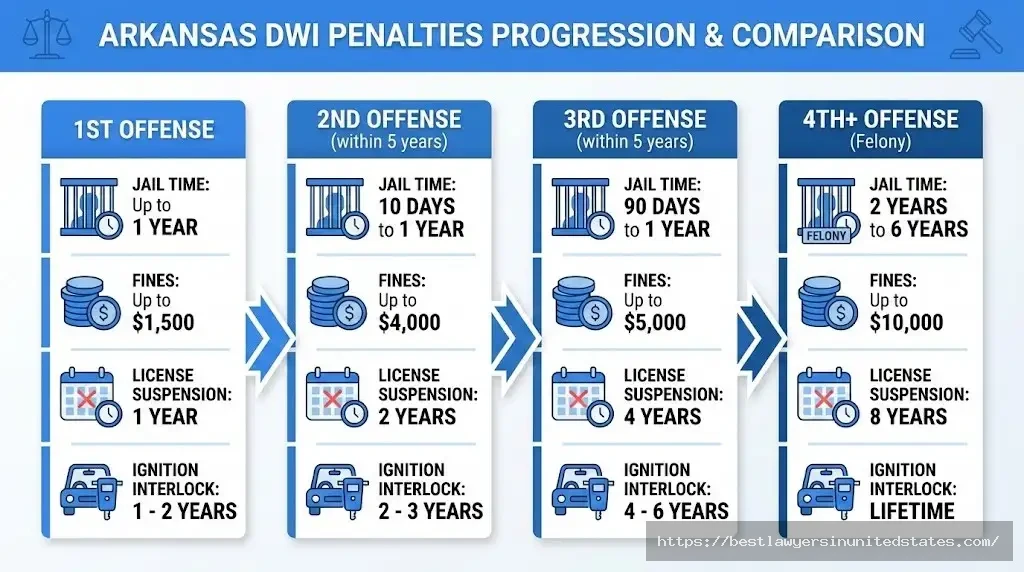
| Offense | Jail/Prison | Fines | License Suspension | IID Required |
|---|---|---|---|---|
| 1st DWI | 24 hrs – 1 year | $150 – $1,000 | 6 months | 6-12 months |
| 2nd DWI | 7 days – 1 year | $400 – $3,000 | 24 months | 24 months |
| 3rd DWI | 90 days – 6 years | $900 – $5,000 | 30 months | 30 months |
| 4th+ DWI | 1 – 6 years | $900 – $5,000 | 4 years | Lifetime |
Arkansas BAC Legal Limits
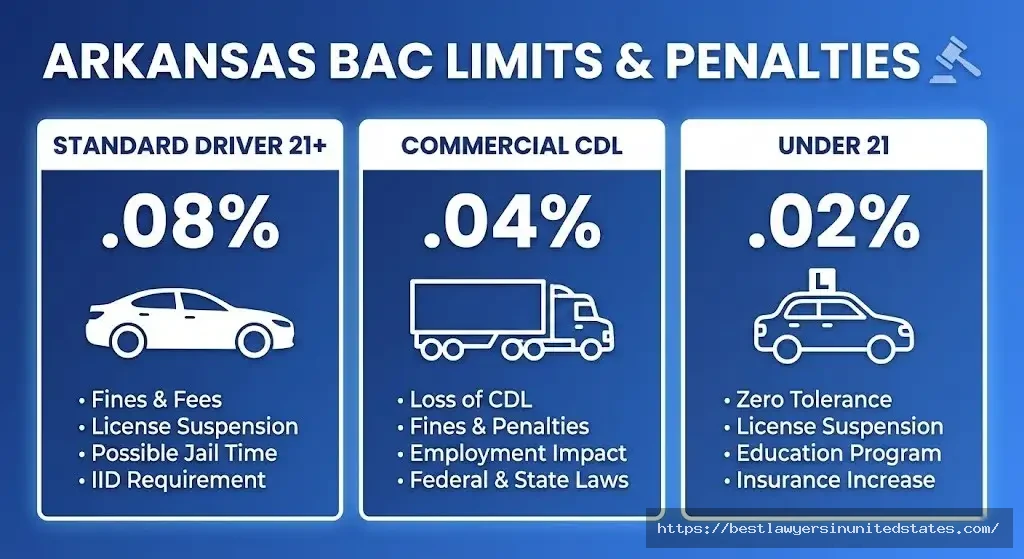
Arkansas sets different BAC limits based on driver category. The limits apply statewide on all roads, including Interstate 40, Highway 65, and Interstate 30 through Little Rock.
| Driver Type | BAC Limit | Violation |
|---|---|---|
| Standard Driver (21+) | 0.08% | DWI |
| Commercial Driver (CDL) | 0.04% | CDL suspension |
| Under Age 21 | 0.02% | DUI (zero tolerance) |
| School Bus Driver | 0.02% | Enhanced penalties |
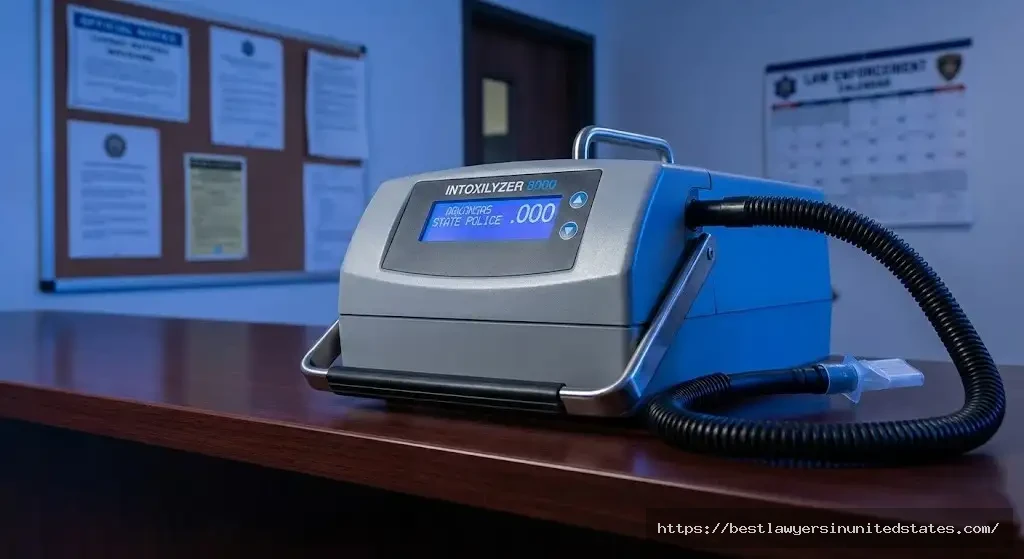
Arkansas uses “per se” laws. This means you can be convicted based solely on BAC results, even without visible impairment. The Arkansas State Police and local departments use Intoxilyzer 8000 breathalyzer machines at booking facilities.
What Does Arkansas’s Implied Consent Law Mean?
Arkansas’s implied consent law means you automatically agree to chemical testing when you drive on Arkansas roads. This applies to breath, blood, and urine tests requested by law enforcement.
Under Arkansas Code § 5-65-202, refusing a chemical test triggers automatic penalties:
Refusal Penalties:
- First refusal: 180-day license suspension
- Second refusal: 2-year license suspension
- Third refusal: 30-month license suspension
- Refusal evidence: Admissible in criminal trial
The Arkansas Office of Driver Services in Little Rock handles administrative hearings. You have 15 days from arrest to request a hearing. Miss this deadline and you lose your right to contest the suspension.
Prosecutors can use your refusal against you in court. Juries often view refusal as evidence of guilt. However, refusal also means no BAC evidence exists for the state to use.
Can You Refuse a Breathalyzer Test in Arkansas?
Yes, you can refuse a breathalyzer in Arkansas. However, refusal carries serious consequences that may be worse than taking the test.
Consequences of Refusal:
- Immediate license suspension (longer than test failure)
- No chance for administrative hearing success
- Refusal used against you at trial
- Harder to negotiate plea agreements
- Officers may get a warrant for forced blood draw
Arkansas State Police can obtain search warrants for blood draws within hours. Pulaski County, Benton County, and Washington County have 24-hour magistrates available. Once officers have a warrant, they can legally force a blood draw.
When Refusal Might Help:
- You’re significantly over the legal limit
- You’ve consumed multiple substances
- You have prior DWI convictions
- You’re certain you’ll fail the test badly
Consult an attorney immediately if you refused testing. You have very limited time to challenge the administrative suspension through the Arkansas Department of Finance and Administration.
Field Sobriety Tests in Arkansas
Arkansas police use standardized field sobriety tests (FSTs) during DWI investigations. Unlike chemical tests, you can refuse FSTs without automatic license suspension.
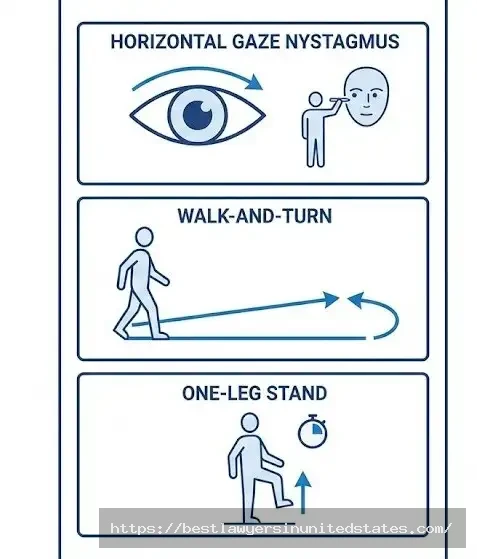
Common Field Sobriety Tests:
- Horizontal Gaze Nystagmus (HGN)
- Walk-and-Turn Test
- One-Leg Stand Test
- Finger-to-Nose Test
- Alphabet Recitation
These tests are designed to build evidence against you. Officers look for “clues” of impairment. Medical conditions, injuries, and nervousness affect test performance. Age and weight also impact results.
You Can Refuse Field Sobriety Tests
Arkansas law does not require you to perform field sobriety tests. Politely declining FSTs prevents officers from gathering additional evidence. However, refusal often leads to arrest and chemical testing at the station.
Many Arkansas DWI attorneys recommend declining field sobriety tests. The tests provide subjective evidence that’s hard to challenge later. Your refusal cannot be used against you in court for FSTs specifically.
Calculate Your Total DWI Costs
Use our calculator to estimate the full financial impact of a DWI in Arkansas. The calculator includes fines, court costs, attorney fees, and long-term expenses most people don’t consider.
DUI Cost Calculator
Estimate total DUI expenses by state and offense
Detailed Cost Breakdown
Payment Timeline
Bail bond, towing fees, car impound, attorney retainer
Initial court fines, DMV fees, DUI school enrollment, ignition interlock installation
Monthly probation fees, ignition interlock fees, DUI school payments, attorney balance
Insurance premium increases, license reinstatement, SR-22 filing fees
- Lost wages from missed work (court dates, jail time, DUI school) – $2,000-$10,000
- Job loss or difficulty finding employment – Varies
- Professional license suspension (doctors, lawyers, nurses, pilots) – Career ending
- Rideshare and transportation costs during suspension – $1,500-$5,000
- Travel restrictions and visa denials – Varies
- Security clearance loss – Career impact
- Child custody implications – Legal costs
- Rental car restrictions – Varies
- Personal relationships and mental health costs – Priceless
Get a detailed cost breakdown on our DUI cost calculator page.
True Cost of a DWI in Arkansas
The statutory fine is just the beginning. Arkansas DWI convictions carry hidden costs that add up to thousands of dollars.
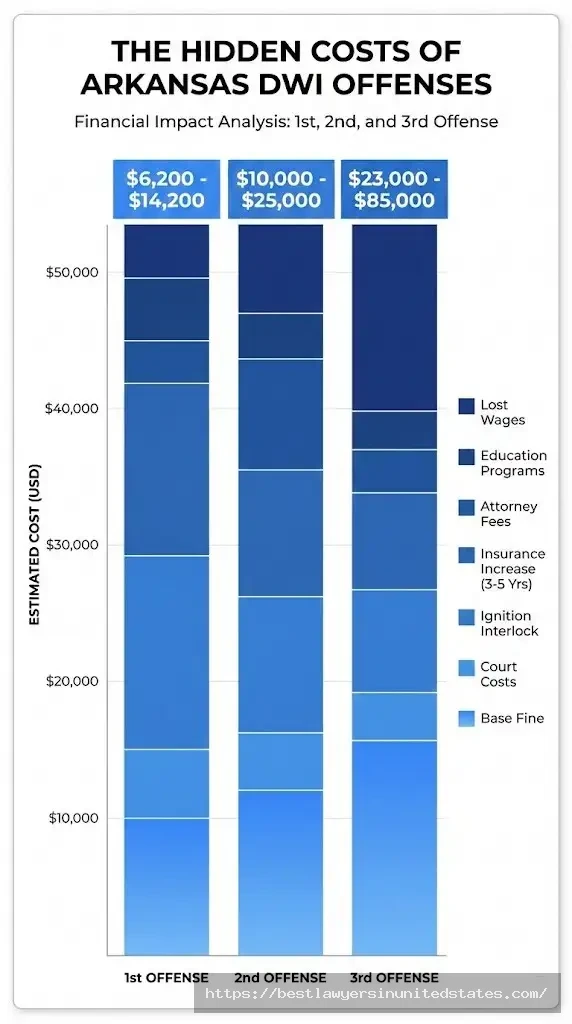
First Offense DWI Costs
| Expense | Cost Range |
|---|---|
| Base Fine | $150 – $1,000 |
| Court Costs | $200 – $500 |
| Attorney Fees | $2,500 – $5,000 |
| License Reinstatement Fee | $150 |
| Ignition Interlock (6 months) | $450 – $900 |
| SR-22 Insurance (3 years) | $1,500 – $3,000 |
| DUI Education Program | $300 – $500 |
| SATOP Classes | $250 – $400 |
| Towing & Impound | $200 – $400 |
| Lost Wages (court/jail) | $500 – $2,000 |
| Total First Offense | $6,200 – $14,200 |
Second Offense DWI Costs
| Expense | Cost Range |
|---|---|
| Base Fine | $400 – $3,000 |
| Court Costs | $300 – $600 |
| Attorney Fees | $3,500 – $8,000 |
| License Reinstatement Fee | $150 |
| Ignition Interlock (24 months) | $1,800 – $3,600 |
| SR-22 Insurance (3 years) | $2,500 – $5,000 |
| SATOP Program | $400 – $600 |
| Lost Wages | $1,000 – $5,000 |
| Total Second Offense | $10,050 – $25,950 |
Third Offense DWI Costs
| Expense | Cost Range |
|---|---|
| Base Fine | $900 – $5,000 |
| Court Costs | $500 – $800 |
| Felony Attorney Fees | $5,000 – $15,000 |
| License Reinstatement Fee | $150 |
| Ignition Interlock (30 months) | $2,250 – $4,500 |
| SR-22 Insurance (5 years) | $5,000 – $10,000 |
| Lost Wages/Employment | $10,000 – $50,000 |
| Total Third Offense | $23,800 – $85,450 |
These numbers don’t include increased insurance premiums beyond SR-22 requirements. Arkansas drivers see insurance rates increase 60-80% after DWI convictions. The increase lasts 3-5 years minimum.
What Happens After a DWI Arrest in Arkansas?
Understanding the timeline helps you protect your rights. Arkansas has strict deadlines you must meet.
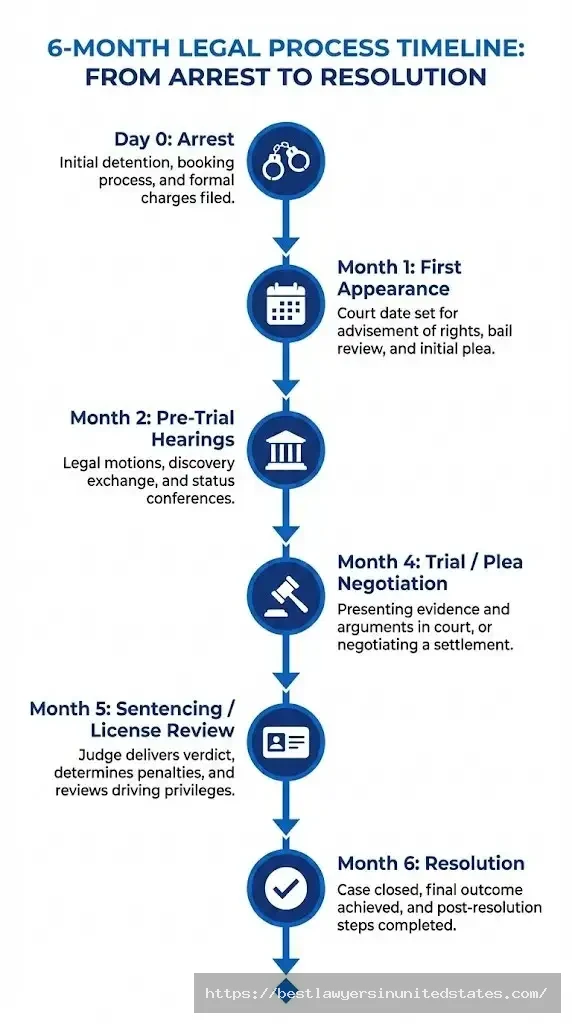
First 24 Hours After Arrest
At the Scene:
- Police conduct investigation and field sobriety tests
- Arrest happens if officer has probable cause
- You’re transported to county jail or police station
- Chemical testing occurs (breath, blood, or urine)
At the Station:
- Booking and fingerprinting
- Mugshot taken
- Bond set (typically $500-$2,500 for first offense)
- Officer issues Notice of License Suspension
- You receive court date information
Days 1-15: Critical Deadline Window
You have 15 calendar days from arrest to request an administrative license hearing with the Arkansas Office of Driver Services. This is separate from your criminal case.
File the request at: Arkansas Department of Finance and Administration
Office of Driver Services
1900 W 7th Street
Little Rock, AR 72201
Miss this deadline and your license suspension becomes automatic. No exceptions exist for late filings. Pay the $175 hearing fee when filing.
Days 15-30: Administrative Hearing
The Office of Driver Services schedules your administrative hearing. This happens before your criminal court date.
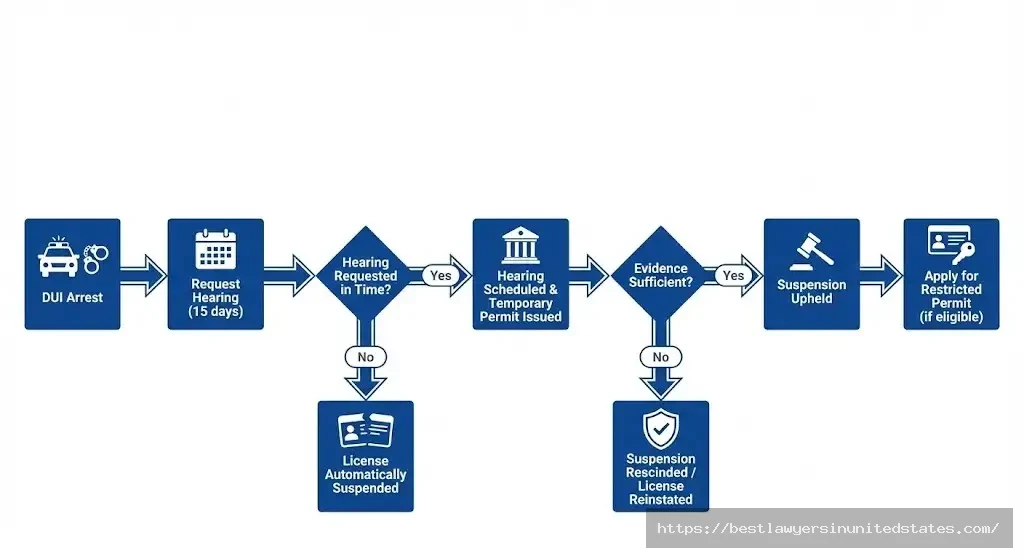
Purpose of Administrative Hearing:
- Contest license suspension
- Challenge the arrest legality
- Question test accuracy
- Cross-examine the arresting officer
An administrative law judge decides whether to suspend your license. This decision is independent of your criminal case. You can lose the administrative hearing but win your criminal case, or vice versa.
Days 30-60: Arraignment
Your first court appearance is the arraignment. This happens in the circuit court for the county where you were arrested.

What Happens at Arraignment:
- Judge reads charges against you
- You enter a plea (guilty, not guilty, no contest)
- Bond conditions are reviewed
- Preliminary hearing date is set (if needed)
- Attorney discusses case with prosecutor
Most defendants plead not guilty at arraignment. This preserves your right to challenge the evidence. You can always change your plea later through negotiations.
Months 2-6: Pre-Trial Period
Your attorney investigates the case and negotiates with prosecutors. This period varies based on court backlog.
Common Pre-Trial Activities:
- Discovery: Getting police reports, video footage, test results
- Suppression motions: Challenging illegal stops or test procedures
- Plea negotiations: Discussing reduced charges
- Pre-trial conferences: Meeting with judge and prosecutor
The Washington County Circuit Court in Fayetteville and Pulaski County Circuit Court in Little Rock handle the most DWI cases. Court backlog in these counties can extend pre-trial periods to 6-12 months.
Trial or Plea Resolution
Most DWI cases resolve through plea agreements. Only 5-10% go to trial.
Plea Agreement Benefits:
- Reduced charges possible
- Lower penalties negotiated
- Certainty of outcome
- Faster resolution
- Potentially no jail time
Trial Process:
- Jury selection (you have right to jury trial)
- Prosecution presents evidence
- Defense cross-examines witnesses
- Defense presents case
- Closing arguments
- Jury deliberation
- Verdict
Arkansas juries must reach unanimous verdicts in criminal cases. If convicted at trial, judges often impose harsher sentences than plea agreements offered.
Key Deadlines After Arkansas DWI Arrest
| Deadline | Action Required | Consequence of Missing |
|---|---|---|
| 15 days | Request administrative hearing | Automatic license suspension |
| 30 days | First court appearance (arraignment) | Warrant issued for arrest |
| 45 days | Pay court costs and fees | Additional late fees |
| 60 days | Begin DUI education program | Delayed license reinstatement |
How Does a DWI Affect Employment in Arkansas?
Arkansas is an at-will employment state. Employers can fire employees for DWI convictions unless an employment contract states otherwise.
Immediate Employment Impact
Jobs at High Risk:
- Commercial drivers (CDL required)
- Professional licenses (doctors, nurses, lawyers)
- Government positions
- Jobs requiring driving company vehicles
- Positions with background check requirements
- School employees
- Healthcare workers
A CDL driver loses commercial driving privileges for one year minimum after a DWI. Federal regulations prohibit CDL operation after certain alcohol violations. This effectively ends trucking careers for many drivers.
Background Checks in Arkansas
Arkansas employers commonly run background checks. DWI convictions appear on:
Types of Background Checks:
- County criminal records
- State criminal records
- Driving record checks (MVR)
- Professional license verifications
DWI convictions remain on your Arkansas criminal record permanently unless expunged. Most employers check back 7 years for criminal convictions. However, felony DWI convictions may appear indefinitely.
Professional License Impact
The Arkansas State Medical Board, Arkansas State Board of Nursing, and Arkansas Supreme Court (for attorneys) review DWI convictions. Each board has different policies.
Common License Actions:
- Temporary suspension during investigation
- Mandatory reporting requirements
- Substance abuse evaluation
- Monitoring programs
- Public reprimand
- License revocation (repeat offenses)
Nurses with DWI convictions often enter the Arkansas State Board of Nursing’s Peer Assistance Program. This requires regular drug testing and monitoring for 2-5 years.
How to Disclose DWI to Employers
Many job applications ask about criminal convictions. Arkansas law requires honest answers.
Disclosure Best Practices:
- Be honest about the conviction
- Explain steps taken for rehabilitation
- Emphasize time passed since conviction
- Show completion of required programs
- Demonstrate changed behavior
Lying on job applications constitutes fraud. Employers can fire you later if they discover the concealment. However, you’re not required to volunteer information if the application doesn’t specifically ask.
Compare your situation to challenges faced in divorce proceedings – financial impacts can be significant. Learn more about divorce costs in Arkansas.
Does a DWI Show Up on Background Checks in Arkansas?
Yes, DWI convictions appear on Arkansas background checks. The conviction shows on your criminal record maintained by the Arkansas State Police.
Where DWI Appears:
- Arkansas Criminal Information Center (ACIC) records
- County court records
- Arkansas Administrative Office of the Courts database
- Driving records (from Office of Driver Services)
- FBI National Crime Information Center (for federal checks)
Employers, landlords, and licensing boards can access these records. The conviction remains visible indefinitely unless you get it expunged or sealed.
Can You Get a DWI Expunged in Arkansas?
Arkansas allows DWI expungement under limited circumstances. Act 990 of 2013 expanded expungement eligibility.
First-Time DWI Expungement
You can petition to seal a first-time DWI conviction if you meet these requirements:
Eligibility Requirements:
- First DWI conviction only
- No other criminal convictions (excluding minor traffic)
- 5 years passed since completion of sentence
- All fines, court costs, and restitution paid
- No pending criminal charges
- No subsequent alcohol-related offenses
Arkansas law uses “sealing” rather than true expungement. Sealed records remain accessible to law enforcement and courts. However, the conviction won’t appear on most background checks.
DUI for Minors (Under 21)
Arkansas treats underage DUI differently. Minors may qualify for record sealing after shorter periods.
Minor DUI Sealing:
- Available after 1 year for first offense
- Completion of all court requirements
- No subsequent offenses
- Petition to juvenile or circuit court
The Arkansas First Time Offender Act provides additional options for young offenders. Courts may allow deferred adjudication, which results in dismissal upon successful completion.
Expungement Process
File your petition in the circuit court where the conviction occurred.
Expungement Steps:
- Obtain certified copy of conviction
- File Petition to Seal with circuit court
- Pay filing fees ($150-$250)
- Serve notice to prosecutor
- Attend hearing
- Wait for judge’s order
- Submit order to Arkansas State Police
The process takes 3-6 months minimum. Judges have discretion to deny petitions even if you meet requirements. Hiring an attorney increases success rates significantly.
What Cannot Be Expunged
Arkansas prohibits expungement for:
- Felony DWI convictions (3rd or higher)
- DWI causing serious injury or death
- Multiple DWI convictions
- DWI with child endangerment
- Commercial vehicle DWI
What Changed in Arkansas DWI Laws in 2024-2025?
Arkansas updated several DWI-related laws in recent legislative sessions. These changes affect penalties, ignition interlock requirements, and expungement eligibility.
Ignition Interlock Expansion (2024)
Arkansas expanded mandatory ignition interlock device requirements. Act 423 of 2023 (effective 2024) requires IID for all first-time offenders.
Before 2024:
- IID optional for first offense
- Courts had discretion
- Required for BAC over 0.15%
After 2024:
- IID mandatory for all DWI convictions
- No judicial discretion to waive
- Minimum 6 months for first offense
- Lifetime requirement for 4th offense
The Arkansas Department of Finance and Administration maintains the list of approved IID providers. Installation costs run $75-150, plus $60-80 monthly monitoring fees.
CDL DWI Penalties Enhanced (2024)
Federal regulations prompted Arkansas to tighten CDL DWI penalties.
New CDL Rules:
- First offense BAC 0.04%: 1-year CDL disqualification
- Second offense: Lifetime CDL disqualification
- Out-of-service violations: Enhanced penalties
- Refusal in commercial vehicle: Immediate CDL suspension
These rules apply even if you’re driving your personal vehicle. A DWI in your car during off-duty hours still costs your CDL.
Boating While Intoxicated (BWI) Changes
Arkansas increased BWI penalties to match DWI penalties. Previously, BWI carried lighter consequences.
Updated BWI Penalties:
- Same fine structure as DWI
- Boating privilege suspension
- Criminal record identical to DWI
- Applies to all motorized watercraft
Arkansas Game and Fish Commission officers enforce BWI on lakes including Lake Ouachita, Greers Ferry Lake, and Beaver Lake. Summer holiday weekends see increased patrols.
Common DWI Defense Strategies in Arkansas
Arkansas DWI cases can be challenged on multiple grounds. Not all arrests lead to convictions.
Challenging the Traffic Stop
Police need reasonable suspicion to stop your vehicle. Arkansas courts dismiss cases based on illegal stops.
Invalid Stop Reasons:
- “I wanted to check if driver was okay”
- “Car was in high-crime area”
- “Driver looked suspicious”
- Anonymous tips without corroboration
- Stops based solely on time of night
Valid reasons include traffic violations, equipment problems (broken taillight), or objective signs of impaired driving (weaving, speeding).
Your attorney files a Motion to Suppress Evidence based on illegal stops. If granted, all evidence from the stop gets excluded. Without evidence, prosecutors must dismiss charges.
Breathalyzer Accuracy Challenges
Arkansas breathalyzer results can be challenged on technical and procedural grounds.
Common Breathalyzer Issues:
- Calibration errors (must be calibrated every 60 days)
- Operator not properly certified
- 15-minute observation period not followed
- Radio interference from police equipment
- Medical conditions (GERD, diabetes)
- Mouth alcohol contamination
Arkansas uses Intoxilyzer 8000 devices. These machines require monthly maintenance and annual certification. Missing calibration records give your attorney grounds to challenge results.
Rising BAC Defense
Your BAC continues rising after you stop drinking. This creates a defense window.
Rising BAC Theory:
- Alcohol takes 30-90 minutes to fully absorb
- Your BAC at testing may exceed BAC while driving
- You were under 0.08% while actually driving
- Test occurred after the legal time limit
This defense works best when police test you 1-2 hours after the stop. Arkansas law requires testing “as soon as practical,” but delays are common due to booking procedures.
Medical Conditions Affecting Tests
Certain medical conditions produce false positives on breath tests.
Conditions That Affect Results:
- Gastroesophageal Reflux Disease (GERD)
- Diabetes (ketoacidosis)
- Low-carb diets (ketosis)
- Dental work trapping alcohol
- Breath sprays or mouthwash
Medical documentation from your doctor supports these defenses. Arkansas courts require expert testimony to explain how conditions affect test results.
Field Sobriety Test Challenges
Arkansas officers must follow National Highway Traffic Safety Administration (NHTSA) protocols for field sobriety tests.
Common FST Administration Errors:
- Improper instructions given
- Tests on uneven surface
- Poor lighting conditions
- Weather interference (wind, rain)
- Improper demonstration by officer
- Not accounting for age/weight/injuries
Video evidence from police dashcams and bodycams often shows protocol violations. Your attorney reviews all footage for procedural errors.
What Makes a DWI Case Weak in Arkansas?
Certain factors significantly weaken the prosecution’s DWI case. Recognizing these issues helps you understand your defense options.
No BAC Evidence
Cases without chemical test results are harder to prove. Prosecutors must rely on:
Circumstantial Evidence Only:
- Officer observations
- Field sobriety test performance
- Driving pattern
- Physical appearance
Juries often question convictions without scientific evidence. Arkansas requires proof beyond reasonable doubt. Subjective observations alone may not meet this standard.
Improper Stop Documentation
Police reports with inconsistencies hurt the prosecution’s credibility.
Red Flags in Reports:
- Contradictions between officers’ statements
- Dashboard camera contradicting report
- Missing information about stop reason
- Vague descriptions of driving behavior
- No documentation of Miranda rights
Arkansas discovery rules require prosecutors to provide all reports. Your attorney identifies inconsistencies that cast doubt on the arrest.
Lack of Officer Training
Arkansas requires officers to complete standardized field sobriety test training. Officers without current certification cannot testify as experts.
Required Officer Qualifications:
- NHTSA-approved SFST training
- Certification within 2 years
- Annual refresher courses
- Breathalyzer operator certification
- Video footage of stop (in many departments)
Your attorney subpoenas the officer’s training records. Officers without proper credentials undermine the state’s case.
Miranda Rights Violations
Any statements you made after arrest require proper Miranda warnings. Arkansas courts suppress statements made without advisement.
Miranda Requirements:
- Warning before custodial interrogation
- Clear explanation of rights
- Voluntary waiver documented
- No coercion or threats
Police often ask questions in squad cars or during booking without Miranda warnings. These statements cannot be used at trial if challenged properly.
Your Rights During a DWI Stop in Arkansas
Knowing your rights during a traffic stop protects you from self-incrimination. Arkansas law provides specific protections.
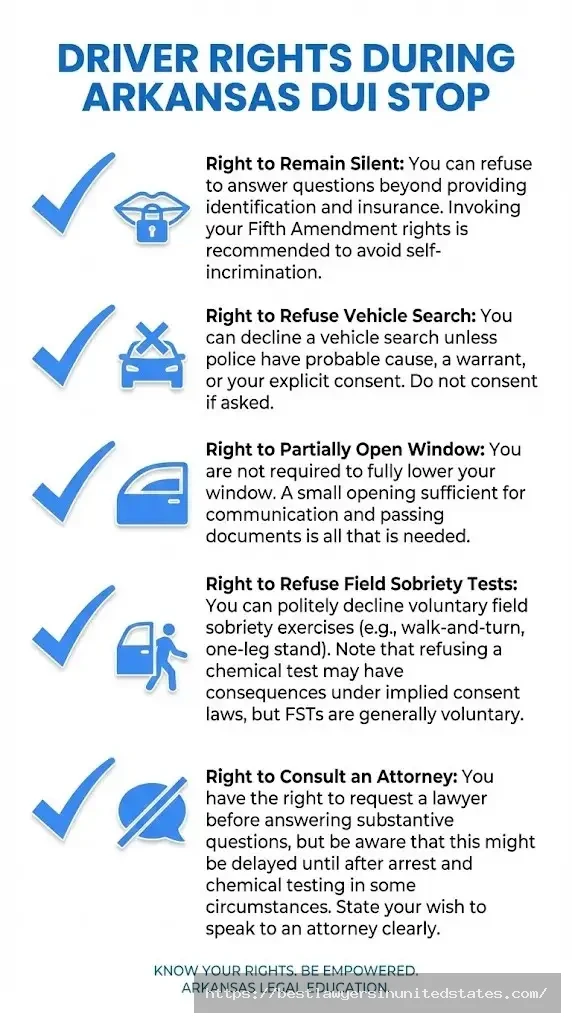
Do You Have to Roll Down Your Window in Arkansas?
Arkansas law requires you to lower your window enough to communicate with the officer and pass documents. You don’t have to roll it completely down.
Window Requirements:
- Lower enough to hear officer clearly
- Allow document exchange
- Permit officer to see inside vehicle
- Reasonable communication possible
Cracking your window 4-6 inches satisfies legal requirements. Officers cannot force you to lower it further without probable cause for arrest.
Can You Refuse to Get Out of Your Car?
No. Arkansas law and U.S. Supreme Court precedent (Pennsylvania v. Mimms) require you to exit when ordered.
Officer’s Authority:
- Can order driver out of vehicle
- Can order passengers out of vehicle
- Based on officer safety
- Does not require probable cause
Refusing to exit leads to additional charges like obstruction or resisting arrest. Always comply with exit orders. You can still refuse searches and testing.
Do You Have to Answer Questions?
You have the Fifth Amendment right to remain silent. Arkansas officers often ask questions designed to gather evidence.
Common Trap Questions:
- “Do you know why I stopped you?”
- “How much have you had to drink?”
- “Where are you coming from?”
- “What have you been doing tonight?”
Answer only required questions:
- “License, registration, and insurance, please” (provide documents)
- “Exit the vehicle” (comply)
- “What is your name?” (provide identification)
Politely decline other questions: “I’m exercising my right to remain silent. I’d like to speak with an attorney.”
Can You Refuse to Open Your Trunk or Doors?
Yes. Arkansas requires probable cause or consent for vehicle searches.
Your Search Rights:
- Refuse trunk searches
- Refuse to unlock doors
- Refuse to empty pockets
- Officer needs probable cause or warrant
Simply state: “I do not consent to searches.” Don’t physically interfere if officers search anyway. Challenge the search later in court.
Can Passengers Drink Alcohol in Arkansas?
No. Arkansas prohibits open containers of alcohol in vehicles under Act 935.
Open Container Law:
- No open alcohol containers in passenger areas
- Applies to drivers and passengers
- Exception: Motor homes and buses
- Sealed containers in trunk allowed
Passengers drinking alcohol gives officers probable cause to investigate the driver for DWI. Even sealed containers within reach raise suspicion.
Arkansas DWI Checkpoint Laws
Arkansas permits sobriety checkpoints under specific constitutional requirements. These checkpoints must follow strict guidelines.
Are DWI Checkpoints Legal in Arkansas?
Yes. The Arkansas Supreme Court upholds DWI checkpoints if properly conducted. However, checkpoints must meet constitutional standards.
Legal Checkpoint Requirements:
- Supervisory approval of checkpoint location
- Neutral vehicle selection (every car, or every 3rd car)
- Visible warning signs approaching checkpoint
- Minimal detention time
- Officers trained in DWI detection
- Public notice of checkpoint (sometimes)
Arkansas State Police and local departments conduct checkpoints primarily on holidays. Memorial Day, Fourth of July, Labor Day, and New Year’s Eve see increased checkpoint activity.
Common Checkpoint Locations
Arkansas places checkpoints on high-traffic roads and areas with DWI history.
Frequent Checkpoint Areas:
- Interstate 40 through Little Rock
- Highway 71B in Fayetteville
- Interstate 30 near Texarkana
- Highway 65 near Conway
- College Avenue in Fayetteville
- Dickson Street area (Friday/Saturday nights)
Washington County and Benton County conduct the most checkpoints in Arkansas. Student areas near University of Arkansas see regular weekend checkpoints.
What to Do at a DWI Checkpoint
You must stop at checkpoints. However, you maintain your constitutional rights.
Checkpoint Best Practices:
- Stop when directed
- Lower window for communication
- Provide license, registration, insurance
- Politely decline questions beyond identification
- Refuse field sobriety tests (not required)
- Follow directions to pull aside if asked
If officers ask you to pull into a secondary inspection area, you’re being investigated for DWI. Request an attorney immediately.
Can You Turn Around Before a Checkpoint?
Legally yes, but it often triggers pursuit. Arkansas courts hold that turning around before a checkpoint creates reasonable suspicion.
Legal Turning Around:
- Legal turn using existing road
- Normal driving behavior
- No traffic violations committed
- Not evading the checkpoint obviously
Officers often station units before checkpoints to stop vehicles that turn around. They look for traffic violations (illegal U-turns, failure to signal) to justify stops.
Underage DUI Laws in Arkansas (Under 21)
Arkansas enforces zero-tolerance DUI laws for drivers under 21. Any detectable alcohol results in penalties.
Arkansas Zero Tolerance Law
Arkansas Code § 5-65-303 prohibits drivers under 21 from operating vehicles with BAC of 0.02% or higher.
Underage DUI Penalties:
- Fine: $100 to $500
- License suspension: 90 days minimum
- Community service: Required
- DUI education program: Required
- Parent notification: Mandatory
A 0.02% BAC equals approximately one drink. Arkansas essentially prohibits any alcohol consumption before driving for those under 21.
First Offense Underage DUI
Young drivers face immediate administrative and criminal consequences.
Administrative Penalties:
- 90-day license suspension
- Restricted license after 30 days
- Ignition interlock may be required
- SR-22 insurance required
Criminal Penalties:
- Misdemeanor charge
- Fine up to $500
- 20-40 hours community service
- Alcohol education class
- Parent/guardian notified
Arkansas treats underage DUI separately from adult DWI. However, if your BAC exceeds 0.08%, you face adult DWI charges plus underage DUI charges.
Impact on College Students
Underage DUI affects college admission and financial aid. Arkansas colleges review criminal records during admission.
Educational Consequences:
- Scholarship loss (many require good standing)
- Dormitory housing removal
- Athletic eligibility affected
- Student organization restrictions
- Professional school admission impact
The University of Arkansas, Arkansas State University, and University of Central Arkansas have specific policies for student conduct violations. A DUI conviction may violate student conduct codes.
License Suspension for Minors
Arkansas extends license suspensions for underage drivers compared to adults.
Minor License Penalties:
- First underage DUI: 90-day suspension minimum
- Second underage DUI: 1-year suspension
- Under 18: May lose license until age 21
Young drivers cannot obtain hardship licenses as easily as adults. Courts deny hardship licenses unless you prove severe hardship beyond typical needs.
CDL Drivers: Arkansas DWI Consequences
Commercial driver’s license holders face career-ending consequences from DWI convictions.
Federal CDL DWI Standards
Federal Motor Carrier Safety Administration regulations control CDL DWI penalties nationwide. Arkansas must follow federal standards.
CDL BAC Limits:
- 0.04% while operating commercial vehicle
- 0.08% in personal vehicle (standard limit)
- Any detectable alcohol within 4 hours of driving
A CDL driver arrested for DWI in their personal car loses commercial driving privileges. The offense doesn’t need to happen in a commercial vehicle.
CDL Disqualification Periods
First DWI Offense (CDL Holder):
- 1-year CDL disqualification (minimum)
- Lifetime disqualification if transporting hazmat
- Affects interstate and intrastate drivers
- Cannot obtain hardship CDL for work
Second DWI Offense:
- Lifetime CDL disqualification
- No possibility of reinstatement for 10 years
- Even if second offense in personal vehicle
- Rehabilitation programs don’t reduce penalty
Impact on Trucking Career
Arkansas’s trucking industry employs over 50,000 commercial drivers. A DWI ends most trucking careers immediately.
Career Consequences:
- Current employer terminates employment
- Cannot obtain CDL positions elsewhere
- Federal regulations prohibit hiring
- Insurance companies refuse coverage
- Owner-operators lose insurance and operating authority
Companies like J.B. Hunt, Walmart Transportation, and ABF Freight check annual driving records. Even minor alcohol violations appear and trigger termination.
Clearing CDL After Conviction
Arkansas offers no fast path to CDL reinstatement after DWI.
Reinstatement Requirements:
- Complete all criminal penalties
- Wait full disqualification period
- Pass CDL tests again
- Obtain SR-22 insurance
- Complete employer-required safety programs
After 10 years for second offense, you can petition Arkansas Office of Driver Services for reinstatement consideration. Approval is discretionary and rarely granted.
How to Reinstate Your License After Arkansas DWI
Arkansas requires multiple steps to regain driving privileges after DWI suspension.
Step 1: Complete All Court Requirements
The Office of Driver Services won’t reinstate your license until you finish your sentence.
Required Completions:
- All jail time served
- All fines paid in full
- Court costs paid
- Community service completed
- DUI education program finished
- SATOP program completed (if ordered)
Obtain completion certificates from each program. The circuit court where you were convicted provides a “satisfaction of sentence” letter.
Step 2: Wait Full Suspension Period
Arkansas suspensions run from conviction date, not arrest date.
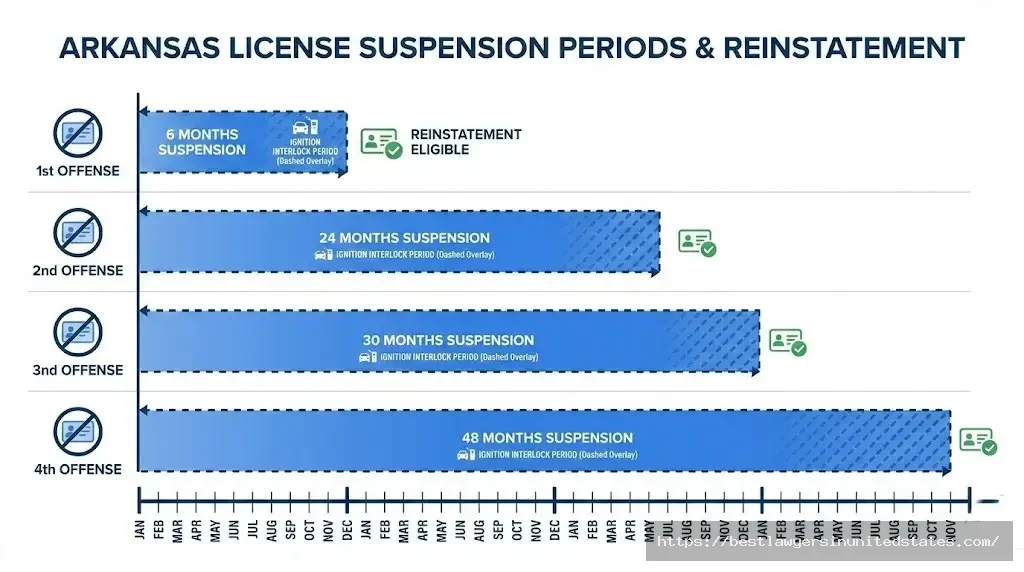
Suspension Waiting Periods:
- First offense: 6 months minimum
- Second offense: 24 months minimum
- Third offense: 30 months minimum
- Fourth offense: 48 months minimum
Time served on administrative suspension may not count toward criminal suspension. Check with Arkansas Office of Driver Services to confirm your exact eligibility date.
Step 3: Complete Ignition Interlock Requirement
Arkansas requires ignition interlock devices before license reinstatement for most DWI convictions.
IID Requirements:
- Install with approved vendor
- Maintain for full required period
- Pay all monitoring fees
- No violations during IID period
- Pass all monthly calibrations
Approved Arkansas IID vendors include:
- LifeSafer Ignition Interlock
- Smart Start Arkansas
- Intoxalock
Installation appointments take 1-2 hours. Devices connect to your vehicle’s ignition. You must blow into the device before starting the car.
Step 4: Obtain SR-22 Insurance
Arkansas requires SR-22 insurance certificates for license reinstatement.
SR-22 Requirements:
- Purchase SR-22 from insurance company
- Insurance company files SR-22 with state
- Maintain continuous coverage
- No lapses in coverage (triggers suspension)
- Keep SR-22 for required period (usually 3 years)
SR-22 isn’t separate insurance. It’s a certificate proving you have liability coverage. Arkansas requires minimum liability limits:
- $25,000 bodily injury per person
- $50,000 bodily injury per accident
- $25,000 property damage
Step 5: Pay Reinstatement Fees
Arkansas License Reinstatement Fees:
- Reinstatement fee: $150
- License replacement fee: $40
- Administration fee: $5
- Total: $195
Pay fees at: Arkansas Office of Driver Services
1900 W 7th Street
Little Rock, AR 72201
Or online at: dfa.arkansas.gov
Bring proof of:
- SR-22 insurance certificate
- IID installation certificate
- Completion certificates from programs
- Photo identification
Step 6: Retake License Exam (Some Cases)
Arkansas may require you to retake the written and driving tests after certain suspensions.
Test Requirements:
- Suspensions over 2 years
- Multiple DWI convictions
- At discretion of Office of Driver Services
Schedule testing appointments at Arkansas revenue offices statewide. Test locations include Little Rock, Fort Smith, Fayetteville, Jonesboro, and other major cities.
License Reinstatement Timeline
| Step | Timeframe | Action Required |
|---|---|---|
| Conviction | Day 0 | Note suspension start date |
| Complete sentence | Varies | Finish all court requirements |
| End suspension | 6-48 months | Wait full suspension period |
| Install IID | Before reinstatement | Install and pay fees |
| Obtain SR-22 | Before reinstatement | File with DFA |
| Pay fees | At reinstatement | $195 total |
| Get license | Same day | Visit revenue office |
Aggravated DWI in Arkansas
Arkansas enhances DWI penalties for aggravating factors beyond standard charges.
What Qualifies as Aggravated DWI
Aggravating Factors:
- BAC of 0.15% or higher
- Refusal to submit to testing
- Excessive speed (20+ mph over limit)
- Child under 16 in vehicle
- Causing accident with injury
- Driving on suspended license
- School zone violation while intoxicated
Courts increase penalties substantially for aggravated circumstances. Judges have less discretion for lenient sentencing with aggravating factors present.
Child Endangerment DWI
Driving while intoxicated with a child passenger adds serious charges.
Child Endangerment Penalties:
- Separate charge under Arkansas Code § 5-27-209
- Class D felony (up to 6 years prison)
- Stacked onto DWI charges
- No possibility of expungement
- Department of Human Services investigation possible
Child endangerment charges run consecutive to DWI sentences. This means you serve both sentences back-to-back, not simultaneously. A first DWI with child endangerment could result in 7 years total incarceration.
DWI Causing Serious Injury or Death
Arkansas charges vehicular manslaughter or negligent homicide for DWI crashes causing death.
DWI Death Penalties:
- Class B felony: Negligent homicide (5-20 years)
- Class Y felony: Vehicular manslaughter if prior DWI (10-40 years)
- Victim restitution required
- Civil lawsuits likely
The Pulaski County Prosecutor’s Office and other major counties aggressively prosecute DWI death cases. Defendants rarely receive probation for these charges.
Getting Legal Help for Arkansas DWI
Arkansas DWI cases require immediate legal representation. The consequences are too serious to handle alone.

When to Hire a DWI Attorney
Call an attorney within 24 hours of arrest. The 15-day administrative hearing deadline doesn’t allow delay.
Critical Early Actions:
- Request administrative hearing
- Preserve evidence (video footage)
- Interview witnesses
- Challenge arrest procedures
- Negotiate with prosecutors
Evidence disappears quickly. Police dashcam footage often gets overwritten after 30-60 days. Your attorney must act fast to preserve crucial evidence.
What Arkansas DWI Attorneys Cost
Attorney fees vary based on case complexity and location.
Typical Attorney Fees:
- First offense DWI: $2,500 – $5,000
- Second offense DWI: $3,500 – $8,000
- Third offense felony DWI: $5,000 – $15,000
- Trial representation: Additional $5,000 – $20,000
Many Arkansas DWI attorneys offer payment plans. Some accept credit cards or financing through legal funding companies.
Finding DWI Lawyers in Arkansas
Find experienced Arkansas DWI attorneys at:
Contact DWI Attorneys – [email protected]
Look for attorneys certified in DWI defense and familiar with Arkansas circuit courts. Experience with local prosecutors and judges matters significantly.
Public Defender Availability
Arkansas provides public defenders for indigent defendants. However, public defenders handle heavy caseloads.
Public Defender Eligibility:
- Income below federal poverty guidelines
- Asset test requirements
- No property ownership (generally)
- Application required through court
To qualify, most defendants must show they cannot afford any attorney. Owning property or having significant assets disqualifies you. However, you might consider how legal costs compare to other major expenses – similar to divorce attorney fees which also represent significant investments in your future.
Frequently Asked Questions About Arkansas DWI Laws
What is the legal blood alcohol limit in Arkansas?
The legal BAC limit is 0.08% for drivers 21 and older, 0.04% for commercial drivers, and 0.02% for drivers under 21.
How long does a DWI stay on your record in Arkansas?
A DWI conviction stays on your criminal record permanently unless expunged. You can petition to seal a first offense after 5 years.
Can you get a DUI dismissed in Arkansas?
Yes. Common dismissal reasons include illegal traffic stops, improper arrest procedures, inaccurate breathalyzer results, and violation of constitutional rights. Your attorney must file appropriate motions.
Do people usually go to jail for DUI in Arkansas?
First-time offenders often avoid jail through plea agreements that substitute community service. However, judges can impose up to one year jail time for first offense. Second and subsequent offenses carry mandatory minimum jail sentences.
How much does a first DUI cost in Arkansas?
A first DUI costs $6,200 to $14,200 total, including fines, attorney fees, court costs, ignition interlock device, SR-22 insurance, and education programs.
Is a DWI a felony in Arkansas?
A third DWI conviction is a Class D felony. First and second DWI offenses are Class A misdemeanors.
How many drinks equal 0.08% BAC?
For most people, 2-3 drinks within one hour produces 0.08% BAC. However, weight, gender, metabolism, and food consumption affect results. Our BAC calculator provides personalized estimates.
Can you refuse a field sobriety test in Arkansas?
Yes. Arkansas doesn’t require field sobriety tests. However, refusal may lead to arrest and breathalyzer testing at the station.
What happens if you refuse a breathalyzer in Arkansas?
Your license gets suspended for 180 days (first refusal) to 30 months (third refusal). Prosecutors can use your refusal as evidence against you at trial.
Does Arkansas have a DUI checkpoint app?
No official app exists. However, local news stations and social media often report checkpoint locations. Arkansas doesn’t require advance public notice of checkpoints.
Can you get a hardship license after DWI in Arkansas?
Arkansas allows restricted licenses after 30-45 days for work, school, or medical appointments. You must install an ignition interlock device and prove necessity.
What is SATOP in Arkansas?
SATOP (Substance Abuse Traffic Offender Program) is a court-ordered education program for DWI offenders. The program includes alcohol assessment, education classes, and possible treatment referrals.
How do I get my license back after DWI in Arkansas?
Complete all court requirements, wait the full suspension period, install an ignition interlock device, obtain SR-22 insurance, pay $195 in reinstatement fees, and visit the Arkansas Office of Driver Services.
Can employers fire you for DWI in Arkansas?
Yes. Arkansas is an at-will employment state. Employers can terminate employees for DWI convictions unless protected by employment contract. Jobs requiring driving or professional licenses face highest risk.
Does a DWI affect car insurance in Arkansas?
Yes. Insurance rates increase 60-80% after DWI convictions. The increase lasts 3-5 years minimum. You’ll need SR-22 insurance certification for license reinstatement.
What’s the difference between administrative and criminal DWI penalties?
Administrative penalties involve license suspension handled by the Office of Driver Services. Criminal penalties include fines, jail time, and probation handled by circuit courts. Both processes happen separately.
Can you get DWI charges reduced in Arkansas?
Sometimes. Prosecutors may reduce charges to reckless driving or negligent driving if evidence weaknesses exist. However, Arkansas law limits plea bargaining for repeat offenders.
How long is probation for DWI in Arkansas?
First offense probation typically runs 1-2 years. Second and third offenses may include 3-5 years probation. Felony DWI probation can extend up to 6 years.
What is actual physical control in Arkansas DWI law?
Actual physical control means you’re in position to operate the vehicle even without driving. Sitting in the driver’s seat with keys accessible can constitute actual physical control, even if the car isn’t running.
Can you leave the state while on DWI probation in Arkansas?
You need permission from your probation officer to leave Arkansas. Interstate travel requires advance approval. Leaving without permission violates probation and triggers a warrant.
