Getting a divorce in Arkansas typically costs between $500 and $15,000, depending on whether your case is contested or uncontested. The base filing fee alone ranges from $165 to $185 depending on your county, but total expenses quickly add up when you factor in attorney fees, document preparation, and hidden costs most people don’t plan for.

If you’re facing divorce, understanding the real costs upfront helps you budget properly and avoid financial surprises during an already stressful time.
Divorce Cost Calculator
Get an estimated cost for your divorce based on your specific situation
Your Estimated Divorce Cost
Cost Breakdown
📧 Get a Personalized Consultation
Have questions about your specific situation? Contact our legal experts for guidance tailored to your needs.
Contact Us via EmailWhat Does a Divorce Actually Cost in Arkansas?
Let’s break down the real numbers. The cheapest option—an uncontested DIY divorce with no children—can cost as little as $165 to $300 total. On the other end, a contested divorce with child custody disputes and significant assets can exceed $15,000 to $20,000 per spouse.

Most Arkansas divorces fall somewhere in between. An uncontested divorce with minor attorney assistance typically runs $1,500 to $3,500. A moderately contested case averages $5,000 to $10,000 per person.
The biggest cost driver? Attorney fees. Arkansas family law attorneys charge $150 to $400 per hour, with most requiring a $2,500 to $5,000 retainer upfront.
Quick Cost Breakdown:
| Divorce Type | Total Cost Range | Timeline |
|---|---|---|
| DIY Uncontested (no children) | $165 – $300 | 30-60 days |
| Uncontested with Attorney | $1,500 – $3,500 | 45-90 days |
| Contested (moderate) | $5,000 – $10,000 | 6-12 months |
| High-Conflict Contested | $15,000+ per spouse | 12-24+ months |
How Much Are Arkansas Divorce Filing Fees by County?

Arkansas divorce filing fees vary by county, though most charge between $165 and $185 to file a Complaint for Divorce. Some counties add separate fees for cases involving children or property division.
Arkansas County Filing Fees (2026):
| County | Filing Fee | Additional Fees |
|---|---|---|
| Pulaski County | $165 | $10 processing fee |
| Benton County | $170 | None |
| Washington County | $170 | None |
| Faulkner County | $165 | Varies by case type |
| Saline County | $175 | $5 e-filing fee |
| Sebastian County | $180 | None |
| Craighead County | $165 | None |
| Garland County | $170 | $10 for cases with children |
Call your county circuit clerk to confirm current fees before filing. Fee waivers are available if you meet income qualifications (explained below).
Should You Hire an Attorney or File for Divorce Yourself?
This is the decision that most impacts your total cost. Here’s the honest truth about when each option makes sense.

DIY divorce works when:
- Both spouses agree on everything
- No minor children involved
- Minimal assets (under $50,000 total)
- No retirement accounts or pensions to divide
- Neither spouse wants alimony
- You’re comfortable with legal paperwork
Total DIY cost: $165-$300 (just filing fees and certified copies). Our DIY divorce guide walks through the process step by step.
You need an attorney when:
- Any disagreement exists on custody, property, or support
- Significant assets or retirement accounts involved
- One spouse owns a business
- Domestic violence or safety concerns exist
- You suspect hidden assets or income
- Your spouse already hired an attorney
Attorney costs: $1,500-$20,000+ depending on complexity. Arkansas divorce attorney fees typically include a retainer ($2,500-$5,000) plus hourly billing at $150-$400/hour.
Middle ground option: Limited scope representation. An attorney reviews your paperwork and advises on specific issues for $500-$1,500 total. This works well for mostly-agreed divorces where you just want expert review of the settlement agreement.
How Much Does an Uncontested Divorce Cost in Arkansas?
An uncontested divorce happens when both spouses agree on all terms: property division, debt allocation, child custody, child support, and alimony (if any). This is the cheapest and fastest divorce option.

Uncontested divorce costs:
- Filing fees: $165-$185 (county-dependent)
- Process server: $40-$75 if your spouse needs formal service
- Certified copies: $10-$20 (you’ll need 2-3 certified final decrees)
- Parenting class: $50 if you have minor children (required in most Arkansas counties)
- Attorney fees (optional): $500-$2,000 for document prep and filing
Total uncontested DIY cost: $165-$300 Total with attorney assistance: $1,500-$3,500
Arkansas requires a 30-day waiting period from the date you file until the court can finalize your divorce. Most uncontested divorces with children take 45-90 days total because of parenting class requirements.
If both spouses live in Arkansas and agree on all terms, you can file an uncontested divorce without an attorney using forms provided by Arkansas Legal Services. The process typically takes 2-3 months from filing to final decree.
What Does a Contested Divorce Cost in Arkansas?
A contested divorce means you and your spouse disagree on one or more major issues. Even one disputed issue—like whether to sell the house or who gets primary custody—turns your case from uncontested to contested.
Contested divorce costs:
- Attorney retainer: $2,500-$5,000 upfront
- Hourly attorney fees: $150-$400/hour (most cases use 20-80 hours)
- Filing fees: $165-$185
- Court reporter for depositions: $300-$500 per deposition
- Expert witnesses (if needed): $2,000-$10,000 (business valuators, child custody evaluators, forensic accountants)
- Mediation: $150-$300 per hour (usually 3-6 hours total)
- Guardian ad litem (if appointed): $1,500-$5,000
- Process server: $40-$75
Total contested divorce cost: $5,000-$20,000+ per spouse
The more you fight, the more you pay. Contested divorces in Arkansas typically take 6-18 months. Court backlogs in Pulaski County and other urban areas can extend this timeline.
Cost comparison: Contested vs. Uncontested
| Cost Factor | Uncontested | Contested |
|---|---|---|
| Attorney fees | $500-$2,000 | $5,000-$20,000 |
| Total timeline | 30-90 days | 6-18 months |
| Court appearances | Usually none | 3-10+ hearings |
| Stress level | Low | High |
| Control over outcome | Full control | Judge decides |
Consider divorce mediation as an alternative. A neutral mediator helps you reach agreement for $150-$300 per hour, typically resolving cases in 3-6 sessions. Total mediation cost: $1,000-$2,500, far less than contested litigation.
Hidden Divorce Costs Nobody Warns You About
Most people budget for filing fees and attorney costs but get blindsided by these additional expenses:
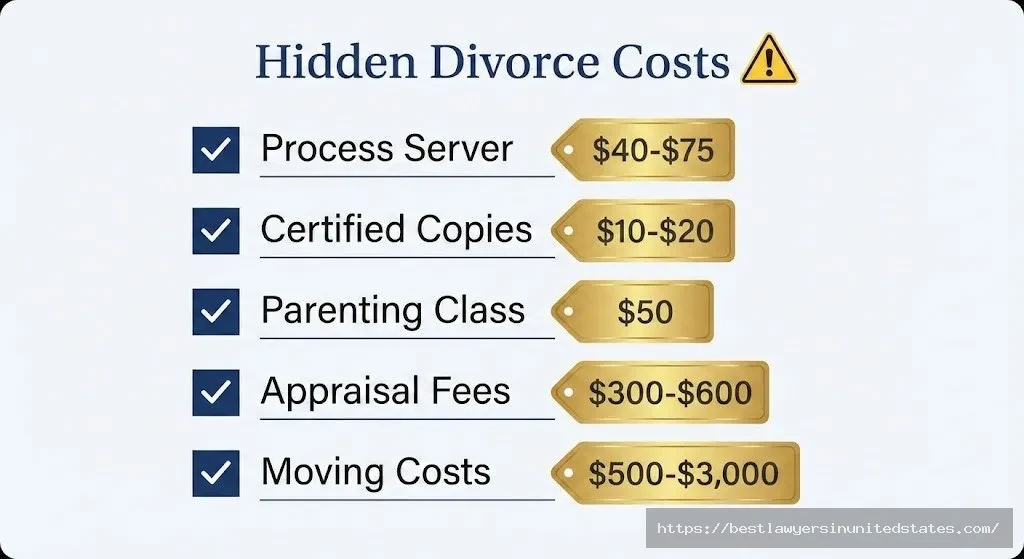
Process server fees: $40-$75 to formally serve divorce papers if your spouse won’t sign an Acceptance of Service.
Certified copies: $5-$10 per copy. You’ll need multiple certified final decrees for banks, retirement accounts, Social Security, and DMV.
Parenting classes: Arkansas courts require divorcing parents to complete a parenting education program before finalizing divorces with minor children. Cost: $50 per person.
Credit report copies: $15-$30. You need accurate financial disclosure to divide debts properly.
Appraisal fees: $300-$600 to appraise your home if you’re selling or one spouse is buying out the other.
Document preparation services: $200-$500 if you’re filing yourself but want help completing forms correctly.
Notary fees: $5-$10 per notarized signature. Some divorce documents require notarization.
Transcript fees: $3-$5 per page if you need hearing transcripts for an appeal.
Moving costs: $500-$3,000 if one spouse is moving out. Security deposits and first month’s rent add up quickly.
New household setup: $2,000-$5,000 for furniture, utilities deposits, and basic necessities if you’re starting over.
Budget an extra $500-$1,500 beyond your filing and attorney fees for these incidentals.
Can You Get a Free Divorce in Arkansas?
Yes, through fee waivers or legal aid programs. Arkansas offers two paths to free or reduced-cost divorce.
Arkansas Fee Waiver (In Forma Pauperis)
If you can’t afford filing fees, you can request the court waive them by filing an Affidavit of Indigency. You’ll need to prove your income falls below federal poverty guidelines.

2026 Federal Poverty Guidelines for Arkansas Fee Waivers:
| Household Size | Annual Income Limit |
|---|---|
| 1 person | $15,060 |
| 2 people | $20,440 |
| 3 people | $25,820 |
| 4 people | $31,200 |
| 5 people | $36,580 |
If you receive SSI, SNAP (food stamps), TANF, or Medicaid, you automatically qualify. The court clerk provides the fee waiver form when you file.
What the fee waiver covers:
- Court filing fees
- Service of process fees
- Certified copy fees
What it doesn’t cover:
- Attorney fees
- Expert witness fees
- Court reporter costs
Legal Aid of Arkansas

Legal Aid of Arkansas provides free attorneys to low-income residents in civil cases, including divorce. Income limits are typically 125% of federal poverty level.
2026 Legal Aid Income Limits (125% FPL):
| Household Size | Annual Income Limit |
|---|---|
| 1 person | $18,825 |
| 2 people | $25,550 |
| 3 people | $32,275 |
| 4 people | $39,000 |
| 5 people | $45,725 |
Legal Aid of Arkansas has offices in Little Rock, Fort Smith, Jonesboro, Springdale, and other cities. Call 1-800-952-9243 to apply.
What Legal Aid covers:
- Full attorney representation
- Court filing fees
- All legal paperwork and court appearances
Priority cases:
- Domestic violence victims
- Cases involving children
- Elderly or disabled clients
Legal Aid has limited funding and can’t accept every case. Apply early—waiting lists exist in most counties.
Arkansas Legal Services Partnership also offers free legal clinics in most counties where volunteer attorneys provide limited advice and document review. Check your county circuit court website for clinic schedules.
How Long Does a Divorce Take in Arkansas (and How Does That Affect Cost)?
Arkansas divorce timeline directly impacts your total cost because the longer your case drags on, the more attorney hours accumulate.

Mandatory 30-day waiting period: Arkansas requires a 30-day cooling-off period from the date you file until the court can finalize your divorce. This is the absolute minimum timeline even for agreed divorces with no children.
Realistic timelines:
| Divorce Type | Typical Timeline | Why It Takes This Long |
|---|---|---|
| Uncontested, no children | 30-45 days | Just filing and waiting period |
| Uncontested with children | 60-90 days | Parenting class requirement |
| Contested (settled before trial) | 6-12 months | Discovery, mediation, negotiations |
| Contested going to trial | 12-24 months | Court scheduling backlogs |
Pulaski County Family Court often schedules trials 12-18 months out due to high case volume. Washington County and Benton County move faster, typically 8-12 months for contested cases.
Does Arkansas require separation before divorce?
No. Arkansas has no separation requirement before filing for divorce. You can file the day you decide to divorce.
However, Arkansas does have an 18-month separation ground for divorce. If you’ve lived separately for 18 continuous months, the court will grant divorce even if your spouse contests it. This is Arkansas’s only true “no-fault” divorce option once the separation period is complete.
Most Arkansas divorces use the “general indignities” ground, which essentially means irreconcilable differences making the marriage unendurable.
How timeline affects cost:
Every month your divorce continues costs $200-$1,000+ in attorney fees depending on activity level. A case that settles in mediation after 4 months might cost $3,000. The same case going to trial after 18 months could cost $15,000+.
Want to minimize costs? Agree on everything you can before filing, respond to all requests promptly, and seriously consider mediation instead of courtroom battles.
Is Arkansas a 50/50 Divorce State for Property Division?
No. Arkansas uses “equitable distribution” rather than community property rules. This means courts divide marital property fairly—not necessarily equally.
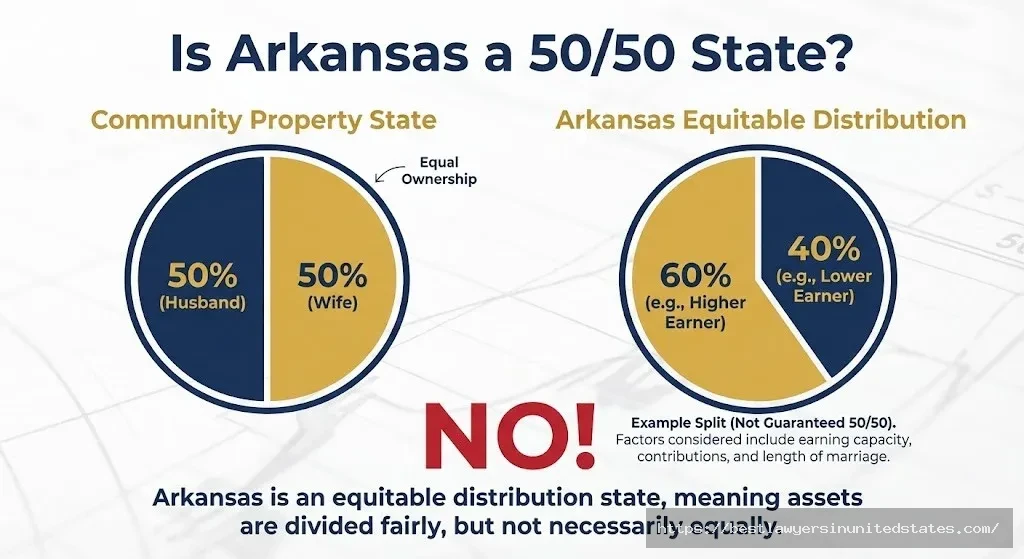
What is equitable distribution?
Arkansas courts consider these factors when dividing property:
- Length of the marriage
- Each spouse’s income and earning capacity
- Age and health of each spouse
- Contributions to the marriage (including homemaking)
- Which spouse has custody of minor children
- Tax consequences of the property division
- Whether either spouse wasted marital assets
A 60/40 or 70/30 split is common when one spouse significantly out-earns the other or when one spouse stayed home with children while the other built a career.
What property gets divided?
Only marital property is subject to division. This includes:
- Income earned during the marriage
- Houses, vehicles, and property purchased during marriage
- Retirement accounts and pensions accumulated during marriage
- Businesses started or grown during marriage
- Debts incurred during the marriage
What property isn’t divided?
Separate property stays with the spouse who owns it:
- Property owned before marriage
- Inheritances received by one spouse
- Gifts given specifically to one spouse
- Personal injury settlements (compensation for pain and suffering portion only)
Commingling separate and marital property can change this. If you deposited your inheritance into a joint account, it may become marital property.
What about credit card debt in an Arkansas divorce?
Arkansas courts divide marital debts using the same equitable distribution principles as assets. Both spouses typically share responsibility for debts incurred during the marriage, even if only one spouse’s name is on the account.
However, the court can assign debt based on:
- Who incurred the debt
- What the debt was used for
- Each spouse’s ability to pay
- Who receives the asset the debt was used to purchase
If your spouse racked up $30,000 in credit card debt on personal expenses right before filing for divorce, argue that debt should be assigned entirely to them. Document the timeline and purpose of all debts.
Important: Even if the divorce decree assigns a debt to your spouse, creditors can still pursue you if your name is on the account. Refinance or close joint accounts as soon as possible.
For comparison, neighboring states like Louisiana use community property rules where assets and debts are typically split 50/50.
What Is a Wife Entitled to in a Divorce in Arkansas?
Arkansas law doesn’t automatically favor wives over husbands in divorce. The state abolished gender-based divorce laws decades ago. Both spouses have equal rights to marital property, custody, and support.
That said, here’s what any spouse (wife or husband) can potentially receive:
Property division: A fair share of marital property based on equitable distribution factors. If the wife stayed home with children while the husband built a business, she’s entitled to a share of that business value.
Alimony (spousal support): Arkansas courts award alimony based on need and ability to pay, considering:
- Length of the marriage (longer marriages typically result in alimony awards)
- Each spouse’s income and earning capacity
- Age and health
- Education level and job skills
- Contributions to the marriage (including homemaking and child-rearing)
- Standard of living during the marriage
Alimony isn’t automatic. You must request it and prove need.
Child custody: Arkansas courts award custody based on the child’s best interests, not gender. Mothers don’t automatically get primary custody. Courts consider which parent was the primary caregiver, each parent’s living situation, work schedule, and ability to meet the child’s needs.
Child support: The parent with less custody time typically pays child support calculated using Arkansas’s percentage-of-income formula. The court considers both parents’ incomes when setting the amount.
Retirement accounts: A spouse is entitled to a portion of any retirement accounts accumulated during the marriage, regardless of whose name is on the account. This includes 401(k)s, pensions, and IRAs.
The family home: Either spouse can request to keep the marital home, typically by buying out the other spouse’s equity share or by being awarded more of the house in exchange for less of other marital assets.
The key factor is always the same: fairness based on circumstances, not gender. Document your contributions to the marriage, your financial needs, and your ability to support yourself post-divorce.
Who Pays Attorney Fees in an Arkansas Divorce?
Generally, each spouse pays their own attorney fees in Arkansas divorces. However, Arkansas courts can order one spouse to pay part or all of the other spouse’s attorney fees in specific circumstances.

When courts order fee shifting:
Significant income disparity: If one spouse earns substantially more, the court may order them to pay the lower-earning spouse’s attorney fees to level the playing field. This prevents a wealthy spouse from outspending their way to victory.
Bad faith conduct: If one spouse unnecessarily prolongs the case, hides assets, or violates court orders, the court may order them to pay the other’s attorney fees as a sanction.
Domestic violence cases: Courts often order abusers to pay the victim’s attorney fees.
Request for fee shifting: File a motion asking the court to order your spouse to pay your attorney fees. Include evidence of income disparity, financial records showing inability to pay, and documentation of any bad faith conduct.
Typical fee arrangements:
Most Arkansas divorce attorneys require a retainer—an upfront deposit against which they bill hourly. Retainers typically range from $2,500 to $5,000.
Hourly rates vary by location and attorney experience:
- Small town/rural attorneys: $150-$250/hour
- Mid-sized city attorneys: $200-$300/hour
- Major city/experienced attorneys: $300-$400/hour
Some attorneys offer flat fees for uncontested divorces: $1,000-$2,500 total.
Payment plans are sometimes available, though most attorneys require the retainer upfront before starting work.
Arkansas Divorce Cost FAQs
How much does a simple divorce cost in Arkansas?
A simple uncontested divorce with no children costs $165-$300 if you file yourself, or $1,500-$2,500 with attorney assistance. Filing fees range from $165-$185 depending on county, plus $10-$20 for certified copies.
Can you get divorced online in Arkansas?
No. Arkansas doesn’t offer fully online divorce filing or hearings for final divorce decrees. However, you can download divorce forms online from Arkansas Legal Services, complete them at home, and file them in person at your county circuit court clerk’s office. Some counties accept e-filing for divorce documents, but you still need to appear in court for the final hearing in most cases.
How much does a divorce cost in Arkansas with a child?
Expect to pay $1,800-$4,000 for an uncontested divorce with children (including attorney fees), or $7,000-$20,000 for a contested custody case. Additional costs include mandatory parenting classes ($50 per parent) and potentially a guardian ad litem ($1,500-$5,000) if custody is disputed.
What is the income limit for legal aid in Arkansas?
Legal Aid of Arkansas serves individuals earning up to 125% of the federal poverty level. For 2026, that’s $18,825 annually for a single person, $25,550 for a household of two, and $39,000 for a family of four. Priority goes to domestic violence victims, cases involving children, and elderly or disabled clients.
How long do you have to be married to get alimony in Arkansas?
Arkansas has no minimum marriage length requirement for alimony, but longer marriages typically result in alimony awards. Marriages under 5 years rarely result in alimony unless extreme circumstances exist. Marriages over 10 years frequently involve alimony, especially when one spouse sacrificed career advancement for homemaking or child-rearing.
Can I file for divorce in Arkansas without a lawyer?
Yes. Arkansas allows self-representation in divorce cases. Download free divorce forms from Arkansas Legal Services and file them at your county circuit court. This works best for uncontested divorces with no children and minimal assets. For contested cases or complex financial situations, hiring an attorney protects your interests and often saves money long-term by avoiding costly mistakes.
What are grounds for divorce in Arkansas?
Arkansas recognizes both fault and no-fault divorce grounds. The most common ground is “general indignities” (essentially irreconcilable differences). Other grounds include adultery, conviction of a felony, habitual drunkenness for one year, cruel and barbarous treatment, 18 months’ separation, and incurable insanity. For most divorces, general indignities is the easiest ground to prove and avoids airing personal details in court.
How much does a divorce lawyer cost in Little Rock, Arkansas?
Little Rock divorce attorneys charge $250-$400 per hour with typical retainers of $3,000-$5,000. Total costs range from $1,500 for simple uncontested divorces to $15,000+ for contested cases with custody disputes. Smaller Arkansas cities like Fort Smith, Jonesboro, and Conway have lower rates, typically $150-$300 per hour.
Do both spouses have to agree to a divorce in Arkansas?
No. Arkansas allows unilateral divorce. If you file and your spouse contests, the case becomes contested, but the court will eventually grant the divorce even without your spouse’s agreement. The 18-month separation ground provides a guaranteed path to divorce after living apart for that period, regardless of your spouse’s objections.
What’s the fastest way to get a divorce in Arkansas?
An uncontested divorce with no children is fastest—30-45 days from filing to final decree. To speed things up: (1) agree on all terms before filing, (2) have your spouse sign an Acceptance of Service to avoid formal service, (3) file all paperwork correctly the first time, and (4) attend all scheduled court dates promptly.
Final Thoughts: Planning Your Arkansas Divorce Budget
Arkansas divorces range from a few hundred dollars to tens of thousands depending on complexity and conflict level. The average Arkansas divorce costs $3,000-$8,000 when you factor in filing fees, attorney costs, and incidentals.

Action steps to minimize costs:
- Attempt to reach agreement before filing. Every issue you resolve between yourselves saves attorney fees and stress.
- Consider mediation instead of litigation. Mediation costs $1,000-$2,500 total versus $5,000-$20,000 for contested trials.
- Organize your financial documents. Providing organized records to your attorney reduces billable hours spent gathering information.
- Apply for fee waivers if eligible. No point paying filing fees if you qualify for a waiver.
- Use limited scope representation when appropriate. An attorney reviewing your DIY paperwork costs $500-$1,500 versus $3,000+ for full representation in simple cases.
- Respond promptly to all requests. Delays extend your case timeline and increase costs.
- Pick your battles. Fighting over a $500 couch when attorney fees are $300/hour makes no financial sense.
The cheapest divorce is one where both spouses act reasonably, compromise on minor issues, and focus on moving forward rather than punishing each other. Legal fees accumulate quickly when emotions drive decisions instead of logic.
Budget realistically, explore all cost-saving options, and remember—the money you spend fighting could instead fund your fresh start.
For detailed state-by-state divorce cost comparisons, check our complete guide to how much divorce costs nationally. You can also estimate your specific costs using our divorce cost calculator.