Driving while intoxicated in New Jersey carries severe penalties under N.J.S.A. 39:4-50, the state’s primary DWI statute. First-time offenders face fines up to $500, license suspension until installing an ignition interlock device, and mandatory attendance at the Intoxicated Driver Resource Center. Unlike many states, New Jersey treats all DWI offenses as traffic violations rather than criminal charges, but the consequences remain serious and long-lasting.
New Jersey uses “DWI” (driving while intoxicated) in official statutes, though “DUI” (driving under the influence) means the same thing. The state enforces a 0.08% blood alcohol concentration limit for standard drivers, with lower thresholds for commercial drivers (0.04%) and underage drivers (0.01%). New Jersey Municipal Courts handle all DWI cases, and the state’s unique three-tier penalty system bases first-offense consequences on your exact BAC level.
Quick Answer: A first DUI in New Jersey costs $250-$500 in fines, plus mandatory fees totaling $406, ignition interlock installation, 12-48 hours at IDRC, and license suspension until device installation. Total costs typically range from $5,000-$12,000 when including attorney fees, insurance increases, and device rental.
New Jersey BAC Limits and Legal Thresholds
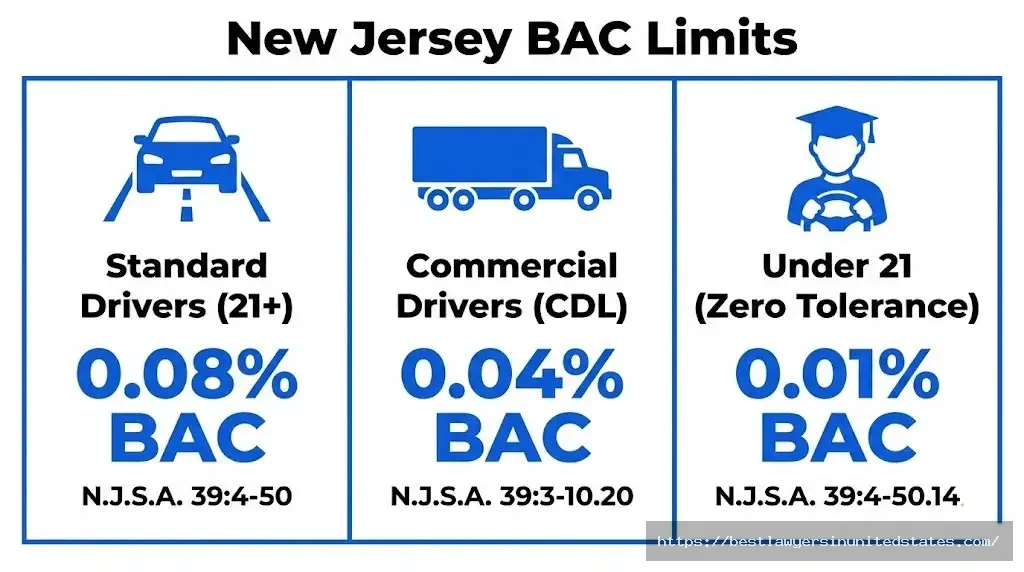
New Jersey defines drunk driving as operating a vehicle with a blood alcohol concentration of 0.08% or higher. The state applies different BAC thresholds based on driver category and age.
Standard Driver BAC Limits
Standard drivers (age 21+): 0.08% BAC constitutes per se intoxication under N.J.S.A. 39:4-50. Officers can arrest you at lower BAC levels if your driving shows impairment. Physical evidence like failed field sobriety tests supports DWI charges even below 0.08%.
Commercial drivers: 0.04% BAC triggers DWI charges under N.J.S.A. 39:3-10.20. Commercial license holders face federal standards regardless of whether they’re driving commercially at the time of arrest.
Underage drivers (under 21): 0.01% BAC violates New Jersey’s zero tolerance law under N.J.S.A. 39:4-50.14. Any detectable alcohol triggers penalties for drivers under the legal drinking age.
| Driver Type | BAC Limit | Statute |
|---|---|---|
| Standard (21+) | 0.08% | N.J.S.A. 39:4-50 |
| Commercial (CDL) | 0.04% | N.J.S.A. 39:3-10.20 |
| Under 21 | 0.01% | N.J.S.A. 39:4-50.14 |
Understanding Your BAC Level
Blood alcohol concentration measures the amount of alcohol in your bloodstream. A 180-pound man typically reaches 0.08% BAC after four standard drinks in two hours. A 140-pound woman reaches the same level after three drinks in the same timeframe.
Many factors affect BAC beyond drink count. Your weight, gender, food consumption, and drinking pace all influence alcohol absorption. Using a BAC calculator helps estimate your level, though breathalyzer results provide the only legally admissible measurement in New Jersey courts.
BAC Calculator
Estimate your Blood Alcohol Content
• Commercial Driver (CDL): 0.04% BAC
• Drivers Under 21: 0.00-0.02% BAC (Zero Tolerance)
• Enhanced Penalties: 0.15% BAC or higher in most states
Important: BAC calculators provide estimates only. Individual metabolism varies significantly. The only way to avoid DWI charges is not driving after drinking.
First Offense DWI Penalties in New Jersey
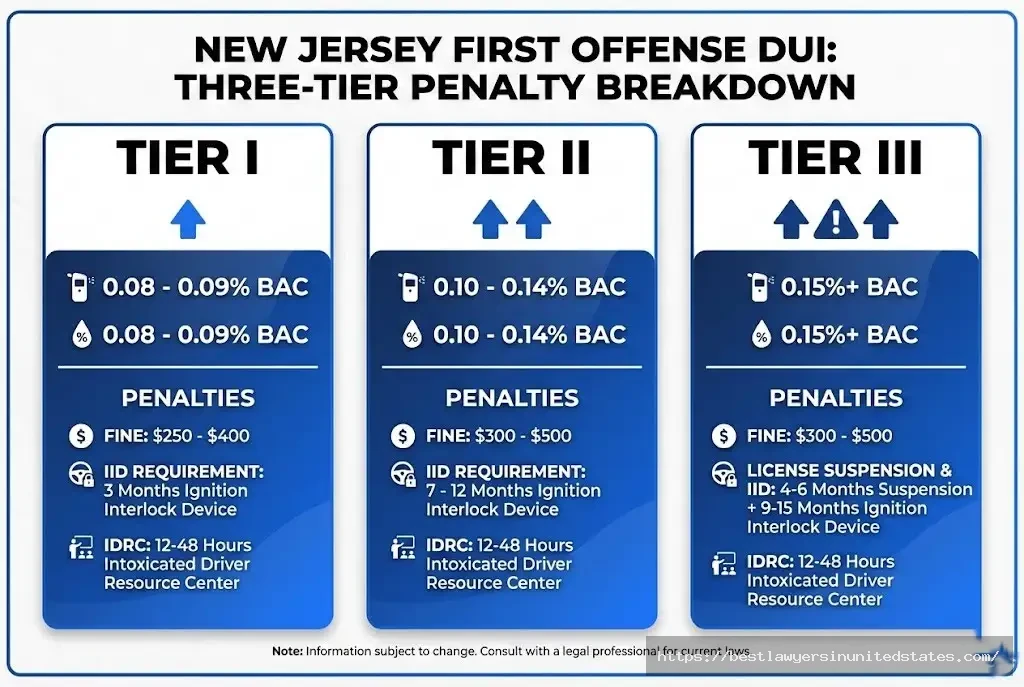
New Jersey divides first-offense penalties into three tiers based on BAC level. This tiered system, established under P.L. 2003, Chapter 314, creates different consequences depending on how far above 0.08% you measure.
Tier I: BAC 0.08-0.09%
The lowest penalty tier applies to BAC between 0.08% and 0.09%. These cases receive the most lenient treatment under New Jersey law.
Penalties for Tier I offenses:
- Fines: $250-$400
- Jail: Up to 30 days (court’s discretion)
- License suspension: Until ignition interlock installed (minimum 3 months)
- IDRC: 12-48 hours mandatory attendance
- Insurance surcharge: $1,000 per year for 3 years
Judges rarely impose jail time for first offenders in this tier. License suspension continues until you install an ignition interlock device in your vehicle. The device must remain for three months after installation.
Tier II: BAC 0.10-0.14%
BAC between 0.10% and 0.14% triggers enhanced penalties. Most first-time DWI arrests fall into this category.
Penalties for Tier II offenses:
- Fines: $300-$500
- Jail: Up to 30 days (court’s discretion)
- License suspension: Until ignition interlock installed (7 months to 1 year)
- IDRC: 12-48 hours mandatory attendance
- Insurance surcharge: $1,000 per year for 3 years
The key difference from Tier I is the longer ignition interlock requirement. Your license stays suspended for 7-12 months, then the device must remain installed during that period.
Tier III: BAC 0.15% or Higher
BAC of 0.15% or above receives the harshest first-offense treatment. The state views this level as evidence of severe impairment.
Penalties for Tier III offenses:
- Fines: $300-$500
- Jail: Up to 30 days (court’s discretion)
- License suspension: 4-6 months, then ignition interlock for 9-15 months
- IDRC: 12-48 hours mandatory attendance
- Insurance surcharge: $1,000 per year for 3 years
Critical difference: Even after license restoration, the ignition interlock device must remain installed for an additional 9-15 months. Total interlock time can exceed two years.
| BAC Level | Fine Range | License Action | Interlock Period |
|---|---|---|---|
| 0.08-0.09% | $250-$400 | Suspended until IID installed | 3 months |
| 0.10-0.14% | $300-$500 | Suspended until IID installed | 7-12 months |
| 0.15%+ | $300-$500 | Suspended 4-6 months | 9-15 months post-restoration |
IDRC Attendance Requirements
Every first-time offender must complete 12-48 hours at an Intoxicated Driver Resource Center. This program is unique to New Jersey and cannot be substituted with online classes or out-of-state programs.
IDRC locations operate throughout New Jersey in counties including Bergen, Essex, Hudson, Middlesex, Morris, Ocean, and Union. The program costs approximately $100-$280 depending on location and length. You must complete IDRC within 90 days of sentencing or face additional license suspension.
Second Offense DWI in New Jersey
A second DWI within 10 years of your first offense triggers mandatory jail time and significantly harsher penalties. New Jersey uses a 10-year lookback period to determine offense number.
Second Offense Penalties
Mandatory consequences for second DWI:
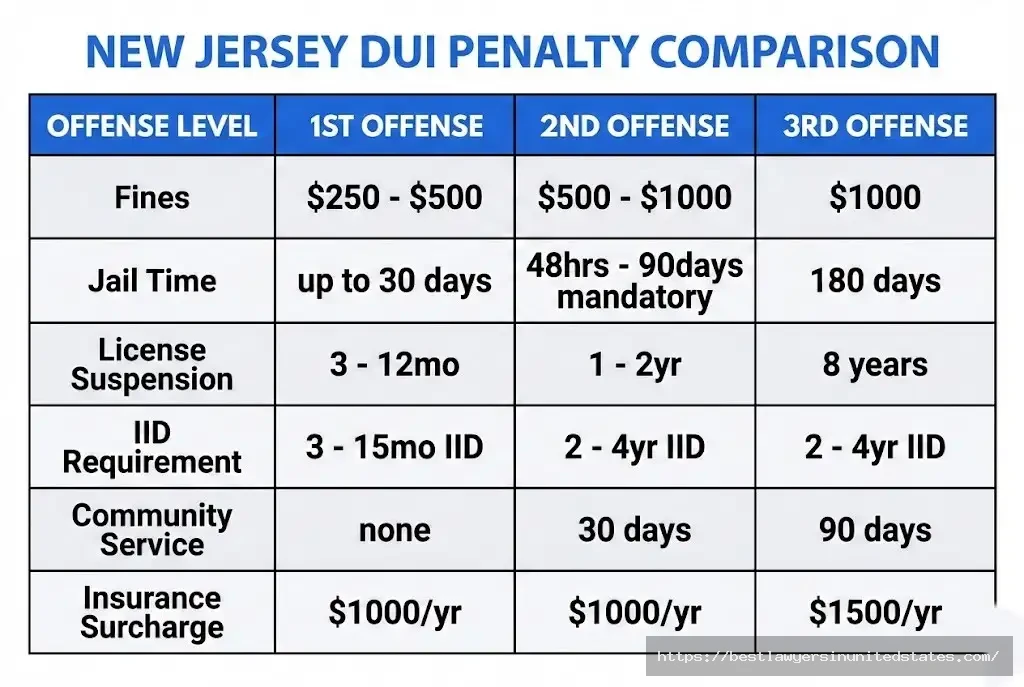
- Fines: $500-$1,000
- Jail: 48 hours to 90 days (mandatory minimum)
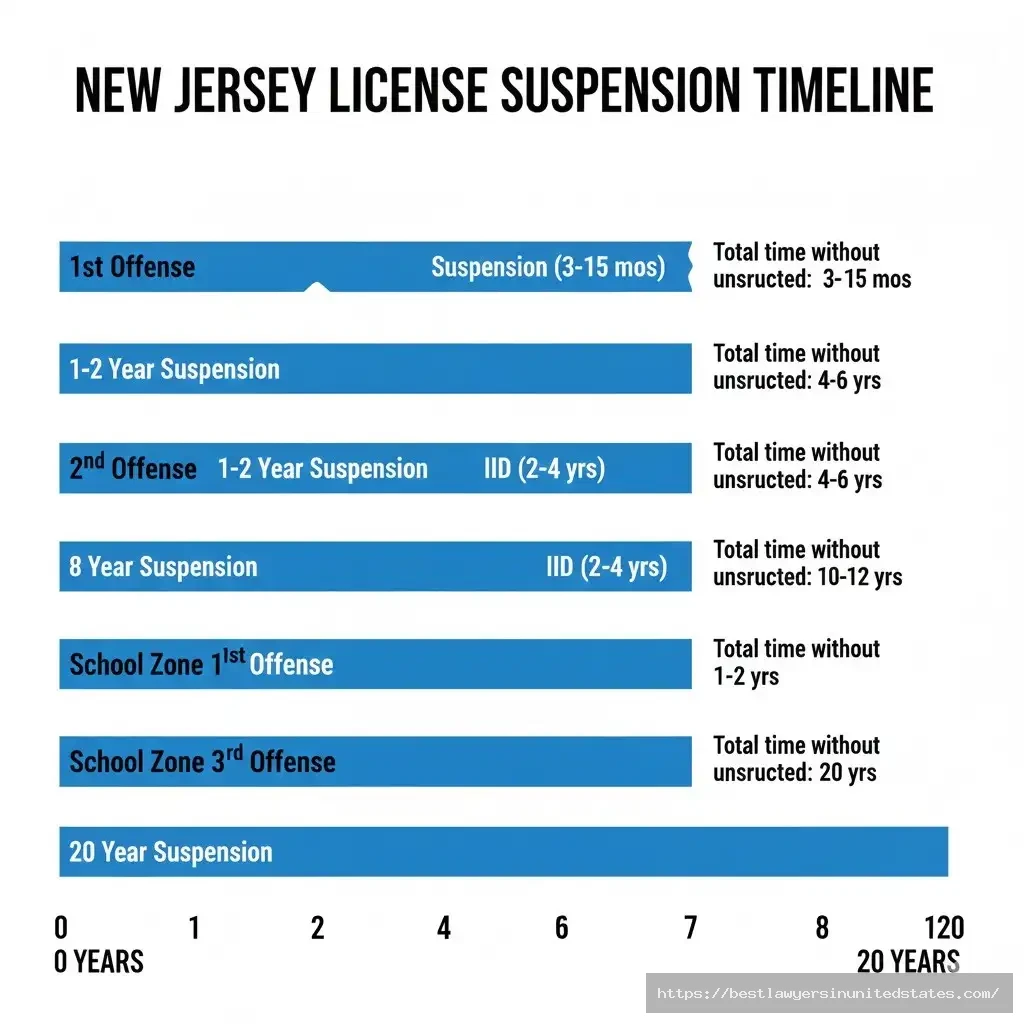
- License suspension: 1-2 years
- Community service: 30 days mandatory
- Ignition interlock: 2-4 years after license restoration
- Insurance surcharge: $1,000 per year for 3 years
Critical point: Jail time is mandatory for second offenses. Courts cannot waive the 48-hour minimum. Some judges allow defendants to serve time on weekends.
How Lookback Periods Work
New Jersey counts any DWI conviction within the previous 10 years as a prior offense. The clock starts from your first conviction date, not arrest date.
Example: If convicted of DWI on March 1, 2016, any arrest before March 1, 2026 counts as a second offense. After March 1, 2026, the conviction no longer counts toward offense escalation.
Out-of-state convictions count toward your New Jersey offense total. The Interstate Driver License Compact shares conviction data between states. A Pennsylvania DUI or New York DWI counts as a prior offense if it occurred within 10 years.
IDRC Requirements for Second Offense
Second offenders must complete a more intensive IDRC evaluation. The program assesses whether you need alcohol treatment beyond the standard education component. Some defendants receive referrals to outpatient or inpatient rehabilitation programs.
Failure to complete IDRC requirements results in indefinite license suspension. Your license remains suspended until you satisfy all program requirements, even if the court-ordered suspension period expires.
Third Offense DWI in New Jersey
Third DWI offenses within 10 years carry the most severe penalties in New Jersey. The state treats repeat offenders as a serious public safety threat.
Third Offense Penalties
Mandatory consequences for third DWI:
- Fines: $1,000
- Jail: 180 days (reducible with inpatient treatment)
- License suspension: 8 years
- Community service: 90 days mandatory
- Ignition interlock: 2-4 years after license restoration
- Insurance surcharge: $1,500 per year for 3 years
Jail time reduction: Courts may reduce the 180-day sentence by up to 90 days if you complete an approved inpatient rehabilitation program. Each day in treatment counts as one day off your sentence.
Eight-Year License Suspension
The eight-year suspension represents one of the harshest administrative penalties in New Jersey. You cannot obtain a hardship license or work permit during this period.
After serving the eight-year suspension, you must install an ignition interlock device for an additional 2-4 years. Total time without unrestricted driving privileges can exceed 12 years for third offenders.
Calculating Total DWI Costs in New Jersey
Financial consequences extend far beyond court fines. Insurance increases, legal fees, and device rental costs add up quickly.
DUI Cost Calculator
Estimate total DUI expenses by state and offense
Detailed Cost Breakdown
Payment Timeline
Bail bond, towing fees, car impound, attorney retainer
Initial court fines, DMV fees, DUI school enrollment, ignition interlock installation
Monthly probation fees, ignition interlock fees, DUI school payments, attorney balance
Insurance premium increases, license reinstatement, SR-22 filing fees
- Lost wages from missed work (court dates, jail time, DUI school) – $2,000-$10,000
- Job loss or difficulty finding employment – Varies
- Professional license suspension (doctors, lawyers, nurses, pilots) – Career ending
- Rideshare and transportation costs during suspension – $1,500-$5,000
- Travel restrictions and visa denials – Varies
- Security clearance loss – Career impact
- Child custody implications – Legal costs
- Rental car restrictions – Varies
- Personal relationships and mental health costs – Priceless
Use the DUI cost calculator to estimate your total expenses based on offense number and BAC level.
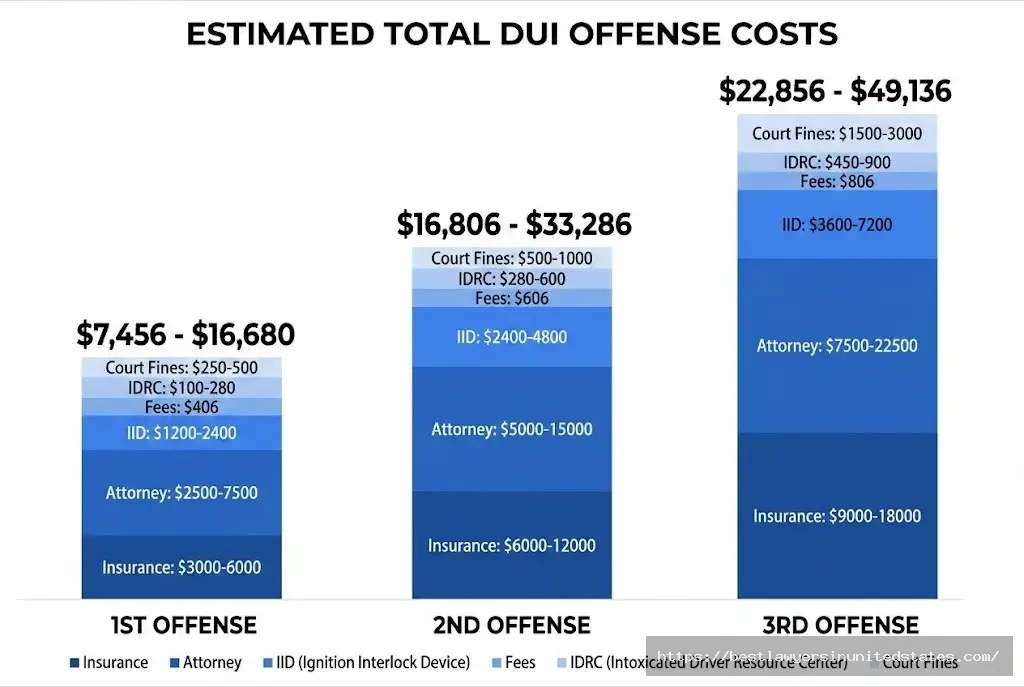
| Cost Category | First Offense | Second Offense | Third Offense |
|---|---|---|---|
| Court fines | $250-$500 | $500-$1,000 | $1,000 |
| Mandatory fees | $406 | $406 | $456 |
| Attorney fees | $2,500-$7,500 | $5,000-$10,000 | $7,500-$15,000 |
| IDRC | $100-$280 | $100-$280 | $100-$280 |
| Ignition interlock | $1,200-$2,400 | $4,800-$9,600 | $4,800-$14,400 |
| Insurance increase (3 years) | $3,000-$6,000 | $6,000-$12,000 | $9,000-$18,000 |
| Total Estimated Cost | $7,456-$16,680 | $16,806-$33,286 | $22,856-$49,136 |
School Zone DWI Enhancement in New Jersey
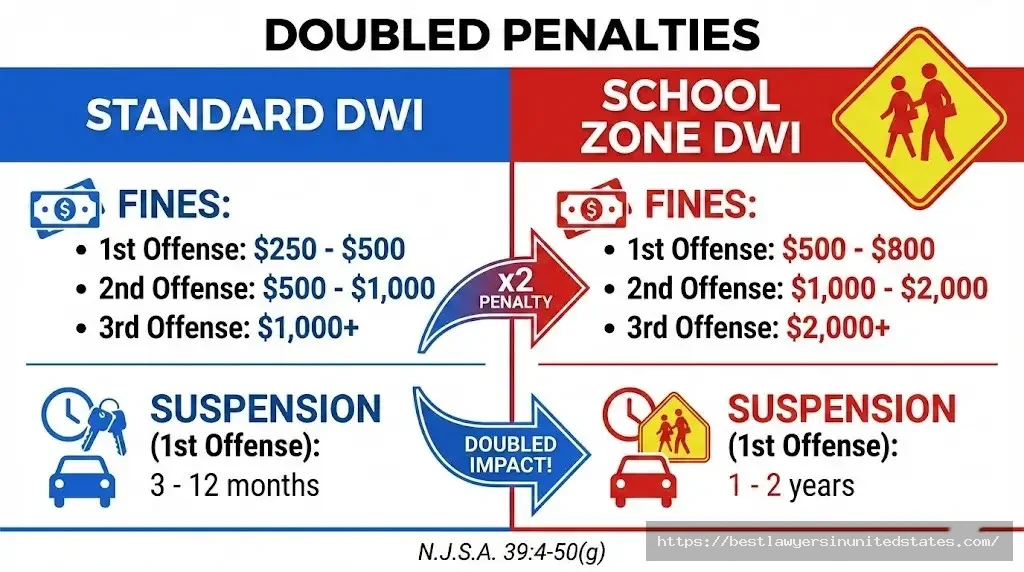
Driving while intoxicated in a school zone triggers enhanced penalties under N.J.S.A. 39:4-50(g). This separate statute doubles many standard DWI penalties.
What Qualifies as a School Zone
School zones include:
- Any property owned or leased by an elementary or secondary school board
- Areas within 1,000 feet of school property
- Designated school crossings (by municipal ordinance)
- School crossings where juveniles are present (even without designation)
The 1,000-foot radius extends from the school property boundary in all directions. This covers surrounding streets and residential areas near schools throughout New Jersey.
Enhanced Penalties for School Zone DWI
School zone DWI penalties effectively double base fines and extend license suspensions significantly.
| Offense | Standard Fine | School Zone Fine | Standard Suspension | School Zone Suspension |
|---|---|---|---|---|
| First | $250-$500 | $500-$800 | 3-12 months | 1-2 years |
| Second | $500-$1,000 | $1,000-$2,000 | 1-2 years | 4 years |
| Third | $1,000 | $2,000 | 8 years | 20 years |
Critical point: School zone enhancements apply even if school is not in session. Time of day and school calendar do not affect whether the enhancement applies.
No Community Service for First School Zone Offense
Standard first offenses carry no community service requirement. School zone first offenses require 60 days of community service. This mandatory requirement cannot be waived or reduced.
New Jersey’s Unique IDRC Requirement
The Intoxicated Driver Resource Center program is unique to New Jersey. No other state operates a similar mandatory education and evaluation system for all DWI offenders.
What Happens at IDRC
IDRC programs run for two consecutive days with at least six hours per day. You must attend both days to satisfy court requirements.
Day 1 activities:
- Alcohol and drug screening assessment
- Educational presentations on impaired driving risks
- Group discussions with other offenders
- Evaluation for substance abuse issues
Day 2 activities:
- Continuation of educational programming
- Individual counseling sessions
- Treatment recommendations (if applicable)
- Program completion certification
Some offenders receive referrals to additional treatment based on their assessment results. Treatment recommendations range from outpatient counseling to 30-day inpatient rehabilitation.
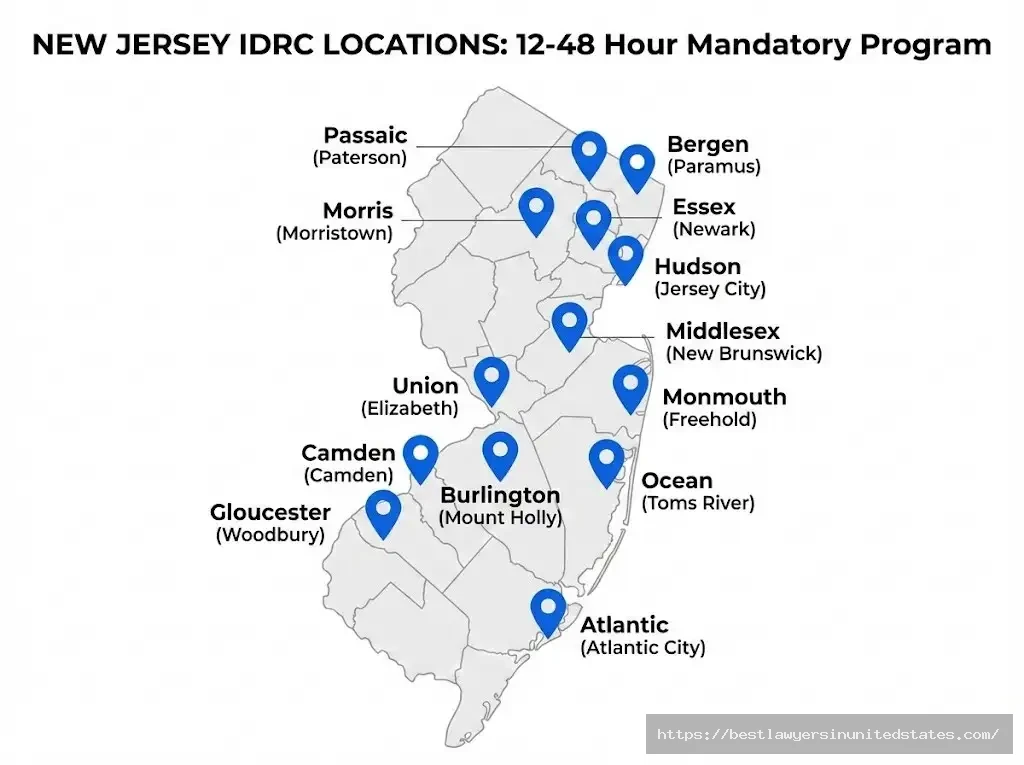
IDRC Locations Across New Jersey
IDRC operates centers in multiple counties to serve offenders statewide:
Northern New Jersey:
- Bergen County IDRC (Paramus)
- Essex County IDRC (Newark)
- Hudson County IDRC (Jersey City)
- Morris County IDRC (Morristown)
- Passaic County IDRC (Paterson)
Central New Jersey:
- Middlesex County IDRC (New Brunswick)
- Monmouth County IDRC (Freehold)
- Ocean County IDRC (Toms River)
- Union County IDRC (Elizabeth)
Southern New Jersey:
- Atlantic County IDRC (Atlantic City)
- Burlington County IDRC (Mount Holly)
- Camden County IDRC (Camden)
- Gloucester County IDRC (Woodbury)
IDRC Costs and Scheduling
IDRC fees range from $100 to $280 depending on program length and location. Payment is typically due at the start of the program. Most centers accept cash, money orders, and credit cards.
You must schedule IDRC attendance within 30 days of sentencing. The program must be completed within 90 days or your license suspension continues indefinitely. Call your assigned IDRC center directly to schedule your attendance dates.
Failure to complete IDRC: Your license remains suspended until you complete the program, even if your court-ordered suspension period expires. Additional penalties may apply for non-compliance.
Ignition Interlock Devices in New Jersey
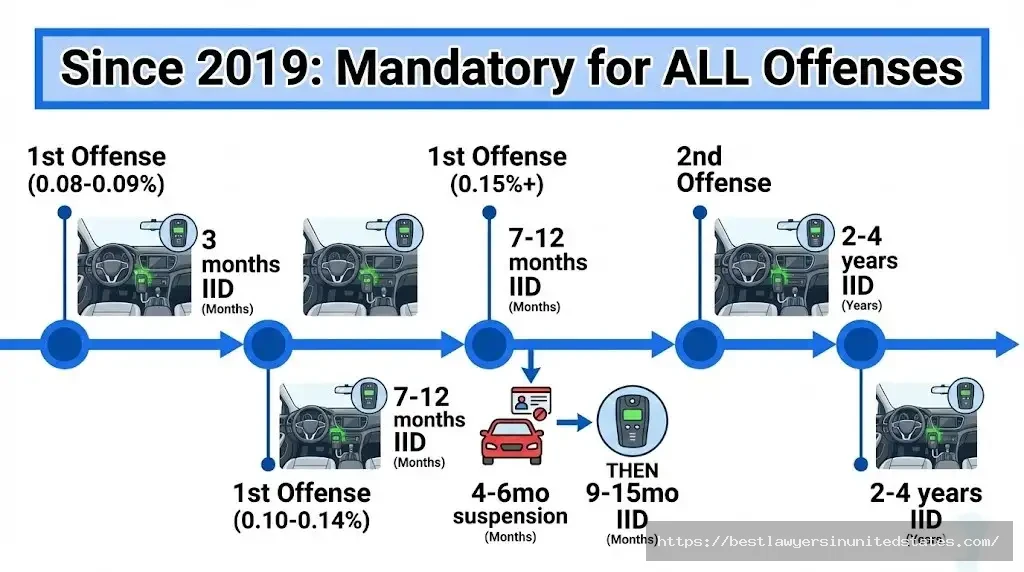
New Jersey requires ignition interlock devices for all DWI offenses since the 2019 law changes. The state eliminated fixed suspension periods in favor of suspension until device installation.
How Ignition Interlock Devices Work
An ignition interlock device connects to your vehicle’s ignition system. You must provide a breath sample before starting the car. The device prevents engine ignition if it detects alcohol above a preset limit (typically 0.025% BAC).
While driving:
- Random rolling retests occur every 5-15 minutes
- You must pull over safely to provide samples
- Failure to retest or failed retest triggers violations
- All test results download to monitoring authorities
Installation and Monthly Costs
Ignition interlock expenses:
- Installation: $100-$150
- Monthly monitoring: $75-$125
- Calibration (monthly): Included in monitoring fee
- Removal: $50-$75
Total cost examples:
- 3-month requirement (Tier I first offense): $325-$525
- 12-month requirement (Tier II first offense): $1,000-$1,625
- 48-month requirement (second offense): $3,700-$6,125
Multiple approved vendors operate in New Jersey including Intoxalock, LifeSafer, and Smart Start. You may choose any approved vendor for installation.
Ignition Interlock Violations
Violations trigger additional consequences and may extend your interlock requirement:
Common violations:
- Failed startup test (BAC above limit)
- Missed rolling retest
- Tampering with device
- Attempting to remove device
- Having someone else blow into device
Three violations within a monitoring period may result in extended interlock requirements or new criminal charges. Each violation gets reported to the New Jersey Motor Vehicle Commission and your municipal court.
Refusing a Breath Test in New Jersey
New Jersey’s implied consent law under N.J.S.A. 39:4-50.2 means you automatically consent to chemical testing by accepting a driver’s license. Refusal triggers separate penalties under N.J.S.A. 39:4-50.4a.
Implied Consent Law Explained
Every New Jersey driver agrees to submit to breath, blood, or urine testing when arrested for DWI. This agreement is automatic when the Motor Vehicle Commission issues your license.
Officers must:
- Read you the implied consent warning before testing
- Explain refusal consequences
- Request testing only after arrest (not during initial stop)
- Offer you a choice of breath or blood test in some situations
You have the right to refuse testing, but refusal carries its own penalties separate from DWI charges.
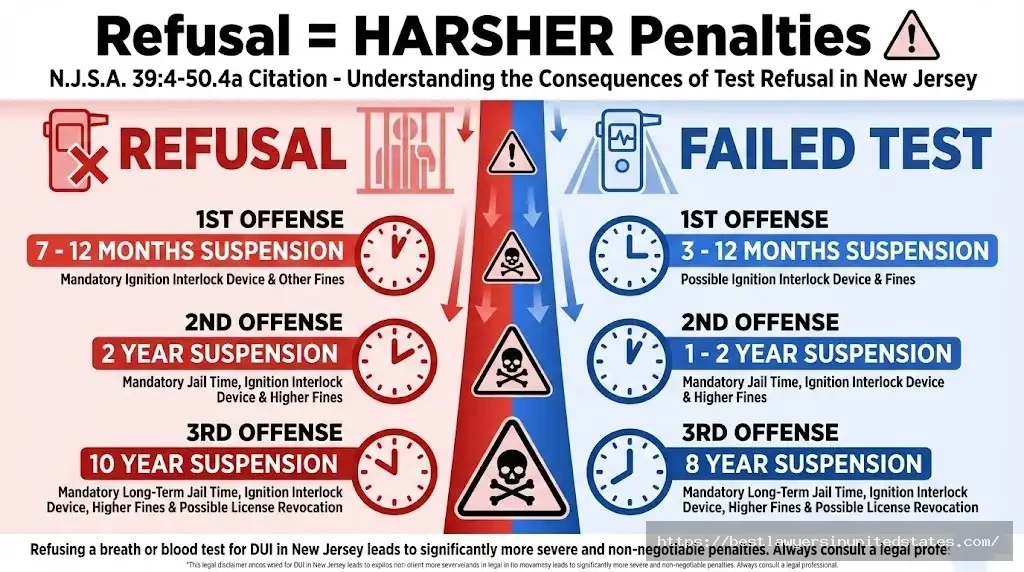
Refusal Penalties by Offense Number
Refusal penalties often exceed failed test penalties, especially for first-time offenders.
| Offense | Refusal Suspension | Failed Test Suspension |
|---|---|---|
| First | 7 months to 1 year | 3-12 months (based on BAC) |
| Second | 2 years | 1-2 years |
| Third | 10 years | 8 years |
Critical difference: First refusal brings a 7-12 month suspension while a first offense with BAC 0.08-0.09% brings only a 3-month suspension. Refusal penalties are significantly harsher.
Refusal Charges Run Separately from DWI
Prosecutors charge refusal as a separate violation from DWI. You can face both refusal charges and DWI charges from the same arrest.
Two separate cases:
- Refusal hearing (administrative) – Lower burden of proof
- DWI trial (quasi-criminal) – Higher burden of proof
Winning your DWI case does not dismiss refusal charges. The refusal suspension continues even if you beat the underlying DWI charge. You must fight both cases independently.
Can Police Force You to Take a Test?
Officers cannot physically force you to provide a breath sample without a warrant. However, New Jersey courts increasingly grant warrants for blood draws in serious cases.
Warrants are common for:
- Accidents involving injuries or deaths
- Suspected DUI with drugs (not just alcohol)
- Unconscious drivers who cannot provide breath samples
- Refusal cases with aggravating circumstances
A valid warrant removes your right to refuse. Physically resisting a warranted blood draw may result in additional criminal charges.
Underage DWI in New Jersey
New Jersey enforces zero tolerance for drivers under 21. N.J.S.A. 39:4-50.14 prohibits any detectable alcohol for underage drivers.
0.01% BAC Threshold
The underage threshold of 0.01% BAC means virtually any alcohol consumption triggers violations. A single drink hours before driving can exceed this limit.
Underage DWI penalties:
- License suspension: 30-90 days (or postponement until age 17 if unlicensed)
- Community service: 15-30 days
- IDRC: Mandatory referral and evaluation
- Fines: $500 (if purchased/consumed at licensed premises)
These penalties apply in addition to standard DWI penalties if BAC exceeds 0.08%. An underage driver with 0.10% BAC faces both zero tolerance charges and regular DWI charges.
Underage DWI vs. Standard DWI
Underage offenders may face charges under both zero tolerance law and standard DWI statutes depending on BAC level.
| BAC Level | Applicable Charge | Primary Statute |
|---|---|---|
| 0.01-0.07% | Zero tolerance only | N.J.S.A. 39:4-50.14 |
| 0.08%+ | Both zero tolerance and DWI | N.J.S.A. 39:4-50 + 39:4-50.14 |
Double penalties: An 18-year-old driver with 0.12% BAC faces standard first-offense DWI penalties plus additional zero tolerance consequences. License suspension periods may run concurrently or consecutively depending on court discretion.
License Postponement for Minors
Drivers under 17 who have not yet obtained a license face postponement of eligibility. The suspension period begins when they would have become eligible for licensing, not on conviction date.
Example: A 16-year-old convicted of underage DWI receives a 60-day suspension. The suspension starts on their 17th birthday when they become eligible for a license.
Additional DWI-Related Offenses in New Jersey
Several related offenses carry their own penalties beyond standard DWI charges.
Open Container Violations
N.J.S.A. 39:4-51b prohibits open alcohol containers in the passenger compartment while the vehicle is on a public roadway.
Open container penalties:
- First violation: $200 fine
- Second violation: $250 fine or 10 days community service
The law applies to drivers and passengers. An unopened container in the trunk or locked glove compartment is legal. Open containers in the back seat or passenger area violate the statute even if no one is drinking.
DWI with a Minor in the Vehicle
N.J.S.A. 39:4-50.15 creates additional charges when you drive while intoxicated with a passenger under 18 years old. This applies to parents, guardians, or any driver transporting minors.
Additional penalties:
- Disorderly persons offense (up to 6 months jail and $1,000 fine)
- License suspension: Up to 6 months (in addition to DWI suspension)
- Community service: Up to 5 days
These penalties apply on top of standard DWI consequences. A first-time offender with a child in the car faces DWI charges plus this separate child endangerment charge.
Driving While Suspended for DWI
N.J.S.A. 39:3-40 prohibits driving while your license is suspended for DWI. This separate offense carries mandatory jail time.
Driving while suspended penalties:
- Fines: $500 base fine plus $500 additional for DWI-related suspension
- Jail: 10-90 days mandatory
- Additional suspension: 1-2 years beyond existing suspension
- Registration revocation: All owned or leased vehicles
School zone enhancement: Driving while suspended in a school zone adds another $500 fine and extends jail time to 60-90 days for first offense.
Getting caught driving on a suspended license for DWI creates serious consequences. Unlike many traffic violations, jail time is mandatory and cannot be waived.
Mandatory Fees and Surcharges Breakdown
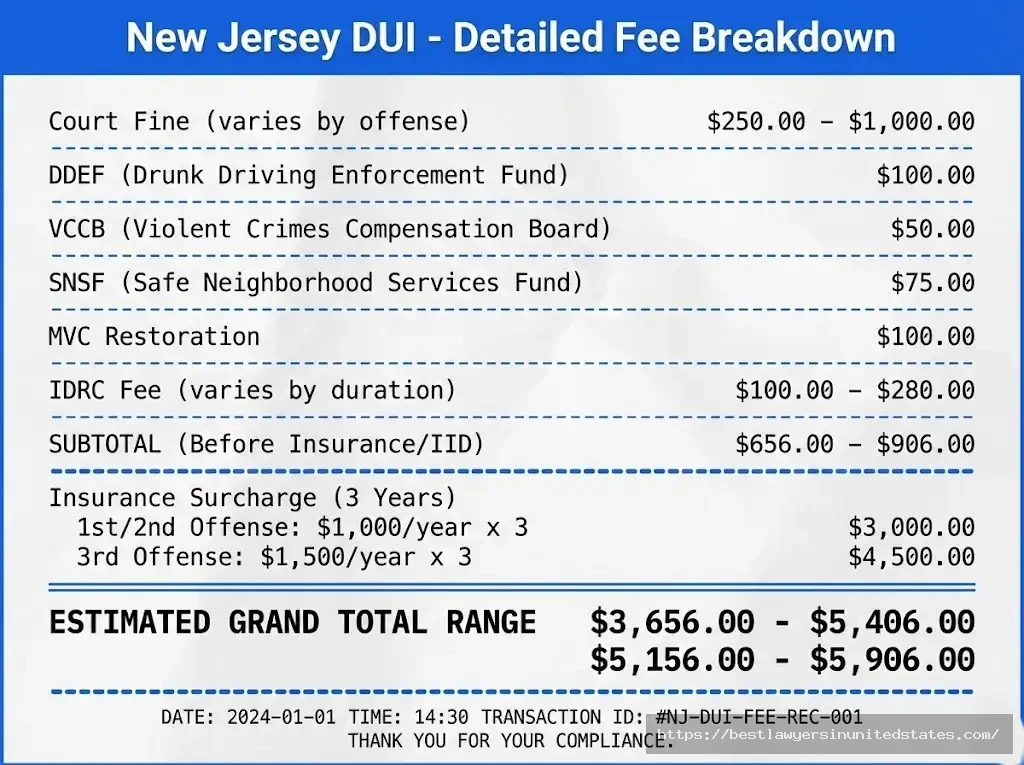
Court fines represent only part of total DWI costs in New Jersey. Multiple mandatory fees and surcharges apply to all offenses.
Complete Fee Schedule
Every DWI conviction triggers specific fees paid to different state agencies:
| Fee Type | Amount | Paid To |
|---|---|---|
| Court fine | $250-$1,000 (offense dependent) | Municipal court |
| DDEF | $100 | Drunk Driving Enforcement Fund |
| VCCB | $50 | Violent Crimes Compensation Board |
| SNSF | $75 | Safe Neighborhood Services Fund |
| MVC restoration | $100 | Motor Vehicle Commission |
| IDRC fee | $100-$280 | Intoxicated Driver Resource Center |
| Insurance surcharge | $1,000/year (3 years) | Auto insurance |
First offense total fees: $406 in mandatory fees plus $250-$500 court fine equals $656-$906 before insurance or device costs.
Third offense total fees: $456 in mandatory fees plus $1,000 court fine equals $1,456 before insurance or device costs.
Insurance Surcharges Explained
New Jersey imposes automatic insurance surcharges for DWI convictions. Your insurance company does not collect these fees. The state bills you directly.
Surcharge amounts:
- First and second offenses: $1,000 per year for 3 years ($3,000 total)
- Third offense: $1,500 per year for 3 years ($4,500 total)
These surcharges are separate from your regular insurance premium increases. Most drivers see insurance rates double or triple after DWI conviction on top of the state surcharge.
Failure to pay surcharges results in license suspension. The state will not restore your driving privileges until all surcharges are paid in full.
The Alcotest 7110: New Jersey’s Breathalyzer
New Jersey uses the Alcotest 7110 MKIII-C as its standard breath testing device. Some jurisdictions have upgraded to the Alcotest 9510. Understanding how these devices work helps you evaluate your case.
How the Alcotest Works
The Alcotest uses dual testing technology to measure BAC. Each breath sample undergoes two separate analysis methods:
Infrared spectroscopy: Measures alcohol absorption at specific light wavelengths Electrochemical fuel cell: Creates electrical current proportional to alcohol content
Both readings must agree within acceptable limits or the test is invalid. This dual-system approach reduces false positives from mouth alcohol or radio frequency interference.
State v. Chun and Alcotest Reliability
The 2008 New Jersey Supreme Court case State v. Chun established admissibility standards for Alcotest results. The court found the device scientifically reliable when properly maintained and operated.
Court-mandated requirements:
- Monthly calibration checks
- Annual recertification
- Proper 20-minute observation period before testing
- Trained operator certification
- Maintenance of calibration records
Failure to meet these requirements may invalidate test results. Defense attorneys routinely request calibration records and operator training certificates to challenge Alcotest evidence.
Legal Challenges to Alcotest Results
Several factors can compromise Alcotest accuracy and provide defense opportunities:
Common challenge points:
- Mouth alcohol contamination (recent drinking, burping, vomiting)
- Medical conditions (GERD, acid reflux, diabetes)
- Improper observation period (less than 20 minutes)
- Device calibration lapsed or improper
- Operator certification expired
- Radio frequency interference
- Temperature variations during testing
Challenging Alcotest results requires expert testimony and detailed analysis of device records. An experienced DWI attorney can identify technical violations that may suppress breath test evidence.
Municipal Court Process for New Jersey DWI
New Jersey handles all DWI cases in municipal court, not superior court. Understanding the process helps you prepare for court appearances.
Which Municipal Court Handles Your Case
The municipality where police arrested you determines which court hears your case. New Jersey has 565 municipal courts across its 21 counties.
Examples of municipal courts:
- Newark Municipal Court (Essex County)
- Jersey City Municipal Court (Hudson County)
- Edison Municipal Court (Middlesex County)
- Toms River Municipal Court (Ocean County)
- Camden Municipal Court (Camden County)
Each municipality operates its own court with different schedules and procedures. Contact the specific municipal court clerk for your case information and court dates.
Arraignment and Initial Appearance
Your first court appearance is the arraignment. This typically occurs within 2-4 weeks of arrest.
What happens at arraignment:
- Judge reads charges against you
- You enter a plea (guilty, not guilty, no contest)
- Court sets future court dates
- Judge may address bail or release conditions
- You receive discovery (police reports, breath test results)
Most defendants plead not guilty at arraignment. This preserves your right to challenge evidence and negotiate with prosecutors. You can always change your plea later.
Pre-Trial Conference
After arraignment, the court schedules a pre-trial conference. This meeting between your attorney, the prosecutor, and sometimes the judge explores settlement possibilities.
Pre-trial conference purposes:
- Review evidence strength and weaknesses
- Discuss potential plea agreements
- Identify suppression issues
- Schedule motion hearings if needed
- Set trial date if case doesn’t settle
Critical point: New Jersey courts cannot downgrade DWI charges to reckless driving or other lesser offenses. The state Supreme Court prohibits plea bargaining that reduces DWI charges. Your attorney can negotiate penalties within the statutory range but cannot eliminate the DWI conviction.
DWI Trial Process
If your case doesn’t settle, it proceeds to trial in municipal court. DWI trials in New Jersey do not use juries. The municipal court judge decides guilt or innocence.
Trial process:
- Opening statements (optional)
- Prosecution presents evidence (officer testimony, breath test results, video)
- Defense cross-examines prosecution witnesses
- Defense presents evidence (expert witnesses, defendant testimony)
- Prosecution cross-examines defense witnesses
- Closing arguments
- Judge renders verdict
Trials typically last 2-4 hours for straightforward cases. Complex cases with expert witnesses may take multiple court sessions.
Why You Cannot Plead Down a DWI in New Jersey
New Jersey stands among the strictest states for DWI plea bargaining. The state Supreme Court effectively banned downgrading DWI charges in State v. Hessen (1976).
The State v. Hessen Precedent
The Hessen decision established that municipal courts lack authority to accept guilty pleas to lesser offenses when evidence supports DWI charges. This prohibition applies regardless of defendant circumstances or first-time offender status.
What you cannot do:
- Plead guilty to reckless driving instead of DWI
- Plead guilty to careless driving instead of DWI
- Accept any reduced charge that eliminates DWI conviction
- Negotiate away license suspension or IDRC requirements
What you can negotiate:
- Specific jail time within statutory range
- Payment plan for fines and fees
- Timing of license suspension
- IDRC attendance dates
- Community service schedule
Limited Exceptions
Very narrow exceptions exist for cases with serious evidentiary problems. If the prosecutor determines they cannot prove DWI beyond reasonable doubt, they may dismiss charges entirely rather than accept a plea to lesser charges.
Dismissal scenarios:
- Breath test results suppressed due to technical violations
- Officer lacked probable cause for stop
- Chain of custody problems with blood test
- Constitutional violations during arrest
These cases result in complete dismissal, not reduction to other charges. The prosecutor either proceeds with DWI charges or dismisses the case entirely.
Why This Matters for Your Defense
The no-plea-bargaining rule means fighting your case requires either winning at trial or negotiating within DWI penalties. Many defendants from states like Pennsylvania or New York expect plea bargaining options that simply do not exist in New Jersey.
Your defense strategy must focus on suppressing evidence, challenging probable cause, or negotiating the most favorable outcome within statutory DWI penalties. An experienced New Jersey DWI attorney understands how to work within these constraints.
Commercial Drivers and DWI in New Jersey
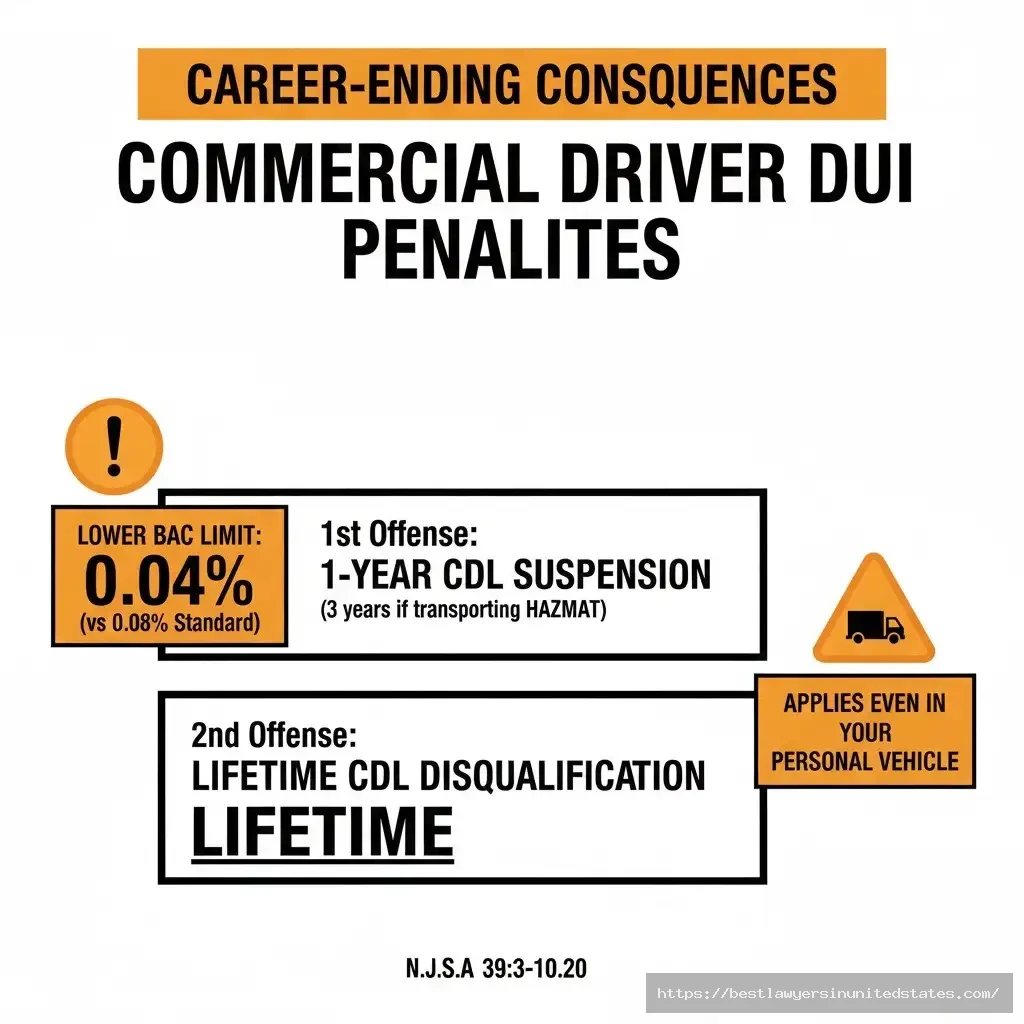
Commercial driver’s license (CDL) holders face federal standards that exceed regular DWI penalties. N.J.S.A. 39:3-10.20 implements federal commercial driving regulations in New Jersey.
CDL BAC Limit: 0.04%
Commercial drivers face a 0.04% BAC limit, half the standard 0.08% threshold. This limit applies whether you’re driving commercially or personally at the time of arrest.
Example: A CDL holder arrested for DWI while driving their personal car with 0.06% BAC faces DWI charges under the commercial standard, not the higher 0.08% threshold.
CDL Suspension Periods
First offense CDL suspension:
- 1 year for alcohol or drug violations
- 3 years if transporting hazardous materials
- 3 years if displaying hazmat placards
Second offense CDL suspension:
- Lifetime CDL disqualification
- No hardship licenses available
- Applies even if second offense occurred in different state
Critical point: CDL suspensions run in addition to regular license suspensions. A commercial driver faces both their CDL disqualification and standard DWI license suspension simultaneously.
Using CMV in Commission of Felony
CDL holders who use a commercial motor vehicle while committing felony crimes involving controlled substances face permanent CDL revocation under N.J.S.A. 39:3-10.20(e).
This lifetime ban applies to:
- Manufacturing controlled substances
- Distributing controlled substances
- Possessing with intent to distribute
The revocation is permanent with no possibility of reinstatement.
Impact on Commercial Driving Career
A DWI conviction effectively ends most commercial driving careers. Trucking companies, bus operators, and delivery services rarely hire drivers with DWI convictions even after license restoration.
Career consequences:
- Immediate job termination for professional drivers
- Inability to obtain new commercial driving employment
- Loss of CDL-dependent professional licenses
- Damage to DOT safety record
Commercial drivers should consult an attorney immediately after DWI arrest. The stakes extend far beyond license suspension to complete career loss.
Out-of-State Drivers and License Reciprocity
DWI arrests in New Jersey affect out-of-state license holders through interstate compacts and reciprocity agreements.
Interstate Driver License Compact
New Jersey participates in the Interstate Driver License Compact (IDLC). This agreement shares DWI conviction information among 45 member states.
How it works:
- New Jersey convicts out-of-state driver of DWI
- New Jersey reports conviction to driver’s home state
- Home state posts conviction to driving record
- Home state may impose its own penalties
Most states treat out-of-state DWI convictions the same as in-state convictions. A Connecticut resident convicted in New Jersey will see the conviction on their Connecticut driving record.
New Jersey License Suspension for Out-of-State Drivers
Out-of-state drivers receive New Jersey license suspensions even though they hold licenses from other states. The suspension prevents you from driving in New Jersey during the suspension period.
Example: A Pennsylvania driver convicted of DWI in New Jersey receives a New Jersey suspension. They cannot legally drive in New Jersey during the suspension period, though they may retain Pennsylvania driving privileges.
However, Pennsylvania will likely impose its own penalties based on the New Jersey conviction under interstate compact rules.
Border State Considerations
Drivers from neighboring states face particular challenges. New Jersey shares borders with New York, Pennsylvania, and Delaware.
Common scenarios:
- New York residents arrested crossing George Washington Bridge
- Pennsylvania residents arrested on Interstate 295
- Delaware residents arrested on New Jersey Turnpike
Many border state residents work in New Jersey or regularly cross state lines. A New Jersey DWI conviction creates license problems in both states and may jeopardize employment.
2019 New Jersey DWI Law Changes
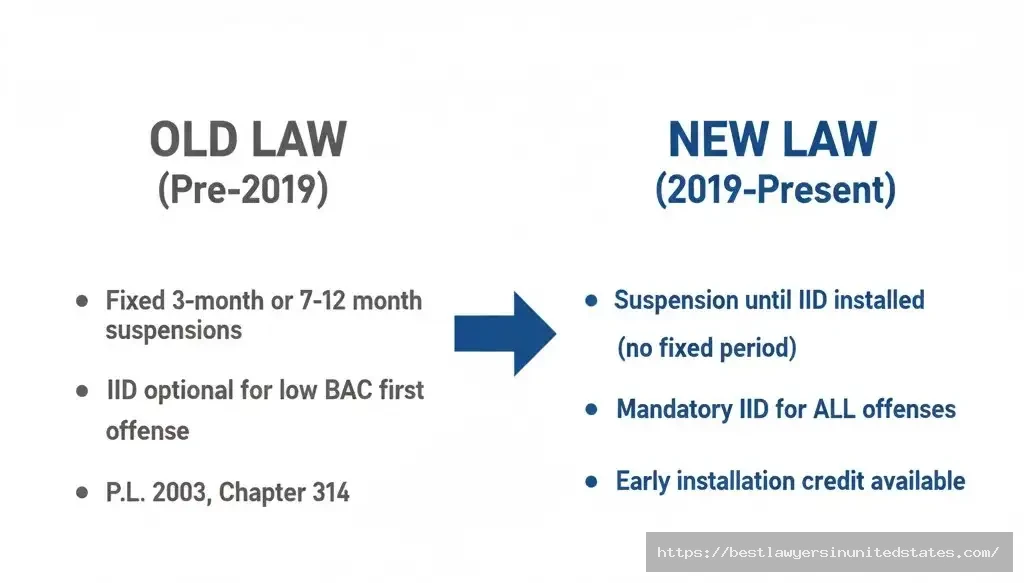
P.L. 2003, Chapter 314 amendments took effect in 2019 and fundamentally changed New Jersey’s DWI penalty structure. These changes primarily affected license suspension and ignition interlock requirements.
Elimination of Fixed Suspension Periods
Before 2019, first-offense DWI carried fixed 3-month or 7-12 month license suspensions depending on BAC level. The 2019 law eliminated these fixed periods.
Old law (pre-2019):
- BAC 0.08-0.09%: 3-month suspension
- BAC 0.10%+: 7-12 month suspension
New law (2019-present):
- All BAC levels: Suspension until ignition interlock device installed
- No fixed time period specified
- Suspension can be shorter or longer depending on installation timing
Mandatory Ignition Interlock for All Offenses
The 2019 changes made ignition interlock devices mandatory for all DWI offenses, including first-time offenders. Previously, first offenders with BAC below 0.15% could avoid ignition interlock.
Current requirements:
- First offense (0.08-0.09%): 3-month interlock
- First offense (0.10-0.14%): 7-12 month interlock
- First offense (0.15%+): 9-15 month interlock after 4-6 month suspension
- Second offense: 2-4 year interlock
- Third offense: 2-4 year interlock
All offenders must install devices in all vehicles they own, lease, or regularly operate.
Early Installation Credit
The 2019 law created incentives for voluntary early ignition interlock installation. Installing the device before sentencing can reduce your total interlock requirement.
How early installation works:
- Arrest occurs in January 2026
- You voluntarily install ignition interlock in February 2026
- Sentencing occurs in May 2026 with 12-month interlock requirement
- Three months of pre-sentencing interlock counts toward the 12-month requirement
- Total interlock period: 15 months (3 pre-sentence + 12 post-sentence)
Benefit: Your total restricted driving period may be shorter than waiting until sentencing to install the device.
Defenses to New Jersey DWI Charges
Several defense strategies can challenge DWI charges or suppress evidence. Success depends on specific case facts and officer conduct.
Challenging the Initial Stop
Police must have reasonable suspicion to stop your vehicle. Random stops without articulable suspicion violate the Fourth Amendment.
Valid reasons for stops:
- Traffic violations (speeding, running red light, lane violations)
- Equipment violations (broken taillight, expired registration)
- Erratic driving (weaving, near-collisions)
- Information from dispatch (BOLO, tip with reliability indicators)
Invalid reasons for stops:
- Anonymous tips without corroboration
- Hunches or profiling
- Leaving bar parking lot without other violations
- Driving late at night in high-DWI area
If the judge suppresses evidence from an illegal stop, prosecutors cannot use it at trial. This often results in case dismissal.
20-Minute Observation Period Violations
New Jersey requires officers to observe defendants for 20 continuous minutes before administering Alcotest breath tests. This observation prevents mouth alcohol contamination.
What officers must ensure during observation:
- No drinking, eating, or smoking
- No burping, vomiting, or regurgitation
- No gum, breath mints, or other oral substances
- Continuous visual monitoring
Failure to maintain proper observation can invalidate breath test results. Police dash cam or body cam footage may contradict officer testimony about observation periods.
Rising BAC Defense
Alcohol absorption takes 30-90 minutes after consumption. Your BAC may have been below the legal limit while driving but rose above it by testing time.
Rising BAC scenario:
- You finish drinking at 10:00 PM (BAC 0.06%)
- Police stop you at 10:15 PM (BAC 0.07%)
- Breath test occurs at 11:00 PM (BAC 0.09%)
- Your BAC was legal while driving but illegal at testing time
Expert witnesses can testify about alcohol absorption rates and retrograde extrapolation to estimate BAC at driving time. This defense requires detailed timeline documentation and toxicology expertise.
Medical Conditions Affecting Breath Tests
Certain medical conditions can cause falsely high breath test readings:
GERD and acid reflux: Stomach acid containing alcohol vapors rises into the mouth and inflates readings
Diabetes: Ketones produced during diabetic episodes can trigger false positives on electrochemical sensors
Asthma inhalers: Some inhalers contain alcohol that affects breath test results
Medical records documenting these conditions before arrest strengthen defense claims. Post-arrest diagnoses appear suspicious to judges and juries.
Alcotest Calibration and Maintenance Issues
Defense attorneys routinely request Alcotest maintenance and calibration records. Missing or improper records may invalidate test results.
Required documentation:
- Monthly calibration verification logs
- Annual recertification certificates
- Repair and maintenance records
- Operator training and certification
New Jersey law requires strict compliance with calibration schedules. A device tested on a defendant without proper calibration produces inadmissible results.
License Restoration Process in New Jersey
Restoring your license after DWI suspension requires completing multiple steps and paying various fees. The New Jersey Motor Vehicle Commission controls the restoration process.
Required Steps for Restoration
Complete these requirements before license restoration:
- Serve full suspension period (or install ignition interlock per 2019 law)
- Complete IDRC program and obtain completion certificate
- Pay all court fines and fees
- Pay MVC restoration fee ($100)
- Satisfy ignition interlock requirements
- Provide proof of SR-22 insurance
- Pay all insurance surcharges
Missing any requirement prevents license restoration. The MVC will not process restoration applications until you complete every step.
SR-22 Insurance Requirement
New Jersey requires SR-22 insurance certificates for license restoration after DWI. SR-22 is not a type of insurance but a certificate proving you carry liability coverage meeting state minimums.
SR-22 requirements:
- Maintain for 3 years after restoration
- Higher premiums than standard insurance
- Insurance company files certificate directly with MVC
- Lapse in coverage triggers automatic license suspension
Most insurance companies charge $15-$50 to file SR-22 certificates. However, DWI convictions raise your base insurance rates significantly. Expect insurance costs to double or triple for the SR-22 period.
Ignition Interlock Installation Verification
For offenses after 2019, you cannot restore your license until installing an ignition interlock device. The installation company files verification directly with the MVC.
Installation process:
- Choose an approved vendor (Intoxalock, LifeSafer, Smart Start)
- Schedule installation appointment
- Vendor installs device and files certification with MVC
- MVC updates your license status to “Ignition Interlock Required”
- You may drive only vehicles equipped with interlock
The MVC typically processes interlock installations within 5-7 business days. You cannot legally drive during this processing period even after installation.
Timeline for Full Restoration
Typical first-offense restoration timeline:
- Day 1: DWI arrest
- Day 30-90: Court proceedings and sentencing
- Day 91-180: IDRC completion, fee payment, SR-22 filing
- Day 181: Ignition interlock installation
- Day 188: MVC processes restoration (5-7 business days)
- Day 188-278: Driving with ignition interlock (3 months minimum)
- Day 278+: Full unrestricted license after interlock removal
Second and third offenses extend these timelines significantly due to longer suspension periods and interlock requirements.
Long-Term Consequences of a New Jersey DWI
DWI convictions create consequences extending far beyond court penalties and license suspension.
Permanent Record – No Expungement
New Jersey law prohibits expungement of DWI convictions. The conviction remains on your driving record permanently and appears on background checks indefinitely.
What cannot be expunged:
- DWI convictions under N.J.S.A. 39:4-50
- Refusal convictions under N.J.S.A. 39:4-50.4a
- Related motor vehicle offenses from same incident
What can be expunged:
- DWI arrests that resulted in dismissal or acquittal
- Municipal ordinance violations (not DWI-related)
- Criminal charges unrelated to DWI
The permanent record affects employment, professional licensing, and insurance rates for life.
Employment Impact
Many employers conduct driving record checks as part of background screening. DWI convictions appear prominently and may disqualify you from employment.
Jobs severely affected by DWI:
- Commercial driving positions (complete disqualification)
- Jobs requiring company vehicle use
- Delivery and transportation services
- Positions involving driving clients or customers
- Government and security clearance jobs
- Healthcare professions requiring licensure
- Teaching and childcare positions
Even non-driving jobs may reject applicants with DWI convictions. Employers view DWI as evidence of poor judgment and potential liability.
Professional License Consequences
New Jersey professional licensing boards review DWI convictions and may impose discipline:
Affected professions:
- Medical doctors (NJ Board of Medical Examiners)
- Nurses (NJ Board of Nursing)
- Attorneys (NJ Supreme Court Attorney Ethics)
- Accountants (NJ State Board of Accountancy)
- Real estate professionals (NJ Real Estate Commission)
- Teachers (NJ Department of Education)
Consequences range from mandatory reporting to license suspension or revocation depending on profession and offense number. Multiple DWI convictions create serious professional license jeopardy.
Immigration Consequences for Non-Citizens
DWI convictions can affect immigration status for green card holders and visa holders. While a single DWI typically doesn’t trigger deportation, multiple convictions create serious problems.
Immigration risks:
- Denial of citizenship naturalization applications
- Additional scrutiny at border crossings
- Potential deportation with aggravated felony DWI (serious injury/death cases)
- Denial of visa renewals or adjustments of status
Non-citizens should consult an immigration attorney before resolving DWI charges. Certain plea agreements or sentencing outcomes create worse immigration consequences than others.
Frequently Asked Questions About New Jersey DWI
Is DWI a Felony in New Jersey?
Quick Answer: No, DWI is a traffic offense in New Jersey, not a criminal offense or felony, even for repeat offenders.
New Jersey treats all DWI violations as traffic offenses under Title 39 (Motor Vehicles and Traffic Regulation). This means DWI convictions do not appear on criminal records or FBI background checks as crimes.
However, DWI remains a quasi-criminal offense with serious penalties including jail time. The distinction matters primarily for background checks and professional licensing rather than actual consequences.
Can I Get a DWI Expunged in New Jersey?
Quick Answer: No, New Jersey law prohibits expungement of DWI convictions. The conviction remains on your record permanently.
N.J.S.A. 2C:52-2 specifically excludes motor vehicle offenses from expungement eligibility. Only arrests that resulted in dismissal or acquittal can be expunged. Actual DWI convictions appear on your driving record for life.
What Are the Chances of Beating a DUI in New Jersey?
Quick Answer: Approximately 10-15% of DWI cases result in dismissals or acquittals, though success rates vary widely based on case-specific evidence.
Cases with the best dismissal chances involve:
- Illegal stops without reasonable suspicion
- Alcotest calibration or maintenance violations
- Improper 20-minute observation periods
- Medical conditions affecting breath test accuracy
- Blood test chain of custody problems
Cases with the worst dismissal chances involve:
- High BAC (0.15%+) with proper Alcotest procedure
- Accidents with injuries
- Video evidence showing severe impairment
- Multiple failed field sobriety tests
An experienced DWI attorney significantly improves your chances by identifying procedural violations and technical defenses.
Is Jail Time Mandatory for First Offense DWI in New Jersey?
Quick Answer: No, jail time is discretionary for first DWI offenses in New Jersey. Most first offenders receive no jail time.
Judges may impose up to 30 days jail for first offenses but rarely do so unless aggravating factors exist. Cases involving accidents, high BAC (0.20%+), or endangering children more commonly result in jail sentences.
Second and third offenses carry mandatory minimum jail time that judges cannot waive.
Can I Refuse a Breathalyzer in New Jersey?
Quick Answer: Yes, but refusal triggers automatic license suspension of 7 months to 1 year for first refusal, which exceeds most failed test penalties.
You have the legal right to refuse breath testing under New Jersey law. However, refusal creates its own violation under N.J.S.A. 39:4-50.4a with penalties that often exceed failed test consequences.
Refusal does not prevent DWI charges. Prosecutors can prove DWI through officer observations, field sobriety tests, and other evidence even without breath test results.
How Much Does a DWI Cost in Total in New Jersey?
Quick Answer: Total first-offense DWI costs range from $5,000-$12,000 including fines, fees, attorney costs, insurance increases, and ignition interlock expenses.
Calculate your estimated costs using the DUI cost calculator based on your specific BAC level and offense number.
Major cost components include court fines ($250-$500), mandatory fees ($406), attorney fees ($2,500-$7,500), ignition interlock ($1,200-$2,400), insurance increases ($3,000-$6,000 over 3 years), and IDRC fees ($100-$280).
Can I Get a Hardship License in New Jersey?
Quick Answer: No, New Jersey does not offer hardship licenses or work permits for DWI suspensions. No exceptions exist for employment or family needs.
Unlike states such as Florida or California, New Jersey provides no restricted driving privileges during DWI suspensions. Your only option is installing an ignition interlock device to restore driving privileges after the 2019 law changes.
Public transportation, ridesharing, or designated drivers are your only legal alternatives during suspension periods.
How Long Does a DWI Stay on My Record in New Jersey?
Quick Answer: DWI convictions remain on your New Jersey driving record permanently and cannot be expunged.
The conviction affects insurance rates for 3-5 years typically, though it remains visible to insurance companies indefinitely. Employers conducting background checks will see the conviction permanently.
The 10-year lookback period for determining repeat offenses ends after 10 years, but the conviction itself never disappears from your record.
Finding a DWI Attorney in New Jersey
The consequences of DWI conviction in New Jersey are severe enough that legal representation provides significant value for most defendants.
Why Legal Representation Matters
Benefits of hiring a DWI attorney:
- Understanding of complex Alcotest science and challenges
- Knowledge of local municipal court procedures and judges
- Ability to negotiate within statutory penalty ranges
- Experience identifying procedural violations and technical defenses
- Access to expert witnesses for breath test and field sobriety challenges
- Representation at both DWI proceedings and refusal hearings
Attorneys familiar with New Jersey DWI law understand what defenses work in your jurisdiction. Municipal court judges and prosecutors handle thousands of DWI cases. An experienced attorney levels the playing field.
What to Look For in a New Jersey DWI Lawyer
Key qualifications:
- Practice focused primarily on DWI defense (not general practice)
- Experience in your specific municipal court
- Training in Alcotest operation and challenges
- Membership in National College for DUI Defense
- Positive client reviews and case results
- Clear fee structure with written agreement
Avoid attorneys who guarantee specific outcomes. No lawyer can guarantee dismissal or reduced charges given New Jersey’s strict DWI laws and plea bargaining prohibition.
Questions to Ask During Consultation
Ask potential attorneys:
- How many DWI cases have you handled in [your municipality] Municipal Court?
- What percentage of your practice involves DWI defense?
- Have you completed Alcotest training courses?
- What are typical outcomes for cases like mine in this court?
- What is your fee structure and what services does it include?
- Will you personally handle my case or delegate to an associate?
- What defense strategies do you see in my case?
Most DWI attorneys offer free initial consultations. Interview multiple attorneys before deciding.
Attorney Cost Considerations
Typical New Jersey DWI attorney fees:
- First offense (no trial): $2,500-$5,000
- First offense (trial): $5,000-$10,000
- Second offense: $5,000-$10,000
- Third offense: $7,500-$15,000
- Refusal hearing (additional): $1,500-$3,000
Complex cases involving accidents, injuries, or expert witnesses cost more. Attorneys typically require retainers upfront with additional payments before trial.
While attorney fees seem expensive, conviction consequences (insurance increases, ignition interlock, lost employment) often cost far more. Quality legal representation provides strong return on investment for most defendants.
[Find DUI Lawyers in New Jersey – Free Consultation]
Email: [email protected]
Conclusion: Understanding New Jersey’s Strict DWI Laws
New Jersey enforces some of the nation’s strictest DWI penalties through mandatory ignition interlock requirements, permanent record keeping, and prohibition on plea bargaining. First-time offenders face license suspension until device installation, mandatory IDRC attendance, and insurance surcharges exceeding $3,000 over three years.
The state’s three-tier penalty system bases consequences on precise BAC levels, with harsher penalties for readings above 0.10% and 0.15%. Second offenses within 10 years trigger mandatory jail time starting at 48 hours, while third offenses bring eight-year license suspensions and 180 days incarceration.
New Jersey’s unique IDRC requirement, found nowhere else in the United States, mandates 12-48 hours of screening and education at state-operated centers. Refusal to submit to breath testing carries penalties exceeding failed tests, with first refusals resulting in 7-12 month suspensions compared to 3-month suspensions for low BAC failures.
Understanding these consequences before arrest helps you make informed decisions about drinking and driving. After arrest, consulting an experienced New Jersey DWI attorney provides your best chance at minimizing penalties within the state’s strict legal framework. The DUI cost calculator shows total expense estimates based on your specific situation.
Critical reminder: No attorney can eliminate DWI charges through plea bargaining in New Jersey. Your defense must focus on suppressing evidence, challenging probable cause, or negotiating within mandatory penalty ranges. The permanent record and long-term consequences make prevention through designated drivers or ridesharing the only certain way to avoid New Jersey’s harsh DWI laws.