
New Mexico enforces some of the strictest DUI laws in the United States. A DWI conviction stays on your record for 55 years—essentially a lifetime. Even first-time offenders must install ignition interlock devices in every vehicle they drive.
Under NMSA § 66-8-102, you commit DWI when operating a vehicle with a blood alcohol concentration of 0.08% or higher. The state also prosecutes drivers “impaired to the slightest degree” by drugs or alcohol.
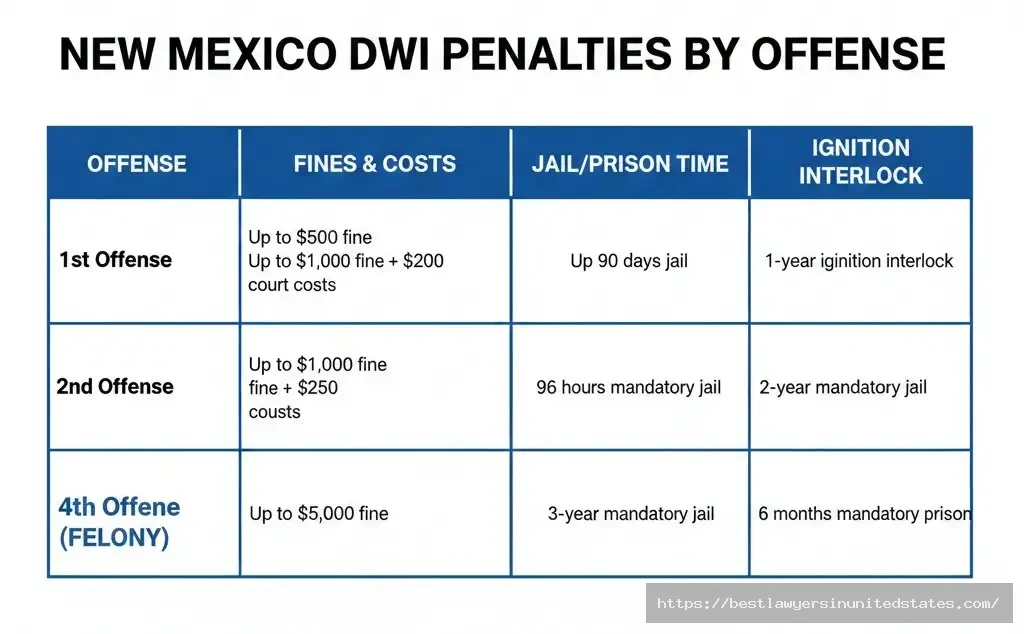
This guide explains New Mexico’s DWI penalties, legal process, and your rights when facing charges.
Understanding New Mexico’s DWI Laws
What Qualifies as DWI in New Mexico?
New Mexico law defines DWI as operating a motor vehicle while under the influence of intoxicating liquor or drugs. “Operating” includes physical control of the vehicle—even if it’s not moving.
Three ways to get charged with DWI:
- BAC of 0.08% or higher (measured by breath or blood)
- Physical impairment from alcohol or drugs
- Combination of alcohol and drugs causing impairment
Key legal point: You can get arrested for DWI while sitting in a parked car with the engine running.
New Mexico Uses “DWI” Not “DUI”
New Mexico officially uses the term “DWI” (Driving While Intoxicated) in all statutes and legal documents. While “DUI” (Driving Under the Influence) appears in searches, state law exclusively uses DWI.
This distinction matters when reviewing court documents or researching your case.
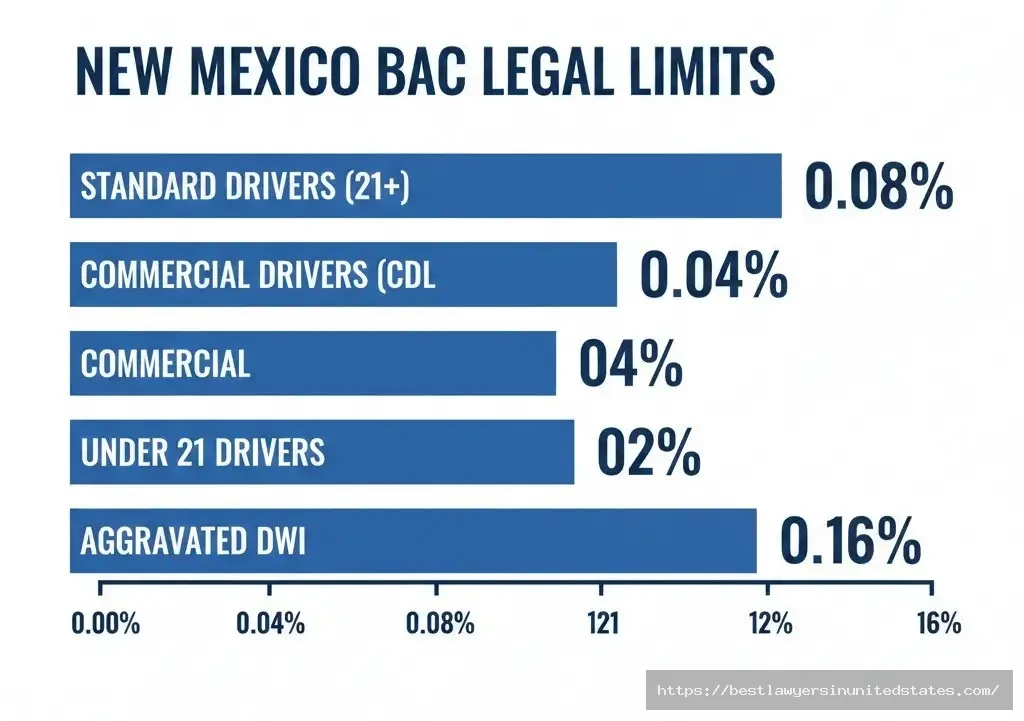
Blood Alcohol Concentration Limits
| Driver Type | BAC Limit | Violation |
|---|---|---|
| Standard (21+) | 0.08% | DWI |
| Commercial (CDL) | 0.04% | DWI |
| Under 21 | 0.02% | Zero Tolerance |
| Aggravated DWI | 0.16% | Enhanced Penalties |
Not sure if you’re over the limit? Check your estimated BAC level with our BAC calculator before making any decisions.
BAC Calculator
Estimate your Blood Alcohol Content
• Commercial Driver (CDL): 0.04% BAC
• Drivers Under 21: 0.00-0.02% BAC (Zero Tolerance)
• Enhanced Penalties: 0.15% BAC or higher in most states
Critical fact: New Mexico’s 0.16% aggravated DWI threshold is double the standard legal limit.
New Mexico DWI Penalties by Offense
First Offense DWI (Misdemeanor)
Jail Time: Up to 90 days
Fines: Up to $500 plus approximately $200 in court costs
Probation: Up to 1 year
License: Ignition interlock license for 1 year (must install in every vehicle you drive)
Mandatory Requirements:
- 24 hours community service
- DWI school attendance
- Victim impact panel
- Substance abuse screening and treatment compliance
Total estimated cost: $2,500-$8,000 including all fees, attorney costs, and ignition interlock installation. Calculate your specific costs with our DUI cost calculator.
DUI Cost Calculator
Estimate total DUI expenses by state and offense
Detailed Cost Breakdown
Payment Timeline
Bail bond, towing fees, car impound, attorney retainer
Initial court fines, DMV fees, DUI school enrollment, ignition interlock installation
Monthly probation fees, ignition interlock fees, DUI school payments, attorney balance
Insurance premium increases, license reinstatement, SR-22 filing fees
- Lost wages from missed work (court dates, jail time, DUI school) – $2,000-$10,000
- Job loss or difficulty finding employment – Varies
- Professional license suspension (doctors, lawyers, nurses, pilots) – Career ending
- Rideshare and transportation costs during suspension – $1,500-$5,000
- Travel restrictions and visa denials – Varies
- Security clearance loss – Career impact
- Child custody implications – Legal costs
- Rental car restrictions – Varies
- Personal relationships and mental health costs – Priceless
Second Offense DWI (Misdemeanor)
Jail Time: Up to 364 days (96 consecutive hours mandatory)
Fines: Up to $1,000 ($500 mandatory minimum) plus approximately $250 in court costs
Probation: Up to 5 years
License: Ignition interlock license for 2 years
Mandatory Requirements:
- 48 hours community service
- Substance abuse screening and treatment compliance
- Either 28-day inpatient OR 90-day outpatient treatment program
- Drug court program option
Key difference: Second offense requires professional substance abuse treatment, not just DWI school.
Third Offense DWI (Misdemeanor)
Jail Time: Up to 364 days (30 consecutive days mandatory)
Fines: Up to $1,000 ($750 mandatory minimum)
Probation: Up to 5 years
License: Ignition interlock license for 3 years
Mandatory Requirements:
- 96 hours community service
- Substance abuse screening and treatment compliance
- 28-day inpatient OR 90-day outpatient treatment program
- Drug court program option
Critical escalation: Third offense carries 30 days mandatory jail time—you will serve time.
Fourth Offense and Beyond (Felony DWI)
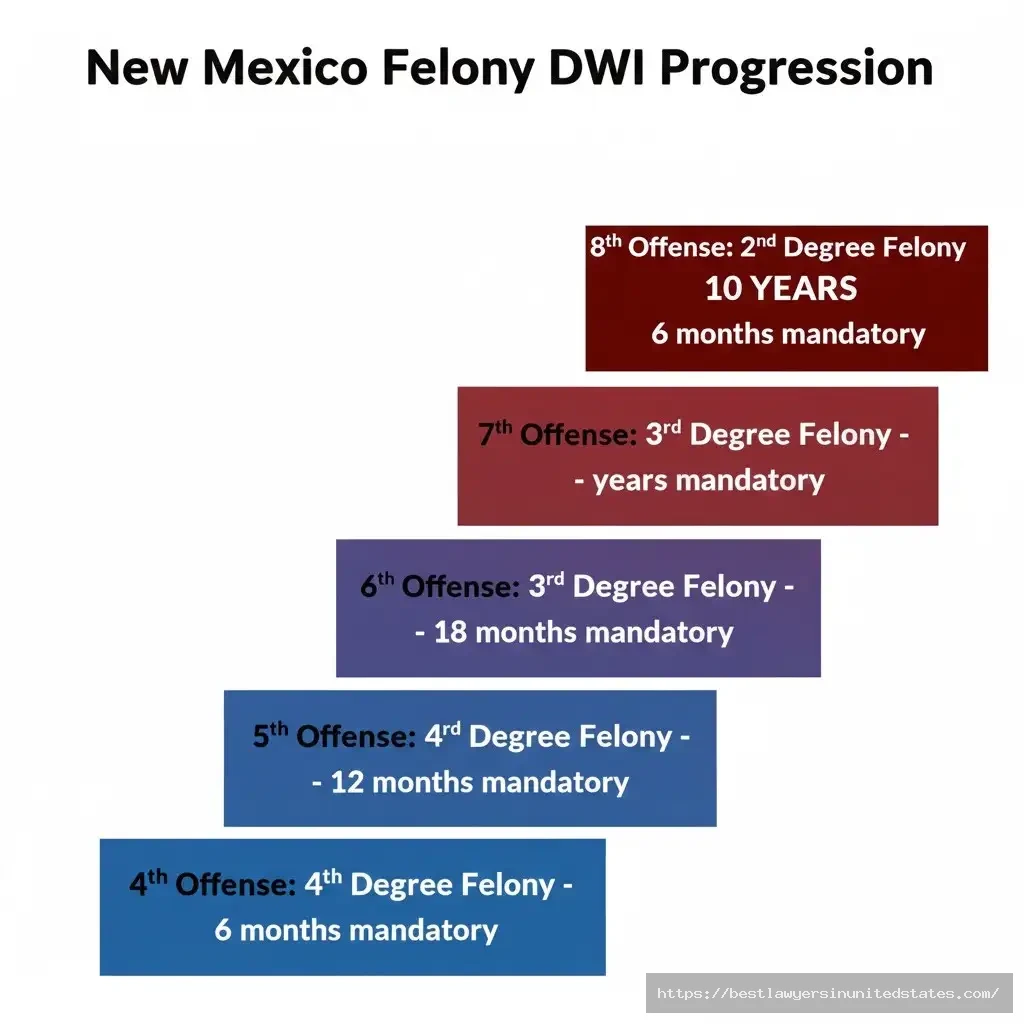
Fourth offense DWI crosses into felony territory in New Mexico.
| Offense | Classification | Prison (Mandatory) | Fine | Ignition Interlock |
|---|---|---|---|---|
| 4th | 4th Degree Felony | Up to 18 months (6 months mandatory) | Up to $5,000 | 3 years |
| 5th | 4th Degree Felony | Up to 24 months (12 months mandatory) | Up to $5,000 | 3 years |
| 6th | 3rd Degree Felony | Up to 30 months (18 months mandatory) | Up to $5,000 | 3 years |
| 7th | 3rd Degree Felony | Up to 3 years (2 years mandatory) | Up to $5,000 | 3 years |
| 8th | 2nd Degree Felony | Up to 12 years (10 years mandatory) | Up to $10,000 | 3 years |
License restoration option: Beginning with fourth offense, you can petition District Court for standard license restoration every 5 years without another conviction.
Important note: New Mexico counts DWI convictions for 55 years, making “washout” nearly impossible.
Aggravated DWI in New Mexico
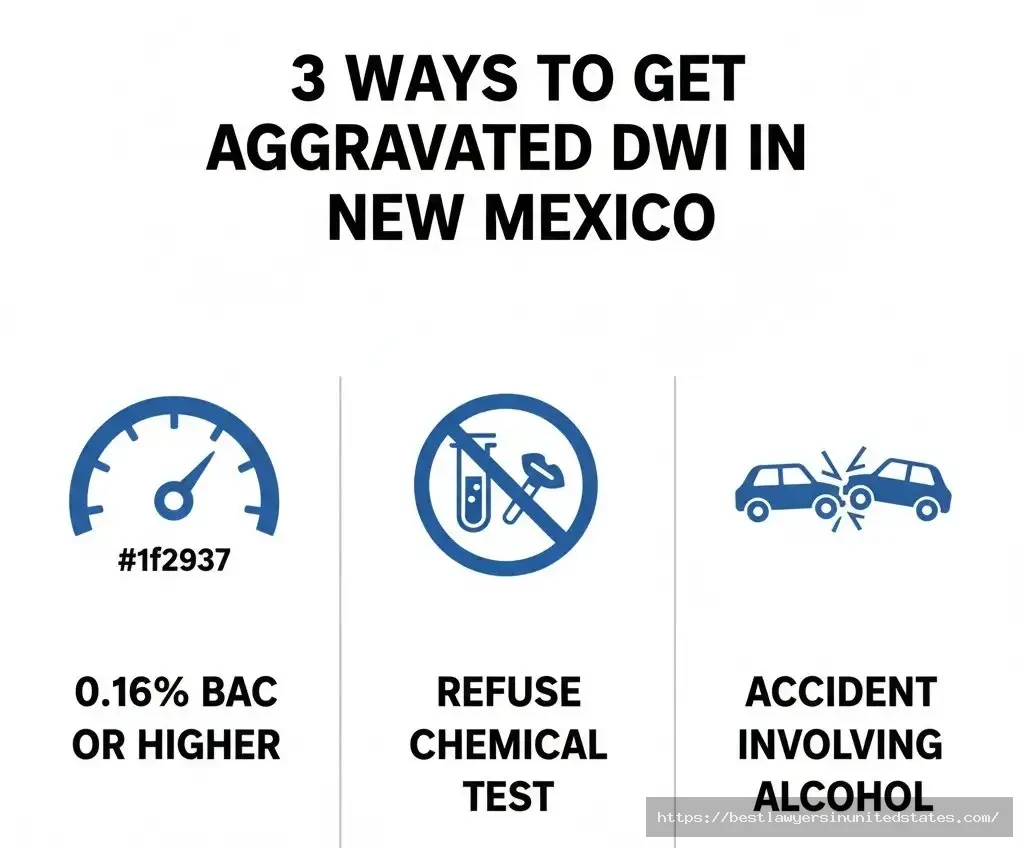
The Three Aggravated DWI Triggers
New Mexico enhances standard DWI to aggravated DWI under three conditions:
- BAC of 0.16% or higher (double the legal limit)
- Refusal of chemical testing
- Accident involving alcohol
Any single trigger converts your charge to aggravated DWI with enhanced penalties.
Additional Penalties for Aggravated DWI
Aggravated DWI adds mandatory jail time on top of standard penalties:
| Offense Level | Standard DWI | Aggravated DWI Enhancement | Total Mandatory Jail |
|---|---|---|---|
| 1st Offense | No mandatory jail | +48 hours | 48 hours |
| 2nd Offense | 96 hours mandatory | +96 hours | 192 hours (8 days) |
| 3rd Offense | 30 days mandatory | +60 days | 90 days |
Critical point: Aggravated enhancement applies even if your BAC drops below 0.16% by the time you’re tested. The initial reading at the scene determines aggravated status.
New Mexico’s 55-Year Lookback Period
Why New Mexico Is Different
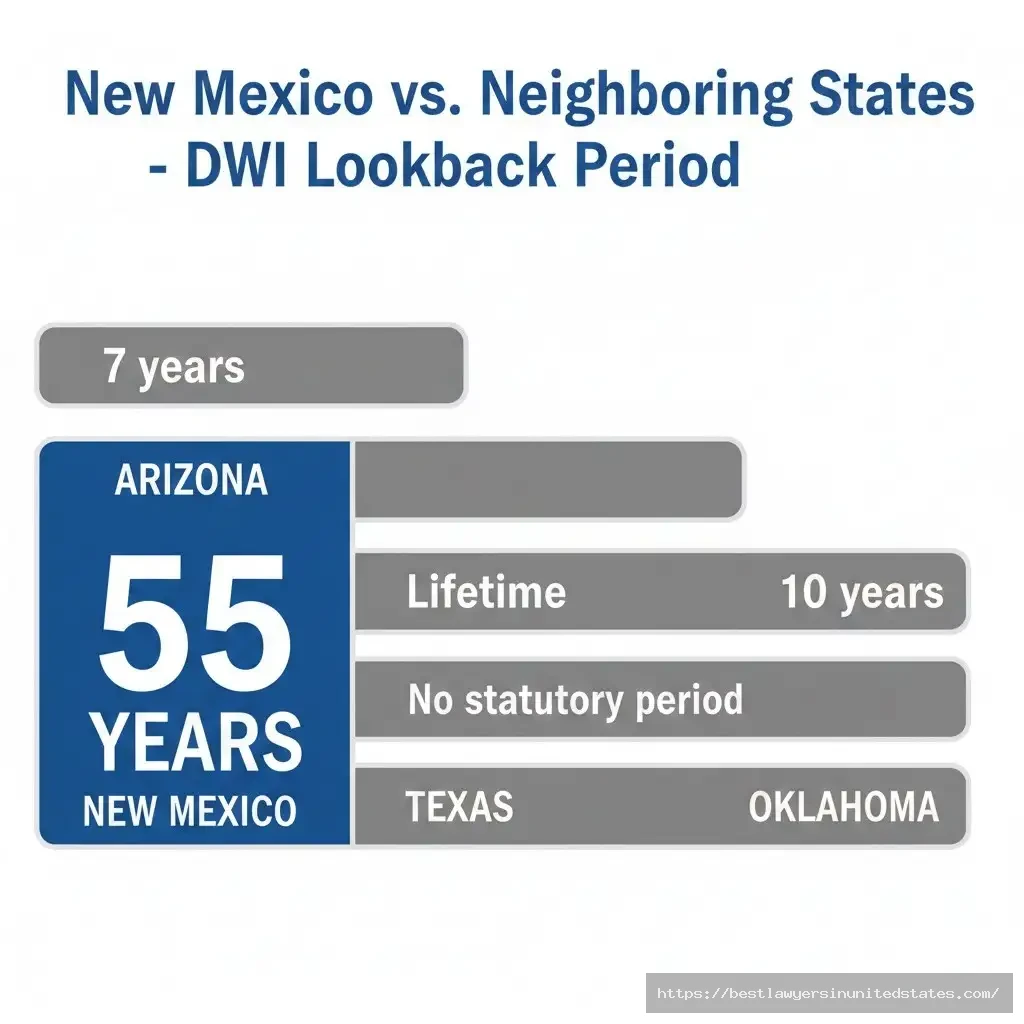
Most states use 5-10 year lookback periods for DWI offenses. New Mexico tracks DWI convictions for 55 years—essentially your entire driving life.
This means a DWI at age 25 counts toward sentencing enhancement if you get arrested again at age 75.
Comparison with neighboring states:
- Arizona: 7-year lookback
- Colorado: Lifetime lookback (similar to NM)
- Texas: No statutory lookback period
- Oklahoma: 10-year lookback
Impact on Background Checks
A DWI conviction appears on background checks for:
- Employment screening
- Professional license applications
- Security clearances
- Housing applications
- Volunteer positions
No expungement available: New Mexico does not allow DWI expungement or record sealing. The conviction remains public forever.
License Consequences and Ignition Interlock
Understanding New Mexico’s Dual Revocation System
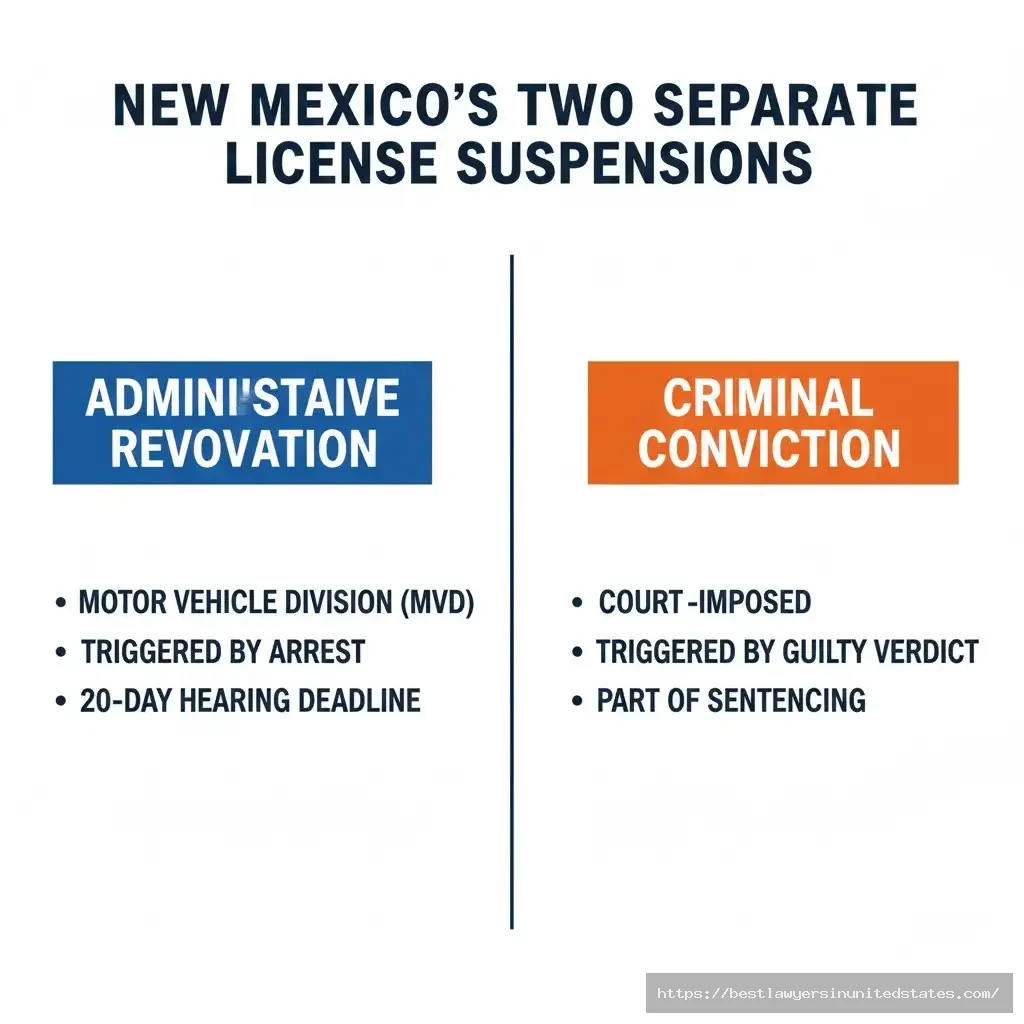
New Mexico runs two separate license revocation processes simultaneously:
1. Administrative Revocation (Motor Vehicle Division)
- Triggered by arrest, not conviction
- Based on BAC test results or refusal
- Separate hearing at MVD
2. Criminal Conviction Revocation (Court)
- Triggered by guilty verdict or plea
- Part of criminal sentencing
- Handled by judge
Critical deadline: You have 20 days from arrest to request an MVD administrative hearing. Missing this deadline means automatic suspension.
Both suspensions can run concurrently or consecutively depending on timing and circumstances.
Ignition Interlock Requirements
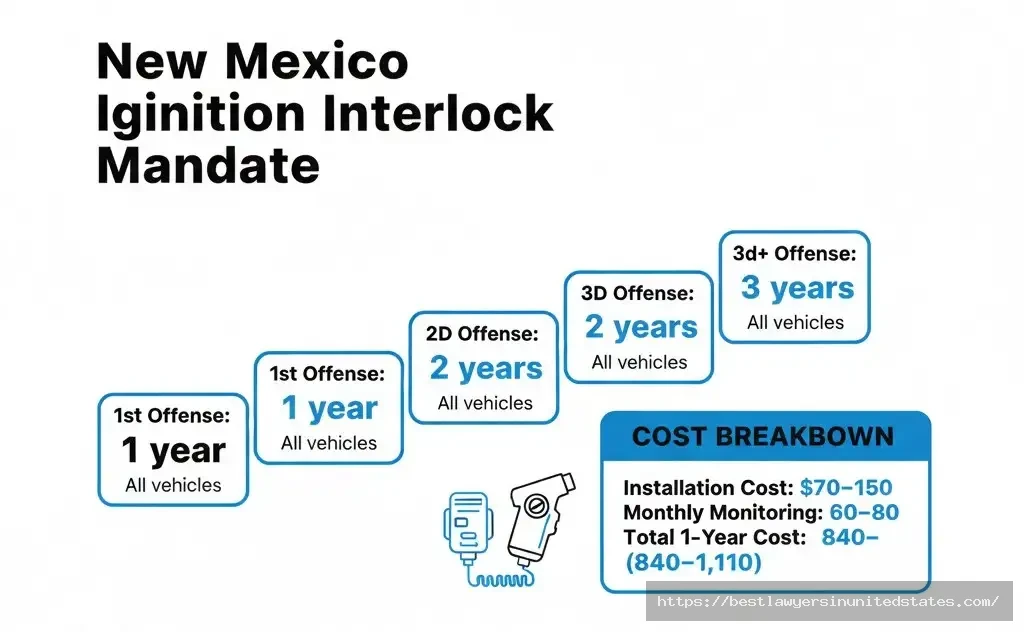
New Mexico requires ignition interlock devices for every DWI conviction—even first offense.
| Offense | IID Duration | Installation Required |
|---|---|---|
| 1st | 1 year | Every vehicle you operate |
| 2nd | 2 years | Every vehicle you operate |
| 3rd+ | 3 years | Every vehicle you operate |
Cost breakdown:
- Installation: $70-$150 per vehicle
- Monthly monitoring: $60-$80
- Calibration visits: $20-$40 every 30-60 days
- Removal fee: $50-$100
First-year total: $840-$1,110 for one vehicle
Key requirement: If you drive a company vehicle, employer vehicle, or rental car, it must have an ignition interlock device installed.
Requesting an MVD Hearing
You must request an administrative hearing within 20 days of arrest. This hearing determines whether MVD suspends your license based on:
- Legal justification for the traffic stop
- Probable cause for arrest
- Proper administration of chemical tests
- Whether you refused testing
MVD hearing office locations:
- Albuquerque: 10500 Copper Ave NE
- Las Cruces: 2101 S Main St
- Santa Fe: 1120 Paseo de Peralta
- Farmington: 1450 E 20th St
Important: Requesting a hearing does NOT stop the suspension. You receive a temporary license valid until the hearing date (typically 30-60 days).
The DWI Arrest Process in New Mexico
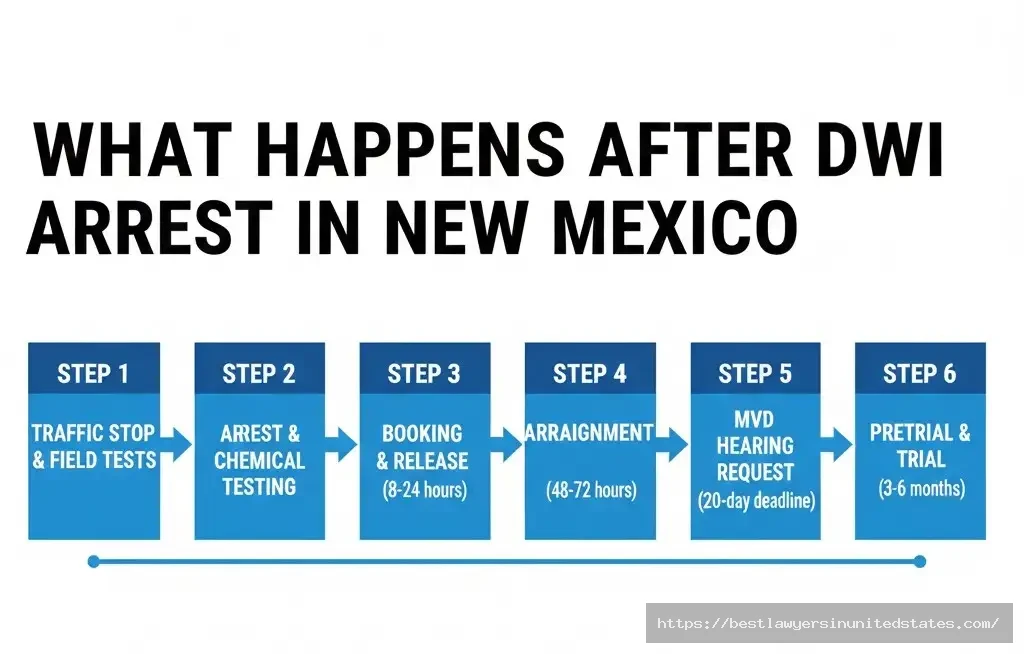
From Traffic Stop to Arrest
Step 1: Initial Traffic Stop
New Mexico State Police or local law enforcement initiate stops based on:
- Traffic violations (speeding, weaving, running lights)
- Erratic driving patterns
- DWI checkpoints
Step 2: Field Investigation
Officer observes signs of impairment:
- Odor of alcohol
- Slurred speech
- Bloodshot eyes
- Open containers
Step 3: Field Sobriety Tests
Officer may request three standardized tests:
- Horizontal Gaze Nystagmus (eye test)
- Walk-and-Turn
- One-Leg Stand
You can refuse field sobriety tests without automatic penalties. Only chemical tests (breath/blood) trigger refusal consequences.
Step 4: Arrest
Officer arrests you if probable cause exists based on:
- Failed field sobriety tests
- Admission of drinking
- Physical signs of impairment
Chemical Testing and Implied Consent
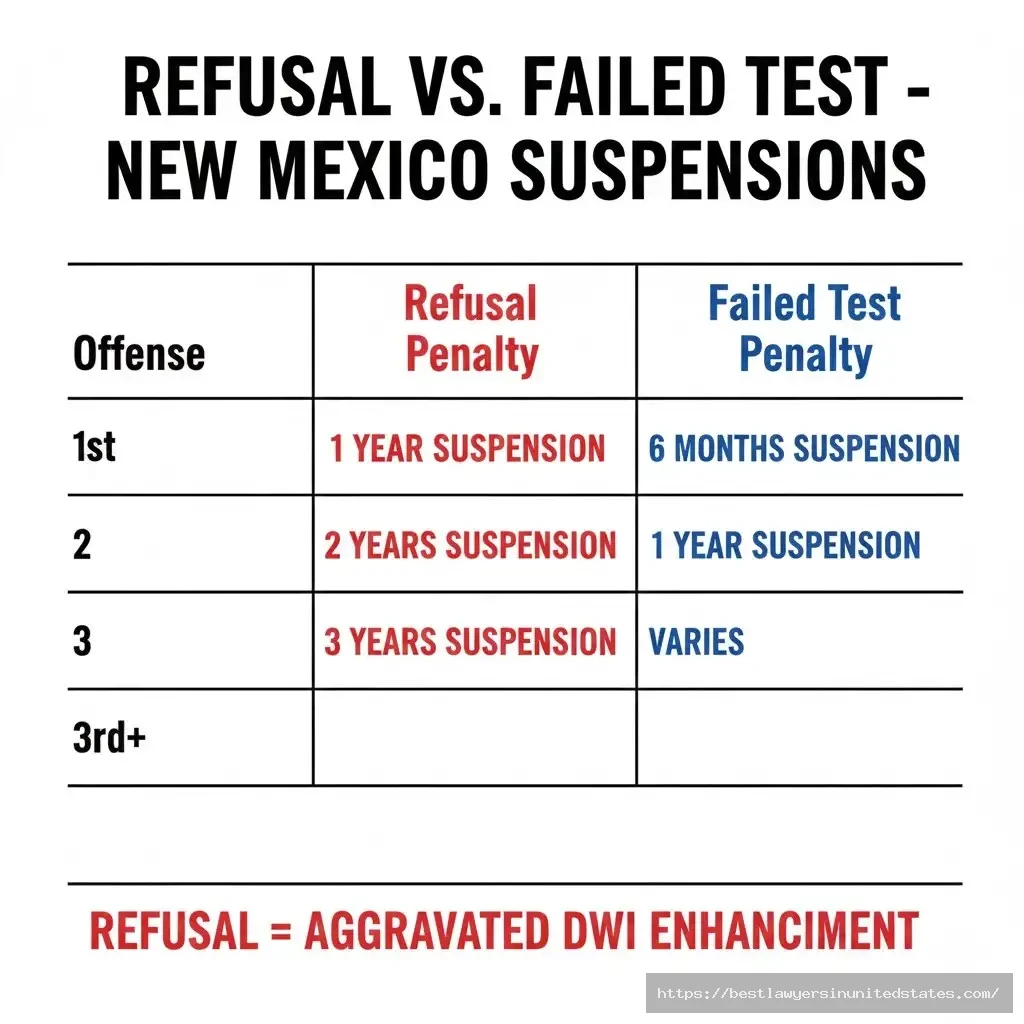
New Mexico’s implied consent law (NMSA § 66-8-107) requires you to submit to chemical testing when lawfully arrested for DWI.
Testing methods:
- Breath test (most common)
- Blood test (accidents, injuries)
- Urine test (drug-related DWI)
What happens if you refuse:
| Offense | Refusal Suspension | Failed Test Suspension |
|---|---|---|
| 1st Refusal | 1 year | 6 months |
| 2nd Refusal | 2 years | 1 year |
| 3rd+ Refusal | 3 years | Varies |
Plus: Refusal becomes aggravating factor, adding mandatory jail time to any conviction.
Police can obtain warrants for blood draws in cases involving:
- Serious bodily injury
- Death
- Child passengers
- Repeat offenders
Booking and Release
After arrest, you’re transported to:
- County detention center
- Municipal jail facility
- State Police station
Booking process:
- Fingerprinting and photographing
- Personal property inventory
- Criminal history check
- Bail determination
Release options:
- Personal recognizance (PR bond)
- Cash bond ($500-$2,500 typical)
- Surety bond through bail bondsman
- Court-ordered conditions
Time in custody: First-time DWI arrests typically result in release within 8-24 hours.
Arraignment and Pretrial Proceedings
Arraignment (First Court Appearance)
Occurs within 48-72 hours of arrest at:
- Metropolitan Court (Bernalillo County)
- Magistrate Court (other counties)
- Municipal Court (city violations)
At arraignment you:
- Receive formal charges
- Enter initial plea (not guilty recommended)
- Discuss bail/release conditions
- Receive court date schedule
Pretrial Proceedings
Multiple court appearances occur before trial:
- Discovery phase (30-60 days)
- Prosecutor shares evidence
- Police reports released
- Video footage provided
- Chemical test results disclosed
- Pretrial motions (60-90 days)
- Challenge illegal stops
- Suppress evidence
- Contest test results
- Negotiate plea agreements
- Pretrial conference (90-120 days)
- Final plea negotiations
- Trial scheduling
- Witness disclosure
Timeline: DWI cases typically resolve within 3-6 months from arrest.
Implied Consent Law Explained
What Is Implied Consent?
By accepting a New Mexico driver’s license, you automatically consent to chemical testing when arrested for DWI. This “implied consent” under NMSA § 66-8-107 activates the moment an officer places you under arrest.
Pre-arrest vs. post-arrest:
- Before arrest: You can refuse portable breathalyzer tests (PBT) without penalty
- After arrest: Refusal triggers automatic license suspension and aggravated DWI status
Consequences of Refusing Chemical Tests
Immediate consequences:
- License confiscation at arrest scene
- 20-day temporary license issued
- Automatic MVD revocation hearing scheduled
- Aggravated DWI enhancement added
Long-term consequences:
- Refusal used as evidence of guilt at trial
- Longer license suspension than failed test
- Cannot obtain hardship license during suspension
- Insurance rates increase significantly
Court testimony: Prosecutors frequently call officers to testify about your refusal, arguing it demonstrates “consciousness of guilt.”
Your Rights During Testing
You have the right to:
- Request independent testing at your own expense after official test
- Consult with attorney before deciding (though this may delay testing)
- Understand the consequences of refusal before deciding
You do NOT have the right to:
- Refuse testing without penalties
- Choose which test type (breath vs. blood)
- Delay testing indefinitely
- Have attorney present during testing
Medical exceptions: If you have legitimate medical conditions preventing testing (e.g., lung disease, blood clotting disorder), inform the officer immediately. Documentation helps your case.
Special Circumstances
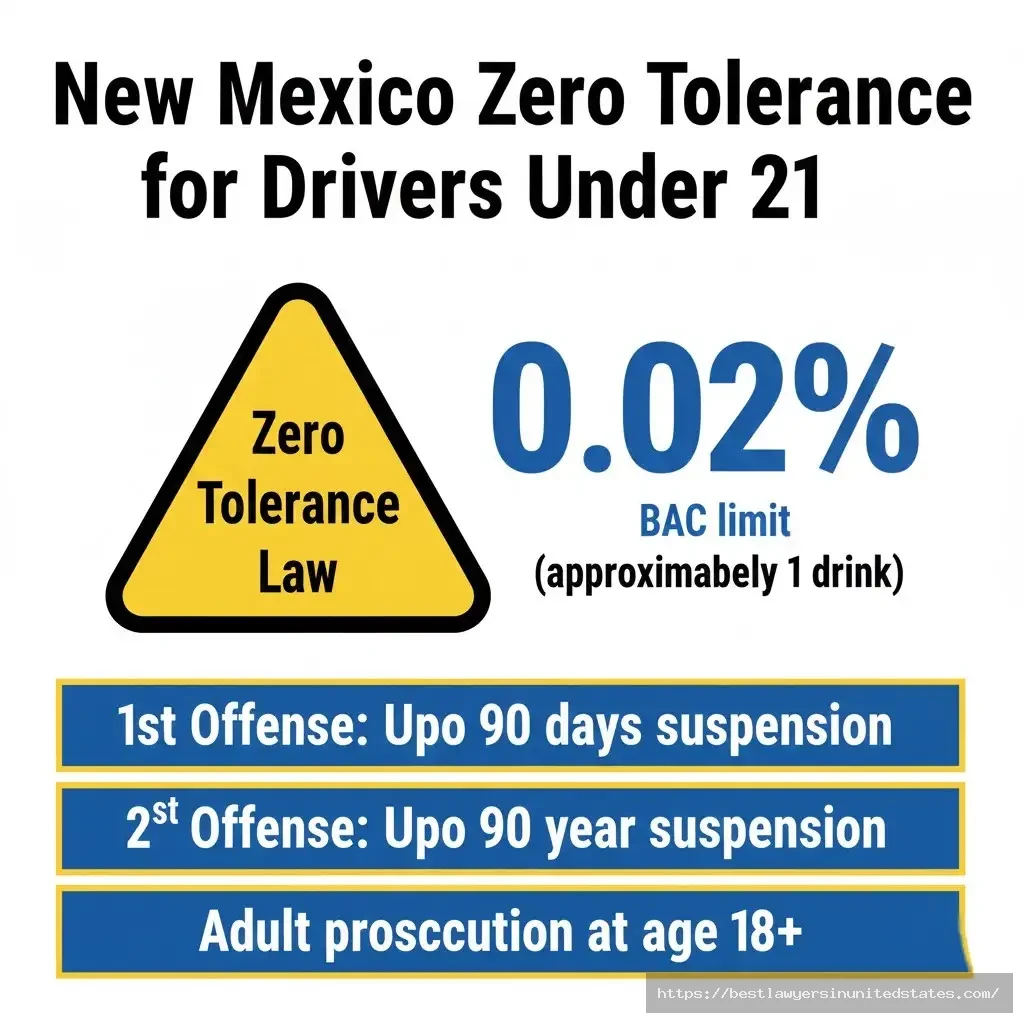
Under-21 DWI Laws (Zero Tolerance)
New Mexico enforces zero tolerance for drivers under 21 under NMSA § 66-8-111.
BAC threshold: 0.02% (roughly one drink)
Penalties for under-21 DWI:
| Offense Type | License Action | Fines | Other Penalties |
|---|---|---|---|
| 1st Offense (Delinquent Act) | Up to 90 days suspension | None | Community service, alcohol education |
| 2nd Offense | Up to 1 year suspension | Up to $300 | Mandatory education program |
| Adult Prosecution (18+) | Same as adult DWI | Same as adult DWI | Same as adult DWI |
Delinquent act vs. adult crime:
- Under 18: Handled in Children’s Court as delinquent act
- 18-20: Prosecuted as adult misdemeanor DWI
Additional consequences for minors:
- Parents notified
- School reporting possible
- College application impact
- Scholarship eligibility affected
Commercial Driver’s License (CDL) Holders
CDL holders face stricter standards and career-ending consequences.
BAC limit: 0.04% (half the standard limit)
DWI consequences for CDL holders:
- 1-year CDL disqualification (first offense)
- Lifetime disqualification (second offense)
- Applies even if driving personal vehicle
- Cannot obtain hardship CDL during suspension
Critical point: A single DWI conviction effectively ends most commercial driving careers. Similar strict enforcement exists in states like Texas and California.
Out-of-State Drivers
A New Mexico DWI affects your home state license through the Interstate Driver’s License Compact.
What happens:
- New Mexico reports conviction to your home state
- Home state applies equivalent penalties
- Both states track the conviction
- Suspension may occur in both states
Court appearances: Out-of-state defendants must:
- Appear at arraignment (usually)
- Attend all court dates (or hire local attorney to appear)
- Complete New Mexico sentencing requirements
- Cannot transfer probation to home state initially
Attorney representation: Hiring a New Mexico DWI attorney allows them to appear on your behalf, reducing required trips.
Driving While Revoked for DWI
Getting caught driving while your license is revoked for DWI carries severe penalties under NMSA § 66-5-39.
Mandatory penalties:
- 7 days jail (must serve)
- $300 minimum fine (up to $1,000)
- 30-day vehicle immobilization
- Additional 1-year revocation added to current period
Vehicle immobilization: Police tow and impound your vehicle for 30 days at your expense.
Impound costs:
- Towing: $150-$300
- Storage: $25-$50 per day ($750-$1,500 total)
- Release fees: $50-$100
Total additional cost: $2,000-$4,000 plus the original DWI penalties still apply.
Understanding Treatment Requirements
DWI School
First-time offenders must complete state-approved DWI school.
Program details:
- 12-16 hour curriculum
- Covers alcohol effects, legal consequences, victim impact
- Costs $100-$300
- Must complete within probation period
Approved providers in major cities:
- Albuquerque: Multiple locations including UNM area
- Las Cruces: NMSU vicinity providers
- Santa Fe: Downtown area facilities
- Roswell: East side locations
Failure to complete: Results in probation violation and potential jail time.
Victim Impact Panel
All DWI offenders must attend a victim impact panel presentation.
What happens:
- DWI crash victims share stories
- Family members of DWI victims speak
- Single session (2-3 hours)
- Cost: $25-$50
Purpose: Help offenders understand real-world consequences of impaired driving.
Substance Abuse Screening
Every DWI conviction requires professional substance abuse screening.
Process:
- Court orders screening
- You schedule with approved provider
- Licensed counselor conducts assessment
- Counselor recommends treatment level
- You must complete recommended treatment
Screening cost: $75-$150
Critical point: You cannot refuse recommended treatment without violating probation.
28-Day Inpatient Programs
Second and third offenses require either 28-day inpatient treatment or 90-day outpatient program.
Inpatient treatment:
- Residential facility stay
- Daily group therapy
- Individual counseling
- Medical monitoring if needed
- Cost: $3,000-$8,000
When required:
- Screening indicates substance dependence
- Court orders inpatient specifically
- Previous treatment failures
90-Day Outpatient Programs
Alternative to inpatient for second/third offenses.
Outpatient structure:
- 3-5 sessions per week
- Evening hours available
- Maintain employment
- Random drug/alcohol testing
- Cost: $1,500-$3,500
Attendance requirements:
- Cannot miss more than 2 sessions
- Must test negative for substances
- Complete all assignments
- Participate in group discussions
Drug Court Alternative
New Mexico offers drug court programs as alternative sentencing for repeat DWI offenders.
Drug court benefits:
- Avoid jail time if completed successfully
- Intensive supervision and treatment
- Regular court appearances
- Random testing
- Probation after completion
Requirements:
- Plead guilty or no contest
- Commit to 12-18 month program
- Attend all sessions and court dates
- Remain sober throughout program
Available locations:
- Bernalillo County Metropolitan Court
- Doña Ana County District Court
- Santa Fe County District Court
- San Juan County District Court
Completion rate: Approximately 60-70% successfully complete program and avoid prison.
Financial Impact of a New Mexico DWI
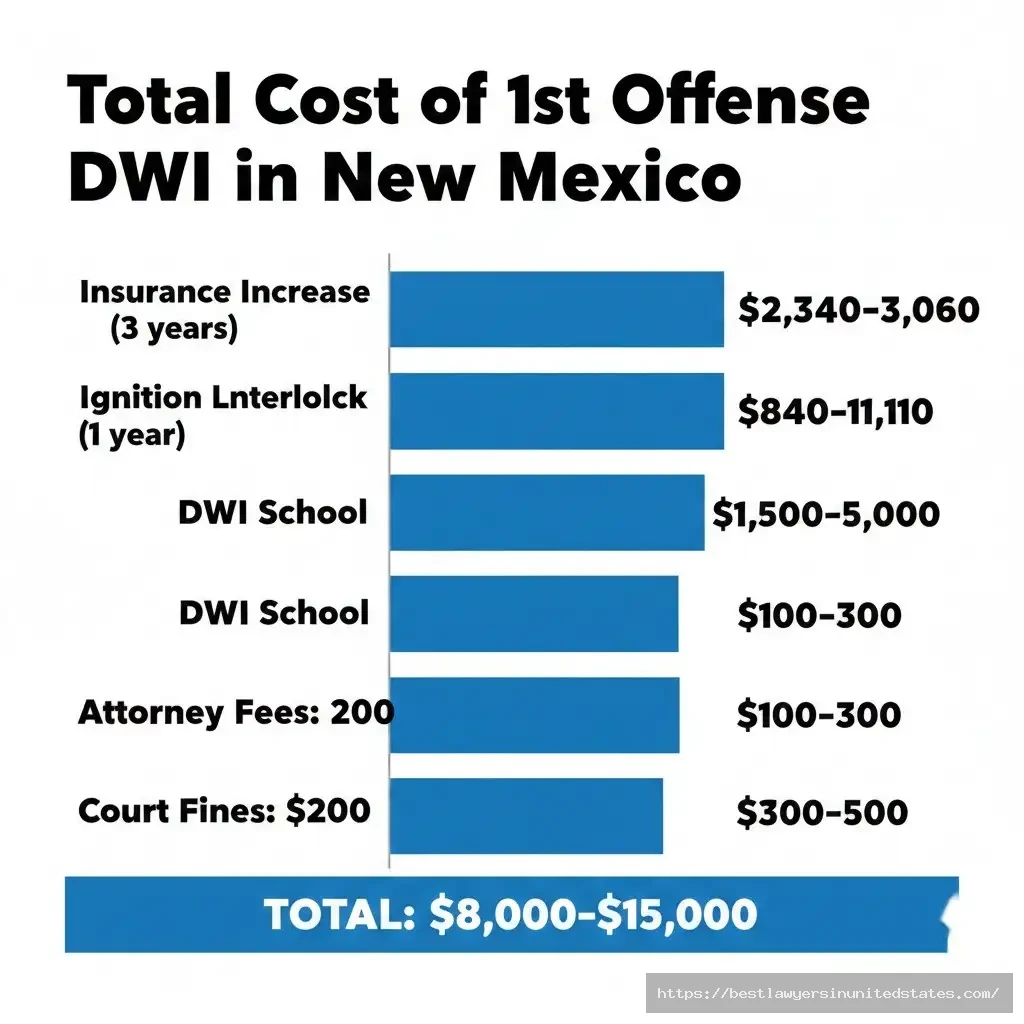
Direct Costs Breakdown
| Cost Category | First Offense | Second Offense | Third Offense |
|---|---|---|---|
| Court Fines | $300-$500 | $500-$1,000 | $750-$1,000 |
| Court Costs | $200 | $250 | $250 |
| Attorney Fees | $1,500-$5,000 | $2,500-$8,000 | $3,500-$10,000 |
| DWI School | $100-$300 | N/A | N/A |
| Treatment Program | $75-$150 (screening) | $1,500-$8,000 | $1,500-$8,000 |
| Victim Impact Panel | $25-$50 | $25-$50 | $25-$50 |
| Subtotal | $2,200-$6,200 | $4,775-$17,300 | $6,025-$19,300 |
Get a personalized cost estimate with our DUI cost calculator.
Ignition Interlock Costs
Installation and monitoring fees:
| Duration | Installation | Monthly Fee | Total Cost |
|---|---|---|---|
| 1 year (1st offense) | $70-$150 | $60-$80 | $840-$1,110 |
| 2 years (2nd offense) | $70-$150 | $60-$80 | $1,680-$2,070 |
| 3 years (3rd+ offense) | $70-$150 | $60-$80 | $2,520-$3,030 |
Additional costs:
- Calibration visits: $20-$40 every 30-60 days
- Failed tests/violations: $50-$100 per incident
- Removal fee: $50-$100
Financial hardship: Some providers offer reduced rates based on income verification.
Long-Term Financial Consequences
Insurance rate increases:
- Average increase: 65-85% for 3-5 years
- SR-22 filing requirement: $25-$50 annually
- High-risk insurance: $200-$500 more per month
Example: If you currently pay $100/month for auto insurance:
- New rate: $165-$185/month
- Additional cost over 3 years: $2,340-$3,060
Employment impact:
- Job loss for CDL holders
- Difficulty finding work requiring driving
- Professional license suspensions (healthcare, teaching, law)
- Background check failures
Total 5-year cost of first DWI: $8,000-$15,000 including all direct and indirect expenses.
Neighboring states have comparable costs—compare with Arizona DUI penalties or Colorado DUI laws.
DWI Checkpoints in New Mexico
Are Checkpoints Legal in New Mexico?
Yes. New Mexico courts have ruled DWI checkpoints constitutional under both state and federal law when properly conducted.
Legal requirements for valid checkpoints:
- Advance public notice
- Neutral selection pattern (every car or every 3rd car)
- Supervisor approval and oversight
- Minimal delay for stopped drivers
- Clearly marked as law enforcement operation
Your Rights at a Checkpoint
You must:
- Stop when directed
- Provide license and registration
- Answer basic identity questions
You can:
- Refuse to answer questions about drinking
- Decline field sobriety tests
- Refuse vehicle searches without warrant
- Record the interaction (if safe to do so)
You cannot:
- Drive around or avoid the checkpoint
- Leave once stopped without permission
- Refuse to identify yourself
If you smell like alcohol or show impairment signs: Officer has probable cause to investigate further.
ENDWI Program and Checkpoint Schedules
New Mexico’s ENDWI (End DWI) program coordinates statewide DWI enforcement.
ENDWI Hotline: 877-394-4258
- Report suspected impaired drivers
- Request safe ride information
- Access DWI prevention resources
High-enforcement periods:
- Holiday weekends (Memorial Day, July 4th, Labor Day)
- Super Bowl weekend
- St. Patrick’s Day
- New Year’s Eve/Day
- Cinco de Mayo
Common checkpoint locations:
- I-25 corridor (Albuquerque to Santa Fe)
- I-40 through Albuquerque
- Central Avenue in Albuquerque
- Highway 70 in Las Cruces
- Main thoroughfares in Santa Fe
Checkpoint notices: Law enforcement typically announces checkpoint locations 24-48 hours in advance through local media.
Building Your Defense
Common DWI Defenses in New Mexico
1. Improper Traffic Stop
Officer lacked reasonable suspicion to initiate stop.
Examples:
- No traffic violation observed
- Anonymous tip without corroboration
- Pretextual stop for minor violation
If successful: All evidence suppressed, case dismissed.
2. Faulty Breathalyzer Calibration
Breath test machines require regular calibration and maintenance.
Challenge points:
- Calibration records missing or outdated
- Improper administration procedure
- Mouth alcohol contamination
- Machine malfunction
Evidence needed: Calibration logs, maintenance records, operator certifications.
3. Rising BAC Defense
Your BAC was below legal limit while driving but rose above limit by testing time.
How it works:
- Alcohol takes 30-90 minutes to fully absorb
- BAC continues rising after you stop drinking
- You may have been legal while driving
Example: You had last drink at 10:00 PM, stopped at 10:15 PM (BAC 0.06%), tested at 11:00 PM (BAC 0.09%).
4. Medical Conditions
Certain conditions mimic intoxication signs or affect BAC readings.
Examples:
- Diabetes (acetone breath)
- GERD (acid reflux affecting breath test)
- Neurological conditions (affecting coordination)
- Dental work (trapped alcohol in mouth)
Required: Medical documentation and expert testimony.
5. Field Sobriety Test Challenges
Officers must properly administer standardized tests.
Common errors:
- Improper instructions
- Unsafe testing location (uneven ground, poor lighting)
- Weather conditions affecting performance
- Physical limitations not considered
Note: Video evidence strengthens this defense significantly.
When to Hire a DWI Attorney
Hire an attorney immediately if:
- This is your second or subsequent DWI
- You face aggravated DWI charges
- Accident involved injuries or property damage
- Your BAC exceeded 0.15%
- You hold a professional license
- You work in a driving-dependent job
First-time offenders should hire attorney if:
- You want to fight the charges
- Chemical test results seem questionable
- Officer made procedural errors
- You have professional licensing concerns
Public defender eligibility: You must financially qualify (typically income below 200% of poverty level).
What to Look for in Legal Representation
Experience in New Mexico DWI law:
- Handles DWI cases regularly (not general practice)
- Knows local prosecutors and judges
- Familiar with testing protocols and equipment
- Success rate with similar cases
Questions to ask potential attorneys:
- How many DWI cases have you handled in [your county]?
- What percentage go to trial vs. plea bargain?
- What are typical outcomes for cases like mine?
- Will you personally handle my case or pass to associate?
- What is your fee structure?
Red flags:
- Guarantees specific outcome
- Requires full payment upfront
- Has disciplinary history
- Doesn’t specialize in criminal defense
Find experienced New Mexico DWI attorneys for free consultations.
Contact: [email protected]
Frequently Asked Questions
What happens when you get a DWI in New Mexico?
Quick Answer: You face arrest, license confiscation, court appearances, fines of $500-$1,000, possible jail time, mandatory ignition interlock installation, and a conviction staying on your record for 55 years.
The specific process: Officer arrests you and confiscates your license. You receive a 20-day temporary license and must request an MVD hearing within that timeframe. Your first court appearance (arraignment) occurs within 48-72 hours of arrest.
How long does a DWI stay on your record in New Mexico?
Quick Answer: 55 years—essentially a lifetime.
New Mexico uses one of the longest lookback periods in the United States. A DWI at age 25 still counts toward penalty enhancement if you’re arrested again at age 75. The state offers no expungement or record sealing for DWI convictions.
Can you get a DWI dismissed in New Mexico?
Quick Answer: Yes, but it’s difficult and requires strong legal defenses like illegal stop, faulty testing, or procedural errors.
Common grounds for dismissal include illegal traffic stops without reasonable suspicion, improperly administered chemical tests, broken chain of custody for blood samples, or violation of your constitutional rights. Most DWI cases resolve through plea bargains rather than dismissal.
What is aggravated DWI in New Mexico?
Quick Answer: Aggravated DWI occurs when your BAC exceeds 0.16%, you refuse chemical testing, or an accident involves alcohol—adding mandatory jail time to standard penalties.
First offense aggravated DWI adds 48 hours mandatory jail. Second offense adds 96 hours. Third offense adds 60 days. These enhancements stack on top of base penalties and cannot be suspended or reduced.
Is a fourth DWI a felony in New Mexico?
Quick Answer: Yes. Fourth offense DWI becomes a fourth-degree felony with 6 months mandatory prison time.
The felony designation escalates with each subsequent offense: fifth offense carries 12 months mandatory, sixth carries 18 months mandatory, and eighth offense becomes a second-degree felony with 10 years mandatory prison time.
Can you refuse a breathalyzer in New Mexico?
Quick Answer: You can refuse, but you face automatic 1-year license suspension (longer than the 6-month suspension for failing the test) plus aggravated DWI charges.
Refusal triggers two immediate consequences: administrative license revocation through MVD and enhancement to aggravated DWI status. Prosecutors also use refusal as evidence of consciousness of guilt at trial. In serious cases involving accidents or injuries, officers obtain warrants for forced blood draws.
How much does a DWI cost in New Mexico?
Quick Answer: First offense costs $2,500-$8,000 including fines, attorney fees, ignition interlock, and classes. Second offense costs $5,000-$17,000. Third offense costs $6,000-$19,000.
These figures include court fines, legal representation, ignition interlock installation and monitoring, DWI school or treatment programs, and immediate costs. Long-term expenses like increased insurance rates add $2,000-$5,000 more over 3-5 years.
What is the first offender program in New Mexico?
Quick Answer: New Mexico does not offer a specific “first offender program,” but first-time offenders receive more lenient sentencing including probation options and treatment instead of jail.
While no formal diversion program exists, judges often sentence first offenders to probation with conditions like DWI school, victim impact panel, substance abuse screening, and community service instead of jail time. Some counties offer DUI task force programs providing intensive supervision as alternative to incarceration.
How does a New Mexico DWI affect insurance rates?
Quick Answer: Insurance rates increase 65-85% on average for 3-5 years, costing an additional $2,340-$3,060 over three years for typical drivers.
You must file an SR-22 certificate proving financial responsibility. Many standard insurers drop DWI offenders, forcing them into high-risk insurance markets with significantly higher premiums. Multiple DWI convictions may make you uninsurable through standard markets.
Can I get a restricted license after DWI in New Mexico?
Quick Answer: No traditional restricted license exists, but you receive an ignition interlock license allowing you to drive any vehicle equipped with an IID.
The ignition interlock license serves as New Mexico’s version of a restricted license. You can drive to work, school, medical appointments, and anywhere else—but only in vehicles with properly installed and functioning ignition interlock devices.
New Mexico DWI Resources
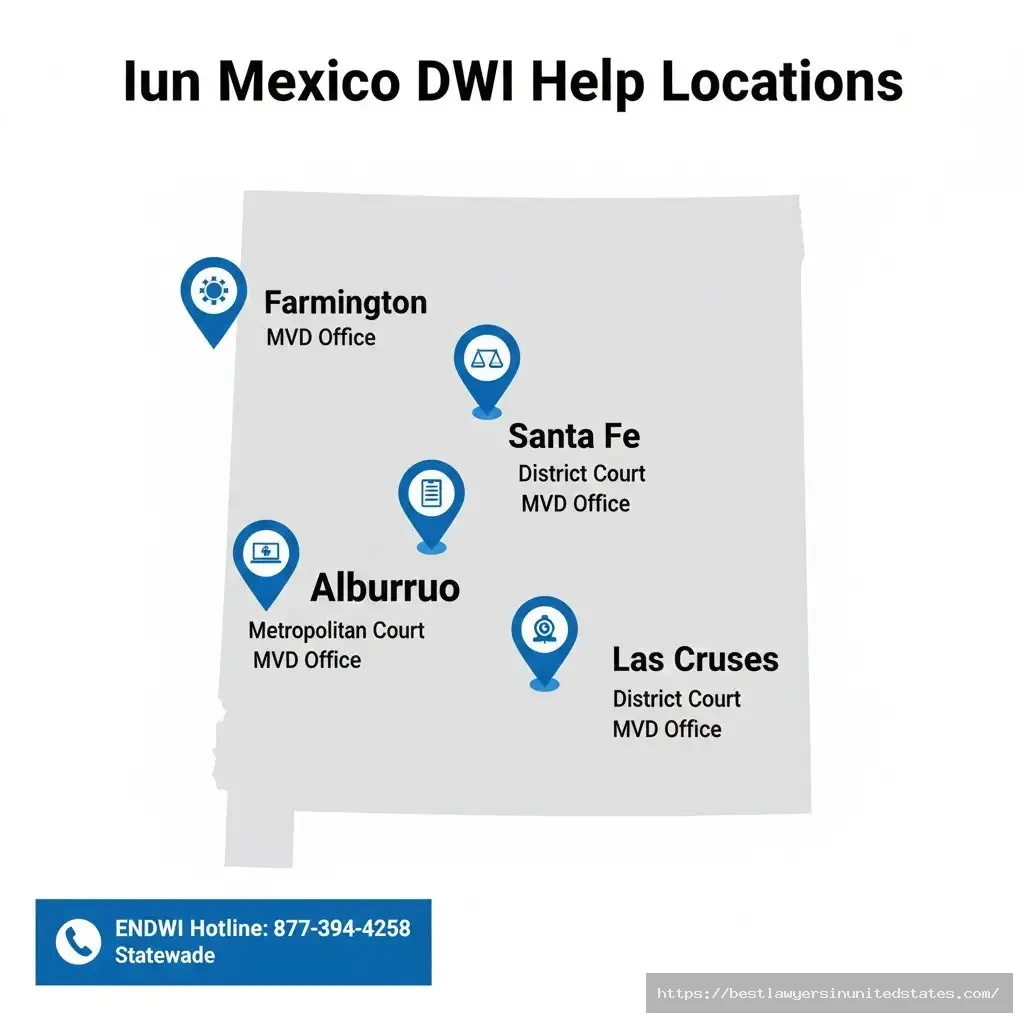
State Agencies and Programs
ENDWI Hotline: 877-394-4258
- Report impaired drivers
- DWI prevention information
- Safe ride resources
New Mexico Motor Vehicle Division
- Main Office: 1100 S St Francis Dr, Santa Fe, NM 87504
- Phone: 888-683-4636
- Website: mvd.newmexico.gov
New Mexico Traffic Safety Bureau
- Focus: DWI prevention and enforcement
- Highway safety programs
- Statistical reporting
New Mexico Department of Transportation
- DWI program coordination
- Public awareness campaigns
- Highway safety initiatives
Court Locations
Second Judicial District Court (Bernalillo County)
- 400 Lomas Blvd NW, Albuquerque, NM 87102
- Handles felony DWI cases
Metropolitan Court (Albuquerque)
- 401 Lomas Blvd NW, Albuquerque, NM 87102
- Handles misdemeanor DWI cases
Third Judicial District Court (Doña Ana County)
- 201 W Picacho Ave, Las Cruces, NM 88005
- Felony jurisdiction
Santa Fe County Magistrate Court
- 2056 Siringo Rd, Santa Fe, NM 87505
- Misdemeanor jurisdiction
Treatment Program Locators
New Mexico Behavioral Health Services
- Phone: 505-476-9266
- Approved treatment provider list
- Screening services directory
Substance Abuse and Mental Health Services (SAMHSA)
- National Helpline: 1-800-662-4357
- 24/7 treatment referral service
- Confidential assistance
Legal Aid Organizations
New Mexico Legal Aid
- Phone: 1-866-416-1934
- Free legal services for qualifying low-income residents
- DWI representation based on income eligibility
State Bar of New Mexico Lawyer Referral Service
- Phone: 505-797-6000
- Attorney matching service
- Initial consultation discounts
Conclusion
New Mexico enforces strict DWI laws with long-lasting consequences. A single conviction stays on your record for 55 years and requires ignition interlock installation in every vehicle you drive. Second and third offenses mandate professional substance abuse treatment and significant jail time. Fourth offense crosses into felony territory with mandatory prison sentences.
The dual revocation system creates separate administrative and criminal consequences requiring different defense strategies. Missing the 20-day deadline for requesting an MVD hearing results in automatic license suspension. Total costs exceed $8,000-$15,000 for first offense when including all direct and indirect expenses.
If you face DWI charges in New Mexico, consult with an experienced criminal defense attorney immediately. The complexity of New Mexico’s DWI laws and severe penalties make professional legal representation critical for protecting your rights and minimizing consequences.
Need legal help? Contact experienced New Mexico DWI attorneys for free case evaluations.
Email: [email protected]
