
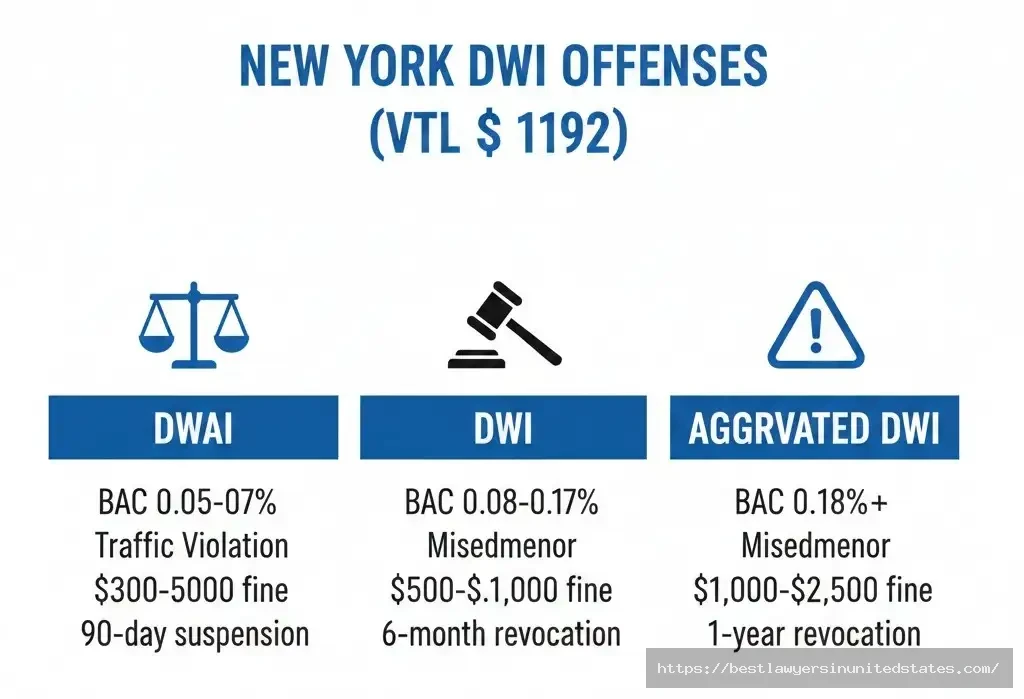
New York charges drivers with DWI (Driving While Intoxicated), not DUI. A first-time DWI in New York brings fines of $500-$1,000, up to one year in jail, a minimum six-month license revocation, and mandatory ignition interlock installation. The state uses a three-tier system: DWAI for BAC 0.05-0.07%, DWI for BAC 0.08% or higher, and Aggravated DWI for BAC 0.18% or above.
New York’s DWI laws under Vehicle and Traffic Law § 1192 differ significantly from other states. The state enforces a strict “2-hour rule” for chemical testing, doesn’t allow “wet reckless” plea bargains like California, and requires ignition interlock devices for all DWI convictions under Leandra’s Law. Understanding these unique New York rules can mean the difference between a traffic violation and a permanent criminal record.
Why New York Uses “DWI” Instead of “DUI”
New York officially charges impaired driving as DWI (Driving While Intoxicated) under Vehicle and Traffic Law § 1192. The state doesn’t use the term “DUI” in its legal code, though many people search for “New York DUI laws” online.
The distinction matters because New York’s charging system differs from most states. While California uses DUI terminology and allows reduced “wet reckless” pleas, New York prosecutors resist plea bargains except in cases where evidence weaknesses exist.
Key difference: New York created DWAI (Driving While Ability Impaired) as a separate, lesser charge for BAC levels between 0.05% and 0.07%. This three-tier system sets New York apart from neighboring states like New Jersey, which uses only DWI/DUI classifications.
New York DWI Statute: Vehicle and Traffic Law § 1192 Explained
Vehicle and Traffic Law § 1192 establishes five distinct impaired driving offenses in New York:
| VTL Section | Offense Type | BAC Threshold | Classification |
|---|---|---|---|
| § 1192.1 | DWAI (alcohol) | 0.05-0.07% | Traffic violation |
| § 1192.2 | DWI (per se) | 0.08% or higher | Misdemeanor |
| § 1192.3 | DWI (common law) | Any BAC if impaired | Misdemeanor |
| § 1192.2-a | Aggravated DWI | 0.18% or higher | Misdemeanor |
| § 1192.5 | Commercial DWI | 0.04% or higher | Misdemeanor |
Per Se vs Common Law DWI
VTL § 1192.2 creates a “per se” offense where prosecutors only need to prove your BAC reached 0.08% or higher. Your actual driving ability doesn’t matter under this statute.
VTL § 1192.3 charges you based on impaired driving ability regardless of BAC. Prosecutors can file this charge even if you blow under 0.08% but show clear signs of intoxication through field sobriety tests or erratic driving.
Critical point: Officers often charge both § 1192.2 and § 1192.3 simultaneously. You can only be convicted of one, but this dual charging gives prosecutors flexibility at trial.
Special Categories Under VTL § 1192
VTL § 1192.4 covers DWAI-Drug (impairment by any drug including marijuana or prescription medication). VTL § 1192.4-a addresses DWAI-Combination (alcohol plus drugs). Both carry the same penalties as standard DWI.
Commercial drivers face stricter rules under VTL § 1192.5. A BAC of 0.04% triggers a commercial DWI charge, ending most trucking careers even on a first offense.
BAC Limits in New York: What Is the Legal Alcohol Limit?
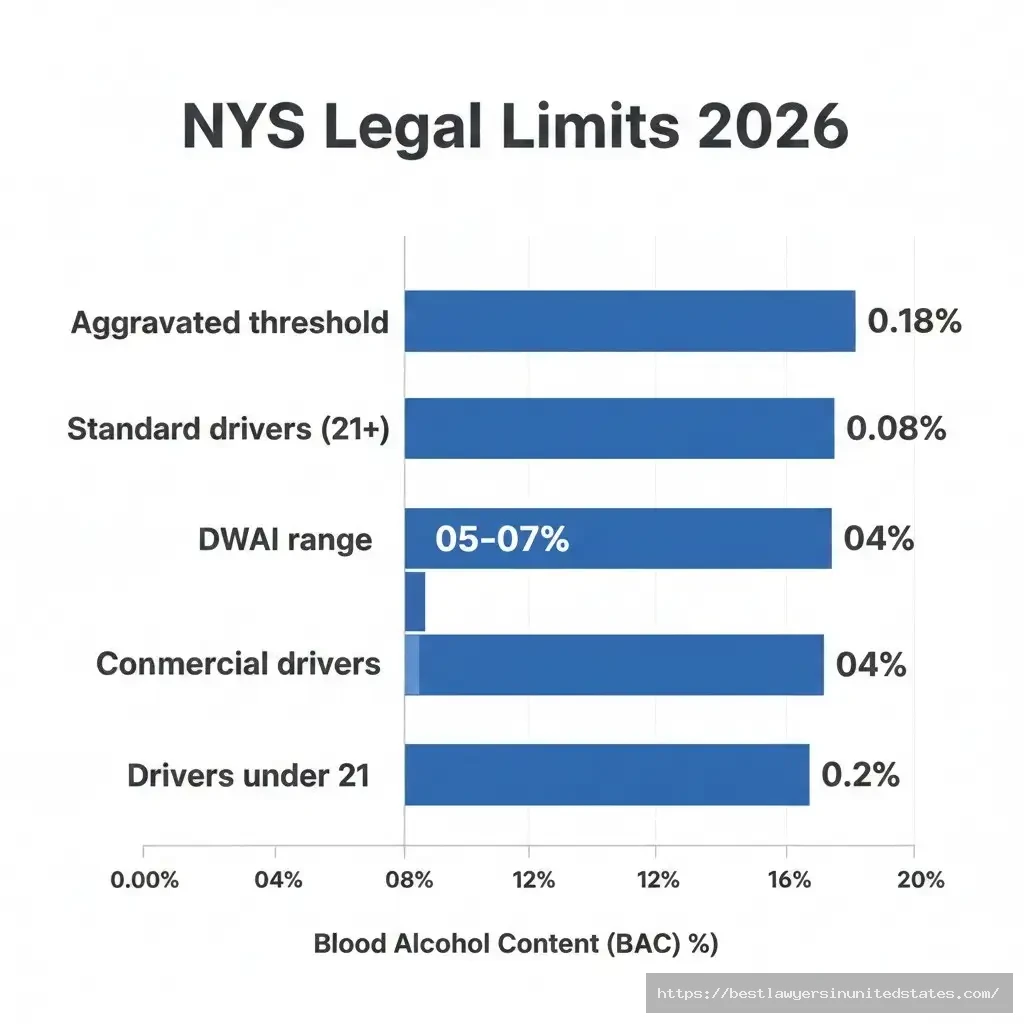
New York sets different BAC thresholds depending on your driver classification:
| Driver Type | Legal BAC Limit | Violation Type |
|---|---|---|
| Standard drivers (21+) | 0.08% | DWI (VTL § 1192.2) |
| Aggravated threshold | 0.18% | Aggravated DWI (VTL § 1192.2-a) |
| DWAI threshold | 0.05-0.07% | DWAI (VTL § 1192.1) |
| Commercial drivers | 0.04% | Commercial DWI (VTL § 1192.5) |
| Drivers under 21 | 0.02% | Zero Tolerance violation |
How Many Drinks Equal 0.08% BAC?
The number of drinks that put you over New York’s 0.08% limit varies by weight, gender, and metabolism. Generally, a 180-pound man reaches 0.08% after about four standard drinks in two hours. A 140-pound woman hits 0.08% after approximately three drinks in the same timeframe.
Calculate your BAC: Use our BAC Calculator to estimate whether you’re over New York’s legal limit based on your specific characteristics and drinking pattern.
BAC Calculator
Estimate your Blood Alcohol Content
• Commercial Driver (CDL): 0.04% BAC
• Drivers Under 21: 0.00-0.02% BAC (Zero Tolerance)
• Enhanced Penalties: 0.15% BAC or higher in most states
Important: Drinks come in different strengths. A “standard drink” means 12 oz beer (5% alcohol), 5 oz wine (12% alcohol), or 1.5 oz liquor (40% alcohol). Mixed drinks often contain 2-3 standard drinks in one glass.
The DWAI Gray Area (0.05-0.07% BAC)
New York’s DWAI charge applies when your BAC falls between 0.05% and 0.07%. This creates a unique “gray area” where you’re impaired but below the DWI threshold.
First-time DWAI is a traffic violation, not a crime. However, second and third DWAI offenses within specific timeframes can escalate to misdemeanors. Prosecutors sometimes offer DWAI plea bargains when DWI evidence appears weak.
DWI vs DWAI vs Aggravated DWI: New York’s Three-Tier System
New York separates impaired driving into three distinct levels based on BAC and circumstances:
DWAI (Driving While Ability Impaired)
DWAI charges apply when your BAC measures 0.05-0.07% or when drugs impair your ability to drive safely. A first DWAI offense counts as a traffic violation, not a crime, keeping it off your criminal record.
First DWAI penalties:
- Fine: $300-$500
- Jail: Up to 15 days
- License suspension: 90 days
- No mandatory ignition interlock
Standard DWI (0.08-0.17% BAC)
DWI charges trigger when your BAC reaches 0.08% or higher, or when officers observe clear impairment regardless of BAC. This misdemeanor goes on your permanent criminal record.
First DWI penalties:
- Fine: $500-$1,000
- Jail: Up to 1 year
- License revocation: 6 months minimum
- Mandatory ignition interlock device
- Drinking Driver Program required
Aggravated DWI (0.18%+ BAC)
Aggravated DWI applies when your BAC reaches 0.18% or higher—more than twice the legal limit. This enhanced misdemeanor brings harsher penalties even for first-time offenders.
First Aggravated DWI penalties:
- Fine: $1,000-$2,500
- Jail: Up to 1 year
- License revocation: 1 year minimum
- Mandatory ignition interlock device
- Higher insurance rates than standard DWI
Comparison table:
| Factor | DWAI | DWI | Aggravated DWI |
|---|---|---|---|
| BAC threshold | 0.05-0.07% | 0.08-0.17% | 0.18%+ |
| Classification | Traffic violation | Misdemeanor | Misdemeanor |
| Criminal record | No (first offense) | Yes | Yes |
| Minimum fine | $300 | $500 | $1,000 |
| License action | 90-day suspension | 6-month revocation | 1-year revocation |
| IID required | No (first offense) | Yes | Yes |
New York’s “2-Hour Rule” for DWI Chemical Testing
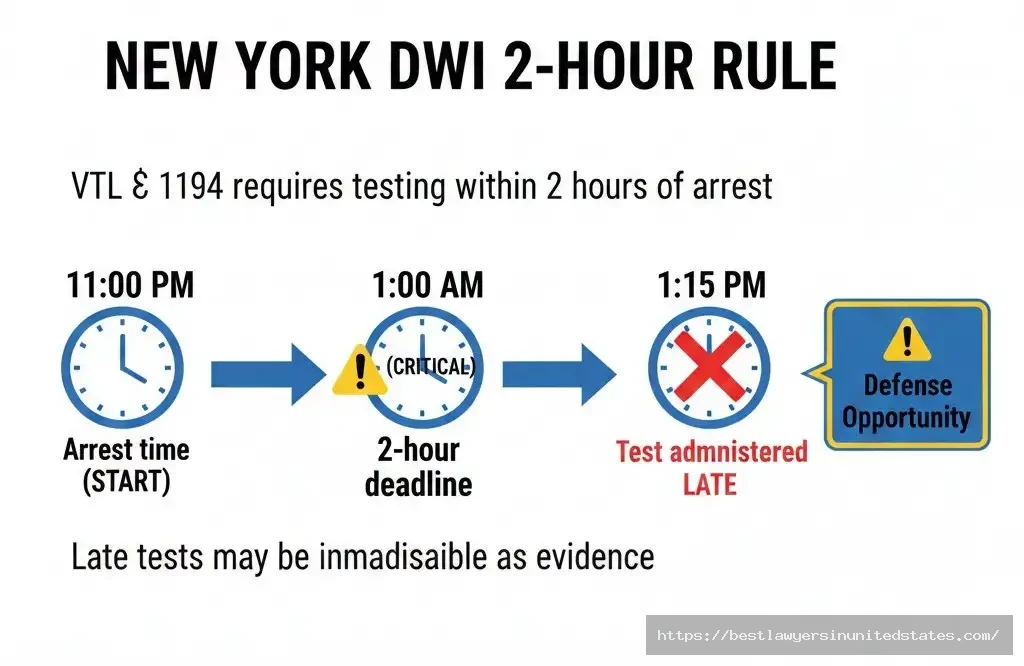
Vehicle and Traffic Law § 1194 requires officers to administer chemical tests within two hours of your arrest. This “2-hour rule” creates a strict deadline that can make or break a DWI prosecution.
How the 2-Hour Rule Works
Police must complete your breath, blood, or urine test within two hours from the moment they place you under arrest for DWI. If testing occurs after the two-hour window, the BAC results may become inadmissible as evidence.
Example timeline:
- 11:00 PM: Officer arrests you for DWI
- 11:45 PM: Transport to station
- 1:15 AM: Breathalyzer administered (2 hours 15 minutes after arrest)
- Result: BAC evidence potentially inadmissible
When the 2-Hour Rule Helps Your Defense
Defense attorneys use the 2-hour rule to challenge late testing. Blood draws at hospitals often occur 3-4 hours after arrest, especially in cases involving accidents or injuries requiring medical treatment first.
Critical exception: Prosecutors can still introduce late BAC results, but judges instruct juries to consider the timing when evaluating evidence reliability. The later the test, the less weight it carries.
2-Hour Rule Defense Strategies
Your attorney might argue:
- Police delayed booking to let you “sober up” for better test results
- Hospital staff prioritized medical care over timely testing
- BAC naturally decreased during the delay, making results unreliable
- Testing equipment wasn’t immediately available
Important: The 2-hour rule doesn’t automatically dismiss your case. Prosecutors can still pursue DWI charges under VTL § 1192.3 (common law DWI) using field sobriety tests, officer observations, and dashcam footage.
Penalties for DWI in New York: First, Second, and Third Offenses
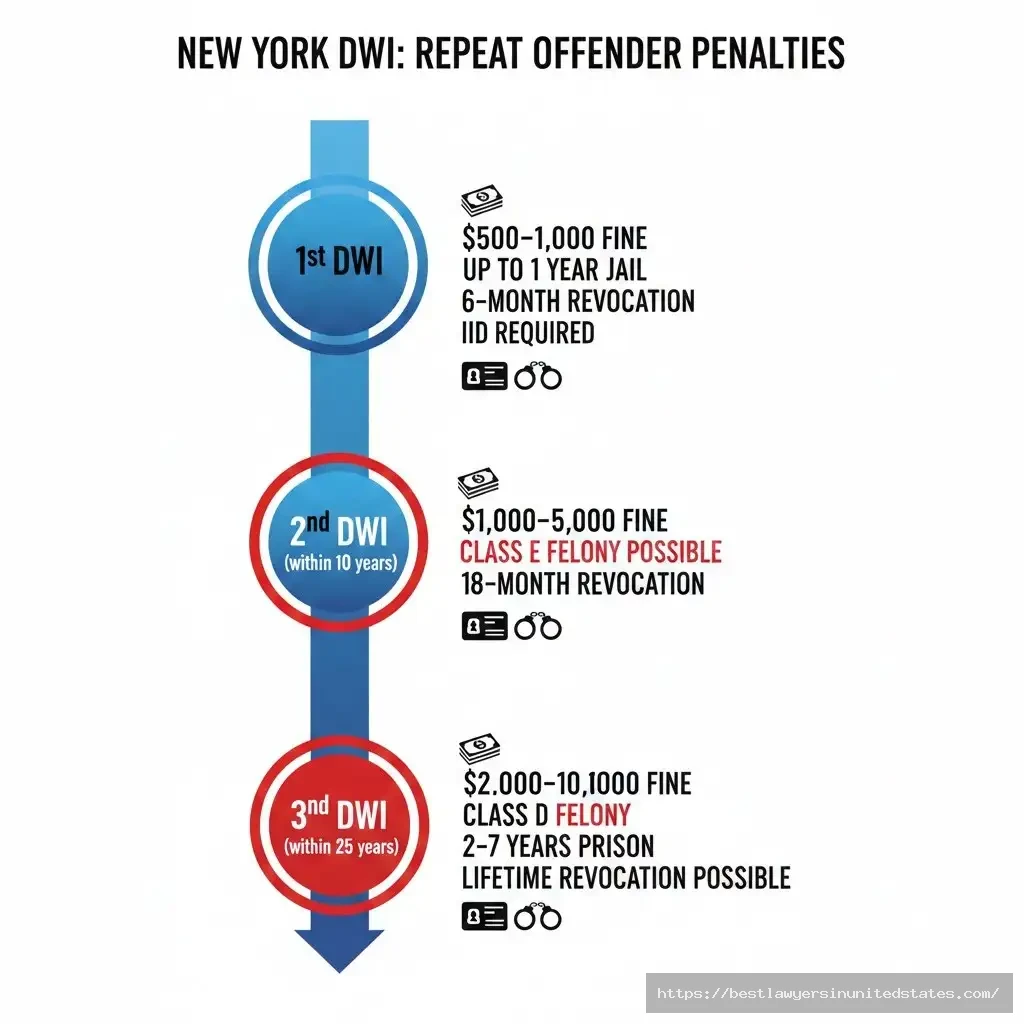
New York escalates DWI penalties dramatically with each conviction. The state counts prior DWI or DWAI convictions within specific lookback periods when determining your sentence.
First-Time DWI Offense in New York
A first DWI conviction under VTL § 1192.2 brings mandatory minimum penalties that judges cannot reduce:
| Penalty Category | First DWI | First Aggravated DWI |
|---|---|---|
| Fine | $500-$1,000 | $1,000-$2,500 |
| Jail time | Up to 1 year | Up to 1 year |
| License revocation | 6 months minimum | 1 year minimum |
| Ignition interlock | 1 year minimum | 1 year minimum |
| Probation | 3 years possible | 3 years possible |
Additional requirements:
- Drinking Driver Program (DDP) enrollment ($225)
- Victim impact panel attendance
- $175 crime victim assistance fee
- $260 mandatory surcharge
Second DWI Offense in New York (Within 10 Years)
A second DWI within 10 years of your first conviction elevates to a Class E felony at the prosecutor’s discretion. Even when charged as a misdemeanor, penalties increase substantially:
Second DWI (misdemeanor):
- Fine: $1,000-$5,000
- Jail: 30 days to 1 year (30-day minimum mandatory)
- License revocation: 18 months minimum
- Ignition interlock: Permanent until 5 years conviction-free
Second DWI (felony):
- Fine: $1,000-$5,000
- Prison: Up to 4 years
- License revocation: 18 months minimum
- Permanent criminal felony record
Third DWI Offense in New York
Three DWI or DWAI-Drug convictions within 25 years triggers New York’s “persistent DWI” felony under VTL § 1193(1)(c)(ii). This Class D felony brings severe consequences:
Third DWI penalties:
- Fine: $2,000-$10,000
- Prison: 2-7 years
- License revocation: 18 months minimum (lifetime revocation possible)
- Permanent felony record affecting employment, housing, voting rights
Critical point: The 25-year lookback period means a DWI from 2000 still counts toward felony charges in 2026. Unlike Massachusetts which uses a 10-year lookback, New York never forgets.
Is DWI a Felony in New York? When DWI Becomes a Felony
Standard first-time DWI charges in New York are misdemeanors, not felonies. However, specific circumstances automatically elevate DWI to felony status.
Automatic Felony DWI Situations
Second DWI within 10 years: Prosecutors can charge this as a Class E felony (maximum 4 years prison) instead of a misdemeanor. The decision depends on your BAC level, prior record, and case circumstances.
Third DWI within 25 years: This mandatory Class D felony brings 2-7 years in state prison. Judges have no discretion to reduce the charge to a misdemeanor.
Leandra’s Law violation: Any DWI with a child under 16 in the vehicle becomes an automatic Class E felony, regardless of whether it’s your first offense.
Class E vs Class D Felony Differences
| Factor | Class E Felony | Class D Felony |
|---|---|---|
| Triggers | 2nd DWI in 10 years, Leandra’s Law | 3rd DWI in 25 years |
| Prison term | Up to 4 years | 2-7 years |
| Probation option | Yes (5 years) | Yes (5 years) |
| Permanent record | Yes | Yes |
| Voting rights | Suspended while imprisoned | Suspended while imprisoned |
Long-term consequences: Felony DWI convictions create permanent barriers to employment in healthcare, education, law enforcement, and positions requiring professional licenses. Many apartments refuse tenants with felony records.
Leandra’s Law: New York’s Child Endangerment DWI Law
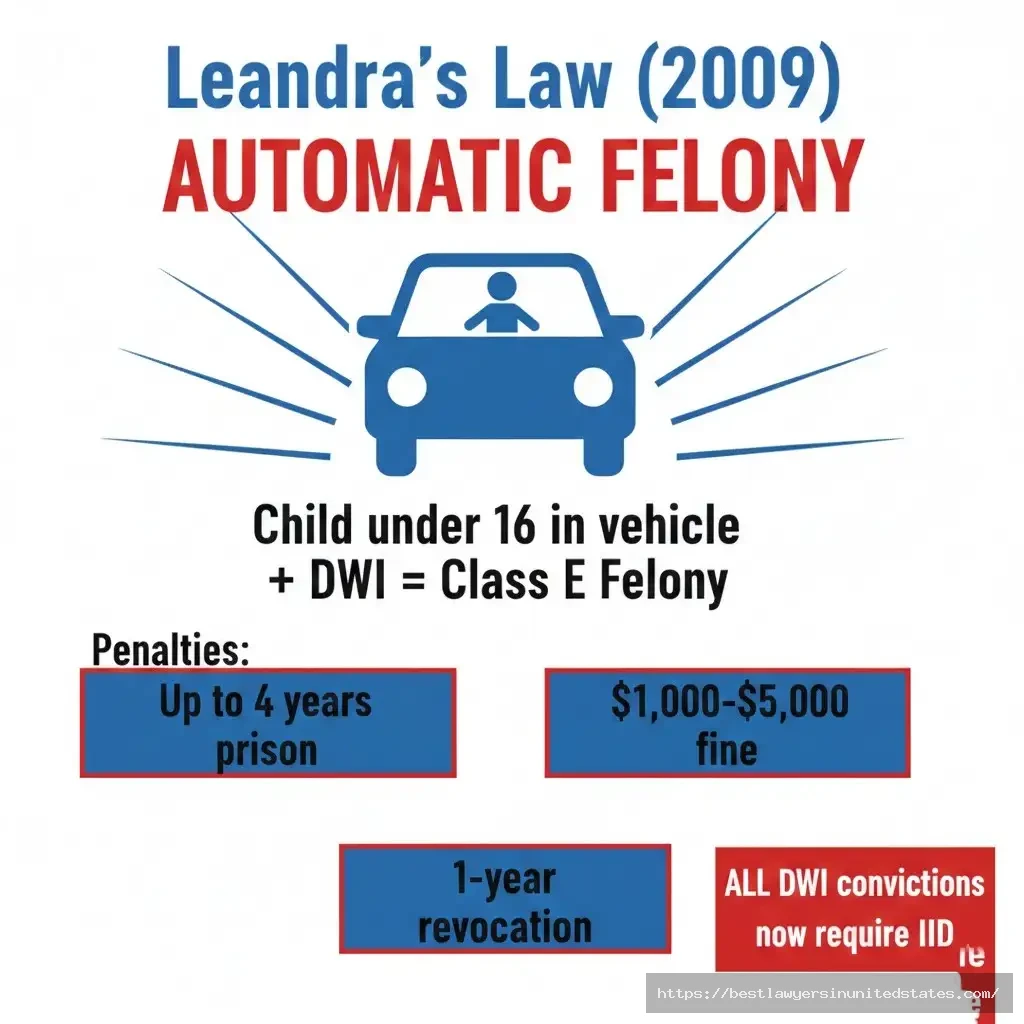
Leandra’s Law, enacted in 2009, revolutionized New York DWI enforcement by adding two major provisions: automatic felony charges for DWI with a child passenger, and mandatory ignition interlock devices for all DWI convictions.
Automatic Felony for Child Passengers
Any DWI or DWAI-Drug with a child under 16 in the vehicle triggers an automatic Class E felony charge under VTL § 1192.2-a(b). This applies even to first-time offenders with no prior record.
Leandra’s Law felony penalties:
- Prison: Up to 4 years
- Fine: $1,000-$5,000
- License revocation: 1 year minimum
- Permanent felony record
- Possible child endangerment charges under Penal Law
Critical point: The child doesn’t need to be yours. Driving a friend’s kids to soccer practice while impaired creates felony liability.
Mandatory Ignition Interlock for All DWI
Before Leandra’s Law, only repeat offenders needed ignition interlock devices. Now every DWI conviction—even first-time DWAI offenses—requires IID installation.
IID requirements:
- Installation within 10 days of conviction
- Minimum 6 months for first DWI
- Minimum 1 year for Aggravated DWI
- Permanent IID for second DWI until 5 years conviction-free
The Tragedy Behind the Law
Eleven-year-old Leandra Rosado died in October 2009 when her friend’s mother drove drunk on New York’s Henry Hudson Parkway. Seven children were in the SUV when it flipped. Within six weeks, New York passed the nation’s toughest child endangerment DWI law.
New DWI Laws in New York 2025-2026: Recent Changes and Updates
New York strengthened its DWI penalties in 2025 with stricter enforcement for repeat offenders and enhanced technology requirements.
Enhanced Repeat Offender Provisions
The 2025 legislative session tightened the “3 DWI in 25 years” provision. Previously, judges had limited discretion in sentencing third-time offenders. New mandatory minimums now require:
- Minimum 2 years prison (no probation option) for third DWI
- Lifetime license revocation consideration after fourth DWI
- No conditional discharge for second DWI within 5 years
Expanded Ignition Interlock Monitoring
New York DMV now requires monthly monitoring reports for all IID users. Devices must use cellular connectivity to transmit violation data in real-time. Previous systems allowed 30-60 day gaps between inspections.
2026 compliance deadlines:
- March 1, 2026: All IID providers must offer real-time monitoring
- July 1, 2026: Older non-connected devices become non-compliant
- Violations trigger immediate 30-day license suspension
STOP-DWI Program Funding Increases
New York allocated an additional $15 million to county STOP-DWI programs in the 2025-2026 budget. Funding supports increased DWI checkpoints, improved officer training, and expanded public awareness campaigns.
Implied Consent Law in New York (VTL § 1194)
New York’s implied consent law under VTL § 1194 requires all drivers to submit to chemical testing when arrested for DWI. By accepting your license, you automatically agree to testing.
What “Implied Consent” Means
The moment you operate a vehicle on any New York road, you consent to breath, blood, or urine testing if arrested for DWI. This consent exists whether you explicitly agree or not.
Officers must read you a formal implied consent warning explaining:
- Refusal triggers automatic license revocation
- Refusal penalties are harsher than test failure penalties
- You have the right to refuse, but consequences apply immediately
Types of Chemical Tests in New York
Breath test (most common):
- Administered at police station using Datamaster or similar device
- Results available immediately
- Most frequently used test in NYC, Long Island, and Westchester County
Blood test:
- Requires licensed medical professional
- Used when breath testing is unavailable or in accident cases
- More accurate but slower (results take 2-4 weeks)
Urine test (rare):
- Only when breath/blood testing isn’t feasible
- Primarily used for drug impairment cases
- Least reliable, rarely admissible in court
Field breath screening: Portable roadside devices are NOT official chemical tests in New York. Officers use them for probable cause, but results can’t be introduced at trial. You can refuse roadside screening without implied consent penalties.
Refusing a Breathalyzer in New York: Consequences of Chemical Test Refusal
Refusing chemical testing in New York triggers immediate civil penalties separate from any criminal DWI charges. Understanding the dual penalty system helps you make informed decisions during arrest.
Immediate Consequences of Refusal
DMV administrative penalties:
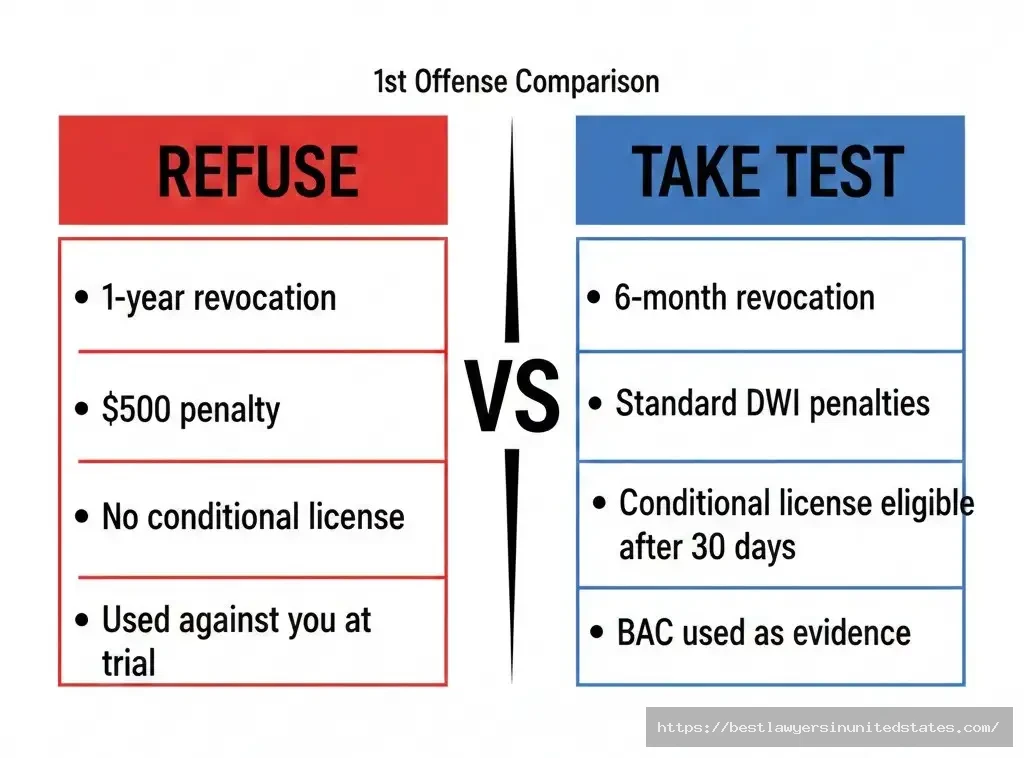
- First refusal: 1-year license revocation
- Second refusal (within 5 years): 18-month revocation or until age 21 (whichever is longer) for drivers under 21
- $500 civil penalty
- Separate from any criminal court penalties
Critical timeline: You have 15 days from arrest to request a DMV refusal hearing. Missing this deadline results in automatic revocation without any opportunity to challenge the suspension.
Refusal vs Failed Test Comparison
| Factor | Chemical Test Refusal | Failed Chemical Test |
|---|---|---|
| License penalty (1st) | 1-year revocation | 6-month revocation (DWI) |
| License penalty (2nd) | 18-month revocation | 18-month revocation (2nd DWI) |
| Criminal charges | Still charged with DWI | Charged with DWI |
| Conditional license | Not eligible | Eligible after 30 days |
| Trial evidence | Refusal used against you | BAC results used against you |
How Refusal Affects Your Criminal Case
Prosecutors present your refusal to juries as “consciousness of guilt.” The logic: innocent people don’t refuse to prove their innocence. Juries often view refusals more negatively than failed tests.
Defense attorneys counter this by arguing:
- Constitutional right to refuse warrantless searches
- Fear of inaccurate testing equipment
- Medical conditions preventing safe sample provision
- Officer intimidation or coercion
Can Police Force Chemical Testing?
Officers cannot physically force you to blow into a breathalyzer. However, they can obtain a warrant for blood draws in serious cases involving:
- Accidents with injuries or fatalities
- Aggravated DWI charges
- Repeat offenders
- Child endangerment situations
Recent trend: New York judges issue blood draw warrants much faster than in previous years. Some jurisdictions have “on-call” judges who approve warrants by phone within 30 minutes.
Two Separate Penalty Systems
DMV administrative penalties run independently from criminal court consequences. Even if a judge dismisses your DWI charge, the DMV revocation remains in effect unless you win a separate refusal hearing.
Important: You must fight two separate battles—one in criminal court and one at a DMV administrative hearing within 15 days of arrest.
How to Get a DWI Dismissed in New York
DWI cases can be dismissed or reduced when prosecutors lack sufficient evidence or when police violated your rights during the arrest process. Understanding dismissal grounds helps you evaluate your case realistically.
When Dismissal Is Possible
Insufficient probable cause for the stop: Police need reasonable suspicion to pull you over. Minor traffic violations (broken taillight, lane drift) provide sufficient cause, but random stops without observed violations violate Fourth Amendment protections.
2-hour rule violations: Chemical tests administered more than two hours after arrest face admissibility challenges. If the BAC evidence gets excluded and prosecutors have weak alternative proof, dismissal becomes possible.
Improper arrest procedures: Officers must follow specific protocols when making DWI arrests. Failures that can lead to dismissal include:
- Not reading implied consent warnings properly
- Conducting field sobriety tests on uneven surfaces
- Failing to observe the driver for 20 minutes before breath testing
- Administering tests without proper calibration records
Breathalyzer Calibration and Maintenance Issues
New York requires breath testing devices to undergo calibration every 10 days and annual certification by the Department of Health. Defense attorneys request maintenance records to identify:
- Missed calibration dates
- Failed quality control checks
- Repairs or malfunctions near your test date
- Expired certification periods
Defense strategy: One missed calibration can invalidate months of test results from that device, potentially affecting dozens of cases.
Odds of Getting DWI Dismissed
Realistic expectations: Complete dismissals occur in roughly 5-10% of New York DWI cases. More commonly (20-30% of cases), prosecutors reduce charges to DWAI or non-alcohol traffic violations when evidence weaknesses exist.
Dismissal more likely when:
- BAC was under 0.10% with no bad driving
- No accident or injuries occurred
- Field sobriety tests were borderline or not recorded
- Police made procedural errors
- First-time offense with clean record
Dismissal unlikely when:
- BAC exceeded 0.15%
- Accident caused injuries
- Child was in the vehicle
- Prior DWI convictions exist
- You refused chemical testing
Building a Dismissal Defense
Your attorney should immediately request:
- Police bodycam and dashcam footage
- Breathalyzer calibration records
- Officer training certifications
- Dispatch call recordings
- Witness statements
Critical deadline: Evidence requests must be filed within 30 days of arraignment in many New York counties. Delays can result in permanent loss of crucial footage.
DWI Plea Bargains in New York: Can DWI Be Reduced to DWAI?
New York prosecutors sometimes offer DWAI plea bargains when DWI evidence contains weaknesses. Understanding when reductions are possible helps you evaluate settlement options realistically.
When Prosecutors Offer DWAI Pleas
Common DWAI plea scenarios:
- BAC between 0.08-0.10% (just over the limit)
- No accident or property damage
- First offense with clean driving record
- Questionable probable cause for the stop
- Calibration issues with breath testing device
- 2-hour rule timing problems
What prosecutors require:
- Admission to impaired driving
- Payment of full DWAI fines and fees
- Completion of Drinking Driver Program
- Acceptance of 90-day license suspension
DWAI vs DWI: Why the Reduction Matters
| Factor | DWAI Plea | Standard DWI |
|---|---|---|
| Criminal record | No (first offense) | Yes (permanent misdemeanor) |
| Fine range | $300-$500 | $500-$1,000 |
| License action | 90-day suspension | 6-month revocation |
| Ignition interlock | Not required | Mandatory 6-12 months |
| Background checks | Traffic violation only | Shows as criminal conviction |
| Insurance impact | Smaller increase | 80-100% rate hike |
| Employment effect | Minimal | Bars many professional licenses |
Calculate your total costs: Use our DUI Cost Calculator to compare the financial impact of DWAI versus DWI conviction in New York.
DUI Cost Calculator
Estimate total DUI expenses by state and offense
Detailed Cost Breakdown
Payment Timeline
Bail bond, towing fees, car impound, attorney retainer
Initial court fines, DMV fees, DUI school enrollment, ignition interlock installation
Monthly probation fees, ignition interlock fees, DUI school payments, attorney balance
Insurance premium increases, license reinstatement, SR-22 filing fees
- Lost wages from missed work (court dates, jail time, DUI school) – $2,000-$10,000
- Job loss or difficulty finding employment – Varies
- Professional license suspension (doctors, lawyers, nurses, pilots) – Career ending
- Rideshare and transportation costs during suspension – $1,500-$5,000
- Travel restrictions and visa denials – Varies
- Security clearance loss – Career impact
- Child custody implications – Legal costs
- Rental car restrictions – Varies
- Personal relationships and mental health costs – Priceless
Why Prosecutors Resist DWAI Pleas
New York prosecutors face significant pressure to maintain tough-on-DWI reputations. Many district attorneys’ offices have written policies limiting DWAI pleas to specific circumstances.
County variations:
- New York City: Rare DWAI pleas except for 0.08-0.09% BAC cases
- Nassau/Suffolk: Aggressive prosecution with minimal plea bargaining
- Upstate counties: More flexible, especially in first-offense cases
- Westchester: Case-by-case basis depending on BAC and circumstances
Alternative Plea Options
When DWAI isn’t available, prosecutors might offer:
- Reckless driving (VTL § 1212): No alcohol finding but still a misdemeanor
- Speed contest (VTL § 1182): Traffic violation with license suspension
- Conditional discharge: DWI conviction with no jail if you complete probation successfully
Important: Judges must approve all plea bargains. Some judges reject DWAI pleas on principle, forcing cases to trial even when prosecutors agreed to reductions.
Negotiating the Best Plea
Your attorney’s negotiation leverage depends on:
- Strength of the state’s evidence
- Your prior record
- Court calendar backlog
- Availability of defense witnesses
- Quality of police work in your case
First offense plea bargain statistics: Approximately 65% of first-time DWI defendants in New York plead guilty to some charge rather than going to trial. Of those, roughly 15-20% receive DWAI reductions.
DWI License Suspension vs Revocation in New York
New York uses two distinct license penalties for DWI: suspension and revocation. Understanding the difference affects your ability to drive during the case and your reinstatement process afterward.
Suspension vs Revocation: Key Differences
License suspension:
- Temporary removal of driving privileges
- Automatic restoration after suspension period ends
- Can apply for conditional/restricted license
- Eligible for hardship privilege during criminal case
- DMV keeps your original license number
License revocation:
- Complete termination of driving privileges
- Must reapply for new license after revocation period
- Pay $100 re-application fee
- Retake written and road tests
- New license number issued
DWI penalties use revocation, not suspension. This means you can’t automatically resume driving when the revocation period ends—you must go through the full application process as if you never had a license.
Hardship Privilege (Pre-Conviction)
Before your DWI case concludes, you can apply for a hardship privilege allowing limited driving to:
- Work or business
- Medical appointments
- DWI-related court appearances
- Drinking Driver Program classes
Eligibility requirements:
- No commercial driver’s license
- Didn’t refuse chemical testing
- No prior DWI within 5 years
- Enroll in Drinking Driver Program within first 30 days
Application process: File Form DS-307 with supporting documentation at any DMV office. Processing takes 2-3 weeks. The privilege ends when your case concludes.
Conditional License (Post-Conviction)
After a DWI conviction, you become eligible for a conditional license once you:
- Serve minimum revocation period (typically 1-2 months)
- Complete at least 7 weeks of Drinking Driver Program
- Pay all required fees and surcharges
- Install ignition interlock device (if required)
Conditional license restrictions:
- Drive only to/from work, DDP classes, medical appointments
- No recreational driving
- Must carry conditional license and IID compliance card
- Violations result in immediate revocation
Timeline Example: First DWI Conviction
Day 1 (arrest): Police confiscate license, issue temporary permit valid 30 days
Day 30: Temporary permit expires, no driving allowed
Day 45: Conditional license hearing scheduled after completing 7 DDP weeks
Day 60: Conditional license issued (if approved)
Month 6: Minimum revocation period ends, can apply for full license restoration
Month 12: IID requirement ends, full unrestricted license restored
Multiple Revocation Periods
New York imposes separate revocation periods for:
- DMV administrative action (chemical test refusal)
- Criminal court conviction
These run concurrently (at the same time), not consecutively. However, both must be satisfied before full license restoration.
New York Conditional License for DWI
A conditional license allows limited driving privileges while your full license remains revoked for a DWI conviction. Understanding eligibility requirements and restrictions helps you maintain employment and meet obligations during your revocation period.
Conditional License Eligibility Requirements
You qualify for a New York conditional license only if you meet ALL these conditions:
Timing requirements:
- Completed minimum revocation period (usually 1 month for first DWI)
- Enrolled in and attending Drinking Driver Program for at least 7 weeks
- At least 30 days passed since conviction or guilty plea
Disqualifying factors:
- Chemical test refusal
- Commercial driver’s license holder
- Second DWI within 5 years
- Pending DWI charges in any jurisdiction
- Outstanding suspensions or revocations
Drinking Driver Program (DDP) Requirement
New York requires completion of a 7-week Drinking Driver Program before issuing a conditional license. The program includes:
Program components:
- 16 hours of classroom instruction
- Alcohol/drug evaluation and assessment
- Victim impact panel attendance
- Weekly attendance documentation
Program costs:
- Registration fee: $225
- Assessment fee: Varies by provider ($50-$150)
- Victim impact panel: $20-$50
DDP providers: Find approved programs at New York DMV’s DDP directory. Programs operate in every county with evening and weekend sessions available.
Conditional License Restrictions
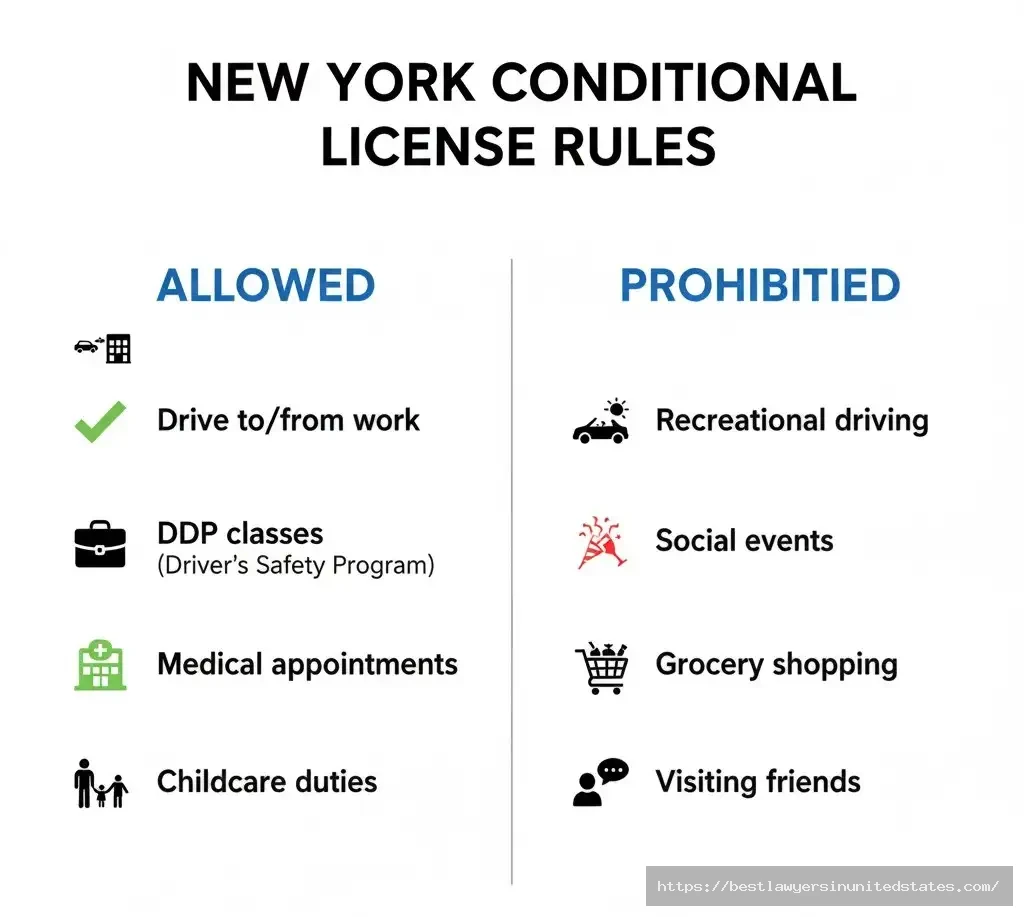
Your conditional license permits driving ONLY for:
- Travel to/from employment
- Travel to/from Drinking Driver Program classes
- Medical appointments for you or household members
- Childcare for dependent children
- Court-ordered obligations
Prohibited uses:
- Recreational driving
- Social events
- Grocery shopping (unless part of work duties)
- Visiting friends or family
Verification requirement: Employers must complete DMV Form MV-45C verifying your work schedule and commute necessity.
Application Process
Step 1: Complete 7 weeks of Drinking Driver Program
Step 2: Gather required documents:
- Completion certificate from DDP provider
- Employer verification form (MV-45C)
- Proof of insurance
- Payment for $75 application fee
Step 3: Submit application at any DMV office or by mail
Step 4: Receive approval within 2-3 weeks
Step 5: Install ignition interlock device (if required)
Step 6: Return to DMV with IID installation certificate to receive conditional license
Conditional License Violations
Operating outside permitted uses terminates your conditional license immediately and can result in:
- Extended revocation period (additional 6-12 months)
- Criminal charges for aggravated unlicensed operation
- Immediate arrest if stopped
- Additional fines up to $5,000
DMV monitors compliance through:
- Random employer verification calls
- IID data downloads showing unauthorized trips
- Police reports of conditional license violations
Ignition Interlock Device (IID) in New York
Leandra’s Law requires ignition interlock devices for all DWI convictions in New York, even first-time offenders. Understanding IID requirements, costs, and compliance obligations prevents violations that extend your revocation period.
What Is an Ignition Interlock Device?
An IID connects to your vehicle’s ignition system and requires you to blow into a breathalyzer before the engine starts. The device prevents the car from starting if it detects alcohol on your breath.
How IID works:
- Blow into device before starting vehicle
- Engine starts only if BAC registers 0.00% (zero tolerance)
- Random “rolling retests” required every 5-15 minutes while driving
- Device logs all tests, violations, and tampering attempts
- Monthly downloads transmit data to NYS DMV
IID Installation Requirements
New York DMV requires IID installation within 10 days of receiving your conditional or restricted license. You must use a DMV-approved provider from the state’s certified list.
Installation process:
- Schedule appointment with approved provider
- Provider installs device (takes 1-2 hours)
- Provider trains you on proper use
- Provider gives you installation certificate
- Submit certificate to DMV within 10 days
- DMV updates your license restrictions
Approved providers in New York:
- Smart Start
- LifeSafer
- Intoxalock
- Guardian Interlock
- Low Cost Interlock
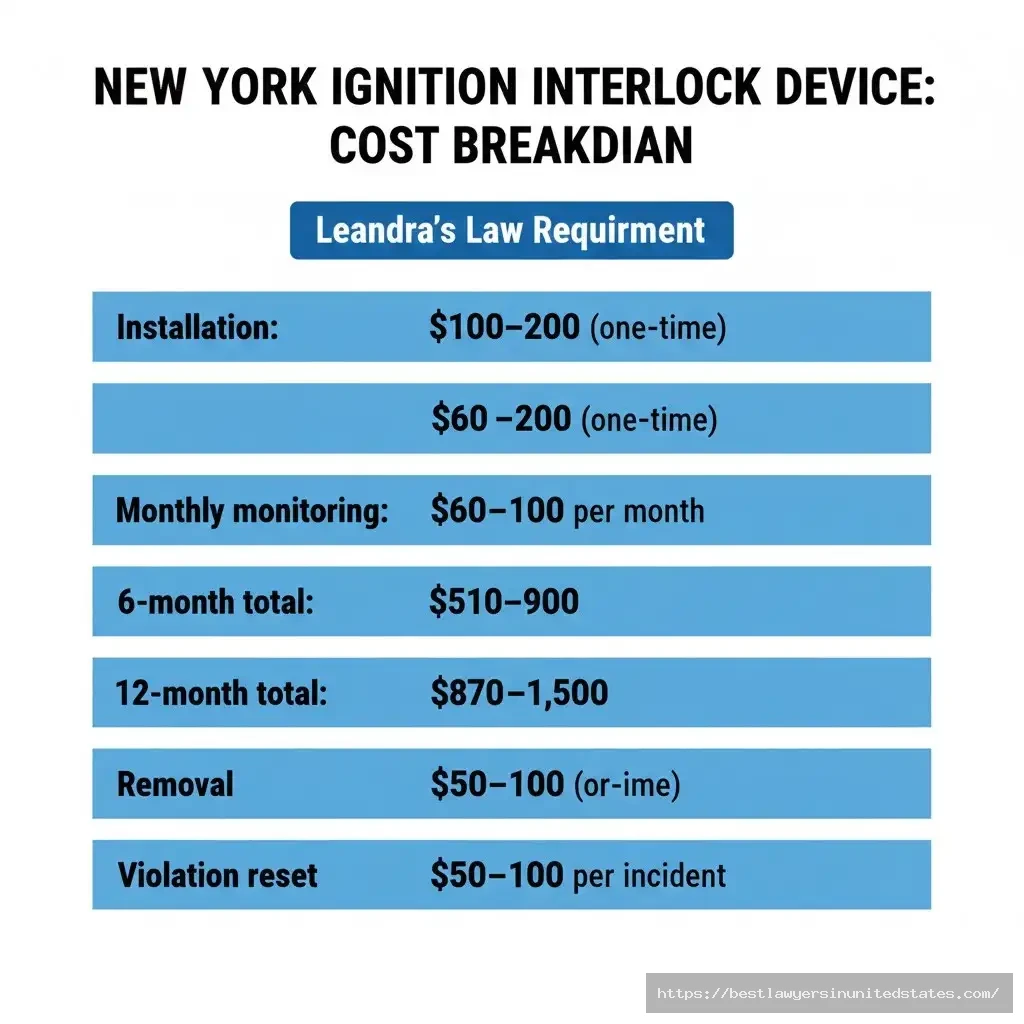
IID Costs and Duration
| Cost Category | Amount | Frequency |
|---|---|---|
| Installation | $100-$200 | One time |
| Monthly monitoring | $60-$100 | Every month |
| Removal | $50-$100 | One time |
| Violation reset | $50-$100 | Per incident |
| Calibration (included in monitoring) | Included | Monthly |
Duration requirements:
- First DWI: Minimum 6 months
- Aggravated DWI: Minimum 1 year
- Second DWI: Until 5 years conviction-free
- Leandra’s Law: Minimum 1 year
Financial assistance: New York provides IID cost subsidies for low-income defendants. Apply through your county’s STOP-DWI program for potential $60/month cost reduction.
IID Violations and Consequences
Major violations triggering penalties:
- Failed startup test (BAC above 0.00%)
- Failed rolling retest
- Missing rolling retest (didn’t blow within time limit)
- Tampering or attempting to bypass device
- Missing monthly calibration appointment
- Disconnecting the device
Penalties for violations:
- First violation: Warning letter from DMV
- Second violation: 30-day license suspension
- Third violation: Revocation of conditional license
- Criminal tampering charges possible (misdemeanor)
Important: The IID requirement period doesn’t begin until you install the device. Delays in installation extend your total revocation period.
Driving Without Required IID
Operating any vehicle without a court-ordered IID constitutes Aggravated Unlicensed Operation (AUO) under VTL § 511, a criminal misdemeanor bringing:
- Up to 1 year in jail
- $500-$5,000 fine
- Vehicle impoundment
- Extended license revocation (additional 1 year minimum)
Other vehicles: The IID requirement applies to ALL vehicles you operate, including employer vehicles, rental cars, and vehicles owned by family members. You cannot legally drive any car without an installed IID.
Zero Tolerance Law for Drivers Under 21 in New York
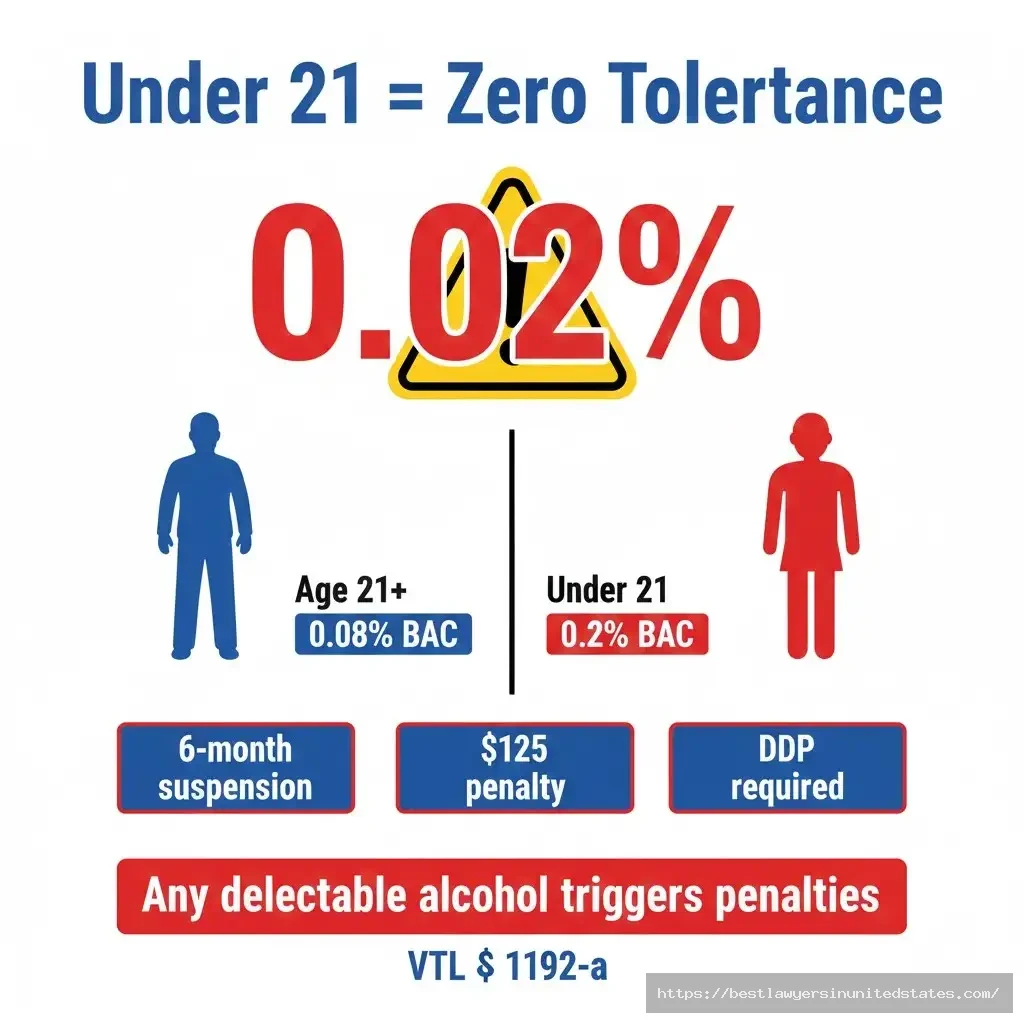
New York enforces strict zero tolerance for underage drinking and driving. Drivers under 21 face license sanctions for any detectable alcohol—even levels well below the standard 0.08% DWI threshold.
0.02% BAC Limit for Underage Drivers
Vehicle and Traffic Law § 1192-a creates a separate violation for drivers under 21 with BAC between 0.02% and 0.07%. This “zero tolerance” law recognizes that underage drivers may have minimal alcohol in their system from mouthwash, medication, or a single drink hours earlier.
BAC thresholds for under-21 drivers:
- 0.02-0.07%: Zero tolerance violation (VTL § 1192-a)
- 0.08-0.17%: Standard DWI (adult penalties apply)
- 0.18%+: Aggravated DWI (adult penalties apply)
Zero Tolerance Penalties
A zero tolerance violation is a civil violation handled by DMV, not criminal court. However, the consequences still create significant hardship:
First zero tolerance violation:
- License suspension: 6 months minimum (or until age 21, whichever is longer)
- Civil penalty: $125
- Re-application fee: $100
- Drinking Driver Program: Required before reinstatement
Second zero tolerance violation:
- License revocation: 1 year (or until age 21, whichever is longer)
- Civil penalty: $125
- Re-application fee: $100
- Must reapply and retest for new license
Zero Tolerance Hearing Process
Unlike adult DWI arrests, zero tolerance cases go through DMV administrative hearings, not criminal court:
Hearing timeline:
- Officer issues notice of hearing at time of arrest
- Hearing scheduled within 15 days
- You can request postponement (maximum 2 weeks)
- DMV hearing officer (not a judge) conducts hearing
- Decision issued same day or within 1 week
Hearing issues:
- Was driver under 21?
- Did officer have probable cause for stop?
- Was BAC between 0.02-0.07%?
- Was test administered properly?
No right to jury trial: Zero tolerance hearings are administrative proceedings where normal trial rights don’t apply. However, you can have an attorney represent you.
Drinking Driver Program Requirement
Even though zero tolerance is a civil violation, New York requires underage offenders to complete the full 7-week Drinking Driver Program before license reinstatement.
DDP completion timeline:
- Enroll within 30 days of hearing decision
- Attend 16 hours of classes over 7 weeks
- Complete evaluation and victim impact panel
- Receive completion certificate
- Submit certificate to DMV with reinstatement application
Criminal Charges for Higher BAC
If your BAC exceeds 0.08%, you face standard adult DWI charges in addition to or instead of zero tolerance:
| Your BAC | Charge | Court | Penalties |
|---|---|---|---|
| 0.02-0.07% | Zero tolerance | DMV hearing | 6-month suspension |
| 0.08-0.17% | DWI | Criminal court | Adult DWI penalties |
| 0.18%+ | Aggravated DWI | Criminal court | Enhanced penalties |
Dual penalties possible: Prosecutors can pursue criminal DWI charges while DMV proceeds with zero tolerance suspension. You face both systems simultaneously.
How Long Does a DWI Stay on Your Record in New York?
DWI convictions create permanent records that affect employment, housing, insurance, and professional licenses for years. Understanding what appears on different types of records helps you plan for long-term consequences.
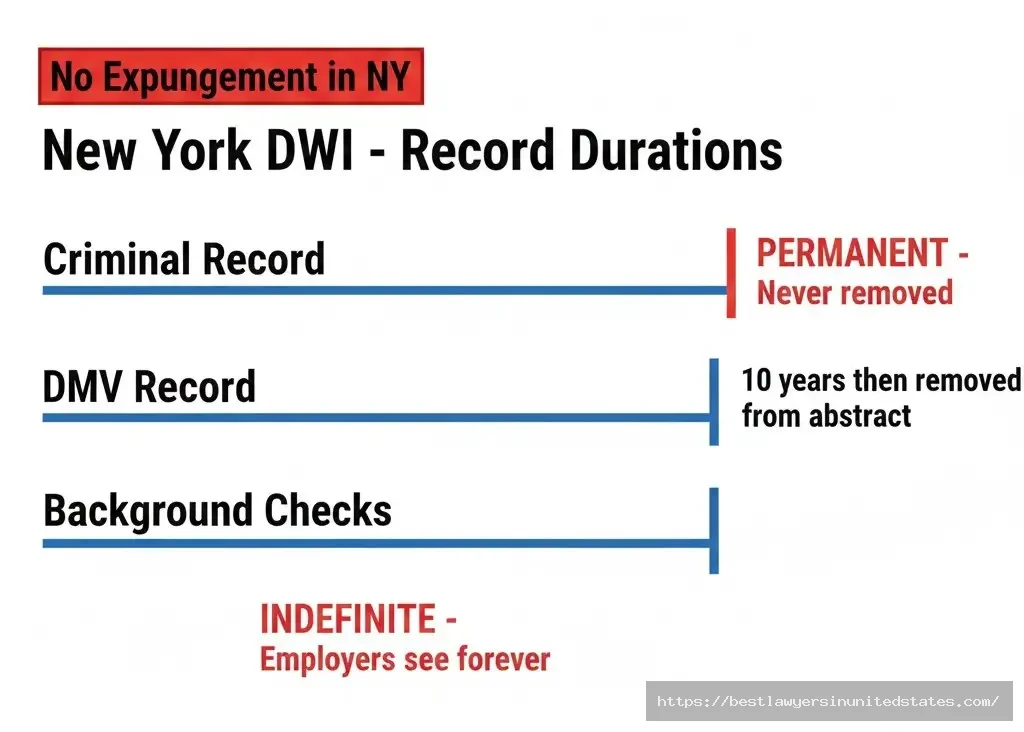
Criminal Record: Permanent
DWI misdemeanor and felony convictions remain on your New York criminal record permanently. The state does not allow expungement (complete erasure) of DWI convictions under any circumstances.
What stays on your criminal record:
- Conviction date and court location
- Charge (DWI, Aggravated DWI, DWAI-Drug)
- Sentence imposed (jail, fines, probation)
- Classification (misdemeanor or felony)
- Disposition (guilty plea or trial verdict)
Important: First-time DWAI (BAC 0.05-0.07%) appears only as a traffic violation, not a crime. It won’t show on criminal background checks run by employers.
NYS DMV Record: 10 Years
Your New York driving record shows DWI convictions for 10 years under VTL § 201. After 10 years, the conviction disappears from your DMV abstract but still exists on your criminal record.
DMV record includes:
- All DWI/DWAI convictions
- Chemical test refusals
- License suspensions and revocations
- Ignition interlock device requirements
- Conditional license restrictions
Who sees your DMV record:
- Insurance companies (for rate calculations)
- Employers requiring driving (CDL positions, delivery jobs)
- Courts during subsequent DWI cases
- Other states through interstate compacts
Background Check Visibility: Indefinite
Employer background checks through the NYS Division of Criminal Justice Services (DCJS) show DWI convictions indefinitely, regardless of how long ago they occurred.
Background check sources:
- DCJS fingerprint-based checks (most thorough)
- County court records (public access)
- Commercial background check companies
- Federal databases (FBI, TSA)
Jobs requiring disclosure:
- Healthcare positions (nurses, EMTs, pharmacists)
- Teaching and childcare
- Commercial driving (CDL)
- Law enforcement and security
- Professional licenses (attorneys, accountants)
- Government employment
Sealing vs Expungement in New York
New York’s sealing law (CPL § 160.59) allows sealing of some criminal convictions after 10 years, but DWI convictions are specifically excluded from eligibility.
Cannot be sealed:
- Any DWI conviction (VTL § 1192)
- Any DWAI-Drug conviction (VTL § 1192.4)
- Aggravated DWI convictions
- Felony DWI convictions
Can be sealed:
- Reckless driving (if reduced from DWI)
- Other traffic violations
- Unrelated misdemeanors and some felonies
Comparison to other states: Unlike California where DUI can sometimes be expunged, or Florida which allows sealing in limited circumstances, New York provides no relief for DWI convictions.
Impact Timeline
| Years After Conviction | Impact Level | What Changes |
|---|---|---|
| 0-3 years | Severe | Insurance at maximum rates, employment difficult |
| 3-5 years | High | Insurance rates decrease 20-40%, some jobs possible |
| 5-10 years | Moderate | Insurance near normal, DMV record still visible |
| 10+ years | Low | Removed from DMV record, insurance unaffected |
| Indefinite | Minimal | Still on criminal record but less employer concern |
Certificate of Relief from Disabilities
While you can’t seal or expunge a DWI, New York offers a Certificate of Relief from Disabilities that removes some automatic disqualifications for employment and professional licenses.
Eligibility:
- Completed all sentence requirements
- Waited required time period (1-5 years depending on offense)
- Demonstrated rehabilitation
- No new convictions
What the certificate does:
- Removes automatic license disqualifications
- Creates presumption of rehabilitation for employers
- Required for many professional licenses after DWI
- Does NOT hide the conviction from background checks
DWI and Auto Insurance in New York: How Much Will Rates Increase?
A DWI conviction triggers dramatic auto insurance rate increases in New York. Understanding how insurers calculate risk and set premiums helps you budget for long-term costs.
Average Insurance Rate Increase: 80-100%
New York drivers see insurance premiums jump 80-100% after DWI conviction. A policy costing $1,500 annually pre-conviction typically increases to $2,700-$3,000 annually.
Sample rate increases by company:
| Insurance Company | Pre-DWI Annual Rate | Post-DWI Annual Rate | Percentage Increase |
|---|---|---|---|
| Geico | $1,400 | $2,600 | 86% |
| State Farm | $1,600 | $3,000 | 88% |
| Progressive | $1,500 | $2,800 | 87% |
| Allstate | $1,700 | $3,200 | 88% |
| USNY | $1,300 | $2,500 | 92% |
Factors affecting your increase:
- BAC level (higher BAC = higher rates)
- Accident involvement
- Prior violations
- Age and gender
- Vehicle type and value
- Coverage limits carried
How Long Insurance Rates Stay High
Insurance companies surcharge DWI convictions for 3-5 years in New York. The conviction remains on your insurance record even after disappearing from your DMV abstract.
Typical rate decrease timeline:
- Years 1-3: Maximum surcharge (80-100% increase)
- Years 4-5: Reduced surcharge (40-60% increase)
- Years 6+: Minimal to no surcharge (0-20% increase)
Total 5-year insurance cost impact: $5,000-$8,000 additional premium payments compared to pre-DWI rates.
Will Your Insurer Drop You?
Many insurance companies cancel policies after DWI convictions. New York law allows insurers to non-renew your policy at the end of your current term (usually 6-12 months).
Companies most likely to drop you:
- Geico (non-renews most DWI policyholders)
- Progressive (depends on prior record)
- Liberty Mutual (selective non-renewal)
Companies more likely to keep you:
- State Farm (usually keeps first-offense customers)
- Allstate (case-by-case decisions)
- NYCM Insurance (New York-specific carrier)
Finding Insurance After DWI
If your current insurer drops you, these options remain available:
High-risk insurance carriers:
- Dairyland Insurance
- The General
- National General
- Bristol West
- Direct Auto Insurance
Average high-risk carrier costs: $3,500-$5,000 annually for minimum state coverage
SR-22 in New York: Not Required
Unlike many states, New York does NOT require SR-22 certificates (proof of insurance filing) for DWI convictions. However, you must maintain continuous insurance coverage throughout your revocation and conditional license periods.
Insurance requirements:
- Maintain coverage during entire license revocation
- Prove insurance to reinstate license
- Ignition interlock device must be listed on policy
- Lapses trigger automatic license re-suspension
Reducing Insurance Costs After DWI
Strategies to lower premiums:
- Complete defensive driving course ($75-$150, saves 10%)
- Increase deductibles ($500 to $1,000 saves 15-20%)
- Drop comprehensive/collision on older vehicles
- Bundle home and auto policies
- Pay annual premium upfront (avoid monthly fees)
- Shop multiple carriers every 6 months
Comparison shopping saves: DWI rate increases vary dramatically between companies. One carrier charging $3,500 might quote $2,400 for identical coverage. Always get 5+ quotes.
Total Cost of a DWI in New York: Financial Breakdown
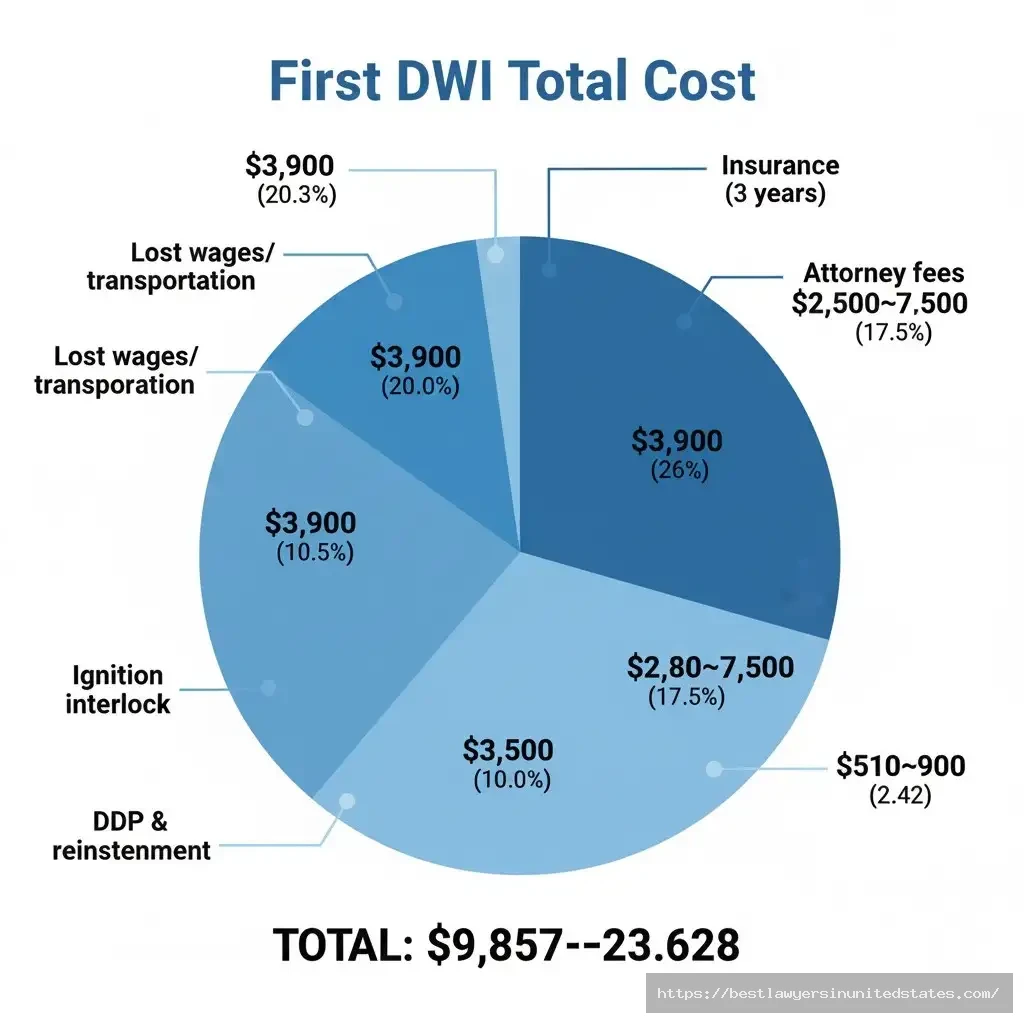
A first-time DWI conviction in New York costs $8,000-$25,000+ when accounting for all fees, fines, and long-term expenses. Understanding the complete financial impact helps you budget and plan for the years ahead.
Court Fines and Fees
Criminal court penalties (first DWI):
- Base fine: $500-$1,000
- Mandatory surcharge: $260
- Crime victim assistance fee: $175
- Court costs: $50-$200 (varies by county)
Total court costs: $985-$1,635
Aggravated DWI increases:
- Base fine: $1,000-$2,500
- Same surcharges and fees apply
- Total: $1,485-$3,135
Attorney Fees
Private DWI attorney costs in New York:
| Case Complexity | Fee Range | Payment Structure |
|---|---|---|
| Guilty plea (first offense) | $2,500-$5,000 | Flat fee |
| Trial (misdemeanor) | $5,000-$10,000 | Flat fee or hourly |
| Trial (felony) | $10,000-$25,000 | Hourly ($300-$500/hour) |
| Appeals | $5,000-$15,000 | Additional flat fee |
Geographic variations:
- NYC/Long Island: $3,500-$7,500 average
- Westchester: $3,000-$6,000 average
- Upstate: $2,000-$4,500 average
- Rural counties: $1,500-$3,500 average
Public defender: Available only if you qualify financially (typically household income under $35,000). Quality varies significantly by county.
License Reinstatement and DDP Costs
Drinking Driver Program:
- Program fee: $225
- Assessment fee: $50-$150
- Victim impact panel: $20-$50
- Total: $295-$425
License reinstatement:
- Re-application fee: $100
- Road test fee: $40 (if required)
- Written test fee: $10 (if required)
- New license fee: $17.50
- Total: $167.50
Ignition Interlock Device Costs
IID expenses (6-month minimum):
- Installation: $100-$200
- Monthly monitoring: $60-$100 × 6 months = $360-$600
- Removal: $50-$100
- Total 6-month cost: $510-$900
12-month Aggravated DWI: $870-$1,500
Multiple violations: Each failed test or missed calibration adds $50-$100 in reset fees.
Insurance Premium Increases
3-year insurance cost impact:
- Pre-DWI: $1,500/year × 3 years = $4,500
- Post-DWI: $2,800/year × 3 years = $8,400
- Additional cost: $3,900
5-year total impact: $5,000-$7,500 in extra premiums
Lost Income and Opportunity Costs
Potential income losses:
- Court appearances: 3-6 days missed work ($600-$1,500)
- Jail time: Up to 365 days (first DWI)
- Job loss: Common in CDL, healthcare, teaching positions
- Professional license suspension: Attorneys, nurses, real estate agents
Transportation alternatives during revocation:
- Taxi/rideshare: $200-$500/month
- Public transportation: $120-$160/month (MetroCard)
- 6-month revocation period: $720-$3,000 in extra transportation
Complete Cost Breakdown
| Expense Category | First DWI | Aggravated DWI |
|---|---|---|
| Court fines/fees | $985-$1,635 | $1,485-$3,135 |
| Attorney fees | $2,500-$7,500 | $5,000-$15,000 |
| DDP and reinstatement | $462-$593 | $462-$593 |
| Ignition interlock (6-12 mo) | $510-$900 | $870-$1,500 |
| Insurance (3 years) | $3,900 | $3,900 |
| Lost wages/transportation | $1,500-$5,000 | $2,000-$8,000 |
| TOTAL | $9,857-$23,628 | $13,717-$32,128 |
Use our calculator: Get a personalized cost estimate with our DUI Cost Calculator based on your specific circumstances, BAC level, and county.
Second DWI Costs
Second DWI within 10 years at least doubles first-offense costs:
- Higher fines: $1,000-$5,000
- Longer attorney battle: $7,500-$25,000
- Permanent IID until 5 years clean: $5,000-$9,000
- Felony possible: Additional attorney fees, lost employment
Estimated second DWI total: $25,000-$60,000+
Hidden Costs Often Overlooked
- Towing and impound: $150-$500
- Bail/bond: $500-$2,500 (refunded after case concludes)
- Drug/alcohol evaluation: $100-$300
- Travel expenses for court appearances
- Childcare during DDP classes and court dates
- Career advancement lost
- Security clearance denied
- Immigration consequences (green card denials, deportation)
Does a DWI Show Up on Background Checks in New York?
DWI convictions appear on most employment background checks in New York. Understanding what employers can see and which jobs bar DWI convictions helps you navigate the job search process after conviction.
Types of Background Checks
DCJS fingerprint-based checks: New York Division of Criminal Justice Services maintains the most comprehensive criminal records. These fingerprint checks show:
- All misdemeanor and felony convictions (indefinitely)
- Pending charges
- Arrest records (if resulted in conviction)
- Sealed convictions (visible to law enforcement only)
Commercial background checks: Companies like HireRight, Sterling, and Checkr search:
- County court records (vary by thoroughness)
- Statewide criminal databases
- Federal court records
- Sex offender registries
County court searches: Direct searches of court records where you were convicted show complete case files including:
- Charges filed
- Plea agreements
- Sentences imposed
- Probation terms
What Jobs Bar DWI Convictions
Automatic disqualification (legally required):
Commercial drivers: CDL holders face permanent or lifetime disqualification for DWI under federal regulations. First DWI = 1-year CDL suspension minimum. Second DWI = lifetime CDL revocation.
School bus drivers: New York Education Law § 3035 bars anyone with DWI conviction from driving school buses indefinitely.
Taxi/rideshare: NYC Taxi & Limousine Commission denies licenses to drivers with DWI convictions within 3 years.
Discretionary rejection (employer choice):
Healthcare positions:
- Registered nurses (NYS Office of Professions reviews each case)
- EMTs and paramedics (DOH certification may be denied)
- Pharmacists
- Home health aides
Education:
- Teachers (NYSED reviews convictions case-by-case)
- Teaching assistants
- Childcare workers
- School administrators
Law enforcement and security:
- Police officers (most departments have zero-tolerance policies)
- Correction officers
- Security guards
- Private investigators
Financial services:
- Bank tellers and loan officers
- Insurance agents
- Securities dealers
- Mortgage brokers
Disclosure Requirements
When you must disclose:
- Application asks about “convictions” (DWI is a conviction)
- Application asks about “criminal history”
- Job requires professional license review
- Position involves driving
When you don’t have to disclose:
- Application only asks about “felonies” and you have misdemeanor DWI
- Application only asks about convictions “in the past 7 years” and yours is older (but verify state law)
- No question asked (never volunteer)
DWAI exception: First-offense DWAI (BAC 0.05-0.07%) is a traffic violation, not a crime. You can honestly answer “no” to questions about criminal convictions.
New York Fair Chance Act
New York’s Fair Chance Act (also called “Ban the Box”) prohibits employers from asking about criminal history on initial applications. However, this applies only to:
- Private employers with 4+ employees
- After conditional job offer
Exceptions (can still ask on application):
- Police and law enforcement
- Jobs working with vulnerable populations
- Positions requiring specific licenses
- Jobs where conviction creates legal bar
Fighting Wrongful Denial
If an employer denies you based on your DWI, New York requires:
Article 23-A analysis factors:
- Nature and seriousness of the offense
- Time since conviction
- Your age at time of offense
- Evidence of rehabilitation
- Relationship between conviction and job duties
- Employer’s legitimate business interest
Certificate of Relief: Obtaining this certificate from the court creates a legal presumption of rehabilitation and removes automatic disqualifications for many professional licenses.
Professional License Impact
Licenses requiring disclosure and review:
| Profession | Reviewing Agency | Typical Impact |
|---|---|---|
| Attorney | NYS Bar Association | Possible denial, character review |
| Registered Nurse | Office of Professions | Case-by-case review |
| Real Estate Agent | DOS Division of Licensing | Temporary denial possible |
| Teacher | NYSED Office of Teaching | Review required |
| CPA | State Board of Accountancy | Evaluation process |
Most professional boards consider:
- Time since conviction (2+ years helps significantly)
- Completion of all sentence requirements
- Alcohol evaluation and treatment
- Letters of reference
- Employment history since conviction
DWI Court Process in New York: What to Expect
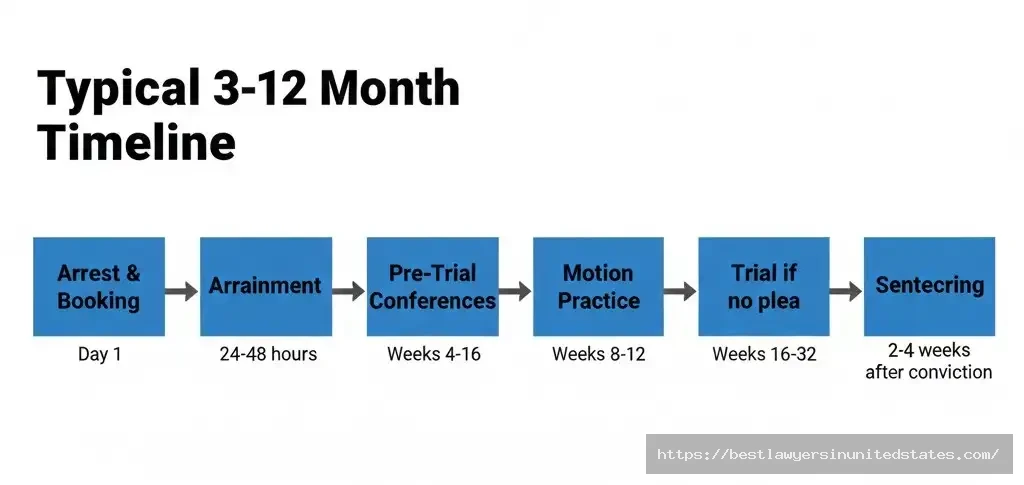
Understanding the New York DWI court process helps you prepare for each stage and make informed decisions about your case. The timeline from arrest to final resolution typically spans 3-12 months.
Arrest and Booking
At the scene:
- Officer conducts field sobriety tests
- Portable breath test (not admissible in court)
- Arrest if probable cause exists
- Handcuffed and transported to police station
At the station (1-3 hours):
- Booking and fingerprinting
- Implied consent warnings read
- Chemical test offered (breath or blood)
- License confiscated if you fail or refuse
- Temporary driving permit issued (valid 30 days)
- Appearance ticket or detention until arraignment
Quick Answer: You’ll typically be released within 4-6 hours unless you caused an accident, injured someone, or have outstanding warrants.
Arraignment (Within 24-48 Hours)
Your first court appearance occurs quickly after arrest. In NYC and larger counties, arraignments happen within 24 hours. Rural counties may take 48-72 hours.
What happens at arraignment:
- Judge reads charges against you
- Prosecutor requests bail or release conditions
- Your attorney enters “not guilty” plea
- Judge sets bail or releases you on own recognizance
- Court schedules next appearance date
- Temporary suspension begins (if you refused chemical test)
Bail amounts (first DWI):
- Standard DWI: Released without bail (ROR) in most counties
- Aggravated DWI: $500-$2,500 bail possible
- DWI with accident: $1,000-$10,000 bail
- Felony DWI: $5,000-$25,000 bail
DMV Refusal Hearing (If You Refused Testing)
If you refused chemical testing, NYS DMV schedules a separate administrative hearing within 15 days of arrest. You must request this hearing—it doesn’t happen automatically.
Hearing issues (only these, nothing else):
- Did officer have probable cause to stop you?
- Did officer have probable cause to arrest you?
- Did officer properly read implied consent warnings?
- Did you refuse testing?
Possible outcomes:
- Finding: Refusal occurred → 1-year license revocation effective immediately
- Finding: No refusal → License restored, no DMV penalty
- Adjournment granted → Additional evidence gathering, reschedule hearing
Important: This is NOT your DWI trial. Even if you win the refusal hearing, criminal DWI charges continue in criminal court.
Pre-Trial Conferences (Weeks 4-16)
Most counties schedule multiple pre-trial conferences where your attorney negotiates with prosecutors and reviews evidence.
What happens at conferences:
- Discovery exchange (police reports, videos, test results)
- Plea bargain discussions
- Motion argument schedules set
- Trial date scheduling
Typical conference schedule:
- Conference #1 (Week 4): Initial discovery, plea offer
- Conference #2 (Week 8): Motion deadlines set
- Conference #3 (Week 12): Final plea deadline
- Trial date (Week 16-24 if no plea)
Motion Practice (Weeks 8-12)
Your attorney files pre-trial motions challenging evidence and procedures:
Common DWI motions:
- Motion to suppress stop: Argues officer lacked probable cause
- Motion to suppress statements: Challenges Miranda violations
- Motion to suppress breath test: Attacks calibration, 20-minute observation, 2-hour rule
- Motion for discovery: Demands additional evidence
- Motion to dismiss: Argues legal insufficiency
Motion hearing process:
- Written motion filed with court
- Prosecutor files written opposition
- Oral argument before judge (30 minutes-2 hours)
- Judge issues decision (same day or within 2 weeks)
Trial (If No Plea Agreement)
Only 5-10% of New York DWI cases proceed to trial. Trials typically occur 6-12 months after arrest.
Jury vs bench trial:
- Jury trial: 6 jurors decide guilty/not guilty
- Bench trial: Judge alone decides (rare in DWI cases)
Trial timeline (typical 2-3 day trial):
Day 1:
- Jury selection (4-8 hours)
- Opening statements
- Prosecution witnesses begin (arresting officer)
Day 2:
- Prosecution completes witnesses
- Defense witnesses (if any)
- Cross-examination
Day 3:
- Closing arguments
- Jury instructions
- Jury deliberations (1-6 hours)
- Verdict
Verdict options:
- Guilty of all charges
- Guilty of lesser included offense (DWAI instead of DWI)
- Not guilty
Sentencing (2-4 Weeks After Conviction)
If you plead guilty or are convicted at trial, the judge schedules a sentencing hearing where you receive your official punishment.
Sentencing factors considered:
- Your BAC level
- Prior criminal history
- Accident involvement
- Cooperation with police
- Completion of alcohol evaluation
- Letters of support
- Victim impact statements (if accident)
Typical first DWI sentence:
- $500-$1,000 fine
- 3 years probation (no jail)
- Conditional discharge possible
- 6-month license revocation
- Drinking Driver Program
- Ignition interlock device
Jail alternatives:
- Community service (1-10 days)
- Electronic monitoring
- Weekend jail program
- Shock incarceration (rare)
Timeline Summary
| Stage | Typical Timing | Key Actions |
|---|---|---|
| Arrest to arraignment | 24-48 hours | Hire attorney before arraignment if possible |
| Arraignment to first conference | 2-4 weeks | Attorney reviews discovery, begins negotiations |
| Pre-trial conferences | 8-16 weeks | File motions, negotiate plea |
| Trial (if no plea) | 16-32 weeks | Present defense, jury verdict |
| Sentencing | 2-4 weeks after verdict | Complete pre-sentence requirements |
| Total case duration | 3-12 months | Varies by county, case complexity |
DWAI for Drugs and Combination DWAI in New York
New York prosecutes drug-impaired driving as aggressively as alcohol DWI. Understanding DWAI-Drug and DWAI-Combination charges helps you recognize that these offenses carry the same penalties as standard DWI.
DWAI-Drug (VTL § 1192.4)
DWAI-Drug charges apply when any drug impairs your ability to drive safely. “Drugs” includes:
- Illegal substances (marijuana, cocaine, heroin)
- Prescription medications (opioids, benzodiazepines, sleep aids)
- Over-the-counter drugs (antihistamines, cold medicine)
No per se limit: Unlike alcohol’s 0.08% standard, New York has no specific drug threshold. Prosecutors must prove impairment through:
- Officer observations and field sobriety tests
- Drug Recognition Expert (DRE) evaluation
- Blood or urine test showing drug presence
- Erratic driving patterns
DWAI-Combination (VTL § 1192.4-a)
DWAI-Combination charges involve impairment by alcohol AND drugs together. A BAC under 0.08% combined with any drug presence can support this charge.
Common combinations:
- 0.06% BAC + marijuana
- 0.05% BAC + prescription painkillers
- 0.04% BAC + cocaine
- Any BAC + multiple drugs
Why prosecutors like this charge: It allows conviction when alcohol alone wouldn’t reach DWI threshold and drug levels alone might not prove impairment.
DWAI-Drug Penalties
DWAI-Drug and DWAI-Combination carry identical penalties to standard DWI:
| Offense | Fine | Jail | License Revocation |
|---|---|---|---|
| First DWAI-Drug | $500-$1,000 | Up to 1 year | 6 months minimum |
| Second (within 10 years) | $1,000-$5,000 | Up to 4 years | 18 months minimum |
| Third (within 25 years) | $2,000-$10,000 | 2-7 years | 18 months minimum |
Additional requirements:
- Ignition interlock device mandatory
- Drinking Driver Program (even for drugs-only cases)
- Substance abuse evaluation and treatment
- Probation for first offense, prison likely for repeats
Drug Recognition Expert (DRE) Evaluations
When officers suspect drug impairment, they often call a specially trained Drug Recognition Expert to conduct a 12-step evaluation:
DRE evaluation components:
- Breath alcohol test (to rule out alcohol)
- Interview of arresting officer
- Preliminary examination and eye tests
- Divided attention psychophysical tests
- Vital signs check (pulse, blood pressure, temperature)
- Dark room eye examinations
- Muscle tone examination
- Injection site check
- Subject’s statements and interview
- Toxicological examination opinion
- Analysis and conclusions
- Toxicology laboratory results
DRE conclusions: The expert identifies which drug category caused impairment:
- Cannabis
- CNS depressants (alcohol, benzodiazepines)
- CNS stimulants (cocaine, meth)
- Hallucinogens
- Narcotic analgesics (opioids)
- Inhalants
- PCP
Marijuana DWI in New York
New York’s marijuana legalization in 2021 did NOT change DWAI-Drug laws. Driving while impaired by marijuana remains illegal and carries full DWI penalties.
Marijuana detection challenges:
- THC remains in blood/urine for days or weeks
- No reliable roadside test for current impairment
- Legal use vs illegal driving creates confusion
Prosecution strategy: Officers document:
- Marijuana odor in vehicle
- Bloodshot, glassy eyes
- Admissions to recent use
- Failed field sobriety tests
- DRE evaluation results
Defense opportunity: THC presence in blood doesn’t prove impairment at the time of driving. Your attorney can challenge the timeline between use and driving.
Prescription Medication DWAI
Taking prescription drugs as directed doesn’t automatically protect you from DWAI-Drug charges. Many medications warn “do not operate machinery” or “may cause drowsiness.”
Commonly prosecuted medications:
- Opioid painkillers (Oxycodone, Hydrocodone)
- Benzodiazepines (Xanax, Valium, Ativan)
- Sleep aids (Ambien, Lunesta)
- Muscle relaxants (Flexeril, Soma)
- Strong antihistamines (Benadryl at high doses)
Affirmative defense: You can assert that you took medication as prescribed and didn’t know about impairment risks. However, this defense requires:
- Valid prescription in your name
- Taking medication as directed
- No warning label about driving
- No prior knowledge of impairment effects
Reality: Juries rarely accept this defense. Prosecutors argue that responsible adults should know their medications’ effects.
New York STOP-DWI Program
New York pioneered the nation’s first STOP-DWI program in 1981. This county-based initiative combines enforcement, education, and rehabilitation to reduce impaired driving.
How STOP-DWI Works
Every New York county operates its own STOP-DWI program funded by DWI fines and penalties. Counties must spend these funds exclusively on impaired driving prevention.
STOP-DWI funding sources:
- 25% of all DWI fines collected in county
- NYS grants and matching funds
- Federal highway safety grants
- Private donations
2025-2026 program funding: $42 million statewide supporting programs in all 62 counties.
STOP-DWI County Programs
Each county designs its own initiatives based on local impaired driving patterns:
Enforcement initiatives:
- Sobriety checkpoints on high-risk roads
- Saturation patrols during holidays
- DWI crackdown weekends
- Drug Recognition Expert training for officers
Education programs:
- High school drunk driving presentations
- College campus awareness campaigns
- Senior citizen medication safety workshops
- Community education events
Rehabilitation:
- Drinking Driver Program funding
- Treatment court support
- Ignition interlock device subsidies for low-income defendants
- Victim impact panels
County STOP-DWI Coordinators
Each county employs a full-time STOP-DWI coordinator who:
- Plans enforcement strategies
- Coordinates with law enforcement agencies
- Manages education campaigns
- Tracks DWI statistics
- Administers program funding
Aggressive county programs (highest enforcement):
- Nassau County
- Suffolk County
- Erie County (Buffalo)
- Monroe County (Rochester)
- Westchester County
Special Traffic Options Program for Driving While Intoxicated (STOP-DWI)
First-time DWI offenders in some counties can participate in expanded programs offering:
- Intensive supervision instead of jail
- Enhanced alcohol education
- Counseling and treatment services
- Community service opportunities
Eligibility varies by county. Not all counties offer these alternatives, and participation requires prosecutor approval.
New York DWI Resources
These official resources provide accurate information about DWI laws, license restoration, and program requirements:
Government Agencies
New York State Department of Motor Vehicles (DMV)
- Website: dmv.ny.gov
- Phone: (518) 473-5595
- Services: License reinstatement, conditional licenses, IID compliance
New York State STOP-DWI Foundation
- Website: stopdwi.org
- Phone: (518) 432-7800
- Services: County program information, public education materials
NYS Division of Criminal Justice Services
- Website: criminaljustice.ny.gov
- Services: Criminal record information, fingerprinting locations
Drinking Driver Program Providers
Find state-approved DDP providers at: dmv.ny.gov/tickets/about-drinking-driver-program
Major provider locations:
- New York City: 15+ approved programs
- Long Island: 8 approved programs
- Upstate: Programs in every county
- Cost: $225 statewide
Legal Assistance
New York State Bar Association
- Lawyer referral service: (800) 342-3661
- Website: nysba.org
Legal Aid Society (income-qualified)
- NYC: (212) 577-3300
- Statewide directory: lawhelp.org/ny
Support Groups
Alcoholics Anonymous (AA) New York
- Phone: (212) 647-1680
- Website: nyintergroup.org
- Local meetings: Available in every county
SMART Recovery
- National helpline: (866) 951-5357
- Website: smartrecovery.org
- Science-based alternative to 12-step programs
FAQs About New York DWI Laws
Can you go to jail for a DWI in New York?
Quick Answer: Yes, first-time DWI carries up to 1 year in jail, though most first offenders receive probation instead.
Judges have discretion to impose jail sentences for first DWI convictions, but typically order probation, fines, and license revocation instead. However, jail becomes likely if:
- Your BAC exceeded 0.18% (Aggravated DWI)
- You caused an accident
- You had a child in the vehicle
- You have prior DWI or DWAI convictions
Second DWI within 10 years brings mandatory 30-day minimum jail sentence if charged as a misdemeanor, or up to 4 years prison if charged as a felony.
Do you lose your license immediately after a DWI in New York?
Quick Answer: No, but your license gets confiscated and you receive a temporary permit valid for 30 days.
At arrest, police take your physical license and issue a temporary driving permit. This permit expires 30 days later, creating a “grace period” before full suspension. During this time, you should:
- Hire an attorney immediately
- Request DMV refusal hearing (if you refused testing)
- Apply for hardship privilege
- Enroll in Drinking Driver Program
After 30 days, you cannot legally drive until you obtain a conditional license (requires DDP enrollment and minimum revocation period completion).
What is the most common sentence for a first DWI in New York?
Quick Answer: Conditional discharge with 3 years probation, $750-$1,000 in fines, 6-month license revocation, and mandatory ignition interlock device.
The “typical” first DWI sentence in New York includes:
- No jail time (suspended sentence or community service)
- Fine: $500-$1,000 plus $435 in surcharges/fees
- Probation: 3 years
- License revocation: 6 months minimum
- Ignition interlock: 6-12 months
- Drinking Driver Program: Mandatory completion
- Community service: 1-5 days possible
Judges deviate from this standard when BAC exceeded 0.15%, accidents occurred, or you have any prior record.
How long does a DWI stay on your record in New York?
Quick Answer: DWI convictions remain on your criminal record permanently and your DMV record for 10 years.
New York does NOT allow expungement of DWI convictions. The conviction stays on your:
- Criminal record: Indefinitely (shows on all background checks)
- DMV driving record: 10 years (affects insurance and lookback periods)
- DCJS fingerprint record: Permanently (employment screening)
After 10 years, the conviction disappears from your DMV abstract but employers conducting criminal background checks will still see it. First-offense DWAI (traffic violation) appears only on your driving record, not criminal record.
Can you get a DWI expunged in New York?
Quick Answer: No, New York does not allow expungement or sealing of any DWI conviction.
New York’s sealing law (CPL § 160.59) specifically excludes all DWI offenses from eligibility. This means:
- First-time DWI: Cannot be expunged or sealed
- Multiple DWI: Cannot be expunged or sealed
- DWAI-Drug: Cannot be expunged or sealed
- Felony DWI: Cannot be expunged or sealed
Your only option is obtaining a Certificate of Relief from Disabilities, which doesn’t hide the conviction but removes some automatic employment disqualifications. This certificate requires court application and proof of rehabilitation.
How to beat a DWI in New York?
Quick Answer: Challenge the stop’s legality, test administration procedures, or 2-hour rule violations through pre-trial motions and trial defenses.
Successful DWI defenses attack:
- Illegal stop: Officer lacked probable cause to pull you over
- 2-hour rule: Chemical test occurred more than 2 hours after arrest
- Breath test issues: Improper calibration, no 20-minute observation period, medical conditions affecting results
- Field sobriety tests: Conducted on uneven surface, officer wasn’t trained, you have medical conditions
- Rising BAC defense: Your BAC was under 0.08% while driving but rose above it by testing time
Complete dismissals are rare (5-10% of cases), but these defenses often result in reduced charges to DWAI or favorable plea bargains.
Will I go to jail for first-time misdemeanor DWI in New York?
Quick Answer: Unlikely unless your BAC was very high (0.18%+), you caused an accident, or you had a child passenger.
Most first-time DWI defendants in New York avoid jail through:
- Conditional discharge (no jail, probation only)
- Community service instead of jail
- Weekend jail program (rare, usually 2-4 weekends)
Jail becomes likely when:
- Aggravated DWI (BAC ≥ 0.18%)
- Accident with injuries
- Child under 16 in vehicle (automatic felony)
- Extremely poor driving (high speed, wrong way)
- Prior criminal record
Judges typically impose suspended jail sentences—meaning you face jail only if you violate probation terms.
Get Help With Your New York DWI Case
A DWI charge in New York creates serious consequences affecting your license, criminal record, employment, and finances for years. Understanding your rights and the court process helps you make informed decisions about your defense.
Key points to remember:
- New York uses DWI terminology, not DUI
- First-time DWI brings 6-month license revocation and mandatory ignition interlock
- The 2-hour rule for chemical testing is unique to New York
- DWAI plea bargains are possible but require weak prosecution evidence
- DWI convictions cannot be expunged or sealed
- Total costs typically range from $8,000-$25,000 for first offense
Need legal representation? Contact experienced New York DWI attorneys who understand state-specific defenses and local court procedures.
Email: [email protected]
Learn more about DWI laws in neighboring states: Compare New York’s strict penalties to New Jersey and Massachusetts to understand regional differences in impaired driving enforcement.
