
Delaware DUI laws carry serious consequences that start the moment police pull you over. A first offense means up to $1,500 in fines, 12 months license suspension, and potential jail time. Your license gets suspended immediately after arrest unless you request a hearing within 7 days.
Getting arrested for DUI in Delaware triggers two separate legal processes. The Delaware Division of Motor Vehicles handles your license suspension. Delaware Criminal Court handles criminal charges. Both move forward at the same time.
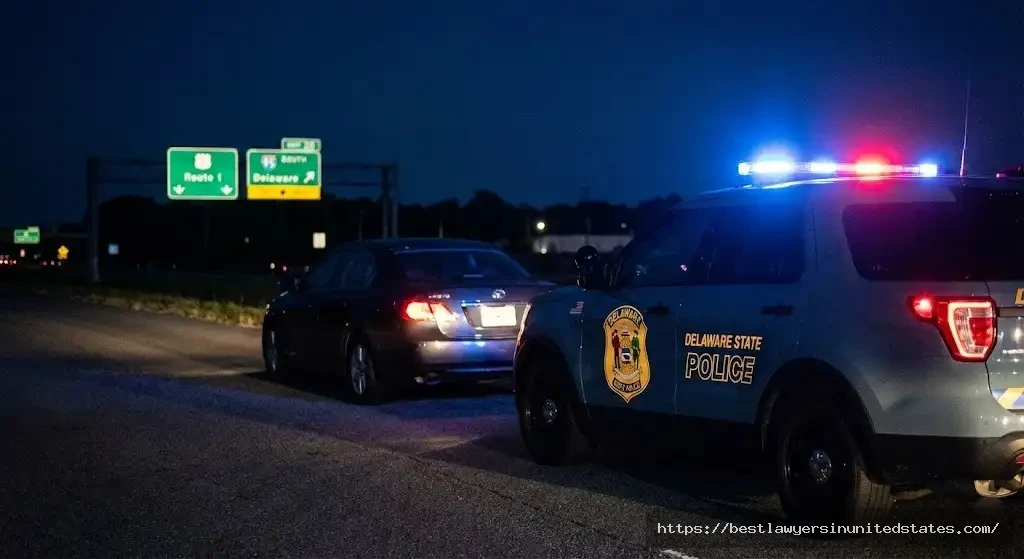
This guide explains what happens after a Delaware DUI arrest, how much it costs, and your legal options. We cover penalties for each offense level, the administrative hearing process, and defense strategies that work in Delaware courts.
Understanding Delaware DUI Law Basics
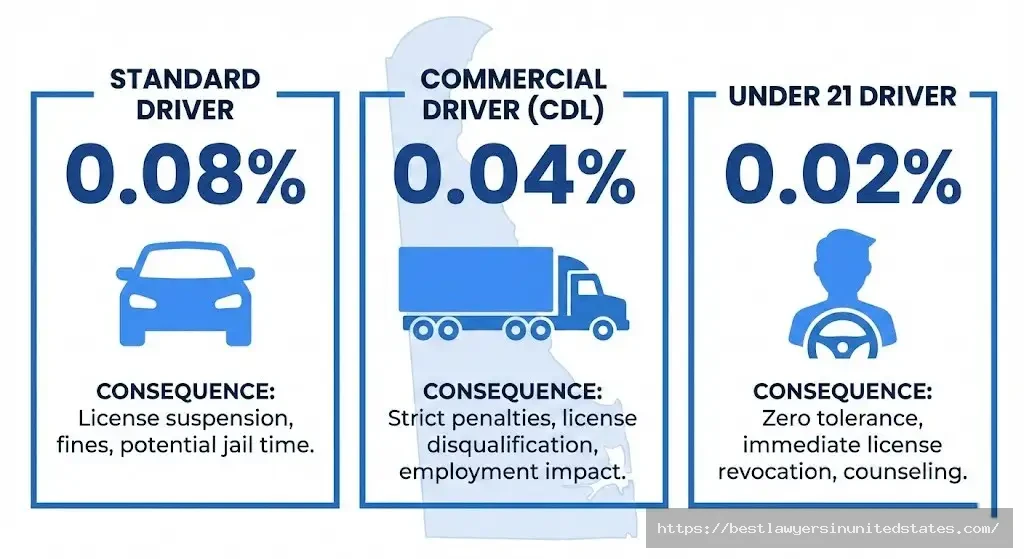
Delaware Code Title 21, Section 4177 makes it illegal to drive with a blood alcohol content of 0.08% or higher. The law also prohibits driving while impaired by drugs, including prescription medications and marijuana.
Police can arrest you for DUI even if your BAC is below 0.08%. Delaware allows arrests based on observed impairment alone. Officers look for signs like slurred speech, erratic driving, or failing field sobriety tests.
The law defines “driving” broadly. You don’t need to be actively moving the vehicle. Sitting behind the wheel with keys in the ignition counts as driving under Delaware law, even if the car is parked.
Delaware BAC Limits by Driver Type
| Driver Type | Legal BAC Limit | Violation Level |
|---|---|---|
| Standard drivers (21+) | 0.08% | Misdemeanor (1st-2nd offense) |
| Commercial drivers (CDL) | 0.04% | Federal violation + state DUI |
| Drivers under 21 | 0.02% | Zero tolerance violation |
| Any driver with drug impairment | Any detectable amount | Same as alcohol DUI |
Delaware’s DUI law covers all vehicles including cars, motorcycles, boats, and even bicycles on public roads. The Delaware State Police and local law enforcement agencies conduct regular DUI enforcement on major routes like I-95, Route 1, and Route 13.
What Happens When You Get a DUI in Delaware
The arrest process starts when police stop your vehicle. Officers look for probable cause such as weaving between lanes, speeding, or running a stop sign. Delaware State Police and local departments conduct DUI checkpoints on weekends and holidays.
The Arrest Process
Police ask you to perform field sobriety tests. These tests are voluntary in Delaware. You can refuse them without automatic penalties. However, refusal gives officers less evidence to work with.
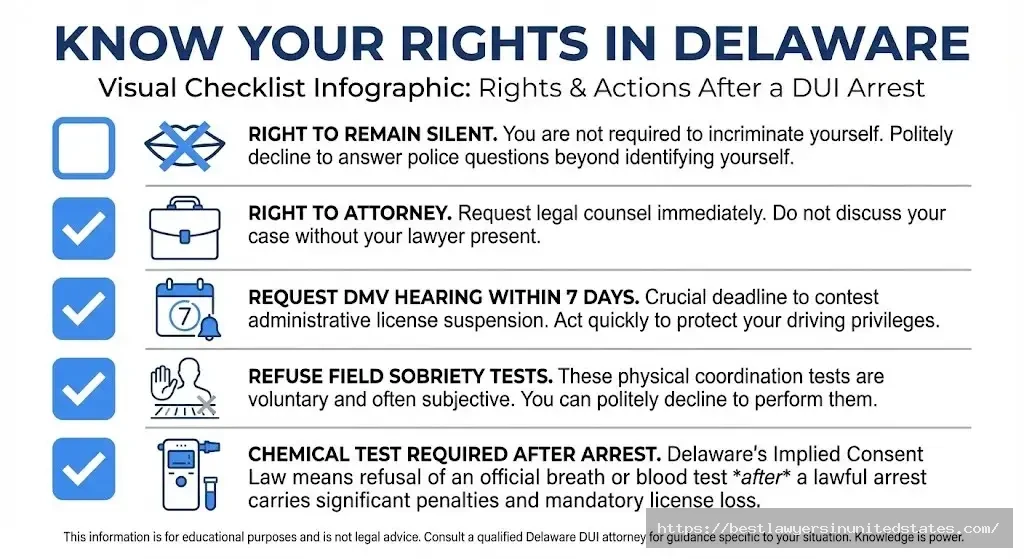
Officers then request a preliminary breath test (PBT) at the roadside. This test is also voluntary. The PBT reading helps officers decide whether to arrest you, but it’s not admissible in court.
After arrest, Delaware’s implied consent law requires you to submit to chemical testing at the police station. You can choose between a breath test using an Intoxilyzer machine or a blood test. Refusing this test triggers automatic license suspension.
First 48 Hours After Arrest
Police take you to the station for booking and chemical testing. The Delaware State Police operate testing facilities in Wilmington, Dover, and Georgetown. Local police departments also have approved testing equipment.
You receive a 15-day temporary license if your BAC exceeds 0.08% or if you refuse testing. This temporary license lets you drive until the Delaware DMV holds an administrative hearing.
The arresting officer gives you paperwork explaining your right to request a DMV hearing. You have exactly 7 days from arrest to request this hearing. Missing this deadline means automatic license suspension with no appeal.
Critical Deadlines After DUI Arrest
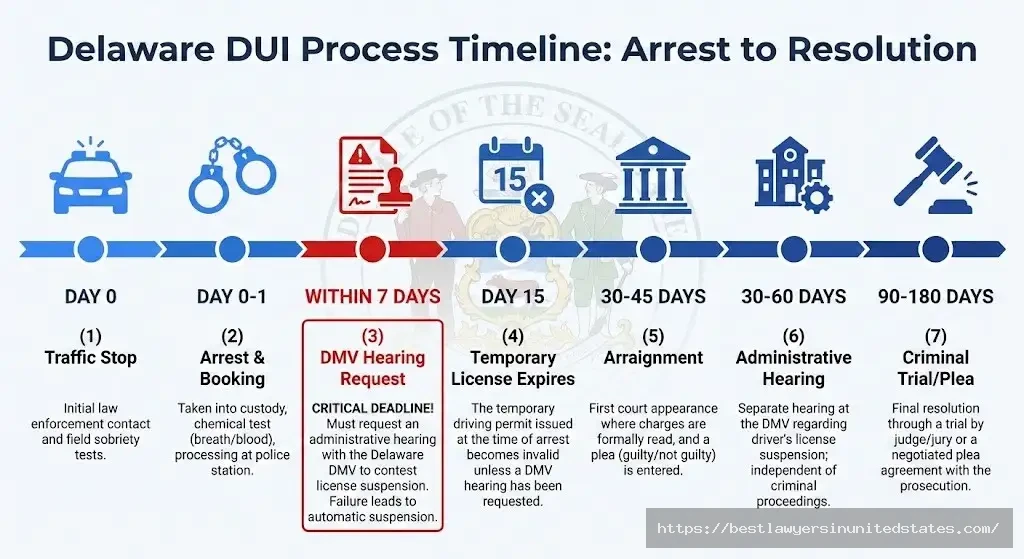
| Deadline | Action Required | Consequence of Missing |
|---|---|---|
| 7 days | Request DMV administrative hearing | Automatic license suspension (no appeal) |
| 15 days | Temporary license expires | Cannot drive legally |
| 30-45 days | Arraignment in Criminal Court | Warrant issued for arrest |
| 60 days | File motions to suppress evidence | Lose right to challenge stop/testing |
Bond is usually set at $500-$1,500 for first offenses. You can post bond and leave the same day. Delaware courts handle DUI cases in Justice of the Peace Court for arraignment, then transfer to Court of Common Pleas or Superior Court depending on offense level.
Delaware Administrative vs. Criminal DUI Process
Delaware prosecutes DUI through two completely separate systems. Understanding both is critical because you can lose your license through the DMV even if criminal charges get dismissed.
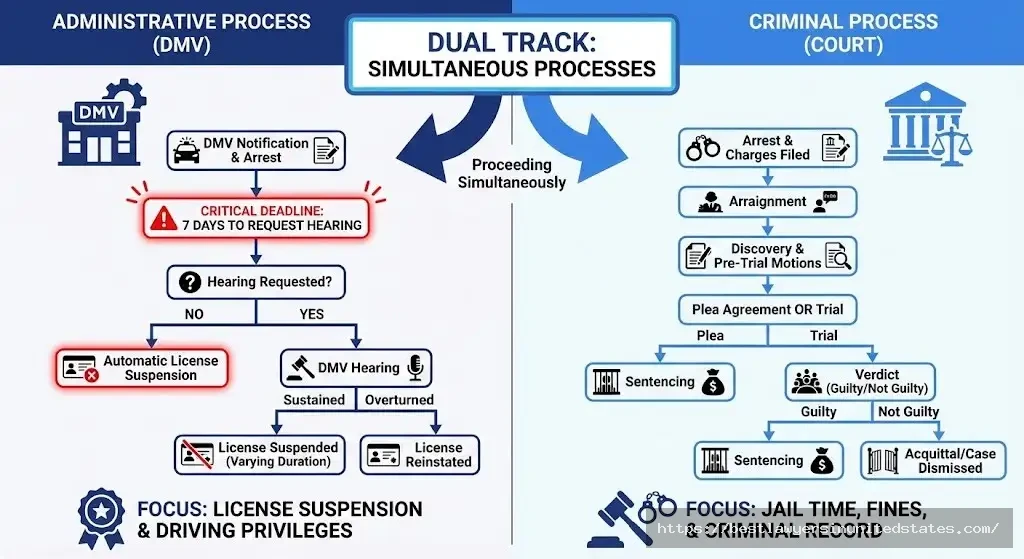
The administrative process through the Delaware Division of Motor Vehicles focuses only on your driving privileges. The criminal process through Delaware Criminal Court handles fines, jail time, and your criminal record.
Administrative License Suspension (DMV Process)
The Delaware DMV automatically suspends your license when you’re arrested with a BAC of 0.08% or higher, or if you refuse chemical testing. This suspension happens before any criminal conviction.
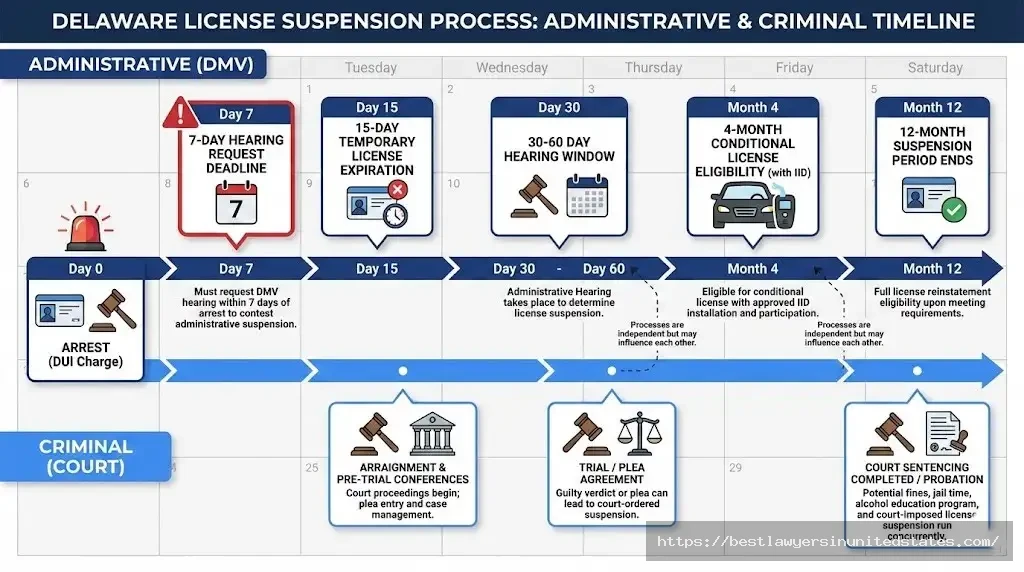
You must request an administrative hearing within 7 days of arrest to challenge the suspension. The hearing occurs at Delaware DMV offices in Wilmington, Dover, or Georgetown. You can appear in person or have an attorney represent you.
At the hearing, the DMV hearing officer reviews three things: whether police had probable cause to stop you, whether they had grounds to arrest you, and whether your BAC exceeded the legal limit. The officer doesn’t consider whether you were actually impaired.
If you win the administrative hearing, you keep your license regardless of criminal proceedings. If you lose, your license gets suspended for 3-12 months depending on your BAC level and prior offenses.
Criminal Court Process
Criminal DUI charges begin with arraignment in Delaware Justice of the Peace Court. This happens 30-45 days after arrest. The court formally reads charges and you enter a plea.
First and second DUI offenses are misdemeanors heard in Court of Common Pleas. Third and subsequent offenses may be felonies prosecuted in Superior Court in Wilmington, Dover, or Georgetown.
The criminal case proceeds independently of the DMV hearing. You can lose your license administratively but beat the criminal charges. Conversely, you can keep your license through the DMV but get convicted criminally.
Most DUI cases resolve through plea bargaining. Delaware prosecutors sometimes offer reduced charges like Reckless Driving Alcohol Related (RAR) for first offenses with no aggravating factors.
Check Your BAC Level
Not sure what your blood alcohol content might be? Understanding BAC helps you make informed decisions about driving. Body weight, gender, drinks consumed, and time elapsed all affect your BAC level.
Use our interactive BAC calculator to estimate your blood alcohol content based on these factors. The calculator shows how many drinks typically result in a 0.08% BAC for different body types.
BAC Calculator
Estimate your Blood Alcohol Content
• Commercial Driver (CDL): 0.04% BAC
• Drivers Under 21: 0.00-0.02% BAC (Zero Tolerance)
• Enhanced Penalties: 0.15% BAC or higher in most states
Keep in mind that even one or two drinks can impair driving ability in some people. Delaware law allows DUI arrests below 0.08% if officers observe impairment. Learn more about how BAC testing works and factors that affect results on our BAC calculator page.
Delaware DUI Penalties by Offense Level
Delaware DUI penalties increase dramatically with each conviction. The state counts prior DUI convictions within a 10-year lookback period. A DUI from 11 years ago doesn’t count toward your current offense level.
First Offense DUI Delaware
A first DUI conviction in Delaware is a misdemeanor. Courts typically show some leniency for first-time offenders with no aggravating factors.
Jail Time: 0-12 months possible, though most first offenders avoid jail entirely with completion of First Offender Program
Fines: $500-$1,500 plus court costs of approximately $200-$400
License Suspension: 12 months, but you can apply for a conditional license after 4 months if you install an ignition interlock device
Other Penalties:
- Mandatory DUI education program (12-hour course, costs $150-$300)
- DUI evaluation by approved provider ($200-$400)
- Possible community service (up to 200 hours)
- SR-22 insurance requirement for 3 years
- 6 points added to license (if reduced to RAR)
First offenders often qualify for the Delaware First Offender Program. This program requires completing DUI education, evaluation, and possible treatment. Successful completion may reduce some penalties.
Second Offense DUI Delaware
Second DUI convictions within 10 years carry mandatory jail time. Delaware courts take repeat offenses seriously.
Jail Time: Mandatory minimum 60 days to 18 months
Fines: $750-$2,500 plus court costs
License Suspension: 18 months, conditional license possible after 12 months with ignition interlock device
Other Penalties:
- Mandatory ignition interlock device for 12-18 months
- DUI treatment program (may require inpatient if evaluation shows addiction)
- Higher insurance rates (typically 80-100% increase for 3-5 years)
- Possible vehicle impoundment
- No eligibility for First Offender Program
Delaware judges rarely grant probation instead of jail for second offenses. Expect to serve at least the 60-day minimum unless your attorney negotiates a reduced charge.
Third Offense DUI Delaware
Third DUI offenses may be charged as felonies if they occur within 10 years of prior convictions. This is where Delaware DUI laws get extremely serious.
Jail Time: Mandatory minimum 90 days to 3 years (felony range if applicable)
Fines: $1,500-$3,000 plus court costs
License Suspension: 24 months minimum, permanent revocation possible
Other Penalties:
- Mandatory ignition interlock device for 18-24 months
- Designation as habitual offender
- Mandatory substance abuse treatment
- Possible vehicle forfeiture
- Federal restrictions (gun ownership, voting rights if felony)
- Significant employment consequences
A third DUI conviction creates a permanent criminal record that affects employment, housing, and professional licensing. Many employers won’t hire anyone with a felony DUI.
Fourth, Fifth, and Sixth+ DUI Offenses
Delaware treats these as serious felonies with harsh penalties. Cases are prosecuted in Superior Court.
Jail/Prison Time: 1-5 years minimum, up to 15 years for extreme cases
Fines: $3,000-$5,000 plus court costs
License Suspension: Permanent revocation (no possibility of reinstatement)
Other Penalties:
- Mandatory minimum 2-year prison sentence
- Lifetime ignition interlock requirement if driving privileges ever restored
- Vehicle forfeiture
- Loss of voting rights
- Federal firearm prohibition
Delaware courts show no leniency for repeat DUI offenders. These cases almost always result in prison time.
Delaware DUI Penalties Comparison Table
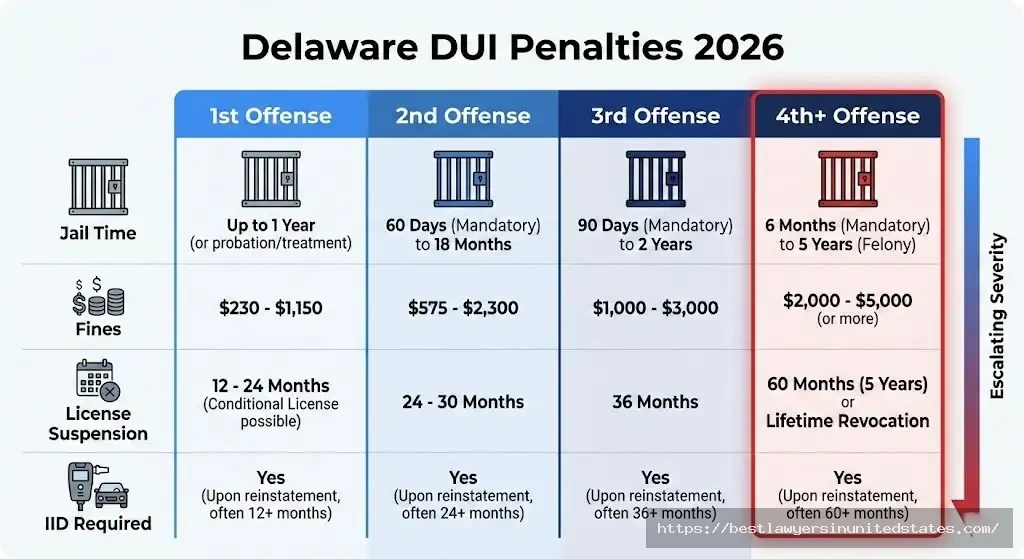
| Offense | Jail/Prison | Fines | License Suspension | IID Required | Felony? |
|---|---|---|---|---|---|
| 1st DUI | 0-12 months (usually probation) | $500-$1,500 | 12 months | Optional for early license | No |
| 2nd DUI | 60 days-18 months (mandatory) | $750-$2,500 | 18 months | Yes (12-18 months) | No |
| 3rd DUI | 90 days-3 years (mandatory) | $1,500-$3,000 | 24+ months | Yes (18-24 months) | Possible |
| 4th+ DUI | 1-5 years minimum | $3,000-$5,000 | Permanent | Lifetime | Yes |
Calculate Your Total DUI Costs in Delaware
Delaware DUI convictions cost far more than just court fines. When you add attorney fees, insurance increases, lost wages, and mandatory programs, the total often exceeds $10,000 for a first offense.
Our interactive DUI cost calculator helps you estimate the true financial impact. Enter your offense level, employment situation, and whether you need an attorney to see realistic cost projections.
DUI Cost Calculator
Estimate total DUI expenses by state and offense
Detailed Cost Breakdown
Payment Timeline
Bail bond, towing fees, car impound, attorney retainer
Initial court fines, DMV fees, DUI school enrollment, ignition interlock installation
Monthly probation fees, ignition interlock fees, DUI school payments, attorney balance
Insurance premium increases, license reinstatement, SR-22 filing fees
- Lost wages from missed work (court dates, jail time, DUI school) – $2,000-$10,000
- Job loss or difficulty finding employment – Varies
- Professional license suspension (doctors, lawyers, nurses, pilots) – Career ending
- Rideshare and transportation costs during suspension – $1,500-$5,000
- Travel restrictions and visa denials – Varies
- Security clearance loss – Career impact
- Child custody implications – Legal costs
- Rental car restrictions – Varies
- Personal relationships and mental health costs – Priceless
The calculator includes hidden costs like towing fees, bail bonds, license reinstatement fees, and the long-term insurance rate increases that last 3-5 years. Get a detailed breakdown on our DUI cost calculator page.
Is a DUI a Felony in Delaware?
Most Delaware DUI charges are misdemeanors. First and second offenses are always misdemeanors regardless of BAC level or circumstances.
Third DUI offenses become felonies if they occur within 10 years of previous convictions. The prosecutor reviews your criminal history and decides whether to charge the case as a misdemeanor or felony.
Delaware also charges felony DUI when the arrest involves:
- Serious bodily injury to another person (vehicular assault)
- Death of another person (vehicular homicide)
- Fourth or subsequent DUI offense
- DUI while license is suspended for prior DUI
Felony DUI carries 1-15 years prison time depending on circumstances. A felony conviction creates a permanent record that appears on all background checks. You lose the right to vote while incarcerated and face federal restrictions on gun ownership.
The difference between misdemeanor and felony DUI is substantial. Misdemeanors typically result in probation or county jail time under 1 year. Felonies mean state prison, loss of civil rights, and much harder consequences for employment and housing.
How Long Does a DUI Stay on Your Record in Delaware?
Delaware DUI convictions create two separate records: your criminal record and your driving record. These records have different retention periods and purposes.
Criminal Record
DUI convictions remain on your criminal record permanently in Delaware. Employers, landlords, and licensing boards can see the conviction indefinitely through background checks.
Delaware does not allow expungement of DUI convictions. Once convicted, the charge stays on your record for life. This differs from some states that allow DUI expungement after 5-10 years.
The only way to avoid a permanent criminal record is to get charges dismissed or reduced to a non-DUI offense like Reckless Driving Alcohol Related (RAR).
Driving Record
The Delaware Division of Motor Vehicles maintains your driving record separately from criminal records. DUI convictions appear on your DMV record for 10 years for insurance purposes.
However, the DMV keeps DUI convictions in its system permanently for calculating repeat offender status. If you get another DUI 15 years later, Delaware won’t count it as a second offense, but the original conviction still appears in DMV records.
Insurance companies typically look back 3-5 years when setting rates. After 5 years without another DUI, most insurers stop surcharging for the old conviction even though it remains on your record.
Background Check Implications
FBI and national background checks show Delaware DUI convictions permanently. This affects:
- Employment applications (especially jobs requiring driving)
- Professional licenses (medical, legal, real estate, teaching)
- Security clearances
- Immigration and citizenship applications
- Gun ownership (if felony DUI)
- College admissions
- Apartment rentals
Some employers only ask about felonies, not misdemeanors. A misdemeanor DUI may not appear on basic employment screenings. However, thorough background checks always reveal DUI convictions.
Delaware DUI Points System Explained
Delaware does not assess points for DUI convictions. The state suspends your license entirely instead of adding points.
You only receive points if charges get reduced to a traffic violation. Reckless Driving Alcohol Related (RAR) carries 6 points on your Delaware license. Standard reckless driving carries 5 points.
Points matter for insurance rates and license suspension. Delaware suspends licenses when drivers accumulate 12-13 points within 24 months. However, DUI cases bypass the points system entirely through mandatory suspension.
If you complete a DUI sentence and get your license reinstated, you start with a clean point total. The DUI conviction doesn’t add points to your renewed license.
Delaware operates on a points system for traffic violations:
- Speeding 15+ mph over limit: 4-5 points
- Running red light: 3 points
- Failure to yield: 3 points
- Following too close: 2 points
Accumulating points from other violations while on DUI probation can trigger additional license suspension. Keep your driving record clean during and after DUI proceedings.
Ignition Interlock Device Requirements in Delaware
Delaware requires ignition interlock devices (IID) for most DUI offenders. An IID is a breathalyzer connected to your vehicle’s ignition system. You must provide a breath sample to start the car.

Who Must Install an IID
First Offense: Optional for conditional license after 4 months of suspension. Installing an IID lets you drive 8 months earlier than waiting out the full 12-month suspension.
Second Offense: Mandatory for 12-18 months. You cannot get a conditional license without installing an IID.
Third+ Offense: Mandatory for 18-24 months minimum. Some cases require lifetime IID even after license reinstatement.
High BAC (0.15%+): First offenders with very high BAC may face mandatory IID requirements.
How Ignition Interlock Devices Work
You blow into the device before starting your car. If your BAC exceeds 0.025%, the vehicle won’t start. The device also requires random “rolling retests” while driving.
The IID records all test results and transmits data to Delaware DMV monthly. Violations like failing a test, tampering with the device, or missing a retest trigger penalties including extended IID requirements or license suspension.
Delaware-Approved IID Providers
Delaware only allows certified IID providers. Approved vendors include:
- Smart Start Inc. (locations in Wilmington, Dover, Newark)
- Intoxalock (installations throughout Delaware)
- LifeSafer (available statewide)
- Guardian Interlock Systems
You must use an approved provider or the DMV won’t accept your installation. Contact providers directly for appointment scheduling.
IID Costs in Delaware
Installation typically costs $70-150 depending on vehicle type. Monthly monitoring and calibration fees run $60-90 per month.
Total First Year Costs: $800-$1,200
- Installation: $70-150
- Monthly fees ($60-90 × 12): $720-1,080
- Removal: $50-75
The Delaware Division of Motor Vehicles offers an indigent program that reduces IID costs for low-income offenders. You must demonstrate financial hardship through documentation of income and expenses.
IID Violations and Consequences
Violations include:
- Failed breath test (0.025% BAC or higher)
- Missed rolling retest while driving
- Tampering with device
- Driving another vehicle without IID
- Missing calibration appointments
Each violation extends your IID requirement by 1-3 months. Multiple violations can result in license suspension and new criminal charges for violating probation.
Delaware law prohibits anyone else from blowing into your IID. Having a passenger start your car violates the terms and gets reported to the DMV.
Delaware First Offender Program
Delaware offers a First Offender Program designed to help people with no prior DUI convictions avoid the harshest penalties. This program is one of the most important opportunities for first-time offenders.
Program Eligibility
You qualify for the First Offender Program if:
- This is your first DUI offense in any state
- You had no prior DUI convictions within 10 years
- The DUI didn’t involve serious injury or death
- You weren’t driving on a suspended license
- Your BAC was under 0.15%
Second and subsequent offenders don’t qualify. The program is only available once in your lifetime.
What the Program Includes
The First Offender Program requires:
DUI Evaluation: A certified evaluator assesses your alcohol use and risk level. Cost: $200-400.
DUI Education: 12-hour education course covering drunk driving risks, Delaware laws, and decision-making. Cost: $150-300.
Treatment (if recommended): Some evaluations require outpatient treatment. This can range from 10 weekly sessions to intensive programs. Cost: $500-2,000.
Community Service: Courts may order 50-200 hours of community service.
Benefits of Completing the Program
Successful completion offers significant benefits:
- Reduced jail time (most first offenders avoid jail entirely)
- Earlier eligibility for conditional license with IID
- Possible reduction of charges to Reckless Driving Alcohol Related (RAR)
- Better plea bargaining position with prosecutors
- Shows court you’re taking responsibility
Failure to complete the program results in full sentencing including potential jail time and maximum fines. Delaware courts take program completion seriously.
How to Apply
Your attorney typically enrolls you in the First Offender Program as part of plea negotiations. The prosecutor and judge must approve your participation.
After enrollment, you have 6-12 months to complete all requirements. The Delaware Division of Motor Vehicles tracks completion. You must submit proof of finishing each component.
Contact approved DUI evaluation providers through the Delaware Department of Health and Social Services. They maintain a list of certified evaluators statewide.
Delaware License Suspension and Reinstatement Process
Delaware DUI arrests trigger immediate license suspension through two different processes. Understanding both is critical because missing deadlines makes everything harder.
Administrative License Suspension Process
Police confiscate your license immediately if your BAC exceeds 0.08% or if you refuse chemical testing. You receive a 15-day temporary license on the spot.
Within 7 days, you must request an administrative hearing with the Delaware Division of Motor Vehicles. Send your hearing request to:
Delaware DMV
303 Transportation Circle
Dover, DE 19901
Or request online through the Delaware DMV website. Missing this 7-day deadline means automatic suspension with no opportunity to contest it.
The DMV schedules hearings within 30-45 days. Hearings occur at DMV offices in Wilmington (2230 Hessler Blvd), Dover (303 Transportation Circle), or Georgetown (23 The Circle).
At the hearing, the hearing officer reviews whether police had probable cause and whether test results were valid. You can testify and present witnesses. Many people hire DUI attorneys to handle these hearings.
If you win, your license stays valid during criminal proceedings. If you lose, suspension begins immediately and lasts:
- 3 months (first offense, BAC 0.08-0.14%)
- 6 months (first offense, BAC 0.15%+)
- 12 months (first offense, test refusal)
- 18 months (second offense)
- 24 months (third+ offense)
How to Get Your License Back After DUI
License reinstatement requires completing several steps. Missing any step delays reinstatement for weeks or months.
Step 1: Complete Suspension Period
You must wait out the full suspension period. Delaware doesn’t allow early reinstatement except through the conditional license program with ignition interlock.
Step 2: Complete First Offender Program
Submit proof of finishing DUI evaluation, education, and any required treatment. The DMV won’t reinstate without this documentation.
Step 3: Install Ignition Interlock Device (if required)
Schedule installation with an approved IID provider before requesting reinstatement. Bring proof of installation to the DMV.
Step 4: Obtain SR-22 Insurance
Contact your insurance company for SR-22 certificate of financial responsibility. Delaware requires SR-22 for 3 years after DUI conviction.
SR-22 insurance typically costs 50-100% more than standard coverage. Shop multiple insurers because rates vary significantly.
Step 5: Pay Reinstatement Fees
Delaware charges reinstatement fees totaling $266-$400 depending on your case:
- License reinstatement fee: $266
- SR-22 filing fee: $50-75 (paid to insurance company)
- Additional fees for multiple suspensions: $75-100
Step 6: Visit DMV in Person
Bring all documentation to a Delaware DMV office:
- Proof of IID installation (if applicable)
- SR-22 certificate
- First Offender Program completion certificates
- Payment for reinstatement fees
- Valid identification
The DMV issues a new license the same day if all paperwork is in order. The process takes 30-60 minutes at the DMV office.
Conditional License vs. Full Reinstatement
Conditional licenses let you drive before the full suspension period ends. You must install an ignition interlock device and meet eligibility requirements.
First offenders can apply for conditional licenses after 4 months. Second offenders must wait 12 months. Third offenders must wait 18 months.
Conditional licenses restrict driving to:
- Employment and work-related purposes
- Medical appointments
- DUI program attendance
- Religious services
- Court appearances
Violating conditional license restrictions results in immediate suspension and possible new criminal charges. Delaware State Police conduct frequent compliance checks.
Full license reinstatement removes all restrictions after completing the full suspension period and meeting all requirements.
Understanding Blood Alcohol Content and DUI Testing
Blood alcohol content measures the amount of alcohol in your bloodstream. Delaware law prohibits driving with a BAC of 0.08% or higher for standard drivers.
BAC depends on several factors:
- Amount of alcohol consumed
- Your body weight
- Gender (women typically metabolize alcohol slower)
- Food in stomach (eating slows absorption)
- Time elapsed since drinking
One standard drink equals 12 oz beer (5% alcohol), 5 oz wine (12% alcohol), or 1.5 oz liquor (40% alcohol). Most people’s BAC increases approximately 0.02% per standard drink.
How Many Drinks Equal 0.08% BAC?
The number varies by body weight and gender:
For a 180-pound male:
- 4 standard drinks in 1 hour = approximately 0.08% BAC
- 3 drinks in 1 hour = approximately 0.05% BAC
For a 140-pound female:
- 3 standard drinks in 1 hour = approximately 0.08% BAC
- 2 drinks in 1 hour = approximately 0.05% BAC
These are estimates. Individual metabolism varies significantly. Some people reach 0.08% with fewer drinks.
Your BAC continues rising for 30-90 minutes after your last drink as alcohol absorbs into your bloodstream. You can feel fine but still have a rising BAC.
Delaware DUI Testing Methods
Delaware police use three testing methods to measure impairment:
Field Sobriety Tests

Standardized field sobriety tests include:
- Horizontal Gaze Nystagmus (following a pen with your eyes)
- Walk-and-Turn (walking heel-to-toe in a line)
- One-Leg Stand (balancing on one foot)
These tests are voluntary. You can refuse without automatic penalties. However, refusal gives officers probable cause to arrest based on other observations.
Police also use non-standardized tests like reciting the alphabet or touching your nose. These aren’t scientifically validated but officers use them anyway.
Preliminary Breath Test (PBT)
The roadside breath test uses a small handheld device. Results aren’t admissible in Delaware courts but help police decide whether to arrest you.
PBT tests are voluntary. Refusing doesn’t trigger license suspension like refusing the evidential breath test at the station does.
Evidential Chemical Testing
After arrest, Delaware requires you to submit to chemical testing under the implied consent law. You choose between:
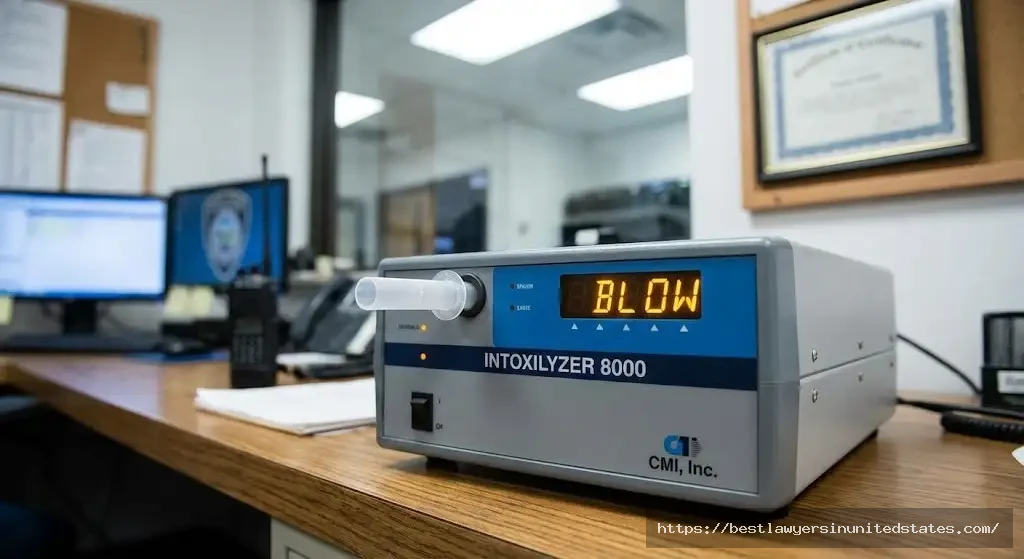
Breathalyzer (Intoxilyzer): Most common test. Delaware uses Intoxilyzer 8000 machines at police stations. Results are available immediately.
Blood Test: More accurate but takes longer for results. Requires a trained phlebotomist. Useful if you’re unconscious or officers suspect drug impairment.
Urine Test: Rarely used in Delaware. Only for drug DUI cases when blood testing isn’t available.
Testing occurs at Delaware State Police stations in Wilmington, Dover, and Georgetown, or at local police departments with approved testing equipment.
Can You Refuse a Breathalyzer in Delaware?
You can refuse chemical testing, but Delaware’s implied consent law imposes serious penalties:
Administrative Penalties for Refusal:
- Immediate 12-month license suspension (first refusal)
- 18-month suspension (second refusal)
- No conditional license available
- No possibility of early reinstatement
Criminal Penalties:
- Refusal is admissible in court as evidence of guilt
- Prosecutors often seek harsher penalties for refusals
- Judges view refusal negatively at sentencing
Does Refusal Help Your Case?
Refusing eliminates one piece of evidence (your BAC number). However, prosecutors can still prove DUI through:
- Officer testimony about your behavior and appearance
- Failed field sobriety tests
- Erratic driving captured on dashcam
- Statements you made
- Smell of alcohol
Delaware courts instruct juries that refusal can indicate consciousness of guilt. In practice, refusal rarely helps and often makes cases harder to defend.
The only situations where refusal might make sense:
- Your BAC is obviously very high (over 0.15%)
- You have multiple prior DUI convictions
- You’re facing felony charges where refusal can’t make things worse
Consult an attorney immediately if you refused testing. You need aggressive representation because prosecutors pursue refusal cases vigorously.
Drug DUI and Prescription Medications in Delaware
Delaware Code § 4177 prohibits driving under the influence of any drug, including legal prescription medications and marijuana. You don’t need to be “drunk” to get a DUI. Any impairment counts.
Marijuana DUI in Delaware
Delaware legalized recreational marijuana possession in 2023, but driving under marijuana’s influence remains illegal. There is no legal limit for THC like there is for alcohol.
Police determine marijuana impairment through:
- Drug Recognition Expert (DRE) evaluation
- Observable symptoms (red eyes, odor, impaired speech)
- Failed field sobriety tests
- Blood test showing THC presence
THC stays in your system for days or weeks after use. A positive blood test doesn’t prove you were impaired while driving. This creates defense opportunities.
Delaware marijuana DUI cases are harder for prosecutors to prove than alcohol DUI. However, convictions carry the same penalties as alcohol DUI.
Prescription Medication DUI
Taking prescription medication as directed doesn’t automatically make you guilty of DUI. Delaware law recognizes an affirmative defense if:
- You had a valid prescription
- You took the medication as prescribed
- You weren’t warned about driving impairment
- The impairment wasn’t reasonably foreseeable
However, this defense is narrow. If your prescription label warns “Do not operate machinery” or “May cause drowsiness,” you can’t use this defense.
Common prescription drugs that cause DUI arrests:
- Benzodiazepines (Xanax, Valium, Ativan)
- Opioid pain medications (Oxycodone, Hydrocodone)
- Sleep medications (Ambien, Lunesta)
- Muscle relaxants (Flexeril, Soma)
- ADHD medications (Adderall at high doses)
Combining prescription drugs with alcohol dramatically increases impairment. Delaware prosecutors aggressively charge these cases.
Illegal Drug DUI
Any illegal drug in your system while driving violates Delaware DUI law. This includes:
- Cocaine
- Methamphetamine
- Heroin
- MDMA (Ecstasy)
- LSD
- Psilocybin mushrooms
Delaware doesn’t require proof of impairment for illegal drugs. Detectable presence in your blood is sufficient for conviction.
Drug Testing Procedures
Unlike alcohol, drugs require blood or urine testing. Delaware State Police request blood draws for suspected drug DUI.
Blood is drawn at hospitals by trained phlebotomists. Delaware Medical Center in Wilmington, Bayhealth Hospital in Dover, and Beebe Healthcare in Lewes commonly perform DUI blood draws.
Blood samples get sent to Delaware Division of Forensic Science laboratory for analysis. Results take 4-8 weeks. The lab tests for dozens of drugs including:
- THC (marijuana)
- Cocaine and metabolites
- Opiates (heroin, morphine, codeine)
- Amphetamines
- Benzodiazepines
- Prescription medications
Chain of custody issues create defense opportunities in drug DUI cases. Blood samples must be properly stored, labeled, and tested. Mistakes happen frequently.
Defending Against DUI Charges in Delaware
Delaware DUI cases aren’t unbeatable. Police make mistakes, testing equipment fails, and prosecutors sometimes overcharge. Understanding common defenses helps you evaluate your case.
Common DUI Defense Strategies
Illegal Traffic Stop
Police need reasonable suspicion to stop your vehicle. Weaving within your lane isn’t enough. The Delaware Constitution requires specific, articulable facts justifying the stop.
If police lacked probable cause, your attorney can file a motion to suppress all evidence from the stop. This often results in case dismissal.
Faulty Breathalyzer Results
Intoxilyzer machines require regular calibration and maintenance. Delaware regulations mandate monthly inspections and annual recertification.
Your attorney can subpoena maintenance records to verify proper calibration. Missing or improper maintenance invalidates test results.
Breathalyzers also produce false positives from:
- Mouth alcohol (recent use of mouthwash)
- GERD or acid reflux
- Certain medical conditions
- Radio frequency interference
- Improper observation period (police must watch you for 20 minutes before testing)
Rising Blood Alcohol
Your BAC continues rising for 30-90 minutes after drinking stops. You might be under 0.08% while driving but over 0.08% when tested 30-60 minutes later.
This defense works if you consumed alcohol shortly before driving. Expert witnesses can calculate your BAC at the time of driving versus time of testing.
Improper Blood Test Procedures
Blood testing requires strict protocols. The phlebotomist must use proper sterilization, the blood must be stored at correct temperatures, and chain of custody must be maintained.
Challenges to blood testing include:
- Contamination during collection
- Improper storage causing fermentation
- Missing chain of custody documentation
- Lab errors in analysis
- Blood clotting affecting results
Medical Conditions Mimicking Intoxication
Several medical conditions produce symptoms that look like intoxication:
- Diabetes (high or low blood sugar)
- Inner ear problems affecting balance
- Neurological conditions
- Extreme fatigue
- Certain medications
Medical records proving these conditions help establish reasonable doubt.
Reducing DUI to Reckless Driving Alcohol Related (RAR)
Delaware prosecutors sometimes offer reduction to Reckless Driving Alcohol Related (RAR) instead of DUI. This plea bargain reduces penalties significantly.
RAR vs. DUI Comparison:
| Factor | DUI Conviction | RAR Conviction |
|---|---|---|
| Criminal charge | Misdemeanor DUI | Misdemeanor reckless driving |
| Jail time | Possible | Rare (usually probation) |
| License suspension | 12 months minimum | 30-90 days typical |
| Ignition interlock | Required | Not required |
| Points | 0 (suspended license) | 6 points |
| Insurance impact | 80-100% increase | 40-60% increase |
| Employment impact | Severe (DUI on record) | Less severe (reckless driving) |
When Prosecutors Offer RAR:
- First offense with no aggravating factors
- BAC under 0.12%
- No accident or property damage
- No children in vehicle
- Strong defense to DUI charges
- Breathalyzer or blood test issues
RAR still involves alcohol-related charges. It’s not ideal but far better than DUI conviction. Your attorney negotiates RAR reductions during plea bargaining.
When You Need a DUI Attorney
First offenses with low BAC and no complications might resolve favorably without an attorney. However, most people benefit from legal representation.
You definitely need a DUI lawyer if:
- Second or subsequent DUI offense
- BAC over 0.15%
- Accident with injuries
- Commercial driver’s license at risk
- Professional license required for employment
- Prior criminal record
- You refused chemical testing
- Evidence problems exist
Delaware DUI attorneys typically charge $2,500-$7,500 depending on case complexity. This seems expensive but often saves you far more in reduced penalties.
What a DUI Attorney Can Do:
- Challenge illegal stops and searches
- Suppress breathalyzer or blood test results
- Negotiate charge reductions to RAR
- Represent you at DMV administrative hearings
- File pretrial motions to dismiss
- Identify weaknesses in prosecution’s case
- Present expert witness testimony
- Negotiate minimal jail time or probation
Public defenders are available if you can’t afford private counsel. Delaware Public Defender’s Office represents indigent defendants in Wilmington, Dover, and Georgetown.
However, public defenders handle 200+ cases simultaneously. Private attorneys provide more attention to your case.
Delaware DUI Laws for Out-of-State Drivers
Getting a DUI while visiting Delaware creates complications for your home state license. Delaware participates in the Interstate Driver License Compact, which shares conviction information between states.
How Delaware DUI Affects Your Home State License
Delaware reports DUI convictions to your home state through the National Driver Register. Most states treat out-of-state DUI convictions the same as in-state convictions.
Your home state typically:
- Suspends your license for the same period Delaware would
- Adds points to your driving record (if your state uses points)
- Requires you to complete your own state’s DUI programs
- Counts the conviction toward repeat offender status if you get another DUI
Some states have harsher penalties than Delaware. California, Arizona, and Florida often impose longer suspensions than Delaware’s original sentence.
Must You Return to Delaware for Court?
Yes, you must appear for all court dates unless your attorney gets permission for your absence. Delaware courts rarely excuse out-of-state defendants from appearing.
Failing to appear results in:
- Bench warrant for your arrest
- Additional charges for failure to appear
- Forfeiture of any bond posted
- Possible extradition if you’re arrested in your home state
Most out-of-state defendants hire Delaware attorneys to handle court appearances. Your attorney can appear for some hearings while you attend only critical proceedings like trial.
Can You Do DMV Hearing Remotely?
Delaware DMV administrative hearings can occur by phone for out-of-state drivers. You must request telephone participation when filing your hearing request.
However, appearing in person is better. Hearing officers view remote participation less favorably. If possible, travel to Delaware for the administrative hearing.
Your attorney can appear on your behalf if you can’t travel. This is better than telephone participation.
Interstate Compact Implications
The Driver License Compact means Delaware shares information with 44 states. Only Georgia, Massachusetts, Michigan, Tennessee, and Wisconsin don’t participate fully.
If your home state is a compact member:
- You can’t get a license there while suspended in Delaware
- The conviction appears on your home state driving record
- Your insurance rates increase in your home state
- You may face additional penalties imposed by your home state
Some people try getting licenses in different states to avoid Delaware suspension. This doesn’t work. The National Driver Register prevents licensing in any state while suspended elsewhere.
Special Rules for Neighboring State Residents
Maryland, Pennsylvania, and New Jersey residents arrested for DUI in Delaware face reciprocal enforcement.
Delaware State Police frequently patrol I-95, Route 1, and Route 13 near state borders. Summer beach traffic to Delaware’s coastal areas produces many out-of-state DUI arrests.
If you’re from a nearby state, expect full enforcement of Delaware DUI laws. Police don’t give breaks to out-of-state drivers.
Zero Tolerance Law for Drivers Under 21
Delaware’s zero tolerance law prohibits drivers under 21 from operating vehicles with any measurable alcohol in their system. The legal limit is 0.02% BAC instead of 0.08%.
A 0.02% BAC equals less than one beer. Even mouthwash or certain foods can produce this reading.
Penalties for Underage DUI in Delaware
First offense penalties for drivers under 21:
- License suspension: 2-6 months
- Fine: $200-$500
- Community service: 25-50 hours
- Mandatory alcohol education program
- Parent/guardian notification
- Possible probation
Delaware treats underage DUI separately from adult DUI. The conviction doesn’t count toward repeat offender status if you get another DUI after turning 21.
However, two underage DUI convictions result in adult-level penalties including longer suspension and higher fines.
Educational Programs for Underage Offenders
Delaware requires underage offenders to complete:
Prime for Life Program: 12-hour course specifically designed for young drivers. Covers decision-making, peer pressure, and alcohol’s effects. Cost: $150-$250.
Victim Impact Panel: Listening to presentations from DUI crash victims and their families. Usually 2-hour session. Cost: $25-$50.
Parents must attend some portions of these programs with their children. Delaware courts believe parental involvement reduces repeat offenses.
How Underage DUI Affects College Admission
Delaware underage DUI convictions appear on criminal background checks. However, most colleges only ask about felonies, not misdemeanors.
The bigger impact is loss of driving privileges. Many students need cars for internships, jobs, and getting to campus. A 6-month suspension during your college years creates significant hardship.
Some universities and professional programs (nursing, education, law) require disclosure of all criminal convictions. An underage DUI can affect acceptance into these competitive programs.
DUI Laws for Commercial Drivers in Delaware
Commercial driver’s license (CDL) holders face stricter DUI standards. Federal regulations require states to impose harsher penalties on commercial drivers.
CDL BAC Limit: 0.04%
Commercial drivers violate federal law at 0.04% BAC, half the standard driver limit. This applies:
- While operating any commercial vehicle
- While operating your personal vehicle
- While off-duty (if arrested, your CDL is affected)
A DUI in your personal car on the weekend suspends your CDL even though you weren’t driving commercially.
CDL DUI Penalties in Delaware
First CDL DUI:
- CDL disqualification: 1 year minimum
- 3 years if transporting hazardous materials
- Regular license suspension: 12 months
- Criminal penalties same as non-commercial DUI
Second CDL DUI:
- Lifetime CDL disqualification
- May apply for reinstatement after 10 years
- Regular license suspended 18 months
DUI While Operating Commercial Vehicle:
- Immediate out-of-service order
- Vehicle impoundment
- Federal Motor Carrier Safety Administration violation
- Possible termination from employer
- Increased criminal penalties
Impact on Employment
Most trucking and commercial driving companies have zero-tolerance policies. A single DUI conviction typically results in termination regardless of whether it occurred in a commercial or personal vehicle.
Finding new employment with a CDL DUI conviction is extremely difficult. Many companies won’t hire anyone with DUI history, even years later.
Delaware CDL holders should refuse field sobriety tests and contact an attorney immediately if arrested. The stakes are much higher than for regular drivers.
Delaware DUI Checkpoint Laws and Your Rights
Delaware State Police conduct sobriety checkpoints regularly, especially during holidays and summer beach weekends. These checkpoints are legal under both federal and Delaware law.
Where Delaware Conducts DUI Checkpoints
Common checkpoint locations include:
- Route 1 near Dewey Beach and Rehoboth Beach (summer weekends)
- I-95 near Wilmington (holiday weekends)
- Route 13 in Dover area
- Routes near University of Delaware campus in Newark
- Roads near Firefly Music Festival and other large events
Delaware State Police announce checkpoints in advance through media releases, though not the exact locations. They’re looking for DUI, suspended licenses, and other violations.
Your Rights at DUI Checkpoints
You cannot avoid a checkpoint by turning around. Police watch for this and often stop vehicles that try to turn away.
At the checkpoint:
You must:
- Stop when directed
- Provide license and registration
- Answer basic questions (name, where you’re coming from)
You don’t have to:
- Answer questions about drinking
- Consent to vehicle searches
- Perform field sobriety tests
- Take a preliminary breath test
Police can only detain you at checkpoints if they develop reasonable suspicion of DUI. Smell of alcohol, slurred speech, or visible intoxication creates this suspicion.
If directed to a secondary screening area, you should decline to answer questions and request an attorney. Anything you say helps build the case against you.
Challenging Checkpoint DUI Stops
Delaware law requires checkpoints to follow specific procedures:
- Established based on neutral criteria (every 3rd car, every car, etc.)
- Supervised by a supervisor on scene
- Proper signage warning drivers
- Minimal detention time
- Safety precautions for traffic
Your attorney can challenge checkpoint arrests if police violated these procedures. However, Delaware courts rarely suppress checkpoint evidence.
Enhanced DUI Penalties and Aggravating Factors
Certain circumstances trigger enhanced penalties beyond standard DUI sentences. Delaware courts and prosecutors take these aggravating factors seriously.
High BAC Enhancements
BAC 0.15-0.19%: Nearly double the legal limit. Courts typically impose:
- Higher fines (top of the range)
- Longer license suspension
- Mandatory ignition interlock even for first offense
- Less likelihood of getting probation instead of jail
BAC 0.20%+: More than twice the legal limit. Penalties include:
- Mandatory jail time even for first offense
- Extended license suspension (18-24 months)
- Longer ignition interlock requirement
- Possible felony charges if combined with other factors
- Mandatory intensive treatment programs
Delaware prosecutors rarely offer plea deals for BAC over 0.20%. Expect full prosecution.
Child Endangerment DUI
Driving under the influence with a child under 18 in the vehicle adds serious penalties:
- Additional 6-12 months jail time
- Fines increased by $500-$1,000
- Extended license suspension
- Mandatory Department of Children, Youth and Families investigation
- Possible child abuse/neglect charges
- Loss of custody rights in extreme cases
Child endangerment DUI often results in felony charges even for first offenses.
Accident-Related DUI Enhancements
DUI with Property Damage:
- Additional restitution payments to victims
- Higher fines and longer jail time
- Civil liability for damages
- Felony charges if damage exceeds $5,000
DUI with Bodily Injury:
- Felony charges regardless of prior record
- 2-10 years prison time
- Permanent license revocation possible
- Victim restitution often exceeding $100,000
- Civil lawsuits in addition to criminal penalties
DUI with Death (Vehicular Homicide):
- First degree felony charges
- 5-15 years mandatory prison time
- Lifetime license revocation
- Permanent criminal record
- Federal firearm prohibition
Delaware judges show no leniency in accident DUI cases. Expect maximum penalties.
School Zone DUI
DUI occurring in a school zone during school hours (7am-4pm) increases penalties by 25-50%. This includes:
- Enhanced fines
- Additional jail time
- Extended license suspension
- Public safety enhancement sentencing
Delaware defines school zones as within 1,000 feet of any K-12 school building. Many Delaware streets fall within this zone.
The Real Cost of a DUI in Delaware
Court fines represent only a fraction of total DUI costs. When you calculate everything, first offense DUI costs typically exceed $10,000. Subsequent offenses cost even more.
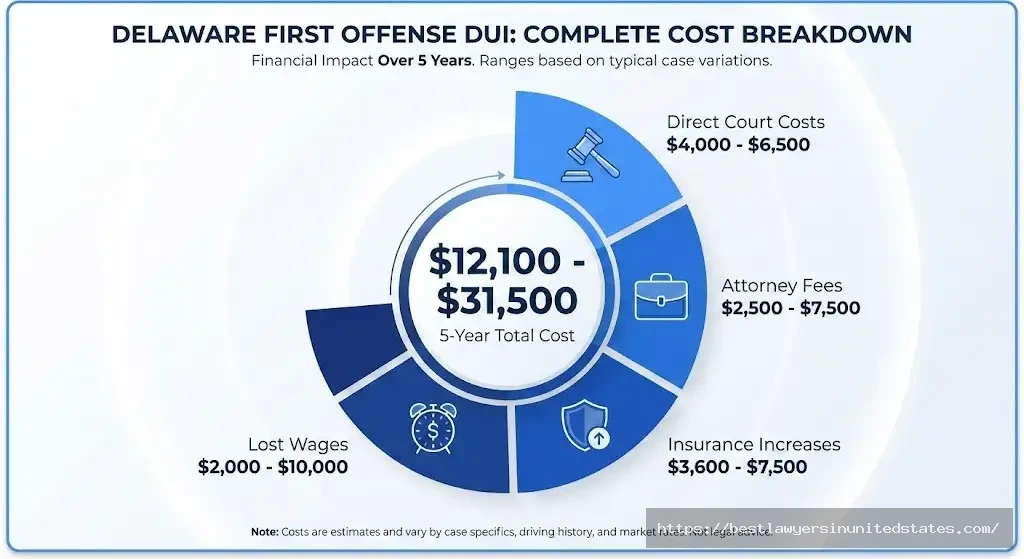
Itemized Delaware DUI Cost Breakdown
Direct Court Costs:
- Fines: $500-$1,500 (first offense)
- Court costs: $200-$400
- Public defender fee (if applicable): $500-$1,200
Attorney Fees:
- Private DUI attorney: $2,500-$7,500
- Trial costs (if case goes to trial): $5,000-$15,000
License Related:
- Reinstatement fees: $266
- SR-22 insurance filing: $50-$75
- Ignition interlock installation: $70-$150
- Ignition interlock monthly fees (×12): $720-$1,080
DUI Programs:
- DUI evaluation: $200-$400
- DUI education classes: $150-$300
- Treatment programs (if required): $500-$2,000
Pre-Trial Costs:
- Bail bond (10% of bail): $50-$150
- Towing and impound: $200-$500
- Alternative transportation during suspension: $1,200-$3,000
Insurance Increases:
Delaware insurers increase rates 80-100% after DUI conviction. For someone paying $1,500/year:
- Additional cost per year: $1,200-$1,500
- Duration: 3-5 years
- Total insurance increase: $3,600-$7,500
Lost Wages:
- Court appearances: $500-$2,000
- Jail time (if sentenced): $5,000-$20,000
- Job loss due to conviction: Varies significantly
Total 5-Year Cost Analysis
First Offense DUI (no jail time):
- Direct costs: $4,000-$6,500
- Attorney fees: $2,500-$7,500
- Insurance increases: $3,600-$7,500
- Lost wages/job impacts: $2,000-$10,000
- Total: $12,100-$31,500
Second Offense DUI (with mandatory jail):
- Direct costs: $5,500-$8,500
- Attorney fees: $5,000-$10,000
- Insurance increases: $4,500-$9,000
- Lost wages (60+ days jail): $10,000-$30,000
- Total: $25,000-$57,500
Third Offense DUI (felony):
- Direct costs: $7,000-$12,000
- Attorney fees: $10,000-$25,000
- Insurance increases: $5,000-$10,000
- Lost wages (prison time): $30,000-$100,000
- Lifetime earning reduction: Incalculable
- Total: $52,000-$147,000+
These estimates don’t include hidden costs like difficulty finding employment, loss of professional licenses, damage to reputation, family stress, or reduced lifetime earning potential.
Compare these costs when deciding whether to hire an attorney. Spending $5,000 on legal defense might save you $20,000+ in reduced penalties.
Delaware DUI Statistics and Trends
Delaware reported 3,847 DUI arrests in 2024 according to Delaware State Police data. This represents a 5% decrease from 2023 but remains higher than pre-pandemic levels.
DUI Arrests by County
New Castle County: 2,156 arrests (56% of total)
- Wilmington: 847 arrests
- Newark: 423 arrests
- Route 1 corridor: 312 arrests
Kent County: 1,089 arrests (28% of total)
- Dover: 558 arrests
- Route 13 corridor: 298 arrests
Sussex County: 602 arrests (16% of total)
- Rehoboth/Dewey Beach area: 356 arrests
- Georgetown: 127 arrests
Sussex County sees dramatic increases during summer months when beach tourism peaks. July and August account for 40% of annual Sussex County DUI arrests.
Repeat Offender Statistics
Delaware DUI arrests by offense level in 2024:
- First offense: 2,888 arrests (75%)
- Second offense: 731 arrests (19%)
- Third offense: 189 arrests (5%)
- Fourth+ offense: 39 arrests (1%)
About 25% of Delaware DUI arrests involve repeat offenders. This highlights the importance of strong first offense defense to avoid becoming a repeat offender statistic.
DUI Fatality Data
Delaware traffic fatalities involving alcohol-impaired drivers in 2024:
- Total alcohol-related traffic deaths: 38
- Percentage of all traffic deaths: 32%
- Deaths per 100,000 population: 3.8
Most fatal DUI crashes occur on weekends between 11pm and 3am. I-95, Route 1, and Route 13 account for 60% of fatal DUI crashes.
These statistics come from the Delaware Office of Highway Safety and National Highway Traffic Safety Administration reports. Numbers fluctuate yearly but remain consistently concerning.
How Delaware DUI Laws Compare to Other States
Delaware’s DUI laws fall in the moderate-to-strict range compared to other states. We’re tougher than some states but more lenient than the strictest.
Delaware vs. Neighboring States
Maryland:
- First offense penalties similar to Delaware
- Longer lookback period (5 years vs. 10 years)
- Higher fines ($1,000-$2,000 typical)
- Similar license suspension (1 year)
Pennsylvania:
- Three-tier BAC system (.08%, .10%, .16%+)
- First offense jail possible at higher BAC tiers
- Accelerated Rehabilitation Disposition (ARD) program better than Delaware’s First Offender Program
- Similar overall costs
New Jersey:
- Stricter than Delaware
- Mandatory ignition interlock for all first offenses
- Higher fines ($300-$500 plus surcharges of $1,000/year for 3 years)
- License suspension similar (3-12 months)
Overall: Delaware sits in the middle. Pennsylvania offers better diversion programs. New Jersey and Maryland impose harsher total costs.
Strictest States for DUI
States with toughest DUI laws:
- Arizona: Mandatory jail time even for first offense, ignition interlock for all offenders, extremely high costs
- Alaska: Minimum 3 days jail mandatory, 90-day license suspension minimum, no plea bargaining allowed
- Utah: Lowest BAC limit (.05%), strict enforcement, harsh penalties
- Georgia: Mandatory DUI school for all offenses, clinical evaluation, 12-month ignition interlock
- Kansas: Mandatory jail time, no probation allowed, very high costs
Delaware’s penalties are moderate compared to these states.
Most Lenient States for DUI
States with more lenient DUI laws:
- South Dakota: First offense often reduced to reckless driving, minimal jail time
- North Dakota: Lower fines, shorter suspensions
- Wisconsin: First offense treated as traffic violation, not criminal charge
- Montana: More lenient sentencing, better plea bargain opportunities
Delaware is significantly stricter than these states. Our mandatory sentencing guidelines and limited plea bargaining make Delaware DUI laws tougher than many states.
Frequently Asked Questions About Delaware DUI Laws
Can you refuse a breathalyzer in Delaware?
Yes, but Delaware suspends your license for 12 months for first refusal. Refusal is admissible in court as evidence of guilt. You also lose eligibility for conditional license with ignition interlock.
What is the difference between DUI and DWI in Delaware?
Delaware uses only “DUI” (Driving Under the Influence). The state doesn’t distinguish between DUI and DWI. Some states use DWI for alcohol and DUI for drugs, but Delaware uses DUI for both.
How can I get a DUI expunged in Delaware?
Delaware doesn’t allow expungement of DUI convictions. The conviction stays on your criminal record permanently. You can only expunge charges that were dismissed or resulted in acquittal.
What happens if I’m arrested for DUI while visiting Delaware?
Delaware charges you the same as residents. Delaware reports the conviction to your home state through the Interstate Driver License Compact. Your home state typically suspends your license for the same period Delaware would.
Will two drinks get you a DUI?
Possibly. Two standard drinks can put a 140-pound person near or over 0.08% BAC. Individual metabolism varies significantly. Delaware also allows DUI arrests below 0.08% if officers observe impairment. Our BAC calculator helps estimate your BAC based on drinks consumed and body weight.
Do you lose your license immediately after a DUI?
Yes. Police confiscate your license and issue a 15-day temporary license. You must request a DMV hearing within 7 days to contest the suspension. If you don’t request a hearing or you lose the hearing, suspension begins after 15 days.
How long are DUI classes in Delaware?
Delaware’s DUI education program is 12 hours total, typically spread over 3-4 sessions. Some programs offer weekend or evening classes. Treatment programs (if required by evaluation) range from 10 weeks to 6 months.
What is Donna’s Law in Delaware?
Donna’s Law relates to domestic violence, not DUI. It requires courts to consider abuse when determining child custody. The law doesn’t impact DUI cases.
Is a DUI a misdemeanor or felony in Delaware?
First and second DUI offenses are misdemeanors. Third DUI within 10 years can be charged as a felony. DUI causing injury or death is always a felony.
How much does a DUI attorney cost in Delaware?
Delaware DUI attorneys charge $2,500-$7,500 for standard cases. Complex cases requiring trial cost $10,000-$15,000. Many attorneys offer payment plans.
Can I get a work permit after Delaware DUI arrest?
Delaware doesn’t issue hardship or work permits. Your only option is applying for a conditional license after serving part of your suspension. First offenders can apply after 4 months with ignition interlock device installed.
What is the First Offender Program in Delaware?
A diversion program for first-time DUI offenders requiring evaluation, education, and possible treatment. Successful completion reduces jail time and improves chances of charge reduction to Reckless Driving Alcohol Related (RAR).
How does a DUI affect my car insurance in Delaware?
Expect 80-100% rate increases for 3-5 years. Some insurers cancel policies after DUI. You must maintain SR-22 insurance for 3 years proving financial responsibility.
Can out-of-state drivers do Delaware DUI programs remotely?
Some programs allow remote participation but most require in-person attendance in Delaware. Check with specific program providers about remote options.
What BAC level is considered high in Delaware?
BAC of 0.15% or higher is considered high and triggers enhanced penalties including likely jail time even for first offense and mandatory ignition interlock.
Resources and Next Steps After Delaware DUI Arrest
Taking immediate action after a DUI arrest improves your outcomes. Here are critical resources and contacts.

Delaware Division of Motor Vehicles
Main Office (Dover):
303 Transportation Circle
Dover, DE 19901
Phone: (302) 744-2506
Wilmington Office:
2230 Hessler Boulevard
Wilmington, DE 19810
Phone: (302) 434-3200
Georgetown Office:
23 The Circle
Georgetown, DE 19947
Phone: (302) 853-1000
Request administrative hearings within 7 days of arrest at any DMV office or online at dmv.de.gov.
Delaware Courts
New Castle County Court of Common Pleas:
500 N. King Street
Wilmington, DE 19801
Phone: (302) 255-0800
Kent County Court of Common Pleas:
38 The Green
Dover, DE 19901
Phone: (302) 735-2262
Sussex County Court of Common Pleas:
1 The Circle, Suite 2
Georgetown, DE 19947
Phone: (302) 856-5257
DUI Education and Treatment Providers
Contact Delaware Department of Health and Social Services at (302) 255-9040 for approved DUI evaluation and treatment providers statewide.
Ignition Interlock Device Providers
Smart Start:
Multiple Delaware locations
(800) 880-3394
smartstartinc.com
Intoxalock:
Statewide installation
(888) 283-5899
intoxalock.com
LifeSafer:
Delaware service centers
(800) 634-3077
lifesafer.com
Legal Resources
Delaware Volunteer Legal Services:
Free legal assistance for low-income Delaware residents
100 W. 10th Street, Suite 801
Wilmington, DE 19801
(302) 478-8850
Delaware Public Defender:
Carvel State Building
820 N. French Street, 3rd Floor
Wilmington, DE 19801
(302) 577-5200
Take These Steps Within 7 Days
- Request DMV administrative hearing (don’t miss this deadline)
- Document everything about your arrest while memory is fresh
- Photograph the arrest location if possible
- Preserve all paperwork police gave you
- Don’t discuss your case on social media
- Contact a DUI attorney for consultation
- Notify your insurance company (required by policy)
Calculate Your DUI Costs
Use our comprehensive DUI cost calculator to estimate total costs including fines, attorney fees, insurance increases, and lost wages. Understanding the financial impact helps you budget and decide whether to hire an attorney.
Find Legal Representation
Need help finding a qualified Delaware DUI attorney? Contact us at [email protected] for attorney referrals. Most DUI lawyers offer free initial consultations.
Delaware DUI laws are complex and the stakes are high. Don’t face these charges alone. Take action now to protect your rights, your license, and your future.
