
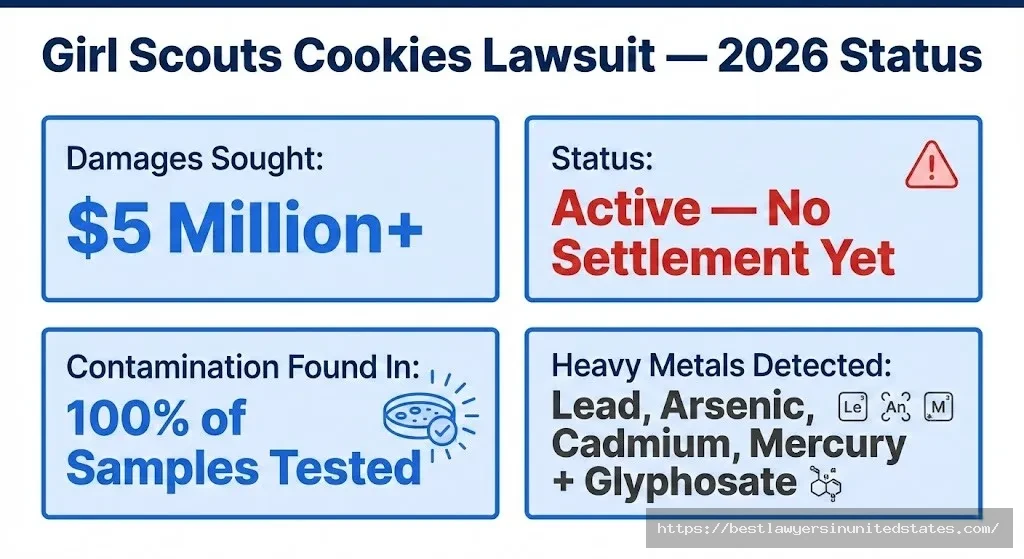
Multiple class action lawsuits filed in federal court accuse Girl Scouts of the United States of America and its licensed bakers of selling cookies contaminated with heavy metals and pesticides — and then misleading the public about it. The lawsuits, filed beginning in March 2025, are still active as of February 2026. No settlement has been reached yet, which means there is no claim form, no deadline, and no payout available right now. What you can do is understand the allegations, know whether you’d be a potential class member, and stay informed so you’re ready when — or if — a settlement is announced. adriana chechik lawsuit
Quick Answer: The Girl Scouts cookies class action lawsuits allege that popular cookie varieties contain dangerous levels of lead, arsenic, cadmium, mercury, and the pesticide glyphosate. The cases are active in the U.S. District Court for the Eastern District of New York. No settlement has been reached as of February 2026. There is nothing to file right now — but if the case resolves, anyone who purchased Girl Scout Cookies within the applicable timeframe may be eligible to claim compensation. This guide explains everything you need to know.
What Is the Girl Scouts Cookies Lawsuit About?
Background of the Lawsuit
For over a century, Girl Scout Cookies have been one of America’s most trusted traditions. Parents buy boxes every spring assuming they’re getting a safe, quality product — and helping young girls learn valuable skills in the process. That trust is now at the center of federal litigation.
In December 2024, consumer advocacy groups GMOScience and Moms Across America published a report titled Danger in the Dough: Unveiling the Toxic Contaminants in Girl Scout Cookies. The study tested 25 boxes of 13 different Girl Scout Cookie varieties — purchased from California, Iowa, and Louisiana — and found heavy metals and pesticides in every single sample. When the findings went viral (partly after podcaster Joe Rogan cited them to his audience), Girl Scouts issued a February 2025 blog post defending their cookies. Plaintiffs say that response was inadequate and misleading. Within weeks, multiple class action lawsuits were filed in New York federal court.
The core argument is straightforward: consumers paid a premium for cookies they believed were safe and high-quality. Had they known about the contamination, they would have paid less — or not bought them at all. That’s the kind of claim courts take seriously in consumer protection cases. HexClad Lawsuit: 2026 Settlement Guide, Payment Timeline & Full Case Update
Timeline of Key Events
| Date | Event | Details |
|---|---|---|
| December 27, 2024 | GMOScience report published | “Danger in the Dough” reveals heavy metals and glyphosate in 13 cookie varieties |
| February 6, 2025 | Girl Scouts blog post | Organization declares cookies “safe to consume” and compliant with FDA standards |
| March 10–11, 2025 | First class action filed | Amy Mayo files suit in Eastern District of New York; also filed: Barbaro & Cholewa v. Girl Scouts |
| March 11, 2025 | Key plaintiff drops out | Mayo voluntarily dismisses her individual claims (without prejudice); Barbaro & Cholewa case continues |
| June 13, 2025 | Second class action filed | Jeanine Finkelstein files Case No. 1:25-cv-03343, adding new allegations and naming nationwide class |
| Ongoing 2025–2026 | Discovery and litigation | Cases remain active in U.S. District Court for the Eastern District of New York |
| TBD | Settlement or trial | No settlement reached as of February 2026 |
Who Filed the Lawsuit?
There are currently two active lawsuits, both pending in the Eastern District of New York:
Case 1 — Barbaro & Cholewa v. Girl Scouts et al. Plaintiffs Danielle Barbaro and Judy Cholewa filed this case on March 11, 2025, represented by Leeds Brown Law. They sued on behalf of themselves and anyone in the United States who purchased Girl Scout Cookies. (A third plaintiff, Amy Mayo, voluntarily dismissed her individual claims days after filing, though the class action continues with Barbaro and Cholewa.)
Case 2 — Finkelstein v. Girl Scouts et al., Case No. 1:25-cv-03343 Plaintiff Jeanine Finkelstein filed this separate class action on June 13, 2025, against Girl Scouts of the United States of America and Ferrero U.S.A. Inc. This case seeks to represent a nationwide class and a New York subclass.
Named Defendants across both cases:
- Girl Scouts of the United States of America (GSUSA)
- Ferrero U.S.A. Inc. (owns Little Brownie Bakers)
- Interbake Foods LLC (operates ABC Bakers) — named in the first case
What Are the Allegations?
The lawsuits allege the defendants knew or should have known their products were contaminated — and continued selling them while claiming the cookies were safe and high-quality. Key allegations include:
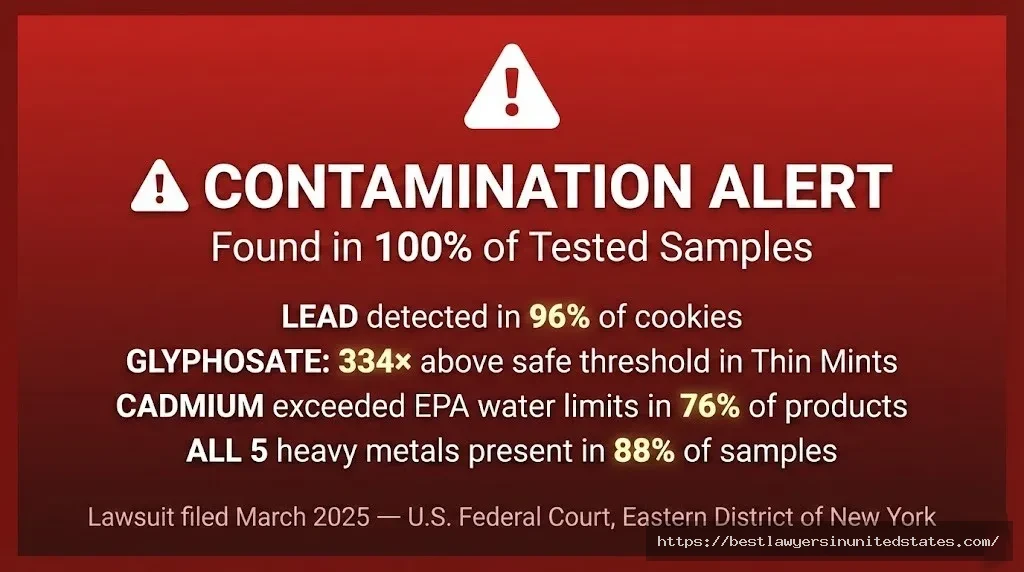
- 100% of tested cookie varieties contained glyphosate, a pesticide linked to cancer, neurological disorders, endocrine disruption, and reproductive problems
- 96% of samples contained lead, a heavy metal with no safe exposure level for children
- 76% of products tested positive for cadmium at levels exceeding EPA limits for drinking water
- 88% of samples contained all five heavy metals tested: aluminum, arsenic, cadmium, lead, and mercury
- Thin Mints contained 334 times more glyphosate than levels generally accepted as safe by scientists in the field
- Defendants made false and misleading marketing claims — including “We trust our licensed bakers, who are industry leaders, to produce the best-tasting and highest-quality cookies”
- After the GMOScience report went public, defendants failed to recall products or acknowledge the test results
- Girl Scout Cookies are heavily marketed to children, the most vulnerable population for heavy metal exposure
Who Would Qualify for a Settlement — If One Is Reached?
Quick Answer: Based on how the lawsuits are structured, you’d likely qualify if you purchased any Girl Scout Cookies at any point within the applicable statute of limitations period (typically 3–6 years depending on state). You would NOT need to prove you were physically harmed.
No class has been certified and no settlement exists yet. But here’s what the plaintiffs are seeking — and what eligibility would likely look like if the case resolves:
Likely Eligibility Criteria
| Requirement | Details | What You’d Probably Need |
|---|---|---|
| Purchased Girl Scout Cookies | Any variety, any state | Proof of purchase, or statement under penalty of perjury |
| Purchase timeframe | Within the applicable statute of limitations (likely 3–6 years back) | Approximate dates and varieties |
| U.S. resident | The nationwide class covers all U.S. purchases | No additional documentation |
| Not an excluded party | Courts typically exclude defendants, their employees, and their family members | N/A for regular consumers |
Cookie Varieties Named in the Lawsuits
The GMOScience report tested 13 varieties, and the lawsuits reference contamination broadly across Girl Scout Cookie products. Specific varieties mentioned include:
| Variety | Heavy Metals Found | Glyphosate Detected? | Baker |
|---|---|---|---|
| Thin Mints | Yes (multiple) | Yes — 334x above common safe threshold | Ferrero / ABC Bakers |
| Samoas / Caramel deLites | Yes | Yes | Ferrero / ABC Bakers |
| Tagalongs / Peanut Butter Patties | Yes | Yes | ABC Bakers |
| Do-si-dos | Yes | Yes | Ferrero / ABC Bakers |
| Trefoils | Yes | Yes | Ferrero |
| Adventurefuls | Yes | Yes | Ferrero / ABC Bakers |
| Lemon-Ups | Yes | Yes | Ferrero |
| S’mores | Yes | Yes | Ferrero / ABC Bakers |
| Peanut Butter Paddies | Yes | Yes | ABC Bakers |
(Note: All 13 varieties tested positive for at least four of five heavy metals and glyphosate.)
Who Probably Would NOT Qualify
You’d likely be excluded from any future class if you:
- Work for Girl Scouts of the USA, Ferrero, or Interbake Foods / ABC Bakers
- Are an immediate family member of a named defendant employee
- Are a judge presiding over the case or their immediate family
- Already settled an individual lawsuit related to these same products
- Purchased cookies outside the applicable timeframe
The “No Physical Harm” Standard
One important thing to understand: you don’t need to have gotten sick to qualify for a consumer protection class action like this. The theory of damages here is economic — you paid for a product that was allegedly not as safe or high-quality as advertised. If you paid $5–$7 a box and the cookies were contaminated, the argument is you were overcharged or misled, regardless of your health outcome.
How Much Money Could You Get?
Quick Answer: There is no settlement amount yet. The lawsuits seek over $5 million in damages collectively, but actual per-person payouts in food contamination class actions typically range from a few dollars to $20–$50 per claimant, depending on how many people file and the total fund size.
What the Lawsuits Are Seeking
| Category | Amount Sought | Notes |
|---|---|---|
| Compensatory damages | Unspecified (economic losses) | Based on purchase price of contaminated cookies |
| Total damages sought | $5 million+ | Stated in the complaints |
| Injunctive relief | Required labeling changes | Disclose contaminants on packaging |
| Attorney fees | TBD | Typically 25–33% of any settlement fund |
| Punitive damages | Possible | If defendants found to have acted willfully |
Realistic Payout Expectations
Food contamination class actions that DO settle typically pay out modest amounts to individual class members. For context:
| Lawsuit Type | Typical Per-Person Payout | Total Fund Size |
|---|---|---|
| Food contamination / mislabeling | $3–$50 | $1–$20 million |
| Pesticide in food products | $5–$30 | $2–$15 million |
| Heavy metals in baby food | $10–$100 (ongoing cases) | Varies |
| This case (if settled) | Unknown — TBD | Potentially $5M+ |
The honest answer: if this case settles, each person who files a claim would likely receive somewhere between a small cash payment and a product voucher. The bigger value is usually in forcing labeling changes, reformulation, or stricter testing — not in individual payouts.
Current Lawsuit Status — February 2026 Update
Where Things Stand Right Now
As of February 2026, both class action lawsuits are in the early litigation phase in the U.S. District Court for the Eastern District of New York. This stage typically involves:
- Class certification motions (plaintiffs must prove the case qualifies as a class action)
- Discovery (both sides exchanging documents and evidence)
- Possible motions to dismiss from the defense
- Potential consolidation of the two cases
Girl Scouts of the USA has maintained publicly that their cookies are safe and comply with all FDA and EPA standards. Their defense will likely argue that the GMOScience study — which was not peer-reviewed and used a small sample size — doesn’t meet the scientific standards required to prove their claims in court. Midland Credit Management Class Action Lawsuit
Recent Developments
| Date | Development |
|---|---|
| March 11, 2025 | First lawsuit filed; Amy Mayo voluntarily dismisses individual claims days later |
| June 13, 2025 | Second class action filed by Jeanine Finkelstein (Case No. 1:25-cv-03343) |
| August 2025 | Both cases reported as pending in federal court |
| February 2026 | Cases remain active; no settlement announced |
What Happens Next?
Class action lawsuits like these typically follow this path:
- Motion practice: The defense may try to get the case dismissed. If that fails, it proceeds to discovery.
- Class certification: Plaintiffs will file a motion asking the court to certify a class. This is a critical hurdle — if denied, the case cannot proceed as a class action.
- Discovery: Both sides gather evidence. This could include internal testing records from the bakers, communications about the GMOScience report, and expert testimony on food safety.
- Settlement negotiations or trial: Most class actions settle before trial. If both sides agree to terms, a settlement is announced and class members get notified.
- Timeline: Realistically, a resolution — whether settlement or trial — is likely 1–3 years away from the filing dates, putting potential outcomes in the 2026–2028 range.
Girl Scouts Cookies Lawsuit vs. Similar Cases
How This Case Compares
| Lawsuit | Filed | Status | Settlement |
|---|---|---|---|
| Girl Scouts Cookies (heavy metals/glyphosate) | March & June 2025 | Active | None yet |
| Hain Celestial baby food (heavy metals) | 2021 | Active / appeals | None finalized |
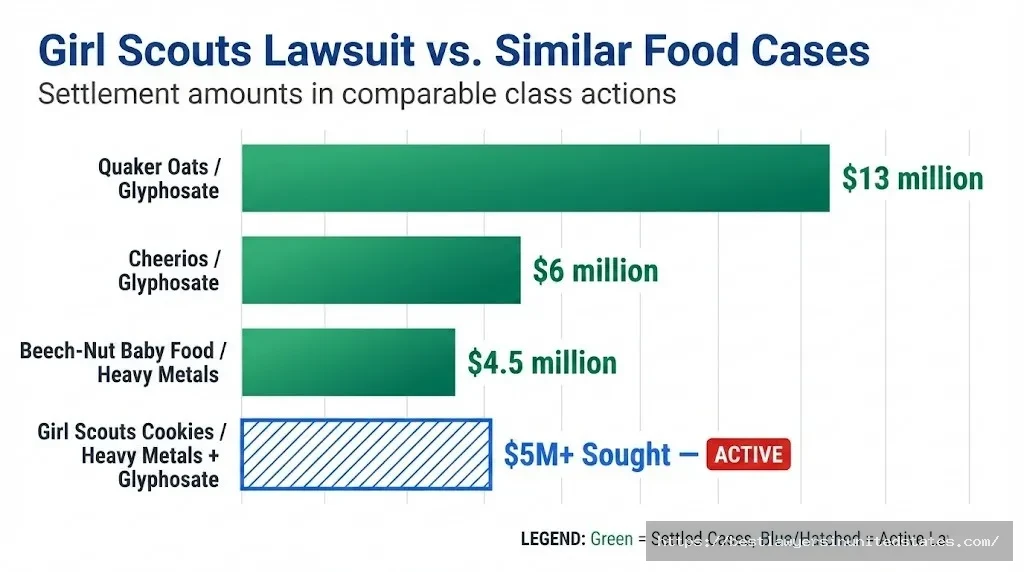
| Beech-Nut baby food (heavy metals) | 2021–2022 | Settled | $4.5 million (2024) |
| Gerber baby food (heavy metals) | 2021 | Partially settled | Multiple state AGs |
| Quaker Oats / oatmeal (glyphosate) | 2018 | Settled | ~$13 million |
| Cheerios (glyphosate) | 2022 | Settled | $6 million |
What Makes This Case Stand Out
A few things set the Girl Scouts lawsuit apart from typical food contamination cases:
The brand’s mission creates a unique legal angle. Girl Scout Cookies aren’t sold by a faceless corporation — they’re sold by children, on behalf of an organization explicitly built around ethics, honesty, and trust. The plaintiffs’ attorneys hammer this point repeatedly in the complaints, and it’s a compelling one for juries and in settlement negotiations.
Multiple heavy metals plus a pesticide. Many food contamination cases focus on one substance. This lawsuit alleges simultaneous contamination with five heavy metals AND glyphosate. That’s a broader, more complex claim.
The defendants’ public response may backfire. By issuing a blog post explicitly telling consumers the cookies were “safe to consume” after the GMOScience report was released, GSUSA arguably doubled down in a way that strengthens the plaintiffs’ false advertising argument.
Do You Need a Lawyer Right Now?
Quick Answer: No. There’s nothing to file right now, and you don’t need an attorney to eventually submit a claim if a settlement is reached. The process will be designed for individual consumers to handle themselves. That said, if you believe you’ve suffered specific health harm linked to cookie consumption, speaking with an attorney about an individual case makes sense.
For Most Consumers: Wait and Watch
If you’ve purchased Girl Scout Cookies and want to potentially recover money if a settlement is reached, you don’t need to do anything right now. Class action settlements involve:
- A settlement announcement (major news coverage usually follows)
- A court-approved notice sent to potential class members
- A claim period (typically 60–180 days) to file online or by mail
- No attorney required — you can file directly
If You Have Health Concerns
If you or your child consumed large quantities of these cookies and have concerns about heavy metal exposure — especially for young children, pregnant women, or immunocompromised individuals — consider:
- Speaking with your doctor about heavy metal exposure testing
- Consulting with a personal injury attorney if health effects are suspected
- Checking the FDA and EPA websites for current food safety guidance on heavy metals and glyphosate
When an Attorney Could Help
Consider a free consultation with a plaintiff’s attorney if:
- You purchased large quantities of Girl Scout Cookies regularly
- A child in your household has tested positive for elevated lead or cadmium levels
- You want to stay informed about case developments and eligibility
- Your claim would involve documented health harm, not just economic loss
For attorney referrals related to food safety class actions, contact: [email protected]
Frequently Asked Questions
What is the Girl Scouts cookies lawsuit?
Quick Answer: It’s a class action lawsuit (actually two separate suits) alleging that Girl Scout Cookies contain unsafe levels of heavy metals — including lead, arsenic, cadmium, and mercury — and the pesticide glyphosate, and that Girl Scouts and its bakers misled consumers about the safety of their products.
The lawsuits were triggered by a December 2024 report by GMOScience and Moms Across America, which tested 13 varieties of cookies purchased across multiple states. Every single sample tested positive for glyphosate, and nearly all contained multiple heavy metals. Jefferson Capital Systems Lawsuit
Has a settlement been reached?
Quick Answer: No. As of February 2026, no settlement has been announced. Both lawsuits remain active in the U.S. District Court for the Eastern District of New York.
Don’t believe any website claiming you can currently file a claim and receive payment — no such process exists yet.
Is there a claim form I can fill out right now?
Quick Answer: No. There is no active claim form, no settlement website, and no deadline to file a claim. Anyone telling you otherwise is misinformed or misleading you.
When and if a settlement is reached, class members will be notified, usually by mail or email if they’ve registered interest, and through a court-approved settlement website.
Who qualifies for the lawsuit?
Quick Answer: The lawsuits seek to represent any U.S. consumer who purchased Girl Scout Cookies within the applicable statute of limitations. You don’t need to have gotten sick — the claim is based on being misled about what you were buying.
The exact class definition will be determined by the court during the class certification process.
Which cookie varieties are affected?
Quick Answer: The testing covered 13 varieties, and all of them tested positive for contaminants. Thin Mints, Samoas, Tagalongs, Do-si-dos, Trefoils, Adventurefuls, S’mores, and more are all named.
If you’ve purchased any Girl Scout Cookies within the past several years, you’d likely fall within the class as currently defined.
What exactly did the testing find?
Quick Answer: 100% of samples had glyphosate. 96% had lead. 76% had cadmium above EPA water limits. 88% had all five tested heavy metals. Thin Mints alone had 334 times more glyphosate than the commonly accepted safe level.
The tests were conducted on 25 boxes of cookies purchased from California, Iowa, and Louisiana. Critics of the lawsuits note the study was not peer-reviewed and used a small sample size.
What does Girl Scouts say in response?
Quick Answer: They say the cookies are safe, comply with all FDA and EPA standards, and that heavy metals and glyphosate are commonly found in trace amounts in virtually all plant-based foods.
In their February 2025 blog post, Girl Scouts stated: “Girl Scout Cookies are safe to consume and are manufactured in accordance with all food safety regulations.” They noted that environmental contaminants occur naturally in soil and are not intentionally added to products.
Is glyphosate actually dangerous?
Quick Answer: It’s genuinely debated. The International Agency for Research on Cancer (IARC) classified glyphosate as “probably carcinogenic to humans” in 2015. The EPA, meanwhile, has maintained it’s not likely carcinogenic at current exposure levels. Scientific opinion remains divided.
The lawsuits don’t need to conclusively prove glyphosate causes cancer — they need to show consumers were misled about its presence in a product marketed as safe and high-quality.
Are heavy metals in food normal?
Quick Answer: Trace amounts are common in many foods, yes. The dispute is whether the levels found in these cookies are harmful — and whether consumers should have been told about them.
Heavy metals like lead and cadmium can enter the food supply through soil, water, and farming practices. The FDA has been tightening guidelines on heavy metals in food, particularly for children, in recent years. There is no safe level of lead exposure for children, according to the CDC.
Do I need a lawyer to eventually file a claim?
Quick Answer: No. If a settlement is reached, you’ll be able to file a claim yourself online or by mail. The process is designed for individuals.
Attorneys become more relevant if you’re pursuing an individual personal injury claim based on documented health effects.
Will the lawsuit affect whether I can still buy Girl Scout Cookies?
Quick Answer: No. Girl Scout Cookies continue to be sold normally. The 2026 cookie season is underway, with some troops selling online due to other community factors. The lawsuit hasn’t prompted any recall.
Girl Scouts River Valleys, for example, announced online-only sales in February 2026 — but that was in response to community unrest around immigration enforcement, not the lawsuit.
What’s the difference between the two lawsuits?
Quick Answer: The first was filed in March 2025 by Barbaro and Cholewa; the second was filed in June 2025 by Finkelstein. Both are in the same court and make similar allegations, but differ in their named plaintiffs, class definitions, and some specific legal theories.
The two cases may eventually be consolidated by the court into a single proceeding.
What if I have a child who ate a lot of these cookies?
Quick Answer: If you have specific health concerns about lead or heavy metal exposure in children, speak with your pediatrician. Heavy metal testing is available through blood tests.
The CDC states that there is no safe blood lead level in children, and the American Academy of Pediatrics recommends blood lead testing for children in high-risk situations. If you believe your child may have been exposed to harmful levels, consult your doctor — not a lawsuit website.
How will I know if a settlement is reached?
Quick Answer: Watch for news coverage, check the court docket, or sign up for class action newsletters from sites like ClassAction.org or TopClassActions.com.
You can also save the case numbers — Barbaro & Cholewa v. Girl Scouts and Case No. 1:25-cv-03343 (Finkelstein) — and track them on PACER (the federal court system’s public records portal) for free with an account.
What is the court and case information?
Quick Answer: Both cases are in the U.S. District Court for the Eastern District of New York. The Finkelstein case is Case No. 1:25-cv-03343.
The Eastern District of New York covers Brooklyn, Queens, Staten Island, Nassau County, and Suffolk County. The cases were filed and are being managed there.
If the lawsuits lose, can I still sue individually?
Quick Answer: Potentially, depending on your state’s statute of limitations and the specific circumstances. If you opt out of a future class action, you’d preserve that right.
You’d want to consult an attorney about individual options, particularly if you have documented health impacts.
Could these lawsuits lead to recipe or ingredient changes?
Quick Answer: Possibly. One of the remedies sought is an injunction requiring better ingredient sourcing and labeling. Even without winning, the litigation creates pressure on GSUSA and its bakers to demonstrate improved testing and transparency.
Similar lawsuits have resulted in food manufacturers voluntarily reformulating products or committing to enhanced testing programs as part of settlement terms.
What happens to my rights if I do nothing?
Quick Answer: If the case is certified as a class action and a settlement is reached, you’ll typically receive a notice explaining you’re included automatically — and giving you the option to opt out if you want to preserve the right to sue individually.
Doing nothing means you’d be included in any settlement class and receive whatever payment is distributed, but you’d give up the right to sue the defendants separately over the same claims.
What Consumers Should Do Right Now
There are no claims to file and no deadlines to meet at this moment. But here’s what makes sense if you’re following this case:
Stay informed. Bookmark ClassAction.org or TopClassActions.com and search “Girl Scouts” periodically. A settlement announcement would likely generate major news coverage.
Keep an eye on the 2026 cookie season. If Girl Scouts or their bakers announce changes to testing, sourcing, or labeling, that could signal movement in the litigation.
Talk to your doctor if you have health concerns. If you have children who consumed these cookies regularly, a pediatrician can advise whether any testing makes sense. This is especially worth considering for children under 6, who are most vulnerable to lead exposure effects.
Don’t pay anyone to “join” this lawsuit. No one should be charging you a fee to add you to a class action. Plaintiff’s attorneys in class cases are paid from the settlement fund — not by individual class members.
For more on your rights as a consumer in food safety cases, understanding how class action lawsuits work, or to request an attorney referral, reach out to [email protected].
Last updated: February 17, 2026. This article is for informational purposes only and does not constitute legal advice. The lawsuits described are active litigation; facts and case status may change. For the most current information, consult court records or a licensed attorney.

Comments