
Affirm Holdings faces three separate class action lawsuits involving data breach exposure, securities fraud, and deceptive “buy now, pay later” (BNPL) practices. One case — the Evolve Bank & Trust data breach settlement — reached a $3.78 million final settlement approved December 15, 2025, though the claim deadline has passed. Two other major cases remain active and ongoing heading into 2026, with potential settlements expected in 2026–2027. If you’re an Affirm user or investor, here’s exactly where each case stands and what you can do right now. adriana chechik lawsuit
Quick Answer: Affirm is involved in three major lawsuits: (1) a data breach settlement ($3.78M, final approval December 15, 2025 — claim deadline passed October 30, 2025); (2) a consumer protection class action (filed June 2021, still active) over deceptive BNPL fees and practices; and (3) a securities fraud lawsuit (filed December 2022, still active) targeting AFRM investors who lost money between February 12, 2021 and December 15, 2021. No active claim deadlines currently apply — but watch for future settlement announcements in both ongoing cases.
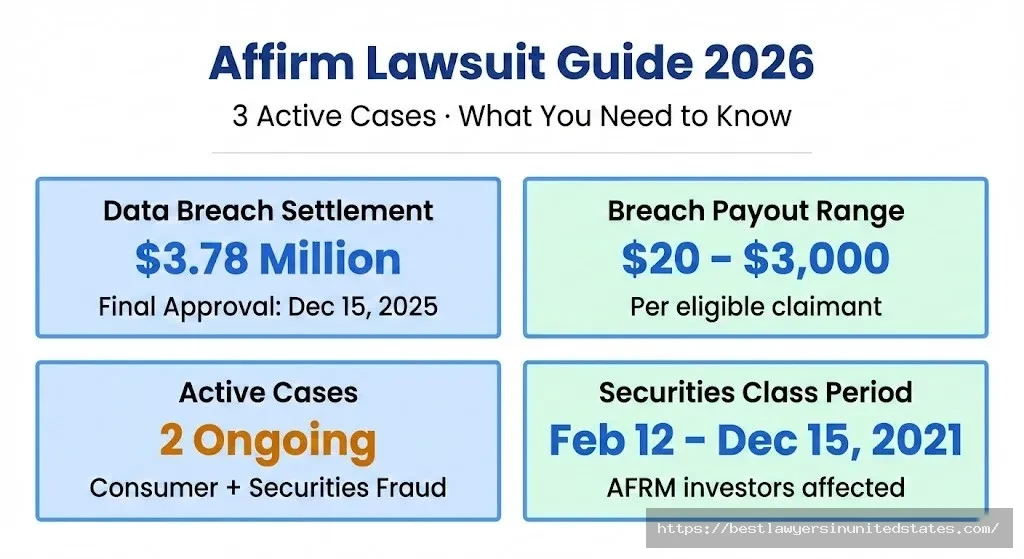
Affirm Lawsuit Overview: Key Facts at a Glance
| Case | Court | Filed | Status | Settlement |
|---|---|---|---|---|
| Data Breach (Evolve Bank) | W.D. Tennessee | Aug 2024 | Final approval Dec 15, 2025 | $3.78 million |
| Consumer BNPL Fraud (Shepard v. Affirm) | S.D. New York | June 14, 2021 | Active / Ongoing | None yet |
| Securities Fraud (Kusnier v. Affirm) | N.D. California | Dec 8, 2022 | Active / Ongoing | None yet |
| Derivative Shareholder (Quiroga v. Affirm) | N.D. California | March 29, 2023 | Stayed | None yet |
What Are the Affirm Lawsuits About?
Background: Multiple Legal Fronts
Affirm Holdings, Inc. (NASDAQ: AFRM) is one of the largest “buy now, pay later” (BNPL) platforms in the United States, partnering with thousands of merchants including Amazon, Walmart, and Shopify. The company lets shoppers split purchases into installment payments — sometimes with interest, sometimes without — rather than using a traditional credit card.
That business model is now at the center of multiple lawsuits. Consumers say Affirm’s BNPL plans come with hidden fees, make returns nearly impossible, and encourage overspending. Investors say Affirm misled them about those very risks before the stock collapsed. And millions of Affirm users had their personal data — Social Security numbers, bank account details, and more — exposed in a 2024 cyberattack on a banking partner.
The result: three separate class action cases in federal court, one of which has already settled, two of which remain unresolved.
What Is Affirm’s BNPL Service?
Affirm’s platform works like a reverse layaway: instead of saving up and then getting the product, you buy immediately and pay in installments. The company earns money through merchant fees and, in many cases, consumer interest rates ranging from 0% to 36% APR. Affirm partners with retailers and gets consumers approved at checkout in seconds.
Critics, regulators, and now courts have questioned whether that convenience comes with costs that aren’t clearly disclosed — from late fees and interest charges to the near-impossibility of disputing transactions the way you can with a credit card. Girl Scouts Cookies Lawsuit
The Three Affirm Lawsuits Explained
Lawsuit #1: The Evolve Bank Data Breach Settlement (Resolved)
What Happened
In late May 2024, Evolve Bank & Trust — one of Affirm’s banking partners — discovered a ransomware attack by the cybercriminal group LockBit. The attackers had been in Evolve’s systems since at least February 2024, accessing and downloading sensitive customer information. Evolve refused to pay the ransom, and LockBit leaked the stolen data on the dark web.
Affirm filed a notice with the Securities and Exchange Commission in June 2024 disclosing that customer data had been compromised. The exposed information included names, dates of birth, Social Security numbers, driver’s license numbers, bank account numbers, and contact details.
Who Was Affected
The breach didn’t just hit Evolve’s own customers. Because Evolve served as a banking partner for multiple fintech companies through Synapse Financial Technologies, customers of Affirm, Dave, Mercury, Bilt, Shopify, Plaid, Stripe, and Wise were also affected.
The Settlement
A class action was filed in August 2024 by Morgan & Morgan and other law firms. The case was consolidated into the Western District of Tennessee under MDL No. 2:24-md-03127-SHL-cgc. Evolve agreed to a $3.78 million settlement — without admitting wrongdoing — to avoid further litigation.
Final approval was granted December 15, 2025. The claim deadline was October 30, 2025, which has now passed.
| Settlement Detail | Information |
|---|---|
| Total Settlement Fund | $3.78 million |
| Final Approval Date | December 15, 2025 |
| Claim Deadline | October 30, 2025 (PASSED) |
| Settlement Administrator | Kroll Settlement Administration LLC |
| Administrator Phone | (833) 421-7300 |
| Administrator Address | P.O. Box 225391, New York, NY 10150-5391 |
Can You Still File a Claim?
The official claim deadline has passed. However, you can still call the settlement administrator at (833) 421-7300 (Monday–Friday, 8 a.m. to 8 p.m. ET) to inquire about late claims or appeals. Late claims are not guaranteed to be accepted, but it’s worth asking.
What the Settlement Paid
| Benefit Type | Amount | Requirements |
|---|---|---|
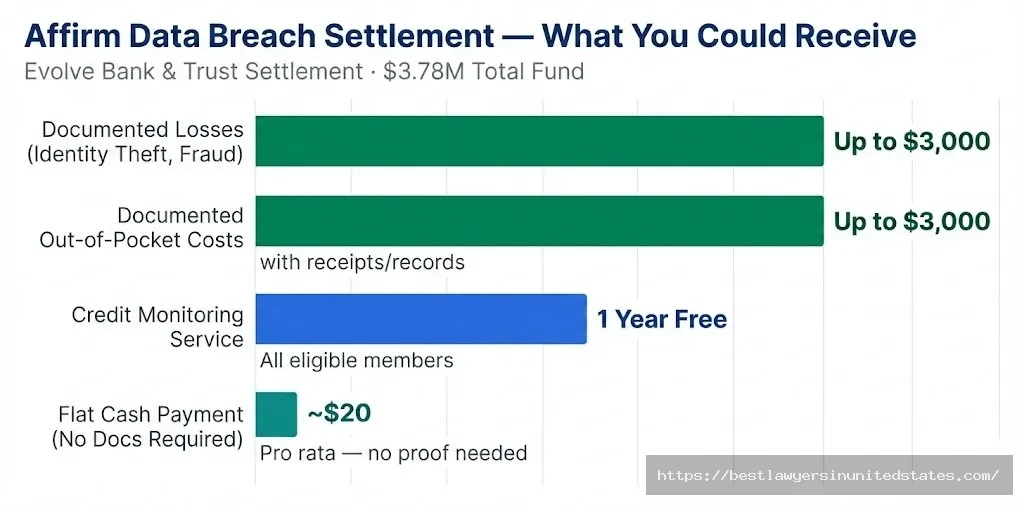
| Documented Loss Reimbursement | Up to $3,000 | Receipts, bank statements, police reports showing breach-related losses |
| Flat Cash Payment (Tier B) | ~$20 (pro rata) | Basic eligibility, no documentation required |
| Credit Monitoring | 1 year free | Available to all eligible class members |
Who qualified: U.S. residents who provided personal information to Evolve Bank & Trust directly or indirectly through Affirm or another fintech partner, and whose data was in files compromised during the February or May 2024 breach.
Lawsuit #2: Consumer BNPL Deception Case (Active)
The Allegations
On June 14, 2021, New York consumer Judith Shepard filed a class action against Affirm Holdings in the U.S. District Court for the Southern District of New York (Case No. 7:21-cv-05241). She wants to represent all New York consumers who used Affirm’s BNPL plans.
The core claim: Affirm tricks consumers into spending more than they can afford, hides the true cost of its services, and leaves buyers stuck paying for items they’ve already returned.
Here’s what the lawsuit specifically alleges Affirm does wrong:
- Deceives consumers with marketing that obscures the total cost of BNPL financing compared to traditional credit cards
- Makes returns nearly impossible — shoppers who return items to retailers are still required to keep paying Affirm installments
- Strips consumers of dispute rights they’d have with a credit card, leaving no recourse when merchants fail to deliver
- Charges hard-to-track fees that lead to surprise charges
- Encourages overspending by making high-cost items feel artificially affordable
- Violates New York consumer protection laws, including General Business Law § 349
Status as of February 2026
This case is still active. A significant development: Affirm has moved to compel arbitration — essentially arguing that users agreed to handle disputes individually, not through class actions. Courts can deny these motions when arbitration clauses are found to be unconscionable or buried in fine print, and no ruling has been issued yet. The class action remains viable while that motion is pending.
No settlement has been announced. Based on typical class action timelines, legal experts expect this case could reach a resolution in 2026 or 2027.
| Key Detail | Information |
|---|---|
| Case Name | Shepard v. Affirm Holdings, Inc. |
| Case Number | 7:21-cv-05241 |
| Court | U.S. District Court, S.D. New York |
| Filed | June 14, 2021 |
| Status | Active — Arbitration motion pending |
| Expected Resolution | 2026–2027 |
Lawsuit #3: Securities Fraud Lawsuit (Active)
The Allegations
On December 8, 2022, investor Mark Kusnier filed a securities fraud class action against Affirm Holdings, CEO Max Levchin, and CFO Michael Linford in the Northern District of California (Case No. 22-cv-7770). Pomerantz LLP was appointed as Lead Counsel on March 7, 2023.
The securities case targets a specific time period: February 12, 2021 through December 15, 2021 (the “Class Period”). Investors who bought AFRM stock during that window and lost money may be class members.
The central allegation is that Affirm executives knowingly misled investors about the risks embedded in the company’s business model. Specifically, the lawsuit claims Affirm concealed that:
- Its BNPL service was facilitating excessive consumer debt and would attract regulatory scrutiny
- The company was engaged in regulatory arbitrage, structuring its product to avoid consumer protection laws that apply to traditional credit
- Affirm was harvesting user data in ways that created additional legal and regulatory exposure
- Affirm’s business model was more vulnerable to interest rate changes than executives publicly acknowledged
The Trigger: CFPB Inquiry
On December 16, 2021, the Consumer Financial Protection Bureau (CFPB) announced it had launched a formal inquiry into Affirm and four other BNPL companies. The CFPB specifically flagged concerns about debt accumulation, regulatory arbitrage, and data harvesting in BNPL services.
That announcement caused Affirm’s stock price to drop approximately 10.6% — from $110.98 to $99.24 — in a single day, wiping out significant investor value. HexClad Lawsuit
Status as of February 2026
This case has faced a rocky road. The court dismissed the complaint in December 2023 but allowed plaintiffs to amend. A second amended complaint was filed in January 2024. The case remains listed as ONGOING as of April 2025 by the Stanford Securities Class Action Clearinghouse.
A related shareholder derivative lawsuit (Quiroga v. Affirm) filed in March 2023 was stayed pending resolution of the Kusnier case.
| Key Detail | Information |
|---|---|
| Case Name | Kusnier v. Affirm Holdings, Inc. |
| Case Number | 22-cv-7770 |
| Court | U.S. District Court, N.D. California |
| Filed | December 8, 2022 |
| Lead Counsel | Pomerantz LLP |
| Class Period | Feb 12, 2021 – Dec 15, 2021 |
| Status | Active — Second amended complaint filed |
| Expected Resolution | 2026–2027 |
Complete Affirm Lawsuit Timeline
| Date | Event | Details |
|---|---|---|
| February 12, 2021 | Securities class period begins | AFRM stock trading opens to claims |
| February 10, 2022 | Securities class period ends | Quarter results trigger scrutiny |
| June 14, 2021 | Consumer BNPL lawsuit filed | Shepard v. Affirm, S.D.N.Y. |
| December 15, 2021 | CFPB inquiry announced | 10.6% stock drop follows |
| December 8, 2022 | Securities lawsuit filed | Kusnier v. Affirm, N.D. Cal. |
| March 7, 2023 | Lead counsel appointed | Pomerantz LLP named for Kusnier case |
| March 29, 2023 | Derivative suit filed | Quiroga v. Affirm, stayed pending Kusnier |
| May 2023 | First amended complaint filed | Kusnier case |
| December 20, 2023 | Court grants motion to dismiss | Kusnier first amended complaint |
| January 19, 2024 | Second amended complaint filed | Kusnier case, case continues |
| February–May 2024 | Evolve Bank data breach | LockBit ransomware attack |
| June 2024 | Affirm SEC filing on breach | Customer data exposure disclosed |
| August 2024 | Data breach class action filed | Morgan & Morgan leads case |
| August 2024 | Kusnier dismissal again | Plaintiffs given leave to amend again |
| October 30, 2025 | Data breach claim deadline | Final day to file Evolve settlement claim |
| December 15, 2025 | Data breach settlement approved | Final court approval |
| February 2026 | Consumer + securities cases ongoing | No settlements yet announced |
Who Can Still Take Action in 2026?
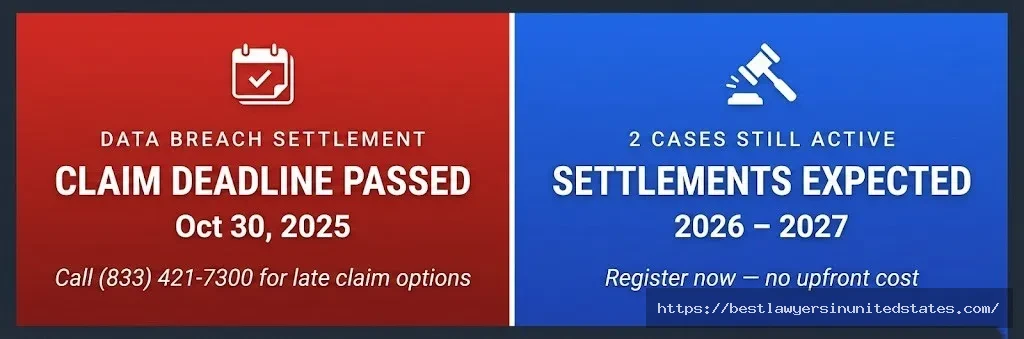
If You Were an Affirm User Whose Data Was Breached
The official claim deadline for the Evolve Bank settlement passed on October 30, 2025. Your options now:
- Call the settlement administrator at (833) 421-7300 to ask about late claims — they may accept them at their discretion
- Monitor your credit and bank accounts for identity theft or fraud related to the breach
- Document any financial losses you’ve experienced (identity theft costs, fraudulent charges) in case new legal avenues open
If You Were an AFRM Investor (Feb 12 – Dec 15, 2021)
The securities fraud case (Kusnier v. Affirm) is still active. While there’s no current deadline to join as a class member — you’ll generally be included in any settlement unless you opt out — you should:
- Contact Pomerantz LLP (lead counsel) to register your interest: pomlaw.com
- Gather your trading records showing AFRM purchases and sales during the class period
- Document your losses — the difference between what you paid for shares and what they were worth after the disclosures
If You Were a Consumer Deceived by Affirm’s BNPL Practices
The Shepard v. Affirm consumer case remains active, though Affirm is fighting class certification via arbitration motions. To preserve your options:
- Keep records of your Affirm loan agreements and any payment disputes
- File a complaint with the CFPB at consumerfinance.gov/complaint — these filings support the broader case
- Contact the law firms handling this case for a free consultation on your specific situation
What Are the Key Allegations Against Affirm?
Consumer Protection Violations
| Allegation | Specific Claim | Who It Affects |
|---|---|---|
| Deceptive marketing | BNPL terms obscure true APR and total cost | All Affirm borrowers |
| Return policy trap | Borrowers must keep paying even after returning items | Shoppers who returned purchases |
| No dispute rights | Can’t dispute charges like you can with a credit card | All Affirm borrowers |
| Hidden fees | Payment schedules create unexpected charges | All Affirm borrowers |
| Overspending encouragement | Marketing targets people who can’t otherwise afford items | High-risk consumer groups |
Securities Fraud Allegations
| Allegation | What Executives Allegedly Said | What Was True |
|---|---|---|
| BNPL risk | Minimal regulatory exposure | CFPB inquiry was foreseeable |
| Consumer debt | Business helps consumers manage spending | Service facilitates excessive debt |
| Data practices | Standard data use | Data harvesting for regulatory arbitrage |
| Interest rate risk | Business model resilient | Model vulnerable to rate changes |
How the Affirm Cases Compare to Similar BNPL Lawsuits
Affirm isn’t alone. The entire BNPL industry has faced legal and regulatory pressure, and comparisons help put Affirm’s cases in context.
| Company / Case | Issue | Settlement / Status | Amount |
|---|---|---|---|
| Affirm (Evolve breach) | Data breach | Final approval Dec 2025 | $3.78 million |
| Afterpay | Deceptive fees | Investigated, regulatory action | Undisclosed |
| Klarna | Hidden fees, debt traps | CFPB scrutiny ongoing | None |
| Zip (Quadpay) | FTC action on fees | Consent order | $600,000 in refunds |
| PayPal Credit | Marketing deception | FTC settlement | $15 million |
| LendUp Loans | Consumer deception | CFPB settlement | $3.63 million |
What makes the Affirm consumer case unique is its focus on the merchant relationship — specifically, how Affirm’s contracts with retailers may prevent consumers from exercising return and dispute rights they’d normally have. That’s a broader structural argument than most BNPL cases, and it’s why the case has lasted this long despite challenges. Midland Credit Management Class Action Lawsuit
Do You Need a Lawyer?
Quick Answer: For the data breach settlement, no lawyer was needed to file a claim. For the consumer protection and securities cases — which are still active — you don’t pay anything out of pocket to be included in a class action. Attorneys work on contingency, meaning they only get paid if the case wins (typically 25–33% of any settlement).
When to Consider a Free Consultation
You might want to reach out directly to an attorney if:
- You have significant documented losses from the Evolve Bank data breach (identity theft, fraud, financial harm)
- You bought substantial amounts of AFRM stock during the February–December 2021 class period and want to pursue a lead plaintiff role or ensure your losses are represented
- You have a complex consumer dispute with Affirm — multiple unauthorized charges, a major disputed transaction, or significant return/refund issues
Free Legal Help
- Pomerantz LLP (securities case lead counsel): pomlaw.com
- Data breach administrator: (833) 421-7300
- CFPB consumer complaints: consumerfinance.gov/complaint
- Attorney referrals: [email protected]
No legitimate class action attorney charges you upfront. If anyone asks for payment to file your class action claim, that’s a scam.
Current Status & What to Watch in 2026
Where Things Stand Right Now
The data breach settlement is the only fully resolved piece of the Affirm legal saga. Payments from that settlement are expected to be distributed in the months following final approval (December 15, 2025), likely by mid-2026 for those who filed claims before the deadline.
The consumer BNPL case and securities fraud case are both in active litigation. The securities case has survived multiple rounds of dismissal, suggesting the core allegations have enough merit to continue. The consumer case is waiting on a key ruling about Affirm’s arbitration motion.
Key Upcoming Events to Watch
| Event | Expected Timeframe | What It Means |
|---|---|---|
| Evolve settlement payments | Early-to-mid 2026 | Checks distributed to claimants |
| Kusnier arbitration ruling | 2026 | Will determine if class action proceeds |
| Kusnier potential settlement | 2026–2027 | Securities case resolution |
| Shepard BNPL case ruling | 2026–2027 | Consumer case resolution |
| CFPB BNPL rule enforcement | Ongoing | Could force Affirm to offer credit-card-level protections |
The CFPB Factor
In May 2024, the CFPB issued an interpretive rule requiring BNPL lenders to provide credit card-level consumer protections — including the right to dispute charges, receive billing statements, and get refunds for returned goods. If enforced, this directly addresses the core issues in the Shepard consumer lawsuit and could significantly strengthen the plaintiffs’ position.
Frequently Asked Questions
What is the Affirm lawsuit about?
There are actually three separate Affirm lawsuits. The first is a settled data breach case involving a 2024 cyberattack on Evolve Bank & Trust that exposed millions of Affirm users’ personal data — that case settled for $3.78 million. The second is an ongoing consumer protection case claiming Affirm uses deceptive BNPL marketing, traps consumers into paying for returned items, and strips them of dispute rights. The third is an ongoing securities fraud case claiming Affirm misled AFRM investors between February and December 2021.
Who qualifies for the Affirm data breach settlement?
The claim deadline was October 30, 2025, which has passed. To have qualified, you needed to be a U.S. resident who provided personal information to Evolve Bank & Trust — directly or through Affirm, Dave, Mercury, or another fintech partner — and whose data was compromised in the February or May 2024 breach. Contact the settlement administrator at (833) 421-7300 to ask about late claims.
How much money does the Affirm data breach settlement pay?
Claimants who filed by the deadline could receive either up to $3,000 for documented losses (with proof like bank statements or fraud reports) or a flat ~$20 cash payment, plus one year of free credit monitoring. The total settlement fund was $3.78 million.
Is there a current open deadline to file an Affirm lawsuit claim?
No active claim deadlines currently apply. The data breach claim deadline (October 30, 2025) has passed. The two ongoing cases — the consumer BNPL suit and the securities fraud suit — haven’t settled yet, so there are no current claim forms to file. Watch for settlement announcements in 2026–2027.
Who can join the Affirm securities fraud lawsuit?
You may be eligible if you purchased or acquired AFRM securities between February 12, 2021 and December 15, 2021, and suffered losses as a result. Contact Pomerantz LLP at pomlaw.com to register your information.
Who can join the Affirm consumer BNPL lawsuit?
Anyone who used Affirm’s BNPL plans — particularly New York consumers — and experienced hidden fees, was charged for returned items, or couldn’t dispute a transaction may be a potential class member in the Shepard case. The case is still in early litigation stages; formal class membership won’t be defined until the case progresses further.
Do I need a lawyer to be part of these class actions?
No. Class action attorneys work on contingency — they get paid only if the case wins, typically 25–33% of any settlement. You don’t pay anything upfront to be included in a class. However, you should consult a lawyer if you have significant losses or want to pursue a lead plaintiff role.
What is the Affirm BNPL consumer lawsuit claiming, specifically?
The Shepard lawsuit claims that Affirm: (1) uses deceptive marketing that hides the true cost of its plans versus credit cards; (2) leaves consumers responsible for paying installments even after returning items to the retailer; (3) strips consumers of the right to dispute transactions; (4) charges hidden or hard-to-track fees; and (5) violates New York’s consumer protection laws.
What happened to Affirm’s stock during the class period?
On December 16, 2021, when the CFPB announced it was investigating Affirm and four other BNPL companies, Affirm’s stock fell approximately 10.6% — from $110.98 to $99.24 in a single trading session. The securities lawsuit covers investors who bought AFRM between February 12, 2021 and December 15, 2021.
What data was exposed in the Evolve Bank / Affirm data breach?
The LockBit ransomware attack exposed names, dates of birth, Social Security numbers, driver’s license numbers, bank account numbers, and contact information for potentially millions of Affirm customers. Affirm disclosed the breach to the SEC in June 2024. Hackers accessed data in February and May 2024.
Has the Affirm consumer BNPL lawsuit settled?
No. As of February 2026, the Shepard v. Affirm case is still active. Affirm has moved to compel arbitration, and no ruling has been issued. No settlement has been announced.
Has the Affirm securities fraud lawsuit settled?
No. The Kusnier v. Affirm case is still active. Courts have dismissed earlier versions of the complaint but allowed plaintiffs to file amended claims. The case remains listed as ongoing by the Stanford Securities Class Action Clearinghouse.
What is CFPB’s role in the Affirm lawsuits?
The Consumer Financial Protection Bureau launched a formal inquiry into Affirm’s BNPL practices in December 2021, which directly triggered the securities fraud lawsuit. In May 2024, the CFPB issued a rule requiring BNPL lenders to provide the same consumer protections as credit card companies — a development that strengthens the consumer protection arguments in the Shepard case.
Can Affirm force me into arbitration instead of a class action?
Affirm is trying to do exactly that in the consumer case. The company argues its user agreement requires individual arbitration. However, courts regularly deny arbitration motions when clauses are buried in fine print, unconscionable, or contrary to public policy. No ruling has been issued yet in the Shepard case.
What should I do if I think I was affected by the data breach but missed the claim deadline?
Call the settlement administrator at (833) 421-7300. While the official deadline has passed, late claims are sometimes considered at the administrator’s discretion. Also, monitor your credit reports at annualcreditreport.com for signs of identity theft, and consider placing a free credit freeze with Equifax, Experian, and TransUnion.
Will payments from the Evolve Bank settlement affect my taxes?
Settlements for reimbursement of out-of-pocket losses you actually experienced are generally not taxable as income. However, flat cash payments with no specific documented losses may be treated differently. Consult a tax professional for guidance on your specific situation — this is not tax advice.
What law firms are handling the Affirm lawsuits?
The securities fraud case (Kusnier) is led by Pomerantz LLP. The consumer BNPL case (Shepard) was filed independently. The data breach class action was filed by Morgan & Morgan, among others. Firms including Kessler Topaz, Levi & Korsinsky, and Glancy Prongay & Murray have also been involved in monitoring and investigating the securities case.
How long do class action lawsuits typically take?
Class actions usually take 2–5 years from filing to resolution. The Affirm consumer case (filed June 2021) is now in its fifth year. The securities case (filed December 2022) is in its fourth year. Both are on track for potential resolution in 2026–2027 based on typical timelines.
Where can I get updates on the Affirm lawsuits?
- Data breach settlement: evolvesettlement.com
- Securities case tracking: Stanford Securities Class Action Clearinghouse
- Consumer case updates: classaction.org
- CFPB complaints: consumerfinance.gov/complaint
The Bottom Line
The Affirm legal saga covers three distinct areas of harm: a data breach that has settled (though payments are still forthcoming), an ongoing consumer protection fight over deceptive BNPL practices, and an ongoing securities fraud case targeting investor losses from the 2021 stock drop.
If you missed the data breach claim deadline, call (833) 421-7300 immediately to ask about late options. If you held AFRM stock during the 2021 class period and lost money, register with lead counsel Pomerantz LLP. If you’re an Affirm borrower who experienced hidden fees or was charged for returned items, document everything and file a CFPB complaint — it matters for the ongoing consumer case.
The two remaining lawsuits have no active settlement deadlines right now, but that will change. Watch for announcements in 2026.
This article provides general legal information about Affirm class action lawsuits and should not be treated as legal advice. Always consult a qualified attorney for guidance specific to your situation. Information is current as of February 2026.

Comments