
A class action lawsuit accused Coca-Cola’s Simply Orange brand of selling juice products that contained dangerous synthetic “forever chemicals” — while marketing them as completely natural. The case was filed in December 2022 and went through three years of legal battles before a federal judge dismissed it with prejudice on September 29, 2025. adriana chechik lawsuit
There is no active settlement. There is no open claim deadline. Consumers cannot currently file for compensation in this case. What you can do is understand exactly what happened, why the case failed, what the allegations meant for consumer safety, and what options — if any — may still exist. Affirm Lawsuit: 2026 Complete Guide
Quick Answer: The Simply Orange lawsuit (Lurenz v. The Coca-Cola Co.) was a class action that alleged PFAS “forever chemicals” were present in Simply Tropical juice, contradicting the product’s “all natural” marketing. The lawsuit was filed in December 2022 and was dismissed with prejudice on September 29, 2025, meaning it cannot be refiled. No settlement was reached, and there is currently no open claim process for consumers.
Lawsuit Overview
| Detail | Information |
|---|---|
| Case Name | Lurenz v. The Coca-Cola Co. |
| Case Number | 7:22-cv-10941 |
| Court | U.S. District Court, Southern District of New York |
| Judge | U.S. District Judge Nelson S. Roman |
| Filed | December 28, 2022 |
| Lead Plaintiff | Joseph Lurenz (Dutchess County, NY) |
| Defendants | The Coca-Cola Company; The Simply Orange Juice Co. |
| Plaintiff’s Attorneys | Sultzer & Lipari PLLC; Milberg Coleman Bryson Phillips Grossman PLLC |
| Central Allegation | PFAS (forever chemicals) found in “all natural” Simply juice products |
| Settlement | None reached |
| Final Status | Dismissed with prejudice — September 29, 2025 |
What Is the Simply Orange Juice Lawsuit About?
Background
Simply Orange is a subsidiary of The Coca-Cola Company that launched in 2001. It started as an orange juice brand and grew into one of the most recognized chilled juice lines in the United States, generating over $2 billion in annual retail sales. The brand’s entire marketing identity is built around words like “pure,” “simple,” and “all natural” — phrases that appear prominently on every bottle.
In December 2022, a New York man named Joseph Lurenz filed a class action complaint in federal court. He claimed that Simply Tropical juice — one of the brand’s products — contained per- and polyfluoroalkyl substances, better known as PFAS or “forever chemicals.” His argument was simple: you can’t label a product “all natural” if it contains synthetic chemicals that have nothing natural about them.
The lawsuit didn’t claim anyone got sick. It argued that consumers were misled — that they paid a premium for juice they believed was free of synthetic additives, when in fact it allegedly wasn’t. That distinction mattered enormously to how the case played out legally.
What Are PFAS?
PFAS are a class of roughly 12,000 synthetic chemicals used in a wide variety of industrial and consumer products since the 1940s. They’re found in nonstick cookware, food packaging, water-resistant clothing, firefighting foam, and more. The name “forever chemicals” comes from the fact that they don’t break down easily — they persist in the environment and in the human body for years or decades.
Research has linked long-term PFAS exposure to a range of health concerns, including increased risk of certain cancers (kidney, testicular, prostate), thyroid disease, liver damage, hormonal disruption, and immune system effects. In 2022, the EPA dramatically lowered its health advisory levels for two of the most studied PFAS compounds — PFOA and PFOS — to near-zero. Girl Scouts Cookies Lawsuit
| PFAS Compound | EPA Lifetime Health Advisory (Drinking Water) | Where Found |
|---|---|---|
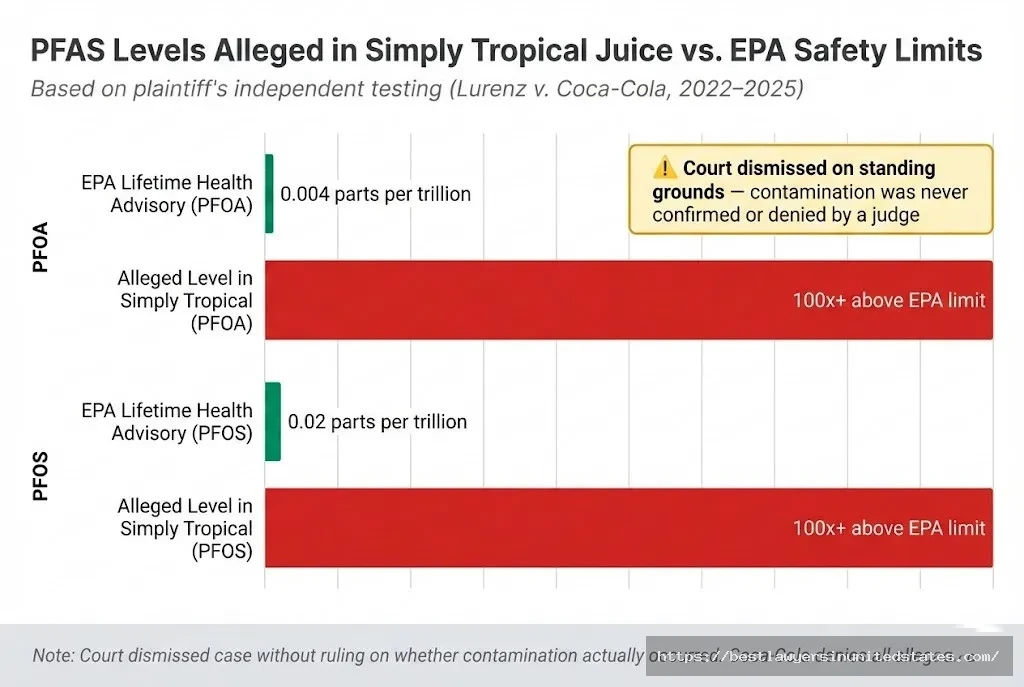
| PFOA (perfluorooctanoic acid) | 0.004 parts per trillion | Nonstick coatings, food packaging |
| PFOS (perfluorooctanesulfonic acid) | 0.02 parts per trillion | Firefighting foam, stain repellents |
| PFNA | 10 parts per trillion | Food packaging, cookware |
| PFHxS | 10 parts per trillion | Various industrial uses |
The plaintiff’s independent testing allegedly found PFOA and PFOS in Simply Tropical juice at levels more than 100 times higher than the EPA’s lifetime health advisory limits for drinking water. That claim became the center of years of legal argument — and ultimately the reason the case fell apart.
Timeline: From Filing to Final Dismissal
| Date | Event | What Happened |
|---|---|---|
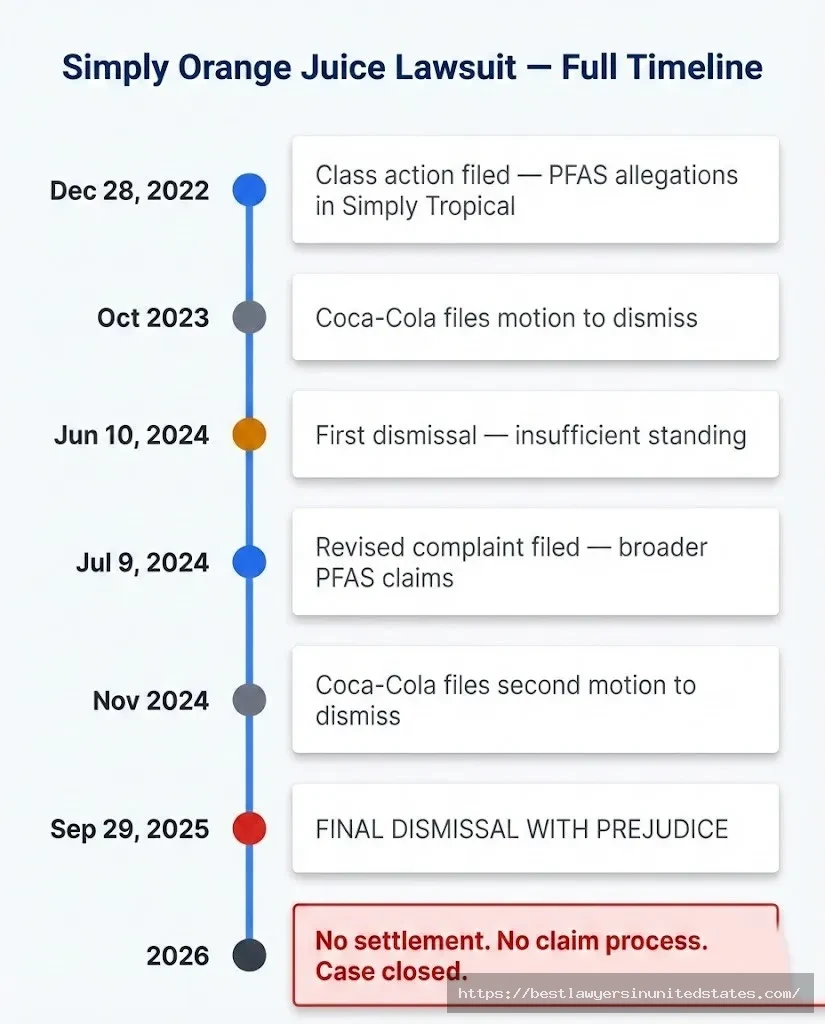
| December 28, 2022 | Lawsuit Filed | Lurenz files class action in SDNY; alleges Simply Tropical contains PFAS at 100x+ EPA limits |
| October 2023 | Motion to Dismiss Filed | Coca-Cola argues plaintiff can’t prove harm or that his specific purchase contained PFAS |
| June 10, 2024 | First Dismissal (Without Prejudice) | Judge Roman dismisses case; single test sample insufficient; plaintiff given leave to amend |
| July 9–10, 2024 | Second Amended Complaint Filed | Lurenz files revised complaint with broader independent testing across multiple Simply products |
| July–November 2024 | Second Motion to Dismiss | Coca-Cola files new motion to dismiss the revised complaint |
| September 29, 2025 | Final Dismissal (With Prejudice) | Judge Roman dismisses case entirely; plaintiff fails to establish standing; case permanently closed |
| Current (2026) | No active litigation | No settlement, no claim process, no appeal on record |
Who Filed the Lawsuit and Who Was Sued?
The lead plaintiff was Joseph Lurenz, a resident of Dutchess County, New York. He purchased Simply Tropical juice and, after seeing reports about PFAS contamination in consumer products, arranged for independent laboratory testing of a sample.
He was represented by two law firms:
- Sultzer & Lipari PLLC (Jason P. Sultzer and Philip J. Furia)
- Milberg Coleman Bryson Phillips Grossman PLLC (Nick Suciu III, Gary Klinger, Erin Ruben, and J. Hunter Bryson)
The defendants were The Coca-Cola Company and its subsidiary The Simply Orange Juice Company. Coca-Cola is the parent company and the entity ultimately responsible for Simply’s marketing and manufacturing decisions.
What Did the Lawsuit Actually Claim?
The complaint centered on five core allegations:
1. PFAS in a product marketed as PFAS-free. The product’s label listed only natural ingredients: filtered water, fruit juice, puree, cane sugar, and natural flavors. Nowhere did it disclose PFAS. Independent testing allegedly found otherwise.
2. Deceptive “all natural” marketing. Simply’s branding uses words like “pure,” “simple,” and “all natural.” The lawsuit argued that a reasonable consumer reading those labels would understand them to mean the product was free from synthetic chemicals.
3. False premium pricing. Because consumers paid extra for what they believed was a clean, natural product, the lawsuit argued they received less value than they paid for. The injury wasn’t a health claim — it was an economic one.
4. Violations of consumer protection laws. Lurenz sued under the New York Deceptive Trade Practices Act, New York Agriculture and Markets Law, and federal consumer protection statutes, as well as negligence and unjust enrichment claims.
5. Widespread contamination across the product line. The revised 2024 complaint went further, alleging that PFAS contamination wasn’t limited to Simply Tropical but extended across Simply’s broader lineup of juices.
| Allegation | Specific Claim | Legal Theory |
|---|---|---|
| PFAS present despite “all natural” label | PFOA and PFOS allegedly found in samples | Consumer deception |
| No PFAS disclosure on packaging | Label omits any mention of synthetic chemicals | False advertising |
| Consumers paid premium for false promise | Economic loss; product worth less than marketed | Unjust enrichment |
| Widespread product line contamination | Not just one batch but systemic issue | Class-wide injury |
Why Did the Lawsuit Fail? Understanding the Court’s Rulings
The lawsuit was dismissed twice — and the second dismissal was permanent. Understanding why is important, because many people searching for this case may have seen early headlines that made it sound more certain than it turned out to be.
First Dismissal: June 10, 2024
Judge Roman dismissed the original complaint primarily because of a concept called standing. Under Article III of the U.S. Constitution, a plaintiff can’t sue in federal court unless they can show a concrete, personal injury. Abstract or speculative harm isn’t enough.
The problem: Lurenz’s independent testing was conducted on a juice sample — but he couldn’t prove the specific bottle he purchased was the one that had been tested, or that PFAS was present in it at all. The judge wrote that the plaintiff’s allegations made it “plausible” that the test result could have been “a false positive or an isolated incident of contamination.”
One test, one sample, no link to what Lurenz personally bought. The court said that wasn’t sufficient to establish a real injury.
The dismissal was without prejudice, meaning Lurenz could try again with stronger evidence.
Second Complaint: July 9, 2024
Lurenz came back a month later with a significantly expanded complaint. This time, he alleged testing across multiple Simply products — not just one bottle of Simply Tropical. He claimed the results showed PFOA and PFOS at more than 100 times EPA drinking water advisory levels across the entire product line, and argued this demonstrated “widespread and uniform contamination.”
Coca-Cola filed a new motion to dismiss in November 2024, arguing the standing problem hadn’t been fixed.
Final Dismissal: September 29, 2025 (With Prejudice)
Judge Roman agreed with Coca-Cola. In an 18-page dismissal order, the court found that Lurenz still failed to establish that the products he personally purchased contained PFAS. The judge pointed to several additional problems:
- Some of the tests cited in the revised complaint were conducted after the original lawsuit was filed, meaning any juice purchased for testing purposes was “self-inflicted harm” with no legal standing
- The complaint claimed “significant levels of PFAS” at “100 times the EPA’s recommended levels” but never explained how EPA drinking water standards apply to fruit juice, or connected those standards to FDA regulations for food
- The allegations were “substantively similar” to other recent PFAS cases the court had rejected for the same reasons
This dismissal was with prejudice — meaning the case is permanently closed and cannot be refiled. No settlement was reached. No claim fund was created.
| Dismissal | Date | Reason | Effect |
|---|---|---|---|
| First Dismissal | June 10, 2024 | Single test sample; no link to plaintiff’s purchases; insufficient standing | Without prejudice; plaintiff allowed to amend |
| Final Dismissal | September 29, 2025 | Revised complaint still failed on standing; post-filing tests = self-inflicted harm; no FDA connection | With prejudice; case permanently closed |
Is There an Active Settlement? Can I File a Claim?
No. This is the most important thing to understand.
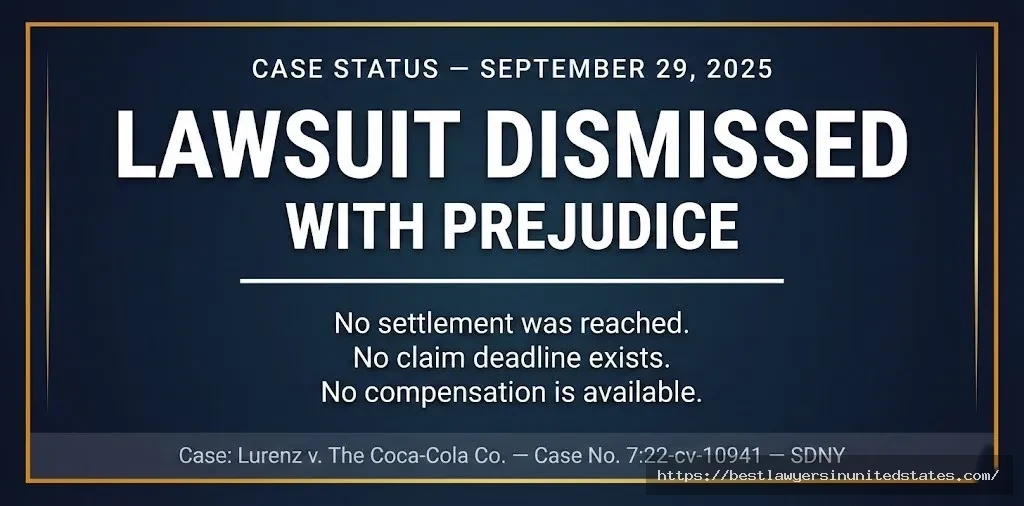
There is no settlement in the Simply Orange PFAS lawsuit. There is no claims administrator, no official settlement website, no claim form, and no deadline to file. The case was dismissed before any settlement was negotiated.
If you’ve seen websites suggesting you can file a claim for compensation in this case, those websites are wrong. There is nothing to file.
Who Would Have Qualified — And What Might Compensation Have Looked Like?
While no settlement exists, it’s worth understanding what would have been in play had the lawsuit succeeded. This helps put the case in context.
The lawsuit sought to represent all U.S. consumers who purchased Simply juice products (later expanded beyond just Simply Tropical). The lead plaintiff and his attorneys specifically sought:
- Reimbursement for the purchase price of affected products
- Statutory and actual damages
- Civil penalties where permitted
- Punitive damages
- Injunctive relief (forcing labeling changes)
Legal experts tracking similar PFAS false advertising cases note that if a settlement had been reached, individual payouts would likely have been modest — somewhere in the range of $1–$3 per bottle purchased, with no receipt required for small claims. That’s the typical range for consumer product false advertising settlements where no physical injury is alleged.
The total class would have potentially numbered in the millions of consumers, given Simply’s scale as the leading chilled juice brand in the U.S. HexClad Lawsuit
| Category | What Would Have Applied | Realistic Estimate |
|---|---|---|
| No receipt, basic claim | Purchased any Simply juice product | $1–$3 per unit up to a cap |
| With proof of purchase | Documentation of purchase amounts | Higher reimbursement, proportional to spend |
| Total potential class size | All U.S. Simply juice buyers over claim period | Potentially millions of people |
| Individual payouts | Based on similar false advertising settlements | Very low dollar amounts per person |
These are hypothetical figures based on comparable settled cases — not actual settlement terms, which were never negotiated.
How Does This Compare to Similar PFAS Cases?
The Simply Orange case isn’t unique. A wave of PFAS lawsuits targeting consumer packaged goods followed the EPA’s 2022 health advisories. Some have fared better in court than others.
| Lawsuit | Product | Outcome | Notes |
|---|---|---|---|
| Simply Orange (Lurenz v. Coca-Cola) | Simply Tropical/Simply juices | Dismissed with prejudice, Sept. 2025 | Standing issues; no settlement |
| Whole Foods 365 Orange Juice | Store brand OJ | Dismissed; similar standing issues | Pattern of courts rejecting single-test PFAS claims |
| BASF AFFF Firefighting Foam | Firefighting foam (PFAS) | $316.5 million settlement | Occupational exposure; direct harm alleged |
| 3M AFFF Settlement | Firefighting foam | $10.3 billion settlement (2023) | Drinking water contamination; municipal plaintiffs |
| Band-Aid PFAS Lawsuit | Adhesive bandages | Pending as of 2026 | Still in early litigation |
| Costco Kirkland Baby Wipes | Baby wipes | Pending as of 2026 | Filed 2023; class not yet certified |
The pattern that emerges: PFAS lawsuits involving direct physical harm (firefighters, contaminated municipal water systems) have succeeded in reaching massive settlements. Consumer product cases based purely on deceptive advertising have struggled far more — courts keep tripping over the standing question of whether the plaintiff can prove their specific purchase was contaminated.
Current Status: What Happens Now?
As of February 2026, the Simply Orange PFAS case is closed. Judge Roman’s September 2025 dismissal with prejudice ended this specific litigation. There are no pending appeals on record in this case.
That said, the underlying issue — PFAS in fruit juice and other food products — isn’t going away. Several developments are worth watching:
FDA packaging regulations: In 2024 and 2025, the FDA moved to phase out PFAS in food packaging and grease-resistant food contact materials. These are regulatory actions, not lawsuits, but they reflect growing federal pressure on the food industry.
New attorneys, new cases: The legal theories tested in Lurenz v. Coca-Cola may be refined and retried by other plaintiffs with stronger standing — meaning people who can directly tie their purchased product to a positive PFAS test. No such new case against Simply Orange had been filed as of February 2026.
State-level regulation: Some states are moving faster than the federal government on PFAS disclosure rules. California, in particular, has proposed stricter food labeling requirements that could eventually require companies to disclose PFAS presence on packaging.
Do You Need a Lawyer for This Case?
There’s nothing to file right now, so you don’t need a lawyer for the Simply Orange lawsuit specifically. But if you have concerns about PFAS exposure from consumer products — or if you’re a firefighter or other worker with documented PFAS exposure — an attorney consultation may be worth pursuing.
PFAS personal injury litigation is a developing area of law, particularly for occupational exposure cases. If you believe you’ve developed a health condition linked to PFAS exposure (from any source, not just orange juice), speak with a mass tort attorney who handles PFAS cases. Most offer free consultations.
For the Simply Orange case specifically: there is no claim to file, and no attorney can get you compensation from a lawsuit that was dismissed before a settlement was reached.
Frequently Asked Questions
What is the Simply Orange juice lawsuit?
It was a class action lawsuit filed in December 2022 alleging that Simply Tropical juice — a product marketed as “all natural” — contained PFAS (per- and polyfluoroalkyl substances, or “forever chemicals”) at levels far above EPA health advisories. The lawsuit accused The Coca-Cola Company and its Simply Orange Juice subsidiary of deceiving consumers with misleading “natural” labeling.
Is there a settlement in the Simply Orange lawsuit?
No. The case was dismissed before any settlement was negotiated. There is no settlement fund, no claims process, and no compensation available to consumers from this lawsuit.
Can I still file a claim?
No. The lawsuit was dismissed with prejudice on September 29, 2025. That means the case is permanently closed. There is no open claim period and no settlement administrator.
Why was the lawsuit dismissed?
Twice, actually. The first dismissal in June 2024 was because the plaintiff couldn’t prove his specific purchase contained PFAS — he had tested a sample, but couldn’t link that sample to a bottle he actually bought. The second and final dismissal in September 2025 found the same standing problem persisted, and added that tests conducted after the lawsuit was filed were essentially self-created harm with no legal weight.
Does Simply Orange juice actually contain PFAS?
The plaintiff’s independent testing alleged yes — specifically PFOA and PFOS at more than 100 times EPA drinking water advisory levels. However, the court never adjudicated the truth of this claim. Coca-Cola denies it. Because the case was dismissed on technical standing grounds rather than on the merits, no court ruling ever confirmed or denied whether PFAS is actually present in these products.
What are PFAS and why are they a concern?
PFAS (per- and polyfluoroalkyl substances) are synthetic chemicals used in thousands of products since the 1940s. They’re called “forever chemicals” because they don’t break down in the environment or the body. Long-term exposure has been linked to certain cancers, thyroid problems, liver disease, and immune system effects. The EPA dramatically lowered its health advisory levels for PFOA and PFOS in 2022.
Has the FDA said Simply Orange is unsafe?
No. The FDA has not declared Simply Orange or any Simply product unsafe or pulled them from shelves. The agency’s recent PFAS actions have focused on packaging and food contact materials, not fruit juice content specifically.
What is “standing” and why did it kill this lawsuit?
In U.S. federal courts, you can only sue if you can prove a concrete, personal injury — not a theoretical or speculative one. This is called “standing.” The Simply Orange plaintiff couldn’t establish that the specific juice he bought was contaminated, so the court ruled he hadn’t suffered a real injury. No standing = no lawsuit, regardless of how valid the underlying concern might be.
Who was suing whom?
Joseph Lurenz, a New York consumer, sued The Coca-Cola Company and The Simply Orange Juice Company (a Coca-Cola subsidiary). His attorneys were Sultzer & Lipari PLLC and Milberg Coleman Bryson Phillips Grossman PLLC.
What is the case number and court?
Case No. 7:22-cv-10941, U.S. District Court for the Southern District of New York, before Judge Nelson S. Roman.
Were any other Simply products involved, not just Simply Tropical?
The original complaint focused on Simply Tropical. The revised July 2024 complaint expanded the allegations to include the broader Simply product line, asserting “widespread and uniform contamination.” That broader claim was part of what was ultimately dismissed in September 2025.
Does this mean PFAS in orange juice aren’t a real concern?
Not necessarily. The court’s dismissal was based on technical legal requirements (standing), not a scientific finding that PFAS aren’t present or aren’t dangerous. The broader concern about PFAS in food and beverages is real and actively being studied. The EPA, FDA, and state regulators are all working on expanded PFAS regulations. The dismissal of this specific lawsuit doesn’t resolve those questions.
Could a new lawsuit against Simply Orange be filed?
Technically yes, but it would need to overcome the same standing hurdles that sank this one. A future plaintiff would need much stronger evidence directly linking their personal purchases to contaminated products — likely through rigorous, documented chain-of-custody testing. No new case had been filed as of February 2026.
What happened with PFAS lawsuits that actually settled?
The biggest PFAS settlements involved direct, demonstrable harm. 3M settled for $10.3 billion in 2023 over PFAS contamination of municipal drinking water systems. BASF settled for $316.5 million. Firefighters and communities with documented exposure to PFAS through firefighting foam have had considerably more legal success than consumers trying to prove a juice bottle was contaminated.
What should I do if I’m concerned about PFAS in my food or drink?
You can reduce PFAS exposure by choosing products not packaged in PFAS-treated materials, using water filters certified to remove PFAS (reverse osmosis is particularly effective), and following FDA and EPA guidance as regulations evolve. Consulting a doctor about PFAS blood testing is an option if you have significant occupational exposure concerns. For general consumer products, the science is still developing on safe exposure thresholds.
Who can I contact about PFAS lawsuits in general?
If you have a potential PFAS personal injury claim — particularly if you’re a firefighter, military veteran, or live near a known PFAS contamination site — a mass tort law firm specializing in PFAS litigation can evaluate your case. Most offer free consultations. For the Simply Orange case specifically, there is currently no attorney who can help you recover compensation because no settlement exists.
The Bottom Line
The Simply Orange PFAS lawsuit raised a legitimate question: should a company be able to call its product “all natural” while allegedly containing synthetic chemicals the brand never discloses? That question didn’t get a definitive answer in court. The case failed not because the court ruled the juice was clean, but because the plaintiff couldn’t prove he personally bought a contaminated bottle.
For consumers, the practical takeaways are these: there’s no money available from this case, the lawsuit is permanently closed, and anyone telling you otherwise is wrong. The broader issue of PFAS in food and beverages continues to be actively litigated and regulated elsewhere — and that’s the space worth watching if you care about how these chemicals end up in products marketed as natural.
Last updated: February 2026. This article is for informational purposes only and does not constitute legal advice. The Simply Orange PFAS lawsuit (Lurenz v. The Coca-Cola Co.) was dismissed with prejudice on September 29, 2025. There is no active settlement or claims process.

Comments