
Taylor Swift is one of the most litigated artists in music history — not because she’s a serial infringer, but because her astronomical success makes her a magnet for copyright claims. From a multi-year battle over the phrase “players gonna play” to a Florida poet who tried to block a Disney+ documentary, the legal story behind Taylor Swift’s career is as dramatic as any of her albums.
This guide covers every major copyright lawsuit Taylor Swift has faced, what the courts actually decided, and what it all means for music copyright law going forward. Facial abuse lawsuit
Quick Summary: Taylor Swift has faced at least five significant copyright disputes. The highest-profile case — over “Shake It Off” lyrics — was dismissed in June 2025 after eight years of litigation. A separate lawsuit filed by Florida poet Kimberly Marasco was largely dismissed by late 2025, though a second Marasco suit remains active in early 2026. Swift has never lost a copyright case at trial. Biote Lawsuit
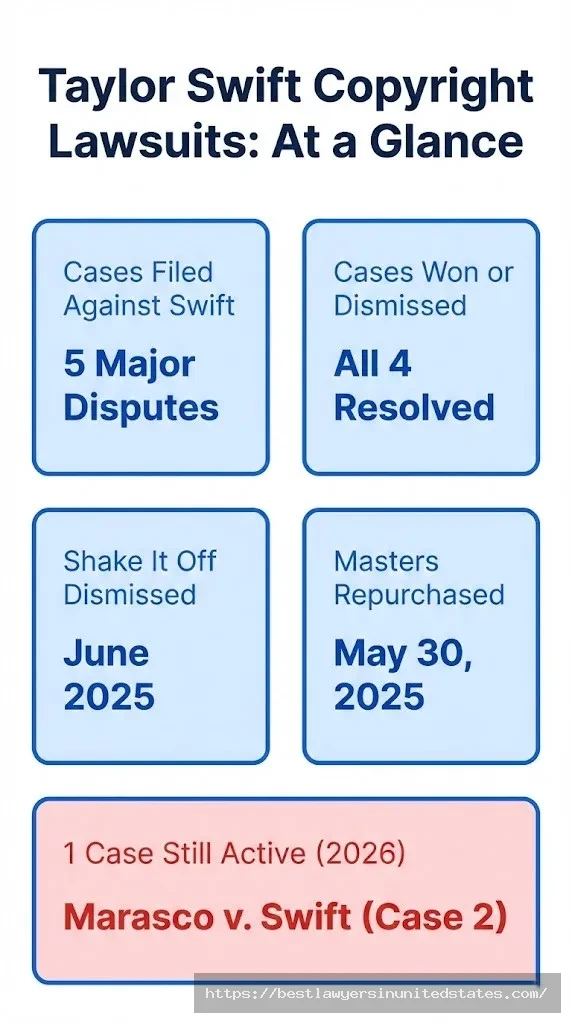
Taylor Swift Copyright Lawsuit Overview
| Case | Filed | Plaintiff | Claim | Outcome |
|---|---|---|---|---|
| Hall v. Swift (“Shake It Off”) | 2017 | Sean Hall & Nathan Butler | Lyrics copied from “Playas Gon’ Play” (2001) | Settled 2022; formally dismissed June 2025 |
| La Dart v. Swift | 2022 | Teresa La Dart | Lover companion book copied her poetry book | Voluntarily dismissed July 2023 |
| Marasco v. Swift (Case 1) | April 2024 | Kimberly Marasco | Songs and videos copied her poems | Swift dismissed Dec 2024; Production Co. dismissed with prejudice Sept 2025 |
| Marasco v. Swift (Case 2) | February 2025 | Kimberly Marasco | Same poetry claims, new defendants added | Active; motion to dismiss pending as of early 2026 |
| Masters Dispute (Big Machine) | N/A | N/A | Not a lawsuit — contract/ownership dispute | Resolved May 2025; Swift repurchased original masters |
The “Shake It Off” Lawsuit: Eight Years, One Dismissal
Background
This is the case that defined modern music copyright law more than any other Taylor Swift dispute.
In 2017, songwriters Sean Hall and Nathan Butler sued Swift in federal court in California, claiming her 2014 megahit “Shake It Off” lifted lyrics from their 2001 R&B track “Playas Gon’ Play,” originally recorded by girl group 3LW. The argument centered on a small but apparently contested patch of the English language: the parallel between Swift’s “players gonna play, play, play” and Hall and Butler’s “playas, they gonna play” and “haters, they gonna hate.”
Swift denied ever hearing the 3LW song. Her legal team argued, persuasively, that these phrases were too commonplace to belong to anyone — they were part of the broader culture of hip-hop and pop long before either track existed.
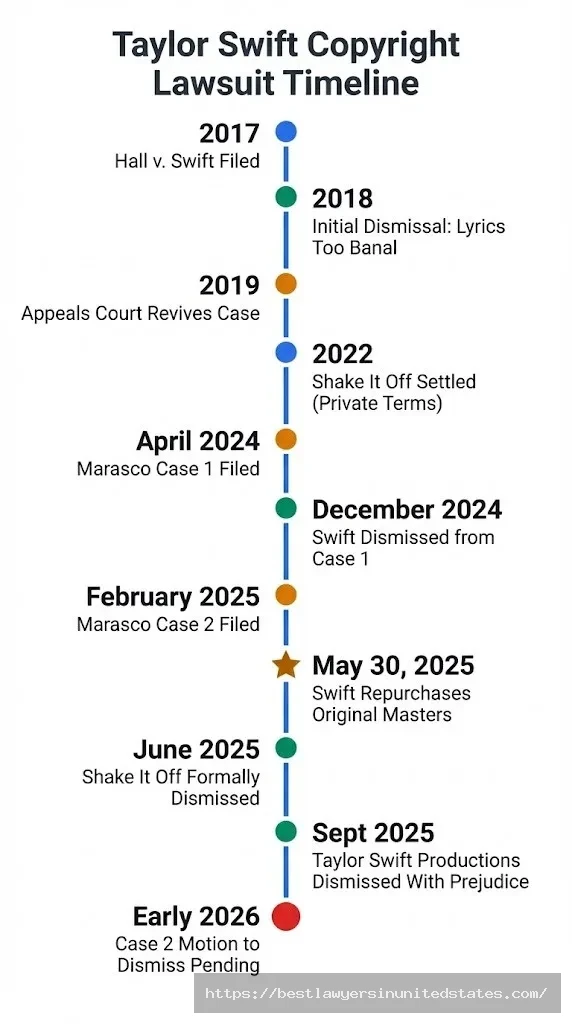
Timeline of the “Shake It Off” Case
| Date | Event | What Happened |
|---|---|---|
| 2017 | Lawsuit filed | Hall and Butler sue in U.S. District Court, Central District of California (Case No. CV 17-6882-MWF) |
| 2018 | Initial dismissal | Judge rules lyrics are “too banal” to be copyrightable |
| 2019 | Appeals court revival | Ninth Circuit reverses dismissal; case allowed to proceed |
| Dec 2021 | Summary judgment denied | Judge Fitzgerald rules triable issues of fact exist; case heads toward jury trial |
| Sept 2022 | Last-ditch motion denied | Swift’s team asks judge to reconsider; denied; trial set for January 2023 |
| Early 2023 | Private settlement | Parties reach an agreement weeks before trial; terms never disclosed publicly |
| June 2025 | Formal dismissal | Case formally closed after nearly eight years of litigation |
What the Courts Actually Said
The legal back-and-forth in this case produced genuinely important precedents. The 2018 dismissal established that short, commonplace phrases are not protectable under copyright law. But the 2019 appeals court reversal complicated that principle by suggesting that the overall “combination” of elements — the pairing of “players” with “haters,” in a specific rhythmic structure — might be protectable even if the individual phrases were not.
That tension between protecting creative combinations versus generic phrases is still unresolved in copyright law, which is why this case attracted so much attention from music industry lawyers.
The Settlement
The 2022 settlement terms were never made public. The song’s writing credits remain unchanged — Hall and Butler did not receive songwriting credit on “Shake It Off.” Swift’s camp never acknowledged wrongdoing. The case was formally dismissed in June 2025 after all settlement conditions were satisfied. Carnival Triumph Lawsuit
The La Dart Lawsuit: A Quick Dismissal
What Happened
In 2022, Teresa La Dart of Mississippi sued Swift in the Western District of Tennessee, claiming Swift’s companion booklet for her Lover album copied “a number of creative elements” from La Dart’s 2010 self-published poetry collection, also titled Lover.
Swift’s attorney Doug Baldridge called the suit “legally and factually baseless” and said it “never should have been filed.”
Outcome
La Dart’s own attorney filed to drop the case permanently in July 2023. The reason was straightforwardly financial: La Dart was facing the prospect of losing and being responsible for tens of thousands of dollars in legal fees. The case was voluntarily dismissed with no monetary payment to either party.
This case is notable mainly because it foreshadowed what would come next — another writer alleging Swift copied her poetry for the Lover album era and beyond.
The Marasco Lawsuits: Florida Poet vs. Taylor Swift
This is where things get genuinely strange.
Who Is Kimberly Marasco?
Kimberly Marasco is a Florida-based poet and artist who, by her own account, had never purchased any of Swift’s albums and “only listened to alternative rock” before attending the Eras Tour in 2024. According to court filings, it was at the Eras Tour that she first noticed what she believed were similarities between Swift’s work and her own published poems.
She went back through Swift’s catalog and identified what she believed were dozens of instances of copying across Lover, Folklore, Midnights, and The Tortured Poets Department.
Case 1: Filed April 2024
Marasco filed her first lawsuit in April 2024, initially in small claims court seeking just $100 and a writing credit. She then amended her complaint in October 2024, dramatically expanding her claims to seek more than $7 million. The amended complaint accused Swift and Taylor Swift Productions of copying metaphors, themes, and specific expressions from poems including “Ordinary Citizen” and “Scorpion.”
The serving problem. Marasco immediately ran into a uniquely 21st-century obstacle: she couldn’t find Taylor Swift to serve her the lawsuit. Swift’s multiple residences are held through LLCs and trusts, her security turns away process servers, and her whereabouts are not always publicly tracked. Marasco documented unsuccessful service attempts in California, Tennessee, New York, and Rhode Island. At a Rhode Island property, a sheriff’s deputy warned that Marasco’s process server would be arrested for trespassing if they returned.
Eventually, Judge Aileen Cannon (yes, the same judge known for other high-profile cases) gave Marasco a final deadline to serve Swift. She failed to meet it. In December 2024, Swift was dismissed from the case.
The production company dismissal. With Swift personally out of the picture, the case continued against Taylor Swift Productions, Inc. Swift’s lawyers argued the claims were about “general ideas, metaphors, contexts, and themes — none of which is a proper subject of copyright protection.” Judge Cannon agreed. In September 2025, she dismissed Taylor Swift Productions from the case with prejudice — meaning it cannot be refiled.
Cannon’s ruling was pointed: “Plaintiff’s attempt to protect various words is equally unavailing. These common words alone are not copyrightable.” The words at issue included “tears,” “yelling,” “running,” “fear,” “time,” “rain,” “sky,” “waves,” “cruel,” and “love.”
Marasco Case 2: Filed February 2025
Undeterred, Marasco filed a second lawsuit in February 2025. This time she named Swift, Aaron Dessner, Jack Antonoff (both Swift collaborators and co-writers), Universal Music Group, and Republic Records. She sought approximately $25–30 million, including disgorgement of profits — meaning she wanted the court to strip Swift and her collaborators of all revenue from the allegedly infringing songs.
Marasco voluntarily dismissed Antonoff from the second case in September 2025. Swift’s team filed a motion to dismiss the remaining defendants, calling the claims “utterly frivolous.”
In November 2025, Marasco escalated by filing a motion for a preliminary injunction to halt the release of Swift’s Eras Tour docuseries The End of an Era on Disney+. The series began streaming on December 12, 2025 — the injunction was not granted.
As of early 2026, the motion to dismiss filed by Swift’s production company’s attorneys remains pending before the court. Judge Cannon has not yet issued a final ruling.
Marasco Lawsuit Timeline
| Date | Event |
|---|---|
| April 2024 | Marasco files Case 1 in small claims court |
| October 2024 | Complaint amended; damages claim increased to $7M+ |
| December 2024 | Swift dismissed from Case 1 for failure to serve |
| February 2025 | Marasco files Case 2 naming Swift, Dessner, Antonoff, UMG, Republic Records |
| May 2025 | Court grants extension on service deadline to June 15 |
| August 2025 | Judge Cannon finds substitute service of Swift was completed |
| September 2025 | Taylor Swift Productions dismissed from Case 1 with prejudice |
| September 2025 | Marasco voluntarily dismisses Antonoff from Case 2 |
| November 2025 | Marasco seeks injunction to block Disney+ docuseries |
| December 2025 | The End of an Era streams on Disney+; injunction not granted |
| Early 2026 | Motion to dismiss Case 2 pending before court |
Taylor Swift’s Masters Dispute: The Bigger Legal Story
While the copyright suits grabbed tabloid headlines, the more consequential legal and intellectual property battle of Swift’s career involved something different: ownership of her master recordings.
What Are Masters and Why Do They Matter?
When an artist records an album, two separate copyrights are created. The first covers the underlying musical composition (lyrics and melody). The second covers the actual recorded performance — the “master recording.” For most of music history, record labels owned the master recordings of artists they signed, allowing them to license, sell, and profit from those recordings indefinitely.
Swift signed with Big Machine Records in 2005. Under her contract, Big Machine owned the master recordings of her first six albums: Taylor Swift, Fearless, Speak Now, Red, 1989, and Reputation.
The Scooter Braun Sale
When Swift’s contract with Big Machine expired, she declined to renew and signed with Republic Records and Universal Music Group — this time securing ownership of all future master recordings. But before she could negotiate to buy back her old masters, Big Machine’s founder Scooter Braun sold the label (and with it, all of Swift’s original recordings) to private equity firm Shamrock Holdings in 2019 without giving Swift a meaningful opportunity to purchase them.
Swift went public about her opposition to the sale. She called it “my worst case scenario” and said she had been “grossly misled” about the process.
The Re-Recording Strategy
Unable to immediately buy back her masters, Swift took an approach that legal scholars at Harvard Law School would later call a “breakthrough moment” in music industry history: she re-recorded her first six albums from scratch.
These “Taylor’s Version” recordings were legally distinct from the originals. Swift owned them outright. By releasing high-quality re-recordings and encouraging fans, media, and music licensing platforms to use Taylor’s Version instead of the originals, she systematically eroded the commercial value of the masters she didn’t own — and shifted leverage in any future negotiation.
The Repurchase
It worked. On May 30, 2025, Taylor Swift formally repurchased her original master recordings from Shamrock Holdings. She now owns both the master recordings and the underlying compositions for all six albums — the reunification of rights she had sought for years.
The strategy demonstrated something the music industry had never seen before at this scale: an artist using copyright law creatively (and entirely legally) to compete against the very recordings they didn’t own, forcing the eventual return of those recordings on their own terms.
What These Cases Mean for Music Copyright Law
Swift’s legal battles don’t exist in isolation. They reflect broader tensions in how copyright law applies to music, and the outcomes have real implications for every songwriter. Endurance Warranty Lawsuit
The “Common Phrases” Question
The “Shake It Off” case and the Marasco dismissals both turned on the same fundamental principle: copyright protects specific creative expression, not ideas, themes, or everyday language. You cannot own “players gonna play.” You cannot own the word “love” or “rain.”
This sounds obvious until you look at cases like Blurred Lines, where Robin Thicke and Pharrell Williams lost a $7.4 million verdict for creating a song that captured the “feel” of a Marvin Gaye track without copying specific lyrics or melodies. The line between protectable expression and unprotectable style remains genuinely blurry, and courts have not resolved it consistently.
The “Shake It Off” dismissal in June 2025 — coming after eight years and a near-trial — reinforced the “too banal to protect” principle for short, commonplace phrases. But the case’s long journey through the courts shows how expensive and time-consuming even a winning defense can be.
The Copying Access Requirement
To win a copyright infringement case, a plaintiff must show two things: that the defendant had access to the original work, and that the works are substantially similar. The Marasco cases collapsed partly on the access question — it was implausible that Swift had read the poems of a self-published Florida poet whose work she had no documented contact with.
This is why, in music copyright law, similarity alone is not enough. “Independent creation” is a complete defense. Two songs can arrive at similar lyrics, melodies, or structures by coincidence, and copyright law has to account for that.
The Value of Re-Recording Rights
The masters dispute introduced a legal strategy that did not exist before Swift used it at this scale. The Copyright Act has always allowed original recording artists to re-record their work after a certain period (typically five years from the initial release). Swift exploited this provision more aggressively and successfully than any artist in history, and the result was the return of her original masters.
Other artists are watching. Several have begun similar re-recording projects. The legal principle Swift proved — that re-recordings can be legitimate competitive substitutes that erode the value of original masters — is now part of the industry’s working vocabulary.
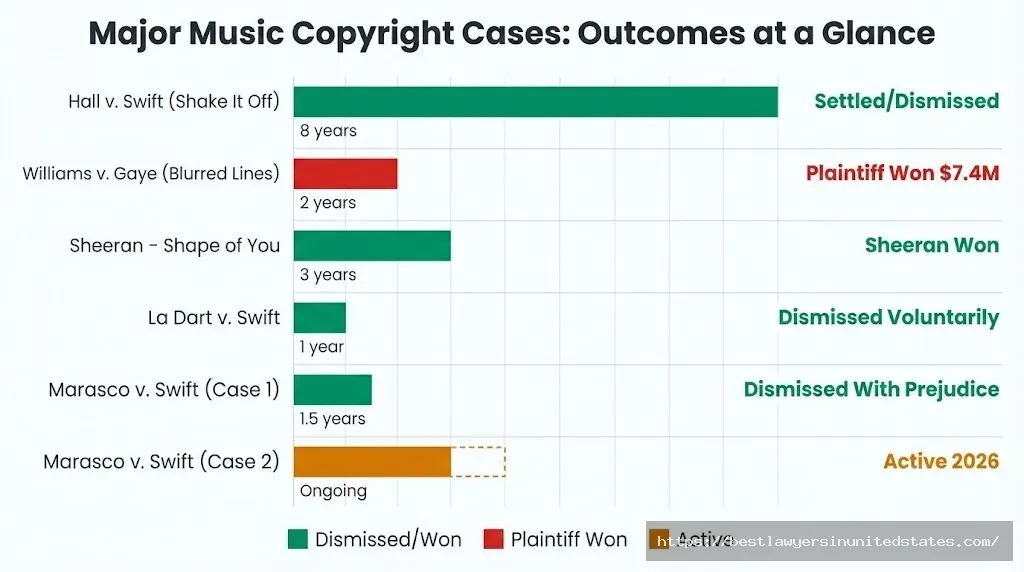
Comparison: Swift’s Cases vs. Other Major Music Copyright Lawsuits
| Case | Plaintiff | Defendant | Claim | Outcome | Settlement/Award |
|---|---|---|---|---|---|
| Hall v. Swift | Sean Hall & Nathan Butler | Taylor Swift | “Shake It Off” lyrics | Private settlement | Undisclosed |
| Williams v. Gaye (“Blurred Lines”) | Gaye Estate | Robin Thicke / Pharrell | “Feel” of Marvin Gaye track | Plaintiff won | $7.4M (reduced) |
| Structured Asset v. Sheeran (“Shape of You”) | Multiple | Ed Sheeran | Melody copying | Sheeran won | N/A |
| Sheeran “Thinking Out Loud” | Townsend Music | Ed Sheeran | Gaye “Let’s Get It On” chord progression | Sheeran won | N/A |
| Gray v. Perry (“Dark Horse”) | Flame | Katy Perry | Ostinato pattern | Perry won (reversed on appeal, then affirmed) | N/A |
| La Dart v. Swift | Teresa La Dart | Taylor Swift | Companion booklet copied poetry | Dismissed voluntarily | N/A |
One pattern stands out: most of these cases settle before trial or end in dismissal for defendants. The Blurred Lines case remains an outlier — a plaintiff victory based on “feel” and “groove” that the music industry widely considers a mistake and that no court has replicated at scale since.
Do You Need a Lawyer If You Have a Music Copyright Claim?
If you’re a songwriter or artist who believes someone has copied your work, here’s what actually matters legally.
What you need to prove:
You must show you own a valid, registered copyright. You must show the defendant had access to your work. And you must show the works are “substantially similar” in their protected expression — not just in themes, ideas, or common phrases.
Copyright registration is not required for protection to exist, but it is required before you can sue in federal court. And registration before infringement occurs unlocks statutory damages of up to $150,000 per work for willful infringement — registration after the fact limits you to actual damages, which can be much harder to calculate and prove.
What copyright does not protect:
- General ideas, themes, or concepts
- Common words and phrases
- Musical styles or “feels”
- Chord progressions in most circumstances
- Facts
When to consult an attorney:
Copyright infringement cases are expensive. The Marasco cases illustrate what happens when someone pursues a copyright claim without strong legal representation — procedural errors, dismissed filings, and cases thrown out for failure to follow court rules. If you believe your work has been copied, a copyright attorney can evaluate whether you have a claim worth pursuing before you invest years and tens of thousands of dollars.
Frequently Asked Questions
What is the Taylor Swift “Shake It Off” copyright lawsuit?
Quick Answer: Songwriters Sean Hall and Nathan Butler sued Swift in 2017, claiming her lyrics “players gonna play / haters gonna hate” copied their 2001 song. The case settled privately in 2022 and was formally dismissed in June 2025.
The case became one of the most-watched music copyright disputes in history because it forced courts to grapple with whether short, common phrases can be protected by copyright. After an initial dismissal, an appeals court revival, and years of litigation, the parties reached a private settlement just weeks before the scheduled trial. No money amounts or terms were disclosed publicly.
Who is Kimberly Marasco and what is her lawsuit against Taylor Swift?
Quick Answer: Marasco is a Florida poet who filed two copyright infringement suits against Swift, claiming songs from Lover, Folklore, Midnights, and The Tortured Poets Department copied her poems. Both cases have largely been dismissed, though a second suit remains technically active in early 2026.
Marasco filed her first case in April 2024 but was unable to serve Swift in time, leading to Swift’s dismissal from that case. A judge then dismissed the production company from the same case with prejudice in September 2025, ruling Marasco’s claimed similarities involved unprotectable words and ideas. Marasco’s second lawsuit, filed in February 2025, is still working through the courts.
Has Taylor Swift ever lost a copyright case?
Quick Answer: No. Swift has never lost a copyright infringement case at trial or in a final ruling.
The “Shake It Off” case settled before trial with undisclosed terms, and Swift’s team never acknowledged wrongdoing. Every case that proceeded to a judicial ruling has been dismissed in Swift’s favor.
What is the significance of Taylor Swift buying back her masters in 2025?
Quick Answer: On May 30, 2025, Swift repurchased her original master recordings from Shamrock Holdings, completing a years-long effort to fully own her first six albums.
This followed Swift’s unprecedented re-recording campaign, in which she released “Taylor’s Version” editions of all six albums she didn’t own. By creating legal substitute recordings and encouraging fans and platforms to use them, she eroded the commercial value of the original masters and gained leverage in negotiations. Legal scholars have called the strategy the most significant artist-led copyright action in the streaming era.
What happened in the La Dart v. Swift lawsuit?
Quick Answer: Teresa La Dart sued Swift in 2022 claiming the Lover companion booklet copied her 2010 poetry collection of the same name. The case was voluntarily dismissed in July 2023, with no money changing hands.
La Dart’s own attorney recommended dropping the case because the potential legal costs of losing would have far exceeded any realistic recovery. Swift’s team called the suit “legally and factually baseless.”
Did Kimberly Marasco try to block Taylor Swift’s Disney+ documentary?
Quick Answer: Yes. In November 2025, Marasco asked a court for an emergency injunction to stop the release of The End of an Era on Disney+. The request was not granted, and the series began streaming December 12, 2025.
Marasco argued that streaming the documentary would cause “irreparable harm” by embedding allegedly infringing material in the global cultural record. Swift’s attorneys described the motion as part of a pattern of “utterly frivolous claims.”
What does “dismissal with prejudice” mean in the Taylor Swift cases?
Quick Answer: Dismissal with prejudice means the case is permanently closed and cannot be refiled. Dismissal without prejudice means the plaintiff could potentially refile.
Swift was dismissed from Marasco’s first case without prejudice — meaning technically, Marasco could refile against her personally. Taylor Swift Productions was dismissed with prejudice from that same case in September 2025, permanently ending those claims against the production company.
What is copyright infringement in music and how hard is it to prove?
Quick Answer: Music copyright infringement requires proving you own a valid registered copyright, the defendant had access to your work, and the works are “substantially similar” in protected creative expression — not just in general themes or common language.
The standard is tougher than most people realize. You cannot copyright a chord progression on its own, a common phrase, a general idea, or a musical “feel.” Courts look for specific similarities in melody, lyrics, or other concrete creative elements. That’s why so many lawsuits against major artists fail: similarity alone is not infringement.
What is the difference between a composition copyright and a master recording copyright?
Quick Answer: A composition copyright covers the underlying song — the lyrics and melody. A master recording copyright covers the specific recorded performance. These are two separate rights that can be owned by different parties.
This distinction is at the heart of Swift’s masters dispute. She always owned the composition rights to her songs, but Big Machine Records owned the master recordings. When she re-recorded her albums, she created new master recordings she owned outright, while the original recordings remained with Shamrock Holdings until she repurchased them in 2025.
Are any Taylor Swift copyright lawsuits still active in 2026?
Quick Answer: Yes — Kimberly Marasco’s second lawsuit (filed February 2025) was still pending in early 2026, with a motion to dismiss awaiting ruling from the court.
The second Marasco suit names Swift, Aaron Dessner, Universal Music Group, and Republic Records. Swift’s attorneys argue the claims are legally identical to those already dismissed and that no protectable expression was copied. A ruling could come at any point in 2026, but given the prior dismissals, most legal observers expect this case to follow the same path.
What This All Means for Music and Copyright Law
Looking across the full landscape of Taylor Swift’s copyright history, a few things stand out.
Swift has a near-perfect defensive record. Every case that reached a substantive ruling has been dismissed in her favor, often with pointed language from judges about the lack of protectable similarity. The one case that didn’t end in a judicial ruling — “Shake It Off” — settled privately after eight years, which itself demonstrates that even baseless or borderline claims can impose enormous costs on defendants.
The Marasco cases serve as a cautionary tale about copyright maximalism — the tendency to see infringement in any similarity, including similarities in common words, universal emotions, and general themes. Copyright law has never protected these things, and courts have repeatedly reaffirmed that it doesn’t, no matter how sincerely a plaintiff believes otherwise.
Swift’s masters strategy remains the most durable legacy of her legal battles. What began as a grievance against a label deal became a blueprint for artist ownership that other musicians are actively following. The re-recording strategy, and its successful conclusion with the repurchase of her originals in May 2025, showed that copyright law can be used offensively as well as defensively — not to restrict creativity, but to reclaim it.
Last updated: February 2026. This article is for informational purposes only and does not constitute legal advice. If you have a copyright question related to your own work, consult a licensed intellectual property attorney.

Comments