
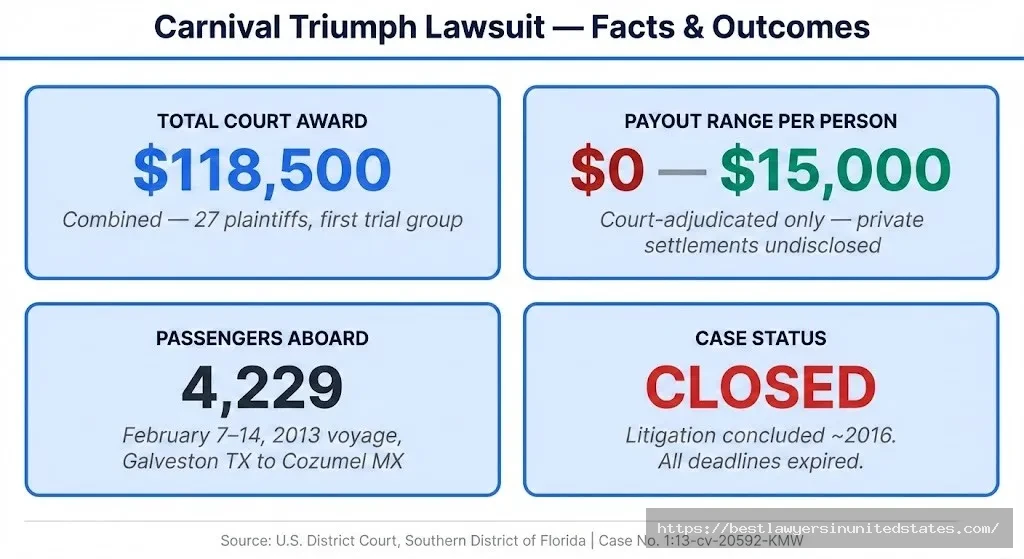
The Carnival Triumph lawsuit grew out of one of the most shocking cruise disasters in modern American history — a 2013 engine fire that left over 4,200 people stranded in the Gulf of Mexico for four days without working toilets, air conditioning, or adequate food. Carnival settled most cases privately, but the ones that went to court produced awards ranging from $0 to $15,000 per person — far less than most passengers expected. The litigation is fully closed. No new claims can be filed for this event. Facial abuse lawsuit
Quick Answer: The Carnival Triumph “Poop Cruise” lawsuits are over and all deadlines have expired. Passengers who didn’t file by February 14, 2014 cannot collect from those cases. Most passengers received a $500 cash payment, a full cruise refund, and a free future cruise credit from Carnival directly — worth about $1,750 total. Those who sued got court awards averaging under $3,000, with a handful settling privately for reportedly higher amounts. If you have a current cruise injury, scroll to the Legal Help section — different deadlines apply.
If you’re here because the Netflix documentary Trainwreck: Poop Cruise got you wondering what actually happened to all those lawsuits, you’re in the right place. This guide breaks down exactly what passengers received, why courts limited payouts so sharply, and what every cruise passenger today should know to protect themselves if something goes wrong.
You’ll find the full case timeline, payout breakdown, what the ticket contract did (and still does) to limit your rights, and answers to every question people are searching right now.
What Is the Carnival Triumph Lawsuit About?
The Problem
On February 10, 2013, a fuel leak from the No. 6 diesel engine aboard the Carnival Triumph sparked a fire in the ship’s aft engine room. The automatic suppression system put out the flames — but the heat destroyed the main power cables. The ship went dark. The engines stopped. And 4,229 passengers and 1,086 crew members found themselves adrift in the Gulf of Mexico with no way to move, no air conditioning, and — most memorably — no working toilets.
Raw sewage backed up through the plumbing and began flooding passenger areas. Some cabins had waste dripping through the ceiling. People slept on deck to escape the heat. Carnival handed out red biohazard bags for passengers to use as toilets. The little food available shrank to cucumber-and-condiment sandwiches. The ship’s crew opened the bar to boost morale — which, according to witnesses, created its own separate set of problems.
Four days later, tugboats dragged the Triumph into Mobile, Alabama. Passengers kissed the ground. Some held bedsheet signs spelling out “SOS.” Carnival CEO Gerry Cahill apologized publicly and offered immediate compensation. Then the lawsuits started.
Key Dates
| Date | What Happened | Why It Matters |
|---|---|---|
| February 7, 2013 | Triumph departs Galveston, TX | Start of the 4-night Cozumel cruise |
| February 10, 2013 | Engine room fire breaks out | Ship loses power, propulsion, and plumbing |
| Feb. 10–14, 2013 | Ship adrift in Gulf of Mexico | 4 days of documented unsanitary conditions |
| February 14, 2013 | Triumph towed into Mobile, AL | Start of the legal clock |
| February 14, 2013 | First lawsuit filed | Filed within hours of docking |
| February 18, 2013 | Crusan v. Carnival filed | Case No. 1:13-cv-20592-KMW; first formal federal case |
| August 14, 2013 | 6-month written notice deadline | Passengers had to notify Carnival by this date |
| February 14, 2014 | 1-year lawsuit filing deadline | All new claims expired on this date |
| ~2014 | Judge Graham rules on damages | Strikes punitive damages; limits recovery to proven medical costs |
| ~March 2015 | First trial verdicts issued | 27 plaintiffs; $118,500 total; 6 receive nothing |
| April 3, 2013 | Triumph breaks free from moorings during repairs | Strikes Army Corps vessel; one dockworker dies |
| 2016 | Remaining cases settled privately | Litigation effectively closed |
| 2019 | Ship renamed Carnival Sunrise | After $200 million renovation in Cádiz, Spain |
| June 24, 2025 | Netflix airs Trainwreck: Poop Cruise | 7.3M+ streams; reignites public interest in the case |
Who Filed the Lawsuit and Against Whom
Defendant: Carnival Corporation and its subsidiary Carnival Cruise Lines, headquartered in Miami, Florida.
The first formal lawsuit was filed by Matt and Melissa Crusan of Oklahoma within days of docking. Their case (No. 1:13-cv-20592-KMW) was heard by U.S. District Judge Donald Graham in the Southern District of Florida — the only court where Carnival’s ticket contract allows passenger lawsuits. Miami maritime firm Lipcon, Margulies & Winkleman, P.A. filed a proposed class action. Maritime attorney Frank Spagnoletti represented a separate group. Dozens more individual suits followed from attorneys across the country.
All cases ended up in the same Miami federal courthouse. That wasn’t a coincidence — it was a clause in the ticket.
What They’re Accused Of
✅ Negligent maintenance — The No. 6 diesel generator was overdue for service by more than a year before the voyage. In the two years prior, the same ship had nine documented fuel line leak incidents.
✅ Ignoring prior warning signs — Two weeks before the fire, Triumph had propulsion problems that made the ship five hours late returning to Galveston. Carnival allegedly took no corrective action.
✅ Pattern of fleet-wide negligence — The Triumph fire was the fourth engine room fire on a Carnival-owned ship resulting in power loss, following the Tropicale (1999), Carnival Splendor (2010), and Costa Allegra (2012).
✅ Bypassing the closer port for financial reasons — Progreso, Mexico was only 105 miles away. Mobile, Alabama was much farther. Plaintiffs argued Carnival chose Alabama for business reasons — insurance, repair facilities, keeping the ship in U.S. waters — extending passenger suffering by days.
✅ Sending an unseaworthy vessel to sea — Plaintiffs argued Carnival knew the ship wasn’t fit to sail and did so anyway.
✅ Failure to provide safe conditions — No functioning toilets, inadequate food, no AC, sewage flooding living areas, risk of communicable disease (Norovirus, Hepatitis).
✅ Unconscionable ticket contract language — The ticket literally stated that Carnival made “absolutely no guarantee for safe passage, a seaworthy vessel, adequate and wholesome food, and sanitary and safe living conditions.” Attorneys called this clause a blueprint for the disaster that followed.
✅ Negligent infliction of emotional distress — Plaintiffs reported PTSD, anxiety disorders, kidney stones, and other lasting health effects tied to the ordeal.
Did Passengers Qualify to Sue? The Eligibility Rules That Shaped Everything
Quick Answer: You could only sue if you were aboard the Triumph on February 7–14, 2013, filed written notice with Carnival by August 14, 2013, and filed your lawsuit in Miami federal court by February 14, 2014. All of those deadlines are now expired.
Who Was Eligible to File
| Requirement | Specifics | Proof Needed |
|---|---|---|
| Aboard the vessel | On the Feb. 7–14, 2013 Galveston–Cozumel voyage | Cruise ticket / booking confirmation |
| Physical injury or illness | Strongest claims had proven physical harm | Medical records from Feb–March 2013 |
| Written notice to Carnival | Had to notify Carnival within 6 months of Feb. 14, 2013 | Certified mail receipt / copy of notice letter |
| Lawsuit filed on time | Had to file in Miami federal court within 1 year | Court filing records |
| Filed individually | Class action was barred by ticket contract | Individual complaint only |
Here’s what most passengers didn’t realize: emotional distress alone wasn’t enough. Judge Graham ruled early in the proceedings that passengers could only recover medical costs conclusively tied to the Triumph incident. If you didn’t have a doctor’s note connecting your kidney stones, anxiety, or stomach problems to those four days on the ship, your case was on thin ice from the start.
The six-month written-notice requirement tripped up several passengers entirely. Some had their cases dismissed not because their claims were weak, but because they missed a deadline buried in the fine print of their ticket contract. The Eleventh Circuit upheld at least one such dismissal.
Who Didn’t Qualify
❌ Anyone who was NOT on the February 7–14, 2013 voyage
❌ Anyone who missed the 6-month written-notice window to Carnival (deadline: August 14, 2013)
❌ Anyone who missed the 1-year lawsuit filing deadline (February 14, 2014)
❌ Anyone seeking to file a class action — the ticket contract barred class actions unless there was wrongful death or serious bodily injury
❌ Anyone seeking punitive damages — Judge Graham struck all punitive damage claims before trial
❌ Anyone with only emotional distress and no documentable physical harm
What Documents Passengers Needed
| Document | Purpose | Where to Find It | If You Didn’t Have It |
|---|---|---|---|
| Cruise ticket or booking confirmation | Prove you were aboard | Carnival booking records / email | Carnival passenger manifest as backup |
| Medical records (Feb–March 2013) | Link physical harm to the voyage | Doctor or hospital from that period | Significantly weakened the claim |
| Written notice to Carnival | Prove you met the 6-month deadline | Certified mail receipt / copy of letter | Claim was often dismissed outright |
| Expense documentation | Prove losses beyond what Carnival refunded | Bank statements, receipts | Estimates rarely held up in court |
| Witness accounts | Corroborate conditions aboard | Fellow passengers, journalist accounts | Helpful but not legally required |
How Much Did Passengers Actually Get?
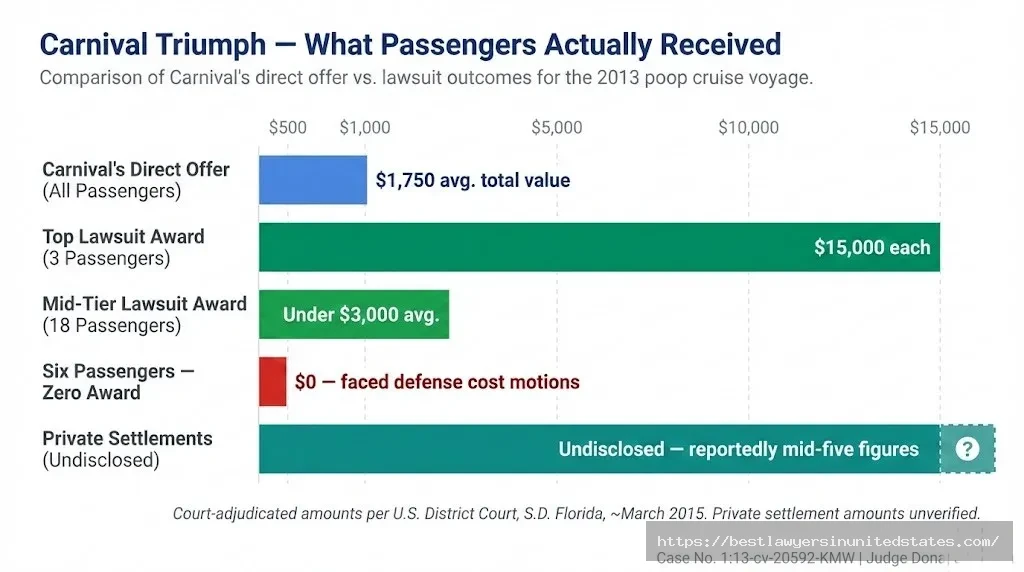
Quick Answer: Every passenger got roughly $1,750 in total non-litigation compensation from Carnival directly. Those who sued got court awards averaging under $3,000 — with the highest getting $15,000. Some who settled privately reportedly got more. Many got nothing.
What Carnival Offered Every Passenger Immediately (No Lawsuit Required)
| Benefit | Amount | Notes |
|---|---|---|
| Full cruise fare refund | 100% of what you paid | Covered all passengers |
| Transportation reimbursement | Actual cost of travel to/from Galveston | Covered all passengers |
| Cash payment | $500 per person | Called “laughable” by plaintiff attorney Michael Winkleman |
| Future cruise credit | Equal to the amount you paid for the voyage | Carnival-branded; not transferable |
| Total estimated value | ~$1,750 per person | Based on average 4-night cruise cost |
What Passengers Who Sued Actually Recovered (Court Verdicts)
| Outcome | Payout | What Made the Difference |
|---|---|---|
| Top-tier plaintiffs (3 people) | $15,000 each | Strong physical injury documentation directly tied to the voyage |
| Mid-tier plaintiffs (18 people) | Under $3,000 average | Documented harm but weaker medical evidence |
| Zeroed out (6 people) | $0 — and faced Carnival motions to tax costs against them | Insufficient proof or claims that didn’t meet the judge’s standard |
| Private settlements (unknown number) | Undisclosed; attorneys report mid-five figures in strongest cases | Pre-verdict private deals for passengers with the best injury documentation |
| Total court-adjudicated award (27 plaintiffs) | $118,500 combined | First trial group, March 2015 |
The gap between what passengers expected and what they got shocked even legal observers. Maritime attorney Robert Peltz told Reuters it seemed “rather obvious that ships shouldn’t just catch fire and then have fire suppression systems that don’t work.” But Judge Graham’s early rulings gutted the most valuable claims before trial even began.
Punitive damages? Gone. Pain and suffering? Gone. Emotional distress without physical injury? Gone. What remained were medical bills — and only those a doctor could tie directly to what happened on those four days.
When Did People Get Paid?
| Stage | When It Happened |
|---|---|
| Carnival’s direct compensation offer | February–March 2013 (immediately after docking) |
| First trial verdicts | ~March 2015 |
| Remaining cases closed | ~2016 |
| All litigation concluded | 2016 |
This case is over. No payments are pending. No checks are being mailed.
How the Ticket Contract Destroyed Most Claims
This is the part the Netflix documentary touched on — but didn’t fully explain.
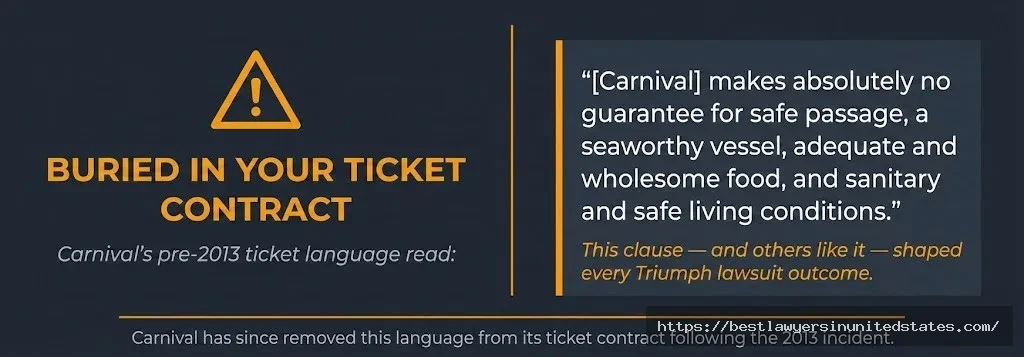
When you buy a Carnival cruise ticket, you agree to an 8,000-word legal contract. Most people never read it. In 2013, that contract contained a line that essentially predicted the Poop Cruise disaster: Carnival made “absolutely no guarantee for safe passage, a seaworthy vessel, adequate and wholesome food, and sanitary and safe living conditions.”
Maritime attorney Frank Spagnoletti, who represented passengers in the Netflix documentary, said: “If most people actually knew that existed at the time, they probably would never buy a ticket.” Despite that clause, his cases all settled — because Carnival’s conduct was bad enough that even a favorable contract couldn’t fully protect them.
Here’s what else the ticket contract did to limit your rights:
- Forum selection clause: You had to sue in Miami federal court. Didn’t matter where you lived or where your cruise departed from.
- Class action waiver: No combining claims. Every passenger had to hire their own lawyer and pay their own way.
- 6-month notice requirement: Had to formally notify Carnival in writing before the lawsuit could even be filed.
- 1-year statute of limitations: Far shorter than Florida’s typical 4-year personal injury deadline.
- Emotional distress limitation: Contract explicitly disclaimed liability for mental anguish without physical injury.
- Punitive damages bar: Reinforced by the judge’s early ruling.
The good news — if there is any — is that Carnival removed most of these limiting clauses after the Triumph incident, and the Cruise Lines International Association adopted the Cruise Passenger Bill of Rights in 2013, which now guarantees emergency backup power, pro-rated refunds for mechanical failures, and the right to disembark at port if essential services can’t be maintained.
Those rights exist because of the Triumph. Hawthorne Residential Partners Lawsuit
What’s Happening With This Case Right Now?
Current Status as of February 2026
The Carnival Triumph lawsuit has been closed since approximately 2016. There are no open claims, no pending settlements, and no active class actions related to the February 2013 incident.
The ship itself doesn’t even exist under that name anymore. After a $200 million renovation in Cádiz, Spain in 2019, Carnival Triumph was relaunched as Carnival Sunrise — complete with new engines, redundant generators, upgraded fire suppression, and redesigned sewage systems. It now sails from Miami to the Bahamas and Caribbean. Facial Abuse Lawsuits
What reignited public interest was Netflix. The documentary Trainwreck: Poop Cruise premiered June 24, 2025, and streamed more than 7.3 million times in its first weeks. People who watched it — many learning about the incident for the first time — naturally wondered what happened to all those lawsuits. That’s why you’re reading this now.
Recent Updates
- June 24, 2025: Netflix’s Trainwreck: Poop Cruise premieres globally; 7.3M+ streams reignite public inquiry into the lawsuits
- June–July 2025: Carnival issues statement calling the incident “a teachable moment,” noting $500M+ in fleet-wide safety investments since 2013
- December 2025: Multiple maritime law firms update their Carnival Triumph content pages in response to documentary traffic surge
- January 2026: Travel industry publications continue referencing the case in passenger rights discussions
- February 10, 2026: 13th anniversary of the engine room fire — editorial coverage, no new legal activity
- February 2026: Carnival Sunrise continues sailing from Miami; no new regulatory or legal proceedings related to the 2013 incident found
What Comes Next (For This Case)
Nothing. This chapter is closed.
But if you have a current cruise injury — from any Carnival ship today — the legal framework is very much alive. The same 1-year filing deadline and 6-month notice requirement still apply to Carnival ticket holders. The difference is you still have time to use them.
How This Case Compares to Similar Cruise Ship Lawsuits
| Lawsuit | Settlement / Award | Passengers Affected | Payout Range | Status |
|---|---|---|---|---|
| Carnival Triumph “Poop Cruise” (2013) | $118,500 court award + private settlements | ~3,143 passengers | $0–$15,000 (court); higher privately | CLOSED 2016 |
| Carnival Splendor Engine Fire (2010) | Confidential individual settlements | Thousands aboard | Not disclosed | CLOSED |
| Costa Concordia Disaster (2012) | ~€14,460 per passenger (Costa’s offer); higher for death claims | ~4,200 passengers; 32 deaths | €14,460+ | CLOSED (Italian proceedings) |
| P&O Pacific Aria / Cyclone Donna (2017) | AUD $2.4M class action | ~713 passengers | ~AUD $1,754 each | CLOSED 2025 |
| Royal Caribbean Anthem of the Seas / Hurricane (2016) | Individual settlements; class action filed | Thousands aboard | Not publicly disclosed | CLOSED |
What stands out about the Triumph case isn’t the dollar amounts — it’s the near-total failure of the class action mechanism. In Australia, Carnival’s P&O brand settled a class action for $2.4 million. In the U.S., the ticket contract blocked a class action entirely, forcing each Triumph passenger to fight alone. Most didn’t bother, which is exactly what Carnival’s legal team designed the contract to produce.
The Costa Concordia comparison is also instructive. That disaster killed 32 people and generated much larger claims — but U.S. courts largely dismissed American attempts to litigate it, sending cases to Italy. The Triumph, at least, was litigated in a U.S. court where Judge Graham’s rulings, while harsh, gave passengers some access to justice.
Do You Need a Lawyer for a Cruise Ship Injury Today?
Quick Answer: For the Triumph 2013 case — no, because it’s too late. For a current cruise injury — yes, you should at least talk to a maritime lawyer immediately, because the deadlines are extremely short.
If You Have a Current Carnival Cruise Injury
The Triumph case is the best argument for calling a maritime attorney the moment something goes wrong on a cruise. Here’s why:
You have 6 months to send written notice to Carnival. You have 1 year to file a lawsuit in Miami federal court. Miss either deadline and your claim is almost certainly gone, no matter how strong it is. The Triumph lawsuits proved this — several passengers lost winnable cases not on the merits, but on a missed paperwork window.
A good maritime attorney handles the notice letter, preserves evidence (CCTV footage disappears fast), identifies all liable parties, and knows which arguments actually work in front of Judge Graham and his colleagues in the Southern District of Florida. DailyNewsLaw Alternative
When a Lawyer Clearly Helps
- You suffered a serious physical injury that required medical treatment
- You missed a port and believe the cruise line acted negligently
- You were sexually assaulted aboard the ship
- You experienced a documented illness outbreak (Norovirus, food poisoning)
- You’re facing a claims department telling you the ticket contract waives your rights
- Your injury is worth more than what you can recover by filing alone
Free Consultations Available From These Firms
All of these firms handle cruise injury cases on contingency — you pay nothing unless they win.
| Firm | Phone | Website | Notes |
|---|---|---|---|
| Lipcon, Margulies & Winkleman, P.A. | 1-877-233-1238 | lipcon.com | Miami; handled hundreds of Triumph claims; 16 attorneys |
| Aronfeld Trial Lawyers | 866-597-4529 | aronfeld.com | Filed first Triumph claim; 30+ years maritime experience |
| Perkins Law Offices | 305-741-5297 | perkinslawoffices.com | SuperLawyers nominated 17 years running |
| Hickey Law Firm | hickeylawfirm.com | hickeylawfirm.com | Former cruise line attorney; double Board Certified |
| Jason Turchin / Victim Aid | 954-515-5000 | victimaid.com | Florida-admitted; handled Triumph claims |
| Brais Law | braislaw.com | braislaw.com | AV Preeminent rated; 50+ years combined experience |
You can also contact [email protected] for attorney referrals matched to your specific situation.
Frequently Asked Questions
What was the Carnival Triumph lawsuit?
Quick Answer: It was a collection of individual lawsuits filed by passengers who were stranded aboard the Carnival Triumph for four days in February 2013 after an engine room fire.
The Triumph fire knocked out the ship’s power and propulsion, leaving 4,229 passengers without working toilets, air conditioning, or adequate food. When the ship docked in Mobile, Alabama on February 14, 2013, passengers filed lawsuits alleging negligence, unseaworthy conditions, and that Carnival had prior knowledge of the ship’s mechanical problems. The litigation lasted from 2013 through approximately 2016.
Who qualified for compensation from the Triumph lawsuits?
Quick Answer: Only passengers aboard the February 7–14, 2013 voyage who filed written notice with Carnival by August 14, 2013 and a lawsuit in Miami federal court by February 14, 2014.
Those deadlines are expired. No new claims can be filed for this incident. Endurance Warranty Lawsuit
What cruise was affected?
Quick Answer: The 4-night sailing from Galveston, Texas to Cozumel, Mexico aboard the Carnival Triumph that departed February 7, 2013 and was supposed to return February 11 but didn’t dock until February 14.
Only passengers on this specific sailing were part of the lawsuits.
How much did Triumph passengers actually get paid?
Quick Answer: All passengers received a $500 cash payment, a full cruise refund, and a future cruise credit — worth about $1,750 total. Passengers who sued got court awards averaging under $3,000, with the top three getting $15,000 each.
Six of the 27 passengers in the first trial group received absolutely nothing — and faced Carnival’s motions to recover court costs from them. Some passengers who settled privately before trial reportedly received higher amounts, but those numbers are confidential and unverified.
What was the total settlement amount?
Quick Answer: There was no single class-action fund. The first court-adjudicated group of 27 plaintiffs shared $118,500 total. Other cases settled privately for undisclosed amounts.
Because the ticket contract barred class actions, every passenger who sued had to fight separately. This fragmented structure meant there’s no single settlement number like you’d see in a typical class action case.
Is there still a deadline to file a claim for the Triumph?
Quick Answer: No. The deadline was February 14, 2014 — one year after docking. All claims for this incident are permanently time-barred.
If you have a current cruise ship injury (from any Carnival voyage today), you have a new 1-year window from your incident date, and a 6-month deadline to send written notice to Carnival.
How do I file a claim for the Triumph lawsuit?
Quick Answer: You can’t. The case is closed and the filing deadline expired in 2014.
If you have a current Carnival cruise injury, contact a maritime attorney in Miami immediately. The process involves sending written notice to Carnival within 6 months and filing in U.S. District Court for the Southern District of Florida within 1 year.
What documents did Triumph passengers need to file?
Quick Answer: A cruise ticket or booking confirmation, medical records linking physical harm to the voyage, proof of written notice to Carnival, and documentation of any expenses beyond what Carnival already refunded.
The most critical document turned out to be medical records. Passengers who couldn’t prove physical injury directly tied to the conditions aboard lost their claims even when their evidence of the conditions themselves was solid.
What if a passenger lost their cruise documents?
Quick Answer: Carnival maintained passenger manifests that could confirm who was aboard. But for this case, it no longer matters — the window to file has been closed for over a decade.
For current cruise injuries, Carnival’s own incident reports and onboard medical records can substitute for personal documentation in many cases. Are Lawsuit Settlements Taxable?
Do you need a lawyer to file a cruise ship claim?
Quick Answer: You don’t legally need one, but for Carnival specifically, having an experienced maritime attorney dramatically improves your chances — and the 6-month notice and 1-year filing deadlines make timing critical.
Carnival has a sophisticated defense team that knows every clause in that ticket contract. Passengers who tried to navigate the Triumph litigation without experienced maritime counsel fared significantly worse.
Has the Triumph settlement been approved by the court?
Quick Answer: There was no class settlement to approve. The cases were adjudicated individually or settled privately. The litigation ended around 2016.
When did Triumph passengers get paid?
Quick Answer: Carnival’s immediate $500 payment and refund went out in February–March 2013. Court awards were issued around March 2015. Private settlements were finalized by approximately 2016.
How did Triumph passengers receive their compensation?
Quick Answer: Carnival’s direct payments came as cash payments and future cruise credits. Court awards were paid as cash judgments. Private settlements were confidential cash payments.
Could Triumph passengers opt out of the lawsuit?
Quick Answer: There was no class action to opt out of — the ticket contract blocked one. Each passenger made an individual choice to accept Carnival’s initial offer or hire an attorney and file separately.
What does accepting Carnival’s initial $500 payment mean legally?
Quick Answer: Some passengers worried the $500 acceptance would waive their right to sue. Maritime attorneys at the time said that accepting the initial offer did not necessarily bar a later lawsuit — but you should always check with a lawyer before accepting any settlement offer.
Will accepting the initial Carnival offer stop you from suing separately?
Quick Answer: This depends on the specific release language. Carnival’s 2013 offer was widely reported not to include a full waiver of lawsuit rights, but any acceptance should be reviewed by an attorney before signing.
For any current cruise injury, never sign a settlement or release without legal advice. Cruise lines sometimes include broad waivers of future claims in their initial compensation offers.
What happened to the Carnival Triumph ship itself?
Quick Answer: Carnival renamed it Carnival Sunrise after a $200 million renovation in 2019. It now sails from Miami to the Bahamas and Caribbean.
The renovation added new engines, redundant generators, upgraded fire suppression systems, and redesigned sewage lines — directly addressing the failures that caused the 2013 disaster.
What if someone missed the deadline to sue Carnival for the Triumph?
Quick Answer: The deadline expired in February 2014. There are no known exceptions or extensions available now.
Courts have consistently enforced Carnival’s contractual 1-year deadline. The Eleventh Circuit upheld the dismissal of at least one Triumph case for a missed filing deadline, sending the message that these timeframes are absolute.
How do passengers check on old Triumph claim status?
Quick Answer: There’s no active claims administrator for this case. If you had a settled case, your attorney should have records. If you had a court judgment, federal PACER court records can be accessed at pacer.gov.
What if a Triumph lawsuit claim was rejected?
Quick Answer: The cases are fully closed. Appeals from the 2015 trial verdicts would have been due long ago. No further recourse exists for rejected Triumph claims.
Will old Triumph lawsuit payouts affect taxes?
Quick Answer: Compensation for documented medical expenses is generally not taxable. Compensation for emotional distress or lost wages may be taxable. Consult a tax professional — this varies based on how the payout was structured.
Where was the official claim form for the Triumph lawsuit?
Quick Answer: There was no official online claim portal. Individual lawsuits required filing formal complaints in the U.S. District Court for the Southern District of Florida in Miami.
Why did the Netflix documentary bring back so much interest in this lawsuit?
Quick Answer: Because Trainwreck: Poop Cruise showed millions of people — many for the first time — how little passengers were compensated and why, making it clear the outcome was shaped by contract clauses rather than the seriousness of what happened.
The documentary premiered June 24, 2025 and streamed over 7.3 million times. Maritime attorney Frank Spagnoletti, who represented Triumph passengers, appears in the film describing how the ticket contract effectively “made it absolutely no guarantee” for safe conditions — and how that language shaped every lawsuit that followed. Philips CPAP Lawsuit Payout Per Person
Could a similar disaster happen on a Carnival cruise today?
Quick Answer: The Cruise Passenger Bill of Rights adopted in 2013 now requires backup emergency power, and Carnival has invested over $500 million in fleet-wide safety upgrades. But cruise ships still catch fire. Tickets still contain limiting language.
The Triumph disaster did produce real industry reform. Every Carnival ship now carries independent backup generators positioned away from the main engine room. The Passenger Bill of Rights guarantees the right to disembark at a docked port if essential services fail. Carnival removed the “no guarantee of sanitary conditions” language from its ticket contract. But the fundamental legal structure — individual suits only, 1-year deadline, Miami federal court, no punitive damages for emotional distress — remains largely unchanged for U.S. passengers today.
What should I do if I have a current injury on a Carnival cruise?
Quick Answer: Report it to ship staff immediately, get medical attention, document everything with photos and written notes, and contact a maritime attorney as soon as you’re back on land.
Do not sign anything Carnival offers without having an attorney review it first. Send written notice of your potential claim to Carnival within 6 months. File your lawsuit in Miami federal court within 1 year. Both deadlines are absolute, and missing either one is how strong cases get dismissed — exactly as happened to some Triumph passengers over a decade ago.
Final Thoughts
The Carnival Triumph lawsuit is one of the most important passenger rights cases in U.S. cruise history — not because passengers won big, but because they didn’t. Despite four days in genuinely dangerous and degrading conditions, most people who sued received less than $3,000. Six received nothing. The ticket contract they never read did exactly what it was designed to do: limit Carnival’s exposure to a fraction of what passengers believed they were owed.
The lasting value of those lawsuits isn’t in the checks that were mailed. It’s in what they exposed: maintenance records showing a ship that should have been grounded, a pattern of engine fires across the Carnival fleet, and a ticket contract that disclaimed responsibility for the very conditions that made the Triumph famous. That exposure pushed the cruise industry into actual reform, and gave future passengers rights they’d never had before.
If you were on the Triumph and wondering whether you missed something — you didn’t, unless you filed before February 14, 2014. That window closed long ago.
If you’re a cruise passenger today and something goes wrong, remember this: you have six months to send written notice and one year to file. Act immediately. Document everything. Call a maritime attorney before you sign anything. The Triumph passengers who got the most — even if “the most” sounds modest — were the ones who moved fast and found experienced lawyers.
The deadline for this case passed in February 2014. Don’t let the next one pass, too.

Comments