
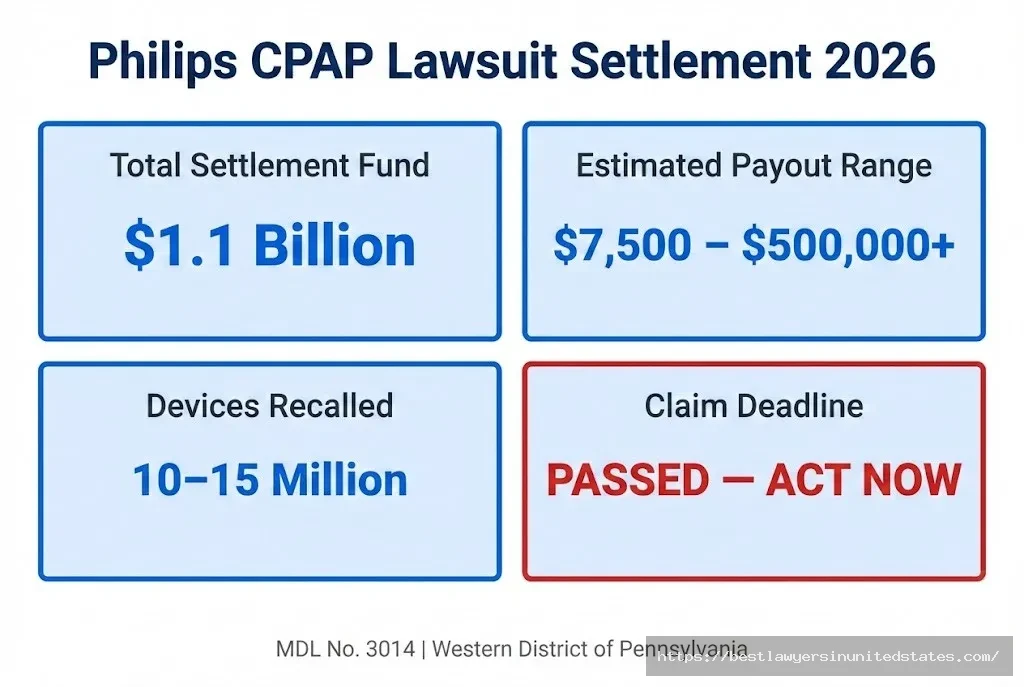
The Philips CPAP lawsuit involves claims that millions of recalled CPAP, BiPAP, and mechanical ventilator devices manufactured by Philips Respironics contained defective foam that released toxic particles and chemicals directly into users’ airways, causing cancer, lung damage, and other serious health injuries. Philips has committed $1.1 billion to resolve personal injury claims, on top of a separate $479 million settlement for economic losses. Payments from the personal injury fund are expected to reach eligible claimants throughout 2025 and into 2026. Tepezza Lawsuit
Quick Answer: The Philips CPAP personal injury settlement totals $1.1 billion ($1.075 billion for injuries, $25 million for medical monitoring). Individual payouts are estimated at $7,500–$10,000 for less severe injuries and $100,000–$500,000 for serious cancer cases, based on a points-based injury scoring system. The economic loss settlement deadline has already passed. If you have a personal injury claim (cancer, serious respiratory illness) and were represented by an attorney or filed a claim before April 29, 2024, contact your attorney immediately for current payment status. Facial abuse lawsuit
What Is the Philips CPAP Lawsuit About?
Background of the Lawsuit
Philips Respironics — a subsidiary of Dutch healthcare giant Koninklijke Philips N.V. — manufactured tens of millions of CPAP (Continuous Positive Airway Pressure), BiPAP (Bilevel Positive Airway Pressure), and mechanical ventilator devices that millions of Americans relied on nightly to treat sleep apnea and other respiratory conditions. Inside these machines was a layer of polyester-based polyurethane foam, known as PE-PUR foam, designed to reduce sound and vibration. The problem: that foam degrades.
When the PE-PUR foam breaks down, it releases tiny black particles and toxic chemical gases directly into the device’s airflow pathway — the same airflow users breathe through all night long. Internal Philips documents show the company was aware of foam degradation concerns as far back as 2015 and had received over 222,000 consumer complaints from 2008 to 2017. Despite this, Philips reportedly took no significant corrective action until April 2021. The foam breakdown can be accelerated by heat, humidity, and the use of ozone-based cleaning products like SoClean.
The chemicals found in degraded PE-PUR foam include toluene diamine, toluene diisocyanate, and diethylene glycol — substances linked to cancer, organ damage, and respiratory disease. Users who slept with these devices every night for years potentially inhaled these particles unknowingly, and many have since been diagnosed with lung cancer, other cancers, and serious pulmonary conditions.
Timeline of Key Events
| Date | Event | Details |
|---|---|---|
| 2008–2017 | Consumer complaints mount | Philips receives 222,000+ complaints about foam issues |
| January 2020 | Internal awareness | Philips executive management reportedly aware of foam degradation |
| April 2021 | First internal action | Philips begins internal review |
| June 14, 2021 | Recall announced | Philips issues voluntary recall of 10–15 million devices made 2009–2021 |
| June 2021 | FDA Class I recall | FDA classifies recall as Class I — the most serious type |
| October 2021 | MDL established | MDL No. 3014 created in Western District of Pennsylvania |
| June 2023 | FDA injury reports | FDA reports 105,000+ complaints and 385 foam-related death reports |
| September 2023 | Economic loss settlement | Philips offers $479 million to settle economic damage class action |
| October 2023 | Economic loss preliminary approval | Court preliminarily approves $479 million settlement |
| April 9, 2024 | FDA consent decree | Court approves consent decree; Philips halts U.S. CPAP sales |
| April 29, 2024 | $1.1B personal injury settlement | Philips agrees to $1.1 billion for injury and wrongful death claims |
| August 9, 2024 | Economic loss deadline | Deadline for device reimbursement claims |
| December 10, 2024 | Personal injury registration deadline | Deadline for law firms to register eligible PI claimants |
| January 6, 2025 | Philips deposits settlement funds | Philips deposits $1.05 billion into Settlement Fund |
| 2025–2026 | Payment distribution ongoing | Personal injury claims being reviewed and paid out |
| February 2026 | 618 cases remain | 618 cases still pending in MDL as of this writing |
Who Filed the Lawsuit?
The litigation began as individual lawsuits filed across the country by people who used recalled Philips devices and developed serious health conditions. In October 2021, the U.S. Judicial Panel on Multidistrict Litigation consolidated these cases into MDL No. 3014 in the U.S. District Court for the Western District of Pennsylvania in Pittsburgh, where Philips Respironics is headquartered. Senior U.S. District Judge Joy Flowers Conti was assigned to oversee all federal CPAP cases. A 12-member Plaintiffs’ Steering Committee, led by four co-lead counsel, negotiated the landmark settlement on behalf of all claimants.
The defendants are Philips Respironics (the U.S. subsidiary that manufactured the devices) and its parent company, Koninklijke Philips N.V., based in the Netherlands. Zicam Lawsuit
What Are the Allegations?
Plaintiffs allege that Philips:
- Knew about the foam defect for years — Internal documents from as early as 2015 show awareness of PE-PUR foam degradation risks, yet no action was taken
- Failed to warn users — CPAP user manuals did not disclose the risks of foam particle inhalation or chemical off-gassing
- Delayed the recall — The company waited until 2021 to issue a recall despite mounting internal and consumer evidence of the problem
- Put profits over safety — Philips prioritized sales and market position over disclosing a known health hazard to users
- Caused serious physical harm — Victims developed lung cancer, other cancers, kidney disease, heart damage, and severe respiratory illnesses after years of foam particle exposure
- Covered up the danger — The FDA alleged Philips had at least 14 internal assessments warning of foam problems from 2016 onward that triggered no timely corrective action
Who Qualifies for the Philips CPAP Lawsuit Settlement?
Quick Answer: There are two separate settlement tracks — one for economic losses (filing deadline has passed) and one for personal injuries (cancer, respiratory illness, etc.). For the personal injury settlement, you must have been represented by an attorney or filed a pro se claim before April 29, 2024, and must have a qualifying injury from a recalled Philips device. If you don’t know your status, contact a mass tort attorney immediately.
Understanding the Two Settlements
This is one of the most important things to understand: the Philips CPAP litigation produced two distinct settlements with very different populations of eligible people.
Settlement 1 — Economic Loss ($479 million): This covered anyone who purchased or rented a recalled Philips device and suffered financial harm from the recall — things like the cost of the device, costs to replace it, rental fees paid on a device that had to be returned. The deadline to file for this settlement was August 9, 2024, and that window has closed.
Settlement 2 — Personal Injury ($1.1 billion): This covers people who used a recalled device and suffered actual physical harm — most importantly cancer, serious respiratory illness, or other significant medical conditions. This is where the larger individual payouts come from. To participate, claimants needed to be represented by an attorney or have filed a pro se claim by April 29, 2024.
Personal Injury Eligibility Requirements
| Requirement | Details | Documentation Needed |
|---|---|---|
| Used a recalled device | Must have used a Philips CPAP, BiPAP, or ventilator that was part of the 2021 recall | Device serial number, model records, prescription records |
| Device manufactured 2009–2021 | Devices made and distributed between 2009 and 2021 are covered | Model documentation, purchase records |
| U.S.-based claimant | Must be a U.S. resident with claims in U.S. courts | Standard ID / residency documentation |
| Qualifying injury | Cancer, serious respiratory illness, organ damage, or other significant medical harm | Medical records, pathology reports, physician diagnosis |
| Represented before April 29, 2024 | Must have had an attorney of record or filed a pro se claim before the settlement date | Attorney engagement records, court filing records |
| Registered by December 10, 2024 | Attorney must have submitted registration declaration by this deadline | Handled by your attorney |
Recalled Device Models
| Brand/Product Line | Device Types | Manufacturing Years | Coverage Status |
|---|---|---|---|
| DreamStation (1st Gen) | CPAP, Auto CPAP, BiPAP | 2009–2021 | Covered — core recall |
| DreamStation Go | CPAP, Auto CPAP | 2009–2021 | Covered |
| System One (50/60 Series) | CPAP, Auto CPAP, BiPAP | 2009–2021 | Covered |
| REMstar | CPAP, Auto CPAP, BiPAP | Various models | Covered |
| Trilogy (Ventilators) | Mechanical ventilators | Various | Covered |
| OmniLab Advanced+ | Sleep lab titration | Various | Covered |
| A-Series BiPAP | BiPAP, ASV variants | Various | Covered |
If you’re unsure whether your specific model was recalled, check the official Philips recall page at usa.philips.com or contact your device supplier.
Who Does NOT Qualify?
You may not be eligible if:
- ❌ You never used a recalled Philips device
- ❌ Your device was manufactured after 2021 (outside the recall window)
- ❌ You didn’t have legal representation or file a claim before April 29, 2024 (for the personal injury fund)
- ❌ You used a competing brand’s CPAP machine (ResMed, Fisher & Paykel, etc.)
- ❌ Your only injury is the economic loss from replacing the device (that deadline has passed)
- ❌ You don’t have a qualifying physical injury diagnosis (minor side effects alone may not qualify)
- ❌ You are a non-U.S. resident (the $1.1 billion settlement is for U.S. claims only)
How to Prove Your Claim
| Document Type | Why It’s Needed | Where to Find It | If You Don’t Have It |
|---|---|---|---|
| Device serial number / model | Confirms you used a recalled device | Original device, Philips recall portal, DME supplier | Contact your home medical equipment supplier or Philips recall line |
| CPAP prescription | Proves you were a legitimate user of the device | Prescribing physician or sleep clinic | Request from your doctor’s office; records typically available 7–10 years back |
| Medical records / diagnosis | Documents your injury (cancer, lung disease, etc.) | Treating physicians, hospital records | Medical records request from all treating facilities |
| Proof of purchase/rental | Supports economic damage claims | Credit card records, insurance records, receipts | Bank or insurance statements may substitute |
| Treatment records | Documents the extent and cost of your medical care | Hospitals, oncologists, pulmonologists | Request copies from all treating providers |
How Much Money Can You Get from the Philips CPAP Settlement?
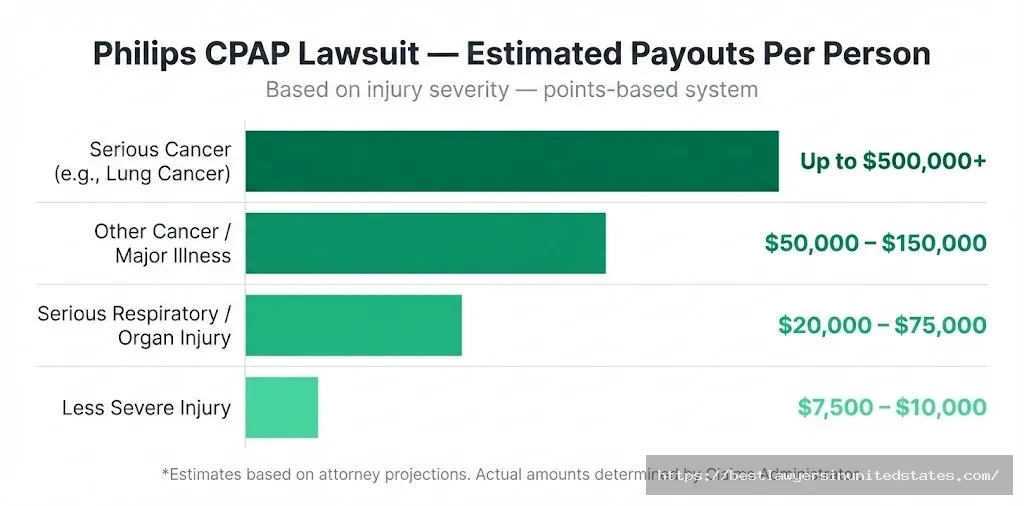
Quick Answer: Individual payout amounts vary widely based on injury severity. Less severe cases may receive approximately $7,500 to $10,000. Cancer cases and serious lung injuries are estimated at $100,000 to $500,000 or more. The total fund is $1.075 billion for personal injury claims. There is no flat-rate payout — each claim is evaluated individually.
Settlement Fund Breakdown
| Category | Amount | Purpose |
|---|---|---|
| Personal Injury Settlement Fund | $1.075 billion | Direct compensation to injury claimants |
| Medical Monitoring Fund | $25 million | 15-year health surveillance program for exposed users |
| Initial Administrative Deposit | $25 million | Paid by Philips within 14 days of signing MSA |
| Remaining Fund Deposit | $1.05 billion | Deposited by Philips by January 6, 2025 |
| Economic Loss Settlement (Separate) | $479 million | Already-resolved separate class action (deadline passed) |
| Total Philips CPAP Compensation Committed | ~$1.6 billion | Both settlements combined |
Payout Tiers and Estimated Amounts
The personal injury settlement uses a points-based allocation system, meaning your payout depends on your injury severity score, how long you used the device, your age, and other medical factors. The Claims Administrator independently evaluates each claim. Spectrum Lawsuit 2026
| Claim Category | Estimated Payout Range | Qualifying Conditions | Payment Form |
|---|---|---|---|
| Serious Cancer (e.g., lung cancer, rare cancers) | $100,000 – $500,000+ | Malignant cancer diagnosis tied to device use | Check/wire transfer |
| Other Cancer / Major Illness | $50,000 – $150,000 | Non-lung cancers, significant tumors | Check/wire transfer |
| Serious Respiratory / Organ Injury | $20,000 – $75,000 | Significant pulmonary disease, kidney damage, heart conditions | Check/wire transfer |
| Less Severe Injury (minor respiratory) | $7,500 – $10,000 | Verified exposure, documented but less serious symptoms | Check/wire transfer |
| Wrongful Death | Varies (potentially higher) | Death of a loved one linked to device | Check/wire transfer |
| Economic Loss (separate settlement) | $55 – $100+ per device | Ownership/rental of recalled device | Check/credit — deadline passed |
These are estimates based on attorney projections and settlement structure, not guaranteed flat amounts. Your actual payout will depend on the Claims Administrator’s individual evaluation of your specific case.
Factors That Affect Your Payout
How much you actually receive depends on several things that are evaluated as part of the points-based system:
- Injury type and severity — Cancer diagnoses receive significantly more weight than milder respiratory symptoms; lung cancer and rare cancers tend to score highest
- Duration of device use — Longer use means more exposure, which typically translates to a higher points score
- Age at diagnosis — Younger age at diagnosis generally results in higher scores, reflecting longer expected lifetime impact
- Wrongful death — Cases where a family member died from a foam-exposure-related illness may receive additional compensation
- Overall claims volume — With thousands of claims drawing from the same $1.075 billion fund, the final per-person amount depends on how many valid claims are submitted and approved
When Will You Receive Payment?
| Stage | Timeframe | What Happens |
|---|---|---|
| Philips deposits $1.05 billion | January 6, 2025 (completed) | Settlement funds placed in escrow |
| Claims review / evaluation | Throughout 2025 | Claims Administrator reviews individual claims |
| Points calculation | 2025–2026 | Each claim receives an injury score |
| Initial payouts begin | 2025 (some already distributed) | First wave of payments to eligible claimants |
| Ongoing distribution | 2025–2026 | Remaining claims processed and paid |
| EIF (Extraordinary Injury Fund) | Separate timeline | $75–$150 million reserved for unique hardship cases |
Some claimants have already begun receiving settlement checks in 2025. However, with hundreds of claims in the system, many are still being processed. If you believe you qualify and haven’t heard from your attorney, contact them right away.
How to Get Your Philips CPAP Settlement Money — Step by Step
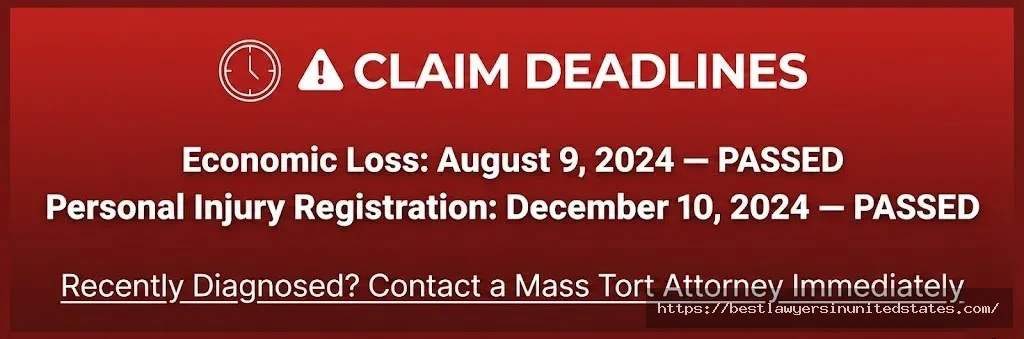
⚠️ IMPORTANT: The main registration deadline for the personal injury settlement was December 10, 2024. The economic loss claim deadline was August 9, 2024. If you missed these deadlines, you may still have options — but you need to speak with a mass tort attorney immediately, as remaining pathways are limited.
If You’re Already a Registered Claimant
Step 1: Confirm Your Registration Status Your attorney should have submitted a declaration registering you as an eligible claimant by December 10, 2024. If you’re unsure whether you were registered, contact your attorney now. Don’t assume — confirm.
Step 2: Complete Your Plaintiff Fact Sheet Registered claimants must submit a detailed Plaintiff Fact Sheet within required deadlines (previously 60 days for pre-existing claims, 45 days for newly filed short-form complaints). This document covers your device use history, medical conditions, and treatment details. Your attorney should help you complete this.
Step 3: Gather All Medical Records and Documentation Work with your attorney to ensure you have complete medical records documenting your diagnosis, treatment, and timeline. The Claims Administrator will use this to calculate your points score. Missing or incomplete records can significantly reduce your payout.
Step 4: Provide Complete Device Use History You’ll need to document how long you used the recalled device, which model it was, and whether you used ozone-based cleaning (which accelerates foam degradation). Pull together serial numbers, prescription dates, and any communications from your DME supplier.
Step 5: Check Your Status on the Official Portal You can log in to the official settlement administrator portal at RespironicsCPAP-ELSettlement.com using your Claim ID. For personal injury claim inquiries, contact the Claims Administrator at [email protected] or 1-855-912-3432.
Step 6: Respond Promptly to Any Requests The Claims Administrator may request additional documentation. Respond quickly — delays in providing information can push your payout back or jeopardize your claim.
Step 7: Update Your Address and Payment Information If you’ve moved since filing your claim, update your address on the administrator portal immediately. Settlement checks sent to old addresses get lost, and reissuing them takes time.
Step 8: Understand Any Liens on Your Payment If Medicare, Medicaid, or private insurance covered your cancer treatments, there may be liens on your settlement payment that must be resolved before you receive the full amount. Your attorney should help handle this.
Step 9: Receive Your Payment Payments are issued by check or wire transfer. Initial payments started going out in 2025. If you haven’t heard anything yet and believe your claim was registered, check in with your attorney and the official portal.
If You Were Recently Diagnosed (Possible Late Claims)
If you were recently diagnosed with cancer or another serious illness you believe is related to Philips CPAP foam exposure, the main settlement registration window has closed. However:
- The settlement agreement contains provisions for new claimants in some circumstances
- You should consult a mass tort attorney immediately to evaluate whether any exceptions or alternative legal avenues apply to your situation
- State-by-state statutes of limitations for product liability cases typically run 2–4 years from diagnosis or the date you learned about the defect (which is sometimes measured from the June 2021 recall announcement)
Critical Deadlines — Summary Table
| Deadline Type | Date | Status | What It Means |
|---|---|---|---|
| Economic Loss Claim Deadline | August 9, 2024 | PASSED | No new economic loss claims accepted |
| Personal Injury Claimant Registration | December 10, 2024 | PASSED | Law firms had to declare all eligible PI clients |
| Settlement Fund Deposit by Philips | January 6, 2025 | COMPLETED | $1.05B deposited into escrow |
| Claims Review / Evaluation | Ongoing 2025–2026 | IN PROGRESS | Claims being scored and evaluated |
| First Payments | 2025 | STARTED | Some checks already issued |
| Extraordinary Injury Fund (EIF) | 2025–2026 | In progress | $75M–$150M for exceptional hardship cases |
Common Mistakes to Avoid
These are the errors that cause the most problems for claimants currently in the process:
- Not following up with your attorney — With a massive settlement fund being distributed, attorneys are handling hundreds of clients. Be proactive and ask for status updates.
- Failing to respond to requests for information — If the Claims Administrator asks for additional records, a delayed response can push your payment back significantly.
- Not updating your contact information — Checks mailed to outdated addresses get lost. Update your information on the administrator portal.
- Assuming your claim is fully handled — Even with an attorney, confirm that you were properly registered and that your Plaintiff Fact Sheet is complete.
- Ignoring potential liens — Medicare and Medicaid liens can delay payment if not handled proactively. Ask your attorney about any outstanding liens on your claim.
Current Lawsuit Status & Latest Updates
Settlement Status as of February 2026
As of February 2026, the personal injury settlement is actively distributing payments. Philips deposited the full $1.05 billion into the Settlement Fund by January 6, 2025, and the Claims Administrator has been evaluating claims and issuing payments throughout 2025.
The $479 million economic loss class action settlement is separately resolved and distributing payments for device reimbursement. That process is also ongoing for claims that were filed before the August 2024 deadline.
There are still 618 pending cases in MDL 3014 as of February 2026. These are primarily cases that either fall outside the main settlement (opt-outs, complex litigation) or involve contested aspects still being worked through the court system.
Recent Developments (2025–2026)
- January 26, 2026: Judge Conti sent a Kentucky CPAP cancer lawsuit back to state court, dealing Philips another setback in its effort to keep all cases in federal MDL. The case involves a woman who alleges she developed a rare cancer after using a recalled Philips DreamStation.
- Late 2025: The FDA issued new warnings about certain DreamStation Auto CPAP and Auto BiPAP models (a newer round of programming errors unrelated to the foam issue), signaling continued safety concerns with Philips devices.
- August 2025: A separate data breach involving CPAP Medical Supplies and Services Inc. was reported — unrelated to the foam litigation, but a reminder to stay alert to communications about your claim.
- 2025 (Ongoing): The Extraordinary Injury Fund (EIF), a $75 million to $150 million pool set aside for unique hardship cases under Section 6.7 of the Master Settlement Agreement, has been in the process of methodology development and application review.
- Ongoing: Philips is pursuing contribution claims against SoClean and other ozone-based cleaning device manufacturers, alleging they share responsibility for accelerating foam degradation.
What Happens Next?
The main story in 2026 is the continued rollout of personal injury payments. Here’s what to expect:
- Ongoing 2026: The Claims Administrator continues to evaluate, score, and pay claims — large, complex cancer cases with substantial medical documentation take the most time
- EIF Applications: The Extraordinary Injury Fund process continues for claimants with especially severe circumstances not fully captured by the standard points system
- Remaining MDL cases: 618 cases still pending may proceed toward bellwether trials or individual resolution
- Ongoing Philips/SoClean litigation: Philips continues to pursue SoClean for contribution
Philips CPAP Settlement vs. Similar Lawsuits
How This Settlement Compares
| Lawsuit | Total Settlement | Devices/People Affected | Estimated Payout Range | Status |
|---|---|---|---|---|
| Philips CPAP (Personal Injury) | $1.075 billion | 10–15 million devices | $7,500 – $500,000+ | Distributing 2025–2026 |
| Philips CPAP (Economic Loss) | $479 million | Millions of device owners | $55 – $100+ per device | Distributing (deadline passed) |
| 3M Combat Earplug | $6 billion | ~265,000 veterans | Varied | Mostly resolved |
| Camp Lejeune Water | $21+ billion authorized | Hundreds of thousands | $100,000 – $500,000+ | Ongoing |
| Roundup (Monsanto) | $11+ billion | Thousands of cancer patients | $5,000 – $250,000+ | Ongoing |
| Talcum Powder (J&J) | $6.5 billion proposed | Ovarian cancer patients | Varied | Contested |
What Makes This Lawsuit Unique?
The Philips CPAP litigation stands out in several ways:
Scale of device use: Sleep apnea devices are used every single night — often for years. This means exposure was continuous and prolonged, unlike many one-time product liability cases, which contributes to the severity of injuries.
Company knowledge: Internal documents show Philips was aware of the foam issue years before the recall. This “knew and concealed” narrative was central to plaintiffs’ leverage in negotiations.
Two-track structure: The parallel economic loss and personal injury settlements are unusual. Most product liability mass torts only produce one class of settlement. Here, people who only suffered financial harm (like having to replace an expensive device) were compensated through a separate $479 million fund.
Regulatory consequences: Philips wasn’t just sued — it also entered a consent decree with the FDA that halted U.S. CPAP sales entirely, making this one of the rare mass tort cases with a simultaneous regulatory shutdown of the defendant company.
Do You Need a Lawyer to File a Claim?
Quick Answer: For the personal injury settlement, practically speaking, yes — the main registration required attorney representation, and the process of documenting injuries, responding to the Claims Administrator, and handling medical liens is complex. For the economic loss settlement, the process was designed to be more accessible, though that deadline has passed.
The Personal Injury Process Requires Legal Representation
Unlike a simple class action where you can submit an online form, the $1.1 billion personal injury settlement was specifically structured around attorney-represented claimants. The registration process required attorneys to submit formal declarations to the court. If you developed cancer or serious illness from a recalled Philips device, a mass tort attorney would handle:
- Filing your complaint or short-form complaint in MDL No. 3014
- Registering you as an eligible claimant with the court
- Completing your Plaintiff Fact Sheet
- Gathering and organizing your medical records
- Navigating the Claims Administrator’s evaluation process
- Handling any Medicare/Medicaid liens on your settlement payment
- Ensuring you receive your maximum eligible payout
When You Might Still Need Legal Help in 2026
Even if you’re already in the settlement process, consulting your attorney is still important if:
- You haven’t received confirmation of your registration or claims status
- You were recently diagnosed with a qualifying illness and want to explore whether any late-claim options remain
- Your claim has been denied or disputed and you want to understand your options
- You believe your injury is severe enough to warrant EIF consideration
- You are a family member handling a wrongful death case
Free Legal Consultation
Many mass tort law firms offer completely free case reviews. If you’re unsure about your status or eligibility, contact a personal injury attorney who handles medical device mass tort cases. You can also reach out via [email protected] for attorney referrals, or visit your state bar association’s referral service. The official settlement administrator can also help answer procedural questions at 1-855-912-3432.
Frequently Asked Questions
What is the Philips CPAP lawsuit about?
Quick Answer: The lawsuit claims Philips CPAP, BiPAP, and ventilator devices contained defective PE-PUR foam that released toxic particles and chemicals into users’ airways, causing cancer and serious respiratory illness.
Philips Respironics manufactured millions of sleep apnea devices with polyurethane foam that degrades over time, releasing particles and gases that users inhale nightly. The June 2021 recall of up to 15 million devices triggered a wave of personal injury lawsuits from people who developed cancer and other health conditions. The litigation is consolidated in MDL No. 3014 in Pittsburgh, Pennsylvania.
How much is the Philips CPAP settlement?
Quick Answer: There are two settlements — $1.1 billion for personal injury claims and a separate $479 million for economic losses, totaling roughly $1.6 billion committed by Philips.
The personal injury settlement of $1.1 billion ($1.075 billion for injuries, $25 million for medical monitoring) was announced on April 29, 2024. The earlier economic loss settlement of $479 million resolved claims from people who suffered financial harm from the recall but not necessarily a physical injury.
How much money will I get per person from the Philips CPAP settlement?
Quick Answer: Estimates range from $7,500–$10,000 for less severe cases to $100,000–$500,000+ for serious cancer diagnoses.
There is no flat payout amount. The personal injury settlement uses a points-based system where your score is calculated based on injury type and severity, duration of device use, your age, and the medical evidence in your file. Serious cancers like lung cancer, rare cancers, and cancers requiring extensive treatment score the highest. Minor respiratory symptoms without a significant medical diagnosis will receive much lower compensation. Your final amount also depends on the total number of valid claims drawing from the $1.075 billion fund.
Is the Philips CPAP settlement approved by the court?
Quick Answer: The economic loss settlement was approved. The personal injury settlement went through a structured process with Philips depositing funds by January 2025, and distribution is actively underway.
The $479 million economic loss settlement received preliminary approval in October 2023. The $1.1 billion personal injury settlement was announced April 29, 2024, with Philips committing to deposit funds by January 6, 2025 — which it did. The Claims Administrator is actively reviewing and paying claims throughout 2025 and into 2026.
Can I still file a Philips CPAP claim in 2026?
Quick Answer: The main deadlines have passed, but if you recently received a qualifying cancer or illness diagnosis, you should consult a mass tort attorney immediately.
The economic loss claim deadline was August 9, 2024. The personal injury claimant registration deadline was December 10, 2024. However, some states’ statutes of limitations may still apply if you were recently diagnosed with an illness linked to the devices. Each case is different, so talk to an attorney before assuming you’re too late.
What devices are covered by the Philips CPAP recall?
Quick Answer: Philips CPAP, BiPAP, and mechanical ventilator devices manufactured between 2009 and 2021, including DreamStation, System One, REMstar, Trilogy, and other product lines.
The recall covered devices made by Philips Respironics at various U.S. facilities. If you used a Philips brand CPAP or BiPAP machine and it was manufactured in this timeframe, it was almost certainly part of the recall. Check your device’s model number against the official Philips recall list.
What injuries are covered by the personal injury settlement?
Quick Answer: Cancer (especially lung cancer and other serious cancers), significant respiratory illness, organ damage, and wrongful death linked to recalled Philips device use.
The settlement specifically targets harm caused by inhaling or swallowing degraded PE-PUR foam particles and chemicals. Qualifying conditions include lung cancer, kidney cancer, nasal and throat cancers, mouth and tongue cancers, inflammatory diseases, serious pulmonary conditions, kidney disease requiring transplant, and heart damage. Minor side effects or temporary symptoms are less likely to qualify.
Do I need a lawyer to participate in the settlement?
Quick Answer: Yes, for the personal injury track — the settlement was structured around attorney-represented claimants, and the registration process required legal representation.
While the economic loss settlement was more self-service, the personal injury process required your attorney to formally declare your eligibility to the court by December 10, 2024. If you already have an attorney, they should be managing your claim. If you don’t, and you believe you have a qualifying injury, consult a mass tort attorney immediately.
When will I receive my Philips CPAP settlement check?
Quick Answer: Some payments started in 2025, and distribution continues into 2026 as claims are evaluated and approved.
The timeline depends on how quickly the Claims Administrator reviews and scores your claim. Cases with complete documentation move faster. Cases involving complex injuries, extensive medical histories, or unresolved Medicare/Medicaid liens take longer. Check your status at RespironicsCPAP-ELSettlement.com or contact your attorney for updates.
How will the settlement payment be made?
Quick Answer: Payments are made by check or wire transfer — your attorney or the Claims Administrator will handle the payment method details.
If you have a structured legal representation agreement, your attorney will receive the settlement check, deduct attorney fees (typically 30–40% in contingency fee arrangements), handle any liens, and distribute the remainder to you. Be sure you understand your fee agreement with your attorney before your payment arrives.
What is the Extraordinary Injury Fund (EIF)?
Quick Answer: The EIF is a $75 million to $150 million pool within the settlement reserved for claimants whose injuries or circumstances are especially severe and not fully covered by the standard points system.
Under Section 6.7 of the Master Settlement Agreement, the Allocation Special Master can award additional compensation from the EIF to eligible claimants with unique situations — extraordinary medical costs, unusual injury types, or circumstances that the standard points formula doesn’t adequately address. If you believe your case warrants EIF consideration, discuss this with your attorney.
What if I used ozone cleaning on my CPAP — does that affect my claim?
Quick Answer: It can affect your claim narrative, but it doesn’t automatically disqualify you.
Philips’ own recall notice acknowledged that ozone-based cleaning (like products from SoClean) can accelerate PE-PUR foam degradation. In fact, Philips has pursued separate litigation against SoClean seeking contribution for this very reason. If you used ozone cleaning, document it and discuss the implications with your attorney, as it could affect how causation is argued in your case.
What if my loved one died from cancer linked to a Philips CPAP?
Quick Answer: Wrongful death claims are covered and may result in higher individual payouts — contact a mass tort attorney as soon as possible.
Family members or estate representatives of someone who died from a qualifying illness related to Philips device use can pursue a wrongful death claim within the settlement. These cases are evaluated with additional weight for the loss of life. The same registration and documentation requirements apply.
Will my Philips CPAP settlement be taxable?
Quick Answer: Compensation for physical injury is generally not subject to federal income tax, but you should consult a tax professional or your attorney.
Under IRS rules, settlements compensating for physical personal injuries or illness are typically excluded from gross income. However, any portion compensating for lost wages or punitive damages may be taxable. Every situation is different, and your attorney or a qualified tax professional can advise you on your specific payment.
What is MDL 3014?
Quick Answer: MDL 3014 is the federal multidistrict litigation that consolidated all Philips CPAP personal injury lawsuits in the Western District of Pennsylvania.
Rather than having thousands of identical lawsuits proceed separately across the country, the U.S. Judicial Panel on Multidistrict Litigation combined them into one centralized proceeding in Pittsburgh in October 2021. This allowed for coordinated discovery, efficient management, and ultimately the negotiation of the $1.1 billion settlement. Judge Joy Flowers Conti presides over MDL 3014.
Can I opt out of the Philips CPAP settlement?
Quick Answer: Technically yes, but opting out is very difficult and comes with strict procedural hurdles that most claimants are not prepared to handle alone.
Claimants who miss the registration deadline are treated as opt-outs by default and face extensive demands: they must produce comprehensive medical records, device usage evidence, expert causation reports within 60 days, and face the real risk of case dismissal if they fall short. Opting out to pursue an individual lawsuit only makes sense in extraordinary circumstances. Talk to your attorney before making any decision to opt out.
Where is the official settlement website?
Quick Answer: The official economic loss settlement portal is RespironicsCPAP-ELSettlement.com. For personal injury claim questions, contact the Claims Administrator at 1-855-912-3432 or [email protected].
Always use official sources for settlement information. Be cautious of unofficial websites that may charge fees to help you file claims you can file yourself, or that misrepresent the status of the settlement.
What should I do right now if I used a recalled Philips CPAP?
Quick Answer: If you have a qualifying injury, contact a mass tort attorney immediately to discuss whether any claim options remain. If you’re already registered, check your claim status and make sure your documentation is complete.
If you’re a current claimant, the most important thing you can do is stay in contact with your attorney, make sure all your medical records are submitted, keep your contact information current on the administrator portal, and respond promptly to any requests. If you’re not sure whether you’re registered, find out today.

Comments