
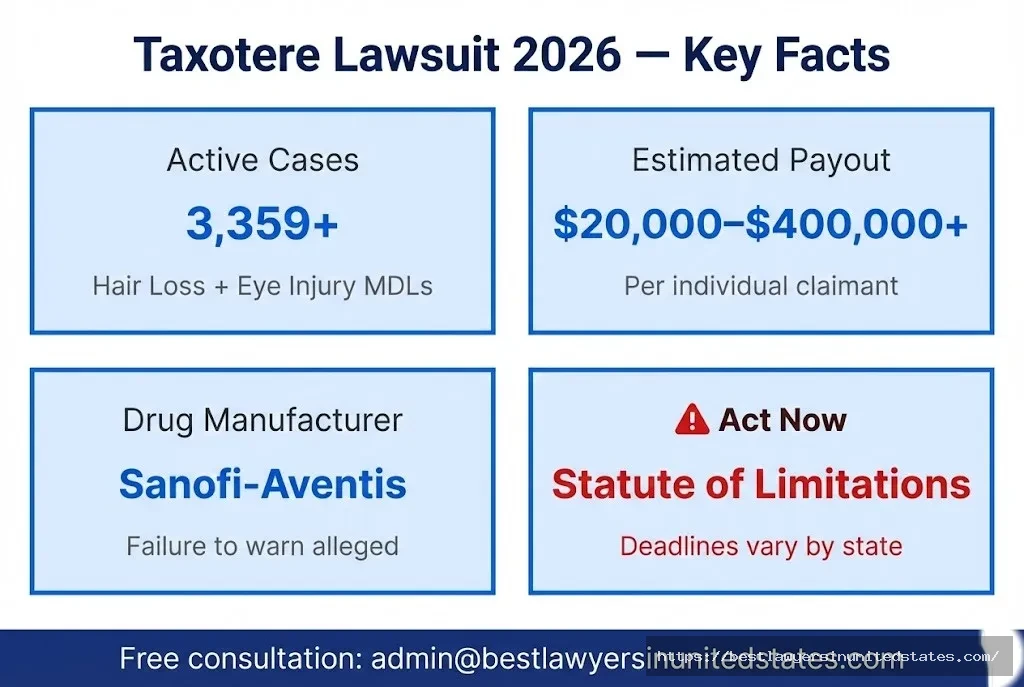
The Taxotere lawsuit involves thousands of cancer patients who say the chemotherapy drug Taxotere (docetaxel), made by Sanofi-Aventis, caused permanent hair loss and serious eye injuries — conditions the company allegedly failed to warn them about. Two active federal Multidistrict Litigations (MDLs) are currently pending in Louisiana, and no global settlement has been reached yet. If you or a loved one suffered permanent hair loss or eye damage after Taxotere treatment, you may still be able to file a lawsuit — but the statute of limitations means you need to act quickly. crepe erase lawsuit
Quick Answer: The Taxotere lawsuits are active MDL litigations in federal court in Louisiana — not a traditional class action with a simple claim form. To join, you need to hire a Taxotere lawsuit lawyer who will file your case individually. Estimated future compensation ranges from $20,000 to over $400,000 depending on the severity of your injury. As of February 2026, both MDLs remain pending with no settlement announced. Contact a Taxotere attorney today — waiting too long could bar your claim entirely.
Taxotere Lawsuit Overview
| Key Detail | Information |
|---|---|
| Drug Name | Taxotere (docetaxel) |
| Manufacturer | Sanofi-Aventis |
| FDA Approval | May 1996 |
| Primary Uses | Breast, lung, prostate, stomach, and head/neck cancers |
| Injuries Alleged | Permanent hair loss (alopecia), eye damage, vision loss, blocked tear ducts |
| MDL (Hair Loss) | MDL 2740 — E.D. Louisiana |
| MDL (Eye Injuries) | MDL 3023 — E.D. Louisiana |
| Presiding Judge | Hon. Jane Triche Milazzo |
| Active Cases (Nov 2025) | ~2,988 hair loss; ~371 eye injury |
| Settlement Status | No global settlement reached as of February 2026 |
| Estimated Payouts | $20,000–$400,000+ per claimant |
| How to File | Hire a Taxotere lawsuit lawyer |
What Is the Taxotere Lawsuit About?
Background of the Lawsuit
Taxotere is a chemotherapy drug Sanofi-Aventis has sold in the U.S. since 1996. It’s prescribed to treat breast cancer, lung cancer, prostate cancer, and several other forms of the disease. For decades, it was one of the most widely used chemotherapy drugs in the country.
The problem: Sanofi allegedly knew — or should have known — that Taxotere carried a risk of permanent hair loss and permanent eye damage, and failed to adequately warn patients and doctors in the United States. While temporary hair loss is expected with chemotherapy, permanent alopecia is not. Many patients say they would have chosen a different drug had they known.
The lawsuits break into two main groups. The first involves permanent alopecia — scalp hair, eyebrows, eyelashes, and body hair that never grew back after treatment ended. The second, more recent litigation covers eye injuries: blocked tear ducts, excessive tearing (epiphora), and a condition called canalicular stenosis, which can require surgery and cause permanent vision damage. Dr. Daniel Pompa Lawsuits Explained
Timeline of Key Events
| Date | Event | Details |
|---|---|---|
| May 1996 | FDA approves Taxotere | Approved for breast cancer treatment |
| Late 1990s–2000s | European warnings issued | Sanofi warned European patients about permanent hair loss risk |
| ~2010–2015 | U.S. patients report permanent hair loss | Widespread complaints emerge; no U.S. label warning existed |
| December 2015 | U.S. hair loss warning added | Sanofi finally updates U.S. label — nearly a decade after European markets |
| October 2016 | MDL 2740 established | Hair loss cases consolidated in E.D. Louisiana |
| 2019 | First bellwether trial (hair loss) | Sanofi wins; plaintiff’s case dismissed |
| December 2021 | Second bellwether trial (hair loss) | Sanofi wins again |
| 2022 | MDL 3023 established | Eye injury cases consolidated separately |
| 2022 | Sanofi moves to dismiss eye injury MDL | Court denies full dismissal; cases continue |
| September 2023 | JAMA study supports eye injury claims | Published in JAMA Ophthalmology; Taxotere linked to sevenfold increase in excessive tearing |
| August 2025 | Sanofi summary judgment hearing (MDL 3023) | Critical motion heard; decision still pending |
| November 2025 | Active case counts confirmed | 2,988 hair loss cases; 371 eye injury cases |
| February 2026 | Current status | Both MDLs active; no settlement announced |
Who Filed the Lawsuits?
The lawsuits were originally filed by individual cancer patients — primarily women who had been treated for breast cancer. Cases began being filed in federal courts across the country after December 2015, when Sanofi finally updated the U.S. drug label to mention permanent hair loss. By October 2016, the Judicial Panel on Multidistrict Litigation (JPML) consolidated the cases into MDL 2740 in the Eastern District of Louisiana.
The eye injury MDL (MDL 3023) followed years later, brought by patients who developed conditions like canalicular stenosis and epiphora after Taxotere chemotherapy. Both MDLs are overseen by Judge Jane Triche Milazzo. Plaintiffs are represented by law firms from across the country, with a Plaintiffs’ Steering Committee coordinating the litigation strategy.
What Are the Allegations Against Sanofi?
The core claim in both MDLs is failure to warn — a product liability theory that holds a manufacturer responsible when it doesn’t tell patients and doctors about known risks. Specifically, plaintiffs allege that Sanofi:
- Concealed the permanent hair loss risk in the U.S. for years while issuing warnings in Europe and Canada
- Delayed updating the U.S. drug label until December 2015, depriving patients of informed consent
- Failed to adequately warn about eye injury risks, including the risk of permanent tear duct damage and canalicular stenosis
- Engaged in a fraudulent marketing scheme, allegedly paying kickbacks and providing unlawful incentives to encourage doctors to prescribe Taxotere over other, potentially safer chemotherapy options
- Withheld or downplayed clinical study data that would have revealed the risks to patients and the FDA
These are serious allegations. Sanofi has consistently denied wrongdoing and has prevailed in both hair loss bellwether trials so far. The eye injury litigation is still developing.
Who Qualifies for the Taxotere Lawsuit?
Quick Answer: You may qualify if you received Taxotere (docetaxel) during cancer treatment and developed permanent hair loss that never grew back, OR if you developed eye injuries like excessive tearing or blocked tear ducts. A Taxotere lawsuit lawyer can review your case for free to confirm eligibility. Don’t wait — statutes of limitations apply.
Eligibility Requirements
| Requirement | Details | Evidence Needed |
|---|---|---|
| Received Taxotere (brand name) | Must have been treated with the brand-name drug, not generic docetaxel only | Medical records, oncology treatment records |
| Diagnosis of permanent alopecia OR eye injury | Hair loss must have persisted 6+ months after treatment, OR you have documented eye damage | Medical diagnosis from doctor, ophthalmologist |
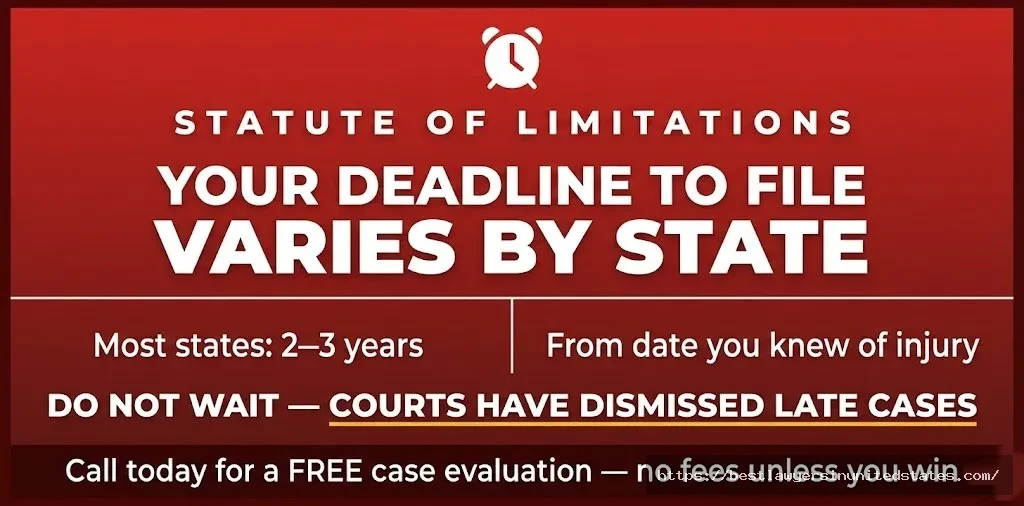
| Treatment within the statute of limitations window | Varies by state — typically 2–3 years from when you knew (or should have known) of the injury | Consult a lawyer immediately to assess your window |
| Cancer treatment in the U.S. | Cases are filed in U.S. federal court | Treatment facility records |
| No prior settlement or release | You haven’t previously settled a claim against Sanofi related to Taxotere | Attorney review of prior agreements |
There are two separate eligibility tracks. The hair loss MDL covers people who suffered permanent scalp alopecia, loss of eyebrows, eyelashes, or body hair that never returned after finishing Taxotere treatment. The eye injury MDL covers people who developed conditions like epiphora (chronically watery eyes), canalicular stenosis (scarring and blockage of tear ducts), or other documented vision problems linked to the drug.
Not every law firm is still accepting hair loss cases. Because the two bellwether trials for hair loss both resulted in Sanofi wins, some firms have shifted focus to eye injury cases, which are seen as legally stronger at this stage. However, many firms are still reviewing hair loss cases. A free consultation with a Taxotere attorney will tell you where your case stands.
Who May NOT Qualify
You may not be eligible to file a Taxotere lawsuit if:
- You only received generic docetaxel (not brand-name Taxotere made by Sanofi)
- Your hair loss fully grew back after chemotherapy ended
- Your statute of limitations has expired (this varies by state and when you first noticed the injury — contact a lawyer immediately to find out)
- You received Taxotere after December 11, 2015 — the court has previously dismissed some cases involving treatment after this date on specific legal grounds
- You already settled or released claims against Sanofi related to Taxotere
- Your eye symptoms are attributed to another cause and you lack medical documentation linking them to Taxotere
The statute of limitations question is the most critical issue right now. Courts have dismissed cases where plaintiffs waited too long. If you’re unsure, the safest thing you can do is call a Taxotere lawsuit lawyer today for a free evaluation.
How to Document Your Claim
| Document Type | Why It’s Needed | Where to Find It |
|---|---|---|
| Oncology treatment records | Proves you received Taxotere specifically | Treating oncologist’s office or hospital medical records department |
| Pharmacy/infusion records | Confirms drug name and dosage | Infusion center or hospital pharmacy |
| Medical records showing diagnosis | Documents your hair loss or eye condition | Primary care doctor, dermatologist, or ophthalmologist |
| Photos (if available) | Visual evidence of hair loss extent | Personal photos taken during/after treatment |
| Ophthalmology records | Proves eye injury and links it to timeline | Ophthalmologist or eye specialist |
| Surgical records (if applicable) | Documents tear duct surgery from canalicular stenosis | Hospital surgical records |
How Much Money Could You Get from a Taxotere Lawsuit?
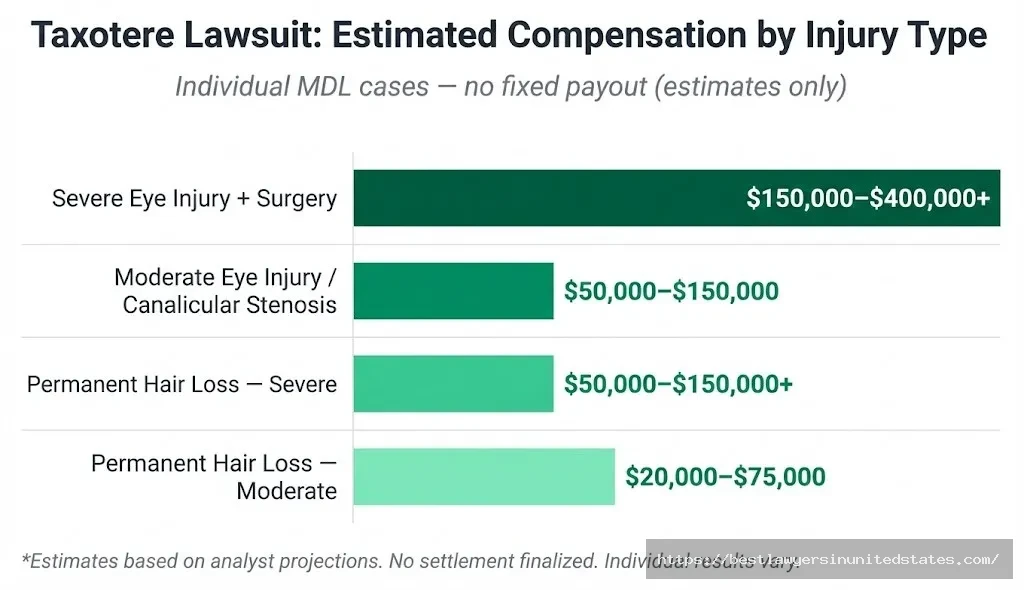
Quick Answer: Because the Taxotere cases are individual MDL lawsuits (not a class action), there are no fixed payout tiers. Legal analysts estimate compensation could range from $20,000 to over $400,000 per person, depending on the severity of your injury, how long it has persisted, and other case-specific factors. No settlement has been announced yet.
Why There’s No Fixed Payout (MDL vs. Class Action)
This is one of the most misunderstood things about the Taxotere litigation. It’s not a class action lawsuit. In a class action, thousands of people share one settlement pot and receive relatively small, equal amounts.
The Taxotere cases are Multidistrict Litigation (MDL) — a different legal structure where your case is filed individually and your compensation is calculated based on your specific injuries and circumstances. That means someone with severe, documented eye damage requiring multiple surgeries could receive significantly more than someone with moderate hair loss. Your individual outcome depends on the strength of your medical evidence, the severity of your injury, and how the litigation develops.
Estimated Compensation Ranges
| Injury Category | Estimated Range | Factors That Influence Amount |
|---|---|---|
| Severe eye injury with surgery | $150,000–$400,000+ | Required dacryocystorhinostomy (DCR) or tear duct surgery, permanent vision damage |
| Moderate eye injury / canalicular stenosis | $50,000–$150,000 | Documented tear duct damage, ongoing symptoms, medical treatment required |
| Permanent alopecia (hair loss) — severe | $50,000–$150,000+ | Total scalp hair loss, eyebrow/eyelash loss, documented emotional distress |
| Permanent alopecia — moderate | $20,000–$75,000 | Partial permanent hair loss persisting post-treatment |
| Base-level documented injury | $20,000–$40,000 | Documented but less severe cases |
These are analyst estimates only. No settlement has been finalized. Individual results vary.
Factors That Affect Your Compensation
How much you could recover depends on several things specific to your case:
Severity and permanence of your injury — The more severe and permanent the damage (especially blindness-threatening eye conditions), the higher the potential compensation. Courts and juries place the highest value on injuries that permanently reduce quality of life.
Medical treatment and costs — If your condition required surgery, ongoing treatment, or expensive medical intervention, those costs factor directly into your damages.
Your age and occupation — Younger plaintiffs and those whose appearance or vision directly affected their career may receive higher compensation.
Emotional distress and quality of life — Permanent disfigurement from hair loss and the daily suffering caused by chronic eye conditions are compensable damages. Documented mental health impacts strengthen your case.
The strength of your evidence — Well-documented cases with clear medical records linking your injury to Taxotere — and showing Sanofi’s failure to warn — are worth more. DKOldies Lawsuit
When Will Payments Happen?
This is the honest answer: nobody knows yet. No settlement has been announced in either MDL as of February 2026. The eye injury litigation is awaiting a critical summary judgment ruling from Judge Milazzo. The hair loss litigation continues after two plaintiff losses in bellwether trials.
| Stage | Status (Feb 2026) | What Happens |
|---|---|---|
| Active litigation | Ongoing | Both MDLs in discovery/motion phases |
| Sanofi summary judgment (MDL 3023) | Decision pending | Court ruling will determine viability of eye injury cases |
| Potential settlement negotiations | Not yet announced | MDL judge has appointed a Settlement Committee; discussions possible |
| Bellwether trials (MDL 2740) | Being considered | Additional trials may clarify hair loss case value |
| Global settlement (estimated) | Unknown — could be 2026–2028+ | Would depend on court rulings, negotiation, and case outcomes |
| Payment distribution | After any settlement is finalized | Typically 6–18 months after a settlement is approved |
The best way to protect your place in this litigation — and make sure you’re there when a settlement does come — is to file your case now with a qualified Taxotere lawsuit lawyer.
How to File a Taxotere Lawsuit — Step by Step
⚠️ CRITICAL: These cases require an attorney. Unlike a class action with an online claim form, the Taxotere MDL requires you to file an individual lawsuit through a licensed attorney. There is no claim form to fill out on a website. And because statutes of limitations vary by state, acting quickly is essential.
Complete Filing Process
Step 1: Get a Free Case Evaluation
Your first step is to contact a Taxotere lawsuit lawyer for a free, no-obligation case review. During this call, the attorney will ask about your cancer treatment history, the specific drug you received, and the injuries you’ve experienced. This review costs you nothing. Most Taxotere attorneys work on a contingency fee basis — meaning they only get paid if you win or settle.
Before your consultation, gather what you can:
- Medical records from your oncologist
- Any pharmacy or infusion center records showing Taxotere use
- Records from your eye doctor or dermatologist
- Photos documenting your hair loss or eye condition
Step 2: Sign a Retainer Agreement
If the attorney believes you have a viable claim, they’ll send you paperwork to formally hire the firm. Read it carefully. You should understand the contingency fee percentage (usually 33–40%), what expenses you might owe, and the timeline. Never feel rushed to sign.
Step 3: Your Attorney Files Your Case
Your lawyer will draft and file a Short Form Complaint in the MDL — either MDL 2740 (hair loss) or MDL 3023 (eye injuries). This officially adds you to the litigation. Your attorney handles all court filings and paperwork.
Step 4: Case Discovery and Fact Sheets
Once your case is filed, you’ll complete a Plaintiff Fact Sheet — a detailed document about your treatment, injuries, and damages. Your attorney guides you through this. Medical records and expert reports are gathered during discovery.
Step 5: Monitor Case Progress
Your attorney will keep you updated on the MDL’s progress — court rulings, trial results, settlement developments, and what they mean for your case. You don’t need to attend court proceedings for MDL cases unless selected for a bellwether trial.
Step 6: Settlement or Trial
If and when a global settlement is reached, your attorney negotiates your individual settlement amount based on your injuries and damages. If no settlement is reached, your case may proceed to trial.
Step 7: Receive Compensation
After a settlement agreement is signed or a verdict is reached, payment is processed. Timelines vary but typically take months after final resolution.
Don’t Make These Mistakes
The biggest mistake people make is waiting too long. Statutes of limitations have already gotten cases thrown out. Courts dismissed New Jersey Taxotere cases in 2023 because plaintiffs were time-barred. In Louisiana MDL 2740, the court granted summary judgment dismissing cases where treatment started after December 11, 2015, on specific legal grounds.
Other mistakes to avoid:
- Assuming you don’t qualify without asking an attorney — eligibility depends on facts specific to your case
- Not gathering medical records before your consultation — the more documentation you bring, the better
- Hiring a non-specialist — look for firms actively handling Taxotere MDL cases, not general personal injury lawyers who’ve never worked in mass torts
- Thinking the two bellwether losses mean all cases are dead — MDL litigation often continues through losses; the eye injury litigation in particular remains viable
Current Lawsuit Status & Latest 2026 Updates
Status as of February 2026
Both Taxotere MDLs remain actively pending in the U.S. District Court for the Eastern District of Louisiana before Judge Jane Triche Milazzo. No global settlement has been announced in either MDL.
As of November 2025, there were approximately 2,988 active hair loss cases in MDL 2740 and 371 active eye injury cases in MDL 3023. The case count for hair loss has declined significantly from a peak of over 10,000 cases in 2022–2023, largely due to court-ordered dismissals for various procedural and legal grounds.
The most critical pending development in early 2026 is the outcome of Sanofi’s motion for summary judgment in the eye injury MDL (MDL 3023). A hearing was held in August 2025, but as of this writing, Judge Milazzo has not yet issued a ruling. This decision will be a pivotal moment: if the court denies Sanofi’s motion, the eye injury cases remain on track; if granted, it could significantly narrow the field of viable claims.
Recent Developments
August 2025: The summary judgment hearing in MDL 3023 was held. Sanofi argued for dismissal of eye injury claims. Plaintiffs’ attorneys pushed back. The court’s ruling is pending and is closely watched by lawyers across the country.
2024–2025: The 5th Circuit Court of Appeals ruled that a plaintiff in an eye injury bellwether trial should receive a new trial because Sanofi presented inadmissible expert testimony at the original proceeding. This is considered a significant win for plaintiffs in MDL 3023 — it breathed new life into cases that had been dismissed or stalled.
November 2024: Active litigation continued with 9,264 hair loss lawsuits and 320 eye damage lawsuits. No major settlement news was announced.
September 2023: A study published in JAMA Ophthalmology lent scientific support to plaintiffs’ claims, finding that Taxotere was linked to a sevenfold increase in excessive tearing compared to other chemotherapy drugs. This kind of independent scientific evidence is significant in ongoing litigation.
What Happens Next?
The near-term milestones to watch in 2026:
- Summary judgment ruling in MDL 3023 — The most important immediate development. Denial would keep eye injury cases alive and on track toward potential settlement
- Additional bellwether trials (MDL 2740) — Courts use these test trials to gauge how juries respond to the evidence
- Settlement negotiations — Judge Milazzo has appointed a dedicated Settlement Committee; meaningful negotiations could emerge if key rulings go plaintiffs’ way
- Statute of limitations rulings — Courts will continue deciding which cases are timely filed
How These Lawsuits Compare to Similar Cases
Taxotere MDL vs. Similar Pharmaceutical Litigations
| Litigation | Alleged Harm | MDL/Settlement Status | Est. Per-Person Value |
|---|---|---|---|
| Taxotere MDL 2740 (Hair Loss) | Permanent alopecia | Active; 2 bellwether losses for plaintiffs | TBD — $20K–$150K+ estimated |
| Taxotere MDL 3023 (Eye Injuries) | Canalicular stenosis, vision damage | Active; pivotal ruling pending | TBD — $50K–$400K+ estimated |
| Zantac (Ranitidine) MDL | Cancer from NDMA contamination | MDL largely dismissed; some state cases ongoing | Varied |
| Elmiron MDL | Permanent vision/macular damage | Active litigation | $50K–$300K+ estimated |
| Risperdal (Johnson & Johnson) | Male breast growth (gynecomastia) | Many cases settled; ongoing litigation | Varied by state/case |
| Roundup (Glyphosate) | Non-Hodgkin’s lymphoma | Bayer settled ~$11 billion across cases | $5K–$250K+ per case |
What Makes the Taxotere Litigation Unique
The Taxotere cases are particularly compelling because Sanofi warned patients in Europe and Canada about permanent hair loss years before adding the warning in the United States. That disparity in warnings is central to the failure-to-warn claim and gives plaintiffs powerful evidence that Sanofi knew about the risk but chose not to disclose it to American patients.
The eye injury litigation is unique in another way: canalicular stenosis is a condition that requires surgery to correct, and in some cases the damage is irreversible. A 2023 JAMA study providing scientific support for the causal link to Taxotere strengthens these claims considerably.
Unlike some mass torts where the science is disputed, the Taxotere cases benefit from a relatively clear mechanism: the drug damages the lacrimal system (tear duct and drainage system), leading to documented, testable injury. Popeyes Lawsuit Guide
Do You Need a Lawyer to File a Taxotere Lawsuit?
Quick Answer: Yes, absolutely. Unlike a class action settlement with an online claim form, Taxotere cases are individual lawsuits that must be filed by a licensed attorney. There is no other way to participate. The good news: Taxotere lawsuit lawyers work on contingency, meaning you pay nothing out of pocket.
Why You Must Have an Attorney
This point can’t be stated clearly enough: you cannot join the Taxotere MDL without filing an individual lawsuit, and you cannot file a lawsuit without a lawyer. There is no settlement website. There is no claim form. There is no number to call that puts you “in the settlement.”
To be part of this litigation, a licensed attorney must file a Short Form Complaint on your behalf in the Eastern District of Louisiana. If you try to proceed without representation, your case won’t be accepted.
Cost — What You Should Know
Taxotere lawsuit lawyers almost universally work on a contingency fee basis. That means:
- No upfront costs. You pay nothing to get started.
- No monthly fees. The firm covers litigation costs.
- You only pay if you win. The attorney’s fee (typically 33–40% of any recovery) comes out of your settlement or verdict.
- If you don’t win, you owe nothing (in most agreements — confirm this when you hire).
This arrangement means there’s virtually no financial risk to consulting a lawyer and filing a case if you qualify.
When to Call an Attorney
Call today if any of the following apply to you:
- You received brand-name Taxotere (not just generic docetaxel) during cancer treatment
- Your hair never fully grew back after treatment, with the loss persisting 6+ months post-chemotherapy
- You developed excessive tearing, blocked tear ducts, or other eye problems after Taxotere treatment
- You had surgery on your tear ducts or lacrimal system after Taxotere
- You’re unsure whether you still qualify — statute of limitations clocks vary by state and by when you became aware of the injury
Free Legal Consultation
Multiple law firms across the United States are actively handling Taxotere cases. You can:
- Contact a mass tort attorney in your state who handles pharmaceutical litigation
- Reach out to firms like TorHoerman Law, Sokolove Law, Stark & Stark, or TruLaw that are actively managing Taxotere MDL cases
- Email [email protected] for attorney referrals
There is no cost and no obligation for a case review. The call takes 15–20 minutes. If you qualify, your lawyer handles everything from there.
Frequently Asked Questions About the Taxotere Lawsuit
What is the Taxotere lawsuit about?
Quick Answer: The Taxotere lawsuits allege that Sanofi-Aventis failed to warn patients that the chemotherapy drug Taxotere could cause permanent hair loss and serious eye injuries, including permanent tear duct damage and vision problems.
The lawsuits are consolidated into two MDLs in Louisiana federal court. MDL 2740 covers permanent hair loss (alopecia). MDL 3023 covers eye injuries like canalicular stenosis and epiphora. Both allege Sanofi knew about these risks and failed to disclose them to U.S. patients and doctors in time.
Who is eligible to file a Taxotere lawsuit?
Quick Answer: People who received brand-name Taxotere during cancer treatment and developed permanent hair loss or documented eye injuries may be eligible.
You generally need to have received the brand-name drug (Taxotere by Sanofi), not just generic docetaxel, and to have suffered a qualifying injury — permanent alopecia or documented eye damage. Statute of limitations rules vary by state, so time matters. A free attorney consultation is the best way to confirm your eligibility.
How much money could I get?
Quick Answer: Legal analysts estimate individual compensation could range from $20,000 to over $400,000 depending on injury severity, but no settlement has been finalized yet.
Compensation in MDL litigation is individualized. Severe eye injuries requiring surgery typically command higher values than hair loss cases. Your age, the permanence of your injury, your medical costs, and the strength of your evidence all affect the final number.
Is there a deadline to file a Taxotere lawsuit?
Quick Answer: There is no “claim deadline” like a class action — but statutes of limitations apply, and they vary by state. For many people, the clock is already running.
Waiting is one of the most common mistakes people make. Courts have already dismissed cases that were filed too late. Some states give you 2 years from when you knew (or reasonably should have known) about your injury; others give more. Only a lawyer reviewing your specific situation can tell you whether you’re still within the window.
How do I file a Taxotere lawsuit?
Quick Answer: You hire a Taxotere lawsuit attorney who files a Short Form Complaint on your behalf in the MDL in Louisiana. There is no online claim form.
The process starts with a free case review. If you qualify, you sign a retainer, your attorney files your case, and you provide information through a Plaintiff Fact Sheet. Your lawyer handles all the court filings and litigation steps.
Do I need a lawyer to file?
Quick Answer: Yes. These are individual lawsuits that must be filed by a licensed attorney. You cannot self-file into an MDL.
There is no way to participate in the Taxotere litigation without legal representation. Fortunately, attorneys in these cases work on contingency — you pay nothing unless you recover compensation.
What documents do I need?
Quick Answer: Oncology treatment records showing Taxotere use, and medical records documenting your hair loss or eye injury.
Key documents include: records from your oncologist confirming Taxotere treatment, pharmacy or infusion center records showing the drug name, records from a dermatologist, ophthalmologist, or other doctor documenting your injury, and any surgical records if you had tear duct procedures. Your attorney will help gather what’s missing.
What if I don’t have my old medical records?
Quick Answer: You can still pursue a claim — your attorney can help obtain records from hospitals, oncology practices, and infusion centers.
Medical providers are generally required to retain records for several years. Even if you no longer see the same doctor, records can often be obtained. Your lawyer’s office handles medical record retrieval routinely.
When will payments be issued?
Quick Answer: No settlement has been announced, so there is no payment date. Settlement discussions could potentially begin in 2026–2028 depending on how key court rulings go.
Payment comes after a global settlement is negotiated, approved by the court, and distributed by a claims administrator — a process that typically takes 6–18 months after a deal is finalized. Nobody can guarantee a timeline right now.
Is this a class action lawsuit?
Quick Answer: No — the Taxotere cases are Multidistrict Litigation (MDL), which is different from a class action.
In a class action, all plaintiffs share one settlement equally. In an MDL, your case is filed and evaluated individually. That’s why there’s no claim form and why compensation varies widely from person to person.
Has the settlement been approved?
Quick Answer: No. As of February 2026, no settlement has been reached or approved in either Taxotere MDL.
Both MDLs remain in active litigation. The eye injury MDL has a critical ruling pending. The hair loss MDL has had two plaintiff losses at trial, but continues. Settlement talks could happen once the litigation landscape clarifies.
What is canalicular stenosis, and why does it matter for my case?
Quick Answer: Canalicular stenosis is a scarring and narrowing of the tear drainage canal in the eye — a documented, serious injury that Taxotere has been linked to causing.
This condition blocks normal tear drainage, leads to chronically watery eyes (epiphora), can cause infections, and in severe cases leads to permanent vision damage. Many patients have required surgery (dacryocystorhinostomy, or DCR) to repair the damage. The 2023 JAMA Ophthalmology study specifically identified this link to Taxotere, making these cases scientifically well-supported.
What if my hair grew back partially — do I still qualify?
Quick Answer: Possibly. Courts generally look for permanent or long-term hair loss that persists 6+ months after treatment ends.
Partial regrowth doesn’t automatically disqualify you, especially if the loss has been permanent in certain areas (eyebrows, eyelashes, significant scalp areas). An attorney can review your specific situation and help assess whether your hair loss qualifies.
What if I was treated with generic docetaxel, not brand-name Taxotere?
Quick Answer: Your case is more complicated, but may still be possible — discuss it with an attorney.
MDL 2740 originally included cases against generic manufacturers, though much of the litigation focuses on brand-name Sanofi. Generic drug makers face different legal standards under federal preemption law, which has led to many generic cases being dismissed. An attorney familiar with Taxotere litigation can assess whether you have a viable claim.
Can men file Taxotere lawsuits?
Quick Answer: Yes. While most plaintiffs are women treated for breast cancer, Taxotere is prescribed to men too for prostate cancer, lung cancer, and other diseases.
Men who received Taxotere and developed permanent hair loss or eye injuries may qualify. The eligibility criteria are the same regardless of gender.
What if I was treated with Taxotere before 2006?
Quick Answer: These cases face additional legal hurdles — the court has dismissed some pre-2006 cases. Speak with a lawyer to assess your options.
MDL 2740 rulings have dismissed some cases where treatment started before December 15, 2006, based on specific legal arguments. This doesn’t mean all early cases are barred, but it adds complexity. A Taxotere attorney can tell you whether your claim is still viable.
Will the Taxotere lawsuit affect my taxes?
Quick Answer: Compensation for physical injuries is generally not taxable, but portions covering emotional distress or punitive damages may be. Consult a tax professional.
The IRS generally excludes personal injury compensation from taxable income, but the rules are nuanced. When you receive any settlement, ask a tax advisor how to treat it properly.
Where can I find more information or start a case?
Quick Answer: Contact a Taxotere lawsuit lawyer directly for a free consultation. There is no official settlement website for these MDL cases.
You can reach out to mass tort law firms actively handling Taxotere cases, or email [email protected] for a referral to a qualified attorney in your area. The consultation is free and carries no obligation.
The Bottom Line: Should You File a Taxotere Lawsuit?
If you received Taxotere during cancer treatment and you’re living with permanent hair loss that never came back — or chronic eye problems like excessive tearing and blocked tear ducts — you may have a real legal claim against Sanofi-Aventis.
The litigation is ongoing. No settlement has been reached. But that actually works in your favor right now: you can still file. Many people who suffered these exact injuries haven’t yet come forward, either because they didn’t know they had a claim or because they thought it was too late.
The statute of limitations is the only hard barrier. Once that window closes, it closes. That’s why the most important thing you can do — if any of this applies to you — is speak with a Taxotere lawsuit lawyer today, at no cost, and find out where you stand.
Disclaimer: This article is for informational purposes only and does not constitute legal advice. Every case is different. Consult a licensed attorney to evaluate your specific situation.
Sources: U.S. District Court Eastern District of Louisiana (MDL 2740 and MDL 3023 dockets), Drugwatch.com, TruLaw, TorHoerman Law, JAMA Ophthalmology (September 2023), Lawsuit Information Center, Select Justice — all verified as of February 2026.
