
Texas Roadhouse has faced several significant lawsuits over the years, most notably a landmark $12 million age discrimination settlement with the U.S. Equal Employment Opportunity Commission (EEOC) and a more recent proposed class action investigation into allegedly deceptive menu labeling. The age discrimination case — one of the largest EEOC restaurant industry settlements in U.S. history — resolved in 2017. The misleading menu investigation, launched in early 2025 by law firm Trief and Olk, was closed later that same year without producing a certified class action.
This guide covers every major Texas Roadhouse lawsuit, what happened, who was affected, what changed as a result, and what current and former employees or diners should know in 2026. Byte Aligners Lawsuit
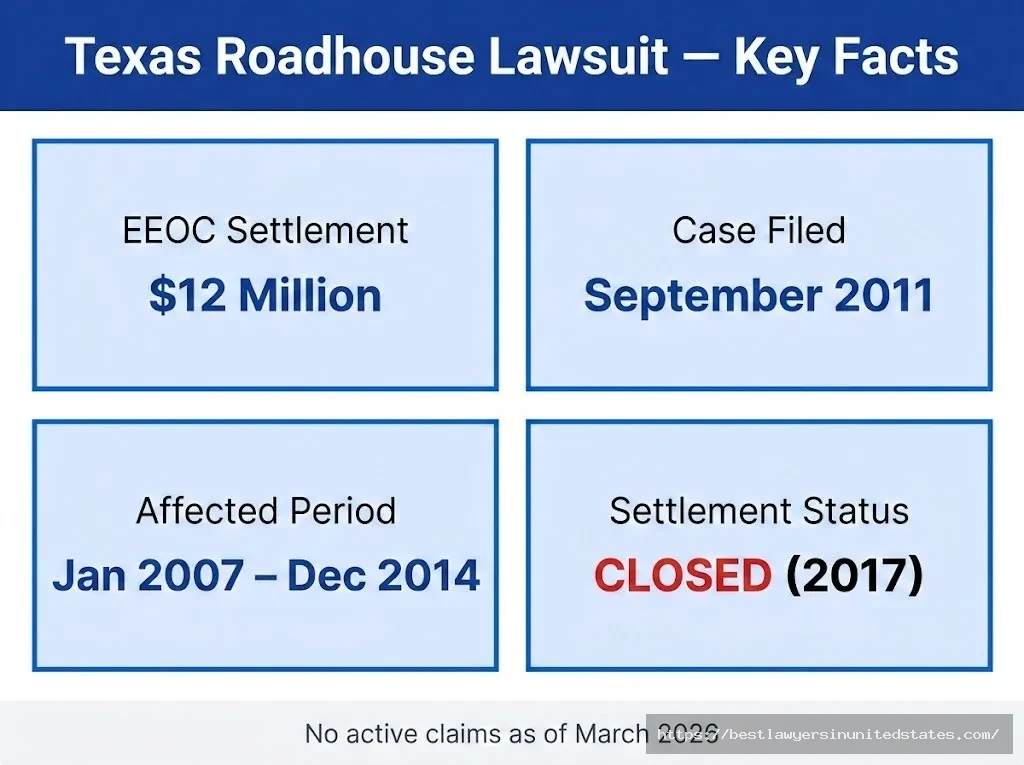
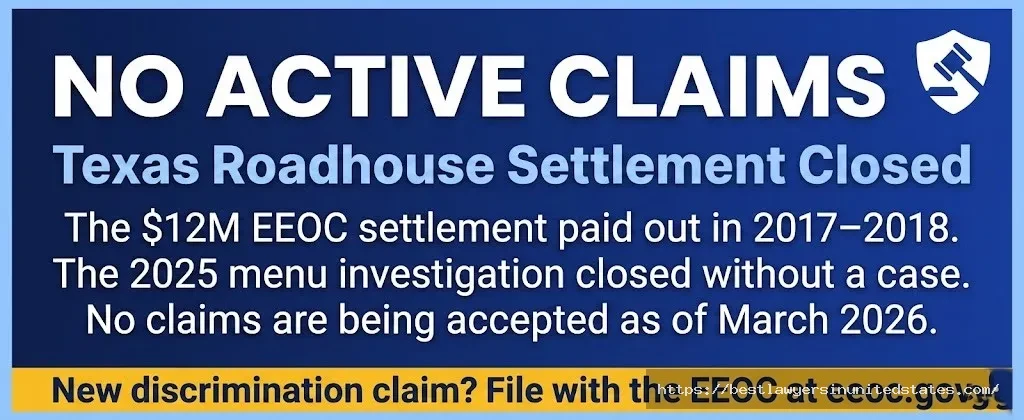
Quick Answer: The Texas Roadhouse age discrimination lawsuit settled for $12 million in 2017, compensating job applicants aged 40 and older who were denied front-of-house positions between 2007 and 2014. That claims window is now closed. A 2025 proposed class action over misleading menu labeling was investigated but did not result in a certified case or open settlement. There is no currently active Texas Roadhouse settlement accepting new claims as of March 2026.
What Is the Texas Roadhouse Lawsuit About?
Over the past 15 years, Texas Roadhouse has been the subject of multiple legal actions covering employment discrimination, website accessibility, wage violations, and consumer protection. The most significant of these — the EEOC age discrimination case — resulted in one of the largest monetary settlements ever obtained by the EEOC against a restaurant chain in the United States.
Background of the Lawsuits
Texas Roadhouse operates over 780 locations across the U.S. and markets itself as a casual, friendly steakhouse known for hand-cut steaks, fresh-baked rolls, and a lively atmosphere. Behind that brand image, however, the company faced serious allegations that it systematically excluded workers over 40 from customer-facing roles to maintain a “younger-looking” front-of-house staff — a practice that violates the federal Age Discrimination in Employment Act (ADEA).
Separately, consumer advocates and plaintiffs’ attorneys have more recently scrutinized how the chain describes certain menu items, raising questions about whether descriptions of dishes like grilled shrimp, grilled salmon, and certain sides accurately reflect what diners actually receive.
Timeline of Key Legal Events
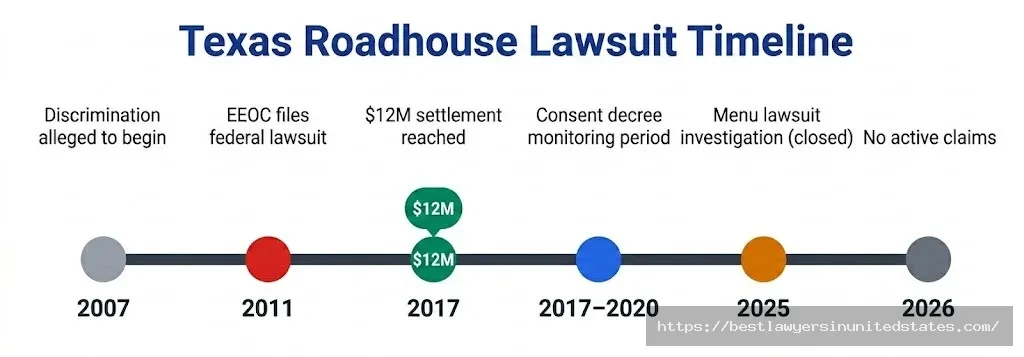
| Date | Event | Details |
|---|---|---|
| 2007 | Alleged discrimination begins | Texas Roadhouse accused of steering applicants 40+ away from server, host, bartender roles |
| September 2011 | EEOC files federal lawsuit | Filed in U.S. District Court, District of Massachusetts, Case No. 1:11-cv-11732-DJC |
| 2011–2016 | Discovery and litigation | EEOC gathers internal documents, hiring records, manager communications |
| May 2017 | Trial results in hung jury | First trial ends in mistrial; retrial scheduled |
| April 2017 | Settlement reached | Texas Roadhouse agrees to pay $12 million rather than continue litigation |
| April 2017 | Consent decree approved | Judge Denise Casper approves decree; claims process opens for affected applicants |
| 2017–2018 | Claims paid | Applicants who applied for front-of-house positions between Jan. 1, 2007, and Dec. 31, 2014, could submit claims |
| 2017–2020 | Consent decree in force | 3.5-year monitoring period; Texas Roadhouse required to change hiring practices |
| March 2025 | Menu lawsuit investigation announced | Law firm Trief and Olk launches proposed class action over allegedly deceptive menu descriptions |
| Late 2025 | Menu investigation closed | Top Class Actions closes the investigation; no certified class action was filed |
Who Filed the Lawsuits?
The age discrimination lawsuit was brought by the U.S. Equal Employment Opportunity Commission (EEOC), a federal agency — not a private plaintiff. Lead EEOC trial attorneys were Mark Penzel and Sara Smolik. The EEOC’s New York District Office directed the case, with Jeffrey Burstein serving as regional attorney.
For the menu labeling investigation, Trief and Olk, a Hackensack, New Jersey-based law firm, initiated the proposed class action. The firm advertised through Top Class Actions seeking potential plaintiffs who felt Texas Roadhouse’s menu descriptions were deceptive.
What Were the Allegations?
Age Discrimination (EEOC Case):
- Texas Roadhouse systematically refused to hire applicants aged 40 and older for front-of-house positions including servers, hosts, server assistants, and bartenders
- This pattern occurred across hundreds of the chain’s locations spanning nearly a decade
- Internal documents allegedly showed managers using age-related comments to screen applicants
- One internal document reportedly depicted an older woman as a “non-ideal employee” compared with a younger woman labeled as “ideal”
- Some applicants over 40 were allegedly told directly that the work was “intended for younger workers”
- Hiring managers in some locations reportedly noted age and body type on application materials
Menu Labeling (Proposed Class Action):
- Menu descriptions for grilled shrimp, grilled salmon, signature fresh-baked bread, baked potato with toppings, sweet potato with toppings, and buttered corn were alleged to be misleading
- The law firm claimed these descriptions failed to adequately disclose the true nature, ingredients, or preparation methods of menu items
- Allegations invoked FDA menu labeling rules and the Fair Packaging and Labeling Act (FPLA)
The Age Discrimination Case: Full Details
Who Was Eligible?
The EEOC settlement covered a specific, defined class of people. You were potentially eligible if:
| Requirement | Details |
|---|---|
| Age at time of application | 40 years or older |
| Type of position applied for | Front-of-house: server, host/hostess, bartender, server assistant |
| Application date range | Between January 1, 2007 and December 31, 2014 |
| Geographic scope | Any Texas Roadhouse location in the United States |
| Application result | Denied the position (not hired) |
This claim window is now closed. The settlement was approved in 2017 and payments were distributed to claimants through the 2017–2018 period. No new claims can be filed for this case.
Who Did NOT Qualify?
People who were not eligible for the age discrimination settlement included:
- Applicants under the age of 40 at the time they applied
- People who applied for back-of-house positions (cooks, dishwashers, kitchen staff)
- People who applied outside the January 1, 2007 to December 31, 2014 window
- Current or former employees suing for wrongful termination (this case covered applicants, not existing employees)
- Anyone who previously settled or released claims against Texas Roadhouse related to this matter
Settlement Breakdown
| Category | Amount | Notes |
|---|---|---|
| Total Settlement Fund | $12,000,000 | Approved by federal court |
| Attorney Fees & Costs | Portion of total | EEOC does not charge claimants; federal agency brought the case |
| Claims Administration | Portion of total | Settlement administrator processing |
| Net Available to Claimants | Distributed proportionally | Based on number of valid claims submitted |
| Non-Monetary Relief | Included | Hiring reforms, diversity director, independent monitor |
Non-Monetary Terms of the Consent Decree
Beyond the $12 million payout, the court-approved consent decree required Texas Roadhouse to:
- Establish a diversity director position company-wide
- Fund an independent compliance monitor to verify adherence to the decree
- Increase recruitment and hiring of applicants aged 40 and older for front-of-house roles
- Implement enhanced anti-discrimination training for hiring managers
- Change internal hiring processes and record-keeping practices
- Comply with a 3.5-year monitoring period (running approximately 2017–2020)
These structural reforms were considered by many involved in the case to be as important as the financial settlement itself. Camp Lejeune Lawsuit Lawyer
The Menu Labeling Investigation: What Happened?
In March 2025, law firm Trief and Olk announced it was investigating a proposed class action against Texas Roadhouse over allegedly deceptive menu descriptions. The investigation drew significant attention on social media, with Top Class Actions promoting it to millions of followers.
What Was Allegedly Misleading?
The investigation focused on menu items including:
- Grilled shrimp
- Grilled salmon
- Signature fresh-baked bread
- Baked potato with toppings
- Sweet potato with toppings
- Buttered corn
The firm claimed these descriptions may not accurately reflect the actual ingredients, preparation methods, or sourcing of the items. The legal theory relied on the FDA’s menu labeling rule (which applies to chains with 20 or more locations) and the Fair Packaging and Labeling Act.
What Happened to This Lawsuit?
The investigation was closed. As of late 2025, Top Class Actions marked this investigation as ended, stating “This Investigation Is Now Closed.” No certified class action lawsuit was filed in federal court. No settlement was reached. No claims process was ever opened.
This means there is currently no way to file a claim or receive compensation related to the menu labeling investigation.
Why Did It Close Without a Case?
Investigations like this are preliminary — law firms look for plaintiffs and build a factual record before deciding whether to actually file a lawsuit. Without adequate evidence or a sufficiently strong legal theory, firms often close these investigations before reaching the filing stage. That appears to be what happened here.
Other Texas Roadhouse Legal Actions
Texas Roadhouse has faced additional legal challenges beyond these two primary cases. Since 2000, the company has accumulated over $17.4 million in total penalties across approximately 20 recorded violations, according to public regulatory tracking data.
ADA Website Accessibility Lawsuit (2017)
In June 2017, a blind plaintiff filed a proposed class action (Andrews v. Texas Roadhouse, Inc., Case No. 1:17-cv-03555) in U.S. District Court alleging that TexasRoadhouse.com violated the Americans with Disabilities Act by containing barriers that made the site inaccessible to blind users. Specific issues cited included missing alt-text on images, inaccessible image maps, and screen-reader compatibility problems. Many similar ADA web accessibility lawsuits have been filed against restaurant chains during this period, and most resolve through confidential settlements.
Wage and Overtime Claims (2017)
A Fort Myers, Florida, Texas Roadhouse location was named in a proposed class action in March 2017 alleging failure to pay proper minimum wages and overtime compensation to hourly workers. Wage theft claims against restaurant chains are common and often resolve through private settlement.
Mall Dispute Involving Texas Roadhouse (Ongoing – 2026 Trial Set)
In a case where Texas Roadhouse is not actually a defendant but a central figure, a Montana mall (GK Holiday Village) sued Ross Dress for Less for allegedly blocking the mall’s ability to bring a Texas Roadhouse location to the property. A jury trial in this civil dispute is scheduled for December 1, 2026.
Current Status: What’s Active in 2026?
| Lawsuit | Status | Claims Open? |
|---|---|---|
| EEOC Age Discrimination ($12M) | Fully settled and closed | No — window closed 2017–2018 |
| Misleading Menu Proposed Class Action | Investigation closed | No — never became a certified case |
| ADA Website Accessibility | Resolved | No active claims process |
| Wage/Overtime (Fort Myers) | Resolved | No active claims process |
| Mall dispute (Montana) | Ongoing | N/A — not a consumer case |
Bottom line: As of March 2026, there is no open Texas Roadhouse settlement accepting consumer or employee claims.
How This Compares to Similar Restaurant Lawsuits
Texas Roadhouse’s legal history fits a broader pattern of lawsuits targeting major restaurant chains over employment practices and consumer transparency.
| Lawsuit | Settlement Amount | Affected Parties | Type | Status |
|---|---|---|---|---|
| Texas Roadhouse (EEOC) | $12 million | Job applicants 40+ | Age discrimination | Closed |
| Darden Restaurants | $8 million | Employees/consumers | Various | Closed |
| McDonald’s (wage theft) | $26 million | California workers | Wage violations | Resolved |
| Starbucks (tips/wages) | Various | Baristas | Wage violations | Various |
| Olive Garden (portion claims) | Investigation only | Diners | Menu labeling | Closed |
Texas Roadhouse’s $12 million EEOC settlement was notably large because the case was brought by the federal government — not just private plaintiffs — and covered a national pattern rather than a single location.
What This Means for Job Applicants and Diners Today
For Job Applicants
The consent decree that governed Texas Roadhouse’s hiring practices ran through approximately 2020. While the formal monitoring period has ended, federal law still prohibits age discrimination in employment. If you believe you were denied a job at any employer — including Texas Roadhouse — because of your age (40+), you can:
- File a charge with the EEOC at eeoc.gov — this is free and does not require an attorney
- Contact a private employment attorney for a free consultation on age discrimination claims
- Know your deadlines — ADEA charges generally must be filed with the EEOC within 180 days of the discriminatory act (or 300 days in states with their own anti-discrimination agencies)
For Diners
No active consumer settlement exists for Texas Roadhouse menu-related claims. If you believe you were misled about a menu item at any restaurant, your options include:
- Filing a complaint with your state attorney general’s consumer protection office
- Contacting the FDA if you believe menu labeling rules were violated
- Consulting a consumer protection attorney if your damages are significant
Do You Need a Lawyer?
Quick Answer: For the closed Texas Roadhouse settlements, no attorney is needed because no claims are being accepted. For new discrimination or consumer protection claims, you don’t need a lawyer to file an EEOC charge or a state AG complaint — but one can help if your situation is complex.
When Legal Help Makes Sense
Consider consulting an attorney if:
- You were denied a job at Texas Roadhouse recently and believe age was a factor
- You experienced wage theft or unpaid overtime as a Texas Roadhouse employee
- You have a significant personal injury claim arising from a Texas Roadhouse visit
- You want to understand whether any new proposed class action applies to your situation
Many employment and consumer protection attorneys offer free initial consultations.
Frequently Asked Questions
What is the Texas Roadhouse lawsuit?
The most well-known Texas Roadhouse lawsuit is the EEOC age discrimination case, which alleged the chain systematically refused to hire applicants aged 40 and older for front-of-house positions like servers and hosts between 2007 and 2014. Texas Roadhouse settled for $12 million in 2017.
Can I still file a claim for the Texas Roadhouse age discrimination settlement?
No. The claims window for the 2017 EEOC settlement is closed. Payments were distributed to eligible claimants years ago, and no new claims are being accepted.
What was the Texas Roadhouse $12 million settlement about?
It resolved federal allegations that Texas Roadhouse violated the Age Discrimination in Employment Act by refusing to hire people aged 40 and older for customer-facing positions — servers, hosts, bartenders, and server assistants — across hundreds of its locations.
Is there an active Texas Roadhouse settlement I can claim from in 2026?
No. As of March 2026, no open Texas Roadhouse settlement is accepting claims from consumers or former job applicants.
What was the Texas Roadhouse menu lawsuit?
In early 2025, law firm Trief and Olk launched an investigation into whether Texas Roadhouse menu descriptions for items like grilled shrimp, grilled salmon, and certain sides were deceptive. The investigation was closed by late 2025 without a certified class action being filed.
Who filed the age discrimination lawsuit against Texas Roadhouse?
The U.S. Equal Employment Opportunity Commission (EEOC) — a federal agency — filed the lawsuit in September 2011. This was not a private plaintiff action; it was a government enforcement case.
Did Texas Roadhouse admit wrongdoing?
No. Texas Roadhouse’s official statement described the settlement as “a business decision” and not an admission of guilt. The company stated it faced many more years of legal costs after a mistrial and chose to settle rather than continue litigating.
What changes did Texas Roadhouse make after the lawsuit?
Under the court-approved consent decree, Texas Roadhouse was required to hire a diversity director, fund an independent compliance monitor, increase hiring of workers aged 40 and older for front-of-house roles, and implement new anti-discrimination training across all locations.
How much did individual claimants receive from the Texas Roadhouse settlement?
The total fund was $12 million divided among qualifying claimants. Individual amounts depended on how many valid claims were submitted. The EEOC did not publicly disclose per-claimant payout figures.
What should I do if I think I was discriminated against by Texas Roadhouse based on age?
File a charge with the EEOC at eeoc.gov. Age discrimination charges under the ADEA must generally be filed within 180 to 300 days of the discriminatory act. You can also consult a private employment attorney — most offer free initial consultations.
Are there any new Texas Roadhouse lawsuits being investigated in 2026?
No new major class action investigations against Texas Roadhouse were publicly announced as of early 2026. However, class action investigations are launched regularly against restaurant chains. Staying informed through sites like Top Class Actions or ClassAction.org is the best way to track new developments.
Does Texas Roadhouse face ongoing regulatory scrutiny?
Texas Roadhouse has accumulated over $17.4 million in total penalties since 2000 across roughly 20 regulatory actions, based on publicly available violation tracking data. The company operates in a heavily regulated industry and continues to be subject to standard federal and state oversight regarding employment, food safety, and consumer protection.
What is the ADEA and how does it apply to Texas Roadhouse?
The Age Discrimination in Employment Act (ADEA) is a federal law that prohibits employment discrimination against people aged 40 and older. The EEOC’s lawsuit alleged Texas Roadhouse violated this law by treating older job applicants less favorably than younger ones for the same positions.
Can I sue Texas Roadhouse individually for age discrimination?
Potentially, yes — separate from any class action. If you were denied employment at Texas Roadhouse because of your age, you can file a charge with the EEOC and potentially pursue an individual claim. Speaking with an employment attorney familiar with ADEA cases is the best starting point.
What are my rights as a restaurant diner if I feel misled by a menu?
For chain restaurants with 20 or more locations, the FDA’s menu labeling rule requires accurate calorie information and clear descriptions of standard items. You can file a complaint with the FDA or your state’s consumer protection office. For significant financial harm, a consumer protection attorney can advise whether a civil claim is viable.
Key Takeaways
The Texas Roadhouse age discrimination case stands as a landmark moment in employment law enforcement against the restaurant industry. A $12 million payout, along with mandated structural reforms, sent a clear message to hospitality employers that age-based hiring practices carry serious legal and financial consequences. Costco Lawsuit 2026
The 2025 menu labeling investigation, while it generated significant online attention, did not produce a certified class action or any settlement. Anyone who saw social media posts encouraging them to “join the lawsuit” and then signed up through claim forms should be aware that no actual case or settlement resulted from that investigation.
If you believe you have a current legal claim against Texas Roadhouse — whether for age discrimination, wage violations, or any other matter — the right step is consulting an employment or consumer protection attorney directly, not waiting for a class action to materialize. Many attorneys in these practice areas offer free consultations and work on contingency, meaning you pay nothing unless you win.
