
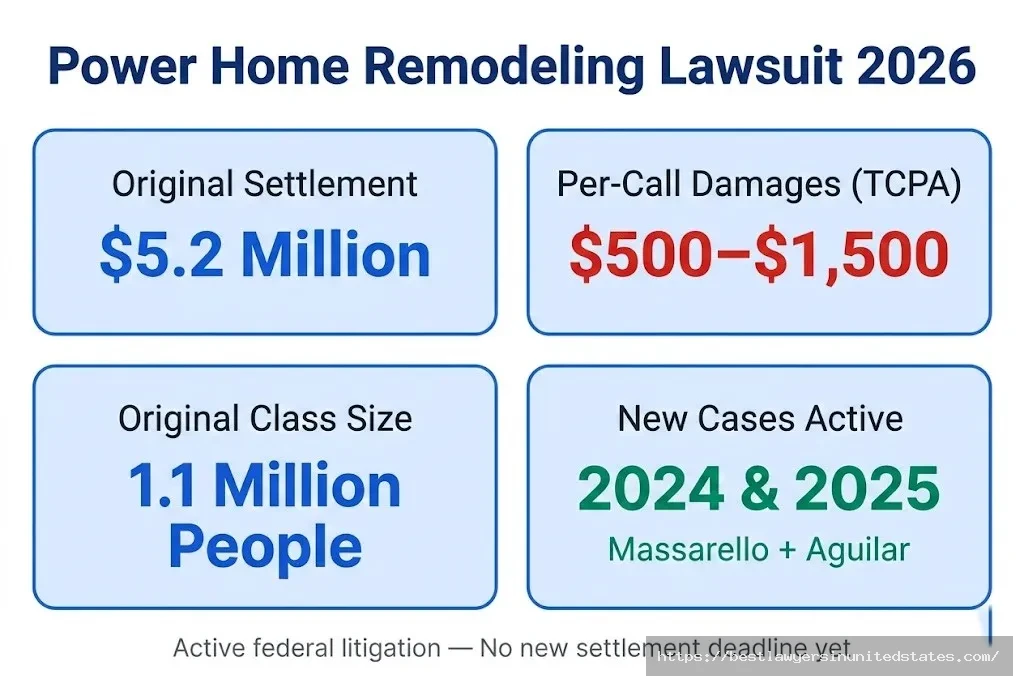
The Power Home Remodeling Group class action lawsuit centers on allegations that the company made millions of illegal robocalls to consumers without their consent, violating the Telephone Consumer Protection Act (TCPA). A landmark $5.2 million federal settlement was reached in the original case — and as of 2026, new lawsuits against Power Home Remodeling are actively moving through federal courts. If you received unsolicited automated calls from Power Home Remodeling, you may have legal rights worth $500 to $1,500 per call under federal law.
Quick Answer: Power Home Remodeling Group LLC has faced multiple class action lawsuits under the TCPA for alleged illegal robocalls. The original Vasco v. Power Home Remodeling Group case settled for $5.2 million in 2016. New federal cases — including Massarello v. Power Home Remodeling (filed 2024, active through late 2025) and Aguilar v. Power Home Remodeling (filed May 2025) — are currently in litigation with no settlement yet announced. If you are still receiving unsolicited calls from Power Home Remodeling, you may be eligible for a new claim. Read on to understand your rights and next steps.
What Is the Power Home Remodeling Group Class Action Lawsuit About?
Background of the Lawsuit
Power Home Remodeling Group LLC — headquartered in Chester, Pennsylvania — is one of the largest exterior home improvement companies in the United States. Founded in the early 1990s under the name Power Windows and Siding, the company expanded into a national brand offering windows, doors, roofing, siding, insulation, and gutters. It built its reputation on aggressive marketing, door-to-door sales, and promises of “lifetime warranties.”
That aggressive outreach eventually drew federal legal scrutiny. The core allegation across multiple class actions is that Power Home Remodeling used automated telephone dialing systems (robodialers) and pre-recorded voice messages to call consumers’ cell phones — often without their permission, and sometimes even after they had asked the calls to stop. Federal law strictly prohibits this without prior express written consent from the person being called.
The original lawsuit was a wake-up call for the home improvement industry. With a class of more than 1.1 million people, it remains one of the largest TCPA settlements in the home remodeling sector. But despite paying $5.2 million to settle in 2016, Power Home Remodeling continued to face new robocall allegations in 2024 and 2025 — suggesting the conduct never fully stopped. Aqua Finance Lawsuit
Timeline of Key Events
| Date | Event | Details |
|---|---|---|
| October 2013 | Alleged robocall campaign begins | Power Home reportedly begins using automated dialers for telemarketing |
| August 2015 | Original lawsuit filed | Teofilo Vasco files in U.S. District Court, Eastern District of Pennsylvania (Case No. 2:15-cv-04623) |
| December 2015 | Settlement agreement reached | Parties reach agreement after mediation before retired U.S. Magistrate Judge Diane M. Welsh |
| Early 2016 | Preliminary settlement approval | Court grants preliminary approval of $5.2 million settlement |
| April 2016 | Alleged call period ends | Covered calls span October 2013 through approximately April 2016 |
| October 12, 2016 | Final settlement approval | U.S. District Judge Mark A. Kearney grants final approval of $5.2M settlement |
| 2016–2023 | Consumer complaints continue | BBB, media investigations, and online reviews document ongoing warranty and robocall issues |
| June 2024 | New robocall allegations | Nathan Massarello receives multiple unwanted pre-recorded calls from Power Home Remodeling |
| August/September 2024 | Massarello lawsuit filed | New TCPA class action filed in U.S. District Court, Eastern District of Michigan (Case No. 2:2024cv12480) |
| August 2025 | Motion to dismiss denied | Judge Robert J. White sides with plaintiff; case proceeds |
| May 9, 2025 | Texas case filed | Aguilar v. Power Home Remodeling Group LLC filed in U.S. District Court, Southern District of Texas (Case No. 4:2025cv02120) |
| November 13, 2025 | Interlocutory appeal denied | Court rejects Power Home’s attempt to pause the Massarello case (2025 WL 3172842) |
| 2026 | Ongoing litigation | Both the Michigan and Texas cases are active; no new settlement announced |
Who Filed the Lawsuit?
The original class action — Teofilo Vasco v. Power Home Remodeling Group LLC — was filed in August 2015 by plaintiff Teofilo Vasco, who claimed he gave his cell phone number to a salesperson at Home Depot, only to receive 21 unsolicited automated calls from Power Home Remodeling. He never gave Power Home his number directly or consented to being contacted. The law firm representing Vasco sought class certification, which the court granted, ultimately covering more than 1.1 million people.
The more recent Massarello v. Power Home Remodeling Group LLC was filed by Nathan James Massarello in August 2024. Massarello alleged that Power Home used an “artificial or prerecorded voice” to call his cell phone multiple times in June 2024 — even though Power Home was apparently trying to reach someone else. Massarello had held the same phone number for ten years, making the “wrong number” defense particularly weak.
What Are the Allegations?
The core legal claims against Power Home Remodeling across the multiple lawsuits involve violations of the Telephone Consumer Protection Act (TCPA), 47 U.S.C. § 227. The specific allegations include:
- Illegal use of auto-dialers: The company allegedly used automatic telephone dialing systems (ATDS) to call consumers’ cell phones without prior express written consent
- Pre-recorded/artificial voice messages: Power Home allegedly used robocall technology with pre-recorded marketing pitches to reach sales leads
- Calling without consent: Many people who received calls allegedly never gave Power Home their number or permission to contact them
- Ignoring opt-out requests: Some consumers reported that calls continued even after they asked to be removed from contact lists
- Wrong-number robocalls: In the Massarello case, the company allegedly called the plaintiff despite intending to reach a different person — and the court ruled that the actual call recipient (not the intended one) has legal standing under the TCPA
Who Qualifies for the Power Home Remodeling Settlement?
Quick Answer: The 2016 Vasco settlement claim period is closed — that deadline has passed. However, if you received unsolicited automated or pre-recorded calls from Power Home Remodeling on or after October 2013 and have not previously filed a claim, or if you have received new calls in 2024 or 2025, you may have a separate legal claim worth pursuing. Under the TCPA, each illegal call can be worth $500 to $1,500 in statutory damages.
Understanding Your Current Options
This is one of the most important things to understand: there are two different legal situations depending on when you received calls from Power Home Remodeling.
If you received calls between October 2013 and April 2016: The Vasco class action settlement covered this period. That settlement was finalized in 2016, and the claim deadline has passed. If you were a class member but did not file a claim, you generally cannot recover from that settlement fund now. However, you did not waive your right to pursue individual claims if you opted out at the time, or if you were not properly notified.
If you received calls in 2024, 2025, or 2026: New lawsuits are actively in litigation. You have not missed any deadline. You may be eligible to join the Massarello class action or the Texas Aguilar case, or you may qualify to bring your own individual TCPA claim. This is where most people searching today will find their best opportunity for compensation.
Eligibility Checklist for Current TCPA Claims
| Requirement | Details | Documentation Needed |
|---|---|---|
| Received automated/pre-recorded call | Call from Power Home Remodeling using a robocaller or artificial voice | Call logs, voicemail recordings |
| Called on a cell phone | TCPA protections are strongest for cell phones | Phone carrier records |
| No prior express written consent | You never signed a form specifically authorizing Power Home to use auto-dialers to contact you | Lack of any signed consent form |
| Call was made for marketing/solicitation purposes | The call was attempting to sell you home improvement services | Voicemail content, any recorded messages |
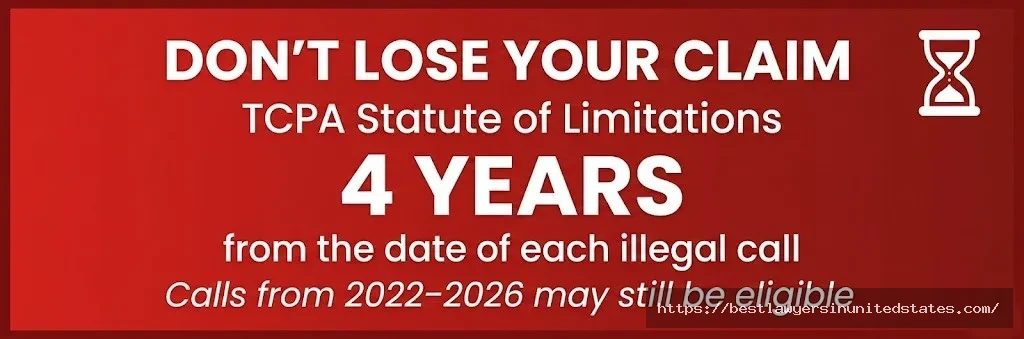
| Call was made within the statute of limitations | TCPA claims generally have a 4-year statute of limitations | Date of call(s) confirmed |
Who Does NOT Qualify?
You likely do not have a strong TCPA claim if:
- You gave written consent to Power Home Remodeling to contact you using automated systems and have not revoked that consent in writing
- The call was made by a live person using a regular dialer (not an ATDS or pre-recorded message)
- Your claim falls outside the statute of limitations (calls more than 4 years ago that were not part of the original class)
- You already participated in the original 2016 settlement and received compensation (you released claims for that period)
- The call was to a landline for a non-commercial purpose (different TCPA rules apply)
How to Prove Your Claim
| Document Type | Why It’s Needed | Where to Find It | If You Don’t Have It |
|---|---|---|---|
| Call logs showing calls from Power Home Remodeling | Proves you received the calls | Phone carrier account, smartphone call history | Request records from your carrier |
| Voicemail recordings | Proves a pre-recorded or artificial voice was used | Phone voicemail inbox or saved recordings | Describe the content in your complaint; attorney can subpoena records |
| Any correspondence with Power Home | Shows you did not consent or asked them to stop | Email inbox, text messages, postal mail | May not be required for initial claim |
| Documentation that you are the phone subscriber | Establishes you are “the called party” under TCPA | Carrier bill, account statement | Standard billing records work |
| Evidence of consent (or lack thereof) | If they claim you consented, you may need to rebut this | No signed TCPA consent forms in your possession | Work with an attorney to challenge consent claims |
How Much Money Can You Get?
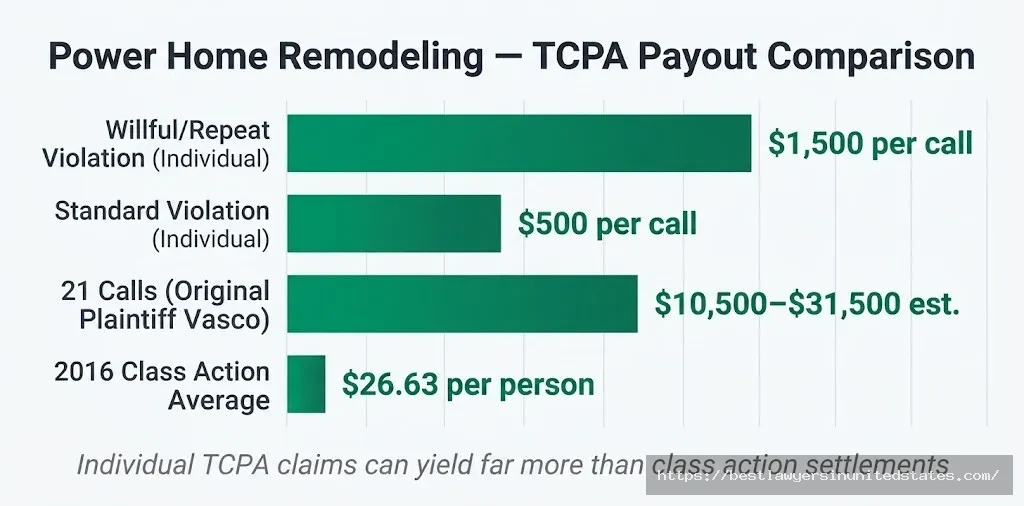
Quick Answer: Under the TCPA, each illegal robocall can be worth $500 in statutory damages — or up to $1,500 per call if the violation was willful. In the original 2016 settlement, each claimant received approximately $26.63 because the fund was divided across 1.1 million people. In a new individual or class claim for recent calls, you could receive far more per violation.
The Original 2016 Settlement Fund Breakdown
| Category | Amount | Purpose |
|---|---|---|
| Total Settlement Fund | $5,200,000 | Available for all claims and costs |
| Attorney Fees | $1,300,000 | Compensation for plaintiff’s legal team |
| Litigation Expenses | Up to $20,000 | Court costs and case expenses |
| Administration Costs | Up to $1,200,000 | Claims processing and distribution |
| Named Plaintiff Award | $3,000 | Incentive award for Teofilo Vasco |
| Net Available to Claimants | ~$2,677,000 | Divided among 1.1 million class members |
Estimated Per-Claimant Breakdown (2016 Settlement)
| Claim Category | Estimated Payout | Notes |
|---|---|---|
| Standard class member | ~$26.63 | Court’s stated estimated average |
| Named plaintiff | $3,000 | Incentive award above standard payout |
| Attorneys | $1,300,000 total | Separate from claimant fund |
The relatively low per-person payout in 2016 was a direct result of the massive class size — 1.1 million people sharing a finite fund. This is how many large class actions work. The value wasn’t in the individual check; it was in forcing the company to change its practices and pay a significant penalty.
What You Could Get in a New Individual TCPA Claim
This is where the numbers get far more meaningful. Under the TCPA:
- $500 per call for each knowing or negligent violation
- $1,500 per call if the court finds the violation was willful or knowing
- No cap on total statutory damages in many individual claims
- Attorney’s fees are typically paid by the defendant if you win
If Power Home Remodeling called you 10 times without consent, that’s potentially $5,000 to $15,000 in statutory damages — just for those 10 calls. The original plaintiff Vasco alleged 21 calls, which would amount to $10,500 to $31,500 in potential individual damages.
Factors That Affect Your Payout
Number of calls received — Every separate illegal call is a separate violation with its own statutory damages amount. Keep records of every call you received.
Whether the violation was willful — If you told Power Home to stop calling and they kept calling anyway, that strengthens the argument for $1,500 per call (rather than $500).
Whether you’re part of a class vs. individual claimant — In a class action, the payout per person is lower but you don’t need to hire a lawyer or front any costs. Individual claims carry more risk but far higher potential individual recovery.
Quality of your documentation — Voicemail recordings, call logs, and any written stop requests make your claim much stronger. LOLA Tampons Lawsuit 2026
Current Lawsuit Status & Latest Updates (2026)
The Massarello Case (Michigan, 2024–Present)
The most active current case is Massarello v. Power Home Remodeling Group LLC, Case No. 2:2024cv12480, in the U.S. District Court for the Eastern District of Michigan, Southern Division, before Judge Robert J. White.
Nathan Massarello filed the complaint in August 2024 after receiving multiple pre-recorded calls from Power Home Remodeling in June 2024. Power Home moved to dismiss the case, arguing Massarello wasn’t “the called party” under the TCPA because the company had consent from a different person they were trying to reach — they had simply dialed a wrong number.
Judge White rejected that argument decisively in August 2025. The court ruled that “the called party” means the actual person who received the call (the phone subscriber), not the person the caller intended to reach. This is consistent with rulings from the Seventh, Ninth, and Eleventh Circuits and represents a significant win for consumers who receive robocalls as a result of companies’ sloppy record-keeping.
Power Home then tried an unusual procedural move — requesting an interlocutory appeal to challenge the ruling mid-case before final judgment. In November 2025 (2025 WL 3172842), the court denied that request as well, finding no substantial grounds for disagreement on the legal question. The case is continuing toward discovery and potential class certification.
The Aguilar Case (Texas, 2025–Present)
A separate TCPA class action, Aguilar v. Power Home Remodeling Group LLC, was filed on May 9, 2025 in the U.S. District Court for the Southern District of Texas (Case No. 4:2025cv02120). As of early 2026, this case is in its early stages. No settlement or class certification has been announced.
Ongoing Consumer Complaints
Beyond the federal litigation, Power Home Remodeling continues to generate significant consumer complaints on multiple fronts:
- Warranty disputes: The BBB and investigative news teams (including Philadelphia’s 6ABC) have documented dozens of complaints about the company’s “lifetime warranty” failing in practice — with customers unable to get window replacements or service despite paying tens of thousands of dollars
- Window failures: Multiple customers report windows failing within months of installation, with the company blaming manufacturers and sometimes asking customers to pay out of pocket for parts the warranty should cover
- Aggressive sales tactics: Complaints about high-pressure door-to-door sales, signing contracts with confusing terms, and financing at extremely high interest rates (reported as high as 24.99%)
- Continued robocalls: Even after the 2016 settlement, consumers reported receiving unsolicited calls from Power Home Remodeling in subsequent years — a pattern the 2024 Massarello case directly addresses
What Happens Next?
The Massarello case is proceeding through discovery and will likely move toward a motion for class certification. If the court certifies a class, potentially millions of people who received similar wrong-number or non-consented robocalls from Power Home Remodeling could be included. Key upcoming milestones include:
- Discovery phase (2026): Both sides gather evidence about Power Home’s calling practices, consent records, and the scope of affected consumers
- Class certification motion: Massarello’s attorneys will likely seek to certify a class of people who received similar calls
- Possible settlement discussions: Many TCPA cases settle before trial once discovery reveals the full scope of violations and potential liability
- Texas case development: The Aguilar case in Texas will develop its own independent timeline
How to Take Action If You Received Calls from Power Home Remodeling
Step 1: Document Everything Now
Time matters. Start building your record today. Write down the date, time, and content of every call you remember receiving. Check your phone’s call log and save any voicemails. If Power Home left a message with a pre-recorded voice or an automated greeting, that voicemail is potentially your strongest piece of evidence.
What to save:
- All call logs showing Power Home’s number
- Voicemail recordings (back these up outside your phone)
- Any texts you received from them
- Any written requests you sent asking them to stop
- Your phone carrier records showing incoming call history
Step 2: Contact a TCPA Attorney for a Free Consultation
You do not need to pay anything upfront to explore your TCPA claim. Consumer protection attorneys who handle robocall cases typically work on contingency — meaning they only get paid if you win or settle. They also routinely recover their fees from the defendant, not from you.
Given that the Massarello case is still in early litigation stages, now is a good time to connect with an attorney who can evaluate whether you should join that class action, file a separate individual claim, or wait and see how the class action develops. Money Metals Exchange Lawsuit
To find an attorney:
- Contact a TCPA-specialized consumer rights firm
- Reach out to [email protected] for attorney referrals
- Search your state bar association for consumer protection attorneys
- Many firms offer free case evaluations online
Step 3: Report the Violation to the FCC
Filing a complaint with the Federal Communications Commission helps build the regulatory record and may support future enforcement. The FCC receives over 1.2 million robocall complaints annually. You can file at fcc.gov/consumers/guides/filing-informal-complaint.
Step 4: File a Complaint with the FTC and Your State AG
The Federal Trade Commission (FTC) also accepts robocall complaints at reportfraud.ftc.gov. Your state Attorney General’s consumer protection office is another avenue — many states have their own telemarketing laws that may offer additional remedies beyond the federal TCPA.
Step 5: Decide Whether to Opt Into or Out of a Class Action
Once class certification is announced in an active case (like Massarello), you will likely receive notice as a potential class member. At that point, you’ll have a choice:
- Stay in the class: Receive whatever the class settlement provides (likely lower per-person amount, no legal work required on your part)
- Opt out: Pursue your own individual lawsuit where you might recover far more — but you’ll need an attorney and take on more risk
Filing Deadlines and Statutes of Limitations
| Claim Type | Deadline | Notes |
|---|---|---|
| TCPA individual claim (federal) | 4 years from the date of the call | Don’t wait — evidence gets harder to gather over time |
| Class action participation | Announced when class is certified | Watch for court notices |
| FCC complaint | No hard deadline, but sooner is better | Supports enforcement actions |
| State TCPA/telemarketing claims | Varies by state (1–4 years) | Some states have shorter deadlines |
| 2016 Vasco settlement claims | CLOSED — deadline has passed | Cannot file new claims for 2013–2016 period |
Power Home Remodeling Lawsuit vs. Similar Cases
The Power Home Remodeling TCPA litigation fits into a broader pattern of home improvement and service companies facing federal class actions for robocall violations. Here’s how it compares:
| Lawsuit | Settlement Amount | Class Size | Per-Person Range | Status |
|---|---|---|---|---|
| Vasco v. Power Home Remodeling (2016) | $5.2 million | 1.1 million | ~$26.63 average | Closed/Settled |
| Massarello v. Power Home Remodeling (2024–present) | Not settled | TBD | $500–$1,500/call potential | Active litigation |
| Aguilar v. Power Home Remodeling (2025–present) | Not settled | TBD | $500–$1,500/call potential | Active litigation |
| Western Express TCPA Wrong Number Settlement | $185 per person | Large commercial class | $185 per head | Settled |
| Typical TCPA robocall class action | $1M–$75M+ | Thousands to millions | $25–$150 class; $500–$1,500 individual | Varies |
What Makes These Cases Unique
The Power Home Remodeling lawsuits are notable for several reasons. First, the company has been sued multiple times for substantially the same conduct — illegal robocalls — suggesting that prior litigation did not permanently change its calling practices. Second, the Massarello case raised an interesting legal question about “wrong number” robocalls: can a company escape TCPA liability by claiming it had consent from the person it intended to call, even though it actually reached someone else? Federal courts, including in the Massarello case, have said no — the actual call recipient is protected by the TCPA regardless of who the caller was trying to reach.
This ruling has broad implications. It means companies can’t hide behind bad phone lists or outdated contact databases as a defense to TCPA claims. If they call the wrong person with a robocall, they’re still liable.
The ongoing consumer complaints about warranties and workmanship quality add another dimension. The TCPA litigation addresses how Power Home finds customers; the warranty and service complaints address what happens after they sign contracts. Together, they paint a picture of a company where aggressive growth tactics have repeatedly outpaced accountability — and where federal courts have repeatedly pushed back.
Do You Need a Lawyer to File a Claim?
Quick Answer: For individual TCPA claims, having an attorney is strongly recommended — but you pay nothing upfront since these cases work on contingency. For joining a class action, you often don’t need your own attorney at all. Either way, free consultations are widely available.
When You Can Handle It Yourself
If you want to file regulatory complaints with the FCC or FTC, you can do that entirely on your own with no legal help and no cost. These agencies accept consumer complaints online, and filing a complaint is straightforward. It won’t directly get you money, but it contributes to the broader enforcement record.
If you received only one or two calls and the potential recovery is small, you might also consider filing a small claims court action in your state. Some states’ small claims courts handle TCPA cases, and the simplified procedures are designed for individuals without attorneys.
When Legal Help Makes Sense
You should talk to a TCPA attorney if:
- You received more than a handful of robocalls (higher potential recovery means more value in proper representation)
- You have voicemail evidence of pre-recorded calls
- Power Home continued calling after you asked them to stop
- You’re unsure whether your situation qualifies or which case you should join
- You want to ensure you don’t accidentally waive your rights
Free Legal Consultation
TCPA attorneys handle these cases at no upfront cost to you. They are paid from the defendant’s settlement or damages if the case succeeds. To explore your options:
- Contact: [email protected] for attorney referrals
- Many national consumer rights law firms offer free online case evaluations for TCPA claims
- The FCC’s website (fcc.gov) lists consumer resources and can point you toward legal aid if needed
Power Home Remodeling: Consumer Issues Beyond the Robocall Lawsuits
While the TCPA litigation gets the most legal attention, many homeowners deal with a separate set of problems after they’ve already signed contracts with Power Home Remodeling. Understanding these issues can help you decide whether you have additional legal claims beyond the robocall cases.
Warranty disputes are the most common complaint. Power Home sells its services with a “lifetime warranty,” but customers have reported that when windows fail — sometimes within months of installation — the company either blames the manufacturer, says the manufacturer went out of business, or tells customers they must pay out-of-pocket to get replacements. Philadelphia’s 6ABC news investigated this pattern extensively in 2023, documenting customers who waited years for promised warranty service.
High-pressure sales tactics are another recurring theme. Multiple BBB complaints and consumer reviews describe sales representatives who pressure homeowners to sign contracts on the spot, sometimes targeting vulnerable individuals. One BBB complaint from 2025 described a salesperson pressuring someone with a brain injury who repeatedly said they didn’t want to sign — resulting in a $30,000 contract at 24.99% interest.
Service delays round out the pattern. Even when Power Home agrees to perform warranty work, customers report being given appointment times months out — and then having those appointments cancelled and rescheduled further into the future.
These issues may give rise to consumer protection claims under state law, breach of contract claims, or complaints to state Attorney General offices, separate from and in addition to any federal TCPA claim.
Frequently Asked Questions
What is the Power Home Remodeling Group class action lawsuit?
Quick Answer: It’s a federal class action lawsuit under the TCPA (Telephone Consumer Protection Act) alleging that Power Home Remodeling Group LLC made illegal automated/robocalls to consumers without their consent.
There have been multiple lawsuits. The original, Vasco v. Power Home Remodeling Group LLC, settled for $5.2 million in October 2016. Newer cases — including Massarello v. Power Home Remodeling (2024) and Aguilar v. Power Home Remodeling (2025) — are currently active in federal court.
Who is eligible to be part of the current lawsuit?
Quick Answer: Anyone who received automated, pre-recorded, or artificial-voice calls from Power Home Remodeling Group without giving prior express written consent — especially if those calls were received in 2024 or 2025.
If you received calls between October 2013 and April 2016, the Vasco settlement already covered that period and that claim window is closed. For newer calls, you may qualify to join the Massarello or Aguilar class actions, or bring your own individual TCPA claim.
How much money could I get?
Quick Answer: Under the TCPA, you’re entitled to $500 per illegal call (or $1,500 per call if willful). In a class action, individual payouts are typically lower — the 2016 settlement paid roughly $26.63 per person.
The difference between individual claims and class action participation is significant. An individual TCPA claim for 10 illegal calls could be worth $5,000 to $15,000. A class action check is much smaller, but requires no effort on your part.
Is there a deadline to file a TCPA claim?
Quick Answer: TCPA claims generally have a 4-year federal statute of limitations from the date of the illegal call. Don’t wait — evidence gets harder to gather over time.
For class action participation in the current active cases, there is no deadline yet because no settlement has been announced. Once a class is certified and a settlement reached, you’ll receive formal notice with a specific opt-in or opt-out deadline.
How do I file a TCPA claim against Power Home Remodeling?
Quick Answer: Contact a TCPA attorney for a free consultation. You pay nothing upfront — attorneys work on contingency and recover fees from the defendant if they win.
You can also file FCC and FTC complaints on your own at fcc.gov and reportfraud.ftc.gov. These regulatory complaints won’t directly get you money, but they contribute to enforcement and can support your legal case.
Do I need a lawyer?
Quick Answer: For a regulatory complaint to the FCC, no. For a class action, you typically don’t need your own lawyer. For an individual TCPA lawsuit, working with an attorney is strongly recommended — and costs you nothing upfront.
What documents do I need?
Quick Answer: Call logs showing calls from Power Home Remodeling, any voicemail recordings, any texts, and any written correspondence. The more calls documented, the stronger your claim.
Your phone carrier can provide incoming call records if you don’t have them. Voicemails proving a pre-recorded message was used are particularly valuable evidence of a TCPA violation.
What if I don’t have any voicemails saved?
Quick Answer: You can still have a valid claim. Your call log showing calls from Power Home Remodeling’s number, combined with your sworn statement about the nature of the calls, is a starting point.
An experienced TCPA attorney can subpoena Power Home’s dialing records, which would show whether your number was called by an auto-dialer. You don’t need to prove everything yourself before speaking to a lawyer.
When will I receive a payment?
Quick Answer: There is no settlement in the current active cases yet. The Massarello and Aguilar cases are still in litigation. No payout timeline can be given at this time.
For anyone who filed a timely claim in the 2016 Vasco settlement, payments were distributed after October 2016 final approval. That settlement is completely closed.
Has the new lawsuit (Massarello) been approved for class certification?
Quick Answer: No. As of early 2026, the Massarello case is still in the early litigation phase. Power Home’s motion to dismiss was denied, but class certification has not yet been sought or granted.
The next major milestones are the completion of discovery and a potential motion for class certification by the plaintiff’s attorneys.
Can I opt out of a class action and sue Power Home individually?
Quick Answer: Yes. Once a class is certified, you typically have a period to opt out and pursue your own individual claim instead.
Opting out makes sense if you received many calls, have strong evidence, and the potential individual recovery (at $500–$1,500 per call) significantly exceeds what you’d get from the class. Talk to an attorney before deciding.
What if I also have warranty complaints about Power Home Remodeling’s workmanship?
Quick Answer: Warranty disputes and workmanship complaints are separate from the robocall/TCPA lawsuits. You may have additional claims under state consumer protection law or breach of contract.
For warranty and service failures, your best steps are: document everything in writing, file a BBB complaint, contact your state Attorney General’s consumer protection office, and consult a consumer protection or contract attorney in your state.
Can Power Home Remodeling’s “lifetime warranty” be legally enforced?
Quick Answer: Generally yes — warranties are contracts. If Power Home promised a lifetime warranty in writing and is refusing to honor it, you may have a breach of contract claim.
The challenge is proving what the warranty covers versus what the company claims are excluded. Get a copy of your original warranty documentation and any written communications about your service requests. An attorney can evaluate your options.
What does the TCPA actually say?
Quick Answer: The Telephone Consumer Protection Act (47 U.S.C. § 227) prohibits companies from using automated dialing systems or pre-recorded messages to call cell phones without the called party’s prior express written consent.
Violations carry statutory damages of $500 to $1,500 per call — regardless of whether you suffered any out-of-pocket loss. The law is designed to deter robocall abuse through these automatic statutory penalties.
Did the 2016 settlement actually stop Power Home from making robocalls?
Quick Answer: Based on subsequent lawsuits filed in 2024 and 2025, apparently not entirely.
The 2016 settlement required Power Home to pay $5.2 million and reportedly change its calling practices. However, consumers continued reporting robocalls from the company in subsequent years, and the Massarello case (filed 2024) alleges the same type of TCPA violations. This pattern of recurrence despite prior litigation is one reason the current cases carry significant public interest.
Where can I learn more or get updates on the active cases?
Quick Answer: Court documents for the Massarello case (Case No. 2:2024cv12480) are available through the federal court’s PACER system (pacer.gov). The Aguilar case (Case No. 4:2025cv02120) is available in the Southern District of Texas PACER records.
Legal news outlets like the National Law Review and trade publications like Door & Window Market (dwmmag.com) have been covering the Power Home Remodeling litigation actively. You can also sign up for case alerts through services like Justia.com.
What should I do right now if Power Home Remodeling is still calling me?
Quick Answer: Document every call immediately. Then contact a TCPA attorney and file a complaint with the FCC.
Write down the date, time, and number that called you. Save any voicemails. If you haven’t already, send Power Home a written opt-out request by email or letter (keep a copy). If they call again after receiving your written opt-out, that’s a willful violation worth up to $1,500 per call.
Is Power Home Remodeling still in business?
Quick Answer: Yes, Power Home Remodeling Group LLC is still operating as of 2026, headquartered in Chester, Pennsylvania.
The company continues to offer exterior home remodeling services including windows, doors, roofing, siding, and insulation. Ongoing litigation has not closed the business, though it continues to generate consumer complaints about robocalls and warranty service failures.
