| Quick Summary: Speer Laboratories — the company behind Emuaid skincare products — was sued in December 2020 over claims that its website was inaccessible to blind and visually impaired users, violating the Americans with Disabilities Act (ADA). This is NOT a class action settlement. There is no money available to consumers and no claim to file. This article explains exactly what the case is about, why it matters, and what it means for people who buy Emuaid products. |
The Emuaid lawsuit has been mentioned widely online, often in misleading ways that suggest a consumer settlement exists. It doesn’t. What does exist is a real federal court case — Clark v. Speer Laboratories, LLC — filed in Pennsylvania in 2020 that challenged whether blind shoppers could independently use the Emuaid website.
If you found this page searching for a payout or claim deadline, you won’t find one here — because none exists. What you will find is an honest breakdown of the real case, why ADA website accessibility lawsuits matter, and what Emuaid’s obligations are under the law.
What Is the Emuaid Lawsuit Actually About?
Background: Speer Laboratories and the Emuaid Brand
Speer Laboratories, headquartered in Fort Lauderdale, Florida, manufactures and sells Emuaid — a line of topical ointments marketed for over 100 skin conditions including eczema, psoriasis, nail fungus, and wounds. The company was founded by the late Richard Nicolo and has grown into a recognizable health brand, with its products available in major retailers including Walgreens.
Despite its commercial success, the company faced a federal legal challenge in late 2020 — not over its products, but over whether its website was legally accessible to all users.
The Case: Clark v. Speer Laboratories, LLC
| Detail | Information |
| Case Name | Clark v. Speer Laboratories, LLC |
| Plaintiff | Karen Clark |
| Defendant | Speer Laboratories, LLC (maker of Emuaid) |
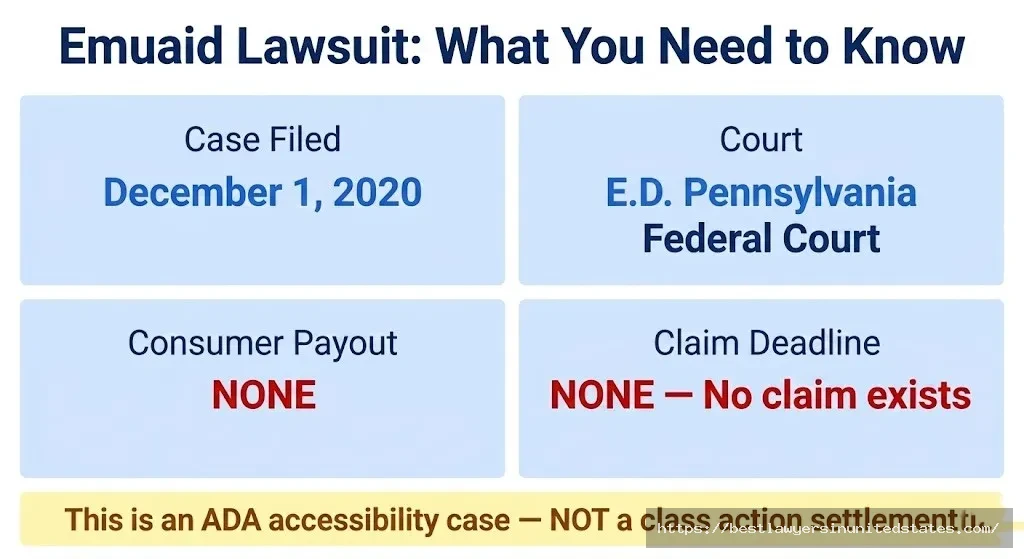
| Court | Eastern District of Pennsylvania, Federal Court |
| Date Filed | December 1, 2020 |
| Law Cited | Americans with Disabilities Act (ADA), Title III |
| Type of Case | Individual ADA accessibility complaint (NOT a class action) |
| Settlement Fund | None — no consumer payouts |
| Claim Deadline | None — there is no claim to file |
On December 1, 2020, Karen Clark filed a complaint in Pennsylvania’s federal court alleging that Speer Laboratories had failed to make its website — specifically the shopping section at www.emuaid.com/shop-now — accessible to people who rely on screen readers to navigate the internet.
Screen readers are assistive technology tools used by blind and visually impaired individuals. They read web page content aloud or convert it to Braille output, letting users interact with websites without a mouse or visual display. For a website to work with a screen reader, it has to be built in a way that the software can interpret — clear text labels on images, keyboard-navigable menus, properly tagged form fields, and so on.
What Were the Specific Complaints?
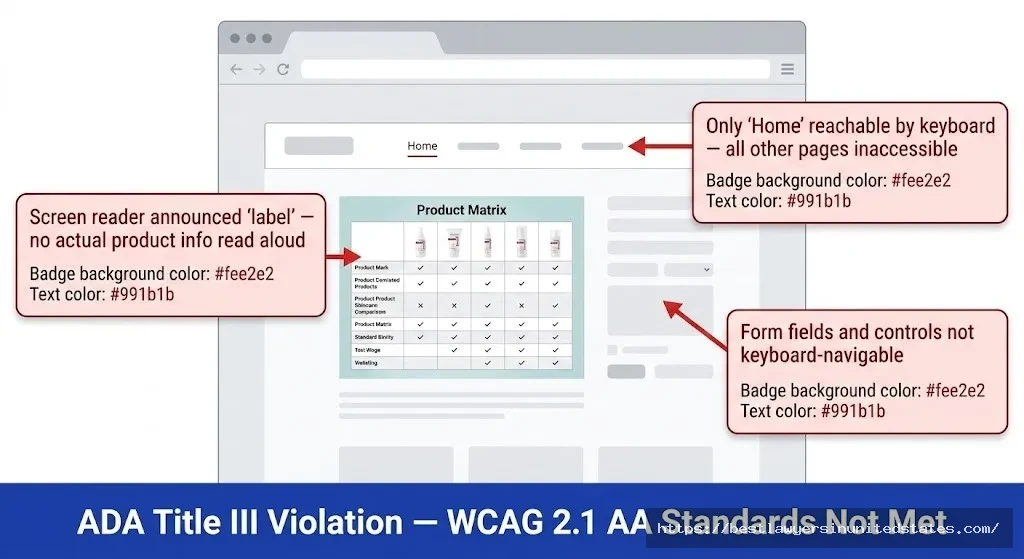
The lawsuit identified several specific barriers on the Emuaid website that prevented screen reader users from fully accessing it:
| Barrier | What It Meant for Users | ADA Standard Violated |
| Unlabeled product comparison matrix | Screen readers announced ‘label’ instead of the actual product information | Images must have descriptive alt text |
| Inaccessible navigation menu | Only the first menu item (‘Home’) could be reached by keyboard tab key | All actionable elements must be keyboard-navigable |
| Menu navigation failure | Pressing tab after ‘Home’ caused users to exit the menu entirely, skipping all other pages | Controls and links must be fully reachable via keyboard |
| Inaccessible form fields | Certain controls and form elements couldn’t be operated by screen reader users | Forms must be fully accessible and labeled |
These barriers meant that a blind person visiting Emuaid’s website could not independently browse the product lineup, compare ointments, or complete a purchase without sighted assistance. Under the ADA, that’s a problem.
What Did Karen Clark Want?
The lawsuit asked for three things:
- A declaratory judgment — a court ruling confirming that Speer Laboratories was violating the ADA
- A permanent injunction — a court order requiring Speer Laboratories to fix its website and keep it accessible going forward
- Attorney fees — payment of legal costs as allowed under the ADA
Notably, the case did not seek financial damages for Clark personally, and it was not a class action. No group of consumers was represented. This is typical for ADA website accessibility cases — the goal is compliance, not compensation.
The Legal Basis: ADA Title III and Website Accessibility
What Does the ADA Say About Websites?
The Americans with Disabilities Act was signed into law in 1990 — long before e-commerce existed. Title III of the ADA prohibits discrimination against people with disabilities in ‘places of public accommodation,’ which originally meant physical spaces like stores, restaurants, and hotels.
Over time, courts and the Department of Justice have increasingly applied Title III to websites, reasoning that a company’s online store is an extension of its public-facing business. If a blind person can’t shop online just as easily as a sighted person, that’s a form of discrimination.
| Important: The DOJ published guidance in March 2022 stating that the ADA’s requirements apply to goods and services offered online, reinforcing the legal framework that supports cases like the one against Emuaid. |
How Courts Handle These Cases
ADA website accessibility lawsuits have become one of the fastest-growing areas of litigation in the U.S. Since 2021, plaintiffs have filed more than 4,000 such lawsuits per year. The consumer goods and retail sector is the most targeted industry.
Most of these cases — roughly 97% — are resolved through settlements that never reach trial. In most settlements, the defendant agrees to fix the website and pay attorney fees. There is typically no payout to consumers.
| Year | Approx. ADA Website Lawsuits Filed | Trend |
| 2019 | ~2,256 | Rapid growth beginning |
| 2020 | Lower (courts closed) | Pandemic disruption |
| 2021 | ~4,000+ | Major surge |
| 2022 | ~2,387 filed in court (+ thousands of demand letters) | Record letters sent |
| 2023–2025 | 4,000+ per year | Sustained high volume |
The WCAG Standard
The Web Content Accessibility Guidelines (WCAG) — developed by the World Wide Web Consortium — are the technical standards most courts and the DOJ reference when determining whether a website is accessible. WCAG 2.1 Level AA is the commonly cited benchmark.
Key requirements under WCAG 2.1 AA include:
- All images must have descriptive text alternatives (alt text)
- All functionality must be available via keyboard alone, without requiring a mouse
- Form inputs must have visible labels that screen readers can announce
- Navigation menus must be fully keyboard-accessible
- Color contrast must meet minimum ratios for readability
The specific failures alleged in the Clark v. Speer Laboratories case — unlabeled images and a keyboard-inaccessible menu — are direct violations of these standards.
What This Case Means for Emuaid Customers
No Money for Consumers — Let’s Be Clear
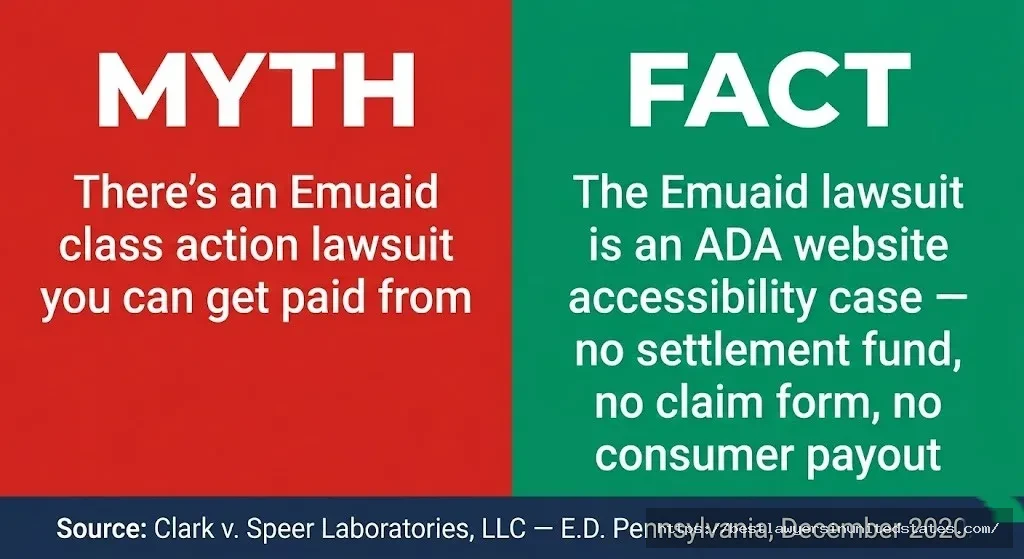
| Important for shoppers: If you are an Emuaid customer who experienced problems with the website, there is no settlement fund, no claim form, and no deadline to file anything. This lawsuit does not entitle consumers to compensation. |
This case was brought on behalf of a single plaintiff — Karen Clark — and sought only a court ruling and website fixes. It was never a class action, and it was never structured to provide financial relief to shoppers who had trouble using the site.
If you’ve been told there’s a payout available from an ‘Emuaid lawsuit,’ that information is inaccurate. Be cautious of websites that imply you can file a claim or collect money from this case.
What It Means for Blind and Visually Impaired Shoppers
The practical outcome of cases like this is improved website accessibility. If Speer Laboratories responded to the lawsuit by updating its website — adding proper alt text, fixing keyboard navigation, and labeling its product matrices — then blind shoppers are better able to use the site today than they were in 2020.
That’s the real-world benefit: not a check in the mail, but equal access to a product website that previously excluded users who rely on assistive technology.
What It Means for Other Companies
The Emuaid case is one of thousands of similar lawsuits that have pressured businesses across the U.S. to take digital accessibility seriously. The message from courts has been consistent: if you sell products or services online, your website needs to work for blind users too.
Companies that ignore accessibility often face:
- Federal court complaints under ADA Title III
- State law claims under California’s Unruh Act or New York’s Human Rights Law
- Attorney fee awards that can exceed the cost of simply fixing the website
- Reputational damage from being publicly named in accessibility litigation
Timeline of the Emuaid ADA Case
| Date | Event | Details |
| December 1, 2020 | Lawsuit filed | Karen Clark files complaint in Pennsylvania federal court (Eastern District) against Speer Laboratories, LLC |
| Late 2020 / Early 2021 | Service of process | Speer Laboratories formally notified of the complaint |
| 2021 onward | Case proceedings | Parties engage in pre-trial procedures; most ADA website cases resolve through negotiated settlement |
| Ongoing | Website compliance | Whether Emuaid.com has been updated to meet WCAG 2.1 AA standards is not publicly confirmed in available records |
| 2022 | DOJ guidance issued | Department of Justice publicly confirms ADA applies to websites, strengthening the legal environment for cases like this one |
| 2025–2026 | Broader legal context | ADA website accessibility lawsuits remain at record volume; retail and consumer goods companies continue to be primary targets |
How ADA Website Accessibility Lawsuits Work
The Typical Lawsuit Process
Understanding how these cases typically unfold helps put the Emuaid case in context:
- A plaintiff or their attorney identifies accessibility barriers on a website, often using automated scanning tools.Demand letter or complaint filed:
- The case is either filed directly in federal court or a demand letter is sent seeking a settlement.Court filing or negotiation:
- The company typically responds by agreeing to fix the site and paying attorney fees, or by contesting the case.Defendant response:
- About 97% of cases settle. Typical terms include a remediation plan, a compliance timeline, and attorney fee payment.Settlement or judgment:
- Courts sometimes retain jurisdiction to confirm compliance is achieved.Monitoring period:
Why Businesses Get Sued Even Without Obvious Bad Intent
Many companies don’t realize their websites are inaccessible. Developers often build sites visually — focusing on how things look rather than how they function for assistive technology. Standard website templates and e-commerce platforms frequently ship with accessibility gaps that need to be corrected manually.
A product comparison matrix that looks great as a visual graphic, for example, can be completely blank to a screen reader if no alt text has been added. A dropdown menu built in JavaScript may work perfectly with a mouse but be unreachable by keyboard users. These are technical oversights, not necessarily deliberate exclusion — but they still violate the law.
What Companies Should Do
| Action | Why It Matters |
| Audit your website against WCAG 2.1 AA | Identifies specific barriers before a lawsuit does |
| Add descriptive alt text to all images and graphics | Directly fixes one of the most common violations |
| Test full keyboard navigation on all pages | Ensures menus, forms, and links work without a mouse |
| Label all form fields and interactive elements | Required for screen reader compatibility |
| Use an automated accessibility checker regularly | Catches new violations as the site is updated |
| Include users with disabilities in testing | Automated tools miss up to 30% of real-world barriers |
About Speer Laboratories and Emuaid
Company Background
Speer Laboratories is a Fort Lauderdale-based company founded by the late Richard Nicolo. It is known for its flagship product EMUAID First Aid Ointment, which uses a patented transdermal delivery system called EMUTANEOUS technology. The company describes itself as family-run and socially responsible, with a focus on natural ingredients for hard-to-treat skin conditions.
In 2021, Speer Laboratories ranked 18th on a list of the 50 fastest-growing women-owned or women-led companies. By 2020, its EmuaidMAX product had launched in 7,000 Walgreens stores nationwide.
Emuaid Products
| Product | Description | Marketed For |
| EMUAID First Aid Ointment | Original ointment formula | Wounds, eczema, fungal infections, skin irritations |
| EMUAIDMAX First Aid Ointment | Higher-strength version | Resistant or severe skin conditions |
| EMUAIDMAX Concentrate Serum | Launched May 2023; free-flowing serum with targeted applicator | Psoriasis, seborrheic dermatitis, folliculitis, scalp conditions |
Emuaid products are manufactured in an FDA-registered over-the-counter drug and homeopathic drug facility. All products are topically applied; note that the active ingredient — colloidal silver — is approved by the FDA for topical use, though it is banned for oral/internal use.
Frequently Asked Questions
Is there an Emuaid class action lawsuit I can join?
| Quick Answer: No. There is no active class action lawsuit against Emuaid and no settlement fund that consumers can claim from. |
The only documented lawsuit involving Emuaid is a 2020 ADA website accessibility case filed by one individual plaintiff. It was not a class action, and it does not entitle consumers to any compensation. Any website suggesting you can file a claim for money from an ‘Emuaid lawsuit’ is providing inaccurate information.
What was the Emuaid lawsuit about?
| Quick Answer: It was a federal ADA case over whether the Emuaid website was accessible to blind and visually impaired users. |
Karen Clark filed a complaint in Pennsylvania federal court on December 1, 2020, alleging that www.emuaid.com was not usable by people who rely on screen readers. Specific issues included an unlabeled product comparison image and a navigation menu that couldn’t be accessed by keyboard.
Who filed the lawsuit against Emuaid?
| Quick Answer: Karen Clark, an individual plaintiff, filed the complaint against Speer Laboratories (the maker of Emuaid). |
Clark alleged that the inaccessible website violated Title III of the Americans with Disabilities Act by denying equal access to visually impaired users.
What did the lawsuit ask for?
| Quick Answer: A court declaration that Emuaid violated the ADA, a court order requiring website fixes, and attorney fees. No consumer payments were sought. |
The relief requested was structural — meaning it aimed to change how the company’s website was built, not to distribute money to injured consumers. This is standard for ADA accessibility cases.
Has Emuaid fixed its website?
| Quick Answer: Available court records do not publicly confirm the resolution or outcome of the case, which is typical for ADA cases that settle privately. |
Most ADA website accessibility cases are resolved through private settlements where the company agrees to fix the site and pay attorney fees. No public ruling was identified in research for this article. Whether www.emuaid.com currently meets WCAG 2.1 AA standards would need to be verified directly by testing the site.
Are there other complaints about Emuaid?
| Quick Answer: Yes — BBB complaints from customers exist regarding refund policy disputes and subscription billing issues, but those are separate from the ADA lawsuit. |
The Better Business Bureau has received complaints from Emuaid customers about issues including: unclear refund policies requiring products to be mailed back, unauthorized subscription charges, and orders not being fulfilled as described. These consumer service issues are distinct from the ADA accessibility case and do not involve a class action or settlement.
Is the ADA website accessibility lawsuit trend growing?
| Quick Answer: Yes. Plaintiffs have filed more than 4,000 such lawsuits per year since 2021, with retail and consumer goods companies targeted most often. |
The Emuaid case is part of a broader national pattern. Consumer goods companies, health and wellness brands, and e-commerce retailers are frequently targeted when their websites fail to meet accessibility standards. The DOJ’s 2022 guidance — confirming that ADA requirements apply to websites — has reinforced the legal foundation for these suits.
Do I need a lawyer to deal with website accessibility issues?
| Quick Answer: If you’re a consumer who couldn’t access a website because of a disability, a disability rights attorney can advise you on your options. |
Legal consultations are often free for ADA accessibility cases. If you are a business owner concerned about ADA website compliance, consulting with an accessibility specialist or attorney is worthwhile — the cost of retrofitting a website is almost always less than defending a lawsuit.
What To Do If You Have an Emuaid-Related Issue
If You Had Trouble Using the Emuaid Website as a Visually Impaired User
You may have legal options under the ADA or your state’s disability rights laws. Consider:
- Contacting a disability rights attorney for a free consultation
- Filing a complaint with the Department of Justice at ADA.gov
- Reaching out to organizations like the National Federation of the Blind or the American Council of the Blind
If You Have a Consumer Complaint About Emuaid Products
Consumer issues like billing disputes, refund denials, or wrong orders are handled through different channels:
- File a complaint with the Better Business Bureau at bbb.org
- Report deceptive billing practices to the Federal Trade Commission at ftc.gov/complaint
- Dispute unauthorized charges directly with your credit card company
- Contact Speer Laboratories customer service (weekdays, 8:30 AM to 11 PM ET)
If You’re a Business Owner Worried About ADA Website Compliance
Don’t wait for a lawsuit to take accessibility seriously. Practical steps:
- Run your site through a free automated checker like WAVE (wave.webaim.org) or Google Lighthouse
- Hire an accessibility auditor to do a manual review against WCAG 2.1 AA
- Work with your web developer to fix identified barriers — common fixes include alt text, keyboard navigation, and form labels
- Schedule regular accessibility reviews as your site is updated
Bottom Line
The Emuaid lawsuit is a real federal court case — but it’s not the kind of lawsuit that puts money in consumers’ pockets. It’s an ADA website accessibility complaint filed in 2020 by one person who couldn’t use Emuaid’s website with a screen reader.
There is no settlement. There is no claim form. There is no deadline. If you were looking for compensation from Emuaid, that case doesn’t exist.
What does exist is a growing legal landscape where companies of all sizes face real consequences if their websites shut out users with disabilities. The Emuaid case is a small but illustrative example of that trend — and a reminder that accessibility isn’t just good practice, it’s a legal requirement.