
Quick Answer The Jardiance lawsuit involves personal injury claims against manufacturer Boehringer Ingelheim for allegedly failing to warn patients about life-threatening side effects — including diabetic ketoacidosis, Fournier’s gangrene, and kidney failure. Unlike a class action settlement with a fixed deadline, these are individual mass tort lawsuits. If you were harmed, you must file your own claim through an attorney before your state’s statute of limitations expires — typically 2–3 years from when you discovered your injury.
Jardiance (empagliflozin) is a Type 2 diabetes drug that millions of Americans take to manage their blood sugar. What many patients were never told is that it carries serious risks — including a dangerous build-up of blood acids that can cause diabetic coma, a rare but devastating flesh-eating infection of the genitals, and sudden kidney failure.
People who suffered these injuries after taking Jardiance have filed lawsuits against Boehringer Ingelheim and Eli Lilly, arguing the companies knew about these risks and failed to warn patients in time. Courts have sided with plaintiffs on key early rulings, and attorneys across the country are still accepting new cases today.
This guide covers everything you need to know: what the lawsuits are about, who qualifies, what compensation looks like, how to get started, and the critical deadline you can’t miss. How Long Does a Personal Injury Lawsuit Take?
What Is the Jardiance Lawsuit About?
Background of the Drug
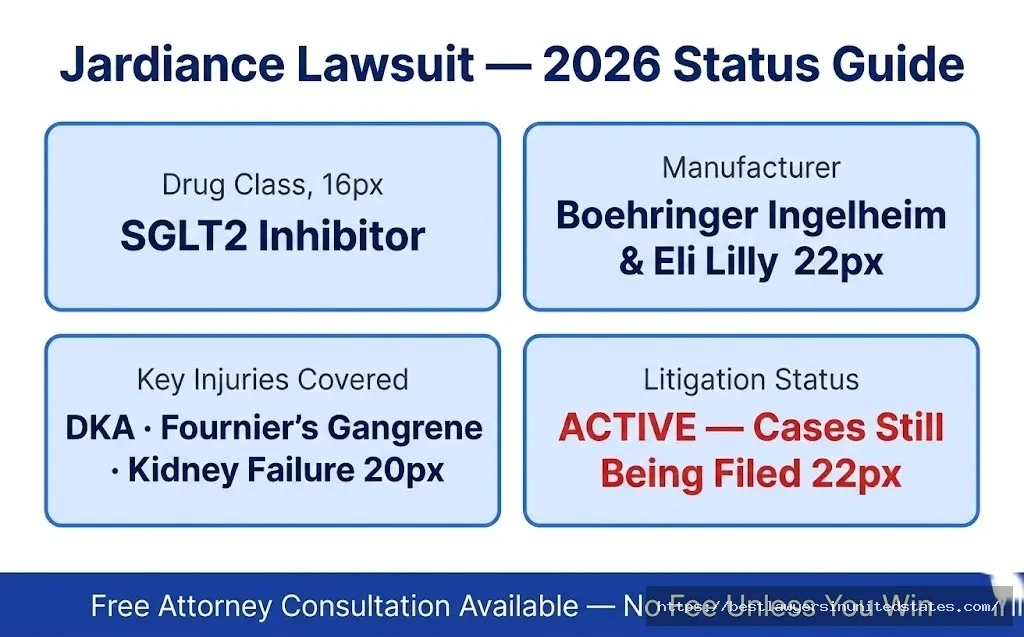
Jardiance (generic name: empagliflozin) is an oral prescription medication approved by the FDA in August 2014 to help adults with Type 2 diabetes control their blood sugar. It belongs to a class of drugs called SGLT2 inhibitors — sodium-glucose cotransporter-2 inhibitors — which work by causing the kidneys to flush excess glucose out through urine rather than absorbing it back into the bloodstream.
Jardiance is manufactured jointly by Boehringer Ingelheim and Eli Lilly. It was heavily marketed as not just effective for blood sugar control, but also beneficial for heart health — a claim that made it enormously popular with both doctors and patients. By 2018, Jardiance and related drugs were generating billions of dollars per quarter in sales.
The problem: as the drug spread to millions of patients, reports of catastrophic side effects began to pile up. Patients were developing a condition called diabetic ketoacidosis (DKA) — sometimes with normal or near-normal blood sugar levels, which meant they weren’t catching it in time. Others developed a rare, life-threatening flesh-eating infection. Many suffered sudden kidney damage. The lawsuits claim Boehringer Ingelheim and Eli Lilly either knew about these risks and concealed them, or failed to conduct adequate testing to discover them.
Timeline of Key Events
| Date | Event | Details |
|---|---|---|
| March 2013 | First SGLT2 inhibitor approved | Invokana (canagliflozin) hits the U.S. market, setting the stage for Jardiance |
| August 2014 | Jardiance FDA approval | Boehringer Ingelheim & Eli Lilly receive FDA approval; drug reaches market |
| May 2015 | FDA issues DKA warning | FDA warns SGLT2 inhibitors linked to diabetic ketoacidosis; reports of at least 20 DKA cases identified |
| December 2015 | Mandatory label update ordered | FDA orders Boehringer Ingelheim to add DKA and urinary tract infection warnings to Jardiance labeling |
| June 2016 | First major Jardiance lawsuit filed | Plaintiff Melissa Mitchell sues Boehringer Ingelheim after hospitalization for DKA following Jardiance use |
| August 2018 | FDA Fournier’s gangrene warning | FDA links Jardiance and Farxiga to Fournier’s gangrene — a rare, potentially fatal genital flesh-eating infection |
| 2019–2023 | Wave of individual lawsuits | Hundreds of personal injury suits filed across federal and state courts; related Invokana and Farxiga MDLs opened and closed |
| 2024–2026 | Ongoing litigation | Jardiance cases remain active; no public class-action settlement announced; attorneys still accepting new cases |
Who Filed the Lawsuits?
Unlike a traditional class action where one group of plaintiffs sues for the same type of financial harm (like a defective product refund), Jardiance lawsuits are personal injury mass tort cases. Each plaintiff files an individual claim based on their specific injuries. Early cases were led by plaintiffs like Melissa Mitchell, who began taking Jardiance in February 2015 and was hospitalized for ketoacidosis just four months later. When Boehringer Ingelheim tried to get her case dismissed — arguing that side effects were already known before she started taking the drug — the court disagreed. The judge ruled the drugmakers had a duty to update their warning labels.
Law firms specializing in pharmaceutical litigation have represented hundreds of patients across the country. The defendants are Boehringer Ingelheim (the primary manufacturer) and, in some cases, Eli Lilly (co-marketer). Related litigation around Invokana (Johnson & Johnson) settled in 2021 and the Farxiga MDL (Bristol-Myers Squibb / AstraZeneca) settled in 2019 — setting meaningful precedent for Jardiance cases.
What Are the Allegations?
The lawsuits don’t claim Jardiance doesn’t work. They claim Boehringer Ingelheim and Eli Lilly knew — or should have known — about life-threatening risks and failed to warn doctors and patients adequately. Specifically, the legal claims include:
- Failure to warn about diabetic ketoacidosis (DKA) — a potentially fatal condition caused by toxic acid buildup in the blood, which Jardiance can trigger even when blood sugar appears normal
- Failure to warn about Fournier’s gangrene — a devastating flesh-eating bacterial infection of the genitals and perineum, which the FDA linked to Jardiance in 2018
- Failure to warn about kidney failure — Jardiance can cause acute kidney injury, particularly in elderly patients and those taking diuretics
- Defective marketing — aggressive direct-to-consumer advertising that emphasized benefits while downplaying serious risks, causing patients to take the drug without adequate information
- Negligent drug design and testing — inadequate pre-market clinical trials that failed to identify serious risks before the drug reached millions of patients
- Fraud and misrepresentation — claims the company made false or misleading statements to regulators, doctors, and patients about the drug’s safety profile
Who Qualifies to File a Jardiance Lawsuit?
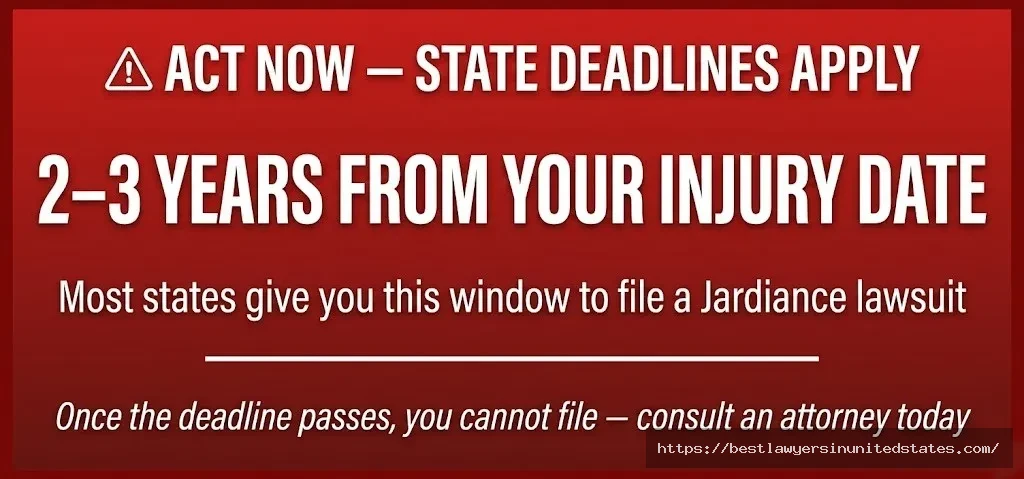
Quick Answer You may qualify if you took Jardiance and suffered a serious injury such as diabetic ketoacidosis, Fournier’s gangrene, kidney failure, or related complications. You’ll need medical records documenting both your Jardiance use and your diagnosis. Your case must be filed before your state’s statute of limitations expires — usually 2–3 years from the date you discovered the injury.
Eligibility Requirements
| Requirement | Details | Documentation Needed |
|---|---|---|
| Took Jardiance (empagliflozin) | You were prescribed and took Jardiance at any point | Prescription records, pharmacy records, pill bottles |
| Suffered a qualifying injury | Diagnosed with DKA, Fournier’s gangrene, kidney failure, or related serious complication | Hospital records, physician diagnosis notes, lab results |
| Causal connection | Your injury occurred during or after taking Jardiance, and medical evidence supports the link | Medical records showing timeline of drug use and injury onset |
| Within the statute of limitations | Your case must be filed before the deadline (varies by state — typically 2–3 years from injury discovery) | Date of first diagnosis or hospitalization |
| No prior settlement | You have not previously settled a Jardiance-related claim with the manufacturer | N/A — attorney will confirm during consultation |
The “discovery rule” is important here. In most states, the statute of limitations clock starts not when you took the drug, but when you first discovered — or reasonably should have discovered — that Jardiance caused your injury. If your doctor linked your hospitalization to the drug in 2022, your clock likely started in 2022, not when you first took the medication in 2019. This is why speaking to an attorney promptly matters: they can assess exactly where you stand on timing. FanDuel Lawsuit 2026
Qualifying Injuries — What Conditions Are Covered?
| Injury / Condition | Description | Why It’s Linked to Jardiance |
|---|---|---|
| Diabetic Ketoacidosis (DKA) | Dangerous buildup of ketones (blood acids) that can cause coma and death | Jardiance can trigger DKA even at near-normal blood sugar levels, delaying diagnosis |
| Fournier’s Gangrene | Rare, fast-spreading flesh-eating infection of the genitals and perineum | FDA issued formal warning in August 2018 linking SGLT2 inhibitors including Jardiance to this infection |
| Acute Kidney Injury (AKI) | Sudden loss of kidney function requiring hospitalization or dialysis | Jardiance’s mechanism of action puts strain on the kidneys, especially in dehydrated or elderly patients |
| Serious Urinary Tract Infections | Severe or recurring UTIs requiring hospitalization | FDA ordered warning label update in December 2015 specifically for this risk |
| Severe dehydration and hypotension | Dangerously low blood pressure caused by fluid loss | Jardiance promotes fluid excretion, which can cause rapid dehydration |
| Wrongful death | Death caused by any of the above complications | Family members of deceased patients may be able to file a wrongful death claim |
Who Does NOT Qualify?
Not every Jardiance user has a viable lawsuit. You’re unlikely to qualify if:
- You took Jardiance and suffered only minor, expected side effects (such as mild UTIs or modest blood sugar changes)
- Your injury has no documented medical evidence linking it to Jardiance use
- Your state’s statute of limitations has already expired and no exceptions apply
- You’ve already signed a release or settlement agreement with Boehringer Ingelheim
- Your injury predated your Jardiance prescription and was unrelated to the drug
The best way to find out if you have a case is to contact a pharmaceutical injury attorney for a free consultation. Most won’t charge you anything to evaluate your claim.
How to Prove Your Claim
| Document Type | Why It’s Needed | Where to Find It | If You Don’t Have It |
|---|---|---|---|
| Prescription records | Proves you were prescribed Jardiance | Your doctor’s office, pharmacy, or online patient portal | Pharmacy can reprint records; insurance EOBs also show prescriptions |
| Pharmacy fill history | Shows how long you took the drug and dosage | CVS, Walgreens, or your pharmacy’s patient history portal | Insurance claims records are a substitute |
| Hospital / ER records | Documents your diagnosis and treatment | Hospital medical records department (you have a right to these) | Your physician’s notes from follow-up visits may suffice |
| Lab and diagnostic results | Confirms conditions like DKA, kidney markers, infection cultures | Hospital lab results, physician’s records | Your attorney can help subpoena records |
| Medical bills | Establishes economic damages (what your injury cost you) | Hospital billing department, insurance explanation of benefits | Insurance records can reconstruct costs |
| Lost income documentation | Supports wage loss claims if you missed work | Pay stubs, employer letter, tax returns | Bank statements may help establish income history |
How Much Compensation Can You Get?
Quick Answer There is no single fixed payout for Jardiance lawsuits — compensation varies by the severity of your injury, your medical costs, lost wages, and pain and suffering. Similar drug lawsuits (Invokana, Farxiga) resulted in settlements ranging from tens of thousands to hundreds of thousands of dollars per plaintiff. Serious cases involving hospitalization, permanent injury, or death can yield significantly higher awards.
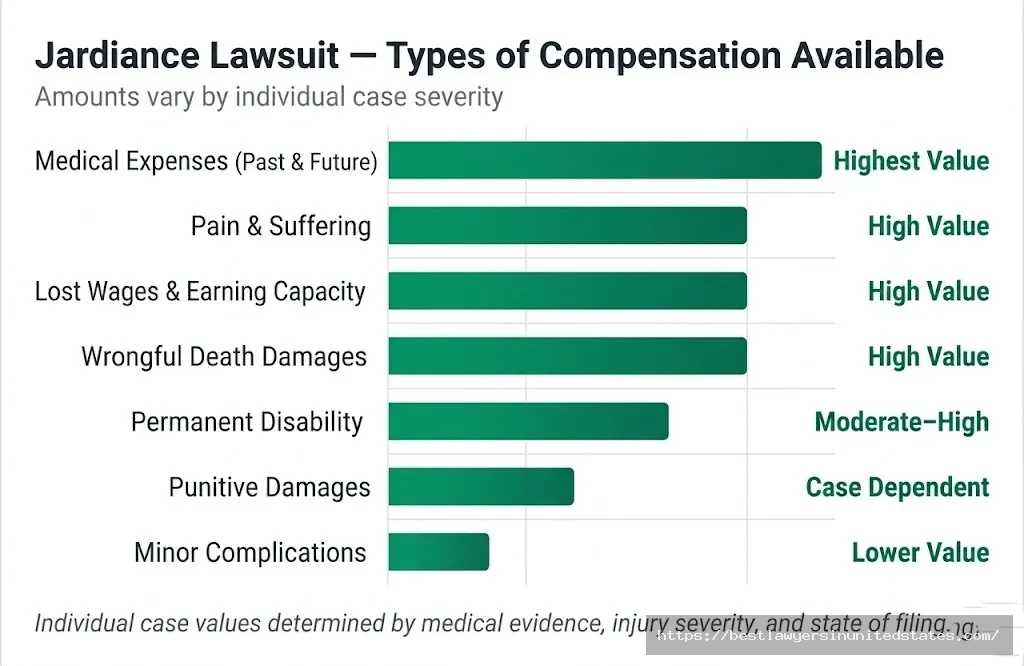
Because Jardiance lawsuits are individual personal injury cases — not a class action with a fixed settlement pool — your compensation depends on the specific facts of your situation. Courts and settlement negotiations take many factors into account.
Types of Compensation Available
| Compensation Type | What It Covers | Examples |
|---|---|---|
| Medical expenses | All costs related to treating your Jardiance injury | ER visits, hospitalization, ICU stays, surgeries, dialysis, ongoing treatment |
| Future medical costs | Projected cost of ongoing care for permanent injuries | Long-term dialysis for kidney damage, continued treatment for gangrene scarring |
| Lost wages | Income lost because of your injury | Time off work during hospitalization, recovery period |
| Loss of earning capacity | If your injury prevents you from working at the same level long-term | Career change forced by permanent kidney damage or disability |
| Pain and suffering | Physical pain and emotional distress caused by your injury | Chronic pain, anxiety, depression, reduced quality of life |
| Punitive damages | Additional damages meant to punish the manufacturer | Awarded in cases where the company’s conduct was especially reckless or deceptive |
| Wrongful death damages | For families of patients who died from Jardiance-related complications | Funeral costs, lost financial support, loss of companionship |
Factors That Affect Your Payout
In pharmaceutical personal injury cases, the value of your claim depends on several factors:
- Severity of injury — a DKA episode requiring a 3-day hospital stay is valued differently than one that caused permanent kidney damage or death
- Medical costs incurred — higher out-of-pocket and insurance costs typically mean a higher damages figure
- Duration of Jardiance use — longer use can strengthen the causal connection between the drug and your injury
- Your age and earning capacity — younger plaintiffs with more working years ahead generally see higher lost-income calculations
- Strength of medical documentation — strong records that clearly link Jardiance to your diagnosis increase case value
- State of filing — some states allow punitive damages more readily than others
What Did Similar Drug Lawsuits Pay?
| Lawsuit | Drug / Manufacturer | Settlement | Type | Year Resolved |
|---|---|---|---|---|
| Invokana Lawsuits | Canagliflozin / J&J | Undisclosed (est. hundreds of millions) | Mass tort settlement | 2021 |
| Farxiga Lawsuits | Dapagliflozin / BMS & AstraZeneca | Confidential | MDL settlement | 2019 |
| Actos (pioglitazone) | Bladder cancer claims / Takeda | ~$2.4 billion | Mass tort global settlement | 2015 |
| Risperdal Lawsuits | Antipsychotic / J&J | ~$800 million+ | Mass tort | 2012–2019 |
| Jardiance Lawsuits | Empagliflozin / Boehringer Ingelheim | Ongoing — no public settlement yet | Individual mass tort | Active 2026 |
The Invokana settlement is the most directly comparable, since Invokana is in the same SGLT2 inhibitor drug class. Although the settlement amount was not publicly disclosed, the litigation involved thousands of plaintiffs and the overall figure was estimated to be in the hundreds of millions. Individual payouts in mass tort pharmaceutical cases of this type typically range from $50,000 to $500,000 or more for serious injuries, with the highest awards going to plaintiffs with permanent injuries, multiple hospitalizations, or wrongful death claims.
⚠️ Important: No “Set” Payout Exists Anyone who gives you a guaranteed dollar figure for a Jardiance claim without reviewing your medical records is not being accurate with you. Compensation is highly case-specific. The best way to get a realistic estimate is a free consultation with a pharmaceutical injury attorney who has reviewed your specific records.
How to File a Jardiance Lawsuit — Step by Step
⚠️ Do Not Wait — Statutes of Limitations Are Real Deadlines Most states give you 2–3 years from the date you discovered (or should have discovered) that Jardiance caused your injury. Once that window closes, you generally cannot file — regardless of how serious your injury is. If you’re unsure whether your deadline has passed, contact an attorney today. Many offer free case evaluations with no obligation.
Step-by-Step Filing Process
1Gather your medical records and pharmacy history. Pull together your hospital records, ER discharge papers, physician notes, lab results, and any documentation showing your Jardiance prescription and fill history. Your pharmacy can reprint your prescription history, and your doctor’s office can provide medical records (federal law gives you the right to these). Don’t worry if you’re missing something — attorneys can often help obtain records through subpoenas.
2Contact a pharmaceutical injury attorney for a free consultation. Jardiance cases are handled by personal injury attorneys who specialize in pharmaceutical drug litigation. Most work on contingency — meaning you pay nothing unless they win your case. Your first consultation is free and carries no obligation. The attorney will review your situation, assess whether you have a viable claim, and explain your options. Use the contact information in the Do You Need a Lawyer? section below.
3Attorney evaluates your claim. A good pharmaceutical attorney will review your records and advise you honestly about whether you have a strong case. They’ll look at the timeline, the medical evidence linking your injury to Jardiance, and the potential value of your claim. This process typically takes a week or two after you provide your records.
4Sign a representation agreement if you want to proceed. If you decide to move forward, you sign a contingency fee agreement. Standard contingency fees in pharmaceutical cases are typically 33–40% of any recovery (this will be explained clearly before you sign anything). You pay nothing upfront.
5Your attorney files the lawsuit. Your attorney prepares and files your complaint in the appropriate court. Many pharmaceutical cases are filed in federal court, and depending on the volume of Jardiance cases, they may eventually be consolidated into a multidistrict litigation (MDL) for more efficient handling.
6Discovery and investigation phase. Both sides exchange evidence, including internal company documents. This is often where cases get stronger — internal communications can reveal what the manufacturer knew and when. This phase can take months to years.
7Negotiation and potential settlement. Most pharmaceutical mass tort cases settle before trial. Your attorney will negotiate on your behalf. You’ll be consulted before any settlement offer is accepted — you always have the final say.
8Receive your compensation. If your case settles or results in a court award, you receive your compensation minus attorney fees and case costs. Your attorney will walk you through the payment process and any tax implications.
Key Deadlines to Know
| Deadline Type | General Timeframe | What It Means |
|---|---|---|
| Statute of limitations (most states) | 2–3 years from injury discovery | Hard deadline after which you cannot file; varies by state |
| California | 2 years from discovery | Code of Civil Procedure § 335.1 |
| Florida | 2 years from discovery (as of 2023 reform) | Florida Statute § 95.11(3) |
| Texas | 2 years from injury/discovery | Texas Civil Practice & Remedies Code § 16.003 |
| New York | 3 years from discovery | CPLR § 214 |
| All other states | Typically 2–3 years; some allow longer | Consult an attorney to confirm your state’s deadline |
The discovery rule means the clock often starts from when your doctor told you — or you had reason to know — that Jardiance caused your injury, not from when you first took the pill. If you were hospitalized for DKA in 2022 and your doctor documented that Jardiance was the likely cause, that’s generally when your window opened. An attorney can assess exactly where you stand.
Common Mistakes That Can Kill Your Case
- Waiting too long to consult an attorney — the statute of limitations is a hard cutoff in most states, with very limited exceptions
- Discarding medical records or pill bottles — even old records can be requested from hospitals, but starting your own file is better
- Assuming you need to have a severe injury to qualify — serious hospitalizations and permanent injuries are the most valuable claims, but consult an attorney to assess your specific situation
- Talking to the drug manufacturer or their representatives without an attorney — if anyone from Boehringer Ingelheim or their legal team contacts you, consult your attorney first
- Signing any releases or waivers — don’t sign any documents from the manufacturer without legal advice
Current Lawsuit Status & 2026 Updates
Where Things Stand as of March 2026
As of early 2026, Jardiance personal injury litigation remains active. Unlike the related SGLT2 inhibitor cases — the Invokana MDL (closed in 2023) and the Farxiga MDL (closed in 2020) — Jardiance has not been consolidated into a single federal multidistrict litigation proceeding. Cases continue to be filed and litigated individually in both federal and state courts across the country.
No public global settlement between Boehringer Ingelheim and Jardiance plaintiffs has been announced. This means the window to file individual claims is still open — but only for those who act before their state’s statute of limitations runs out. Attorneys who specialize in pharmaceutical litigation are still actively accepting Jardiance cases. How Long Does a Nursing Home Lawsuit Take
Key Regulatory History Affecting the Cases
| Date | Regulatory Action | Impact on Litigation |
|---|---|---|
| May 2015 | FDA issues DKA safety warning for all SGLT2 inhibitors | Establishes that the risk was known; key evidence in failure-to-warn claims |
| December 2015 | FDA orders mandatory Jardiance label update for DKA and UTI risks | Shows manufacturer was compelled to act; supports claims that earlier warnings were inadequate |
| August 2018 | FDA issues safety communication linking SGLT2 inhibitors to Fournier’s gangrene | Opens new category of Fournier’s gangrene claims against Jardiance |
| 2019 | Farxiga MDL 2776 settled (Bristol-Myers Squibb / AstraZeneca) | Confidential settlement; establishes pharmaceutical industry’s willingness to resolve SGLT2 claims |
| 2021 | Invokana MDL settled (Johnson & Johnson) | Provides framework for potential Jardiance resolution; demonstrates claim value |
| 2024–2026 | Jardiance cases continue individually | Attorneys still filing; no global resolution announced as of March 2026 |
What Might Happen Next
In pharmaceutical mass tort litigation, there are typically several possible paths from here. If enough Jardiance cases accumulate in federal courts, a judge could consolidate them into a multidistrict litigation — similar to what happened with Invokana. That process tends to accelerate settlements because it creates a larger, more efficient pool for negotiations. Alternatively, bellwether trials (early test cases) can establish damages ranges that drive broader settlement discussions.
For patients considering filing, the practical message is straightforward: the window is open now, but it won’t stay open forever. Statutes of limitations are running. The time to consult an attorney is before your deadline — not after.
Jardiance vs. Similar Drug Lawsuits
How This Litigation Compares
| Drug | Class | Primary Claims | Litigation Status | Resolution |
|---|---|---|---|---|
| Jardiance (empagliflozin) | SGLT2 inhibitor | DKA, Fournier’s gangrene, kidney failure, failure to warn | Active — cases still being filed | No global settlement announced |
| Invokana (canagliflozin) | SGLT2 inhibitor | DKA, amputation, kidney failure | MDL closed 2023 | Undisclosed global settlement (2021) |
| Farxiga (dapagliflozin) | SGLT2 inhibitor | DKA, Fournier’s gangrene, kidney failure | MDL closed 2020 | Confidential settlement (2019) |
| Actos (pioglitazone) | Thiazolidinedione diabetes drug | Bladder cancer, failure to warn | Resolved | ~$2.4 billion global settlement (2015) |
| Ozempic / Wegovy (semaglutide) | GLP-1 agonist | Gastroparesis, intestinal blockage | Active and growing — MDL underway | Ongoing |
What Makes Jardiance Cases Distinctive
Jardiance cases share a lot of DNA with Invokana and Farxiga litigation — same drug class, similar injuries, same core failure-to-warn theory. But a few things make Jardiance cases somewhat unique. First, Jardiance was specifically and heavily marketed for heart health benefits in patients with established cardiovascular disease, which expanded the population taking it well beyond typical diabetes management. Second, the FDA’s specific Fournier’s gangrene warning in 2018 named Jardiance and Farxiga by name, creating a particularly clean evidence trail for gangrene-related claims. Third, because the Invokana and Farxiga MDLs have now closed, Jardiance claimants don’t face the same overcrowded litigation environment — meaning individual cases can potentially move faster.
Note on Related SGLT2 Drug Cases If you took a different SGLT2 inhibitor — Invokana, Farxiga, or Xigduo XR — and suffered similar injuries, separate litigation applies. Consult an attorney regardless of which specific drug you took. Many firms handle claims across the full SGLT2 class.
Do You Need a Lawyer to File a Jardiance Claim?
Quick Answer Yes — unlike a class action settlement where you fill out a form online, Jardiance lawsuits require filing an individual legal complaint. You’ll need an attorney. The good news: pharmaceutical injury attorneys handle these cases on contingency, meaning you pay nothing unless they win. Free consultations are standard.
Why You Need a Lawyer for This Type of Case
Jardiance litigation is not a simple claim form you fill out on a website. These are personal injury lawsuits against a multi-billion-dollar pharmaceutical company that has teams of defense lawyers. To succeed, you need an attorney who understands pharmaceutical product liability law, how to build a failure-to-warn case, how to obtain and analyze medical records, and how to negotiate or litigate against well-funded corporate defendants.
The contingency fee model means this is financially accessible even if you can’t afford legal costs upfront. Your attorney fronts all costs — filing fees, expert witnesses, medical record retrieval — and gets reimbursed only if you win or settle. Typical contingency rates in pharmaceutical mass tort cases run between 33% and 40% of the final recovery, and this will be spelled out clearly in your retainer agreement before you sign anything.
What to Look For in a Jardiance Attorney
- Experience specifically in pharmaceutical or drug injury litigation (not just general personal injury)
- Track record in SGLT2 inhibitor cases, or similar mass tort drug cases
- Willingness to take cases on contingency
- Free initial consultation with a real attorney reviewing your case
- Clear communication about fees and realistic case expectations
- National reach — you don’t need to find someone in your own city; pharmaceutical attorneys handle cases across all 50 states
How to Get Free Legal Help
The fastest path to knowing whether you have a case is a free consultation with a pharmaceutical injury attorney. You can reach attorneys handling Jardiance cases in several ways:
| Resource | What They Offer | Cost |
|---|---|---|
| Pharmaceutical injury law firms | Free case evaluation, contingency representation, national reach | Free consultation; contingency fees only if you win |
| State bar attorney referral services | Connects you with qualified local attorneys | Usually free or low-cost referral |
| Attorney referral via [email protected] | Free referral to attorneys handling Jardiance cases | Free |
You can also email [email protected] for a referral to an attorney with experience in pharmaceutical drug injury cases. Most consultations take 20–30 minutes and give you a clear picture of whether you have a viable claim.
Frequently Asked Questions
What is the Jardiance lawsuit?
Quick Answer Personal injury lawsuits against Boehringer Ingelheim and Eli Lilly, alleging failure to adequately warn patients about serious side effects of the diabetes drug Jardiance.
The Jardiance lawsuit refers to a wave of individual personal injury claims filed by patients who suffered serious harm — including diabetic ketoacidosis, Fournier’s gangrene, and kidney failure — after taking Jardiance. Unlike a class action settlement, each plaintiff files their own case based on their specific injuries. The core claim is that the manufacturer knew (or should have known) about these serious risks and failed to warn doctors and patients adequately before people were harmed.
Is there a class action settlement I can join?
Quick Answer No. As of March 2026, there is no public class action settlement for Jardiance with a claim form or fixed deadline.
Jardiance litigation consists of individual personal injury mass tort cases, not a single class action with a claim portal. This matters because you can’t simply fill out a form online. You need to file your own lawsuit — which requires an attorney. The related Invokana and Farxiga MDLs have both closed, but Jardiance cases remain individually active. An attorney can advise you on the current litigation landscape and whether your case makes sense to pursue.
Who is eligible to file a Jardiance lawsuit?
Quick Answer Anyone who took Jardiance and suffered a serious injury such as DKA, Fournier’s gangrene, or kidney failure — as long as you’re within your state’s statute of limitations.
The core eligibility requirements are: (1) you were prescribed and took Jardiance, (2) you suffered a qualifying serious injury, (3) there’s medical documentation supporting the link between the drug and your condition, and (4) your case is still within your state’s filing deadline (typically 2–3 years from injury discovery). Family members of patients who died from Jardiance-related complications may also be able to file wrongful death claims.
What injuries are covered in these lawsuits?
Quick Answer Diabetic ketoacidosis, Fournier’s gangrene, kidney failure, severe urinary tract infections, and wrongful death are the primary covered injuries.
The most common injuries in Jardiance lawsuits are: diabetic ketoacidosis (DKA), which can cause coma and death; Fournier’s gangrene, a flesh-eating infection of the genitals linked to the drug by the FDA in 2018; acute kidney injury; and serious urinary tract infections requiring hospitalization. Cases involving permanent disability or death tend to have the highest case values.
How much money can I get from a Jardiance lawsuit?
Quick Answer There’s no set figure — compensation depends on your specific injuries, medical costs, lost wages, and pain and suffering. Serious cases can potentially yield tens of thousands to hundreds of thousands of dollars.
Compensation in pharmaceutical personal injury cases is highly individual. Your payout depends on the severity and permanence of your injury, your total medical costs (past and future), income lost due to your injury, and non-economic damages like pain, suffering, and reduced quality of life. The comparable Invokana litigation resulted in significant individual settlements, though amounts weren’t publicly disclosed. An attorney can give you a realistic assessment of your claim’s value after reviewing your records.
What is the deadline to file a Jardiance lawsuit?
Quick Answer The deadline varies by state — typically 2–3 years from the date you discovered (or should have discovered) that Jardiance caused your injury. Act promptly; once this deadline passes, you generally cannot file.
Most states apply a “discovery rule,” meaning your deadline starts from when you knew or reasonably should have known that Jardiance caused your specific injury — not necessarily from when you first took the drug. If you were hospitalized for DKA in 2023 and your doctor linked it to Jardiance at that time, your clock likely started in 2023. If you’re unsure whether your deadline has passed, the best step is an immediate free consultation with a pharmaceutical attorney — many will do a quick initial assessment the same day you call.
Do I need a lawyer to file a Jardiance lawsuit?
Quick Answer Yes. These are individual personal injury lawsuits, not a claim form you fill out online. You need an attorney — but most work on contingency, meaning you pay nothing unless they win.
Jardiance cases involve filing a formal legal complaint against Boehringer Ingelheim, which employs sophisticated legal defense teams. You’ll need a pharmaceutical injury attorney to navigate the process. The good news: these attorneys typically work on a contingency fee basis, advancing all costs themselves and collecting only if they win. Your initial consultation is free.
What documents do I need to start a case?
Quick Answer Prescription records, pharmacy history, hospital and doctor records documenting your injury, medical bills, and any records showing lost income.
Don’t worry if you don’t have everything assembled yet — your attorney can help you obtain records. The most important things to have or request are: your Jardiance prescription history from your pharmacy, hospital records from any DKA hospitalization or related treatment, physician diagnosis notes, lab results, and insurance explanation of benefits showing what care was billed. Start gathering these now, but don’t let missing documents stop you from making an initial attorney call.
What if I don’t have my prescription records anymore?
Quick Answer Your pharmacy keeps prescription records for years — often 7–10 years. Your health insurance company also has claims records showing medications you were prescribed.
Call your pharmacy and ask for a complete prescription history — they’re required to maintain these records and can typically print or email them to you. CVS, Walgreens, Rite Aid, and most chains have online patient portals where you can access fill history yourself. Your insurance company’s member portal also shows all prescriptions covered under your plan. If you used GoodRx or a similar discount service, they may also have your fill history. An attorney can assist in obtaining records if you run into barriers.
How long does a Jardiance lawsuit take?
Quick Answer Typically 1–4 years, depending on whether your case settles or goes to trial, and how courts manage the broader Jardiance litigation.
Pharmaceutical mass tort cases are rarely quick, but most resolve before trial through settlement negotiations. If Jardiance cases are eventually consolidated into an MDL, the overall timeline tends to accelerate as courts run early “bellwether” trials to establish case values and pressure global settlements. Your attorney will set realistic expectations based on the current state of the litigation.
What happened to the Invokana and Farxiga lawsuits?
Quick Answer Both settled — Farxiga in 2019 and Invokana in 2021 — for confidential undisclosed amounts. Both MDLs have since closed.
Invokana (canagliflozin, made by Johnson & Johnson) faced the largest SGLT2 MDL — MDL 2750 in New Jersey — and J&J agreed to settle the existing cases in 2021 for an undisclosed amount. The MDL closed in 2023. The Farxiga MDL (MDL 2776) settled in 2019 and closed in 2020. These resolutions matter for Jardiance plaintiffs because they establish that SGLT2 manufacturers are willing to settle, and they provide a framework for what compensation might look like.
Can I still file if my Jardiance injury happened years ago?
Quick Answer Possibly — it depends on when you discovered (or had reason to know) that Jardiance caused your injury, and what state you’re in. Consult an attorney immediately to assess your specific deadline.
The discovery rule in most states means your deadline may be more recent than you think. If you took Jardiance in 2016 but weren’t diagnosed with a related condition until 2022, your clock may have started in 2022, not 2016. That said, statutes of limitations do expire, and the longer you wait, the more at risk you are of missing your window. A free attorney consultation is the fastest way to get a definitive answer on your specific situation.
Will filing a Jardiance lawsuit affect my medical care?
Quick Answer No. Your medical care is independent of any legal action you take. Doctors and hospitals cannot alter your care because you filed a lawsuit.
Filing a personal injury lawsuit is a legal matter entirely separate from your medical treatment. Your doctors are bound by professional obligations to provide appropriate care regardless of any litigation. That said, your ongoing medical records will continue to be relevant to your case — which is another reason to maintain consistent documentation of your treatment and any lasting effects of your injury.
What is diabetic ketoacidosis (DKA), and why is it so dangerous?
Quick Answer DKA is a life-threatening condition where the body produces toxic levels of blood acids (ketones). It can cause diabetic coma and death if not treated urgently.
In DKA, the body doesn’t have enough insulin to use glucose for energy, so it burns fat instead — producing ketones as a byproduct. When ketone levels rise too high, the blood becomes dangerously acidic. The especially alarming aspect of Jardiance-related DKA is that it can occur even when blood sugar appears normal or only mildly elevated, which means the standard warning signs that patients and doctors rely on may not trigger appropriate concern. This is central to the failure-to-warn claims: patients and their doctors needed earlier, stronger warnings about this atypical DKA presentation.
What is Fournier’s gangrene, and how is it linked to Jardiance?
Quick Answer Fournier’s gangrene is a fast-spreading, potentially fatal bacterial infection of the genitals and perineum. The FDA formally linked Jardiance and other SGLT2 inhibitors to this infection in August 2018.
Fournier’s gangrene is an infection that destroys tissue in the genital and anal area. Before SGLT2 inhibitors were on the market, it was extremely rare — fewer than 20 cases linked to all diabetic drugs over a 30-year span. After SGLT2 drugs came out, the FDA identified 12 new cases in just five years among people taking drugs like Jardiance. All 12 required hospitalization and surgery. One patient died. The FDA’s August 2018 warning specifically called out Jardiance and Farxiga as associated with this risk — a warning many patients say should have come far earlier.
I’m still taking Jardiance. Should I stop?
Quick Answer Do not stop any medication without talking to your doctor first. This is a medical decision, not a legal one. Your doctor can assess your specific situation and discuss alternatives if appropriate.
Filing a lawsuit or researching your legal options does not require you to stop your medication. Many people continue taking Jardiance because the cardiovascular benefits outweigh the risks for their specific situation. Your prescribing physician is the right person to evaluate whether Jardiance remains appropriate for you, and whether closer monitoring for DKA symptoms makes sense. Do not make medication changes based on legal articles — always consult your doctor.
Are wrongful death claims possible for Jardiance?
Quick Answer Yes. If a family member died from DKA, Fournier’s gangrene, kidney failure, or other complications linked to Jardiance, their estate or surviving family members may be able to file a wrongful death lawsuit.
Wrongful death claims allow surviving spouses, children, or parents to pursue compensation for a family member’s death caused by another party’s negligence. In pharmaceutical wrongful death cases, these claims cover funeral expenses, lost financial support the deceased would have provided, medical costs incurred before death, and damages for the family’s loss of companionship. Wrongful death cases are among the most serious in pharmaceutical litigation and often carry the highest potential compensation. Contact a pharmaceutical attorney as soon as possible, as wrongful death statutes of limitations also apply.
What if I can’t afford a lawyer?
Quick Answer Cost is not a barrier. Pharmaceutical injury attorneys handle these cases on contingency — you pay nothing upfront and nothing unless they win your case.
Contingency fee representation means your attorney fronts all costs — filing fees, expert witnesses, travel, everything. You don’t pay a cent out of pocket during the case. If they win or settle, they take an agreed-upon percentage (typically 33–40%) from your recovery. If they don’t win, you owe nothing. This model was specifically designed to make serious legal representation accessible to individuals who couldn’t otherwise afford it when going up against large corporations.
Will a Jardiance settlement be taxable?
Quick Answer Generally, compensation for physical injuries and medical costs is not taxable. Punitive damages and compensation for lost wages typically are. Consult a tax professional for your specific situation.
Under IRS rules, compensatory damages received for physical injuries or illness are generally not taxable income. This covers medical expense reimbursement and compensation for physical pain and suffering. However, punitive damages and amounts compensating for lost wages (which would have been taxable income) are typically taxable. Wrongful death awards may have different treatment. Given the complexity, your attorney will likely recommend consulting a tax professional once your case resolves.
Have a question not covered here? Contact an attorney for a free case evaluation: [email protected]
