
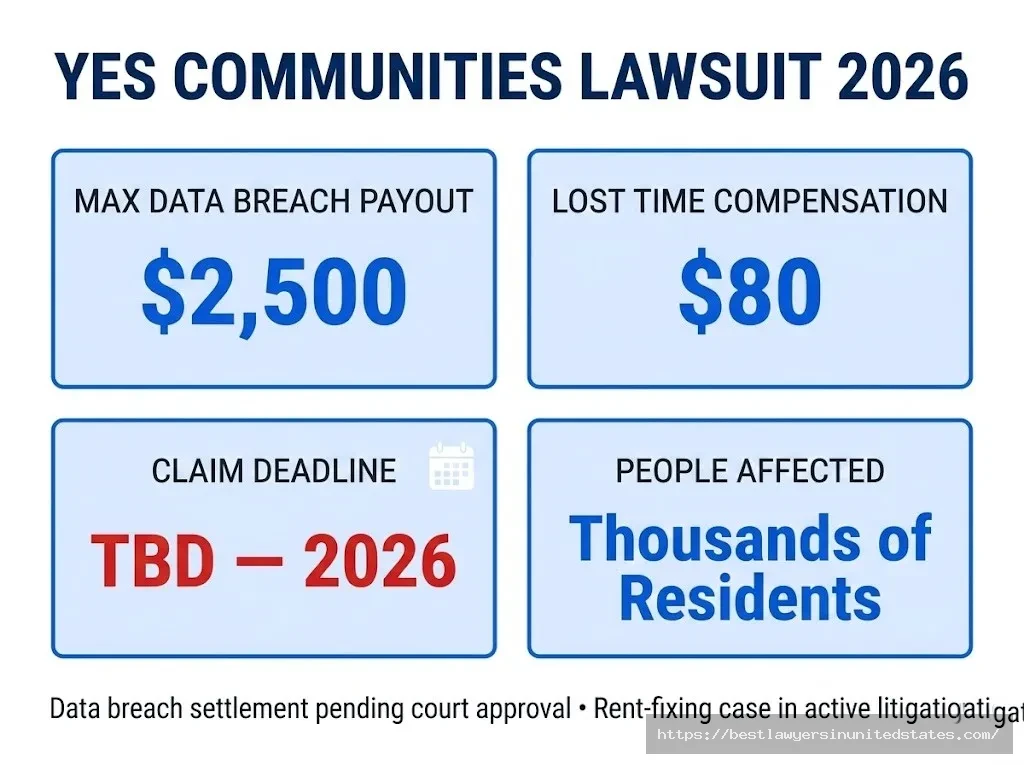
Yes Communities is currently facing two major class action lawsuits: a 2024 data breach settlement agreed to in January 2026 that could pay affected residents up to $2,500, and an ongoing antitrust rent-fixing lawsuit alleging the company conspired to illegally inflate manufactured home lot rents across the U.S. If you’re a current or former Yes Communities resident or anyone whose personal information was exposed in the breach, you may have legal rights and compensation available to you right now.
The data breach settlement was filed in the U.S. District Court for the District of Colorado on January 13, 2026, and is currently awaiting preliminary approval. The rent-fixing antitrust case (Case No. 1:23-cv-06715) is active in the Northern District of Illinois and covers anyone who paid manufactured home lot rent to Yes Communities or its co-defendants after August 31, 2019.
Quick Answer: Yes Communities faces two separate class action lawsuits. The data breach settlement offers up to $2,500 for documented losses, $80 for lost time, and free credit monitoring. The rent-fixing antitrust lawsuit is still in active litigation with no settlement yet — but you may automatically be included in the class if you rented a manufactured home lot after August 2019.
What Are the Yes Communities Lawsuits About?
Background on Yes Communities
Yes Communities (also marketed as YES! Communities) is a Denver, Colorado-based manufactured home community operator. It owns or controls more than 200 manufactured home communities across the United States, with approximately 55,000 home sites. The company is partially owned by Stockbridge Capital Group, LLC — a private equity firm managing over $33.7 billion in assets — along with the Government of Singapore Investment Company and the Pennsylvania Public School Employees Retirement System.
Yes Communities has been one of the most aggressive acquirers of manufactured home communities in recent years, expanding its portfolio across states including Michigan, Illinois, Tennessee, Texas, Colorado, and others. That growth has come with controversy. Residents at multiple communities have reported steep annual rent increases, deteriorating community conditions, and ignored maintenance requests — all forming the backdrop of two significant legal battles the company now faces. How Long Does a Personal Injury Lawsuit Take?
LAWSUIT #1: The Yes Communities Data Breach Settlement (2026)
What Happened in the Data Breach?
Between December 9 and December 11, 2024, an unauthorized party accessed Yes Communities’ computer network and copied certain files containing sensitive personal information. Yes Communities concluded its internal investigation on January 9, 2025, and began notifying affected individuals.
The data exposed in the breach reportedly includes:
- Full legal names
- Social Security numbers
- Driver’s license numbers
- Financial account information
- Physical addresses
If you received a data breach notification letter from Yes Communities in early 2025, your information was likely among the data exposed.
Timeline of Key Events — Data Breach Lawsuit
| Date | Event | Details |
|---|---|---|
| December 9–11, 2024 | Data breach occurs | Unauthorized access to Yes Communities’ network; files copied |
| January 9, 2025 | Investigation concluded | Company finishes reviewing the scope and affected individuals |
| February 2025 | Notification letters sent | Affected individuals begin receiving breach notices |
| Early 2025 | Class action investigation launched | ClassAction.org attorneys begin investigating potential claims |
| 2025 | Class action lawsuit filed | Filed in U.S. District Court for the District of Colorado |
| January 13, 2026 | Settlement agreement announced | Yes Communities agrees to settle; motion for preliminary approval filed |
| Pending (Spring/Summer 2026) | Preliminary approval hearing | Court decides whether to approve the settlement terms |
| TBD (after approval) | Claim deadline set | Official filing window opens for class members |
| TBD (2026–2027) | Payment distribution | Checks and credit monitoring issued to approved claimants |
Who Filed the Lawsuit?
The data breach class action was filed in the U.S. District Court for the District of Colorado by plaintiffs acting on behalf of all individuals whose personal data was exposed. The plaintiffs allege that Yes Communities negligently failed to implement and maintain reasonable cybersecurity measures to protect the sensitive personal information it collected and stored from residents and employees.
Key Allegations in the Data Breach Case
The lawsuit accuses Yes Communities of the following:
- Failing to implement adequate data security protocols despite handling sensitive personal information
- Neglecting to detect or prevent the unauthorized intrusion for multiple days
- Delayed response in notifying affected individuals after discovering the breach
- Storing sensitive data — including Social Security numbers and financial information — without sufficient encryption or access controls
- Failing to comply with applicable state data protection laws, including Colorado’s data breach notification requirements
Who Qualifies for the Data Breach Settlement?
Quick Answer: You likely qualify if you received a data breach notification letter from Yes Communities in early 2025 related to the December 2024 incident. Documentation of your losses will increase your potential payout significantly.
Eligibility Requirements — Data Breach Settlement
| Requirement | Details | Documentation Needed |
|---|---|---|
| Received breach notification | Yes Communities sent you a letter about the Dec. 2024 breach | Keep your notification letter |
| Personal data was exposed | Your name, SSN, or other info was in the breach | Letter confirms this |
| U.S. resident | Must be a U.S. person affected by the breach | N/A |
| Valid claim filed | Must submit claim form by deadline after preliminary approval | Completed claim form |
| Documented losses (for higher payout) | Proof of identity theft, fraud, or related out-of-pocket costs | Receipts, bank statements, police reports |
Who Does NOT Qualify?
You are NOT eligible for the data breach settlement if:
- You did not receive a breach notification letter from Yes Communities
- Your information was not included in the December 2024 data breach
- You are a Yes Communities employee who is separately covered under different terms
- You missed the claim submission deadline (once it is officially set by the court)
- You opt out of the class action to pursue your own separate lawsuit
How to Prove Your Claim — Required Documents
| Document Type | Why It’s Needed | Where to Find It | If You Don’t Have It |
|---|---|---|---|
| Breach notification letter | Confirms you’re a class member | Mailed by Yes Communities in early 2025 | Contact settlement administrator once approved |
| Proof of identity theft/fraud | Supports higher “documented loss” tier | Bank or credit card statements, IRS letters | Not required for base cash payment |
| Out-of-pocket expense receipts | Documents financial harm from breach | Your own records | Not required for base or lost-time claims |
| Time spent records | Supports the $80 lost-time claim | Your own log of hours spent on breach response | Self-certification may be permitted |
| Credit monitoring enrollment records | Documents protective steps taken | Emails from monitoring service | Not required |
How Much Can You Get from the Data Breach Settlement?
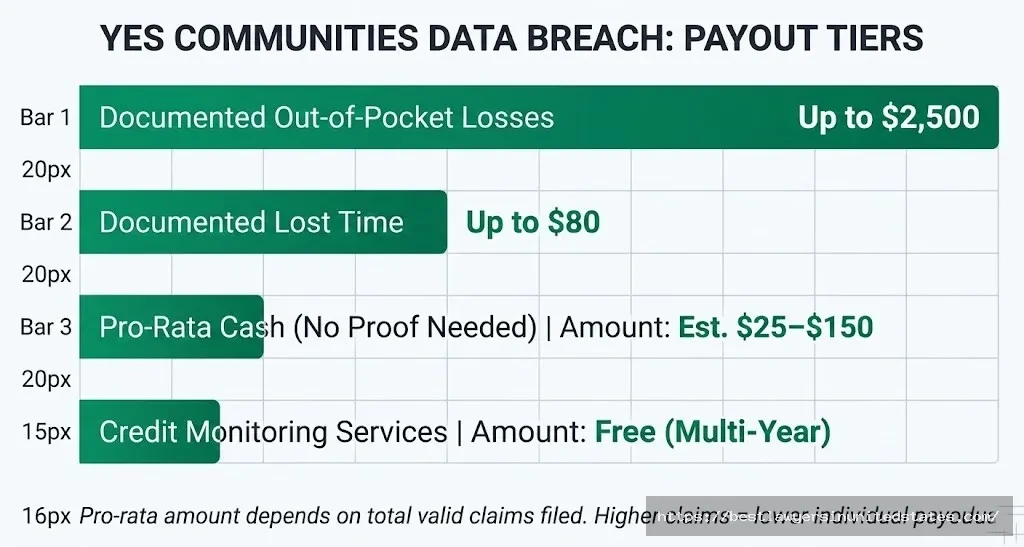
Quick Answer: Settlement benefits include up to $2,500 for documented out-of-pocket losses, $80 for lost time dealing with the breach, free credit monitoring services, and an alternative pro-rata cash payment for those without documented losses.
Settlement Benefit Tiers — Data Breach
| Claim Category | Estimated Payout | Requirements | Payment Form |
|---|---|---|---|
| Documented out-of-pocket losses | Up to $2,500 | Proof of losses tied to the breach | Cash payment |
| Lost time compensation | Up to $80 | Documentation or self-certification of time spent | Cash payment |
| Credit monitoring services | Free (multi-year) | Class membership | Identity/credit protection enrollment |
| Alternative cash payment (no documented losses) | Pro-rata share (TBD) | Class membership only; no proof needed | Cash payment |
The “alternative cash payment” for class members without documented losses is a pro-rata amount — meaning the exact dollar figure depends on how many people file valid claims. The fewer claims filed, the higher each individual payout. In similar data breach settlements, these payments have ranged from roughly $25 to $150 per person.
Factors That Affect Your Payout
How much you get depends on:
- Whether you have documented losses — Proving actual financial harm from the breach gets you the highest tier (up to $2,500)
- How many hours you spent responding to the breach — Up to $80 for verified lost time
- How many total claims are filed — The pro-rata cash pool is divided among all eligible claimants
- Court approval and any appeals — Final amounts are only confirmed after the settlement clears all legal steps
When Will Payments Be Sent?
| Stage | Timeframe | What Happens |
|---|---|---|
| Preliminary approval hearing | Spring/Summer 2026 | Court reviews and approves settlement terms |
| Notice period and claim window | Following preliminary approval | Class members receive notice and can file claims |
| Final approval hearing | Several months after preliminary approval | Court gives final sign-off |
| Payment distribution | 60–90 days after final approval | Checks and credit monitoring codes issued |
| Expected receipt | Late 2026 to early 2027 | Approximate window based on case timeline |
How to File Your Data Breach Claim — Step by Step
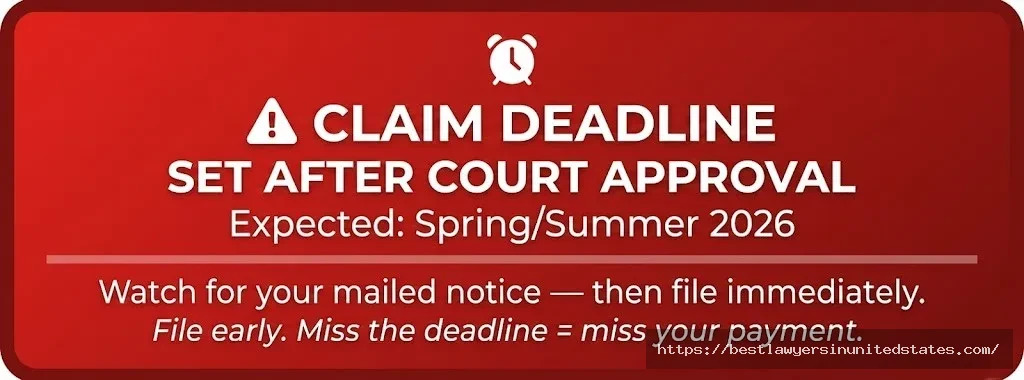
⚠️ IMPORTANT: As of March 2026, the settlement has been announced but is not yet preliminarily approved by the court. The official claim deadline will be set after preliminary approval is granted. Do NOT file with any unofficial website claiming to take claims now — those are scams. Watch for the official settlement website and your mailed notice.
Step 1: Keep Your Breach Notification Letter Your letter from Yes Communities confirming your data was exposed is your primary proof of class membership. Store it somewhere safe. If you lost it, you can contact ClassAction.org attorneys at the contact info below.
Step 2: Start Tracking Any Losses Document any suspicious activity, identity theft attempts, unauthorized charges, or time you’ve spent dealing with the aftermath of the breach. Save receipts, bank alerts, and a log of hours spent resolving issues.
Step 3: Watch for Your Official Settlement Notice Once the court grants preliminary approval, a notice will be mailed to all affected individuals. It will include a unique Class Member ID, a PIN, and instructions for filing online or by mail.
Step 4: Access the Official Claim Form Use only the court-authorized settlement website (to be announced). Do not use any third-party site that charges fees — legitimate settlement claims are always free to file.
Step 5: Complete and Submit Your Form You’ll choose between:
- Documented loss claim (up to $2,500 + $80) — requires supporting documents
- Alternative cash payment — no documentation needed; just confirm class membership
Step 6: Save Your Confirmation After submitting online, you’ll receive a confirmation number. Save it. You’ll need it to track your claim status.
Step 7: Watch for Additional Information Requests The settlement administrator may contact you if they need additional documentation. Respond promptly to avoid your claim being rejected.
Step 8: Receive Your Payment Payments are expected to go out via check or electronic payment within 60–90 days after final court approval, which is anticipated in late 2026. FanDuel Lawsuit 2026
Filing Mistakes to Avoid
- Filing with unofficial sites — Only use the court-authorized settlement website when it goes live
- Missing the deadline — Set a calendar reminder the moment you receive your official notice
- Choosing the wrong tier — If you have documented losses, claim them; don’t settle for the base cash payment
- Throwing away your breach letter — This is your primary proof of class membership
- Not saving your confirmation number — Required if your claim hits a problem
LAWSUIT #2: Yes Communities Manufactured Home Rent-Fixing Antitrust Lawsuit
What Is the Rent-Fixing Lawsuit About?
This is a separate and distinct lawsuit from the data breach case. In August and October 2023, multiple class action lawsuits were filed — now consolidated as In re Manufactured Home Lot Rents Litigation — in the U.S. District Court for the Northern District of Illinois (Case No. 1:23-cv-06715, Judge Franklin U. Valderrama).
The lawsuit alleges that Yes Communities and eight other major manufactured home community operators conspired with Datacomp Appraisal Systems — the nation’s largest provider of manufactured home market data — to fix, raise, and systematically inflate lot rental prices across the United States. If true, this affected hundreds of thousands of manufactured home residents, many of them elderly, low-income, or on fixed incomes.
Rent-Fixing Lawsuit Timeline
| Date | Event | Details |
|---|---|---|
| August 31, 2019 | Alleged conspiracy begins | Companies allegedly start coordinating rent increases |
| August 31, 2023 | First class action filed | Hajek v. Datacomp, Case No. 1:23-cv-06715, N.D. Illinois |
| October 6, 2023 | Second class action filed | Kazmirzak v. Datacomp, Case No. 1:23-cv-14598 |
| December 4, 2023 | Third class action filed | Case No. 1:23-cv-16462, similar allegations |
| 2024 | Cases consolidated | Merged into In re Manufactured Home Lot Rents Litigation |
| 2024–2025 | Discovery phase | Attorneys gathering evidence, deposing witnesses |
| 2025–2026 | Motions to dismiss | Defendants attempt to have the case dismissed |
| Ongoing (2026) | Active litigation | No settlement reached; case continues |
Who Filed the Rent-Fixing Lawsuit?
Lead plaintiffs include Carla Hajek, Gregory Hammerlund, Ronald Kazmirzak, and Andrea M. Muns, all manufactured home lot residents who allege they were overcharged because of the defendants’ alleged conspiracy. The cases are being prosecuted by DiCello Levitt LLP (Chicago/New York) and Hausfeld LLP (Washington, D.C.) — two of the nation’s top antitrust litigation firms.
Who Are the Defendants in the Rent-Fixing Case?
Yes Communities is one of ten defendants:
- Datacomp Appraisal Systems, Inc. (alleged hub of the conspiracy)
- Equity LifeStyle Properties, Inc. (ELS)
- Sun Communities, Inc.
- RHP Properties, Inc.
- YES! Communities, Inc.
- Inspire Communities, L.L.C.
- Kingsley Management Corp.
- Cal-Am Properties, Inc.
- Hometown America Management, L.L.C.
- Lakeshore Communities, Inc.
Together, these companies control hundreds of thousands of manufactured home lots across the U.S.
Key Allegations in the Rent-Fixing Case
The antitrust lawsuit makes the following core claims:
- The defendants used Datacomp’s proprietary “JLT Market Reports” — which contain detailed, non-anonymized, competitively sensitive data about specific manufactured home communities — to secretly coordinate rent increases
- By sharing this non-public pricing data, the companies could “reduce or eliminate competition amongst themselves” on price, services, and quality
- Manufactured home lot rents increased at a staggering 9.1% per year between 2019 and 2021 — far outpacing inflation and any justified market increase
- Residents at Yes Communities properties in Tennessee saw rents rise nearly 30% between 2013 and 2019, while community conditions worsened and maintenance requests went ignored
- The alleged conspiracy particularly harmed elderly residents, veterans, and people with disabilities — populations with limited ability to simply move elsewhere
As the court documents note, manufactured home residents face a unique trap: they own their homes but rent the land, making relocation extremely costly. The defendants allegedly exploited this to extract maximum rent with impunity.
Who Qualifies for the Rent-Fixing Lawsuit?
The proposed class covers all persons and entities who paid rent directly to any of the defendant companies for a manufactured home lot in a community included in a Datacomp JLT Market Report between August 31, 2019 and the present.
You may qualify if you:
- Rented a manufactured home lot from Yes Communities, ELS, Sun Communities, RHP, Inspire, Kingsley, Cal-Am, Hometown America, or Lakeshore Communities after August 31, 2019
- Your community was listed in a Datacomp JLT Market Report
- You paid rent in that period (you do not need to still be a resident)
You likely do NOT qualify if you:
- Owned your own land (not a renter)
- Rented from a company not named in the lawsuit
- Were in a community not covered by Datacomp’s JLT reporting
Current Status of the Rent-Fixing Lawsuit
As of March 2026, the rent-fixing case is in active litigation. The defendants have filed motions to dismiss. The court has not yet certified a class, meaning you cannot file a claim right now. If and when the court certifies the class, notice will be sent to eligible residents and a claims process will begin.
To register your interest or stay informed, contact the plaintiffs’ counsel:
- DiCello Levitt: [email protected] | 646-933-1000
- Hausfeld LLP: [email protected] | 202-540-7200
Yes Communities Lawsuits vs. Similar Cases
How These Cases Compare
| Lawsuit | Type | Settlement Amount | Affected Parties | Payout Range | Status |
|---|---|---|---|---|---|
| Yes Communities Data Breach (2026) | Data breach | Claims-made | Thousands of residents/employees | Up to $2,500 + $80 + monitoring | Settlement pending approval |
| Yes Communities Rent-Fixing (2023–) | Antitrust | TBD — no settlement | Hundreds of thousands | TBD | Active litigation |
| RealPage Rent Algorithm Lawsuit | Antitrust (multifamily) | TBD | Millions of renters | TBD | Active litigation |
| 23andMe Data Breach Settlement | Data breach | $30M | ~6.4M users | Up to several hundred dollars | Settled 2026 |
| Nelnet Data Breach Settlement | Data breach | $10M | ~2.5M borrowers | Pro-rata cash + monitoring | Claims closed March 2026 |
| Numotion Data Breach Settlement | Data breach | $4M | ~602,000 individuals | Up to $15,000 | Deadline March 18, 2026 |
What Makes the Yes Communities Cases Unique?
The combination of lawsuits Yes Communities faces is unusual and tells a broader story. On one hand, the data breach case is a straightforward cybersecurity failure affecting residents whose sensitive information was stored by the company. On the other, the rent-fixing antitrust case is a systemic, industry-wide allegation — one of the first major antitrust actions targeting manufactured housing, a sector that houses over 22 million Americans and represents the country’s largest source of unsubsidized affordable housing.
The rent-fixing case is particularly significant because:
- The alleged victims are among America’s most financially vulnerable residents
- The structure of manufactured housing (own home, rent land) creates a captive renter class
- The conspiracy allegedly involved sharing non-public competitor data — a textbook antitrust violation if proven
- Multiple law firms and three separate lawsuits were filed within weeks of each other, signaling strong legal confidence in the allegations
Do You Need a Lawyer?
Quick Answer: No — you don’t need a lawyer to file a data breach settlement claim once the claim window opens. The process is designed for individuals. For the rent-fixing lawsuit, you don’t need to do anything right now — if the class is certified, you’ll be automatically included.
Filing the Data Breach Claim Without a Lawyer
The data breach settlement is structured so that individual class members can file directly, without legal representation. The claim form will be available online, and the process typically takes 10–15 minutes. You do not pay any fee to file.
When Legal Help Could Be Useful — Data Breach
Consider consulting an attorney if:
- Your documented losses from the breach exceed $2,500 and you want to explore a separate individual lawsuit
- Your identity was stolen and you’ve suffered significant ongoing financial harm
- You’re unsure whether to opt in, opt out, or object to the settlement
For the Rent-Fixing Lawsuit
You don’t need to do anything active right now to preserve your place in the class. If the court certifies the class, you will be automatically included if you meet the eligibility criteria. You only need to take action if you want to opt out of the class to sue independently, or if you wish to join and want updates from plaintiffs’ counsel.
Free Legal Consultation
If you want to understand your rights under either lawsuit:
- DiCello Levitt (rent-fixing): [email protected] | 646-933-1000
- Hausfeld LLP (rent-fixing): [email protected] | 202-540-7200
- ClassAction.org (data breach): classaction.org/data-breach-lawsuits/yes-communities-february-2025
- General referrals: [email protected]
Current Status & Latest 2026 Updates
Data Breach Settlement (January 2026 Update)
On January 13, 2026, Yes Communities’ attorneys filed a motion for preliminary approval of the class action settlement in the U.S. District Court for the District of Colorado. The motion confirms that:
- Yes Communities has agreed to settle all claims related to the December 2024 data breach
- The settlement is “claims-made,” meaning the total payout depends on how many class members file valid claims
- Benefits include up to $2,500 for documented losses, $80 for lost time, credit monitoring services, and an alternative pro-rata cash option
- Preliminary approval is the next step before the court sets a formal notice and claims deadline
Rent-Fixing Antitrust Case (2026 Update)
As of early 2026, the rent-fixing antitrust case continues in the Northern District of Illinois before Judge Franklin U. Valderrama. Key developments include:
- The defendants filed motions to dismiss the consolidated complaint
- Plaintiffs’ attorneys at DiCello Levitt and Hausfeld have continued building the case through discovery
- No settlement has been reached; the case is expected to proceed through additional pretrial proceedings in 2026
- Attorneys estimate hundreds of thousands of manufactured home residents nationwide could ultimately be included in the class
What to Expect Next
For the data breach: After preliminary approval, watch for a mailed notice from the settlement administrator (likely mid-2026), which will include your Class Member ID and the official claim deadline.
For the rent-fixing case: The court will rule on the motion to dismiss first. If the case survives, the next major milestone will be a motion for class certification — which would formally define who’s in the class and trigger a notice campaign to potential members. How Long Does a Nursing Home Lawsuit Take
Frequently Asked Questions
What is the Yes Communities lawsuit?
There are actually two separate lawsuits. The first is a data breach class action settled in January 2026, covering individuals whose personal information was exposed in a December 2024 cyberattack. The second is an ongoing antitrust lawsuit alleging Yes Communities and nine other manufactured home community operators conspired to fix and inflate lot rental prices across the U.S. since 2019.
Who qualifies for the data breach settlement?
Anyone who received a data breach notification letter from Yes Communities about the December 2024 incident likely qualifies as a class member. You can receive a free cash payment with no documentation, or up to $2,500 if you have proof of out-of-pocket losses from the breach.
How much money will I receive from the data breach settlement?
It depends on which type of claim you file. Documented losses can yield up to $2,500, plus $80 for time spent dealing with the breach. If you have no documented losses, you’ll receive a pro-rata share of the remaining settlement fund — an amount that will be determined after all valid claims are counted.
When is the deadline to file a data breach claim?
As of March 2026, the deadline has not yet been set. It will be announced after the court grants preliminary approval of the settlement, which is expected in spring or summer 2026. Watch for your mailed settlement notice or check ClassAction.org for updates.
How do I file a data breach claim?
Once the settlement is preliminarily approved, an official settlement website will be launched. You’ll need your Class Member ID from your mailed notice to file online. You can also file by mail. Do not file through any unofficial site.
Do I need a lawyer to file a data breach claim?
No. The process is designed for individuals to file directly at no cost. Never pay anyone to help you file a class action settlement claim — legitimate claims are always free.
What documents do I need for the data breach claim?
To receive the base alternative cash payment, you don’t need documents — just your breach notification letter and Class Member ID. For the higher documented loss claim (up to $2,500), you’ll need receipts or records showing financial harm tied to the breach.
What if I lost my breach notification letter?
Contact the settlement administrator once the official website is live, or reach out to ClassAction.org’s attorneys. You may still be able to file using your personal information to verify class membership.
When will I receive payment from the data breach settlement?
Payments are expected to go out approximately 60–90 days after the court grants final approval — likely sometime in late 2026 or early 2027, depending on the timeline for preliminary approval and any appeals.
How will I receive my payment?
Most data breach settlements pay via paper check or electronic payment (ACH/Zelle/PayPal). The settlement notice will let you choose your preferred payment method.
Has the data breach settlement been approved?
As of March 2026, the settlement has been agreed to by the parties and a motion for preliminary approval was filed January 13, 2026. It has not yet received court approval. Preliminary approval is expected in spring or summer 2026.
Can I opt out of the data breach settlement?
Yes. Once the settlement receives preliminary approval, you’ll have the option to opt out during the notice period if you want to preserve your right to file an individual lawsuit against Yes Communities. The deadline to opt out will be stated in your mailed notice.
What if I opt out of the data breach settlement?
If you opt out, you will receive no payment from the settlement, but you can file your own independent lawsuit against Yes Communities for the data breach. This is rarely a better financial outcome for most individuals, unless you suffered very substantial, documented financial losses.
What is the rent-fixing antitrust lawsuit about?
It alleges that Yes Communities and eight other manufactured home community operators — along with Datacomp Appraisal Systems — illegally shared non-public pricing data to coordinate rent increases. The lawsuit claims manufactured home lot rents rose at 9.1% per year from 2019 to 2021 as a result of this alleged conspiracy.
Who is in the rent-fixing lawsuit class?
The proposed class includes all people who paid rent to any of the named defendant companies for a manufactured home lot in a community covered by Datacomp’s JLT Market Reports after August 31, 2019.
How do I join the rent-fixing lawsuit?
You don’t need to “join” right now. If the court certifies the class, all eligible renters will be automatically included. To stay informed and potentially speak to an attorney, contact DiCello Levitt at [email protected] or Hausfeld at [email protected].
Has there been a settlement in the rent-fixing case?
No. As of March 2026, the rent-fixing antitrust case is still in active litigation with no settlement reached. The defendants have filed motions to dismiss the case.
Will the data breach settlement affect my taxes?
It may. Payments for documented financial losses may be non-taxable if they reimburse you for actual harm. However, pro-rata cash payments from a general settlement fund are often taxable as ordinary income. If your payment exceeds $600, the settlement administrator will send a 1099 form. Talk to a tax professional if you have questions.
What if I missed the data breach deadline?
If the deadline has passed, you generally cannot file a claim in that specific settlement. Missing the deadline means forfeiting your right to compensation from the settlement — which is why it’s critical to file as soon as the official claim window opens.
What if Yes Communities denies my claim?
If your claim is rejected, the settlement administrator will typically notify you and may give you an opportunity to correct deficiencies or provide additional documentation. If the denial stands, you can seek guidance from plaintiffs’ counsel.
Where can I find official information about the settlement?
Once the settlement is formally approved, an official settlement website will be launched. Until then, the most reliable sources are Bloomberg Law, ClassAction.org, and PACER.gov (the federal court document database). Search for the case in the U.S. District Court for the District of Colorado.
Are there other lawsuits against Yes Communities?
Beyond the two major class actions covered here, Yes Communities has faced individual complaints about wrongful evictions, security deposit withholding, and habitability issues. Some residents have pursued these claims through tenant rights organizations and state attorneys general. These are separate from the class actions described in this guide.
Summary: Your Action Checklist
For the data breach (if you received a Yes Communities notification letter):
- Keep your notification letter in a safe place
- Document any suspicious account activity, identity theft, or fraud since December 2024
- Sign up for free credit monitoring through the three major bureaus if you haven’t already
- Watch for your official settlement notice in the mail (expected mid-2026 after preliminary approval)
- File your claim as soon as the official claim window opens — don’t wait until the last day
- Choose the documented loss tier if you have evidence of financial harm; otherwise file for the base cash payment
For the rent-fixing antitrust lawsuit (if you rented a Yes Communities lot after August 2019):
- Keep any rent payment records, lease agreements, and correspondence from Yes Communities
- Contact DiCello Levitt or Hausfeld if you want to be proactive
- Watch for class certification news — you’ll be automatically included if you qualify
- You do not need to take any action right now to preserve your place in the class
This article is for informational purposes only and does not constitute legal advice. If you have specific questions about your legal rights, consult a licensed attorney. Information is current as of March 8, 2026, and reflects publicly available court filings and news coverage.
